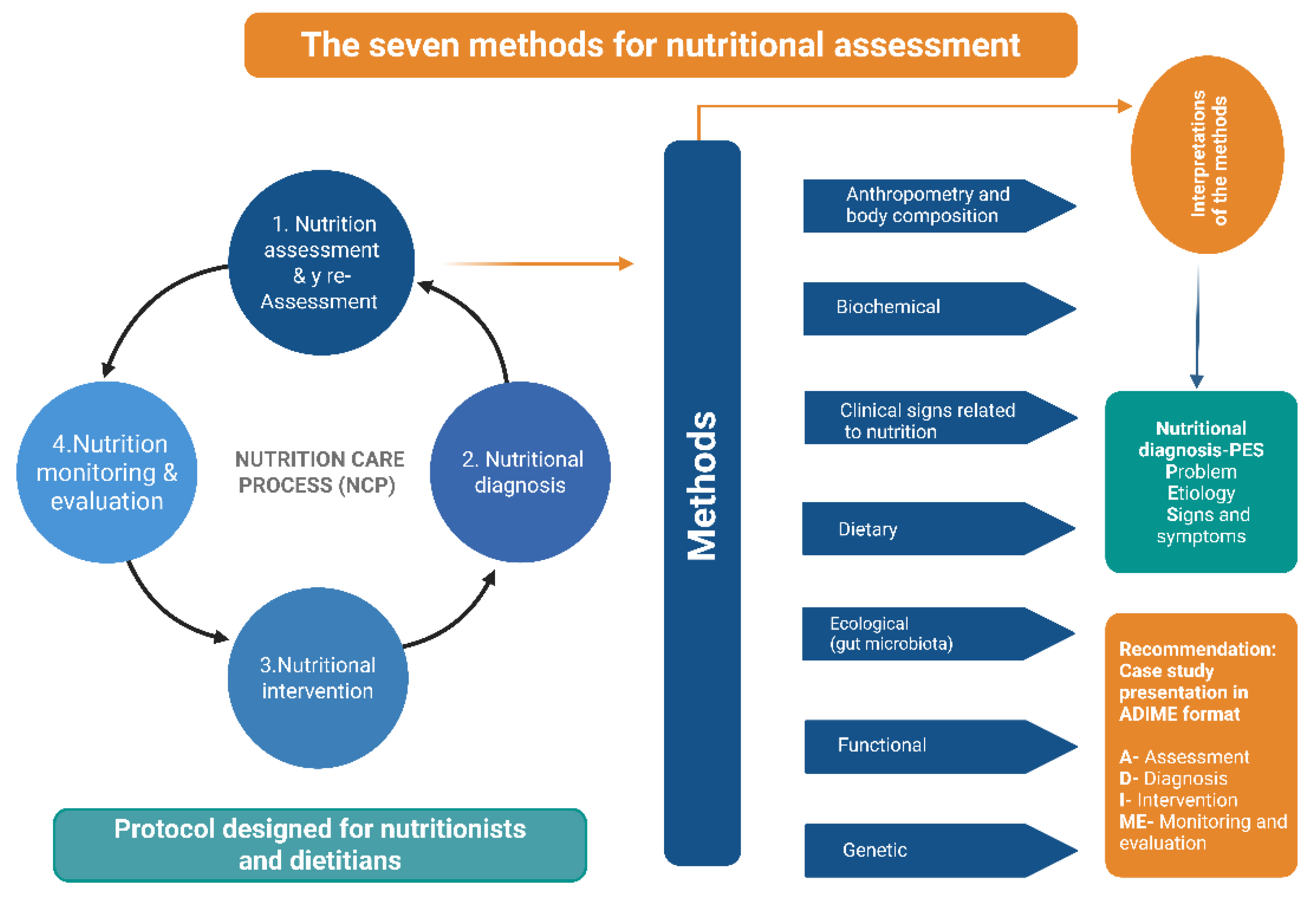
The Seven Methods for the Evaluation of Nutritional Status—ABCDEFG: Narrative Review

 ,
,  ,
,  ,
,  ,
,  , , ,
, , ,  and
and 
Featured Application
Abstract
1. Introduction
2. Materials and Methods
3. Results
3.1. Anthropometry and Body Composition
3.1.1. Anthropometry and Kinanthropometry
3.1.2. Body Composition
- Five-Component Fractionation Model
- Segmental Muscular and Adipose Distribution
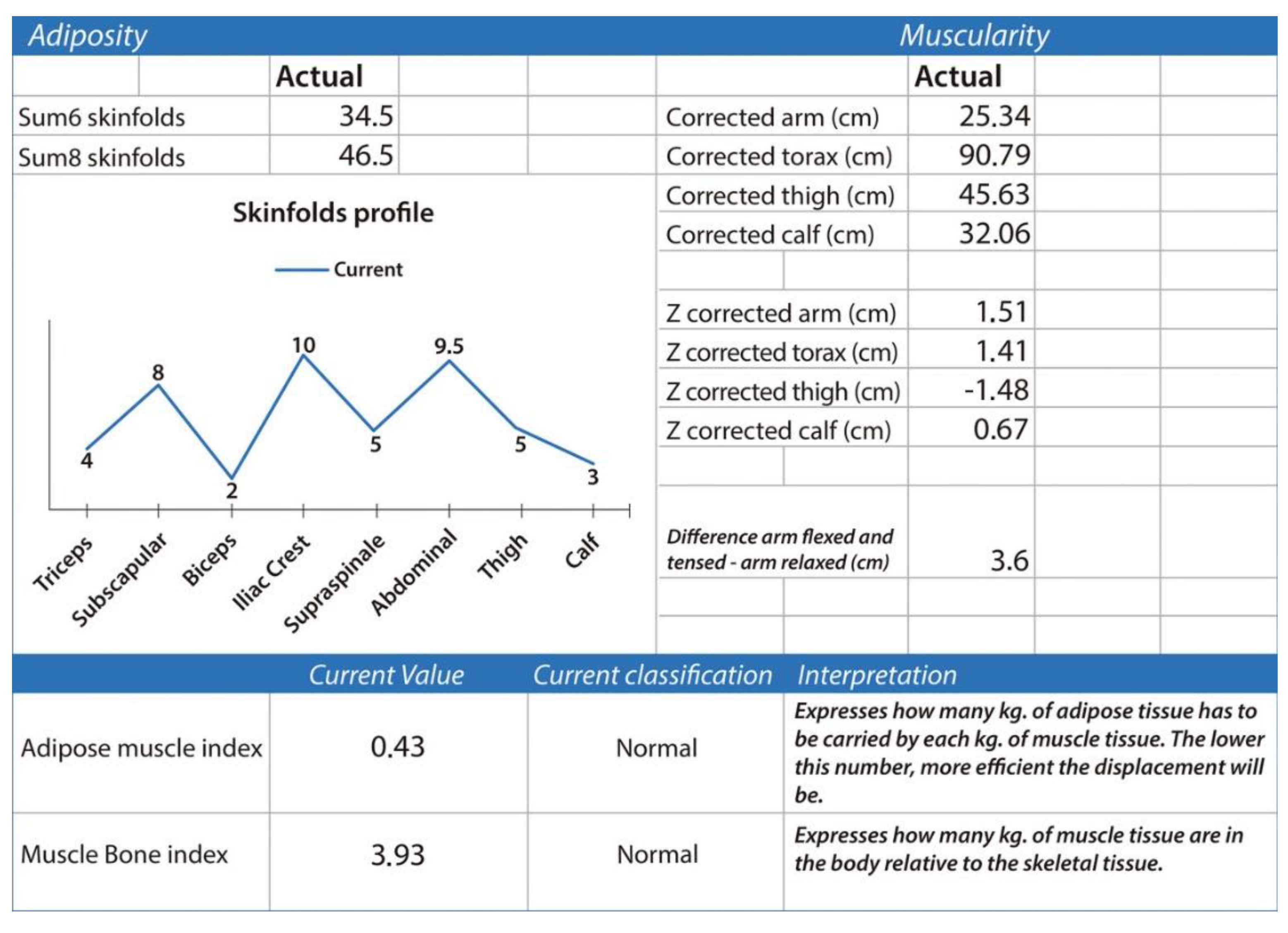
- Adiposity and Muscularity Indices
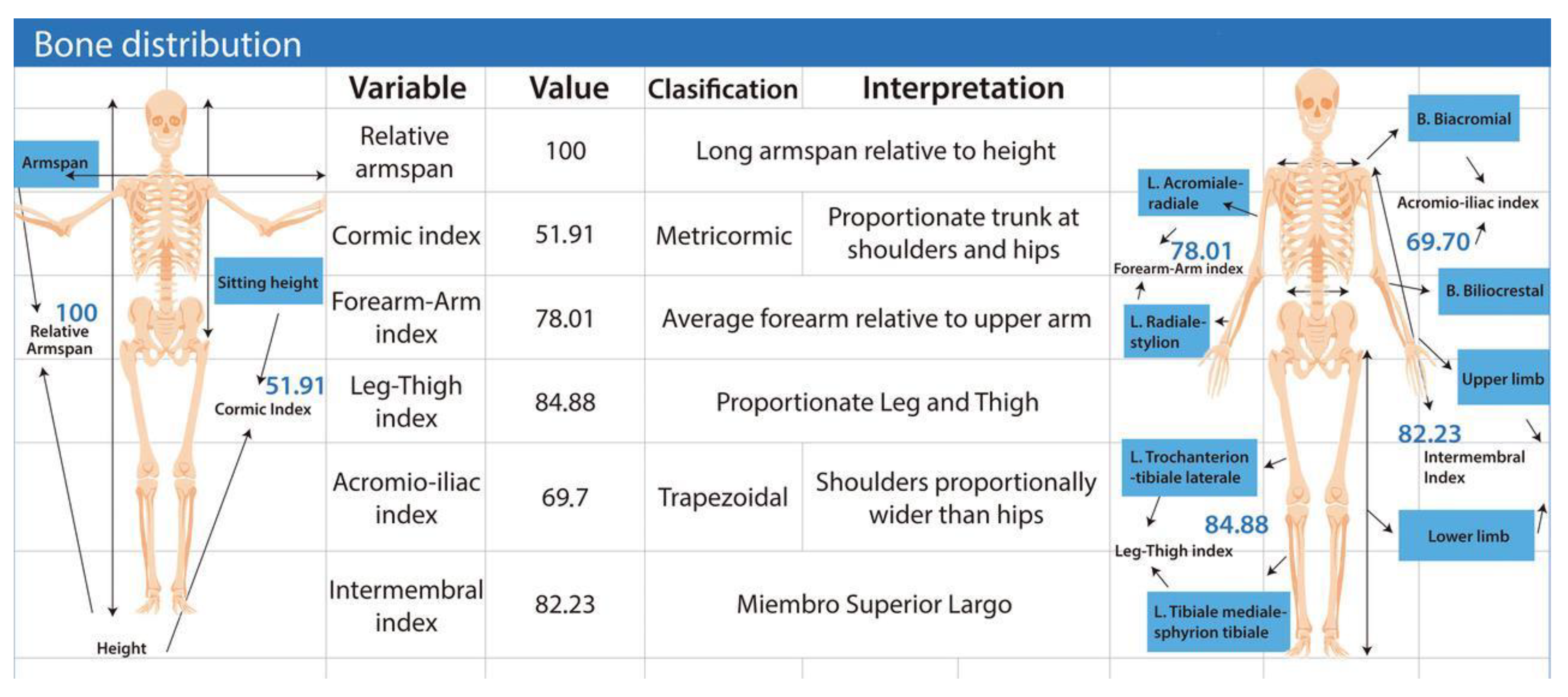
3.1.3. Skeletal Proportions and Bone Distribution
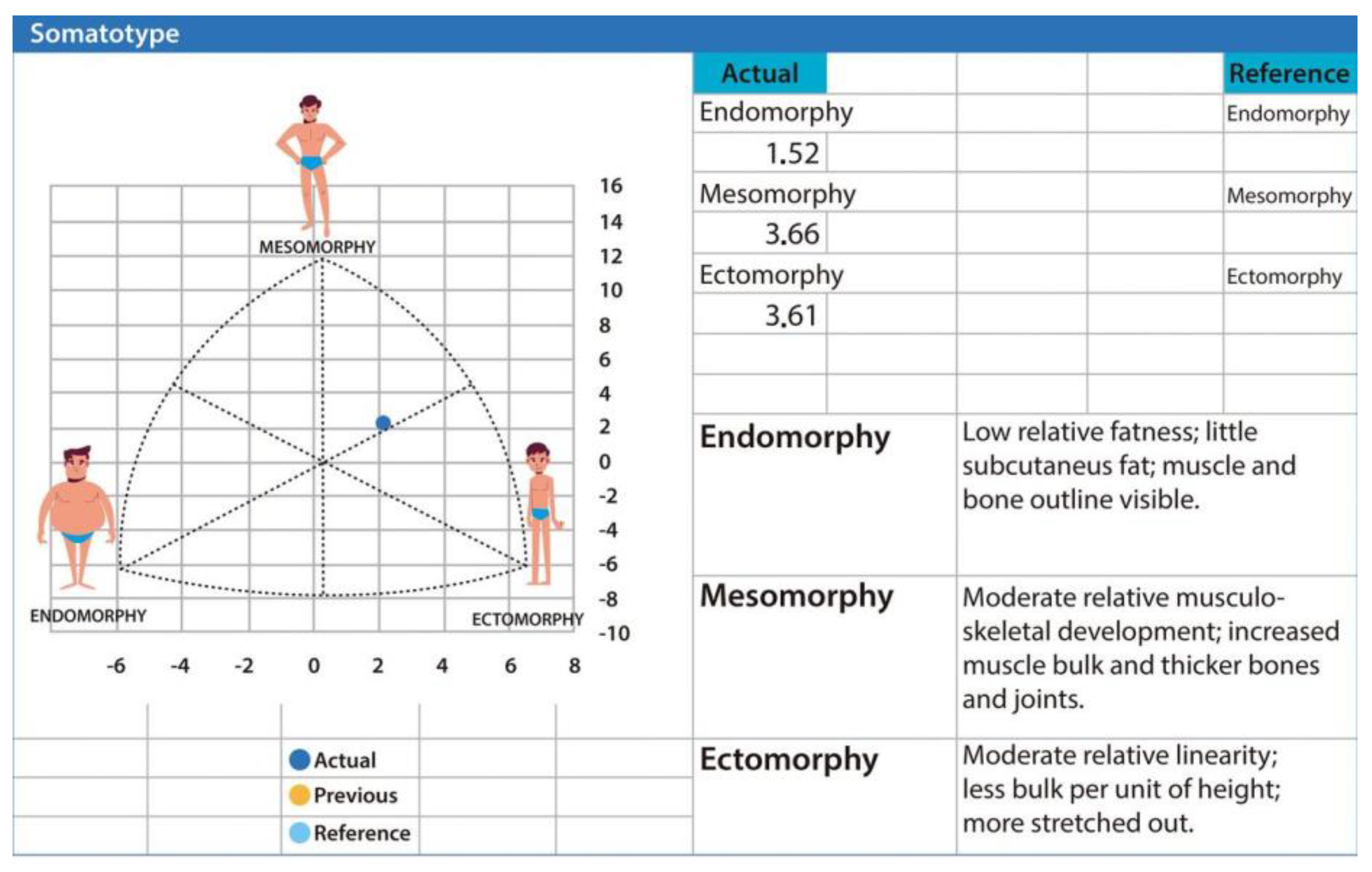
3.1.4. Somatotype Analysis
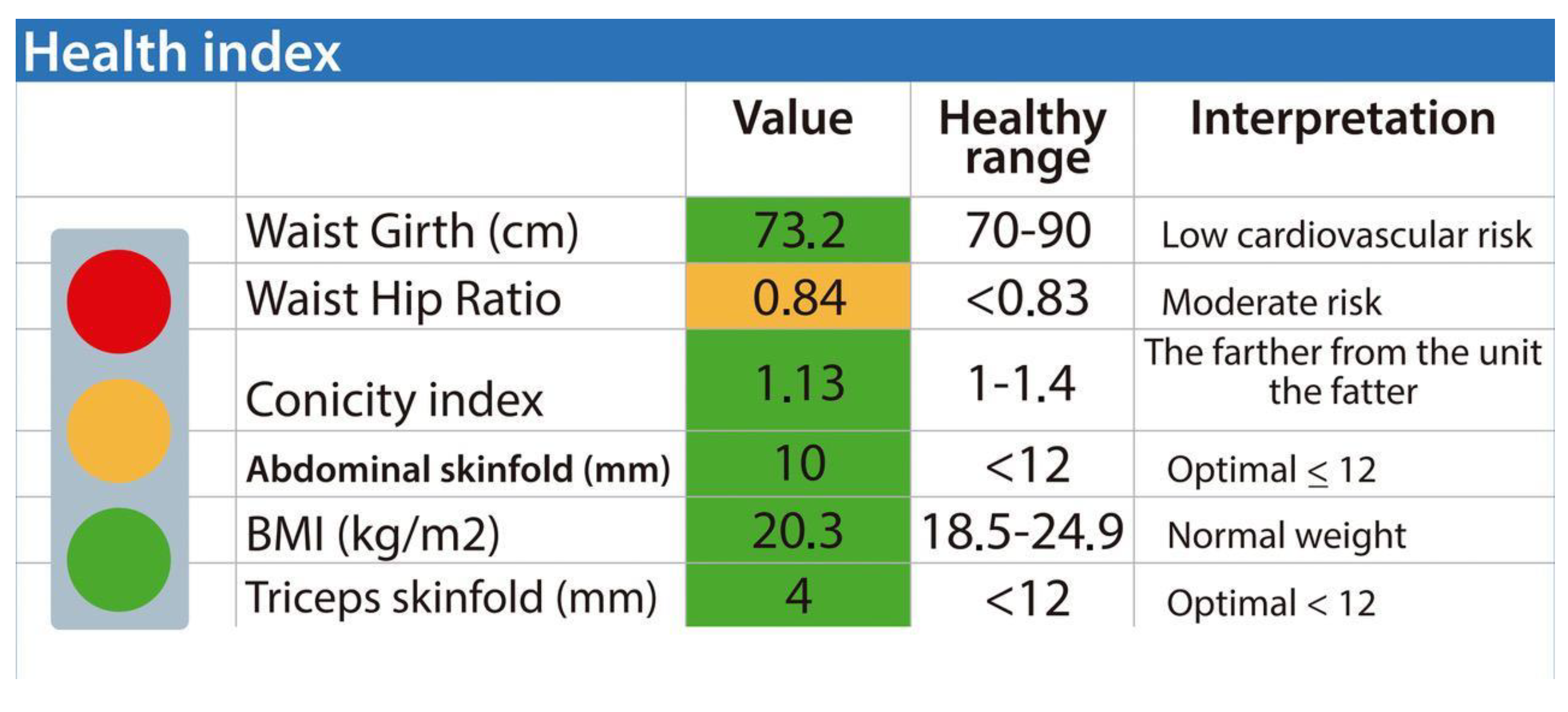
3.1.5. Health-Related Anthropometric Indices
3.2. Technologies for Body Composition Assessment
3.2.1. Bioelectrical Impedance Analysis (BIA)
3.2.2. Muscle Ultrasound (MU)
3.3. Nutritional Biochemistry
3.4. Clinical Signs Related to Nutrition
3.4.1. Clinical Signs Associated with Nutritional Deficiencies
3.4.2. Interpretation of Clinical Signs
3.5. Dietary Assessment
3.5.1. Methods for Assessing Dietary Intake
3.5.2. Nutrient–Drug Interactions
3.6. Ecological Assessment: Microbiome and Gut Microbiota
3.6.1. Tools for Screening the State of Gut Microbiota
3.6.2. Physiological Axes and Systemic Implications of the Gut Microbiota
3.7. Functional Assessment
3.7.1. Techniques to Measure Muscle Strength and Function
- Muscle Strength
- Muscle Function
3.7.2. Physical Performance
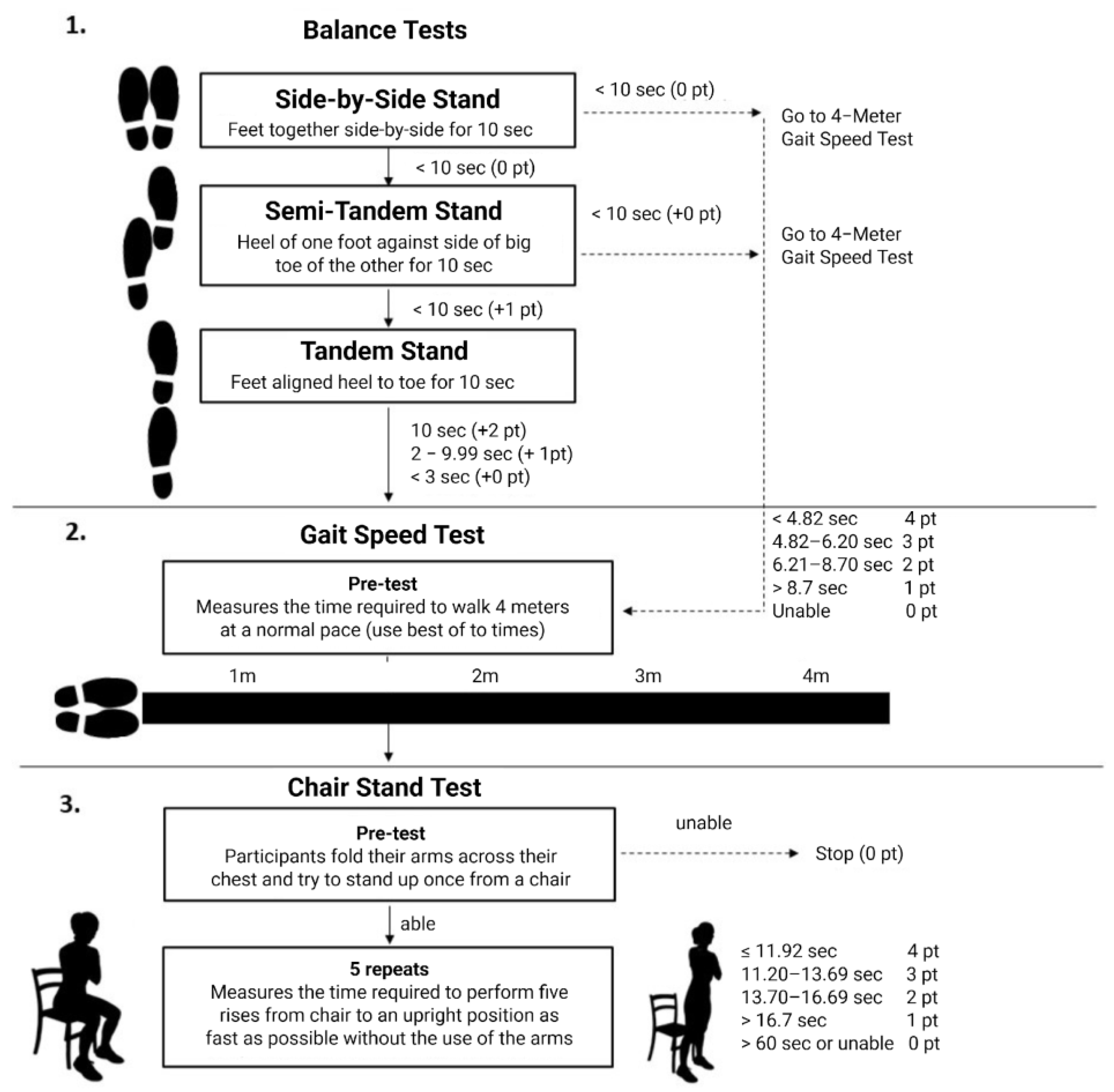
- Short Physical Performance Battery
3.7.3. Timed up and Go Test
3.8. Genetics
- Genetic Tests and Their Influence on Nutritional Status
4. Discussion
5. Limitations
6. Conclusions
Supplementary Materials
Author Contributions
Funding
Data Availability Statement
Acknowledgments
Conflicts of Interest
Abbreviations
| R24hrs | 24-hour recall |
| ABCD | Anthropometry, Biochemical, Clinical, Dietary approaches |
| ABCDEFG | Anthropometry, Biochemical, Clinical, Dietary, Ecological–microbiota, Functional and Genomic–nutrigenomic approaches. |
| ADIME | Assessment, Diagnosis, Intervention, Monitoring and Evaluation |
| BIA | Bioelectrical impedance analysis |
| BMI | Body Mass Index |
| CANS Score | Clinical Assessment of Nutritional Status Score |
| CRP | C-Reactive Protein |
| DC | Consumption diaries |
| DYS/FQM | Dysbiosis Frequently Asked Questions Management semi-structured questionnaire |
| FC | Frequency of consumption |
| GV | Gait velocity |
| HGS | Handgrip strength |
| ISAK | International Society for the Advancement of Kinanthropometry |
| MU | Muscle ultrasound |
| NCP | Nutrition Care Process |
| NDIs | Nutrient–Drug Interactions |
| PES | Problem, Etiology, Signs and symptoms |
| SPPB | The Short Physical Performance Battery |
References
- Carbajal, Á.; Sierra, J.L.; López-Lora, L.; Ruperto, M. Nutrition Care Process: Elements for its implementation and use by Nutrition and Dietetics Professionals. Rev. Esp. Nutr. Hum. Diet. 2020, 24, 172–186. [Google Scholar] [CrossRef]
- Pérez, A.; Díaz-Muñoz, G.; Maza Moscoso, C.P.; Castro Muñoz, M.G.; Canicoba, M.; González, M.C.; Barbosa Barbosa, J.; Calvo Higuera, I.G.; Baptista, G.; Ferraresi, E.M.; et al. Nutritional care process model: Consensus for Latin America. Rev. Nutr. Clin. Metab. 2022, 5, 38–50. [Google Scholar] [CrossRef]
- Ferrand, S.; Onfray, M.P.; Medina, M.G.; Ferrand, S.; Onfray, M.P.; Medina, M.G. Update of the Clinical Nutritionist Role: Standards of Practice. Rev. Chil. Nutr. 2021, 48, 437–446. [Google Scholar] [CrossRef]
- Kiosia, A.; Dagbasi, A.; Berkley, J.; Wilding, J.; Prendergast, A.; Li, J.; Swann, J.; Mathers, J.; Kerac, M.; Morrison, D.; et al. The Double Burden of Malnutrition in Individuals: Identifying Key Challenges and Re-Thinking Research Focus. Nutr. Bull. 2024, 49, 132–145. [Google Scholar] [CrossRef]
- Phillips, M.E.; Robertson, M.D.; Bennett-Eastley, K.; Rowe, L.; Frampton, A.E.; Hart, K.H. Standard Nutritional Assessment Tools Are Unable to Predict Loss of Muscle Mass in Patients Due to Undergo Pancreatico-Duodenectomy: Highlighting the Need for Detailed Nutritional Assessment. Nutrients 2024, 16, 1269. [Google Scholar] [CrossRef]
- Almeida, J.M.G.; García, C.G.; Aguilar, I.M.V.; Castañeda, V.B.; Guerrero, D.B. Morphofunctional Assessment of Patient’s Nutritional Status: A Global Approach. Nutr. Hosp. 2021, 38, 592–600. [Google Scholar] [CrossRef]
- Hoover-Fong, J.; Semler, O.; Barron, B.; Collett-Solberg, P.F.; Fung, E.; Irving, M.; Kitaoka, T.; Koerner, C.; Okada, K.; Palm, K.; et al. Considerations for Anthropometry Specific to People with Disproportionate Short Stature. Adv. Ther. 2025, 42, 1291–1311. [Google Scholar] [CrossRef]
- Stewart, A.D. Kinanthropometry and Body Composition: A Natural Home for Three-Dimensional Photonic Scanning. J. Sports Sci. 2010, 28, 455–457. [Google Scholar] [CrossRef] [PubMed]
- Ros, F.E.; Vaquero-Cristóbal, R.; Marfell-Jones, M. Protocolo Internacional Para la Valoración Antropométrica, 2019; Sociedad Internacional para el Avance de la Cineantropometría; ISAK: Murcia, Spain, 2019; ISBN 978-84-92986-17-0. [Google Scholar]
- Marfell-Jones, M.; Vaquero-Cristóbal, R.; Ros, F.E. ISAK Accreditation Handbook (2024); International Society for the Advancement of Kinanthropometry (ISAK): Murcia, Spain, 2024; ISBN 978-84-16045-25-9. [Google Scholar]
- Zambrano-Villacres, R.; Frias-Toral, E.; Maldonado-Ponce, E.; Poveda-Loor, C.; Leal, P.; Velarde-Sotres, A.; Leonardi, A.; Trovato, B.; Roggio, F.; Castorina, A.; et al. Exploring Body Composition and Somatotype Profiles among Youth Professional Soccer Players. Mediterr. J. Nutr. Metab. 2024, 17, 241–254. [Google Scholar] [CrossRef]
- Esparza, M.; Vaquero, R.; Castillo, A.; Ponce, F.; Mecherques, M.; Baglietto, N. ISAK Metry 2025. Available online: https://isakmetry.com/ (accessed on 8 June 2025).
- Martínez-Mireles, X.; Nava-González, E.J.; López-Cabanillas Lomelí, M.; Puente-Hernández, D.S.; Gutiérrez-López, M.; Lagunes-Carrasco, J.O.; López-García, R.; Ramírez, E. The Shape of Success: A Scoping Review of Somatotype in Modern Elite Athletes Across Various Sports. Sports 2025, 13, 38. [Google Scholar] [CrossRef]
- Cintoni, M.; Rinninella, E.; Ainora, M.E.; Raoul, P.C.; Strippoli, A.; Pozzo, C.; Trovato, G.; Graziano, R.; Palombaro, M.; Pulcini, G.; et al. Concordance between Muscle Ultrasound and Bioelectrical Impedance Analysis for Muscle Assessment in Gastric Cancer Patients: A Prospective Study. Clin. Nutr. ESPEN 2025, 69, 1022. [Google Scholar] [CrossRef]
- Ozturk, Y.; Koca, M.; Burkuk, S.; Unsal, P.; Dikmeer, A.; Oytun, M.; Bas, A.O.; Kahyaoglu, Z.; Deniz, O.; Coteli, S.; et al. The Role of Muscle Ultrasound to Predict Sarcopenia. Nutrition 2022, 101, 111692. [Google Scholar] [CrossRef]
- Ogawa, M.; Matsumoto, T.; Harada, R.; Yoshikawa, R.; Ueda, Y.; Takamiya, D.; Sakai, Y. Reliability and Validity of Quadriceps Muscle Thickness Measurements in Ultrasonography: A Comparison with Muscle Mass and Strength. Prog. Rehabil. Med. 2023, 8, 20230008. [Google Scholar] [CrossRef]
- Zanotelli, A.; Rossi, A.P.; Del Monte, L.; Vantini, G.; Stabile, G.; Urbani, S.; Giani, A.; Zoico, E.; Babbanini, A.; Fantin, F.; et al. The Role of Combined Muscle Ultrasound and Bioimpedentiometry Parameters for Sarcopenia Diagnosis in a Population of Hospitalized Older Adults. Nutrients 2024, 16, 2429. [Google Scholar] [CrossRef]
- Costa Goes, A.; Santos, M.A.; Oliveira, R.S.; Oliveira, J.S.; Carneiro Roriz, A.; De Oliveira, C. The Use of Bioelectrical Impedance Vector Analysis for a Nutritional Evaluation of Older Adults in the Community. Exp. Gerontol. 2021, 147, 111276. [Google Scholar] [CrossRef] [PubMed]
- Brunani, A.; Perna, S.; Soranna, D.; Rondanelli, M.; Zambon, A.; Bertoli, S.; Vinci, C.; Capodaglio, P.; Lukaski, H.; Cancello, R. Body Composition Assessment Using Bioelectrical Impedance Analysis (BIA) in a Wide Cohort of Patients Affected with Mild to Severe Obesity. Clin. Nutr. 2021, 40, 3973–3981. [Google Scholar] [CrossRef] [PubMed]
- Keller, U. Nutritional Laboratory Markers in Malnutrition. J. Clin. Med. 2019, 8, 775. [Google Scholar] [CrossRef]
- Wunderle, C.; Stumpf, F.; Schuetz, P. Inflammation and Response to Nutrition Interventions. JPEN J. Parenter. Enteral Nutr. 2024, 48, 27–36. [Google Scholar] [CrossRef]
- Jarvis, P.R.E.; Cardin, J.L.; Nisevich-Bede, P.M.; McCarter, J.P. Continuous Glucose Monitoring in a Healthy Population: Understanding the Post-Prandial Glycemic Response in Individuals without Diabetes Mellitus. Metabolism 2023, 146, 155640. [Google Scholar] [CrossRef] [PubMed]
- Picó, C.; Serra, F.; Rodríguez, A.M.; Keijer, J.; Palou, A. Biomarkers of Nutrition and Health: New Tools for New Approaches. Nutrients 2019, 11, 1092. [Google Scholar] [CrossRef]
- Kamel, K.S.; Halperin, M.L. Use of Urine Electrolytes and Urine Osmolality in the Clinical Diagnosis of Fluid, Electrolytes, and Acid-Base Disorders. Kidney Int. Rep. 2021, 6, 1211–1224. [Google Scholar] [CrossRef]
- Powers, H. Approaches to Setting Dietary Reference Values for Micronutrients, and Translation into Recommendations. Proc. Nutr. Soc. 2021, 80, 365–372. [Google Scholar] [CrossRef] [PubMed]
- Jenab, M.; Slimani, N.; Bictash, M.; Ferrari, P.; Bingham, S. Biomarkers in Nutritional Epidemiology: Applications, Needs and New Horizons. Hum. Genet. 2009, 125, 507–525. [Google Scholar] [CrossRef]
- Urdampilleta, A.; López-Grueso, R.; Martínez-Sanz, J.M.; Mielgo-Ayuso, J. Parámetros bioquímicos básicos, hematológicos y hormonales para el control de la salud y el estado nutricional en los deportistas. Rev. Esp. Nutr. Hum. Diet. 2014, 18, 155–171. [Google Scholar] [CrossRef]
- Hummell, A.C.; Cummings, M. Role of the Nutrition-focused Physical Examination in Identifying Malnutrition and Its Effectiveness. Nutr. Clin. Pract. 2022, 37, 41–49. [Google Scholar] [CrossRef]
- Cáceres-Vinueza, S.; Frias-Toral, E.; Suárez, R.; Daher-Nader, J.; Flor-Muñoz, E.; Márquez-Vinueza, M.; Guevara-Flores, L.V.; Duarte-Vera, Y. Anthropometric indexes and cardiovascular risk in Ecuadorian university students: A comparison with international references. Revis Bionatura 2023, 8, 89. [Google Scholar]
- Reber, E.; Gomes, F.; Vasiloglou, M.F.; Schuetz, P.; Stanga, Z. Nutritional Risk Screening and Assessment. J. Clin. Med. 2019, 8, 1065. [Google Scholar] [CrossRef]
- Park, S.E.; Williams, M.; Crew, A.B.; Hsiao, J.L. Cutaneous Signs of Nutritional Deficiencies. Curr. Geriatr. Rep. 2024, 13, 189–199. [Google Scholar] [CrossRef]
- Singh, P.; Seth, A. From Kwashiorkor to Edematous Malnutrition. Indian Pediatr. 2018, 54, 763–764. [Google Scholar] [CrossRef] [PubMed]
- Kolarš, B.; Mijatović Jovin, V.; Živanović, N.; Minaković, I.; Gvozdenović, N.; Dickov Kokeza, I.; Lesjak, M. Iron Deficiency and Iron Deficiency Anemia: A Comprehensive Overview of Established and Emerging Concepts. Pharmaceuticals 2025, 18, 1104. [Google Scholar] [CrossRef]
- East, P.; Doom, J.R.; Blanco, E.; Burrows, R.; Lozoff, B.; Gahagan, S. Iron Deficiency in Infancy and Neurocognitive and Educational Outcomes in Young Adulthood. Dev. Psychol. 2021, 57, 962–975. [Google Scholar] [CrossRef]
- West, K. Vitamin A Deficiency Disorders in Children and Women. Food Nutr. Bull. 2003, 24, S78–S90. [Google Scholar] [CrossRef]
- Imdad, A.; Mayo-Wilson, E.; Herzer, K.; Bhutta, Z. Vitamin A Supplementation for Preventing Morbidity and Mortality in Children from Six Months to Five Years of Age. Cochrane Database Syst. Rev. 2017, 3, CD008524. [Google Scholar] [CrossRef]
- Alberts, A.; Moldoveanu, E.-T.; Niculescu, A.-G.; Grumezescu, A.M. Vitamin C: A Comprehensive Review of Its Role in Health, Disease Prevention, and Therapeutic Potential. Molecules 2025, 30, 748. [Google Scholar] [CrossRef]
- Granger, M.; Eck, P. Dietary Vitamin C in Human Health. Adv. Food Nutr. Res. 2018, 83, 281–310. [Google Scholar] [CrossRef] [PubMed]
- Li, K.; Wang, X.-F.; Li, D.-Y.; Chen, Y.-C.; Zhao, L.-J.; Liu, X.-G.; Guo, Y.-F.; Shen, J.; Lin, X.; Deng, J.; et al. The Good, the Bad, and the Ugly of Calcium Supplementation: A Review of Calcium Intake on Human Health. Clin. Interv. Aging 2018, 13, 2443–2452. [Google Scholar] [CrossRef] [PubMed]
- Shertukde, S.; Cahoon, D.; Prado, B.; Cara, K.; Chung, M. Calcium Intake and Metabolism in Infants and Young Children: A Systematic Review of Balance Studies for Supporting the Development of Calcium Requirements. Adv. Nutr. 2022, 13, 1529–1553. [Google Scholar] [CrossRef] [PubMed]
- Fleet, J. Vitamin D-Mediated Regulation of Intestinal Calcium Absorption. Nutrients 2022, 14, 3351. [Google Scholar] [CrossRef]
- Eidelberg, A.; Newberry, C. Dietary Composition and Nutritional Deficiencies. In Nutrition, Weight, and Digestive Health, The Clinician’s Desk Reference; Springer: Cham, Switzerland, 2022; pp. 29–41. ISBN 978-3-030-94953-2. [Google Scholar]
- Esper, D. Utilization of Nutrition-Focused Physical Assessment in Identifying Micronutrient Deficiencies. Nutr. Clin. Pract. 2015, 30, 194–202. [Google Scholar] [CrossRef]
- Hamilton, C.; Jevenn, A.; Hipskind, P.; Galand, M.; Pogatschnik, C. Nutrition-Focused Physical Exam for Adults: An Illustrated Handbook, 2nd ed.; American Society for Parenteral and Enteral Nutrition (ASPEN): Silver Spring, MD, USA, 2022; ISBN 978-1-889622-50-7. [Google Scholar]
- Armaza Cespedes, A.; Medina, B.M.; Gareca, E.; Dorado R, C.; Mamani Ortiz, Y.; Romero Marca, D.J. Utilidad del CANs SCORE para valoración clínica del estado nutricional del recién nacido. Gac. Médica Boliv. 2021, 44, 6–13. [Google Scholar] [CrossRef]
- Bates, C.; Bogin, B.; Holmes, B. Nutritional Assessment Methods. In Human Nutrition; Oxford University Press: Oxford, UK, 2017; pp. 613–646. ISBN 978-0-19-876802-9. [Google Scholar]
- Dao, M.; Subar, A.; Warthon-Medina, M.; Cade, J.; Burrows, T.; Golley, R.; Forouhi, N.; Pearce, M.; Holmes, B. Dietary Assessment Toolkits: An Overview. Public Health Nutr. 2018, 22, 404–418. [Google Scholar] [CrossRef] [PubMed]
- Ortega, R.M.; Pérez-Rodrigo, C.; López-Sobaler, A.M. Métodos de evaluación de la ingesta actual: Registro o diario diétetico. Rev. Esp. Nutr. Comunitaria 2015, 21, 34–41. [Google Scholar] [CrossRef]
- FAO. Dietary Assessment: A Resource Guide to Method Selection and Application in Low Resource Settings; Food and Agriculture Organization of the United Nations: Rome, Italy, 2018; Available online: https://www.fao.org/4/i0351e/i0351e12.pdf (accessed on 3 June 2025).
- Pérez Rodrigo, C.; Aranceta, J.; Salvador, G.; Varela-Moreiras, G. Food Frequency Questionnaires. Nutr. Hosp. 2015, 31, 49–56. [Google Scholar] [CrossRef]
- Burke, B.S. The Dietary History as a Tool in Research. J. Am. Diet. Assoc. 1947, 23, 1041–1046. [Google Scholar] [CrossRef]
- Salvador Castell, G.; Serra-Majem, L.; Ribas-Barba, L. What and How Much Do We Eat? 24-Hour Dietary Recall Method. Nutr. Hosp. 2015, 31, 46–48. [Google Scholar] [CrossRef]
- Ovaskainen, M.; Paturi, M.; Reinivuo, H.; Hannila, M.; Sinkko, H.; Lehtisalo, J.; Pynnönen-Polari, O.; Männistö, S. Accuracy in the Estimation of Food Servings against the Portions in Food Photographs. Eur. J. Clin. Nutr. 2008, 62, 674–681. [Google Scholar] [CrossRef]
- Amoutzopoulos, B.; Page, P.; Roberts, C.; Roe, M.; Cade, J.; Steer, T.; Baker, R.; Hawes, T.; Galloway, C.; Yu, D.; et al. Portion Size Estimation in Dietary Assessment: A Systematic Review of Existing Tools, Their Strengths and Limitations. Nutr. Rev. 2020, 78, 885–900. [Google Scholar] [CrossRef] [PubMed]
- Herrera, M.; Chisaguano, M.; Vayas-Rodriguez, G.; Crsipim, S. Manual Fotografico de Porciones Para Cuantificacion Alimentaria—Ecuador; Primera, Ed.; USFQ-Press: Quito, Ecuador, 2019; ISBN 978-9978-68-142-8. [Google Scholar]
- Herrera, M.E.; Chisaguano, M.; Rodríguez, G.V.; Crispim, S.P. Manual Fotográfico de Porciones Para Cuantificación Alimentaria del Ecuador, 2nd ed.; USFQ Press: Quito, Ecuador, 2022; ISBN 978-9978-68-205-0. [Google Scholar]
- Ortiz, J.; Rubio, G.; Donoso, S.; Ochoa-Avilés, A. Tabla de Composición de Alimentos, Cuenca—Ecuador 2018; Universidad de Cuenca: Cuenca, Ecuador, 2018; ISBN 978-9978-14-383-4. [Google Scholar]
- Herrera-Fontana, M.; Chisaguano, A.; Jumbo, J.; Castro, N.; Anchundia, A. Tabla de Composición Química de los Alimentos: Basada en Nutrientes de Interés Para la Población Ecuatoriana; Primera, Ed.; USFQ Press: Quito, Ecuador, 2021. [Google Scholar]
- D’Alessandro, C.; Benedetti, A.; Di Paolo, A.; Giannese, D.; Cupisti, A. Interactions between Food and Drugs, and Nutritional Status in Renal Patients: A Narrative Review. Nutrients 2022, 14, 212. [Google Scholar] [CrossRef]
- Boullata, J.I.; Hudson, L.M. Drug–Nutrient Interactions: A Broad View with Implications for Practice. J. Acad. Nutr. Diet. 2012, 112, 506–517. [Google Scholar] [CrossRef] [PubMed]
- Sajedah Yassin Al-Shbeeb, A.A.A.; Fatimah Hussein Alhajji, A.S.M.A. Impact of Drug Nutrient Interaction on Chronic Disease: Roles of Pharmacy, Nursing, Nutrition|Migration Letters. Migr. Lett. 2022, 19, 319–324. [Google Scholar] [CrossRef]
- Dragan, S.; Man, D.; Kundnani, N.R. Nutrient-Drug Interactions and Cardiotoxicity in Oncologic Patients. In Cardiovascular Toxicity; Springer: Cham, Switzerland, 2025; pp. 361–383. ISBN 978-3-031-90598-8. [Google Scholar]
- Okunji, P.; Johnson, A. Food-Drug Interactions: Implications for Nursing Practice. Nurs. Healthc. Int. J. 2017, 1, 000102. [Google Scholar] [CrossRef]
- Matthewman, C.; Narin, A.; Huston, H.; Hopkins, C.E. Systems to Model the Personalized Aspects of Microbiome Health and Gut Dysbiosis. Mol. Asp. Med. 2023, 91, 101115. [Google Scholar] [CrossRef]
- Fox, J.D.; Sims, A.; Ross, M.; Bettag, J.; Wilder, A.; Natrop, D.; Borsotti, A.; Kolli, S.; Mehta, S.; Verma, H.; et al. Bioinformatic Methodologies in Assessing Gut Microbiota. Microbiol. Res. 2024, 15, 2554–2574. [Google Scholar] [CrossRef] [PubMed]
- Babraham Bioinformatics. FastQC. Available online: https://www.bioinformatics.babraham.ac.uk/projects/fastqc/ (accessed on 23 October 2025).
- Bolger, A.M.; Lohse, M.; Usadel, B. Trimmomatic: A Flexible Trimmer for Illumina Sequence Data. Bioinformatics 2014, 30, 2114–2120. [Google Scholar] [CrossRef]
- Quast, C.; Pruesse, E.; Yilmaz, P.; Gerken, J.; Schweer, T.; Yarza, P.; Peplies, J.; Glöckner, F.O. The SILVA Ribosomal RNA Gene Database Project: Improved Data Processing and Web-Based Tools. Nucleic Acids Res. 2013, 41, D590–D596. [Google Scholar] [CrossRef]
- McDonald, D.; Price, M.; Goodrich, J.; Nawrocki, E.; DeSantis, T.; Probst, A.; Andersen, G.; Knight, R.; Hugenholtz, P. An Improved Greengenes Taxonomy with Explicit Ranks for Ecological and Evolutionary Analyses of Bacteria and Archaea. ISME J. 2012, 6, 610–618. [Google Scholar] [CrossRef] [PubMed]
- Parks, D.H.; Chuvochina, M.; Rinke, C.; Mussig, A.J.; Chaumeil, P.-A.; Hugenholtz, P. GTDB: An Ongoing Census of Bacterial and Archaeal Diversity through a Phylogenetically Consistent, Rank Normalized and Complete Genome-Based Taxonomy. Nucleic Acids Res. 2022, 50, D785–D794. [Google Scholar] [CrossRef] [PubMed]
- Prodan, A.; Tremaroli, V.; Brolin, H.; Zwinderman, A.H.; Nieuwdorp, M.; Levin, E. Comparing Bioinformatic Pipelines for Microbial 16S rRNA Amplicon Sequencing. PLoS ONE 2020, 15, e0227434. [Google Scholar] [CrossRef]
- Milani, C.; Lugli, G.A.; Fontana, F.; Mancabelli, L.; Alessandri, G.; Longhi, G.; Anzalone, R.; Viappiani, A.; Turroni, F.; van Sinderen, D.; et al. METAnnotatorX2: A Comprehensive Tool for Deep and Shallow Metagenomic Data Set Analyses. mSystems 2021, 6, 10–1128. [Google Scholar] [CrossRef]
- Galloway-Peña, J.; Hanson, B. Tools for Analysis of the Microbiome. Dig. Dis. Sci. 2020, 65, 674–685. [Google Scholar] [CrossRef]
- Beghini, F.; McIver, L.J.; Blanco-Míguez, A.; Dubois, L.; Asnicar, F.; Maharjan, S.; Mailyan, A.; Manghi, P.; Scholz, M.; Thomas, A.M.; et al. Integrating Taxonomic, Functional, and Strain-Level Profiling of Diverse Microbial Communities with bioBakery 3. eLife 2021, 10, e65088. [Google Scholar] [CrossRef]
- Langille, M.G.I.; Zaneveld, J.; Caporaso, J.G.; McDonald, D.; Knights, D.; Reyes, J.A.; Clemente, J.C.; Burkepile, D.E.; Vega Thurber, R.L.; Knight, R.; et al. Predictive Functional Profiling of Microbial Communities Using 16S rRNA Marker Gene Sequences. Nat. Biotechnol. 2013, 31, 814–821. [Google Scholar] [CrossRef]
- Kers, J.G.; Saccenti, E. The Power of Microbiome Studies: Some Considerations on Which Alpha and Beta Metrics to Use and How to Report Results. Front. Microbiol. 2022, 12, 796025. [Google Scholar] [CrossRef] [PubMed]
- Mensah, G.; Maseng, M.; Allard, S.; Gilbert, J. The Microbiome, Metabolism, and Networks in Precision Nutrition. In Precision Nutrition; Academic Press: Cambridge, MA, USA, 2024; pp. 91–142. ISBN 978-0-443-15315-0. [Google Scholar]
- Nayman, E.; Schwartz, B.; Polanco, F.; Firek, A.; Gumabong, A.; Hofstee, N.; Narasimhan, G.; Cickovski, T.; Mathee, K. Microbiome Depiction through User-Adapted Bioinformatic Pipelines and Parameters. J. Med. Microbiol. 2023, 72. [Google Scholar] [CrossRef] [PubMed]
- Balmant, B.D.; Fonseca, D.C.; Rocha, I.M.; Callado, L.; Torrinhas, R.S.M.d.M.; Waitzberg, D.L. Dys-R Questionnaire: A Novel Screening Tool for Dysbiosis Linked to Impaired Gut Microbiota Richness. Nutrients 2023, 15, 4261. [Google Scholar] [CrossRef]
- Lloyd-Price, J.; Abu-Ali, G.; Huttenhower, C. The Healthy Human Microbiome. Genome Med. 2016, 8, 51. [Google Scholar] [CrossRef] [PubMed]
- Willing, B.; Russell, S.; Finlay, B. Shifting the Balance: Antibiotic Effects on Host-Microbiota Mutualism. Nat. Rev. Microbiol. 2011, 9, 233–243. [Google Scholar] [CrossRef]
- Kase, B.E.; Liese, A.D.; Zhang, J.; Murphy, E.A.; Zhao, L.; Steck, S.E. The Development and Evaluation of a Literature-Based Dietary Index for Gut Microbiota. Nutrients 2024, 16, 1045. [Google Scholar] [CrossRef]
- Cháidez, Y.L.B.; Guadarrama, R.G.; Hernández, G.A.; Merino, M.V.F.; Alpizar, E.J.; Barretero, D.Y.R.; García, M.V.D. Construcción y validación de un cuestionario para medir función gastrointestinal en adultos. Nutr. Clin. Diet. Hosp. 2020, 40, 26–35. [Google Scholar] [CrossRef]
- Mariños Cotrina, B.W. Prevalencia del riesgo de desnutrición y situación de la terapia nutricional en pacientes adultos hospitalizados en Perú. Rev. Nutr. Clin. Metab. 2020, 3, 13–19. [Google Scholar] [CrossRef]
- Wang, L.; Wang, X.; Zhang, G.; Ma, Y.; Zhang, Q.; Li, Z.; Ran, J.; Hou, X.; Geng, Y.; Yang, Z.; et al. The Impact of Pelvic Radiotherapy on the Gut Microbiome and Its Role in Radiation-Induced Diarrhoea: A Systematic Review. Radiat. Oncol. 2021, 16, 187. [Google Scholar] [CrossRef]
- National Cancer Institute. National Cancer Institute’s Common Terminology Criteria for Adverse Events: Diarrheaa. Available online: https://www.ncbi.nlm.nih.gov/books/NBK65768.4/table/CDR0000062736__287/?report=objectonly (accessed on 23 October 2025).
- Barry, D.J.; Wu, S.S.X.; Cooke, M.B. The Relationship Between Gut Microbiota, Muscle Mass and Physical Function in Older Individuals: A Systematic Review. Nutrients 2024, 17, 81. [Google Scholar] [CrossRef]
- Liu, C.; Cheung, W.; Li, J.; Chow, S.; Yu, J.; Wong, S.; Ip, M.; Sung, J.; Wong, R. Understanding the Gut Microbiota and Sarcopenia: A Systematic Review. J. Cachexia Sarcopenia Muscle 2021, 12, 1393–1407. [Google Scholar] [CrossRef] [PubMed]
- Terry, S.; Barnett, J.; Gibson, D. A Critical Analysis of Eating Disorders and the Gut Microbiome. J. Eat. Disord. 2022, 10, 154. [Google Scholar] [CrossRef]
- Agus, A.; Clément, K.; Sokol, H. Gut Microbiota-Derived Metabolites as Central Regulators in Metabolic Disorders. Gut 2021, 70, 1174–1182. [Google Scholar] [CrossRef]
- Chen, Y.; Xu, J.; Chen, Y. Regulation of Neurotransmitters by the Gut Microbiota and Effects on Cognition in Neurological Disorders. Nutrients 2021, 13, 2099. [Google Scholar] [CrossRef]
- Ruiz-Pozo, V.; Tamayo-Trujillo, R.; Cadena-Ullauri, S.; Frias-Toral, E.; Guevara-Ramírez, P.; Paz-Cruz, E.; Chapela, S.; Montalván, M.; Morales-López, T.; Simancas-Racines, D.; et al. The Molecular Mechanisms of the Relationship between Insulin Resistance and Parkinson’s Disease Pathogenesis. Nutrients 2023, 15, 3585. [Google Scholar] [CrossRef] [PubMed]
- Hsu, C.; Schnabl, B. The Gut-Liver Axis and Gut Microbiota in Health and Liver Disease. Nat. Rev. Microbiol. 2023, 21, 719–733. [Google Scholar] [CrossRef]
- Muscogiuri, G.; Barrea, L.; Caprio, M.; Ceriani, F.; Chavez, A.; El Ghoch, M.; Frias-Toral, E.; Mehta, R.; Mendez, V.; Paschou, S.; et al. Nutritional Guidelines for the Management of Insulin Resistance. Crit. Rev. Food Sci. Nutr. 2022, 62, 6947–6960. [Google Scholar] [CrossRef]
- Reytor-González, C.; Annunziata, G.; Campuzano-Donoso, M.; Morales-López, T.; Basantes-Tituaña, C.; Fascì-Spurio, F.; Verde, L.; Muscogiuri, G.; Barrea, L.; Frias-Toral, E.; et al. Endocrinologist’s Crucial Role in Metabolic Dysfunction-Associated Steatotic Liver Disease: A Comprehensive Review. Minerva Endocrinol. 2025, 50, 209–226. [Google Scholar] [CrossRef] [PubMed]
- Simancas-Racines, D.; Annunziata, G.; Verde, L.; Fascì-Spurio, F.; Reytor-González, C.; Muscogiuri, G.; Frias-Toral, E.; Barrea, L. Nutritional Strategies for Battling Obesity-Linked Liver Disease: The Role of Medical Nutritional Therapy in Metabolic Dysfunction-Associated Steatotic Liver Disease (MASLD) Management. Curr. Obes. Rep. 2025, 14, 7. [Google Scholar] [CrossRef]
- Buchynskyi, M.; Kamyshna, I.; Halabitska, I.; Petakh, P.; Kunduzova, O.; Oksenych, V.; Kamyshnyi, O. Unlocking the Gut-Liver Axis: Microbial Contributions to the Pathogenesis of Metabolic-Associated Fatty Liver Disease. Front. Microbiol. 2025, 16, 1577724. [Google Scholar] [CrossRef] [PubMed]
- Choi, H.; Rao, M.; Chang, E. Gut Microbiota as a Transducer of Dietary Cues to Regulate Host Circadian Rhythms and Metabolism. Nat. Rev. Gastroenterol. Hepatol. 2021, 18, 679–689. [Google Scholar] [CrossRef] [PubMed]
- Moreira Gobis, M.d.L.; Goulart de Souza-Silva, T.; de Almeida Paula, H.A. The Impact of a Western Diet on Gut Microbiota and Circadian Rhythm: A Comprehensive Systematic Review of in Vivo Preclinical Evidence. Life Sci. 2024, 349, 122741. [Google Scholar] [CrossRef]
- Reytor-González, C.; Simancas-Racines, D.; Román-Galeano, N.M.; Annunziata, G.; Galasso, M.; Zambrano-Villacres, R.; Verde, L.; Muscogiuri, G.; Frias-Toral, E.; Barrea, L. Chrononutrition and Energy Balance: How Meal Timing and Circadian Rhythms Shape Weight Regulation and Metabolic Health. Nutrients 2025, 17, 2135. [Google Scholar] [CrossRef]
- Fuad, S.A.; Ginting, R.P.; Lee, M.-W. Chrononutrition: Potential, Challenges, and Application in Managing Obesity. Int. J. Mol. Sci. 2025, 26, 5116. [Google Scholar] [CrossRef]
- Godos, J.; Currenti, W.; Ferri, R.; Lanza, G.; Caraci, F.; Frias-Toral, E.; Guglielmetti, M.; Ferraris, C.; Lipari, V.; Carvajal Altamiranda, S.; et al. Chronotype and Cancer: Emerging Relation Between Chrononutrition and Oncology from Human Studies. Nutrients 2025, 17, 529. [Google Scholar] [CrossRef]
- Godos, J.; Rosi, A.; Scazzina, F.; Touriz Bonifaz, M.; Giampieri, F.; Abdelkarim, O.; Ammar, A.; Aly, M.; Frias-Toral, E.; Pons, J.; et al. Diet, Eating Habits, and Lifestyle Factors Associated with Adequate Sleep Duration in Children and Adolescents Living in 5 Mediterranean Countries: The DELICIOUS Project. Nutrients 2025, 17, 1242. [Google Scholar] [CrossRef]
- Serón-Arbeloa, C.; Labarta-Monzón, L.; Puzo-Foncillas, J.; Mallor-Bonet, T.; Lafita-López, A.; Bueno-Vidales, N.; Montoro-Huguet, M. Malnutrition Screening and Assessment. Nutrients 2022, 14, 2392. [Google Scholar] [CrossRef] [PubMed]
- Vigneron, C.; Laousy, O.; Chassagnon, G.; Vakalopoulou, M.; Charpentier, J.; Alexandre, J.; Jamme, M.; Pène, F. Assessment of Functional and Nutritional Status and Skeletal Muscle Mass for the Prognosis of Critically Ill Solid Cancer Patients. Cancers 2022, 14, 5870. [Google Scholar] [CrossRef]
- Fuchs-Tarlovsky, V.; Castillo Pineda, J.; Rodríguez Veintimilla, D.; Calvo Higuera, I.; Grijalva Guerrero, P.; Gómez García, A.; Frias-Toral, E.; Santana Porbén, S. Cancer-Related Malnutrition: Epidemiological Results from the Latin American Study of Malnutrition in the Oncology Practice. Nutr. Cancer 2022, 74, 2479–2488. [Google Scholar] [CrossRef]
- Russell, M.K. Functional Assessment of Nutrition Status. Nutr. Clin. Pract. 2015, 30, 211–218. [Google Scholar] [CrossRef]
- Concha-Cisternas, Y.; Petermann-Rocha, F.; Castro-Piñero, J.; Parra, S.; Albala, C.; Wyngard, V.; Vásquez, J.; Cigarroa, I.; Celis-Morales, C. Handgrip Strength as a Predictor of Adverse Health Outcomes. Rev. Med. Chile 2022, 150, 1075–1086. [Google Scholar] [CrossRef]
- Arteaga-Pazmiño, C.; Guzmán-Gurrola, A.L.; Fonseca-Pérez, D.; Galvez-Celi, J.; Aycart, D.F.; Álvarez-Córdova, L.; Frias-Toral, E. Waist–Calf Circumference Ratio Is Associated with Body Composition, Physical Performance, and Muscle Strength in Older Women. Geriatrics 2025, 10, 103. [Google Scholar] [CrossRef]
- Soysal, P.; Hurst, C.; Demurtas, J.; Firth, J.; Howden, R.; Yang, L.; Tully, M.; Koyanagi, A.; Ilie, P.; López-Sánchez, G.; et al. Handgrip Strength and Health Outcomes: Umbrella Review of Systematic Reviews with Meta-Analyses of Observational Studies. J. Sport Health Sci. 2021, 10, 290–295. [Google Scholar] [CrossRef] [PubMed]
- Kaegi-Braun, N.; Tribolet, P.; Baumgartner, A.; Fehr, R.; Baechli, V.; Geiser, M.; Deiss, M.; Gomes, F.; Kutz, A.; Hoess, C.; et al. Value of Handgrip Strength to Predict Clinical Outcomes and Therapeutic Response in Malnourished Medical Inpatients: Secondary Analysis of a Randomized Controlled Trial. Am. J. Clin. Nutr. 2021, 114, 731–740. [Google Scholar] [CrossRef]
- White, J.; Guenter, P.; Jensen, G.; Malone, A.; Schofield, M. Consensus Statement: Academy of Nutrition and Dietetics and American Society for Parenteral and Enteral Nutrition: Characteristics Recommended for the Identification and Documentation of Adult Malnutrition (Undernutrition). JPEN J. Parenter. Enteral Nutr. 2012, 36, 275–283. [Google Scholar] [CrossRef]
- Cruz-Jentoft, A.J.; Bahat, G.; Bauer, J.; Boirie, Y.; Bruyère, O.; Cederholm, T.; Cooper, C.; Landi, F.; Rolland, Y.; Sayer, A.A.; et al. Sarcopenia: Revised European Consensus on Definition and Diagnosis. Age Ageing 2019, 48, 16–31. [Google Scholar] [CrossRef] [PubMed]
- Spruit, M.; Sillen, M.; Groenen, M.; Wouters, E.; Franssen, F. New Normative Values for Handgrip Strength: Results from the UK Biobank. J. Am. Med. Dir. Assoc. 2013, 14, 775.e5–775.e11. [Google Scholar] [CrossRef]
- Baldwin, C.; Paratz, J.; Bersten, A. Muscle Strength Assessment in Critically Ill Patients with Handheld Dynamometry: An Investigation of Reliability, Minimal Detectable Change, and Time to Peak Force Generation. J. Crit. Care 2013, 28, 77–86. [Google Scholar] [CrossRef]
- Maza Moscoso, C.P.; Calvo Higuera, I.; Gómez Carrillo, A.; Abril, T.; Frías-Toral, E. Estado nutricional y disminución de fuerza muscular en pacientes hospitalizados. Rev. Bionatura 2023, 8, 1–10. [Google Scholar] [CrossRef]
- Compher, C.W.; Jensen, G.L.; Aloupis, M.; Steiber, A. Perspectives in Practice: Updates on Diagnosing Malnutrition in Adults in Clinical Settings. J. Acad. Nutr. Diet. 2025, 125, S69–S73. [Google Scholar] [CrossRef]
- Pérez-Ros, P.; Barrachina-Igual, J.; Pablos, A.; Fonfria-Vivas, R.; Cauli, O.; Martínez-Arnau, F.M. Diagnostic Accuracy of Isometric Knee Extension Strength as a Sarcopenia Criteria in Older Women. BMC Geriatr. 2024, 24, 988. [Google Scholar] [CrossRef]
- Buendía-Romero, Á.; Hernández-Belmonte, A.; Martínez-Cava, A.; García-Conesa, S.; Franco-López, F.; Conesa-Ros, E.; Courel-Ibáñez, J. Isometric Knee Extension Test: A Practical, Repeatable, and Suitable Tool for Lower-Limb Screening among Institutionalized Older Adults. Exp. Gerontol. 2021, 155, 111575. [Google Scholar] [CrossRef]
- Šarabon, N.; Kozinc, Ž.; Perman, M. Establishing Reference Values for Isometric Knee Extension and Flexion Strength. Front. Physiol. 2021, 12, 767941. [Google Scholar] [CrossRef]
- Zhang, Y.; Chen, K.; Liu, K.; Wang, Q.; Ma, Y.; Pang, B.; Huang, L.; Ma, Y. New Prediction Equations for Knee Isokinetic Strength in Young and Middle-Aged Non-Athletes. BMC Public Health 2023, 23, 2558. [Google Scholar] [CrossRef] [PubMed]
- Alonso, A.; Ribeiro, S.; Luna, N.; Peterson, M.; Bocalini, D.; Serra, M.; Brech, G.; Greve, J.; Garcez-Leme, L. Association between Handgrip Strength, Balance, and Knee Flexion/Extension Strength in Older Adults. PLoS ONE 2018, 13, e0198185. [Google Scholar] [CrossRef]
- Nagano, A.; Ueshima, J.; Tsutsumiuchi, K.; Inoue, T.; Shimizu, A.; Mori, N.; Maeda, K. Effect of Tongue Strength on Clinical Outcomes of Patients: A Systematic Review. Arch. Gerontol. Geriatr. 2022, 102, 104749. [Google Scholar] [CrossRef] [PubMed]
- Pitts, L.; Morales, S.; Stierwalt, J. Lingual Pressure as a Clinical Indicator of Swallowing Function in Parkinson’s Disease. J. Speech Lang. Hear. Res. 2018, 61, 257–265. [Google Scholar] [CrossRef]
- Marín-Bernard, E.; Ruiz-López, M.; Gómez-Pozo, B.; Artacho, R. Maximum Anterior Tongue Strength and Maximum Lip Strength in Healthy Spanish Adults: A Proposal of Reference Values. Dysphagia 2024, 39, 881–888. [Google Scholar] [CrossRef]
- Cruz-Jentoft, A.; Dawson Hughes, B.; Scott, D.; Sanders, K.; Rizzoli, R. Nutritional Strategies for Maintaining Muscle Mass and Strength from Middle Age to Later Life: A Narrative Review. Maturitas 2020, 132, 57–64. [Google Scholar] [CrossRef]
- Sakai, K.; Nakayama, E.; Tohara, H.; Maeda, T.; Sugimoto, M.; Takehisa, T.; Takehisa, Y.; Ueda, K. Tongue Strength Is Associated with Grip Strength and Nutritional Status in Older Adult Inpatients of a Rehabilitation Hospital. Dysphagia 2017, 32, 241–249. [Google Scholar] [CrossRef] [PubMed]
- Itani, L.; Pellegrini, M.; Saadeddine, D.; Samouda, H.; Kreidieh, D.; Tannir, H.; El Ghoch, M. Association between Dietary Practice and Gait Speed in Community-Dwelling Older Adults with Overweight and Obesity: A Cross-Sectional Study. Diseases 2024, 12, 54. [Google Scholar] [CrossRef]
- Bohannon, R.; Wang, Y. Four-Meter Gait Speed: Normative Values and Reliability Determined for Adults Participating in the NIH Toolbox Study. Arch. Phys. Med. Rehabil. 2019, 100, 509–513. [Google Scholar] [CrossRef] [PubMed]
- Festa, R.; Jofré-Saldía, E.; Garrido-Osorio, V.; Jannas-Vela, S. Physical Performance in the Health Environment: An Undervalued Practical and Inexpensive Tool. Perspect. Public Health 2024, 144, 342–343. [Google Scholar] [CrossRef] [PubMed]
- Álvarez Córdova, L.R.; Artacho Martín-Lagos, R.; Arteaga Pazmiño, C.; Fonseca Pérez, D.M.; Sierra Nieto, V.H.; Ruiz-López, M.D. Comprehensive geriatric assessment in a marginal community of Ecuador. Nutr. Hosp. 2020, 37, 926–932. [Google Scholar] [CrossRef]
- Guralnik, J.; Simonsick, E.; Ferrucci, L.; Glynn, R.; Berkman, L.; Blazer, D.; Scherr, P.; Wallace, R. A Short Physical Performance Battery Assessing Lower Extremity Function: Association with Self-Reported Disability and Prediction of Mortality and Nursing Home Admission. J. Gerontol. 1994, 49, M85–M94. [Google Scholar] [CrossRef]
- Western, M.; Malkowski, O. Associations of the Short Physical Performance Battery (SPPB) with Adverse Health Outcomes in Older Adults: A 14-Year Follow-Up from the English Longitudinal Study of Ageing (ELSA). Int. J. Environ. Res. Public Health 2022, 19, 16319. [Google Scholar] [CrossRef]
- Podsiadlo, D.; Richardson, S. The Timed “Up & Go”: A Test of Basic Functional Mobility for Frail Elderly Persons. J. Am. Geriatr. Soc. 1991, 39, 142–148. [Google Scholar] [CrossRef]
- Ascencio, E.; Cieza-Gómez, G.; Carrillo-Larco, R.; Ortiz, P. Timed up and Go Test Predicts Mortality in Older Adults in Peru: A Population-Based Cohort Study. BMC Geriatr. 2022, 22, 61. [Google Scholar] [CrossRef]
- Ugarte LL, J.; Vargas R, F. Sensibilidad y Especificidad de La Prueba Timed Up and Go. Tiempos de Corte y Edad En Adultos Mayores. Rev. Med. Chile 2021, 149, 1302–1310. [Google Scholar] [CrossRef]
- Defagó, M.; Eynard, A. Nutrigenetics: Potentials and Applications in Cardiovascular Diseases and Associated Risk Factors. Rev. Fac. Cien. Med. Univ. Nac. Cordoba 2022, 79, 168–180. [Google Scholar] [CrossRef]
- Espinosa-Salinas, I.; Fernández-Cabezas, J.; Fernández-Díaz, C.M.; Reglero, G.; Martínez, J.A.; Molina, A.R. de Test nutrigenéticos como herramienta para una alimentación de precisión. Rev. Esp. Nutr. Hum. Diet. 2021, 25, 18–19. [Google Scholar]
- Robinson, K.; Rozga, M.; Braakhuis, A.; Ellis, A.; Monnard, C.R.; Sinley, R.; Wanner, A.; Vargas, A.J. Effect of Incorporating Genetic Testing Results into Nutrition Counseling and Care on Dietary Intake: An Evidence Analysis Center Systematic Review—Part I. J. Acad. Nutr. Diet. 2021, 121, 553–581.e3. [Google Scholar] [CrossRef]
- Braakhuis, A.; Monnard, C.R.; Ellis, A.; Rozga, M. Consensus Report of the Academy of Nutrition and Dietetics: Incorporating Genetic Testing into Nutrition Care. J. Acad. Nutr. Diet. 2021, 121, 545–552. [Google Scholar] [CrossRef] [PubMed]
- Ellis, A.; Rozga, M.; Braakhuis, A.; Monnard, C.; Robinson, K.; Sinley, R.; Wanner, A.; Vargas, A. Effect of Incorporating Genetic Testing Results into Nutrition Counseling and Care on Health Outcomes: An Evidence Analysis Center Systematic Review-Part II. J. Acad. Nutr. Diet. 2021, 121, 582–605. [Google Scholar] [CrossRef]
- Shyam, S.; Lee, K.; Tan, A.; Khoo, T.; Harikrishnan, S.; Lalani, S.; Ramadas, A. Effect of Personalized Nutrition on Dietary, Physical Activity, and Health Outcomes: A Systematic Review of Randomized Trials. Nutrients 2022, 14, 4104. [Google Scholar] [CrossRef]
- Lagoumintzis, G.; Patrinos, G.P. Triangulating Nutrigenomics, Metabolomics and Microbiomics toward Personalized Nutrition and Healthy Living. Hum. Genom. 2023, 17, 109. [Google Scholar] [CrossRef] [PubMed]
- Grosso, G.; Laudisio, D.; Frias-Toral, E.; Barrea, L.; Muscogiuri, G.; Savastano, S.; Colao, A. Anti-Inflammatory Nutrients and Obesity-Associated Metabolic-Inflammation: State of the Art and Future Direction. Nutrients 2022, 14, 1137. [Google Scholar] [CrossRef]
- Nielsen, D.E.; El-Sohemy, A. Disclosure of Genetic Information and Change in Dietary Intake: A Randomized Controlled Trial. PLoS ONE 2014, 9, e112665. [Google Scholar] [CrossRef]
- Pérez-Beltrán, Y.E.; Rivera-Iñiguez, I.; Gonzalez-Becerra, K.; Pérez-Naitoh, N.; Tovar, J.; Sáyago-Ayerdi, S.G.; Mendivil, E.J. Personalized Dietary Recommendations Based on Lipid-Related Genetic Variants: A Systematic Review. Front. Nutr. 2022, 9, 830283. [Google Scholar] [CrossRef] [PubMed]
- Orsso, C.; Ghomashchi, H.; Caretero, A.; Atkins, M.; Barbosa-Silva, T.; Basualdo-Hammond, C.; Cardenas, D.; Chevalier, S.; Gonzalez, M.; Gramlich, L.; et al. Pathways for Integration of Body Composition and Energy Metabolism Assessments throughout the Nutrition Care Process: Protocol for Implementation Planning. Clin. Nutr. ESPEN 2025, 69, 234–240. [Google Scholar] [CrossRef] [PubMed]
- Dulal, S.; Prost, A.; Karki, S.; Saville, N.; Merom, D. Characteristics and Effects of Integrated Nutrition and Stimulation Interventions to Improve the Nutritional Status and Development of Children under 5 Years of Age: A Systematic Review and Meta-Analysis. BMJ Glob. Health 2021, 6, e003872. [Google Scholar] [CrossRef]
- Álvarez-Córdova, L.R.; Artacho, R.; Chedraui, P.; Arteaga-Pazmiño, C.; Sánchez-Briones, M.; Ruiz-López, M.D. Arm Muscle Area Is Correlated to Handgrip Strength in Postmenopausal Women. Gynecol. Endocrinol. 2024, 40, 2420937. [Google Scholar] [CrossRef]
- González-Martin, A.M.; Limón-Villegas, E.S.; Reyes-Castillo, Z.; Esparza-Ros, F.; Hernández-Palma, L.A.; Santillán-Rivera, M.S.; Herrera-Amante, C.A.; Ramos-García, C.O.; Righini, N. Anthropometric Measurements for Predicting Low Appendicular Lean Mass Index for the Diagnosis of Sarcopenia: A Machine Learning Model. J. Funct. Morphol. Kinesiol. 2025, 10, 276. [Google Scholar] [CrossRef] [PubMed]
- Şengül Ayçiçek, G.; Caran Karabacak, E.; Gökçe, B.; Oktay Oğuz, E.; Koca, M.; Ünsal, P. Muscle-Specific Strength and Its Functional Correlates in Patients with Osteosarcopenia. Eur. Geriatr. Med. 2025, 16, 1753–1758. [Google Scholar] [CrossRef]
- García-Moreno, R.M.; Mola Reyes, L.; López-Plaza, B.; Palma Milla, S. C-Reactive Protein-to-Prealbumin and C-Reactive Protein-to-Albumin Ratios as Nutritional and Prognostic Markers in Hospitalized Patients—An Observational Study. Nutrients 2024, 16, 2610. [Google Scholar] [CrossRef]
- Berger, M.M.; Shenkin, A.; Schweinlin, A.; Amrein, K.; Augsburger, M.; Biesalski, H.-K.; Bischoff, S.C.; Casaer, M.P.; Gundogan, K.; Lepp, H.-L.; et al. ESPEN Micronutrient Guideline. Clin. Nutr. 2022, 41, 1357–1424. [Google Scholar] [CrossRef]
- Stoppe, C.; Elke, G.; Silvstre, S.C.d.M.; Kappus, M. Highlights in the Clinical Nutrition Literature: A Critical Appraisal of Current Research. JPEN J. Parenter. Enteral Nutr. 2024, 48, 377–388. [Google Scholar] [CrossRef]
- Milbar, H.C.; Caplan, A.; Schwab, R.D.; Coromilas, A.J.; Baumrin, E.; Forrestel, A.; Steele, K.T.; Micheletti, R.G.; Perl, A.; Rosenbach, M. Vitamin C Deficiency in Patients with Acute Myeloid Leukemia: A Case Series and Review of the Literature. Blood Adv. 2023, 7, 5780–5783. [Google Scholar] [CrossRef]
- Liu, J.; Tan, Y.; Cheng, H.; Zhang, D.; Feng, W.; Peng, C. Functions of Gut Microbiota Metabolites, Current Status and Future Perspectives. Aging Dis. 2022, 13, 1106–1126. [Google Scholar] [CrossRef] [PubMed]
- Bautista, J.; Echeverría, C.E.; Maldonado-Noboa, I.; Ojeda-Mosquera, S.; Hidalgo-Tinoco, C.; López-Cortés, A. The Human Microbiome in Clinical Translation: From Bench to Bedside. Front. Microbiol. 2025, 16, 1632435. [Google Scholar] [CrossRef]
- Wang, D.X.M.; Yao, J.; Zirek, Y.; Reijnierse, E.M.; Maier, A.B. Muscle Mass, Strength, and Physical Performance Predicting Activities of Daily Living: A Meta-analysis. J. Cachexia Sarcopenia Muscle 2020, 11, 3–25. [Google Scholar] [CrossRef] [PubMed]
- Azuelos, C.; Marquis, M.; Laberge, A. A Systematic Review of the Assessment of the Clinical Utility of Genomic Sequencing: Implications of the Lack of Standard Definitions and Measures of Clinical Utility. Eur. J. Med. Genet. 2024, 68, 104925. [Google Scholar] [CrossRef]
- Ceriani, F.; Montalvan, M.; Quintero, B.; Suárez, R.; Bautista-Valarezo, E.; Frias-Toral, E. Ethics of the Clinical Practice of Nutrigenetics and Nutrigenomics. Clin. Nutr. Open Sci. 2023, 49, 58–66. [Google Scholar] [CrossRef]
- Cederholm, T.; Jensen, G.; Correia, M.; Gonzalez, M.; Fukushima, R.; Pisprasert, V.; Blaauw, R.; Braz, D.; Carrasco, F.; Cruz Jentoft, A.; et al. The GLIM Consensus Approach to Diagnosis of Malnutrition: A 5-Year Update. Clin. Nutr. 2025, 49, 11–20. [Google Scholar] [CrossRef] [PubMed]
- Cederholm, T.; Jensen, G.L.; Correia, M.I.T.D.; Gonzalez, M.C.; Fukushima, R.; Higashiguchi, T.; Baptista, G.; Barazzoni, R.; Blaauw, R.; Coats, A.; et al. GLIM Criteria for the Diagnosis of Malnutrition—A Consensus Report from the Global Clinical Nutrition Community. Clin. Nutr. 2019, 38, 1–9. [Google Scholar] [CrossRef]
- Guastaferro, K.; Moucheraud, C.; Purtle, J.; Collins, L.; Shelley, D. Integrating Implementation Science and Intervention Optimization. Implement. Sci. 2025, 20, 41. [Google Scholar] [CrossRef]
- Keller, H.H.; McCullough, J.; Davidson, B.; Vesnaver, E.; Laporte, M.; Gramlich, L.; Allard, J.; Bernier, P.; Duerksen, D.; Jeejeebhoy, K. The Integrated Nutrition Pathway for Acute Care (INPAC): Building Consensus with a Modified Delphi. Nutr. J. 2015, 14, 63. [Google Scholar] [CrossRef]
- Carvalho, B.; Ribeiro, A.; da Mota, J.; Carvalho, L.; Nicoletti, C. Integrating Biological Age, Epigenetic Clocks, and Telomere Length in Precision Nutrition Strategies for Chronic Disease Management: Potential Frameworks and Ongoing Challenges. Nutr. Res. 2025, 140, 135–160. [Google Scholar] [CrossRef]
- Raiten, D.J.; Steiber, A.L.; Bremer, A.A. The Value of Integrating the Nutritional Ecology into the Nutrition Care Continuum—A Conceptual and Systems Approach. Adv. Nutr. 2025, 16, 100385. [Google Scholar] [CrossRef]
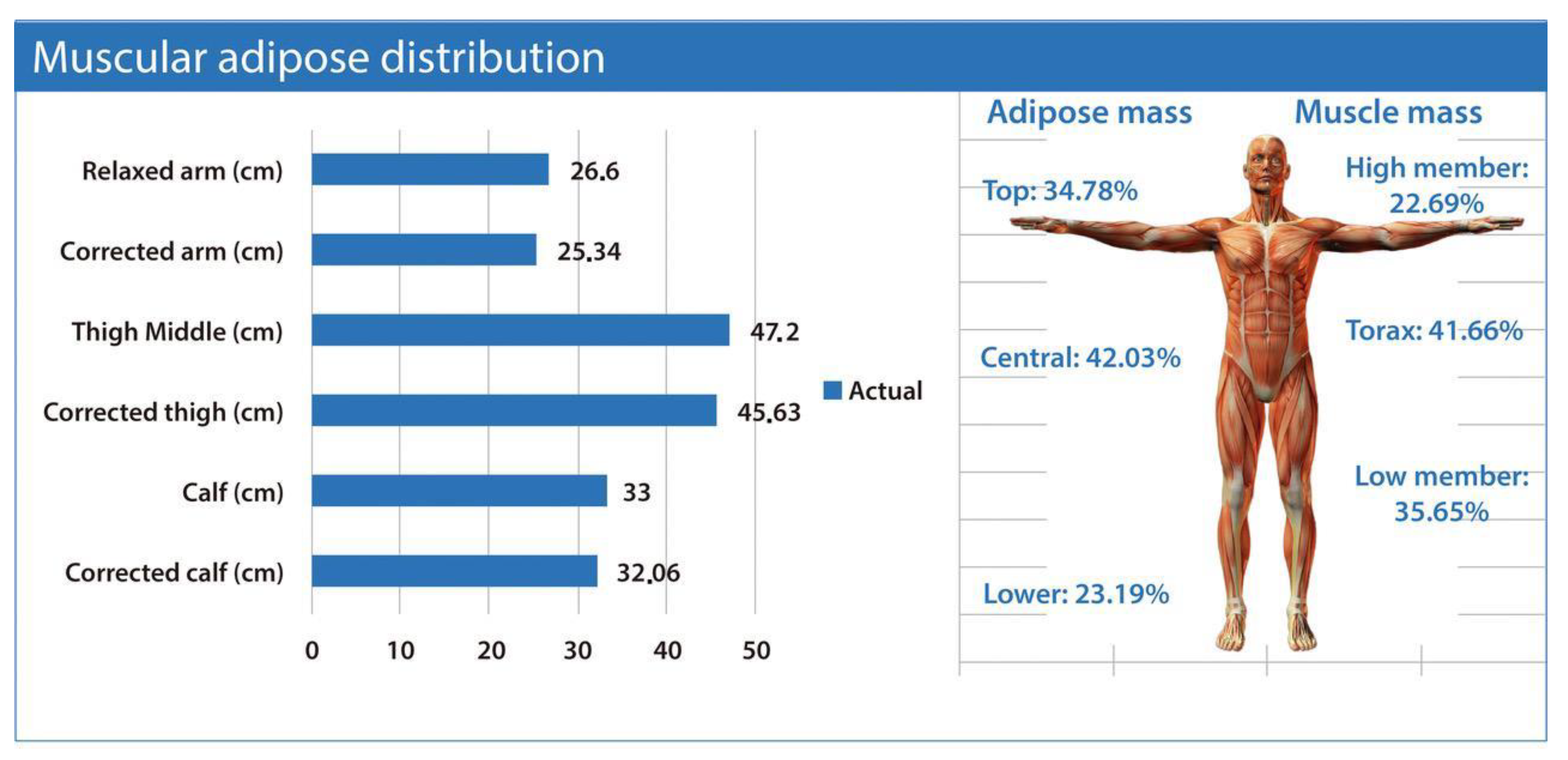



| Component | Total |
|---|---|
| Adipose mass (kg) | 12.61 |
| Muscular mass (kg) | 29.34 |
| Bone mass (kg) | 7.46 |
| Skin mass (kg) | 3.65 |
| Residual mass (kg) | 7.84 |
| Estimated total mass (kg) | 59.56 |
| Kg dif estructured-brute mass | −1.34 |
| % dif estructured-brute mass | −2.22 |
| Settings | Hospital | Community | Sports | References |
|---|---|---|---|---|
| Bioelectrical impedance analysis (BIA) | In clinical environments, BIA is employed to assess body composition in patients with chronic conditions such as kidney disease, heart failure, and cancer. It aids in evaluating nutritional status, fluid balance, and muscle mass, which are critical for patient management and prognosis. | In community health programs, BIA serves as a non-invasive, cost-effective tool for assessing body composition and detecting obesity, malnutrition, and sarcopenia, particularly among older adults. Its application in large-scale screenings supports early identification of nutritional risks and metabolic imbalances. | Athletic programs use BIA to monitor athletes’ body composition, hydration status, and muscle mass. This information guides training regimens and nutritional plans to optimize performance and recovery. | [14,17,18,19] |
| Muscle Ultrasound (MU) | Muscle ultrasound is utilized to detect muscle wasting and monitor sarcopenia in hospitalized patients, particularly the elderly. It provides real-time imaging to assess muscle thickness and quality, facilitating early intervention strategies. | While less common in community settings due to equipment and training requirements, muscle ultrasound can be employed in mobile clinics or health fairs to assess muscle health, especially in populations at risk for muscle degeneration. | In sports medicine, muscle ultrasound assists in evaluating muscle injuries, monitoring rehabilitation progress, and assessing muscle adaptations to training. It offers detailed insights into muscle architecture and function. | [15,19] |
| Nutritional Assessment Category | Parameter (Normal Range) | Clinical Relevance | References |
|---|---|---|---|
| Evaluation of Protein Status | Albumin (3.5–5.0 g/dL) | Indicator of long-term protein status. Low levels may suggest malnutrition, inflammation or liver disease. | [20] |
| Prealbumin (15–36 mg/dL) | More sensitive indicator of nutritional status, useful to evaluate recent changes in protein intake. | [20] | |
| C-Reactive Protein (<0.3 mg/dL) | Used in combination with albumin and prealbumin to assess chronic inflammation and its impact on nutritional status. | [21] | |
| Evaluation of Energy Status and Macronutrient Metabolism | Fasting Glucose (70–100 mg/dL) | Assesses carbohydrate metabolism and may indicate hypoglycemia, insulin resistance or diabetes. | [22] |
| Glycosylated hemoglobin (<5.7% normal, >6.5% diabetes) | Indicates glycemic control over the past 3 months. | [22] | |
| Lipid Profile: Total cholesterol (<200 mg/dL). LDL (<100 mg/dL) HDL (>40 mg/dL in men and >50 mg/dL in women) Triglycerides (<150 mg/dL) | Assesses cardiovascular risk and fat metabolism. | [23] | |
| Evaluation of Renal Function | Blood Urea Nitrogen (BUN, 7–20 mg/dL) Creatinine (0.6–1.3 mg/dL) | BUN reflects the concentration of nitrogen in the blood derived from urea, a product of protein catabolism formed in the liver and excreted by the kidneys. Elevated serum creatinine levels are indicative of decreased glomerular filtration rate (GFR) and may suggest acute or chronic kidney disease. | [23] |
| Serum Osmolarity (275–295 mOsm/kg) | Electrolytes: Sodium (135–145 mEq/L). Potassium (3.5–5.0 mEq/L) Chlorine (96–106 mEq/L) Calcium (8.5–10.5 mg/dL) | Evaluates hydration status. | [24] |
| Micronutrient Status Evaluation | Serum iron (50–170 mcg/dL) and Ferritin (12–300 ng/mL in men, 12–150 ng/mL in women) | They assess iron stores and risk of anemia. | [25] |
| Vitamin B12 (>200 pg/mL) | Deficiency associated with megaloblastic anemia and neuropathies. | [25] | |
| Folate (>3 ng/mL) | Indispensable in DNA synthesis and red blood cell formation. | [25] | |
| Vitamin D (30–50 ng/mL) | Important in bone health and immune function. | [25] | |
| Zinc (70–120 mcg/dL) | Related to the immune system and healing. | [25] |
| Clinical Sign | Associated Nutritional Deficiency |
|---|---|
| Skin | |
| Pale skin | Iron deficiency |
| Xerosis (dry skin) | Vitamin A, essential fatty acid deficiency |
| Seborrheic dermatitis | Zinc, vitamin B3 (niacin) deficiency |
| Delayed wound healing | Vitamin C, zinc, protein deficiency |
| Petechiae | Vitamin C deficiency |
| Hair and Nails | |
| Alopecia | Zinc, biotin, protein deficiency |
| Trichorrhexis | Protein, iron deficiency |
| Koilonychia | Iron deficiency |
| Onychorrhexis | Protein deficiency |
| Eyes | |
| Xerophthalmia | Vitamin A deficiency |
| Night blindness | Vitamin A deficiency |
| Bitot’s spots | Vitamin A deficiency |
| Oral Cavity | |
| Gingivitis | Vitamin C deficiency |
| Glossitis | Iron, vitamin B2 (riboflavin), vitamin B3 (niacin), vitamin B6 (pyridoxine) deficiency |
| Angular cheilitis | Iron, vitamin B2 (riboflavin) deficiency |
| Gastrointestinal Tract | |
| Diarrhea | Zinc, vitamin B3 (niacin), folic acid, vitamin B12 (cobalamin) deficiency |
| Nervous System | |
| Asthenia and adynamia | Iron, vitamin B12 (cobalamin) deficiency |
| Irritability | Vitamin B1 (thiamine) deficiency |
| Attention deficit | Iron deficiency |
| Musculoskeletal System | |
| Muscle weakness | Protein, vitamin D deficiency |
| Growth delay | Protein, calcium, vitamin D deficiency |
| Other | |
| Edema | Protein deficiency |
| Method | Strength | Rationale | Advantages | Disadvantages | References | |
|---|---|---|---|---|---|---|
| Prospective | Duplicate meal method | Considered the gold standard for evaluating micronutrient or contaminant intake. | Used in controlled institutional studies where portion sizes are predetermined. Participants set aside duplicate samples of all foods and beverages consumed over a defined period, which are weighed and analyzed in a laboratory. Useful for the direct measurement of dietary exposure, nutrient content, and the influence of environmental factors (e.g., soil composition affecting selenium, iodine, zinc). |
|
| [49] |
| Consumption diaries | Considered the reference method in validation studies. | Participants record foods consumed through estimated or weighed entries. High validity and accuracy when properly performed. |
|
| [48] | |
| Retrospective | Frequency of consumption | Useful for large-scale studies examining dietary patterns and associations with disease. | Collects frequency of consumption of specific foods or food groups over predefined time periods (daily to yearly). Can be interviewer-administered or self-administered. Semi-quantitative versions include portion sizes to estimate nutrient intake. |
|
| [49,50] |
| 24 h Recall | Widely used for estimating mean intake in large populations. | Records all foods and beverages consumed in the prior 24 h using a standardized, open-ended interview format. Quantitative information is converted to energy/nutrient intake using national food composition tables. |
|
| [49,51] | |
| Dietary History | Developed for clinical evaluation of typical long-term intake. | Combines 3-day food diary, 24 h recall, and a checklist of common foods. Conducted through an in-depth interview on usual eating behavior. Portion size recorded using standardized measures. |
|
| [49,52] |
| Method | Research | Community Nutrition | Outpatient Clinical Nutrition | Hospital Clinical Nutrition |
|---|---|---|---|---|
| Consumption Diaries | X | - | X | - |
| Duplicate meal method | X | - | - | - |
| Frequency of consumption | X | X | X | - |
| 24 h Recall | X | X | X | X |
| Dietary history | X | - | - | X |
| Item | Question | Response | Clinical Relevance |
|---|---|---|---|
| 1 | Do you regularly consume grapefruit or grapefruit juice? | Yes/No | Inhibitor of CYP3A4: increasing drug plasma levels (e.g., statins, calcium channel blockers). |
| 2 | Do you use supplements or foods high in calcium along with your prescription drugs? | Yes/No | Interference with antibiotics like tetracyclines, bisphosphonates, thyroid hormones. |
| 3 | Do you consume alcohol while taking your medications? | Yes/No | Alters drug metabolism, risk of hepatotoxicity with certain drugs. |
| 4 | Do you drink tea or coffee within 1 h of taking your medication? | Yes/No | Reduction in absorption of iron, levothyroxine, bisphosphonates. |
| 5 | Do you follow a high-fiber diet or consume fiber supplements? | Yes/No | Decrease absorption of some oral drugs (e.g., digoxin, metformin). |
| 6 | Do you use herbal supplements (e.g., St. John’s Wort, ginseng, ginkgo)? | Yes/No | Potential for strong pharmacokinetic interactions. |
| 7 | Have you noticed any changes in appetite, digestion, or nutrient tolerance since starting your medication? | Yes/No | Helps detect drug-induced nutrient malabsorption or intolerance. |
| Questions | Score | |
|---|---|---|
| A | Were you born by cesarean section? 0 = No 1 = Yes | |
| B | Were you breastfed for less than 6 months? 0 = No 2 = Yes | |
| C | Do you consume ultra-processed foods more than 3 times per week? 0 = No 1 = Yes | |
| E | Have you taken antibiotics in the last 3 months? 0 = No 3 = Yes | |
| F | Have you taken non-steroidal anti-inflammatory drugs in the last 3 months? 0 = No 2 = Yes | |
| G | Are you currently undergoing treatment or follow-up for any health problem? 0 = No 3 = Yes | |
Total score (Maximum 14 points)
| Total | |
| Effect of Diet on Gut Microbiota | Modifications of the Gut Microbiota | ||||
|---|---|---|---|---|---|
| Beneficial Bacteria | Opportunistic Pathogens | ||||
| Diet components | Diet/food | Bifidobacteria | Lactobacilli | Bacteroides | Clostridia |
| Protein | Animal protein (lean) | Increases | - | Decreases | - |
| Animal protein (high fat) | Decreases | - | - | Increases | |
| Whey protein extract (Dairy or Supplements) | Increases | Increases | Decreases | Decreases | |
| Pea Protein Extract (Peas) | Increase | Increases | - | - | |
| Lipids | Rich in fat (Saturated—LCT) | Decreases | Increases | Increases | |
| Low fat (low fat—Low LCT) | Increases | - | - | - | |
| Saturated fat (LCT): lard | - | Increase | - | ||
| Unsaturated fat (polyunsaturated): fish oil | Increases | Increases | - | - | |
| Carbohydrates | Glucose, Sucrose, Fructose (fruits with peel) | Increases | - | Decreases | - |
| Lactose (dairy products and derivatives) | Increases | Increases | Decreases | Decreases | |
| Artificial sweeteners (saccharin) | Decreases | Decreases | Increases | Decreases | |
| Gluten-free diets | Decreases | Decreases | - | ||
| Soluble fiber (prebiotics): fruits and raw salads | Increases/SCFA | Increases/SCFA | - | Decreases | |
| Dietary fiber: whole grain cereals and wheat bran | Increases | Increases | - | ||
| Dietary fiber: FOS, polydextrose and AOS | - | - | - | Decreases | |
| Dietary fiber: resistant starches | Increases | Increases | - | - | |
| Polyphenols | catechins, flavonols, flavones, anthocyanins, proanthocyanidins and phenolic acids | Increases | Increases | Decreases | Decreases |
| Red wine | - | - | Increases | - | |
| Supplementation | Probiotic Capsule | Increases/SCFA | Increases/SCFA | - | - |
| Symptoms/Severity Assessment | |||||
|---|---|---|---|---|---|
| Category | Symptom | Category 1 | Category 2 | Category 3 | Category 4 |
| 1 | Do you have intestinal gas? | Absent/Nearly none (0) | Mild (1) | Moderate (2) | Severe (3) |
| 2 | Do you feel abdominal bloating during the day? | No bloating (0) | Mild (1) | Moderate (2) | Severe (3) |
| 3 | Do you have the presence of bowel sounds? | Absent (0) | Mild (1) | Moderate (2) | Severe (3) |
| 4 | Do you feel abdominal pain? | No discomfort (0) | Mild to moderate discomfort (1) | Somewhat severe discomfort (1) | Very severe discomfort (1) |
| 5 | Do you feel any discomfort in your rectum during bowel movements? | No discomfort (0) | Mild (1) | Moderate (2) | Severe (3) |
| 6 | How many bowel movements per day? | 0–2 bowel movements per day (0) | 3–4 bowel movements per day (1) | 5–6 bowel movements per day (2) | 7 or more bowel movements per day (3) |
| 7 | What is the consistency of the bowel movements? | All bowel movements are solid (0) | Bowel movements solid and soft (pasty) (1) | Soft stools (2) | Liquid stools (3) |
| 8 | Do you feel the urge to have a bowel movement? | Not urgent (0) | Somewhat urgent (1) | Urgent (2) | Very urgent (3) |
| 9 | Do you feel pain during bowel movements? | No pain (0) | Mild (1) | Moderate (2) | Severe (3) |
| Score | Total: | ||||
| Interpretation | A: Normal function | B: Mild dysfunction | C: Moderate dysfunction | D: Severe dysfunction | |
| 0 to 5 points | 6 to 11 points | 12 to 20 points | 21 to more points | ||
| Indicator | Clinical Use | Cut of Points | Protocols |
|---|---|---|---|
| Handgrip strength |
| EWGSOP2 [113]: <27 kg for men <16 kg for women |
|
| Criteria for malnutrition [117] | Measurably reduced according to normative standards. | ||
| Knee flexion/extension | Šarabon N. et al. [120]. Males:
| ||
| Tongue strength | Marín-Bernard E et al. [125]: Males:
|
| Genetic Test | Description | Impact on Nutritional Status | References |
|---|---|---|---|
| SNP genotyping | Identification of single-nucleotide polymorphisms related to nutrient metabolism. | Allows for personalized dietary recommendations based on genetic predisposition to certain deficiencies or diseases. | [139] |
| Exome sequencing | Analysis of all coding regions of the genome. | Detects mutations that can affect the absorption and metabolism of essential nutrients. | [140] |
| Macronutrient Metabolism Testing | Evaluation of genes related to carbohydrate, fat and protein metabolism. | Helps design personalized diets to optimize energy metabolism. | [138] |
| Analysis of Vitamin-Related Genes | Study of genetic variants that affect the absorption and utilization of vitamins. | Identifies risks of vitamin deficiencies, allowing specific nutritional interventions. | [139] |
| Genetic Food Intolerance Testing | Detection of genetic predisposition to intolerances such as lactose or gluten. | Facilitates dietary adaptation to avoid adverse symptoms and improve nutrient absorption. | [140] |
Disclaimer/Publisher’s Note: The statements, opinions and data contained in all publications are solely those of the individual author(s) and contributor(s) and not of MDPI and/or the editor(s). MDPI and/or the editor(s) disclaim responsibility for any injury to people or property resulting from any ideas, methods, instructions or products referred to in the content. |
© 2026 by the authors. Licensee MDPI, Basel, Switzerland. This article is an open access article distributed under the terms and conditions of the Creative Commons Attribution (CC BY) license.
Share and Cite
Zambrano-Villacres, R.; Arteaga-Pazmiño, C.; Guevara Castillo, W.D.; Herrera-Fontana, M.E.; Domínguez Brito, L.D.; Becerra Granados, L.M.; Recoba-Obregón, P.E.; Rodríguez-Veintimilla, D.; Bressi, V.; Andrade-Molina, D.; et al. The Seven Methods for the Evaluation of Nutritional Status—ABCDEFG: Narrative Review. Appl. Sci. 2026, 16, 845. https://doi.org/10.3390/app16020845
Zambrano-Villacres R, Arteaga-Pazmiño C, Guevara Castillo WD, Herrera-Fontana ME, Domínguez Brito LD, Becerra Granados LM, Recoba-Obregón PE, Rodríguez-Veintimilla D, Bressi V, Andrade-Molina D, et al. The Seven Methods for the Evaluation of Nutritional Status—ABCDEFG: Narrative Review. Applied Sciences. 2026; 16(2):845. https://doi.org/10.3390/app16020845
Chicago/Turabian StyleZambrano-Villacres, Raynier, Cecilia Arteaga-Pazmiño, Washington David Guevara Castillo, Maria Elisa Herrera-Fontana, Lorena Daniela Domínguez Brito, Luis Miguel Becerra Granados, Paulo E. Recoba-Obregón, Dolores Rodríguez-Veintimilla, Viviana Bressi, Derly Andrade-Molina, and et al. 2026. "The Seven Methods for the Evaluation of Nutritional Status—ABCDEFG: Narrative Review" Applied Sciences 16, no. 2: 845. https://doi.org/10.3390/app16020845
APA StyleZambrano-Villacres, R., Arteaga-Pazmiño, C., Guevara Castillo, W. D., Herrera-Fontana, M. E., Domínguez Brito, L. D., Becerra Granados, L. M., Recoba-Obregón, P. E., Rodríguez-Veintimilla, D., Bressi, V., Andrade-Molina, D., Frias-Toral, E., & Duran-Aguero, S. (2026). The Seven Methods for the Evaluation of Nutritional Status—ABCDEFG: Narrative Review. Applied Sciences, 16(2), 845. https://doi.org/10.3390/app16020845