Article

Analysis of Wear Behavior Between Tire Rubber and Silicone Rubber


by
Juana Abenojar
1,*,
Miguel Angel Martínez
1 and
Daniel García-Pozuelo
2
1
Material Science and Engineering Department, Universidad Carlos III de Madrid, 28911 Leganés, Spain
2
Mechanical Engineering Department, Universidad Carlos III de Madrid, 28911 Leganés, Spain
*
Author to whom correspondence should be addressed.
Appl. Sci. 2026, 16(2), 878; https://doi.org/10.3390/app16020878
Submission received: 10 December 2025 / Revised: 7 January 2026 / Accepted: 13 January 2026 / Published: 14 January 2026
(This article belongs to the Section Materials Science and Engineering)

Featured Application

This study explores a wheel redesign concept based on a detachable tread made from silicone instead of conventional rubber, while keeping the wheel body unchanged. The proposed configuration is intended to increase durability, reduce abrasive wear, and improve the sustainability of tire components under service-relevant friction conditions.

Abstract

Vulcanized NR-SBR is widely used in vehicle components; however, its irreversible crosslinking limits recyclability and contributes to the large number of tires discarded annually worldwide, and in this context, this work presents an experimental comparative assessment of the tribological behavior of conventional tire rubber and silicone VMQ, motivated by a wheel concept based on a detachable tread aimed at improving durability and sustainability rather than proposing an immediate material substitution. Wear and friction behavior were investigated under abrasive and self-friction conditions using pin-on-disk testing with an abrasive counterpart representative of asphalt, supported by optical and scanning electron microscopy. The results show that NR-SBR undergoes severe abrasive and erosive wear, characterized by deep and irregular wear tracks, pronounced fluctuations in the dynamic friction coefficient, and strong sensitivity to load and sliding speed, particularly during the initial stages of track formation. In contrast, VMQ exhibits mild abrasive wear dominated by viscoelastic deformation, leading to shallow and stable wear tracks, lower friction coefficients, and significantly reduced material loss once the contact track is fully developed. These differences are attributed to the distinct mechanical responses of the elastomers, as the higher hardness and limited strain capacity of rubber promote micro-tearing and unstable material removal, while the high elasticity of silicone enables stress redistribution and stable contact conditions under abrasive loading. UV aging increases stiffness of rubber, resulting in reduced wear and friction, while silicone remains largely unaffected after 750 h due to the stability of its Si–O–Si backbone. Self-friction tests further indicate that smooth silicone sliding against rubber yields the lowest friction values, highlighting a favorable material pairing for detachable tread concepts. Factorial design analysis confirms material type as the dominant factor influencing both wear and friction. Overall, for the specific materials and operating conditions investigated, VMQ demonstrates higher durability, greater tribological stability, and improved aging resistance compared to NR-SBR, providing experimental evidence that supports its potential for long-life, more sustainable detachable tread applications.

1. Introduction

Tire rubber is composed of natural rubber (NR, polyisoprene) and synthetic materials such as styrene-butadiene rubber (SBR) blended in specific proportions. NR-SBR, commonly used in vehicle components, constitutes 5.1% of a vehicle’s weight, with 3.6% attributed to wheels. These rubber compounds, primarily used in the tread and sidewalls, provide durability and performance [1]. To enhance these properties, carbon black and silica are often added as reinforcing fillers, improving wear resistance and tensile strength throughout the tire’s lifecycle [2]. Traditionally, metals such as beads and belts strengthened the tire’s structure, but synthetic fibers like rayon, nylon, and polyester now replace them, reducing both cost and weight [3].
Vulcanization processes introduce sulfur to enhance the rubber’s mechanical and wear properties, facilitating the irreversible crosslinking and resistance, which complicates recycling [4,5,6]. Zinc oxide and stearic acid accelerate this process [7]. Additives (stabilizers, antioxidants, antiozonants, extenders, and waxes) optimize the rubber’s resistance to environmental conditions like UV radiation and high temperatures [8]. Recycling tire rubber requires breaking the sulfur bonds formed during vulcanization [5,6].
The global tire industry consumes about 65% of all natural and synthetic rubbers produced [5,9]. Over 1.5 billion end-of-life tires (ELTs) containing approximately 40% vulcanized rubber are discarded annually [5,10]. Around 1 billion tires become unfit for reuse each year, with projections reaching 1.2 billion by 2030 [11,12]. Discarded tires pose significant environmental and health risks, accumulating water that fosters disease-carrying pests and creating fire hazards that release toxic by-products, as demonstrated by incidents such as the Seseña fire in Spain and the Tire King Recycling fire in Canada [13,14,15].
Legislative efforts promote sustainable ELT management, favoring energy and material recovery over landfilling while encouraging supply chain innovation [16]. However, the key challenge remains the establishment of economically viable recycling systems and markets for ELT-derived products.
Tire recycling is hindered by their chemically and mechanically complex structure, designed for durability and abrasion resistance. Early disposal methods, such as incineration and landfilling, proved unsustainable due to space consumption and non-biodegradability. However, new recycling techniques are continuously emerging [17].
The permanence of vulcanization complicates rubber reprocessing, as it is not a thermoplastic [18]. Chemical and mechanical methods (such as grinding) have been explored to blend vulcanized rubber with thermoplastics [19,20] or thermosetting polymers [21,22], with or without compatibilization, as well as with construction materials or pavements [11,18]. Kazemi et al. [23] analyzed the environmental, health, and economic effects of using ELTs for energy recovery (fuel) and asphalt filler.
Currently, the trend is shifting towards devulcanization methods [24], where crosslinks are broken to improve adhesion between devulcanized rubber particles and the matrix. Various devulcanization techniques exist, including thermomechanical, thermochemical, mechanochemical, physical, supercritical CO2, and biological techniques [25], as well as biotechnological approaches using microorganisms or enzymes [26]. Additionally, microwave- [18] and ultrasound-based [27,28] methods have been developed.
Another approach involves rubbers with reversible double bonds, or dynamic covalent bonds, which break and reform in response to external stimuli [4,29]. These vitrimeric rubbers hold promise for reprocessable and recyclable materials, reducing waste [30]. However, balancing tensile properties, self-healing ability, and recyclability remains a challenge. The incorporation of dynamic covalent bonds, supramolecular interactions, and nanofillers enhances mechanical strength without compromising recyclability [31,32].
Further advances in polymer chemistry are needed to integrate vitrimer networks into elastomers while maintaining compatibility with reinforcements like carbon black, which are essential for tire applications [32]. Shuangjian et al. [33] designed a manufacturing network for vitrimers, enabling extrudable reprocessability with sufficient crosslinking. This structure promotes chain orientation, improving strength, toughness, and stretchability while preserving elasticity. Cantamessa et al. [34] further refined vitrimeric rubbers via the Diels–Alder reaction using a melt-blending process as an eco-friendly alternative to solvent-based synthesis.
As research advances in sustainable alternatives to rubber, silicone-based elastomers are emerging as a promising replacement for vulcanized rubber. This is attributed to hybrid chains (organic and inorganic elements), which crosslink effectively compared to traditional organic rubber with alkane chains. Silicone inherently offers greater resistance to environmental degradation, high and low temperatures, and UV radiation [35]. However, exposure to high temperatures around 180 °C leads to gradual oxidation of silicone rubber molecules [36]. Silicone rubber products exhibit long service life, lasting up to five years at a temperature between 90 and 150 °C [37], or remain largely unchanged after 400 h at 180 °C [38]. Conversely, microwave exposure [39], freezing, thermal aging, ultraviolet aging, and salt spray aging accelerate degradation, thereby shortening the product’s lifespan [37].
The mechanical and electrical properties of silicone rubber can be significantly enhanced by incorporating particles such as carbon fillers [40], nano-silica particles [41], or fibers. For instance, the addition of hexagonal boron nitride or carbon fibers demonstrates excellent heat dissipation performance [42], while nanorods derived from clay and modified with silane coupling agents improve the mechanical and triboelectric properties of silicone rubbers [43]. Additionally, mechanical properties can be tailored using a solvothermal polymerization process, achieving elongation limits exceeding 30 times and a tensile modulus below 0.15 MPa, making it suitable for applications like flexible sensors, artificial electronic skin, and oil collection [44].
Although silicone is a durable material with a lower environmental impact during use—helping to reduce greenhouse gas emissions by about 52 million tons annually in regions like Europe, North America, and Japan—it still presents a challenge at the end of its life [45]. Silicone waste continues to grow, and because it is non-biodegradable, it is usually incinerated or sent to landfills. Incineration, while safer than landfilling, results in resource loss and CO2 emissions. Since silicone elastomers and heat-resistant types cannot be melted like thermoplastics, the most sustainable solution involves mechanical or chemical recycling through closed-loop systems that depolymerize silicone for reuse in new products [46].
Following an analysis of the challenges associated with tire recycling and the properties of VMQ, the ECOTIRE project proposes the replacement of NR-SBR in the tire casing with VMQ, which offers enhanced durability, while the tread remains composed of NR-SBR [47,48]. The development of an intelligent tire design within this project aims to reduce the environmental impact of NR-SBR waste. Furthermore, VMQ systems facilitate easier recycling, as silicone crosslinking is achieved through tri- and tetrafunctional silanes (room-temperature curing) or peroxides via a free radical mechanism (high-temperature curing), resulting in a material that does not contain sulfur [46].
Within the ECOTIRE framework, the tribological behavior of the two selected materials, NR-SBR and VMQ, is therefore assessed under conditions representative of service contact. Accordingly, the aim of this study is to experimentally compare the wear and friction behavior of both materials using a pin-on-disk configuration with an abrasive pin. The use of an abrasive counterpart enables a closer simulation of road asphalt, where material removal and track formation play a dominant role in tribological response. In addition, self-friction tests were conducted on both materials to evaluate their behavior under direct elastomer–elastomer contact conditions.
The novelty of this work lies in the combined use of an abrasive pin (stone wheel type) and a systematic comparison between conventional tire NR-SBR and VMQ under identical testing conditions. In previous studies, metallic pins or cylinders—such as stainless steel in wet conditions with sand particles—were commonly employed to simulate abrasive wear [49]. Steel balls have also been used to investigate the behavior of silicone rubber and the influence of lubricants [50], while the effect of exfoliated graphite addition on silicone rubber wear was studied using a hardened steel disk (EN-32, HRC 65) and silica sand as an abrasive medium [40,51]. In contrast, the present study focuses on unmodified commercial elastomers and employs an abrasive counterpart representative of asphalt to identify wear regimes, friction stability, and material-dependent tribological mechanisms relevant to detachable tread concepts, without aiming to propose a complete tire design.

2. Materials and Methods

This section outlines the experimental procedures employed to investigate the wear resistance of NR-SBR and VMQ. The tests were designed to comprehensively evaluate the tribological behavior of these materials under abrasive conditions and self-friction, as well as their degradation under UV radiation. The stages outlined below describe the methodological approach followed throughout this research:
(1)
Tribological tests at different sliding distances (SDs), speeds, and loads for both materials, enabling the calculation of wear and the coefficient of friction (μ) as a function of SD;
(2)
Self-friction tests aimed at understanding the influence of surface roughness on wear behavior;
(3)
Analysis of the wear track using optical microscopy, including measurements of wear volume, height, and width;
(4)
Evaluation of the effect of UV radiation on wear performance;
(5)
Characterization of material degradation under UV radiation performed using FTIR (Fourier-transform infrared spectroscopy);
(6)
Assessment of the most influential wear factors for each material (NR-SBR and VMQ) using a factorial design approach.

2.1. Materials

For experimental purposes, an NR-SBR-type material sourced from Eguía Manufacturas de Goma, S.L. (Madrid, Spain) was utilized, with a hardness rating of 70 Shore A. This material demonstrates superior mechanical characteristics ideal for elastic and cushioning applications. Samples measuring 25 mm × 25 mm were obtained by cutting a sheet with a thickness of 5 mm, a width of 1000 mm, and a length of 10 m (reference 0910.001).
The comparative material is a green silicone rubber (referred to in the paper as VMQ), designated TED2021-129604B-100, with a hardness rating of 60 Shore A, supplied by Advantaria (Alcala de Henares, Spain). This VMQ differs from conventional organic rubbers in that it lacks carbon backbone atoms; instead, it consists exclusively of silicon and oxygen atoms, forming a chemically defined polysiloxane chain (VMQ, Vinyl Methylsiloxane).
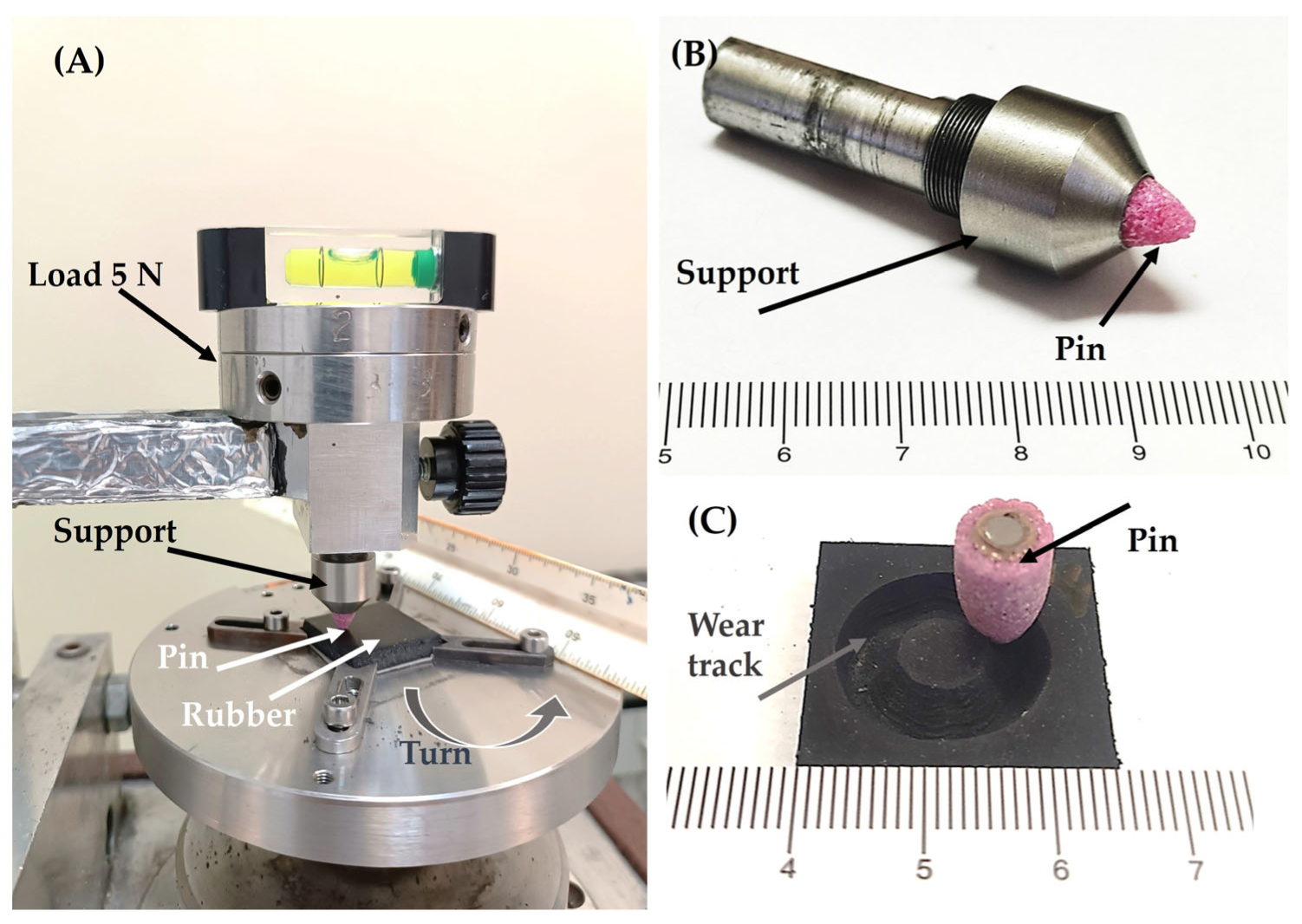
Abrasive stone wheels made of aluminum oxide were used as counterbodies in the pin-on-disk wear tests, supplied by Ferreteria Unceta (Elgoibar, Spain). Each wheel is bullet-shaped and mounted on a shank, which was adapted as needed to fit the wear tester. Pin roughness was 84 ± 66 μm, with a pin tip diameter of 2.5 ± 0.1 mm (Figure 1A).
The surfaces of the VMQ do not have the same roughness, so a HOMMELWERKE profilometer with a T5E stylus (Tecnimetal, Madrid, Spain) was used, since differences in roughness can influence wear. The roughness of the rubber was Ra = 2.5 ± 0.5 µm, while for the rough side of the silicone, it was Ra = 17.1 ± 1.7 µm, and the smooth side Ra = 1.5 ± 0.2 µm. Therefore, two distinct surfaces of the VMQ were considered: a rough side and a smooth side.

2.2. Wear Experimental Procedure

Before the experiment tests, the pin and NR-SBR or VMQ samples were cleaned with ethanol solvent. Figure 1B shows pin-on-disk tests, which were carried out with a friction wear tester (Microtest, Madrid, Spain). Tests were performed dry, without removing debris during the test. The temperature was kept constant, at approximately 22 °C, since significant differences in temperature affect the tests when dealing with elastomeric polymers [40]. In addition, no lubricant was used; in this case, this represents the most severe condition, since lubricant-like engine oil or dimethyl silicone oil improve wear resistance [50]. All samples were cut from the same bulk NR-SBR or VMQ sheets. Each condition was repeated three times using new specimens.
The parameters considered for the tests were speeds of 120 and 150 rpm, loads of 5 and 10 N, and SDs of 100, 250, 500, and 1000 m. The rotation radius was kept constant at 8 mm. For VMQ, tests were carried out on both sides in order to evaluate the influence of surface roughness.
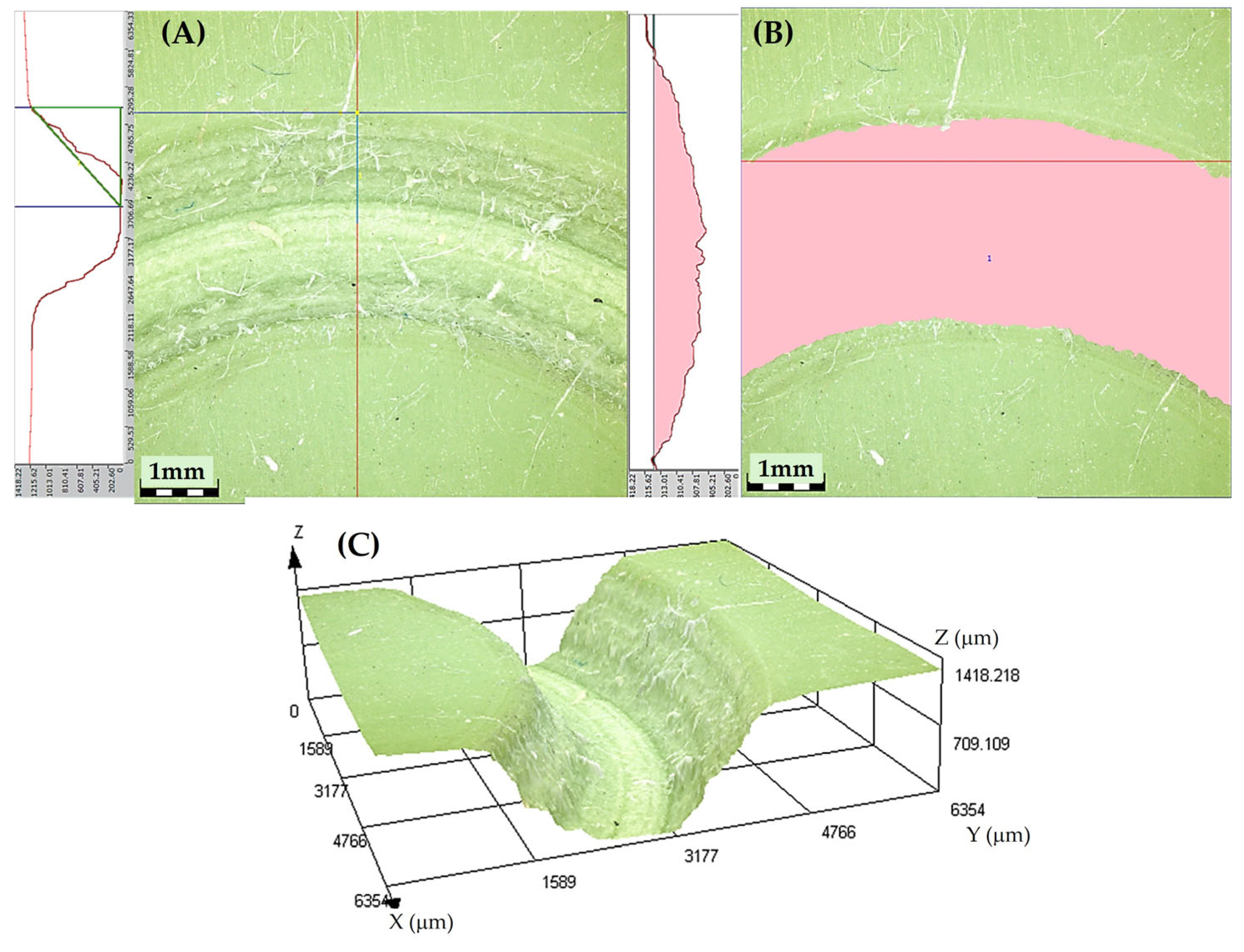
Wear tracks (Figure 1C) were evaluated by digital microscopic Olympus DSX1000 (Olympus, Barcelona, Spain) with a DSC10-XLOB lens. PRECiV DSX software (version 2.1.1) was employed to generate two- and three-dimensional (2D and 3D) representations of the wear tracks, as well as to obtain their depth, width, and height profiles (Figure 2A). Additionally, it facilitated the calculation of the track volume and the surface area ratio (surface area/projected area) (Figure 2B,C). For each wear track, four images were analyzed to determine geometrical characteristics with higher accuracy.
Wear was measured according to the ASTM G99-05 standard [52] using (Equation (1)). The volume loss was calculated from 3D optical microscope images (Figure 2C) and compared with the volume calculated from the weight loss and the corresponding material density (Equation (2)). The density of the NR-SBR and VMQ was measured using the Archimedes method (Equation (3)), with an alcohol pycnometer (ethanol density: 0.8 g/cm3). Here, M1 is the weight of the empty and dry pycnometer, M2 is the pycnometer with polymer pieces, M3 is the pycnometer with alcohol and polymer, and M4 is the pycnometer with alcohol only. The densities used in Equation (2) were 1.48 ± 0.02 g/cm3 for NR-SBR and 1.30 ± 0.01 g/cm3 for VMQ.
W = V o l u m e   L o s s L o a d × S l i d i n g   d i s t a n c e
V o l u m e   L o s s = W e i g h t   L o s s D e n s i t y
D e n s i t y = ( M 2 M 1 ) × a l c o h o l   d e n s i t y ( M 4 M 3 ) + ( M 2 M 1 )
To complete the set of materials and test conditions studied, the NR-SBR and VMQ samples were also exposed to UV radiation for 750 h. After this treatment, the irradiated samples were evaluated using the pin-on-disk wear test in order to assess the influence of UV-induced molecular modifications on the wear behavior of both materials. In addition, infrared spectroscopy was performed to characterize the surface changes caused by UV radiation.

2.3. Friction Coefficient (μ)

The dynamic friction coefficient (μd) was measured during the wear test by plotting μ against SD. The reported μd value corresponds to the steady-state region observed after the initial peak, which reflects the formation of the wear track.
Self-friction refers to the resistance of a material when sliding against itself, especially relevant in soft elastomers like VMQ or NR-SBR. These materials tend to adhere and resist motion due to strong intermolecular forces and their ability to conform to surface asperities, increasing real contact area. Smooth surfaces (low roughness) maximize adhesion and friction, while moderate roughness reduces effective contact and lowers friction. However, excessive roughness can cause mechanical interlocking and raise friction again. For elastomers, an optimal roughness balances reduced adhesion without hindering sliding. The static friction coefficient (μs) quantifies this resistance and can be measured following DIN EN ISO 8295:2004-10 standard [53] using a universal testing machine with an additional test fixture consisting of a flat table and a sled of known mass (Microtest, Madrid, Spain). The first peak of the traction force on the sled is used to calculate the μs. At least, three pairs of specimens (approx. 80 mm × 200 mm each) were tested.
Moreover, in light of the potential frictional interaction between the VMQ and the NR-SBR induced by the wheel assembly, the frictional behavior of these two materials was systematically evaluated using the same experimental protocol applied in the self-friction assessments.
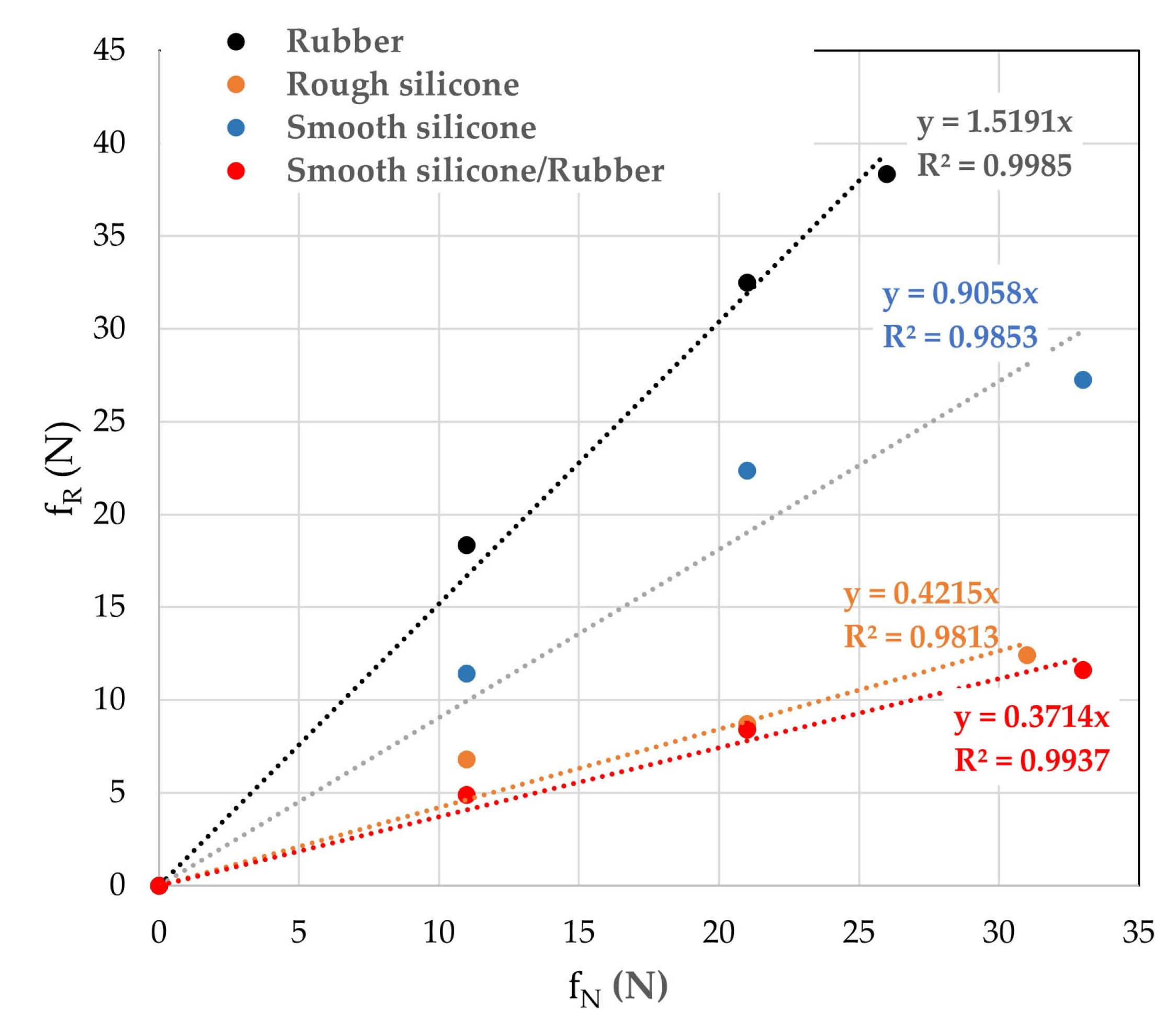
The μs was calculated using Equation (4), fN is the normal load, and fR is the friction force at the onset of sliding. Due to surface roughness differences, it is necessary to study self-friction on both sides of the silicone, on the rubber, and between silicone and rubber. Friction is measured under incremental normal loads (11 N, 21 N, and 31 N).
μ s = f R f N

2.4. UV Radiation and Infrared Spectroscopy

The accelerated aging test was performed in a Solarbox 3000E chamber (Neutrek, Guipúzcoa, Spain) equipped with a 2500 W xenon arc lamp, in accordance with UNE-EN ISO 4892-3 [54]. The black standard temperature (BST) was maintained at 65 °C, with an irradiance of 550 W/m2. Samples were exposed in the chamber for up to 750 h, which corresponds to approximately 187 days of natural outdoor exposure, based on the equivalence of 20 min in the chamber to two hours of sunlight [55].
Fourier-transform infrared (FTIR) spectra of the NR-SBR samples, before and after UV aging, were acquired using a Bruker Optik GmbH (Ettlingen, Germany) infrared spectrometer equipped with an attenuated total reflection (ATR) accessory in order to assess surface chemical changes. The spectra were recorded on a Bruker Tensor 27 spectrometer with a resolution of 4 cm−1, averaging 32 scans at an incident angle of 45°. For each NR-SBR sample, three spectra were collected to ensure reproducibility.
Wear tracks were analyzed by scanning electron microscopy (SEM) with energy-dispersive X-ray spectroscopy (EDAX) using a Philips X-30 model (Philips Electronic Instruments, Mahwah, NJ, USA) to determine the mechanism of wear [56] and elemental composition.

2.5. Factorial Design

Factorial experimental design is based on the analysis of different factors that may influence the outcome of an experiment. This tool makes it possible to identify the optimal combination of factor levels by testing the appropriate hypotheses for each factor and estimating their effects on the test results, as well as the interactions between factors.
In this study, the factorial design was implemented with four variables: type of material (m), sliding distance (sd), speed (s), and load (l) in the wear test, yielding 16 possible combinations (24). Given the number of variables involved, only two SDs were considered instead of the four used in the initial tests; the two shortest distances were selected, as they exhibited greater wear. Additionally, the two surfaces of the VMQ were not distinguished in this analysis: the rough surface was chosen arbitrarily, since both sides were ultimately observed to behave similarly.
Once the factors were selected and their high and low levels defined, the test plan was developed. Table 1 presents the test plan, listing all combinations of factors and the corresponding level for each. In this case, the high level (+) corresponds to VMQ, 250 m, 150 rpm, and 10 N, while the low level (−) corresponds to NR-SBR, 100 m, 120 rpm, and 5 N.
From the experimental tests, two response variables were obtained: wear and μd. These two responses were used to evaluate the main effects and the interactions between the factors, as well as to study the relationship between wear and friction under the different test conditions. Using Yates’ algorithm [57,58,59], the influence of each factor and interaction was determined.

3. Results

3.1. Wear

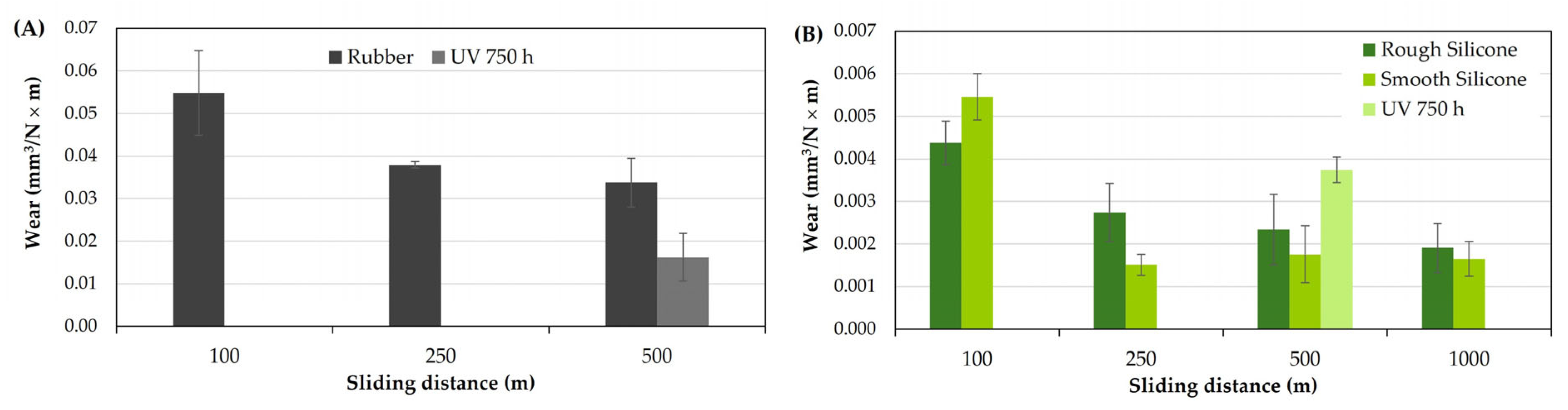
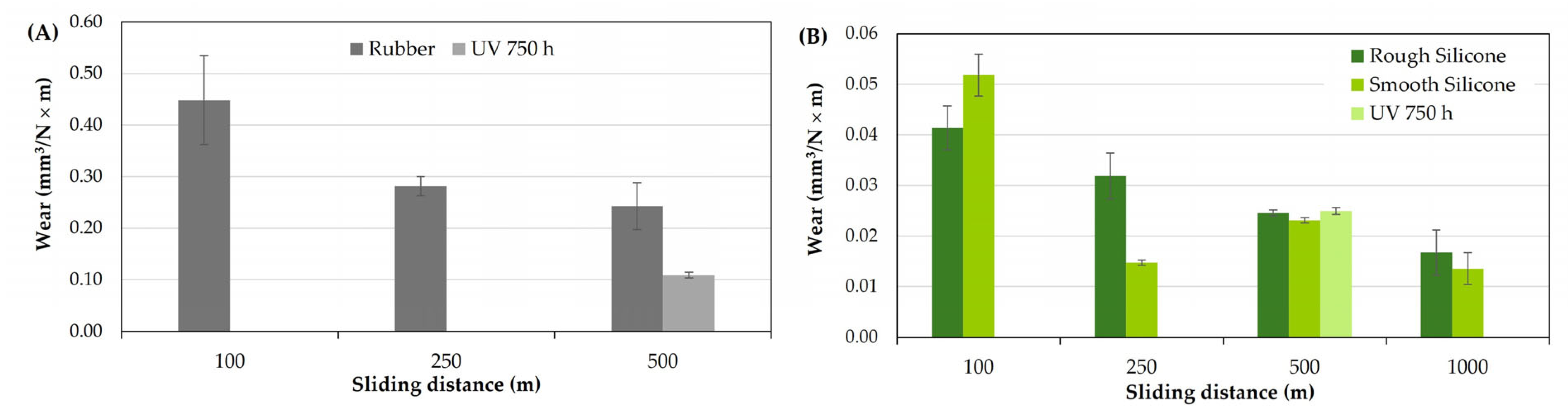
Figure 3 shows the wear values calculated from mass loss as a function of SD, where both NR-SBR and VMQ exhibit a decrease in wear with increasing SD. For NR-SBR (Figure 3A), the most pronounced reduction occurs between 100 m and 250 m (from 0.45 to 0.28 mm3/Nm). After 750 h of UV aging, the wear at 500 m decreases substantially (from 0.24 to 0.11 mm3/Nm), likely as a result of increased material stiffness. For VMQ (Figure 3B), wear values are approximately one order of magnitude lower than those of NE-SBR and follow the same decreasing trend. Differences between rough and smooth surfaces are observed at short distances but converge at 500 m and continue decreasing at 1000 m. UV exposure produces no significant change in this material.
Because elastomer deformation can bias volume estimates, wear volume was also calculated using Equation (1), where volume is obtained from digital microscope (Figure 2B). Table 2 lists the parameters derived from the wear tracks for NR-SBR.
The 2D track parameters (width, depth, and angle) increase with SD, consistent with increased erosion (Table 2), although not necessarily with higher wear rates, since wear is normalized by SD (Figure 3A). After UV exposure, these parameters decrease, yielding values closer to those measured at 250 m than at 500 m, reflecting the effect of aging.
The 3D parameters (area, surface area, and volume) also increase with SD, although not proportionally. The surface roughness ratios (Sratio) quantifies the difference between surface area and projected area. Surface area represents the actual 3D area of the wear track, whereas projected area corresponds to its planar projection. Consequently, surface area provides a more representative description of track roughness. Table 2 therefore shows larger surface area values than projected area, reflecting increased curvature or roughness induced by abrasion.
For VMQ (Table 3), all wear-track parameters are considerably smaller than those of NR-SBR. Track width, depth, and length are reduced, and the resulting wear grooves are flatter due to smaller angles. Although the 3D parameters are also lower, the Sratio is slightly higher, consistent with more pronounced abrasion lines. UV aging reduces this Sratio. These changes, for both NR-SBR and VMQ, are examined in detail in the Discussion section.
Figure 4 presents the wear calculated from the wear track volume obtained by digital microscopy (Table 2 and Table 3). Although the absolute values are lower than those derived from mass loss, the trend is identical: wear progressively decreases with SD. For NR-SBR (Figure 4A), UV aging leads to a reduction of up to 70%, whereas for VMQ (Figure 4B), the decrease ranges from 51% to 65% depending on surface finish and SD, with a smaller effect after UV exposure.
Both measurement methods therefore confirm the same overall trend, although they differ in magnitude due to elastic deformation and the inherent limitations of each technique. The volumetric method provides a more conservative estimate of wear, whereas mass loss is more sensitive to differences between materials and testing conditions.
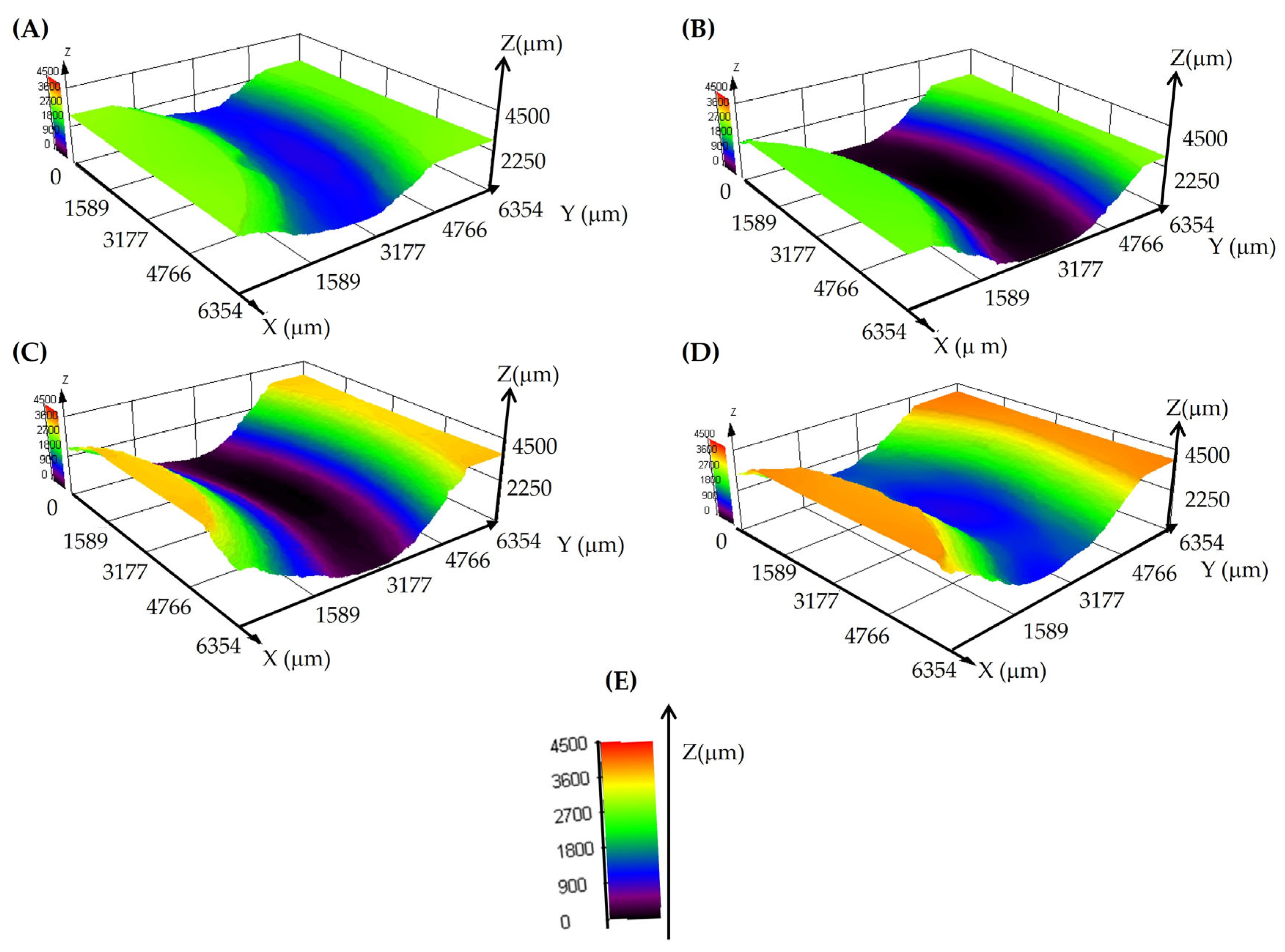
Figure 5 shows 3D digital microscope images of the wear tracks. These images illustrate the measured parameters and the high wear levels observed for NR-SBR, as well as their variation with SD. According to the z-axis color scale (Figure 5E), darker blue tones, indicating greater depth, increase from Figure 5A to Figure 5C. From 250 m (Figure 5B) to 500 m (Figure 5C), the track widens in its upper region while becoming narrower and deeper at the lower region. In contrast, the track obtained after UV aging at 500 m (Figure 5D) shows reduced depth, with values between those observed at 100 m and 250 m.
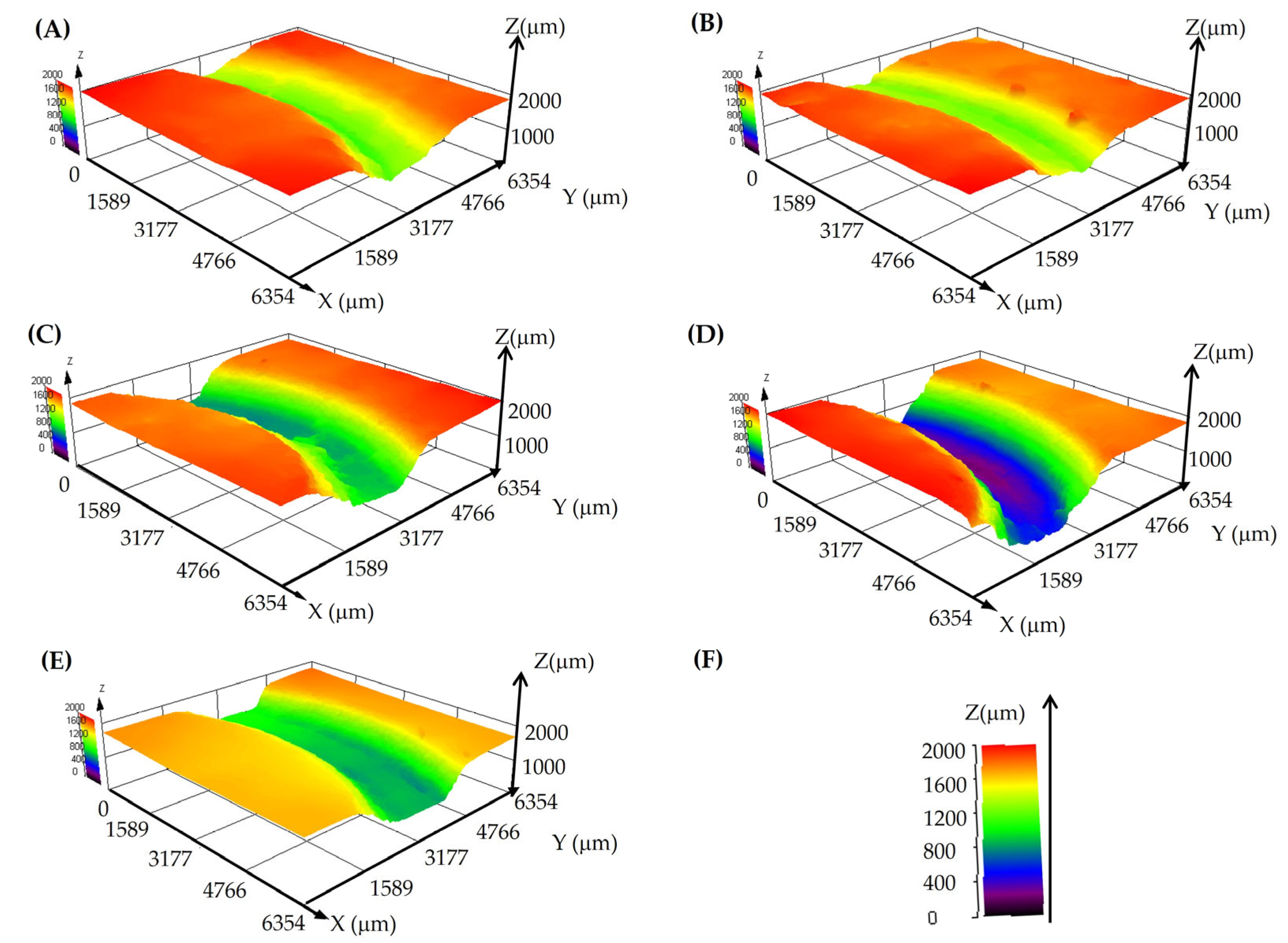
VMQ exhibits shallower and flatter wear tracks, requiring a reduction in the z-axis scale from 4500 mm (Figure 5E) for NR-SBR to 2000 mm (Figure 6F) for VMQ. As SD increases from Figure 6A (100 m) to Figure 6E (1000 m), darker blue tones progressively appear, indicating increased track depth.
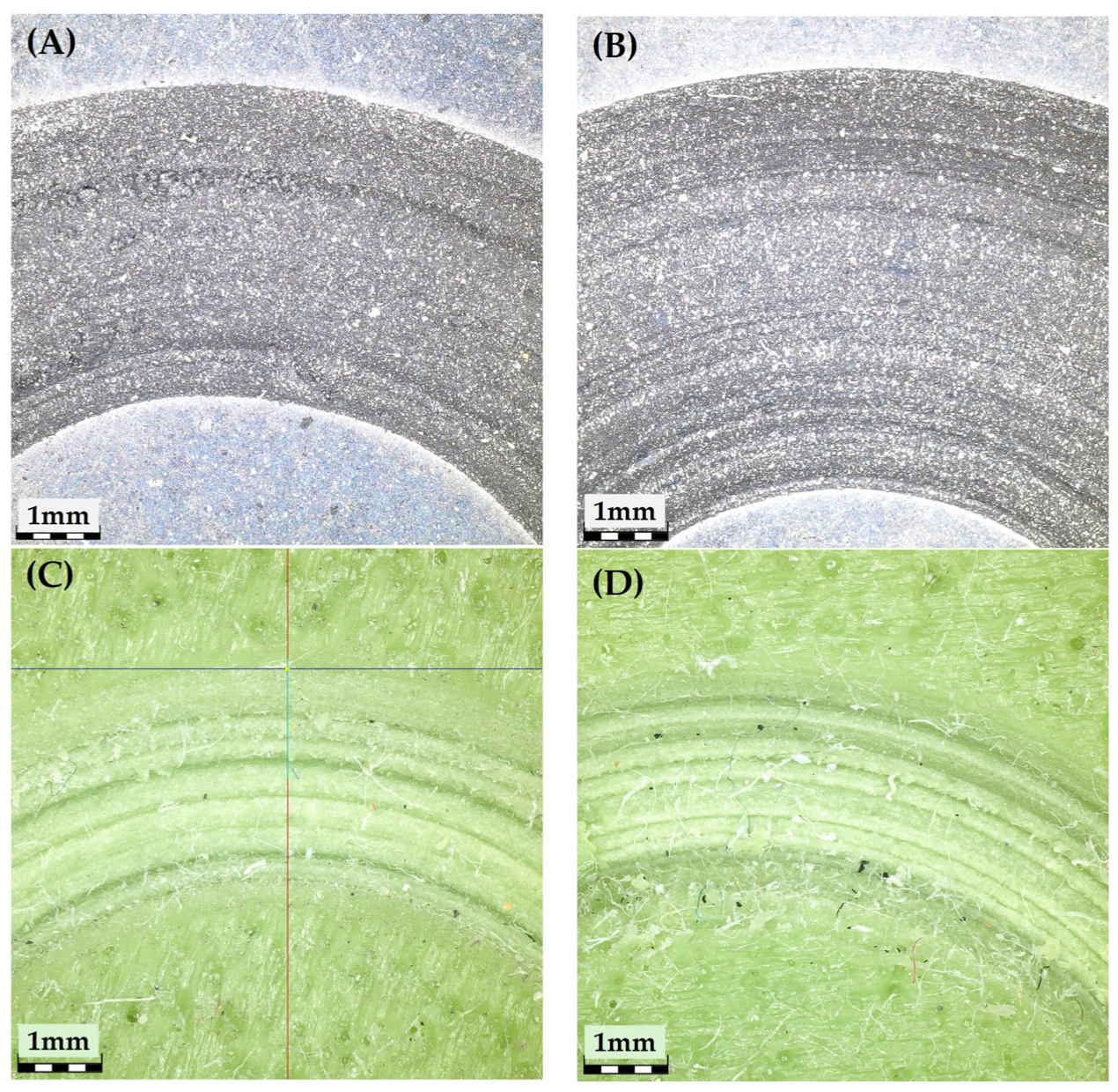
Abrasion lines are more clearly observed in the 2D images. Figure 7A (NR-SBR, 100 m) shows abrasion predominantly along the track edges, with a smoother bottom, similar to the wider track observed at 500 m (Figure 7B). In all cases, light-colored particles—likely originating from the pin or some NR-SBR additives—are visible, although adhesion is not observed. For VMQ at 250 m, abrasion lines extend across the track and are accompanied by small VMQ filaments that remain attached. At 1000 m (Figure 7D), these lines resemble cuts in the material and are more frequent than in NR-SBR.
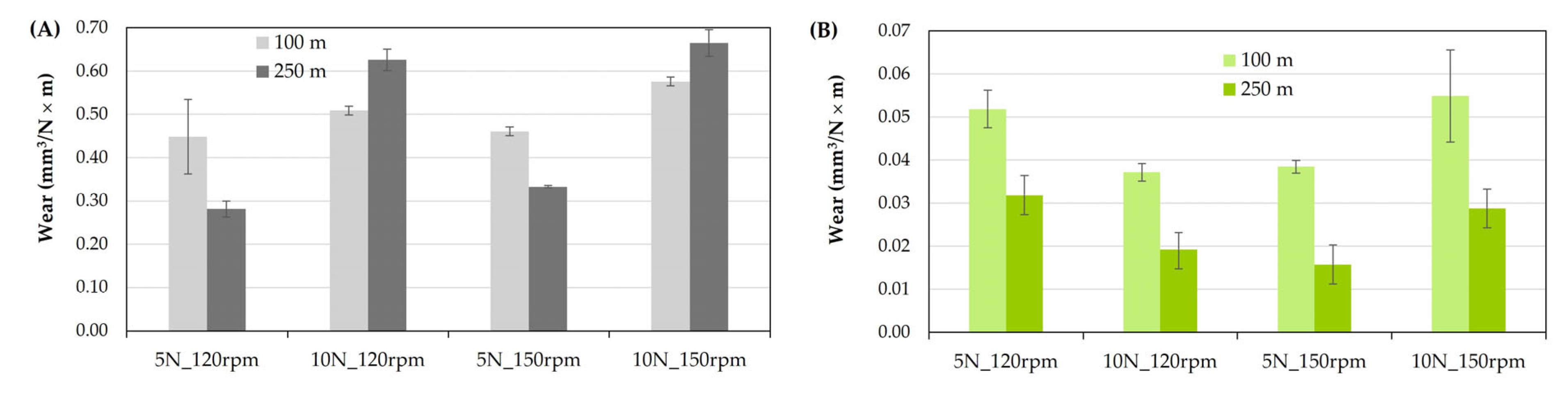
To evaluate the influence of load and sliding speed, SD was kept at 100 m and 250 m, while load (5 and 10 N) and rotational speed (120 and 150 rpm) were varied. Figure 8A summarizes the results obtained for NR-SBR. All comparisons are made relative to the reference condition of 5 N and 120 rpm, which corresponds to the most favorable case. increasing the load leads to higher wear at both distances, with a stronger effect at 250 m (122%) than at 100 m (15%). Sliding speed has negligible effect at 100 m (4%) and increases wear at 250 m (18%). The combined increase in load and speed produces the largest effect, resulting in wear increases of up to 122–136%.
For VMQ (Figure 8B), a different behavior is observed. Increasing the load to 10 N or speed to 150 rpm reduces wear (up to 18–40%), particularly longer at SD. When both load and speed are increased simultaneously, wear increases slightly (6%) at 100 m but decreases by 9% at 250 m.
The contrasting wear behavior between NR-SBR and VMQ remains evident regardless of whether wear is calculated from mass loss or from wear track volume obtained by digital microscopy.
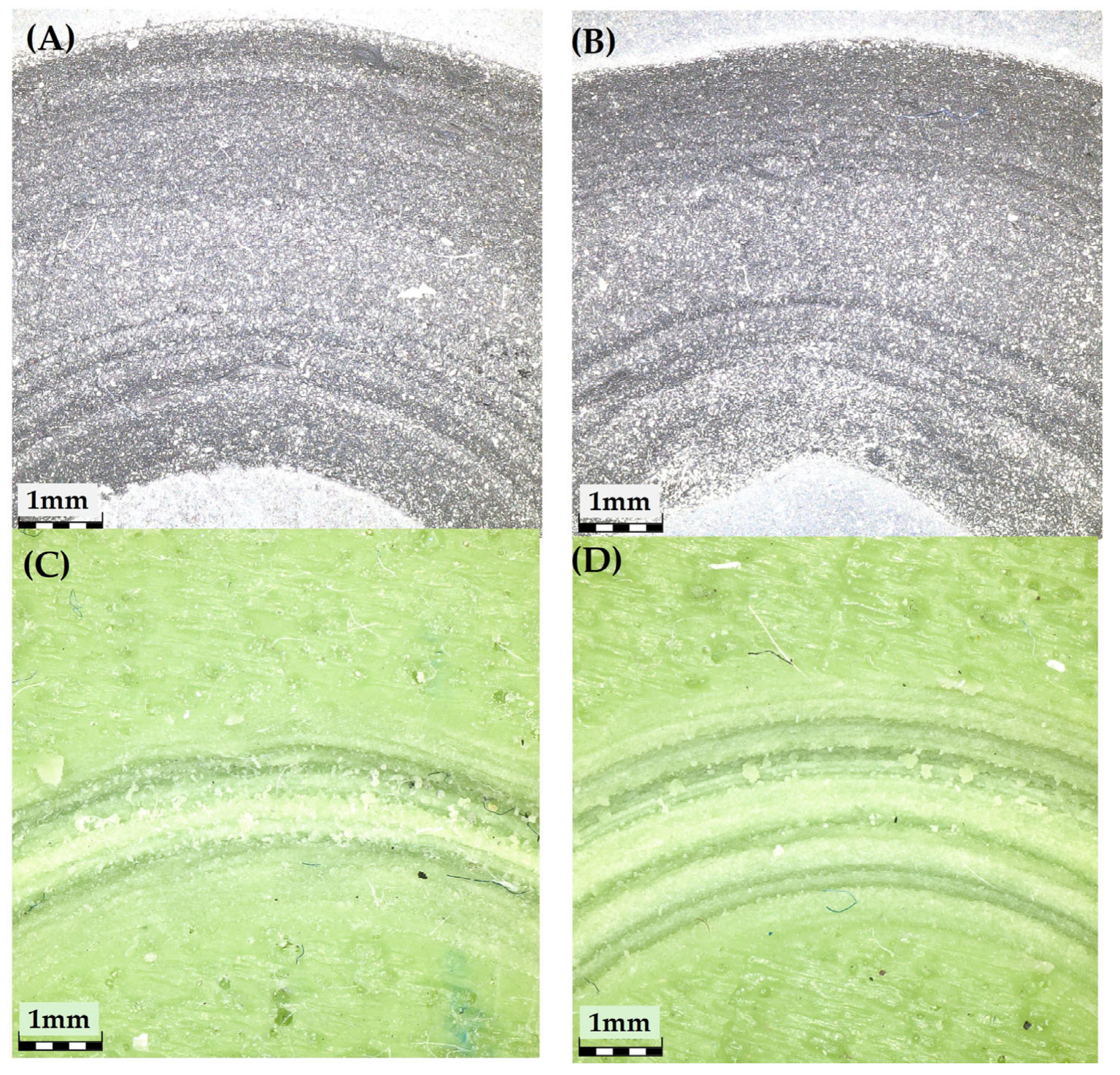
Under these conditions, the digital microscope parameters for NR-SBR also increase. At 100 m with 10 N and 120 rpm (Figure 9A), as well as at 250 m with 10 N and 150 rpm (Figure 9B), the wear track reaches a volume of approximately 82 mm3 and an Sratio of 2, indicating more severe abrasion. In contrast, when the load remains at 5 N and only speed increases, the volume increases by only 5% and Sratio by 3%. The track profile parameters (width, height, length, and angle) at 100 m under higher load and speed resemble those obtained at 500 m under the most favorable conditions (Table 2).
For VMQ at 100 m, 10 N, and 120 rpm (Figure 9C), the track profile parameters are comparable to those measured at 250 m, 5 N, and 120 rpm (Table 4), although the wear volume is lower (3.06 mm3) and Sratio is 1.32. In general, at 100 m, increasing speed, load, or both reduces the Sratio, a trend also observed at 250 m (Table 4).
At 250 m under maximum load and speed, VMQ exhibits increased track depth, length, and angle, as well as higher surface area and volume (Table 4). However, Sratio decreases relative to the most favorable condition. Although abrasion lines are clearly visible and appear deeper, they are fewer in number, which may contribute to a lower overall surface roughness (Figure 9D).

3.2. Friction Coefficients (μd and μs)

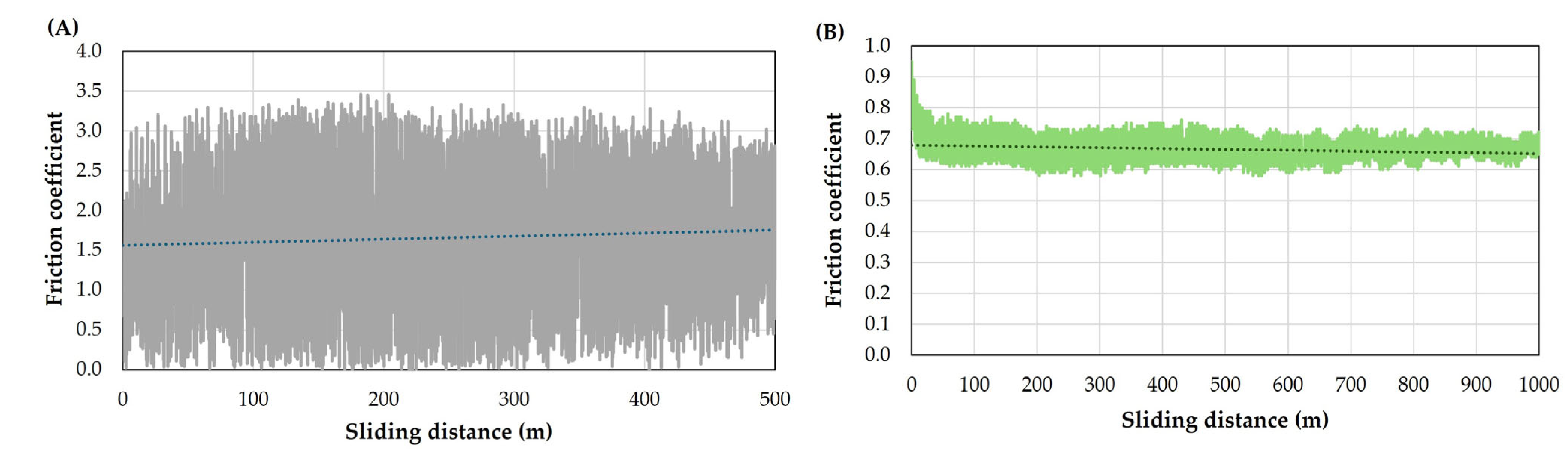
The plots of μd as a function of SD show markedly different behaviors for NR-SBR and VMQ (Figure 10). For NR-SBR (Figure 10A), strong fluctuations in μd are observed as a consequence of continuous abrasion wear. Material removal by the pin is not uniform across the entire area, leading to the formation of small steps on the wear track. These irregularities cause intermittent pin displacement, which results in pronounced fluctuations in the force signal recorded by the equipment. As a result, μd for NR-SBR varies from values close to zero to up to values of three or higher, as observed at an SD of 500 m (Figure 10).
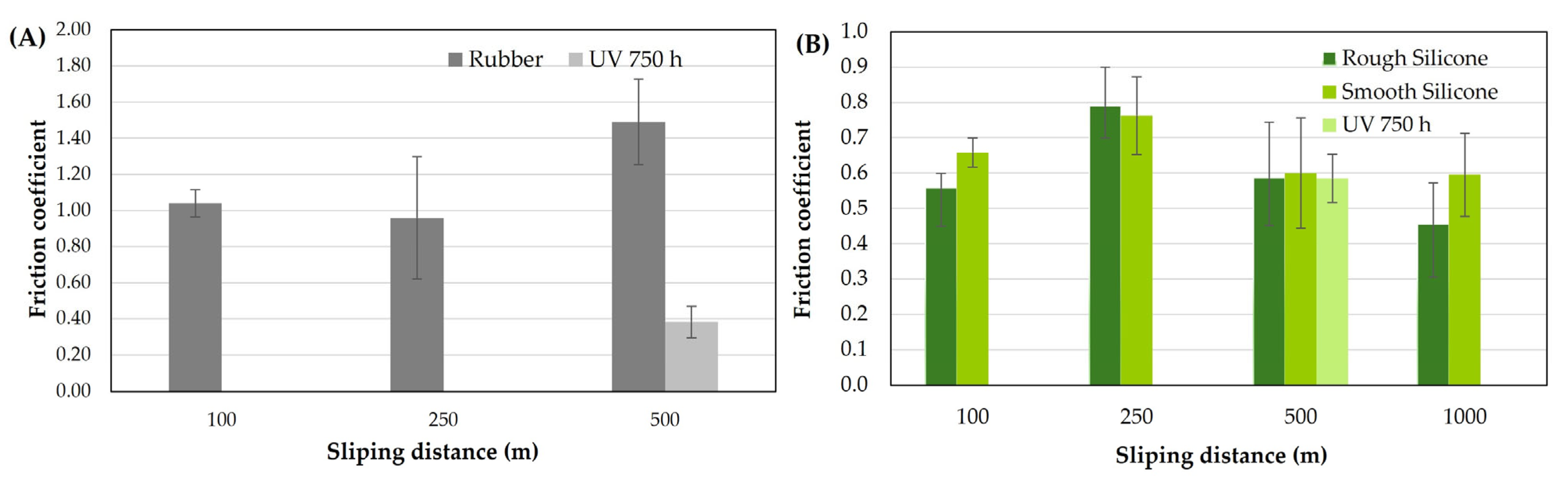
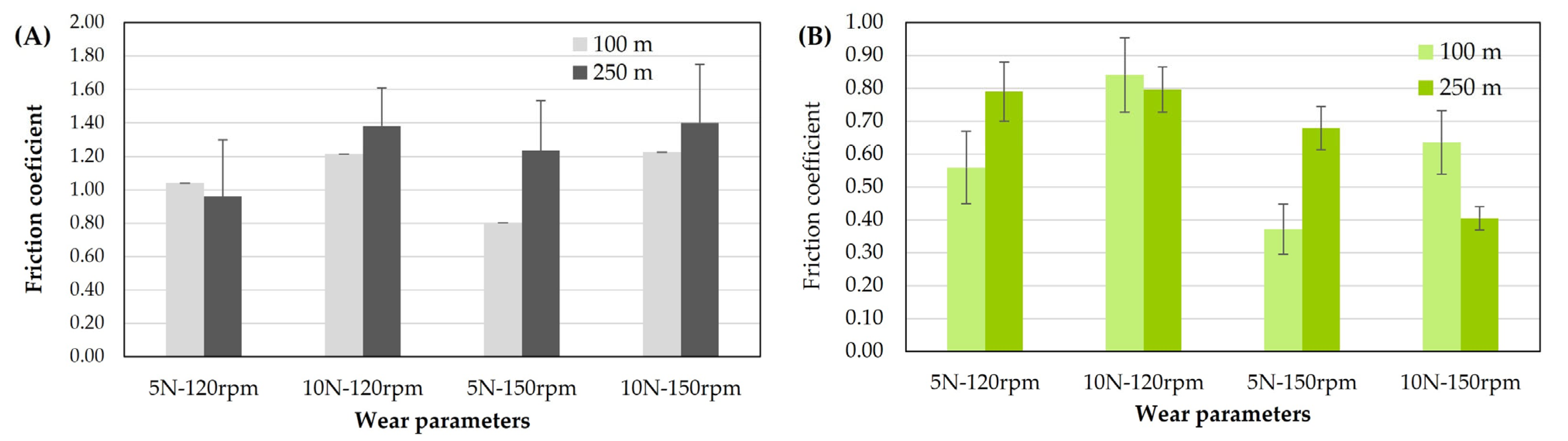
The μd values reported in Figure 11 correspond to average values between the maximum and the minimum values recorded during each test. For the three SDs investigated, μd for NR-SBR is equal to or greater than 1 at 100 m and 250 m and reaches values of approximately 1.5 at 500 m (Figure 11A). The effect of UV aging on NR-SBR is clearly reflected in the reduction in μd (Figure 11A), which decreases from 1.5 for non-aged NR-SBR to approximately 0.8 after aging.
In contrast, VMQ exhibits a more uniform μd along the wear track, as illustrated in Figure 10B, for a sample tested at an SD of 1000 m, with an average μd around 0.7 (Figure 11B). Under none of the tested conditions does VMQ reach a μd values equal to or higher than 1, indicating a more homogeneous frictional response with few fluctuations. Consistent with the wear results (Figure 4B), UV aging has a negligible effect on the μd of VMQ.
Regarding the effect of load, increasing the normal load to 10 N leads to an 18% increase in μd for NR-SBR at 100 m of SD and a 44% increase at 250 m (Figure 12A). When the sliding speed is increased to 150 rpm while maintaining the load at 5 N, μd decreases by 23% at 100 m and increases by 29% at 250 m. When both load and speed are increased, μd rises by 19% at 100 m and by 46% at 500 m (Figure 12A).
For VMQ, the influence of load and speed on μd is less systematic (Figure 12B). Increasing load results in a 50% increase at 100 m and a 10% increase at 250 m. Increasing the sliding speed leads to a decrease in μd of 33% and 14% at 100 m and 250 m, respectively (Figure 12B). When both load and speed increased simultaneously, μd increases by 14% at 100 m but decreases by 49% at 250 m (Figure 12B). In all cases, μd remains below 1, with average values ranging between 0.40 and 0.85.
Self-friction (μs) was calculated according to Equation (4) (Figure 13). The highest μs corresponds to NR-SBR, (μs = 1.52). Significant differences are observed between the two surfaces of VMQ,: the smooth surface exhibits a μs approximately twice that of the rough surface (0.91 and 0.42, respectively). The lowest μs among all tested configurations is obtained for the pairing between the smooth VMQ and NR-SBR, with a value of 0.37. This result is discussed in detail in the following section.

3.3. Factorial Design

To perform the factorial design analysis, the mean values of wear and μd obtained for each tested condition (Table 5) were used. The overall average value of these values was then calculated and employed to determine the percentage contribution of each parameter combination. The combinations of parameters are described in Table 1.
After applying Yates’ algorithm, material type was identified as the factor with the greatest influence on both responses. NR-SBR exhibits the highest values of both μd and wear, showing the largest absolute deviation from the overall average in both variables.
For μd, the second most relevant effect corresponds to the combination of NR-SBR tested at high sliding speed (150 rpm). In contrast, for wear, the second most influential combination is NR-SBR subjected to a high applied load (10 N).
Since the material is the dominant factor in these experiments, a separate 23 factorial design was applied to each material. The results indicate that, for NR-SBR, high load (10 N) is the most influential factor, affecting both μd and wear.
For VMQ, the factors with the greatest influence on μd are sliding speed (150 rpm) and the interaction between SD (250 m) and the applied load (10 N). However, in terms of wear, the applied load (10 N) remains the most influential factor.

4. Discussion

The tribological behavior of NR-SBR and VMQ is governed by intrinsic material properties, degradation mechanisms, and their response to mechanical and environmental conditions. By integrating wear data, μd, microscopy observations, and factorial design analysis, a consistent mechanistic interpretation can be established.

4.1. Wear Mechanisms and Material Differences

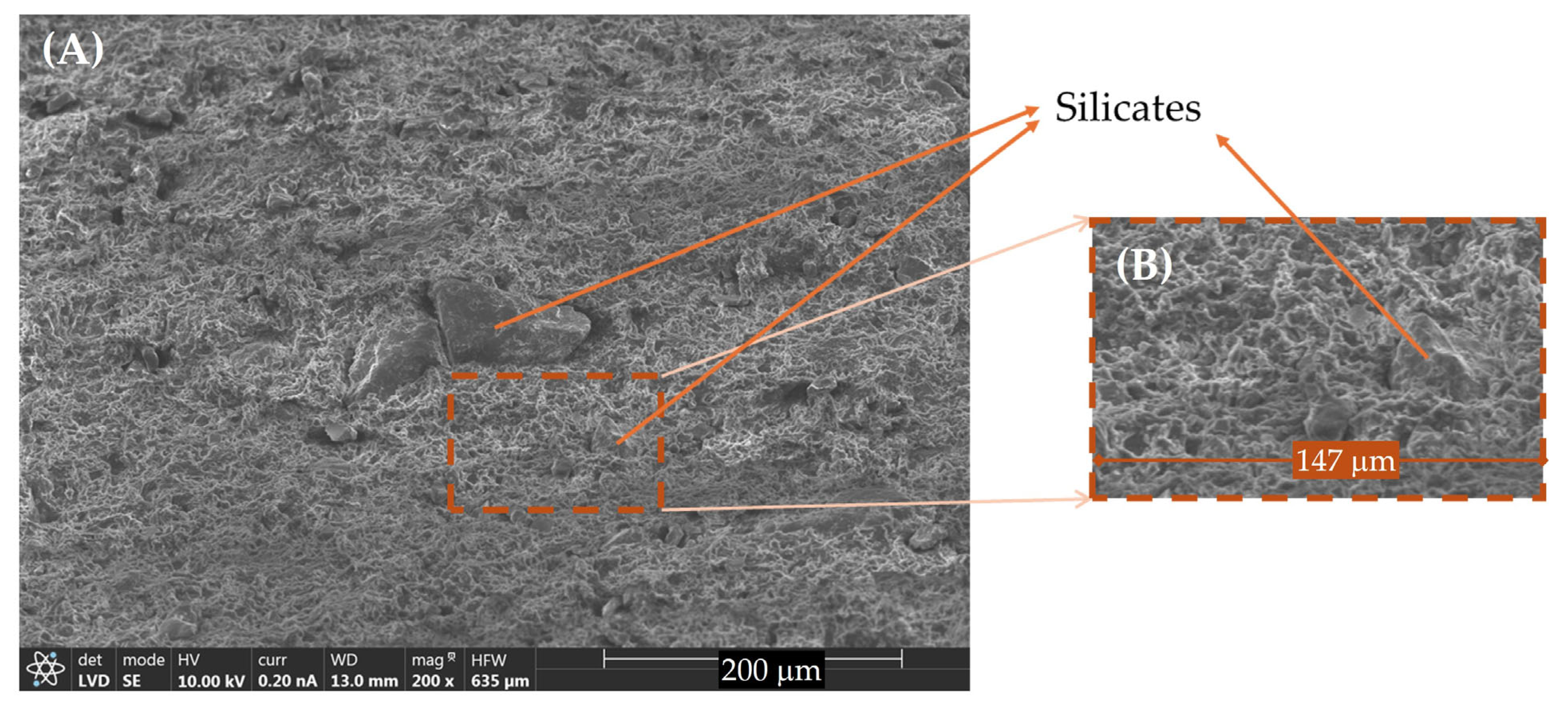
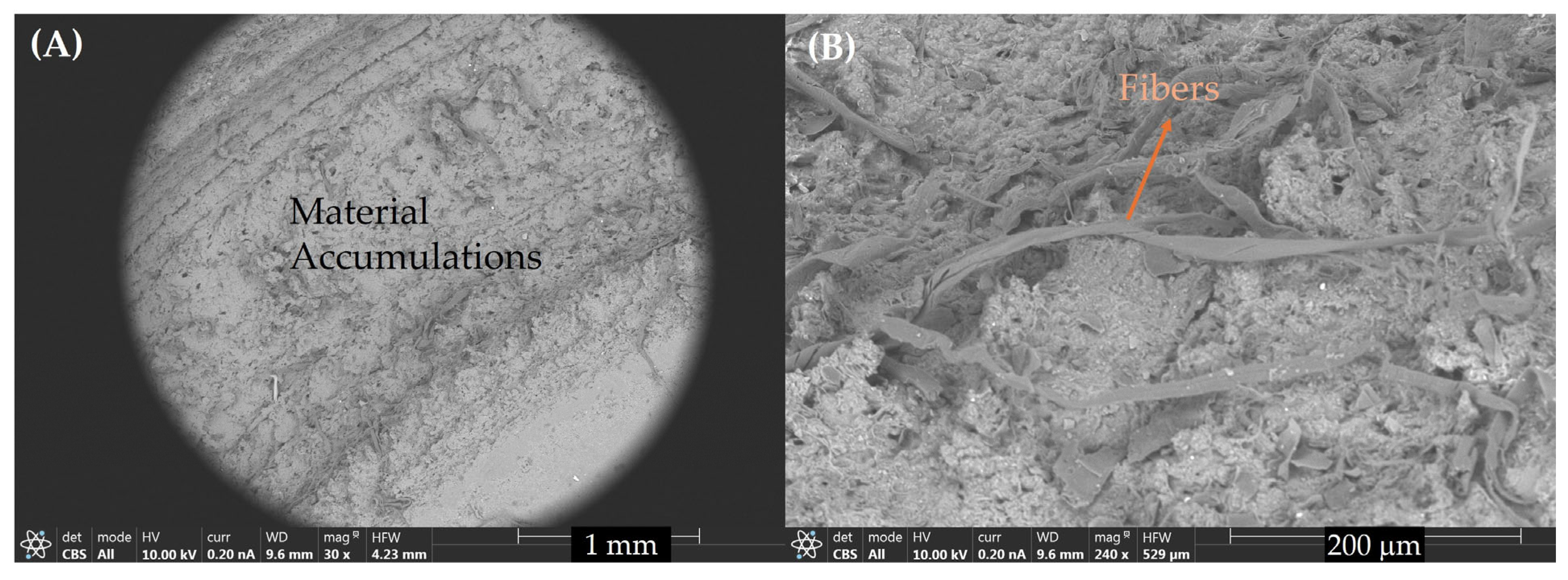
NR-SBR exhibits significantly higher wear than VMQ at all SDs (Figure 3A and Figure 4A). In NR-SBR, the deep, angular wear tracks observed under digital microscopy (Figure 5 and Figure 7A,B), together with the pronounced fluctuations in μd (Figure 10A and Figure 11A), indicate a severe abrasive/erosive wear regime. SEM confirms an abrasive mechanism characterized by abrasion lines along the entire track (Figure 14A), as well as surface deformation caused by material tearing and removal (Figure 14B). These mechanisms amplify both material loss and friction instability.
Furthermore, EDAX confirms the presence of inorganic particles within the wear track, containing silicon, magnesium, calcium, and sodium of varying particles sizes. This observation can be attributed to the incorporation of silicates, which are commonly added to rubber formulations to improve mechanical properties and thermal stability [60].
In contrast, VMQ exhibits significantly lower wear and smoother friction (Figure 3B, Figure 4B, Figure 10B, and Figure 11B). The shallow wear tracks, fine abrasion lines, and absence of large debris fragments indicate a mild abrasive wear (Figure 6 and Figure 7C,D), dominated by viscoelastic deformation rather than material removal, as evidenced by material accumulation at the bottom of the wear tracks (Figure 15A). The presence of VMQ filaments at long SD suggests localized deformation instead of fracture (Figure 15B). These features explain lower wear rates and reduced μd observed for VMQ.
The differences between NR-SBR and VMQ can be directly related to their distinct mechanical properties. NR-SBR presents an SHA hardness of 70 compared to 60 for VMQ. An additional key difference is their deformation behavior: at a tensile stress of 2 MPa, NR-SBR exhibits strain of approximately 50–75%, while VMQ reaches strain of 140–180%, as determined from tensile tests on bulk samples.
The lower hardness of VMQ allows for greater deformation during contact, promoting filament formation during the wear test. Moreover, as a more elastic material, VMQ recovers more rapidly once the normal load is released by the pin. Together, these factors contribute to its reduced wear and improved frictional stability.

4.2. Influence of Load and Speed

NR-SBR is highly sensitive to load and to the combined effect of load and sliding speed. Increasing normal load enhances the penetration of abrasive asperities and promotes micro-tearing, explaining the steep increase in wear (Figure 8A) and μd (Figure 12A) under severe conditions. The instability of μd at long SDs reflects repeated particle formation and removal processes. Jensen et al. [49] reported an exponential increase in wear with sliding speed and a weak dependence on load, attributed to third-body effects. Since no third-body mechanism is present in the current tests, the load dependence observed here follows a different trend.
VMQ exhibits a markedly different response: increasing load or speed often leads to reduced wear (Figure 8B), as the material redistributes stress through viscoelastic deformation rather than fracture. This behavior results in smoother tracks with lower Sratio (Table 4) and reduced roughness values. These contrasting trends highlight the fundamentally different mechanical responses of the two elastomers.
The abrasive pin used in this study also plays a critical role. Unlike the elastomeric samples, the abrasive pin does not undergo measurable wear. According to Sarath et al. [51], increasing load generally leads to a decrease in μd and an increase in wear (Figure 12A). However, the VMQ tested in this work shows the opposite behavior: μd increases with load (Figure 12B), while wear decreases (Figure 8B). This response can be attributed to the high elasticity of VMQ, which enables efficient stress redistribution under increasing contact pressures.

4.3. Effect of UV Aging

UV exposure significantly affects NR-SBR but has a limited influence on VMQ. For NR-SBR, the pronounced reduction in wear and μd at 500 m indicates UV-induced stiffening (Figure 3A and Figure 11A and Table 2). FTIR analysis reveals a decrease in methylene group intensity (2800–3000 cm−1) and an increase in the absorption area between 1500 and 1650 cm−1, associated with vinyl and butadiene and/or carbonyl groups. These changes indicate increased stiffness and reduced elasticity in the material [61], explaining the shallower wear tracks and the lower μd observed after aging.
In contrast, VMQ, whose structure is dominated by Si–O–Si bonds, shows minimal sensitivity to UV degradation after 750 h of exposure (Figure 3B and Figure 11B and Table 3). The minor changes in wear and μd are consistent with FTIR results, which show only slight variations in CH3 (methylene) peaks. However, in previous work [61], where UV aging was extended to 1500 h, a substantial reduction or disappearance of methylene peaks was observed, indicating crosslinking reactions and the onset of increased stiffness.

4.4. Self-Friction Behavior

The self-friction results provide important insight into material compatibility. NR-SBR exhibits the highest µs among all tested configuration (Figure 13). In contrast, VMQ shows a strong dependence on surface finish, with the smooth side exhibiting more than twice the µs of the rough side (Figure 13). This behavior mirrors the trend observed for µd as a function of SD (Figure 11B). Notably, the lowest μs of all material combinations is obtained between smooth VMQ and NR-SBR, which may be due to limited interfacial adhesion between the two materials. This result identifies a potentially favorable material pairing for applications requiring controlled sliding and reduces wear. Consequently, the proposed smart tire design becomes more viable, as both materials can remain in contact without any mechanical interlocking, contributing to a longer service life.

4.5. Integrated Interpretation with Factorial Design

The factorial design (Table 5) confirms that material type is the dominant factor governing tribological performance. NR-SBR consistently exhibits the highest wear and μd values, with normal load emerging as the most influential mechanical parameter. In contrast, VMQ shows weaker interactions between load, speed, and SD, consistent with its elastic response and chemical stability. The factorial design provides a useful framework for interpolating material behavior within the investigated range of loads and speeds.
Overall, these statistical results reinforce the mechanistic interpretation derived from experimental observations: NR-SBR undergoes aggressive wear processes that intensify with increasing load, whereas VMQ dissipates contact stress through viscoelastic deformation in enhanced tribological stability.

5. Conclusions

NR-SBR and VMQ exhibit clearly distinct tribological behaviors under the abrasive and self-friction conditions investigated in this study. Conventional NR-SBR undergoes severe abrasive wear characterized by deep wear tracks, pronounced fluctuations in μd, and strong sensitivity to load and sliding speed. In contrast, VMQ shows a mild abrasive wear regime dominated by viscoelastic deformation, resulting in shallow and more stable wear tracks, lower friction levels, and reduced material loss.
These differences are primarily associated with the distinct mechanical responses of the elastomers. The higher hardness and limited strain accommodation of NR-SBR promote micro-tearing and unstable material removal, whereas the high elasticity of VMQ enables stress redistribution at the contact interface and more stable tribological behavior once the wear track is formed.
UV aging further differentiates the materials, as NR-SBR becomes stiffer and exhibits reduced wear and μd after exposure, while VMQ remains largely unaffected after 750 h due to the inherent stability of its Si–O–Si backbone.
Self-friction tests additionally show that smooth VMQ sliding against NR-SBR yields the lowest μs values, indicating a favorable material pairing for detachable tread concepts.
Finally, the factorial design analysis identifies material type as the dominant factor governing wear and friction behavior under the specific experimental conditions examined. Overall, the results provide a consistent experimental basis for assessing the relative durability, tribological stability, and aging resistance of VMQ compared to conventional tire NR-SBR, supporting its potential as an alternative elastomer for long-life, more sustainable tread configurations, without aiming to extrapolate beyond the investigated materials and operating conditions.

Author Contributions

Conceptualization, J.A., M.A.M. and D.G.-P.; methodology, M.A.M. and J.A.; software, M.A.M.; validation, M.A.M. and D.G.-P.; formal analysis, M.A.M. and J.A.; investigation, M.A.M. and J.A.; resources, M.A.M. and D.G.-P.; data curation, M.A.M.; writing—original draft preparation, J.A.; writing—review and editing, M.A.M., J.A. and D.G.-P.; visualization, M.A.M. and J.A.; supervision, M.A.M. and D.G.-P.; project administration, D.G.-P.; funding acquisition, M.A.M. and D.G.-P. All authors have read and agreed to the published version of the manuscript.

Funding

This research received no external funding.

Institutional Review Board Statement

Not applicable.

Informed Consent Statement

Not applicable.

Data Availability Statement

The original contributions presented in this study are included in the article. Further inquiries can be directed to the corresponding authors.

Acknowledgments

This publication is part of the R + D + i project: TED2021-129604B-100, funded by MCIU/AEI/10.13039 501100011033 and by the European Union NextGeneration EU PRTR. Additionally, we would like to thank Advantaria and its director, Ignacio Requena Rodríguez, for the conceptual contributions and the provided technical and industrial support.

Conflicts of Interest

The authors declare no conflicts of interest.

References

  1. Xiao, Z.; Pramanik, A.; Basak, A.K.; Prakash, C.; Shankar, S. Material Recovery and Recycling of Waste Tyres-A Review. Clean. Mater. 2022, 5, 100115. [Google Scholar] [CrossRef]
  2. Pirityi, D.Z.; Bárány, T.; Pölöskei, K. Hybrid Reinforcement of Styrene-Butadiene Rubber Nanocomposites with Carbon Black, Silica, and Graphene. J. Appl. Polym. Sci. 2022, 139, 52766. [Google Scholar] [CrossRef]
  3. Bandyopadhyay, S. Fundamentals of Rubber Compounding. In Rubber Products: Technology and Cost Optimisation; Banerjee, B., Ed.; Walter de Gruyter GmbH: Boston, MA, USA, 2024; pp. 1–52. [Google Scholar]
  4. Liu, C.; Fang, W.; Cheng, Q.; Qiu, B.; Shangguan, Y.; Shi, J. Revolutionizing Elastomer Technology: Advances in Reversible Crosslinking, Reprocessing, and Self-Healing Applications. Polym. Rev. 2024, 65, 483–526. [Google Scholar] [CrossRef]
  5. Fazli, A.; Rodrigue, D. Waste Rubber Recycling: A Review on the Evolution and Properties of Thermoplastic Elastomers. Materials 2020, 13, 782. [Google Scholar] [CrossRef]
  6. Alarifi, I.M. A Comprehensive Review on Advancements of Elastomers for Engineering Applications. Adv. Ind. Eng. Polym. Res. 2023, 6, 451–464. [Google Scholar] [CrossRef]
  7. Fasihi, M. Effects of Zinc Stearate Replacement and Zinc Oxide/Zinc Stearate Ratio on Rheological Properties and Curing Characteristics of Carbon Black-Filled RubbersEffects of Zinc Stearate Replacement and Zinc Oxide/Zinc Stearate Ratio on Rheological Properties An. J. Text. Polym. 2024, 12, 212203. [Google Scholar] [CrossRef]
  8. Weyrauch, S.; Seiwert, B.; Voll, M.; Wagner, S.; Reemtsma, T. Accelerated Aging of Tire and Road Wear Particles by Elevated Temperature, Artificial Sunlight and Mechanical Stress—A Laboratory Study on Particle Properties, Extractables and Leachables. Sci. Total Environ. 2023, 904, 166679. [Google Scholar] [CrossRef] [PubMed]
  9. Fang, Y.; Zhan, M.; Wang, Y. The Status of Recycling of Waste Rubber. Mater. Des. 2001, 22, 123–127. [Google Scholar] [CrossRef]
  10. Bockstal, L.; Berchem, T.; Schmetz, Q.; Richel, A. Devulcanisation and Reclaiming of Tires and Rubber by Physical and Chemical Processes: A Review. J. Clean. Prod. 2019, 236, 117574. [Google Scholar] [CrossRef]
  11. Arulrajah, A.; Mohammadinia, A.; Maghool, F.; Horpibulsuk, S. Tire Derived Aggregates as a Supplementary Material with Recycled Demolition Concrete for Pavement Applications. J. Clean. Prod. 2019, 230, 129–136. [Google Scholar] [CrossRef]
  12. Liu, L.; Cai, G.; Zhang, J.; Liu, X.; Liu, K. Evaluation of Engineering Properties and Environmental Effect of Recycled Waste Tire-Sand/Soil in Geotechnical Engineering: A Compressive Review. Renew. Sustain. Energy Rev. 2020, 126, 109831. [Google Scholar] [CrossRef]
  13. Ramarad, S.; Khalid, M.; Ratnam, C.T.; Chuah, A.L.; Rashmi, W. Waste Tire Rubber in Polymer Blends: A Review on the Evolution, Properties and Future. Prog. Mater. Sci. 2015, 72, 100–140. [Google Scholar] [CrossRef]
  14. Cuevas, J.; Gonza, D.E.; Rau, I.R.; Eymar, E.; Jime, R. Impact of a Tire Fire Accident on Soil Pollution and the Use of Clay Minerals as Natural Geo-Indicators. Environ. Geochem. Health 2020, 2, 2147–2161. [Google Scholar] [CrossRef] [PubMed]
  15. Sebastian, R.M.; Louis, J. Waste Management in Northwest Territories, Canada: Current Practices, Opportunities, and Challenges. J. Environ. Chem. Eng. 2022, 10, 106930. [Google Scholar] [CrossRef]
  16. Fazli, A.; Rodrigue, D. Recycling Waste Tires into Ground Tire Rubber (Gtr)/Rubber Compounds: A Review. J. Compos. Sci. 2020, 4, 103. [Google Scholar] [CrossRef]
  17. Abbas-abadi, M.S.; Kusenberg, M.; Shirazi, H.M.; Goshayeshi, B.; Geem, K.M. Van Towards Full Recyclability of End-of-Life Tires: Challenges and Opportunities. J. Clean. Prod. 2022, 374, 134036. [Google Scholar] [CrossRef]
  18. Abel, D.; Pirityi, D.; Tamás-bényei, P.; Bárány, T. Microwave Devulcanization of Ground Tire Rubber and Applicability in SBR Compounds. J. Appl. Polym. Sci. 2020, 137, 48351. [Google Scholar] [CrossRef]
  19. Garcia, P.S.; Gouveia, R.F.; Maia, J.M.; Scuracchio, C.H.; Cruz, S.A. 2D and 3D Imaging of the Deformation Behavior of Partially Devulcanized Rubber/Polypropylene Blends. Express Polym. Lett. 2018, 12, 1047–1060. [Google Scholar] [CrossRef]
  20. Hejna, A.; Zedler, L.; Przybysz-Romatowska, M.; Cañavate, J.; Colom, X.; Formela, K. Reclaimed Rubber/Poly(E-Caprolactone) Blends: Structure, Mechanical, and Thermal Properties. Polymers 2020, 12, 1204. [Google Scholar] [CrossRef]
  21. Tamas-Benyei, P.; Bitay, E.; Kishi, H.; Matsuda, S.; Czigany, T. Toughening of Epoxy Resin: The Effect of Water Jet Milling on Worn Tire Rubber Particles. Polymers 2019, 11, 529. [Google Scholar] [CrossRef]
  22. Zhou, Y.; Xu, G.; Wang, H.; Chen, X.; Fan, Y.; Yang, J. Investigation of the Rheological Properties of Devulcanized Rubber- Modified Asphalt with Different Rubber Devulcanization Degrees and Rubber Contents. Road Mater. Pavement Des. 2025, 25, 1950–1963. [Google Scholar] [CrossRef]
  23. Kazemi, M.; Zarmehr, S.P.; Yazdami, H.; Fini, E. Review and Perspectives of End-of-Life Tires Applications for Fuel and Products. Energy Fuels 2023, 37, 10758–10774. [Google Scholar] [CrossRef]
  24. Saputra, R.; Walvekar, R.; Khalid, M.; Mubarak, N.M.; Sillanpää, M. Current Progress in Waste Tire Rubber Devulcanization. Chemosphere 2021, 265, 129033. [Google Scholar] [CrossRef]
  25. Asaro, L.; Gratton, M.; Seghar, S.; Aït Hocine, N. Recycling of Rubber Wastes by Devulcanization. Resour. Conserv. Recycl. 2018, 133, 250–262. [Google Scholar] [CrossRef]
  26. Goevert, D. The Value of Different Recycling Technologies for Waste Rubber Tires in the Circular Economy—A Review. Front. Sustain. 2023, 4, 1282805. [Google Scholar] [CrossRef]
  27. Mangili, I.; Lasagni, M.; Huang, K.; Isayev, A.I. Modeling and Optimization of Ultrasonic Devulcanization Using the Response Surface Methodology Based on Central Composite Face-Centered Design. Chemom. Intell. Lab. Syst. 2015, 144, 1–10. [Google Scholar] [CrossRef]
  28. Dorigato, A.; Rigotti, D.; Fredi, G. Recent Advances in the Devulcanization Technologies of Industrially Relevant Sulfur-Vulcanized Elastomers. Adv. Ind. Eng. Polym. Res. 2023, 6, 288–309. [Google Scholar] [CrossRef]
  29. Zou, W.; Dong, J.; Luo, Y.; Zhao, Q.; Xie, T. Dynamic Covalent Polymer Networks: From Old Chemistry to Modern Day Innovations. Adv. Mater. 2017, 29, 1606100. [Google Scholar] [CrossRef] [PubMed]
  30. Trinh, B.; Owen, P.; VanderHeide, A.; Gupta, A.; Mekonnen, T.H. Recyclable and Self-Healing Natural Rubber Vitrimers from Anhydride-Epoxy Exchangeable Covalent Bonds. ACS Appl. Polym. Mater. 2023, 5, 8890–8906. [Google Scholar] [CrossRef]
  31. Podara, C.; Termine, S.; Modestou, M.; Semitekolos, D.; Tsirogiannis, C.; Karamitrou, M.; Trompeta, A.F.; Milickovic, T.K.; Charitidis, C. Recent Trends of Recycling and Upcycling of Polymers and Composites: A Comprehensive Review. Recycling 2024, 9, 37. [Google Scholar] [CrossRef]
  32. Wemyss, A.M.; Bowen, C.; Plesse, C.; Vancaeyzeele, C.; Nguyen, G.T.M.; Vidal, F.; Wan, C. Dynamic Crosslinked Rubbers for a Green Future: A Material Perspective. Mater. Sci. Eng. R Reports 2020, 141, 100561. [Google Scholar] [CrossRef]
  33. Yu, S.; Li, F.; Fang, S.; Yin, X.; Wu, S.; Tang, Z.; Zhang, L.; Guo, B. Extrudable Vitrimeric Rubbers Enabled via Heterogeneous Network Design. Macromolecules 2022, 55, 3236–3248. [Google Scholar] [CrossRef]
  34. Cantamessa, F.; Damonte, G.; Monticelli, O.; Arrigo, R.; Fina, A. Thermoreversible Cross-Linked Rubber Prepared via Melt Blending and Its Nanocomposites. ACS Appl. Polym. Mater. 2022, 4, 4796–4807. [Google Scholar] [CrossRef]
  35. Bukvic, M.; Milojevic, S.; Gajevic, S.; Dordevic, M.; Stojanovic, B. Production Technologies and Application of Polymer Composites in Engineering: A Review. Polymers 2025, 17, 2187. [Google Scholar] [CrossRef] [PubMed]
  36. Yang, D.; Ma, J.; Zhang, Q.; Li, B.; Ming, P.; Zhang, C. Accelerated Test of Silicone Rubbers Exposing to PEMFC Environment. Prog. Nat. Sci. Mater. Int. 2020, 30, 882–889. [Google Scholar] [CrossRef]
  37. Liu, Y.Q.; Wang, Z.W.; Hu, C.Y. Progress in Research on the Safety of Silicone Rubber Products in Food Processing. Compr. Rev. Food Sci. Food Saf. 2023, 22, 2887–2909. [Google Scholar] [CrossRef]
  38. Helling, R.; Seifried, P.; Fritzsche, D.; Simat, T.J. Characterisation and Migration Properties of Silicone Materials during Typical Long-Term Commercial and Household Use Applications: A Combined Case Study. Food Addit. Contam. Part A 2012, 29, 1489–1500. [Google Scholar] [CrossRef] [PubMed]
  39. Liu, Y.Q.; Yu, W.W.; Jiang, H.; Shang, G.Q.; Zeng, S.F.; Wang, Z.W.; Hu, C.Y. Variation of Baking Oils and Baking Methods on Altering the Contents of Cyclosiloxane in Food Simulants and Cakes Migrated from Silicone Rubber Baking Moulds. Food Packag. Shelf Life 2020, 24, 100505. [Google Scholar] [CrossRef]
  40. Kumar, V.; Alam, M.N.; Manikkavel, A.; Song, M.; Lee, D.J.; Park, S.S. Silicone Rubber Composites Reinforced by Carbon Nanofillers and Their Hybrids for Various Applications: A Review. Polymers 2021, 13, 2322. [Google Scholar] [CrossRef]
  41. Huang, L.Z.; Yang, C.W.; Song, K.; Yang, T.T.; Xu, J.Z.; Sun, G.A.; Li, Z.M.; Liu, D. Effects of Various Filler Surfaces on Tuning the Hierarchical Structures and Reinforcement of Silicone Rubbers. Surf. Interfaces 2023, 41, 103254. [Google Scholar] [CrossRef]
  42. Ji, Y.; Han, S.; Zhang, Q.; Wu, H.; Guo, S.; Zhang, F.; Qiu, J. Constructing a Highly Vertically Aligned Network of H-BN/CF in Silicone Rubber Composites: Achieving Superior through-Plane Thermal Conductivity and Electrical Insulation. Compos. Part B Eng. 2023, 266, 111024. [Google Scholar] [CrossRef]
  43. Xia, L.; Zeng, J.; Xiao, Y.; Gong, J.; Chen, Y. Surface-Grafting Modification of Attapulgite Nanorods with Polysiloxane Coupling Agents for Highly-Efficient Mechanical and Triboelectric Performance Enhancement of Silicone Rubbers. Compos. Part B Eng. 2024, 271, 111170. [Google Scholar] [CrossRef]
  44. Huang, J.; Cai, Y.; Xue, C.; Ge, J.; Zhao, H.; Yu, S.H. Highly Stretchable, Soft and Sticky PDMS Elastomer by Solvothermal Polymerization Process. Nano Res. 2021, 14, 3636–3642. [Google Scholar] [CrossRef]
  45. Research, E.C.E.M. Global Silicones Market Report and Forecast 2025–2034. 2025. Available online: https://www.researchandmarkets.com/reports/5878889/silicones-market-report-forecast?srsltid=AfmBOopiDgMPT7hkKjqh5CdETOB6KMzlhqpWrcb9-GGocdnwtsePX0QD (accessed on 8 April 2025).
  46. Wolf, A.T.; Stammer, A. Chemical Recycling of Silicones—Current State of Play (Building and Construction Focus). Polymers 2024, 16, 2220. [Google Scholar] [CrossRef] [PubMed]
  47. García-Pozuelo Ramos, D.; Afshari, F.; Martínez Casanova, M.A.; Viadero-Monasterio, F.; Álvarez-Caldas, C.; Calvo Ramos, J.A. Designing a New Sustainable and Instrumented Tire: ECOTIRE. In Proceedings of the New trends in Mechanisms and Machine Science, Padova, Italy, 18–20 September 2024; Rosati, G., Gasparetto, A., Ceccarelli, M., Eds.; Springer Nature Switzerland: Cham, Switzerland, 2024; Volume 165, pp. 366–374. [Google Scholar]
  48. Garcia-Pozuelo, D.; Afshari, F.; Gutierrez-Moizant, R. ECOTIRE: A New Concept of a Smart and Sustainable Tire Based on a Removable Tread. Appl. Sci. 2025, 15, 3675. [Google Scholar] [CrossRef]
  49. Jensen, J.S.K.; Aghababaei, R. Experimental Investigation of Three-Body Wear for Rubber Seals in Abrasive Slurry Environment. Wear 2023, 534–535, 205131. [Google Scholar] [CrossRef]
  50. Liu, R.; Su, J.; Zhang, T.; Ke, L. Fretting Wear Behaviors of Silicone Rubber under Dry Friction and Different Lubrication Conditions. Materials 2024, 17, 2598. [Google Scholar] [CrossRef]
  51. Sarath, P.S.; Samson, S.V.; Reghunath, R.; Pandey, M.K.; Haponiuk, J.T.; Thomas, S.; George, S.C. Fabrication of Exfoliated Graphite Reinforced Silicone Rubber Composites—Mechanical, Tribological and Dielectric Properties. Polym. Test. 2020, 89, 106601. [Google Scholar] [CrossRef]
  52. ASTM G99-05; Standard Test Method for Wear Testing with a Pin-on-Disk Apparatus. ASTM International: West Conshohocken, PA, USA, 2010.
  53. DIN EN ISO 8295-10; Plastics—Film and Sheeting—Determination of the Coefficients of Friction. National Standards Authority of Spain: Madrid, Spain, 2004.
  54. UNE-EN ISO 4892-3; Plastics—Methods of Exposure to Laboratory Light Sources—Part 3: Fluorescent UV Lamps. National Standards Authority of Spain: Madrid, Spain, 2006.
  55. How Many Hours of Sunlight Are Equivalent to One Hour of UVA Rays? Available online: https://pulcher.es/rayos-uva/ (accessed on 5 December 2024).
  56. Shipway, P.H.; Kirk, A.M.; Bennett, C.J.; Zhu, T. Understanding and Modelling Wear Rates and Mechanisms in Fretting via the Concept of Rate-Determining Processes—Contact Oxygenation, Debris Formation and Debris Ejection. Wear 2021, 486–487, 204066. [Google Scholar] [CrossRef]
  57. Yates, F. The Design and Analysis of Factorial in Experiments; Imperial Bureau of Soil Scienc: Harpenden, UK, 1937; Volume TC 35. [Google Scholar]
  58. Martínez, M.A.; López de Armentia, S.; Abenojar, J. Influence of Sample Dimensions on Single Lap Joints: Effect of Interactions between Parameters. J. Adhes. 2021, 97, 1358–1369. [Google Scholar] [CrossRef]
  59. Abenojar, J.; Lopez de Armentia, S.; Barbosa, A.Q.; Martinez, M.A.; del Real, J.C.; da Silva, L.F.M.; Velasco, F. Magnetic Cork Particles as Reinforcement in an Epoxy Resin: Effect of Size and Amount on Thermal Properties. J. Therm. Anal. Calorim. 2023, 148, 1981–1995. [Google Scholar] [CrossRef]
  60. Wang, W.; Zhang, Y.; Zhang, Y.; Sun, J. Vulcanization, Static Mechanical Properties, and Thermal Stability of Activated Calcium Silicate/Styrene-Butadiene Rubber Composites Prepared via a Latex Compounding Method. J. Appl. Polym. Sci. 2022, 139, 51462. [Google Scholar] [CrossRef]
  61. Martínez, M.A.; Abenojar, J.; García-pozuelo, D. Effect of Plasma Treatment on Coating Adhesion and Tensile Strength in Uncoated and Coated Rubber Under Aging. Materials 2025, 18, 427. [Google Scholar] [CrossRef] [PubMed]
Figure 1. (A) Abrasive stone pin used in the pin-on-disk tests, representative of asphalt-like contact. (B) Experimental setup of the pin-on-disk tribometer. (C) Example of a wear track generated on NR-SBR after sliding against the abrasive pin.
Applsci 16 00878 g001
Figure 2. Representative wear track on VMQ after 1000 m SD under dry conditions (5 N, 120 rpm): (A) 2D profile, where the lines on the image are the axes to measure and left curve is the profile, which marks the width, height and angle; (B) 2D volume reconstruction corresponds to pink part and (C) 3D volume reconstruction. Axes are given in millimeters for 2D and μm for 3D.
Applsci 16 00878 g002
Figure 3. Wear rate of (A) NR-SBR and (B) VMQ as a function of SD, calculated from mass loss. VMQ exhibits wear values approximately one order of magnitude lower than NR-SBR under all conditions. UV aging significantly reduces wear in NR-SBR, while its effect on VMQ is negligible.
Applsci 16 00878 g003
Figure 4. Wear of (A) NR-SBR and (B) VMQ calculated from wear-track volume obtained by digital microscopy. Although absolute values differ from those obtained by mass loss, both methods show the same decreasing trend with SD, confirming the reliability of the wear measurements.
Applsci 16 00878 g004
Figure 5. Three-dimensional digital microscopy images of wear tracks on NR-SBR at different SDs: (A) 100 m, (B) 250 m, (C) 500 m, (D) 500 m after UV aging and (E) z-axis color scale. Increasing SD results in deeper and more angular wear tracks, while UV aging leads to shallower tracks due to increased material stiffness.
Applsci 16 00878 g005
Figure 6. Three-dimensional digital microscopy images of wear tracks on VMQ at SD of (A) 100 m, (B) 250 m, (C) 500 m, (D) 1000 m, (E) 500 m after UV aging and (F) z-axis color scale. Wear tracks remain shallow and flat, indicating mild abrasive wear dominated by viscoelastic deformation.
Applsci 16 00878 g006
Figure 7. Two-dimensional digital microscopy images of wear tracks showing different wear mechanisms: (A,B) NR-SBR, characterized by severe abrasion and material removal, and (C,D) VMQ, where fine abrasion lines and filament formation indicate dominant viscoelastic deformation. Red and blue lines (C) mark the axes for taking measurements.
Applsci 16 00878 g007
Figure 8. Effect of load and sliding speed on wear of (A) NR-SBR and (B) VMQ. NR-SBR shows increased wear with higher load and speed, whereas VMQ exhibits reduced or only slightly increased wear due to stress redistribution through viscoelastic deformation.
Applsci 16 00878 g008
Figure 9. Two-dimensional digital microscopy images of wear tracks under increased load and/or sliding speed: (A) NR-SBR, 100 m, 10 N, 120 rpm; (B) NR-SBR, 250 m, 10 N, 150 rpm; (C) VMQ, 100 m, 10 N, 120 rpm; and (D) VMQ, 250 m, 10 N, 150 rpm. NR-SBR exhibits wider and deeper tracks under severe conditions, while VMQ maintains comparatively flatter tracks, reflecting different stress accommodation mechanisms.
Applsci 16 00878 g009
Figure 10. Dynamic friction coefficient (µd) as a function of SD for (A) NR-SBR at 500 m, grey area and (B) VMQ at 1000 m, green area. NR-SBR exhibits strong fluctuations associated with unstable abrasive wear, whereas VMQ shows a smoother and more stable friction response. Dash line is the average value of the μd as a function of SD.
Applsci 16 00878 g010
Figure 11. Average µd of (A) NR-SBR and (B) VMQ as a function of SD. NR-SBR exhibits higher and more variable friction values, while VMQ maintains consistently lower µd, indicating a more stable tribological behavior.
Applsci 16 00878 g011
Figure 12. Effect of load and sliding speed on µd of (A) NR-SBR and (B) VMQ. NR-SBR shows a strong sensitivity to load and combined load–speed effects, whereas VMQ exhibits a less predictable but overall lower friction response.
Applsci 16 00878 g012
Figure 13. Static self-friction coefficient (µs) for NR-SBR and VMQ with different surface finishes, as well as for the NR-SBR—VMQ pairing. The lowest friction is obtained for smooth VMQ sliding against NR-SBR, indicating a favorable material combination for applications involving controlled sliding contact.
Applsci 16 00878 g013
Figure 14. SEM images of the wear track on NR-SBR: (A) general view of the worn surface and (B) magnified detail of the area highlighted in (A). Pronounced abrasion grooves and localized material tearing are observed, confirming a severe abrasive/erosive wear mechanism.
Applsci 16 00878 g014
Figure 15. SEM images of the wear track on VMQ: (A) low-magnification view of the worn surface and (B) higher-magnification detail showing the formation of VMQ filaments. These features indicate a mild abrasive wear regime dominated by viscoelastic deformation rather than material fracture.
Applsci 16 00878 g015
Table 1. Factorial design matrix (24) showing the combinations of material type, SD, speed, and applied load used in the wear and friction analysis.
CombinationsMaterialDistanceSpeedLoad
1−1−1−1−1
m1−1−1−1
sd−11−1−1
s−1−11−1
l−1−1−11
m-sd11−1−1
m-s1−11−1
m-l1−1−11
sd-s−111−1
sd-l−11−11
s-l−1−111
m-sd-s111−1
m-sd-l11−11
sd-s-l−1111
m-s-l1−111
m-sd-s-l1111
Table 2. Geometrical parameters obtained from digital microscopy analysis of wear tracks on NR-SBR at different SDs, before and after UV aging. Increasing SD leads to larger and deeper tracks, while UV aging results in reduced track dimensions due to increased material stiffness.
ParametersSliding Distance (SD)
100 m250 m500 m500 m UV 750 h
Width (µm)2161.19±603.272199.66±112.602245.33±175.032012.41±45.36
Height (µm)1630.25±336.502670.30±144.103937.67±360.412218.11±100.04
Length (µm)2756.23±393.943460.37±165.594532.99±398.862995.14±103.46
Angle (°)38.17±10.9850.51±1.2660.28±0.4847.77±0.70
Area (mm2)25.32±0.4729.19±0.6334.42±0.7128.37±0.46
Surface area (mm2)41.77±1.1449.97±1.6371.64±0.9547.00±1.03
Volume (mm3)30.92±2.1047.36±2.4484.51±1.8040.63±1.17
Sratio1.65±0.021.71±0.032.08±0.021.66±0.03
Table 3. Geometrical parameters obtained from digital microscopy analysis of wear tracks on rough VMQ at different SDs, before and after UV aging. All parameters are significantly smaller than those of NR-SBR, confirming a milder wear regime dominated by elastic deformation.
ParametersSliding Distance (SD)
100 m250 m500 m1000 m500 m UV 750 h
Width (µm)1200.96±428.071140.91±227.501284.80±216.071479.30±181.431320.91±164.87
Height (µm)469.22±225.81602.71±139.52944.61±152.531214.21±207.091011.31±158.80
Length (µm)1291.90±476.201291.23±261.801597.81±241.931916.09±256.511665.01±214.74
Angle (°)20.35±4.1527.77±2.3936.39±4.0639.25±2.9837.38±2.67
Area (mm2)11.06±1.5012.65±0.6713.35±0.5415.89±0.3216.04±0.98
Surface area (mm2)13.24±2.0015.34±1.1518.39±0.9222.01±0.9023.13±1.82
Volume (mm3)2.19±0.893.43±0.715.84±0.747.50±0.939.35±1.30
Sratio2.08±0.022.08±0.022.08±0.032.16±0.021.44±0.03
Table 4. Wear-track geometrical parameters for rough VMQ at an SD of 250 m under different combinations of load and sliding speed. Variations in load and speed modify track geometry, although overall wear remains low compared to NR-SBR.
ParametersSliding Distance—250 m
5 N-120 rpm5 N-150 rpm10 N-120 rpm10 N-150 rpm
Width (µm)1140.91±227.501143.85±149.531366.45±160.351258.79±139.47
Height (µm)602.71±139.52203.34±130.09667.25±145.891368.83±129.85
Length (µm)1291.23±261.801160.80±225.511520.66±230.831859.64±245.83
Angle (°)27.77±2.3910.09±1.9926.03±3.1547.40±2.95
Area (mm2)12.65±0.6710.38±1.4514.23±1.6016.01±1.39
Surface area (mm2)15.34±1.1510.65±1.3617.94±1.4526.96±1.62
Volume (mm3)3.43±0.710.86±0.225.04±0.1512.07±0.59
Sratio2.08±0.021.26±0.011.68±0.031.68±0.05
Table 5. Results of the 24 factorial design showing the influence of material type, SD, speed, and load on wear and µd. Material type is the dominant factor affecting both wear and friction.
CombinationParametersAnswer
Material (m)Distance (sd)Speed (rpm)Load (N)μdWear
1Rubber10012051.0400.448
mSilicone10012050.5590.041
sdRubber25012050.9590.281
sRubber10015050.8020.461
lRubber100120101.2140.509
m-sdSilicone25012050.7900.281
m-sSilicone10015050.3720.038
m-lSilicone100120100.8400.037
sd-sRubber25015051.2330.333
sd-lRubber250120101.3770.626
s-lRubber100150101.2260.576
m-sd-sSilicone25015050.6780.038
m-sd-lSilicone250120100.7960.019
sd-s-lRubber250150101.4010.665
m-s-lSilicone100150100.6350.055
m-sd-s-lSilicone250150100.4050.029
Average 0.8950.277
Disclaimer/Publisher’s Note: The statements, opinions and data contained in all publications are solely those of the individual author(s) and contributor(s) and not of MDPI and/or the editor(s). MDPI and/or the editor(s) disclaim responsibility for any injury to people or property resulting from any ideas, methods, instructions or products referred to in the content.