1. Introduction
Pyrethroids are synthetic insecticides structurally derived from natural pyrethrins and are widely used in agricultural and household applications due to their high insecticidal potency and relatively low mammalian toxicity. They are structurally classified into Type I and Type II pyrethroids, and are distinguished by the absence (Type I) or presence (Type II) of an α-cyano group (–CN) at the benzylic position of the phenoxybenzyl moiety. Both types typically contain a cyclopropane carboxylic acid ester, although some Type II compounds (e.g., fenvalerate) are derived from phenylacetic acid instead [
1]. Type I pyrethroids (e.g., permethrin, allethrin) primarily exert their neurotoxic effects by modulating voltage-gated sodium channels (VGSCs), delaying their inactivation and causing prolonged sodium influx, which leads to neuronal hyperexcitability. In contrast, Type II pyrethroids (e.g., cypermethrin, deltamethrin) not only affect VGSCs but also interact with voltage-dependent chloride channels and GABA-gated chloride channels, resulting in enhanced neurotoxicity and often convulsive symptoms [
2]. Structurally, most pyrethroids possess two or more chiral centers, resulting in multiple stereoisomers with significantly different biological activity and metabolic behavior. The stereochemistry of these compounds plays a crucial role in determining their insecticidal efficacy, selectivity, environmental persistence, and toxicokinetics. Therefore, commercial formulations may contain either racemic mixtures or stereochemically enriched isomers (e.g., α-cypermethrin, esfenvalerate) to maximize potency and safety. The combined effects of chemical structure, chiral configuration, and specific ion channel interactions are key determinants of the toxicological profile, residue behavior, and regulatory significance of pyrethroids in food and environmental matrices [
3].
Cypermethrin is a synthetic type II pyrethroid insecticide, designated by the ISO common name (RS)-α-cyano-3-phenoxybenzyl (1RS,3RS;1RS,3SR)-3-(2,2-dichlorovinyl)-2,2-dimethylcyclopropanecarboxylate. The molecule exhibits pronounced stereochemical complexity due to the presence of three stereogenic carbon centers, resulting in eight optical isomers arranged into four pairs of diastereomers. These isomers differ markedly in their biological activity and toxicological potency, and selected isomeric compositions are marketed as distinct active substances under individual ISO common names, including alpha-, beta-, theta-, and zeta-cypermethrin [
4].
Cypermethrin primarily exerts its insecticidal and toxic effects by interfering with voltage-gated sodium channels in neuronal membranes, resulting in prolonged channel opening and sustained neuronal depolarization [
5]. Cypermethrin (CYP) induces neurotoxicity by modulating ionic conductance, prolonging depolarization and delaying the inactivation of sodium channels (VGSCs), inhibiting voltage-gated calcium channels (VGCCs) with impaired IP
3R–CaN signaling, modulating potassium channels and blocking GABA-A-dependent Cl
− flux, which leads to excessive neuronal excitation, while inducing oxidative stress (ROS), lipid peroxidation, DNA damage and dysregulation of neurotransmitter homeostasis, including dopamine (DA) and GABA, resulting in selective degeneration of dopaminergic neurons in the substantia nigra and striatum and phenotypic motor deficits resembling sporadic Parkinson’s disease [
6,
7]. The toxicological profile of cypermethrin is therefore strongly influenced by its stereochemical configuration, with substantial differences in relative toxicity observed among individual isomers, notably the high biological activity of the (1S-cis-αR) stereoisomer [
8]. In addition to the parent compound, metabolites containing the 3-phenoxybenzoyl moiety are of significant toxicological and regulatory relevance. In particular, 3-phenoxybenzoic acid (3-PBA) and 3-(4′-hydroxyphenoxy)benzoic acid (PBA(OH)) represent common metabolites formed from several pyrethroid active substances. Owing to their shared structural origin, these metabolites are considered key markers of exposure. They are of central importance for hazard characterization, cumulative exposure assessment, and consumer risk evaluation of active substances that give rise to 3-phenoxybenzoyl-containing degradation products [
4].
The analytical methods used for enforcing regulations on cypermethrin residues in plant commodities are primarily based on multiresidue GC–MS/MS techniques, which enable the quantification of the sum of isomers at a limit of quantification of 0.01 mg/kg in the main plant matrix groups. However, these methods are not enantioselective and therefore do not allow selective determination of stereoisomeric forms [
9].
While GC-MS/MS remains widely used for pyrethroid residue analysis, it is limited by extensive fragmentation and potential thermal degradation of thermolabile compounds, which can complicate both identification and quantification. LC-ESI-MS/MS offers high sensitivity and selectivity for a wide range of pyrethroid pesticide classes, allowing for the reliable determination of multiple residues in complex matrices, such as food and environmental samples [
10]. Importantly, LC-MS/MS can be combined with chiral stationary phases to achieve stereoselective separation and quantification of chiral pesticides. Chiral LC methods have been reported to resolve structural isomers and individual enantiomers of pesticides, demonstrating that reversed-phase LC with appropriate chiral columns provides separations under optimized conditions [
11].
Recent studies have demonstrated that the enantioselective behavior of pyrethrin significantly influences its environmental fate and toxicological profile. For instance, Fenvalerate showed strong enantioselective toxicity to aquatic organisms, with the aS-2S isomer (esfenvalerate) being approximately 51-fold more toxic than aR-2R-fenvalerate for Daphnia magna (24 h EC
50) and up to 99-fold more toxic in the 48 h LC
50 test, while in the case of Danio rerio fish, its toxicity was 17–56-fold higher depending on the exposure time [
12].
Beta-cypermethrin enantiomers induced yolk sac edema, pericardial edema, and crooked body in zebrafish, with 1R-cis-αS and 1R-trans-αS enantiomers showing strong developmental toxicities while 1S-cis-αR and 1S-trans-αR induced no malformations at higher concentrations [
13]. Collectively, these results indicate that enantioselective toxicity is a critical determinant of the biological effects of synthetic pyrethroids [
14,
15].
The pervasive use of synthetic pyrethroid insecticides in contemporary agricultural practices and food production systems necessitates an in-depth elucidation of their toxicological mechanisms, which constitutes a critical prerequisite for the formulation of evidence-based food safety regulations. Such insights are crucial for conducting rigorous dietary exposure and risk assessments, as well as for deriving scientifically defensible maximum residue limits (MRLs) for alpha-cypermethrin and other pyrethroids [
16]. The European Food Safety Authority (EFSA, 2025) [
17] has underscored that current maximum residue levels (MRLs), defined as the sum of cypermethrin isomers, may inadequately reflect the risk associated with α-cypermethrin exposure. To address this limitation, EFSA has proposed a dual MRL framework: one for the aggregate of cypermethrin isomers and a separate, isomer-specific MRL for α-cypermethrin. This distinction enables refined dietary exposure assessments and more accurate risk characterization, integrating isomer-specific toxicokinetic and toxicodynamic considerations. It should be emphasized that these MRLs are provisional and have not yet been formally ratified, pending further evaluation by EU regulatory authorities and harmonization within legislative frameworks. Therefore, while the dual MRL framework represents a scientifically informed approach to enhance dietary risk assessment, it remains a provisional recommendation and should not be interpreted as a formally adopted regulatory requirement [
17].
Within this regulatory and analytical framework, the present study reports the development and optimization of a novel stereoselective LC–MS/MS approach with full enantioselective resolution, enabling the complete chromatographic separation and quantification of all cypermethrin stereoisomers, including both diastereomeric pairs and their constituent enantiomers, in an apple matrix. Apples were selected as the target matrix due to their widespread consumption and frequent exposure to pyrethroid insecticides. Moreover, the relatively simple composition of the apple matrix allows for the straightforward determination of pyrethroid residues with minimal matrix interferences. Both LC–MS/MS and GC–MS/MS were initially evaluated during method development; however, only LC–MS/MS provided the sensitivity and resolution required for comprehensive stereoisomeric analysis. Despite systematic optimization, GC–MS/MS failed to achieve full stereoisomeric separation, with particularly insufficient resolution of enantiomeric pairs, thereby limiting its applicability for enantioselective residue determination.
2. Materials and Methods
2.1. Reagents and Materials
High-purity analytical standards (≥96–99.9%) of the target pyrethroid insecticides—bifenthrin, lambda-cyhalothrin, gamma-cyhalothrin, deltamethrin, resmethrin, bioresmethrin, cypermethrin, alpha-cypermethrin, fenpropathrin, flucythrinate, acrinathrin, and tetramethrin—were purchased from Dr. Ehrenstorfer (LGC Standards, Warsaw, Poland). Individual stock solutions and multi-analyte working solutions were prepared in acetonitrile and stored at 4 °C in amber glass vials until use (
Table S1). Acetonitrile, methanol, and water of LC-MS grade (purity ≥ 99.9%) and n-hexane GC-MS grade (purity ≥ 99.9%) were obtained from JT Baker Chemicals. Formic acid (≥99%), ammonium formate (≥98%), and all other analytical-grade reagents were supplied by Merck (Warsaw, Poland). QuEChERS extraction salts were prepared according to the modified citrate-buffered method and consisted of 4.0 ± 0.2 g anhydrous magnesium sulfate, 1.0 ± 0.05 g sodium chloride, 1.0 ± 0.05 g trisodium citrate dihydrate, and 0.50 ± 0.03 g disodium citrate sesquihydrate per sample. PTFE syringe filters (0.2 μm pore size, 13 mm) were sourced from Millex were supplied by Merck (Warsaw, Poland). All glassware used for LC-MS/MS analysis was pre-rinsed with acetonitrile to minimize potential contamination. Freshly homogenized food samples were kept at −20 °C prior to extraction to prevent degradation of analytes.
2.2. Sample Preparation
Sample preparation was carried out using a modified QuEChERS-type extraction protocol, which differed from the original method by omitting the dispersive solid-phase extraction (d-SPE) clean-up second step and the associated addition of purifying salts. Approximately 10.0 ± 0.1 g of homogenized sample material was weighed into a 50 mL polypropylene centrifuge tube. For fortified samples, the appropriate spiking solution was added at volumes of 10 µL for the first and second fortification levels and 50 µL for the highest fortification level. Afterward, the material was allowed to equilibrate for 30 min to ensure complete analyte adsorption. Subsequently, 10.0 mL of acetonitrile was added to the tube, and the mixture was subjected to vigorous mechanical shaking for 2 min to facilitate efficient extraction of the target analytes. A salt mixture consisting of 4.0 ± 0.2 g anhydrous MgSO4, 1.0 ± 0.05 g NaCl, 1.0 ± 0.05 g trisodium citrate dihydrate, and 0.50 ± 0.03 g disodium citrate sesquihydrate was then introduced to promote phase separation and improve extraction efficiency. The tube was immediately cooled in an ice–water bath to minimize thermal degradation of labile compounds. The mixture was shaken vigorously for 2 min and subsequently centrifuged for 5 min at 3000 rpm to achieve complete separation of the organic and aqueous phases. An aliquot of 1 mL from the upper acetonitrile layer was transferred into a clean vial, and 10 μL of 5% formic acid in acetonitrile was added to stabilize the analytes. The final extract was passed through a 0.2 µm PTFE syringe filter prior to instrumental analysis.
2.3. GC-MS/MS Operating Conditions
Enantioselective analyses were performed using a Shimadzu Nexis GC-2030 system, coupled to a TQ8040NX triple quadrupole GC-MS/MS (Shimadzu Corporation, Kyoto, Japan), equipped with an AOC-6000 Plus autosampler (Shimadzu Corporation, Kyoto, Japan). Instrument control, data acquisition, and processing were performed using LabSolutions GC-MS software Version 6.116 SP. Chiral separations were conducted on BGB-174, BGB-175, and Cyclosil-B capillary columns (30 m × 0.25 mm i.d., 0.25 μm film thickness; BGB Analytik AG, Böckten, Switzerland). BGB-174 contained 20% tert-butyldimethylsilyl-β-cyclodextrin in a 15% phenyl-, 85% methylpolysiloxane matrix, BGB-175 employed 20% tert-butyldimethylsilyl-γ-cyclodextrin in the same matrix, and Cyclosil-B featured chemically modified β-cyclodextrin immobilized in low-polarity polysiloxane, each providing selective enantiomeric resolution via inclusion interactions. Helium was used as the carrier gas at a constant flow of 1.2 mL/min. Samples were injected in splitless mode for 0.8 min at 250 °C. The oven temperature was programmed for optimal enantiomeric separation: 180 °C for 2 min, ramped to 220 °C and held for 60 min, then to 230 °C for 30 min, and finally to 240 °C for 5 min, with all ramps at 5 °C/min, the maximum permissible for the chiral columns. MRM transitions and collision energies (CE) for all analytes are listed in
Table 1.
2.4. LC-MS/MS Operating Conditions
Chromatographic separation and determination of the target pesticide residues were performed using a liquid chromatography system (Agilent 1260 Infinity II) equipped with a G1312B binary pump, a G1367E autosampler, and a G1316A thermostated column compartment (Agilent Technologies, Santa Clara, CA, USA). The LC system was coupled to an Agilent 6460C triple quadrupole mass spectrometer (QQQ) (Agilent Technologies, Santa Clara, CA, USA) fitted with an electrospray ionization (ESI) source operating in both positive and negative ionization modes.
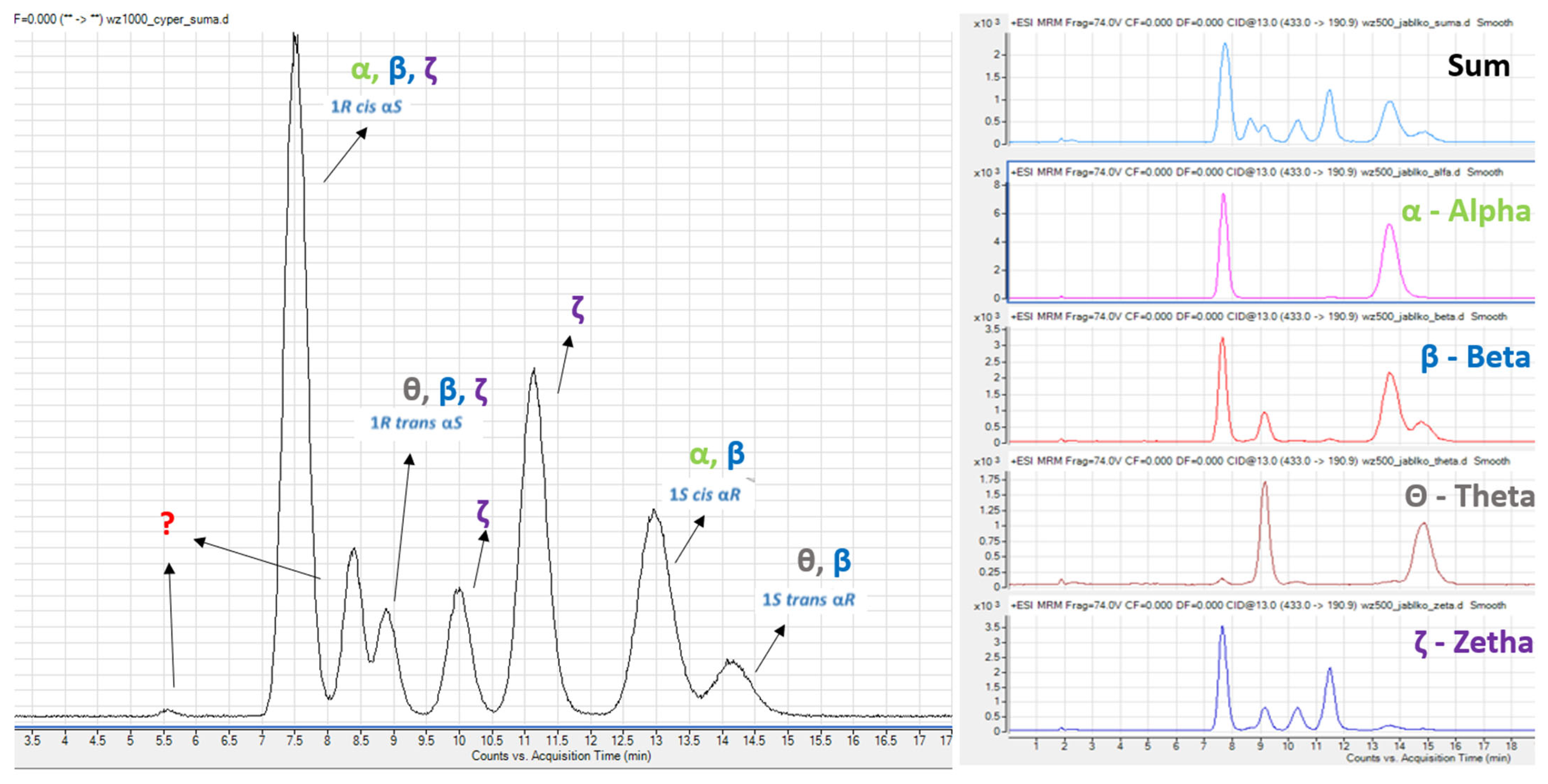
Chromatographic separation was achieved using a Daicel Chiralpak AD-H column (0.21 cm id × 15 cm length). The column compartment was maintained at 40 °C, while the autosampler temperature was kept at 10 °C. The injection volume was 2 μL. The mobile phase consisted of phase A, which was 1 mmol ammonium formate in 60% methanol, 15% acetonitrile, and 25% water, and phase B, which was 1 mmol ammonium formate in methanol. Chromatographic elution was performed at a constant flow rate of 0.2 mL min
−1. In the isocratic mode, the separation was carried out using a constant mobile-phase composition of 80% phase A and 20% phase B, with a total analysis time of 30 min. The ESI ion source parameters were optimized based on the instrument response. The drying gas temperature was set to 350 °C with a gas flow of 11 L min
−1. The nebulizer pressure was maintained at 45 psi. The sheath gas temperature was 375 °C, with a flow of 12 L min
−1. The capillary voltage was set to +4000 V, and the Delta EMV values were +300 in positive ion mode. The mass spectrometer operated in multiple reaction monitoring (MRM) mode, monitoring two transitions (quantifier and qualifier ions) per compound. Retention times, MRM transitions, fragmentor voltages, collision energies (CE), and collision cell accelerator voltages (CAV) for all analytes are listed in
Table 2. Instrument control, data acquisition, and quantitative analysis were carried out using Agilent MassHunter Workstation Software (version 09). Samples were kept in the autosampler at 10 °C throughout the sequence. No carry-over was detected based on solvent blanks injected after high-concentration standards.
2.5. Validation Parameters
The analytical method was validated in accordance with a predefined validation protocol complying with the performance criteria set out in SANTE/11312/2021 V2 for pesticide residue analysis. Quantification was based on matrix-matched calibration prepared in a high-water-content commodity (apple) to compensate for matrix-related signal suppression or enhancement inherent to LC-MS/MS analysis.
Method accuracy was evaluated through recovery experiments conducted at two fortification levels, corresponding to the limit of quantification (LOQ) and 5 × LOQ, with five independent replicates (n = 5) analyzed at each level, using concentration ranges consistent with those applied during validation. The limit of quantification (LOQ) for the analyzed compounds was established in the range of 0.010–0.050 mg·kg−1, depending on the analyte. An LOQ of 0.010 mg·kg−1 was determined for tetramethrin, bioresmethrin, bifenthrin, deltamethrin, fenpropathrin, resmethrin, and alpha-cypermethrin. A higher LOQ value of 0.020 mg·kg−1 was assigned to gamma-cyhalothrin, acrinathrin, and lambda-cyhalothrin, whereas the highest LOQ (0.050 mg·kg−1) was established for flucythrinate. Based on the validation study, the following performance parameters were established: LOQ, recovery, repeatability (RSDwR), linearity, matrix effects, and expanded measurement uncertainty. Analyte identification was achieved by LC-MS/MS following the injection of a certified multi-residue standard mixture, applying EU-compliant identification criteria that included retention time agreement within ±0.1 min relative to calibration standards and verification of multiple reaction monitoring (MRM) ion transition ratios within ±30% of the reference values. The LOQ for each pesticide was defined as the lowest validated calibration level at which the analyte produced a signal-to-noise ratio (S/N) ≥ 10, while the limit of detection (LOD) consistently corresponded to S/N ≥ 3. Method linearity was demonstrated over the concentration range of 0.010–0.25 mg kg−1, with coefficients of determination (R2) ranging from 0.995 to 0.9999, confirming an excellent linear response across the tested range.
4. Discussion
The enantioselective analysis of pyrethroid insecticides, such as cypermethrin, represents a critical challenge in pesticide residue monitoring due to the presence of multiple stereoisomers with distinct toxicological profiles. Among these, α-cypermethrin typically exhibits a racemic mixture of cis II isomers, whereas ζ-cypermethrin shows a markedly non-racemic distribution, highlighting the need for enantiomer-specific quantification. Conventional analytical techniques often fail to achieve sufficient resolution of these isomers, as isomerization processes can lead to partial interconversion, complicating both identification and accurate quantification. The results of the present study are compared with previously reported achievements in the stereoisomeric analysis of pyrethroids, as shown in
Table 4.
The study by Zhao et al. developed a multi-residue enantioselective LC–MS/MS method for 22 chiral pesticides using a Chiralpak IG column, achieving baseline resolution (Rs ≥ 1.5) for 21 compounds and partial resolution for one analyte (Rs = 1.44) within a total runtime of 47 min under isocratic conditions (65% acetonitrile, 0.6 mL min
−1). The method was optimized at a level by adjusting organic modifier type, ammonium acetate concentration (5 mmol L
−1), formic acid content (0.1%), flow rate, and column temperature (20–35 °C), providing a robust and high-throughput platform suitable for routine monitoring of multiple pesticide classes. However, the universality of this approach necessarily limits its ability to address compounds with complex stereochemical behavior, as the optimization was not targeted toward analytes undergoing dynamic isomerization or exhibiting highly non-racemic enantiomeric distributions [
18,
23].
In contrast, the present work focuses specifically on cypermethrin, a pyrethroid with cis II isomers that undergo isomerization and display markedly different enantiomeric ratios in commercial formulations (α-cypermethrin 50: 50 vs. ζ-cypermethrin 22: 3). Comparative evaluation of Chiralpak IG-3 and AD-H columns demonstrated that, despite its higher chemical stability, the IG-3 phase failed to achieve complete isomer resolution, whereas the AD-H column provided superior enantioselectivity. Systematic optimization revealed that variations in the flow rate (0.16–0.20 mL min−1) and mobile-phase composition (A: B ratios of 70: 30–84: 16) primarily affected retention times, without improving resolution, whereas column temperature exerted a decisive effect on enantiomeric discrimination. Increasing the temperature from 30 to 40 °C enabled near-complete separation of the terminal isomers, with 40 °C selected as an optimal compromise to preserve resolution across all isomers. These findings demonstrate that, unlike the multi-analyte method, accurate enantiomeric analysis of cypermethrin requires analyte-specific, thermodynamically driven optimization.
In another study conducted by Fan et al. (2015) [
21], the efficient enantioseparation of cypermethrin was accomplished using HPLC on a Chiralcel OD-H column under normal-phase conditions. Optimal resolution (Rs > 2) was achieved with a hexane: isopropanol ratio of 97:3, a flow rate of 0.4 mL/min, and UV detection at 236 nm. Enantioseparation arises from synergistic hydrogen bonding, dipole–dipole interactions, and π–π stacking between the cellulose-based chiral stationary phase and cypermethrin, enabling formation of stable diastereomeric complexes. Excess isopropanol compromised resolution, whereas reduced flow or lower alcohol content prolonged retention without enhancing selectivity [
21].
Yao et al. (2015) demonstrated that enantiomeric separation of α-cypermethrin was performed using normal-phase HPLC on a Chiralcel OD column (250 × 4.6 mm) with
n-hexane/isopropanol (98: 2,
v/
v) at 0.5 mL min
−1, 20 °C, and UV detection (230 nm), while quantification was carried out separately by GC-ECD following derivatization, achieving an LOQ of 0.015 mg kg
−1 [
12]. In contrast, the present method utilizes LC-MS-compatible chiral stationary phases (Chiralpak AD-H and IG-3) and demonstrates that the enantiomeric discrimination of cypermethrin is primarily governed by column temperature (30–45 °C) rather than by mobile-phase composition or flow rate. Unlike the approach of Yao et al., which is limited to racemic α-cypermethrin and relies on dual analytical platforms, the present work enables the characterization of stereochemically complex cypermethrin formulations within a single LC-based framework, thereby enhancing the reliability of enantiomer-resolved residue analysis and supporting more accurate enantiomer-specific toxicological and regulatory assessments [
12].
In the study conducted by Zhang et al., 2017 [
22], it was presented that the enantiomeric separation of bifenthrin and lambda-cyhalothrin was investigated using reversed-phase high-performance liquid chromatography on Lux Cellulose-1, Lux Cellulose-3, and Chiralpak IC chiral columns. Lux Cellulose-3 achieved baseline separation for both insecticides, with resolution factors up to 13.30 for bifenthrin and 8.29 for lambda-cyhalothrin, whereas Lux Cellulose-1 allowed complete separation of lambda-cyhalothrin and partial separation of bifenthrin. Chiralpak IC showed no separation capability. The mobile phase composition significantly influenced the separation, with methanol-water mixtures being optimal for bifenthrin on Lux Cellulose-3, and acetonitrile-water mixtures enhancing the separation of lambda-cyhalothrin. Lower proportions of organic solvent increased retention times and resolution, reflecting the influence of hydrogen bonding and π-π interactions between enantiomers and the chiral stationary phase. Column temperature also affected separation: lower temperatures generally increased retention and resolution, although maximum resolution occurred at intermediate temperatures in some cases. Thermodynamic analysis indicated that separation was enthalpy-driven, with stronger interactions for the second-eluting enantiomer. These results provide an optimized approach for enantiomer-specific analysis of pyrethroid insecticides, which is critical for environmental monitoring [
22].
In the present study, enantioselective separation was successfully achieved for tetramethrin, resmethrin, two flucythrinate isomers, bifenthrin, fenpropathrin, and lambda-cyhalothrin. In addition, single-enantiomer reference patterns were obtained for gamma-cypermethrin, bioresmethrin, acrinathrin, and deltamethrin. Stereochemical analysis was performed using a Chiralpak AD-H chiral stationary phase, which enabled efficient and reproducible resolution of the enantiomers of the investigated compounds. The applied LC–MS/MS method parameters provided high chromatographic resolution and excellent repeatability, allowing for precise stereochemical assignment and accurate quantitative characterization of individual enantiomers. The obtained results confirm the robustness and suitability of the proposed analytical strategy for monitoring enantiomeric purity and for assessing potential differences in biological activity among individual enantiomers.
An enantioselective LC–MS/MS method for permethrin was described by Lara et al. 2020 [
20], in which chromatographic parameters were identified as the dominant factors governing chiral resolution. The four stereoisomers ((1S)-trans-, (1R)-trans-, (1S)-cis-, and (1R)-cis-permethrin) were resolved on a LiChroCART ChiraDex column containing β-cyclodextrin covalently bonded to silica, where enantiodiscrimination arises from differential stability of diastereomeric inclusion complexes formed within the cyclodextrin cavity. Enantiomeric resolution was highly dependent on the mobile-phase composition: a water–methanol system supplemented with a low concentration of ammonium acetate (5 mM) favored analyte–stationary phase interactions, whereas higher salt concentrations or substitution with ammonium formate markedly reduced resolution due to the competitive inclusion of counterions. Flow rate (0.8 mL min
−1), column temperature (25 °C), and a carefully optimized isocratic–gradient elution program were used to balance analysis time and chiral selectivity, enabling baseline separation with resolutions exceeding 1.5 for both cis- and trans-enantiomeric pairs. Overall, stringent control of mobile-phase additives, hydrodynamic parameters, and elution profile was critical to achieving robust, high-impact enantioselective performance [
20].
Juvancz Z et al. [
19] concerning the selection of a chiral column for the GC–MS/MS method, complete separation of all investigated enantiomers was achieved using capillary columns containing permethylated cyclodextrin derivatives. The highest efficiency and chiral selectivity were obtained with the permethyl β-cyclodextrin column, for which a maximum selectivity factor of α = 1.284 was achieved for cis-permethrinic acid at 100 °C, together with high column efficiency. The superiority of β-cyclodextrin arises from the optimal match between the size of its cavity and the rigid cyclopropane structure of the analytes, promoting stable inclusion and hydrogen-bonding interactions. Free acid forms exhibited higher chiral selectivity than the corresponding methyl esters, whereas the ester derivatives provided improved peak symmetry and overall chromatographic performance [
19].
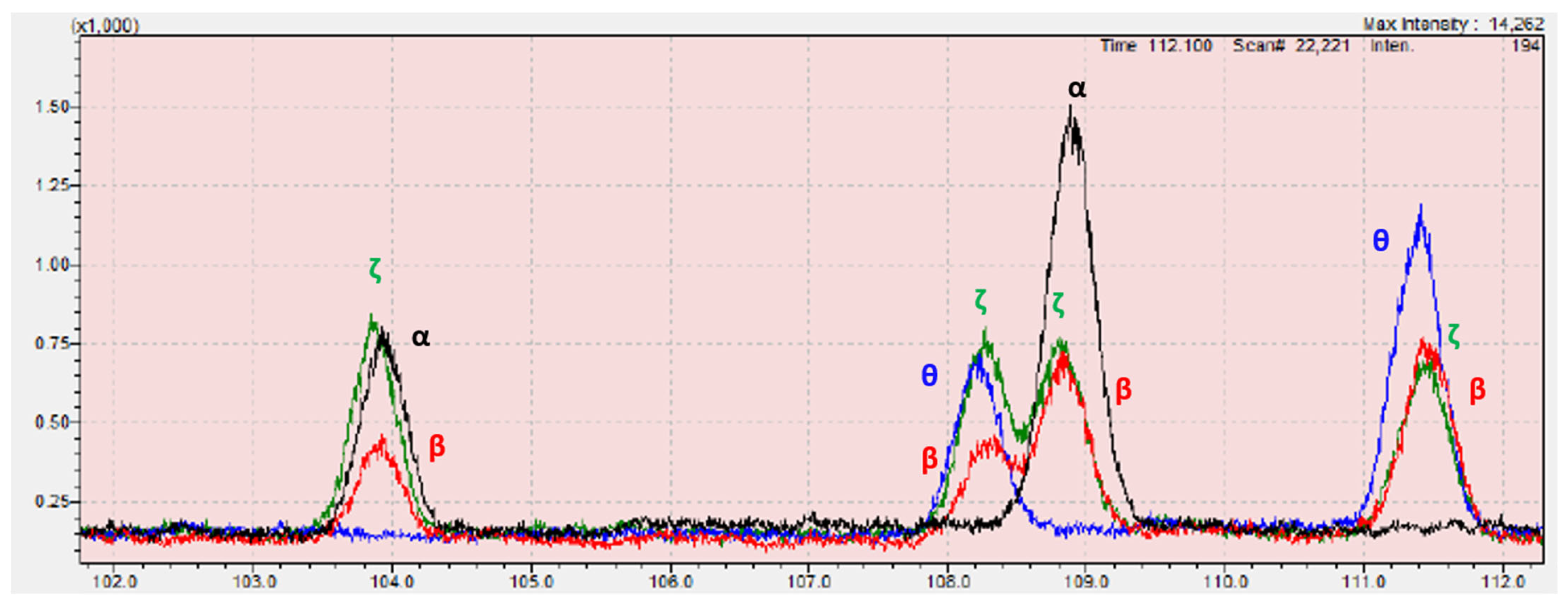
In our study employing GC–MS/MS, three capillary columns based on β-cyclodextrin stationary phases were evaluated. These columns differed only minimally in terms of cyclodextrin conformation and the nature of their substituents, which was intended to enhance chiral and diastereomeric selectivity. Despite these modifications, none of the tested columns provided complete chromatographic resolution of cypermethrin isomers. Partial separation was observed; however, significant co-elution of individual stereoisomers persisted, limiting reliable qualitative and quantitative analysis (
Figure 2). Furthermore, the chromatographic methods required extended analysis times, which negatively affected sample throughput. In addition, the overall sensitivity of the GC–MS/MS system under the applied conditions was insufficient, particularly for low-abundance isomers, resulting in inadequate signal-to-noise ratios. Considering the combination of incomplete isomeric resolution, prolonged run times, and low analytical sensitivity, further work aimed at optimizing a GC–MS/MS-based analytical method was deemed impractical and therefore discontinued.
Isomerization
Cypermethrin, a type II pyrethroid, undergoes significant epimerization within the GC injector due to interactions with active sites, leading to the formation of additional diastereomeric peaks. Polar solvents exacerbate this isomerization, whereas nonpolar solvents, particularly hexane, and the addition of 0.1% acetic acid effectively stabilize the primary isomer and increase the peak intensity by up to 1.9 times. Pulsed splitless injection at 30 psi and an injector temperature of 260 °C minimizes residence time and contact with active sites, thereby further reducing isomerization [
24].
In the study by Qin and Gan (2007) [
25], the enantiomerization of cypermethrin is strongly solvent-dependent, occurring rapidly in protic alcohols such as methanol and isopropanol, but is negligible in aprotic solvents, including n-hexane, acetone, and dichloromethane. After four days at room temperature, 18–39% of cypermethrin enantiomers converted at the R-carbon, while the cyclopropyl ring remained stable. Water as a cosolvent markedly accelerates enantiomerization. In 1: 1 methanol-water or isopropanol-water mixtures, equilibrium is reached within one day, whereas in acetone-water (1: 1) it occurs over four days with ~45% conversion. Lower temperatures (4 °C) reduce the extent of conversion to 3.8–11.8% [
25].
In a study conducted by Byrnes et al. [
26], it was found that the thermal isomerization of pyrethrins in gas chromatography occurs when temperatures exceed approximately 200 °C and is primarily governed by total thermal exposure time. Isothermal operation at 230 °C promotes the extensive conversion of pyrethrin I to isopyrethrin I, whereas temperature-programmed analysis with ramp rates of 5–15 °C min
−1 limits isomerization by allowing elution at lower effective temperatures. Splitless injection, combined with inlet temperatures of 300–320 °C, strongly enhances isomerization due to increased residence time in the hot injector, whereas split injection (10: 1) markedly reduces this effect. Increasing the carrier gas flow from 1.0 to 2.0 mL min
−1 shortens the retention time by approximately 1 min and lowers the elution temperature by roughly 10 °C, further suppressing thermal isomerization. These findings demonstrate that protic solvents and water facilitate R-carbon enantiomerization, potentially causing artifacts in chiral analysis and reducing the efficacy of enantiomer-enriched cypermethrin formulations. The results underscore the crucial importance of selecting and handling solvents carefully to maintain enantiomeric integrity in both analytical and practical applications, with implications for similar pyrethroids, such as cyfluthrin and cyhalothrin [
26].
The limitations of GC–MS/MS enantioseparation of cypermethrin are well-documented and match our findings. Liu and Gan (2004) [
27] evaluated cyclodextrin-based GC columns, including Cyclosil-B and the BGB series, for separating the stereoisomers of cypermethrin and cyfluthrin. Achiral columns (HP-5) achieved baseline separation of all diastereomers, whereas chiral β-cyclodextrin columns only partially resolved enantiomers. BGB-172 was separated into cis-diastereomers but not trans, effectively resolving six of eight stereoisomers. This was due to the high structural similarity and flexibility of trans-isomer pairs, which limited chiral recognition [
27]. Partial resolution required extended temperature programs with long isothermal holds (up to 60 min at 220 °C), highlighting the low throughput and practical limitations of GC. Our results with Cyclosil-B, BGB-174, and BGB-175 confirm these limitations; however, the BGB-172 column is no longer commercially available, which restricts full stereoisomeric GC analysis.
In the study by Michlig et al. [
28], pyrethroid pesticides, particularly type II compounds such as λ-cyhalothrin and deltamethrin, partially isomerized in the GC inlet, producing diastereomer peaks that affected LOQs but aided qualitative identification. Targeted methods—Cold EI-SIM and GC-MS/MS—showed comparable detectability (LOQs 5–6 ng g
−1, LOIs 7–8 ng g
−1), meeting regulatory limits. Cold EI-SIM ionizes analytes at reduced internal energy, enhancing molecular ions while monitoring selected ions for improved sensitivity. Interferences from lab materials, especially alkylated phenols from nitrile gloves, complicated identification. In contrast, Cold EI leveraged molecular ions absent in interferents, thereby improving selectivity and quantification reliability [
28].
In the present study, pronounced stereoisomerization of cypermethrin was observed under specific solvent conditions. When acetonitrile was used as the extraction solvent without PSA cleanup, the fraction of newly formed isomers increased to 12–15% after 4 h of storage at ambient temperature, with further acceleration observed upon exposure to sunlight. Under these conditions, direct quantitative determination of α-cypermethrin was therefore essential to ensure analytical accuracy and data integrity. Analytical reference standards and working solutions were prepared immediately prior to instrumental analysis in order to minimize pre-analytical isomerization. Gas chromatographic investigations revealed substantial solvent-induced isomerization in acetonitrile, whereas the use of n-hexane effectively limited isomer formation to below 3%. Collectively, these findings underscore the critical importance of rigorous analytical control, including the selection of appropriate solvents, the use of amber glassware, and the immediate preparation of analytical solutions, to ensure the accurate, reproducible, and artifact-free determination of α-cypermethrin in environmental samples and commercial formulations.