Micronutrient Intake, Supplementation Practices and Lifestyle Among Pregnant Women in Greece: A Review



Abstract
1. Introduction
2. Materials and Methods
3. Review of Findings
3.1. Vitamin Intake and Supplementation Practices Among Pregnant Women
3.1.1. Folic Acid and Iron
3.1.2. Vitamin D
3.1.3. Iodine
3.1.4. Preconception Intake and Overall Micronutrient Adequacy
3.1.5. Predictors of Supplementation
3.1.6. Synthesis of Findings
3.2. Caffeine, Tobacco and Alcohol Use Among Pregnant Women
3.2.1. Caffeine
3.2.2. Tobacco Use
3.2.3. Alcohol Consumption
3.3. Physical Activity
4. Discussion
4.1. Interpretation of Micronutrient Findings
4.2. Lifestyle Behaviours and Substance Use
4.3. Physical Activity and Sedentary Behaviour
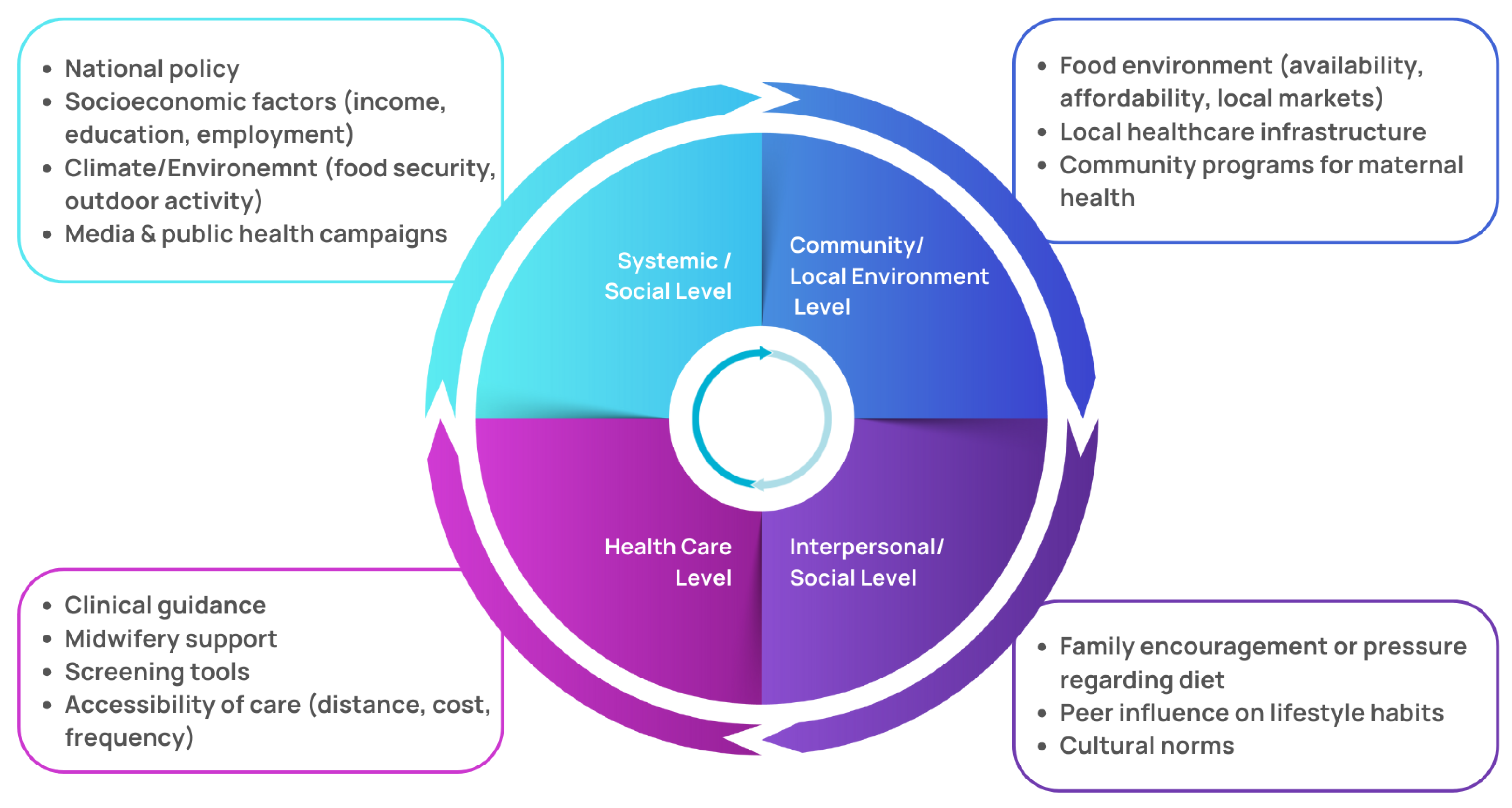
4.4. Structural and Systemic Determinants
4.5. Integrative Perspective
5. Public Health Implications
6. Future Research Directions
7. Conclusions
Author Contributions
Funding
Data Availability Statement
Acknowledgments
Conflicts of Interest
Abbreviations
| ACOG | American College of Obstetricians and Gynecologists |
| BMI | Body Mass Index |
| DRI | Dietary Reference Intake |
| FASD | Fetal Alcohol Spectrum Disorders |
| FGR | Fetal Growth Restriction |
| IU | International Units |
| MAR | Mean Adequacy Ratio |
| MET | Metabolic Equivalent of Task |
| NAR | Nutrient Adequacy Ratio |
| NTD | Neural Tube Defect |
| PA | Physical Activity |
| PPAQ | Pregnancy Physical Activity Questionnaire |
| RHEA | Rhea Mother-Child Cohort in Crete, Greece |
| SIDS | Sudden Infant Death Syndrome |
| TSH | Thyroid Stimulating Hormone |
| UV | Ultraviolet |
| WHO | World Health Organization |
References
- Naaz, A.; Muneshwar, K.N. How Maternal Nutritional and Mental Health Affects Child Health During Pregnancy: A Narrative Review. Cureus 2023, 15, e48763. [Google Scholar] [CrossRef] [PubMed]
- Marshall, N.E.; Abrams, B.; Barbour, L.A.; Catalano, P.; Christian, P.; Friedman, J.E.; Hay, W.W.; Hernandez, T.L.; Krebs, N.F.; Oken, E.; et al. The importance of nutrition in pregnancy and lactation: Lifelong consequences. Am. J. Obstet. Gynecol. 2022, 226, 607–632. [Google Scholar] [CrossRef]
- Rodríguez-Cano, A.M.; Calzada-Mendoza, C.C.; Estrada-Gutierrez, G.; Mendoza-Ortega, J.A.; Perichart-Perera, O. Nutrients, Mitochondrial Function, and Perinatal Health. Nutrients 2020, 12, 2166. [Google Scholar] [CrossRef]
- Farias, P.M.; Marcelino, G.; Santana, L.F.; de Almeida, E.B.; Guimarães Rde, C.A.; Pott, A.; Hiane, P.A.; Freitas, K.d.C. Minerals in Pregnancy and Their Impact on Child Growth and Development. Molecules 2020, 25, 5630. [Google Scholar] [CrossRef]
- Gernand, A.D.; Schulze, K.J.; Stewart, C.P.; West, K.P.; Christian, P. Micronutrient deficiencies in pregnancy worldwide: Health effects and prevention. Nat. Rev. Endocrinol. 2016, 12, 274–289. [Google Scholar] [CrossRef]
- Black, R.E.; Victora, C.G.; Walker, S.P.; Bhutta, Z.A.; Christian, P.; de Onis, M.; Ezzati, M.; Grantham-McGregor, S.; Katz, J.; Martorell, R.; et al. Maternal and child undernutrition and overweight in low-income and middle-income countries. Lancet 2013, 382, 427–451. [Google Scholar] [CrossRef]
- Koletzko, B.; Godfrey, K.M.; Poston, L.; Szajewska, H.; van Goudoever, J.B.; de Waard, M.; Brands, B.; Grivell, R.M.; Deussen, A.R.; Dodd, J.M.; et al. Nutrition During Pregnancy, Lactation and Early Childhood and its Implications for Maternal and Long-Term Child Health: The Early Nutrition Project Recommendations. Ann. Nutr. Metab. 2019, 74, 93–106. [Google Scholar] [CrossRef]
- Blencowe, H.; Cousens, S.; Modell, B.; Lawn, J. Folic acid to reduce neonatal mortality from neural tube disorders. Int. J. Epidemiol. 2010, 39, i110–i121. [Google Scholar] [CrossRef]
- Peña-Rosas, J.P.; de-Regil, L.M.; Garcia-Casal, M.N.; Dowswell, T. Daily Oral Iron Supplementation During Pregnancy. Cochrane Library. 2015. Available online: https://www.cochranelibrary.com/cdsr/doi/10.1002/14651858.CD004736.pub5/full (accessed on 7 September 2025).
- Bi, W.G.; Nuyt, A.M.; Weiler, H.; Leduc, L.; Santamaria, C.; Wei, S.Q. Association Between Vitamin D Supplementation During Pregnancy and Offspring Growth, Morbidity, and Mortality: A Systematic Review and Meta-analysis. JAMA Pediatr. 2018, 172, 635–645. [Google Scholar] [CrossRef] [PubMed]
- Zimmermann, M.B.; Boelaert, K. Iodine deficiency and thyroid disorders. Lancet Diabetes Endocrinol. 2015, 3, 286–295. [Google Scholar] [CrossRef] [PubMed]
- Cetin, I.; Devlieger, R.; Isolauri, E.; Obeid, R.; Parisi, F.; Pilz, S.; van Rossem, L. International expert consensus on micronutrient supplement use during the early life course. BMC Pregnancy Childbirth 2025, 25, 44. [Google Scholar] [CrossRef]
- Saros, L.; Hart, K.; Koivuniemi, E.; Egan, B.; Raats, M.; Laitinen, K. Micronutrient supplement recommendations in pregnancy vary across a geographically diverse range of countries: A narrative review. Nutr. Res. 2024, 123, 18–37. [Google Scholar] [CrossRef] [PubMed]
- Kawai, K.; Spiegelman, D.; Shankar, A.H.; Fawzi, W.W. Maternal multiple micronutrient supplementation and pregnancy outcomes in developing countries: Meta-analysis and meta-regression. Bull. World Health Organ. 2011, 89, 402–411B. [Google Scholar] [CrossRef] [PubMed]
- Carter, R.C.; Senekal, M.; Dodge, N.C.; Bechard, L.J.; Meintjes, E.M.; Molteno, C.D.; Duggan, C.P.; Jacobson, J.L.; Jacobson, S.W. Maternal Alcohol Use and Nutrition During Pregnancy: Diet and Anthropometry. Alcohol. Clin. Exp. Res. 2017, 41, 2114–2127. [Google Scholar] [CrossRef] [PubMed]
- Lakin, H.; Sheehan, P.; Soti, V. Maternal Caffeine Consumption and Its Impact on the Fetus: A Review. Cureus 2023, 15, e48266. [Google Scholar] [CrossRef]
- James, J.E. Maternal caffeine consumption and pregnancy outcomes: A narrative review with implications for advice to mothers and mothers-to-be. BMJ Evid-Based Med. 2021, 26, 114–115. [Google Scholar] [CrossRef]
- May, P.A.; Chambers, C.D.; Kalberg, W.O.; Zellner, J.; Feldman, H.; Buckley, D.; Kopald, D.; Hasken, J.M.; Xu, R.; Honerkamp-Smith, G.; et al. Prevalence of Fetal Alcohol Spectrum Disorders in 4 US Communities. JAMA 2018, 319, 474–482. [Google Scholar] [CrossRef]
- Chen, L.W.; Wu, Y.; Neelakantan, N.; Chong, M.F.F.; Pan, A.; van Dam, R.M. Maternal caffeine intake during pregnancy is associated with risk of low birth weight: A systematic review and dose-response meta-analysis. BMC Med. 2014, 12, 174. [Google Scholar] [CrossRef]
- Wells, A.C.; Lotfipour, S. Prenatal nicotine exposure during pregnancy results in adverse neurodevelopmental alterations and neurobehavioral deficits. Adv. Drug Alcohol Res. 2023, 3, 11628. [Google Scholar] [CrossRef]
- Ioannou, E.; Vivilaki, V.; Diamanti, A.; Tigka, M.; Dagla, M.; Nanou, C. Tobacco, alcohol and caffeine use during pregnancy and lactation: A narrative review. Eleutho 2025, 24, 1. [Google Scholar] [CrossRef]
- Vila-Farinas, A.; Pérez-Ríos, M.; Montes-Martínez, A.; Ahluwalia, J.S.; Mourino, N.; Rey-Brandariz, J.; Triñanes-Pego, Y.; Candal-Pedreira, C.; Ruano-Ravina, A.; Gómez-Salgado, P.; et al. Perception of pregnant individuals, health providers and decision makers on interventions to cease substance consumption during pregnancy: A qualitative study. BMC Public Health 2024, 24, 990. [Google Scholar] [CrossRef] [PubMed]
- Mourady, D.; Richa, S.; Karam, R.; Papazian, T.; Moussa, F.H.; Osta, N.E.; Kesrouani, A.; Azouri, J.; Jabbour, H.; Hajj, A. Associations between quality of life, physical activity, worry, depression and insomnia: A cross-sectional designed study in healthy pregnant women. PLoS ONE 2017, 12, e0178181. [Google Scholar] [CrossRef]
- Santos, P.C.; Maciel, L.Y.S.; Abreu, S.; Mesquita, A.R.; Mesquita, C.C.; Lopes, S.; Mota, J. Cultural adaptation and validation of the “Pregnancy Physical Activity Questionnaire” for the Portuguese population. PLoS ONE 2023, 18, e0279124. [Google Scholar] [CrossRef]
- Trichopoulou, A.; Vasilopoulou, E.; Georga, K.; Soukara, S.; Dilis, V. Traditional foods: Why and how to sustain them. Trends Food Sci. Technol. 2006, 17, 498–504. [Google Scholar] [CrossRef]
- Da Silva, R.; Bach-Faig, A.; Raidó Quintana, B.; Buckland, G.; Vaz de Almeida, M.D.; Serra-Majem, L. Worldwide variation of adherence to the Mediterranean diet, in 1961–1965 and 2000–2003. Public Health Nutr. 2009, 12, 1676–1684. [Google Scholar] [CrossRef]
- Zavras, D.; Tsiantou, V.; Pavi, E.; Mylona, K.; Kyriopoulos, J. Impact of economic crisis and other demographic and socio-economic factors on self-rated health in Greece. Eur. J. Public Health 2013, 23, 206–210. [Google Scholar] [CrossRef] [PubMed]
- Ifanti, A.A.; Argyriou, A.A.; Kalofonou, F.H.; Kalofonos, H.P. Financial crisis and austerity measures in Greece: Their impact on health promotion policies and public health care. Health Policy 2013, 113, 8–12. [Google Scholar] [CrossRef] [PubMed]
- Fotakis, E.A.; Kontele, I.; Tzoutzou, M.; Grammatikopoulou, M.G.; Arvanitaki, E.; Sergentanis, T.N.; Kotrokois, K.; Kornarou, E.; Vassilakou, T. Food Insecurity in Greece and across the Globe: A Narrative Literature Review. Foods 2024, 13, 1579. [Google Scholar] [CrossRef]
- Nilsen, R.M.; Vollset, S.E.; Gjessing, H.K.; Magnus, P.; Meltzer, H.M.; Haugen, M.; Ueland, P.M. Patterns and predictors of folic acid supplement use among pregnant women: The Norwegian Mother and Child Cohort Study2. Am. J. Clin. Nutr. 2006, 84, 1134–1141. [Google Scholar] [CrossRef]
- Allen, L.H. Multiple micronutrients in pregnancy and lactation: An overview. Am. J. Clin. Nutr. 2005, 81, 1206S–1212S. [Google Scholar] [CrossRef]
- Hatzopoulou, K.; Filis, V.; Grammatikopoulou, M.G.; Kotzamanidis, C.; Tsigga, M. Greek Pregnant Women Demonstrate Inadequate Micronutrient Intake Despite Supplement Use. J. Diet. Suppl. 2014, 11, 155–165. [Google Scholar] [CrossRef]
- Papadopoulou, E.; Stratakis, N.; Roumeliotaki, T.; Sarri, K.; Merlo, D.F.; Kogevinas, M.; Chatzi, L. The effect of high doses of folic acid and iron supplementation in early-to-mid pregnancy on prematurity and fetal growth retardation: The mother–child cohort study in Crete, Greece (Rhea study). Eur. J. Nutr. 2013, 52, 327–336. [Google Scholar] [CrossRef]
- Karras, S.N.; Koufakis, T.; Antonopoulou, V.; Goulis, D.G.; Annweiler, C.; Pilz, S.; Bili, H.; Naughton, D.P.; Shah, I.; Harizopoulou, V.; et al. Characterizing neonatal vitamin D deficiency in the modern era: A maternal-neonatal birth cohort from Southern Europe. J. Steroid Biochem. Mol. Biol. 2020, 198, 105555. [Google Scholar] [CrossRef]
- Kokkinari, A.; Antoniou, E.; Gourounti, K.; Dagla, M.; Iliadou, M.; Palaska, E.; Tomara, E.; Iatrakis, G. Prenatal Determinants of Maternal 25(OH)D Levels at Delivery: The Role of Diet and Supplement Use in a Cross-Sectional Study in Greece. Medicina 2025, 61, 1249. [Google Scholar] [CrossRef]
- Kokkinari, A.; Dagla, M.; Gourounti, K.; Sarantaki, A.; Kirkou, G.; Iliadou, M.; Antoniou, E.; Iatrakis, G. Seasonal and Environmental Determinants of Maternal and Neonatal Vitamin D Status: A Cross-Sectional Observational Cohort Study in Urban Greece. Healthcare 2025, 13, 2568. [Google Scholar] [CrossRef]
- Moreno-Reyes, R.; Fuentes Peña, C.; Nuñez, J.F.; Sánchez, M.B.; Carvajal, J.J.; Roble, K.; Mendoza-León, M.J.; Rangel-Ramírez, M.A.; Opazo, M.C.; Lay, M.K.; et al. Critical Role of Iodine and Thyroid Hormones During Pregnancy. Int. J. Mol. Sci. 2025, 26, 10247. [Google Scholar] [CrossRef] [PubMed]
- Koukkou, E.G.; Ilias, I.; Mamalis, I.; Markou, K.B. Pregnant Greek Women May Have a Higher Prevalence of Iodine Deficiency than the General Greek Population. Eur. Thyroid J. 2017, 6, 26–30. [Google Scholar] [CrossRef] [PubMed]
- Heimberg, K.; Martin, A.; Ehlers, A.; Weißenborn, A.; Hirsch-Ernst, K.I.; Weikert, C.; Nagl, B.; Katsioulis, A.; Kontopoulou, L.; Marakis, G. Knowledge and awareness about and use of iodised salt among students in Germany and Greece. BMC Public Health 2022, 22, 1851. [Google Scholar] [CrossRef]
- Khudair, A.; Khudair, A.; Niinuma, S.A.; Habib, H.; Butler, A.E. Beyond thyroid dysfunction: The systemic impact of iodine excess. Front. Endocrinol. 2025, 16, 1568807. [Google Scholar] [CrossRef] [PubMed]
- Apostolopoulou, A.; Tranidou, A.; Chroni, V.; Tsakiridis, I.; Tsekitsidi, E.; Kalaitzopoulou, I.; Magriplis, E.; Bakaloudi, D.R.; Chrysoula, L.; Pazaras, N.; et al. Preconceptional micronutrient adequacy among women in Greece: A prospective epidemiological study. J. Matern. Fetal Neonatal Med. 2024, 37, 2343613. [Google Scholar] [CrossRef]
- Tigka, M.; Metallinou, D.; Tzeli, M.; Lykeridou, K. Maternal tobacco, alcohol and caffeine consumption during the perinatal period: A prospective cohort study in Greece in the midst of COVID-19 pandemic. Tob. Induc. Dis. 2023, 21, 80. [Google Scholar] [CrossRef] [PubMed]
- Papadakis, S.; Vardavas, C.I.; Katsaounou, P.; Smyrnakis, E.; Samoutis, G.; Lintovoi, E.; Tatsioni, A.; Tsiligianni, I.; Thireos, L.; Makaroni, S.; et al. National scale-up of the TITAN Greece and Cyprus Primary Care Tobacco Treatment Training Network: Efficacy, assets, and lessons learned. Tob. Prev. Cessat. 2022, 8, A37. [Google Scholar] [CrossRef]
- Mitrogiannis, I.; Chatzakis, C.; Skentou, C.; Koutalia, N.; Makrydimas, S.; Efthymiou, A.; Makrydimas, G. Pregnancy physical activity questionnaire: Translation and cross-cultural adaptation of a Greek version. Eur. J. Obstet. Gynecol. Reprod. Biol. 2023, 291, 156–161. [Google Scholar] [CrossRef]
- Dube, R.; Kar, S.S.; Bahutair, S.N.M.; Kuruba, M.G.B.; Shafi, S.; Zaidi, H.; Garg, H.C.; Almas, Y.M.; Kidwai, A.; Zalat, R.A.F.; et al. The Fetal Effect of Maternal Caffeine Consumption During Pregnancy—A Review. Biomedicines 2025, 13, 390. [Google Scholar] [CrossRef]
- Tigka, M.; Nanou, C.; Tzeli, M.; Gryparis, A.; Metallinou, D.; Lykeridou, A. The effect of maternal caffeine consumption during the perinatal period on lactation. Health Res. J. 2024, 10, 51–59. [Google Scholar] [CrossRef]
- Diamanti, A.; Lykeridou, K.; Raftopoulos, V.; Katsaounou, P. Smoking and alcohol consumption during pregnancy. The situation in Greece. Eur. Respir. J. 2020, 56, 1330. [Google Scholar] [CrossRef]
- Tsakiridis, I.; Mamopoulos, A.; Papazisis, G.; Petousis, S.; Liozidou, A.; Athanasiadis, A.; Dagklis, T. Prevalence of smoking during pregnancy and associated risk factors: A cross-sectional study in Northern Greece. Eur. J. Public Health 2018, 28, 321–325. [Google Scholar] [CrossRef] [PubMed]
- Skalis, G.; Archontakis, S.; Thomopoulos, C.; Andrianopoulou, I.; Papazachou, O.; Vamvakou, G.; Aznaouridis, K.; Katsi, V.; Makris, T. A single-center, prospective, observational study on maternal smoking during pregnancy in Greece: The HELENA study. Tob. Prev. Cessat. 2021, 7, 16. [Google Scholar] [CrossRef]
- Vivilaki, V.G.; Diamanti, A.; Tzeli, M.; Patelarou, E.; Bick, D.; Papadakis, S.; Lykeridou, K.; Katsaounou, P. Exposure to active and passive smoking among Greek pregnant women. Tob. Induc. Dis. 2016, 14, 12. [Google Scholar] [CrossRef]
- Diamanti, A.; Raftopoulos, V.; Lykeridou, K.; Katsaounou, P.; Rm, A.D. Smoking and Pregnancy: Where are we now? An Update of the Situation in Greece. Int. J. Caring Sci. 2019, 12, 79–91. [Google Scholar]
- Banderali, G.; Martelli, A.; Landi, M.; Moretti, F.; Betti, F.; Radaelli, G.; Lassandro, C.; Verduci, E. Short and long term health effects of parental tobacco smoking during pregnancy and lactation: A descriptive review. J. Transl. Med. 2015, 13, 327. [Google Scholar] [CrossRef]
- Mourtakos, S.P.; Tambalis, K.D.; Panagiotakos, D.B.; Antonogeorgos, G.; Arnaoutis, G.; Karteroliotis, K.; Sidossis, L.S. Maternal lifestyle characteristics during pregnancy, and the risk of obesity in the offspring: A study of 5125 children. BMC Pregnancy Childbirth 2015, 15, 66. [Google Scholar] [CrossRef] [PubMed]
- DeJong, K.; Olyaei, A.; Lo, J.O. Alcohol Use in Pregnancy. Clin. Obstet. Gynecol. 2019, 62, 142–155. [Google Scholar] [CrossRef]
- Gascoigne, E.L.; Webster, C.M.; West Honart, A.; Wang, P.; Smith-Ryan, A.; Manuck, T.A. Physical activity and pregnancy outcomes: An expert review. Am. J. Obstet. Gynecol. MFM 2023, 5, 100758. [Google Scholar] [CrossRef] [PubMed]
- Tsarna, E.; Liakopoulou, M.; Mavromati, I.; Toutoudaki, K.; Paltoglou, G.; Aravantinos, L.; Christopoulos, P. 183 Physical activity routine during pregnancy in greece: A cross-sectional study. Eur. J. Obstet. Gynecol. Reprod. Biol. 2022, 270, e70–e71. [Google Scholar] [CrossRef]
- Michou, V.; Tsiotsias, A.; Eskitzis, P. Assessment of Maternal Dietary Intake, Physical Activity Status, and Body Composition During Pregnancy: A Cross-Sectional Study. Nurs. Rep. 2025, 15, 99. [Google Scholar] [CrossRef] [PubMed]
- Koivuniemi, E.; Hart, K.; Mazanowska, N.; Ruggeri, S.; Egan, B.; Censi, L.; Roccaldo, R.; Mattila, L.; Buonocore, P.; Löyttyniemi, E.; et al. Food Supplement Use Differs from the Recommendations in Pregnant Women: A Multinational Survey. Nutrients 2022, 14, 2909. [Google Scholar] [CrossRef]
- Díaz-Rizzolo, D.A.; Kostov, B.; Gomis, R.; Sisó-Almirall, A. Paradoxical suboptimal vitamin D levels in a Mediterranean area: A population-based study. Sci. Rep. 2022, 12, 19645. [Google Scholar] [CrossRef]
- Fatima, N.; Yaqoob, S.; Rana, L.; Imtiaz, A.; Iqbal, M.J.; Bashir, Z.; Shaukat, A.; Naveed, H.; Sultan, W.; Afzal, M.; et al. Micro-nutrient sufficiency in mothers and babies: Management of deficiencies while avoiding overload during pregnancy. Front. Nutr. 2025, 12, 1476672. [Google Scholar] [CrossRef]
- Wesołowska, E.; Jankowska, A.; Trafalska, E.; Kałużny, P.; Grzesiak, M.; Dominowska, J.; Hanke, W.; Calamandrei, G.; Polańska, K. Sociodemographic, Lifestyle, Environmental and Pregnancy-Related Determinants of Dietary Patterns during Pregnancy. Int. J. Environ. Res. Public Health 2019, 16, 754. [Google Scholar] [CrossRef]
- Struniewicz, K.M.; Ptaszek, M.M.; Ziółkowska, A.M.; Nitsch-Osuch, A.; Kozłowska, A. Pregnancy and Caffeine Metabolism: Updated Insights and Implications for Maternal–Fetal Health. Nutrients 2025, 17, 3173. [Google Scholar] [CrossRef] [PubMed]
- Lange, S.; Probst, C.; Gmel, G.; Rehm, J.; Burd, L.; Popova, S. Global Prevalence of Fetal Alcohol Spectrum Disorder Among Children and Youth: A Systematic Review and Meta-analysis. JAMA Pediatr. 2017, 171, 948–956. [Google Scholar] [CrossRef]
- Popova, S.; Lange, S.; Probst, C.; Gmel, G.; Rehm, J. Estimation of national, regional, and global prevalence of alcohol use during pregnancy and fetal alcohol syndrome: A systematic review and meta-analysis. Lancet Glob. Health 2017, 5, e290–e299. [Google Scholar] [CrossRef]
- Redman, L.M.; Phelan, S.; Apolzan, J.W.; Beyl, R.A.; Altazan, A.D.; Dickey, M.S.; Simeon, E.; Flanagan, E.W.; E Cabre, H.; Sparks, J.R.; et al. Protocol for a randomised controlled trial of a weight maintenance intervention to promote fat loss in pregnant individuals with obesity. BMJ Open 2025, 15, e095804. [Google Scholar] [CrossRef] [PubMed]
- McGregor, G.; Evans, B.; Sandhu, H.K.; Bruce, J.; Devi, G.; Hayat, S.; Hee, S.W.; Heine, P.; Holliday, N.; Joshi, S.; et al. Exercise rehabilitation for people with postural tachycardia syndrome at two secondary care centres in the UK: The PULSE feasibility randomised controlled trial. BMJ Open 2025, 15, e090197. [Google Scholar] [CrossRef] [PubMed]
- Wiles, J.D.; Santer, E.; Rees-Roberts, M.; Borthwick, R.; Doulton, T.; Swift, P.A.; Pellatt-Higgins, T.; Saxby, K.; Mills, A.; Gousia, K.; et al. Feasibility randomised controlled trial to assess the delivery of a novel isometric exercise intervention for people diagnosed with uncomplicated stage 1 hypertension in the National Health Service: Key quantitative findings. BMJ Open 2025, 15, e091219. [Google Scholar] [CrossRef]
- Borodulin, K.; Evenson, K.R.; Wen, F.; Herring, A.H.; Benson, A. Physical Activity Patterns during Pregnancy. Med. Sci. Sports Exerc. 2008, 40, 1901–1908. [Google Scholar] [CrossRef]
- Miteniece, E.; Pavlova, M.; Rechel, B.; Groot, W. Barriers to accessing adequate maternal care in Central and Eastern European countries: A systematic literature review. Soc. Sci. Med. 2017, 177, 1–8. [Google Scholar] [CrossRef]
- Kentikelenis, A.; Karanikolos, M.; Reeves, A.; McKee, M.; Stuckler, D. Greece’s health crisis: From austerity to denialism. Lancet 2014, 383, 748–753. [Google Scholar] [CrossRef]
- Sandall, J.; Soltani, H.; Gates, S.; Shennan, A.; Devane, D. Midwife-led continuity models versus other models of care for childbearing women. Cochrane Database Syst. Rev. 2016, 4, CD004667. [Google Scholar] [CrossRef]
- Renfrew, M.J.; McFadden, A.; Bastos, M.H.; Campbell, J.; Channon, A.A.; Cheung, N.F.; Silva, D.R.A.D.; Downe, S.; Kennedy, H.P.; Malata, A.; et al. Midwifery and quality care: Findings from a new evidence-informed framework for maternal and newborn care. Lancet 2014, 384, 1129–1145. [Google Scholar] [CrossRef]
- Kontoyannis, M.; Dagla, M.; Kokkosi, E.; Vivilaki, V.; Katsetos, C.; Sarella, A. Factors Affecting the Implementation of Community Perinatal Midwifery Care in Greece, in Relation to the Perspectives, Attitudes, and Expectations of Primary Healthcare Midwives. Cureus 2025, 17, e80566. [Google Scholar] [CrossRef] [PubMed]
- Delakovia, T.; Katsaounou, P.; Sarantaki, A.; Bakou, A.; Lykeridou, A.; Diamanti, A. Exploring Greek midwives’ knowledge, attitudes, and practices in perinatal smoking: A cross-sectional study. Tob. Prev. Cessat. 2025, 11, 33. [Google Scholar] [CrossRef] [PubMed]
- Favara, G.; Maugeri, A.; Magnano San Lio, R.; Barchitta, M.; Agodi, A. Exploring Gene–Diet Interactions for Mother–Child Health: A Systematic Review of Epidemiological Studies. Nutrients 2024, 16, 994. [Google Scholar] [CrossRef] [PubMed]
- Bertuccio, M.P.; Currò, M.; Caccamo, D.; Ientile, R. Dietary Intake and Genetic Background Influence Vitamin Needs during Pregnancy. Healthcare 2022, 10, 768. [Google Scholar] [CrossRef]
- Khotimah, K.; Sacharum, N. Effectiveness of Nutritional Counseling on Improving Dietary Compliance Among Pregnant Women. Prof. Health J. 2025, 7, 394–401. [Google Scholar] [CrossRef]
- Knudsen Sde, P.; Roland, C.B.; Alomairah, S.A.; Jessen, A.D.; Maindal, H.T.; Bendix, J.M.; Clausen, T.D.; Løkkegaard, E.; Stallknecht, B.; Molsted, S. The effect of exercise training and motivational counselling on physical activity behaviour and psychosocial factors in pregnant women: Secondary analyses of the FitMum randomised controlled trial investigating prenatal physical activity. BMC Public Health 2024, 24, 92. [Google Scholar] [CrossRef]
- Bose, C.L.; Bauserman, M.; Goldenberg, R.L.; Goudar, S.S.; McClure, E.M.; Pasha, O.; A Carlo, W.; Garces, A.; Moore, J.L.; Miodovnik, M.; et al. The Global Network Maternal Newborn Health Registry: A multi-national, community-based registry of pregnancy outcomes. Reprod. Health 2015, 12, S1. [Google Scholar] [CrossRef]
- Griese, A.; Schuessler, F.; Fleming, T.; Leinweber, J. Applying a Health Care Planning Model to Midwifery: Evidence from Germany and New Zealand. Eur. J. Public Health 2025, 35, ckaf161.1438. [Google Scholar] [CrossRef]
- Myhre, S.L.; Frønsdal, K.B.; Ames, H.M.R.; Papadopoulou, E. A scoping review of climate resilient health system strategies in low-resource settings. Public Health 2025, 249, 106026. [Google Scholar] [CrossRef]
- European Institute of Women’s Health. Maternal Health in the European Union Report. 2022. Available online: https://eurohealth.ie/wp-content/uploads/2023/12/Maternal-Report-2023.pdf (accessed on 10 November 2025).


| Study | Sample/Design | Main Focus | Main Findings | Implications for Practice/Policy |
|---|---|---|---|---|
| [32] | Cross-sectional, 100 pregnant women | Supplementation practices and dietary adequacy | 92% reported supplement use; excess intake common for calcium (84%) and iron (80%); suboptimal folate intake persisted in 8%. | Highlights need for clinical supervision and standardized supplementation guidelines. |
| [33] | Prospective, 1279 women | Folic acid and iron supplementation and birth outcomes | High adherence to folic acid (87.7%) and iron (85.2%); folic acid 5 mg/day reduced risk of preterm birth by 31%. Excess iron (>100 mg/day) increased growth restriction risk. | Confirms benefits of guideline-level folate; warns against unsupervised high-dose iron use. |
| [34] | Cross-sectional, 129 mother–infant pairs | Vitamin D status and neonatal outcomes | 60% of neonates were vitamin D deficient at birth; deficiency linked to impaired skeletal development. | Supports routine vitamin D assessment and context-specific supplementation. |
| [35,36] | Cross-sectional, 248 women, multi-seasonal | Seasonal and environmental variation in vitamin D | 58% of mothers deficient (<20 ng/mL); higher levels in summer deliveries; supplementation (400–800 IU/day) halved maternal deficiency but not neonatal. | Emphasizes need for adjusted vitamin D dosing by season and exposure. |
| [38] | National sample, 1118 pregnant women, 19 regions | Iodine deficiency and thyroid function | 61% below WHO iodine threshold (150 µg/L); TSH increased across trimesters, indicating thyroid stress. | Calls for review of iodized salt policy and pregnancy-specific iodine programmes. |
| [41] | Cross-sectional, 1100 women | Preconception micronutrient adequacy | Vitamin D and iodine most inadequate (NAR 0.07 and 0.46); 12.8% exceeded magnesium upper limit. | Underlines insufficient preconception counselling and supplement oversight. |
| [42] | Prospective, 400 women | Tobacco, caffeine, and alcohol use during pregnancy/lactation | Smoking decreased from 17.6% in pregnancy to 5.6% during lactation, rebounding to 16.9% post-weaning; caffeine use >80% across perinatal period. | Demonstrates persistent behavioural risks and weak cessation support systems. |
| [43] | Implementation study, primary care network | Midwife-led cessation counselling | Training improved provider competence; pilot sites achieved measurable smoking reduction. | Highlights scalable community-based models for behavioural change. |
| [44] | Cohort validation (PPAQ-Greek) of 1058 women | Physical activity validation and levels | Median total PA 142 MET-h/week; only 14.8% met WHO PA guidelines. | Indicates urgent need for structured antenatal PA counselling. |
Disclaimer/Publisher’s Note: The statements, opinions and data contained in all publications are solely those of the individual author(s) and contributor(s) and not of MDPI and/or the editor(s). MDPI and/or the editor(s) disclaim responsibility for any injury to people or property resulting from any ideas, methods, instructions or products referred to in the content. |
© 2025 by the authors. Licensee MDPI, Basel, Switzerland. This article is an open access article distributed under the terms and conditions of the Creative Commons Attribution (CC BY) license.
Share and Cite
Kapellou, A.; Koutelidakis, A.E.; Stoupi, S. Micronutrient Intake, Supplementation Practices and Lifestyle Among Pregnant Women in Greece: A Review. Appl. Sci. 2026, 16, 429. https://doi.org/10.3390/app16010429
Kapellou A, Koutelidakis AE, Stoupi S. Micronutrient Intake, Supplementation Practices and Lifestyle Among Pregnant Women in Greece: A Review. Applied Sciences. 2026; 16(1):429. https://doi.org/10.3390/app16010429
Chicago/Turabian StyleKapellou, Angeliki, Antonios E. Koutelidakis, and Stavroula Stoupi. 2026. "Micronutrient Intake, Supplementation Practices and Lifestyle Among Pregnant Women in Greece: A Review" Applied Sciences 16, no. 1: 429. https://doi.org/10.3390/app16010429
APA StyleKapellou, A., Koutelidakis, A. E., & Stoupi, S. (2026). Micronutrient Intake, Supplementation Practices and Lifestyle Among Pregnant Women in Greece: A Review. Applied Sciences, 16(1), 429. https://doi.org/10.3390/app16010429