


Abstract
The selection of a sustainable packaging circular model approach entails numerous obstacles under rapidly developing circumstances, such as environmental factors, market competition, and advancing technology, impacting decision-making processes. We have considered Z-number-based decision-making methods as an alternative to the conventional method. This study presents a selection of circular sustainable packaging models, considering significant challenges from five primary objectives: economic, environmental, social responsibility, sustainability, and time-based, with three circular models: biodegradable, compostable, and recycling. The ZF-DEMATEL-TOPSIS method is used in an integrated manner to address the packaging circular model selection problem. The study results indicate that the mass-customized recyclable packaging circular model is the most highly sustainable among the three models. At the same time, the most significant challenges are production cost, energy efficiency, and makespan. The proposed method was validated using the sensitivity analysis with an 90% consistency ratio. We conducted this study to aid in analyzing and developing a highly sustainable mass-customized circular packaging model.
1. Introduction
Davis coined the term “Mass Customization” (MC) in 1989. MC signifies satisfying customer needs by providing customized products at a cost comparable to mass-produced goods [1]. Differentiating across Mass Production (MP) and MC as two different perspectives of manufacturing strategic planning is gaining more and more attention. It is crucial to quickly emphasize the function of production and technology in limiting the alternatives of a firm’s overall strategy to understand the contrast between MP and MC [2]. MC is a contemporary production methodology that faces numerous challenges, including optimal batch sizing to balance customization with ideal lead time. In MC, batch size also directly influences cost and time; if the smaller batches lead to higher production costs, a larger batch size leads to extended production time [3]. Small and medium-sized enterprises (SMEs) form the backbone of any country’s economy and are the world’s most active and dynamic industries. India, the world’s second-largest SME base, is balanced to meet the growing customer demand for customized, sustainable products. SMEs have an excellent opportunity to grow and innovate. By embracing MC within a circular economy (CE) framework, SMEs can contribute significantly to sustainable economic growth, reduce waste, and improve resource efficiency [4,5].
In a CE, sustainability is enhanced by prioritizing the system’s eco-efficiency. It entails mitigating the system’s adverse consequences by prioritizing the benefits of implementing the innovative new system [6]. A CE strategy is economically feasible and designed to optimize resource consumption. The CE has an insignificant adverse effect on the environment, economy, society, and community [7]. In a CE firm, products are produced and leased to consumers. Upon the expiration of the usage time, consumers can return the products to the manufacturers for recycling. Reducing waste leads to increased financial gains for both manufacturers and consumers. The primary goal of the CE is to decrease waste and reintegrate end-of-life products into the economic cycle. In addition, using sustainable materials revamps the manufacturing and utilization of goods and inspires hope for a greener future [8]. Combining three-dimensional printing with food waste upcycling to advance CE objectives while enabling the mass customization of sustainable products [9]. The CE in the packaging industry is intended to reduce waste, encourage reuse, recycling, and recovery, and promote ecologically friendly products [10]. Different packaging models, such as biodegradable, compostable, and recyclable, are attainable in mass-customized CE. Effective decision-making tools are required to evaluate and rank various possibilities to determine the best environmentally friendly packaging model.
Early in the 1970s, the Group Multi Criteria Decision-Making (GMCDM) concept was recognized as an essential area of research. In operations research, it represents a well-known class of this decision-making problem. The standard GMCDM challenge focuses on assessing a collection of options among a selection of decision criteria. Each decision-making challenge has some ambiguity, encompassing hesitancy, partialness, or inaccuracy. Crisp numbers are very difficult and reflect these ambiguities. So, Zadeh introduced the fuzzy set theory in 1965 to address the uncertainty problem. Fuzzy set theory helps to overcome ambiguity in decision-making problems [11,12,13,14]. Later, a unique Z-number approach was presented by incorporating probability distributions into unknown variables to tackle the confidence associated with decision-making information [15]. The Z-number is consistent with how humans communicate information since it comprises fuzzy restriction and reliability or confidence. In recent years, substantial investigations have been conducted in several domains since the notion of Z-numbers was developed [16]. Researchers have devoted a lot of time to numerous Z-number MCDM approaches, such as the Z-number based CFAHP-CoCoSo, FAHP, DEA, ELECTRE III, TOPSIS, DEMATEL, COPRAS, and CODAS methods [12,17,18,19,20,21]. The sustainable circular economy’s enablers of the additive manufacturing (AM) paradigm have identified mass customization as one of the vital enablers for sustainability, with social, economic, and environmental impacts, through DEMATEL [22].
However, only some studies have examined mass-customized CE with 3D printing or AM. Further study is needed to explore different industrial sectors. This work is significant, considering it attempts to bridge this gap by reviewing the highly sustainable packaging industry within a mass-customized environment suitable for circular economy practices. The goal is to achieve sustainable value-based SMEs, recognizing their integral role in the circular economy, with the active participation of circular economy experts from academic institutions as decision-makers.
Research questions:
- RQ1:
- How can mass-customized circular economy initiatives in the packaging sector help SMEs build a highly sustainable packaging model for value-driven performance?
- RQ2:
- What are the main challenges SMEs face when implementing mass-customized circular economy practices in the packaging sector and creating sustainable circular supply chain operations?
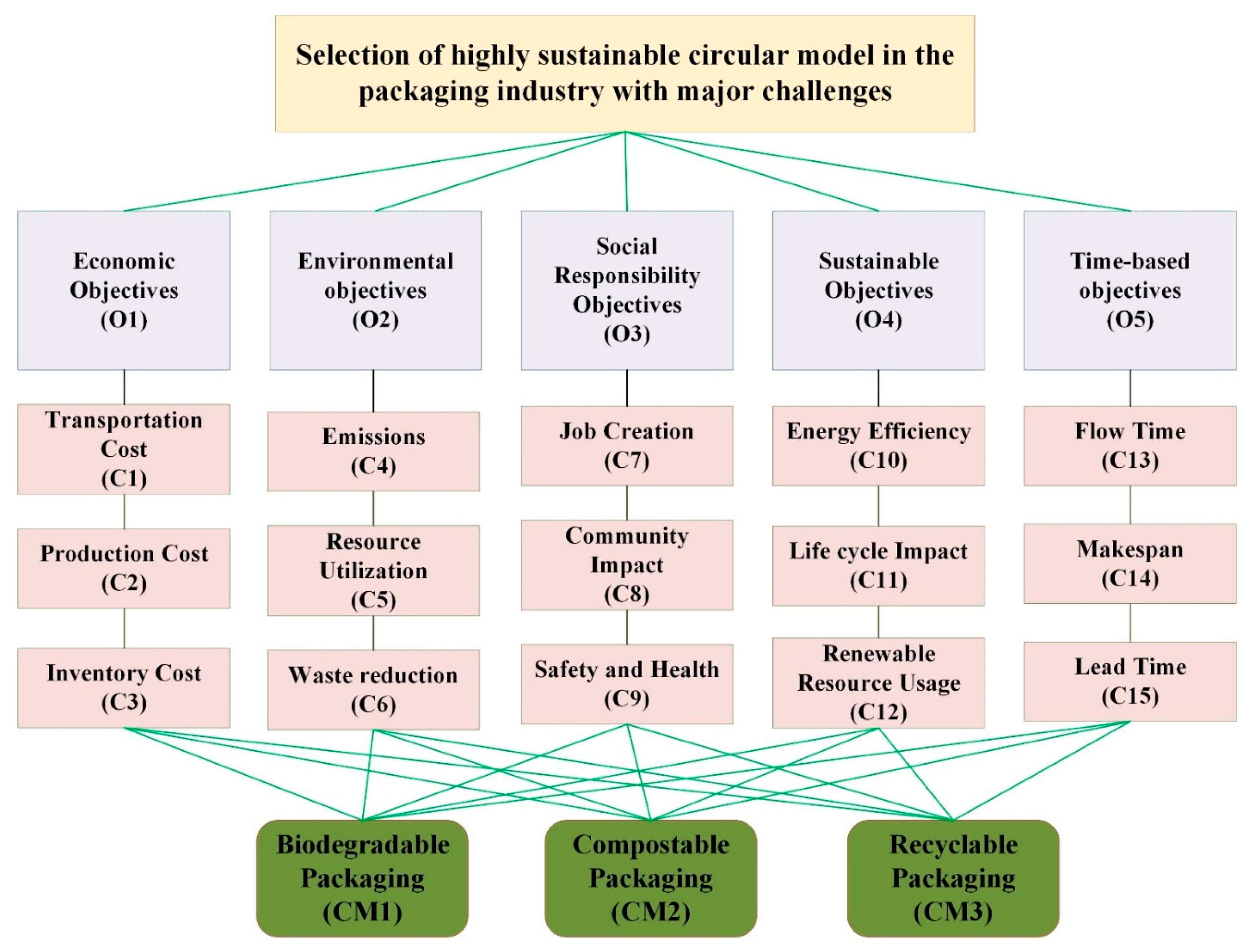
To address this study’s research question, we employ the Group Multi-Criteria Decision-Making (GMCDM) technique to determine which circular packaging model has the most sustainable impact on the circular model in the context of the SMEs-based mass customization packaging industry. This technique, which involves assessing a collection of options in view among a selection of decision criteria, is based on expert decision-maker inputs. To address the challenges in the closed-loop mass-customized packaging industry, we propose a Z-number-based fuzzy DEMATEL with TOPSIS (ZF-DEMATEL-TOPSIS) model. Based on prior literature investigations, this model is designed to solve an illustrated mass-customized sustainable circular model with a Z-number-based MCDM model. The goal is to select a highly sustainable packaging circular model known as the first level. Five significant objectives make up the second level. Based on the previous literature on circular models, the third level was divided into 15 sub-criteria as challenges. The three circular models make up the fourth level. We evaluate the suggested technique by ranking the circular model needed to accomplish the goal with a validity test.
The remainder of this article is structured as follows: Section 2 provides an overview of related works. Section 3 presents the proposed framework model-solving method, which has practical applications in the circular model selection process. Section 4 offers an application of our framework in the context of significant challenges in the circular model selection. Finally, in Section 5, we conclude and outline future directions, inviting further engagement with our research.
2. Related Works
The goal of MC is to provide customized goods while maintaining manufacturing efficiency. The CE plays a crucial role in emphasizing resource conservation, recycling, and reuse to create sustainable product lifecycles. The integration between MC and CE has minimal numbers of studies explored in the AM or 3D printing sectors, highlighting a significant research gap that needs to be addressed in different sectors. However, this research examines the integration of mass-customized CE in the packaging sector, paving the way for further challenges exploration in these areas.
2.1. Current Trends in Circular Economy
According to Guillard et al. (2018), the circular packaging model reduces emissions and preserves food. It is necessary to address plastic litter, food safety, and waste reduction. Instead of fossil feed and soil nutrients, microbially biodegradable polymers made from agro-food waste are an option. Food companies select packaging that reduces waste by conducting mathematical simulations [23]. Kumar et al. (2019) presented that the CE in the manufacturers has challenges and opportunities in the areas of social, political, economic, legal, and environmental problems. Over 200 EU and UK manufacturers have evaluated the benefits and identified various challenges of CE implementation. From a socio-political perspective, the barrier lies in the limited public awareness of the CE, and the benefit is the potential for job creation. The economic obstacle was the lack of suitable partners in supply chains (SCs), while the benefit was the reduction of costs through the implementation of a sustainable SC. From an environmental perspective, an insufficient waste resource system poses a barrier, while sustainable products can help reduce environmental pollution [24]. Meherishi et al. (2019) propose that the three topologies of the SC are downstream recovery and logistics, integrated SC, and mixed SC, which are examined for dyads and broken parts in packaging that impact industry waste and transit. Packaging trends accomplish the aims of the CE, but they ignore the interaction between the product and the packaging system [25]. Jaeger & Upadhyay (2020) stated the barriers to CE in manufacturing include high start-up costs, intricate SCs, challenging B2B collaboration, insufficient knowledge of product design and manufacture, technical skills, compromised quality, and costly and time-consuming product disassembly. However, with increased collaboration and knowledge sharing, these barriers can be overcome [26]. Acerbi & Taisch (2020) reviewed the sustainability of manufacturing businesses using CE principles. Adopting these principles is promising, especially for manufacturers who want to reduce material consumption and resource toxicity while carrying on their business activities [27]. Foltynowicz (2020) introduced the circular economy with multilayered packaging materials utilizing conventional polymers and innovative alternative materials that were newly introduced to the packaging market. Plastic packaging is developing secure recycling methods for food packaging, using biodegradable bio-nanocomposites that demonstrate promising results in the circular economy packaging sector [28]. Bal & Badurdeen (2020) presented the problem of merging the CE business models to optimize the facility locations of end-of-life product recovery facilities to implement product-service systems [29]. Chhimwal et al. (2022) showcased that some of the main obstacles to CE practices in the industrial sector are noncompliance with environmental legislation, revenue generation, design concerns resulting from technology limits, and a decreased preference for refurbished and reused products [30]. Bjørnbet et al. (2021) outlined that if industrial sustainability is restricted, social, environmental, and financial gains from the CE may be ignored. To prevent cyclical solutions that disregard sustainability, holistic approaches are required [31]. Bag et al. (2022) indicated that future sustainability through a CE maximizes the usage of resources [32]. Lieder & Rashid (2016) illustrated the theoretical study of the product life cycle by extending it to the resources value loop since businesses must combine their packaging with their products [33]. Zhu et al. (2022) proposed that a truly CE requires careful consideration of various issues, including SC management, resources, waste management, and packaging [34]. Nandha Gopan & Balaji (2023) showcased to increase the likelihood that CE principles would be successfully implemented in the Indian automotive sectors, hurdles, inadequate or non-existent financial incentives, challenges in guaranteeing product quality, and the price of CE [35].
2.2. Objectives and Challenges in Circular Economy
According to Rathore & Sarmah (2020), municipal solid waste creates a significant risk to the global economy and ecosystems, with an annual generation of 7 to 10 billion tonnes of waste. Currently, the international focus is on adopting the CE manufacturing concept to enhance sustainable product development [36]. The CE is a system that involves the flow loop of resources in sustainable production, utilizing resource recovery and reuse.
After conducting a thorough review of the literature on CE, we have identified five primary objectives that serve as criteria and challenges that serve as sub-criteria. We have systematically gathered and analyzed the essential criteria and sub-criteria from various research on the CE. These criteria are vital for choosing a highly sustainable circular model in the mass-customized packaging industry. The academic professionals suggested practical viewpoints to finalize the criteria, sub-criteria, and alternatives, as indicated in Table 1. As a clear framework for improvement, we hope to gain a thorough grasp of the criteria, sub-criteria, and alternatives in order to select a highly sustainable circular model in the mass-customized packaging industry.

Table 1.
Objectives, challenges and different circular models.
2.3. Different Types of Package Circular Model
Prior research insufficiently clarified the relationship between packaging models and their applicability to mass customisation. This section provides an overview of the various packaging models. In particular, we now discuss a very sustainable packaging concept that SMES might apply for specific product designs. A different approach to the circular model is creating a packaging system that minimizes waste and optimizes resource efficiency by prioritizing the reuse, recycling, or composting of materials. The methods employed include using biodegradable, compostable, and recyclable materials, contributing to a closed-loop system. This strategy effectively minimizes the environmental footprint and supports sustainability objectives by increasing the lifespan of packaging materials.
2.3.1. Biodegradable Circular Model
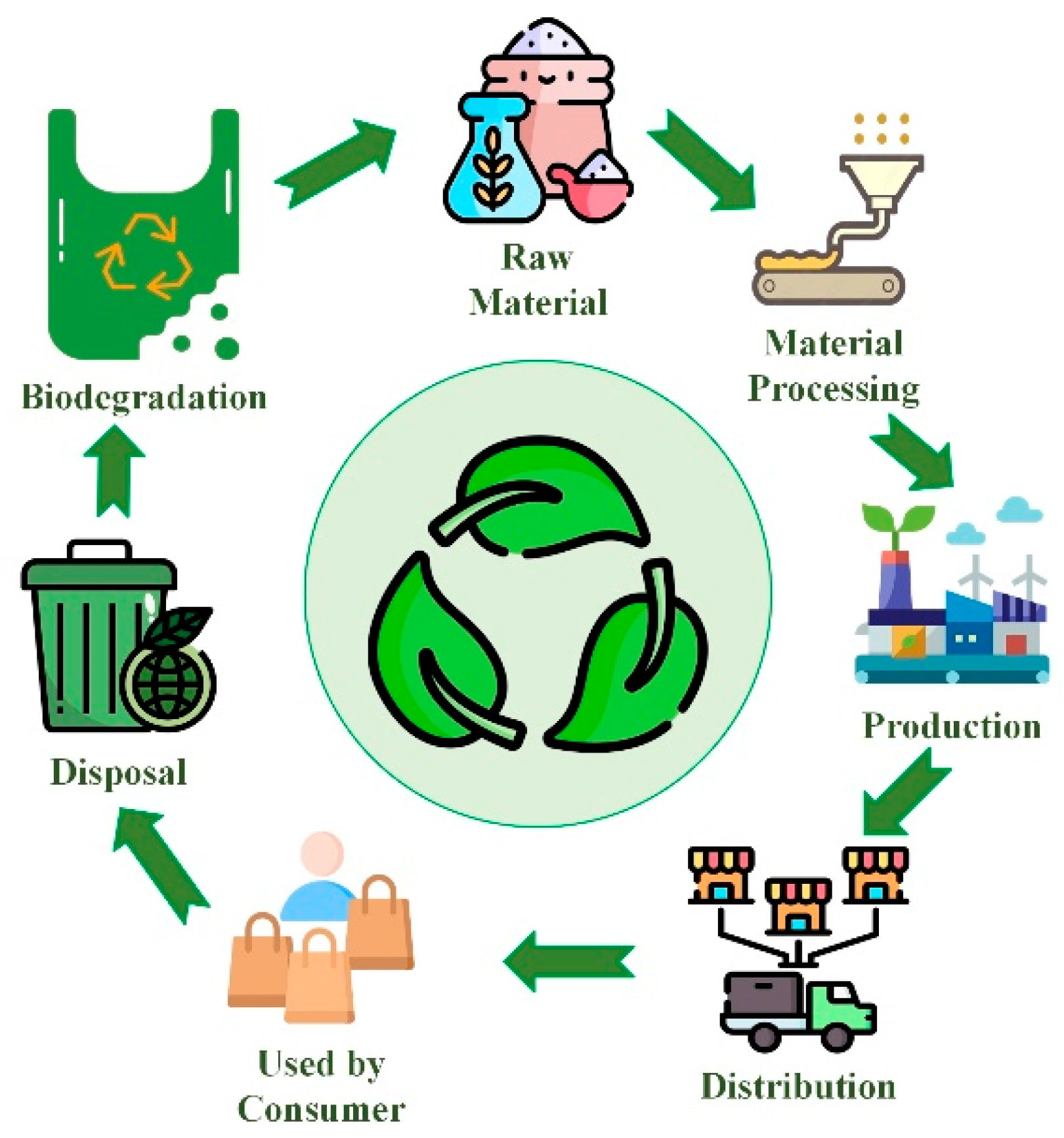
According to Castillo-Díaz et al. (2022), the biodegradable packaging circular model prioritizes using materials that can decompose and reintegrate into the environment, minimizing waste accumulation over time. This strategy utilizes packaging made from biodegradable materials, such as plant-based plastics, paper, or organic fibers, that undergo decomposition through natural processes. Composting facilities dispose of the used packaging, allowing microorganisms to decompose it into organic matter that can improve soil quality. This model facilitates a closed-loop system by redirecting waste away from landfills and minimizing emissions as the materials decompose without producing toxic residues. It is consistent with the CE’s goal of establishing a system of regeneration that follows natural ecosystems [50]. Figure 1 illustrates the circular model for biodegradable packaging.
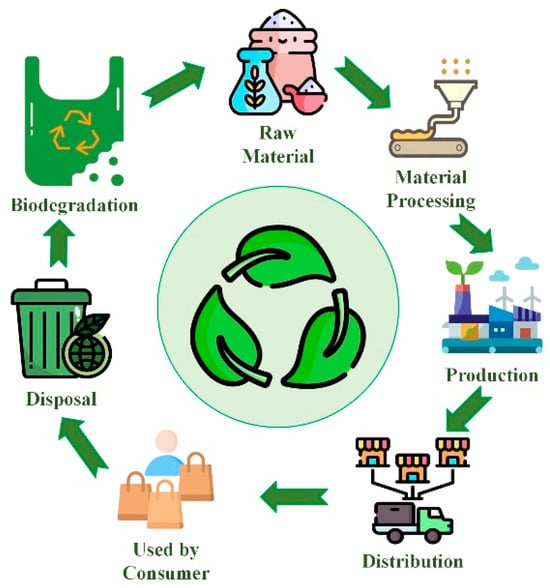
Figure 1.
Biodegradable packaging circular model.
2.3.2. Compostable Circular Model
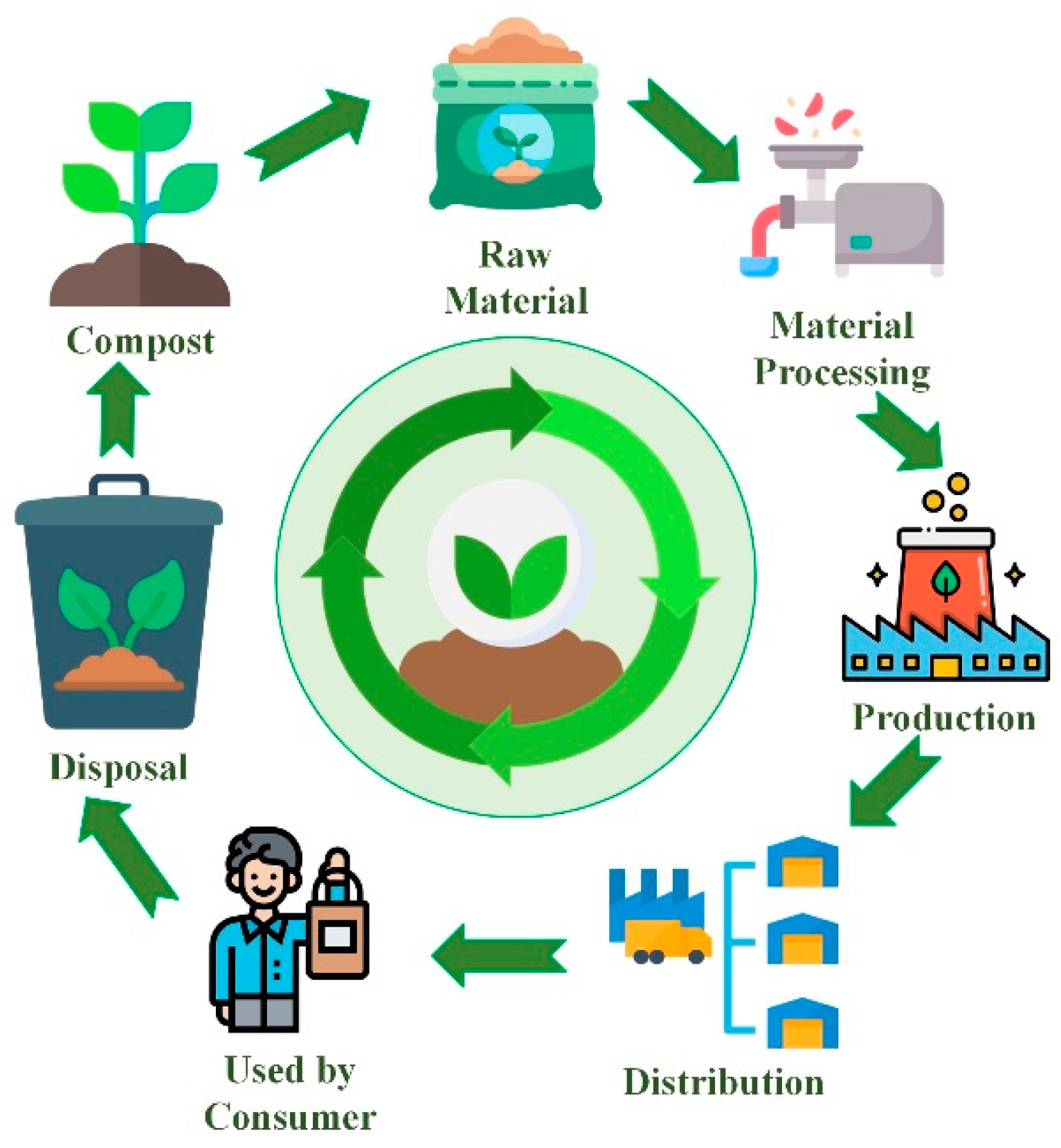
According to Springle et al. (2022), the compostable packaging circular model emphasizes the creation of packaging that can decompose into nutrient-rich compost under particular conditions, thereby restoring crucial organic matter to the soil [51]. Marzantowicz & Wieteska-Rosiak (2021) suggested using compostable packaging materials, such as cornstarch, cellulose, or other plant-based fibers. Compostable materials are entirely broken down when subjected to regulated settings, such as industrial or home composting systems. Upon disposal, the packaging transforms into innocuous elements such as water, carbon dioxide, and biomass, enhancing soil conditions. This strategy decreases the dependence on fossil fuels, reduces the amount of garbage sent to landfills, and promotes a regenerative process in which the packaging aids in plant growth, achieving sustainability through a CE approach [53]. The compostable packaging circular model is shown in Figure 2.
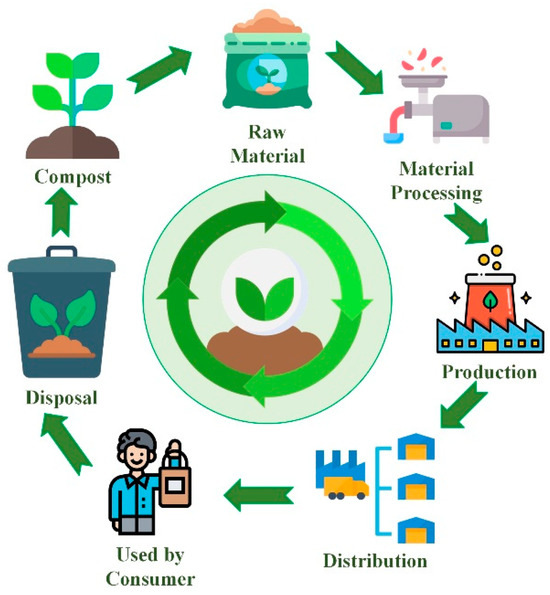
Figure 2.
Compostable packaging circular model.
2.3.3. Recyclable Circular Model
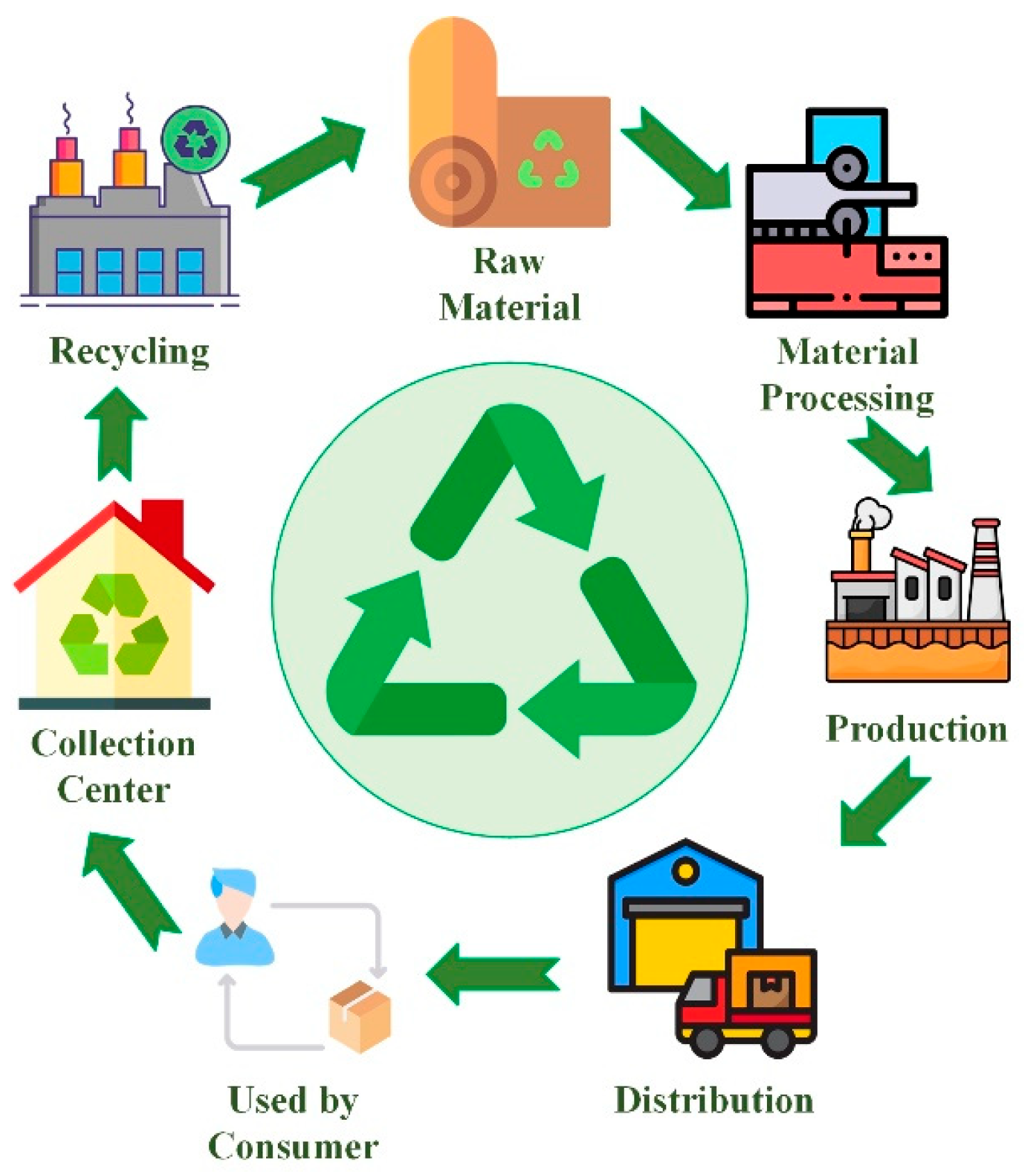
According to Ajwani-Ramchandani et al. (2021), adopting a recyclable circular packaging strategy demonstrates our dedication to conserving resources and advancing sustainability. This model significantly contributes to resource preservation by designing reusable, recyclable packaging suitable for reuse after its initial use. It selects materials based on their recyclability, minimizing the use of new resources and mitigating environmental harm [52]. Figure 3 illustrates how the manufacturing process gathers, treats, and reutilizes the packaging as raw material to create new products. This perpetual cycle not only preserves resources but also diminishes landfill waste, energy usage, and greenhouse gas emissions, promoting a closed-loop system that adheres to the principles of the CE.
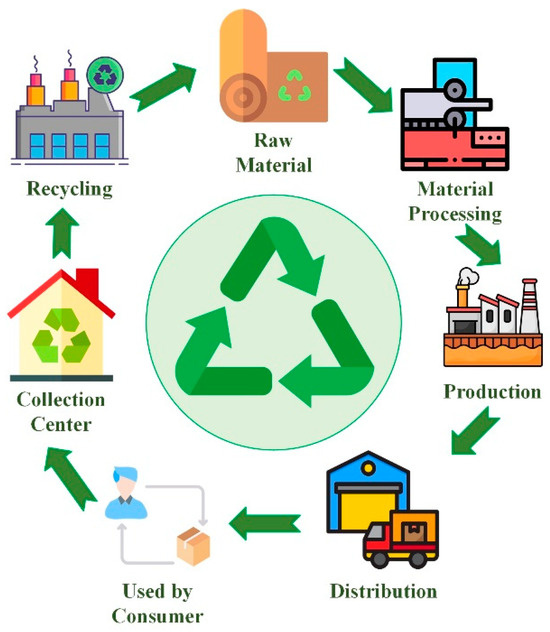
Figure 3.
Recyclable packaging circular model.
2.4. Z-Numbers Based Decision Making Techniques
According to Kang et al. (2012a), the Z-number is indeed an ordered sequence of fuzzy sets (ã, ), where ã is a fuzzy value that denotes the range of possible values for the variable X, and is a possibility for ã [54]. Kang et al. (2012b) presented the primary goal behind Z-numbers as offering a framework for calculation using numbers that are more intelligently designed to express human knowledge and capable of accepting ambiguous information, thereby demonstrating their adaptability [55].
Typically, Cheng et al. (2021) proposed these two elements will be represented using linguistic phrases like (High Impact, Sure). The term probability was changed to possibility in the definition of component q in r. This change reflects the transformation of Z-numbers into fuzzy sets, a process that involves combining a positive coefficient derived by integrating component m [56]. Hendiani & Bagherpour (2020) suggested the phrases listed below are examples of how Z-numbers might transfer meaning in order to convey the notion underlying Z-numbers in linguistic. (i.e., (Product Quality: Extremely High, Sure), (Dispatch the product on Time: Absolutely, Very Sure), (Product Machine efficiency: Roughly 80%, Maybe)) [57].
After reviewing the previous research shown in Table 2, it is evident that the decision-making problem continues to represent numerous significant barriers when considering various recommendations. Choosing a highly sustainable packaging circular model with substantial challenges using an efficient and dependable technique that considers criteria and sub-criteria. To select the most sustainable packaging circular model with significant challenges, we gather expert opinions for this research, prioritizing objectives as the primary criteria and challenges as the secondary criteria. However, these evaluations are inherently ambiguous and imprecise because they rely on subjective judgment. This study used the Z-number-based GMCDM technique to effectively address issues of uncertainty and trustworthiness among a group of academic experts. Therefore, ZF-DEMATEL is a suitable decision-making method, enabling the determination of global weights for sub-criteria. We utilize the ZF-TOPSIS approach to select a highly sustainable circular model in a mass-customized packaging environment. Furthermore, to our knowledge, no study has used the ZF-DEMATEL-TOPSIS method to select a highly sustainable circular model with significant challenges, specifically for mass-customized packaging firms. Our thorough research process ensures the reliability and validity of our findings, providing confidence in the decision-making method.
Table 2.
Prior studies have explored decision-making methodologies that rely on Z-numbers.
2.5. Summary of the Related Works
By examining previous literature and research, we have developed reliable decision-making based on a theoretical basis for our proposed approach. The study by Banerjee et al. (2022) [16] has been instrumental in creating a foundational framework for understanding the Z-number-based GMCDM strategy we propose. Our research aims to identify a sustainable packaging circular model and its significant challenges, thereby addressing a crucial gap in the field. The primary obstacle that real-time SMEs-based mass-customized firms encounter in selecting a highly sustainable packaging circular model is the research gap we aim to bridge. Limited studies have focused on integrating mass-customized CE, and the lack of mass-customized CE in the packaging industry has enhanced the significance of our research.
Furthermore, no study has addressed selecting a highly sustainable circular packaging model in the context of mass customization, which underscores the practical significance of our study. Our main objective is to propose a highly sustainable packaging circular model for a mass customization setting with identifying substantial challenges for SMEs. We achieve this by using the Z-number-based decision-making method. This study introduces a novel approach to identifying sustainable circular models in the packaging industry and provides significant challenges using ZF-DEMATEL-TOPSIS. Importantly, our approach directly addresses the mass-customized circular model problem field, making our research highly relevant and applicable.
3. Proposed Methodology
This part focuses on the research design, number of experts, data collection methods, data analysis tools, and data validation, which are explained in this part. A cross-sectional study is employed in this research design to determine a highly sustainable circular packaging model with significant challenges. Table 3 represents the decision makers, including their designation, experience, and research areas. The selected experts possess extensive qualifications in circular economy, ensuring their insights are both practical and theoretical.
Table 3.
Expertise profile of decision-making specialist.
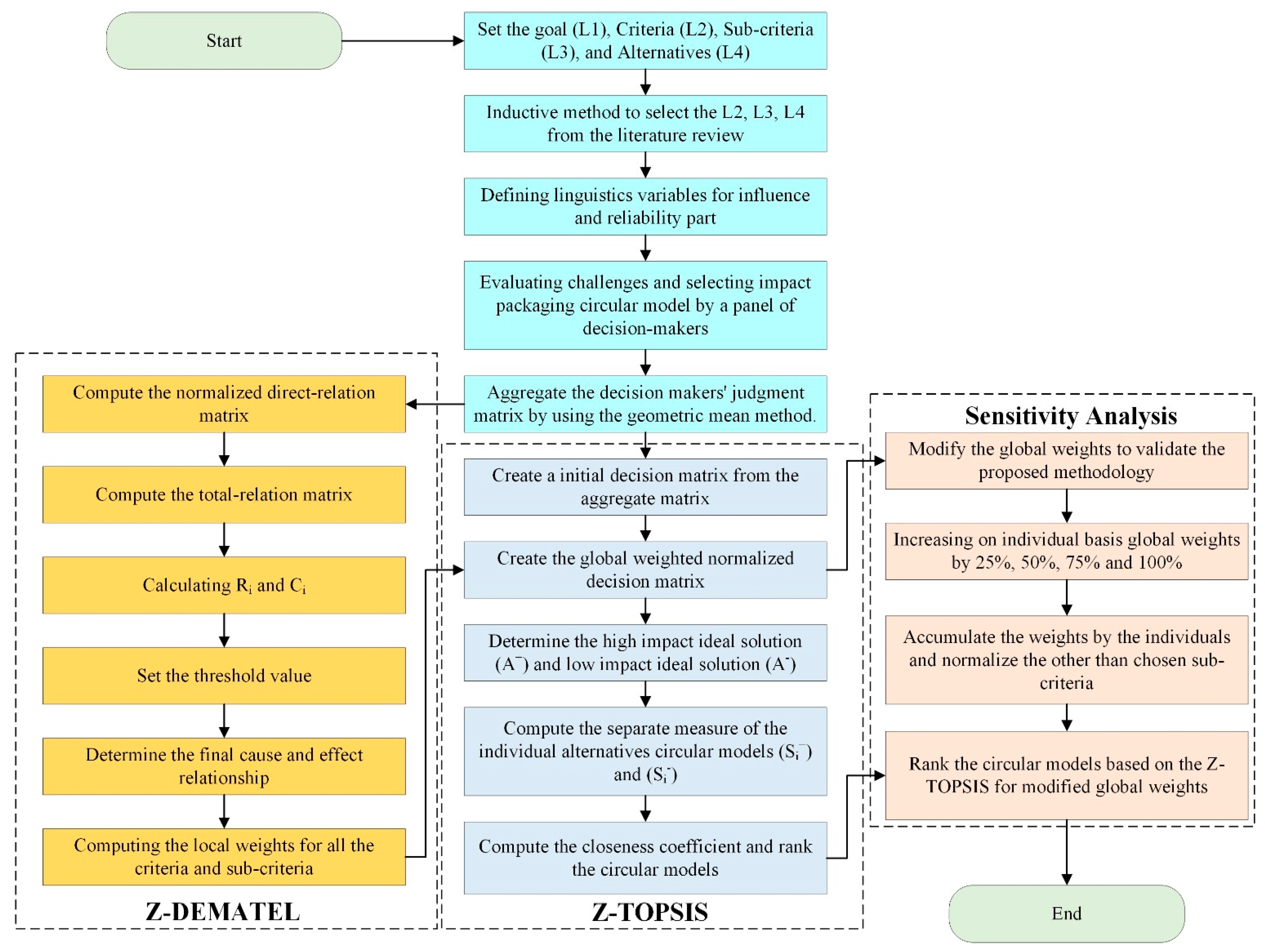
The qualitative research approaches used in this study design incorporate empirical validation studies. The influence of factors on the relationship between the primary five objectives as the criteria and 15 challenges are considered as the sub-criterion is examined using this qualitative study design. An expert group is used in this study to get the data needed for model building. Experts’ preferences for criteria, sub-criteria, and alternative aspects were gathered via a formal questionnaire and a direct approach in which the aim of the study was disclosed to the experts. The flowchart for Z-number-based MCDM methods with sensitivity analysis is shown in above Figure 4.
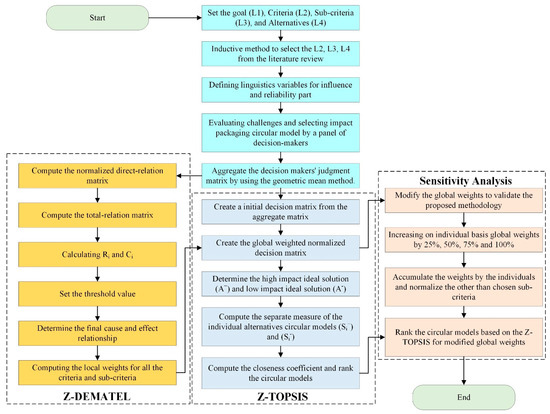
Figure 4.
Proposed methodology.
Assuming that the expert opinions are consistent due to their knowledge of the proposed area adds depth and credibility to the analysis. In CE, the consensus of experts provides a strong basis of understanding and agreement on fundamental concepts. The Z-number-based GMCDM method, a reliable tool for decision-making problems, is a testament to this collective understanding. Sensitivity analysis, a critical component, not only evaluates the impact of changing a model’s input parameter on outcome assessment but also plays a crucial role in validating the model’s robustness. It is instrumental in demonstrating the stability of the final ranking in GMCDM methodologies, which is sensitive to even minor parameter changes, highlighting the need for meticulous assessment. Conducting sensitivity analysis after resolving the problem aids in formulating precise conclusions. In this study, we examined the stability of the final ranking under varying criteria weights, showing how adjusting the global weight of a sub-criteria directly impacts the score and final ranking of alternatives.
3.1. Fuzzy Sets
Definition 1.
A membership function µã(r) that gives each element (r) in a discourse universe (R) a real integer in the range [0; 1] defines a fuzzy set. The degree of membership of r in the group is represented by the numeric number R.
Definition 2.
A triplet with a membership function of ã = [a1, a2, a3] defines a triangular fuzzy number ã.
Definition 3.
If we use the triangular fuzzy number ã = (a1, a2, a3), we can compute that defuzzification value for the triangular fuzzy number m(ã) as follows [63].
3.2. Z-Numbers
Definition 4.
Zadeh introduced the z-number approach in [15]. The concept of Z-numbers is meant to serve as a foundation for calculations with uncertain numbers. In order to ensure that the information is reliable, it is concerned with the reliability variable in fuzzy numbers. An arranged set with two type-1 fuzzy sets, represented by Z = (ã, ), is known as a Z-number. The first element ã, is a real-valued uncertainty on X and is referred to as a restriction or constraint variable. The second element , is a reliability indicator or constraint on the level of confidence for ã. Refs. [15,64] claims that the Z-number is a novel idea in fuzzy set theory that is better able to describe the uncertain and complicated information. Linguistic phrases for reliability and their respective Z-numbers based triangular membership function shown in Table 4.
Table 4.
Triangular fuzzy membership linguistic terms for reliability [12].
Step 1: Transforming the r coordinates confidence element into a crisp numeric technique [12].
Step 2: To the restriction part, add the reliability part weight. We use the weighted Z-number by the following Equation.
Step 3: Preferences of experts should be transformed from weighted Z-numbers to ordinary fuzzy numbers. The following equation is used to calculate the conversion process.
3.3. Z-Number Based Fuzzy DEMATEL
The following is an overview of the steps of Z-number based Fuzzy DEMATEL [65].
Step 1: Create the Z-fuzzy initial relationship matrix (ZFIRM) for the Z-number fuzzy DEMATEL to evaluate the objectives and challenges. Linguistics phrases is used in the building of fuzzy relationship matrices for evaluating criteria and sub-criteria from the Table 4 and Table 5.
Table 5.
Triangular fuzzy membership linguistic terms for restriction part [66].
Step 2: Transform the Z-numbers comprising experts’ preferences into fuzzy numbers using the Equations (3) and (5). Aggregate the experts’ preferences. Using the geometric mean to combine the experts’ preferences fuzzy initial relationship matrix (FIRM).
Step 3: Compute the normalised matrix (ãij) using the Equation (6) to obtain the normalized matrix (ã). Given that
Step 4: To establish the total relation matrix (TRM) employing the Equation (7), where I is an Identity matrix.
Step 5: Determine the R and C values to compute the rows and columns respectively using Equations (8) and (9).
Step 6: Employ the R and C values to obtain the casual relationship.
Step 7: Attaining alpha threshold value for the total-relation Matrix
Step 8: Determine the tiaverage to compute the weight using the Equation (10).
Step 9: Estimate the local weights using the Equation (11).
Step 10: Determine the global weights by converting the local weights of the criteria and sub-criteria into global weights. The local weights of the sub-criterion and the criterion are multiplied by their corresponding values to obtain the global weights.
3.4. Z-Number Based Fuzzy TOPSIS
The following is an overview of the steps of Z-number based Fuzzy TOPSIS [67].
Step 1: Create the Z-fuzzy initial decision matrix (ZFIDM) for the Z-number fuzzy TOPSIS to evaluate the circular models. Linguistics phrases is used in the building of fuzzy decision matrices for evaluating alternatives from the Table 4 and Table 6.
Table 6.
Triangular fuzzy membership linguistic terms for restriction part [68].
Step 2: Transform the Z-numbers comprising experts’ preferences into fuzzy numbers using the Equations (3) and (5). Aggregate the experts’ preferences. Using the geometric mean to combine the experts’ preferences of the fuzzy initial decision matrix (FIDM).
Step 3: Compute the weighted normalized matrix by multiplying the global weight into FIDM. The global weights employed from the Z-number based fuzzy DEMATEL.
Step 4: To defuzzify the weighted normalized matrix using the Equation (2) to transform fuzzy numbers into the crisp numbers.
Step 5: Calculate the High Impact Ideal Solution (HIIS) represents as the H+ and Low Impact Ideal Solution (LIIS) represents as the L− by the following equations.
Step 6: Compute the distance between the individual circular model of the HIIS (DiHIIS) and LIIS (DiLIIS) by the following equations.
Step 7: To identify the high impact parameter, compute the closeness coefficient (CCi) for each individual parameter.
3.5. Sensitivity Analysis
The emphasis is on investigating the effectiveness of the global weight on the ranking of the results in order to verify the suggested approach [69]. Presume that the variable representing the global weights is Wj = (W1, W2 … WK) When the total of the normalized global weights is 1.
If the global weight of the MCDM methodology’s criteria and sub-criteria varies as c using the following Equation (18). The following Equation (19) are used to lower the remaining global weight values by a predetermined amount, reducing the total number of global weights to 1.
In order to improve the effectiveness of the Z-number-based MCDM techniques, this research offers Z-number-based fuzzy DEMATEL with TOPSIS referred to as (ZF-DEMATEL-TOPSIS) an integrated fuzzy DEMATEL and Fuzzy TOPSIS with Z-numbers to address the information reliability, subjectivity, and uncertainty in this research design concept assessment. The entire Z-number-based GMCDM process is divided into three stages, as shown in Figure 4. The first stage is constructing the decision makers’ judgment into matrices and using Z-number-based fuzzy DEMATEL, used for criterion and sub-criterion to determine the global weights; the second stage is Z-number-based fuzzy TOPSIS for highly sustainable packaging circular model ranking, and the third stage is to validate the suggested approach. First, a team of three professors from the CE background are picked as the experts. They choose the evaluation components (criteria, sub-criteria, and alternatives) and provide impact analyses during the expert interview. Excel and Origin Pro are used for the data analysis and validation. The direct relation matrix in the Z-number-based Fuzzy DEMATEL evaluations and the z-number-based Fuzzy TOPSIS decision values in the circular model ranking are to be evaluated independently by each expert. To reflect expert impact estimates and accumulative group evaluations, a Z-number-based GMCDM is created. The global weights of the criterion and sub-criteria will then be determined using a fuzzy AHP based on Z-numbers. A fuzzy TOPSIS based on Z-numbers is provided to rank the parameters. The rank of the parameters is validated via a sensitivity analysis. The effect evaluations’ dependability, uncertainty, and subjectivity are well defined by introducing Z-number into GMCDM.
4. Application in Circular Model Selection with Significant Challenges
An efficient and environmentally friendly packaging circular model that focuses on recycling resources is implemented to minimize waste and reduce the harmful environmental impact while supporting long-term economic stability So, in order to determine which packaging circular model has a high-impact, we decided to identify by using the objectives, challenges and circular models from the previous literature. To assess the circular model three professors represented as the experts (Es) from SC background were selected, E1, E2, and E3, as well as three circular models.
Five objectives represented as criteria are considered which are: Economic Objectives (O1), Environmental Objectives (O2), Social Responsibility Objectives (O3), Sustainable Objectives (O4), and Time-based Objectives (O5). Additionally, fifteen challenges are represented as the sub-criteria evaluate the circular model including: Transportation Cost (C1), Production Cost (C2), Inventory Cost (C3), Emissions (C4), Resource Utilization (C5), Waste Reduction (C6), Job Creation (C7), Community Impact (C8), Safety and Health (C9), Energy Efficiency (C10), Life-cycle Impact (C11), Renewable Resource Usage (C12), Flow Time (C13), Makespan (C14), and Lead Time (C15) and three circular models which are Biodegradable packaging (CM1), Compostable packaging (CM2), and Recyclable packaging (CM3). These 5 criteria, 15 suitable sub-criteria, and 3 alternatives are taken from literature based on expert opinions. In this work, the idea of attributes is condensed to the notation ∈ [0, 1] for fuzzified occurrences. Z-numbers match the values of characteristics. As stated by Figure 5 depicts the hierarchical structure of the objectives, and challenges to research circular model in order to identify the highly sustainable circular model. A thorough questionnaire on the linked factors for influencing circular model selection was created for the relation matrix in order to rate the criteria. Using the linguistic evaluation factors shown in Table 5, experts assessed the criteria and sub-criteria. For the initial decision matrix based on Table 6 linguistic assessment factor, experts evaluated for the circular models.
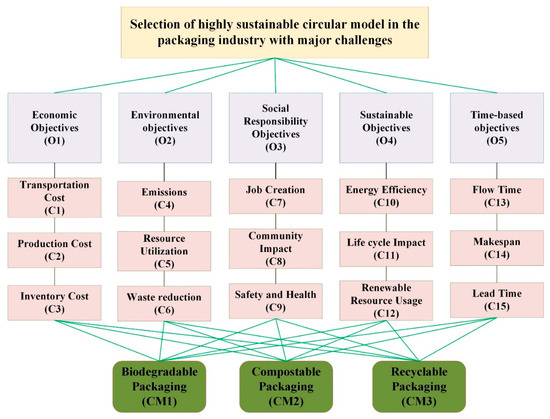
Figure 5.
Hierarchy framework for packaging circular model.
4.1. Stage 1: Z-Number Based Fuzzy DEMATEL for Global Weights
Step 1: Develop a hierarchical framework shown in the Figure 5 The building of a hierarchy model necessitates the completion of a judgement matrix by experts about the assessment of all criteria and sub-criteria.
Step 2: Construct a direct relation matrix (DRM) with confidence part. To determine the global weights of considered criteria and sub-criteria that influence of sustainable circular model. To adhere towards the Z-number-based fuzzy DEMATEL in Section 3.3 to construct DRMs with reliability among all criteria and sub-criteria in the degree of the hierarchy systems that depend on the preferences of the experts with confidence based on the Table 5 using triangular fuzzy number for restriction part and Table 4 using triangular fuzzy number for reliability part (i.e., DRM created using from the Expert 1 (E1) models given in Table 7 and Table 8 utilizing crisp numbers instead of triangular fuzzy numbers for the impact element in order to ease comprehension.). Similarly, the remaining DRMs for the criteria and sub-criteria from the three experts can be tabulated.
Table 7.
Initial Relationship Matrix of criteria with confidence part from E1 w.r.t goal.
Table 8.
Initial Relationship Matrix of sub-criteria with confidence part from E1 w.r.t goal.
Step 3: Convert Z-numbers representing the preferences of experts with a reliability component into normal fuzzy numbers. Using Equation (3), convert the Z-number to crisp number of the reliability component. That crisp number employed as the reliability weight. For the investigation of criteria and sub-criteria by experts at this level, the greatest degree of reliability agreed upon for their judgements is 1. The fuzzy DRMs representing the preferences of experts are collected as illustrated in the example below.
E1—Economic Objectives (O1) ∗ Environmental Objectives (O2) from the Table 7 (i.e., VHI, S)
whereby the ã, values are taken from the Table 4 and Table 5. The competence of the experts can be stated as the Z-number Z = (ã, ): Initially, the part of confidence must be changed to crisp using Equation (3) to employed as the confidence weight. The confidence weight can be denoted as α.
Step 4: The next step is to convert weighted Z-numbers to regular fuzzy number. Augment the weight of the confidence part to the impact part using Equation (5). The regular fuzzy number representing the preferences of experts are collected as illustrated in the sample example used in the previous step is below.
Similarly, the remaining weighted reliability part converting into the normal fuzzy number for the criteria and sub-criteria from the three experts can be calculated.
Step 5: Compute the Total relation matrix using the Equation (7) for criteria and sub-criteria are shown in Table 9 and Table 10.
Table 9.
Total-relation matrix for criteria.
Table 10.
Total-relation matrix for sub-criteria.
Step 6: Compute the casual relations using Equations (8) and (9) for criteria and sub-criteria are shown in Table 11 and Table 12.
Table 11.
Producing causal relations for criteria.
Table 12.
Producing casual relations for sub-criteria.
Table 13.
Calculated the local weights for criteria.
Table 14.
Calculated the local weights for sub-criteria.
Step 8: Finally, compute the global weights for criteria and sub-criteria using Table 13 and Table 14. Computed global weights are shown in Table 15.
Table 15.
Computed global weights from criteria and sub-criteria.
4.2. Stage 2: Z-Number Based Fuzzy TOPSIS for Ranking
Step 1: Construct the Z-Fuzzy Initial Decision Matrix (ZFIDM), the ZFIDM is constructed, and the linguistic variables from Table 4 and Table 6 are used to assess the parameters respect to the criteria and sub-criteria. The assessments of the circular models are reported in Table 16 (i.e., ZFIDM created using from the Experts (E1, E2, E3)).
Table 16.
ZIFDM given by the experts w.r.t Transport criteria.
Step 2: Converting the reliability part and then combine with the restriction part are computed in the above Section 4.1. similarly follow for those steps to convert the Z-numbers to normal fuzzy numbers.
Step 3: Defuzzify the fuzzy numbers of the decision matrix of the experts accumulated preferences using Equation (2). the fuzzy initial decision matrix is defuzzified for converting into crisp decision matrix.
Step 4: Compute the defuzzified weighted normalized matrix to proceed for the further steps of the computations.
Step 5: In the next step, High Impact Ideal Solution (HIIS, H+) and Low Impact Ideal Solution (LIIS L−) are calculated using Equations (12) and (13).
Step 6: Calculate the distance of each circular model from HIIS and LIIS. The distance DiHIIS and DiLIIS of each circular model from formulation A+ and A− can be computed from Equations (14) and (15) are shown in Table 17.
Table 17.
Calculate the A+ and A−.
Step 7: Finally, calculate the closeness co-efficient using Equation (16) is shown in Table 18.
Table 18.
Compute closeness co-efficient.
Table 19 represents the comparison result obtained using Z-DEMATEL-VIKOR [21] to evaluate the robustness of the proposed model.
Table 19.
Comparative result of Z-number-based GMCDM method.
4.3. Stage 3: Sensitivity Analysis for Validation
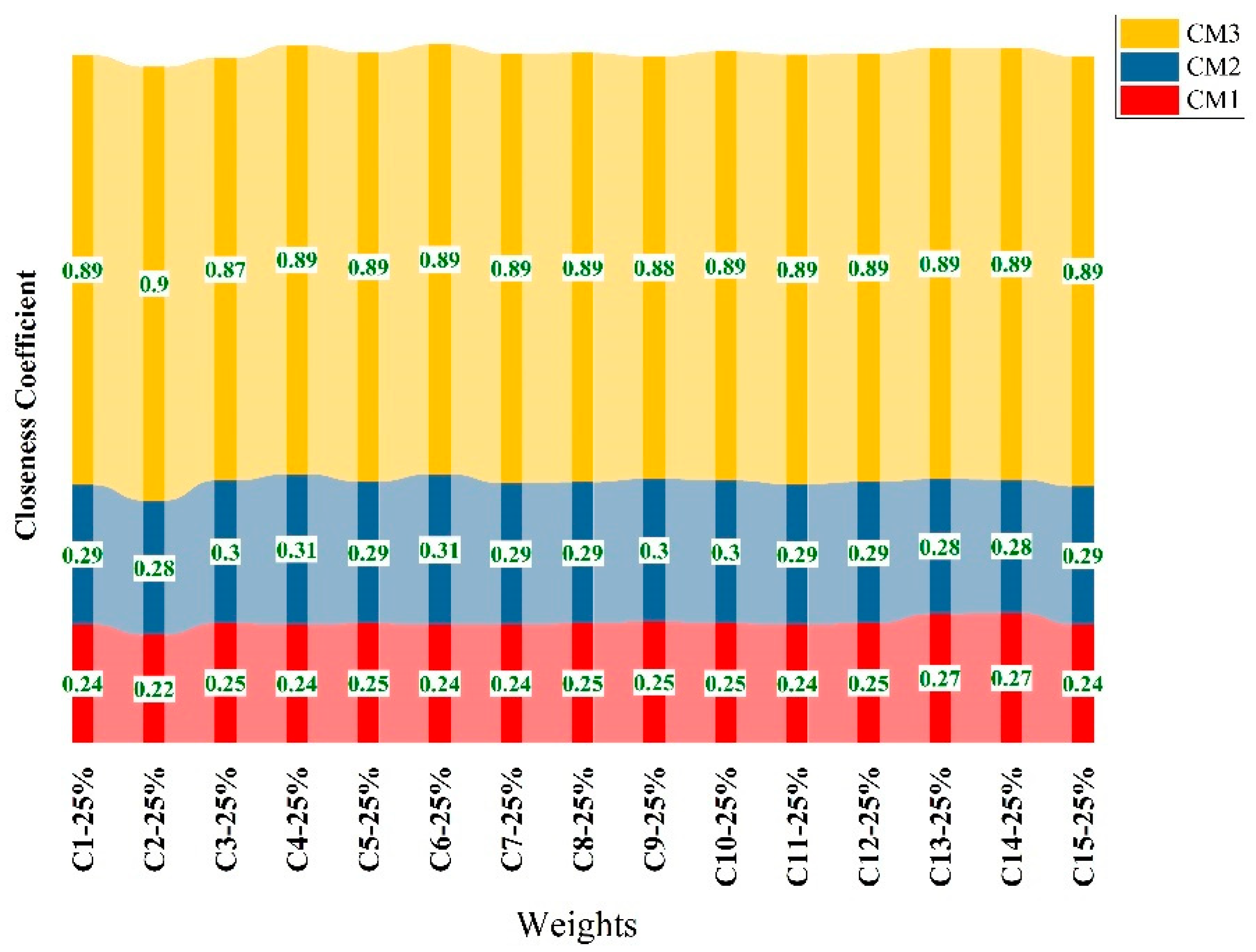
A sensitivity analysis is presented to examine the robustness of the proposed model ZF-DEMATEL-TOPSIS. In MCDM techniques particularly, weights exchange (i.e., 25%, 50%, 75% and 100%) does the sensitivity analysis. Evaluating the influence of the sub-criteria w.r.t criteria global weights on the order of the findings is the main goal of the sensitivity analysis assessment. The tests are then run with each initial sub-criteria w.r.t criteria weight increased by 25%, 50%, 75% and 100%. The values of the other sub-criteria w.r.t criteria are reduced by a set amount while one sub-criterion is raised, bringing the total number of sub-criteria to one using Equations (18) and (19). The global weight of each criterion is changed by 25%, 50%, 75% and 100% throughout a series of assessment runs and then follow the stage 2 to determine the circular models ranking. Totally, 60 assessment runs make up the scenario for this proposed model ZF-DEMATEL-TOPSIS.
Increase the weight of the sub-criteria by 25% with respect to the main criteria, and a new set of weights for the sub-criteria w.r.t criteria would be generated. The new global weight of the sub-criteria relative to the criteria would alter as follows using Equations (18) and (19) would then be used to normalize the global weight of other sub-criteria w.r.t criteria. There is no change in the analysis of weight increased by 25% are shown in Figure 6.
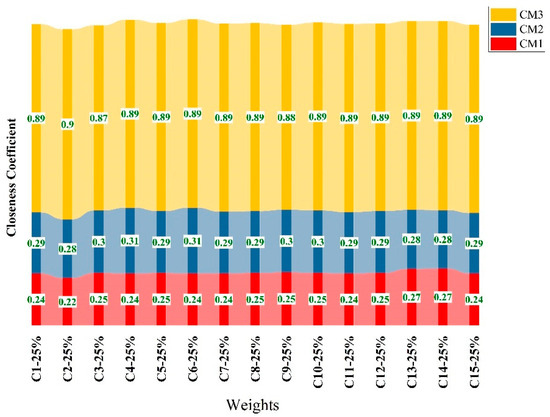
Figure 6.
Sensitivity analysis for 25%.
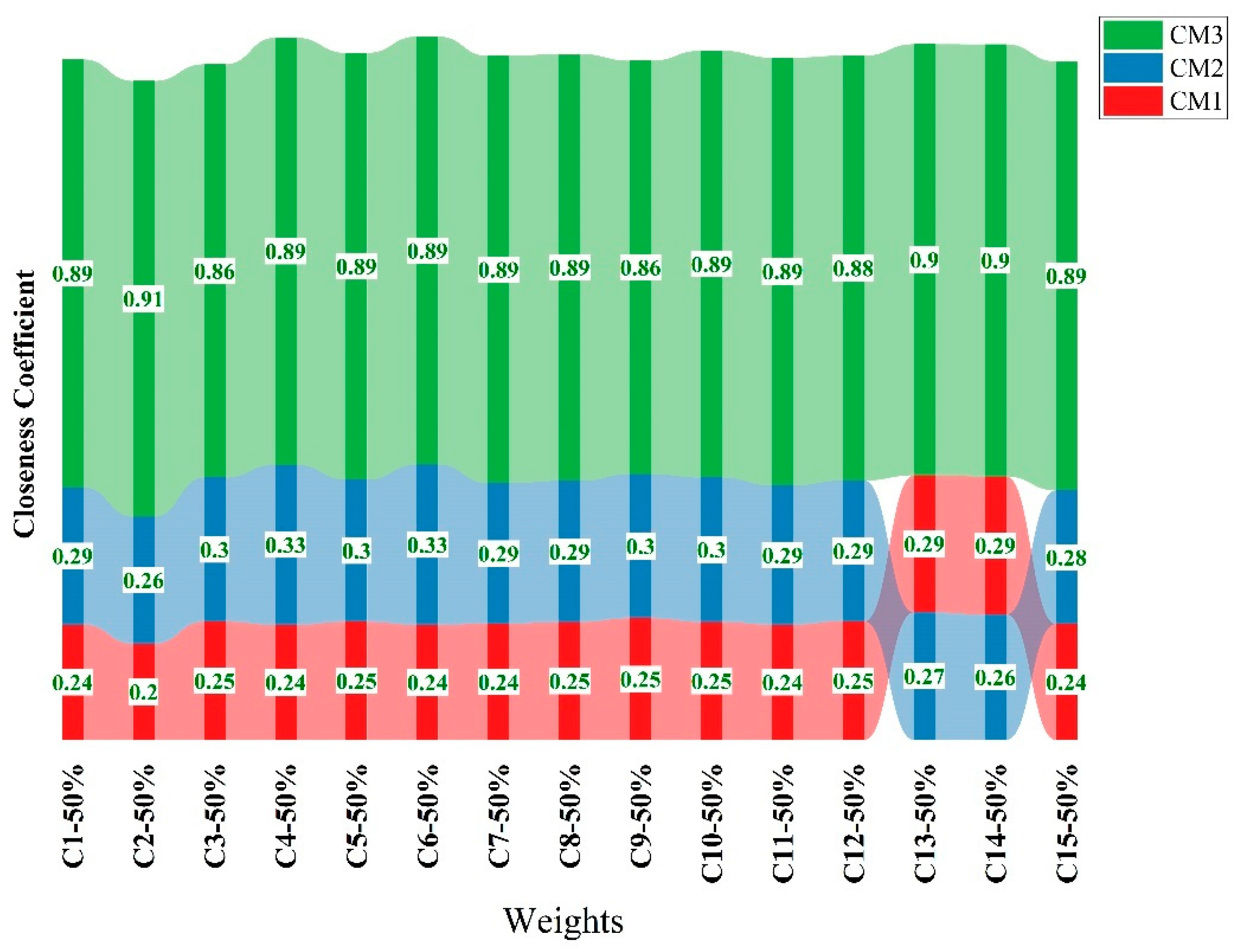
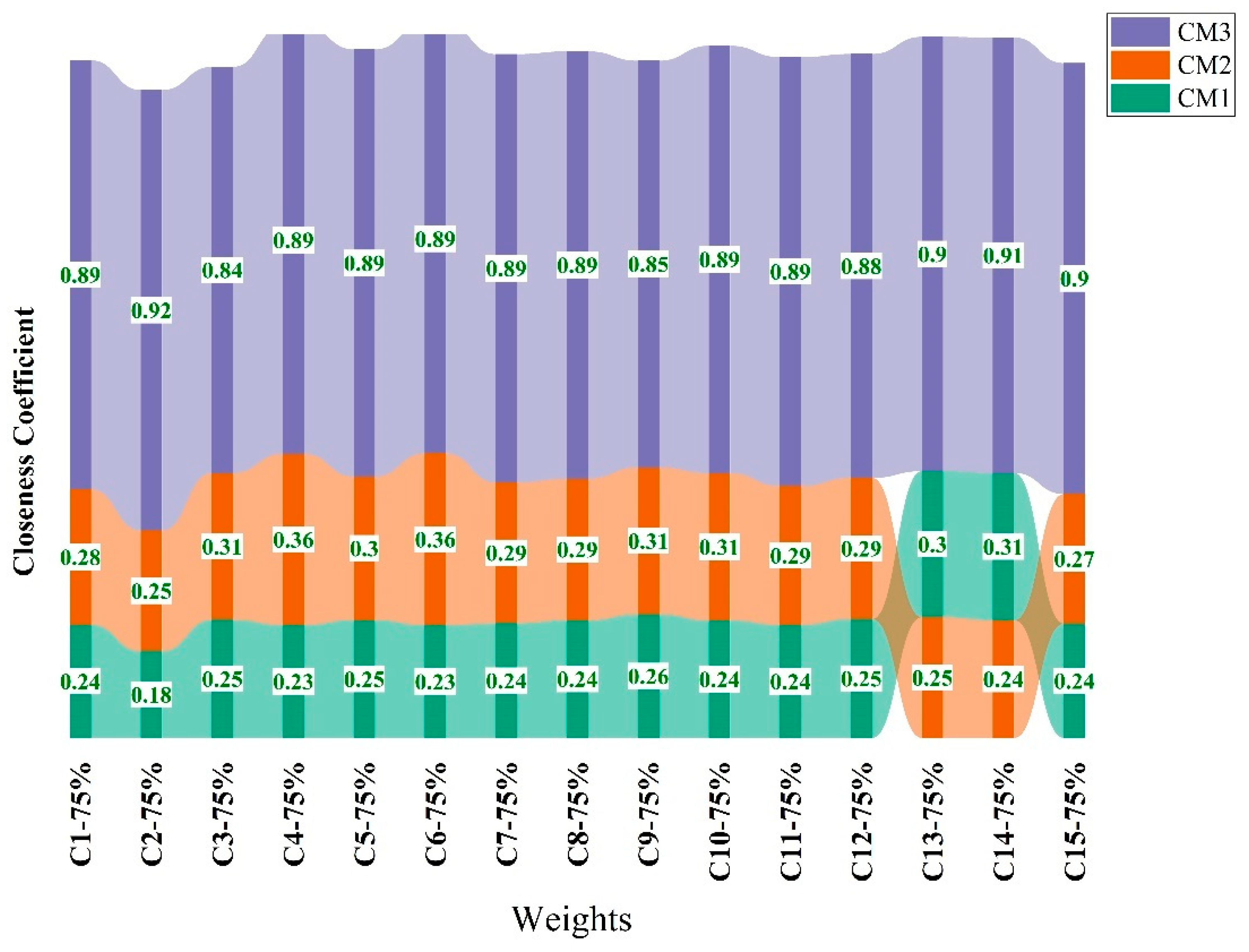
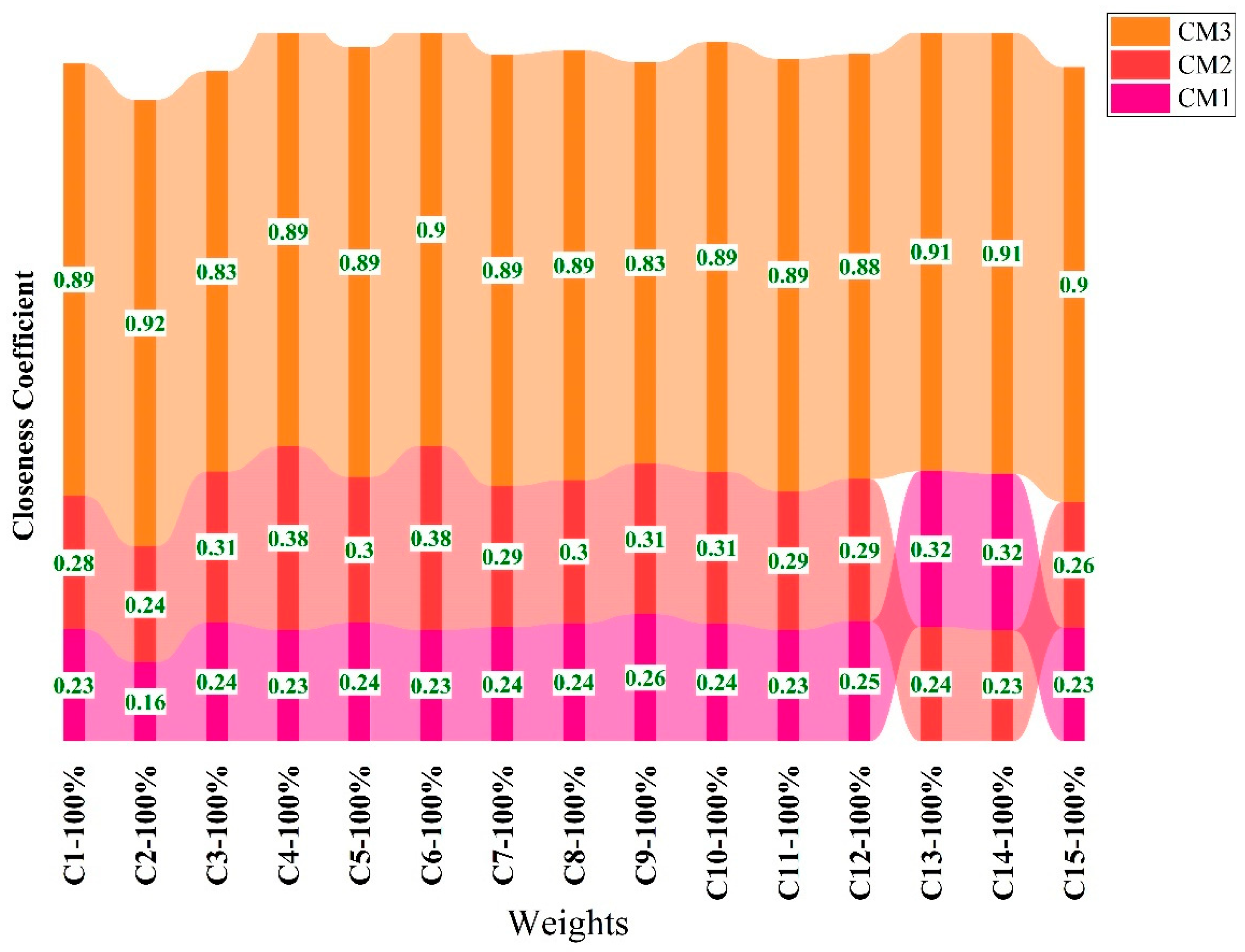
Increase the weight of the sub-criteria by 50% with respect to the main criteria, and a new set of weights for the sub-criteria w.r.t criteria would be generated. Similarly, there is a change in the analysis of weight increased by 50%, 75%, and 100% in the C13 and C14 the rank order changed into CM3 > CM1 > CM2 are shown in Figure 7, Figure 8 and Figure 9.
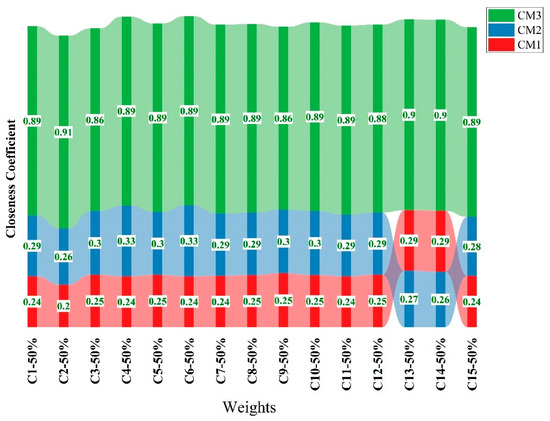
Figure 7.
Sensitivity analysis for 50%.
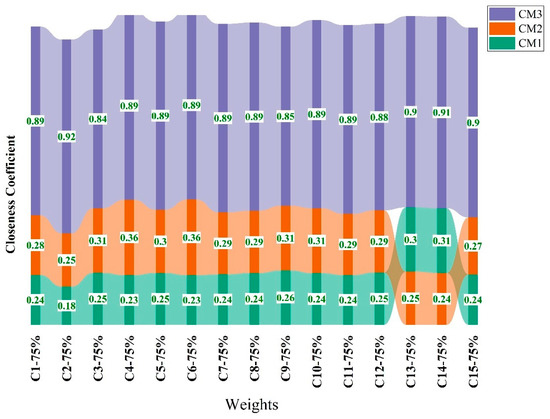
Figure 8.
Sensitivity analysis for 75%.
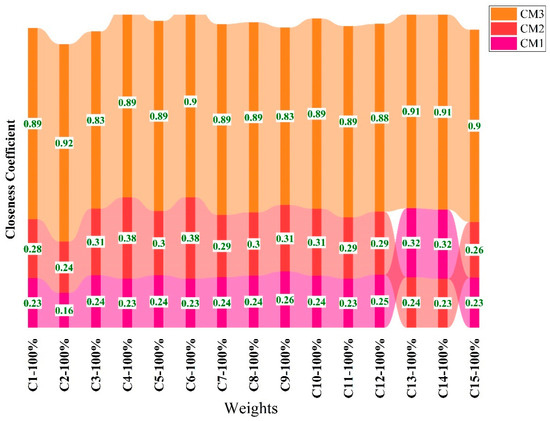
Figure 9.
Sensitivity analysis for 100%.
According to the Figure 6 is stable and resilient since adjustments to the global weights by 25% of the sub-criteria w.r.t criteria. With regard to the criterion, the closeness coefficient differs noticeably for each and every sub-criterion, but the high impact priority remains unchanged from the order in Table 18. The order of the circular models is consistent compared with stage 2 outcomes. However, in Figure 7, Figure 8 and Figure 9 there are certain circumstances where they have some changes on the ultimate priority order of the circular models. Out of 60 experiments 6 experiments ranks are change so the consistency ratio is 90% for the sensitivity analysis.
4.4. Discussion
This section illustrates the three distinct packaging scenarios to demonstrate the implications of choosing highly sustainable packaging. It highlights the crucial role of SMEs, which are currently shifting from traditional manufacturing into mass-customized manufacturing due to global competition. Additionally, to get government funding, most SMEs are also attempting mass-customized CE to produce sustainable product lifecycles. As a result, choosing a highly sustainable packaging method depends on multiple factors. Therefore, in this study, we created a Z-number-based decision-making technique to choose a highly sustainable packaging model. This approach empowers SMEs to play a significant role in the sustainable packaging shift, as they must overcome significant challenges by proactively anticipating unforeseen events, streamlining procedures, and implementing new technology. The ZF-DEMATEL-TOPSIS integrated GMCDM approach is a proposed method for identifying highly sustainable packaging models with significant challenges that significantly affect SMEs’ ability to produce sustainable product lifecycles in mass-customized CE initiatives. Based on the suggested method, the recyclable packaging model is highly sustainable. The primary challenges to producing mass-customized CE in SMEs are production cost, energy efficiency, and makespan. This study provides insightful information for SMEs in India, especially for those operating in sectors like manufacturing, supply chain management, and sustainable development. The study’s examination of the integration of MC and CE is highly significant to the Indian context, where a growing focus is placed on environmentally conscious manufacturing, circular economy models, and customized products.
5. Conclusions
Finding the highly sustainable packaging circular model with significant challenges precisely and reliably is vital to finding the highly sustainable circular model in the mass-customized packaging industries in SMEs. This research suggests that the hybrid Z-number-based fuzzy MCDM model ZF-DEMATEL-TOPSIS can manage information representation and aggregation, improve decision-making in ambiguous situations, and improve model evaluation subjectivity. The reliability of information is effectively considered while handling the complexity and uncertainty of the data. Z-numbers are more effective in describing complicated and uncertain knowledge. So, the Z-numbers are employed in this work as a result. Under the MCDM’s suggested framework, a ZF-DEMATEL for sub-criteria about the global weighting of the criteria and a Z-number-based Fuzzy TOPSIS for circular model ranking are all incorporated. Sensitivity analysis is used to verify the efficacy of the given model utilizing experimental data from the Z-number-based Fuzzy TOPSIS. During the Z-number transformation, the individual evaluation characterization and assessment aggregate of preference choices are entirely resolved. The suggested ZF-DEMATEL-TOPSIS may adequately meet the depiction of information dependability, ambiguity, and subjectivity in MCDM with the Z-number implication. By reflecting uncertainty in human judgment, the suggested ZF-DEMATEL-TOPSIS, which has a consistency rate of 90%, enables the determination of the highly sustainable circular model in the mass-customized packaging industry with significant challenges. The suggested model gives solid and reliable results that deliver a highly sustainable circular model that is recyclable in the mass-customized packaging industry. Three major significant challenges are production cost, energy efficiency, and makespan.
This study has some limitations because it primarily focuses on the packaging industry and mass-customized CE initiatives within SMEs. It does not apply to other manufacturing sectors. The GMCDM approach relies on collected data and the subjective evaluations of experts. Despite these limitations, this research significantly contributes to the mass-customized CE initiatives in the packaging sector. Applying the GMCDM approach provides critical insights for identifying a sustainable packaging model. Also, it points out significant challenges SMEs encounter in implementing the highly sustainable packaging approach, highlighting the inclusivity of the study.
Based on the outcomes of the ZF-DEMATEL-TOPSIS model, future studies will delve into three major significant challenges facing the recyclable packaging circular model in the mass-customized packaging industry. Those challenges are production cost, energy efficiency, and makespan. The aim is to propose further solutions to optimize these challenges on the mass-customized recyclable packaging circular model, leveraging the power of hybrid intelligent algorithms. The potential impact of these future research directions on the recyclable packaging industry is significant, as they could lead to the development of more sustainable and efficient circular model in the packaging solutions.
Author Contributions
Conceptualization, R.R.; methodology, R.R.; software, R.R.; validation, R.R. and S.R.; formal analysis, R.R.; investigation, R.R.; resources, R.R.; data curation, R.R.; writing—original draft preparation, R.R.; writing—review and editing, R.R. and S.R.; visualization, R.R.; supervision, S.R. All authors have read and agreed to the published version of the manuscript.
Funding
This research received no external funding.
Institutional Review Board Statement
Not applicable.
Informed Consent Statement
Not applicable.
Data Availability Statement
Data will be provided upon request.
Conflicts of Interest
The authors declare no conflicts of interest.
References
- Davis, S.M. From “Future Perfect”: Mass Customizing. Plan. Rev. 1989, 17, 16–21. [Google Scholar] [CrossRef]
- Kotha, S. Mass Customization: Implementing the Emerging Paradigm for Competitive Advantage. Strateg. Manag. J. 1995, 16, 21–42. [Google Scholar] [CrossRef]
- Balamurugan, A.; Ranjitharamasamy, S.P. A Modified Heuristics for the Batch Size Optimization with Combined Time in a Mass-Customized Manufacturing System. Int. J. Ind. Eng. Theory Appl. Pract. 2023, 30, 1090–1115. [Google Scholar]
- Sahoo, S.; Yadav, S. Total Quality Management in Indian Manufacturing SMEs. Procedia Manuf. 2018, 21, 541–548. [Google Scholar] [CrossRef]
- Nielsen, K.; Brunoe, T.D.; Skjelstad, L.; Thomassen, M. Challenges in Choice Navigation for SMEs. In Proceedings of the Springer Proceedings in Business and Economics; Springer Science and Business Media B.V.: Berlin/Heidelberg, Germany, 2017; pp. 127–137. [Google Scholar]
- Alamelu, R.; Jayanthi, M.; Dinesh, S.; Nalini, R.; Shobhana, N.; Amudha, R. Sustainable Supply Chain and Circular Economy Ingenuities in Small Manufacturing Firms—A Stimulus for Sustainable Development. Mater. Today Proc. 2023, 92, 17–23. [Google Scholar] [CrossRef]
- Prieto-Sandoval, V.; Jaca, C.; Santos, J.; Baumgartner, R.J.; Ormazabal, M. Key Strategies, Resources, and Capabilities for Implementing Circular Economy in Industrial Small and Medium Enterprises. Corp. Soc. Responsib Environ. Manag. 2019, 26, 1473–1484. [Google Scholar] [CrossRef]
- Sakthivelmurugan, E.; Senthilkumar, G.; Karthick, K.N. Analysis of the Impact of Circular Economy over Linear Economy in the Paper Processing Industry. Mater. Today Proc. 2022, 66, 1446–1452. [Google Scholar] [CrossRef]
- Yu, I.K.M.; Wong, K.H. Food Waste-Derived 3D Printable Materials: A Carbon Neutral Solution to Global Foodloss. Trends Food Sci. Technol. 2023, 137, 156–166. [Google Scholar] [CrossRef]
- Macarthur, E. Towards the Circular Economy. J. Ind. Ecol. 2013, 2, 23–44. [Google Scholar]
- Taş, M.A.; Yetgin, S.A. Integrated Fuzzy Multi-Criteria Decision Making Application Within an Environmental Evaluation Framework a Case Study in TürkiYe. Int. J. Ind. Eng. Theory Appl. Pract. 2024, 31, 734–757. [Google Scholar]
- Tao, R.; Xiao, F. A GMCDM Approach with Linguistic Z-Numbers Based on TOPSIS and Choquet Integral Considering Risk Preference. J. Intell. Fuzzy Syst. 2020, 39, 4285–4298. [Google Scholar] [CrossRef]
- Vinodh, S.; Prasanna, M.; Hari Prakash, N. Integrated Fuzzy AHP-TOPSIS for Selecting the Best Plastic Recycling Method: A Case Study. Appl. Math. Model. 2014, 38, 4662–4672. [Google Scholar] [CrossRef]
- Zadeh, L.A. Fuzzy Sets. Inf. Control 1965, 8, 338–353. [Google Scholar] [CrossRef]
- Zadeh, L.A. A Note on Z-Numbers. Inf. Sci. 2011, 181, 2923–2932. [Google Scholar] [CrossRef]
- Banerjee, R.; Pal, S.K.; Pal, J.K. A Decade of the Z-Numbers. IEEE Trans. Fuzzy Syst. 2022, 30, 2800–2812. [Google Scholar] [CrossRef]
- Ku Khalif, K.M.N.; Gegov, A.; Abu Bakar, A.S. Hybrid Fuzzy MCDM Model for Z-Numbers Using Intuitive Vectorial Centroid. J. Intell. Fuzzy Syst. 2017, 33, 791–805. [Google Scholar] [CrossRef]
- Tüysüz, N.; Kahraman, C. An Integrated Picture Fuzzy Z-AHP & TOPSIS Methodology: Application to Solar Panel Selection. Appl. Soft Comput. 2023, 149, 110951. [Google Scholar]
- RezaHoseini, A.; Rahmani, Z.; BagherPour, M. Performance Evaluation of Sustainable Projects: A Possibilistic Integrated Novel Analytic Hierarchy Process-Data Envelopment Analysis Approach Using Z-Number Information. Environ. Dev. Sustain. 2022, 24, 3198–3257. [Google Scholar] [CrossRef]
- Balamurugan, A.; Ranjitharamasamy, S.P. Investigation of Non-Value-Added Activities to Reduce Lead Time in the Mass-Customized Glass Process Industry. Int. J. Ind. Eng. 2024, 31, 967–1001. [Google Scholar]
- Akhavein, A.; Rezahoseini, A.; Ramezani, A.; Bagherpour, M. Ranking Sustainable Projects through an Innovative Hybrid DEMATEL-VIKOR Decision-Making Approach Using Z-Number. Adv. Civ. Eng. 2021, 2021, 6654042. [Google Scholar] [CrossRef]
- Sonar, H.; Ghosh, S.; Singh, R.K.; Khanzode, V.; Akarte, M.; Ghag, N. Implementing Additive Manufacturing for Sustainability in Operations: Analysis of Enabling Factors. IEEE Trans. Eng. Manag. 2024, 71, 3205–3219. [Google Scholar] [CrossRef]
- Guillard, V.; Gaucel, S.; Fornaciari, C.; Angellier-Coussy, H.; Buche, P.; Gontard, N. The Next Generation of Sustainable Food Packaging to Preserve Our Environment in a Circular Economy Context. Front. Nutr. 2018, 5, 121. [Google Scholar] [CrossRef]
- Kumar, V.; Sezersan, I.; Garza-Reyes, J.A.; Gonzalez, E.D.R.S.; AL-Shboul, M.A. Circular Economy in the Manufacturing Sector: Benefits, Opportunities and Barriers. Manag. Decis. 2019, 57, 1067–1086. [Google Scholar] [CrossRef]
- Meherishi, L.; Narayana, S.A.; Ranjani, K.S. Sustainable Packaging for Supply Chain Management in the Circular Economy: A Review. J. Clean. Prod. 2019, 237, 117582. [Google Scholar] [CrossRef]
- Jaeger, B.; Upadhyay, A. Understanding Barriers to Circular Economy: Cases from the Manufacturing Industry. J. Enterp. Inf. Manag. 2020, 33, 729–745. [Google Scholar] [CrossRef]
- Acerbi, F.; Taisch, M. A Literature Review on Circular Economy Adoption in the Manufacturing Sector. J. Clean. Prod. 2020, 273, 123086. [Google Scholar] [CrossRef]
- Foltynowicz, Z. Polymer Packaging Materials—Friend or Foe of the Circular Economy. Polimery 2020, 65, 3–7. [Google Scholar] [CrossRef]
- Bal, A.; Badurdeen, F. A Multi-Objective Facility Location Model to Implement Circular Economy. Procedia Manuf. 2020, 51, 1592–1599. [Google Scholar] [CrossRef]
- Chhimwal, M.; Agrawal, S.; Kumar, G. Challenges in the Implementation of Circular Economy in Manufacturing Industry. J. Model. Manag. 2022, 17, 1049–1077. [Google Scholar] [CrossRef]
- Bjørnbet, M.M.; Skaar, C.; Fet, A.M.; Schulte, K.Ø. Circular Economy in Manufacturing Companies: A Review of Case Study Literature. J. Clean. Prod. 2021, 294, 126268. [Google Scholar] [CrossRef]
- Bag, S.; Sahu, A.K.; Kilbourn, P.; Pisa, N.; Dhamija, P.; Sahu, A.K. Modeling Barriers of Digital Manufacturing in a Circular Economy for Enhancing Sustainability. Int. J. Product. Perform. Manag. 2022, 71, 833–869. [Google Scholar] [CrossRef]
- Lieder, M.; Rashid, A. Towards Circular Economy Implementation: A Comprehensive Review in Context of Manufacturing Industry. J. Clean. Prod. 2016, 115, 36–51. [Google Scholar] [CrossRef]
- Zhu, Z.; Liu, W.; Ye, S.; Batista, L. Packaging Design for the Circular Economy: A Systematic Review. Sustain. Prod. Consum. 2022, 32, 817–832. [Google Scholar] [CrossRef]
- Nandha Gopan, S.; Balaji, M. Indian Automotive Supply Chains: Barriers to Circular Economy for Sustainable Development. Manag. Decis. 2023, 61, 3589–3609. [Google Scholar] [CrossRef]
- Rathore, P.; Sarmah, S.P. Economic, Environmental and Social Optimization of Solid Waste Management in the Context of Circular Economy. Comput. Ind. Eng. 2020, 145, 106510. [Google Scholar] [CrossRef]
- Ghisellini, P.; Ripa, M.; Ulgiati, S. Exploring Environmental and Economic Costs and Benefits of a Circular Economy Approach to the Construction and Demolition Sector. A Literature Review. J. Clean. Prod. 2018, 178, 618–643. [Google Scholar] [CrossRef]
- Gusmerotti, N.M.; Testa, F.; Corsini, F.; Pretner, G.; Iraldo, F. Drivers and Approaches to the Circular Economy in Manufacturing Firms. J. Clean. Prod. 2019, 230, 314–327. [Google Scholar] [CrossRef]
- Suhandi, V.; Chen, P.S. Closed-Loop Supply Chain Inventory Model in the Pharmaceutical Industry toward a Circular Economy. J. Clean. Prod. 2023, 383, 135474. [Google Scholar] [CrossRef]
- Soon, A.; Heidari, A.; Khalilzadeh, M.; Antucheviciene, J.; Zavadskas, E.K.; Zahedi, F. Multi-Objective Sustainable Closed-Loop Supply Chain Network Design Considering Multiple Products with Different Quality Levels. Systems 2022, 10, 94. [Google Scholar] [CrossRef]
- Mair, C.; Stern, T. Cascading Utilization of Wood: A Matter of Circular Economy? Curr. For. Rep. 2017, 3, 281–295. [Google Scholar] [CrossRef]
- Sarkar, B.; Debnath, A.; Chiu, A.S.F.; Ahmed, W. Circular Economy-Driven Two-Stage Supply Chain Management for Nullifying Waste. J. Clean. Prod. 2022, 339, 130513. [Google Scholar] [CrossRef]
- Mishra, R.; Naik, B.K.R.; Raut, R.D.; Paul, S.K. Circular Economy Principles in Community Energy Initiatives through Stakeholder Perspectives. Sustain. Prod. Consum. 2022, 33, 256–270. [Google Scholar] [CrossRef]
- Cook, E.; Velis, C.A.; Cottom, J.W. Scaling up Resource Recovery of Plastics in the Emergent Circular Economy to Prevent Plastic Pollution: Assessment of Risks to Health and Safety in the Global South. Waste Manag. Res. 2022, 40, 1680–1707. [Google Scholar] [CrossRef]
- Khayyam, H.; Naebe, M.; Milani, A.S.; Fakhrhoseini, S.M.; Date, A.; Shabani, B.; Atkiss, S.; Ramakrishna, S.; Fox, B.; Jazar, R.N. Improving Energy Efficiency of Carbon Fiber Manufacturing through Waste Heat Recovery: A Circular Economy Approach with Machine Learning. Energy 2021, 225, 120113. [Google Scholar] [CrossRef]
- Luthin, A.; Traverso, M.; Crawford, R.H. Assessing the Social Life Cycle Impacts of Circular Economy. J. Clean. Prod. 2023, 386, 135725. [Google Scholar] [CrossRef]
- Klemeš, J.J.; Varbanov, P.S.; Walmsley, T.G.; Foley, A. Process Integration and Circular Economy for Renewable and Sustainable Energy Systems. Renew. Sustain. Energy Rev. 2019, 116, 109435. [Google Scholar] [CrossRef]
- Castiglione, C.; Alfieri, A.; Pastore, E. Circular Economy Strategies at the Manufacturing System Scheduling Level: The Impacts on Makespan. In Proceedings of the Materials Research Proceedings; Association of American Publishers: Washington, DC, USA, 2023; Volume 35, pp. 250–257. [Google Scholar]
- Alizadeh-Basban, N.; Taleizadeh, A.A. A Hybrid Circular Economy—Game Theoretical Approach in a Dual-Channel Green Supply Chain Considering Sale’s Effort, Delivery Time, and Hybrid Remanufacturing. J. Clean. Prod. 2020, 250, 119521. [Google Scholar] [CrossRef]
- Castillo-Díaz, F.J.; Belmonte-Ureña, L.J.; Batlles-delaFuente, A.; Camacho-Ferre, F. Impact of the New Measures Related to the Circular Economy on the Management of Agrochemical Packaging in Spanish Agriculture and the Use of Biodegradable Plastics. Environ. Sci. Eur. 2022, 34, 94. [Google Scholar] [CrossRef]
- Springle, N.; Li, B.; Soma, T.; Shulman, T. The Complex Role of Single-Use Compostable Bioplastic Food Packaging and Foodservice Ware in a Circular Economy: Findings from a Social Innovation Lab. Sustain. Prod. Consum. 2022, 33, 664–673. [Google Scholar] [CrossRef]
- Ajwani-Ramchandani, R.; Figueira, S.; Torres de Oliveira, R.; Jha, S.; Ramchandani, A.; Schuricht, L. Towards a Circular Economy for Packaging Waste by Using New Technologies: The Case of Large Multinationals in Emerging Economies. J. Clean. Prod. 2021, 281, 125139. [Google Scholar] [CrossRef]
- Marzantowicz, Ł.; Wieteska-Rosiak, B. Barriers to the Development of Compostable Packaging in the Food Sector Against the Background of the Circular Economy: The Case of Poland. Eur. Res. Stud. J. 2021, 24, 29–42. [Google Scholar] [CrossRef]
- Kang, B.; Wei, D.; Li, Y.; Deng, Y. A Method of Converting Z-Number to Classical Fuzzy Number. J. Inf. Comput. Sci. 2012, 9, 703–709. [Google Scholar]
- Kang, B.; Wei, D.; Li, Y.; Deng, Y. Decision Making Using Z-Numbers under Uncertain Environment. J. Comput. Inf. Syst. 2012, 8, 2807–2814. [Google Scholar]
- Cheng, R.; Kang, B.; Zhang, J. An Improved Method of Converting Z-Number into Classical Fuzzy Number. In Proceedings of the 33rd Chinese Control and Decision Conference, CCDC 2021, Kunming, China, 22–24 May 2021; IEEE: Piscataway, NJ, USA, 2021; pp. 3823–3828. [Google Scholar]
- Hendiani, S.; Bagherpour, M. Development of Sustainability Index Using Z-Numbers: A New Possibilistic Hierarchical Model in the Context of Z-Information. Environ. Dev. Sustain. 2020, 22, 6077–6109. [Google Scholar] [CrossRef]
- Shen, K.W.; Wang, J.Q. Z-VIKOR Method Based on a New Comprehensive Weighted Distance Measure of Z-Number and Its Application. IEEE Trans. Fuzzy Syst. 2018, 26, 3232–3245. [Google Scholar] [CrossRef]
- Shen, K.W.; Wang, X.K.; Qiao, D.; Wang, J.Q. Extended Z-MABAC Method Based on Regret Theory and Directed Distance for Regional Circular Economy Development Program Selection with Z-Information. IEEE Trans. Fuzzy Syst. 2020, 28, 1851–1863. [Google Scholar] [CrossRef]
- Tüysüz, N.; Kahraman, C. A Novel Decomposed Z-Fuzzy TOPSIS Method with Functional and Dysfunctional Judgments: An Application to Transfer Center Location Selection. Eng. Appl. Artif. Intell. 2024, 127, 107221. [Google Scholar] [CrossRef]
- Venugopal, R.; Veeramani, C.; Edalatpanah, S.A. Enhancing Daily Stock Trading with a Novel Fuzzy Indicator: Performance Analysis Using Z-Number Based Fuzzy TOPSIS Method. Results Control Optim. 2024, 14, 100365. [Google Scholar] [CrossRef]
- Hosseini Dehshiri, S.J.; Amiri, M. Evaluation of Blockchain Implementation Solutions in the Sustainable Supply Chain: A Novel Hybrid Decision Approach Based on Z-Numbers. Expert. Syst. Appl. 2024, 235, 121123. [Google Scholar] [CrossRef]
- Krohling, R.A.; Pacheco, A.G.C.; dos Santos, G.A. TODIM and TOPSIS with Z-Numbers. Front. Inf. Technol. Electron. Eng. 2019, 20, 283–291. [Google Scholar] [CrossRef]
- Zadeh, L.A. The Concept of a Z-Number-A New Direction in Uncertain Computation. In Proceedings of the 2011 IEEE International Conference on Information Reuse & Integration, Las Vegas, NV, USA, 3–5 August 2011. [Google Scholar]
- Shao, Q.G.; Jiang, C.C.; Lo, H.W.; Liou, J.J.H. Establishing a Sustainable Development Assessment Framework for a Smart City Using a Hybrid Z-Fuzzy-Based Decision-Making Approach. Clean. Technol Environ. Policy 2023, 25, 3027–3044. [Google Scholar] [CrossRef]
- Thinakaran, S.; Chandravelu, P.; Ponnambalam, S.G.; Sankaranarayanan, B.; Karuppiah, K. Analyzing the Challenges to Circular Economy in Indian Fashion Industry. IEEE Access 2023, 11, 711–727. [Google Scholar] [CrossRef]
- Yadavalli, V.S.; Darbari, J.D.; Bhayana, N.; Jha, P.C.; Agarwal, V. An Integrated Optimization Model for Selection of Sustainable Suppliers Based on Customers’ Expectations. Oper. Res. Perspect. 2019, 6, 100113. [Google Scholar] [CrossRef]
- Qu, J.; Meng, X.; Yu, H.; You, H. A Triangular Fuzzy TOPSIS-Based Approach for the Application of Water Technologies in Different Emergency Water Supply Scenarios. Environ. Sci. Pollut. Res. 2016, 23, 17277–17286. [Google Scholar] [CrossRef]
- Alinezhad, A.; Amini, A. Sensitivity Analysis of TOPSIS Technique the Results of Change in the Weight of One Attribute on the Final Ranking of Alternatives. J. Optim. Ind. Eng. 2011, 4, 23–28. [Google Scholar]
Disclaimer/Publisher’s Note: The statements, opinions and data contained in all publications are solely those of the individual author(s) and contributor(s) and not of MDPI and/or the editor(s). MDPI and/or the editor(s) disclaim responsibility for any injury to people or property resulting from any ideas, methods, instructions or products referred to in the content. |
© 2024 by the authors. Licensee MDPI, Basel, Switzerland. This article is an open access article distributed under the terms and conditions of the Creative Commons Attribution (CC BY) license (https://creativecommons.org/licenses/by/4.0/).