


Abstract
This study examines workplace bullying within the middle-management tier of a large Gauteng-based retail organisation in South Africa, with a focus on structural organisational pressures and perceptual differences among managers. While traditional research often emphasises individual personality traits or victim demographics, this study explores how organisational conditions—particularly the “middle management squeeze” and performance-driven Key Performance Indicators (KPIs)—are reflected in workplace behaviours. Grounded in a positivist paradigm, a quantitative cross-sectional survey was conducted among a probability-based sample of 253 retail managers. Data were collected using the Negative Acts Questionnaire (NAQ-22) and analysed using Exploratory Factor Analysis (EFA) and nonparametric inferential tests. The findings indicate that task-related negative acts, such as micromanagement (M = 2.00) and persistent monitoring (M = 1.87), are frequently experienced. EFA identified two dimensions—General Harassment and Managerial Control—accounting for 62% of the total variance. Inferential results show that perceptions of General Harassment differ significantly across educational groups (p = 0.0268), whereas perceptions of Managerial Control remain consistent (p = 0.3378). These findings indicate that social forms of incivility are interpreted differently across educational cohorts, while task-related managerial practices are widely normalised. The study highlights the importance of understanding workplace bullying as both a structural and perceptual phenomenon and underscores the need for organisational interventions that address systemic pressures rather than relying solely on individual-level approaches.
1. Introduction
Workplace bullying has increasingly been recognised as a systemic organisational risk rather than solely a private interpersonal grievance (Schoeman, 2025). In the high-pressure retail sector, defined by relentless volume demands, thin profit margins, and extreme efficiency requirements, toxic behaviours extend beyond individual psychological harm to compromise organisational functioning and institutional integrity. These behaviours act as a catalyst for increased staff turnover, the erosion of institutional trust, and significant economic loss (Gallup, 2022). In the South African context, the stakes are particularly high; recent estimates suggest that workplace-related depression and toxic environments cost the national economy approximately R 19 billion annually in lost productivity and healthcare expenditures (Schoeman, 2025; Utete, 2025).
While global scholarship indicates that workplace toxicity permeates all hierarchical levels, its outcomes—such as chronic absenteeism and diminished job satisfaction—are especially disruptive when they manifest at the management tier. Middle managers are the guardians of organisational culture; when they are targeted or adopt toxic behaviours as survival mechanisms, the organisation’s internal systems of coordination, communication, and control are compromised (Ronnie, 2024).
Within the South African retail landscape, middle managers exist in a state of “structural squeeze” (Parsons, 2024). They act as the unstable bridge between senior executive strategy and frontline operational reality. This intermediary position necessitates a dual focus: translating high-pressure performance targets into daily tasks, while managing the complexities of a diverse, often transient workforce (Mabasa & Maluka, 2024).
Consequently, these managers are uniquely vulnerable to subtle, non-physical forms of bullying, such as social exclusion and systematic micromanagement. Because these acts are often framed as “rigorous management,” they frequently bypass traditional Human Resource (HR) detection (Schoeman, 2025). Despite their critical role, the specific lived experiences of middle managers in South Africa remain a neglected variable in local academic dialogue, leaving their professional well-being largely unaddressed. This empirical silence represents a critical knowledge gap, particularly within the high-density retail environments of Gauteng (Pillay, 2023).
While workplace bullying in South African organisations is well documented, research has predominantly focused on frontline employees and senior leadership, leaving middle managers underexplored (Parsons, 2024). According to Monakali (2024), little is known about how managers’ biographical characteristics, such as education, age, and professional socialisation, are associated with differences in their recognition and interpretation of task-related and social forms of bullying (Ng et al., 2010; Tang, 2023). This creates a critical gap in the design of interventions that effectively address the nuanced experiences of middle managers.
Middle managers occupy a unique position within organisational hierarchies, experiencing pressures from both senior leadership and frontline employees. Generic anti-bullying policies frequently assume uniform perceptions of behaviours such as “rigorous management” or “micromanagement” across all managers. However, these perceptions vary across biographical groups, meaning managers may interpret, normalise, or report negative acts differently (Ng et al., 2010; Tang, 2023).
In the South African context, high labour turnover, socio-cultural diversity, and complex power dynamics further complicate the recognition and management of workplace incivility. Without empirical, perception-focused research that maps how middle managers interpret task-related versus social bullying, organisations remain ill-equipped to design interventions that account for these perceptual differences (Gallup, 2022; Parsons, 2024).
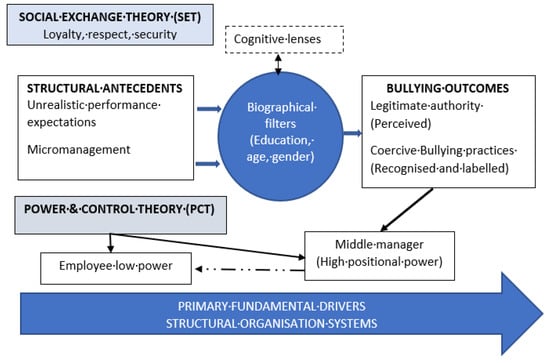
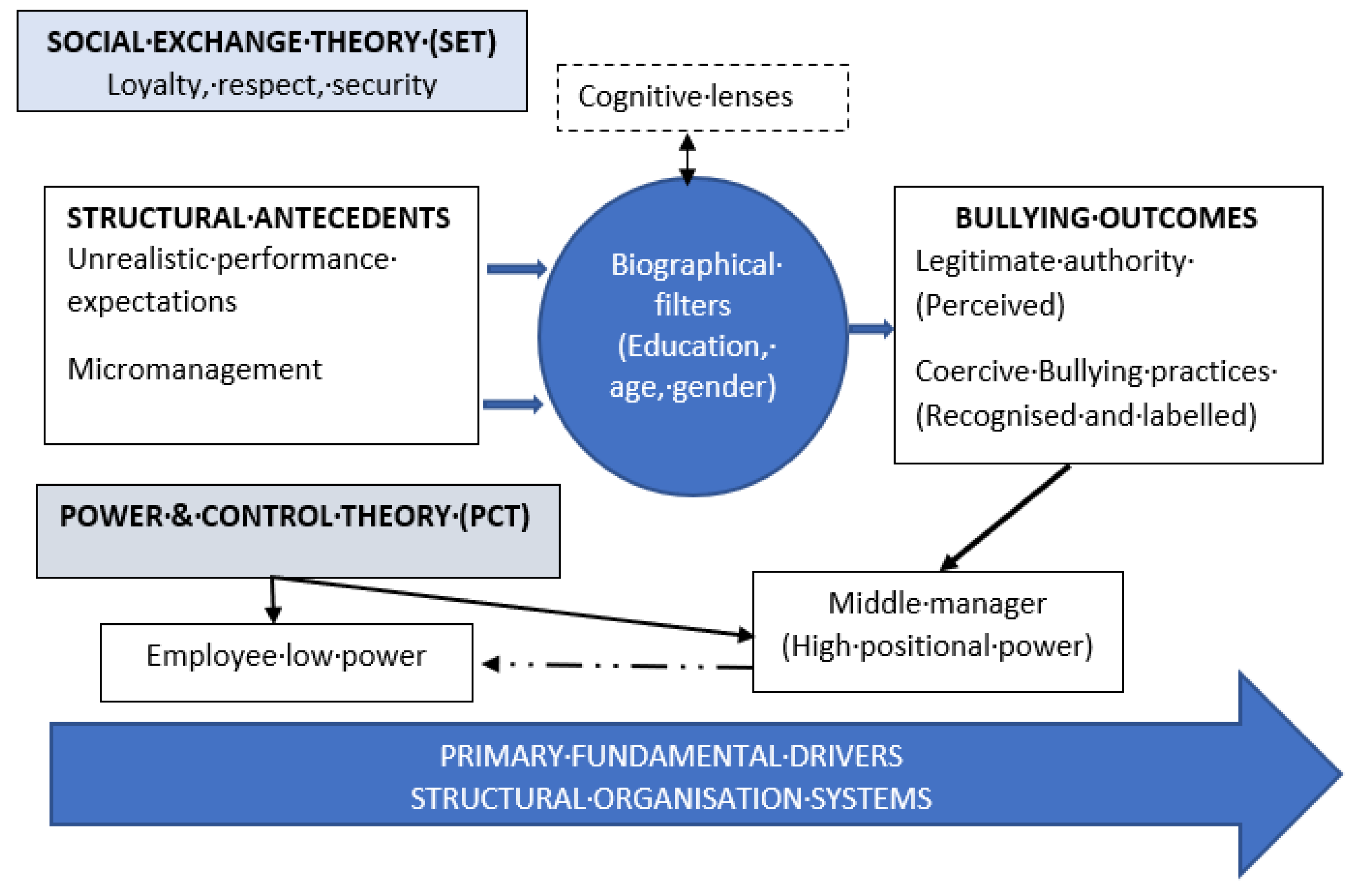
This study adopts an exploratory, descriptive design to map how middle managers perceive task-related and social forms of workplace bullying. The proposed model (Figure 1) is therefore used as a conceptual framework to organise and interpret findings, rather than as a structure to be statistically tested or validated.
Figure 1.
Conceptual framework of the Architecture of Incivility.
2. Literature Review
Research has also highlighted challenges in organisational responses to bullying. Some studies suggest that Human Resource departments may struggle to address workplace harassment or bullying complaints effectively, particularly when organisational power structures discourage reporting (Hodgins et al., 2020; Boddy & Boulter, 2025). These findings show that organisational systems themselves may inadvertently reinforce toxic environments.
Modern organisational dynamics have redefined workplace bullying, moving it from a personality-based conflict to a systemic structural risk (Samnani & Singh, 2012). Within the retail sector, bullying frequently manifests as “performance-driven incivility”. This form of harassment is no longer defined merely by overt physical threats but by a repetitive cycle of humiliation, exclusion, and “digital micromanagement” (Hofmeyr, 2025; Zapf et al., 2020).
The recent literature (Farley et al., 2023; Bwalya, 2024) highlights that in high-velocity retail settings, autocratic leadership styles are often strategically reframed as “rigorous management”. This semantic shift facilitates the normalisation of micromanagement by embedding it within efficiency-driven structures rather than attributing it to individual flaws. While this study prioritizes these structural antecedents, a significant body of research attributes workplace toxicity to individual personality traits, particularly the presence of ‘corporate psychopaths.’ Research suggests that nearly 26% of bullying incidents can be linked to this small cohort of managers, who are statistically more likely to engage in yelling and rudeness than normal managers. In these instances, meanness is a central characteristic, where such individuals may ‘gleefully’ implement authoritarian control to maximize personal bonuses at the expense of employee welfare. However, this study argues that even psychopathic behaviour requires a permissive ‘Architecture of Incivility’ to remain unchecked. In such environments, toxicity is not merely an incident but a structural response to inadequate resources to meet increasing effort demands.
Middle managers in retail organisations are increasingly stuck at the unpredictable convergence of vertical hierarchies. They are tasked with operationalising high-stakes KPIs from senior executives while simultaneously navigating the daily unpredictability of a transient frontline workforce (Bashir & Oetzel, 2025; Ronnie, 2024). This dual pressure creates a “precarious environment” conducive to both “downward” and “upward” bullying as managers attempt to maintain control under extreme accountability (Nielsen et al., 2024).
The collective fallout of this environment is severe. Toxic behaviours erode team cohesion, drive institutional absenteeism, and increase turnover. For middle managers, persistent exposure to task-related stressors triggers a “withdrawal” cycle, in which the social contract with the organisation is severed, resulting in a decline in professional security and long-term organisational commitment (Nielsen et al., 2024).
Workplace bullying research has also emphasised the role of individual personality characteristics of perpetrators. Studies examining “corporate psychopathy” suggest that individuals with psychopathic traits—such as manipulativeness, lack of empathy, and callous interpersonal behaviour—may contribute to abusive organisational climates (Boddy, 2011, p. 30; Boddy & Taplin, 2017). Empirical work indicates strong associations between psychopathic leadership traits and behaviours such as aggression, intimidation, and unethical decision-making (Valentine et al., 2019).
These perspectives highlight that workplace bullying may partly emerge from individual leader characteristics rather than purely structural conditions. However, scholars have also noted that organisational environments characterised by high pressure, weak governance, and strong power hierarchies can enable or amplify destructive leadership behaviours (Farley et al., 2023; Tang, 2023). In this regard, structural and personality-based explanations should be viewed as complementary rather than mutually exclusive.
The present study, therefore, focuses specifically on structural organisational drivers, particularly work intensification and managerial control mechanisms, within the retail sector, while recognising that individual personality characteristics may also be associated with how bullying behaviours manifest.
The management of workplace toxicity in South Africa is situated within a rigorous legislative framework, anchored by the Employment Equity Act (No. 55 of 1998). A pivotal shift occurred with the introduction of the 2022 Code of Good Practice on the Prevention and Elimination of Harassment in the Workplace (Calitz, 2022). This Code explicitly categorises bullying as a pervasive form of harassment and mandates proactive prevention, placing a legal onus on retail organisations to move beyond mere “paper compliance”.
Despite this, Pietersen (2007) notes that a profound disconnect persists between statutory requirements and institutional reality. Many retail firms lack the psychological safety needed, leaving middle managers to navigate a landscape where exercising legal protections carries the implicit risk of career stagnation. The prevailing “command-and-control” culture—often an indication of South Africa’s historical labour relations—masks bullying as legitimate performance management. This cultural barrier makes it difficult for bodies such as the Commission for Conciliation, Mediation and Arbitration (CCMA) to intervene effectively unless the harassment has escalated to the point of constructive dismissal (Mokgolo & Chigo, 2024). There is an urgent need for objective metrics that distinguish between high-performance expectations and systemic harassment.
While the “Architecture of Incivility” creates a uniform baseline of structural pressure, the recognition and labelling of these acts are not uniform; they are interpreted through biographical filters. Crucially, individual characteristics such as education, age, and gender are not conceptualised as determinants of the occurrence of bullying. Rather, they function as interpretive lenses—or “biographical filters”—through which such behaviours are interpreted, labelled, and reported (Mabasa & Maluka, 2024). In this context, organisational structures remain the primary source of pressure, while biographical characteristics shape differences in how such behaviours are perceived. In this context, the organisational structural design remains the primary source of harm, while demographics merely shape the degree of perceptual sensitivity.
Recent empirical evidence suggests a significant “educational gap” in harassment literacy within the South African retail sector. Managers with higher academic qualifications, such as Honours degrees, often exhibit a more sophisticated capacity to identify and articulate psychological harassment compared to those with technical certifications or Grade 12 qualifications (Pillay, 2023). This “Education Paradox” suggests that more educated managers possess the professional vocabulary to distinguish between legitimate performance management and systemic bullying (Bashir & Oetzel, 2025).
Similarly, age and gender act as critical interpretive lenses that define the “perception gap.” Younger managers are often more sensitive to relational aggression and digital micromanagement, whereas their older counterparts—socialised in more traditional, autocratic management eras—may dismiss such toxicity as a standard, albeit harsh, component of career progression (Schoeman, 2025). This discrepancy ensures that while structural pressures are felt universally across the hierarchy, only certain cohorts possess the specific literacy required to formally name these pressures as “bullying.” Consequently, organisational interventions must move beyond “one-size-fits-all” policies, as under-reporting of toxicity in certain demographic groups may result from low harassment literacy rather than a lack of a healthy work environment (Utete, 2025).
Based on this literature, this study presents a conceptual framework (Figure 1) that illustrates how structural organisational pressures and biographical characteristics may shape the interpretation of workplace behaviours, while biographical characteristics are associated with how such behaviours are interpreted and reported. This study utilises SET (Blau, 1964) as the primary lens for interpreting bullying as a fundamental breach of the mutual social contract. In a healthy organisational environment, social exchanges involve a shared trade of effort and loyalty for respect and security. Workplace bullying represents a breach of this contract; when middle managers experience hostile treatment, the perceived imbalance triggers a cycle of withdrawal and reduced productivity.
SET is strategically integrated with French and Raven’s (1959) framework on the Bases of Social Power. In the high-pressure retail sector, the hierarchical structure often blurs the line between legitimate authority (positional power) and coercive control. This study suggests that bullying may be understood as a structural by-product of power imbalances where positional authority is operationalised as coercive managerial control” to enforce unrealistic efficiency demands.
As illustrated in Figure 1, structural antecedents such as unrealistic performance expectations and micromanagement do not directly translate into bullying outcomes (legitimate authority, coercive bullying practices) but are filtered through biographical factors, namely, education, age, and gender. These individual characteristics function as cognitive lenses through which organisational pressures are interpreted, shaping whether managerial actions are perceived as legitimate exercises of authority or as coercive and bullying practices. This mediation reflects the study’s core argument: while the source of pressure is fundamentally organisational (driven by work intensification), the recognition and labelling of that pressure as bullying is contingent upon individual biographical positioning, without displacing organisational systems as the primary causal driver.
Figure 1 serves as a conceptual guide for interpreting the findings and is not intended to represent a statistically tested model.
3. Materials and Methods
Grounded in a positivist paradigm, this study treats workplace bullying as an observable, measurable phenomenon that can be quantified through systematic inquiry (Bryman, 2024). A quantitative, cross-sectional survey design was deployed to capture a high-resolution snapshot of the organisational climate at a single point in time.
The research was conducted within the Gauteng division of a major South African retail firm, a setting characterised by rigid hierarchies and aggressive performance metrics. The target population comprised 610 store-level managers. These roles represent the critical link between senior strategy and the operational realities of the retail floor.
To ensure representativeness, a probability-based simple random sampling method was employed, securing a final sample of n = 253 managers. This provides a 99% confidence level with a 6% margin of error (Ahmed, 2024), The sampling frame consisted of the organisation’s internal list of store-level managers (N = 610). Using this list, a simple random sampling procedure was applied byre and selecting participants using a random number generator. This process ensured that each manager had an equal probability of selection, thereby reducing sampling bias and improving representativeness.
The study utilised the Negative Acts Questionnaire (NAQ-22), a widely validated instrument for measuring exposure to workplace bullying (Einarsen et al., 2023). The instrument was administered in English, which is the organisation’s primary business language; therefore, no translation was required. Although no formal cultural adaptation study was conducted, the NAQ-22 has demonstrated strong cross-cultural applicability across diverse organisational and national contexts (Saunders et al., 2023). In the present study, reliability analysis indicated strong internal consistency (Cronbach’s α > 0.80), further supporting the instrument’s suitability in the South African retail context. In addition, the items were reviewed for contextual relevance to the retail environment to ensure clarity and appropriateness for the study population.
The survey was distributed electronically through Google Forms.
The analysis followed a rigorous three-phase pipeline using SPSS (Version 26):
- Phase 1: Descriptive profiling: Used frequencies, means (M), and standard deviations (SD) to establish the baseline prevalence of negative behaviours.
- Phase 2: Dimensional reduction (EFA): Applied to identify underlying latent constructs, resulting in a two-factor model accounting for 62% of the total variance.
- Phase 3: Inferential testing: Due to the nonparametric nature of Likert data, the Mann–Whitney U test and the Kruskal–Wallis test (with Dunn-Bonferroni post hoc corrections) were used to compare demographic cohorts.
4. Results
The final sample comprised 253 middle managers from a Gauteng-based retail organisation in South Africa. The majority of respondents were frontline store managers (86.56%), reflecting the operational core of the retail hierarchy. Most participants were aged 26–40 years (75.1%), indicating a relatively young managerial cohort. Regarding educational attainment, 54.94% of respondents held a Grade 12 qualification, while 18.18% held higher qualifications, including diplomas and degrees. This variation in educational background provided a suitable basis for examining perceptual differences across biographical groups.
Table 1 presents the most frequently reported negative acts experienced by respondents. The results indicate that task-related forms of managerial control were the most prevalent behaviours in the workplace. The highest-ranked item was micromanagement (intrusive monitoring) (M = 2.00, SD = 1.30), followed by persistent highlighting of professional errors (M = 1.94, SD = 1.15). Social forms of incivility were also present, including gossip and rumours (M = 1.87, SD = 1.12) and social exclusion (M = 1.65, SD = 0.98). Given that lower mean scores reflect more frequent exposure (1 = daily; 5 = never), these findings indicate that respondents experienced these behaviours regularly. Notably, task-oriented behaviours appear to be more embedded in routine managerial practices than purely social forms of bullying.
Table 1.
Prevalence of negative act items in the workplace.
An Exploratory Factor Analysis (EFA) was conducted to identify the underlying structure of workplace bullying behaviours measured by the NAQ-22. The data were deemed suitable for factor analysis based on standard diagnostics. The Kaiser–Meyer–Olkin (KMO) measure of sampling adequacy exceeded the recommended threshold of 0.70, and Bartlett’s Test of Sphericity was statistically significant (p < 0.001), indicating that the data were factorable. The analysis yielded a two-factor solution, accounting for 62% of the total variance. The factors were interpreted as follows:
- Factor 1: General Harassment: This factor comprised socially oriented behaviours such as gossip, rumours, and social exclusion. These behaviours reflect interpersonal forms of workplace bullying.
- Factor 2: Managerial Control: This factor included task-related behaviours such as micromanagement, excessive monitoring, and persistent highlighting of errors. These behaviours represent control-oriented managerial practices embedded within operational processes.
The emergence of these two dimensions suggests that workplace bullying in this context is not a single construct but consists of both social (relational) and task-related (structural) components.
To examine whether perceptions of workplace bullying varied across biographical groups, nonparametric tests were conducted because the data were ordinal. The Kruskal–Wallis test revealed that educational attainment had a statistically significant effect on perceptions of General Harassment (Factor 1: p = 0.0268). Post hoc comparisons (Dunn-Bonferroni) indicated that respondents with higher qualifications (e.g., Honours degrees) were significantly more likely to identify and label socially oriented behaviours as bullying compared to those with lower qualifications (e.g., Higher Certificates). In contrast, no significant differences were found across educational groups for Managerial Control behaviours (Factor 2: p = 0.3378). This suggests that perceptions of task-related behaviours such as micromanagement and monitoring were relatively consistent across all educational levels.
To further summarise the inferential findings, Table 2 presents the relationship between educational attainment and the two identified factors of workplace bullying.
Table 2.
The “educational paradox”.
As shown in Table 2, perceptions of General Harassment differed significantly across educational groups (p = 0.0268), whereas perceptions of Managerial Control did not differ significantly (p = 0.3378).
5. Discussion
The aim of this study was to explore how middle managers in a South African retail organisation perceive workplace bullying, with a particular focus on task-related and social forms of negative acts and the role of biographical characteristics. The findings provide evidence that workplace bullying in this context is multidimensional and shaped by both organisational structures and individual interpretation.
The results identified two distinct dimensions of workplace bullying: General Harassment and Managerial Control. This supports existing research, which conceptualises workplace bullying as both interpersonal and structural in nature (Einarsen et al., 2023; Tang, 2023). While social behaviours such as gossip and exclusion align with traditional definitions of bullying, the prominence of task-related behaviours suggests that bullying may also be embedded within routine managerial practices.
A key finding is that managerial control behaviours were consistently perceived across all educational groups, indicating that practices such as micromanagement and persistent monitoring are widely normalised. This is consistent with Farley et al. (2023), who argue that organisational systems and performance pressures can legitimise behaviours that may otherwise be considered harmful. These findings indicate that, within high-pressure retail environments, certain forms of control are institutionalised and no longer recognised as problematic.
In contrast, social forms of harassment were interpreted differently across educational groups, with higher-educated managers demonstrating greater sensitivity to these behaviours. This supports prior research indicating that education enhances individuals’ ability to recognise and label workplace mistreatment (Ng et al., 2010). This reinforces the role of biographical characteristics as interpretive filters, shaping how workplace experiences are perceived and reported.
These findings can be understood through Social Exchange Theory (Blau, 1964), which emphasises reciprocity in workplace relationships. The normalisation of managerial control behaviours may reflect a shift towards transactional exchanges, where performance demands outweigh relational considerations. In addition, Power and Control Theory (French & Raven, 1959) helps explain how hierarchical authority may be operationalised through monitoring practices, potentially blurring the boundary between legitimate management and coercive control.
While the study does not statistically test the relationships proposed in Figure 1, the findings provide partial empirical support for the conceptual framework, demonstrating that structural pressures are reflected in managerial control behaviours, while biographical factors are associated with differences in how these behaviours are interpreted. Overall, the study highlights the importance of understanding workplace bullying as both a structural and perceptual phenomenon.
While the findings provide valuable insights into the structural and perceptual dimensions of workplace bullying, they should be interpreted in light of the study’s methodological limitations.
This study is subject to several limitations. First, the cross-sectional design limits the ability to draw causal inferences about the relationship between organisational conditions and workplace bullying behaviours. Second, the study was conducted within a single retail organisation in Gauteng, which may limit the generalisability of the findings to other sectors or regions.
Third, the reliance on self-reported data introduces the possibility of response bias, as the findings reflect perceived experiences rather than objectively observed behaviours. Finally, while the study focused on educational differences, other potentially relevant biographical variables—such as tenure or organisational role—were not examined in detail.
Future research could address these limitations by employing longitudinal designs, expanding the sample across multiple organisations, and incorporating mixed-method approaches to capture deeper contextual insights.
6. Conclusions
This study demonstrates that workplace bullying within South African retail organisations is partly embedded within structural organisational practices, particularly through task-related managerial control behaviours such as micromanagement and persistent monitoring. While social forms of harassment are interpreted differently across educational groups, task-related behaviours appear to be widely normalised across all cohorts.
The study contributes to the literature by highlighting the role of biographical factors as perceptual filters that shape how workplace bullying is recognised and reported. It further emphasises that workplace incivility should not be understood solely as an interpersonal issue but as a phenomenon embedded within organisational systems and performance pressures.
From a practical perspective, organisations should critically evaluate performance management practices to ensure that legitimate managerial oversight does not evolve into normalised forms of coercive control. Tailored interventions that account for perceptual differences among managers may improve the effectiveness of anti-bullying strategies.
Author Contributions
Conceptualization, L.v.H., S.L. and P.N.; methodology, L.v.H. and P.N.; formal analysis L.v.H., S.L. and P.N.; investigation, P.N.; resources, L.v.H., S.L. and P.N.; data curation, L.v.H., S.L. and P.N.; writing—original draft preparation, P.N.; writing—review and editing, L.v.H., S.L. and P.N.; supervision, L.v.H. and S.L.; project administration, S.L. All authors have read and agreed to the published version of the manuscript.
Funding
This research received no external funding.
Institutional Review Board Statement
The study was conducted in accordance with the Declaration of Helsinki, and approved by the Tshwane University of Technology Central Ethics Committee (protocol code 207259500 and 26 June 2022).
Informed Consent Statement
Informed consent was obtained from all subjects involved in the study.
Data Availability Statement
The data presented in this study are available on request from the corresponding author due to confidentiality restrictions imposed by the participating retail company.
Acknowledgments
During the preparation of this work, the authors utilized the generative AI models Gemini 1.5 Flash (Google, 2025) and ChatGPT-5.3 (OpenAI, 2025) to assist in drafting, editing, and refining the text. The tools were used for tasks including checking for grammatical errors, improving language and writing style, enhancing structural organization, and refining the academic tone of the manuscript. It was used to enhance the Introduction and Discussion sections and to align in-text citations and reference lists with APA 7th edition standards. After using these tools, the authors carefully reviewed and edited all content, taking full responsibility for the final manuscript. All primary data collection and statistical analyses (conducted using SPSS) are the original work of the authors. The contribution of Dr SHP Mncwabe is acknowledged in relation to academic guidance provided during the supervision of the original thesis only.
Conflicts of Interest
The authors declare no conflicts of interest.
References
- Ahmed, K. S. (2024). How to choose a sampling technique and determine sample size for research: A simplified guide for researchers. Oral Oncology Reports, 12, 100662. [Google Scholar] [CrossRef] [Scilit]
- Bashir, S., & Oetzel, J. G. (2025). Workplace bullying in healthcare organisations: A scoping review of the systematic reviews and meta-analyses on workplace bullying of healthcare workers. Journal of Advanced Nursing, 81(1), 1–18. [Google Scholar] [CrossRef] [Scilit] [PubMed]
- Blau, P. M. (1964). Exchange and power in social life. John Wiley & Sons. [Google Scholar]
- Boddy, C. R. (2011). Corporate psychopaths, bullying and unfair supervision in the workplace. Journal of Business Ethics, 100(3), 367–379. [Google Scholar] [CrossRef] [Scilit]
- Boddy, C. R., & Boulter, L. (2025). HRM’s response to workplace bullying: Complacent, complicit and compounding. Journal of Business Ethics, 197, 541–555. [Google Scholar]
- Boddy, C. R., & Taplin, R. (2017). A note on workplace psychopathic bullying: Measuring its frequency and severity. Aggression and Violent Behavior, 34, 117–119. [Google Scholar] [CrossRef] [Scilit]
- Bryman, A. (2024). Social research methods (6th ed). Oxford University Press. [Google Scholar]
- Bwalya, A. (2024). Micromanagement: A comprehensive analysis. Global Scientific Journals, 12(7), 29–40. [Google Scholar] [CrossRef]
- Calitz, K. (2022). Bullying in the workplace: The plight of South African employees. Potchefstroom Electronic Law Journal, 25, 1–36. [Google Scholar] [CrossRef] [Scilit]
- Einarsen, S., Hoel, H., Zapf, D., & Cooper, C. L. (2023). Bullying and harassment in the workplace: Theory, research and practice (4th ed.). CRC Press. [Google Scholar]
- Farley, S., Mokhtar, D., Ng, K., & Niven, K. (2023). What influences the relationship between workplace bullying and employee well-being? A systematic review of moderators. Work & Stress, 37(3), 345–372. [Google Scholar] [CrossRef] [Scilit]
- French, J. R. P., & Raven, B. (1959). The bases of social power. In D. Cartwright (Ed.), Studies in social power (pp. 150–167). University of Michigan Press. [Google Scholar]
- Gallup. (2022). State of the global workplace report. Gallup. Available online: https://www.gallup.com/workplace/349484/state-of-the-global-workplace.aspx (accessed on 24 March 2026).
- Hodgins, M., MacCurtain, S., & Mannix-McNamara, P. (2020). Workplace bullying and incivility: A systematic review of interventions. International Journal of Workplace Health Management, 13(1), 1–26. [Google Scholar] [CrossRef] [Scilit]
- Hofmeyr, C. D. (2025, February 24). Workplace harassment: Employment law alert. Available online: https://www.cliffedekkerhofmeyr.com/news/publications/2025/Practice/Employment-Law/employment-law-alert-24-february-2025-workplace-harassment (accessed on 18 February 2026).
- Mabasa, F. D., & Maluka, H. R. (2024). Outcomes and consequences of workplace bullying incidents: An indigenous South African perspective. International Journal of Applied Research in Business and Management, 5(2), 1–14. [Google Scholar] [CrossRef] [Scilit]
- Mokgolo, M. M., & Chigo, S. (2024). Exploring a framework to manage bullying in South African academia: A human resources perspective. SA Journal of Industrial Psychology, 50, a2129. [Google Scholar] [CrossRef] [Scilit]
- Monakali, R. (2024). Managing workplace harassment: A conflict management framework [Doctoral thesis, Nelson Mandela University]. [Google Scholar]
- Ng, E. S., Schweitzer, L., & Lyons, S. T. (2010). New generation, great expectations: A field study of the millennial generation. Journal of Business and Psychology, 25(2), 281–292. [Google Scholar] [CrossRef] [Scilit]
- Nielsen, M. B., Einarsen, S. V., Parveen, S., & Rosander, M. (2024). Witnessing workplace bullying: A systematic review and meta-analysis of individual health and well-being outcomes. Aggression and Violent Behavior, 75, 101908. [Google Scholar] [CrossRef] [Scilit]
- Parsons, R. A. (2024). The role of middle management in influencing the success of corporate culture change [Doctoral thesis, Walden University]. [Google Scholar]
- Pietersen, C. (2007). Interpersonal bullying behaviours in the workplace. South African Journal of Industrial Psychology, 33(1), a256. [Google Scholar] [CrossRef] [Scilit]
- Pillay, K. (2023). Exploring mid-level leaders’ perceptions of organisational culture at a cash management company. SA Journal of Human Resource Management, 21, 2250. [Google Scholar] [CrossRef] [Scilit]
- Ronnie, L. (2024). The challenge of toxic leadership in realising the sustainable development goals. SA Journal of Human Resource Management, 22, a2754. [Google Scholar] [CrossRef] [Scilit]
- Samnani, A. K., & Singh, P. (2012). Twenty years of workplace bullying research: A review of developments and future directions. Aggression and Violent Behavior, 17(6), 581–589. [Google Scholar] [CrossRef] [Scilit]
- Saunders, M., Lewis, P., & Thornhill, A. (2023). Research methods for business students (9th ed.). Pearson Education. [Google Scholar]
- Schoeman, R. (2025). World mental health day: Toxic workplaces fueling depression in South Africa. Jacaranda FM. Available online: https://www.jacarandafm.com/news/news/world-mental-health-day-toxic-workplaces-fuelling/ (accessed on 2 February 2026).
- Tang, D. (2023). Workplace bullying: A comprehensive overview of its causes, effects, and organizational prevention strategies. Frontiers in Business, Economics and Management, 8, 41–44. [Google Scholar]
- Utete, G. (2025). The impact of a dysfunctional workplace on a company’s bottom line. Remchannel/Old mutual thought leadership series. Available online: https://www.oldmutual.co.za/news/the-cost-of-workplace-toxicity-on-sa-companies/ (accessed on 2 February 2026).
- Valentine, S. R., Hanson, S. K., & Fleischman, G. M. (2019). The presence of ethics codes and employees’ internal locus of control, social aversion/malevolence, and ethical judgment of incivility: A study of smaller organizations. Journal of Business Ethics, 160(3), 657–674. [Google Scholar] [CrossRef] [Scilit]
- Zapf, D., Escartín, J., Einarsen, S., Hoel, H., & Vartia, M. (2020). Empirical findings on bullying in the workplace. In S. Einarsen, H. Hoel, D. Zapf, & C. L. Cooper (Eds.), Bullying and harassment in the workplace: Theory, research and practice (pp. 105–135). CRC Press. [Google Scholar] [CrossRef] [Scilit]

Disclaimer/Publisher’s Note: The statements, opinions and data contained in all publications are solely those of the individual author(s) and contributor(s) and not of MDPI and/or the editor(s). MDPI and/or the editor(s) disclaim responsibility for any injury to people or property resulting from any ideas, methods, instructions or products referred to in the content. |
© 2026 by the authors. Licensee MDPI, Basel, Switzerland. This article is an open access article distributed under the terms and conditions of the Creative Commons Attribution (CC BY) license.