Article

Induced Phytoextraction of Heavy Metals from Soils Using Brassica juncea and EDTA: An Efficient Approach to the Remedy of Zinc, Copper and Lead


1
Testing Department, National Institute of Research—Development for Machines and Installations Designed for Agriculture and Food Industry—INMA, 013813 Bucharest, Romania
2
Department of Projects and International Relations (DPRI), National Institute of Research—Development for Machines and Installations Designed for Agriculture and Food Industry—INMA, 013813 Bucharest, Romania
3
Department of Biotechnical Systems, Faculty of Biotechnical Systems Engineering, National University of Science and Technology Politehnica Bucharest, 006042 Bucharest, Romania
4
National Research and Development Institute of Occupational Safety—I.N.C.D.P.M. “Alexandru Darabont”, 35A Ghencea Boulevard, Sector 6, 061692 Bucharest, Romania
*
Authors to whom correspondence should be addressed.
Environments 2026, 13(1), 23; https://doi.org/10.3390/environments13010023 (registering DOI)
Submission received: 13 November 2025 / Revised: 23 December 2025 / Accepted: 25 December 2025 / Published: 1 January 2026

Abstract

Contamination of agricultural soils with heavy metals, such as zinc (Zn), copper (Cu) and lead (Pb), is a major problem for food safety and environmental sustainability. The present study aimed to evaluate the efficiency of phytoremediation induced with Brassica juncea (Indian mustard) and ethylenediaminetetraacetic acid (EDTA) in reducing the content of heavy metals in contaminated soils. The experiment was carried out in a greenhouse, using soil polluted with Zn, Cu and Pb, to which different treatments were applied, using: the biological method (Indian mustard only), the chemical method (EDTA in three concentrations: 0.5–1.0–2.0 mmol·kg−1) and the mixed method (Indian mustard and EDTA in three concentrations: 0.5–1.0–2.0 mmol·kg−1). The determinations included the analysis of the residual metal content by atomic absorption spectroscopy, as well as the evaluation of the physiological parameters of the plants (biomass, chlorophyll content in leaves, humidity, height). The results of unifactorial and bifactorial ANOVA revealed highly significant differences (p < 0.001) between the treatments and the types of metals, confirming the synergistic interaction between the chelation and phytoextraction processes. The combined treatments Indian mustard and EDTA in concentrations of 1.0 mmol·kg−1 and 2.0 mmol·kg−1, ensured the highest decontamination efficiency, with reductions of 51.5% for Zn, 36.3% for Pb and 27.5% for Cu. In conclusion, the mixed method represents a viable, ecological and reproducible strategy for the remediation of soils contaminated with heavy metals.

1. Introduction

Soils are one of the most important components of the terrestrial ecosystem, playing an essential role in maintaining ecological balance, agricultural production and global food security. In recent decades, soil pollution with heavy metals, such as zinc (Zn), copper (Cu) and lead (Pb), has become one of the most serious environmental threats, due to the persistence and toxicity of these elements in natural systems [1,2]. The main sources of contamination include industrial activities, mining, the use of fertilizers and pesticides, the burning of fossil fuels, but also the uncontrolled storage of metal waste [3].
Heavy metals are characterized by high chemical stability and lack of biodegradability, which leads to their gradual accumulation in soils and, subsequently, to migration into plants, water and the food chain [4]. Prolonged exposure to high concentrations of heavy metals has toxic effects on plants, soil microorganisms, animals and humans, affecting essential physiological processes such as photosynthesis, respiration and enzymatic activity [5]. From an agronomic point of view, these metals reduce soil fertility and crop yield, affecting the stability of ecosystems [6]. Globally, over 17% of agricultural land is affected by heavy metal pollution above permissible limits [1]. The most vulnerable areas are those with intense industrial activity, where Zn, Cu and Pb are constantly introduced into the environment through smelting, refining and industrial waste disposal processes [3]. Factors such as pH, texture and organic matter content significantly influence the accumulation and mobility of heavy metals in the soil. A low pH increases the solubility and availability of most toxic metals, favoring the contamination of plants and groundwater, while alkaline soils, rich in clay and organic matter, tend to retain metals by forming insoluble compounds and organo-mineral complexes, thus reducing the risk of pollution [7,8,9].
In Romania, soil contamination with heavy metals is frequently reported in areas with historical mining activity (Baia Mare, Zlatna, Copșa Mică), but also in urban and peri-urban areas, where the accumulation of these elements occurs through intense traffic, sludge storage and the application of chemical fertilizers [10,11,12,13]. Recent studies show that in some regions, the content of Zn, Cu and Pb exceeds the threshold values established by national legislation, affecting soil quality and the safety of agricultural production [14,15].
Faced with these challenges, a series of strategies have been developed for the remediation of contaminated soils, which can be grouped into three broad categories: physicochemical methods, biological methods, and combined methods [5].
Physicochemical methods include soil washing with chelating agents, metal stabilization by applying mineral amendments (phosphates, calcium carbonate), and ion exchange [16,17,18]. Among the chelating agents, EDTA (ethylenediaminetetraacetic acid) is one of the most widely used due to its ability to form stable complexes with metal ions, facilitating their mobilization and removal from the soil [19]. However, the use of EDTA must be carefully controlled, as this compound is poorly biodegradable and can cause metal migration into groundwater [1]. Biological methods, such as phytoremediation, are based on the use of plants capable of absorbing, accumulating, or stabilizing heavy metals in the soil [2]. This method is considered “green”, being economical and environmentally friendly. Hyperaccumulator plants, such as Brassica juncea (Indian mustard), are known for their ability to extract metals from soil, especially zinc, copper and lead [20,21,22]. However, the efficiency of phytoremediation depends on many factors, such as soil pH, organic matter content, plant species and metal availability [4,15].
Soil contamination with heavy metals is a major environmental problem, exacerbated by agricultural, mining and industrial activities, as well as the effects of climate change. Toxic metals, such as lead, cadmium or arsenic, significantly affect soil health and agricultural productivity. Natural bioremediation strategies, based on microorganisms and plants, offer ecological and cost-effective solutions compared to physicochemical methods, contributing to the restoration of soil ecosystem functions and the reduction of heavy metal pollution [15].
Combined methods integrate the advantages of both approaches, using simultaneously chelating agents (such as EDTA) and phytoaccumulations plants to maximize the efficiency of the remediation process [19]. Studies show that combined treatments can increase the mobilization of heavy metals from the soil and, implicitly, their uptake by plants [23]. In this context, the use of EDTA in combination with Brassica juncea becomes a promising method, offering a balanced solution between efficiency and sustainability.
Numerous authors have investigated the effect of chelating agent treatments on the physiological parameters of plants used in phytoremediation, especially in the Brassica juncea species. Studies have shown that the application of EDTA, in moderate concentrations, can stimulate plant metabolic processes by increasing nutrient uptake and improving chlorophyll content, while high doses can induce oxidative stress and reduce vegetative growth [23,24]. Under conditions of Zn, Cu and Pb contamination, research has revealed significant variations in physiological parameters such as height, dry mass, water content and antioxidant enzyme activity, dependent on the type of metal and the concentration of EDTA applied [25,26]. Statistical analyses of the ANOVA type and post-hoc tests (Tukey HSD) performed by various authors confirm significant differences between treatments, emphasizing that the interaction between metal, dose and plant determines the degree of tolerance and the capacity to accumulate metals [24,27,28,29,30]. These results support the use of multifactorial statistical analysis as an essential tool in interpreting the physiological responses of hyperaccumulating plants in the remediation processes of contaminated soils.
Recent trends are oriented towards ecological and economic solutions, capable of reducing heavy metal levels without affecting soil quality [14,15]. For this reason, research on the combination of synthetic chelators with plants adapted to local conditions, such as Indian mustard, represents an important step towards the implementation of sustainable practices for the remediation of contaminated soils.
The present work is part of this research direction, aiming to evaluate the efficiency of treatments applied to soil contaminated with heavy metals (Zn, Cu, Pb), by applying three different concentrations of EDTA (0.5 mmol·kg−1, 1.0 mmol·kg−1 and 2.0 mmol·kg−1) and by using the Indian mustard crop (Brassica juncea), both individually and in combination. The aim is to determine the reduction of heavy metal concentrations (mg·kg−1) and to compare the efficiency of chemical, biological and combined treatments. In addition, the research includes a detailed statistical analysis of the effect of treatments on physiological parameters of Indian mustard (Brassica juncea) such as: plant height, biomass, chlorophyll content and humidity, under metal stress conditions, in order to highlight the correlations between the contamination level, EDTA dose and the physiological response of plants. Through the proposed integrated approach, the study contributes to the scientific substantiation of ecological remediation strategies, providing relevant data for the practical application of EDTA-assisted phytoremediation in contaminated soils.

2. Materials and Methods

The experiment was carried out in greenhouse, under controlled conditions, using soil with experimentally established heavy metal levels, at an atmospheric temperature of 24–30 °C, relative air humidity of 45–50%, soil pH between 5.4–6.0 and soil humidity of 80–90%. Plastic containers (pots) arranged in four replicates were used, each containing soil contaminated with three heavy metals: zinc (Zn), copper (Cu) and lead (Pb), each metal being analyzed separately.

2.1. Chemical Composition of the Soil Used in the Experiment

The soil used in the experiment was a commercially available horticultural substrate, with a specific organic composition. The substrate came from a mixture of brown peat (60–70%), matured vegetable compost and perlite (10–15%), formulated for potted crops. From a pedological point of view, the substrate fell into the category of light organic soils, with a loamy-sandy texture, conferred by the high proportions of peat.
The determination of the physicochemical parameters was carried out based on standard procedures used in soil analysis laboratories. The pH and electrical conductivity were measured in aqueous extract, according to the international methodology used in the analysis of horticultural substrates. The total nitrogen content was determined by the Kjeldahl method [31], the available phosphates by colorimetry in an acidic medium [32], and the exchangeable potassium by atomic absorption spectrometry (AAS) [33]. The organic matter was evaluated by the loss on ignition method, carried out by heating at 550 °C. The concentrations of heavy metals (Zn, Cu, Pb) were determined by acid digestion and instrumental analysis using flame atomic absorption spectroscopy (AAS).
The physicochemical analyses performed on this substrate showed that the soil reaction is weakly acidic (pH 5.8 ± 0.2), the high organic matter content (61 ± 4%) reflects a rich nutritional intake, specific to substrates intended for potted crops. The levels of the main nutritional elements determined were within optimal ranges, being represented by 980 ± 80 mg/kg total nitrogen, 580 ± 60 mg/kg phosphates and 1050 ± 100 mg/kg potassium. The electrical conductivity recorded was (1.55 ± 0.25 mS/cm), so the soil had a moderate salinity, suitable for the growth of young plants.
Heavy metal concentrations were 58 ± 10 mg/kg for Zn, 18 ± 4 mg/kg for Cu, 8 ± 3 mg/kg for Pb, all within normal limits, indicating the absence of contamination. All determinations confirmed the suitability of the substrate for use in the experiment, providing a homogeneous and controlled environment for the evaluation of growth parameters.

2.2. Soil Contamination Procedure

To carry out the experiment, the soil was contaminated in a controlled manner, in the laboratory, with heavy metals (Zn, Cu and Pb), so as to reach the established target concentrations and to evaluate the response of the potted plants. The chosen concentrations of 993 mg·kg−1 for Zn, 534 mg·kg−1 for Cu and 152 mg·kg−1 for Pb, were strategically selected to reflect a moderate to high level of contamination, appropriate for studies of the effectiveness of remediation methods, but without completely compromising plant development.
For each metal, 28 pots with a volume of 3.3 L were prepared, each filled with 4 kg of soil, resulting in a total mass of 112 kg of soil per metal. The dried soil was homogenized before contamination, after which, for each metal, a concentrated aqueous solution was prepared, so that the distribution of the metals was uniform throughout the soil mass.
Table 1 presents the quantities of metal salts and the volumes of water used to prepare the solutions necessary to contaminate the 112 kg of soil for each metal.
Soil contamination was carried out through the following stages:
  • Preparation of solutions: the salts corresponding to each metal were dissolved in the indicated volumes of water, obtaining concentrated, completely transparent aqueous solutions.
  • Solution application: the entire amount of soil (112 kg) was placed in a suitable container, and the concentrated solution was added gradually, with continuous mixing, to allow uniform distribution of the metals.
  • Homogenization: the soil was mixed manually and mechanically, using an electric concrete mixer (Imer Syntesi 140 type, IMER Group, Poggibonsi, Italy), until complete homogenization and uniform distribution of metals in the total soil mass were achieved.
  • Stabilization: the contaminated soil was left to rest for 24 h, to allow the penetration and uniformity of metals before distribution into pots (4 kg/pot).
This procedure ensured the obtaining of soil samples with uniform and reproducible concentrations, allowing the comparison of the effects of each heavy metal on plants in a controlled and standardized environment.

2.3. Applied Decontamination Methods

Three distinct methods were applied to improve contaminated soils:
  • The biological method, which consisted of sowing Indian mustard seeds (Brassica juncea) in the contaminated soil, without applying EDTA. 10 seeds were sown in each pot at a depth of approximately 1 cm. After emergence (5–7 days), 3 uniform plants/pot were selected, which were maintained throughout the experiment (80 days).
The selection of the three seedlings/pots was made based on standard visual criteria used in phytoextraction experiments, namely uniformity of height, plant vigor and absence of stress symptoms (chlorosis, necrosis), as well as normal formation of primary leaves. The weight of the seedlings was not measured gravimetrically, since morphological selection is considered sufficient for uniformity of the batches at this stage and is a common practice in the specialized literature. Also, any initial minor differences in biomass are compensated for during the extended experimental period (80 days), in which the plants stabilize their development before the final determinations.
  • The chemical method, which consisted of adding EDTA solution (ethylenediaminetetraacetic acid, disodium salt Na2EDTA·2H2O) in three concentrations equivalent to 0.5, 1.0 and 2.0 mmol·kg−1 dry soil, to the pots with soil contaminated with each metal (Zn, Cu, Pb);
  • Mixed method (chemical-biological), which combined Indian mustard sowing in contaminated soil, according to the biological method, followed by weekly watering with EDTA solution, in the same concentrations (0.5–1.0–2.0 mmol·kg−1 dry soil).
EDTA solutions were prepared from Na2EDTA·2H2O (372.24 g·mol−1), dissolved in distilled water until obtaining stock solutions of 15.625, 31.25 and 62.5 mmol·L−1, corresponding to the three applied doses. The solutions were then diluted with distilled water in a ratio of 1:4, according to the EDTA: water mixture, and were buffered at pH 6.5 ± 0.1 to prevent variations in soil acidity.

2.4. Design Experimental

A total of 84 pots were used, distributed as follows:
  • Biological method: 12 pots containing soil contaminated (4 kg/pot) with each metal (Zn, Cu, Pb), in which Indian mustard seeds were sown and watered only with water.
  • Chemical method: 36 pots with contaminated soil, treated weekly with three different EDTA solutions (EDTA1, EDTA2, EDTA3), obtained from stock solutions of 15,625, 31,250 and 62,500 mmol·L−1. Each stock solution was diluted 1:4 (v/v) with water before application, and the treatments corresponded to final doses of 0.5, 1.0 and 2.0 mmol·kg−1 dry soil.
  • Mixed method: 36 pots in which Indian mustard seeds were sown and treated weekly with the same three diluted EDTA solutions (EDTA1–EDTA3), corresponding to the same three dosage levels.
Soil moisture was maintained constant throughout the experiment (80 days). Each pot was applied weekly with 20 mL of diluted EDTA solution (1:4, v/v), and the doses per application and cumulative doses for each treatment (0.75, 1.50 and 3.00 mmol·pot−1) are presented in Table 2.
In order to maintain optimal soil moisture and prevent water stress, the total volume of liquid applied to each pot was supplemented, when necessary, with additional water. During the experiment, approximately 220–350 mL of water/pot/week was additionally added, depending on the water requirements of the plants. In this way, the EDTA:water ratio (1:4) was strictly maintained in the applied solution, while the total amount of water was adjusted to maintain uniform soil moisture.
The choice of EDTA among other chelating agents (EDDS, DTPA, HEDTA, citric acid) was based on the literature [34,35,36,37], which highlights its ability to mobilize metal ions, prevent heavy metal precipitation and solubilize metals adsorbed in the solid fractions of the soil. The results of other studies [38,39,40,41] substantiated the use of the mixed method (Indian mustard and EDTA) as an effective strategy for accelerated decontamination of soils contaminated with heavy metals.

2.5. Experimental Determinations

The following physiological parameters of Indian mustard plants (fresh weight, chlorophyll content, humidity and height) and soil contaminants (Zn, Cu, Pb) remaining after the application of the three decontamination methods were analyzed.
All morphological and physiological evaluations of Indian mustard plants were carried out exclusively at the end of the experimental period, after 80 days of vegetation. No initial or intermediate measurements were performed, since the objective of the study was to determine the cumulative effect of the treatments on metal mobilization and on the final plant biomass. All plant and soil samples were collected on the same day and in the same session (10:00), to eliminate phenological or diurnal variations. Physiological parameters were determined immediately after harvesting, as follows:
  • Fresh weight of plants, determined by weighing immediately after harvest;
  • Chlorophyll content, determined with a SPAD-502 chlorophyll meter (Konica Minolta, Tokyo, Japan), the results being expressed in SPAD units;
  • Water content (plant moisture), calculated gravimetrically based on the difference between fresh and dry weight, according to standard methodology;
  • Plant height, measured with a millimeter ruler.
After harvest, soil samples were taken from each pot. The samples were air-dried, ground and sieved (2 mm sieve) before analysis. Metal extraction from dry soil was performed by acid digestion with 65% nitric acid (HNO3), and the determination of total Zn, Cu and Pb content was performed by flame atomic absorption spectroscopy (AAS), using a spectrometer calibrated (Analytik Jena ContrAA 700 type, Jena, Germany) with certified standard solutions.
The experimental flow is schematically presented in Figure 1.

2.6. Statistical Processing

ANOVA statistical analyses were performed using the R program (version 4.x), and advanced statistical models were developed in Python (version 3.11). The purpose of these analyses was to evaluate the effect of treatments on the content of heavy metals in the soil and to determine the interaction between the type of treatment and the type of metal (Zn, Cu, Pb).
Within the unifactorial analysis, the effect of a single independent factor—the type of treatment, on a single dependent variable, namely the content of a certain metal (Zn, Cu, Pb) in the soil, expressed in mg·kg−1, was evaluated. The purpose of this analysis was to determine whether the applied treatments (Control, Indian mustard, EDTA 0.5–1.0–2.0 mmol·kg−1, Indian mustard and EDTA 0.5–1.0–2.0 mmol·kg−1) produce statistically significant differences in the content of the analyzed metal. In cases where significant differences were identified (p < 0.05), the post-hoc Tukey HSD test was applied to compare means and identify variants that differ significantly from each other. The results were expressed as the mean ± standard deviation (SD), and Tukey groups were noted by distinct letters, indicating significant differences between treatments.
The bifactorial analysis simultaneously included two independent factors, the type of treatment and the type of metal (Zn, Cu, Pb), while the dependent variable remained the same: the metal content in the soil (mg·kg−1). The purpose of this analysis was to evaluate the overall effect of the treatment, the overall effect of the type of metal and the Treatment × Metal interaction, i.e., whether the effect of the treatments depends on the type of metal.
The statistical model used in Python was the one described by the relation (1):
V a l u e ~ C T r e a t m e n t × C ( M e t a l )
where: Value represents the metal content (mg·kg−1), the dependent variable, Treatment is the factor describing the type of treatment applied, Metal represents the type of metal analyzed (Zn, Cu, Pb), × represents the interaction term Treatment × Metal.
Logarithmic function analysis was used to explore the relationship between the mean values of the heavy metal content (Zn, Cu, Pb) obtained by ANOVA and the percentage losses recorded following the decontamination process, in order to highlight the correlations and the influence of the treatments applied on the reduction of the metal content in the soil. For each metal, a multiple logarithmic regression was applied, according to the relationship (2):
Y = a · ln x + b
where: Y represents the dependent variable, expressed as the metal content (mg·kg−1), respectively the percentage loss (%); x represents the type of treatment applied; ln(x) is the natural logarithm of the independent variable; a is the slope coefficient (describes the direction and intensity of the variation); b is the origin (the value of Y when ln(x) = 0).
Two sets of logarithmic models were thus obtained for each metal (Zn, Cu, Pb): the first describes the variation of the metal content according to the treatments, and the second captures the evolution of the percentage loss after the decontamination process.
To determine the efficiency of the treatments in mobilizing heavy metals (Zn, Cu, Pb) from the soil, the mobilization factor was determined for each metal, denoted MF and calculated according to the relationship (3). When MF = 1 there was no effect on mobilization; when MF < 1 the treatment causes increased mobilization and reduction of metal concentration, therefore the lower the MF, the more effective the treatment is in the decontamination process.
M F = C t r e a t m e n t C c o n t r o l
where: Ctreatment represents the metal concentration in the soil after applying the treatment (mg·kg−1); Ccontrol represents the metal concentration in the contaminated soil (mg·kg−1).

3. Results

The experimental data obtained after conducting the experimental research are continuous quantitative (mg·kg−1), structured on: seven treatments: Indian mustard only (control), EDTA in three concentrations 0.5 mmol·kg−1 (EDTA 1), 1.0 mmol·kg−1 (EDTA 2), 1.5 mmol·kg−1 (EDTA 3) and mixed, Indian mustard and EDTA in three concentrations and three metals: Zn, Cu, Pb, with four repetitions for each treatment, respectively metal.

3.1. Statistical Results and Mathematical Modeling Regarding Soil Metal Content

Table 3 shows the mean values (Mean ± SD) of the content of heavy metals (Cu, Zn, Pb) in the soil initially contaminated versus depending on the type of treatment applied, the Tukey HSD grouping (p < 0.05) and the percentage of metal reduction after soil decontamination, highlighting the efficiency of the different treatments.
  • Zinc (Zn) values recorded the most pronounced decrease, from 993 mg·kg−1 to 481.8 mg·kg−1 in the Indian mustard and EDTA 2.0 mmol·kg−1 treatment, representing a 51.5% reduction. This significant decrease (p < 0.001) demonstrates a superior mobilization of zinc under the chelating action of EDTA, potentiated by the rhizospheric activity of Indian mustard, which confirms the combined remediation efficiency.
  • Copper (Cu) content values progressively decrease from 534 mg·kg−1 in the control soil to 387.2 mg·kg−1 in the Indian mustard and EDTA 2.0 mmol·kg−1 variant. This 27.5% reduction indicates a high efficiency of the combined treatment, highlighting a synergistic interaction between the phytoremediation achieved by Indian mustard and EDTA chelation. The differences between the treatments are highly statistically significant (p < 0.001), confirming the substantial effect of the concentration and combination on copper mobilization.
  • Lead (Pb) concentration decreased significantly from 152 mg·kg−1 in the control soil to 96.8 mg·kg−1 also in the Indian mustard and EDTA 2.0 mmol·kg−1 variant, corresponding to a reduction of 36.3%. Treatments with EDTA applied alone had a moderate efficiency, but the combination with Indian mustard intensified the phytoextraction and chelation processes. The results (p < 0.001) confirm that mixed treatments represent the most efficient strategy for reducing lead accumulation in contaminated soil.
  • The integrated analysis highlights a clear trend of reducing Cu, Pb and Zn concentrations as the EDTA concentration increases, with maximum efficiency in combinations with Indian mustard. The results confirm the synergy between the biological phytoextraction processes and the chemical chelation processes, with Indian mustard and EDTA 0.5–1.0–2.0 mmol·kg−1 treatments achieving the highest percentage reductions (p < 0.001). These variants can be considered optime strategies for remediation of soils contaminated with these heavy metals.
  • One-way analysis of variance (ANOVA) and post-hoc Tukey HSD test were applied to evaluate the effect of the treatments: Indian mustard, EDTA (0.5–1.0–2.0 mmol·kg−1) and mixed Indian mustard and EDTA (0.5–1.0–2.0 mmol·kg−1) on the content of heavy metals (Cu, Zn, Pb) in contaminated soil.
  • The results of the one-way ANOVA analysis revealed highly significant differences (p < 0.001) between treatments for all analyzed metals with F-statistic values of 2274.08 for Zn, 995.64 for Cu, 147.00 for Pb. These results demonstrate the efficiency of the combined Indian mustard and EDTA treatments, especially at concentrations of 1.0 and 2.0 mmol·kg−1, which determined the most pronounced reductions in Zn, Cu, Pb concentrations compared to the control. Overall, the ANOVA analysis confirms that both the type of treatment and the EDTA concentration exert a significant and differentiated effect on the soil remediation processes.
Two-way ANOVA was applied to evaluate the effect of treatment type and metal type, as well as the interaction between these two factors on the content of heavy metals in the soil.
The results obtained indicated that both main factors had a highly significant impact on the measured values (p < 0.001). The Metal factor presented a very high value of the statistic F = 305,086.07, highlighting major differences between the behavior of Cu, Pb and Zn metals in the treated soil. Similarly, the Treatment factor had a strongly significant effect F = 7522.48, confirming the major influence of the applied treatments on the reduction of the content of heavy metals.
The interaction effect between treatment and metal type (Treatment × Metal) was also highly significant F = 2753.76, p < 0.001, indicating that the efficiency of the treatments differs depending on the metal analyzed. In other words, the soil response to the application of treatments is specific to each metal, suggesting a complex interaction between the chelating mechanisms of EDTA and the phytoextraction capacity of Indian mustard.
Interaction between treatment and metal type showed a progressive reduction in concentrations is observed for all metals with the application of the combined treatments, but the decrease differs between metals. Zinc shows the most pronounced decrease (993–482 mg·kg−1), followed by copper (534–387 mg·kg−1) and lead (152–97 mg·kg−1). This variation confirms the significant interaction identified by ANOVA (p < 0.001), demonstrating that the efficiency of the treatment depends on the nature of the metal analyzed. The post-hoc Tukey HSD test showed significant differences between the combined Indian mustard and EDTA treatments and the individual variants (p < 0.001), highlighting the synergistic effect between the biological phytoextraction and chemical chelation processes. The numerical interpretation, demonstrating that the combined treatments significantly reduce the concentrations of Zn, Cu and Pb in the contaminated soil, with maximum efficiency at Indian mustard and EDTA 2.0 mmol·kg−1.
Overall, these results demonstrate that both the individual factors (treatment type and metal type), as well as their combined effect, contribute significantly to the variability of the heavy metal content in the soil. The combined treatments Indian mustard and EDTA, especially at concentrations of 1.0 and 2.0 mmol·kg−1, proved to be the most effective in reducing the concentrations of Zn, Cu and Pb, confirming the synergistic interaction between the biological and chemical processes involved in the remediation of contaminated soils.
These results are consistent with those obtained in the unifactorial analysis, confirming the relevance of combined treatments for the simultaneous reduction of heavy metals in soil.
Analysis of logarithmic functions regarding the evolution of the content and percentage loss of heavy metals following soil decontamination treatments shown in combined Table 4. In this analysis, logarithmic functions were applied to evaluate the relationship between the intensity of decontamination treatments and the variation of heavy metal content (Zn, Cu, Pb) in the soil. The choice of the logarithmic model was motivated by the nonlinear nature of remediation processes, in which the reduction of metal concentrations does not occur proportionally to the increase in dose or complexity of the treatment. By using these functions, it was aimed to obtain a realistic mathematical representation of the trend of decreasing residual content and increasing percentage losses, thus highlighting the efficiency of the different treatments applied.
In Table 4 (metal content, mg·kg−1), a logarithmic decrease in metal content is observed with the intensification of decontamination treatments, all models showing a very good fit (R2 > 0.87). The highest degree of correlation was obtained for copper (R2 = 0.98), indicating a clear and predictable decrease in residual concentrations.
Table 4 (percentage loss, %), summarizes the logarithmic models applied to the percentage losses of heavy metals, depending on the decontamination treatments. Positive values of the coefficient a indicated a logarithmic increase in the percentage loss with the intensification of the treatments, which confirms their efficiency in mobilizing metals from the soil. The correlations are strong for Cu and Zn (R2 > 0.87), and for Pb a good fit is observed, but slightly lower (R2 = 0.79), suggesting a more difficult mobilization of this metal.
All three metals (Zn, Cu, Pb) show a clear logarithmic evolution, both for the residual content and for the percentage loss. The Indian mustard and EDTA combinations (0.5–1.0–2.0 mmol·kg−1) determine the highest losses, indicating a superior decontamination efficiency. The negative coefficients in the content functions indicate significant decreases in the residual concentrations, and the positive values in the loss functions show a progressive increase in the mobilization of the metals. The high R2 values (0.87–0.97) con-firm the excellent fit of the logarithmic models.
In conclusion, the order of the efficiency of the decontamination process was Zn > Cu > Pb. Zinc shows the highest sensitivity to treatments, with high percentage losses, while lead is the most stable and more difficult to mobilize.
Comparing the two sets of models, it is observed that the efficiency of the treatments follows the same trend for all metals, with a sharp reduction in the residual content and a corresponding increase in the percentage loss. Thus, the application of logarithmic modeling has proven to be a valuable tool for interpreting the processes of soil contamination reduction and for substantiating decisions regarding the optimization of remediation treatments.
In Table 5, the mobilization factor for each metal, MF, was calculated based on the mean values from Table 3.
Mobilization factor (MF) values were calculated for each treatment and metal, relating the determined concentrations to the values of the contaminated control.
It is observed that MF < 1 for all treatment variants, which confirms the reduction of metal content in the soil after applying the treatments.
The most efficient treatments in metal mobilization were the Indian mustard and EDTA combinations, especially at the concentration of 2.0 mmol·kg−1, with minimum MF values of 0.49 for Zn, 0.72 for Cu and 0.64 for Pb.
In general, metal mobilization followed the trend: Zn > Cu > Pb, which suggests a higher mobility of Zn in soils treated with chelating agents.

3.2. Statistical Analysis of the Effect of Treatments on the Physiological Parameters of Indian Mustard (Brassica juncea) in Soil Contaminated with Cu, Zn and Pb

The aim of this chapter was to evaluate the physiological response of Indian mustard plants to soil contamination with heavy metals (Cu, Zn, Pb) and to the application of Indian mustard fara EDTA and Indian mustard mixture treatments with three different doses of EDTA (EDTA 1–0.5 mmol·kg−1; EDTA 2–1.0 mmol·kg−1 and EDTA 3–2.0 mmol·kg−1). The parameters analyzed were: fresh mass of Indian mustard plants grown in contaminated soils (g/plant), Indian mustard leaf chlorophyll content (SPAD units), Indian mustard plant humidity (%) and Indian mustard plant height (cm). The following is a graphical presentation of the average values for the four replicates of each analyzed parameter.
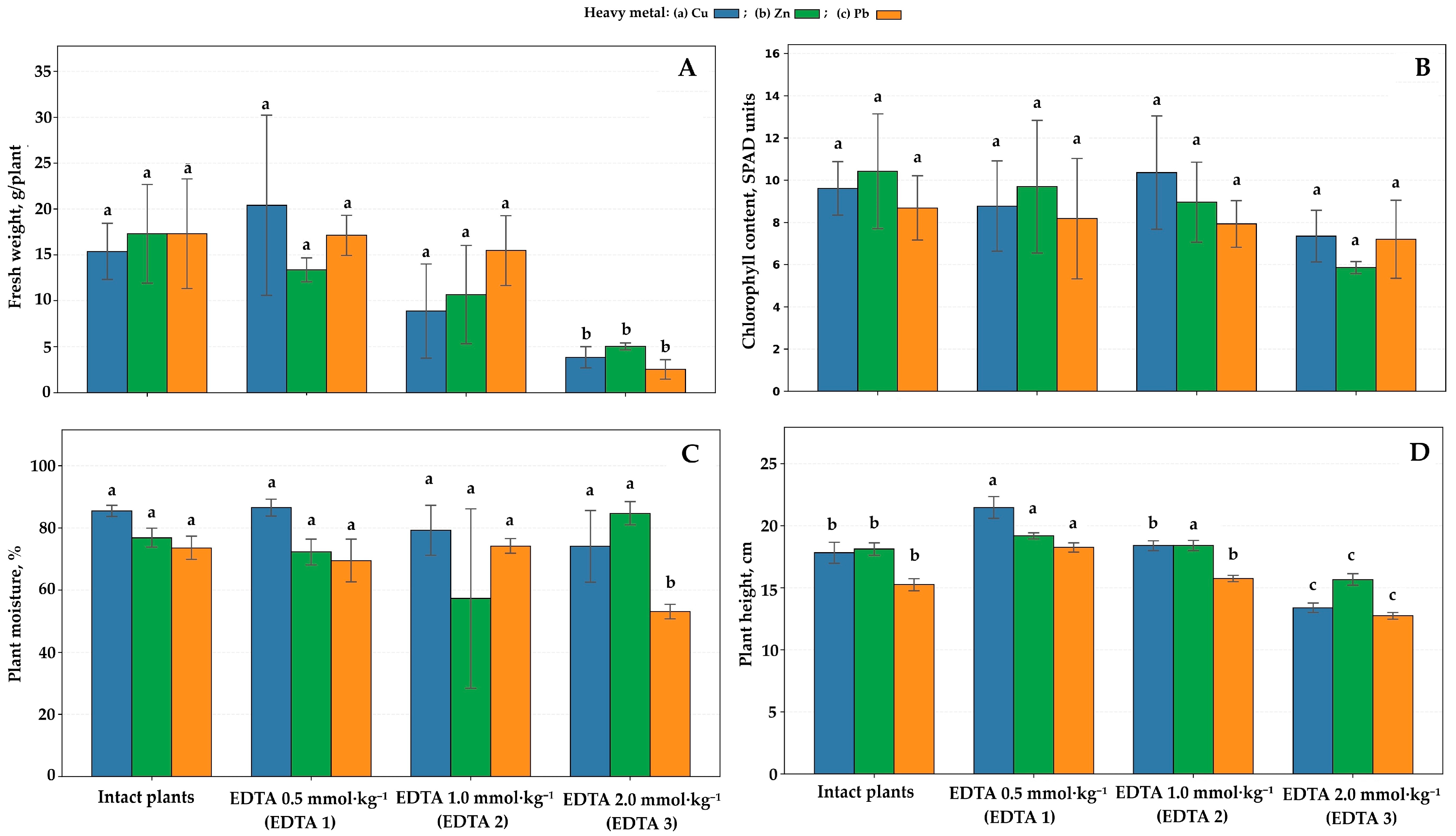
The results are presented graphically in Figure 2, as mean ± standard deviation (M ± SD) for the four replicates of each parameter analyzed: A—Fresh weight; B—Chlorophyll content; C—Plant moisture; D—Plant height and for three heavy metals noted and identified as follows: (a) Cu, dark cyan; (b) Zn, olive; (c) Pb, orange. The data were analyzed with analysis of variance (one-way ANOVA) for each parameter, followed by the post-hoc Tukey HSD test (p < 0.05), different letters indicate significant differences between treatments for the same metal.
The results of one-way ANOVA for the effect of EDTA treatments on physiological parameters are shown in Table 6.
EDTA application differently influenced the physiological parameters of Indian mustard plants grown on soil contaminated with zinc, copper and lead, the effects varying depending on the concentration of the chelator and the metal present in the soil. In general, moderate doses of EDTA (0.5–1.0 mmol·kg−1) had stimulatory effects on growth, while high doses (2.0 mmol·kg−1) generated clear phytotoxic effects, by excessive mobilization of metals and accentuation of oxidative stress.
The effects of EDTA on the physiological parameters of Indian mustard (Brassica juncea) in soil contaminated with Zn, Cu and Pb were:
  • Fresh weight of Indian mustard plants, Figure 2A, responded significantly to EDTA application in heavy metal contaminated soils. ANOVA analysis revealed significant treatment effects for copper (F = 6.315, p = 0.0081), zinc (F = 7.155, p = 0.0052) and lead (F = 14.419, p = 0.0003). Tukey post hoc test showed that only the highest concentration of EDTA 3 caused a significant decrease in fresh weight compared to Indian mustard without EDTA (p < 0.05). The most drastic decrease was recorded for lead, where the weight decreased from 17.305 ± 5.965 g/plant in Indian mustard without EDTA to 2.532 ± 1.056 g/plant in EDTA 2. This suggests a phytotoxic effect of EDTA at high concentrations, probably through excessive mobilization of metals in the soil solution and their increased uptake by the plant [41,42,43,44].
  • The chlorophyll content, represented by the SPAD index, Figure 2B, did not show significant differences between treatments for any of the tested metals (Cu: p = 0.2013; Zn: p = 0.0686; Pb: p = 0.7537). The values ranged between 5.862 ± 0.286 SPAD (Zn, EDTA 3) and 10.425 ± 2.716 SPAD (Zn, Indian mustard only, no EDTA). The lack of a significant response suggests that chlorophyll biosynthesis was not critically affected by EDTA treatments under the experimental conditions, even in the presence of metal-induced stress [27,45,46,47,48].
  • The relative humidity of plant tissues, Figure 2C, was significantly influenced by EDTA only in the case of lead (F = 21.705, p < 0.0001), where the EDTA 3 treatment reduced the water content from 73.612 ± 3.727% to 53.09 ± 2.324%. For copper (p = 0.0996) and zinc (p = 0.1152), the variations were not statistically significant. The decrease in humidity in lead under the EDTA 3 treatment may be associated with osmotic stress and damage to cell membranes under the influence of the increased toxicity of the mobilized metal [45,49].
  • Plant height, Figure 2D, demonstrated the strongest response to EDTA application, with extremely strong significant effects for all metals (Cu: F = 98.532, p < 0.0001; Zn: F = 53.966, p < 0.0001; Pb: F = 160.526, p < 0.0001). Tukey’s test revealed a significant growth stimulation at EDTA 1 compared to the Indian mustard treatment alone, without EDTA, for all metals, with maximum values of 21.475 ± 0.881 cm for copper and 18.25 ± 0.37 cm for lead. In contrast, EDTA 3 strongly inhibited growth [50,51], reducing the height to 13.4 ± 0.392 cm (Cu), 15.675 ± 0.457 cm (Zn) and 12.75 ± 0.265 cm (Pb). This biphasic response (stimulation at low concentration, inhibition at high concentration) is characteristic of the hormesia effect [52] and indicates an optimization of growth at low doses of EDTA, probably by alleviating ionic stress.
In soils contaminated with Zn, Cu and Pb, EDTA has a dual effect on Indian mustard: low doses of EDTA 1 (0.5 mmol·kg−1) and EDTA 2 (1.0 mmol·kg−1) alleviate metal stress and improve physiological parameters, while high doses of EDTA 3 (2.0 mmol·kg−1) intensify toxicity by excessive metal mobilization, reducing plant biomass, moisture and height, the effect being most severe in the presence of lead.
The results obtained highlight the fact that heavy metals have distinct influences on the physiological parameters analyzed, both depending on the metal and on the EDTA concentration. Next, the effects of the metals Cu, Zn and Pb on the physiological parameters of Indian mustard plants will be presented:
  • Zinc (Zn) showed a dual effect, specific to essential elements. At low or moderate concentrations of EDTA, Zn supported physiological processes, contributing to maintaining an optimal level of tissue moisture, increasing chlorophyll content and slightly superior vegetative development compared to the control. However, at high doses of EDTA, Zn began to exhibit inhibitory effects, reflected by a reduction in fresh weight and a moderate decrease in plant height, suggesting exceeding the optimal physiological threshold and the establishment of metal stress.
  • Copper (Cu), although an essential element in small quantities, caused a series of more pronounced negative effects at the concentrations used by EDTA compared to Zn. A significant decrease in chlorophyll content was observed, associated with inhibition of photosynthesis. Tissue moisture and fresh weight were negatively affected, reflecting disruption of cellular metabolism and possible changes in water absorption. Plant height progressively decreased with increasing EDTA concentration at Cu, indicating a strong impact on vegetative growth.
  • Lead (Pb), an element with high toxic potential, generated the most pronounced inhibitions for all physiological parameters studied. Pb visibly reduced chlorophyll content, indicating damage to the photosynthetic system, and drastically decreased fresh weight, reflecting severe disturbances in water metabolism and biomass development. Humidity levels were also reduced, suggesting altered root absorption. Plant height was severely limited, especially at high EDTA concentrations, confirming the general inhibitory effect of lead on vegetative growth.
Overall, Zn exhibited the most balanced physiological profile, with benefits at low doses of EDTA and moderate effects at high doses of EDTA; Cu had a more pronounced negative impact, while Pb stood out as the most toxic, causing consistent reductions in all physiological parameters analyzed.
The main physiological mechanisms of action of EDTA treatments in combination with heavy metals are:
  • Biphasic response to EDTA: hormesis and phytotoxicity. The observed biphasic effect of EDTA on plant height, significant stimulation at 0.5 mmol·kg−1 followed by inhibition at 2.0 mmol·kg−1, aligns with the concept of hormesis in plant-metal interactions [52]. Low concentrations of EDTA may ameliorate metal toxicity by forming soluble complexes that reduce the activity of free metal ions, while high concentrations likely enhance metal uptake beyond plant tolerance thresholds. This pattern has been documented in Brassica juncea for Pb-EDTA complexes [50,51], where optimal chelation improved metal translocation without compromising biomass.
  • Metal-specific phytotoxicity and EDTA efficiency. The differential responses among heavy metals reflect distinct chemical behaviors and phytotoxic mechanisms. The pronounced reduction in fresh weight and moisture content for Pb at 2.0 mmol·kg−1 EDTA (Figure 2A,C) suggests efficient formation of Pb-EDTA complexes and subsequent uptake by plants [50,51,52,53].
  • Physiological tolerance mechanisms in Indian mustard. The maintenance of chlorophyll content in all treatments (Figure 2B) suggests that the photosynthetic apparatus of Brassica juncea possesses considerable resilience to stress induced by metal-EDTA complexes. This could be attributed to: (1) compartmentalization of metals in vacuoles via HMA transporters [53], (2) upregulation of antioxidant enzymes such as SOD and CAT observed in EDTA-treated Indian mustard [26], or (3) structural stability of chloroplastic membranes under the action of moderate chelation [16,20,22,28].
  • Moisture content as an indicator of physiological stress. The significant reduction in lead-specific moisture content at high EDTA concentration (Figure 2C) may indicate a disruption of water relations due to: (1) metal-induced stomatal closure, reducing transpiration [45], (2) affecting the hydraulic conductivity of roots through damage to aquaporins by metals [49], or (3) osmotic stress caused by the accumulation of metal-chelate complexes. The fact that this effect was metal-specific (absent for copper and zinc) suggests different modes of action on water transport systems [21,44].
Overall, the results demonstrate that fine-tuning the EDTA dose represents an essential tool in the management of contaminated soils, allowing an optimal balance between remediation efficiency and maintenance of plant physiological performance.

4. Discussion

4.1. Comparison of One-Way and Two-Way ANOVA Analyses

The unifactorial ANOVA analysis allowed the evaluation of the effect of the type of treatment on the content of each metal (Cu, Pb and Zn), highlighting highly significant differences between the variants (p < 0.001), according to the methodology described by [54,55]. This analysis showed that all the tested treatments determined significant reductions compared to the control, with maximum efficiency for the Indian mustard and EDTA combinations at concentrations of 1.0–2.0 mmol·kg−1, results that are in agreement with the studies [51,56], which highlighted the role of chelating agents in the mobilization of heavy metals from the soil.
In contrast, the bifactorial ANOVA analysis extended the approach, allowing the simultaneous evaluation of the effect of two independent factors, the type of treatment and the type of metal, as well as the interaction between them, according to the statistical principles presented by [55]. The bifactorial results showed that both main factors, as well as their interaction, had highly significant effects (p < 0.001) on the content of heavy metals, confirming that the soil response to the applied treatments depends on the type of metal analyzed, in accordance with the observations of [57], regarding the differentiated behavior of metals in the presence of chelating agents.
In other words, the efficiency of the treatments was not uniform for all metals, with zinc presenting a higher percentage reduction than copper and lead, an aspect also reported by [58] in studies on metal phytoremediation. Thus, the unifactorial analysis highlighted the differences between treatments for each metal in particular, and the bifactorial analysis demonstrated the complex interaction between the type of treatment and the type of metal, reinforcing the conclusion regarding the synergistic efficiency of the Indian mustard and EDTA combinations in the remediation processes of contaminated soil [51,56].

4.2. Evolution of Zinc (Zn) Content in Applied Treatments

For zinc, the concentrations were the highest of the three metals, ranging from 993 mg·kg−1 in the control soil to 482 mg·kg−1 in the Indian mustard and EDTA 2.0 mmol·kg−1 variant, equivalent to a 51.5% reduction. This value highlights a pronounced mobilization of Zn2+ in the presence of EDTA, followed by an efficient transfer into the plant biomass.
Zinc presents a higher mobility in the soil compared to copper and lead, a fact supported by the F values obtained by ANOVA (p < 0.001). In treatments containing only EDTA, the reduction was approximately 23%, but by combining with Indian mustard, the efficiency doubled, confirming the important role of rhizospheric activity in the mobilization and absorption process.
The results are comparable to those reported by [2,59,60,61], who showed that the use of Brassica juncea in combination with EDTA causes a significant increase in zinc translocation to the aerial parts of the plant. Therefore, combined treatments can be considered an effective strategy for the remediation of Zn contaminated soils.

4.3. Evolution of Copper (Cu) Content in the Applied Treatments

The values obtained for copper content indicated a progressive decrease from 534 mg·kg−1 in the control soil to 387 mg·kg−1 in the variant treated with Indian mustard and EDTA 2.0 mmol·kg−1, representing a reduction of 27.5%. This statistically significant decrease (p < 0.001) reflects the efficiency of the combined phytoextraction and chelation process.
Indian mustard plants (Brassica juncea) are recognized for their ability to accumulate heavy metals through active absorption mechanisms at the root level, and EDTA acts as a chelating agent that increases the solubility of copper in the soil solution. Thus, the higher concentration of EDTA favors the mobilization of Cu2+ ions and increases their bioavailability for plant absorption.
Compared to treatments containing only EDTA, the combined variants (Indian mustard and EDTA) showed a higher efficiency, confirming the existence of a synergistic effect between biological and chemical processes. This behavior is consistent with the results reported in the literature, which highlight the increased efficiency of combining phytoremediation with chelating agents for Cu-contaminated soils [24,62,63].

4.4. Evolution of Lead (Pb) Content in Applied Treatments

Lead concentration recorded the lowest value in the treated soils, decreasing from 152 mg·kg−1 (control) to 96.8 mg·kg−1 in the Indian mustard and EDTA 2.0 mmol·kg−1 variant, which corresponds to a reduction of 36.3%. Although lead has a low mobility in the soil due to the formation of insoluble compounds, the results obtained confirm the role of the chelator EDTA in increasing its solubility and transfer to the plant.
Individual treatments with EDTA determined moderate reductions (14–21%), while those combined with Indian mustard produced significantly greater decreases (p < 0.001), suggesting an additional absorption facilitated by the plant roots. These results are consistent with the observations of [25,64], who reported a significant increase in Pb availability under the action of EDTA. However, lead remains the least mobile metal, which limits remediation efficiency compared to Cu and Zn.

4.5. Integrated Analysis of Metal Behavior and Treatment Efficiency

The comparative analysis of the three metals shows a clear sequence of their mobility and availability in the soil: Zn > Cu > Pb, an ordering confirmed by both the mean values and the main effects identified by ANOVA.
The combined treatments Indian mustard and EDTA 1.0–2.0 mmol·kg−1 proved to be the most efficient for all metals, with reductions ranging between 27% and 52%. This performance is explained by the simultaneous action of two mechanisms: chemical chelation (EDTA increases the solubility and transfer of metals in the soil solution) and biological phytoextraction (Indian mustard takes up the solubilized metals and accumulates them in the biomass).
The Treatment × Metal interaction was significant (p < 0.001), demonstrating that the soil response to the treatment depends on the nature of the metal. These results confirm the validity of the initial hypothesis regarding the synergistic effect of combined treatments and highlight the application potential of chemically assisted phytoremediation in the management of contaminated soils.

4.6. Analysis of Logarithmic Functions Between the Intensity of Soil Decontamination Treatments

The results obtained by applying logarithmic functions revealed a clear and stable relationship between the intensity of decontamination treatments and the soil response expressed by the variation of the content of heavy metals (Zn, Cu, Pb). The values of the determination coefficients R2 ranging from 0.7860 to 0.9804 confirm that the logarithmic model faithfully describes the decreasing trend of the residual content and the evolution of the percentage losses with the intensification of the treatments.
For Cu, the logarithmic model revealed a predictable decrease in the residual content (R2 = 0.9804), and the function applied to the percentage losses confirmed a very strong correlation (R2 = 0.9715), indicating a constant but moderate mobilization.
Zn presented the most pronounced logarithmic decrease and the highest percentage loss (51.5%), which reflects the high mobility of this metal in slightly acidic soils, an aspect also reported by [65,66].
In contrast, Pb exhibited lower mobilization, with lower R2 values (0.9096/0.7860) and a percentage loss of 36.3%, which is consistent with the high stability of its compounds in the soil matrix [67].
The maximum efficiency was obtained for the combined treatment Indian mustard and EDTA 2.0 mmol·kg−1, which determined the highest percentage losses for all metals. This result confirms the synergistic effect between plant bioremediation (Indian mustard, as a hyperaccumulating species of metals) and chemical chelation produced by EDTA, which increases the availability of metals for mobilization [25,68].
Comparatively, the order of metal mobilization efficiency was Zn > Pb > Cu, which reflects their electrochemical behavior and affinity for soil fractions. Zinc, being an element with high redox potential and weak complexing, is more easily released from the soil matrix, while lead remains strongly fixed in the form of phosphates or lead carbonate [69].
These results are in agreement with previous studies showing that logarithmic models provide a more realistic description of remediation processes compared to linear models, as they reflect the initial rapid decrease in concentration followed by a stabilization phase [70,71]. Thus, logarithmic regression proves to be a valuable tool for modeling the dynamics of decontamination processes, providing a solid predictive basis for optimizing treatments and reducing the ecological risk associated with heavy metals in soil.

4.7. Analysis of Physiological Parameters of Indian Mustard Plants Grown in Soil Contaminated with Zinc, Copper and Lead

The results obtained confirm the significant effect of EDTA treatment on the physiological parameters of Indian mustard (Brassica juncea) grown in soil contaminated with Zn, Cu and Pb. In general, an improvement in vegetative and biochemical performances was observed at moderate doses of EDTA (0.5–1.0 mmol·kg−1), followed by a decrease at high doses (2.0 mmol·kg−1).
Moderate metal chelation reduces the concentration of free ions (Zn2+, Cu2+, Pb2+) in the rhizosphere, which reduces oxidative stress and allows plants to maintain their structural and functional integrity [24]. Thus, the increase in fresh weight and moisture is correlated with a better photosynthesis rate and with the stability of the cell membrane, protected from excess metal ions [72,73].
At the same time, metal-EDTA complexes are more mobile and can be translocated to the leaves, which explains the higher values of SPAD index and plant height at moderate doses. However, at 2.0 mmol·kg−1 EDTA, the increase in the flux of mobilized metals leads to excessive accumulation in tissues and generation of free radicals, affecting antioxidant enzymes and degrading chlorophyll [25,26,62,74,75].
Compared between metals, lead (Pb) showed the most severe toxic effect, causing obvious decreases in mass, moisture and chlorophyll in the control treatment. EDTA 0.5 mmol·kg−1 substantially reduced this effect, in accordance with the observations of other authors [30,76,77], which show that partial chelation favors phytostabilization of Pb without major metabolic stress. For copper (Cu) and zinc (Zn), the effects are similar, but high levels of EDTA can increase the uptake above the optimal physiological threshold, generating secondary toxicity [78,79].
Based on these findings, it is confirmed that Indian mustard (Brassica juncea) has a high capacity to tolerate and accumulate heavy metals, but its response critically depends on the chelator dose and the type of metal.
EDTA application should be calibrated to maximize metal uptake and stabilization without compromising fundamental physiological processes.
Overall, the research confirms that EDTA assisted Brassica juncea represents an effective and sustainable strategy for the remediation of soils contaminated with Cu, Pb and Zn. The maximum efficiency was obtained with the combined treatments Indian mustard and EDTA 1.0–2.0 mmol·kg−1, especially for zinc, and statistical analysis demonstrated significant relationships between the type of treatment, metal and the physiological response of the plants. Moderate doses of EDTA optimize chelation processes and physiological tolerance, while high concentrations can generate oxidative stress. Therefore, EDTA-assisted phytoremediation in controlled doses proves to be a promising solution for the sustainable management of contaminated soils.

4.8. The Study’s Innovative Contributions to the Field of Remediation Research

  • Definition of the “optimal concentration window”: the study clearly identifies 0.5 mmol·kg−1 EDTA as the optimal concentration for assisted phytoextraction, balancing extractive efficiency with plant health.
  • Demonstrated metal specificity: the study highlights that responses to EDTA are metal-specific, requiring differentiated protocols (Pb requires special attention due to its strong effect on humidity).
  • Confirmation of the photosynthetic resistance of Brassica juncea: the study shows that under conditions of extreme metal stress, the photosynthetic apparatus remains functional, supporting the potential for long-term applications.
  • Quantified biphasic response: the study shows the exact quantification of the hormetic effect providing a basis for dose optimization in practical applications.

4.9. Research Limitations

  • Controlled conditions: the experiment was conducted under laboratory/pot conditions, which may differ from complex field conditions (soil microbiome, climatic variations, interactions with other elements).
  • Short exposure period: the long-term effects of repeated EDTA treatments have not been evaluated.
  • Limited mechanistic aspects: the study evaluates physiological parameters, but does not investigate in depth the molecular or biochemical mechanisms underlying them.
  • Variety specificity: The results may be specific to the Brassica juncea variety studied, requiring validation on other genotypes.

5. Conclusions

(1) Statistical analysis (unifactorial and bifactorial ANOVA) revealed significant differences (p < 0.001) between treatments and metals, confirming the efficiency of the Brassica juncea and EDTA combinations in reducing the content of Cu, Pb and Zn in contaminated soils. (2) Treatments combined with EDTA (0.5–1.0 mmol·kg−1) demonstrated the best remediation efficiency, significantly reducing heavy metal concentrations compared to the contaminated control. The efficiency decreases at high doses (2.0 mmol·kg−1), due to the saturation of chelation processes and the induced physiological stress. (3) The phytoremediation results show that the Indian mustard and EDTA treatments (1.0–2.0 mmol·kg−1) produced the greatest reductions in metal content: Zn (≈51.5%) > Pb (≈36.3%) > Cu (≈27.5%), reflecting the differences in mobility and affinity of each metal. (4) Analysis of plant physiological response revealed that moderate doses of EDTA (0.5–1.0 mmol·kg−1) improved Indian mustard physiological parameters, fresh weight, water content, chlorophyll content and plant height, by reducing oxidative stress and optimizing photosynthesis. In contrast, high doses (2.0 mmol·kg−1) caused oxidative stress and inhibited vegetative growth. (5) Logarithmic regression models showed an excellent correlation between experimental and theoretical values (R2 = 0.79–0.98), confirming the statistical robustness of the data and the suitability of combined treatments in decontamination processes.

Author Contributions

Conceptualization, A.P., M.N. and F.N.; methodology, I.V. and G.I.; software, M.N. and M.M.; validation, A.P., V.V. and M.M.; formal analysis, N.V., D.C. and D.O.B.; investigation, A.P., M.N., G.I. and F.N.; resources, I.V. and M.M.; data curation, N.V., D.C. and D.O.B.; writing—original draft preparation, M.N., G.I. and F.N.; writing—review and editing, I.V., M.M. and A.P.; visualization, M.M. and I.V.; supervision, V.V. and A.P.; project administration, V.V.; funding acquisition, F.N. All authors have read and agreed to the published version of the manuscript.

Funding

This research was funded by, Project PNRR, Contract No. 760005/30.12.2022 Establishment and operationalization of a Competence Center for Soil Health and Food Safety, Specific Project P1: Soil health and food safety by introducing a soil remediation protocol and developing a mobile remediation equipment to reduce the concentration of organic/inorganic pollutants.

Data Availability Statement

Data is available upon request from the corresponding author.

Conflicts of Interest

The authors declare no conflicts of interest.

References

  1. Wuana, R.A.; Okieimen, F.E. Heavy Metals in Contaminated Soils: A Review of Sources, Chemistry, Risks and Best Available Strategies for Remediation. ISRN Ecol. 2011, 20, 402647. [Google Scholar] [CrossRef]
  2. Yan, A.; Wang, Y.; Tan, S.N.; Mohd Yusof, M.L.; Ghosh, S.; Chen, Z. Phytoremediation: A Promising Approach for Revegetation of Heavy Metal-Polluted Land. Front. Plant Sci. 2020, 11, 359. [Google Scholar] [CrossRef]
  3. Yang, Q.; Li, Z.; Lu, X.; Duan, Q.; Huang, L.; Bi, J. A review of soil heavy metal pollution from industrial and agricultural regions in China: Pollution and risk assessment. Sci. Total Environ. 2018, 642, 690–700. [Google Scholar] [CrossRef]
  4. Ali, H.; Khan, E.; Ilahi, I. Environmental Chemistry and Ecotoxicology of Hazardous Heavy Metals: Environmental Persistence, Toxicity, and Bioaccumulation. J. Chem. 2019, 2019, 6730305. [Google Scholar] [CrossRef]
  5. Shen, X.; Dai, M.; Yang, J.; Sun, L.; Tan, X.; Peng, C.; Ali, I.; Naz, I. A critical review on the phytoremediation of heavy metals from environment: Performance and challenges. Chemosphere 2021, 291, 132979. [Google Scholar] [CrossRef]
  6. Wan, Y.; Liu, J.; Zhuang, Z.; Wang, Q.; Li, H. Heavy Metals in Agricultural Soils: Sources, Influencing Factors, and Remediation Strategies. Toxics 2024, 12, 63. [Google Scholar] [CrossRef]
  7. Kicińska, A.; Pomykała, R.; Izquierdo, M. Changes in soil pH and mobility of heavy metals in contaminated soils. Eur. J. Soil Sci. 2021, 73, e13203. [Google Scholar] [CrossRef]
  8. Ali, S.; Ullah, S.; Umar, H.; Saghir, A.; Nasir, S.; Aslam, Z.M.; Jabbar, H.; ul Aabdeen, Z.; Zain, R. Effects of Heavy Metals on Soil Properties and their Biological Remediation. Ind. J. Pure App. Biosci. 2022, 10, 40–46. [Google Scholar] [CrossRef]
  9. Sintorini, M.M.; Widyatmoko, H.; Sinaga, E.; Aliyah, N. Effect of pH on metal mobility in the soil. IOP Conf. Ser. Earth Environ. Sci. 2021, 737, 012071. [Google Scholar] [CrossRef]
  10. Mihali, C.; Oprea, G.; Michnea, A.; Jelea, S.G.; Jelea, M.; Man, C.; Senila, M.; Grigor, L. Assessment of heavy metals content and pollution level in soil and plants in Baia Mare area, NW Romania. Carpathian J. Earth Environ. Sci. 2013, 8, 143–152. [Google Scholar]
  11. Donici, A.; Bunea, C.I.; Calugar, A.; Harsan, E.; Racz, I.; Bora, F.D. Assessment of Heavy Metals Concentration in Soil and Plants from Baia Mare Area, NW Romania. Bull. UASVM Hortic. 2018, 75, 128–132. [Google Scholar] [CrossRef]
  12. Nedelescu, M.; Baconi, D.; Neagoe, A.; Iordache, V.; Stan, M.; Constantinescu, P.; Ciobanu, A.-M.; Vardavas, A.I.; Vinceti, M.; Tsatsakis, A.M. Environmental metal contamination and health impact assessment in two industrial regions of Romania. Sci. Total Environ. 2016, 580, 984–995. [Google Scholar] [CrossRef]
  13. Crăciun, A.I.; Ozunu, A. Comprehensive analysis and review of soil contamination and the associated risks at the Poșta-Rât Industrial Site in Turda, Cluj, Romania. J. Eng. Sci. Innov. 2024, 9, 383–392. [Google Scholar] [CrossRef]
  14. Rashid, A.; Schutte, B.J.; Ulery, A.; Deyholos, M.K.; Sanogo, S.; Lehnhoff, E.A.; Beck, L. Heavy Metal Contamination in Agricultural Soil: Environmental Pollutants Affecting Crop Health. Agronomy 2023, 13, 1521. [Google Scholar] [CrossRef]
  15. Mohammad, S.J.; Ling, Y.E.; Halim, K.A.; Sani, B.S.; Abdullahi, N.I. Heavy metal pollution and transformation in soil: A comprehensive review of natural bioremediation strategies. J. Umm. Al-Qura Univ. Appll. Sci. 2025, 11, 528–544. [Google Scholar] [CrossRef]
  16. Priya, A.K.; Muruganandam, M.; Ali, S.S.; Kornaros, M. Clean-Up of Heavy Metals from Contaminated Soil by Phytoremediation: A Multidisciplinary and Eco-Friendly Approach. Toxics 2023, 11, 422. [Google Scholar] [CrossRef]
  17. Sharma, J.K.; Kumar, N.; Singh, N.P.; Santal, A.R. Phytoremediation technologies and their mechanism for removal of heavy metal from contaminated soil: An approach for a sustainable environment. Front. Plant Sci. 2023, 14, 1076876. [Google Scholar] [CrossRef]
  18. Kumar, V.; Rout, C.; Singh, J.; Saharan, Y.; Goyat, R.; Umar, A.; Akbar, S.; Baskoutas, S. A review on the clean-up technologies for heavy metal ions contaminated soil samples. Heliyon 2023, 9, e15472. [Google Scholar] [CrossRef]
  19. Li, X. A comparative study on the efficacy of conventional and green chelating agents for soil heavy metal remediation. Theor. Nat. Sci. 2024, 37, 102–111. [Google Scholar] [CrossRef]
  20. Sut-Lohmann, M.; Grimm, M.; Kästner, F.; Raab, T.; Heinrich, M.; Fischer, T. Brassica juncea as a Feasible Hyperaccumulator of Chosen Potentially Toxic Metals Under Extreme Environmental Conditions. Int. J. Environ. Res. 2023, 17, 38. [Google Scholar] [CrossRef]
  21. Jiang, W.; Liu, D.; Hou, W. Hyperaccumulation of Lead by Roots, Hypocotyls, and Shoots of Brassica juncea. Biol. Plant. 2000, 43, 603–606. [Google Scholar] [CrossRef]
  22. Selvaraj, K.; Sevugaperumal, R.; Ramasubramanian, V. Phytoextraction: Using Brassica as a Hyper Accumulator. Biochem. Physiol. 2015, 4, 172. [Google Scholar] [CrossRef]
  23. Singh, S.R.; Bhadra, A.; Premalatha, S.J.; Malathi, H.; Madhu, A.K.; Shrivastava, R.; Patil, S.J. Phytoremediation—A promising approach for pollution management. Eur. Chem. Bull. 2023, 12, 416–421. [Google Scholar] [CrossRef]
  24. Kamal, M.A.; Perveen, K.; Khan, F.; Sayyed, R.Z.; Hock, O.G.; Bhatt, S.C.; Singh, J.; Qamar, M.O. Effect of different levels of EDTA on phytoextraction of heavy metal and growth of Brassica juncea L. Front. Microbiol. 2023, 14, 1228117. [Google Scholar] [CrossRef]
  25. Evangelou, M.W.H.; Bauer, U.; Ebel, M.; Schaeffer, A. The influence of EDDS and EDTA on the uptake of heavy metals of Cd and Cu from soil with tobacco (Nicotiana tabacum). Chemosphere 2007, 68, 345–353. [Google Scholar] [CrossRef] [PubMed]
  26. Bortoloti, G.; Baron, D. Phytoremediation of toxic heavy metals by Brassica plants: A biochemical and physiological approach. Environ. Adv. 2022, 8, 100204. [Google Scholar] [CrossRef]
  27. Quadir, S.; Hameed, A.; Nisa, N.T.; Azooz, M.; Wani, M.R.; Hasannuzaman, M.; Kazi, A.G.; Ahmad, P. Brassicas: Responses and Tolerance to Heavy Metal Stress. In Improvement of Crops in the Era of Climatic Changes; Ahmad, P., Wani, M.R., Azooz, M.M., Tran, L.S.P., Eds.; Springer Science: New York, NY, USA, 2014; Volume 2. [Google Scholar] [CrossRef]
  28. Mourato, M.P.; Moreira, I.N.; Leitão, I.; Pinto, F.R.; Sales, J.R.; Martins, L.L. Effect of Heavy Metals in Plants of the Genus Brassica. Int. J. Mol. Sci. 2015, 16, 17975–17998. [Google Scholar] [CrossRef]
  29. Małecka, A.; Konkolewska, A.; Hanć, A.; Ciszewska, L.; Staszak, A.M.; Jarmuszkiewicz, W.; Ratajczak, E. Activation of antioxidative and detoxificative systems in Brassica juncea L. plants against the toxicity of heavy metals. Sci. Rep. 2021, 11, 22345. [Google Scholar] [CrossRef]
  30. Saifullah; Meers, E.; Qadir, M.; de Caritat, P.; Tack, F.M.; Du Laing, G.; Zia, M.H. EDTA-assisted Pb phytoex-traction. Chemosphere 2009, 74, 1279–1291. [Google Scholar] [CrossRef]
  31. Bremner, J.M. Nitrogen-Total. In Methods of Soil Analysis. Part 3: Chemical Methods; Sparks, D.L., Page, A.L., Helmke, P.A., Loeppert, R.H., Soltanpour, P.N., Tabatabai, M.A., Johnston, C.T., Sumner, M.E., Eds.; Soil Science Society of America: Madison, WI, USA; American Society of Agronomy: Madison, WI, USA, 1996; pp. 1085–1121. [Google Scholar] [CrossRef]
  32. Murphy, J.; Riley, J.P. A modified single solution method for the determination of phosphate in natural waters. Anal. Chim. Acta 1962, 27, 31–36. [Google Scholar] [CrossRef]
  33. Thomas, G.W. Exchangeable Cations. In Methods of Soil Analysis. Part 2: Chemical and Microbiological Properties, 2nd ed.; Page, A.L., Ed.; American Society of Agronomy: Madison, WI, USA; Soil Science Society of America: Madison, WI, USA, 1982; pp. 159–165. [Google Scholar]
  34. Shazia, A.; Shazi, I.; Mahmood, U.H. Effect of chelating agents on heavy metal extraction from contaminated soils. Res. J. Chem. Sci. 2014, 4, 70–87. [Google Scholar]
  35. Dipu, S.; Kumar, A.A.; Thanga, S.G. Effect of chelating agents in phytoremediation of heavy metals. Remediat. J. 2012, 22, 133–146. [Google Scholar] [CrossRef]
  36. Volf, I.; Stingu, A.; Popa, V.I. New natural chelating agents with modulator effects on copper phytoextraction. Environ. Eng. Manag. J. 2012, 11, 487–491. [Google Scholar] [CrossRef]
  37. Guo, D.; Ali, A.; Ren, C.; Du, J.; Li, R.; Lahori, A.H.; Xiao, R.; Zhang, Z.; Zhang, Z. EDTA and organic acids assisted phytoextraction of Cd and Zn from a smelter contaminated soil by potherb Indian mustard (Brassica juncea, Coss) and evaluation of its bioindicators. Ecotoxicol. Environ. Saf. 2019, 167, 396–403. [Google Scholar] [CrossRef]
  38. Souza, L.A.; Piotto, F.A.; Nogueirol, R.C.; Azevedo, R.A. Use of non-hyperaccumulator plant species for the phytoextraction of heavy metals using chelating agents. Sci. Agric. 2013, 70, 290–295. [Google Scholar] [CrossRef]
  39. Chaudhry, H.; Nisar, N.; Mehmood, S.; Iqbal, M.; Nazir, A.; Yasir, M. Indian mustard Brassica juncea efficiency for the accumulation, tolerance and translocation of zinc from metal contaminated soil. Biocatal. Agric. Biotechnol. 2020, 23, 101489. [Google Scholar] [CrossRef]
  40. Hosseinniaee, S.; Jafari, M.; Tavili, A.; Zare, S.; Cappai, G. Chelate facilitated phytoextraction of Pb, Cd, and Zn from a lead-zinc mine contaminated soil by three accumulator plants. Sci. Rep. 2023, 13, 21185. [Google Scholar] [CrossRef]
  41. Clemens, S. Toxic metal accumulation, responses to exposure and mechanisms of tolerance in plants. Biochimie 2006, 88, 1707–1719. [Google Scholar] [CrossRef]
  42. Ghori, N.H.; Ghori, T.; Hayat, M.Q.; Imadi, S.R.; Gul, A.; Altay, V.; Ozturk, M. Heavy metal stress and responses in plants. Int. J. Environ. Sci. Technol. 2019, 16, 1807–1828. [Google Scholar] [CrossRef]
  43. Wu, L.H.; Luo, Y.M.; Xing, X.R.; Christie, P. EDTA-enhanced phytoremediation of heavy metal contaminated soil with Indian mustard and associated potential leaching risk. Agric. Ecosyst. Environ. 2004, 102, 307–318. [Google Scholar] [CrossRef]
  44. Nowack, B. Environmental chemistry of aminopolycarboxylate chelating agents. Environ. Sci. Technol. 2002, 36, 4009–4016. [Google Scholar] [CrossRef]
  45. Guo, Z.; Gao, Y.; Yuan, X.; Yuan, M.; Huang, L.; Wang, S.; Liu, C.; Duan, C. Effects of Heavy Metals on Stomata in Plants: A Review. Int. J. Mol. Sci. 2023, 24, 9302. [Google Scholar] [CrossRef]
  46. Hameed, A.; Rasool, S.; Azooz, M.M.; Hossain, M.A.; Ahanger, M.A.; Ahmad, P. Chapter 24—Heavy Metal Stress: Plant Responses and Signaling; Ahmad, P., Ed.; Plant Metal Interaction; Elsevier: Amsterdam, The Netherlands, 2016; pp. 557–583. ISBN 9780128031582. [Google Scholar] [CrossRef]
  47. Epelde, L.; Hernández-Allica, J.; Becerril, J.M.; Blanco, F.; Garbisu, C. Effects of chelates on plants and soil microbial community: Comparison of EDTA and EDDS for lead phytoextraction. Sci. Total Environ. 2008, 401, 21–28. [Google Scholar] [CrossRef]
  48. Lee, J.; Sung, K. Effects of chelates on soil microbial properties, plant growth and heavy metal accumulation in plant. Ecol. Eng. 2014, 73, 386–394. [Google Scholar] [CrossRef]
  49. Barceló, J.; Poschenrieder, C. Plant water relations as affected by heavy metal stress: A review. J. Plant Nutr. 1990, 13, 1–37. [Google Scholar] [CrossRef]
  50. Epstein, A.L.; Gussman, C.D.; Blaylock, M.J.; Yermiyahu, U.; Huang, J.W.; Kapulnik, Y.; Orser, C.S. EDTA and Pb—EDTA accumulation in Brassica juncea grown in Pb—Amended soil. Plant Soil 1999, 208, 87–94. [Google Scholar] [CrossRef]
  51. Blaylock, M.J.; Salt, D.E.; Dushenkov, S.; Zakharova, O.; Gussman, C.; Kapulnik, Y.; Ensley, B.D.; Raskin, I. Enhanced accumulation of Pb in Indian mustard (Brassica juncea) by soil-applied chelating agents. Environ. Sci. Technol. 1997, 31, 860–865. [Google Scholar] [CrossRef]
  52. Calabrese, E.J.; Baldwin, L.A. Hormesis: The dose-response revolution. Annu. Rev. Pharmacol. Toxicol. 2003, 43, 175–197. [Google Scholar] [CrossRef]
  53. Mendoza-Cózatl, D.G.; Jobe, T.O.; Hauser, F.; Schroeder, J.I. Long-distance transport, vacuolar sequestration, tolerance, and transcriptional responses induced by cadmium and arsenic. Curr. Opin. Plant Biol. 2011, 14, 554–562. [Google Scholar] [CrossRef]
  54. Field, A. Discovering Statistics Using IBM SPSS Statistics, 5th ed.; SAGE Publications Ltd.: London, UK, 2018. [Google Scholar]
  55. Montgomery, D.C. Design and Analysis of Experiments, 10th ed.; John Wiley & Sons: Hoboken, NJ, USA, 2019. [Google Scholar]
  56. Udeigwe, T.K.; Eze, P.N.; Teboh, J.M.; Stietiya, M.H. Application, chemistry, and environmental implications of contaminant-immobilization amendments on agricultural soil and water quality. Environ. Int. 2011, 37, 258–267. [Google Scholar] [CrossRef]
  57. Nowack, B.; VanBriesen, J.M. Chelating agents in the environment. In Biogeochemistry of Chelating Agents; Nowack, B., VanBriesen, J.M., Eds.; American Chemical Society: Washington, DC, USA, 2005; pp. 1–18. [Google Scholar] [CrossRef]
  58. Garbisu, C.; Alkorta, I. Phytoextraction: A cost-effective plant-based technology for the removal of metals from the environment. Bioresour. Technol. 2001, 77, 229–236. [Google Scholar] [CrossRef]
  59. Clemente, R.; Walker, D.J.; Bernal, M.P. Uptake of heavy metals and As by Brassica juncea grown in a contaminated soil in Aznalcóllar (Spain): The effect of soil amendments. Environ. Pollut. 2005, 138, 46–58. [Google Scholar] [CrossRef]
  60. Zeremski, T.; Ranđelović, D.; Jakovljević, K.; Marjanović Jeromela, A.; Milić, S. Brassica Species in Phytoextractions: Real Potentials and Challenges. Plants 2021, 10, 2340. [Google Scholar] [CrossRef]
  61. Liao, Y.; Li, Z.; Yang, Z.; Wang, J.; Li, B.; Zu, Y. Response of Cd, Zn Translocation and Distribution to Organic Acids Heterogeneity in Brassica juncea L. Plants 2023, 12, 479. [Google Scholar] [CrossRef]
  62. Saleem, M.H.; Ali, S.; Kamran, M.; Iqbal, N.; Azeem, M.; Tariq Javed, M.; Ali, Q.; Zulqurnain Haider, M.; Irshad, S.; Rizwan, M. Ethylenediaminetetraacetic Acid (EDTA) Mitigates the Toxic Effect of Excessive Copper Concentrations on Growth, Gaseous Exchange and Chloroplast Ultrastructure of Corchorus capsularis L. and Improves Copper Accumulation Capabilities. Plants 2020, 9, 756. [Google Scholar] [CrossRef]
  63. Rathika, R.; Srinivasan, P.; Alkahtani, J.; Al-Humaid, L.A.; Alwahibi, M.S.; Mythili, R.; Selvankumar, T. Influence of biochar and EDTA on enhanced phytoremediation of lead-contaminated soil by Brassica juncea. Chemosphere 2021, 271, 129513. [Google Scholar] [CrossRef]
  64. Saman, R.U.; Shahbaz, M.; Maqsood, M.F.; Lili, N.; Zulfiqar, U.; Haider, F.U.; Naz, N.; Shahzad, B. Foliar Application of Ethylenediamine Tetraacetic Acid (EDTA) Improves the Growth and Yield of Brown mustard (Brassica juncea) by Modulating Photosynthetic Pigments, Antioxidant Defense, and Osmolyte Production under Lead (Pb) Stress. Plants 2023, 12, 115. [Google Scholar] [CrossRef]
  65. Alloway, B.J. Heavy Metals in Soils: Trace Metals and Metalloids in Soils and Their Bioavailability, 3rd ed.; Springer: Dordrecht, The Netherlands; Berlin/Heidelberg, Germany; New York, NY, USA; London, UK, 2013; Volume 22. [Google Scholar] [CrossRef]
  66. Kabata-Pendias, A. Trace Elements in Soils and Plants, 4th ed.; CRC Press: Boca Raton, FL, USA, 2011. [Google Scholar]
  67. McBride, M.B. Environmental Chemistry of Soils; Oxford University Press: New York, NY, USA, 1994. [Google Scholar]
  68. Luo, C.; Shen, Z.; Li, X.; Baker, A.J. Enhanced phytoextraction of Pb and other metals from artificially contaminated soils through the combined application of EDTA and EDDS. Chemosphere 2006, 63, 1773–1784. [Google Scholar] [CrossRef]
  69. Adriano, D.C. Trace Elements in Terrestrial Environments: Biogeochemistry, Bioavailability and Risks of Metal, 2nd ed.; Springer: New York, NY, USA, 2001; p. 867. [Google Scholar] [CrossRef]
  70. Nouri, J.; Khorasani, N.; Lorestani, B.; Karami, M.; Hassani, A.H.; Yousefi, N. Accumulation of heavy metals in soil and uptake by plant species with phytoremediation potential. Environ. Earth. Sci. 2009, 59, 315–323. [Google Scholar] [CrossRef]
  71. Bian, X.; Cui, J.; Tang, B.; Yang, L. Chelant-Induced Phytoextraction of Heavy Metals from Contaminated Soils: A Review. Pol. J. Environ. Stud. 2018, 27, 2417–2424. [Google Scholar] [CrossRef]
  72. Ali, H.; Khan, E.; Sajad, M.A. Phytoremediation of heavy metals—Concepts and applications. Chemosphere 2013, 91, 869–881. [Google Scholar] [CrossRef]
  73. Sarwar, N.; Imran, M.; Shaheen, M.R.; Ishaque, W.; Kamran, M.A.; Matloob, A.; Rehim, A.; Hussain, S. Phytore-mediation strategies for soils contaminated with heavy metals: Modifications and future perspectives. Chemosphere 2017, 171, 710–721. [Google Scholar] [CrossRef]
  74. Hasanuzzaman, M.; Bhuyan, M.H.M.B.; Zulfiqar, F.; Raza, A.; Mohsin, S.M.; Mahmud, J.A.; Fujita, M.; Fotopoulos, V. Reactive Oxygen Species and Antioxidant Defense in Plants under Abiotic Stress: Revisiting the Crucial Role of a Universal Defense Regulator. Antioxidants 2020, 9, 681. [Google Scholar] [CrossRef]
  75. Sharma, P.; Jha, A.; Dubey, R.; Pessarakli, M. Reactive oxygen species, oxidative damage, and antioxidative defense mechanism in plants under stressful conditions. J. Bot. 2012, 2012, 217037. [Google Scholar] [CrossRef]
  76. Zhao, F.J.; Ma, Y.; Zhu, Y.G.; Tang, Z.; McGrath, S.P. Soil contamination in China: Current status and mitigation strategies. Environ. Sci. Technol. 2015, 49, 750–759. [Google Scholar] [CrossRef]
  77. Vassil, A.D.; Kapulnik, Y.; Raskin, I.; Salt, D.E. The Role of EDTA in Lead Transport and Accumulation by Indian mustard. Plant Physiol. 1998, 117, 447–453. [Google Scholar] [CrossRef]
  78. Yadav, S.K. Heavy metals toxicity in plants: An overview on the role of glutathione and phytochelatins in heavy metal stress tolerance of plants. S. Afr. J. Bot. 2010, 76, 167–179. [Google Scholar] [CrossRef]
  79. Nagajyoti, P.C.; Lee, K.D.; Sreekanth, T.V.M. Heavy metals, occurrence and toxicity for plants: A review. Environ. Chem. Lett. 2010, 8, 199–216. [Google Scholar] [CrossRef]
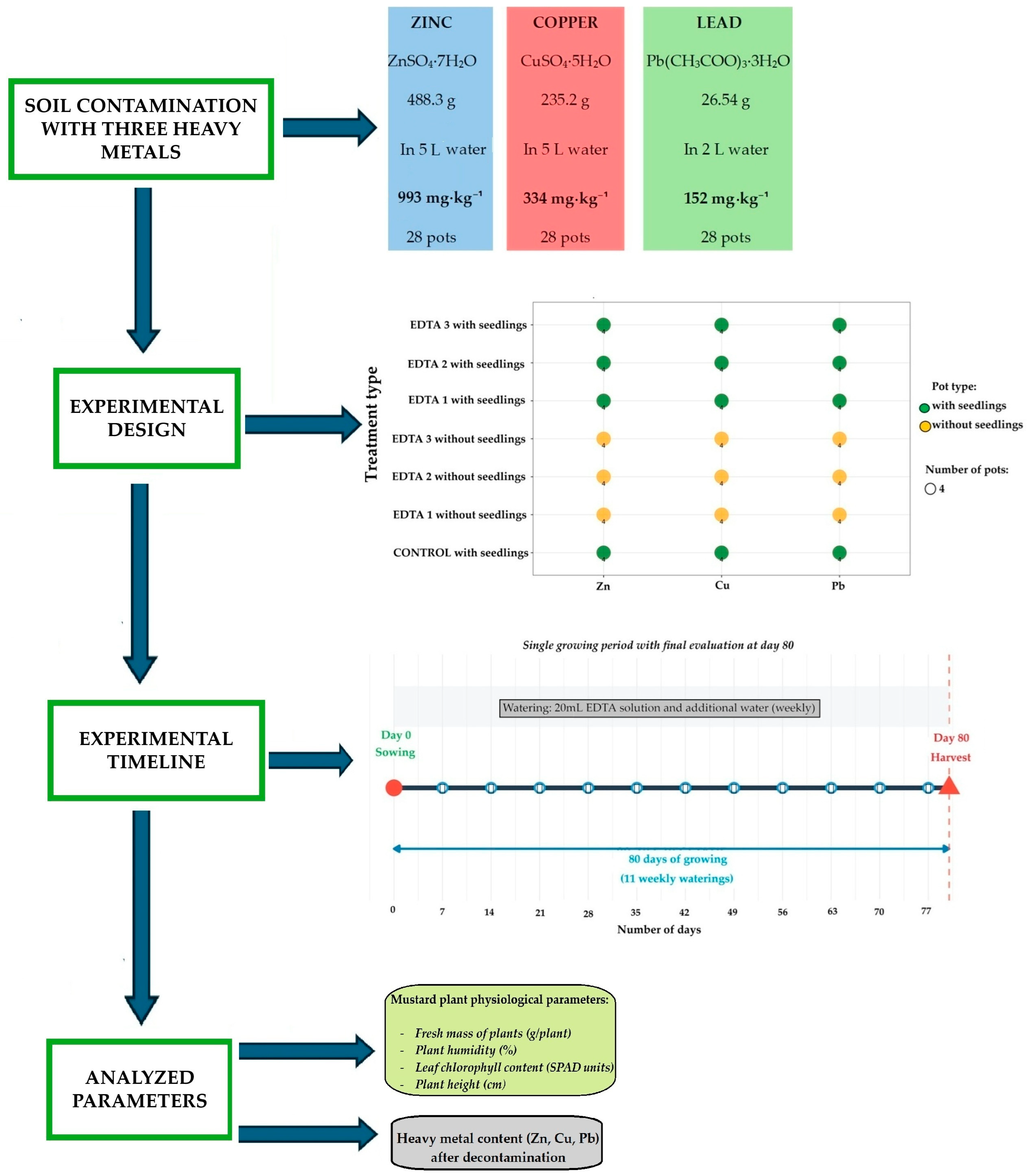
Figure 1. Experimental flow chart.
Environments 13 00023 g001
Figure 2. The values (M ± SD) of physiological parameters of Indian mustard plants exposed to heavy metals. (A)—Fresh weight; (B)—Chlorophyll content; (C)—Plant moisture; (D)—Plant height.
Environments 13 00023 g002
Table 1. Amounts of salt and water used to contaminate 112 kg of soil with Zn, Cu and Pb.
MetalSalt Used Metal Content in Salt, %Total Quantity, gQuantity Per Pot, gWater Used, L
ZnZnSO4·7H2O22.75488.317.445
CuCuSO4·5H2O25.44235.28.405
PbPb(CH3COO)2·3H2O64.326.540.9482
Table 2. Concentrations of EDTA solutions and doses applied in the experiment.
TreatmentConcentration of the Solution EDTA (mmol·L−1)Content EDTA
(g·L−1)
Dosage
per Application (mmol/pot)
Cumulative Dose (mmol/pot)Equivalent (mmol·kg−1
Dry Soil)
EDTA 115.6255.8160.06250.750.5
EDTA 231.25011.6330.12501.501.0
EDTA 362.50023.2650.25003.002.0
Table 3. Statistical characteristics of heavy metal content in soil depending on treatment types.
Type of TreatmentMean ± SD of Soil Metal Content
and Tukey Grouping *, (mg·kg−1)
Percentage of Metal Reduction After Soil Decontamination, (%)
Zn Cu Pb ZnCuPb
Untreated contaminated soil993.0 ± NA (a)534.0 ± NA (a)152.0 ± NA (a)0.00.00.0
Only Indian mustard951.0 ± NA (b)496.0 ± NA (b)134.0 ± NA (b)4.27.111.8
EDTA 0.5 mmol·kg−1 (EDTA 1)786.5 ± 4.2 (c)445.5 ± 2.4 (c)129.8 ± 1.7 (b)20.816.614.6
EDTA 1.0 mmol·kg−1 (EDTA 2)778.8 ± 2.6 (c)432.0 ± 2.4 (d)126.0 ± 2.9 (b)21.619.117.1
EDTA 2.0 mmol·kg−1
(EDTA 3)
761.0 ± 2.6 (d)425.5 ± 1.3 (e)119.8 ± 3.1 (c)23.420.321.2
Indian mustard and EDTA 0.5 mmol·kg−1 (EDTA 1)672.5 ± 11.2 (e)395.5 ± 2.1 (f)119.0 ± 1.8 (c)32.325.921.7
Indian mustard and EDTA 1.0 mmol·kg−1 (EDTA 2)568.2 ± 4.3 (f)393.0 ± 1.8 (f)104.8 ± 0.5 (d)42.826.431.1
Indian mustard and EDTA 2.0 mmol·kg−1 (EDTA 3)481.8 ± 2.4 (g)387.2 ± 2.5 (g)96.8 ± 1.7 (e)51.527.536.3
* Note: Values marked with the same letter are not statistically significantly different from each other (Tukey HSD, p < 0.05).
Table 4. Logarithmic function analysis of heavy metal content and percentage loss under decontamination treatments.
Type of Metala (Slope)b (Intercept)R2Interpretation
Metal content (mg·kg−1)
Cu−73.79536.410.98Strong decrease, excellent model (98%)
Zn−232.11056.70.88Strong decrease, very good model
Pb−23.26153.610.91Steady decrease, stable model
Percentage loss (%)
Cu10.347.82110.97Progressive loss, very strong correlation
Zn21.3372.10020.87Accelerated loss, very good model
Pb11.4698.00410.79Moderate loss, good fit
Table 5. Mobilization factor (MF) of heavy metals Zn, Cu and Pb, depending on treatment.
Treatment TypeMobilization Factor (MF) of Heavy Metals
ZnCuPb
Contaminated soil1.001.001.00
Only Indian mustard0.960.930.88
EDTA 0.5 mmol·kg−1 (EDTA 1)0.790.830.85
EDTA 1.0 mmol·kg−1 (EDTA 2)0.780.810.83
EDTA 2.0 mmol·kg−1 (EDTA 3)0.770.800.79
Indian mustard and EDTA 0.5 mmol·kg−1 (EDTA 1)0.680.740.78
Indian mustard and EDTA 1.0 mmol·kg−1 (EDTA 2)0.570.740.69
Indian mustard and EDTA 2.0 mmol·kg−1 (EDTA 3)0.490.720.64
Table 6. ANOVA results (F and p-value).
Heavy MetalParameterF-Value p-ValueSignificance
Cu
(a)
Fresh weight, (g/plant)F = 6.315p = 0.0081**
Chlorophyll content, (SPAD units)F = 1.797p = 0.2013ns
Plant moisture, (%)F = 2.610p = 0.0996ns
Plant height, (cm)F = 98.532p < 0.0001***
Zn
(b)
Fresh weight, (g/plant)F = 7.155p = 0.0052**
Chlorophyll content, (SPAD units)F = 3.076p = 0.0686ns
Plant moisture, (%)F = 2.435p = 0.1152ns
Plant height, (cm)F = 53.966p < 0.0001***
Pb
(c)
Fresh weight, (g/plant)F = 14.419p = 0.0003***
Chlorophyll content, (SPAD units)F = 0.403p = 0.7537ns
Plant moisture, (%)F = 21.705p < 0.0001***
Plant height, (cm)F = 160.526p < 0.0001***
Note: *** p < 0.001, ** p < 0.01, ns = not significant.
Disclaimer/Publisher’s Note: The statements, opinions and data contained in all publications are solely those of the individual author(s) and contributor(s) and not of MDPI and/or the editor(s). MDPI and/or the editor(s) disclaim responsibility for any injury to people or property resulting from any ideas, methods, instructions or products referred to in the content.