
Article

Interactive Effects of Laminaria digitata Supplementation and Heatwave Events on Farmed Gilthead Seabream Antioxidant Status, Digestive Activity, and Lipid Metabolism

by
Rita V. C. Gomes
1,*,
Isa Marmelo
1,2,3,
Tomás Chainho
1,
Alícia Pereira
2,
Daniel Bolotas
1,
Marisa Barata
4,
Pedro Pousão-Ferreira
4,5,
Elsa F. Vieira
6,
Cristina Delerue-Matos
6,
Patrícia Anacleto
1,7,
António Marques
1,2,
Mário S. Diniz
3,8,
Narcisa M. Bandarra
1,2 and
Ana Luísa Maulvault
1,3,8,*
1
IPMA DivAV—Division of Aquaculture, Upgrading and Biosprospection, Portuguese Institute for the Sea and Atmosphere, Avenida Alfredo Magalhães Ramalho, 6, 1495-165 Algés, Portugal
2
CIIMAR, Interdisciplinary Centre of Marine and Environmental Research, University of Porto, Terminal de Cruzeiros do Porto de Leixões, Avenida General Norton de Matos s/n, 4450-208 Matosinhos, Portugal
3
UCIBIO REQUIMTE, Applied Molecular Biosciences Unit, NOVA School of Science and Technology, NOVA University of Lisbon, 2829-516 Caparica, Portugal
4
IPMA-EPPO—Aquaculture Research Station, Portuguese Institute for the Sea and Atmosphere, Avenida Parque Natural da Ria Frormosa s/n, 8700-194 Olhão, Portugal
5
S2AQUA—Collaborative Laboratory, Association for a Sustainable and Smart Aquaculture, Avenida Parque Natural da Ria Formosa s/n, 8700-194 Olhão, Portugal
6
REQUIMTE/LAQV, ISEP/IPP—Polytechnic of Porto—School of Engineering, Rua Doutor António Bernardino de Almeida, 431, 4249-015 Porto, Portugal
7
MARE—Marine and Environmental Sciences Centre & ARNET, Aquatic Research Infrastructure Network Associate Laboratory, Faculty of Sciences, University of Lisbon (FCUL), 1749-016 Lisbon, Portugal
8
Associate Laboratory i4HB Institute for Health and Bioeconomy, NOVA School of Science and Technology, NOVA University of Lisbon, 2829-516 Caparica, Portugal
*
Authors to whom correspondence should be addressed.
Environments 2026, 13(1), 25; https://doi.org/10.3390/environments13010025 (registering DOI)
Submission received: 2 December 2025 / Revised: 26 December 2025 / Accepted: 27 December 2025 / Published: 1 January 2026

Abstract

Extreme weather events, particularly marine heatwaves (MHWs), increasingly threaten aquaculture systems worldwide by impairing animal physiology and economical sustainability. This showcases the need to develop nutritional approaches that enhance animal performance under sub-optimal conditions. This study evaluated the effects of dietary supplementation with the brown macroalga Laminaria digitata (whole dried powder or extract) on the antioxidant status, digestive activity, and lipid metabolism of juvenile Sparus aurata exposed to a simulated MHW. Fish were fed four diets (control, 0.3% extract, and 0.3% or 1.5% powder) for 30 days before being exposed to a category III Mediterranean MHW. Under optimal temperature, macroalgae supplementation reduced oxidative status (lower catalase activity). The powder-feeds decreased lipid peroxidation, while the extract-feed elicited the opposite. All supplemented diets reduced proteolytic activity, and the extract-feed also decreased amylase activity. The MHW impaired gastrointestinal antioxidant defenses and liver lipid metabolism, decreasing catalase and glutathione S-transferase activities, as well as ΣPUFA n-6, 16:1 n-7, and 18:2 n-6 levels. The 0.3% powder-feed mitigated MHW-induced reductions in antioxidant activity, while both 0.3%-diets prevented thermal stress-related alterations on fatty acid profile. Overall, L. digitata powder at 0.3% was most effective at enhancing thermal stress resilience, supporting its value as a functional aquafeed ingredient.

1. Introduction

Aquaculture production has been steadily increasing each year, and its contribution to the global seafood supply already surpasses capture fisheries total production [1]. However, this industry is being confronted with various environmental pressures that threaten the sustainability and welfare of farmed seafood production, namely the need to cope with climate change effects [2,3,4]. As a direct consequence of climate change, extreme weather events have increased and are expected to continue intensifying in both severity and duration [5,6]. Marine heatwaves (MHWs) are now three times more frequent than they were just four decades ago, and their duration has significantly risen [7]. As outdoor aquaculture systems are unable to control temperature fluctuations, they become especially vulnerable to these events, thus challenging economic profits and the wellbeing of farmed species [2]. Adverse rearing conditions, such as the abrupt exposure to intense thermal stress that occurs during MHW events, can prompt drastic effects on farmed animals’ metabolism, appetite, nutrient conversion and digestive functionality, growth performance, and, in extreme situations, survival [7,8,9,10]. In recent decades, the Mediterranean Sea has emerged as a global hotspot for MHWs [11,12,13]. These thermal anomalies pose serious threats to aquaculture operations across this region, as they often translate into substantial economic losses and challenges, thus calling for an urgent implementation of adaptive strategies, including the design of nutrition programs that enhance animal resilience to thermal stress [13,14,15].
Over the last decades, aquaculture research has strongly invested in the development of nutritional modulation strategies that not only promote animal growth and health, but also allow a transition from typical feed formulations based on non-sustainable and costly ingredients (e.g., fish oils and meals from wild species and cereals and vegetable oils from intensive crop productions) to alternative ones that derive from sustainable sources and/or a circular economy framework, and which can reduce carbon footprint contributions [4,16,17]. However, the cost-effectiveness of new nutritional modulation strategies is still mostly validated under optimal rearing conditions, i.e., typically stable temperature, oxygen, and salinity levels. This experimental bias overlooks the reality that farmed seafood species are increasingly exposed to climate-change-related stressors such as MHWs. Therefore, there is an urgent need to integrate climate-relevant conditions into research and to assure that dietary strategies remain effective, resilient, and sustainable throughout time [1].
When it comes to the use of new feed ingredients/additives, plant-based natural products have been growing in interest in recent years, due to their eco-friendlier production and recently reported ability to enhance animal health status and nutritional value [18,19]. In addition to their nutritional and functional attributes, another key advantage of these ingredients is that their inclusion in feed formulations can improve the overall public perception of the aquaculture industry by reducing the use of animal-derived ingredients and, thus, contributing to fairer food production [19]. Among plant-based ingredients that are suitable for aquatic animal nutrition, macroalgae constitute a thoroughly solid option, as they provide a viable source of bioactive compounds (e.g., polysaccharides, polyphenols, and carotenoids) with well-reported antioxidant, antibacterial, antiviral, antifungal, and anti-inflammatory properties [20,21]. Brown macroalgae contain fucoidan and laminarin that can improve feed utilization and growth [22,23]. These species are also rich in carotene, violaxanthin, and fucoxanthin, which play a paramount role as antioxidants [24]. Multiple studies have shown that dietary macroalgae inclusion can lead to improved growth performance [24], digestion efficiency [25], antioxidant responses [26,27], and tolerance to thermal stress [15,25,27], along with better fillet quality and fatty acid composition [20]. Laminaria digitata is a brown macroalga of particular interest, due to its richness in bioactive molecules and wide cultivation [28]. Its dietary inclusion has been shown to boost immunological defences and stress responses [15,26,27,29,30].
Within this context, the aims of this study were to investigate the effects of L. digitata supplementation in different inclusion forms (dried macroalgae powder versus extract) and levels (0.3% and 1.5%) on gilthead seabream (Sparus aurata) digestive activity, antioxidant capacity, and fatty acids metabolism. This study also sought to validate the effectiveness of this innovative nutritional modulation strategy in mitigating the impacts of MHWs in these physiological traits. S. aurata was chosen as a model species based on two main facts: (i) it is a carnivorous species, and, thus, the validation of plant-based nutritional modulation strategies is more challenging; and (ii) it is one of the most widely produced fish species in the Mediterranean region, being highly appreciated in Southern European countries, which further reinforces the urgent need to safeguard the sustainable production of this species under projected climate change scenarios.

2. Materials and Methods

2.1. Experimental Diets

Four diets were produced in collaboration with the feed producer company SPAROS Lda. (Olhão, Portugal). All feeds were produced according to juvenile S. aurata nutritional requirements. The commercial control diet (CTR) did not include any macroalgae supplementation. Based on the control feed formulation, three experimental diets were prepared with L. digitata, replacing wheat meal. Two diets included dried powdered L. digitata, at two distinct inclusion percentages: 1.5% (P1.5%) and 0.3% (P0.3%). The third diet included L. digitata extract, at the inclusion percentage of 0.3% (E0.3%). This extract was prepared by subcritical water extraction (SWE). For further information regarding macroalgae collection and processing, extract preparation, and feed design, as well as the ingredients and proximate chemical composition of all four aquafeeds, see [15,27].

2.2. Organisms and Experimental Design

Specimens S. aurata (n = 243) were grown until juvenile stage (29.7 ± 4.9 g total weight, 12.2 ± 0.6 cm total length; mean ± standard deviation) at the Aquaculture Research Station of the Portuguese Institute for Sea and Atmosphere (EPPO-IPMA, Olhão, Portugal) and then transported to LABVIVOS—Live Marine Organisms Laboratory (IPMA, Algés, Portugal). For the present study, only 108 animals were used, with the remainder being allocated to parallel studies. Fish were maintained in quarantine for three weeks and then randomly and equitably allocated into the experimental systems, which consisted of 27 rectangular glass tanks (200 L capacity) within independent recirculation aquaculture systems (RAS). Fish were acclimated to the experimental tanks for one week. During quarantine and acclimation, fish were hand-fed twice a day with a commercial feed (CTR) following the nutritional requirements of juvenile S. aurata (2% average body weight, BW). To maintain adequate seawater quality and abiotic parameters, all tanks were equipped with aeration, both physical (filter bag, filter sponge, and glass wool) and biological filters (Bio Balls 1.5” Aquarium Pond Filter, TMC Iberia, Loures, Portugal), UV sterilization (ClearUVC-36, EHEIM, Deizisau, Germany), protein skimmers (Tornado 120, Mantis), digital thermostats (300 W, V2Therm Digital Heaters, TMC Iberia, Loures, Portugal), and temperature refrigeration systems (Foshan Weinuo Refrigeration Equipment Co., Ltd., Foshan, China) integrated into a computerized control system (ProfiLux 3 Outdoor, GHL, Kaiserslautern, Germany). Additionally, faeces were removed daily by siphoning and a 25% seawater renewal was performed. Ammonia, nitrite, and nitrate levels were quantified weekly using colorimetric tests (TMC Iberia, Loures, Portugal); nitrates were kept below 50 mg L−1 and both ammonia and nitrite below detectable levels.
After the animals were acclimated to laboratory conditions, the feeding trial was initiated. Fish from each treatment were fed (~2% BW/day) for 30 days with the corresponding feed for a prophylactic supplementation period (see Section 2.1), while being kept at control temperatures of 21.4 °C (reflecting the average sea surface water temperature in Mediterranean coastal zones near the beginning of summer, i.e., 16 June). Following this period, a category III MHW was simulated by gradually increasing seawater temperature from the control temperature (approximately 0.5 °C/day) for 10 days, until it reached the peak MHW temperature of 25.7 °C, which was maintained for a period of 7 days (except for CTR treatment, which remained at 21.4 °C throughout the whole 47 days of trial). The selection of temperature and MHW conditions simulated in this study was based on sea surface temperature time series data spanning 30 years acquired from coastal Mediterranean zones, specifically focusing on representative locations where S. aurata is farmed in Greece and Turkey. An extensive description of the modulation of MHWs can be found in [15].
The experimental setup of the present work included 5 treatments, with triplicate tanks assigned to these treatments (n = 9 per tank; Figure 1). The remaining tanks and organisms were allocated for parallel studies, as previously mentioned. The treatments were the following: (i) CTR, control treatment, fed the non-supplemented commercial diet, while exposed to average temperature conditions, i.e., 21.4 °C; (ii) CTR–MHW, fed the control diet and exposed to the MHW after the thirty days of prophylactic period; (iii) E0.3%–MHW, fed the diet supplemented with 0.3% L. digitata extract and later exposed to the MHW; (iv) P0.3%–MHW, fed the diet supplemented with 0.3% L. digitata powder and later exposed to the MHW; and (v) P1.5%–MHW, fed the diet supplemented with 1.5% L. digitata powder and later exposed to the MHW. For clarity, from herein when discussing results regarding the prophylactic supplementation period (pre-heatwave, T1), the following terms will be used: E0.3%, P0.3%, and P1.5%.
Sampling took place after the prophylactic period (i.e., after 30 days of supplementation, T1) and at the end of the MHW simulation (i.e., after 7 days of continuous exposure to the peak MHW temperature, T2) (Figure 1). Twelve fish were randomly selected from each treatment (four per replicate tank) and euthanized by immersion in an overdose of tricaine methanesulfonate (MS-222; 2 g L−1, Acros Organics, Geel, Belgium), buffered with sodium bicarbonate (NaHCO3, Sigma-Aldrich, St. Louis, MO, USA) at a 1:2 MS-222:NaHCO3 ratio. Afterwards, fish were sacrificed and dissected. The animals were fasted for 24 h prior to sampling events in order to avoid contamination of samples with faeces or feed in the digestive tract. Samples of gastrointestinal tract (i.e., gut) tissue were collected and individually homogenized (Ultra-Turrax device, Ika, Germany; n = 6/treatment and sampling point) in different buffer solutions, depending on the specificities of each procedure (see Section 2.3). Samples of liver were collected and freeze-dried in pools of pairs (n = 3 pools/treatment and sampling point) for 48 h at low pressure, followed by homogenization utilizing a mortar and pestle. All samples were subsequently stored at −80 °C until analysis.
Figure 1. Experimental design representing the various treatments and the timeline of sampling after prophylactic supplementation (T1) and post-marine heatwave, MHW, exposure (T2).
Environments 13 00025 g001

2.3. Biochemical Analysis

The samples were analysed in duplicates through methods adapted to 96-well microplates (Greiner Bio-one, Kremsmünster, Austria), using a Multiskan GO 1510 microplate reader (ThermoFisher Scientific, Waltham, MA, USA). Protein levels were quantified through the Bradford method [31] in order to normalize our results. As such, biomarker results were expressed per mg of protein (except for the enzyme superoxide dismutase, SOD). A thorough description of all biomarker methodologies is available in [25].

2.3.1. Oxidative Stress

A portion of the gut samples (~50 mg) were homogenized in 2 mL of phosphate-buffered saline at pH = 7.4 (0.14 M NaCl, 0.003 M KCl, 0.01 M Na2HPO4, 0.002 M KH2PO4; Sigma-Aldrich, St. Louis, MO, USA). Tissue homogenates were centrifuged at 10,000× g and 4 °C for 10 min, which were then used to determine oxidative stress biomarkers: catalase (CAT) activity according to [32], glutathione S-transferase (GST) activity according to [33], superoxide dismutase (SOD) activity according to [34], and malondialdehyde content (as a proxy for lipid peroxidation, LPO) according to [35].

2.3.2. Digestive Enzymes

The whole gut was homogenized in 2 mL of buffer for digestive enzymes at pH = 7.8 (1 mM Tris-HCl, 0.1 mM EDTA, 0.1% Triton X-100; Sigma-Aldrich, Germany). These homogenates were centrifuged at 14,000× g and 4 °C for 30 min, which were then used to determine the activity of the following digestive enzymes: amylase according to [36], pepsin based on [37,38], and trypsin based on [39,40].

2.3.3. Fatty Acid Analysis

The fatty acid profile was determined by acid-catalysed transesterification, following the procedures thoroughly described in [41]. Briefly, the organic phase was collected, and fatty acid methyl esters (FAMEs) were separated and quantified by gas chromatography (Varian Star 3800 CP, Walnut Creek, CA, USA) using a DB-Wax capillary column and flame ionization detection, with helium as the carrier gas and n-heptane as washing solvent. Fatty acids were identified by comparison of retention times with a commercial standard (Menhaden oil, Sigma-Aldrich, Schnelldorf, Germany) and quantified using heneicosanoic acid (C21:0, 10 mg mL−1; Sigma-Aldrich, Schnelldorf, Germany) as an internal standard.

2.4. Statistical Analysis

Data were tested for normality through the Shapiro–Wilk test and homoscedasticity through the Levene test. The presence of significant differences between treatments in oxidative stress, digestive enzymes, and fatty acids levels were assessed through one-way ANOVAs. Multiple comparison analysis was performed when necessary through post hoc Tukey HSD tests. Kruskal–Wallis tests and the Dunn’s Test were performed if the data did not meet parametric assumptions. These analyses were performed at a significance level of 0.05, through RStudio (4.1.1, 2021).

3. Results

Oxidative stress biomarker levels and the activities of digestive enzymes in the fish gut are, respectively, presented in Figure 2 and Figure 3 (after thirty days of prophylactic exposure) and in Figure 4 and Figure 5 (after exposure to the MHW), as well as in Supplementary Table S1. The main liver fatty acids (>1%) are shown in Table 1 (after thirty days of prophylactic exposure) and Table 2 (after exposure to the MHW), while the complete fatty acid profile can be found in Supplementary Table S2.

3.1. The Effects of L. digitata Supplementation Under Control Temperature Conditions
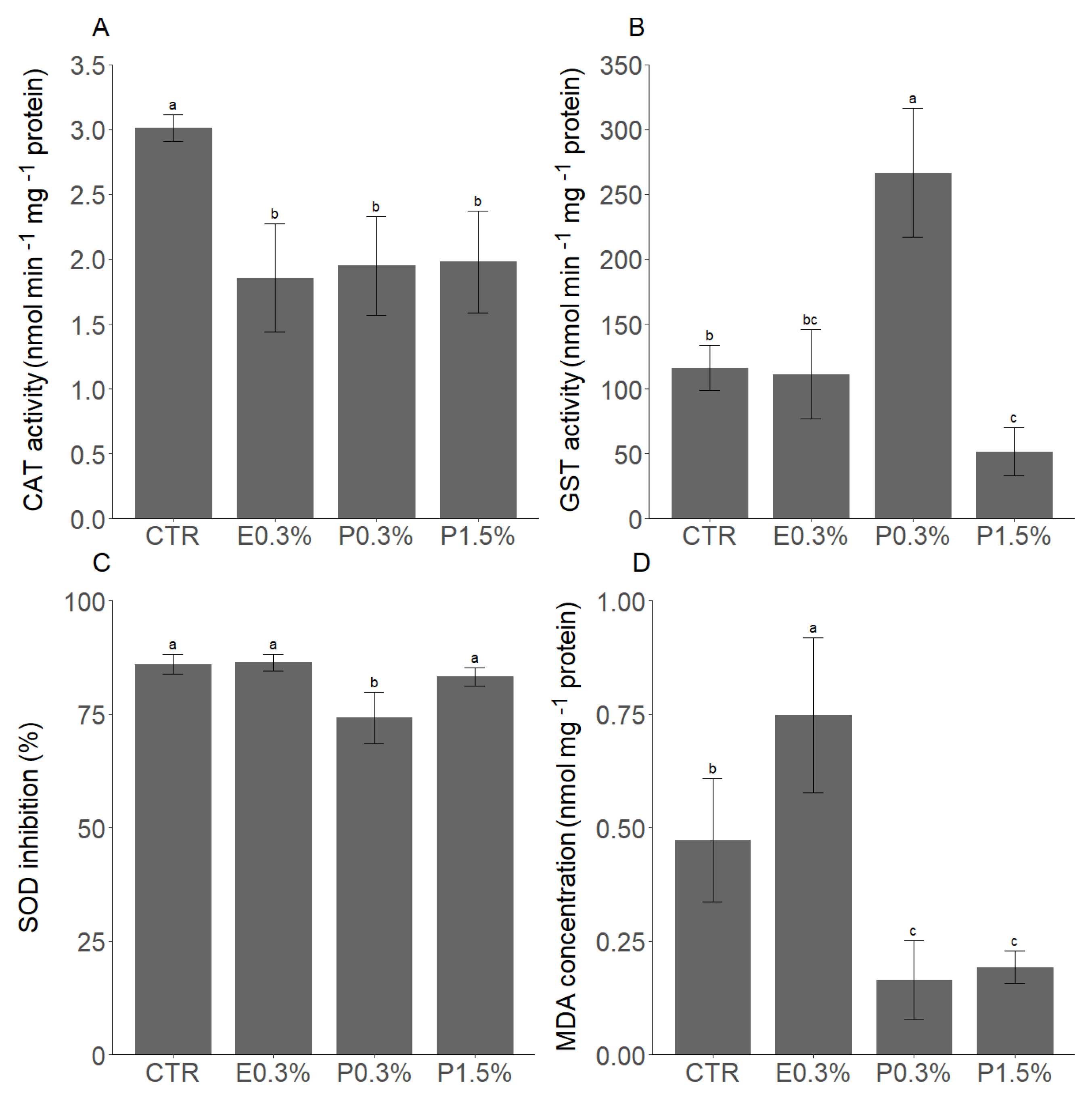
Antioxidant scavengers’ activities (CAT, GST, and SOD) and LPO levels were significantly affected by the supplementation with L. digitata under control temperature conditions (Figure 2, Table S1). There was a significant reduction in CAT activity for all macroalga-supplemented treatments, regardless of incorporation method and inclusion level (corresponding to 38.41% with p = 0.002; 35.30% with p = 0.005; and 34.34% with p = 0.006, for E0.3%, P0.3%, and P1.5% treatments, respectively, as shown in Figure 2A and Table S1). Regarding GST, significant changes were found between the CTR and P1.5% (corresponding to a 55.69% decrease and p = 0.020), as well as P0.3% (corresponding to a 129.77% increase and p < 0.001 as shown in Figure 2B and Table S1). SOD activity differed between all other treatments and P0.3%, which exhibited a 13.64% decrease in relation to CTR (p = 0.001; Figure 2C, Table S1). As for cell damage, the treatments employing powdered macroalga displayed significantly lower LPO levels than CTR (65.61%, p = 0.015, for P0.3% and 59.14%, p = 0.027, for P1.5%; Figure 2D, Table S1), whilst the treatment employing macroalga extract (E0.3%) displayed significant higher levels (58.21%, p = 0.029; Figure 2D, Table S1).
Figure 2. Oxidative stress biomarkers in the gastrointestinal tract of S. aurata fed the experimental diets after 30 days of prophylactic supplementation under control temperature conditions: catalase activity ((A); CAT; nmol min−1 mg−1 protein), glutathione S-transferase activity ((B); GST; nmol min−1 mg−1 protein), superoxide dismutase activity ((C); SOD; % inhibition), and lipid peroxidation, expressed as MDA content ((D); nmol MDA mg−1 protein). Different letters indicate significant differences (p < 0.05) between treatments. CTR—control feed; E0.3%—feed supplemented with 0.3% of L. digitata extract; P0.3%—feed supplemented with 0.3% of dried powdered L. digitata; P1.5%—feed supplemented with 1.5% of dried powdered L. digitata.
Environments 13 00025 g002
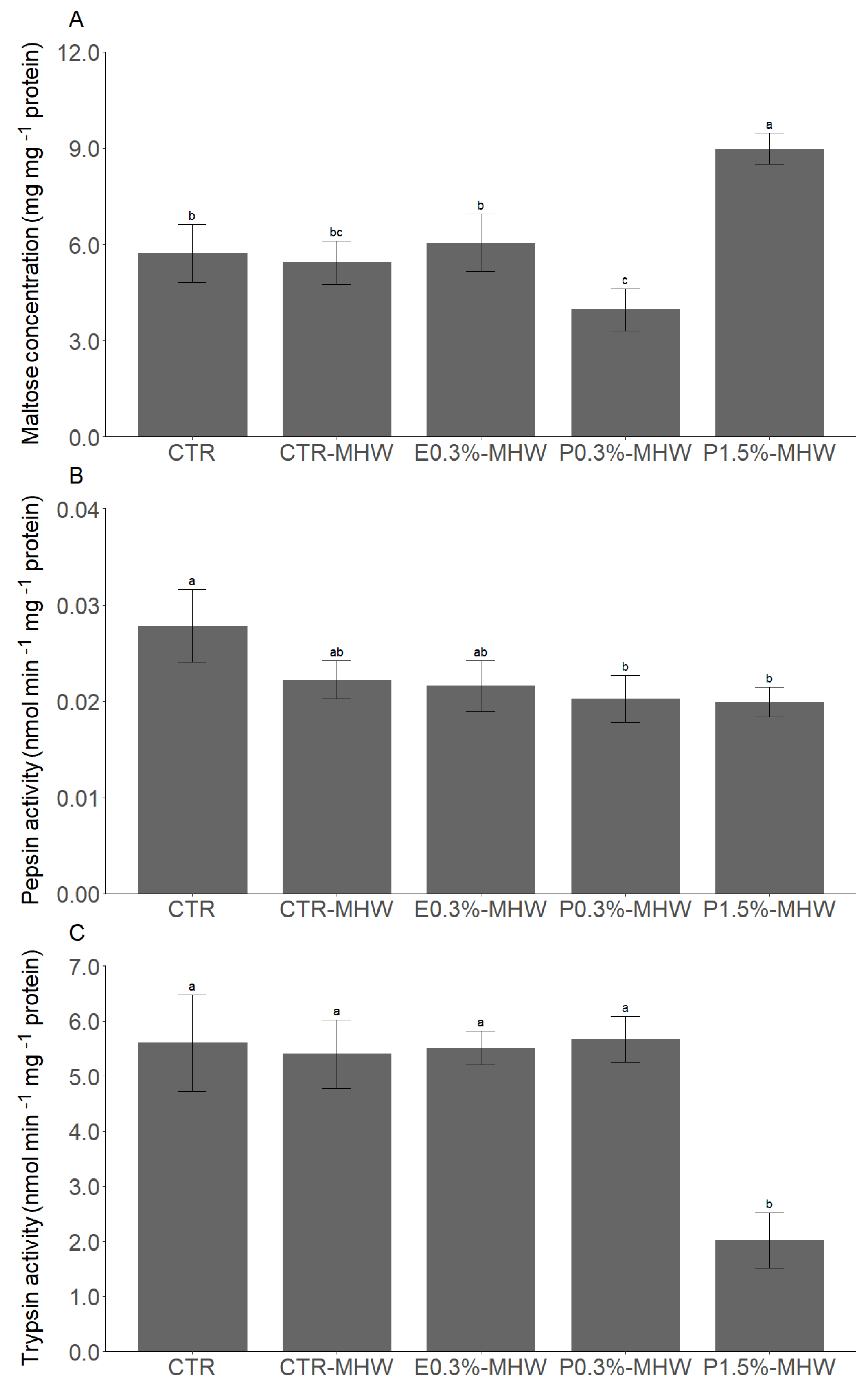
Gut digestive enzymes (amylase, pepsin, and trypsin) were likewise significantly affected by L. digitata dietary supplementation (Figure 3, Table S1). Although the values of amylase activity were lower after all types of supplementations, significant differences were only found between the CTR and E0.3% treatment, with the latter displaying a decrease of 37.35% relative to the former (p = 0.035; Figure 3A, Table S1). As for pepsin and trypsin activity, the supplementation with L. digitata elicited a similar pattern. There were significant decreases in the activity of these enzymes, with the lowest being found for treatment P0.3% (corresponding to a decrease of 46.23%, p < 0.001, for pepsin activity and 53.29%, p < 0.001, for trypsin activity), followed by E0.3% (20.41%, p = 0.010, for pepsin activity and 27.92%, p = 0.012, for trypsin activity) and P1.5% (27.89%, p = 0.012, for trypsin activity, but no significant differences from the CTR for pepsin activity) (Figure 3B,C, Table S1).
Figure 3. Digestive function biomarkers in the gastrointestinal tract of S. aurata fed the experimental diets after 30 days of prophylactic supplementation under control temperature conditions: amylase activity, reflected through maltose concentration ((A); mg maltose mg−1 protein), pepsin activity ((B); nmol min−1 mg−1 protein), trypsin activity ((C); nmol min−1 mg−1 protein). Different letters indicate significant differences (p < 0.05) between treatments. CTR—control feed; E0.3%—feed supplemented with 0.3% of L. digitata extract; P0.3%—feed supplemented with 0.3% of dried powdered L. digitata; P1.5%—feed supplemented with 1.5% of dried powdered L. digitata.
Environments 13 00025 g003
Regarding FAME profile, palmitic acid (16:0) was the main saturated fatty acid (SFA) for all treatments, followed by stearic acid (18:0) and myristic acid (14:0). As for monounsaturated fatty acids (MUFA), the most abundant were oleic acid (18:1 n-9), palmitoleic acid (16:1 n-7), and vaccenic acid (18:1 n-7), regardless of the treatment. Docosahexaenoic acid (DHA, 22:6 n-3), linoleic acid (18:2 n-6), and eicosapentaenoic acid (EPA, 20:5 n-3) were the predominant polyunsaturated fatty acids (PUFA). No statistically significant variations were found between treatments for these main fatty acids, neither for the sum of total SFA, MUFA, PUFA, PUFA n-3, and PUFA n-6 (p > 0.05, Table 1). Still, some notable non-significant trends were observed: the concentration of 18:1 n-9, 18:1 n-7, and 16:1 n-7 were apparently lower in E0.3%, resulting in lower ΣMUFA, with this trend also seen for the treatment P0.3%. Although likewise non-significantly, E0.3% presented an apparent higher percentage of EPA and arachidonic acid (20:4 n-6), while both E0.3% and P0.3% presented an apparent higher percentage of DHA than the CTR, resulting in an overall higher Σn-3 and ΣPUFA levels in these treatments (Table 1).
Table 1. Main fatty acids (>1%; percentage of total fatty acids, mean ± standard deviation) in the liver of juvenile S. aurata fed the experimental diets after 30 days of prophylactic supplementation under control temperature conditions. Absence of letters indicates lack of significant differences (p > 0.05) between treatments. SFA: saturated fatty acids; MUFA: monounsaturated fatty acids; PUFA: polyunsaturated fatty acids. CTR—control feed; E0.3%—feed supplemented with 0.3% of L. digitata extract; P0.3%—feed supplemented with 0.3% of dried powdered L. digitata; P1.5%—feed supplemented with 1.5% of dried powdered L. digitata. p-value: one-way ANOVA p-value for each variable.
CTRE0.3%P0.3%P1.5%p-Value
14:02.61 ± 0.432.63 ± 0.242.45 ± 0.162.93 ± 0.070.372
16:014.69 ± 0.5016.52 ± 0.3516.30 ± 1.0615.79 ± 0.190.150
18:05.30 ± 0.905.23 ± 0.075.38 ± 0.315.15 ± 0.530.797
ΣSFA24.51 ± 1.2726.15 ± 0.3325.61 ± 0.8425.36 ± 0.280.313
16:1 n-74.43 ± 0.573.71 ± 0.033.82 ± 0.324.45 ± 0.030.120
18:1 n-73.13 ± 0.112.63 ± 0.052.79 ± 0.212.93 ± 0.120.058
18:1 n-922.64 ± 3.0817.14 ± 0.6718.64 ± 2.2421.43 ± 0.600.155
20:1 n-91.20 ± 0.371.10 ± 0.011.07 ± 0.091.43 ± 0.060.430
ΣMUFA33.62 ± 3.8126.46 ± 0.8528.21 ± 3.1032.39 ± 0.460.113
18:2 n-611.41 ± 1.6010.28 ± 0.1010.66 ± 0.4311.43 ± 0.650.451
18:3 n-32.19 ± 0.461.95 ± 0.061.97 ± 0.122.18 ± 0.180.599
20:4 n-61.33 ± 0.362.01 ± 0.021.78 ± 0.311.37 ± 0.110.130
20:5 n-35.85 ± 0.977.22 ± 0.286.62 ± 1.055.73 ± 0.010.186
22:5 n-32.38 ± 0.362.70 ± 0.242.79 ± 0.342.65 ± 0.640.623
22:6 n-310.29 ± 2.6315.38 ± 0.1614.70 ± 1.9410.90 ± 0.020.121
ΣPUFA37.75 ± 2.2943.70 ± 0.4342.49 ± 2.1233.22 ± 7.200.106
ΣPUFA n-322.84 ± 3.4129.21 ± 0.5627.98 ± 2.1623.47 ± 0.410.097
ΣPUFA n-614.16 ± 1.2513.82 ± 0.1313.86 ± 0.2714.03 ± 0.520.867

3.2. The Effects of L. digitata Supplementation upon MHW Exposure

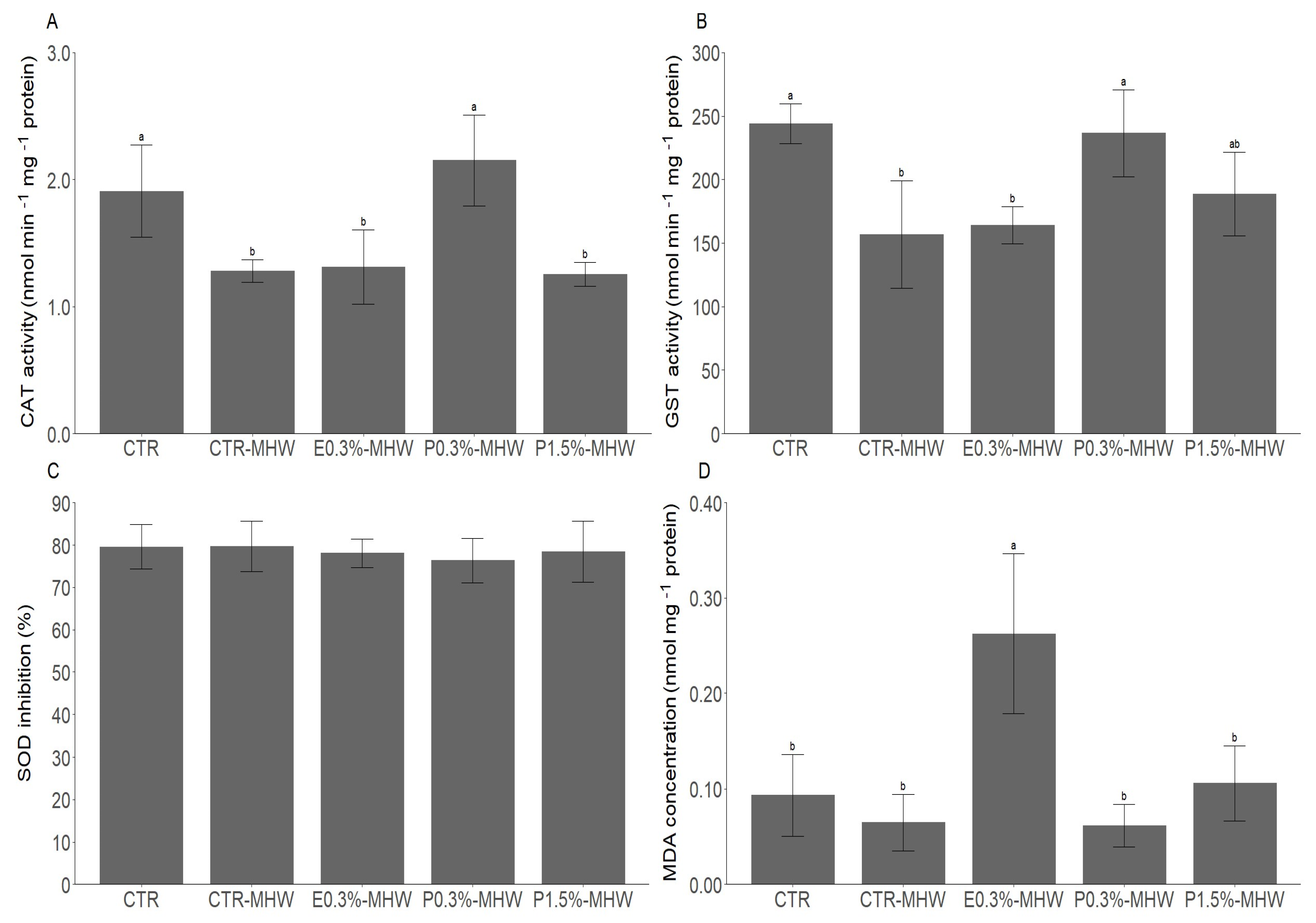
Upon exposure to the MHW, both CAT and GST enzyme activities significantly decreased (i.e., differences between CTR and CTR–MHW: 32.88%, p = 0.034, Figure 3A and 35.75%, p = 0.002, Figure 3B, respectively; Table S1). Such reduction was not seen in the supplemented treatment P0.3%–MHW, which had significantly higher enzymatic activities than CTR–MHW, corresponding to a 67.90% increase for CAT (p = 0.003, Figure 3A, Table S1) and 51.04% for GST (p = 0.008, Figure 3B, Table S1). On the other hand, the other two supplemented treatments presented similar CAT and GST activities to CTR–MHW treatment (p > 0.05). As for SOD, its activity levels did not differ between treatments (p > 0.05, Figure 4C, Table S1). LPO levels, on the other hand, differed between all other treatments and E0.3%, which presented significantly higher values (4-fold in relation to CTR–MHW, p < 0.001; Figure 4D, Table S1).
Figure 4. Oxidative stress biomarkers in the gastrointestinal tract of S. aurata fed the experimental diets at the end of the 7-day exposure to the peak temperature of the MHW: catalase activity (A); CAT; nmol min−1 mg−1 protein), glutathione S-transferase activity ((B); GST; nmol min−1 mg−1 protein), superoxide dismutase activity ((C); SOD; % inhibition), and lipid peroxidation, expressed as MDA content ((D); nmol MDA mg−1 protein). Different letters indicate significant differences (p < 0.05) between treatments; the absence of letters indicate lack of statistical differences (p > 0.05). CTR—control feed maintained under control temperature; CTR–MHW—control feed exposed to MHW conditions; E0.3%–MHW—feed supplemented with 0.3% of L. digitata extract exposed to MHW conditions; P0.3%–MHW—feed supplemented with 0.3% of dried powdered L. digitata exposed to MHW conditions; P1.5%–MHW—feed supplemented with 1.5% of dried powdered L. digitata exposed to MHW conditions.
Environments 13 00025 g004
The exposure to MHW did not produce significant differences in digestive enzymes activities (i.e., no differences between CTR and CTR–MHW, p > 0.05; Table S1). Amylase activity was enhanced in treatment P1.5%–MHW relatively to both CTR and CTR–MHW (56.75% and 65.18%, respectively, p < 0.001; Figure 5A, Table S1), whereas lower activity occurred in treatment P0.3%–MHW compared to CTR only (30.72%, p = 0.019; Figure 5A, Table S1). On the other hand, trypsin activity was significantly lower in treatment P1.5%–MHW compared to all others (corresponding to a reduction of 62.52% compared to CTR–MHW with p < 0.001 as shown in Figure 5C and Table S1). Regarding pepsin activity, significant differences were found only between CTR and both P1.5%-HW and P0.3%-HW (corresponding to a decrease of 28.37% with p = 0.017 and 27.21% with p = 0.030, respectively, as shown in Figure 5B and Table S1).
Figure 5. Digestive function biomarkers in the gastrointestinal tract of S. aurata fed the experimental diets at the end of the 7-day exposure to the peak temperature of the MHW: amylase activity, reflected through maltose concentration ((A); mg maltose mg−1 protein), pepsin activity ((B); nmol min1 mg−1 protein), and trypsin activity ((C); nmol min1 mg−1 protein). Different letters indicate significant differences (p < 0.05) between treatments. CTR—control feed maintained under control temperature; CTR–MHW—control feed exposed to MHW conditions; E0.3%–MHW—feed supplemented with 0.3% of L. digitata extract exposed to MHW conditions; P0.3%–MHW—feed supplemented with 0.3% of dried powdered L. digitata exposed to MHW conditions; P1.5%–MHW—feed supplemented with 1.5% of dried powdered L. digitata exposed to MHW conditions.
Environments 13 00025 g005
As before the MHW event, the main SFA for all treatments were palmitic acid, stearic acid, and myristic acid, the main MUFA were oleic acid, palmitoleic acid, and vaccenic acid, and the main PUFA were DHA, linoleic acid, and EPA, regardless of the treatment. The MHW resulted in a few statistically significant alterations (i.e., between CTR–MHW and CTR): a decrease in the percentage of palmitoleic acid (p = 0.024), linoleic acid (p = 0.037), and ΣPUFA n-6 (p = 0.011). Additionally, although non-significantly, there was an increasing trend in the percentages of 16:0, 18:0, and ΣSFA post-MHW (Table 2). Both the E0.3%–MHW and P0.3%–MHW treatments presented statistically higher values than the treatment CTR–MHW which were no different to that of the CTR in regard to ΣPUFA n-6 (p > 0.05). Additionally, E0.3%–MHW presented significantly higher 18:2 n-6 percentage values than CTR–MHW, which were similar to CTR as well (p > 0.05). Finally, E0.3%–MHW presented significantly lower percentages of 18:0 compared to CTR–MHW (p = 0.042) (Table 2).
Table 2. Main fatty acids (>1%; percentage of total fatty acids, mean ± standard deviation) in the liver of juvenile S. aurata fed the experimental diets at the end of the 7-day exposure to the peak temperature of the MHW. Different letters indicate significant differences (p < 0.05) between treatments, and their absence indicates lack of significant differences (p > 0.05). SFA: saturated fatty acids; MUFA: monounsaturated fatty acids; PUFA: polyunsaturated fatty acids. CTR—control feed maintained under control temperature; CTR-HW—control feed exposed to MHW conditions; E0.3%–MHW—feed supplemented with 0.3% of L. digitata extract exposed to MHW conditions; P0.3%–MHW—feed supplemented with 0.3% of dried powdered L. digitata exposed to MHW conditions; P1.5%–MHW—feed supplemented with 1.5% of dried powdered L. digitata exposed to MHW conditions. p-value: one-way ANOVA p-value for each variable.
CTRCTR-HWE0.3%-HWP0.3%-HWP1.5%-HWp-Value
14:02.83 ± 0.212.23 ± 0.112.82 ± 0.422.75 ± 0.232.40 ± 0.300.095
16:015.63 ± 0.48 b16.72 ± 0.29 ab15.76 ± 1.04 ab16.61 ± 0.36 ab17.86 ± 0.46 a0.033
18:05.20 ± 0.61 ab6.06 ± 0.13 a4.90 ± 0.19 b4.86 ± 0.33 ab5.70 ± 0.19 ab0.039
ΣSFA23.59 ± 0.55 ab24.85 ± 0.05 ab22.63 ± 0.34 ab23.11 ± 0.96 b25.11 ± 0.52 a0.026
16:1 n-74.41 ± 0.08 a3.50 ± 0.14 b4.13 ± 0.44 ab4.06 ± 0.01 ab3.47 ± 0.39 b0.012
18:1 n-72.91 ± 0.092.62 ± 0.042.76 ± 0.292.59 ± 0.122.42 ± 0.210.127
18:1 n-921.32 ± 1.9217.94 ± 0.5919.25 ± 1.8818.65 ± 0.1316.83 ± 1.400.050
20:1 n-91.29 ± 0.281.05 ± 0.101.12 ± 0.881.09 ± 0.040.96 ± 0.160.437
ΣMUFA32.11 ± 2.2227.29 ± 0.9328.95 ± 2.9528.20 ± 0.3625.51 ± 2.280.067
18:2 n-610.91 ± 0.65 a9.63 ± 0.25 b11.01 ± 0.13 a10.96 ± 0.34 ab9.64 ± 0.55 b0.005
18:3 n-32.13 ± 0.21 ab1.80 ± 0.05 ab2.12 ± 0.07 a2.16 ± 0.21 ab1.69 ± 0.11 b0.033
20:4 n-61.36 ± 0.27 b1.92 ± 0.05 ab1.53 ± 0.28 ab1.61 ± 0.0 ab2.06 ± 0.24 a0.019
20:5 n-35.54 ± 0.646.72 ± 0.456.12± 0.406.55 ± 0.626.24 ± 0.390.147
22:5 n-32.29 ± 0.202.39 ± 0.122.67 ± 0.232.51 ± 0.131.28 ± 0.170.081
22:6 n-311.71 ± 1.4916.70 ± 0.3614.83 ± 3.1815.32 ± 1.1418.89 ±2.700.057
ΣPUFA38.33 ± 2.0942.89 ± 0.3642.45 ± 3.1242.92 ± 2.0544.05 ± 2.440.168
ΣPUFA n-323.85 ± 2.1829.43 ± 0.4227.83 ± 3.0628.52 ± 1.8430.64 ± 2.730.123
ΣPUFA n-613.77 ± 0.29 a12.94 ± 0.09 b13.94 ± 0.16 a13.79 ± 0.22 a12.97 ± 0.31 b<0.001

4. Discussion

The present study provides novel data regarding the interactive effects of macroalgae supplementation and MHW events on digestive performance and lipid metabolism in farmed fish. Such information is crucial to validate the effectiveness of dietary modulation approaches in both optimal and sub-optimal environmental conditions. These findings complement the work previously conducted by our team [14,26], which reported the beneficial effects of L. digitata supplementation on S. aurata immune system, growth performance, and liver antioxidant response.

4.1. L. digitata Supplementation Under Control Temperature Conditions

The gastrointestinal tract plays a crucial role in marine organisms, being the only site for nutrient absorption and contributing to fish overall performance [42], and it is particularly sensitive to dietary modulations [25]. Oxidative stress biomarkers are key indicators of organism’s health, as antioxidant defence systems are of utmost relevance to evaluate the health of organisms. This system constitutes the first line of cellular protection against the build-up of harmful reactive oxygen species, which can cause lipid and protein damage [42,43]. The macroalgae L. digitata contains an abundance of bioactive compounds, such as laminarin, fucoidan, or β-glucans, with the ability to neutralize free radicals and/or boost antioxidant scavengers’ activity and, thus, reduce oxidative stress [19,23,26,44,45]. The results observed for the fish gut in the present study were consistent with the trends previously reported in our initial work on liver [27]. Macroalgae supplementation under optimal rearing conditions triggered significant decreases in the activities of SOD (P0.3%), CAT (all treatments), and GST (P1.5%), which is likely associated with a protective effect of L. digitata that effectively reduced oxidative stress, thereby lowering the requirement for primary antioxidant enzymatic action. The elevated GST activity observed in treatment P0.3% indicates a stimulated phase II detoxification response, leading to enhanced removal of peroxidised cell membrane lipids. Previous studies involving S. aurata and Salmo salar supplemented with higher doses of Laminaria spp. (1.5–10%) described both an enhancement and inhibition of antioxidant defences [26,30,46]. These discrepancies among studies likely reflect species-, tissue-, inclusion-dose-, and formulation-dependent responses.
In accordance with a lower oxidative state, LPO levels were markedly lower for fish fed with powdered macroalgae, further confirming the effectiveness of the L. digitata supplementation in its dry powder form in preventing cell damage. Conversely, this beneficial effect was not observed in fish supplemented with the macroalgae in the extract form (i.e., increased lipid damage), potentially due to changes in feed digestibility and/or increased bioavailability of specific bioactive compounds (e.g., phenolic compounds, such as phlorotannin) with reported adverse pro-inflammatory effects in high doses [47]. Previous studies have reported a stimulation of lipid degradation following powdered macroalgae supplementation, although the inclusion levels reported were much higher than those herein tested (5–7.5%) [48,49].
Fish welfare is intrinsically related with gut health, and gastrointestinal enzyme activity strongly influences physiological status [50,51]. Dietary macroalgae supplementation has been shown to modulate the digestive and absorptive processes [18]. Brown macroalgae are described as relevant sources of complex polysaccharides, phenolic compounds, and alginates that act as α-amylase inhibitors [36]. In line with this, supplemented fish exhibited decreased amylase activity, particularly when L. digitata was added as an extract. This was most likely caused by the presence of inhibiting compounds and/or less digestible polysaccharides that can compromise digestive enzyme secretion or activity, especially in carnivorous species that have naturally low capacity to digest carbohydrates [52]. Similarly, pepsin and trypsin activities were also reduced in supplemented fish regardless of the inclusion form. This suggests, once again, the potential presence of antinutritional factors in L. digitata, such as tannins, alginates, or phenolic compounds, that act as proteolytic inhibitors by either binding to dietary proteins and/or digestive enzymes, altering gut pH or viscosity, or forming indigestible complexes [20,49,53,54].
The suppression of the aforementioned enzymes’ activity can be linked to decreased digestive functionality and nutrient utilization, raising concerns for aquaculture. However, the same L. digitata-supplemented feeds utilized in this study were not previously associated with compromised feed efficiency and growth rate [27], indicating that these feeds are still nutritionally balanced and the alterations on digestive enzymatic activities were not severe enough to impair nutrient conversion. Moreover, it has been observed that S. salar digestive tracts became heavier and longer upon Laminaria spp. supplementation, suggesting an increased surface area and retention time for digestion [30]. This would allow enzymes to remain active for a longer period [55], meaning that their activity can be lowered while maintaining similar functionality. Alternatively, algae probiotics can stimulate the growth of non-harmful microbiota, which has been associated to the secretion of digestive enzymes [56,57]. In this context, we hypothesize that the microbiocidal activity of some macroalgae compounds could, conversely, partially inhibit the growth of beneficial microbiota and associated enzyme production [20,24].
Lipid metabolism is a critical component in the assessment of dietary supplementation of farmed fish species, as it directly influences animal growth performance, tissue composition, and overall physiological health status. Understanding processes by which different fish species metabolize dietary lipids allows feed producers and farmers to optimize aquafeed formula’s nutritional balance (i.e., ratio of lipids to carbohydrates and proteins) towards the enhancement of energy efficiency, animal growth, and immunocompetence. A thirty-day supplementation with L. digitata did not significantly alter liver fatty acid composition of S. aurata, suggesting that the inclusion of the macroalgae did not influence fish lipid metabolism. This finding is consistent with the pattern reported by [58], in which S. aurata muscle fillets’ fatty acids profile was assessed upon supplementation with L. digitata at 10%. Nonetheless, the non-significant increase in the present study found in ΣPUFA and Σn-3, only for both E0.3% and P0.3%, should not be overlooked, since these are essential to support organ function and overall animal welfare.

4.2. L. digitata Supplementation upon MHW Exposure
As discussed above, antioxidant enzymes are typically elevated by stress exposure. Yet, under sustained or severe stress conditions, enzyme inhibition can also occur as a result of protein denaturation, oxidative damage to the enzymes themselves, or depletion of antioxidant substrates [27,43,59]. Exposure to the MHW had some mild effects on the antioxidant defence system of S. aurata, namely the inhibition of CAT and GST activities. Despite the lowered defences, peroxidation of cell membrane lipids was not significantly enhanced (i.e., LPO levels remained similar between CTR and CTR-HW). However, this result could be related with the duration of the trial, i.e., the duration of the MHW event was not long enough to elicit severe effects.
Overall, dietary supplementation with L. digitata did not counteract the inhibition of antioxidant scavengers elicited by the MHW, except for treatment P0.3%–MHW, in which GST and CAT activity values were closer to optimal/baseline levels (i.e., similar values to those found for fish in CTR). As observed under optimal rearing conditions, upon exposure to the MHW, fish from E0.3% kept experiencing an increase in LPO levels, further confirming the pro-inflammatory action of this feed formulation, regardless of temperature conditions. Remarkably, in our previous work [27], this same feed formulation reduced LPO levels in S. aurata liver under a MHW simulation, showcasing how different tissues respond in distinct ways to dietary modulation and/or stressful environmental conditions.
Consistent with control temperature conditions, the effects of inclusion form (dried powder versus extract) on antioxidant fish responses remain evident under MHW exposure. Indeed, macroalgae processing and extraction may remove or cleave particular bioactive compounds, either allowing fish to better access them [49] or altering their bioactivity [60]. It is probable that the subcritical extraction through which L. digitata extracts were obtained and the addition to feed pellets (which involves exposure to high temperatures during extrusion; [27]) partially influenced the type and bioavailability of compounds present in the final aquafeed formula [61]. The contradictory results amongst numerous studies indicate the necessity to conduct further research focused on comparisons between macroalgae processing methods and diet manufacturing procedures, as well as on comprehensive feed characterization (an extensive characterization of the L. digitata dried powder and sub-critical extracts utilized in the present work is currently underway in the scope of another study from our team).
Regarding digestive capacity, the exposure to the MHW did not result in significant changes, evidencing the minor impact that these acute thermal events may have on fish gastrointestinal physiology, as opposed to other tissues [43]. Under these conditions, a higher inclusion level (1.5%) of L. digitata increased amylase and decreased trypsin activities, suggesting dose-dependent modulation of digestive capacity under thermal stress. To the best of our knowledge, this is the first study addressing the effects of L. digitata supplementation on digestive capacity under sub-optimal thermal conditions, which hampers appropriate comparisons of the present results with previous studies.
Thermal stress can disrupt normal lipid synthesis, mobilization, and oxidation, affecting energy homeostasis, membrane fluidity, and overall physiological performance [55]. In the present study, exposure to the MHW significantly decreased the percentage of palmitoleic and linoleic acids, as well as Σn-6 fatty acids, which may compromise membrane structure and inflammatory signalling. Conversely, the non-significant tendency toward higher ΣSFA, 16:0, and 18:0 could indicate increased membrane saturation. The liver plays an essential role in fatty acid metabolism, with these processes being severely affected by temperature [62,63]. In particular, n-6 PUFAs biosynthesis depend on hepatic enzymes that present lower activity at higher temperatures [64], and thermal stress can specifically compromise linoleic acid metabolism in fish [65]. Overall, thermal stress could have altered lipid metabolism by impairing metabolism pathways or downregulated key enzymes involved in the conversion of SFA to MUFA/PUFA. As suggested by [66], the present alterations could also be connected to a homeoviscous adaptation, which is based on the maintenance of cell membranes’ fluidity in response to temperature fluctuations. Additionally, the observed reduction in certain fatty acids may be associated with increased liver lipid damage caused by thermal stress (see [27]). On the other hand, a decrease in specific fatty acids (e.g., palmitoleic and linoleic acids) can likewise be linked to increased metabolic requirements and energy needs at higher temperatures or stress situations that were not overcome via diet [62]. This latter hypothesis, together with the fact that macroalgae-supplemented feeds can prevent thermal stress-related liver lipid damage [27], is better supported by the attenuation of these alterations in the 0.3% supplemented-diet treatments. All in all, the outcomes of the present study highlight that MHWs negatively impact liver lipid metabolism, which were partially mitigated through L. digitata dietary supplementation at lower doses (0.3%), regardless of the incorporation form. However, the use of powder L. digitata may be more economically feasible compared to the extract-feed, due to the additional costs associated with this processing method. Hence, the powdered low-dose supplementation may represent a more practical option in commercial applications.

5. Conclusions

This study aimed to investigate the potential benefits of L. digitata supplementation on the gastrointestinal health and liver fatty acid composition of farmed gilthead seabream (S. aurata), as well as to understand whether this macroalgae can provide antioxidant and digestive protection under thermal stress conditions. Under optimal environmental conditions, feeds enriched with dried macroalgae powder (both at P0.3% and P1.5% inclusion levels) enhanced antioxidant capacity and reduced lipid peroxidation in the fish gastrointestinal tract. Furthermore, despite diminishing digestive enzymes activities, L. digitata supplementation did not substantially influence nutrient conversion and lipid metabolism. The simulated MHW condition did not impair fish digestive function nor did it elicit severe oxidative damage, which can be attributed either to the resilience of the gastrointestinal system to acute temperature changes or to the thermal optimal range of the model fish species. Nonetheless, the MHW reshaped the liver fatty acid profile (i.e., decreasing the percentage of some specific fatty acids and total n-6 PUFAs), most likely to follow up the higher energy demands due to enhanced fish metabolism. The feed supplemented with 0.3% L. digitata powder somewhat mitigated these effects by either allowing the fish to maintain favourable antioxidant defences or preventing changes in lipid metabolism.
Taken together, the present results align with our previous findings, confirming that L. digitata is a promising ingredient that can be used to benefit fish well-being while simultaneously contributing to the sustainability of the aquaculture industry. Considering the gut tissue damage caused by the 0.3% extract feed under both optimal and sub-optimal conditions, as well as the lack of protective effects of the 1.5% powder feed under sub-optimal conditions, the aquafeed containing 0.3% dried macroalgae powder stood out as the most balanced and cost-effective formula from a gastrointestinal physiology and lipid metabolism standpoint. Nonetheless, the formulation of macroalgae supplemented aquafeeds should be tailored to the producer’s objectives, as the beneficial outcomes that they promote can substantially vary across species and life stage, as well as tissues and physiological endpoints.

Supplementary Materials

The following supporting information can be downloaded at https://www.mdpi.com/article/10.3390/environments13010025/s1, Table S1: biomarker levels in juvenile Sparus aurata for each treatment and sampling time (mean ± standard deviation) and their statistical comparison (p-value). CAT: catalase activity (nmol min−1 mg−1 protein); GST: glutathione S-transferase activity (nmol min−1 mg−1 protein); SOD: superoxide dismutase activity (% of inhibition); LPO: lipid peroxidation levels (nmol MDA mg−1 protein); pepsin: pepsin activity (nmol min−1 mg−1 protein); trypsin: trypsin activity (nmol min−1 mg−1 protein); amylase: amylase activity (mg maltose mg−1 protein). p-value: one-way ANOVA p-value for each variable; and Table S2: fatty acid composition in liver of juvenile Sparus aurata for each treatment (%, percentage of total fatty acids, mean ± standard deviation). SFA: saturated fatty acids; MUFA: monounsaturated fatty acids; PUFA: polyunsaturated fatty acids.

Author Contributions

Conceptualization, I.M., A.M. and A.L.M.; methodology, I.M., A.M. and A.L.M.; formal analysis, R.V.C.G.; investigation, R.V.C.G., I.M., T.C., A.P., D.B., E.F.V., C.D.-M., P.A., M.S.D. and A.L.M.; resources, M.B., P.P.-F., E.F.V., C.D.-M., N.M.B. and A.L.M.; data curation, R.V.C.G.; writing—original draft preparation, R.V.C.G.; writing—review and editing, R.V.C.G., I.M., T.C., A.P., D.B., M.B., P.P.-F., E.F.V., C.D.-M., P.A., A.M., M.S.D., N.M.B. and A.L.M.; visualization: R.V.C.G.; supervision, M.S.D., A.M. and A.L.M.; project administration, A.L.M.; funding acquisition, A.M. and A.L.M. All authors have read and agreed to the published version of the manuscript.

Funding

This research was funded by The Portuguese Foundation for Science and Technology (FCT I.P.), under the framework of the Aqua-CLIMADAPT project (PTDC/CTA-AMB/0592/2021, doi:10.54499/PTDC/CTA-AMB/0592/2021) and the Applied Molecular Biosciences Unit (UCIBIO), which is financed by national funds from FCT/MCTES (UIDB/04378/2020), as well as the Associate Laboratory Institute for Health and Bioeconomy–i4HB (LA/P/0140/2020). I.M. acknowledges FCT I.P. for her PhD Grant (2020.04413.BD). R.V.C.G., T.C., and D.B. acknowledge the NextGenerationEU program under the Recovery and Resilience Facility Plan for Portugal–Agenda VIIAFOOD–Platform for Valorization, Industrialization, and Commercial Innovation for the Agri-Food Sector (C644929456-0000004) for their research fellowship. A.P. acknowledges the INNOECOFOOD project (101136739, Horizon Europe) for her research contract.

Institutional Review Board Statement

Fish trials were conducted in accordance with the European regulations (EU Directive 2010/63) and the Portuguese legislation for Laboratory Animal Science (Decreto-Lei nº 113/2013). IPMA’s Animal Welfare and Ethics Body (ORBEA, LABVIVOS-002-AquaClimAdapt) granted approval, under the supervision of the Portuguese National Competence Authority (Directorate General for Food and Veterinary, DGAV), under the ethical clearance number 20596/25-S(01.07.2024). Fish handling, sampling, and maintenance were performed by certified researchers by the Federation of European Laboratory Animal Science Associations (FELASA), following the ARRIVE (Animal research: reporting of in vivo experiments) guidelines.

Data Availability Statement

Data are contained within the article or Supplementary Material.

Acknowledgments

The authors acknowledge the team from the Aquaculture Research Station of Olhão (EPPO–IPMA I.P.) for the technical support provided during animal rearing and transplantation, as well as Júlia Ferreira for her technical support in FAME analysis. The authors also thank Leonardo Mata (GOPSIS Lda.) for providing the macroalga Laminaria digitata and Jorge Dias (SPAROS Lda.) for supplying the experimental aquafeeds.

Conflicts of Interest

The authors declare no conflicts of interest.

References

  1. FAO. The State of World Fisheries and Aquaculture 2024; FAO: Rome, Italy, 2024; ISBN 978-92-5-138763-4. [Google Scholar]
  2. Da Fonseca Ferreira, A.; Roquigny, R.; Grard, T.; Le Bris, C. Temporal and Spatial Dynamics of Vibrio Harveyi: An Environmental Parameter Correlation Investigation in a 4-Metre-Deep Dicentrarchus labrax Aquaculture Tank. Microorganisms 2024, 12, 1104. [Google Scholar] [CrossRef]
  3. Matias, A.C.; Andrade, C.; Matias, A.C.; Andrade, C. New Challenges in Marine Aquaculture Research. J. Mar. Sci. Eng. 2025, 13, 324. [Google Scholar] [CrossRef]
  4. D’Abramo, L.R. Realizing the Potential of Aquaculture: Undertaking the Wicked Problems of Climate Change, Fed Production Systems and Global Food Security. Rev. Fish. Sci. Aquac. 2025, 33, 1–7. [Google Scholar] [CrossRef]
  5. Hobday, A.J.; Alexander, L.V.; Perkins, S.E.; Smale, D.A.; Straub, S.C.; Oliver, E.C.J.; Benthuysen, J.A.; Burrows, M.T.; Donat, M.G.; Feng, M.; et al. A Hierarchical Approach to Defining Marine Heatwaves. Prog. Oceanogr. 2016, 141, 227–238. [Google Scholar] [CrossRef]
  6. Baker-Austin, C.; Lake, I.; Archer, E.; Hartnell, R.; Trinanes, J.; Martinez-Urtaza, J. Stemming the Rising Tide of Vibrio Disease. Lancet Planet. Health 2024, 8, e515–e520. [Google Scholar] [CrossRef]
  7. Atalah, J.; Ibañez, S.; Aixalà, L.; Barber, X.; Sánchez-Jerez, P. Marine Heatwaves in the Western Mediterranean: Considerations for Coastal Aquaculture Adaptation. Aquaculture 2024, 588, 740917. [Google Scholar] [CrossRef]
  8. Scharsack, J.P.; Franke, F. Temperature Effects on Teleost Immunity in the Light of Climate Change. J. Fish Biol. 2022, 101, 780–796. [Google Scholar] [CrossRef]
  9. Liu, X.; Peng, Y.; Xu, Y.; He, G.; Liang, J.; Masanja, F.; Yang, K.; Xu, X.; Deng, Y.; Zhao, L. Responses of Digestive Metabolism to Marine Heatwaves in Pearl Oysters. Mar. Pollut. Bull. 2023, 186, 114395. [Google Scholar] [CrossRef] [PubMed]
  10. Siboni, N.; King, W.L.; Williams, N.L.R.; Scanes, E.; Giardina, M.; Green, T.J.; Ostrowski, M.; O’Connor, W.; Dove, M.; Labbate, M.; et al. Increased Abundance of Potentially Pathogenic Vibrio and a Marine Heatwave Co-Occur with a Pacific Oyster Summer Mortality Event. Aquaculture 2024, 583, 740618. [Google Scholar] [CrossRef]
  11. Darmaraki, S.; Somot, S.; Sevault, F.; Nabat, P. Past Variability of Mediterranean Sea Marine Heatwaves. Geophys. Res. Lett. 2019, 46, 9813–9823. [Google Scholar] [CrossRef]
  12. Dayan, H.; McAdam, R.; Juza, M.; Masina, S.; Speich, S. Marine Heat Waves in the Mediterranean Sea: An Assessment from the Surface to the Subsurface to Meet National Needs. Front. Mar. Sci. 2023, 10, 1045138. [Google Scholar] [CrossRef]
  13. Can, M.F.; Mazlum, Y. Global Warming and Sustainable Aquaculture in Türkiye: The Case of Sea Bass (Dicentrarchus labrax) and Gilthead Sea Bream (Sparus aurata). Aquacult Int. 2025, 33, 249. [Google Scholar] [CrossRef]
  14. Stavrakidis-Zachou, O.; Lika, K.; Anastasiadis, P.; Papandroulakis, N. Projecting Climate Change Impacts on Mediterranean Finfish Production: A Case Study in Greece. Clim. Change 2021, 165, 67. [Google Scholar] [CrossRef]
  15. Marmelo, I.; Chainho, T.; Bolotas, D.; Pereira, A.; Özkan, B.; Marques, C.; Silva, I.A.L.; Soares, F.; Pousão-Ferreira, P.; Vieira, E.F.; et al. Laminaria digitata Supplementation as a Climate-Smart Strategy to Counteract the Interactive Effects of Marine Heatwaves and Disease Outbreaks in Farmed Gilthead Seabream (Sparus aurata). Environments 2025, 12, 226. [Google Scholar] [CrossRef]
  16. Ciji, A.; Akhtar, M.S. Stress Management in Aquaculture: A Review of Dietary Interventions. Rev. Aquac. 2021, 13, 2190–2247. [Google Scholar] [CrossRef]
  17. Tacon, A.G.J.; Metian, M.; McNevin, A.A. Future Feeds: Suggested Guidelines for Sustainable Development. Rev. Fish. Sci. Aquac. 2022, 30, 135–142. [Google Scholar] [CrossRef]
  18. Galindo, A.; Pérez, J.A.; Martín, V.; Acosta, N.G.; Reis, D.B.; Jiménez, I.A.; Rosa, G.; Venuleo, M.; Marrero, M.; Rodríguez, C. Effect of Feed Supplementation with Seaweed Wracks on Performance, Muscle Lipid Composition, Antioxidant Status, Digestive Enzyme Activities, and Plasma Biochemistry of Gilthead Seabream (Sparus aurata) Juveniles. Aquac. Rep. 2023, 31, 101673. [Google Scholar] [CrossRef]
  19. Abdel-Tawwab, M.; Harikrishnan, R.; Devi, G.; Bhat, E.A.; Paray, B.A. Stimulatory Effects of Seaweed Laminaria digitata Polysaccharides Additives on Growth, Immune-Antioxidant Potency and Related Genes Induction in Rohu Carp (Labeo rohita) during Flavobacterium columnare Infection. Aquaculture 2024, 579, 740253. [Google Scholar] [CrossRef]
  20. Gunathilake, T.; Akanbi, T.O.; Suleria, H.A.R.; Nalder, T.D.; Francis, D.S.; Barrow, C.J. Seaweed Phenolics as Natural Antioxidants, Aquafeed Additives, Veterinary Treatments and Cross-Linkers for Microencapsulation. Mar. Drugs 2022, 20, 445. [Google Scholar] [CrossRef] [PubMed]
  21. Mwendwa, R.; Wawire, M.; Kahenya, P. Potential for Use of Seaweed as a Fish Feed Ingredient: A Review. J. Agric. Sci. 2023, 15, 96. [Google Scholar] [CrossRef]
  22. Abdel-Latif, H.M.R.; Dawood, M.A.O.; Alagawany, M.; Faggio, C.; Nowosad, J.; Kucharczyk, D. Health Benefits and Potential Applications of Fucoidan (FCD) Extracted from Brown Seaweeds in Aquaculture: An Updated Review. Fish Shellfish Immunol. 2022, 122, 115–130. [Google Scholar] [CrossRef]
  23. Abdel-Mawla, M.S.; Magouz, F.I.; Khalafalla, M.M.; Amer, A.A.; Soliman, A.A.; Zaineldin, A.I.; Gewaily, M.S.; Dawood, M.A.O. Growth Performance, Intestinal Morphology, Blood Biomarkers, and Immune Response of Thinlip Grey Mullet (Liza ramada) Fed Dietary Laminarin Supplement. J. Appl. Phycol. 2023, 35, 1801–1811. [Google Scholar] [CrossRef]
  24. Miranda, M.; López-Alonso, M.; García-Vaquero, M. Macroalgae for Functional Feed Development: Applications in Aquaculture, Ruminant and Swine Feed Industries. In Seaweeds: Biodiversity, Environmental Chemistry and Ecological Impacts; Newton, P., Ed.; NOVA, Science Publishers: Hauppauge, NY, USA, 2017. [Google Scholar]
  25. Pereira, A.; Marmelo, I.; Dias, M.; Silva, A.C.; Grade, A.C.; Barata, M.; Pousão-Ferreira, P.; Dias, J.; Anacleto, P.; Marques, A.; et al. Asparagopsis Taxiformis as a Novel Antioxidant Ingredient for Climate-Smart Aquaculture: Antioxidant, Metabolic and Digestive Modulation in Juvenile White Seabream (Diplodus sargus) Exposed to a Marine Heatwave. Antioxidants 2024, 13, 949. [Google Scholar] [CrossRef] [PubMed]
  26. Marmelo, I.; Dias, M.; Grade, A.; Pousão-Ferreira, P.; Diniz, M.S.; Marques, A.; Maulvault, A.L. Immunomodulatory and Antioxidant Effects of Functional Aquafeeds Biofortified with Whole Laminaria digitata in Juvenile Gilthead Seabream (Sparus aurata). Front. Mar. Sci. 2024, 11, 1325244. [Google Scholar] [CrossRef]
  27. Pereira, A.; Marmelo, I.; Chainho, T.; Bolotas, D.; Dias, M.; Cereja, R.; Barata, M.; Pousão-Ferreira, P.; Vieira, E.F.; Delerue-Matos, C.; et al. Improving Farmed Juvenile Gilthead Seabream (Sparus aurata) Stress Response to Marine Heatwaves and Vibriosis Through Seaweed-Based Dietary Modulation. Animals 2025, 15, 1970. [Google Scholar] [CrossRef]
  28. Purcell-Meyerink, D.; Packer, M.A.; Wheeler, T.T.; Hayes, M. Aquaculture Production of the Brown Seaweeds Laminaria digitata and Macrocystis pyrifera: Applications in Food and Pharmaceuticals. Molecules 2021, 26, 1306. [Google Scholar] [CrossRef] [PubMed]
  29. Palstra, A.P.; Kals, J.; Blanco Garcia, A.; Dirks, R.P.; Poelman, M. Immunomodulatory Effects of Dietary Seaweeds in LPS Challenged Atlantic Salmon Salmo salar as Determined by Deep RNA Sequencing of the Head Kidney Transcriptome. Front. Physiol. 2018, 9, 625. [Google Scholar] [CrossRef]
  30. Kamunde, C.; Sappal, R.; Melegy, T.M. Brown Seaweed (AquaArom) Supplementation Increases Food Intake and Improves Growth, Antioxidant Status and Resistance to Temperature Stress in Atlantic Salmon, Salmo salar. PLoS ONE 2019, 14, e0219792. [Google Scholar] [CrossRef]
  31. Bradford, M.M. A Rapid and Sensitive Method for the Quantitation of Microgram Quantities of Protein Utilizing the Principle of Protein-Dye Binding. Anal. Biochem. 1976, 72, 248–254. [Google Scholar] [CrossRef]
  32. Johansson, L.H.; Håkan Borg, L.A. A Spectrophotometric Method for Determination of Catalase Activity in Small Tissue Samples. Anal. Biochem. 1988, 174, 331–336. [Google Scholar] [CrossRef]
  33. Habig, W.H.; Pabst, M.J.; Jakoby, W.B. Glutathione S-Transferases. J. Biol. Chem. 1974, 249, 7130–7139. [Google Scholar] [CrossRef]
  34. Sun, Y.; Oberley, L.W.; Li, Y. A Simple Method for Clinical Assay of Superoxide Dismutase. Clin. Chem. 1988, 34, 497–500. [Google Scholar] [CrossRef]
  35. Uchiyama, M.; Mihara, M. Determination of Malonaldehyde Precursor in Tissues by Thiobarbituric Acid Test. Anal. Biochem. 1978, 86, 271–278. [Google Scholar] [CrossRef] [PubMed]
  36. Zaharudin, N.; Salmeán, A.A.; Dragsted, L.O. Inhibitory Effects of Edible Seaweeds, Polyphenolics and Alginates on the Activities of Porcine Pancreatic α-Amylase. Food Chem. 2018, 245, 1196–1203. [Google Scholar] [CrossRef]
  37. Anson, M.L. The Estimation Of Pepsin, Trypsin, Papain and Cathepsin With Hemoglobin. J. Gen. Physiol. 1938, 22, 79–89. [Google Scholar] [CrossRef]
  38. Comabella, Y.; Mendoza, R.; Aguilera, C.; Carrillo, O.; Hurtado, A.; García-Galano, T. Digestive Enzyme Activity during Early Larval Development of the Cuban Gar Atractosteus tristoechus. Fish. Physiol. Biochem. 2006, 32, 147–157. [Google Scholar] [CrossRef]
  39. Erlanger, B.F.; Kokowsky, N.; Cohen, W. The Preparation and Properties of Two New Chromogenic Substrates of Trypsin. Arch. Biochem. Biophys. 1961, 95, 271–278. [Google Scholar] [CrossRef]
  40. Klomklao, S.; Benjakul, S.; Visessanguan, W.; Kishimura, H.; Simpson, B. Proteolytic Degradation of Sardine (Sardinella gibbosa) Proteins by Trypsin from Skipjack Tuna (Katsuwonus pelamis) Spleen. Food Chem. 2006, 98, 14–22. [Google Scholar] [CrossRef]
  41. Bandarra, N.M.; Batista, I.; Nunes, M.L.; Empis, J.M.; Christie, W.W. Seasonal Changes in Lipid Composition of Sardine (Sardina pilchardus). J. Food Sci. 1997, 62, 40–42. [Google Scholar] [CrossRef]
  42. Martínez-Antequera, F.P.; Simó-Mirabet, P.; Román, M.; Fuentes, J.; Oliva, M.; Méndez-Paz, D.; Vázquez-Sobrado, R.; Martos-Sitcha, J.A.; Moyano, F.J.; Mancera, J.M. Effect of Algal Extracts on the Metabolism, Intestinal Functionality and Oxidative Status of Gilthead Seabream (Sparus aurata). Aquaculture 2025, 609, 742869. [Google Scholar] [CrossRef]
  43. Madeira, D.; Vinagre, C.; Diniz, M.S. Are Fish in Hot Water? Effects of Warming on Oxidative Stress Metabolism in the Commercial Species Sparus aurata. Ecol. Indic. 2016, 63, 324–331. [Google Scholar] [CrossRef]
  44. Yin, G.; Li, W.; Lin, Q.; Lin, X.; Lin, J.; Zhu, Q.; Jiang, H.; Huang, Z. Dietary Administration of Laminarin Improves the Growth Performance and Immune Responses in Epinephelus coioides. Fish Shellfish Immunol. 2014, 41, 402–406. [Google Scholar] [CrossRef] [PubMed]
  45. Zhu, L.; Wang, S.; Cai, Y.; Shi, H.; Zhou, Y.; Zhang, D.; Guo, W.; Wang, S. Effects of Five Prebiotics on Growth, Antioxidant Capacity, Non-Specific Immunity, Stress Resistance, and Disease Resistance of Juvenile Hybrid Grouper (Epinephelus fuscoguttatus ♀ × Epinephelus lanceolatus ♂). Animals 2023, 13, 754. [Google Scholar] [CrossRef]
  46. Pereira, A.; Marmelo, I.; Dias, M.; Anacleto, P.; Pires, C.; Batista, I.; Marques, A.; Maulvault, A.L. Antioxidant, Metabolic and Digestive Biomarker Responses of Farmed Sparus aurata Supplemented with Laminaria digitata. Aquaculture 2025, 598, 741984. [Google Scholar] [CrossRef]
  47. Negara, B.F.S.P.; Sohn, J.H.; Kim, J.-S.; Choi, J.-S. Effects of Phlorotannins on Organisms: Focus on the Safety, Toxicity, and Availability of Phlorotannins. Foods 2021, 10, 452. [Google Scholar] [CrossRef]
  48. Peixoto, M.J.; Svendsen, J.C.; Malte, H.; Pereira, L.F.; Carvalho, P.; Pereira, R.; Gonçalves, J.F.M.; Ozório, R.O.A. Diets Supplemented with Seaweed Affect Metabolic Rate, Innate Immune, and Antioxidant Responses, but Not Individual Growth Rate in European Seabass (Dicentrarchus labrax). J. Appl. Phycol. 2016, 28, 2061–2071. [Google Scholar] [CrossRef]
  49. Guerreiro, I.; Magalhães, R.; Coutinho, F.; Couto, A.; Sousa, S.; Delerue-Matos, C.; Domingues, V.F.; Oliva-Teles, A.; Peres, H. Evaluation of the Seaweeds Chondrus crispus and Ulva lactuca as Functional Ingredients in Gilthead Seabream (Sparus aurata). J. Appl. Phycol. 2019, 31, 2115–2124. [Google Scholar] [CrossRef]
  50. Castro, C.; Peréz-Jiménez, A.; Coutinho, F.; Díaz-Rosales, P.; Serra, C.A.D.R.; Panserat, S.; Corraze, G.; Peres, H.; Oliva-Teles, A. Dietary Carbohydrate and Lipid Sources Affect Differently the Oxidative Status of European Sea Bass (Dicentrarchus labrax) Juveniles. Br. J. Nutr. 2015, 114, 1584–1593. [Google Scholar] [CrossRef]
  51. Sheikhzadeh, N.; Ahmadifar, E.; Soltani, M.; Tayefi-Nasrabadi, H.; Mousavi, S.; Naiel, M.A.E. Brown Seaweed (Padina australis) Extract Can Promote Performance, Innate Immune Responses, Digestive Enzyme Activities, Intestinal Gene Expression and Resistance against Aeromonas hydrophila in Common Carp (Cyprinus carpio). Animals 2022, 12, 3389. [Google Scholar] [CrossRef] [PubMed]
  52. Norambuena, F.; Hermon, K.; Skrzypczyk, V.; Emery, J.A.; Sharon, Y.; Beard, A.; Turchini, G.M. Algae in Fish Feed: Performances and Fatty Acid Metabolism in Juvenile Atlantic Salmon. PLoS ONE 2015, 10, e0124042. [Google Scholar] [CrossRef]
  53. Peixoto, M.J.; Salas-Leitón, E.; Pereira, L.F.; Queiroz, A.; Magalhães, F.; Pereira, R.; Abreu, H.; Reis, P.A.; Gonçalves, J.F.M.; Ozório, R.O.D.A. Role of Dietary Seaweed Supplementation on Growth Performance, Digestive Capacity and Immune and Stress Responsiveness in European Seabass (Dicentrarchus labrax). Aquac. Rep. 2016, 3, 189–197. [Google Scholar] [CrossRef]
  54. Vizcaíno, A.J.; Mendes, S.I.; Varela, J.L.; Ruiz-Jarabo, I.; Rico, R.; Figueroa, F.L.; Abdala, R.; Moriñigo, M.Á.; Mancera, J.M.; Alarcón, F.J. Growth, Tissue Metabolites and Digestive Functionality in Sparus aurata Juveniles Fed Different Levels of Macroalgae, Gracilaria cornea and Ulva rigida. Aquac. Res. 2016, 47, 3224–3238. [Google Scholar] [CrossRef]
  55. Volkoff, H.; Rønnestad, I. Effects of Temperature on Feeding and Digestive Processes in Fish. Temperature 2020, 7, 307–320. [Google Scholar] [CrossRef]
  56. Abdala-Díaz, R.T.; García-Márquez, J.; Rico, R.M.; Gómez-Pinchetti, J.L.; Mancera, J.M.; Figueroa, F.L.; Alarcón, F.J.; Martínez-Manzanares, E.; Moriñigo, M.Á. Effects of a Short Pulse Administration of Ulva rigida on Innate Immune Response and Intestinal Microbiota in Sparus aurata Juveniles. Aquac. Res. 2021, 52, 3038–3051. [Google Scholar] [CrossRef]
  57. Abdel-Tawwab, M.; Mousa, M.A.A.; Mamoon, A.; Abdelghany, M.F.; Abdel-Hamid, E.A.A.; Abdel-Razek, N.; Ali, F.S.; Shady, S.H.H.; Gewida, A.G.A. Dietary Chlorella vulgaris Modulates the Performance, Antioxidant Capacity, Innate Immunity, and Disease Resistance Capability of Nile Tilapia Fingerlings Fed on Plant-Based Diets. Anim. Feed Sci. Technol. 2022, 283, 115181. [Google Scholar] [CrossRef]
  58. Ramalho Ribeiro, A.; Gonçalves, A.; Colen, R.; Nunes, M.L.; Dinis, M.T.; Dias, J. Dietary Macroalgae Is a Natural and Effective Tool to Fortify Gilthead Seabream Fillets with Iodine: Effects on Growth, Sensory Quality and Nutritional Value. Aquaculture 2015, 437, 51–59. [Google Scholar] [CrossRef]
  59. Tian, J.; Wang, D.; Wang, H.; Huan, P.; Liu, B. The Combination of High Temperature and Vibrio Infection Worsens Summer Mortality in the Clam Meretrix petechialis by Increasing Apoptosis and Oxidative Stress. Fish Shellfish Immunol. 2024, 149, 109542. [Google Scholar] [CrossRef]
  60. Peixoto, M.J.; Magnoni, L.; Gonçalves, J.F.M.; Twijnstra, R.H.; Kijjoa, A.; Pereira, R.; Palstra, A.P.; Ozório, R.O.A. Effects of Dietary Supplementation of Gracilaria Sp. Extracts on Fillet Quality, Oxidative Stress, and Immune Responses in European Seabass (Dicentrarchus labrax). J. Appl. Phycol. 2019, 31, 761–770. [Google Scholar] [CrossRef]
  61. Yin, D.; Sun, X.; Li, N.; Guo, Y.; Tian, Y.; Wang, L. Structural Properties and Antioxidant Activity of Polysaccharides Extracted from Laminaria japonica Using Various Methods. Process Biochem. 2021, 111, 201–209. [Google Scholar] [CrossRef]
  62. Barbosa, V.; Maulvault, A.L.; Alves, R.N.; Anacleto, P.; Pousão-Ferreira, P.; Carvalho, M.L.; Nunes, M.L.; Rosa, R.; Marques, A. Will Seabass (Dicentrarchus labrax) Quality Change in a Warmer Ocean? Food Res. Int. 2017, 97, 27–36. [Google Scholar] [CrossRef] [PubMed]
  63. Guo, K.; Zhang, R.; Luo, L.; Wang, S.; Xu, W.; Zhao, Z. Effects of Thermal Stress on the Antioxidant Capacity, Blood Biochemistry, Intestinal Microbiota and Metabolomic Responses of Luciobarbus capito. Antioxidants 2023, 12, 198. [Google Scholar] [CrossRef] [PubMed]
  64. Tocher, D.R.; Fonseca-Madrigal, J.; Dick, J.R.; Ng, W.-K.; Bell, J.G.; Campbell, P.J. Effects of Water Temperature and Diets Containing Palm Oil on Fatty Acid Desaturation and Oxidation in Hepatocytes and Intestinal Enterocytes of Rainbow Trout (Oncorhynchus mykiss). Comp. Biochem. Physiol. Part. B Biochem. Mol. Biol. 2004, 137, 49–63. [Google Scholar] [CrossRef] [PubMed]
  65. Li, S.; Liu, Y.; Li, B.; Ding, L.; Wei, X.; Wang, P.; Chen, Z.; Han, S.; Huang, T.; Wang, B.; et al. Physiological Responses to Heat Stress in the Liver of Rainbow Trout (Oncorhynchus mykiss) Revealed by UPLC-QTOF-MS Metabolomics and Biochemical Assays. Ecotoxicol. Environ. Saf. 2022, 242, 113949. [Google Scholar] [CrossRef] [PubMed]
  66. Oliveira, H.; Maulvault, A.L.; Santos, C.P.; Silva, M.; Bandarra, N.M.; Valente, L.M.P.; Rosa, R.; Marques, A.; Anacleto, P. Can Marine Heatwaves Affect the Fatty Acid Composition and Energy Budget of the Tropical Fish Zebrasoma scopas? Environ. Res. 2023, 224, 115504. [Google Scholar] [CrossRef]
Disclaimer/Publisher’s Note: The statements, opinions and data contained in all publications are solely those of the individual author(s) and contributor(s) and not of MDPI and/or the editor(s). MDPI and/or the editor(s) disclaim responsibility for any injury to people or property resulting from any ideas, methods, instructions or products referred to in the content.