Orthographic Learning of Inconsistent Non-Words in Good and Poor Spellers: Linking Dictation and Eye-Tracking Measures
 , ,
, ,
Abstract
1. Introduction
1.1. Inconsistencies and Learning to Spell
- Phonological knowledge enables the identification and manipulation of phonemes, as well as the mastery of basic P-G correspondences (Fayol, 2009; Sprenger-Charolles et al., 2003).
- Specific orthographic knowledge (or lexical knowledge) corresponds to word-specific orthographic representations stored in long-term memory, enabling rapid and precise access to written forms (Apel, 2011; Apel et al., 2019; Fayol, 2009). The term “orthographic lexicon” refers to the long-term storage of orthographic representations (Buchwald & Rapp, 2009; Fayol & Jaffré, 2024; Rapp et al., 2016).
- General orthographic knowledge reflects sensitivity to broader orthographic patterns, which include graphotactic knowledge, i.e., positional and combinatorial constraints on letters and to permissible grapheme sequences in the written language (Apel et al., 2019; Fayol, 2009; Pacton et al., 2001). Children implicitly acquire these statistical regularities of their writing system well before formal literacy instruction, through repeated exposure to print (Pacton et al., 2001; Treiman, 2017).
- Morphological knowledge allows the identification of morphemes (roots, affixes, grammatical markers) and the use of morphological relationships to determine spellings and maintain silent letters (Casalis & Colé, 2018; Fayol, 2009; Sénéchal, 2000).
- Finally, metalinguistic knowledge involves the ability to consciously apply contextual and morphological rules, and to reason about the functioning of the orthographic system (Pacton et al., 2005).
1.2. Theoretical Frameworks of Orthographic Learning
1.2.1. Self-Teaching Hypothesis
1.2.2. Integration of Multiple Patterns Model
1.2.3. BRAID-Learn Model
1.2.4. Complementarity of the Three Frameworks and Extension to Inconsistencies
1.3. Dyslexia-Dysorthographia and Orthographic Learning
1.4. Using Eye-Tracking to Explore Orthographic Learning
1.5. Aim of the Study and Hypotheses
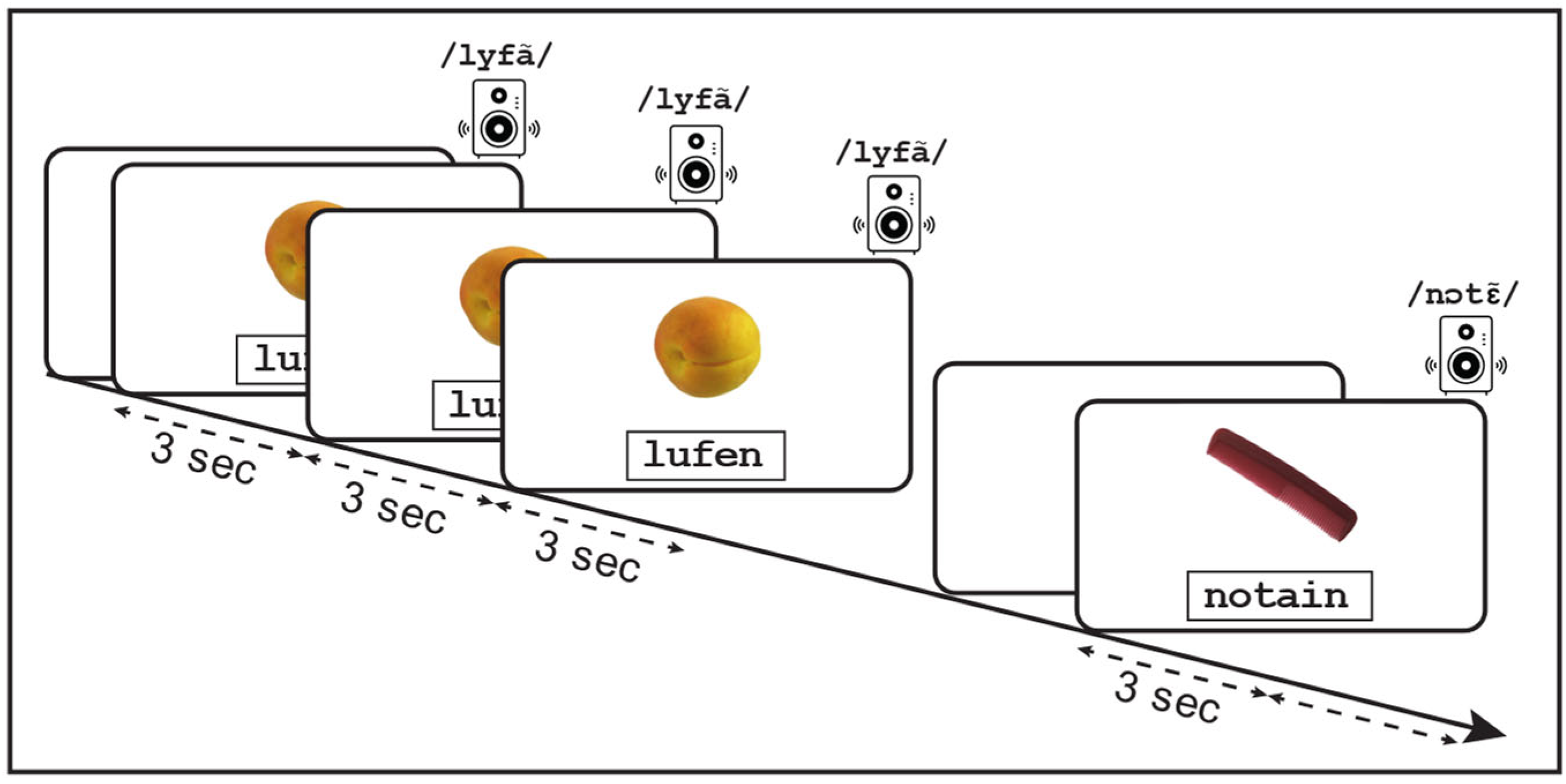
- To analyze learning progression—from the encoding of the orthographic representation to its retrieval in long-term memory after one week—by combining changes in spelling accuracy and eye-movement measures across repeated exposures.
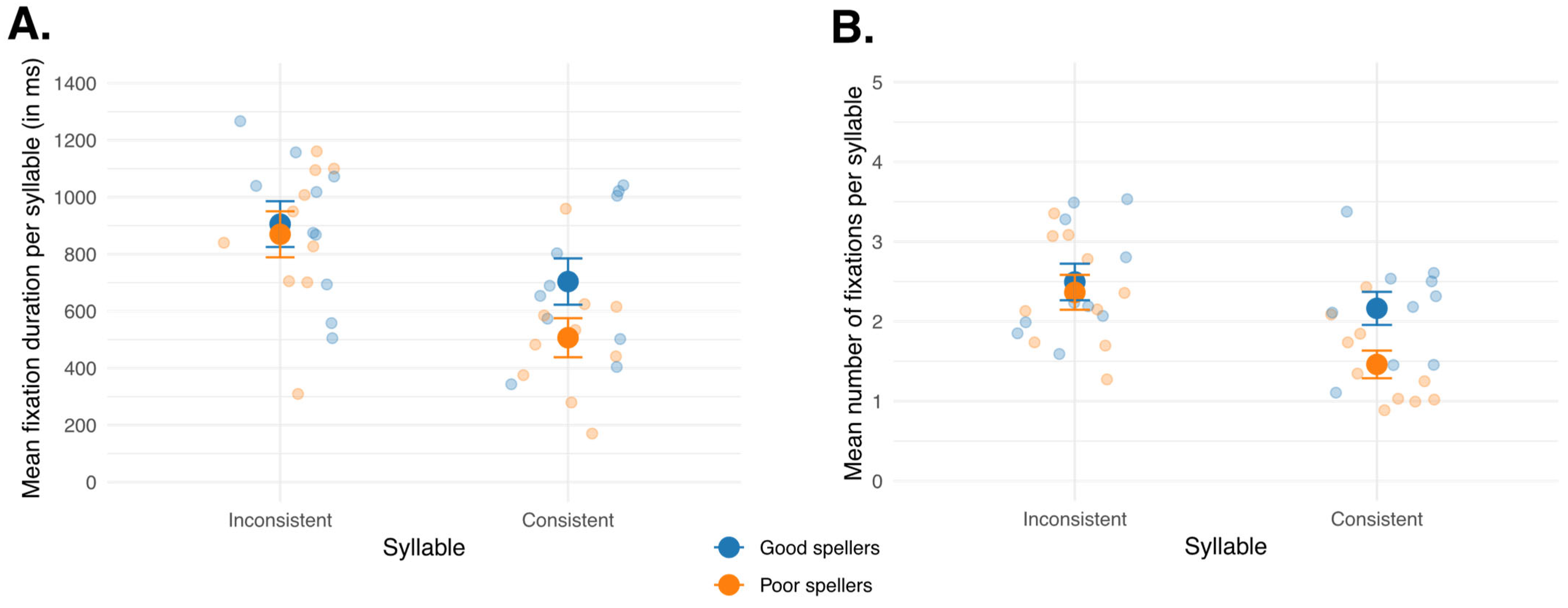
- To examine the influence of inconsistencies on visual exploration of non-words during encoding process.
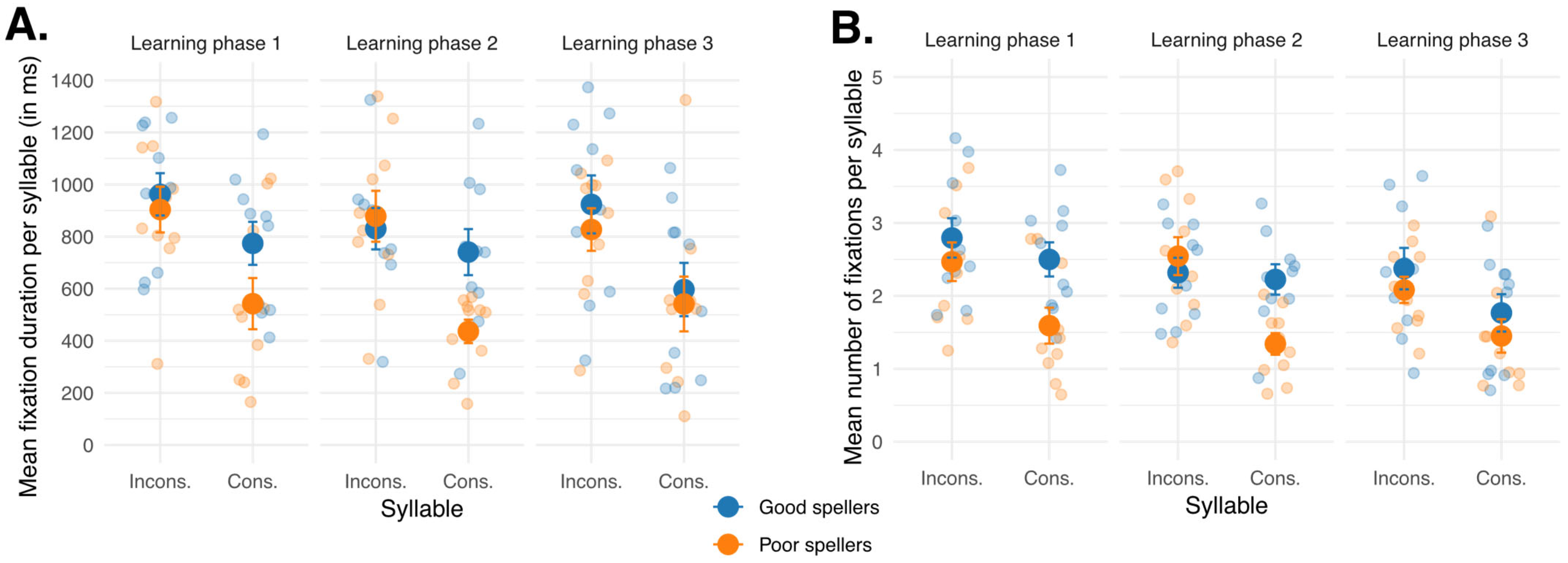
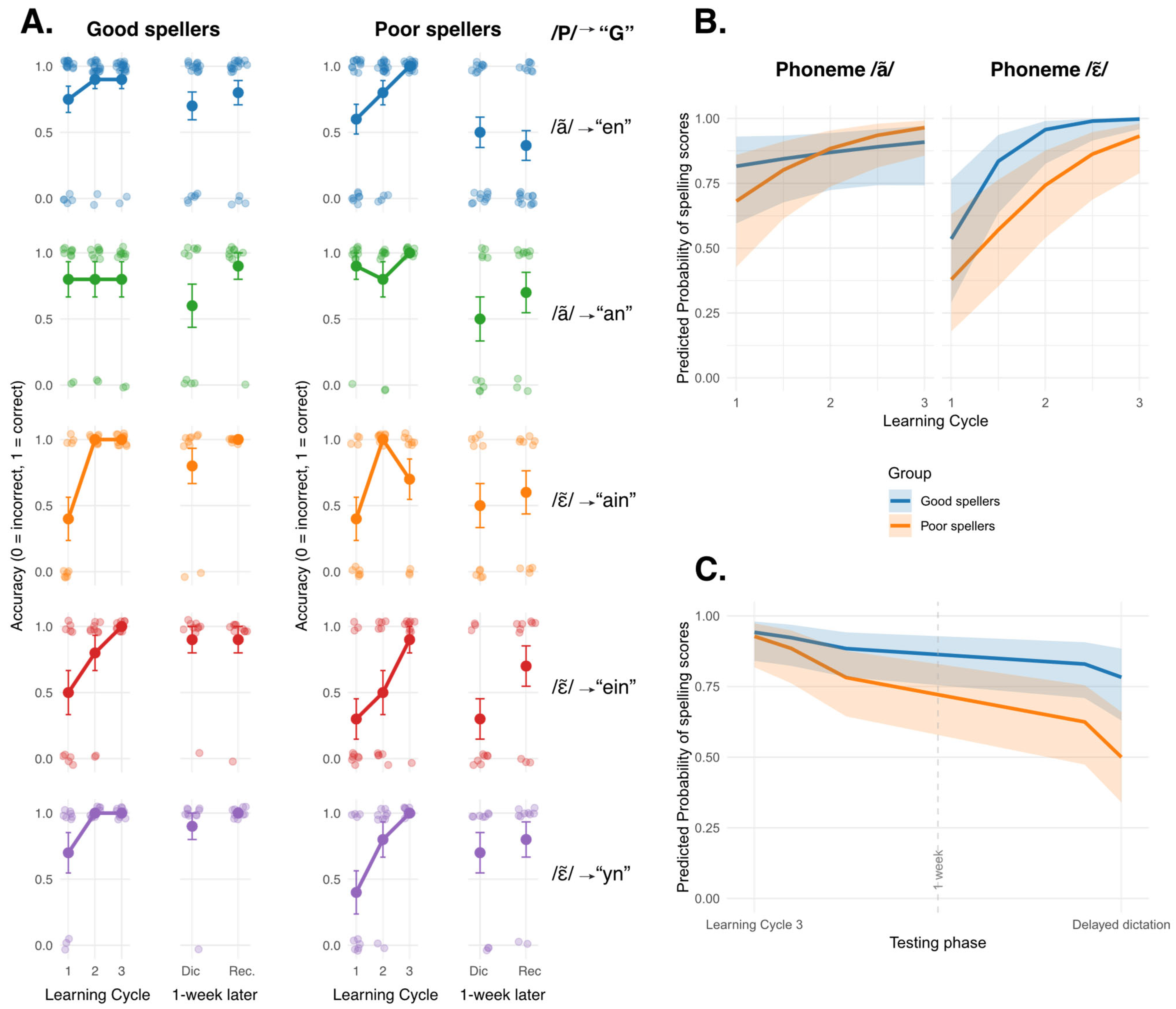
- Across learning cycles, both groups were expected to learn the spelling of non-words. However, poor spellers were predicted to obtain lower dictation scores in the first learning cycle and to reach the performance of their peers by the final exposure (Binamé et al., 2015; Mehlhase et al., 2019). Both groups were also expected to show a decrease in fixation durations and number of fixations across exposures, reflecting progressive orthographic learning (Joseph & Nation, 2018; van Viersen et al., 2022). For long-term retrieval, good spellers were anticipated to show a slight decrease in their performance after a one-week delay, as typically observed, whereas poor spellers were expected to exhibit a larger decline (Binamé et al., 2015; Mehlhase et al., 2019).
- During the visual exploration of non-words, both groups were predicted to fixate more often and for longer durations on the inconsistency in order to learn the spelling (Ginestet et al., 2022). Since inconsistencies represent a challenge in spelling, they might require multiple fixations before orthographic representations become well-specified.
2. Methods
2.1. Participants
2.2. Stimuli of the Orthographic Learning Task
2.3. Procedure
2.4. Apparatus
2.5. Analyses
2.5.1. Eye-Movement Data Cleaning
2.5.2. Data Scoring and Preprocessing
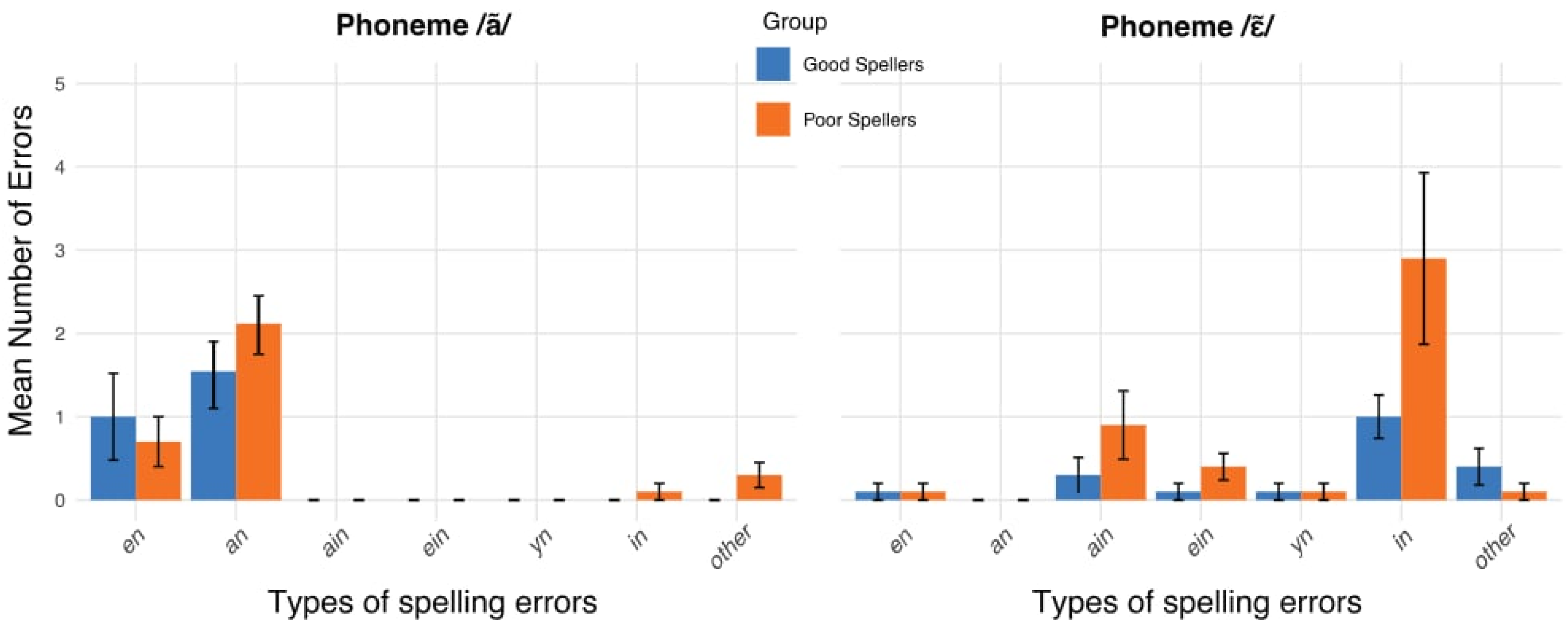
- “in” or “an” produced instead of “en”; and
- “en” produced instead of “an”.
- “in”, “ein”, or “yn” for the grapheme “ain”;
- “in”, “en”, “ain”, or “yn” for the grapheme “ein”; and
- “in”, “ein”, or “ain” for the grapheme “yn”.
2.5.3. Statistical Analyses
3. Results
3.1. Behavioral Results
3.1.1. Spelling Accuracy Results
3.1.2. Results of Spelling Error Analysis
3.2. Eye-Tracking Results
3.2.1. Mean Fixation Duration per Syllable
3.2.2. Mean Number of Fixations per Syllable
4. Discussion
4.1. Orthographic Learning Progression Reflected in Spelling Accuracy, Spelling Errors, and Eye Movements
4.1.1. Orthographic Learning Progression Based on Spelling Accuracy
4.1.2. Impact of Phonemes-to-Graphemes Correspondences’ Characteristics on Orthographic Learning and Spelling Errors
4.1.3. Contribution of Eye Movements to Orthographic Learning Progression
4.2. Influence of Inconsistencies on Visual Exploration Patterns During Encoding
4.3. Extension of the Findings to Children with Dyslexia-Dysorthographia
4.4. Practical Implications
4.5. Limitations and Future Research
5. Conclusions
Author Contributions
Funding
Institutional Review Board Statement
Informed Consent Statement
Data Availability Statement
Acknowledgments
Conflicts of Interest
Abbreviations
| ADHD | Attention deficit hyperactivity disorder |
| AIC | Akaike’s Information Criterion |
| BALE | Batterie Analytique du Langage Écrit (Analytical test battery of written language) |
| BOSS | Bank of Standardized Stimuli |
| DD | Dyslexia-dysorthographia (stands for Dyslexia in French) |
| IMP model | Integration of Multiple Patterns model |
| GLMM | Generalized Linear Mixed Model |
| LMM | Linear Mixed-effects Model |
| P-G correspondences/mappings | Phonemes-to-graphemes correspondences/mappings |
Appendix A

| Predictors | Odds Ratios | CI | p |
|---|---|---|---|
| Intercept | 2.95 | 0.59–14.81 | 0.188 |
| Group [poor] | 0.20 | 0.02–1.89 | 0.161 |
| Learning phase | 1.50 | 0.73–3.08 | 0.268 |
| Phoneme // | 0.02 | 0.00–0.26 | 0.003 |
| Group [poor] × Learning phase | 2.38 | 0.79–7.16 | 0.123 |
| Group [poor] × Phoneme // | 10.69 | 0.43–262.61 | 0.147 |
| Learning phase × Phoneme // | 12.89 | 2.35–70.76 | 0.003 |
| Group [poor] × Learning phase × Phoneme // | 0.10 | 0.01–0.78 | 0.027 |
| Random Effects | |||
| σ2 | 3.29 | ||
| τ00 (Participant) | 0.93 | ||
| τ00 (Non-word) | 0.09 | ||
| ICC | 0.24 | ||
| NParticipant | 20 | ||
| NNon-word | 6 | ||
| Observations | 360 | ||
| Marginal R2/Conditional R2 | 0.385/0.530 |
| Predictors | Odds Ratios | CI | p |
|---|---|---|---|
| Intercept | 1472.34 | 16.44–131,887.26 | 0.001 |
| Group [poor] | 18.39 | 0.04–7807.07 | 0.346 |
| Testing phase | 0.22 | 0.07–0.73 | 0.013 |
| Group [poor] × Testing phase | 0.35 | 0.07–1.74 | 0.200 |
| Random Effects | |||
| σ2 | 3.29 | ||
| τ00 (Participant) | 0.30 | ||
| τ00 (Non-word) | 0.07 | ||
| ICC | 0.10 | ||
| NParticipant | 20 | ||
| NNon-word | 6 | ||
| Observations | 240 | ||
| Marginal R2/Conditional R2 | 0.254/0.330 |
| Predictors | Odds Ratios | CI | p |
|---|---|---|---|
| Intercept | 5.00 | 2.08–14.81 | 0.001 |
| Group [poor] | 0.20 | 0.06–0.63 | 0.008 |
| Phoneme // | 5.80 | 0.86–115.10 | 0.119 |
| Group [poor] × Phoneme // | 0.40 | 0.02–3.67 | 0.467 |
| Observations | 120 | ||
| R2 Tjur | 0.159 |
| Predictors | Estimates | CI | p |
|---|---|---|---|
| Intercept | 954.76 | 797.29–1112.22 | <0.001 |
| Group [poor] | −35.80 | −233.94–162.34 | 0.723 |
| Syllable [consistent] | −201.66 | −283.51–−119.81 | <0.001 |
| Learning phase 2 | −74.44 | −145.32–−3.55 | 0.040 |
| Learning phase 3 | −73.47 | −144.35–−2.58 | 0.042 |
| Group [poor] × Syllable [consistent] | −161.29 | −277.04–−45.54 | 0.006 |
| Random Effects | |||
| σ2 | 156,426.36 | ||
| τ00 (Participant) | 42,235.91 | ||
| τ00 (Non-word) | 5432.33 | ||
| ICC | 0.23 | ||
| NParticipant | 20 | ||
| NNon-word | 6 | ||
| Observations | 720 | ||
| Marginal R2/Conditional R2 | 0.114/0.321 |
| Predictors | Estimates | CI | p |
|---|---|---|---|
| Intercept | 2.71 | 2.29–3.14 | <0.001 |
| Group [poor] | −0.13 | −0.67–0.41 | 0.634 |
| Syllable [consistent] | −0.33 | −0.54–−0.12 | 0.002 |
| Learning phase 2 | −0.23 | −0.42–−0.05 | 0.014 |
| Learning phase 3 | −0.42 | −0.61–−0.24 | <0.001 |
| Group [poor] × Syllable [consistent] | −0.57 | −0.88–−0.27 | <0.001 |
| Random Effects | |||
| σ2 | 1.07 | ||
| τ00 (Participant) | 0.31 | ||
| τ00 (Non-word) | 0.04 | ||
| ICC | 0.25 | ||
| NParticipant | 20 | ||
| NNon-word | 6 | ||
| Observations | 720 | ||
| Marginal R2/Conditional R2 | 0.117/0.338 |

References
- Apel, K. (2011). What is orthographic knowledge? Language, Speech, and Hearing Services in Schools, 42(4), 592–603. [Google Scholar] [CrossRef]
- Apel, K., Henbest, V. S., & Masterson, J. (2019). Orthographic knowledge: Clarifications, challenges, and future directions. Reading and Writing, 32(4), 873–889. [Google Scholar] [CrossRef]
- Bates, D., Maechler, M., Bolker, B., & Walker, S. (2015). Fitting linear mixed-effects models using lme4. Journal of Statistical Software, 67(1), 1–48. [Google Scholar] [CrossRef]
- Binamé, F., Danzio, S., & Poncelet, M. (2015). Relative ease in creating detailed orthographic representations contrasted with severe difficulties to maintain them in long-term memory among dyslexic children. Dyslexia, 21(4), 361–370. [Google Scholar] [CrossRef]
- Binamé, F., & Poncelet, M. (2016). The development of the abilities to acquire novel detailed orthographic representations and maintain them in long-term memory. Journal of Experimental Child Psychology, 143, 14–33. [Google Scholar] [CrossRef]
- Bodard, J., Jost, C., Uzan, G., & Truck, I. (2023). Spelling errors made by people with dyslexia. Language Resources and Evaluation, 57(1), 293–322. [Google Scholar] [CrossRef]
- Bosman, A. M. T., & Van Orden, G. C. (1997). Why spelling is more difficult than reading. In C. A. Perfetti, L. Rieben, & M. Fayol (Eds.), Learning to spell: Research, theory, and practice across languages (pp. 173–194). Lawrence Erlbaum Associates. [Google Scholar]
- Bosse, M. L., Chaves, N., Largy, P., & Valdois, S. (2015). Orthographic learning during reading: The role of whole-word visual processing. Journal of Research in Reading, 38(2), 141–158. [Google Scholar] [CrossRef]
- Brodeur, M. B., Guérard, K., & Bouras, M. (2014). Bank of Standardized Stimuli (BOSS) phase II: 930 new normative photos. PLoS ONE, 9(9), e106953. [Google Scholar] [CrossRef]
- Buchwald, A., & Rapp, B. (2009). Distinctions between orthographic long-term memory and working memory. Cognitive Neuropsychology, 26(8), 724–751. [Google Scholar] [CrossRef]
- Caravolas, M. (2004). Spelling development in alphabetic writing systems: A cross-linguistic perspective. European Psychologist, 9(1), 3–14. [Google Scholar] [CrossRef]
- Carroll, J. M., Holden, C., Kirby, P., Thompson, P. A., Snowling, M. J., & the Dyslexia Delphi Panel. (2025). Toward a consensus on dyslexia: Findings from a Delphi study. Journal of Child Psychology and Psychiatry, 66(7), 1065–1076. [Google Scholar] [CrossRef]
- Carter, B. T., & Luke, S. G. (2020). Best practices in eye tracking research. International Journal of Psychophysiology, 155, 49–62. [Google Scholar] [CrossRef]
- Casalis, S., & Colé, P. (2018). Le morphème, une unité de traitement dans l’acquisition de la litéracie. Langue Française, 3(199), 69–81. [Google Scholar] [CrossRef]
- Castles, A., & Nation, K. (2006). How does orthographic learning happen? In S. Andrews (Ed.), From inkmarks to ideas (pp. 151–179). Psychology Press. [Google Scholar]
- Castles, A., Rastle, K., & Nation, K. (2018). Ending the reading wars: Reading acquisition from novice to expert. Psychological Science in the Public Interest, 19(1), 5–51, (Erratum in 2018, Psychological Science in the Public Interest, 19(2), 93). [Google Scholar] [CrossRef]
- Catach, N. (2014). L’orthographe française: Traité théorique et pratique avec des travaux d’application et leurs corrigés (3rd ed.). Armand Colin. [Google Scholar]
- Chaves, N., Ginestet, E., & Bosse, M.-L. (2020). Lexical orthographic knowledge acquisition in adults: The whole-word visual processing impact. European Review of Applied Psychology, 70(1), 100520. [Google Scholar] [CrossRef]
- Conrad, N. J., Kennedy, K., Saoud, W., Scallion, L., & Hanusiak, L. (2018). Establishing word representations through reading and spelling: Comparing degree of orthographic learning. Journal of Research in Reading, 42(1), 162–177. [Google Scholar] [CrossRef]
- Daigle, D., Berthiaume, R., Costerg, A., Plisson, A., Ruberto, N., & Varin, J. (2020). Do all roads really lead to Rome? The case of spelling acquisition. Reading and Writing, 33(2), 313–328. [Google Scholar] [CrossRef]
- Daigle, D., Costerg, A., Plisson, A., Ruberto, N., & Varin, J. (2016). Spelling errors in French-speaking children with Dyslexia: Phonology may not provide the best evidence. Dyslexia, 22(2), 137–157. [Google Scholar] [CrossRef]
- Dutemple, M. (2023). Facteurs linguistiques favorisant l’acquisition des phonèmes multigraphémiques chez les élèves québécois bons et faibles orthographieurs de la troisième année du primaire: Le cas du phonème multigraphémique [Doctoral thesis, Université du Québec en Outaouais]. Available online: https://archipel.uqam.ca/17786/ (accessed on 26 October 2025).
- Ehri, L. C. (2014). Orthographic mapping in the acquisition of sight word reading, spelling memory, and vocabulary learning. Scientific Studies of Reading, 18(1), 5–21. [Google Scholar] [CrossRef]
- Eskenazi, M. A. (2024). Best practices for cleaning eye movement data in reading research. Behavior Research Methods, 56(3), 2083–2093. [Google Scholar] [CrossRef]
- Eustache, F., Viard, A., & Desgranges, B. (2016). The MNESIS model: Memory systems and processes, identity and future thinking. Neuropsychologia, 87, 96–109. [Google Scholar] [CrossRef]
- Fayol, M. (2009). L’orthographe et son apprentissage. In G. Chapelle, & M. Crahay (Eds.), Réussir à apprendre (pp. 127–139). Presses Universitaires de France. [Google Scholar] [CrossRef]
- Fayol, M., & Jaffré, J.-P. (2008). Orthographier. Presses Universitaires de France. [Google Scholar]
- Fayol, M., & Jaffré, J.-P. (2024). Chapitre III. Apprendre et utiliser l’orthographe lexicale. In M. Fayol, & J.-P. Jaffré (Eds.), L’Orthographe (pp. 54–90). Presses Universitaires de France. [Google Scholar]
- Fox, J. (2003). Effect Displays in R for Generalised Linear Models. Journal of Statistical Software, 8(15), 1–27. [Google Scholar] [CrossRef]
- Fox, J., & Weisberg, S. (2019). An R companion to applied regression (3rd ed.). Sage. Available online: https://www.john-fox.ca/Companion/index.html (accessed on 31 October 2025).
- Ginestet, E., Valdois, S., & Diard, J. (2022). Probabilistic modeling of orthographic learning based on visuo-attentional dynamics. Psychonomic Bulletin & Review, 29(5), 1649–1672. [Google Scholar] [CrossRef]
- Ginestet, E., Valdois, S., Diard, J., & Bosse, M.-L. (2020a). Comprendre l’apprentissage orthographique et ses difficultés: Apports et critiques des dernières modélisations computationnelles. ANAE—Approche Neuropsychologique des Apprentissages Chez L’enfant, 32(164), 87–96. [Google Scholar]
- Ginestet, E., Valdois, S., Diard, J., & Bosse, M.-L. (2020b). Orthographic learning of novel words in adults: Effects of exposure and visual attention on eye movements. Journal of Cognitive Psychology, 32(8), 785–804. [Google Scholar] [CrossRef]
- Guillery-Girard, B., Quinette, P., Piolino, P., Desgranges, B., & Eustache, F. (2008). Chapitre 20. Mémoire et fonctions exécutives. In F. Eustache, B. Lechevalier, & F. Viader (Eds.), Traité de neuropsychologie clinique (pp. 307–365). Éditions De Boeck Supérieur. [Google Scholar] [CrossRef]
- Hazard, M.-C., De Cara, B., Chanquoy, L., & Negro, I. (2020). Influence des caractéristiques de consistance orthographique et fréquence lexicale sur la nature des « fautes » d’orthographe en français: Profils développementaux du CE1 à la troisième. Psychologie Française, 65(3), 225–241. [Google Scholar] [CrossRef]
- Jacquier-Roux, M., Lequette, C., Pouget, G., Valdois, S., & Zorman, M. (2010). BALE—Batterie analytique du langage écrit. Laboratoire des Sciences de l’Éducation Groupe Cogni-sciences et Laboratoire de Psychologie et NeuroCognition. Available online: https://www1.ac-grenoble.fr/media/14951/download (accessed on 20 October 2025).
- JASP Team. (2024). JASP (version 0.19.1) [computer software]. University of Amsterdam. Available online: https://jasp-stats.org/ (accessed on 20 October 2025).
- Joseph, H., & Nation, K. (2018). Examining incidental word learning during reading in children: The role of context. Journal of Experimental Child Psychology, 166, 190–211. [Google Scholar] [CrossRef]
- Joseph, H., Nation, K., & Liversedge, S. P. (2013). Using eye movements to investigate word frequency effects in children’s sentence reading. School Psychology Review, 42(2), 207–222. [Google Scholar] [CrossRef]
- Joseph, H., Wonnacott, E., Forbes, P., & Nation, K. (2014). Becoming a written word: Eye movements reveal order of acquisition effects following incidental exposure to new words during silent reading. Cognition, 133(1), 238–248. [Google Scholar] [CrossRef]
- Kessler, B., Pollo, T. C., Treiman, R., & Cardoso-Martins, C. (2013). Frequency analyses of prephonological spellings as predictors of success in conventional spelling. Journal of Learning Disabilities, 46(3), 252–259. [Google Scholar] [CrossRef]
- Klimovich, M., & Richter, T. (2025). Spelling acquisition in children through interleaved practice: The role of instructional guidance. Cognitive Research: Principles and Implications, 10(1), 68. [Google Scholar] [CrossRef]
- Kuznetsova, A., Brockhoff, P. B., & Christensen, R. H. (2017). lmerTest package: Tests in linear mixed effects models. Journal of Statistical Software, 82(13), 1–26. [Google Scholar] [CrossRef]
- Lai, M.-L., Tsai, M.-J., Yang, F.-Y., Hsu, C.-Y., Liu, T.-C., Lee, S. W.-Y., Lee, M.-H., Chiou, G.-L., Liang, J.-C., & Tsai, C.-C. (2013). A review of using eye-tracking technology in exploring learning from 2000 to 2012. Educational Research Review, 10, 90–115. [Google Scholar] [CrossRef]
- Lenth, R., & Piaskowski, J. (2025). emmeans: Estimated marginal means, aka least-squares means. R package version 2.0.0. Available online: https://CRAN.R-project.org/package=emmeans (accessed on 31 October 2025).
- Lété, B., Peereman, R., & Fayol, M. (2008). Consistency and word-frequency effects on spelling among first- to fifth-grade French children: A regression-based study. Journal of Memory and Language, 58(4), 952–977. [Google Scholar] [CrossRef]
- Li, Y., & Wang, M. (2023). A systematic review of orthographic learning via self-teaching. Educational Psychologist, 58(1), 35–56. [Google Scholar] [CrossRef]
- Lüdecke, D. (2024). sjPlot: Data visualization for statistics in social science. R package version 2.8.17. Available online: https://CRAN.R-project.org/package=sjPlot (accessed on 31 October 2025).
- Manesse, D., & Cogis, D. (2007). Orthographe: à qui la faute? ESF éditeur. [Google Scholar]
- Marinelli, C. V., Zoccolotti, P., & Romani, C. (2020). The ability to learn new written words is modulated by language orthographic consistency. PLoS ONE, 15(2), e0228129. [Google Scholar] [CrossRef]
- Maughan, B., Messer, J., Collishaw, S., Pickles, A., Snowling, M., Yule, W., & Rutter, M. (2009). Persistence of literacy problems: Spelling in adolescence and at mid-life. Journal of Child Psychology and Psychiatry, 50(8), 893–901. [Google Scholar] [CrossRef]
- Maughan, B., Rutter, M., & Yule, W. (2020). The Isle of wight studies: The scope and scale of reading difficulties. Oxford Review of Education, 46(4), 429–438. [Google Scholar] [CrossRef]
- McGrath, L. M., Pennington, B. F., Shanahan, M. A., Santerre-Lemmon, L. E., Barnard, H. D., Willcutt, E. G., Defries, J. C., & Olson, R. K. (2011). A multiple deficit model of reading disability and attention-deficit/hyperactivity disorder: Searching for shared cognitive deficits. Journal of Child Psychology and Psychiatry, 52(5), 547–557. [Google Scholar] [CrossRef]
- Mehlhase, H., Bakos, S., Landerl, K., Schulte-Körne, G., & Moll, K. (2019). Orthographic learning in children with isolated and combined reading and spelling deficits. Child Neuropsychology, 25(3), 370–393. [Google Scholar] [CrossRef]
- Nation, K., Angell, P., & Castles, A. (2007). Orthographic learning via self-teaching in children learning to read English: Effects of exposure, durability, and context. Journal of Experimental Child Psychology, 96(1), 71–84. [Google Scholar] [CrossRef]
- Nation, K., & Castles, A. (2017). Putting the learning into orthographic learning. In K. Cain, D. L. Compton, & R. K. Parrila (Eds.), Theories of reading development (pp. 147–168). John Benjamins Publishing Company. [Google Scholar] [CrossRef]
- Ouellette, G. (2010). Orthographic learning in learning to spell: The roles of semantics and type of practice. Journal of Experimental Child Psychology, 107(1), 50–58. [Google Scholar] [CrossRef]
- Pacton, S., & Afonso-Jaco, A. (2015). Comment les enfants apprennent-ils l’orthographe des mots? Revue Francaise de Linguistique Appliquee, XX(2), 51–61. [Google Scholar] [CrossRef]
- Pacton, S., Fayol, M., & Perruchet, P. (2005). Children’s Implicit Learning of Graphotactic and Morphological Regularities. Child Development, 76(2), 324–339. [Google Scholar] [CrossRef]
- Pacton, S., Perruchet, P., Fayol, M., & Cleeremans, A. (2001). Implicit learning out of the lab: The case of orthographic regularities. Journal of Experimental Psychology: General, 130(3), 401–426. [Google Scholar] [CrossRef]
- Pacton, S., Sobaco, A., Fayol, M., & Treiman, R. (2013). How does graphotactic knowledge influence children’s learning of new spellings? Frontiers in Psychology, 4, 701. [Google Scholar] [CrossRef]
- Peereman, R., Lété, B., & Sprenger-Charolles, L. (2007). Manulex-infra: Distributional characteristics of grapheme-phoneme mappings, and infralexical and lexical units in child-directed written material. Behavior Research Methods, 39(3), 579–589. [Google Scholar] [CrossRef]
- Perfetti, C. A. (1992). The representation problem in reading acquisition. In P. Gough, L. Ehri, & R. Treiman (Eds.), Reading acquisition (pp. 145–174). Lawrence Erlbaum. [Google Scholar]
- Perfetti, C. A. (1997). The psycholinguistics of spelling and reading. In C. A. Perfetti, L. Rieben, & M. Fayol (Eds.), Learning to spell: Research, theory, and practice across languages (pp. 21–38). Lawrence Erlbaum Associates. [Google Scholar]
- Peterson, R. L., & Pennington, B. F. (2015). Developmental dyslexia. Annual Review of Clinical Psychology, 11, 283–307. [Google Scholar] [CrossRef]
- Plisson, A., Daigle, D., & Montésinos-Gelet, I. (2013). The spelling skills of French-speaking dyslexic children. Dyslexia, 19(2), 76–91. [Google Scholar] [CrossRef]
- Poncelet, M., Schyns, T., & Majerus, S. (2003). Further evidence for persisting difficulties in orthographic learning in highly educated adults with a history of developmental dyslexia. Brain and Language, 87(1), 145–146. [Google Scholar] [CrossRef]
- Pugh, K., & Verhoeven, L. (2018). Introduction to this special issue: Dyslexia across languages and writing systems. Scientific Studies of Reading, 22(1), 1–6. [Google Scholar] [CrossRef]
- Quémart, P., & Casalis, S. (2017). Morphology and spelling in French students with dyslexia: The case of silent final letters. Annals of Dyslexia, 67(1), 85–98. [Google Scholar] [CrossRef] [PubMed]
- Radvansky, G. A., Doolen, A. C., Pettijohn, K. A., & Ritchey, M. (2022). A new look at memory retention and forgetting. Journal of Experimental Psychology: Learning, Memory, and Cognition, 48(11), 1698–1723. [Google Scholar] [CrossRef]
- Rapp, B., Purcell, J., Hillis, A. E., Capasso, R., & Miceli, G. (2016). Neural bases of orthographic long-term memory and working memory in dysgraphia. Brain, 139(2), 588–604. [Google Scholar] [CrossRef]
- Rayner, K. (2009). Eye movements and attention in reading, scene perception, and visual search. The Quarterly Journal of Experimental Psychology, 62(8), 1457–1506. [Google Scholar] [CrossRef]
- R Core Team. (2023). R: A language and environment for statistical computing (version 4.3.2) [computer software]. R Foundation for Statistical Computing. Available online: https://www.R-project.org/ (accessed on 9 October 2025).
- Ricketts, J., Bishop, D. V., & Nation, K. (2009). Orthographic facilitation in oral vocabulary acquisition. Quarterly Journal of Experimental Psychology, 62(10), 1948–1966. [Google Scholar] [CrossRef]
- Ruberto, N., Daigle, D., Ammar, A., & Beaulieu, J. (2025). Effet de l’enseignement de l’orthographe et de l’enseignement du sens des mots sur l’apprentissage des phonèmes multigraphémiques et des lettres muettes par des élèves de 7–8 ans. Canadian Journal of Applied Linguistics, 27(3), 52–79. [Google Scholar] [CrossRef]
- Schroeder, S., Hyönä, J., & Liversedge, S. P. (2015). Developmental eye-tracking research in reading: Introduction to the special issue. Journal of Cognitive Psychology, 27(5), 500–510. [Google Scholar] [CrossRef]
- Semel, E., Wiig, E. H., & Secord, W. A. (2009). Évaluation clinique des notions langagières fondamentales—Version pour francophones du Canada (CELF CDN-F) (L. Boulianne, & M. Labelle, Trans.). Pearson Canada Assessment. [Google Scholar]
- Seymour, P. H. K., Aro, M., & Erskine, J. M. (2003). Foundation literacy acquisition in European orthographies. British Journal of Psychology, 94(2), 143–174. [Google Scholar] [CrossRef]
- Sénéchal, M. (2000). Morphological effects in children’s spelling of French words. Canadian Journal of Experimental Psychology/Revue Canadienne de Psychologie Expérimentale, 54(2), 76–86. [Google Scholar] [CrossRef] [PubMed]
- Share, D. L. (1995). Phonological recoding and self-teaching: Sine qua non of reading acquisition. Cognition, 55(2), 151–218. [Google Scholar] [CrossRef]
- Snowling, M. J., Hulme, C., & Nation, K. (2020). Defining and understanding dyslexia: Past, present and future. Oxford Review of Education, 46(4), 501–513. [Google Scholar] [CrossRef]
- Sprenger-Charolles, L., Siegel, L. S., Béchennec, D., & Serniclaes, W. (2003). Development of phonological and orthographic processing in reading aloud, in silent reading, and in spelling: A four-year longitudinal study. Journal of Experimental Child Psychology, 84(3), 194–217. [Google Scholar] [CrossRef]
- SR Research Ltd. (2020a). Data Viewer (version 4.1.211) [computer software]. SR Research Ltd. Available online: https://www.sr-research.com/data-viewer/ (accessed on 16 April 2025).
- SR Research Ltd. (2020b). Experiment Builder (version 2.3.38) [computer software]. SR Research Ltd. Available online: https://www.sr-research.com/experiment-builder/ (accessed on 17 June 2021).
- Stanké, B. (2016). La dyslexie-dysorthographie mnésique. In B. Stanké (Ed.), Les dyslexies-dysorthographies (pp. 145–174). Presses de l’Université du Québec. [Google Scholar]
- Torchiano, M. (2020). effsize: Efficient effect size computation. R package version 0.8.1. Available online: https://cran.r-project.org/web/packages/effsize/citation.html (accessed on 31 October 2025). [CrossRef]
- Treiman, R. (2017). Learning to spell words: Findings, theories, and issues. Scientific Studies of Reading, 21(4), 265–276. [Google Scholar] [CrossRef]
- Treiman, R., Hulslander, J., Willcutt, E. G., Pennington, B. F., & Olson, R. K. (2025). On the relationship between word reading ability and spelling ability. Reading and Writing, 38(6), 1509–1531. [Google Scholar] [CrossRef] [PubMed]
- Treiman, R., & Kessler, B. (2014). Theories. In How children learn to write words (pp. 84–103). Oxford University Press. [Google Scholar]
- Treiman, R., & Kessler, B. (2022). Statistical learning in word reading and spelling across languages and writing systems. Scientific Studies of Reading, 26(2), 139–149. [Google Scholar] [CrossRef]
- Treiman, R., & Kessler, B. (2025). Statistical learning in spelling and reading. Trends in Cognitive Sciences, 29(12), 1136–1145. [Google Scholar] [CrossRef]
- Valdois, S., Guinet, E., & Embs, J.-L. (2017a). EVADYS—Évaluation de l’empan visuo-attentionnel en contexte dyslexique [logiciel]. HappyNeuron. Available online: https://www.happyneuronpro.com/orthophonie/espace-evaluation/evadys/ (accessed on 28 June 2022).
- Valdois, S., Partz, M.-P., & Seron, X. (2017b). Mon orthographe illustrée. Larousse. [Google Scholar]
- van Viersen, S., Protopapas, A., Georgiou, G. K., Parrila, R., Ziaka, L., & de Jong, P. F. (2022). Lexicality effects on orthographic learning in beginning and advanced readers of Dutch: An eye-tracking study. Quarterly Journal of Experimental Psychology, 75(6), 1135–1154. [Google Scholar] [CrossRef] [PubMed]
- Véronis, J. (1988). From sound to spelling in French: Simulation on a computer. European Bulletin of Cognitive Psychology, 8(4), 315–334. [Google Scholar]
- Wang, H.-C., Castles, A., Nickels, L., & Nation, K. (2011). Context effects on orthographic learning of regular and irregular words. Journal of Experimental Child Psychology, 109(1), 39–57. [Google Scholar] [CrossRef]
- Wang, H.-C., Nickels, L., Nation, K., & Castles, A. (2013). Predictors of orthographic learning of regular and irregular words. Scientific Studies of Reading, 17(5), 369–384. [Google Scholar] [CrossRef]
- Wickham, H. (2016). ggplot2: Elegant graphics for data analysis. Springer. [Google Scholar]
- Ziegler, J. C. (2018). Différences inter-linguistiques dans l’apprentissage de la lecture. Langue Française, 3(199), 35–49. [Google Scholar] [CrossRef]
- Ziegler, J. C., Jacobs, A. M., & Stone, G. O. (1996). Statistical analysis of the bidirectional inconsistency of spelling and sound in French. Behavior Research Methods, Instruments & Computers, 28(4), 504–515. [Google Scholar] [CrossRef]



| Good Spellers | Poor Spellers | t-Value | Cohen’s d | |||
|---|---|---|---|---|---|---|
| Age (months) | 133.1 (11.18) | 125.3 (12.58) | 1.466 | 0.66 | ||
| School grade | 3rd grade: 1 | 3rd grade: 4 | --- | --- | ||
| 4th grade: 2 | 4th grade: 1 | --- | --- | |||
| 5th grade: 4 | 5th grade: 4 | --- | --- | |||
| 6th grade: 3 | 6th grade: 1 | --- | --- | |||
| Gender | 4 M, 6 F | 2 M, 8 F | --- | --- | ||
| Spelling skills | Regular words (/10) | 9.6 (0.52) | 8.1 (1.29) | 3.421 | ** | 1.53 |
| (BALE) | Irregular words (/10) | 9.5 (0.85) | 4.4 (1.90) | 7.757 | *** | 3.47 |
| Non-words (/10) | 9.8 (0.42) | 9.4 (1.58) | 0.775 | 0.35 | ||
| Reading skills | Regular words (score) (/20) | 19.6 (0.70) | 17.6 (2.84) | 2.165 | * | 0.97 |
| (BALE) | Regular words (speed) (s) | 16.5 (4.36) | 28.6 (13.96) | −2.626 | * | −1.17 |
| Irregular words (score) (/20) | 17.6 (2.95) | 11.1 (5.97) | 3.086 | ** | 1.38 | |
| Irregular words (speed) (s) | 18.8 (7.00) | 34.5 (18.57) | −2.500 | * | −1.12 | |
| Non-words (score) (/20) | 18.0 (2.87) | 15.1 (3.90) | 1.894 | * | 0.85 | |
| Non-words (speed) (s) | 27.5 (6.82) | 36.8 (12.70) | −2.042 | * | −0.91 | |
| Phonological | Initial phoneme deletion (score) (/10) | 8.7 (2.06) | 8.8 (1.14) | −0.135 | −0.060 | |
| awareness (BALE) | Final phoneme deletion (score) (/10) | 7.6 (2.72) | 8.5 (1.43) | −0.927 | −0.414 | |
| Working memory | Forward digit span | 8.3 (1.64) | 6.8 (1.03) | 2.451 | * | 1.096 |
| (CELF CDN-F) | Backward Digit span | 5.2 (1.69) | 4.4 (0.84) | 1.342 | 0.600 | |
| Visual attention span | % of letters accurately reported | 79.1 (18.87) | 75.8 (9.85) | 0.490 | 0.219 | |
| (Evadys) |
| Phoneme | Non-Word | P-G Correspondence | Frequency | Regularity |
|---|---|---|---|---|
| /ã/ | “lufen” /lyfã/ “tenvo” /tãvo/ | /ã/ → “en” | 40,584.17 | 49.34 |
| “lanti” /lãti/ | /ã/ → “an” | 35,513.72 | 43.17 | |
| // | “notain” /nɔt/ | // → “ain” | 3733.79 | 16.75 |
| “ridein” /ʁid/ | // → “ein” | 655.12 | 2.94 | |
| “mulyn” /myl/ | // → “yn” | 5.12 | 0.02 |
Disclaimer/Publisher’s Note: The statements, opinions and data contained in all publications are solely those of the individual author(s) and contributor(s) and not of MDPI and/or the editor(s). MDPI and/or the editor(s) disclaim responsibility for any injury to people or property resulting from any ideas, methods, instructions or products referred to in the content. |
© 2025 by the authors. Licensee MDPI, Basel, Switzerland. This article is an open access article distributed under the terms and conditions of the Creative Commons Attribution (CC BY) license.
Share and Cite
Robidoux, J.; Rossier-Bisaillon, A.; Jemel, B.; Stanké, B. Orthographic Learning of Inconsistent Non-Words in Good and Poor Spellers: Linking Dictation and Eye-Tracking Measures. Behav. Sci. 2026, 16, 22. https://doi.org/10.3390/bs16010022
Robidoux J, Rossier-Bisaillon A, Jemel B, Stanké B. Orthographic Learning of Inconsistent Non-Words in Good and Poor Spellers: Linking Dictation and Eye-Tracking Measures. Behavioral Sciences. 2026; 16(1):22. https://doi.org/10.3390/bs16010022
Chicago/Turabian StyleRobidoux, Julie, Antonin Rossier-Bisaillon, Boutheina Jemel, and Brigitte Stanké. 2026. "Orthographic Learning of Inconsistent Non-Words in Good and Poor Spellers: Linking Dictation and Eye-Tracking Measures" Behavioral Sciences 16, no. 1: 22. https://doi.org/10.3390/bs16010022
APA StyleRobidoux, J., Rossier-Bisaillon, A., Jemel, B., & Stanké, B. (2026). Orthographic Learning of Inconsistent Non-Words in Good and Poor Spellers: Linking Dictation and Eye-Tracking Measures. Behavioral Sciences, 16(1), 22. https://doi.org/10.3390/bs16010022