


Abstract
Background/Objectives: Bipolar disorder (BD) is associated with physical health and functioning difficulties and social disadvantage. Evidence describing these domains together among Japanese web-based survey respondents reporting BD remains limited. We explored physical, mental health, and social characteristics associated with self-reported BD in Japanese web-based survey samples. Methods: We analyzed responses from 250 respondents with self-reported BD and 1776 respondents in a strictly screened comparison group recruited from separate surveys. We then compared physical, mental health, and social characteristics between groups and estimated adjusted odds ratios (AORs) with 95% confidence intervals (CIs) using multivariable logistic regression analyses. The Benjamini–Hochberg false discovery rate (FDR) procedure was applied across all evaluated characteristics. Results: In the fully adjusted analyses, sleep medication use showed the highest AOR, followed by depressive symptoms, functional capacity limitations, and poor self-rated health status. History of surgery, absence of happiness, and not being married remained associated after FDR correction. Conclusions: In this study, respondents with self-reported BD showed a broad range of physical, mental health, and social characteristics indicating poorer health, greater depressive and sleep-related burden, and social disadvantage compared with the strictly screened comparison group.
1. Introduction
Bipolar disorder (BD) is a chronic psychiatric disorder characterized by recurrent episodes of mania or hypomania and depression [1]. In 2019, approximately 40 million people were living with BD worldwide, with an age-standardized prevalence rate of 489.8 per 100,000 people [2]. The World Mental Health Survey Initiative, which included population-based surveys in the Americas, Europe, and Asia, reported lifetime prevalence rates of 0.6% for bipolar I disorder (BD-I) and 0.4% for bipolar II disorder (BD-II), with an overall prevalence of 2.4% for the broader bipolar spectrum [3]. The same study reported 12-month prevalence rates of 0.4% for BD-I and 0.3% for BD-II, with mean ages at onset of 18.4 and 20.0 years, respectively [3]. Another population-based cohort study identified two peaks in age of onset, at 15–24 years and 45–54 years [4]. Currently, the diagnosis of BD relies on comprehensive clinical assessment by healthcare professionals, as no validated biological markers are available for routine diagnostic use [1]. Diagnosing patients with BD often requires longitudinal assessment, supplemented by information such as mood diaries [1].
Previous studies have shown that people with BD often experience difficulties across multiple domains, including physical health, mental health, and social circumstances [5,6,7,8,9,10]. BD is associated with an increased risk of premature death due to both natural causes (e.g., cardiovascular disease, respiratory disease, and cancer) and unnatural causes, especially suicide [5,6,7]. Individuals with BD have been reported to have a shortened life expectancy compared with the general population, with approximately 13 years of potential life loss [5]. BD also has a significant negative impact on professional and social functioning, as cognitive impairments can hinder work productivity, affect earnings, and make it difficult to maintain employment [8,9,10].
BD has been linked to multiple biological, behavioral, and social processes that may contribute to physical health problems, mental health symptoms, sleep-related difficulties, and social impairments [11]. For instance, shared pathophysiological processes—such as hypothalamic–pituitary–adrenal (HPA) axis dysregulation, chronic low-grade inflammation, and genetic predispositions—may link mood instability to metabolic disorders and cardiovascular risks [1,12,13]. Furthermore, untreated psychological symptoms and social factors (e.g., social isolation, social stress, and employment status) interact in mutually reinforcing ways, creating a cycle that impedes functional recovery and overall health [14]. Recognizing this multifaceted impact is crucial, as effective management of BD requires a shift toward comprehensive care.
In Japan, previous studies have examined several aspects of BD-related burden [10,15,16]. Using a Japanese web-based survey, Kato et al. [10] reported poorer health-related quality of life and greater work and activity impairment among respondents reporting physician-diagnosed BD than among comparison respondents. Tokumitsu et al. [15] investigated clinical factors associated with alcohol dependence among psychiatric outpatients with BD, while Kishi et al. [16] examined body composition among Japanese patients with psychiatric disorders. Beyond those domain-specific designs, studies in other populations have assessed multiple health and social characteristics within the same study. For example, a UK Biobank study found that individuals classified as having probable BD reported poorer self-rated health, more current depressive symptoms, and greater socioeconomic disadvantage than those classified as having no mood disorder [17]. Another study used a web-based instrument to assess multiple quality-of-life domains, including physical health, mood, sleep, and social relationships, among individuals with BD [18]. Although these studies provide valuable insights into the multidimensional characteristics associated with BD, their study populations, measured characteristics, and research objectives differ from those of the present study.
To our knowledge, evidence remains limited regarding the combined descriptive assessment of individual physical health conditions, mental health and sleep-related characteristics, and social circumstances among individuals with self-reported BD in Japanese web-based survey data. The present study addresses this gap by examining characteristics across these domains using questionnaire items available in Japanese web-based surveys. This approach provides an exploratory overview of broader health and social challenges reported by individuals with self-reported BD without relying exclusively on psychiatric clinic-based samples. Based on the questionnaire and screening information available in the surveys, we used a strictly screened comparison group—those without self-reported mental disorder history or prior psychiatric treatment—as an operationally defined descriptive reference for describing differences in the selected health and social characteristics. This group was not intended to represent the general population. Therefore, this exploratory study aimed to examine physical, mental health, and social characteristics associated with self-reported BD by comparing participants with self-reported BD and this strictly screened comparison group in Japanese web-based surveys.
2. Materials and Methods
2.1. Study Design and Participants
This study utilized data from web-based surveys conducted by Rakuten Insight (Rakuten Insight, Inc., Tokyo, Japan), an internet research agency that manages large-scale online surveys in Japan, with approximately 2.2 million panelists in 2022 [19]. Participants were restricted to those aged 20 to 75 years. The study compared respondents with self-reported BD with a strictly screened comparison group without self-reported mental disorder history or prior psychiatric treatment.
For the strictly screened comparison group, we recruited 28,000 individuals from two established surveys—the Japan Society and New Tobacco Internet Survey (JASTIS) and the Japan COVID-19 and Society Internet Survey (JACSIS) [20,21,22,23]—in February 2022. Among the 6656 respondents who completed four preliminary screening questions—(1) “Are you currently experiencing any mental illness?”, (2) “Have you had a mental illness in the past?”, (3) “Have you ever experienced auditory hallucinations?”, and (4) “Have you ever used stimulants or other illegal drugs, struggled with alcoholism, or received psychiatric treatment?”—a total of 1776 individuals who answered “no” to all four questions were included in the study as participants without self-reported mental disorder history or prior psychiatric treatment. This group should be interpreted as a strictly screened comparison group, rather than as a general population control group.
For the group with self-reported BD, participants were recruited from the Rakuten Insight disease panel in March 2025. Two screening questions were employed as inclusion criteria: (1) “Please select any diseases from the following list that you have experienced in the past but have since recovered from,” and (2) “Please select any diseases from the following list that you are currently experiencing.” Respondents who reported BD (including mania or manic depression) in either or both of these two questions were eligible for inclusion. At recruitment, approximately 4200 registrants in this panel had self-reported BD. It is important to note that these diagnoses were based on participant self-reports and were not confirmed through psychiatric interviews or the Diagnostic and Statistical Manual of Mental Disorders (DSM) criteria. Furthermore, information regarding BD subtypes (e.g., BD-I or BD-II), illness duration, and current episode status was not available. Individuals who indicated struggle with alcoholism or substance dependence were excluded. Finally, 250 respondents who met the criteria were included in the study as participants with self-reported BD.
The differences in recruitment sources, survey periods, and screening procedures between the two groups may limit their comparability and should be considered when interpreting the findings. These methodological limitations are discussed further in the Section 5.
2.2. Study Variables
Using questionnaire items available in both survey sources, we selected measures that could broadly describe demographic and physical characteristics, mental health and sleep-related features, and social circumstances. The variables were chosen for an exploratory, descriptive comparison rather than as a comprehensive set of BD-specific predictors. The questionnaire did not permit equally detailed or validated measurement in every domain. Therefore, individual variables should be interpreted according to their operational definitions.
Demographic and physical characteristics included age, sex (male or female), body mass index (BMI) (overweight: ≥25.0 kg/m2, or not: <25.0 kg/m2), smoking status (current smoker or noncurrent smoker), alcohol drinking status (current drinker or noncurrent drinker), tendency to overeat (yes or no), breakfast frequency (<3 times per week or ≥3 times per week), eating out frequency (<3 times per week or ≥3 times per week), instant food consumption frequency (<3 times per week or ≥3 times per week), bowel movement (irregular: <3 times per week or ≥2 times per day, or normal), self-rated health status (SRHS) [24] (good or not good), sports participation (less than once per month: leisurely walking, brisk walking, light-to-moderate exercise, and vigorous exercise less than once per month, or more frequent), functional capacity limitations (present or absent), physical diseases currently under treatment, and history of surgery (yes or no). Currently treated physical diseases were assessed by asking participants whether they were currently receiving treatment for cancer, cardiovascular disease, hypercholesterolemia, diabetes, respiratory disease, or other diseases.
Mental health characteristics included depressive symptoms [25,26] (absent: CES-D score <8, or present: CES-D score ≥8), sleep duration (<10 h or ≥10 h), bedtime (not later than midnight or after midnight/irregular), sleep medication use (yes or no), insomnia frequency (<3 times per week or ≥3 times per week), nocturnal awakening frequency (<3 times per week or ≥3 times per week), poor sleep or morning fatigue frequency (<3 times per week or ≥3 times per week), ikigai [27,28,29] (a positive sense of purpose or meaning in life, absent or present), happiness (absent or present), Perceived Stress Scale (PSS-4) [30], and internet use duration. Sleep medication use was included in this domain as a sleep-related treatment characteristic reflecting pharmacological management or healthcare utilization for sleep problems. It was not considered a psychiatric diagnosis or comorbidity. Specific criteria for depressive symptoms, sleep duration, ikigai, perceived stress, and internet use duration were defined as follows.
- Depressive symptoms: We assessed depressive symptoms using a modified 11-item Center for Epidemiological Studies Depression (CES-D) [25,26]. The presence of depressive symptoms was defined as a score of 8 or higher.
- Sleep duration: We categorized “long sleep duration” as 10 h or more per day, corresponding to the maximum response option available in the survey instrument.
- Ikigai: A Japanese term referring to a positive sense of purpose or meaning in life [27,28,29]. Participants were asked, “Do you feel you have an ikigai (purpose or meaning) in life?” Participants who answered “no” or “not at all” were defined as the absence of ikigai.
- Perceived stress: We assessed perceived stress using a 4-item Perceived Stress Scale (PSS-4) [30]. Scores range from 0 to 16, with higher totals indicating more severe perceived stress. In the descriptive analysis, PSS-4 scores were summarized as continuous values. For multivariable logistic regression analyses, PSS-4 scores were dichotomized and used as an adjustment covariate. High perceived stress was defined as a PSS-4 score greater than 7, corresponding to the median PSS-4 score of the strictly screened comparison group.
- Internet use duration: In the descriptive analysis, internet use duration was summarized as a continuous variable. For multivariable logistic regression analyses, internet use durations were dichotomized and used as an adjustment covariate. High internet use was defined as more than 2 h per day, corresponding to the median duration of internet use of the strictly screened comparison group.
Social characteristics encompassed health checkup attendance (participated or did not participate), educational background (university/graduate school or others), type of employment (full-time employee or others), household income (<3 million Japanese yen or ≥3 million Japanese yen), marital status (married or others), living arrangement (living alone or not), social support measured by the ENRICHD Social Support Instrument (ESSI) [31], structural social capital (low or high), cognitive social capital (low or high), and the presence of close friends or close relatives (at least one or none). Social support and social capital were defined as follows.
- Social support: Social support was evaluated using the ENRICHD Social Support Instrument (ESSI) [31]. In the descriptive analysis, ESSI scores were summarized as continuous values. For multivariable logistic regression analyses, ESSI scores were dichotomized and used as an adjustment covariate. Low social support was defined as an ESSI score less than 14, corresponding to the first quartile of the ESSI score distribution of the strictly screened comparison group.
- Social capital: Social capital was evaluated using the Integrated Questionnaire for the Measurement of Social Capital (SC-IQ) [32]. We assessed two dimensions, including structural and cognitive social capital. Structural social capital reflected participation in community organizations, self-help groups, charities, volunteer groups, or religious organizations. “Low structural social capital” was defined as participation in these activities less than once per week. We assessed cognitive social capital using three items: (1) “Do you think people can generally be trusted?”, (2) “Do you think most people will try to take advantage of others if given the chance?”, and (3) “Do you think most people try to help others?” Responses were selected from four options: “strongly disagree,” “disagree,” “agree,” and “strongly agree.” For items (1) and (3), agreement responses were scored 1, and disagreement responses were scored 0. Item (2) was reverse-scored. Total scores ranged from 0 to 3, with higher scores indicating greater cognitive social capital. We defined “low cognitive social capital” as a total score of less than 2.
2.3. Statistical Analysis
Demographic and physical characteristics, mental health characteristics, and social characteristics were summarized for participants with self-reported BD and participants in a strictly screened comparison group. Continuous variables are presented as median and interquartile range (IQR), and categorical variables as number and percentage. Group differences were examined using the Mann–Whitney U test for continuous variables and the chi-square test or Fisher’s exact test for categorical variables, as appropriate.
We performed multivariable logistic regression analyses to examine the association between each characteristic of interest and self-reported BD status. In these models, self-reported BD status was used as the dependent variable, coded as 1 for participants with self-reported BD and 0 for participants in a strictly screened comparison group. Each characteristic of interest was entered as the independent variable. In the fully adjusted model, the fixed adjustment set included age, sex, BMI, smoking status, alcohol drinking status, insomnia frequency, nocturnal awakening frequency, poor sleep or morning fatigue frequency, sleep duration, bedtime, perceived stress, internet use duration, health checkup attendance, educational background, employment status, household income, and social support. These covariates were selected to address potential confounding and time-sensitive differences between the two survey groups. Variables included in the fixed adjustment set were not additionally evaluated as characteristics of interest in the multivariable models. Although each characteristic of interest was evaluated in a separate model, the fully adjusted models included 17 fixed adjustment covariates in addition to the characteristic of interest. Given the 250 participants with self-reported BD and the small number of observations in some categories, some adjusted estimates may be unstable or imprecise, particularly for characteristics with limited data. These estimates should therefore be interpreted cautiously. The strictly screened comparison group and the self-reported BD group were recruited from different online sampling frames in February 2022 and March 2025, respectively. Since the survey period and source of recruitment coincide with group membership, differences attributable to period or sampling frame cannot be disentangled from the observed group associations by covariate adjustment.
Because the adjustment set may include mediators or pathway-related factors, the estimates should be interpreted as conditional associations rather than total effects. We additionally fitted age/sex/BMI-adjusted models and presented the results of these minimally adjusted analyses in the Supplementary Material. The analyses were exploratory and cross-sectional. Therefore, the results should not be interpreted as evidence of causality or temporal direction. We also performed additional fully adjusted analyses by replacing the binary depressive symptom variable with the raw CES-D score and modeling perceived stress, internet use duration, and social support scores continuously in the corresponding adjustment set. The results are provided in the Supplementary Materials.
To account for multiple comparisons, the Benjamini–Hochberg false discovery rate (FDR) procedure was applied within separate prespecified hypothesis families (24 primary fully adjusted tests, 38 minimally adjusted tests, and 24 continuous-specification tests). All reported associations are exploratory and conditional on model specification. The physical, mental health, and social domains were used only for presentation. Results are presented as adjusted odds ratios (AORs) with 95% confidence intervals (CIs), uncorrected p-values, and FDR-adjusted p-values. Statistical significance was consistently evaluated at the 0.05 level (two-sided). All analyses were conducted using Python (version 3.12; Python Software Foundation) with Jupyter Notebook (version 7.2).
2.4. Ethics and Informed Consent
This study was approved by the Institutional Review Board of Fujita Health University (approval numbers: HM21-408, approved on 24 January 2022, for the survey data of participants in the strictly screened comparison group; and HM 24-473, approved on 7 February 2025, for the survey data of participants with self-reported BD). The study was conducted in accordance with the Declaration of Helsinki. Informed consent was obtained from all participants through an online consent procedure.
3. Results
Table 1 presents the physical, mental health, and social characteristics of participants with self-reported BD and those in the strictly screened comparison group. Regarding demographic and physical characteristics, the self-reported BD group was older and had a higher proportion of male participants than the strictly screened comparison group. Participants with self-reported BD also demonstrated higher proportions of overweight, current smoking, overeating, irregular bowel movements, poor self-rated health status, and functional capacity limitations. Current alcohol consumption was less common among participants with self-reported BD. Participants with self-reported BD had a higher prevalence of cardiovascular disease, diabetes, hypercholesterolemia, and a history of surgery.
Table 1.
Physical, mental health, and social characteristics of participants with self-reported bipolar disorder and participants in the strictly screened comparison group without self-reported mental disorder history or prior psychiatric treatment.
In terms of mental health characteristics, participants with self-reported BD reported a higher prevalence of depressive symptoms, absence of ikigai, and absence of happiness than those in the strictly screened comparison group. Sleep-related problems—including long sleep duration, frequent insomnia, frequent nocturnal awakening, and frequent poor sleep or morning fatigue—were also more common among participants with self-reported BD. The self-reported BD group exhibited higher perceived stress scores and longer internet use durations than the strictly screened comparison group. Additionally, they had a higher prevalence of sleep medication use, a variable categorized here as a sleep-related treatment characteristic.
Regarding social characteristics, participants with self-reported BD were less likely to be full-time employees, more likely to have low household income, less likely to be married, more likely to live alone, more likely to have low cognitive social capital, and more likely to report having no close friends or relatives than those in the strictly screened comparison group. Furthermore, the self-reported BD group exhibited lower ESSI scores than the strictly screened comparison group.
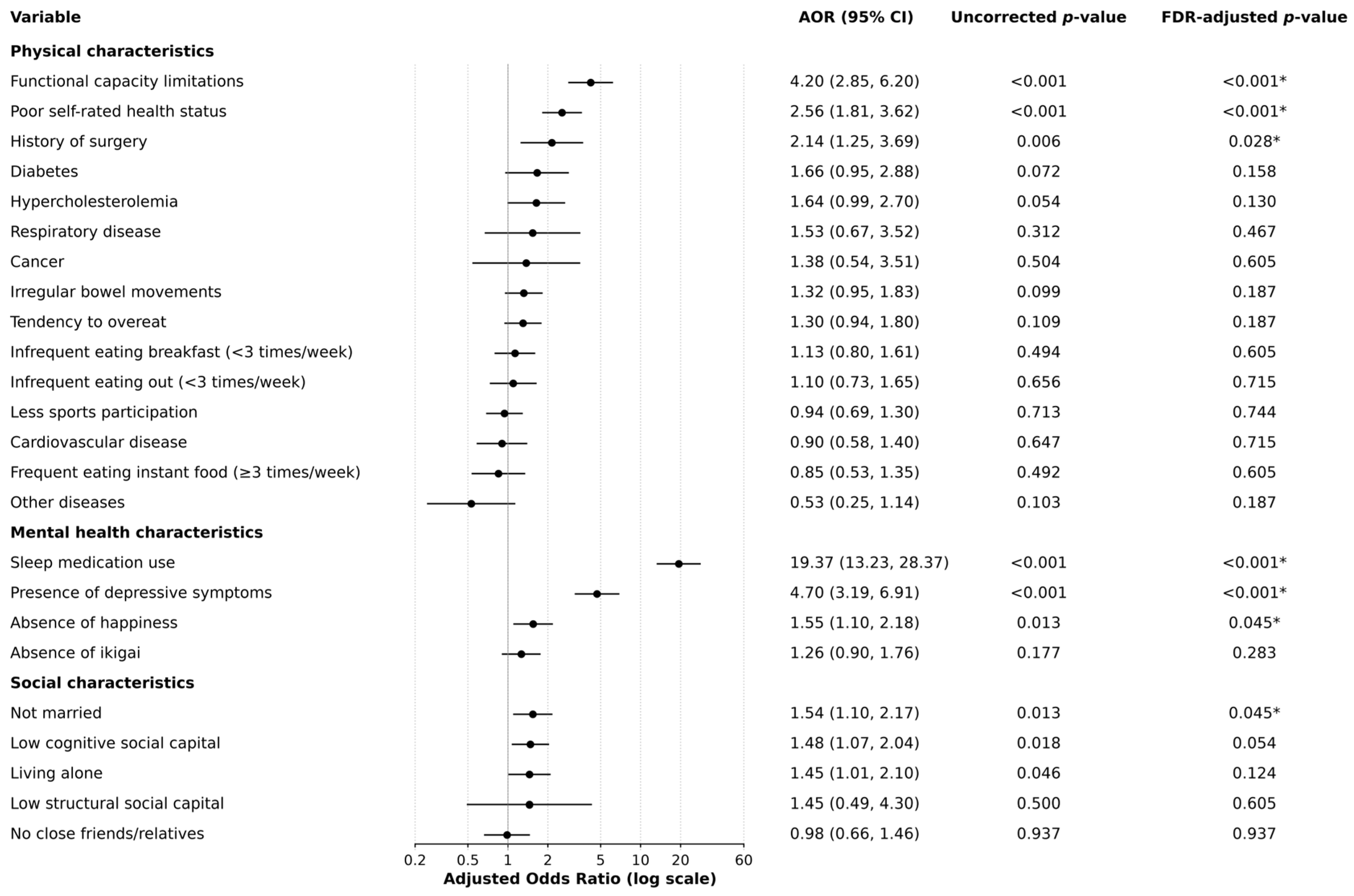
Multivariable logistic regression analyses were then used to examine associations between selected physical, mental health, and social characteristics and self-reported BD status (Figure 1). In the adjusted model, after FDR correction, sleep medication use (AOR: 19.37, 95% CI: 13.23 to 28.37), depressive symptoms (AOR: 4.70, 95% CI: 3.19 to 6.91), functional capacity limitations (AOR: 4.20, 95% CI: 2.85 to 6.20), poor self-rated health status (AOR: 2.56, 95% CI: 1.81 to 3.62), history of surgery (AOR: 2.14, 95% CI: 1.25 to 3.69), absence of happiness (AOR: 1.55, 95% CI: 1.10 to 2.18), and not being married (AOR: 1.54, 95% CI: 1.10 to 2.17) remained associated with self-reported BD. Low cognitive social capital and living alone showed nominal positive associations based on uncorrected estimates (uncorrected p = 0.018 and 0.046, respectively), but these associations did not remain statistically significant after FDR correction (adjusted p = 0.054 and 0.124, respectively).
Figure 1.
Multivariable-adjusted odds ratios (AORs) with 95% confidence intervals for selected physical, mental health, and social characteristics comparing participants with self-reported bipolar disorder (BD) and participants in the strictly screened comparison group without self-reported mental disorder history or prior psychiatric treatment. Self-reported BD status was specified as the dependent variable in all logistic regression models. All models were adjusted for relevant adjustment covariates as described in the Methods. The x-axis is presented on a log scale. Adjusted p-values were derived using the Benjamini–Hochberg false discovery rate (FDR) procedure to account for multiple comparisons. The asterisk (*) in the FDR-adjusted p-value column indicates a statistically significant value after FDR correction (adjusted p < 0.05).
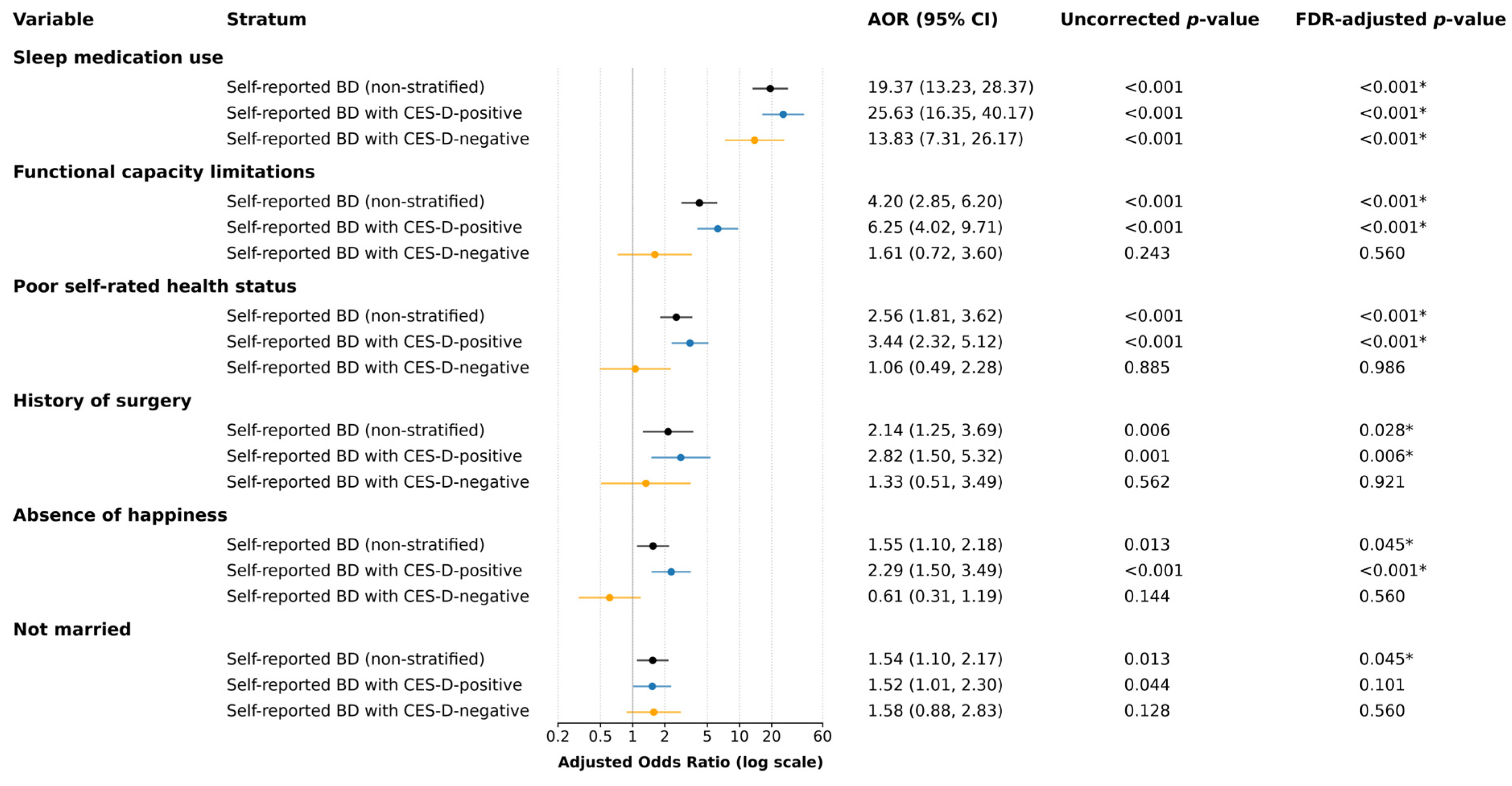
Approximately 70% of participants with self-reported BD screened positive for depressive symptoms (CES-D ≥ 8) (Table 1). We therefore conducted descriptive sensitivity analyses of the fully adjusted models by stratifying participants with self-reported BD according to their reported depressive symptom status (Figure 2). Non-stratified self-reported BD, self-reported BD with CES-D-positive status, or self-reported BD with CES-D-negative status served as the dependent variable (coded as 1 for the self-reported BD group and 0 for the strictly screened comparison group). All models were adjusted for the fixed adjustment covariates. We applied FDR correction within each of the three analytic families (non-stratified self-reported BD, CES-D-positive self-reported BD, and CES-D-negative self-reported BD compared against the strictly screened comparison group). Significant characteristics from the non-stratified fully adjusted models were selected to be presented alongside their stratified results in Figure 2. Sleep medication use was associated with self-reported BD in both strata, with an AOR of 25.63 (95% CI: 16.35 to 40.17) among participants with self-reported BD who screened positive for depressive symptoms and an AOR of 13.83 (95% CI: 7.31 to 26.17) among those who did not. Point estimates for functional capacity limitations, poor self-rated health status, history of surgery, and absence of happiness differed numerically between the subgroup analyses. For not being married, point estimates were above 1.0 in both strata, but neither association remained statistically significant after FDR correction. Complete stratum-specific results are presented in the Supplementary Materials.
Figure 2.
Multivariable-adjusted odds ratios (AORs) with 95% confidence intervals for selected characteristics associated with self-reported bipolar disorder, stratified by depressive symptom status among participants with self-reported bipolar disorder. Results are presented for the non-stratified self-reported bipolar disorder group (black), participants with self-reported bipolar disorder who screened positive for depressive symptoms (CES-D ≥8) (blue), and participants with self-reported bipolar disorder who did not screen positive for depressive symptoms (CES-D <8) (orange). All comparisons are made against the strictly screened comparison group. All models were adjusted for relevant adjustment covariates as described in the Methods. The x-axis is presented on a log scale. Adjusted p-values were derived using the Benjamini–Hochberg false discovery rate (FDR) procedure. The asterisk (*) in the FDR-adjusted p-value column indicates a statistically significant value after FDR correction (adjusted p <0.05).
4. Discussion
Principal Findings
This exploratory study examined physical, mental health, and social characteristics associated with self-reported BD among participants in Japanese web-based surveys. After multivariable adjustment and correction for multiple comparisons, several characteristics remained associated with self-reported BD, including sleep medication use, depressive symptoms, functional capacity limitations, poor self-rated health status, history of surgery, absence of happiness, and not being married. These findings suggest a broad clustering of physical, mental health, and social challenges associated with self-reported BD in these survey samples.
The self-reported BD group was older and had a higher proportion of male participants than the strictly screened comparison group. However, because age at onset, age at diagnosis, and illness duration were unavailable, the reason for this age distribution cannot be determined. In addition, this age difference should also be interpreted in the context of the three-year gap in data collection between groups, as the self-reported BD group was surveyed in March 2025, while the group without mental disorders was surveyed in February 2022. Some prior evidence suggests sex differences across BD subtypes, with BD-I being more frequently diagnosed in men [3]. However, information regarding the BD subtype was not available in this study. Notably, several studies indicate that BD has a relatively equal sex distribution [33], suggesting that the male predominance observed here may partly reflect the sampling characteristics of the online survey rather than a true population-level difference.
Among physical characteristics, functional capacity limitations and poor self-rated health status remained associated with self-reported BD after multivariable adjustment and FDR correction. Consistent with previous studies, patients with BD often experience functional impairments, including cognitive difficulties, occupational disruption, and reduced quality of life [8,9]. However, because this study was cross-sectional and based on self-reported data, the temporal and causal relationships between self-reported BD and functional capacity limitations or perceived health status cannot be determined.
Participants with self-reported BD also had higher descriptive proportions of overweight, current smoking, tendency to overeat, and irregular bowel movements. These differences should be interpreted cautiously because psychiatric medication use, treatment duration, and detailed clinical characteristics were not available. Previous studies have described weight and appetite changes during antipsychotic treatment [34,35,36,37,38], and gastrointestinal symptoms have been reported among people with BD [39], while other clinical or behavioral factors may also contribute. We therefore cannot determine whether the observed differences reflect treatment-related effects, manifestations of illness, other health or behavioral factors, or differences in participant selection. These descriptive observations should not be taken as evidence of BD-specific biological mechanisms. Participants with self-reported BD had a higher proportion of current smoking. Previous studies indicate that individuals with BD have a higher prevalence of current smoking than the general population, possibly resulting from increased smoking initiation and decreased smoking cessation rates [40,41].
While studies have reported that adults with BD are more likely to have alcohol use disorder [15,42], our results showed a lower proportion of current alcohol drinkers among participants with self-reported BD compared with those in the strictly screened comparison group. This may be due to our exclusion of individuals with alcoholism from the study, which resulted in the inclusion of individuals with BD who were less likely to drink alcohol.
Participants with self-reported BD reported a higher prevalence of cardiovascular disease, diabetes, hypercholesterolemia, and a history of surgery than those in the strictly screened comparison group. These findings align with previous evidence indicating that individuals with BD have higher rates of cardiovascular disease and metabolic disorders compared with the general population [1,13,16]. After multivariable adjustment and FDR correction, only history of surgery remained associated with self-reported BD. Previous studies have reported a greater burden of physical health problems among individuals with serious mental health disorders [43,44]. However, the association may reflect differences in underlying health status, healthcare utilization, health awareness, or reporting behavior among participants with self-reported BD. Because detailed surgical data were not collected, this finding should be interpreted with caution.
Regarding mental health characteristics, participants with self-reported BD reported a higher proportion of those who met criteria for depressive symptoms (70.4% vs. 33.9%), and the presence of depressive symptoms was also associated with self-reported BD after multivariable adjustment and FDR correction (AOR: 4.70). Notably, depressive symptoms in this study were assessed via self-screening for distress and were not clinically confirmed. Depression is the most common index presentation of BD, making it challenging for clinicians to differentiate it from major depressive disorder during early consultations. To aid differentiation, clinicians look for characteristics that suggest BD rather than major depressive disorder, such as an earlier age of onset, family history of psychopathology, and atypical symptoms (including hyperphagia and hypersomnia) [1]. Therefore, this finding should be interpreted as screening-level psychological distress rather than as clinically diagnosed mood-state information.
Participants with self-reported BD reported higher rates of absence of ikigai and absence of happiness. This is consistent with prior studies showing that individuals with BD have lower levels of well-being, life satisfaction, and happiness [45,46]. Absence of happiness was also significantly associated with self-reported BD (AOR: 1.55). The self-reported BD group also had higher perceived stress scores than the group without mental disorders. These findings collectively suggest that individuals with self-reported BD may face greater psychological challenges, potentially making daily life more difficult. In this study, we assessed ikigai and happiness using a single question asking participants to rate their own levels of ikigai and happiness. Therefore, these measures may vary depending on participants’ perspectives and backgrounds.
Participants with self-reported BD also reported higher proportions of long sleep duration, frequent insomnia, frequent nocturnal awakening, and frequent poor sleep or morning fatigue. The relationship between sleep patterns and mood in people with BD has been widely reported. An increase in sleep duration is found to be associated with depression, whereas a shorter sleep duration is found for mania [47]. The use of mood stabilizers and antipsychotics may affect the circadian rhythms, further contributing to sleep problems in individuals with BD [48,49]. Furthermore, obstructive sleep apnea (OSA)—which is strongly associated with overweight and obesity [50]—was not assessed in this study. Given that participants with self-reported BD had a higher prevalence of overweight, the observed sleep problems, including nocturnal awakenings, poor sleep or morning fatigue, and sleep medication use, may be partly attributable to OSA. Future studies should include assessment of OSA to disentangle its contribution from that of BD-related sleep disturbance. Sleep medication use remained associated with self-reported BD after multivariable adjustment and FDR correction (AOR: 19.37). This finding might primarily be viewed as a treatment-related or healthcare-contact characteristic. Sleep medication use may reflect treatment for sleep disturbances, other clinical indications, differences in prescribing practices, or differential contact with healthcare services. Information on specific medications, indications, and healthcare access was unavailable. Thus, the present data cannot determine the explanation for this association, and it should not be interpreted as a causal effect, a diagnostic feature of BD, or evidence of BD-specific pathophysiology.
Additionally, the self-reported BD group had a longer internet use duration than the strictly screened comparison group. Prior studies have reported associations between internet use duration and both physical and mental health issues [51,52]. Problematic internet use among individuals with BD can result in serious psychological, economic, and social difficulties, potentially leading to functional impairment [53]. However, this finding should be interpreted as a behavioral characteristic rather than evidence of internet addiction or problematic use.
In terms of social characteristics, participants with self-reported BD were less likely to be employed full-time and more likely to have a low household income. This is consistent with previous studies suggesting individuals with BD often face difficulties in employment and occupational functioning, which can potentially make it difficult to maintain steady employment [10]. Not being married showed an association with self-reported BD (AOR: 1.54), aligning with prior evidence that BD is associated with marital rates and stability. Studies suggest that individuals with BD have a lower likelihood of ever marrying and also have higher rates of divorce [54,55]. Low cognitive social capital and living alone showed point estimates with confidence intervals entirely above 1.0 in the multivariable logistic regression analyses, but did not reach statistical significance after FDR correction. Nevertheless, the direction of these estimates aligns with descriptive social analyses—which indicate that participants with self-reported BD were more likely to live alone, had a higher proportion of low cognitive social capital, were more likely to report having no close friends or relatives, and had lower ESSI scores—suggesting a pattern of social disadvantage. These characteristics may be related to loneliness. The relationship between loneliness and BD is complex and bidirectional, as feelings of loneliness can be both consequences and precursors of the disease [56]. Studies have shown that loneliness significantly predicted poorer quality of life in older adults with BD, and the poorer quality of life observed in young people with BD persists into later life [46]. These findings may support the importance of social connectedness as part of comprehensive care for individuals with self-reported BD.
The proportion of individuals reporting low structural social capital was high in both groups (98.4% vs. 97.7%). These skewed distributions likely indicate that the threshold for categorization was too stringent. Participants who participate in community organizations, self-help groups, charities, volunteer groups, or religious organizations more than once a week were classified as having “high structural social capital”, while those who participate less than once a week were classified as having “low structural social capital”. Using weekly participation as the cutoff, individuals with moderate levels of social engagement (e.g., monthly participation) were grouped into the “low” category. This ceiling effect likely masked potential variance between the groups. Future studies should consider more granular response options to distribute participants more evenly and enhance comparative analysis. Furthermore, the assessment focused on physical forms of community participation and did not account for online social engagement. As digital support networks and social media platforms become increasingly important to social capital, future research should incorporate these digital dimensions to more accurately reflect contemporary social connectivity.
It should also be noted that some of the observed differences between groups may partly reflect the historical and societal context of their respective survey period rather than characteristics specific to BD. We adjusted for several time-sensitive variables, such as sleep behaviors (including insomnia frequency, nocturnal awakening frequency, poor sleep or morning fatigue frequency, sleep duration, and bedtime), perceived stress, internet use duration, health checkup attendance, employment status, household income, and social support. However, these adjustments cannot fully account for unmeasured changes between 2022 and 2025 or differences in the two recruitment frames. Disease-panel registrants may differ from other web-survey respondents in disease awareness, healthcare contact, health interest, motivation to participate in surveys, and digital literacy. These findings should therefore be interpreted as exploratory associations within these surveyed samples.
We examined associations separately for participants with self-reported BD who screened positive or negative for depressive symptoms. Sleep medication use showed positive associations in both comparisons with the strictly screened comparison group. Prior studies have reported that sleep problems occur across all mood phases of BD, suggesting that sleep-related problems may warrant attention across the clinical course of BD [49,57]. Other subgroup point estimates varied numerically. However, these analyses were not designed to test interactions, and no formal evidence of between-stratum differences was established. The smaller CES-D-negative subgroup also limits precision. Because CES-D status does not represent clinically confirmed mood episode status, these stratified findings should be interpreted descriptively.
5. Limitations
Our study has several limitations. First, BD status was obtained from self-reports in a web-based disease panel. Although the Rakuten Insight disease panel is a large-scale resource for survey-based research in Japan, the diagnostic validity of self-reported BD in this panel has not been validated against clinical assessments. Psychiatric interviews or DSM-based diagnostic confirmation were not performed. The disease-panel classification may be affected by diagnostic misclassification. The extent and direction of misclassification are unknown. Information on subtype, illness duration, age at onset, current episode, and detailed psychiatric medications was also unavailable. Differences in healthcare contact may also influence reporting of treated illness, surgery, and sleep medication use. Accordingly, our results should not be interpreted as the clinical profile of individuals with confirmed BD in Japan. Second, the study may be affected by selection bias related to the online survey design and the disease panel. Individuals without internet access, patients with severe conditions, and the elderly with limited digital literacy may have been underrepresented. In addition, participants registered in the disease panel may be more likely to have greater disease awareness, healthcare contact/utilization, health interest, and digital literacy. These differences may have influenced the observed associations between physical, mental health, and social characteristics and self-reported BD. Third, the strictly screened comparison group was not a general population control group. It was selected using restrictive self-report screening. However, such screening cannot exclude the presence of mental disorders. Furthermore, it may select respondents with lower psychiatric-treatment exposure. Therefore, the observed contrasts may be amplified by the reference-group definition. Fourth, individuals with alcoholism or substance dependence were excluded from the study. Because alcohol use disorder and substance use disorder are important comorbid conditions among people with BD, this exclusion may have reduced heterogeneity but may also have led to underestimation of the overall physical, mental health, and social burden among participants with self-reported BD. Fifth, the groups were collected from different online recruitment frames at different times (JASTIS/JACSIS, February 2022; Rakuten Insight disease panel, March 2025). Survey period and sampling source were aligned with group status, so changes in social conditions after the COVID-19 pandemic and differential recruitment cannot be disentangled from the observed associations. Adjustment for measured time-sensitive variables cannot adequately remove unmeasured temporal or selection bias. Sixth, although we adjusted for several covariates, residual confounding from unmeasured factors cannot be excluded. For example, data on illness duration, disease severity, number of lifetime episodes, current mood state, and detailed treatment history were unavailable. In addition, possible overadjustment should be considered, as some adjustment variables may be mediators or pathway-related factors between the characteristics of interest and self-reported BD. Therefore, the adjusted estimates should be interpreted as conditional associations rather than total effects. Seventh, several variables were dichotomized using operational cutoffs, which potentially leads to information loss. Finally, the cross-sectional comparative design prevents determining causal or temporal direction, and findings should be interpreted only as exploratory associations within these surveyed samples.
6. Conclusions
In this exploratory study using Japanese web-based survey data, respondents with self-reported BD differed from the strictly screened comparison group across a broad range of physical, mental health, and social characteristics. Following multivariable adjustment and FDR correction, sleep medication use, depressive symptoms, functional capacity limitations, poor self-rated health, surgery history, absence of happiness, and not being married were associated with self-reported BD status. Some estimates were sensitive to the adjustment strategy and the operationalization of continuous scores. Because the groups differed in recruitment frame and survey year and BD status was not clinically verified, these findings should be interpreted as associations specific to the surveyed samples rather than causal effects or estimates for all individuals with BD in Japan. More comparable and clinically validated studies are needed to assess the generalizability of these patterns.
Supplementary Materials
The following supporting information can be downloaded at: https://www.mdpi.com/article/10.3390/medsci14080815/s1, Table S1. Comparison of minimally adjusted and fully adjusted odds ratios for physical, mental health, and social characteristics associated with self-reported bipolar disorder. Table S2. Comparison of fully adjusted odds ratios between the original categorical-variable models and sensitivity models using continuous variables. Table S3. Complete results of minimally adjusted logistic regression analyses of physical, mental health, and social characteristics associated with self-reported bipolar disorder. Figure S1. Multivariable-adjusted odds ratios (AORs) with 95% confidence intervals for physical characteristics, stratified by depressive symptom status among participants with self-reported bipolar disorder. Figure S2. Multivariable-adjusted odds ratios (AORs) with 95% confidence intervals for mental health characteristics, stratified by depressive symptom status among participants with self-reported bipolar disorder. Figure S3. Multivariable-adjusted odds ratios (AORs) with 95% confidence intervals for social characteristics, stratified by depressive symptom status among participants with self-reported bipolar disorder.
Author Contributions
Conceptualization, P.C., Y.H., M.M., T.K. and A.O.; methodology, P.C. and Y.H.; formal analysis, P.C. and Y.H.; investigation, T.K., K.S. and A.O.; data curation, Y.H. and A.O.; writing—original draft preparation, P.C.; writing—review and editing, Y.H., M.M., T.K., N.I. and A.O.; supervision, A.O. All authors have read and agreed to the published version of the manuscript.
Funding
This research was funded by the Ministry of Health, Labour and Welfare, Japan (JPMH21GC1018 to A.O.), the Japanese Association of Medical Sciences (150-1-16-7 to A.O.), and Fujita Health University (2126 and 11 to Y.H.).
Institutional Review Board Statement
The study was conducted in accordance with the Declaration of Helsinki and approved by the Institutional Review Board of Fujita Health University (approval numbers: HM21-408, approved on 24 January 2022, for the survey data of participants in the strictly screened comparison group; and HM 24-473, approved on 7 February 2025, for the survey data of participants with self-reported BD).
Informed Consent Statement
Informed consent was obtained from all participants involved in the study.
Data Availability Statement
Raw data supporting the reported results of this study are human research participant data. Participants provided informed consent for their data to be used only in the analyses reported in this study, and consent was not obtained for public deposition or unrestricted sharing of individual-level data. For this reason, the raw data are not publicly available. De-identified data can be made available from the corresponding author upon reasonable request and after appropriate procedures, including approval from the institutional ethics review committee.
Acknowledgments
This study was supported by the Ministry of Health, Labour and Welfare, Japan, the Japanese Association of Medical Sciences, and Fujita Health University. The findings and conclusions of this article are the sole responsibility of the authors and do not represent the official views of the research funders. The authors attest that there was no use of generative artificial intelligence technology in the generation of text, figures, or other informational content of this manuscript.
Conflicts of Interest
The authors declare no conflicts of interest.
Abbreviations
BD: bipolar disorder.
References
- McIntyre, R.S.; Berk, M.; Brietzke, E.; Goldstein, B.I.; López-Jaramillo, C.; Kessing, L.V.; Malhi, G.S.; Nierenberg, A.A.; Rosenblat, J.D.; Majeed, A.; et al. Bipolar Disorders. Lancet 2020, 396, 1841–1856. [Google Scholar] [CrossRef] [Scilit] [PubMed]
- GBD 2019 Mental Disorders Collaborators. Global, Regional, and National Burden of 12 Mental Disorders in 204 Countries and Territories, 1990–2019: A Systematic Analysis for the Global Burden of Disease Study 2019. Lancet Psychiatry 2022, 9, 137–150. [Google Scholar] [CrossRef] [Scilit] [PubMed]
- Merikangas, K.R.; Jin, R.; He, J.-P.; Kessler, R.C.; Lee, S.; Sampson, N.A.; Viana, M.C.; Andrade, L.H.; Hu, C.; Karam, E.G.; et al. Prevalence and Correlates of Bipolar Spectrum Disorder in the World Mental Health Survey Initiative. Arch. Gen. Psychiatry 2011, 68, 241–251. [Google Scholar] [CrossRef] [Scilit] [PubMed]
- Kroon, J.S.; Wohlfarth, T.D.; Dieleman, J.; Sutterland, A.L.; Storosum, J.G.; Denys, D.; de Haan, L.; Sturkenboom, M.C. Incidence Rates and Risk Factors of Bipolar Disorder in the General Population: A Population-Based Cohort Study. Bipolar Disord. 2013, 15, 306–313. [Google Scholar] [CrossRef] [Scilit] [PubMed]
- Chan, J.K.N.; Tong, C.H.Y.; Wong, C.S.M.; Chen, E.Y.H.; Chang, W.C. Life Expectancy and Years of Potential Life Lost in Bipolar Disorder: Systematic Review and Meta-Analysis. Br. J. Psychiatry 2022, 221, 567–576. [Google Scholar] [CrossRef] [Scilit] [PubMed]
- Chan, J.K.N.; Wong, C.S.M.; Yung, N.C.L.; Chen, E.Y.H.; Chang, W.C. Excess Mortality and Life-Years Lost in People with Bipolar Disorder: An 11-Year Population-Based Cohort Study. Epidemiol. Psychiatr. Sci. 2021, 30, e39. [Google Scholar] [CrossRef] [Scilit] [PubMed]
- Dong, M.; Lu, L.; Zhang, L.; Zhang, Q.; Ungvari, G.S.; Ng, C.H.; Yuan, Z.; Xiang, Y.; Wang, G.; Xiang, Y.-T. Prevalence of Suicide Attempts in Bipolar Disorder: A Systematic Review and Meta-Analysis of Observational Studies. Epidemiol. Psychiatr. Sci. 2019, 29, e63. [Google Scholar] [CrossRef] [Scilit] [PubMed]
- Alonso, J.; Petukhova, M.; Vilagut, G.; Chatterji, S.; Heeringa, S.; Üstün, T.B.; Alhamzawi, A.O.; Viana, M.C.; Angermeyer, M.; Bromet, E.; et al. Days out of Role Due to Common Physical and Mental Conditions: Results from the WHO World Mental Health Surveys. Mol. Psychiatry 2011, 16, 1234–1246. [Google Scholar] [CrossRef] [Scilit] [PubMed]
- Dominiak, M.; Jażdżyk, P.; Antosik-Wójcińska, A.Z.; Konopko, M.; Bieńkowski, P.; Świȩcicki, Ł.; Sienkiewicz-Jarosz, H. The Impact of Bipolar Spectrum Disorders on Professional Functioning: A Systematic Review. Front. Psychiatry 2022, 13, 951008. [Google Scholar] [CrossRef] [Scilit] [PubMed]
- Kato, T.; Baba, K.; Guo, W.; Chen, Y.; Nosaka, T. Impact of Bipolar Disorder on Health-Related Quality of Life and Work Productivity: Estimates from the National Health and Wellness Survey in Japan. J. Affect. Disord. 2021, 295, 203–214. [Google Scholar] [CrossRef] [Scilit] [PubMed]
- Leboyer, M.; Soreca, I.; Scott, J.; Frye, M.; Henry, C.; Tamouza, R.; Kupfer, D.J. Can Bipolar Disorder Be Viewed as a Multi-System Inflammatory Disease? J. Affect. Disord. 2012, 141, 1–10. [Google Scholar] [CrossRef] [Scilit] [PubMed]
- Hassamal, S. Chronic Stress, Neuroinflammation, and Depression: An Overview of Pathophysiological Mechanisms and Emerging Anti-Inflammatories. Front. Psychiatry 2023, 14, 1130989. [Google Scholar] [CrossRef] [Scilit] [PubMed]
- Goldfarb, M.; De Hert, M.; Detraux, J.; Di Palo, K.; Munir, H.; Music, S.; Piña, I.; Ringen, P.A. Severe Mental Illness and Cardiovascular Disease. J. Am. Coll. Cardiol. 2022, 80, 918–933. [Google Scholar] [CrossRef] [Scilit] [PubMed]
- Fares-Otero, N.E.; Martinez-Aran, A. Social Stress in Bipolar Disorder. Eur. Neuropsychopharmacol. 2022, 60, 22–24. [Google Scholar] [CrossRef] [Scilit] [PubMed]
- Tokumitsu, K.; Sugawara, N.; Adachi, N.; Kubota, Y.; Watanabe, Y.; Miki, K.; Azekawa, T.; Edagawa, K.; Katsumoto, E.; Hongo, S.; et al. Real-World Clinical Determinants of Alcohol Dependence in Outpatients with Bipolar Disorder: A Multicenter Treatment Survey for Bipolar Disorder in Psychiatric Outpatient Clinics with 2,392 Participants. Front. Psychiatry 2024, 15, 1434810. [Google Scholar] [CrossRef] [Scilit] [PubMed]
- Kishi, T.; Okuya, M.; Sakuma, K.; Otaka, Y.; Saitoh, E.; Iwata, N. Body Composition in Japanese Patients with Psychiatric Disorders: A Cross-sectional Study. Neuropsychopharmacol. Rep. 2021, 41, 117–121. [Google Scholar] [CrossRef] [Scilit] [PubMed]
- Smith, D.J.; Nicholl, B.I.; Cullen, B.; Martin, D.; Ul-Haq, Z.; Evans, J.; Gill, J.M.R.; Roberts, B.; Gallacher, J.; Mackay, D.; et al. Prevalence and Characteristics of Probable Major Depression and Bipolar Disorder within UK Biobank: Cross-Sectional Study of 172,751 Participants. PLoS ONE 2013, 8, e75362. [Google Scholar] [CrossRef] [Scilit] [PubMed]
- Morton, E.; Hou, S.H.; Fogarty, O.; Murray, G.; Barnes, S.; Depp, C.; CRESTBD; Michalak, E. A Web-Based Adaptation of the Quality of Life in Bipolar Disorder Questionnaire: Psychometric Evaluation Study. JMIR Ment. Health 2020, 7, e17497. [Google Scholar] [CrossRef] [Scilit] [PubMed]
- Rakuten Insight, Inc. Rakuten Insight. Available online: https://insight.rakuten.co.jp/panel/ (accessed on 18 September 2025).
- Kusama, T.; Kiuchi, S.; Takeuchi, K.; Ikeda, T.; Nakazawa, N.; Kinugawa, A.; Osaka, K.; Tabuchi, T. Information Usage and Compliance with Preventive Behaviors for COVID-19: A Longitudinal Study with Data from the JACSIS 2020/JASTIS 2021. Healthcare 2022, 10, 521. [Google Scholar] [CrossRef] [Scilit] [PubMed]
- Sasaki, R.; Ota, A.; Yatsuya, H.; Tabuchi, T. Gender Difference in Fear and Anxiety about and Perceived Susceptibility to COVID-19 in the Third Wave of Pandemic among the Japanese General Population: A Nationwide Web-Based Cross-Sectional Survey. Int. J. Environ. Res. Public. Health 2022, 19, 16239. [Google Scholar] [CrossRef] [Scilit] [PubMed]
- Tabuchi, T.; Shinozaki, T.; Kunugita, N.; Nakamura, M.; Tsuji, I. Study Profile: The Japan “Society and New Tobacco” Internet Survey (JASTIS): A Longitudinal Internet Cohort Study of Heat-Not-Burn Tobacco Products, Electronic Cigarettes, and Conventional Tobacco Products in Japan. J. Epidemiol. 2019, 29, 444–450. [Google Scholar] [CrossRef] [Scilit] [PubMed]
- Wakabayashi, M.; Sugiyama, Y.; Takada, M.; Kinjo, A.; Iso, H.; Tabuchi, T. Loneliness and Increased Hazardous Alcohol Use: Data from a Nationwide Internet Survey with 1-Year Follow-Up. Int. J. Environ. Res. Public. Health 2022, 19, 12086. [Google Scholar] [CrossRef] [Scilit] [PubMed]
- DeSalvo, K.B.; Bloser, N.; Reynolds, K.; He, J.; Muntner, P. Mortality Prediction with a Single General Self-Rated Health Question: A Meta-Analysis. J. Gen. Intern. Med. 2006, 21, 267–275. [Google Scholar] [CrossRef] [Scilit] [PubMed]
- Kohout, F.J.; Berkman, L.F.; Evans, D.A.; Cornoni-Huntley, J. Two Shorter Forms of the CES-D Depression Symptoms Index. J. Aging Health 1993, 5, 179–193. [Google Scholar] [CrossRef] [Scilit] [PubMed]
- Radloff, L.S. The CES-D Scale: A Self-Report Depression Scale for Research in the General Population. Appl. Psychol. Meas. 1977, 1, 385–401. [Google Scholar] [CrossRef] [Scilit]
- García, H.; Miralles, F. Ikigai: The Japanese Secret to a Long and Happy Life; Penguin Books: New York, NY, USA, 2017. [Google Scholar]
- Tanno, K.; Sakata, K.; Ohsawa, M.; Onoda, T.; Itai, K.; Yaegashi, Y.; Tamakoshi, A. Associations of Ikigai as a Positive Psychological Factor with All-Cause Mortality and Cause-Specific Mortality among Middle-Aged and Elderly Japanese People: Findings from the Japan Collaborative Cohort Study. J. Psychosom. Res. 2009, 67, 67–75. [Google Scholar] [CrossRef] [Scilit] [PubMed]
- Wilkes, J.; Garip, G.; Kotera, Y.; Fido, D. Can Ikigai Predict Anxiety, Depression, and Well-Being? Int. J. Ment. Health Addict. 2023, 21, 2941–2953. [Google Scholar] [CrossRef] [Scilit] [PubMed]
- Warttig, S.L.; Forshaw, M.J.; South, J.; White, A.K. New, Normative, English-Sample Data for the Short Form Perceived Stress Scale (PSS-4). J. Health Psychol. 2013, 18, 1617–1628. [Google Scholar] [CrossRef] [Scilit] [PubMed]
- Vaglio, J.; Conard, M.; Poston, W.S.; O’Keefe, J.; Haddock, C.K.; House, J.; Spertus, J.A. Testing the Performance of the ENRICHD Social Support Instrument in Cardiac Patients. Health Qual. Life Outcomes 2004, 2, 24. [Google Scholar] [CrossRef] [Scilit] [PubMed]
- Grootaert, C.; Narayan, D.; Jones, V.N.; Woolcock, M. Measuring Social Capital: An Integrated Questionnaire; World Bank Working Paper; World Bank: Washington, DC, USA, 2004; ISBN 978-0-8213-5661-6. [Google Scholar]
- Rowland, T.A.; Marwaha, S. Epidemiology and Risk Factors for Bipolar Disorder. Ther. Adv. Psychopharmacol. 2018, 8, 251–269. [Google Scholar] [CrossRef] [Scilit] [PubMed]
- Ertugrul, A.; Meltzer, H.Y. Antipsychotic Drugs in Bipolar Disorder. Int. J. Neuropsychopharmacol. 2003, 6, 277–284. [Google Scholar] [CrossRef] [Scilit] [PubMed]
- Sakurai, H.; Kato, M.; Yasui-Furukori, N.; Suzuki, T.; Baba, H.; Watanabe, K.; Inada, K.; Kishida, I.; Sugawara Kikuchi, Y.; Kikuchi, T.; et al. Pharmacological Management of Bipolar Disorder: Japanese Expert Consensus. Bipolar Disord. 2020, 22, 822–830. [Google Scholar] [CrossRef] [Scilit] [PubMed]
- Yakovleva, Y.V.; Kasyanov, E.D.; Mazo, G.E. Prevalence of Eating Disorders in Patients with Bipolar Disorder: A Scoping Review of the Literature. Consort. Psychiatr. 2023, 4, 91–106. [Google Scholar] [CrossRef] [Scilit] [PubMed]
- Wildes, J.E.; Marcus, M.D.; Fagiolini, A. Eating Disorders and Illness Burden in Patients with Bipolar Spectrum Disorders. Compr. Psychiatry 2007, 48, 516–521. [Google Scholar] [CrossRef] [Scilit] [PubMed]
- Mutwalli, H.; Keeler, J.L.; Bektas, S.; Dhopatkar, N.; Treasure, J.; Himmerich, H. Eating Cognitions, Emotions and Behaviour under Treatment with Second Generation Antipsychotics: A Systematic Review and Meta-Analysis. J. Psychiatr. Res. 2023, 160, 137–162. [Google Scholar] [CrossRef] [Scilit] [PubMed]
- Karling, P.; Maripuu, M.; Wikgren, M.; Adolfsson, R.; Norrback, K.-F. Association between Gastrointestinal Symptoms and Affectivity in Patients with Bipolar Disorder. World J. Gastroenterol. 2016, 22, 8540–8548. [Google Scholar] [CrossRef] [Scilit] [PubMed]
- Jackson, J.G.; Diaz, F.J.; Lopez, L.; de Leon, J. A Combined Analysis of Worldwide Studies Demonstrates an Association between Bipolar Disorder and Tobacco Smoking Behaviors in Adults. Bipolar Disord. 2015, 17, 575–597. [Google Scholar] [CrossRef] [Scilit] [PubMed]
- Kertes, J.; Stein Reisner, O.; Grunhaus, L.; Nezry, R.; Alcalay, T.; Azuri, J.; Neumark, Y. Comparison of Smoking Cessation Program Registration, Participation, Smoking Cessation Medication Utilization, and Abstinence Rates Between Smokers With and Without Schizophrenia, Schizo-Affective Disorder, or Bipolar Disorder. Nicotine Tob. Res. 2022, 24, 670–678. [Google Scholar] [CrossRef] [Scilit] [PubMed]
- Sonne, S.C.; Brady, K.T. Bipolar Disorder and Alcoholism. Alcohol Res. Health 2002, 26, 103–108. [Google Scholar]
- Wienand, D.; Wijnen, L.I.; Heilig, D.; Wippel, C.; Arango, C.; Knudsen, G.M.; Goodwin, G.M.; Simon, J. Comorbid Physical Health Burden of Serious Mental Health Disorders in 32 European Countries. BMJ Ment. Health 2024, 27, e301021. [Google Scholar] [CrossRef] [Scilit] [PubMed]
- Copeland, L.A.; Zeber, J.E.; Sako, E.Y.; Mortensen, E.M.; Pugh, M.J.; Wang, C.-P.; Restrepo, M.I.; Flynn, J.; MacCarthy, A.A.; Lawrence, V.A. Serious Mental Illnesses Associated with Receipt of Surgery in Retrospective Analysis of Patients in the Veterans Health Administration. BMC Surg. 2015, 15, 74. [Google Scholar] [CrossRef] [Scilit] [PubMed]
- Gutiérrez-Rojas, L.; Gurpegui, M.; Ayuso-Mateos, J.L.; Gutiérrez-Ariza, J.A.; Ruiz-Veguilla, M.; Jurado, D. Quality of Life in Bipolar Disorder Patients: A Comparison with a General Population Sample. Bipolar Disord. 2008, 10, 625–634. [Google Scholar] [CrossRef] [Scilit] [PubMed]
- Warner, A.; Holland, C.; Lobban, F.; Bentley, L.; Tyler, E.; Palmier-Claus, J. Quality of Life in Older Adults with Mood States Associated with Bipolar Disorder: A Secondary Analysis of the English Longitudinal Study of Ageing Data. Br. J. Clin. Psychol. 2025, 64, 188–202. [Google Scholar] [CrossRef] [Scilit] [PubMed]
- Ulrichsen, A.; Tröger, A.; Jauhar, S.; Severus, E.; Bauer, M.; Cleare, A. Do Sleep Variables Predict Mood in Bipolar Disorder: A Systematic Review. J. Affect. Disord. 2025, 373, 364–373. [Google Scholar] [CrossRef] [Scilit] [PubMed]
- Harvey, A.G. Sleep and Circadian Rhythms in Bipolar Disorder: Seeking Synchrony, Harmony, and Regulation. Am. J. Psychiatry 2008, 165, 820–829. [Google Scholar] [CrossRef] [Scilit] [PubMed]
- Gica, Ş.; Selvi, Y. Sleep Interventions in the Treatment of Schizophrenia and Bipolar Disorder. Arch. Neuropsychiatry 2021, 58, S53–S60. [Google Scholar] [CrossRef] [Scilit] [PubMed]
- Esmaeili, N.; Gell, L.; Imler, T.; Hajipour, M.; Taranto-Montemurro, L.; Messineo, L.; Stone, K.L.; Sands, S.A.; Ayas, N.; Yee, J.; et al. The Relationship between Obesity and Obstructive Sleep Apnea in Four Community-Based Cohorts: An Individual Participant Data Meta-Analysis of 12,860 Adults. eClinicalMedicine 2025, 83, 103221. [Google Scholar] [CrossRef] [Scilit] [PubMed]
- Ioannidis, K.; Treder, M.S.; Chamberlain, S.R.; Kiraly, F.; Redden, S.A.; Stein, D.J.; Lochner, C.; Grant, J.E. Problematic Internet Use as an Age-Related Multifaceted Problem: Evidence from a Two-Site Survey. Addict. Behav. 2018, 81, 157–166. [Google Scholar] [CrossRef] [Scilit] [PubMed]
- Alshakhsi, S.; Chemnad, K.; Almourad, M.B.; Altuwairiqi, M.; McAlaney, J.; Ali, R. Problematic Internet Usage: The Impact of Objectively Recorded and Categorized Usage Time, Emotional Intelligence Components and Subjective Happiness about Usage. Heliyon 2022, 8, e11055. [Google Scholar] [CrossRef] [Scilit] [PubMed]
- Carmassi, C.; Bertelloni, C.A.; Cordone, A.; Dell’Oste, V.; Pedrinelli, V.; Barberi, F.M.; Massimetti, E.; Bui, E.; Dell’Osso, L. Problematic Use of the Internet in Subjects With Bipolar Disorder: Relationship With Posttraumatic Stress Symptoms. Front. Psychiatry 2021, 12, 646385. [Google Scholar] [CrossRef] [Scilit] [PubMed]
- Granek, L.; Danan, D.; Bersudsky, Y.; Osher, Y. Living with Bipolar Disorder: The Impact on Patients, Spouses, and Their Marital Relationship. Bipolar Disord. 2016, 18, 192–199. [Google Scholar] [CrossRef] [Scilit] [PubMed]
- Grover, S.; Nehra, R.; Thakur, A. Bipolar Affective Disorder and Its Impact on Various Aspects of Marital Relationship. Ind. Psychiatry J. 2017, 26, 114–120. [Google Scholar] [CrossRef] [Scilit] [PubMed]
- Giacco, D. Loneliness and Mood Disorders: Consequence, Cause and/or Unholy Alliance? Curr. Opin. Psychiatry 2023, 36, 47–53. [Google Scholar] [CrossRef] [Scilit] [PubMed]
- Marchetti, M.; Mayeli, A.; Sanguineti, C.; Donati, F.L.; Chaichian, O.; Kim, A.; Piskun, K.; D’Agostino, A.; Meyer, N.; Wilson, J.D.; et al. Sleep Abnormalities in Bipolar Disorders across Mood Phases: A Systematic Review and Meta-Analysis. Sleep Med. Rev. 2025, 83, 102137. [Google Scholar] [CrossRef] [Scilit] [PubMed]

Disclaimer/Publisher’s Note: The statements, opinions and data contained in all publications are solely those of the individual author(s) and contributor(s) and not of MDPI and/or the editor(s). MDPI and/or the editor(s) disclaim responsibility for any injury to people or property resulting from any ideas, methods, instructions or products referred to in the content. |
© 2026 by the authors. Licensee MDPI, Basel, Switzerland. This article is an open access article distributed under the terms and conditions of the Creative Commons Attribution (CC BY) license.