


Abstract
Inhaled corticosteroids (ICS) reduce exacerbations in selected patients with chronic obstructive pulmonary disease (COPD), yet their net benefit is uncertain at blood eosinophil counts of 100–299 cells/µL. This critical review evaluates randomized evidence, eosinophil-stratified analyses and withdrawal studies, separating initiation of triple therapy from ICS continuation or discontinuation. The ETHOS and IMPACT programs demonstrate a graded association between eosinophil count and the exacerbation benefit of ICS-containing regimens, with evidence of benefit below 300 cells/µL in exacerbation-prone populations. A post hoc KRONOS analysis also suggests benefit among patients without recent exacerbations, although short follow-up and subgroup uncertainty limit generalization. A systematic review of continued ICS treatment reported an exacerbation rate ratio of 0.80 (95% CI 0.69–0.94) in the 150–300 cells/µL stratum; this estimate must not be equated with an individual response probability. ICS withdrawal evidence addresses a different clinical decision and suggests that selected patients below 300 cells/µL may be de-escalated. Pneumonia risk, prior exacerbations, smoking status, asthma and treatment history are essential modifiers. No robust evidence establishes a universal percentage of individual ICS responders in the entire 100–299 cells/µL range. Treatment decisions should consider escalation after at least one moderate or severe exacerbation despite optimized LABA/LAMA in patients with blood eosinophils ≥100 cells/µL, while explicitly weighing expected absolute benefits against potential harms.
1. Introduction
The clinical challenge is best understood as a decision under uncertainty rather than a laboratory classification exercise. Blood eosinophils are accessible and inexpensive, but their interpretation depends on the therapeutic comparison being made. An eosinophil value that supports maintaining a well-tolerated regimen in a patient with recurrent exacerbations does not automatically justify starting corticosteroids in a person who has remained stable with dual bronchodilation. Similarly, a relative treatment effect derived from an exacerbation-enriched trial may translate into a very small absolute difference in a low-risk primary-care population. This distinction is especially relevant because patients with COPD often have multiple competing health priorities, including cardiovascular disease, frailty, infection susceptibility and difficulties with inhaler use [1,2].
The 100–299 cells/µL range is not biologically homogeneous, yet creating several additional thresholds from exploratory analyses can give a misleading impression of precision. Eosinophil counts fluctuate over time and can be influenced by acute illness and systemic corticosteroid exposure. A clinical interpretation should therefore incorporate the circumstances of measurement and, where appropriate, previous measurements rather than treating one isolated result as a permanent phenotype. The purpose of this review is to integrate the strongest available evidence while preserving distinctions between directly reported subgroup estimates, modeled treatment interactions, and hypotheses generated after trial completion. We emphasize outcomes that patients and clinicians can recognize (exacerbations, hospital admissions, pneumonia, symptoms and treatment burden) rather than an isolated numerical biomarker response.
Interpretation of eosinophils requires attention to sampling conditions: acute exacerbations, intercurrent infection and recent systemic corticosteroids can change circulating counts. A single value in the 100–299 cells/µL range may conceal historical or intermittent values ≥ 300 cells/µL. Repeated stable-state counts, when available, can improve phenotypic interpretation; intermittent eosinophilia and eosinophilic exacerbator patterns require cautious interpretation rather than rigid cut-offs [2].
Long-acting bronchodilation is foundational in COPD treatment, whereas inhaled corticosteroids (ICS) are reserved for circumstances in which exacerbation prevention is likely to outweigh treatment-related harms [1,2]. Blood eosinophils are a practical biomarker of ICS-associated exacerbation prevention, but the biomarker–response relationship is continuous rather than dichotomous [2,3]. This makes the 100–299 cells/µL interval especially consequential: a single threshold does not resolve the competing priorities of preventing exacerbations and avoiding pneumonia. The question is not whether all patients within this interval should receive ICS, but which clinical profiles derive sufficient incremental benefit from ICS added to LABA/LAMA. We distinguish escalation to triple therapy, continued ICS exposure, and withdrawal because these comparisons address different clinical decisions and may have different selection and withdrawal effects [3,4,5,6,7,8,9,10].
2. Scope and Approach to the Literature
This focused critical narrative review examines randomized controlled trials, secondary and post hoc eosinophil analyses, evidence syntheses, and ICS-withdrawal studies relevant to blood eosinophils of 100–299 cells/µL. The evidence was identified through a targeted, non-systematic review of landmark COPD trials, their linked subgroup publications, relevant systematic reviews, and GOLD 2026 guidance [1]. Search databases, exact search strings, dates of the last search, and selection logs were not prospectively recorded. Studies were prioritized for direct relevance to triple therapy versus LABA/LAMA, ICS continuation or withdrawal, and patient-important efficacy and safety outcomes. We distinguish primary randomized comparisons from post hoc and exploratory subgroup findings, avoid double-counting overlapping trial populations.
The review is organized by clinical decision and evidentiary strength. First, we consider trials that randomized patients to inhaled triple therapy or a dual-bronchodilator comparator, paying particular attention to the entry criteria that determine baseline risk. Second, we examine studies comparing continued corticosteroid exposure with alternative regimens and studies of corticosteroid withdrawal. Third, we translate relative treatment effects into clinically interpretable scenarios without presenting illustrative calculations as observed trial findings. Finally, we examine safety and unresolved questions that limit extrapolation to patients encountered in routine care [3,4,5,6,7,8,9,10,11,12,13,14].
This approach intentionally does not generate a pooled effect estimate. The available publications differ in treatment history, inclusion criteria, follow-up duration, inhaled corticosteroid molecules and doses, and eosinophil subgroup definitions. Several publications report different analyses of the same randomized participants. Treating those reports as independent observations would overstate the amount of evidence. Moreover, a comparison of initiating triple therapy with LABA/LAMA cannot be assumed to estimate the same treatment effect as discontinuing corticosteroids after prolonged use. We use published numerical estimates only in the context in which the original source reports them. This is a focused narrative synthesis, not a systematic search with exhaustive ascertainment or formal certainty grading. Consequently, the review can clarify interpretation and clinical applicability, but it cannot establish the absence of unpublished studies or provide a definitive quantitative summary of all evidence.
3. Why the Intermediate Eosinophil Range Is Clinically Difficult
A continuous association between eosinophil concentration and relative corticosteroid benefit is compatible with considerable overlap in individual clinical outcomes. Two people with identical baseline counts may differ in the frequency and severity of previous exacerbations, exposure to respiratory pathogens, inhaler technique, tobacco exposure, coexisting asthma and susceptibility to pneumonia. Those factors can change the absolute balance of treatment even when a relative rate ratio is similar. Eosinophil count is therefore better understood as one component of a multidimensional decision than as a diagnostic test that labels a patient a responder or non-responder [1,2,3].
Trial populations may also differ from the patients for whom clinicians most want guidance. Enrichment for prior exacerbations increases event rates and statistical efficiency but may reduce generalizability to stable COPD. Conversely, trials with less restrictive exacerbation criteria can generate important hypotheses while providing fewer outcome events and less precise subgroup comparisons. Differences in baseline corticosteroid use matter because randomization to an ICS-free regimen can represent withdrawal for some participants. When interpreting an apparent advantage of triple therapy, it is necessary to ask whether the comparison estimates starting a new anti-inflammatory treatment, avoiding interruption of an established treatment, or both [4,5,6,7,8,9,10,11].
Finally, the outcome chosen affects interpretation. Annualized exacerbation rates account for recurrent events and are not interchangeable with the probability that a person experiences at least one exacerbation. Hospitalizations, quality of life and pneumonia have different baseline frequencies and clinical consequences. An intervention can reduce an event rate while offering limited measurable symptomatic benefit, or prevent exacerbations at the cost of clinically meaningful adverse effects. A transparent review should not compress these distinct outcomes into a single unsupported percentage of patients who benefit.
4. Evidence from Triple-Therapy Trials
IMPACT randomized 10,355 patients with symptomatic, exacerbation-prone COPD for 52 weeks. Its eosinophil modeling analysis found increasing exacerbation protection from ICS-containing regimens with higher baseline eosinophil counts. At <90 cells/µL the triple-therapy versus LABA/LAMA rate ratio was 0.88 (95% CI 0.74–1.04), whereas at ≥310 cells/µL it was 0.56 (0.47–0.66). These anchor estimates demonstrate a gradient, not a directly observed 100–299 subgroup effect; former smokers were more ICS-responsive than current smokers at a given eosinophil count [4,5]. These modeled estimates do not constitute an independently powered trial of the intermediate eosinophil interval.
ETHOS compared budesonide/glycopyrronium/formoterol (BGF) with glycopyrronium/formoterol (GFF) and budesonide/formoterol (BFF) over 52 weeks in patients with exacerbation-prone COPD [6]. The published post hoc eosinophil analysis included 5778 participants with baseline counts of 100–299 cells/µL (modified intention-to-treat population) [7]. In this subgroup, BGF 320 versus GFF was associated with a moderate/severe exacerbation rate ratio of 0.78 (95% CI 0.70–0.87), corresponding to a 22% relative rate reduction [7]. This is a subgroup-specific relative rate estimate, not an individual probability of benefit. Analyses were not prospectively powered for subgroup inference and multiplicity-adjusted significance testing was not undertaken [7]. Prior ICS exposure may influence the comparison [8].
TRIBUTE reported an overall moderate/severe exacerbation rate ratio of approximately 0.85 for extrafine triple therapy versus indacaterol/glycopyrronium during 52 weeks [9]. The overall estimate cannot be treated as a specific 100–299 cells/µL effect. KRONOS, a 24-week trial that did not require a prior exacerbation, provides a complementary population [10]. A 2024 post hoc analysis focusing on 100 to <300 cells/µL found a 56% lower adjusted moderate/severe exacerbation rate for triple versus LABA/LAMA among participants without exacerbations in the preceding year, and reductions of 47% and 50% in moderate and severe COPD subsets, respectively [11]. These are relative rates in exploratory subgroups (not percentages of individual responders) and KRONOS was not powered prospectively for these comparisons. Short duration and multiplicity constrain confidence in applying these findings to routine escalation in otherwise stable COPD. Table 1 summarizes the randomized trials, subgroup analyses and evidence syntheses.
Table 1.
Evidence map of randomized studies and subgroup analyses.
5. Dual Therapy, Continuation and Withdrawal
ICS withdrawal addresses a different decision from initiating triple therapy. WISDOM and SUNSET support careful patient selection rather than automatic de-escalation; the WISDOM eosinophil analysis found greater exacerbation risk following withdrawal principally in patients with higher eosinophil counts (particularly ≥300 cells/µL). Current GOLD 2026 guidance does not support withdrawing ICS solely because a patient is clinically stable on triple therapy. Review the original ICS indication, exacerbation history before treatment, previous eosinophil values, asthma features, recurrent pneumonia and patient preference; monitor closely after any change [1,13,14,15].
FLAME found LABA/LAMA superior to LABA/ICS for prevention of moderate/severe exacerbations in the overall population (rate ratio 0.83, 95% CI 0.75–0.91), supporting dual bronchodilation as an important comparator. It does not answer the triple-versus-LABA/LAMA question directly [12]. A 2022 systematic review of continued ICS use identified 11 randomized trials involving 29,654 patients, mostly previously exposed to ICS, and reported a moderate/severe exacerbation rate ratio of 0.80 (95% CI 0.69–0.94) for the 150–300 cells/µL subgroup. The certainty of this estimate was low to very low, and the range does not exactly match 100–299 cells/µL [3,16,17]. Continuation evidence concerns predominantly previously exposed patients and should not be extrapolated directly to initiation.
SUNSET examined ICS withdrawal from long-term triple therapy in patients without frequent exacerbations and showed that withdrawal was feasible overall, while patients with higher eosinophil counts had less favorable outcomes [13]. A 2024 systematic review of triple-therapy de-escalation similarly found no significant overall exacerbation increase with ICS withdrawal, but identified higher withdrawal risk at ≥300 cells/µL [14]. These findings must not be pooled indiscriminately with trials of ICS initiation: the relevant estimand, previous exposure and patient selection differ.
6. Clinical Benefit, Absolute Effects and Safety
A relative reduction in an exacerbation rate becomes meaningful only after the baseline rate is considered. For illustration, applying a rate ratio of 0.78 to an expected rate of two events per patient-year yields an absolute difference of 0.44 events per patient-year, whereas applying the same ratio to 0.25 events yields a difference of 0.055 events. These hypothetical calculations assume a constant relative effect and do not represent observed absolute differences in ETHOS. They also cannot be inverted to estimate a number needed to treat without a suitable person-level endpoint, defined follow-up period and additional assumptions. A rate difference summarizes events, not necessarily the number of distinct patients spared an event [7].
Severity is equally important. Avoiding an exacerbation requiring hospital admission may carry a different value from preventing a milder episode treated in the community. Trials commonly report composite moderate or severe exacerbations, and the relative contribution of each category may vary. Patient preferences can therefore reasonably differ even when patients have similar eosinophil counts. The expected benefit should be explained using the most relevant baseline clinical risk rather than an abstract subgroup rate ratio alone.
The balance of benefit and harm is particularly important in patients with recurrent lower respiratory infections, previous pneumonia or bronchiectasis. ICS-associated pneumonia risk varies by molecule, dose, case definition and baseline susceptibility; differences between ETHOS and IMPACT cannot be interpreted as head-to-head comparisons. Before escalating, assess adherence, inhaler technique, smoking exposure, asthma features and alternative drivers of symptoms [1,4,6]. In the overall IMPACT population, investigator-reported pneumonia occurred in 317/4151 (7.6%) receiving triple therapy, 292/4134 (7.1%) receiving ICS/LABA and 97/2070 (4.7%) receiving LABA/LAMA [4]. These are overall trial frequencies, not intermediate-eosinophil subgroup estimates.
The clinician should discuss uncertainty explicitly: the available trials estimate average outcomes in selected populations, while a person’s outcome remains uncertain. A shared decision can weigh the severity of previous exacerbations against adverse-effect susceptibility, treatment convenience and willingness to monitor after a change. This framework does not replace guideline recommendations; it provides a way to apply them without interpreting an eosinophil threshold as a stand-alone treatment mandate.
In everyday follow-up, the clinical record should make the reason for an ICS decision explicit. A useful note can document the preceding year of exacerbations, any emergency visits or admissions, the current maintenance inhalers, the relevant eosinophil measurements, pneumonia history, smoking status and whether asthma has been considered. This makes subsequent reassessment more informative. When therapy is escalated, the intended outcome should be stated in advance, usually fewer clinically important exacerbations rather than an assumed change in eosinophil count. When therapy is withdrawn, the plan should identify symptoms or exacerbations that would trigger review. These steps are pragmatic suggestions derived from the evidence interpretation presented here, not a tested management algorithm. They also help avoid attributing every subsequent clinical change to the corticosteroid decision when adherence, infection exposure and underlying disease course may have changed at the same time.
7. Which Patients Are Most Likely to Benefit?
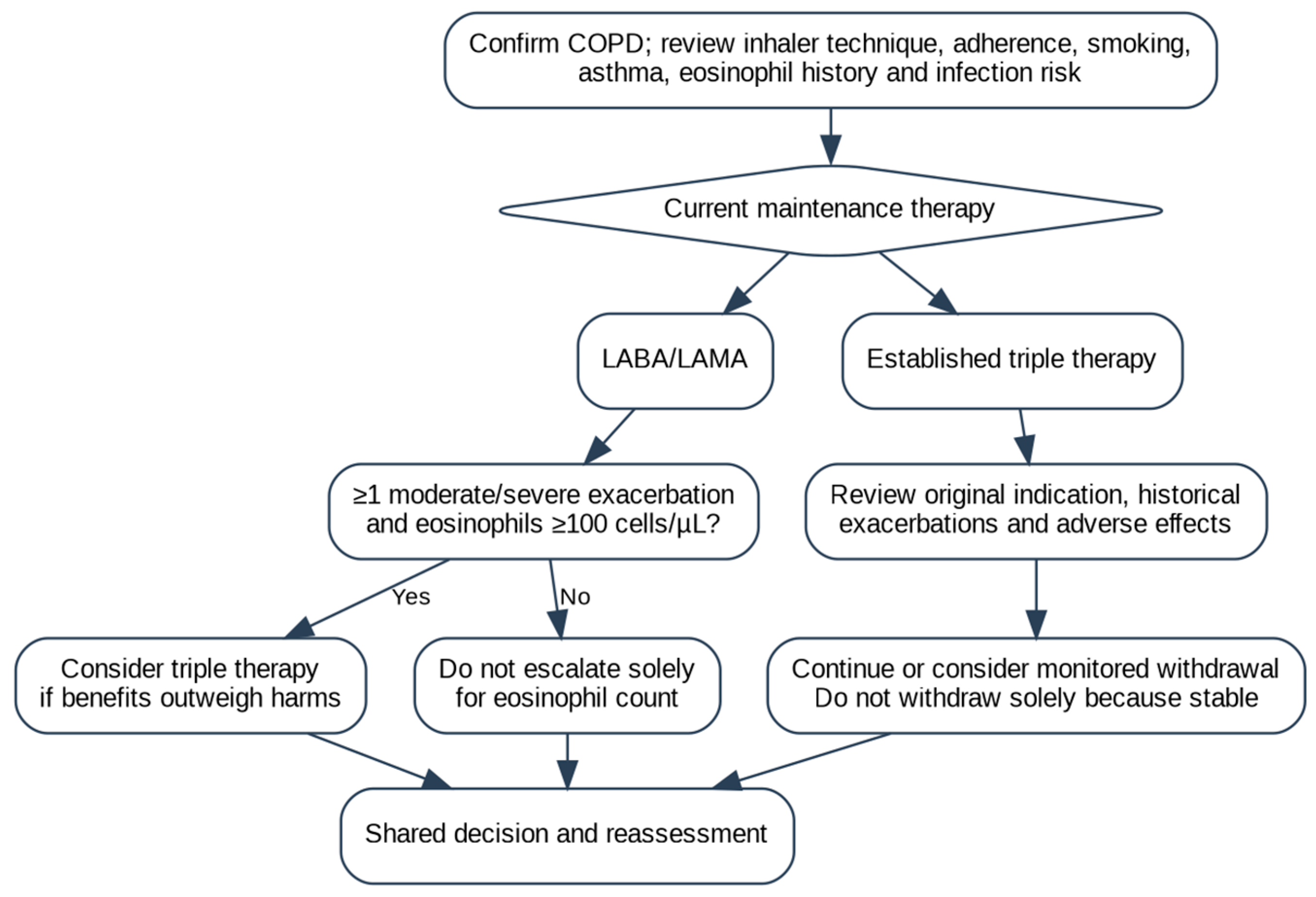
In patients already receiving optimized LABA/LAMA, GOLD 2026 supports considering escalation to triple therapy after at least one moderate or severe exacerbation when blood eosinophils are ≥100 cells/µL, after checking adherence and inhaler technique [1]. This is distinct from the expected absolute benefit: recurrent or severe exacerbations increase baseline risk and generally strengthen the case for ICS, while a patient with no recent exacerbations should not be escalated solely because eosinophils are 100–299 cells/µL. Assess asthma separately, as concomitant asthma changes ICS indications. Treatment decisions should incorporate infection susceptibility and prior ICS exposure. In established triple-therapy users, stability alone is not a reason for withdrawal; review historical exacerbations and eosinophils, adverse effects and the original indication [1,13,14,15].
Prior treatment history should be documented before changing the regimen. A patient who previously experienced deterioration after corticosteroid withdrawal poses a different question from a patient who has never received ICS. Likewise, a person stable for years on triple therapy may prefer continuity, while another with recurrent pneumonia may prioritize de-escalation. Neither preference proves a biological response, but both are relevant to the net clinical benefit of the chosen strategy. Asthma must be evaluated separately because coexisting asthma changes the role of inhaled corticosteroids and limits the applicability of a COPD-only withdrawal framework [1,2,13]. Table 2 summarizes the clinical implications across treatment scenarios.
Table 2.
Clinical interpretation of the available evidence.
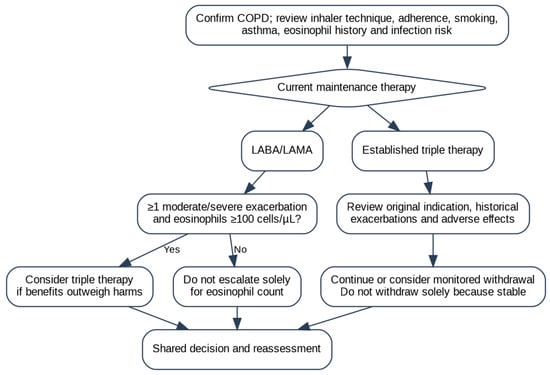
A practical sequence is: (1) confirm the COPD diagnosis and characterize exacerbations in the previous year, including a single moderate or severe event; (2) verify LABA/LAMA optimization, adherence, inhaler technique and smoking status; (3) review repeated eosinophil measurements and sampling conditions; (4) assess asthma features, prior ICS response, pneumonia, bronchiectasis and recurrent infections; (5) discuss expected absolute exacerbation benefit and potential harms; and (6) select escalation, continuation or monitored withdrawal as appropriate, followed by reassessment. This is a clinical reasoning aid, not a validated prediction rule (Figure 1).
Figure 1.
Suggested clinical decision pathway for ICS use in COPD with intermediate blood eosinophil counts.
8. Limitations of the Available Evidence
The evidence base is constrained by both statistical and clinical heterogeneity. Post hoc subgroup analyses can be vulnerable to multiplicity, reduced precision and selective emphasis on apparently favorable contrasts. The absence of a significant subgroup interaction is not necessarily evidence of uniform benefit, while an apparently large effect in a small subgroup may be unstable. Some analyses use continuous eosinophil modeling and others use categories whose boundaries do not align exactly with 100–299 cells/µL. This prevents straightforward numerical comparison and is one reason a single pooled estimate would be misleading [3,4,5,6,7,8,9,10,11].
Other limitations concern transportability. Large randomized trials may enroll patients with greater symptom burden or exacerbation risk than routine primary-care populations. Prior ICS exposure, smoking patterns, comorbidity exclusions and background care vary. Outcomes are also measured over different time horizons, with relatively short studies less informative about longer-term pneumonia risk and sustained clinical stability. Finally, published aggregate data rarely identify which individual patients experience a clinically meaningful net benefit. An average event-rate reduction is therefore an incomplete basis for individualized treatment decisions.
This narrative review has its own limitations. It was not based on a prospectively registered protocol, exhaustive database searches or duplicate independent study selection. It does not formally grade certainty across all outcomes and should not be interpreted as a systematic review or meta-analysis. Its contribution is a transparent, clinically focused interpretation of the cited randomized and synthesis literature, emphasizing what can and cannot be concluded from intermediate-eosinophil subgroup findings. Overlapping parent trials and secondary analyses cannot be treated as independent populations. Table 3 provides a qualitative appraisal of evidence strength and clinical applicability.
Table 3.
Evidence certainty and applicability (qualitative appraisal; not formal GRADE).
9. Research Priorities
Future studies should make the treatment decision explicit at randomization. For patients not receiving ICS, the clinically relevant trial is initiation of triple therapy versus continued optimized LABA/LAMA. For established users, continuation versus carefully monitored withdrawal is a separate question. Stratification by exacerbation history, prior ICS exposure, smoking status and asthma exclusion would help distinguish genuine treatment-effect heterogeneity from differences in baseline risk. Repeated eosinophil measurements could also clarify the clinical consequences of within-person variability.
Research should report both relative and absolute measures for prespecified outcomes, including recurrent exacerbations, first severe exacerbation, hospital admissions, pneumonia and patient-reported health status. Longer follow-up would improve understanding of the persistence of benefit and the cumulative burden of adverse events. Individual-participant-data analyses, where feasible, may allow examination of interactions without arbitrary subdivision of the biomarker range. They should nevertheless prespecify models and account for overlap between publications arising from the same randomized trials.
The most useful endpoint for practice may be a transparent net-benefit assessment that incorporates exacerbation severity and treatment harms, rather than a binary label of ICS response. Any proposed prediction model would require external validation in representative populations before routine use. Until such evidence becomes available, clinicians should resist treating exploratory subgroup percentages as validated individual treatment probabilities.
10. Conclusions
In the intermediate eosinophil range, ICS treatment should be guided by exacerbation history, current therapy and safety, not by a single biomarker threshold. GOLD 2026 supports considering escalation after one moderate or severe exacerbation on LABA/LAMA when eosinophils are ≥100 cells/µL; recurrent events or severe events generally increase potential absolute benefit. In patients without recent exacerbations, routine escalation is not supported by exploratory subgroup findings. Stable long-term triple-therapy users should not undergo automatic ICS withdrawal [1,7,11,13,14,15].
Evidence from ETHOS and IMPACT supports an eosinophil-related gradient of exacerbation reduction, but the 100–299 cells/µL ETHOS estimate is post hoc and cannot establish an individual response probability. KRONOS findings in patients without recent exacerbations are hypothesis-generating. A balanced decision should incorporate repeated eosinophil values, exacerbation severity, prior ICS exposure, coexisting asthma, adherence, inhaler technique and pneumonia or bronchiectasis risk. The available evidence does not establish a universal net benefit across this entire interval [1,2,3,4,5,6,7,8,9,10,11,12,13,14,15].
Author Contributions
Conceptualization, methodology, investigation, evidence interpretation, writing—original draft preparation, and writing—review and editing: J.M.-C., P.V.C., A.F., E.P., S.G., M.T.C.-A., P.M.L.M., A.S.-A., J.D.-R., A.R.G., P.O.-S., J.J.-D. and P.G. All authors have read and agreed to the published version of the manuscript.
Funding
This work received support through the third edition of the PICARD Research Grants (PICARD III), convened by the Institut Universitari d’Investigació en Atenció Primària Jordi Gol (IDIAPJGol) and the Institut Català de la Salut (ICS), with funding from the Diputació de Lleida. No grant identifier has been provided. The authors are responsible for the content of this review.
Institutional Review Board Statement
Not applicable.
Informed Consent Statement
Not applicable.
Data Availability Statement
No new data were created or analyzed in this study. Data sharing is not applicable to this article. The published studies discussed are identified in the reference list.
Acknowledgments
The authors take responsibility for the scientific content and interpretation of this review.
Conflicts of Interest
The authors declare no conflicts of interest.
References
- Global Initiative for Chronic Obstructive Lung Disease (GOLD). Global Strategy for the Diagnosis, Management, and Prevention of Chronic Obstructive Pulmonary Disease: 2026 Report. Available online: https://goldcopd.org/ (accessed on 21 October 2026).
- Agustí, A.; Celli, B.R.; Criner, G.J.; Halpin, D.; Anzueto, A.; Barnes, P.; Bourbeau, J.; Han, M.K.; Martinez, F.J.; de Oca, M.M.; et al. Global Initiative for Chronic Obstructive Lung Disease 2023 Report: GOLD Executive Summary. Eur. Respir. J. 2023, 61, 2300239. [Google Scholar] [CrossRef] [Scilit] [PubMed]
- Dalin, D.A.; Lokke, A.; Kristiansen, P.; Jensen, C.; Birkefoss, K.; Christensen, H.R.; Godtfredsen, N.S.; Hilberg, O.; Rohde, J.F.; Ussing, A.; et al. A systematic review of blood eosinophils and continued treatment with inhaled corticosteroids in patients with COPD. Respir. Med. 2022, 198, 106880. [Google Scholar] [CrossRef] [Scilit] [PubMed]
- Lipson, D.A.; Barnhart, F.; Brealey, N.; Brooks, J.; Criner, G.J.; Day, N.C.; Dransfield, M.T.; Halpin, D.M.; Han, M.K.; Jones, C.E.; et al. Once-Daily Single-Inhaler Triple versus Dual Therapy in Patients with COPD. N. Engl. J. Med. 2018, 378, 1671–1680. [Google Scholar] [CrossRef] [Scilit] [PubMed]
- Pascoe, S.; Barnes, N.; Brusselle, G.; Compton, C.; Criner, G.J.; Dransfield, M.T.; Halpin, D.M.G.; Han, M.K.; Hartley, B.; Lange, P.; et al. Blood eosinophils and treatment response with triple and dual combination therapy in chronic obstructive pulmonary disease: Analysis of the IMPACT trial. Lancet Respir. Med. 2019, 7, 745–756. [Google Scholar] [CrossRef] [Scilit] [PubMed]
- Rabe, K.F.; Martinez, F.J.; Ferguson, G.T.; Wang, C.; Singh, D.; Wedzicha, J.A.; Trivedi, R.; Rose, E.S.; Ballal, S.; McLaren, J.; et al. Triple Inhaled Therapy at Two Glucocorticoid Doses in Moderate-to-Very-Severe COPD. N. Engl. J. Med. 2020, 383, 35–48. [Google Scholar] [CrossRef] [Scilit] [PubMed]
- Bafadhel, M.; Rabe, K.F.; Martinez, F.J.; Singh, D.; Darken, P.; Jenkins, M.; Aurivillius, M.; Patel, M.; Dorinsky, P. Benefits of Budesonide/Glycopyrronium/Formoterol Fumarate Dihydrate on COPD Exacerbations, Lung Function, Symptoms, and Quality of Life Across Blood Eosinophil Ranges: A Post-Hoc Analysis of Data from ETHOS. Int. J. Chron. Obstruct. Pulmon. Dis. 2022, 17, 3061–3073. [Google Scholar] [CrossRef] [Scilit] [PubMed]
- Singh, D.; Rabe, K.F.; Martinez, F.J.; Krüll, M.; Jenkins, M.; Patel, M.; Dorinsky, P. Relationship between prior inhaled corticosteroid use and benefits of budesonide/glycopyrronium/formoterol fumarate dihydrate on exacerbations, symptoms, health-related quality of life, and lung function in patients with chronic obstructive pulmonary disease: Analyses from the ETHOS study. Respir. Med. 2022, 197, 106857. [Google Scholar] [CrossRef] [Scilit] [PubMed]
- Papi, A.; Vestbo, J.; Fabbri, L.; Corradi, M.; Prunier, H.; Cohuet, G.; Guasconi, A.; Montagna, I.; Vezzoli, S.; Petruzzelli, S.; et al. Extrafine inhaled triple therapy versus dual bronchodilator therapy in chronic obstructive pulmonary disease (TRIBUTE): A double-blind, parallel group, randomised controlled trial. Lancet 2018, 391, 1076–1084. [Google Scholar] [CrossRef] [Scilit] [PubMed]
- Ferguson, G.T.; Rabe, K.F.; Martinez, F.J.; Fabbri, L.M.; Wang, C.; Ichinose, M.; Bourne, E.; Ballal, S.; Darken, P.; DeAngelis, K.; et al. Triple therapy with budesonide/glycopyrrolate/formoterol fumarate with co-suspension delivery technology versus dual therapies in chronic obstructive pulmonary disease (KRONOS): A double-blind, parallel-group, multicentre, phase 3 randomised controlled trial. Lancet Respir. Med. 2018, 6, 747–758. [Google Scholar] [CrossRef] [Scilit] [PubMed]
- Muro, S.; Kawayama, T.; Sugiura, H.; Seki, M.; Duncan, E.A.; Bowen, K.; Marshall, J.; Megally, A.; Patel, M. Benefits of budesonide/glycopyrronium/formoterol fumarate dihydrate on lung function and exacerbations of COPD: A post-hoc analysis of the KRONOS study by blood eosinophil level and exacerbation history. Respir. Res. 2024, 25, 297. [Google Scholar] [CrossRef] [Scilit] [PubMed]
- Wedzicha, J.A.; Banerji, D.; Chapman, K.R.; Vestbo, J.; Roche, N.; Ayers, R.T.; Thach, C.; Fogel, R.; Patalano, F.; Vogelmeier, C.F. Indacaterol–Glycopyrronium versus Salmeterol–Fluticasone for COPD. N. Engl. J. Med. 2016, 374, 2222–2234. [Google Scholar] [CrossRef] [Scilit] [PubMed]
- Chapman, K.R.; Hurst, J.R.; Frent, S.-M.; Larbig, M.; Fogel, R.; Guerin, T.; Banerji, D.; Patalano, F.; Goyal, P.; Pfister, P.; et al. Long-Term Triple Therapy De-escalation to Indacaterol/Glycopyrronium in Patients with Chronic Obstructive Pulmonary Disease (SUNSET): A Randomized, Double-Blind, Triple-Dummy Clinical Trial. Am. J. Respir. Crit. Care Med. 2018, 198, 329–339. [Google Scholar] [CrossRef] [Scilit] [PubMed]
- Pirera, E.; Di Raimondo, D.; Tuttolomondo, A. Triple Therapy De-Escalation and Withdrawal of Inhaled Corticosteroids to Dual Bronchodilator Therapy in Patients with Chronic Obstructive Pulmonary Disease (COPD): A Systematic Review and Meta-Analysis. J. Clin. Med. 2024, 13, 6199. [Google Scholar] [CrossRef] [Scilit] [PubMed]
- Watz, H.; Tetzlaff, K.; Wouters, E.F.M.; Kirsten, A.; Magnussen, H.; Rodriguez-Roisin, R.; Vogelmeier, C.; Fabbri, L.M.; Chanez, P.; Dahl, R.; et al. Blood eosinophil count and exacerbations in severe chronic obstructive pulmonary disease after withdrawal of inhaled corticosteroids: A post-hoc analysis of the WISDOM trial. Lancet Respir. Med. 2016, 4, 390–398. [Google Scholar] [CrossRef] [Scilit] [PubMed]
- Mari, P.V.; Coppola, A.; Ielo, S.; Scala, R.; de Corso, E.; Ojetti, V.; Ricci, A.; Baglioni, S.; Carriera, L. How many blood eosinophil measurements are needed to identify COPD patients eligible for biologic therapy? A multi-source decision analysis simulation. Eur. J. Intern. Med. 2026, 107012. [Google Scholar] [CrossRef] [Scilit] [PubMed]
- Baraldi, F.; Bartlett-Pestell, S.; Allinson, J.P.; Macleod, M.; Mah, J.; Bloom, C.; Braddy-Green, A.; Marion, A.; Papi, A.; Wedzicha, J.A.; et al. Blood eosinophil count stability in chronic obstructive pulmonary disease and the eosinophilic exacerbator phenotype. Am. J. Respir. Crit. Care Med. 2025, 211, 870–872. [Google Scholar] [CrossRef] [Scilit] [PubMed]

Disclaimer/Publisher’s Note: The statements, opinions and data contained in all publications are solely those of the individual author(s) and contributor(s) and not of MDPI and/or the editor(s). MDPI and/or the editor(s) disclaim responsibility for any injury to people or property resulting from any ideas, methods, instructions or products referred to in the content. |
© 2026 by the authors. Licensee MDPI, Basel, Switzerland. This article is an open access article distributed under the terms and conditions of the Creative Commons Attribution (CC BY) license.