


Abstract
Background/Objectives: The purpose of this study was to investigate the association between the dysfunctional adiposity index (DAI) and cardiometabolic abnormalities in Mexican adults, both overall and when stratified by body mass index (BMI) and waist circumference. Methods: Data from 12,166 adults were analyzed. Anthropometric measurements, biochemical markers, and self-reported diagnoses of type 2 diabetes (T2D), hypertension, hypercholesterolemia, and cardiovascular disease (CVD) were assessed. DAI values >1.065 were used to define dysfunctional adiposity. Multivariable logistic regression models were fitted to assess associations between elevated DAI and self-reported noncommunicable diseases (NCDs). Results: Overall, 76.6% of participants were overweight or obese, 81.6% had abdominal obesity, and 76.9% had elevated DAI. Among individuals with normal BMI, those with elevated DAI have higher odds ratios [95% confidence intervals] of T2D (3.11 [1.78, 5.41]), hypertension (1.60 [1.07, 2.41]), and hypercholesterolemia (2.78 [1.68, 4.61]) than those with normal DAI. Among individuals with overweight, elevated DAI was associated with higher odds ratios of T2D (2.61 [1.60, 4.25]) and hypercholesterolemia (1.88 [1.24, 2.84]). Among individuals with obesity, elevated DAI was associated with a higher odds ratio of hypercholesterolemia (1.76 [1.23, 2.51]), whereas the association with T2D did not reach statistical significance (1.54 [0.99, 2.40]; p = 0.056). Similar trends were found among individuals stratified by waist circumference. Elevated DAI was not significantly associated with CVD across BMI or waist circumference strata, while the odds of CVD among individuals with excessive adiposity and normal DAI were comparable to those observed among individuals with normal adiposity and normal DAI. Conclusions: Elevated DAI was associated with several cardiometabolic abnormalities across BMI and waist circumference strata. These findings suggest that DAI may provide complementary information for characterizing cardiometabolic abnormalities among individuals with similar adiposity levels.
1. Introduction
Increased adipose tissue (AT) has been associated with a higher risk of developing non-communicable diseases (NCDs) such as hypertension, type 2 diabetes (T2D), and cardiovascular disease (CVD) [1]. Nevertheless, several studies have reported that around 40% of adults with excessive adiposity do not exhibit NCDs, despite still having metabolic disorders such as dyslipidemia, elevated blood pressure, or glucose intolerance [2,3]. Conversely, metabolically unhealthy normal-weight individuals, defined as having normal body mass accompanied by metabolic disorders, have also been increasingly reported [4,5]. These findings suggest that the relationship between adiposity and NCDs may depend not only on total body mass measured with anthropometric tools, but also on other factors, such as AT function [6,7,8]. AT plays a crucial role in maintaining energy homeostasis by releasing free fatty acids and adipokines, regulating glucose and lipid metabolism, and contributing to immune balance [9,10]. Growing evidence over the last two decades has shown that dysfunctional AT—also referred to as adiposopathy—is characterized by reduced lipid storage capacity, increased fatty acid release, and altered adipokine production, which collectively contribute to the metabolic disorders that precede NCDs [10,11].
Although biochemical markers such as free fatty acids, inflammatory cytokines, or the adiponectin-to-leptin ratio have been proposed as early indicators of AT dysfunction [11], these biomarkers are not readily available in clinical practice. To address this, our group previously described and validated the dysfunctional adiposity index (DAI), a proxy measure of AT dysfunction based on clinically accessible parameters [12], primarily described by Amato M.C. et al. as the visceral adiposity index (VAI) [13]. Compared with the VAI, designed for a Caucasian population, the DAI was established for Hispanic subjects with different anthropometric and lipid profiles. Moreover, the DAI was validated using human AT biopsies, assessing morphological and functional adipocyte characteristics, and was subsequently associated with hypertension, T2D, subclinical atherosclerosis, and metabolic dysfunction-associated steatotic liver disease when its values were > 1.065. Nevertheless, these associations were reported in a small, non-representative population sample [12]. Assessing the DAI in a representative population could help define its utility in identifying individuals with a high probability of NCDs, enabling earlier and more targeted interventions to prevent further complications. Thus, the present study aimed to evaluate the association between DAI and cardiometabolic abnormalities in a representative open sample of the Mexican adult population, stratified by body mass index (BMI) and waist circumference.
2. Materials and Methods
The Mexican National Health and Nutrition Survey 2018 (ENSANUT-2018) was designed to estimate the frequency and distribution of health and nutritional conditions in the Mexican population, as well as related health risk factors, at national, regional, and local levels. The survey employed a cross-sectional, probabilistic design to ensure representativeness across the country’s 32 states. Data were collected from 50,654 households, and 17,176 adults aged 20 years and older provided information on sex, age, education, and socioeconomic status. Unfortunately, blood samples were not obtained from 4281 participants, leading to a sample of 12,895 participants, of whom 370 did not have the required 12 h of fasting and 359 did not have complete data for calculating the DAI (Table S1). Age was categorized into three groups, and a detailed description of the sampling procedures and survey methodology has been published previously [14]. For this analysis, data from participants with complete information on anthropometric measurements, biochemical measurements, and sociodemographic variables were used (Figure S1).
2.1. Anthropometric Measurements
Weight, height, and waist circumference (WC) were measured by trained personnel using standardized procedures in accordance with internationally accepted protocols [15]. BMI was calculated as weight in kilograms divided by height in meters squared (kg/m2). BMI categories were those proposed by the World Health Organization (WHO): normal (18.5 to 24.9 kg/m2), overweight (25.0 to 29.9 kg/m2), and obesity (≥30.0 kg/m2). Abdominal obesity was defined according to the International Diabetes Federation (IDF) classification: ≥80.0 cm in women and ≥90.0 cm in men [15]. Pregnant women were excluded from the present analysis.
2.2. Non-Communicable Diseases
The presence of T2D, hypertension, hypercholesterolemia, and CVD was determined based on participants’ self-reported history of a prior medical diagnosis by a physician.
2.3. Serum Biomarker Measurements
Fasting blood samples were collected after a 12-h overnight fast to assess serum concentrations of glucose, glycated hemoglobin (HbA1c), total cholesterol, high-density lipoprotein cholesterol (HDL-c), and triglycerides (Tg). All serum samples were analyzed at the Instituto Nacional de Ciencias Médicas y Nutrición Salvador Zubirán.
2.4. Dysfunctional Adiposity Index Estimation
The DAI was calculated as follows:
For men = ((WC [cm])/(22.79 + (2.68 × BMI [kg/m2])) × ((Tg [mmol/L])/1.37) × (1.19/(HDL-c [mmol/L]))
For women = ((WC [cm])/(24.02 + (2.37 × BMI [kg/m2]))) × ((Tg [mmol/L])/1.32) × (1.43/(HDL-c [mmol/L]))
Considering that parameters included in the algorithm are sex-specific, participants were considered to have elevated DAI when the value was >1.065, independently of sex [12]. This criterion was used in each BMI and waist circumference category.
2.5. Blood Pressure Measurement
Blood pressure was measured using the Omron HEM-907 XL digital sphygmomanometer, following the American Heart Association protocol [16]. Briefly, blood pressure was measured three times, and the average of the last two measurements was used in the analyses. Systolic blood pressure (SBP) values ≥ 80 mmHg and diastolic blood pressure (DBP) values ≥ 50 mmHg were considered valid.
2.6. Measurement of Other Covariates
Smoking status was self-reported and categorized into three groups: never smoked, ex-smoker (smoked more than five cigarettes in their lifetime but no longer smokes), and current smoker. Alcohol consumption was also self-reported and categorized as non-consumer, non-heavy consumer (≤4 drinks per week), or heavy consumer (≥5 drinks per week). Physical activity was measured using the short IPAQ questionnaire for adults aged 20 to 69 years and categorized as inactive, moderately active, or active according to compliance with WHO recommendations. Energy intake was assessed using a food frequency questionnaire covering the previous 7 days, and total energy intake was calculated.
Educational attainment was determined based on the highest level completed and grouped into five categories: no schooling, elementary, junior high school, high school, and university or higher. Place of residence was categorized according to population size: urban (≥2500 inhabitants) and rural (<2500 inhabitants).
The ENSANUT-2018 includes representative population samples from the four geographic regions of Mexico, grouped as follows: (a) North: Baja California, Baja California Sur, Coahuila, Chihuahua, Durango, Nuevo León, Sonora, Sinaloa, San Luis Potosí, Tamaulipas, and Zacatecas. (b) Center: Aguascalientes, Colima, Guanajuato, Hidalgo, Jalisco, Michoacán, Nayarit, Querétaro, and the rest of the State of Mexico. (c) Mexico City: Mexico City and the conurbated municipalities of the State of Mexico. (d) South: Campeche, Chiapas, Guerrero, Morelos, Oaxaca, Puebla, Tlaxcala, Quintana Roo, Tabasco, Veracruz, and Yucatán.
Socioeconomic status was assessed using an index derived from housing construction materials, household goods, and electrical appliances. The index was generated using principal component analysis based on a polychoric correlation matrix and was categorized into tertiles: low, medium, and high [14].
2.7. Ethical Aspects
The ENSANUT-2018 protocol received approval from the Research Ethics and Biosafety Committees of the Instituto Nacional de Salud Pública (protocol 1556, approved on 29 May 2018). All participants were informed about the study procedures and provided written informed consent.
2.8. Statistical Analysis
Prevalence rates were estimated for the sociodemographic and clinical characteristics of the study population, stratified by sex. Continuous variables were expressed as medians with 95% confidence intervals (95% CIs). The chi-square test was used to evaluate differences in NCD prevalence across DAI, BMI, and abdominal obesity categories. The Mann–Whitney U test was used to compare medians. Multiple logistic regression models were performed to assess the independence of the associations. Models were adjusted for sex, age, socioeconomic status, alcohol consumption, smoking, education, and calorie intake. Because physical activity data were available only for individuals aged 20–69 years (n = 10,872), including this variable in the models would have reduced the sample size and restricted the age range of the study population. Therefore, sensitivity analyses were conducted using a change-in-estimate approach to assess the potential impact of adjusting for physical activity. The estimated coefficients changed by no more than 5% after adjustment for this variable, suggesting that its omission had a limited impact on the estimates. Accordingly, physical activity was excluded from the final models to preserve the sample size and age range of the study population and maximize population representativeness. As an additional sensitivity analysis, regression models simultaneously including DAI, BMI, and waist circumference as continuous variables were fitted to assess the stability of the estimates. The estimates remained numerically stable. Because BMI and waist circumference are components of the DAI, they were not included as covariates in the primary models (Table S2). Results were reported as odds ratios with 95% confidence intervals. All analyses accounted for the complex survey design using the SVY module in Stata, version 14.0. The survey design variables specified in the SVY module were the blood subsample weight (ponderador_sangre), the stratification variable (est_var), and the primary sampling unit (PSU). p-values < 0.05 were considered statistically significant, whereas p-values ≥ 0.05 and <0.1 were interpreted as indicating no statistical significance.
3. Results
3.1. Information from the ENSANUT 2018 Dataset
The analysis included 12,166 individuals with sociodemographic, anthropometric, and biochemical information from the ENSANUT-2018 dataset. Table 1 presents the descriptive characteristics of the study population. The proportion of men and women was similar. Compared with women, men have a lower prevalence of age ≥ 60 years and urban residence. Conversely, men have a higher energy intake and a higher prevalence of low socioeconomic status, university education, smoking, alcohol consumption, and active physical activity. Concerning previously diagnosed NCDs, 12.3% of participants self-reported a previous diagnosis of T2D, 21.8% of hypertension, 18.9% of hypercholesterolemia, and 3.8% of cardiovascular disease. These abnormalities were significantly higher among women, except for cardiovascular disease, which was similar between sexes. Adiposity, HbA1c, and Tg averages were above normal values in both men and women.
Table 1.
Sociodemographic, clinical, and biochemical characteristics of the Mexican adult population included in the ENSANUT 2018.
3.2. Prevalence of Overweight/Obesity
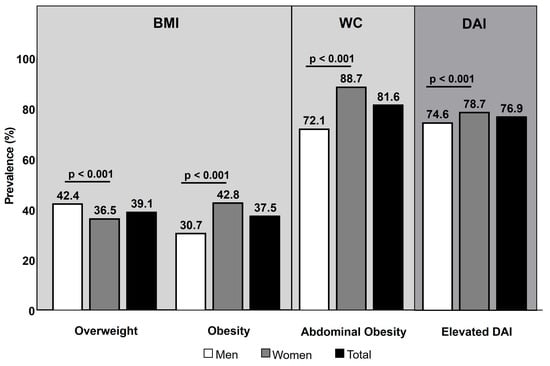
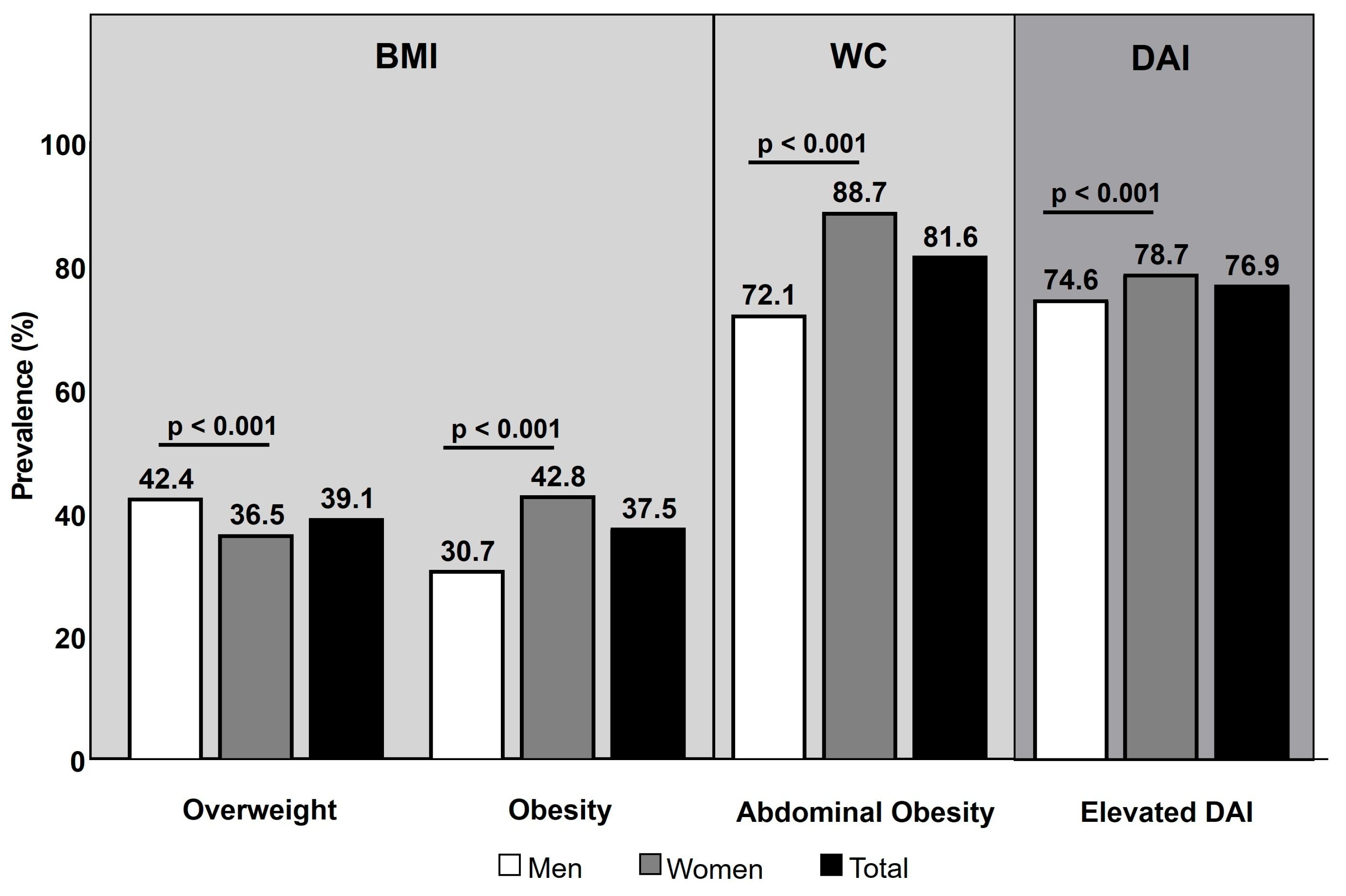
The adiposity analysis shows that 76.6% of the studied population are overweight or obese, 81.6% have abdominal obesity, and 76.9% present elevated DAI values (Figure 1).
Figure 1.
Prevalence of overweight/obesity by body mass index (BMI), abdominal obesity by waist circumference (WC), and elevated dysfunctional adiposity index (DAI) in the Mexican adult population of the ENSANUT 2018 study. Overweight BMI: 25.0 to 29.9 kg/m2; obese BMI: ≥ 30.0 kg/m2. Abdominal obesity was defined as a waist circumference ≥80.0 cm in women and ≥90.0 cm in men. Elevated DAI was defined as DAI values >1.065. p-values by Chi2.
3.3. Prevalence of Non-Communicable Diseases Across BMI or Abdominal Obesity
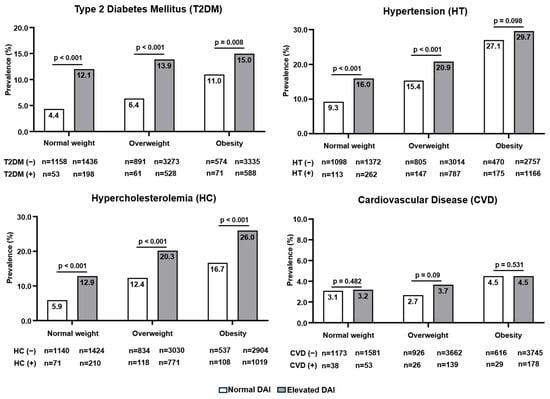
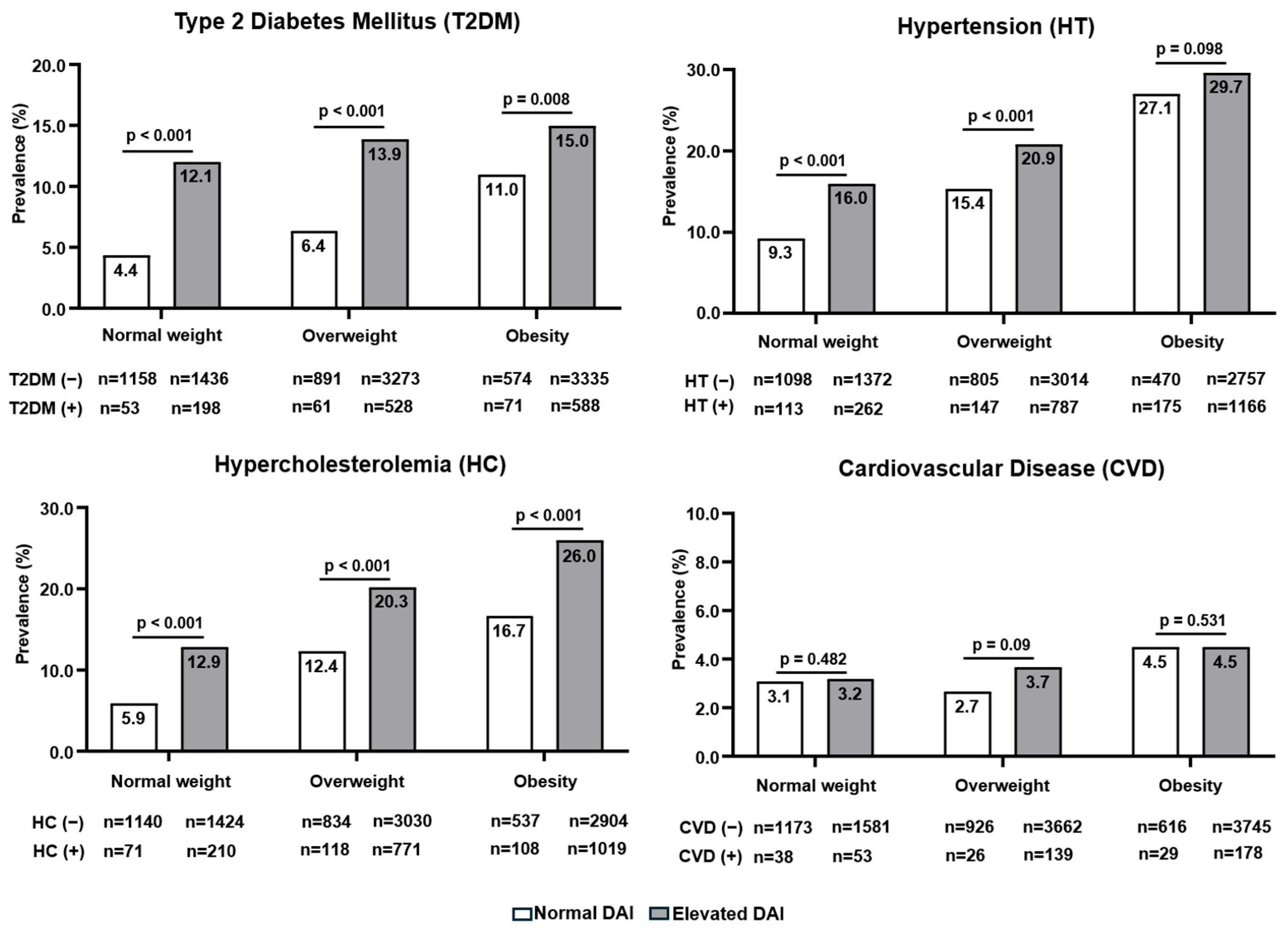
The prevalence of self-reported T2D, hypertension, hypercholesterolemia, and CVD across BMI (Figure 2) or abdominal obesity (Figure 3) categories shows that individuals with elevated DAI exhibited consistently higher NCD prevalence than those with normal DAI. This pattern was particularly striking among participants with normal BMI; compared with normal DAI, those with elevated DAI had 175%, 72%, and 119% higher prevalence of T2D, hypertension, and hypercholesterolemia, respectively (p < 0.0001 for all). Subjects with normal or elevated DAI have a similar prevalence of cardiovascular disease among those with normal BMI. The analysis of overweight subjects showed that compared to participants with normal DAI, those with elevated DAI had a 117% higher prevalence of T2D (p < 0.001), 34% higher probability of hypertension (p < 0.001), 64% higher hypercholesterolemia prevalence (p < 0.001), and a trend to 37% greater prevalence of CVD (p = 0.09). When participants with obesity by BMI were analyzed, we found that, compared with those categorized as having normal DAI, those with elevated DAI had higher T2D (38%, p = 0.008) and hypercholesterolemia (56%, p < 0.001) prevalence (Figure 2).
Figure 2.
Prevalence of non-communicable chronic diseases among adult Mexicans, stratified by body mass index (BMI) and the dysfunctional adiposity index (elevated DAI) in the ENSANUT 2018 study. Normal weight: BMI 18.5 to 24.9 kg/m2, overweight: BMI 25.0 to 29.9 kg/m2, and obesity: BMI ≥ 30.0 kg/m2. Elevated DAI was defined as DAI values >1.065. p-values by Chi2.
Figure 3.
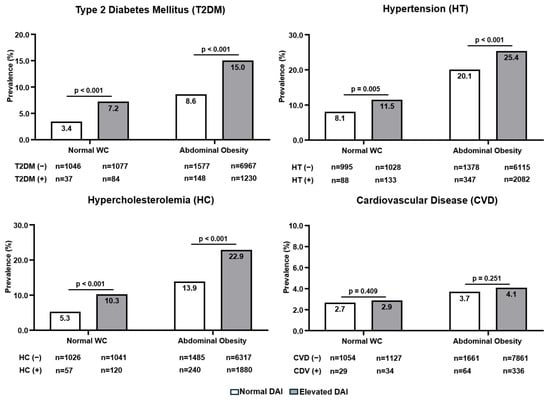
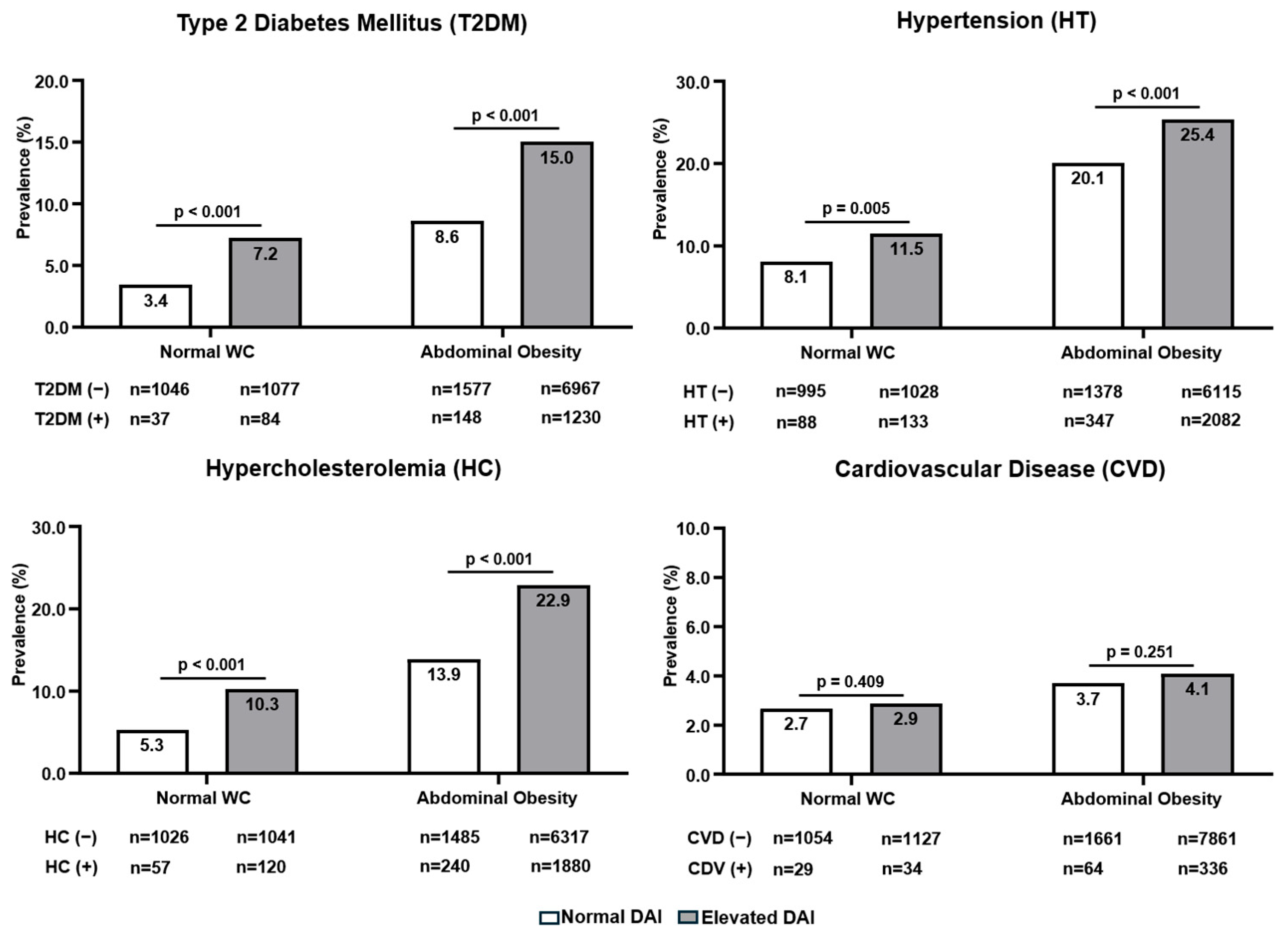
Prevalence of non-communicable chronic diseases among adult Mexicans, stratified by waist circumference and the dysfunctional adiposity index (elevated DAI) in the ENSANUT 2018 study. Abdominal obesity was defined as a waist circumference (WC) ≥ 80.0 cm in women and ≥ 90.0 cm in men. Elevated DAI was defined as DAI values > 1.065. p-values by Chi2.
The waist circumference variable also shows that subjects with normal waist circumference or abdominal obesity, but elevated DAI, have a significantly higher prevalence of NCDs than their counterparts with normal DAI, except for CVD (Figure 3).
To assess the associations between elevated DAI and self-reported NCDs, logistic regression models were fitted within BMI and abdominal adiposity strata, with adjustment for potential confounders. Overall, individuals with elevated adiposity had higher odds of NCDs than those with normal BMI and DAI. However, individuals with obesity and normal DAI did not have significantly higher odds of cardiovascular disease than those with normal BMI and DAI (Table S3). As shown in Table 2, among individuals with normal BMI, those with elevated DAI had significantly higher odds ratios of T2D, hypertension, and hypercholesterolemia compared to those with normal DAI. Among individuals with overweight, elevated DAI was associated with higher odds ratios of T2D and hypercholesterolemia, whereas the statistical association with cardiovascular disease only showed a trend (p = 0.075). Among individuals with obesity, those with elevated DAI had higher odds ratios of hypercholesterolemia, while the association with T2D showed a trend toward statistical significance (p = 0.056), compared with those with normal DAI.
Table 2.
Association * of the dysfunctional adiposity index with the presence of metabolic disorders in the Mexican adult population of the ENSANUT 2018 study, according to BMI or waist circumference strata.
A similar pattern was observed across waist circumference strata. Compared with individuals with normal waist circumference and normal DAI, those with abdominal obesity generally had higher odds of NCDs. However, individuals with abdominal obesity and normal DAI did not have significantly higher odds of cardiovascular disease than the reference group (Table S3). Among individuals with normal waist circumference, those with elevated DAI had significantly higher odds ratios of T2D and hypercholesterolemia, whereas the association with hypertension only showed a trend (p = 0.084). In contrast, among individuals with abdominal obesity, those with elevated DAI had significantly higher ratios of T2D, hypertension, and hypercholesterolemia compared to those with normal DAI (Table 2).
4. Discussion
This study evaluated the association between elevated DAI and self-reported NCDs in a nationally representative sample of Mexican adults across BMI and waist circumference strata. The findings revealed that the associations between DAI and NCDs varied according to the anthropometric stratum and the specific condition examined. Among individuals with normal BMI, elevated DAI was significantly associated with higher odds of T2D, hypertension, and hypercholesterolemia. Among participants with overweight, elevated DAI was associated with higher odds of T2D and hypercholesterolemia, whereas among those with obesity, the association was statistically significant only for hypercholesterolemia. A similar pattern was observed across waist circumference strata: among those with a normal waist circumference, elevated DAI was associated with higher odds of T2D and hypercholesterolemia, while among those with abdominal obesity, elevated DAI was associated with higher odds of T2D, hypertension, and hypercholesterolemia. Notably, participants with overweight/obesity or abdominal obesity and normal DAI did not show significantly higher odds of CVD as compared with those with normal BMI/waist circumference and normal DAI (Table S3). Taken together, these findings suggest that elevated DAI is associated with selected NCDs across different anthropometric strata, including among individuals classified as having normal adiposity. However, these associations should not be interpreted as evidence of causality or as demonstrating the clinical utility of DAI.
Although BMI and waist circumference have been widely used in population-based studies to assess excess adiposity and identify individuals at increased risk of metabolic diseases, these indicators have important limitations [17,18,19,20]. In particular, they do not distinguish between fat mass, lean mass, and water, which are key components of body composition [21,22]. Moreover, despite advanced techniques such as dual-energy X-ray absorptiometry, computed tomography, and magnetic resonance imaging being proposed to assess body composition, these technologies do not directly characterize the functional properties of AT. When combined with biochemical markers of inflammation, endocrine function, and metabolism, they can provide additional insights into fat distribution and function, as well as their relationship with NCDs [11,23,24,25]. Nevertheless, the high cost of these technologies and the limited availability of specialized biochemical assays, which are often restricted to research settings, limit their widespread application in population-based studies [26]. These limitations highlight the importance of investigating accessible complementary tools that may help characterize AT dysfunction in epidemiological research. DAI is an indirect indicator of AT function based on the VAI formula originally described for Caucasian populations [12,13]. It relies on readily accessible anthropometric and biochemical parameters and has been associated with NCDs when its values are >1.065 [12].
Although several anthropometric indices have been proposed to characterize the relationship between excess adiposity and NCDs [27], most primarily reflect body mass or fat distribution rather than the functional properties of AT [6,8,28]. Emerging evidence suggests that metabolic abnormalities may be more closely related to impaired AT function than to fat mass alone [9,10,11,29]. In this context, Reyes-Barrera J. et al. previously developed and validated the DAI in Hispanic subjects and reported better diagnostic performance for identifying NCDs than that of BMI and waist circumference [12]. The present findings extend this evidence by showing that, in a Hispanic population-based study, elevated DAI was associated with T2D, hypertension, and hypercholesterolemia among individuals with normal BMI or waist circumference. In an additional analysis, we compared the associations of DAI and VAI with self-reported NCDs using multivariable models adjusted for the same covariates and treating both indices as continuous variables. This approach was used because no established cutoff is available for the VAI to define high levels. The results show that both indices were significantly associated with each NCD. The odds ratios per standard deviation increase were similar for DAI and VAI across all outcomes (Table S4). These results are particularly relevant because they show that self-reported cardiometabolic conditions are associated with increasing dysfunctional AT indices, even among individuals not classified as having excess adiposity according to conventional anthropometric measures. Our findings are in line with previous reports showing that some individuals with excess adiposity exhibit a relatively favorable metabolic profile [2,6,8], whereas others with normal body weight have metabolic abnormalities [4,5]. Nevertheless, the present study does not establish whether the DAI provides clinically meaningful information beyond conventional adiposity measures or improves disease identification or clinical decision-making. This limitation is further underscored by an additional analysis in the present study comparing the area under the receiver operating characteristic curve (AUC) for models incorporating the DAI, BMI, waist circumference, or the Tg/HDL-c ratio as independent variables to identify NCDs. The AUC estimates were similar across these measures (Table S5). Thus, these findings support further investigation of markers intended to capture AT dysfunction alongside conventional anthropometric measures to better characterize metabolic health.
AT dysfunction is associated with several metabolic abnormalities, including inflammation, insulin resistance, oxidative stress, and dyslipidemia, which are implicated in the development and progression of NCDs and contribute to the global burden of morbidity and mortality [30,31]. Moreover, lifestyle factors, including physical inactivity and poor dietary patterns, may impair AT function and contribute to metabolic disturbances even in the absence of excess adiposity [30,32,33,34]. These mechanisms provide a plausible biological context for the associations observed in the present study, particularly those involving T2D and hypercholesterolemia among individuals with normal anthropometric measurements. However, because of the cross-sectional design, it is not possible to determine whether elevated DAI precedes the development of these conditions or reflects metabolic alterations associated with existing disease. Therefore, longitudinal studies are needed to clarify the temporal relationship between DAI and NCDs and to determine whether DAI is associated with the subsequent development of cardiometabolic conditions.
Several limitations should be acknowledged. First, the cross-sectional design precludes causal inference and does not allow us to establish the temporal relationship between elevated DAI and NCDs. Second, 5010 participants were excluded due to technical issues with blood sample collection or processing, potentially introducing selection bias (Supplementary Figure S1 and Table S1). Although ENSANUT 2018 used a probabilistic sampling design to ensure national representativeness, this does not preclude selection bias due to missing data. Third, NCD status was based on self-reported previous diagnoses, which may have introduced misclassification. Fourth, the study did not account for pharmacological treatments among participants with NCDs, which may have influenced biochemical measurements and the resulting DAI values. However, previous research in Mexican populations, both among individuals without coronary artery disease [35,36,37] and among those with premature cardiovascular disease [38,39,40], has highlighted the relevance of AT dysfunction in cardiometabolic health. These findings provide context for the present results but do not eliminate the potential influence of medication use. Fifth, although we adjusted for several potential confounders, residual confounding cannot be excluded. Finally, we did not evaluate the diagnostic accuracy, prospective predictive performance, calibration, or clinical utility of DAI. Accordingly, the observed associations should not be interpreted as evidence that DAI can diagnose or predict NCDs, prevent their development, or guide clinical interventions. Further prospective studies and clinical validation are required to establish its predictive performance and determine whether it provides meaningful information beyond conventional anthropometric measures and established clinical risk indicators. Despite these limitations, this study has important strengths, including its large sample size, population-based design, and national coverage through ENSANUT-2018, which support the generalizability of the findings to the adult Mexican population.
5. Conclusions
The present study found associations between elevated DAI and self-reported NCDs across different anthropometric strata, including among individuals classified as having normal adiposity. These findings suggest that DAI could provide information for characterizing the relationship between adiposity and NCDs in epidemiological research. However, the cross-sectional design precludes causal inferences, and the potential clinical utility of DAI remains to be established. Further prospective studies and clinical validation are needed to assess its predictive performance and determine its potential role in clinical practice.
Supplementary Materials
The following supporting information can be downloaded at: https://www.mdpi.com/article/10.3390/medsci14080805/s1. Figure S1. Sample selection. The ENSANUT-2018 Mexican survey employed a cross-sectional, probabilistic design to ensure representativeness across the country’s 32 states. Table S1. Sociodemographic and clinical characteristics of participants in the Mexican National Health and Nutrition Survey 2018 (ENSANUT 2018) stratified by blood sample collection. Table S2. Association of the dysfunctional adiposity index with the presence of metabolic disorders in the Mexican adult population of the ENSANUT 2018 study, after adjustment for continuous BMI and waist circumference. Table S3. Association of the dysfunctional adiposity index with the presence of metabolic disorders in the Mexican adult population of the ENSANUT 2018 study. Table S4. Association of the dysfunctional adiposity index (DAI) and visceral adiposity index (VAI) with self-reported non-communicable diseases (NCDs) in the Mexican adult population of the ENSANUT 2018 study. Table S5. Area under the receiver operating characteristic (ROC) curve for self-reported noncommunicable diseases (NCDs) in the Mexican adult population of the ENSANUT 2018 study.
Author Contributions
Conceptualization, J.G.J.-R., L.G.C.-P. and I.T.-V.; methodology, J.G.J.-R., I.T.-V., E.D.-G., I.C.-N. and S.B.-C.; formal analysis, J.G.J.-R. and L.H.-B.; investigation, J.G.J.-R., I.T.-V., M.A.-R., I.C.-N., M.A.S.-M. and L.G.C.-P.; resources, M.A.S.-M.; data curation, L.H.-B.; writing—original draft preparation, J.G.J.-R., L.H.-B. and L.G.C.-P.; writing—review and editing, J.G.J.-R., I.T.-V., L.H.-B., E.D.-G., M.A.-R., I.C.-N., M.A.S.-M., S.B.-C. and L.G.C.-P.; project administration, J.G.J.-R.; funding acquisition, L.G.C.-P. All authors have read and agreed to the published version of the manuscript.
Funding
Open Access funding for this article was supported by the Instituto Nacional de Cardiología Ignacio Chávez.
Institutional Review Board Statement
The study was conducted in accordance with the Declaration of Helsinki and approved by the Institutional Research, Safety, and Ethics Committees of Instituto Nacional de Salud Pública (protocol 1556 approved on 29 May 2018).
Informed Consent Statement
Informed consent was obtained from all subjects involved in the study.
Data Availability Statement
The original contributions presented in this study are included in the article/Supplementary Materials. Further inquiries can be directed to the corresponding author.
Conflicts of Interest
The authors declare no conflicts of interest. The funders had no role in the design of the study; in the collection, analyses, or interpretation of data; in the writing of the manuscript; or in the decision to publish the results.
Abbreviations
The following abbreviations are used in this manuscript:
| DAI | Dysfunctional Adiposity Index |
| BMI | Body Mass Index |
| T2D | Diabetes |
| CVD | Cardiovascular Disease |
| AT | Adipose Tissue |
| NCDs | Non-Communicable Diseases |
| ENSANUT | Mexican National Health and Nutrition Survey |
| WC | Waist Circumference |
| HbA1c | Glycated Hemoglobin |
| HDL-c | High-Density Lipoprotein Cholesterol |
| TG | Triglycerides |
| SBP | Systolic Blood Pressure |
| DBP | Diastolic Blood Pressure |
References
- Longo, M.; Zatterale, F.; Naderi, J.; Parrillo, L.; Formisano, P.; Raciti, G.A.; Beguinot, F.; Miele, C. Adipose Tissue Dysfunction as Determinant of Obesity-Associated Metabolic Complications. Int. J. Mol. Sci. 2019, 20, 2358. [Google Scholar] [CrossRef] [Scilit] [PubMed]
- Smith, G.I.; Mittendorfer, B.; Klein, S. Metabolically healthy obesity: Facts and fantasies. J. Clin. Investig. 2019, 129, 3978–3989. [Google Scholar] [CrossRef] [Scilit] [PubMed]
- An, S.M.; Cho, S.H.; Yoon, J.C. Adipose Tissue and Metabolic Health. Diabetes Metab. J. 2023, 47, 595–611. [Google Scholar] [CrossRef] [Scilit] [PubMed]
- Caleyachetty, R.; Thomas, G.N.; Toulis, K.A.; Mohammed, N.; Gokhale, K.M.; Balachandran, K.; Nirantharakumar, K. Metabolically Healthy Obese and Incident Cardiovascular Disease Events Among 3.5 Million Men and Women. J. Am. Coll. Cardiol. 2017, 70, 1429–1437. [Google Scholar] [CrossRef] [Scilit] [PubMed]
- Gao, J.W.; You, S.; Liu, Z.Y.; Hao, Q.Y.; Wang, J.F.; Vuitton, D.A.; Zhang, S.L.; Liu, P.M. Different Metabolic Phenotypes of Obesity and Risk of Coronary Artery Calcium Progression and Incident Cardiovascular Disease Events: The CARDIA Study. Arterioscler. Thromb. Vasc. Biol. 2022, 42, 677–688. [Google Scholar] [CrossRef] [Scilit] [PubMed]
- Tandar, C.E.; Lin, J.C.; Stanford, F.C. Diagnosis, staging and management of obesity: A synthesis of contemporary guidelines. Nat. Rev. Endocrinol. 2026, 22, 706–716. [Google Scholar] [CrossRef] [Scilit] [PubMed]
- Rodriguez, C.; Ravussin, E. Does Metabolically Healthy Obesity Really Exist: Going Toward New Definitions. J. Clin. Endocrinol. Metab. 2026, 111, e2227–e2259. [Google Scholar] [CrossRef] [Scilit] [PubMed]
- Dardari, Z.A.; Yao, Z.; Zhang, J.; Bakoyannis, G.; Nan, H.; Staten, L.K.; Jha, K.K.; Tasdighi, E.; Jelwan, Y.; Burka, S.; et al. Risk Reclassification Beyond BMI by Waist Circumference and Waist-to-Hip Ratio Across Cardiovascular Outcomes: Results From the Cross-Cohort Collaboration. J. Am. Coll. Cardiol. 2026, 88, 670–684. [Google Scholar] [CrossRef] [Scilit] [PubMed]
- DeFronzo, R.A. Pathogenesis of type 2 diabetes mellitus. Med. Clin. N. Am. 2004, 88, 787–835. [Google Scholar] [CrossRef] [Scilit] [PubMed]
- Medina-Urrutia, A.X.; Torre-Villalvazo, I.; Juárez-Rojas, J.G. Adipose Tissue Immunometabolism: Unveiling the Intersection of Metabolic and Immune Regulation. Rev. Investig. Clin. 2024, 76, 65–79. [Google Scholar] [CrossRef] [Scilit] [PubMed]
- Bays, H.E.; Gonzalez-Campoy, J.M.; Bray, G.A.; Kitabchi, A.E.; Bergman, D.A.; Schorr, A.B.; Rodbard, H.W.; Henry, R.R. Pathogenic potential of adipose tissue and metabolic consequences of adipocyte hypertrophy and increased visceral adiposity. Expert. Rev. Cardiovasc. Ther. 2008, 6, 343–368. [Google Scholar] [CrossRef] [Scilit] [PubMed]
- Reyes-Barrera, J.; Sainz-Escarrega, V.H.; Medina-Urritia, A.X.; Jorge-Galarza, E.; Osorio-Alonso, H.; Torres-Tamayo, M.; Leal-Escobar, G.; Posadas-Romero, C.; Torre-Villalvazo, I.; Juarez-Rojas, J.G. Dysfunctional adiposity index as a marker of adipose tissue morpho-functional abnormalities and metabolic disorders in apparently healthy subjects. Adipocyte 2021, 10, 142–152. [Google Scholar] [CrossRef] [Scilit] [PubMed]
- Amato, M.C.; Giordano, C.; Galia, M.; Criscimanna, A.; Vitabile, S.; Midiri, M.; Galluzzo, A.; AlkaMeSy Study Group. Visceral Adiposity Index: A reliable indicator of visceral fat function associated with cardiometabolic risk. Diabetes Care 2010, 33, 920–922. [Google Scholar] [CrossRef] [Scilit] [PubMed]
- Romero-Martinez, M.; Shamah-Levy, T.; Vielma-Orozco, E.; Heredia-Hernandez, O.; Mojica-Cuevas, J.; Cuevas-Nasu, L.; Rivera-Dommarco, J.; Grupo de trabajo Ensanut 2018-19. National Health and Nutrition Survey 2018–19: Methodology and perspectives. Salud Publica Mex. 2019, 61, 917–923. [Google Scholar] [CrossRef] [Scilit] [PubMed]
- Kim, K.S.; Oh, H.J.; Choi, Y.J.; Huh, B.W.; Kim, S.K.; Park, S.W.; Lee, E.J.; Cho, Y.W.; Huh, K.B. Reappraisal of waist circumference cut off value according to general obesity. Nutr. Metab. 2016, 13, 26. [Google Scholar] [CrossRef] [Scilit] [PubMed]
- Pickering, T.G.; Hall, J.E.; Appel, L.J.; Falkner, B.E.; Graves, J.; Hill, M.N.; Jones, D.W.; Kurtz, T.; Sheps, S.G.; Roccella, E.J.; et al. Recommendations for blood pressure measurement in humans and experimental animals: Part 1: Blood pressure measurement in humans: A statement for professionals from the Subcommittee of Professional and Public Education of the American Heart Association Council on High Blood Pressure Research. Hypertension 2005, 45, 142–161. [Google Scholar] [CrossRef] [Scilit] [PubMed]
- Coelho, M.; Oliveira, T.; Fernandes, R. Biochemistry of adipose tissue: An endocrine organ. Arch. Med. Sci. 2013, 9, 191–200. [Google Scholar] [CrossRef] [Scilit] [PubMed]
- Nishida, C.; Ko, G.T.; Kumanyika, S. Body fat distribution and noncommunicable diseases in populations: Overview of the 2008 WHO Expert Consultation on Waist Circumference and Waist-Hip Ratio. Eur. J. Clin. Nutr. 2010, 64, 2–5. [Google Scholar] [CrossRef] [Scilit] [PubMed]
- Navarro, K.H.; Fernández, A.S. El ABCD de la Evaluación del Estado de Nutrición, 1st ed.; Publisher McGraw-Hill Interamericana: CDMX, Mexico, 2010. [Google Scholar]
- World Health Organization. Global database on body mass index: An interactive surveillance tool for monitoring nutrition transition. Public Health Nutr. 2006, 9, 658–660. [Google Scholar] [CrossRef] [Scilit]
- Moltrer, M.; Pala, L.; Cosentino, C.; Mannucci, E.; Rotella, C.M.; Cresci, B. Body mass index (BMI), waist circumference (WC), waist-to-height ratio (WHtR) e waist body mass index (wBMI): Which is better? Endocrine 2022, 76, 578–583. [Google Scholar] [CrossRef] [Scilit] [PubMed]
- Wu, Y.; Li, D.; Vermund, S.H. Advantages and Limitations of the Body Mass Index (BMI) to Assess Adult Obesity. Int. J. Environ. Res. Public Health 2024, 21, 757. [Google Scholar] [CrossRef] [Scilit] [PubMed]
- Lemos, T.; Gallagher, D. Current body composition measurement techniques. Curr. Opin. Endocrinol. Diabetes Obes. 2017, 24, 310–314. [Google Scholar] [CrossRef] [Scilit] [PubMed]
- Fang, H.; Berg, E.; Cheng, X.; Shen, W. How to best assess abdominal obesity. Curr. Opin. Clin. Nutr. Metab. Care 2018, 21, 360–365. [Google Scholar] [CrossRef] [Scilit] [PubMed]
- Bosy-Westphal, A.; Muller, M.J. Assessment of fat and lean mass by quantitative magnetic resonance: A future technology of body composition research? Curr. Opin. Clin. Nutr. Metab. Care 2015, 18, 446–451. [Google Scholar] [CrossRef] [Scilit] [PubMed]
- Lee, S.Y.; Gallagher, D. Assessment methods in human body composition. Curr. Opin. Clin. Nutr. Metab. Care 2008, 11, 566–572. [Google Scholar] [CrossRef] [Scilit] [PubMed]
- Physical Status: The Use of and Interpretation of Anthropometry, Report of a WHO Expert Committee. 1995. Available online: https://iris.who.int/handle/10665/37003 (accessed on 1 June 2026).
- Sun, L. ADA releases 2026 standards to guide obesity screening, diagnosis, evaluation, and staging. Innov. Nutr. 2026, 1, 100026. [Google Scholar] [CrossRef] [Scilit]
- Obesidad y Sobrepeso. 2025. Available online: https://www.who.int/es/news-room/fact-sheets/detail/obesity-and-overweight (accessed on 14 February 2025).
- Mavromatis, L.A.; Grams, M.E. Epidemiology of cardiovascular-kidney-metabolic syndrome. Nat. Rev. Nephrol. 2026, 22, 855–868. [Google Scholar] [CrossRef] [Scilit] [PubMed]
- Ryden, M. Perspectives on human adipose tissue: From cellular mechanisms to clinical complications. Diabetologia 2026, 69, 1731–1740. [Google Scholar] [CrossRef] [Scilit] [PubMed]
- Sprenkle, N.T.; Mills, E.L. Metabolite and nutrient regulation of macrophages in obesity and metabolic disease. Nat. Rev. Immunol. 2026, 26, 613–626. [Google Scholar] [CrossRef] [Scilit] [PubMed]
- Johnson, R.J.; Lanaspa, M.A.; Tolan, D.R.; Goncalves, M.D.; Softic, S.; Stanhope, K.L.; Sanchez-Lozada, L.G.; Herman, M.A.; Rabinowitz, J.D. Fructose: Metabolic signal and modern hazard. Nat. Metab. 2026, 8, 1019–1033. [Google Scholar] [CrossRef] [Scilit] [PubMed]
- Barazzoni, R.; Ballesteros, M.D.; Bischoff, S.C.; Blaauw, R.; Boirie, Y.; Carey, S.; Cederholm, T.; Cortes, Y.; Cuerda, C.; Deutz, N.E.P.; et al. Sarcopenic obesity: Call to action and nutritional agenda from the international clinical nutrition community. Clin. Nutr. 2026, 61, 106645. [Google Scholar] [CrossRef] [Scilit] [PubMed]
- Juarez-Rojas, J.G.; Torre-Villalvazo, I.; Medina-Urrutia, A.X.; Reyes-Barrera, J.; Sainz-Escarrega, V.H.; Posadas-Romero, C.; Macias-Cruz, A.; Jorge-Galarza, E. Participation of white adipose tissue dysfunction on circulating HDL cholesterol and HDL particle size in apparently healthy humans. Int. J. Obes. 2020, 44, 920–928. [Google Scholar] [CrossRef] [Scilit] [PubMed]
- Antonio-Villa, N.E.; Juarez-Rojas, J.G.; Posadas-Sanchez, R.; Reyes-Barrera, J.; Medina-Urrutia, A. Visceral adipose tissue is an independent predictor and mediator of the progression of coronary calcification: A prospective sub-analysis of the GEA study. Cardiovasc. Diabetol. 2023, 22, 81. [Google Scholar] [CrossRef] [Scilit] [PubMed]
- Medina-Urrutia, A.; Torre-Villalvazo, I.; Diaz-Villasenor, A.; Jorge-Galarza, E.; Cervantes-Perez, L.G.; Antonio-Villa, N.E.; Santibanez-Escobar, F.; Leal-Escobar, G.; Marquina-Castillo, B.; Martinez-Sanchez, F.D.; et al. The adiponectin/leptin ratio as a biomarker of adiposopathy and visceral adipose tissue accumulation: Sex-specific mechanisms. Adipocyte 2026, 15, 2653961. [Google Scholar] [CrossRef] [Scilit] [PubMed]
- Medina-Urrutia, A.X.; Antonio-Villa, N.E.; Martinez-Sanchez, F.D.; Posadas-Sanchez, R.; Bello-Chavolla, O.Y.; Martinez-Alvarado, M.D.R.; Jorge-Galarza, E.; Juarez-Rojas, J.G. Visceral Adipose Tissue is Associated with Recurrent Cardiovascular Events in Premature Coronary Artery Disease: Sub-analysis of the GEA study cohort. Eur. J. Prev. Cardiol. 2026, 33, 2582–2592. [Google Scholar] [CrossRef] [Scilit] [PubMed]
- Martinez-Sanchez, F.D.; Medina-Urrutia, A.X.; Jorge-Galarza, E.; Martinez-Alvarado, M.D.R.; Reyes-Barrera, J.; Osorio-Alonso, H.; Arellano-Buendia, A.S.; Del Carmen Gonzalez-Salazar, M.; Posadas-Sanchez, R.; Vargas-Alarcon, G.; et al. Effect of metabolic control on recurrent major adverse cardiovascular events and cardiovascular mortality in patients with premature coronary artery disease: Results of the Genetics of Atherosclerotic Disease study. Nutr. Metab. Cardiovasc. Dis. 2022, 32, 2227–2237. [Google Scholar] [CrossRef] [Scilit] [PubMed]
- Medina-Urrutia, A.X.; Martinez-Sanchez, F.D.; Posadas-Romero, C.; Jorge-Galarza, E.; Martinez-Alvarado, M.D.R.; Gonzalez-Salazar, M.D.C.; Osorio-Alonso, H.; Juarez-Rojas, J.G. Metabolic control achievement in a population with premature coronary artery disease: Results of the genetics of atherosclerotic disease study. Ther. Adv. Endocrinol. Metab. 2020, 11, 2042018820943374. [Google Scholar] [CrossRef] [Scilit] [PubMed]

Disclaimer/Publisher’s Note: The statements, opinions and data contained in all publications are solely those of the individual author(s) and contributor(s) and not of MDPI and/or the editor(s). MDPI and/or the editor(s) disclaim responsibility for any injury to people or property resulting from any ideas, methods, instructions or products referred to in the content. |
© 2026 by the authors. Licensee MDPI, Basel, Switzerland. This article is an open access article distributed under the terms and conditions of the Creative Commons Attribution (CC BY) license.