


Abstract
Background: ICU-admission lactate after liver transplantation (LT) may reflect perioperative stress, but its association with cumulative morbidity remains unclear. Methods: This retrospective cohort included 457 adults undergoing first LT between October 2015 and July 2026. ICU-admission lactate was evaluated in four prespecified strata (<2, 2–<5, 5–<10, ≥10 mmol/L). Outcomes included the Comprehensive Complication Index (CCI), adapted early allograft dysfunction (EAD), Toronto graft dysfunction, MEAF, and death or retransplantation at 7 and 30 days. Analyses included multivariable regression, ROC analysis, and bootstrap validation. Results: Strata comprised 178, 210, 51, and 18 recipients. Median CCI increased from 29.6 to 89.3 (p < 0.001). After adjustment, the ≥10 mmol/L group had a 40.1-point higher median CCI than the <2 mmol/L group (95% CI 27.1–53.0). Adapted EAD increased from 24.2% to 83.3%, and severe Toronto dysfunction from 0.6% to 61.1%. Seven-day death or retransplantation increased from 0% to 61.1% (adjusted HR per lactate doubling 2.83, 95% CI 2.15–3.72; AUC 0.869). Adding lactate increased the 30-day AUC from 0.691 to 0.800 (optimism-corrected: 0.652 to 0.767). Conclusions: ICU-admission lactate was associated with postoperative morbidity and early adverse outcomes, supporting risk stratification pending external validation.
1. Introduction
Early identification of liver transplant (LT) recipients at risk of an unfavorable postoperative course remains a major clinical challenge. Improvements in surgical technique, graft preservation, perioperative management, and postoperative care have substantially increased graft and patient survival, shifting increasing attention toward clinically relevant outcomes beyond death and graft loss [1,2]. Postoperative complications, organ-support requirements, reinterventions, and prolonged recovery remain frequent after LT and contribute substantially to morbidity and resource utilization [1,2]. Accordingly, early postoperative risk assessment should not be limited to the prediction of catastrophic outcomes but should also help identify patients likely to experience a more complex postoperative trajectory.
Blood lactate is routinely measured during LT and is immediately available at intensive care unit (ICU) admission. Lactate is particularly relevant in this setting because the liver plays a major role in systemic lactate clearance, while perioperative lactate concentrations are also influenced by global tissue perfusion, hemodynamic instability, metabolic stress, and the intraoperative course. Elevated perioperative lactate concentrations and impaired lactate clearance have repeatedly been associated with early allograft dysfunction, graft failure, retransplantation, and mortality after LT [3,4,5,6,7,8]. A systematic review and meta-analysis identified lactate as one of the early biomarkers with the strongest evidence for identifying early allograft dysfunction after LT [7].
Despite these associations, the clinical interpretation of a single lactate concentration at ICU admission may extend beyond the prediction of one specific complication. Previous studies have predominantly focused on isolated adverse outcomes, lactate clearance, measurements obtained at different perioperative or postoperative time points, or outcome-derived thresholds [3,4,5,6,7,8]. Most recently, peak lactate during the first postoperative day was shown to discriminate 90-day graft loss and was compared with established graft-function scores [8]. However, whether lactate available immediately upon ICU admission identifies progressively different degrees of subsequent postoperative morbidity and overall clinical complexity remains less well established.
ICU admission represents a particularly relevant time point for risk stratification because lactate is immediately available to the clinician receiving the patient, before subsequent biochemical evolution or established graft-dysfunction classifications become available. A prespecified stratification spanning the full range from normal lactate concentrations to severe hyperlactatemia may therefore provide an early framework for characterizing the subsequent postoperative course.
We hypothesized that lactate concentration at ICU admission provides a graded assessment of the subsequent postoperative trajectory after LT. The objective of this study was to evaluate the association between ICU-admission lactate concentrations and cumulative postoperative morbidity, assessed using the Comprehensive Complication Index, as well as graft dysfunction, early death or retransplantation, and the incremental prognostic value of lactate beyond conventional perioperative clinical variables.
2. Materials and Methods
2.1. Study Design and Population
This retrospective observational cohort study included consecutive adult recipients (≥18 years) undergoing first liver transplantation at a single tertiary referral center between October 2015 and July 2026. All liver grafts were obtained from deceased donors, including donation after brain death (DBD) and donation after circulatory death (DCD). Of 507 LT assessed during the study period, 50 were excluded: 44 repeat or re-repeat LT, 4 combined organ transplantations and 2 intraoperative deaths. Clinical, donor, intraoperative, and postoperative data were obtained from the institutional liver transplantation database. The final study cohort comprised 457 recipients with an available ICU-admission lactate measurement.
The study was conducted in accordance with the Declaration of Helsinki and was approved by the Ethics Committee of Hospital General Universitario Gregorio Marañón, Madrid, Spain (approval references 192/12 and 356/18; approval date: 8 March 2019). The requirement for written informed consent was waived by the Ethics Committee because of the retrospective nature of the study and the use of anonymized clinical data. The patient selection process is summarized in Supplementary Figure S1.
2.2. Perioperative Data Collection
Recipient, donor, graft, intraoperative, and postoperative variables were obtained from the institutional liver transplantation database. Recipient variables included demographic characteristics, liver disease severity, comorbidities, Model for End-Stage Liver Disease (MELD) score, portal vein thrombosis, and pretransplant pharmacological treatment. Pretransplant beta-blocker therapy consisted exclusively of non-selective beta-blockers prescribed for portal hypertension.
Donor and graft variables included donor age, ischemia time, graft weight, and preservation strategy. Hypothermic oxygenated machine perfusion (HOPE) was recorded as a graft preservation strategy, with unrecorded procedures indicating that HOPE had not been used. Intraoperative variables included operative duration (Interval from skin incision to completion of skin closure), transfusion requirements, norepinephrine use, epinephrine administration during graft reperfusion, postreperfusion syndrome, and hepatic arterial and portal venous flows. Epinephrine was administered as an occasional intravenous bolus to treat hemodynamic instability during graft reperfusion, not as a continuous infusion.
The primary exposure was the lactate concentration measured in the first arterial blood sample obtained immediately upon arrival at the postoperative intensive care unit, as part of routine admission assessment. This sample was collected systematically on ICU arrival, without a planned delay after admission. The interval between completion of surgery and ICU admission was generally approximately 30 min, primarily reflecting emergence from anesthesia and patient transfer. Thus, although the time elapsed from the end of surgery to sampling could vary between patients, lactate measurement was consistently performed at the same clinical time point: immediately upon ICU admission. This measurement was distinct from the last intraoperative blood-gas analysis, which frequently coincided with the sample obtained 60 min after graft reperfusion (R + 60).
For descriptive analyses, recipients were classified into four prespecified ICU-admission lactate strata: <2 mmol/L, 2–<5 mmol/L, 5–<10 mmol/L, and ≥10 mmol/L. These thresholds were selected a priori for clinical interpretability and were not derived from receiver operating characteristic analysis or optimized according to study outcomes.
2.3. Postoperative Morbidity and Graft Dysfunction
Cumulative postoperative morbidity during the index hospitalization was quantified using the Comprehensive Complication Index (CCI), a continuous score ranging from 0 (no complications) to 100 (death), which integrates postoperative complications according to their severity as graded by the Clavien–Dindo classification. The CCI was selected as the primary outcome because it captures the cumulative burden of postoperative complications rather than the severity of the single most serious event [9,10].
The CCI was retrospectively reconstructed from complications recorded in the clinical database. Complications occurring before or during surgery were not included. ICU-admission lactate concentrations were not used in the reconstruction or calculation of the CCI. Lactate was measured at ICU admission, corresponding to the beginning of the postoperative observation period.
Early graft dysfunction was characterized using the Olthoff early allograft dysfunction (EAD) criteria, the Toronto classification of graft dysfunction, and the Model for Early Allograft Function (MEAF) score [11,12,13]. Severe Toronto graft dysfunction was defined as Toronto grade III or IV and analyzed as a predefined binary outcome.
EAD was defined according to the original Olthoff criteria: AST or ALT > 2000 U/L within the first seven postoperative days, or INR ≥ 1.6 or total bilirubin ≥ 10 mg/dL on postoperative day 7. Laboratory measurements obtained after retransplantation were not used to classify the original graft. Recipients who died or underwent retransplantation before the required day-7 measurements were available and who had not already fulfilled the transaminase criterion were considered not assessable according to the original definition. For the exploratory analysis, an adapted EAD classification was also used, in which the last available laboratory measurements before death or retransplantation were considered when postoperative day-7 INR or bilirubin values were unavailable. This adapted approach does not constitute strict application of the original Olthoff criteria and was analyzed separately from the original definition. MEAF was calculated in recipients with sufficient postoperative laboratory data available within the predefined assessment period, and MEAF-specific analyses were restricted to these recipients. Graft failure was defined as loss of the original liver graft resulting in retransplantation or death attributed to graft failure. This outcome was distinguished from early allograft dysfunction, which was assessed using the Olthoff criteria, Toronto classification, and MEAF score.
Additional postoperative outcomes included prolonged mechanical ventilation, renal replacement therapy, surgical reintervention, retransplantation, sepsis, acute kidney injury, and mortality. Prolonged mechanical ventilation was defined as postoperative mechanical ventilation lasting more than 24 h. Acute kidney injury (AKI) was classified according to KDIGO criteria, with stages 2–3 considered clinically significant. Postoperative infections were identified from documented clinical diagnoses, supported by microbiological or radiological findings when appropriate. Sepsis was defined according to Sepsis-3 criteria.
2.4. Early Clinical Endpoints
Early adverse outcomes were evaluated at 7 and 30 days after liver transplantation. The principal composite endpoint was death or retransplantation, defined by whichever event occurred first. For time-to-event analyses, graft survival was defined as freedom from either death or retransplantation. Overall survival considered death as the event, with retransplantation not counted as death. Follow-up was administratively truncated at 7 or 30 days, according to the corresponding analysis.
At our institution, decisions regarding urgent retransplantation are made collectively by a multidisciplinary team comprising intensive care physicians, hepatologists, and transplant surgeons. These decisions are based on the patient’s evolving clinical condition, graft function, hemodynamic status, biochemical abnormalities, and imaging findings. In patients with suspected severe graft dysfunction or primary non-function, serial laboratory assessments are performed throughout the postoperative course. The trajectory of lactate concentrations, together with other clinical and biochemical parameters, is an important component of this multidisciplinary assessment. However, the single lactate concentration measured immediately upon ICU admission, which constitutes the primary exposure variable in the present study, is not used in isolation or as a predefined criterion for retransplantation. Rather, the decision is based on the patient’s subsequent clinical evolution and repeated assessments.
2.5. Statistical Analysis
Continuous variables were summarized as mean ± standard deviation or median [interquartile range], as appropriate, and categorical variables as counts and percentages. Comparisons across the four ICU admission lactate strata (<2, 2–<5, 5–<10, and ≥10 mmol/L) were performed using parametric or nonparametric tests for continuous variables and χ2 or Fisher exact tests for categorical variables, as appropriate.
The association between ICU admission lactate and the Comprehensive Complication Index (CCI) was assessed using Spearman rank correlation. Differences in CCI across lactate strata were evaluated using the Kruskal–Wallis test. Median regression was used to quantify the association between lactate and CCI, both per 1-mmol/L increase and across lactate strata. Multivariable models were adjusted for MELD, donor age, ischemia time, operative duration, transfusion of ≥4 red blood cell units, and intraoperative norepinephrine use.
As a sensitivity analysis, the association between ICU-admission lactate and CCI was reassessed after excluding patients who died during the index hospitalization, using the same statistical methods and adjustment covariates as in the primary analysis.
Covariates were selected a priori based on their clinical relevance as indicators of recipient disease severity, donor and graft characteristics, and intraoperative physiological stress, while limiting model complexity according to the available data and number of outcome events. The purpose of multivariable adjustment was to assess whether ICU-admission lactate remained associated with postoperative outcomes after accounting for major perioperative clinical characteristics, rather than to estimate an independent causal effect of lactate. Different covariate sets were used for the morbidity and incremental prognostic models versus the Cox survival models to account for differences in the outcomes analyzed and to maintain model parsimony, particularly given the limited number of early events. Restricted cubic splines were used to assess potential nonlinear associations between ICU-admission lactate and both CCI and the 30-day composite endpoint of death or retransplantation. Nonlinearity was evaluated by comparison with the corresponding linear model. These spline analyses were distinct from the adjusted incremental prediction model described in Section 2.8.
Missing data were not imputed. Descriptive analyses were based on available observations for each variable, whereas multivariable analyses were performed using complete cases for the covariates included in each model. The extent of missing data for individual variables is reported in the corresponding tables. Because different sets of covariates were used in the Cox survival models and the incremental prognostic models, the complete-case populations were not necessarily identical. Although both 30-day analyses included 454 recipients, the Cox model included 56 composite events, whereas the logistic prediction model included 55. These differences reflect the distinct patterns of missing covariate data and the resulting composition of the analytical samples.
2.6. Time-to-Event Analysis
The composite graft endpoint was defined as death or retransplantation, whichever occurred first. Kaplan–Meier curves were constructed to estimate graft survival according to ICU admission lactate strata at 7 and 30 days after transplantation, and differences between groups were assessed using the log-rank test. Kaplan–Meier analyses of overall survival were also performed at the same time horizons.
Cox proportional hazards regression was used to evaluate the association between ICU admission lactate and death or retransplantation at 7 and 30 days. Because of the skewed distribution of lactate and to provide a clinically interpretable effect estimate, lactate was log2-transformed, with hazard ratios expressed per doubling of lactate concentration. Univariable and multivariable hazard ratios (HRs) with 95% confidence intervals were estimated. Multivariable Cox models were adjusted for MELD, transfusion of ≥4 red blood cell units, hepatic artery flow, and portal thrombosis.
2.7. Discrimination Analysis
Receiver operating characteristic (ROC) curve analysis was used to evaluate the discriminative ability of ICU-admission lactate for death or retransplantation at 7 and 30 days and for selected postoperative outcomes. Areas under the ROC curve (AUCs) with 95% confidence intervals were estimated using 1000 bootstrap resamples.
For the 7- and 30-day composite endpoints, the optimal lactate threshold was identified using the Youden index. Youden-derived thresholds were identified in an exploratory, data-driven analysis and were not considered validated clinical decision thresholds. Sensitivity, specificity, positive predictive value, negative predictive value, positive and negative likelihood ratios, and overall accuracy were calculated at the corresponding cutoff. The diagnostic characteristics of clinically relevant lactate thresholds (≥2, ≥5, and ≥10 mmol/L) were also examined. For the 30-day composite endpoint, the discriminative performance of ICU-admission lactate was additionally compared with day-1 INR, AST, and bilirubin, using the complete-case cohort for this comparison.
2.8. Incremental Prognostic Value of ICU Admission Lactate
The incremental prognostic value of ICU-admission lactate for 30-day death or retransplantation was evaluated using logistic regression in recipients with complete covariate data (n = 454; 55 events). A prespecified perioperative clinical model included MELD score, donor age, ischemia time, operative duration, transfusion of ≥4 red blood cell units, and intraoperative norepinephrine use. ICU-admission lactate was subsequently added first as a linear term and then as a nonlinear term using a natural cubic spline with 2 degrees of freedom, one interior knot at 5.05 mmol/L, and boundary knots at 0.6 and 20.0 mmol/L.
Model performance was assessed using the area under the receiver operating characteristic curve (AUC) and Brier score. Nested models were compared using likelihood-ratio tests, with degrees of freedom determined by the difference in the number of estimated parameters. Internal validation was performed for all three models using 1000 bootstrap resamples to obtain optimism-corrected AUC and Brier scores. The bootstrap-corrected calibration slope was also estimated for the model including linear lactate.
2.9. Decision-Curve Analysis
Decision-curve analysis was performed as an exploratory assessment of the potential clinical utility of the 30-day prediction models, using apparent predicted probabilities without optimism correction. Net benefit was compared between the clinical model alone, the clinical model including linear ICU-admission lactate, and treat-all and treat-none strategies across threshold probabilities ranging from 5% to 50%.
Potential clinical applications might include intensified postoperative monitoring or targeted diagnostic evaluation in patients at increased risk. However, no specific risk threshold or management intervention was prospectively defined, and the analysis did not evaluate the clinical effectiveness, costs, or potential harms of lactate-guided interventions. All tests were two-sided, and a p value < 0.05 was considered statistically significant. All statistical analyses were performed using IBM SPSS Statistics for Macintosh, version 30.0 (IBM Corp., Armonk, NY, USA).
3. Results
3.1. Study Population
A total of 457 first liver transplant recipients were included in the final analysis. According to ICU admission lactate concentration, 178 recipients (38.9%) had lactate < 2 mmol/L, 210 (46.0%) had lactate 2–<5 mmol/L, 51 (11.2%) had lactate 5–<10 mmol/L, and 18 (3.9%) had lactate ≥ 10 mmol/L. Recipient, donor, graft, and intraoperative characteristics according to ICU admission lactate strata are shown in Table 1.
Table 1.
Recipient, donor, graft, and intraoperative characteristics according to ICU admission lactate strata.
Perioperative lactate trajectories according to ICU admission lactate strata are shown in Supplementary Figure S2.
3.2. Postoperative Morbidity According to ICU Admission Lactate
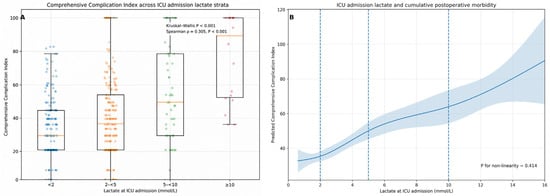
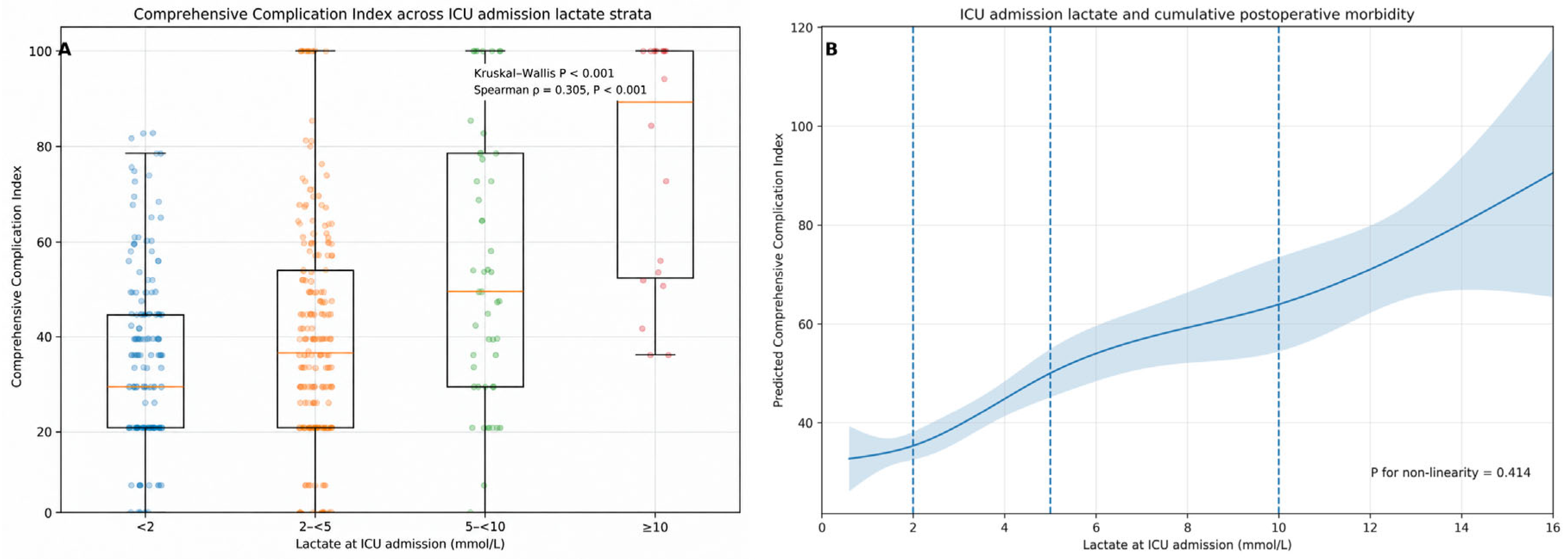
Cumulative postoperative morbidity increased progressively across lactate strata. Median in-hospital Comprehensive Complication Index (CCI) was 29.6 [IQR 20.9–44.7] in recipients with lactate < 2 mmol/L, 36.7 [20.9–54.1] in those with lactate 2–<5 mmol/L, 49.5 [29.6–78.5] in those with lactate 5–<10 mmol/L, and 89.3 [52.4–100] in those with lactate ≥ 10 mmol/L (p < 0.001) (Table 2; Figure 1A).
Table 2.
Postoperative outcomes according to ICU admission lactate strata.
Figure 1.
Association between ICU admission lactate and cumulative postoperative morbidity. (A) Distribution of the Comprehensive Complication Index (CCI) across ICU-admission lactate strata (<2, 2–<5, 5–<10, and ≥10 mmol/L). Boxes represent the interquartile range, horizontal lines indicate the median, and individual points represent observed values. The reported p value corresponds to the global Kruskal–Wallis test (p < 0.001). No post hoc pairwise comparisons were performed. (B) Restricted cubic spline depicting the association between ICU admission lactate and predicted CCI. Shaded areas represent 95% confidence intervals. No evidence of nonlinearity was observed (p for nonlinearity = 0.414).
ICU admission lactate correlated with CCI (Spearman ρ = 0.305, p < 0.001). Restricted cubic spline analysis showed no evidence of nonlinearity (p = 0.414) (Figure 1B). In median regression, each 1-mmol/L increase in lactate was associated with a 3.7-point increase in CCI (p < 0.001). After adjustment for MELD score, donor age, ischemia time, operative duration, transfusion of ≥4 red blood cell units, and intraoperative norepinephrine use, lactate remained associated with higher CCI, with an adjusted increase of 2.67 points per 1 mmol/L (95% CI 1.83–3.51; p < 0.001).
Compared with lactate < 2 mmol/L, adjusted differences in median CCI were +3.6 points (95% CI −1.4 to 8.5; p = 0.160), +18.5 points (95% CI 10.7–26.4; p < 0.001), and +40.1 points (95% CI 27.1–53.0; p < 0.001) for the 2–<5, 5–<10, and ≥10 mmol/L groups, respectively.
To assess whether the association between ICU-admission lactate and cumulative postoperative morbidity was driven by the inclusion of mortality in the Comprehensive Complication Index, we performed a sensitivity analysis excluding patients who died during the index hospitalization (n = 26). Among the 431 remaining recipients, median CCI increased progressively across lactate strata, from 29.6 in patients with lactate < 2 mmol/L to 52.8 in those with lactate ≥ 10 mmol/L (Kruskal–Wallis p < 0.001). In multivariable median regression including 428 recipients with complete covariate data, ICU-admission lactate remained associated with higher CCI (adjusted coefficient 1.37 points per 1 mmol/L increase; 95% CI 0.41–2.32; p = 0.005).
3.3. Graft Dysfunction and Postoperative Outcomes
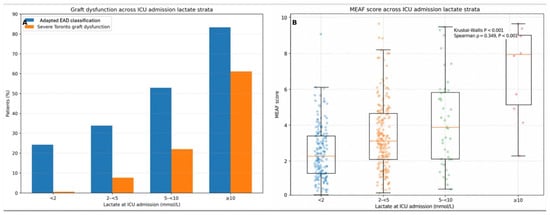
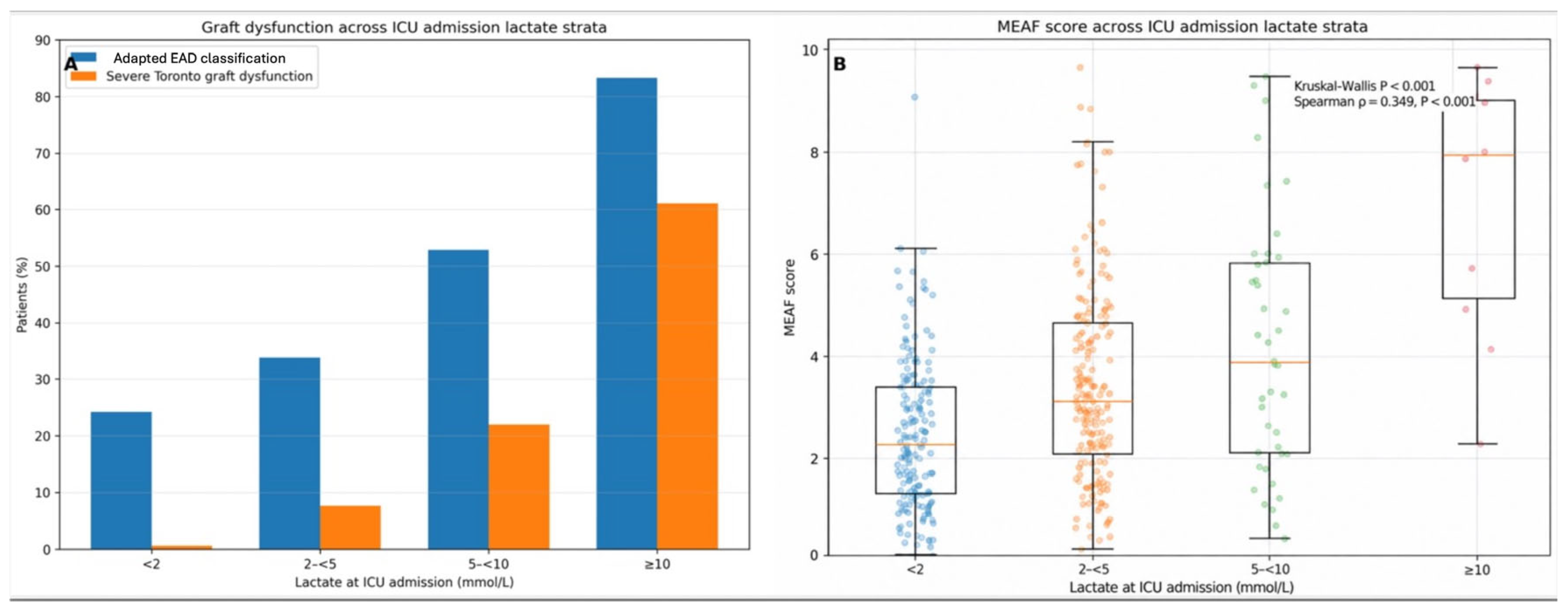
In the exploratory analysis using the adapted EAD classification, EAD was recorded in 155 of 457 recipients (33.9%). The proportions increased across ICU-admission lactate strata: 43/178 (24.2%), 70/210 (33.3%), 27/51 (52.9%), and 15/18 (83.3%), respectively (Table 2; Figure 2A). These findings do not represent the incidence of EAD according to the original Olthoff definition.
Figure 2.
Graft dysfunction according to ICU-admission lactate. (A) Proportion of recipients classified as having early allograft dysfunction (EAD) using the adapted EAD classification (exploratory analysis) and severe Toronto graft dysfunction across ICU-admission lactate strata. The adapted EAD classification does not represent strict application of the original Olthoff criteria. Both outcomes increased progressively with higher lactate concentrations. (B) Distribution of Model for Early Allograft Function (MEAF) scores across ICU-admission lactate strata. MEAF increased significantly across groups (Kruskal–Wallis p < 0.001) and correlated with ICU-admission lactate (Spearman ρ = 0.349, p < 0.001).
Among 46 recipients who died or underwent retransplantation within seven days, 15 had documented AST > 2000 U/L before the event; the remaining 31 lacked sufficient valid index-graft laboratory measurements to establish or exclude EAD according to the original criteria. These patients were not classified as EAD-negative. Consequently, the incidence of EAD according to the original Olthoff definition could not be reliably established for the complete cohort.
Severe Toronto graft dysfunction also increased across ICU-admission lactate strata, from 0.6% to 7.6%, 22.0%, and 61.1%, respectively (Figure 2A).
MEAF was available in 417 recipients. Median MEAF increased from 2.26 [1.29–3.39] in the <2 mmol/L group to 3.11 [2.09–4.65], 3.87 [2.11–5.82], and 7.94 [5.12–9.05] in the 2–<5, 5–<10, and ≥10 mmol/L groups, respectively (p < 0.001). ICU-admission lactate correlated with MEAF score (Spearman ρ = 0.349, p < 0.001) (Figure 2B).
The MEAF score was unavailable in 40 of 457 recipients (8.8%). Missingness increased progressively across ICU-admission lactate strata: 6/178 (3.4%), 17/210 (8.1%), 9/51 (17.6%), and 8/18 (44.4%), respectively. Among the 40 recipients without MEAF data, 22 underwent retransplantation within 7 days, and 25 experienced death or retransplantation within 30 days. These findings suggest that MEAF availability was associated with early clinical outcomes, potentially introducing selection bias into complete-case analyses.
Higher ICU admission lactate was also associated with greater postoperative organ-support requirements and adverse clinical outcomes. Renal replacement therapy increased from 1.1% in the <2 mmol/L group to 55.6% in recipients with lactate ≥ 10 mmol/L, while AKI stage 2–3 increased from 26.4% to 77.8%. Surgical reintervention, sepsis, ICU length of stay, retransplantation, and short-term mortality also differed significantly across lactate strata (Table 2).
3.4. Early Death or Retransplantation
Death or retransplantation occurred in 46 recipients within 7 days and in 56 within 30 days after liver transplantation. Early retransplantation within 7 days was performed in 40 recipients (8.8%). The indications were primary graft non-function (n = 23, 57.5%), hepatic artery thrombosis (n = 16, 40.0%), and an arterial technical complication (n = 1, 2.5%).
Seven-day event rates increased markedly across ICU admission lactate strata, from 0% in recipients with lactate < 2 mmol/L to 9.5%, 29.4%, and 61.1% in the 2–<5, 5–<10, and ≥ 10 mmol/L groups, respectively (p < 0.001). Corresponding 30-day event rates were 0.6%, 12.9%, 33.3%, and 61.1%, respectively (p < 0.001) (Table 2).
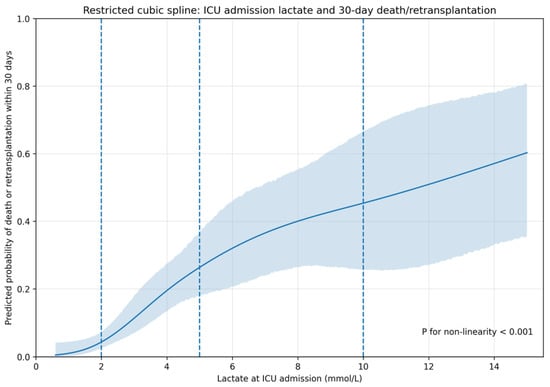
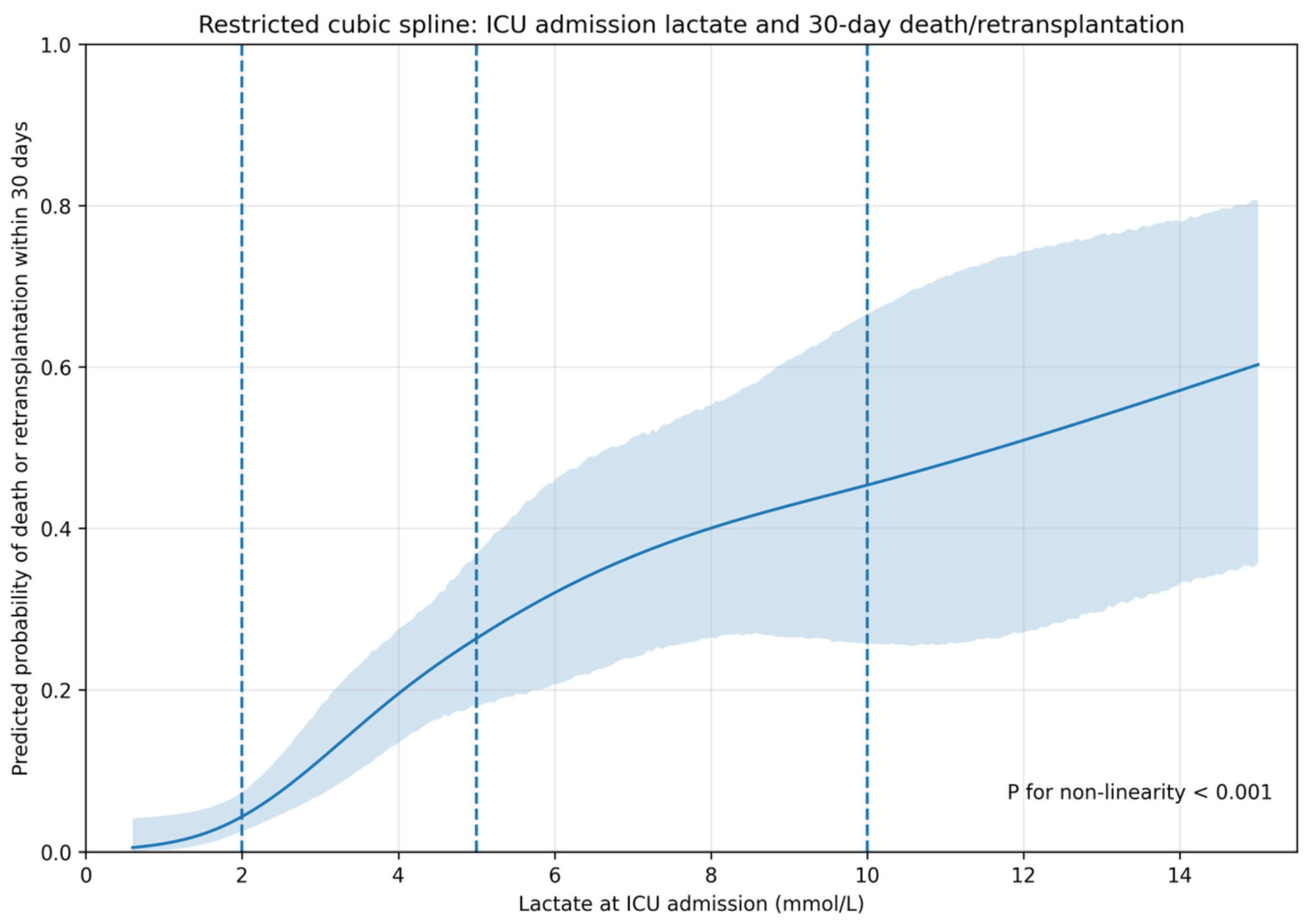
Restricted cubic spline analysis demonstrated a nonlinear association between ICU admission lactate and 30-day death or retransplantation (p for nonlinearity = 0.0009) (Figure 3).
Figure 3.
Nonlinear association between ICU admission lactate and 30-day death or retransplantation. Restricted cubic spline showing the predicted probability of death or retransplantation within 30 days according to ICU admission lactate concentration. Shaded areas represent 95% confidence intervals. Vertical dashed lines indicate lactate concentrations of 2, 5, and 10 mmol/L. The association was nonlinear (p for nonlinearity = 0.0009).
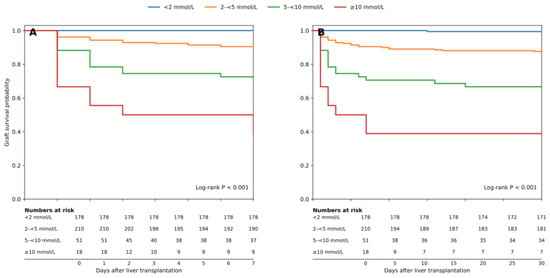
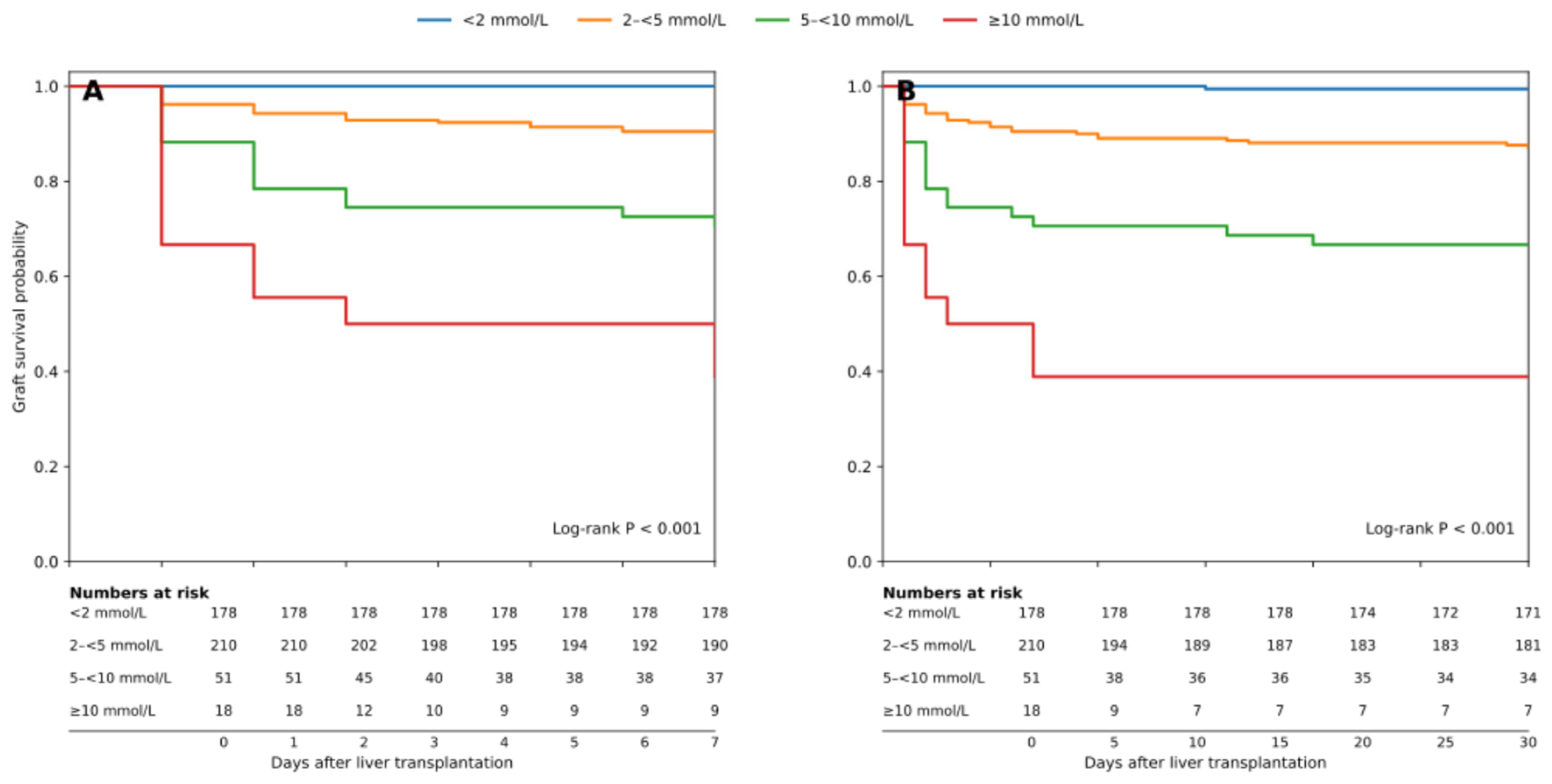
Kaplan–Meier analysis demonstrated a stepwise decrease in graft survival across increasing ICU admission lactate strata at both 7 and 30 days (log-rank p < 0.001 for both) (Figure 4A,B). Separation between lactate strata was particularly marked during the first postoperative week.
Figure 4.
Graft survival according to ICU admission lactate strata at 7 and 30 days. Kaplan–Meier curves showing graft survival, defined as freedom from death or retransplantation, according to ICU admission lactate strata (<2, 2–<5, 5–<10, and ≥10 mmol/L). (A) Seven-day graft survival. (B) Thirty-day graft survival. Numbers at risk are shown below each panel. Differences across lactate strata were significant at both time points (log-rank p < 0.001).
The adjusted 30-day Cox model included 454 recipients and 56 events, corresponding to 11.2 events per predictor parameter; the 7-day model included 46 events (9.2 events per predictor parameter).
When ICU admission lactate was modeled continuously on the log2 scale, each doubling in lactate was associated with a greater than threefold increase in the unadjusted hazard of death or retransplantation within 7 days (HR 3.38, 95% CI 2.59–4.42; p < 0.001). After adjustment for MELD score, transfusion of ≥4 red blood cell units, hepatic arterial flow, and portal vein thrombosis, the association persisted after multivariable adjustment (adjusted HR 2.83, 95% CI 2.15–3.72; p < 0.001).
The association persisted at 30 days, although with a slightly lower magnitude. Each doubling in ICU admission lactate was associated with an unadjusted HR of 2.93 (95% CI 2.31–3.73; p < 0.001) and an adjusted HR of 2.55 (95% CI 2.00–3.27; p < 0.001) for death or retransplantation within 30 days (Table 3).
Table 3.
Cox regression analysis for death or retransplantation at 7 and 30 days.
3.5. Discrimination for 7- and 30-Day Death or Retransplantation
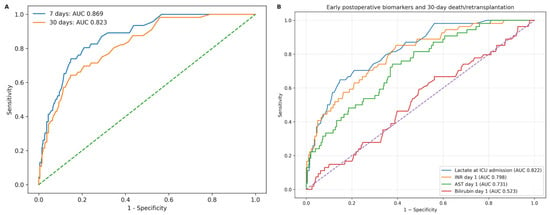
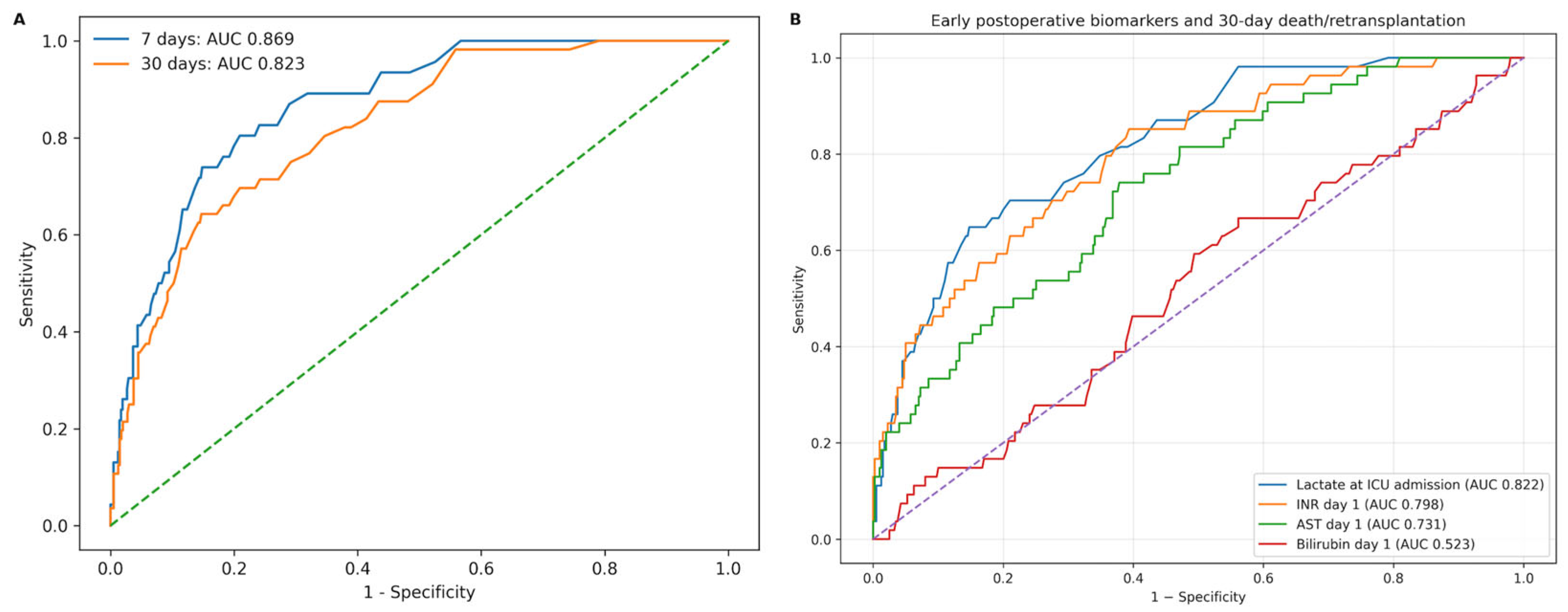
ICU admission lactate showed greater discrimination for death or retransplantation within 7 days than within 30 days, with an AUC of 0.869 (95% CI 0.818–0.914) and 0.823 (95% CI 0.767–0.875), respectively (Figure 5A).
Figure 5.
Discriminative performance of ICU admission lactate for early death or retransplantation. (A) Receiver operating characteristic curves for ICU admission lactate predicting death or retransplantation within 7 and 30 days. AUCs were 0.869 (95% CI 0.818–0.914) and 0.823 (95% CI 0.767–0.875), respectively. (B) Receiver operating characteristic curves comparing ICU admission lactate with day-1 INR, AST, and bilirubin for 30-day death or retransplantation. In recipients with complete laboratory data (n = 453; 54 events), AUCs were 0.822 for lactate, 0.798 for INR, 0.731 for AST, and 0.523 for bilirubin. AUC, area under the receiver operating characteristic curve.
The Youden-optimal lactate thresholds were 3.6 mmol/L for the 7-day endpoint and 4.3 mmol/L for the 30-day endpoint. At 7 days, a lactate concentration ≥ 10 mmol/L had a sensitivity of 23.9% and a specificity of 98.3% for death or retransplantation, with a positive predictive value of 61.1% and a negative predictive value of 92.0%. For the 30-day composite endpoint, the discriminative performance of ICU-admission lactate was descriptively compared with early postoperative laboratory markers. Among recipients with complete laboratory data (n = 453; 54 events), the AUC was 0.822 for ICU-admission lactate, 0.798 for day-1 INR, 0.731 for day-1 AST, and 0.523 for day-1 bilirubin (Figure 5B). These comparisons were descriptive; no formal statistical testing of differences between AUCs was performed. Furthermore, the measurements were obtained at different postoperative time points and should not be interpreted as equivalent prediction opportunities.
The discriminative performance of ICU admission lactate for individual postoperative outcomes, including retransplantation, mortality, prolonged mechanical ventilation, renal replacement therapy, graft dysfunction, and reintervention, is summarized in Table 4.
Table 4.
Discriminative performance of ICU admission lactate for selected postoperative outcomes.
3.6. Incremental Prognostic Value of ICU Admission Lactate
In 454 recipients with complete covariate data, a perioperative clinical model including MELD score, donor age, ischemia time, operative duration, transfusion of ≥4 red blood cell units, and intraoperative norepinephrine use had an AUC of 0.691 for 30-day death or retransplantation. Addition of ICU admission lactate as a linear term increased the AUC to 0.800 (likelihood-ratio χ2 = 40.01; p = 2.53 × 10⁻¹⁰). Modeling lactate nonlinearly further increased the AUC to 0.822 (likelihood-ratio χ2 = 50.25 versus the clinical model; p = 1.22 × 10⁻¹¹), with additional improvement over the linear lactate model (likelihood-ratio χ2 = 10.25; p = 0.0014) (Table 5).
Table 5.
Incremental prognostic value of ICU-admission lactate for 30-day death or retransplantation.
After bootstrap internal validation, the optimism-corrected AUCs were 0.652 for the clinical model, 0.767 for the model including linear lactate, and 0.795 for the nonlinear lactate model. Corresponding optimism-corrected Brier scores were 0.100, 0.088, and 0.086, respectively. The bootstrap-corrected calibration slope for the model including linear lactate was approximately 0.88. Although the nonlinear model retained numerically higher discrimination after internal validation, the improvement over the linear model was modest and should be interpreted cautiously given the limited number of events relative to model complexity. External validation is required before clinical application.
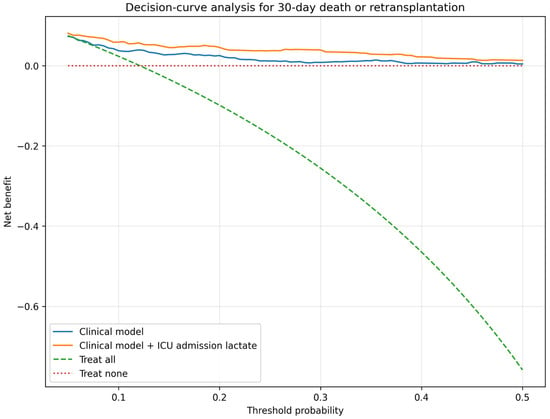
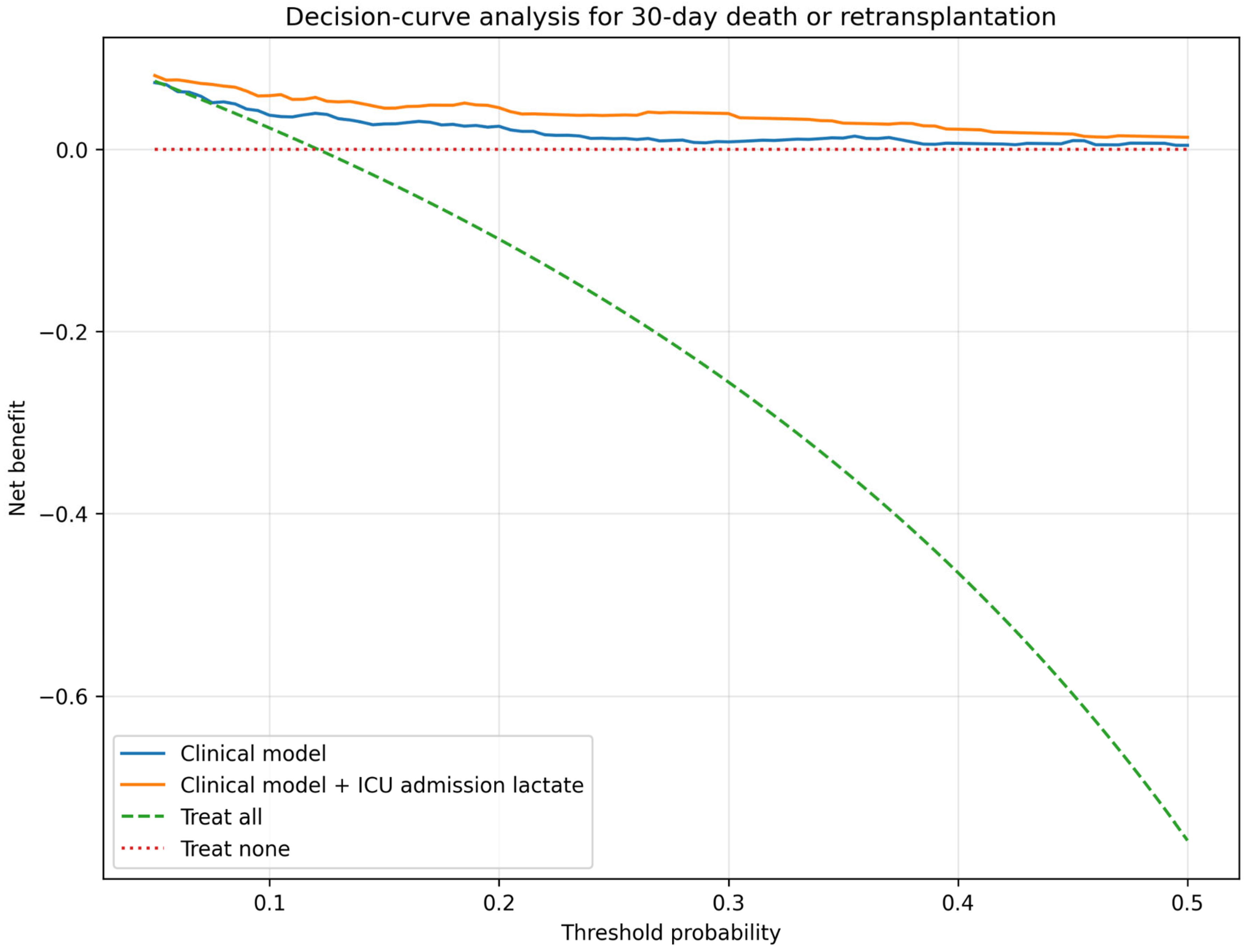
In exploratory decision-curve analysis, the model including ICU-admission lactate showed higher apparent net benefit than the clinical model alone across most evaluated threshold probabilities (Figure 6). These findings describe potential decision-analytic utility but do not demonstrate improved clinical outcomes from lactate-guided management.
Figure 6.
Exploratory decision-curve analysis for 30-day death or retransplantation. Decision-curve analysis comparing the perioperative clinical model with the same model including ICU-admission lactate. The clinical model included MELD, donor age, ischemia time, operative duration, transfusion of ≥4 red blood cell units, and intraoperative norepinephrine use. The analysis was based on apparent model predictions without optimism correction. The addition of lactate showed higher estimated net benefit over portions of the evaluated threshold-probability range (5–50%). These findings are exploratory and do not establish that lactate-guided clinical management improves patient outcomes.
4. Discussion
This study demonstrates that ICU admission lactate after liver transplantation is associated with a marked gradient in subsequent postoperative morbidity and early adverse outcomes. Increasing lactate concentrations were associated with greater cumulative complication burden, more severe graft dysfunction, increased organ-support requirements, and a higher risk of death or retransplantation. These associations persisted after adjustment for relevant perioperative variables. The relationship was particularly strong for very early events, with good discrimination for death or retransplantation within 7 days, while the nonlinear association observed at 30 days suggests a progressive increase in risk at higher lactate concentrations. ICU admission lactate also added prognostic information beyond conventional perioperative variables. Taken together, these findings support ICU admission lactate as a simple and immediately available marker of early postoperative risk after liver transplantation.
The CCI was selected as the primary morbidity outcome because it captures the cumulative burden of postoperative complications rather than focusing on individual adverse events or the most severe complication alone. This approach is particularly relevant in liver transplantation, where recipients frequently experience multiple complications of varying severity during the same hospitalization. By integrating the number and severity of these complications, the CCI provides a more comprehensive assessment of postoperative morbidity and may better reflect the overall clinical impact of early postoperative physiological disturbances.
4.1. ICU Admission Lactate and Cumulative Postoperative Morbidity
Quantifying postoperative morbidity after liver transplantation remains challenging. As short-term survival has improved, mortality and graft loss alone may provide an incomplete description of contemporary postoperative outcomes. The Clavien–Dindo classification grades individual postoperative complications according to the severity of the therapeutic intervention required [14], whereas the Comprehensive Complication Index (CCI) integrates all postoperative complications into a continuous score reflecting cumulative morbidity burden [1,15,16].
Beyond liver transplantation, perioperative hyperlactatemia has been consistently associated with adverse outcomes across major surgical populations. Elevated postoperative lactate has been linked to short-term mortality, postoperative complications, and greater resource utilization, supporting its interpretation as a marker of perioperative physiological stress and impaired recovery rather than as an organ-specific biomarker [17,18].
Liver transplantation represents a distinctive setting in which lactate reflects both systemic perioperative stress and hepatic clearance [19,20,21]. In the present cohort, only modest differences were apparent before graft reperfusion, whereas much greater separation between lactate strata emerged thereafter. This pattern suggests that ICU admission lactate may integrate recipient-related and intraoperative stress with early graft function and restoration of hepatic lactate clearance [4,5].
ICU-admission lactate concentrations should also be interpreted in the context of perioperative hemodynamic conditions and therapeutic interventions. Intraoperative hypoperfusion, blood loss, and postreperfusion hemodynamic instability may increase lactate production, whereas impaired early graft function may reduce lactate clearance. Fluid administration and blood product transfusion may influence lactate concentrations and also reflect the severity of perioperative physiological stress. Furthermore, catecholamines, particularly epinephrine, may increase lactate production through beta-adrenergic stimulation independently of tissue hypoxia. Although transfusion requirements and intraoperative norepinephrine use were included in the adjusted morbidity models, residual confounding related to hemodynamic instability and perioperative treatment cannot be excluded.
The progressive increase in CCI across lactate strata suggests that ICU admission lactate may provide an early estimate of subsequent cumulative morbidity, including in recipients who experience substantial postoperative complications without progressing to graft loss or death [15].
4.2. Lactate, Graft Dysfunction, and Early Adverse Trajectory
Previous studies have consistently linked perioperative lactate abnormalities with early allograft dysfunction, graft failure, and mortality after liver transplantation, although sampling time, lactate metrics, and selected outcomes have varied [3,4,5,8,22,23]. These studies establish lactate as a relevant perioperative marker after liver transplantation but also highlight considerable methodological heterogeneity.
The present study extends this evidence by focusing on a single routinely available lactate measurement at ICU admission and on cumulative postoperative morbidity rather than on an isolated graft-related endpoint. Increasing lactate strata were accompanied by higher rates of severe Toronto graft dysfunction and higher MEAF scores. A similar gradient was observed using the adapted EAD classification in the exploratory analysis; however, these findings should not be interpreted as representing EAD incidence according to the original Olthoff definition. This is relevant because binary EAD definitions may not fully capture the severity or clinical consequences of graft dysfunction. Continuous approaches such as MEAF and L-GrAFT provide a more granular assessment of early graft function and have shown improved discrimination for graft-related outcomes [24,25].
The association was particularly pronounced for death or retransplantation within 7 days, which is biologically plausible because ICU admission lactate primarily reflects the acute perioperative state. Early mortality after liver transplantation is predominantly related to technical, cardiovascular, and graft-related failure, whereas infection becomes increasingly prominent as the postoperative interval lengthens [26,27]. Importantly, early retransplantation was not exclusively attributable to intrinsic graft dysfunction. Seventeen of the 40 retransplantations performed within the first seven postoperative days (42.5%) were associated with hepatic artery thrombosis or technical complications. Therefore, the association between ICU-admission lactate and the composite endpoint of death or retransplantation should not be interpreted solely as reflecting impaired intrinsic graft function. Elevated lactate may also be associated with perioperative circulatory disturbances, vascular complications, and other adverse events contributing to early graft loss.
The 7-day retransplantation rate in our cohort (8.8%) was higher than that generally reported in contemporary liver transplantation series. Of the 40 early retransplantations, 23 (57.5%) were attributed to primary non-function, 16 (40.0%) to hepatic artery thrombosis, and one (2.5%) to a technical complication. Recent literature indicates that the incidence of primary non-function has declined to approximately 2.2%, while hepatic artery thrombosis remains an important cause of early graft failure and urgent retransplantation [28,29]. Our cohort included a relatively high median donor age (63 years) and a substantial proportion of donation-after-circulatory-death grafts (24.8%), characteristics that may have contributed to the observed rate of early graft failure. However, their individual contributions were not specifically evaluated, and a causal explanation cannot be established. Differences in donor selection, graft characteristics, and institutional retransplantation practices may also limit direct comparisons with published series.
Extreme hyperlactatemia deserves particular consideration. Lactate concentrations ≥ 10 mmol/L have been associated with very high mortality in critically ill and surgical populations, although prognosis remains strongly dependent on the underlying cause [30,31]. After liver transplantation, such concentrations may reflect severe systemic stress, impaired perfusion, catecholamine stimulation, and limited early graft clearance. The marked increase in adverse outcomes at the highest lactate levels, together with the nonlinear association with death or retransplantation, suggests that a single optimized cutoff may oversimplify the relationship between lactate and early postoperative prognosis. Nevertheless, the small number of recipients with ICU-admission lactate ≥ 10 mmol/L (n = 18) limits the precision of subgroup estimates, particularly regarding the magnitude of the observed associations.
An additional finding deserving further investigation was the inverse association between pretransplant non-selective beta-blocker (NSBB) therapy and ICU-admission lactate concentrations. Although this observation was exploratory and may be influenced by confounding by indication and differences in baseline clinical characteristics, it raises the hypothesis that pretransplant NSBB exposure could be associated with differences in perioperative metabolic and haemodynamic responses. Future studies specifically designed to investigate the relationship between NSBB therapy, perioperative lactate kinetics, haemodynamic changes, and early postoperative outcomes after liver transplantation are warranted.
4.3. Lactate in Relation to Conventional Biomarkers and Graft Dysfunction Scores
Conventional laboratory markers and graft-function scores capture different dimensions of the postoperative course. AST primarily reflects hepatocellular injury, INR synthetic function, and bilirubin excretory function, whereas lactate is influenced by systemic metabolic stress, tissue perfusion, adrenergic activation, and hepatic clearance. Unlike Olthoff EAD, Toronto criteria, and MEAF, which require subsequent postoperative information, lactate is available immediately at ICU admission. Therefore, comparisons of their discriminative performance should be interpreted cautiously, as these indicators are measured at different time points and do not represent equivalent prediction opportunities. The principal potential advantage of ICU-admission lactate is its earlier availability rather than demonstrated superiority over established graft-function measures.
4.4. Incremental Prognostic Information and Clinical Interpretation
The incremental value of ICU admission lactate is clinically relevant because it suggests that this single measurement captures physiological information not fully represented by conventional recipient, donor, or intraoperative variables. Rather than functioning as an isolated marker of graft injury, lactate may reflect the combined effects of systemic stress, tissue perfusion, adrenergic activation, and early restoration of hepatic metabolic function. Its contribution beyond established clinical variables therefore supports its role as an early summary marker of postoperative risk rather than as a substitute for existing graft-function scores or clinical assessment.
Its main potential advantage is immediacy. Lactate is available at ICU admission, before the subsequent evolution of graft dysfunction, organ failure, or cumulative morbidity becomes apparent, and may therefore help identify recipients who require closer surveillance or greater organ-support requirements. Whether lactate-based risk stratification can improve clinical management requires prospective evaluation.
Several limitations should be acknowledged. First, this single-center retrospective study is subject to residual confounding and potential selection bias. The CCI was retrospectively reconstructed and may underestimate incompletely documented complications. Moreover, CCI incorporates death and major complications such as retransplantation, resulting in partial overlap with the composite endpoint. Although the association between lactate and CCI persisted after excluding in-hospital deaths, this sensitivity analysis may itself introduce selection bias. Second, the original Olthoff criteria could not be applied to all recipients with early death or retransplantation; therefore, the adapted EAD classification was presented separately as an exploratory analysis. Missing MEAF data, particularly among recipients with higher lactate levels and early adverse outcomes, may also introduce selection bias. Third, although ICU-admission lactate was not used as a specific criterion for urgent retransplantation, subsequent lactate measurements and their evolution were considered by the multidisciplinary team when assessing patients with suspected severe graft dysfunction. Therefore, potential incorporation bias cannot be entirely excluded for outcomes involving retransplantation. Adjustment for intraoperative variables may have resulted in overadjustment, while the small number of patients with lactate ≥10 mmol/L and the limited number of events may reduce precision and increase the risk of overfitting, particularly in nonlinear models. Multiple comparisons further increase the possibility of chance findings. Finally, only ICU-admission lactate was assessed, without evaluating serial measurements or lactate clearance. Decision-curve analysis was exploratory and based on apparent predictions without optimism correction. External validation is required before clinical implementation.
5. Conclusions
A single lactate measurement at ICU admission after liver transplantation is associated with a clear gradient in cumulative postoperative morbidity, graft dysfunction, and early death or retransplantation. Its simplicity, immediate availability, and incremental prognostic value support its potential role in early postoperative risk stratification. Prospective multicenter validation is required before clinical implementation.
Supplementary Materials
The following supporting information can be downloaded at https://www.mdpi.com/article/10.3390/medsci14070771/s1, Figure S1. Flow diagram of study selection. Of 507 liver transplantation cases assessed between October 2015 and July 2026, 50 were excluded (44 repeat or subsequent liver transplantations, 4 combined organ transplantations, and 2 intraoperative deaths), resulting in a final cohort of 457 adult first liver transplant recipients with ICU-admission lactate measurements available. Figure S2. Perioperative lactate trajectories according to ICU-admission lactate strata. Boxplots illustrate lactate concentrations at baseline, before reperfusion, immediately after reperfusion, 10 and 60 min after reperfusion, and ICU admission, stratified by ICU-admission lactate concentrations (<2, 2–<5, 5–<10, and ≥10 mmol/L).
Author Contributions
Conceptualization, P.P., E.C., C.L., J.B., M.Z., M.R., B.D.-Z., J.H., I.G. and P.D.; methodology, P.P., E.C., C.L., J.B., M.Z., M.R., B.D.-Z., J.H., I.G. and P.D.; investigation, P.P., E.C., C.L., J.B., M.Z., M.R., B.D.-Z., Y.P., I.G. and P.D.; formal analysis, P.P., J.M.B., J.H., I.G. and P.D.; writing—original draft preparation, P.P., J.M.B., I.G. and P.D.; writing—review and editing, P.P., E.C., C.L., J.B., M.Z., M.R., B.D.-Z., J.M.B., Y.P., J.H., I.G. and P.D.; supervision, P.P., E.C., C.L., J.B., M.Z., M.R., B.D.-Z., J.M.B., Y.P., J.H., I.G. and P.D., I.G. and P.D. jointly supervised the work and share senior authorship. All authors have read and agreed to the published version of the manuscript.
Funding
This research received no external funding.
Institutional Review Board Statement
Ethical approval for this study (references 192/12 and 356/18) was provided by the Ethics Committee of Gregorio Marañón Hospital, Madrid, Spain (Chairperson: Prof. C. Sarobe), on 8 March 2019. The study was conducted in accordance with the Declaration of Helsinki and the STROBE guidelines.
Informed Consent Statement
The requirement for written informed consent was waived by the Ethics Committee because of the retrospective nature of the study and the use of anonymised data.
Data Availability Statement
The original contributions presented in this study are included in the article/Supplementary Materials. Further inquiries can be directed to the corresponding author.
Conflicts of Interest
The authors declare no conflicts of interest.
References
- de Goeij, F.H.C.; Wehrle, C.J.; Abbassi, F.; Satish, S.; Zhang, M.; Panconesi, R.; Hashimoto, K.; Miller, C.M.; Polak, W.G.; Clavien, P.-A.; et al. Mastering the narrative: Precision reporting of risk and outcomes in liver transplantation. J. Hepatol. 2025, 82, 729–743. [Google Scholar] [CrossRef] [Scilit] [PubMed]
- Wehrle, C.J.; de Goeij, F.H.C.; Zhang, M.; Abbassi, F.; Satish, S.; Jiao, C.; Sun, K.; Pinna, A.D.; Hashimoto, K.; Miller, C.; et al. Core outcome sets and benchmarking complications: Defining best practices for standardized outcome reporting in liver transplantation. Liver Transpl. 2025, 31, 395–409. [Google Scholar] [CrossRef] [Scilit] [PubMed]
- Kim, D.G.; Lee, J.Y.; Jung, Y.B.; Song, S.H.; Lee, J.G.; Han, D.H.; Joo, D.J.; Ju, M.K.; Choi, G.H.; Choi, J.S.; et al. Clinical significance of lactate clearance for the development of early allograft dysfunction and short-term prognosis in deceased donor liver transplantation. Clin. Transplant. 2017, 31, e13136. [Google Scholar] [CrossRef] [Scilit] [PubMed]
- Takahashi, K.; Jafri, S.M.R.; Safwan, M.; Abouljoud, M.S.; Nagai, S. Peri-transplant lactate levels and delayed lactate clearance as predictive factors for poor outcomes after liver transplantation: A propensity score-matched study. Clin. Transplant. 2019, 33, e13613. [Google Scholar] [CrossRef] [Scilit] [PubMed]
- Golse, N.; Guglielmo, N.; El Metni, A.; Frosio, F.; Cosse, C.; Naili, S.; Ichaï, P.; Ciacio, O.; Pittau, G.; Allard, M.-A.; et al. Arterial lactate concentration at the end of liver transplantation is an early predictor of primary graft dysfunction. Ann. Surg. 2019, 270, 131–138. [Google Scholar] [CrossRef] [Scilit] [PubMed]
- Coeckelenbergh, S.; Drouard, L.; Ickx, B.; Lucidi, V.; Germanova, D.; Desebbe, O.; Duhaut, L.; Moussa, M.; Naili, S.; Vibert, E.; et al. Arterial lactate concentration at the end of liver transplantation is independently associated with one-year mortality. Transplant. Proc. 2023, 55, 147–152. [Google Scholar] [CrossRef] [Scilit] [PubMed]
- Liu, J.; Martins, P.N.; Bhat, M.; Pang, L.; Yeung, O.W.H.; Ng, K.T.P.; Spiro, M.; Raptis, D.A.; Man, K.; Mas, V.R.; et al. Biomarkers and predictive models of early allograft dysfunction in liver transplantation—A systematic review of the literature, meta-analysis, and expert panel recommendations. Clin. Transplant. 2022, 36, e14635. [Google Scholar] [CrossRef] [Scilit] [PubMed]
- Lai, Q.; Cutic, B.; Iannello, L.; Hanzek, I.; Melandro, F.; Baronica, R.; Mennini, G.; Sesa, V.; Rossi, M.; Mrzljak, A. Peak lactate during the first postoperative day predicts 90-day graft loss after liver transplantation. J. Clin. Med. 2026, 15, 2698. [Google Scholar] [CrossRef] [Scilit] [PubMed]
- Kalisvaart, M.; de Haan, J.E.; Polak, W.G.; Metselaar, H.J.; Wijnhoven, B.P.L.; IJzermans, J.N.M.; de Jonge, J. Comparison of Postoperative Outcomes Between Donation After Circulatory Death and Donation After Brain Death Liver Transplantation Using the Comprehensive Complication Index. Ann. Surg. 2017, 266, 772–778. [Google Scholar] [CrossRef] [Scilit] [PubMed]
- Lai, Q.; Melandro, F.; Nowak, G.; Nicolini, D.; Iesari, S.; Fasolo, E.; Mennini, G.; Romano, A.; Mocchegiani, F.; Ackenine, K.; et al. The role of the comprehensive complication index for the prediction of survival after liver transplantation. Updates Surg. 2021, 73, 209–221. [Google Scholar] [CrossRef] [Scilit] [PubMed]
- Olthoff, K.M.; Kulik, L.; Samstein, B.; Kaminski, M.; Abecassis, M.; Emond, J.; Shaked, A.; Christie, J.D. Validation of a current definition of early allograft dysfunction in liver transplant recipients and analysis of risk factors. Liver Transpl. 2010, 16, 943–949. [Google Scholar] [CrossRef] [Scilit] [PubMed]
- Greig, P.D.; Woolf, G.M.; Sinclair, S.B.; Abecassis, M.; Strasberg, S.M.; Taylor, B.R.; Blendis, L.M.; Superina, R.A.; Glynn, M.F.; Langer, B.; et al. Treatment of primary liver graft nonfunction with prostaglandin E1. Transplantation 1989, 48, 447–453. [Google Scholar] [CrossRef] [Scilit] [PubMed]
- Pareja, E.; Cortes, M.; Hervás, D.; Mir, J.; Valdivieso, A.; Castell, J.V.; Lahoz, A. A score model for the continuous grading of early allograft dysfunction severity. Liver Transpl. 2015, 21, 38–46. [Google Scholar] [CrossRef] [Scilit] [PubMed]
- Dindo, D.; Demartines, N.; Clavien, P.A. Classification of surgical complications: A new proposal with evaluation in a cohort of 6336 patients and results of a survey. Ann. Surg. 2004, 240, 205–213. [Google Scholar] [CrossRef] [Scilit] [PubMed]
- Fodor, M.; Zoller, H.; Oberhuber, R.; Sucher, R.; Seehofer, D.; Cillo, U.; Line, P.D.; Tilg, H.; Schneeberger, S.M. The need to update endpoints and outcome analysis in the rapidly changing field of liver transplantation. Transplantation 2022, 106, 938–949. [Google Scholar] [CrossRef] [Scilit] [PubMed]
- Slankamenac, K.; Graf, R.; Barkun, J.; Puhan, M.A.; Clavien, P.A. The Comprehensive Complication Index: A novel continuous scale to measure surgical morbidity. Ann. Surg. 2013, 258, 1–7. [Google Scholar] [CrossRef] [Scilit] [PubMed]
- Fu, Y.; Zhang, Y.; Shen, L.; Huang, Y. Intraoperative peak lactate as a predictor of in-hospital mortality following non-cardiac emergency surgery: A retrospective cohort study. Langenbeck’s Arch. Surg. 2026, 411, 55. [Google Scholar] [CrossRef] [Scilit] [PubMed]
- Kushimoto, S.; Akaishi, S.; Sato, T.; Nomura, R.; Fujita, M.; Kudo, D.; Kawazoe, Y.; Yoshida, Y.; Miyagawa, N. Lactate, a useful marker for disease mortality and severity but an unreliable marker of tissue hypoxia/hypoperfusion in critically ill patients. Acute Med. Surg. 2016, 3, 293–297. [Google Scholar] [CrossRef] [Scilit] [PubMed]
- Levitt, D.G.; Levitt, J.E.; Levitt, M.D. Quantitative assessment of blood lactate in shock: Measure of hypoxia or beneficial energy source. BioMed Res. Int. 2020, 2020, 2608318. [Google Scholar] [CrossRef] [Scilit] [PubMed]
- Andersen, L.W.; Mackenhauer, J.; Roberts, J.C.; Berg, K.M.; Cocchi, M.N.; Donnino, M.W. Etiology and therapeutic approach to elevated lactate levels. Mayo Clin. Proc. 2013, 88, 1127–1140. [Google Scholar] [CrossRef] [Scilit] [PubMed]
- Yao, S.; Chai, H.; Tao, T.; Zhang, L.; Yang, X.; Li, X.; Yi, Z.; Wang, Y.; An, J.; Wen, G.; et al. Role of lactate and lactate metabolism in liver diseases. Int. J. Mol. Med. 2024, 54, 59. [Google Scholar] [CrossRef] [Scilit] [PubMed]
- Galli, A.M.; Kothari, R.; Adelmann, D.; Holm, Z.; Bokoch, M.P.; De Gasperi, A.; Niemann, C.U.; Kolodzie, K. Lactate concentration at the end of liver transplant: Early predictor of graft function or just one piece of the puzzle? Clin. Transplant. 2023, 37, e15057. [Google Scholar] [CrossRef] [Scilit] [PubMed]
- Katayama, A.; Abuelkasem, E.; Ligon, M.M.; Longhitano, Y.; Wang, D.W. Intraoperative lactate level and lactate clearance is associated with long-term mortality in liver transplant recipients. Anesth. Pain Med. 2026, 21, 72–82. [Google Scholar] [CrossRef] [Scilit] [PubMed]
- Jochmans, I.; Fieuws, S.; Monbaliu, D.; Pirenne, J. “Model for Early Allograft Function” outperforms “Early Allograft Dysfunction” as a predictor of transplant survival. Transplantation 2017, 101, e258–e264. [Google Scholar] [CrossRef] [Scilit] [PubMed]
- Agopian, V.G.; Markovic, D.; Klintmalm, G.B.; Saracino, G.; Chapman, W.C.; Vachharajani, N.; Florman, S.S.; Tabrizian, P.; Haydel, B.; Nasralla, D.; et al. Multicenter validation of the liver graft assessment following transplantation (L-GrAFT) score for assessment of early allograft dysfunction. J. Hepatol. 2021, 74, 881–892. [Google Scholar] [CrossRef] [Scilit] [PubMed]
- Baganate, F.; Beal, E.W.; Tumin, D.; Azoulay, D.; Mumtaz, K.; Black, S.M.; Washburn, K.; Pawlik, T.M. Early mortality after liver transplantation: Defining the course and the cause. Surgery 2018, 164, 694–704. [Google Scholar] [CrossRef] [Scilit] [PubMed]
- VanWagner, L.B.; Lapin, B.; Levitsky, J.; Wilkins, J.T.; Abecassis, M.M.; Skaro, A.I.; Lloyd-Jones, D.M. High early cardiovascular mortality following liver transplantation. Liver Transpl. 2014, 20, 1306–1316. [Google Scholar] [CrossRef] [Scilit] [PubMed]
- Likhitsup, A.; Fontana, R.J. Indications and Outcomes with Liver Retransplantation in 2025. Dig. Dis. Sci. 2025, 70, 29–38. [Google Scholar] [CrossRef] [Scilit] [PubMed]
- Sasaki, V.L.; Coelho, J.C.U.; Wiederkehr, H.A.; Costa, M.A.R.D.; Andrade, D.; Sanches, J.P.B.; Wiederkehr, J.C.; Ramos, E.B.; Junior, A.P. Diagnosis, treatment, and outcomes of hepatic artery thrombosis after liver transplantation. Rev. Col. Bras. Cir. 2026, 53, e20260010. [Google Scholar] [CrossRef] [Scilit] [PubMed]
- Haas, S.A.; Lange, T.; Saugel, B.; Petzoldt, M.; Fuhrmann, V.; Metschke, M.; Kluge, S. Severe hyperlactatemia, lactate clearance and mortality in unselected critically ill patients. Intensive Care Med. 2016, 42, 202–210. [Google Scholar] [CrossRef] [Scilit] [PubMed]
- Spiegelberg, J.; Lederer, A.K.; Claus, S.; Runkel, M.; Utzolino, S.; Fichtner-Feigl, S.; Kousoulas, L. Severe hyperlactatemia in unselected surgical patients: Retrospective analysis of prognostic outcome factors. BMC Surg. 2022, 22, 312. [Google Scholar] [CrossRef] [Scilit] [PubMed]

Disclaimer/Publisher’s Note: The statements, opinions and data contained in all publications are solely those of the individual author(s) and contributor(s) and not of MDPI and/or the editor(s). MDPI and/or the editor(s) disclaim responsibility for any injury to people or property resulting from any ideas, methods, instructions or products referred to in the content. |
© 2026 by the authors. Licensee MDPI, Basel, Switzerland. This article is an open access article distributed under the terms and conditions of the Creative Commons Attribution (CC BY) license.