


Abstract
Background: The COVID-19 pandemic disrupted healthcare systems and antimicrobial stewardship, potentially altering antimicrobial resistance patterns. This study characterized temporal changes in the proportions of multidrug-resistant organisms (MDROs) and identified associated factors before and during the pandemic at a tertiary care hospital in northeastern Thailand. Methods: A single-center retrospective observational study was conducted at Roi Et Hospital, including 5458 culture-confirmed MDRO cases (2017–2022), stratified into pre-pandemic (2017–2019) and pandemic (2020–2022) periods. Pathogen-specific resistance proportions were compared using odds ratios (ORs) with 95% confidence intervals (CIs). Multivariable logistic regression identified independently associated factors within each period. Results: The proportion of MDRO cases classified as hospital-acquired increased from 40.71% to 57.41% (p < 0.001). Carbapenem-resistant Acinetobacter baumannii (CRAB) increased markedly (22.87% to 76.11%; OR 10.75, 95% CI 9.43–12.26), followed by carbapenem-resistant Enterobacterales (CRE) (4.05% to 21.61%; OR 6.54, 95% CI 5.84–7.32) and carbapenem-resistant Pseudomonas aeruginosa (CRPA) (14.32% to 27.15%; OR 2.23, 95% CI 1.87–2.65; all p < 0.001). Vancomycin-resistant Enterococcus (VRE) declined significantly (OR 0.41, 95% CI 0.25–0.68; p < 0.001). Methicillin-resistant Staphylococcus aureus (MRSA) showed a higher proportion among clinical isolates (3.28% to 6.34%; OR 2.01, 95% CI 1.42–2.83), although without a consistent annual trend. In multivariable analyses, ICU admission was independently associated with lower odds of CRE (aOR 0.52) and CRPA (aOR 0.63) and with higher odds of CRAB (aOR 2.13; all p < 0.001). Conclusions: The COVID-19 pandemic was associated with a major proportional shift toward carbapenem-resistant Gram-negative pathogens, with distinct profiles of associated factors across CRAB, CRE, and CRPA. These findings highlight the need for pathogen-specific infection prevention and antimicrobial stewardship strategies during healthcare system disruptions.
1. Introduction
Antimicrobial resistance (AMR) is a major global public health threat that undermines the effective treatment of bacterial infections and is associated with increased morbidity, mortality, and healthcare costs. Recent global estimates indicate that bacterial AMR was associated with 4.71 million deaths in 2021, including 1.14 million deaths directly attributable to resistant pathogens [1]. This burden is expected to be borne disproportionately by low- and middle-income countries, where health systems often face limited diagnostic capacity, constrained infection prevention infrastructure, and high antimicrobial consumption [1,2,3]. In Southeast Asia, AMR is especially concerning because of the high baseline prevalence of resistant pathogens, broad antimicrobial access, and persistent gaps in stewardship and surveillance [4,5,6,7]. In Thailand, AMR imposes substantial clinical and economic consequences. Among the most clinically significant hospital-associated pathogens are carbapenem-resistant Gram-negative organisms, specifically carbapenem-resistant Acinetobacter baumannii (CRAB), carbapenem-resistant Enterobacterales (CRE), and carbapenem-resistant Pseudomonas aeruginosa (CRPA), because of their limited treatment options and poor clinical outcomes [5,8,9,10].
The coronavirus disease 2019 (COVID-19) pandemic placed unprecedented strain on healthcare systems and may have reshaped the epidemiology of multidrug-resistant organisms (MDROs). During this period, hospitals faced surges in critically ill patients, increased use of invasive devices, prolonged hospital stays, workforce shortages, and disruptions to routine infection prevention and control (IPC) and antimicrobial stewardship programs [11,12]. At the same time, empirical antibiotic prescribing increased substantially, with rates exceeding 70% of hospitalized COVID-19 patients in Southeast Asia [4], despite relatively low rates of confirmed bacterial co-infection [13,14,15,16,17]. Together, these conditions created a plausible setting for amplification of healthcare-associated transmission and antimicrobial selection pressure [18].
Published findings have been heterogeneous across pathogens and healthcare settings. Several studies have documented increased incidence and/or proportions of carbapenem-resistant Gram-negative organisms during the pandemic [18,19,20], whereas trends in methicillin-resistant Staphylococcus aureus (MRSA) and vancomycin-resistant enterococci (VRE) have been more variable [21,22,23]. This heterogeneity suggests that the pandemic’s effect on AMR depends on local factors, including patient case mix, patterns of antibiotic use [24], hospital organization, and infection prevention and control (IPC) capacity. In Thailand, most published data originate from university-affiliated or metropolitan centers [25], leaving a knowledge gap regarding MDRO epidemiology in provincial tertiary hospitals, which experience unique challenges such as increased patient referral and limited resources during the pandemic [25,26].
Therefore, this study aimed to characterize changes in the proportions of major MDROs and to identify clinical and healthcare-related factors associated with MDRO infection before and during the COVID-19 pandemic in a tertiary care hospital in northeastern Thailand. Specifically, we evaluated temporal changes in the proportions of CRAB, CRE, CRPA, MRSA, and VRE among clinical isolates between 2017 and 2022, and examined factors independently associated with pathogen-specific MDRO infection within each study period. However, longitudinal data describing pathogen-specific AMR dynamics in provincial tertiary hospitals in Thailand remain limited, particularly in the context of COVID-19-related healthcare disruption.
2. Materials and Methods
2.1. Study Design and Setting
We conducted a single-center retrospective observational epidemiologic study using hospital-based microbiological surveillance and clinical data from Roi Et Hospital, a 1000-bed regional tertiary referral center in northeastern Thailand. The study was reported in accordance with the Strengthening the Reporting of Observational Studies in Epidemiology (STROBE) statement and the STROBE-AMS extension for antimicrobial resistance surveillance [27,28]. Ethical approval was obtained from the Roi Et Hospital Ethics Committee (Approval No. RE068/2023; date of approval: 20 June 2023), which waived the requirement for informed consent because the study used anonymized retrospective data.
2.2. Study Population and Study Period
The study included all hospitalized patients with at least one clinical culture positive for target multidrug-resistant organisms between 1 January 2017 and 31 December 2022. The study period was stratified into two phases: the pre-pandemic period (2017–2019) and the pandemic period (2020–2022). For patients with multiple admissions, each admission separated by ≥30 days was counted as a separate case. This 30-day interval was applied uniformly to all specimen types as an operational rule to define distinct infection episodes and to limit duplication. The rule is consistent with the deduplication principles for cumulative susceptibility data described in CLSI guideline M39 and with prior antimicrobial resistance surveillance studies that defined repeat isolates of the same organism within 30 days as the same episode [29,30]. Infection acquisition was classified using CDC/NHSN-based timing criteria, whereby an isolate recovered >48 h after admission and not present or incubating at the time of admission was classified as hospital-acquired, and an isolate identified within the first 48 h was classified as community-acquired (see Section 2.3). This timing-based acquisition classification is conceptually distinct from the hospital stay prior to culture (time at risk) defined in Section 2.4: the former is a binary classification of where the infection was acquired, whereas the latter is a measure of the interval from admission to the first positive culture. A complete history of previous admissions and healthcare exposure (e.g., in the preceding 90 days) was not consistently recorded in the electronic medical record and could therefore not be incorporated.
2.2.1. Inclusion Criteria
Patients were eligible for inclusion if they met all of the following criteria: (1) admitted to an inpatient ward at Roi Et Hospital during the study period; (2) had at least one culture-confirmed MDRO (CRE, CRAB, CRPA, VRE, or MRSA); (3) had a minimum hospital stay of 48 h, regardless of infection acquisition classification; and (4) in cases with multiple positive cultures for the same organism during a single admission, only the first isolate per species per admission was included to improve epidemiologic independence and avoid overestimation of resistance.
2.2.2. Exclusion Criteria
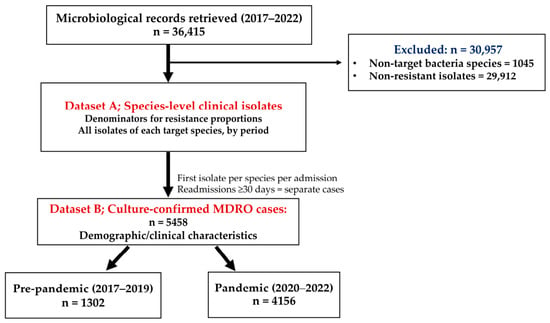
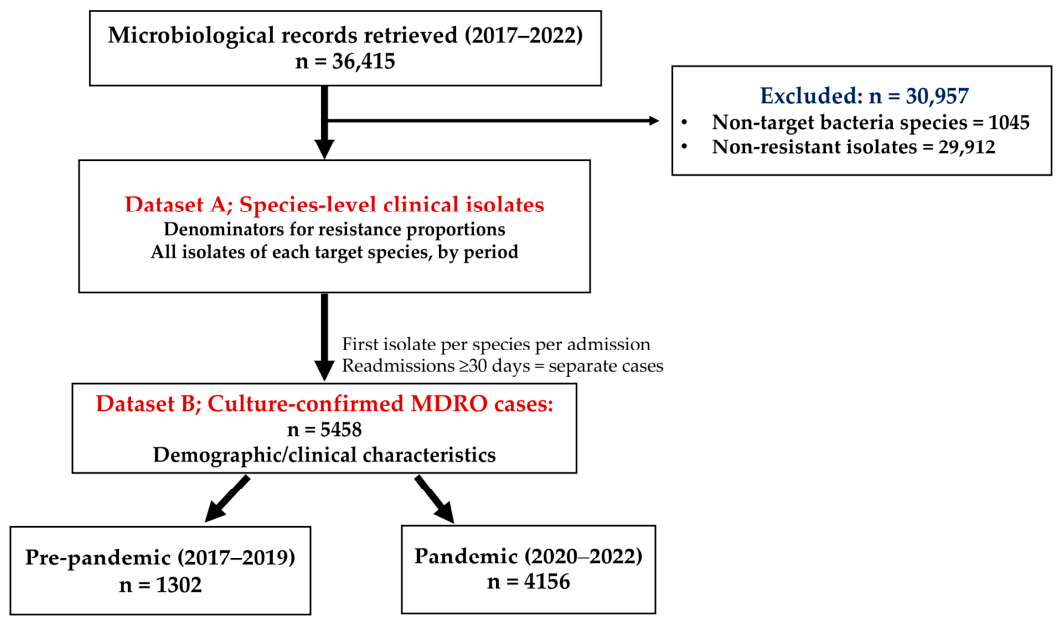
Of 36,415 bacterial isolates retrieved across all species during the study period, 30,957 were not eligible for the case-level analysis: isolates not belonging to the five target pathogen groups (n = 1045) and non-resistant isolates within the target groups (n = 29,912). After retaining only the first isolate per species per admission, 5458 culture-confirmed MDRO cases remained. No cases meeting the MDRO definition were excluded due to incomplete medical records; all 5458 cases had sufficient clinical data for inclusion in the final analysis (Figure 1).
Figure 1.
A participant flow diagram illustrating the derivation of the two analytic datasets used in this study. From 36,415 microbiological records retrieved between 2017 and 2022, isolates of non-target species (n = 1045) and non-resistant isolates (n = 29,912) were excluded (total excluded n = 30,957). Dataset A comprised all clinical isolates of the five target species and served as the denominator for the resistance-proportion analyses and the pathogen-specific regression models; these were counted as all isolates of each target species per period. Dataset B comprised the 5458 culture-confirmed MDRO cases (first isolate per species per admission; readmissions separated by ≥30 days counted as separate cases) used for the demographic and clinical analyses, stratified into pre-pandemic (2017–2019; n = 1302) and pandemic (2020–2022; n = 4156) periods.
2.3. Microbiology and Definitions
All cultures analyzed were clinical cultures ordered as part of routine diagnostic care; surveillance or screening cultures collected solely to detect colonization were not part of the laboratory workflow during the study period. Because clinical infection could not be adjudicated against standardized criteria at the isolate level in this retrospective design, the units of analysis are described throughout as culture-confirmed MDRO cases or clinical isolates rather than as confirmed infections. Pathogen identification and antimicrobial susceptibility testing (AST) were performed using the VITEK 2 automated system (bioMérieux, Marcy-l’Étoile, France). AST results were interpreted according to the Clinical and Laboratory Standards Institute (CLSI) Performance Standards for Antimicrobial Susceptibility Testing (M100) [31,32,33,34,35,36], applying the edition in use during each respective study year (M100-Ed27 through M100-Ed32, 2017–2022). Multidrug-resistant status followed the international consensus definition: acquired non-susceptibility to at least one agent in three or more antimicrobial categories [37]. The target MDROs comprised Carbapenem-resistant Enterobacterales (CRE), Carbapenem-resistant Acinetobacter baumannii (CRAB), Carbapenem-resistant Pseudomonas aeruginosa (CRPA), Methicillin-resistant Staphylococcus aureus (MRSA), and Vancomycin-resistant enterococci (VRE). CRE, CRAB, and CRPA were defined as isolates resistant or non-susceptible to at least one carbapenem agent according to CLSI breakpoints. MRSA was defined based on oxacillin or cefoxitin resistance. VRE was defined as Enterococcus isolates resistant to vancomycin. The Magiorakos et al. criteria [37] are cited as the general framework for defining multidrug resistance; however, classification in this study was based on the resistance phenotype used for routine surveillance rather than on the full multidrug-resistant definition. Specifically, CRE, CRAB, and CRPA were identified by carbapenem non-susceptibility alone, and MRSA and VRE by methicillin and vancomycin resistance, respectively; isolates were not required to meet the complete Magiorakos definition of non-susceptibility to at least one agent in three or more antimicrobial categories. These carbapenem- and marker-based phenotypes were used because they correspond to the organisms of primary public-health and infection-control concern and are the categories captured consistently in the laboratory information system over the study period.
Infection acquisition was classified using CDC/NHSN-based timing criteria. A hospital-acquired infection (HAI) was defined as an isolate recovered >48 h after hospital admission that was not present or incubating at the time of arrival [38]. Isolates identified within the first 48 h of admission were classified as community-acquired [38,39].
2.4. Data Sources and Variables
Comprehensive clinical and demographic data were extracted from the hospital electronic medical record system and laboratory information system. Key variables included age, sex, primary diagnosis, comorbidity status, defined as the presence versus absence of any chronic underlying disease contributing to the Charlson Comorbidity Index [40] and analyzed as a binary variable (present vs. absent), ward type (ICU vs. non-ICU), infection acquisition status, and healthcare utilization measures. To reduce immortal time bias, length of hospital stay was measured from the date of admission to the date of the first positive culture (time at risk), rather than total length of stay. For the regression models, primary diagnosis was entered as a binary variable contrasting urinary tract infection or pneumonia with all other primary diagnoses (reference category). These two syndromes were the most frequent infection-related diagnoses and the presentations most commonly linked to the target Gram-negative pathogens. They were grouped a priori into a single category to preserve degrees of freedom and avoid sparse cells in the pathogen-specific, period-stratified models. The remaining diagnoses were individually infrequent and heterogeneous, and were combined into the reference category. This time-at-risk variable is distinct from the CDC/NHSN timing-based acquisition classification described in Section 2.2 and Section 2.3, and the two were treated as separate variables in all analyses.
2.5. Statistical Analysis
Categorical variables were summarized as frequencies and percentages; continuous variables were summarized as means and standard deviations (SDs), and additionally as medians with interquartile ranges (IQRs) when the distribution was skewed (e.g., length of stay). Baseline characteristics were compared between periods using chi-square tests for categorical variables.
Two analytic datasets were used and are shown in Figure 1. Dataset A comprised all species-level clinical isolates of the five target pathogens and provided the denominators for the resistance-proportion analyses and the pathogen-specific regression models. Dataset B comprised the 5458 culture-confirmed MDRO cases (first isolate per species per admission) and was used for the demographic and clinical analyses. The primary descriptive outcome was the proportion of resistant isolates within each pathogen group in each study period. Proportions were calculated as the number of resistant isolates divided by the total number of isolates of that pathogen group during the corresponding period. Absolute differences in percentage points and odds ratios (ORs) with 95% confidence intervals (CIs) were calculated to compare resistance proportions between the pandemic period (2020–2022; study group) and the pre-pandemic period (2017–2019; reference group). These estimates describe changes in the proportion of resistance among clinical isolates and should not be interpreted as direct measures of incidence in the hospitalized population. This study evaluates changes in pathogen-specific resistance proportions among clinical isolates and does not estimate incidence rates in the hospital population due to lack of denominator data (e.g., patient-days).
For the analyses of associated factor, chi-square tests were used for bivariate comparisons. Pathogen-specific univariate and multivariable logistic regression models were then constructed separately for CRE, CRAB, and CRPA within each study period. In each model the dependent variable was the index pathogen group versus the other culture-confirmed MDRO cases of the same period (a one-versus-other-MDROs comparison); the reference group therefore comprised the remaining MDRO cases rather than carbapenem-susceptible isolates of the same species. Because the comparator was the pool of other MDRO cases, these models identify factors associated with the relative distribution of MDRO types among culture-confirmed MDRO cases, and should not be interpreted as risk factors for acquiring infection or resistance per se. The number of cases contributing to each model corresponds to the period-specific totals shown in Table 1 (pre-pandemic n = 1302; pandemic n = 4156). Variables entered into the multivariable models included sex, age, comorbidity (any chronic underlying disease, present vs. absent), infection acquisition status, primary diagnosis, ward type, and length of hospital stay prior to culture. The five most frequent primary diagnoses at the study hospital were urinary tract infection (UTI), pneumonia, chronic kidney disease, heart failure, and other diagnoses; because each individual diagnosis accounted for less than 10% of cases, the primary diagnosis was analyzed as a binary variable contrasting UTI or pneumonia with all other diagnoses. UTI and pneumonia were grouped because they were the infection syndromes most commonly associated with the target Gram-negative pathogens, and the remaining diagnoses (chronic kidney disease, heart failure, and other) formed the reference category. This primary-diagnosis variable is distinct from the comorbidity variable described above. The results were reported as crude odds ratios (ORs) and adjusted odds ratios (aORs) with 95% CIs. All analyses were performed using IBM SPSS Statistics for Windows, version 26.0 (IBM Corp., Armonk, NY, USA), and a two-sided p-value < 0.05 was considered statistically significant. To assess whether the observed associations were robust to differences in case mix between periods, we performed a sensitivity analysis in which the pathogen-specific models were repeated separately within the ICU and non-ICU strata. The direction and statistical significance of the principal associations were consistent with the main analysis; full results are provided in Supplementary Materials.
Table 1.
Demographic and Clinical Characteristics of Study Population.
3. Results
3.1. Demographic and Clinical Characteristics
During the study period, 36,415 bacterial isolates were retrieved across all species. Of these, 5458 culture-confirmed MDRO cases met all inclusion criteria and constituted the final study population (Figure 1). Demographic and clinical characteristics are summarized in Table 1.
The pre-pandemic period (2017–2019) comprised 1302 cases (23.9%), whereas the pandemic period (2020–2022) comprised 4156 cases (76.1%). The substantially larger number of cases during the pandemic period likely reflects both increased hospital admissions during COVID-19 surges and expanded microbiological culture practices to evaluate suspected secondary bacterial infections in COVID-19 patients.
The overall cohort had a mean age of 63.07 ± 15.84 years, and 64.3% of cases were male. Most cases were aged 60 years or older (62.9%), admitted to non-ICU wards (73.9%), and had a hospital stay of ≤14 days prior to culture (58.5%). Across the full study period, hospital-acquired infection accounted for 53.4% of cases and community-acquired infection for 46.6%.
Several baseline characteristics differed significantly between the two periods (Table 1). During the pandemic period, the proportion of male cases increased from 60.68% to 65.42% (+4.74 percentage points (pp); p = 0.002), and the proportion of patients aged ≥60 years rose from 60.29% to 63.74% (+3.45 pp; p = 0.025). The proportion of cases with a documented comorbidity decreased from 18.82% to 11.16% (–7.66 pp; p < 0.001). The proportion of cases classified as hospital-acquired increased markedly from 40.71% to 57.41% (+16.70 pp; p < 0.001), and ICU admissions increased from 19.74% to 28.10% (+8.36 pp; p < 0.001). The proportion of cases with a hospital stay > 14 days prior to culture did not differ significantly between periods (42.63% vs. 41.17%; p = 0.352), despite a decline in mean length of stay from 23.01 ± 41.30 days to 17.72 ± 21.38 days. Because the distribution of length of stay was right-skewed (standard deviation exceeding the mean), the median (IQR) is also reported and is more representative: 11 (4–28) days pre-pandemic and 11 (5–23) days during the pandemic.
3.2. Temporal Trends in the Proportion of Multidrug-Resistant Organisms (2017–2022)
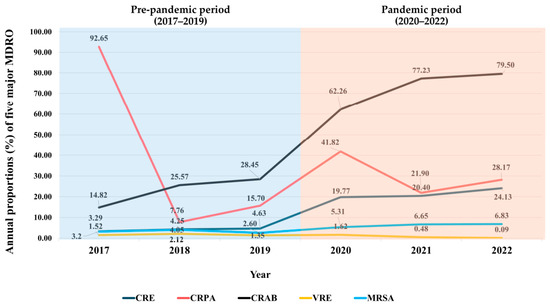
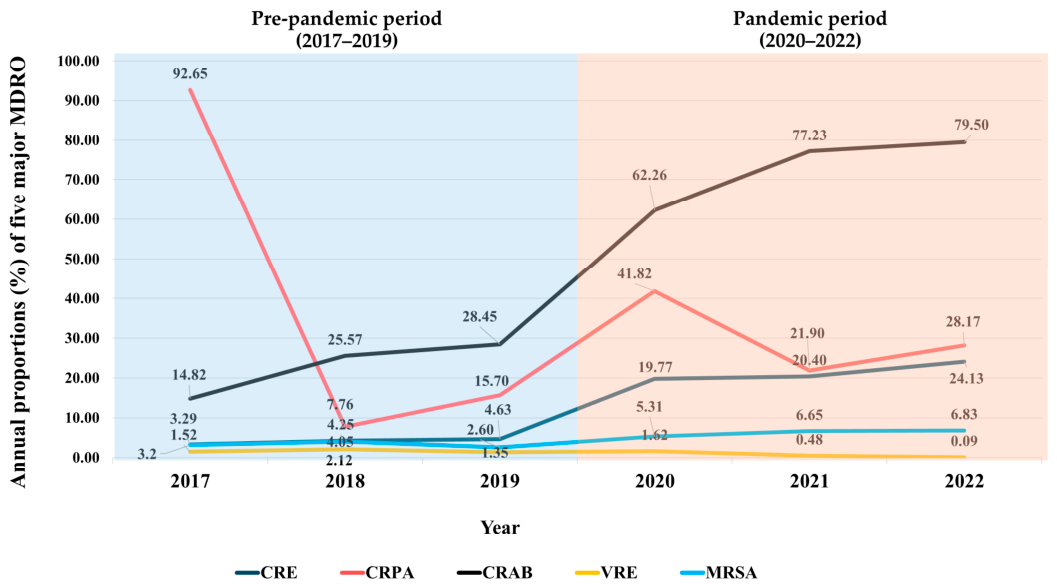
Temporal trends in pathogen-specific proportions of major MDROs are presented in Figure 2. Overall, the proportions of carbapenem-resistant Gram-negative pathogens within their respective pathogen groups increased substantially during the pandemic period, whereas Gram-positive resistance patterns remained stable or declined. These estimates represent proportions within each pathogen group and should not be interpreted as incidence rates in the hospitalized population. Among all pathogens, CRAB showed the most pronounced changes, rising from a relatively low and stable pre-pandemic proportion to a high and sustained level during the pandemic (Figure 2). CRPA demonstrated a markedly different temporal pattern: an exceptionally high proportion in 2017 followed by a sharp decline and subsequent fluctuation; the 2017 value likely reflects the small denominator for that year (68 total P. aeruginosa isolates) and should be interpreted with caution. During the pandemic period, CRPA proportions increased relative to the pre-pandemic period despite year-to-year fluctuation. CRE demonstrated a gradual pre-pandemic rise followed by a substantial acceleration during the pandemic, representing an approximately 7.3-fold increase relative to the pre-pandemic mean. VRE exhibited a sustained decline to near-complete disappearance among clinical isolates by the end of the study period, whereas MRSA showed a higher pandemic proportion without a consistent directional trend on annual examination (Figure 2; annual values and denominators are provided in the figure legend).
Figure 2.
Temporal trends in the annual pathogen-specific proportions of five major MDROs (CRE, CRPA, CRAB, VRE, and MRSA), 2017–2022. Blue shaded area: pre-pandemic period (2017–2019); pink shaded area: pandemic period (2020–2022). Values for each pathogen are proportions within that pathogen group, calculated as the number of resistant isolates divided by the total isolates of that species retrieved in that year, not proportions of all isolates. The annual denominators (total isolates of each species per year) were as follows. Enterobacterales: 3467 (2017), 3928 (2018), 3153 (2019), 1416 (2020), 2882 (2021), 2433 (2022). P. aeruginosa: 68, 953, 669, 275, 872, 529. A. baumannii: 749, 794, 696, 363, 1449, 1010. Enterococci: 1317, 1178, 1037, 925, 1039, 1066. S. aureus: 530, 666, 692, 339, 421, 454.
The between-period distribution of MDROs differed markedly (Table 2). CRAB showed the most pronounced change, rising from 22.87% to 76.11% (OR 10.75), a more than tenfold increase in odds. CRE rose from 4.05% to 21.61% (OR 6.54) and CRPA from 14.32% to 27.15% (OR 2.23). Among Gram-positive pathogens, MRSA increased from 3.28% to 6.34% (OR 2.01), whereas VRE declined from 1.67% to 0.69% (OR 0.41); all between-period differences were significant (p < 0.001; full counts, confidence intervals, and absolute changes are given in Table 2). Overall, these findings indicate that the proportion of carbapenem-resistant Gram-negative pathogens among clinical isolates was substantially higher during the pandemic period, while Gram-positive resistance patterns remained relatively stable or declined.
Table 2.
Proportions and Odds Ratios of Multidrug-Resistant Organisms Before and During COVID-19 Pandemic.
3.3. Factors Associated with the Relative Distribution of Pathogen-Specific MDRO Types
Multivariable logistic regression analysis identified distinct and evolving patterns of factors associated with the relative distribution of pathogen-specific MDRO types across the pre-pandemic (2017–2019) and pandemic (2020–2022) periods (Table 3).
Table 3.
Multivariable Analysis of Factors Associated with the Relative Distribution of Pathogen-Specific MDRO Types (each pathogen group vs. the other MDRO cases) in the Pre-Pandemic (2017–2019) and Pandemic (2020–2022) Periods.
3.3.1. Pre-Pandemic Period (2017–2019)
During the pre-pandemic period, male sex was independently associated with lower odds of CRE compared with female sex (aOR 0.51, 95% CI 0.39–0.65; p < 0.001), but with higher odds of CRAB (aOR 1.57, 95% CI 1.23–2.02; p < 0.001). No significant association between male sex and CRPA was observed. ICU admission was associated with lower odds of CRE (aOR 0.53, 95% CI 0.38–0.75; p < 0.001) but higher odds of CRAB (aOR 1.89, 95% CI 1.41–2.56; p < 0.001) relative to non-ICU admission. Hospital acquisition was independently associated with higher odds of CRE (aOR 1.42, 95% CI 1.11–1.81; p = 0.001). Age, primary diagnosis, comorbidity status, and length of hospital stay prior to culture were not significantly associated with any pathogen-specific outcome during the pre-pandemic period.
3.3.2. Pandemic Period (2020–2022)
During the pandemic period, male sex remained associated with lower odds of CRE (aOR 0.78, 95% CI 0.68–0.89; p < 0.001) and was newly associated with higher odds of CRPA (aOR 1.37, 95% CI 1.11–1.72; p < 0.01), while no significant association with CRAB was observed (aOR 1.12, 95% CI 0.97–1.27; p > 0.05). ICU admission was independently associated with significantly lower odds of CRE (aOR 0.52, 95% CI 0.44–0.61; p < 0.001) and CRPA (aOR 0.63, 95% CI 0.49–0.79; p < 0.001) compared with non-ICU admission, whereas ICU admission was associated with higher odds of CRAB (aOR 2.13, 95% CI 1.85–2.50; p < 0.001). Hospital acquisition was independently associated with higher odds of CRE (aOR 1.24, 95% CI 1.07–1.42; p < 0.01), but lower odds of CRPA (aOR 0.55, 95% CI 0.45–0.67; p < 0.001). The absence of a documented comorbidity was associated with lower odds of CRPA (aOR 0.61, 95% CI 0.42–0.89; p < 0.05). A shorter hospital stay prior to culture (≤14 days vs. >14 days) was associated with lower odds of CRE (aOR 0.75, 95% CI 0.66–0.86; p < 0.001) but higher odds of CRAB (aOR 1.16, 95% CI 1.02–1.33; p < 0.05) and CRPA (aOR 1.31, 95% CI 1.07–1.60; p < 0.01). Primary diagnosis of UTI or pneumonia and age ≥ 60 years were not significantly associated with any pathogen-specific outcome during the pandemic period, except for a modest association between age ≥ 60 years and lower odds of CRPA (aOR 0.80, 95% CI 0.65–0.97).
Overall, non-ICU ward admission was consistently associated with higher odds of CRE in both periods and of CRPA during the pandemic period, and hospital acquisition was independently associated with CRE across both periods. ICU admission was consistently associated with higher odds of CRAB in both periods. Age ≥ 60 years was not independently associated with any pathogen-specific outcome after multivariable adjustment, apart from a modest association with lower odds of CRPA during the pandemic period.
4. Discussion
This six-year retrospective study demonstrated a marked proportional shift toward carbapenem-resistant Gram-negative organisms during the COVID-19 pandemic, with the most prominent finding being a substantial increase in the proportions of CRAB and CRE among cultured clinical isolates. These findings are consistent with reports from other settings documenting pandemic-associated changes in AMR epidemiology, especially among Gram-negative pathogens [15,18,19,21,41,42,43].
The most pronounced finding was the sustained increase in CRAB, which rose from 62.26% in 2020 to 79.50% in 2022 among total A. baumannii isolates. This trajectory aligns with Thailand’s third and fourth COVID-19 waves, driven by the Alpha and Delta variants, respectively, which caused the most severe surges in hospitalizations and placed critical care resources under extreme strain [44,45].
During the pandemic, ICU overflows into general wards, prolonged patient stays, and intensified broad-spectrum antibiotic use coincided with the observed increase in CRAB proportions, consistent with reports documenting CRAB outbreaks concurrent with COVID-19 patient surges [19,26,46,47]. Importantly, studies have shown that CRAB incidence may not correlate with carbapenem consumption alone, suggesting that disrupted IPC practices, rather than antibiotic selection pressure alone, may be a primary driver [25]. Because molecular typing data were unavailable, a localized clonal outbreak cannot be excluded as a contributing factor.
Unlike CRAB, CRPA increased more gradually during the pandemic period (OR 2.23, 95% CI 1.87–2.65), suggesting that selective pressures predated the pandemic and may have continued during it. This trajectory may reflect the mechanistic diversity of carbapenem resistance in P. aeruginosa, encompassing both intrinsic chromosomal pathways (OprD loss, AmpC overproduction, and efflux pump upregulation) and acquired mobile metallo-β-lactamase genes (IMP- and VIM-type carbapenemases) transmitted via integrons and plasmids under sustained antibiotic pressure [48,49]. The divergent temporal trajectories of CRAB and CRPA may also partly reflect inter-species ecological dynamics. P. aeruginosa can suppress the growth of A. baumannii through iron competition (using more effective siderophore systems) and by producing pyocyanin-mediated oxidative stress, yet both organisms can coexist in mixed-species biofilms and are frequently co-isolated from hospital environmental niches [50]. As CRAB proportions remained elevated after 2021, concurrent CRPA elevation was observed, though the underlying mechanisms remain unclear without environmental or genomic data.
The significant decline in VRE (OR 0.41, 95% CI 0.25–0.68) is noteworthy and is not easily attributable to universal IPC measures alone. A study from Taiwan similarly found that enhanced mask wearing and hand hygiene during the pandemic did not significantly reduce VRE transmission [51]. The VRE decline in our setting may instead reflect shifts in patient case mix, reduced vancomycin prescribing, or changes in the population predisposed to VRE colonization. The proportion of MRSA among S. aureus isolates rose between periods (3.28% to 6.34%), and on annual examination increased from 3.21–4.05% before the pandemic to 5.31–6.83% during it. MRSA showed a statistically significant between-period increase (OR 2.01). Part of this change may be attributable to the smaller total S. aureus denominator during the pandemic, but the annual MRSA proportion more than doubled over the study period, so a true increase cannot be excluded and the finding warrants continued monitoring. The maintenance of contact precautions may have helped limit MRSA transmission even under healthcare system strain [21,22]. These pathogen-specific divergences underscore that pandemic-related disruption did not affect all MDROs uniformly, and that organism-specific transmission dynamics must be considered when interpreting AMR trends.
The multivariable analyses revealed distinct and pathogen-specific profiles of associated factors. ICU admission was consistently the higher-risk setting for CRAB in both periods, reflecting the high environmental persistence of A. baumannii, the intensive use of invasive devices, and the concentration of severely ill patients requiring broad-spectrum carbapenem therapy in critical care units [46]. Conversely, non-ICU ward admission (i.e., lower odds with ICU admission) was associated with higher odds of CRE in both periods, whereas the corresponding association for CRPA reached statistical significance during the pandemic period only and was not significant in the pre-pandemic period. During the pandemic, this pattern extended across CRE and CRPA, consistent with a higher proportion of these carbapenem-resistant isolates being recovered across the broader inpatient environment, possibly related to ICU overflow, the cohorting of COVID-19 patients, and reduced IPC compliance in general wards. The absence of a documented comorbidity was significantly associated with lower odds of CRPA during the pandemic (aOR 0.61, 95% CI 0.42–0.89), consistent with the established predilection of P. aeruginosa for patients with chronic lung disease, malignancy, or immunosuppression [48,52]. Although comorbidity status did not reach statistical significance for CRE or CRAB after multivariable adjustment, the direction of the point estimates was consistent, and the absence of statistical significance should not be interpreted as absence of a clinically meaningful relationship.
Male sex was independently associated with lower odds of CRE in both periods, a pattern that likely reflects sex-related differences in underlying disease burden and healthcare utilization patterns rather than a direct biological effect [52]. Shorter hospitalization prior to culture (≤14 days) was associated with lower odds of CRE but higher odds of CRAB and CRPA during the pandemic. For CRE, this is consistent with the established role of prolonged healthcare exposure, through cumulative antibiotic selection pressure, cross-transmission, and extended device exposure, in promoting CRE acquisition [53,54,55]. The association of shorter stay with higher odds of CRAB and CRPA may reflect earlier clinical presentation of healthcare-acquired infection in patients already colonized at or shortly after admission, or increased clinical sampling vigilance during the pandemic for these pathogens. Notably, the proportion of cases with a hospital stay > 14 days prior to culture did not differ between periods despite the decline in mean length of stay, suggesting that the between-period differences in resistance proportions are unlikely to be explained by differential healthcare exposure duration alone.
Several important limitations should be acknowledged. First, the analysis was based on clinical isolates without a hospital-wide population denominator (e.g., patient-days), so incidence rates could not be calculated; the findings therefore describe changes in resistance proportions among clinical isolates rather than direct changes in MDRO incidence. Second, because this was a retrospective laboratory- and record-based study, clinical infection could not be reliably distinguished from colonization at the isolate level. Third, changes in testing practices, admission patterns, and case mix during the pandemic, together with the substantially larger pandemic cohort, may have introduced surveillance and selection bias and could have influenced resistance proportions independently of any true change in resistance burden. Although subgroup sensitivity analyses (ICU/non-ICU and hospital-/community-acquired) were performed to address this, residual compositional effects cannot be excluded. Fourth, a complete history of prior admissions and healthcare exposure was not consistently available and could not be incorporated. Fifth, residual confounding is likely because data on antibiotic consumption, invasive device use, severity of illness, and ward-level IPC conditions were unavailable. Sixth, the absence of molecular typing precluded differentiation between clonal transmission and independent resistance emergence. Finally, as a single-center study at a provincial tertiary referral hospital, generalizability to other settings may be limited.
5. Conclusions
The COVID-19 pandemic period was associated with a substantial proportional shift toward carbapenem-resistant Gram-negative pathogens, particularly CRAB and CRE, among clinical isolates in a provincial tertiary care hospital in Thailand. In multivariable analyses, ICU admission was the primary setting associated with CRAB across both periods, while non-ICU admission was associated with higher odds of CRE in both periods and CRPA during the pandemic period, indicating distinct epidemiological niches for these pathogens. Hospital acquisition was associated with CRE in both periods. Several associated factors were observed during the pandemic period: non-ICU admission was associated with higher odds of CRE and CRPA while CRAB was associated with ICU admission, and shorter hospitalization prior to culture was associated with higher odds of CRAB and CRPA while longer stay was associated with CRE. These findings support strengthening pathogen-specific antimicrobial stewardship, surveillance, and infection prevention strategies across all inpatient settings—not only within ICUs—during periods of healthcare system disruption.
Supplementary Materials
The following supporting information can be downloaded at: https://www.mdpi.com/article/10.3390/medsci14030366/s1, Table S1: Demographic characteristics of the study population stratified by year (2017–2022). Table S2: Factors associated with carbapenem-resistant Enterobacterales (CRE) before the COVID-19 pandemic (logistic regression analysis). Table S3: Factors associated with carbapenem-resistant Enterobacterales (CRE) during the COVID-19 pandemic (logistic regression analysis). Table S4: Factors associated with carbapenem-resistant Acinetobacter baumannii (CRAB) before the COVID-19 pandemic (logistic regression analysis). Table S5: Factors associated with carbapenem-resistant Acinetobacter baumannii (CRAB) during the COVID-19 pandemic (logistic regression analysis). Table S6: Factors associated with carbapenem-resistant Pseudomonas aeruginosa (CRPA) before the COVID-19 pandemic (logistic regression analysis). Table S7: Factors associated with carbapenem-resistant Pseudomonas aeruginosa (CRPA) during the COVID-19 pandemic (logistic regression analysis). Table S8: Sensitivity analysis of factors associated with the relative distribution of MDRO types, stratified by ward type (ICU versus non-ICU).
Author Contributions
Conceptualization, A.K. and P.C.; Formal analysis, T.P. (Tassawan Pangseeta), T.P. (Thuksanai Pussadu) and N.P.; Funding acquisition, T.P. (Tassawan Pangseeta) and P.C.; Investigation, T.P. (Tassawan Pangseeta), N.P. and P.B.; Methodology, T.P. (Tassawan Pangseeta), N.P., J.T. and P.C.; Resources, T.P. (Tassawan Pangseeta), P.B. and N.P.; Supervision, P.C. and A.K.; Validation, T.P. (Tassawan Pangseeta), N.P., J.T., B.H., R.U. and P.C.; Writing—original draft, T.P. (Tassawan Pangseeta) and P.C.; Writing—review and editing, P.J., A.K. and P.C. All authors have read and agreed to the published version of the manuscript.
Funding
This research was supported in part by the Graduate Program Scholarship from The Graduate School, Kasetsart University, Bangkok, Thailand.
Institutional Review Board Statement
The study was conducted in accordance with the Declaration of Helsinki, and approved by the Roi Et Hospital Ethics Review Board. The ethical approval number is RE068/2023 and date of approval: 20 June 2023.
Informed Consent Statement
Ethical approval was obtained from the Roi Et Hospital Ethics Committee (Approval No. RE068/2023; date of approval: 20 June 2023), which waived the requirement for in-formed consent because the study used anonymized retrospective data.
Data Availability Statement
The original contributions presented in this study are included in the article/Supplementary Materials. Further inquiries can be directed to the corresponding author.
Acknowledgments
The authors thank the staff of Roi Et Hospital for their support.
Conflicts of Interest
The authors declare no conflicts of interest.
References
- Naghavi, M.; Vollerset, S.E.; Ikuta, K.S.; Swetschinski, L.R.; Gray, A.P.; Wool, E.E.; Robles Aguilar, G.; Meštrović, T.; Smith, G.; Han, C.; et al. Global burden of bacterial antimicrobial resistance 1990–2021: A systematic analysis with forecasts to 2050. Lancet 2024, 404, 1199–1226. [Google Scholar] [CrossRef] [Scilit] [PubMed]
- World Health Organization. Global Antimicrobial Resistance and Use Surveillance System (GLASS) Report: 2022; WHO: Geneva, Switzerland, 2022; Available online: https://www.who.int/publications/i/item/9789240062702 (accessed on 26 April 2026).
- Murray, C.J.L.; Ikuta, K.S.; Sharara, F.; Swetschinski, L.; Robles Aguilar, G.; Gray, A.; Han, C.; Bisignano, C.; Rao, P.; Wool, E.; et al. Global burden of bacterial antimicrobial resistance in 2019: A systematic analysis. Lancet 2022, 399, 629–655. [Google Scholar] [CrossRef] [Scilit] [PubMed]
- Chanapal, A.; Cheng, H.Y.; Lambert, H.; Cong, W. Antibiotic prescribing and bacterial infection in COVID-19 inpatients in Southeast Asia: A systematic review and meta-analysis. JAC Antimicrob. Resist. 2024, 6, dlae093. [Google Scholar] [CrossRef] [Scilit] [PubMed]
- Kongnakorn, T.; Tichy, E.; Kengkla, K.; Kanokwanvimol, N.; Suthipinijtham, P.; Phuripakathorn, C.; Al Taie, A. Economic burden of antimicrobial resistance and inappropriate empiric treatment in Thailand. Antimicrob. Steward. Healthc. Epidemiol. 2023, 3, e109. [Google Scholar] [CrossRef] [Scilit] [PubMed]
- Phodha, T.; Riewpaiboon, A.; Malathum, K.; Coyte, P.C. Annual relative increases in inpatient mortality from antimicrobial resistant nosocomial infections in Thailand. Epidemiol. Infect. 2019, 147, e133. [Google Scholar] [CrossRef] [Scilit] [PubMed]
- Thamlikitkul, V.; Rattanaumpawan, P.; Boonyasiri, A.; Pumsuwan, V.; Judaeng, T.; Tiengrim, S.; Paveenkittiporn, W.; Rojanasthien, S.; Jaroenpoj, S.; Issaracharnvanich, S. Thailand antimicrobial resistance containment and prevention program. J. Glob. Antimicrob. Resist. 2015, 3, 290–294. [Google Scholar] [CrossRef] [Scilit] [PubMed]
- Paveenkittiporn, W.; Lyman, M.; Biedron, C.; Chea, N.; Bunthi, C.; Kolwaite, A.; Janejai, N. Molecular epidemiology of carbapenem-resistant Enterobacterales in Thailand, 2016–2018. Antimicrob. Resist. Infect. Control 2021, 10, 88. [Google Scholar] [CrossRef] [Scilit] [PubMed]
- Sumpradit, N.; Wongkongkathep, S.; Malathum, K.; Janejai, N.; Paveenkittiporn, W.; Yingyong, T.; Chuxnum, T.; Vijitleela, A.; Boonyarit, P.; Akaleephan, C.; et al. Thailand’s national strategic plan on antimicrobial resistance: Progress and challenges. Bull. World Health Organ. 2021, 99, 661–673. [Google Scholar] [CrossRef] [Scilit] [PubMed]
- Tacconelli, E.; Carrara, E.; Savoldi, A.; Harbarth, S.; Mendelson, M.; Monnet, D.L.; Pulcini, C.; Kahlmeter, G.; Kluytmans, J.; Carmeli, Y.; et al. Discovery, research, and development of new antibiotics: The WHO priority list of antibiotic-resistant bacteria and tuberculosis. Lancet Infect. Dis. 2018, 18, 318–327. [Google Scholar] [CrossRef] [Scilit] [PubMed]
- Abbas, M.; Robalo Nunes, T.; Martischang, R.; Zingg, W.; Iten, A.; Pittet, D.; Harbarth, S. Nosocomial transmission and outbreaks of coronavirus disease 2019: The need to protect both patients and healthcare workers. Antimicrob. Resist. Infect. Control 2021, 10, 7. [Google Scholar] [CrossRef] [Scilit] [PubMed]
- Centers for Disease Control and Prevention. COVID-19: U.S. Impact on Antimicrobial Resistance, Special Report 2022; CDC: Atlanta, GA, USA, 2022. [Google Scholar] [CrossRef] [Scilit]
- Langford, B.J.; So, M.; Raybardhan, S.; Leung, V.; Westwood, D.; MacFadden, D.R.; Soucy, J.P.R.; Daneman, N. Bacterial co-infection and secondary infection in patients with COVID-19: A living rapid review and meta-analysis. Clin. Microbiol. Infect. 2020, 26, 1622–1629. [Google Scholar] [CrossRef] [Scilit] [PubMed]
- Rawson, T.M.; Moore, L.S.P.; Zhu, N.; Ranganathan, N.; Skolimowska, K.; Gilchrist, M.; Satta, G.; Cooke, G.; Holmes, A. Bacterial and fungal coinfection in individuals with coronavirus: A rapid review to support COVID-19 antimicrobial prescribing. Clin. Infect. Dis. 2020, 71, 2459–2468. [Google Scholar] [CrossRef] [Scilit] [PubMed]
- Witt, L.S.; Howard-Anderson, J.R.; Jacob, J.T.; Gottlieb, L.B. The impact of COVID-19 on multidrug-resistant organisms causing healthcare-associated infections: A narrative review. JAC Antimicrob. Resist. 2023, 5, dlac130. [Google Scholar] [CrossRef] [Scilit] [PubMed]
- Baker, M.A.; Sands, K.E.; Huang, S.S.; Kleinman, K.; Septimus, E.J.; Varma, N.; Blanchard, J.; Poland, R.E.; Coady, M.H.; Yokoe, D.S.; et al. The impact of coronavirus disease 2019 (COVID-19) on healthcare-associated infections. Clin. Infect. Dis. 2022, 74, 1748–1754. [Google Scholar] [CrossRef] [Scilit] [PubMed]
- Getahun, H.; Smith, I.; Trivedi, K.; Paulin, S.; Balkhy, H.H. Tackling antimicrobial resistance in the COVID-19 pandemic. Bull. World Health Organ. 2020, 98, 442–442A. [Google Scholar] [CrossRef] [Scilit] [PubMed]
- Lai, C.C.; Chen, S.Y.; Ko, W.C.; Hsueh, P.R. Increased antimicrobial resistance during the COVID-19 pandemic. Int. J. Antimicrob. Agents 2021, 57, 106324. [Google Scholar] [CrossRef] [Scilit] [PubMed]
- Segala, F.V.; Pafundi, P.C.; Masciocchi, C.; Fiori, B.; Taddei, E.; Antenucci, L.; De Angelis, G.; Guerriero, S.; Pastorino, R.; Damiani, A.; et al. Incidence of bloodstream infections due to multidrug-resistant pathogens in ordinary wards and intensive care units before and during the COVID-19 pandemic: A real-life, retrospective observational study. Infection 2023, 51, 1061–1071. [Google Scholar] [CrossRef] [Scilit] [PubMed]
- Kariyawasam, R.M.; Julien, D.A.; Jelinski, D.C.; Larose, S.L.; Rennert-May, E.; Conly, J.M.; Dingle, T.C.; Chen, J.Z.; Tyrrell, G.J.; Ronksley, P.E.; et al. Antimicrobial resistance (AMR) in COVID-19 patients: A systematic review and meta-analysis (November 2019–June 2021). Antimicrob. Resist. Infect. Control 2022, 11, 45. [Google Scholar] [CrossRef] [Scilit] [PubMed]
- Abubakar, U.; Al-Anazi, M.; Alanazi, Z.; Rodríguez-Baño, J. Impact of COVID-19 pandemic on multidrug resistant Gram-positive and Gram-negative pathogens: A systematic review. J. Infect. Public Health 2023, 16, 320–331. [Google Scholar] [CrossRef] [Scilit] [PubMed]
- Langford, B.J.; So, M.; Simeonova, M.; Leung, V.; Lo, J.; Kan, T.; Raybardhan, S.; Sapin, M.E.; Mponponsuo, K.; Farrell, A.; et al. Antimicrobial resistance in patients with COVID-19: A systematic review and meta-analysis. Lancet Microbe 2023, 4, e179–e191. [Google Scholar] [CrossRef] [Scilit] [PubMed]
- Linn, K.Z.; Sutjipto, S.; Ng, O.T.; Teo, J.; Cherng, B.P.Z.; Tan, T.Y.; Pada, S.K.; Ooi, S.T.; Smitasin, N.; Thoon, K.C.; et al. Impact of COVID-19 pandemic on carbapenem-resistant Enterobacterales incidence in the South-East Asia region: An observational study. Antimicrob. Steward. Healthc. Epidemiol. 2023, 3, e208. [Google Scholar] [CrossRef] [Scilit] [PubMed]
- Elsorady, K.E.; Hassan, R.A.; Abdelhamid, D.H.; El-Mohsen, M.A. Antibiotics use and its association with multi-drug resistance in a tertiary care geriatrics hospital in Egypt. J. Infect. Dev. Ctries. 2022, 16, 1860–1869. [Google Scholar] [CrossRef] [Scilit] [PubMed]
- Chotiprasitsakul, D.; Ao-udomsuk, K.; Santanirand, P. Impact of COVID-19 on epidemiology and mortality risk factors in patients with carbapenem-resistant Acinetobacter baumannii bloodstream infections in a tertiary care hospital in Thailand. J. Glob. Antimicrob. Resist. 2025, 43, 155–161. [Google Scholar] [CrossRef] [Scilit] [PubMed]
- Weiner-Lastinger, L.M.; Pattabiraman, V.; Konnor, R.Y.; Patel, P.R.; Wong, E.; Xu, S.Y.; Smith, B.; Edwards, J.R.; Dudeck, M.A. The impact of coronavirus disease 2019 (COVID-19) on healthcare-associated infections in 2020: A summary of data reported to the National Healthcare Safety Network. Infect. Control Hosp. Epidemiol. 2022, 43, 12–25. [Google Scholar] [CrossRef] [Scilit] [PubMed]
- von Elm, E.; Altman, D.G.; Egger, M.; Pocock, S.J.; Gøtzsche, P.C.; Vandenbroucke, J.P.; STROBE Initiative. The Strengthening the Reporting of Observational Studies in Epidemiology (STROBE) statement: Guidelines for reporting observational studies. BMJ 2007, 335, 806–808. [Google Scholar] [CrossRef] [Scilit] [PubMed]
- Vandenbroucke, J.P.; von Elm, E.; Altman, D.G.; Gøtzsche, P.C.; Mulrow, C.D.; Pocock, S.J.; Poole, C.; Schlesselman, J.J.; Egger, M.; STROBE Initiative. Strengthening the Reporting of Observational Studies in Epidemiology (STROBE): Explanation and elaboration. Epidemiology 2007, 18, 805–835. [Google Scholar] [CrossRef] [Scilit] [PubMed]
- CLSI M39; Analysis and Presentation of Cumulative Antimicrobial Susceptibility Test Data. 5th ed. Clinical and Laboratory Standards Institute: Wayne, PA, USA, 2022.
- Cuningham, W.; Perera, S.; Coulter, S.; Wang, Z.; Tong, S.Y.C.; Wozniak, T.M. Repurposing antibiotic resistance surveillance data to support treatment of recurrent infections in a remote setting. Sci. Rep. 2024, 14, 2414. [Google Scholar] [CrossRef] [Scilit] [PubMed]
- CLSI M100; Performance Standards for Antimicrobial Susceptibility Testing. 27th ed. Clinical and Laboratory Standards Institute: Wayne, PA, USA, 2017.
- CLSI M100; Performance Standards for Antimicrobial Susceptibility Testing. 28th ed. Clinical and Laboratory Standards Institute: Wayne, PA, USA, 2018.
- CLSI M100; Performance Standards for Antimicrobial Susceptibility Testing. 29th ed. Clinical and Laboratory Standards Institute: Wayne, PA, USA, 2019.
- CLSI M100; Performance Standards for Antimicrobial Susceptibility Testing. 30th ed. Clinical and Laboratory Standards Institute: Wayne, PA, USA, 2020.
- CLSI M100; Performance Standards for Antimicrobial Susceptibility Testing. 31st ed. Clinical and Laboratory Standards Institute: Wayne, PA, USA, 2021.
- CLSI M100; Performance Standards for Antimicrobial Susceptibility Testing. 32nd ed. Clinical and Laboratory Standards Institute: Wayne, PA, USA, 2022.
- Magiorakos, A.P.; Srinivasan, A.; Carey, R.B.; Carmeli, Y.; Falagas, M.E.; Giske, C.G.; Harbarth, S.; Hindler, J.F.; Kahlmeter, G.; Olsson-Liljequist, B.; et al. Multidrug-resistant, extensively drug-resistant and pandrug-resistant bacteria: An international expert proposal for interim standard definitions for acquired resistance. Clin. Microbiol. Infect. 2012, 18, 268–281. [Google Scholar] [CrossRef] [Scilit] [PubMed]
- Horan, T.C.; Andrus, M.; Dudeck, M.A. CDC/NHSN surveillance definition of health care–associated infection and criteria for specific types of infections in the acute care setting. Am. J. Infect. Control 2008, 36, 309–332. [Google Scholar] [CrossRef] [Scilit] [PubMed]
- Cardoso, T.; Almeida, M.; Friedman, N.D.; Aragão, I.; Costa-Pereira, A.; Sarmento, A.E.; Azevedo, L. Classification of healthcare-associated infection: A systematic review 10 years after the first proposal. BMC Med. 2014, 12, 40. [Google Scholar] [CrossRef] [Scilit] [PubMed]
- Charlson, M.E.; Pompei, P.; Ales, K.L.; MacKenzie, C.R. A new method of classifying prognostic comorbidity in longitudinal studies: Development and validation. J. Chronic Dis. 1987, 40, 373–383. [Google Scholar] [CrossRef] [Scilit] [PubMed]
- Barišić, V.; Kovačević, T.; Travar, M.; Golić Jelić, A.; Kovačević, P.; Vučićević, K.; Milaković, D.; Škrbić, R. The impact of the COVID-19 pandemic on antimicrobial resistance trends in a tertiary care teaching hospital: A ten-year surveillance study. Antibiotics 2025, 14, 1179. [Google Scholar] [CrossRef] [Scilit] [PubMed]
- Sakagianni, A.; Koufopoulou, C.; Koufopoulos, P.; Feretzakis, G.; Koumaki, V. Trends in antimicrobial resistance at a Greek tertiary hospital over a 7-year period, including the COVID-19 pandemic. Antibiotics 2025, 14, 1067. [Google Scholar] [CrossRef] [Scilit] [PubMed]
- Petrakis, V.; Panopoulou, M.; Rafailidis, P.; Lemonakis, N.; Lazaridis, G.; Terzi, I.; Papazoglou, D.; Panagopoulos, P. The impact of the COVID-19 pandemic on antimicrobial resistance and management of bloodstream infections. Pathogens 2023, 12, 780. [Google Scholar] [CrossRef] [Scilit] [PubMed]
- Suphanchaimat, R.; Nittayasoot, N.; Phaiyarom, M.; Cetthakrikul, N.; Teekasap, P. Forecasted trends of the new COVID-19 epidemic due to the Omicron variant in Thailand, 2022. Vaccines 2022, 10, 1024. [Google Scholar] [CrossRef] [Scilit] [PubMed]
- Tangcharoensathien, V.; Vandelaer, J.; Brown, R.; Suphanchaimat, R.; Boonsuk, P.; Patcharanarumol, W. Learning from pandemic responses: Informing a resilient and equitable health system recovery in Thailand. Front. Public Health 2023, 11, 1065883. [Google Scholar] [CrossRef] [Scilit] [PubMed]
- Perez, S.; Innes, G.K.; Walters, M.S.; Mehr, J.; Arias, J.; Greeley, R.; Chew, D. Increase in hospital-acquired carbapenem-resistant Acinetobacter baumannii infection and colonization in an acute care hospital during a surge in COVID-19 admissions—New Jersey, February–July 2020. MMWR Morb. Mortal. Wkly. Rep. 2020, 69, 1827–1831. [Google Scholar] [CrossRef] [Scilit] [PubMed]
- Gottesman, T.; Fedorowsky, R.; Yerushalmi, R.; Lellouche, J.; Nutman, A. An outbreak of carbapenem-resistant Acinetobacter baumannii in a COVID-19 dedicated hospital. Infect. Prev. Pract. 2021, 3, 100113. [Google Scholar] [CrossRef] [Scilit] [PubMed]
- Lister, P.D.; Wolter, D.J.; Hanson, N.D. Antibacterial-resistant Pseudomonas aeruginosa: Clinical impact and complex regulation of chromosomally encoded resistance mechanisms. Clin. Microbiol. Rev. 2009, 22, 582–610. [Google Scholar] [CrossRef] [Scilit] [PubMed]
- Tenover, F.C.; Nicolau, D.P.; Gill, C.M. Carbapenemase-producing Pseudomonas aeruginosa—An emerging challenge. Emerg. Microbes Infect. 2022, 11, 811–814. [Google Scholar] [CrossRef] [Scilit] [PubMed]
- Bhargava, N.; Sharma, P.; Capalash, N. Pyocyanin stimulates quorum sensing-mediated tolerance to oxidative stress and increases persister cell populations in Acinetobacter baumannii. Infect. Immun. 2014, 82, 3417–3425. [Google Scholar] [CrossRef] [Scilit] [PubMed]
- Fukushige, M.; Syue, L.S.; Morikawa, K.; Lin, W.L.; Lee, N.Y.; Chen, P.L.; Ko, W.C. Trend in healthcare-associated infections due to vancomycin-resistant Enterococcus at a hospital in the era of COVID-19: More than hand hygiene is needed. J. Microbiol. Immunol. Infect. 2022, 55, 1211–1218. [Google Scholar] [CrossRef] [Scilit] [PubMed]
- Palacios-Baena, Z.R.; Giannella, M.; Manissero, D.; Rodríguez-Baño, J.; Viale, P.; Lopes, S.; Wilson, K.; McCool, R.; Longshaw, C. Risk factors for carbapenem-resistant Gram-negative bacterial infections: A systematic review. Clin. Microbiol. Infect. 2021, 27, 228–235. [Google Scholar] [CrossRef] [Scilit] [PubMed]
- Mbele, S.; Vasaikar, S.D. Risk factors for carbapenem-resistant Enterobacterales infections: A case-control study. S. Afr. Fam. Pract. 2025, 67, e1–e8. [Google Scholar] [CrossRef] [Scilit] [PubMed]
- Chen, H.Y.; Jean, S.S.; Lee, Y.L.; Lu, M.C.; Ko, W.C.; Liu, P.Y.; Hsueh, P.R. Carbapenem-resistant Enterobacterales in long-term care facilities: A global and narrative review. Front. Cell. Infect. Microbiol. 2021, 11, 601968. [Google Scholar] [CrossRef] [Scilit] [PubMed]
- Yi, J.; Kim, K.H. Identification and infection control of carbapenem-resistant Enterobacterales in intensive care units. Acute Crit. Care 2021, 36, 175–184. [Google Scholar] [CrossRef] [Scilit] [PubMed]

Disclaimer/Publisher’s Note: The statements, opinions and data contained in all publications are solely those of the individual author(s) and contributor(s) and not of MDPI and/or the editor(s). MDPI and/or the editor(s) disclaim responsibility for any injury to people or property resulting from any ideas, methods, instructions or products referred to in the content. |
© 2026 by the authors. Licensee MDPI, Basel, Switzerland. This article is an open access article distributed under the terms and conditions of the Creative Commons Attribution (CC BY) license.