


Abstract
Karstic deltas preserve complex sedimentary records in which changes in element concentrations may reflect depositional conditions rather than contamination. This study investigated sedimentological and geochemical variability in surface sediments, four shallow cores, and the approximately 5 m long NER7 core from the Neretva River Delta (Croatia) to reconstruct changes in the depositional environment and assess possible anthropogenic influence. Sediment pH, organic matter content, grain size distribution, and total concentrations of 26 elements were determined, and element associations were evaluated using Spearman rank correlations and Al normalisation. Recent sediments ranged from coarse-grained, organic-poor coastal deposits to finer-grained, organic-rich marsh sediments. Core NER7 contained two compositionally distinct units separated by a transition zone at approximately 245–300 cm. The deeper unit was alkaline, organic-poor, and enriched in Ca and Mg, whereas the upper unit contained more organic matter and higher concentrations of Al-associated elements. These coordinated changes indicate a transition from an estuarine or lagoonal environment to a marsh and delta-plain setting during delta infilling. Most trace element variability was controlled by changes in aluminosilicate, carbonate, and organic matter components. Localised Cu and Pb enrichment may indicate limited anthropogenic inputs, but the available data cannot quantify anthropogenic contributions independently of natural sediment variability.
1. Introduction
River deltas are highly dynamic coastal systems formed through interactions among fluvial sediment delivery, marine processes, accommodation space, and relative sea-level change. Their sedimentary successions preserve evidence of shoreline migration, changing hydrodynamic conditions, variations in sediment sources, and the development or disappearance of wetlands. Many modern deltas began to develop during the middle and late Holocene, when the deceleration of postglacial sea-level rise allowed sediment accumulation to promote coastal progradation [1]. Relative stabilisation of sea level after approximately 7500 BP initiated progressive infilling of the lower Neretva valley (Croatia), and the river ultimately developed its delta entirely within the former estuary [2].
However, delta evolution is also controlled by catchment geology, basin morphology, tectonic setting, climate, and human modification of river flow and sediment transport [2,3]. These interactions are particularly complex in karstic coastal systems. Carbonate bedrock is predominantly affected by chemical weathering, whereas non-carbonate lithologies within the catchment may supply considerable quantities of aluminosilicate material. Consequently, sediments deposited in karstic estuaries and deltas commonly contain variable proportions of detrital carbonates, biogenic carbonate remains, and terrigenous silicate minerals. Changes in the relative abundance of these components may produce pronounced vertical and lateral variations in element concentrations without a corresponding change in contaminant input. High carbonate contents, for example, can dilute the concentrations of elements associated with aluminosilicate phases, whereas an increased proportion of fine-grained terrigenous material may result in apparently elevated metal concentrations [4].
Sediment geochemistry in transitional environments is further modified by hydrodynamic sorting, organic matter accumulation, and early diagenetic processes. Fine-grained particles generally have a greater capacity to retain trace elements because of their large specific surface area and the presence of clay minerals, Fe–Mn oxyhydroxides, and organic coatings [5]. Organic-rich marsh sediments may additionally accumulate particle-reactive and redox-sensitive elements, while organic matter degradation changes pH and redox conditions and may either retain or remobilise previously deposited elements. Manganese, Fe, As, Mo, and Zn can therefore show vertical distributions that are partly independent of sediment provenance and grain size [6]. Interpretation based on individual element profiles may consequently confuse changes in depositional facies with changes in sediment sources or contamination.
Distinguishing natural geochemical variability from anthropogenic enrichment is particularly challenging in Mediterranean deltas, where long-term environmental evolution is superimposed on intensive agriculture, river regulation, urbanisation and industrial development. Sediment cores are commonly used to reconstruct these changes because their deeper intervals may preserve conditions predating major human disturbance [7]. However, depth alone cannot be treated as a reliable indicator of sediment age or anthropogenic influence. Where a core intersects several depositional environments, the compositional contrast between carbonate-rich estuarine sediment and organic- or aluminosilicate-rich marsh sediment may exceed the magnitude of the anthropogenic signal. Element normalisation to Al or another conservative lithogenic element can reduce the influence of grain size and mineralogical variability, but only when the reference element is appropriate for the investigated system, and the normalised values are interpreted within their sedimentological context [4].
The Neretva River Delta (Croatia) provides a suitable setting in which to investigate these relationships. It is the largest delta on the eastern Adriatic coast and represents an allogenic karstic system in which the river drains a lithologically diverse catchment before entering a lower valley dominated by carbonate rocks and flysch deposits. During the Last Glacial Maximum, when the Adriatic Sea level was approximately 120 m lower than at present, the Neretva River incised across the exposed shelf, and its palaeochannel extended considerably farther seaward than the modern river mouth [8,9,10]. The subsequent Holocene marine transgression flooded the lower valley. As the rate of sea-level rise decreased, continued sediment supply promoted estuarine infilling and delta progradation [3,11]. This evolution produced a heterogeneous landscape comprising estuarine channels, tidal flats, beaches, saline and brackish marshes, freshwater wetlands, and alluvial environments.
The natural functioning of the Neretva River Delta has subsequently been modified by land reclamation, channel regulation, intensive agriculture, and the construction of upstream dams. Historical reclamation reduced the extent of wetlands and the number of active distributary channels, while upstream reservoirs altered river discharge and trapped part of the sediment transported from the upper catchment [12]. Irrigation, drainage, and seawater intrusion additionally affect the hydrology and geochemistry of the lower delta [13]. Agricultural activities may introduce Cu, Zn, and other elements through fertilisers and plant-protection products, while settlements, traffic, and upstream industrial activities represent additional potential sources of trace elements [12,14]. Nevertheless, previous investigations have shown that sediment composition in the Neretva area is also strongly influenced by catchment lithology, carbonate abundance, grain size, and local depositional conditions [4,12,15].
Previous sedimentological and palaeoenvironmental studies identified estuarine, transitional, marsh, and alluvial deposits within the Neretva Delta and demonstrated that their vertical distribution records the progressive infilling and continentalisation of the lower valley [3,11,16]. However, sedimentological indicators and multielement geochemical profiles have rarely been integrated explicitly to determine how depositional facies affect the interpretation of trace-element distributions. In particular, the relationship between the variability observed among modern depositional environments and the vertical geochemical record preserved in longer sediment cores remains insufficiently resolved.
In this study, surface sediments and shallow cores collected from contrasting coastal, deltaic, and marsh environments were analysed together with the approximately 5 m long NER7 sediment core. The modern samples were used to characterise the sedimentological and geochemical properties of different depositional environments, providing a comparative framework for interpreting the sedimentary record preserved in core NER7. We examined whether combined sedimentological, micropalaeontological and geochemical observations provide a coherent framework for interpreting the NER7 depositional succession.
The objectives of the study were therefore to (i) characterise the sedimentological and geochemical variability of modern coastal, deltaic, and marsh environments within the Neretva River Delta; (ii) identify and characterise the principal depositional transition recorded in core NER7; and (iii) evaluate the main controls on element distributions and assess whether observed trace-element variability can be explained by changes in sediment composition and depositional conditions. Particular attention was given to the interval between approximately 245 and 300 cm depth, where several independent sedimentological and geochemical proxies change concurrently. By interpreting this interval as a depositional transition rather than as an isolated geochemical anomaly, the study provides a facies-based approach for interpreting element variability in the sedimentary record of the Neretva River Delta.
2. Geographical and Geological Setting
The Neretva River Delta is located on the southeastern Adriatic coast of Croatia, near the border with Bosnia and Herzegovina (Figure 1a), and covers an area of approximately 170 km2. The Neretva River is 215 km long and drains a catchment of approximately 13,280 km2, of which 3060 km2 is located within Croatia. The river flows through a lithologically diverse catchment before entering a predominantly carbonate karst region in its lower course. The delta consists mainly of Quaternary alluvial deposits overlying Cretaceous and Eocene carbonate rocks and Eocene flysch deposits [3,11].
Figure 1.
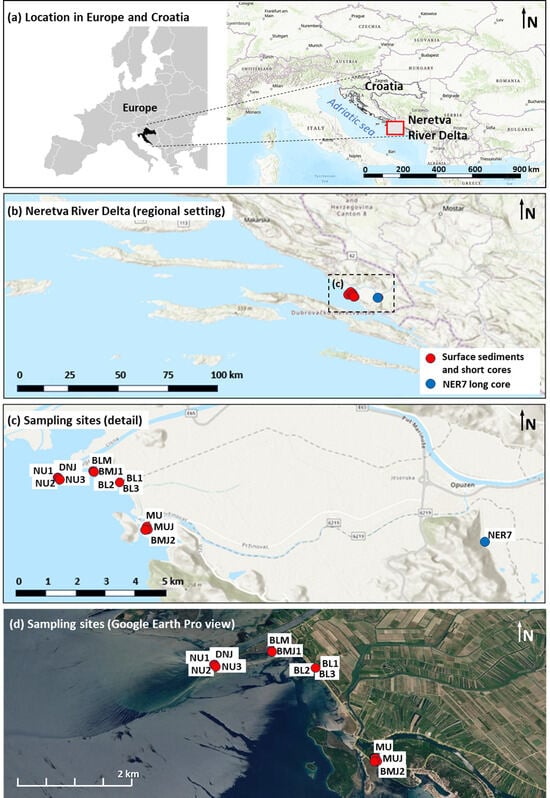
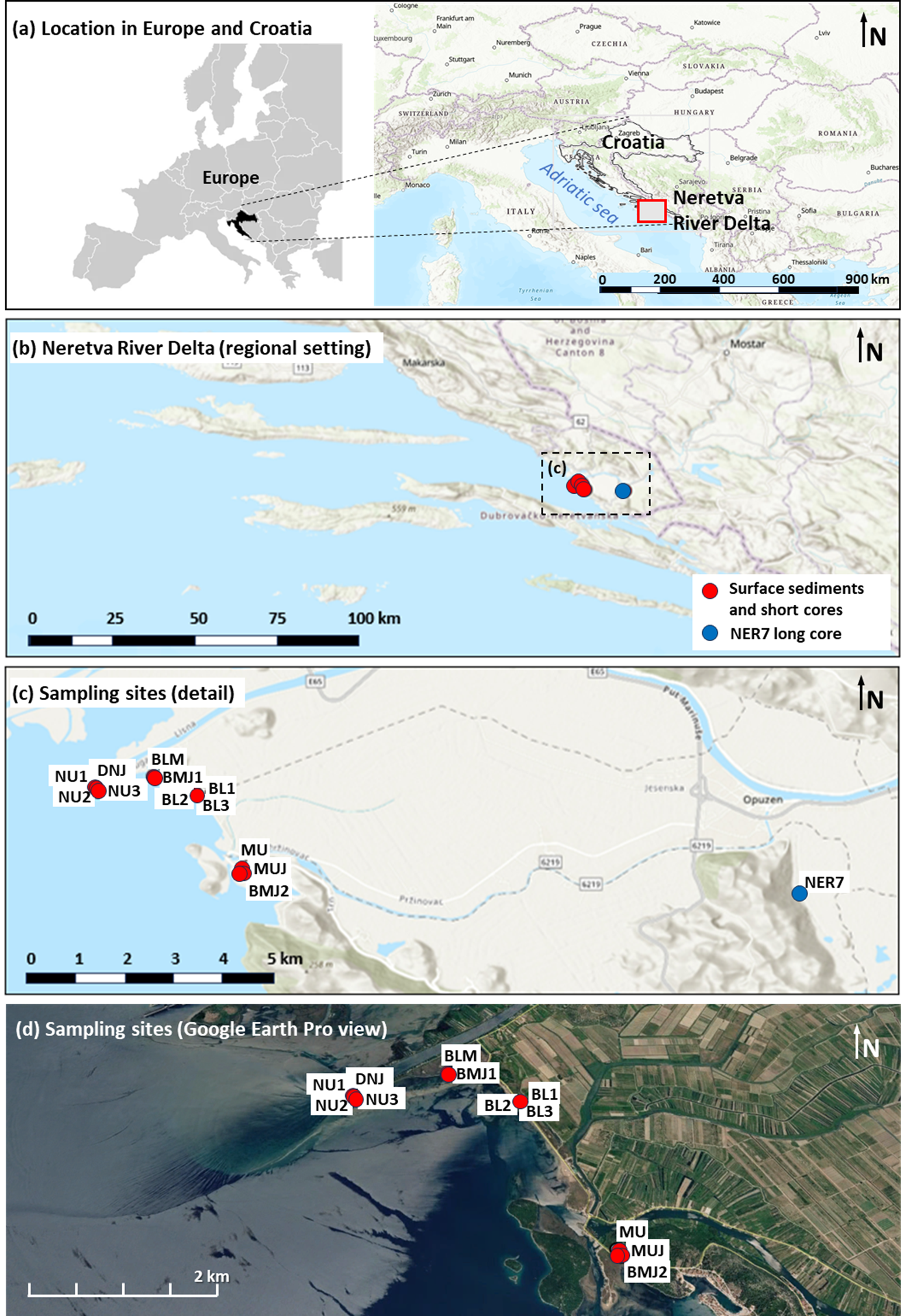
Location of the study area and sampling sites in the Neretva River Delta, Croatia: (a) Geographical location of Croatia within Europe and the Neretva River Delta along the southeastern Adriatic coast. (b) Regional setting of the Neretva River Delta, showing the distribution of sampling sites and the area enlarged in panel (c). (c) Detailed map of sampling locations, including surface sediment samples and shallow sediment cores (red circles), and the long sediment core NER7 (blue circle). (d) Google Earth Pro V7.3.7. (15 October 2026) satellite view showing the spatial distribution of surface sediment sampling sites and shallow sediment cores in the western part of the study area.
The present morphology of the delta reflects the combined effects of tectonic activity, Holocene sea-level rise, riverine sediment supply, and subsequent delta progradation [3,11,16]. The area comprises river channels, coastal sands, tidal flats, saline and brackish marshes, freshwater wetlands, and reclaimed agricultural land. During the twentieth century, the natural hydrological and sedimentary regime was modified by river regulation, land reclamation, intensive agriculture, and the construction of upstream dams [12,13].
3. Materials and Methods
3.1. Sampling and Sample Preparation
The field campaign was conducted in April 2025 in the Neretva River Delta, Croatia (Figure 1), across coastal, river-mouth, deltaic, and marsh environments. A total of eight surface sediment samples, four shallow sediment cores, and one long sediment core (NER7) were collected.
Surface samples were obtained from the upper 10 cm of sediment using a hand scoop and included three beach sediments (BL1–BL3), two marsh sediments (BLM and MU), and three sediments from the Neretva River mouth (NU1–NU3).
Four shallow sediment cores (BMJ1, BMJ2, DNJ, and MUJ) were retrieved using a 1 m-long sediment corer. A total of 14 depth intervals were selected for further analysis based on depth and visible sediment variations. These included ten samples from three marsh sediment cores (BMJ1, BMJ2, and MUJ) and four samples from a deltaic sediment core (DNJ).
The approximately 5 m long sediment core, designated NER7, was collected from a channel within the delta plain at 43°00′05.8″ N and 17°34′07.7″ E, at an elevation of approximately 0.1 m above sea level. Core NER7 was retrieved using an Eijkelkamp hand auger (Royal Eijkelkamp, Giesbeek, the Netherlands) equipped with an Edelman head (7 cm diameter) above the groundwater table and a 1 m long gouge (3 cm diameter) below it. Sampling depths were measured relative to the ground surface, with an estimated field uncertainty of ±5 cm. Coring reached a depth of 5 m, and 17 intervals were selected for laboratory analysis.
Samples recovered with the Edelman head may have been disturbed during extraction, whereas the gouge generally allowed better preservation of sedimentary structures. Core recovery was not systematically quantified for individual sampling runs; therefore, potential recovery gaps, sediment disturbance, and compression cannot be reliably assessed. However, because of the shallow depth from which the core was taken, compaction was probably not significant.
The spatial distribution of all sampling locations is shown in Figure 1b–d, while detailed sampling depths and coordinates are provided in Table S1. Prior to subsampling for laboratory analyses, all sediment samples were macroscopically described, including grain characteristics and the presence of organic matter, plant remains, shells, and other visible components. Sediment colour was additionally determined for core NER7 samples using the Munsell Soil Color Charts (Table S1).
For grain-size analysis, subsamples were retained in their original wet state. Subsamples intended for physicochemical and multielement analyses were air-dried, sieved through a 2 mm mesh to remove gravel-sized particles and plant remains, and homogenised using an agate mortar and pestle as required for subsequent analyses. Subsamples intended for micropalaeontological examination were air-dried prior to microscopic analysis.
Because of the limited amount of sediment available from individual NER7 intervals, different analyses were performed on separate, mostly adjacent sediment subsamples. The exact depths used for each analysis are provided in Tables S1, S3 and S4. Consequently, comparisons between physicochemical, sedimentological, and geochemical parameters are based on general downcore trends rather than direct point-by-point correspondence.
3.2. Determination of Physicochemical Parameters
Sediment suspension pH was measured with a Thermo Scientific ORION Pro (Thermo Fisher Scientific, Chelmsford, MA, USA) meter in 1:10 (w/v) sediment-to-deionised-water suspensions using air-dried and sieved subsamples. Measurements were made immediately after preparation at room temperature. Before analysis, the instrument was calibrated using standard buffer solutions of pH 4.0, 7.0, and 10.0. All measurements were performed in duplicate. Suspension pH is an operational laboratory measurement and not a direct record of porewater pH or depositional pH; it is used only as supporting evidence alongside grain size, organic matter, and microfossils.
Particle-size distribution was determined by laser diffraction using a Beckman Coulter LS 13320 particle-size analyser (measurement range: 0.04–2000 µm). Fresh sediment subsamples were passed through a 2 mm sieve to remove coarse organic fragments and shell material. Prior to analysis, samples were dispersed in an ultrasonic bath for 5 min without the addition of chemical dispersants. Particle-size distributions were expressed as volume percentages, and sediment fractions were classified into clay, silt, and sand [17]. Sediment textural classes were assigned according to the Folk classification [18], based on the relative proportions of sand, silt, and clay. Instrument performance was verified using particle-size reference standards covering different size ranges (LS Control GB500, GB350, G15 and PCS Control L1000). Detailed optical settings and measurement-specific precision estimates were not available for retrospective reporting.
Organic matter content was determined using the loss-on-ignition method. Approximately 5 g of each sample was weighed into porcelain crucibles and heated at 105 °C for 2 h to remove hygroscopic water. The samples were subsequently cooled, weighed, and ignited at 360 °C for 2 h. An ignition temperature of 360 °C was selected to remove most organic matter while minimising the decomposition of inorganic carbonates and loss of clay structural water [19]. Following ignition, the samples were cooled and reweighed. Organic matter content was calculated from the difference in sample mass before and after ignition and expressed as a percentage of dry sediment mass. The reported values represent loss-on-ignition-derived organic matter estimates rather than directly measured organic carbon. Potential non-organic mass loss and the presence of shell and plant material may affect the interpretation of highly organic sediments.
3.3. Micropalaeontological Analysis
Micropalaeontological analysis was performed on all sediment samples, including surface sediments, shallow cores, and core NER7, to provide complementary information on changes in the depositional environment. The sub-samples (1 cm thick) were washed through the 125 μm sieve and dried. Prepared sediment fractions were examined under a Stereo Zoom Microscope and EUROMEX ImageFocus 4.0 camera for the presence and composition of microfossil remains, with particular attention to benthic foraminifera, ostracods, gastropods, and mollusc shells and shell fragments. Microfossils were examined for occurrence and taxonomic composition, and representative specimens were picked and mounted on micropalaeontological slides. For shallow- and long-core samples, micropalaeontological observations were obtained from depth intervals adjacent to those used for other analyses, as specified in Table S1. Because the examined sediment mass, search effort, and specimen counts were not standardised across samples, the observations were interpreted qualitatively and restricted to microfossil occurrence and taxonomic composition rather than quantitative abundance comparisons.
For figure preparation, selected specimens were digitally isolated from the original microscopy images using AI-assisted image processing (ChatGPT Images 2.5, OpenAI, San Francisco, CA, USA) and presented against a uniform black background. The original micrographs and corresponding isolated specimens are provided in Figure S1 to allow direct visual comparison and verification of specimen morphology.
3.4. Multielement Analysis
Before multielement analysis, samples were subjected to closed-vessel microwave-assisted acid digestion using a Multiwave ECO microwave digestion system (Anton Paar, Graz, Austria). Approximately 0.05 g of dried and homogenised sediment was digested using a mixture of 4 mL nitric acid (65% HNO3, pro analysi, Kemika, Zagreb, Croatia), 1 mL hydrochloric acid (36.5% HCl, pro analysi, Kemika, Zagreb, Croatia), and 1 mL hydrofluoric acid (48% HF, pro analysi, Kemika, Zagreb, Croatia). In the second digestion step, 6 mL of boric acid solution (H3BO3, Fluka, Steinheim, Switzerland) was added to complex residual fluoride ions. The parameters of the digestion procedure were as follows: step (a) ramp over 20 min and hold for 20 min at 1400 W, followed by cooling; step (b) ramp over 10 min and hold for 10 min at 1400 W, followed by cooling. Following digestion, the samples were diluted to 20 mL and subsequently subjected to a 50-fold dilution with 2% (v/v) HNO3, corresponding to an effective final volume of 1 L per sample. Indium (50 µg/L) was used as an internal standard.
Multielement analysis was performed using an inductively coupled plasma triple quadrupole mass spectrometer (ICP-QQQ 8900, Agilent Technologies). Total concentrations of 26 elements were determined: Al, As, Ba, Ca, Cd, Co, Cr, Cu, Fe, K, Li, Mg, Mn, Mo, Na, Ni, Pb, Rb, Sb, Sn, Sr, Ti, Tl, U, V, and Zn.
Analytical quality control was ensured through the simultaneous analysis of procedural blanks and certified reference material for estuarine sediment (NBS SRM 1646, Department of Commerce, National Bureau of Standards, Washington, DC, USA) (Table S2). Good agreement between measured and certified values was obtained for the certified reference material, with recoveries ranging from 92% to 112% and a mean recovery of 103% (Table S2).
3.5. Spatial and Statistical Analyses
Geographic maps were prepared in ArcGIS Pro (Esri) 3.2.2, while statistical analysis was performed using STATISTICA 7.0 (StatSoft, Inc., Tulsa, OK, USA). Spearman’s rank correlation coefficient (ρ) was used to evaluate associations among element concentrations because several variables exhibited non-normal distributions and pronounced spatial variability. Statistical significance was set at p < 0.05.
Element-to-Al mass concentration ratios (X/Al) were calculated from the concentrations reported in Table S4. To ensure dimensional consistency, the ratios were defined using concentrations expressed in the same mass units. For major elements, both elemental and Al concentrations were expressed in g/kg, yielding unscaled dimensionless ratios. For trace elements, expressed in mg/kg, the dimensionless mass ratios were multiplied by 103 for presentation. These scaled values are numerically equivalent to dividing the trace-element concentrations in mg/kg by the Al concentrations in g/kg. This convention was applied consistently in Table S5. No missing values or concentrations below detection limits were found in the analysed dataset. The ratios were used for descriptive comparisons of element distributions rather than as formal enrichment factors.
4. Results
4.1. Spatial Variability of Recent Sediments
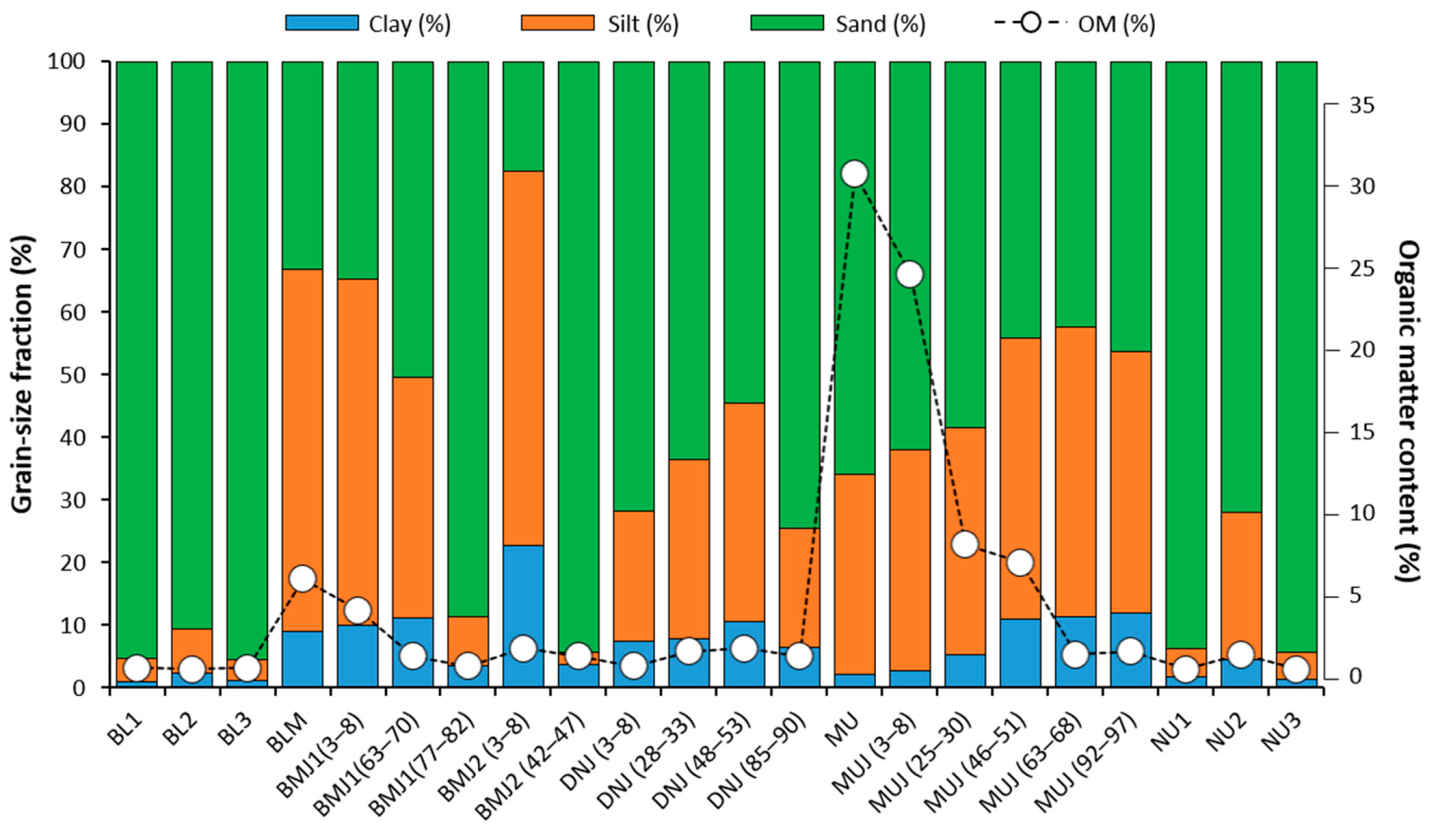
Detailed sample descriptions, sediment characteristics, and Munsell sediment colours are provided in Table S1, while the physicochemical and sedimentological characteristics of surface sediments and shallow cores are summarised in Table S3. Measured pH values ranged from 8.0 to 9.7, indicating alkaline conditions in all samples for which pH was determined. Sediment texture was highly variable, ranging from sand to silty sand to sandy silt. The beach samples (BL1–BL3) and samples from the Neretva River mouth (NU1–NU3) were generally sand-dominated, although considerable variability was observed among the remaining surface and shallow-core samples. Organic matter content ranged from 0.18% to 30.4%, with the highest values recorded in the marsh surface sample MU and the upper interval of the MUJ core (Figure 2).
Figure 2.
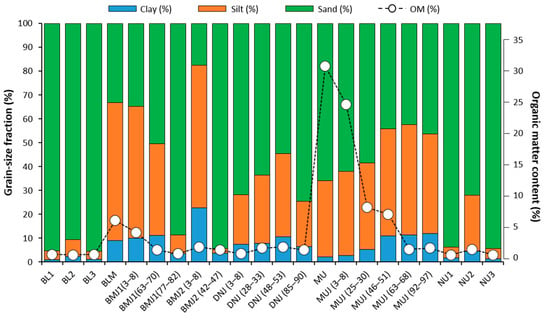
Grain-size composition and organic matter content of surface sediments and shallow sediment cores from the Neretva River Delta. Stacked bars represent clay, silt, and sand fractions, and the line represents organic matter (OM) content. Numbers in parentheses following sample IDs indicate the corresponding sampling depth intervals (cm) within the shallow sediment cores.
Element concentrations were likewise highly variable among the investigated samples (Table S4), and no simple correspondence between depositional setting, grain-size composition, and these values was apparent. This variability was particularly evident for Al and associated lithogenic elements. For example, Al concentrations varied substantially both among and within individual sampling locations, including the shallow sediment cores. Similar sample-to-sample variability was observed for several trace elements.
Several samples also showed locally elevated concentrations of individual elements, including Pb (BL1), Zn (BL2, BMJ1 (77–82)), As (MUJ (92–97), NU1), and Mo (BL1), but their distributions were spatially heterogeneous, and the concentration maxima did not consistently occur in the same samples.
4.2. Sedimentary Transition Recorded in Core NER7
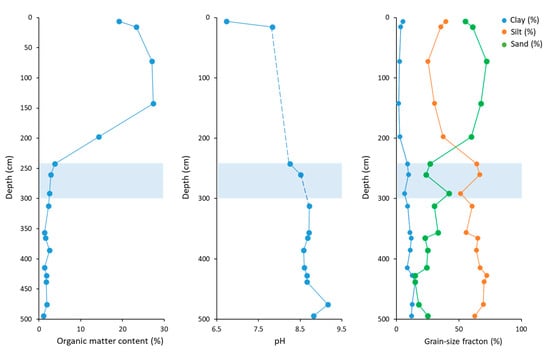
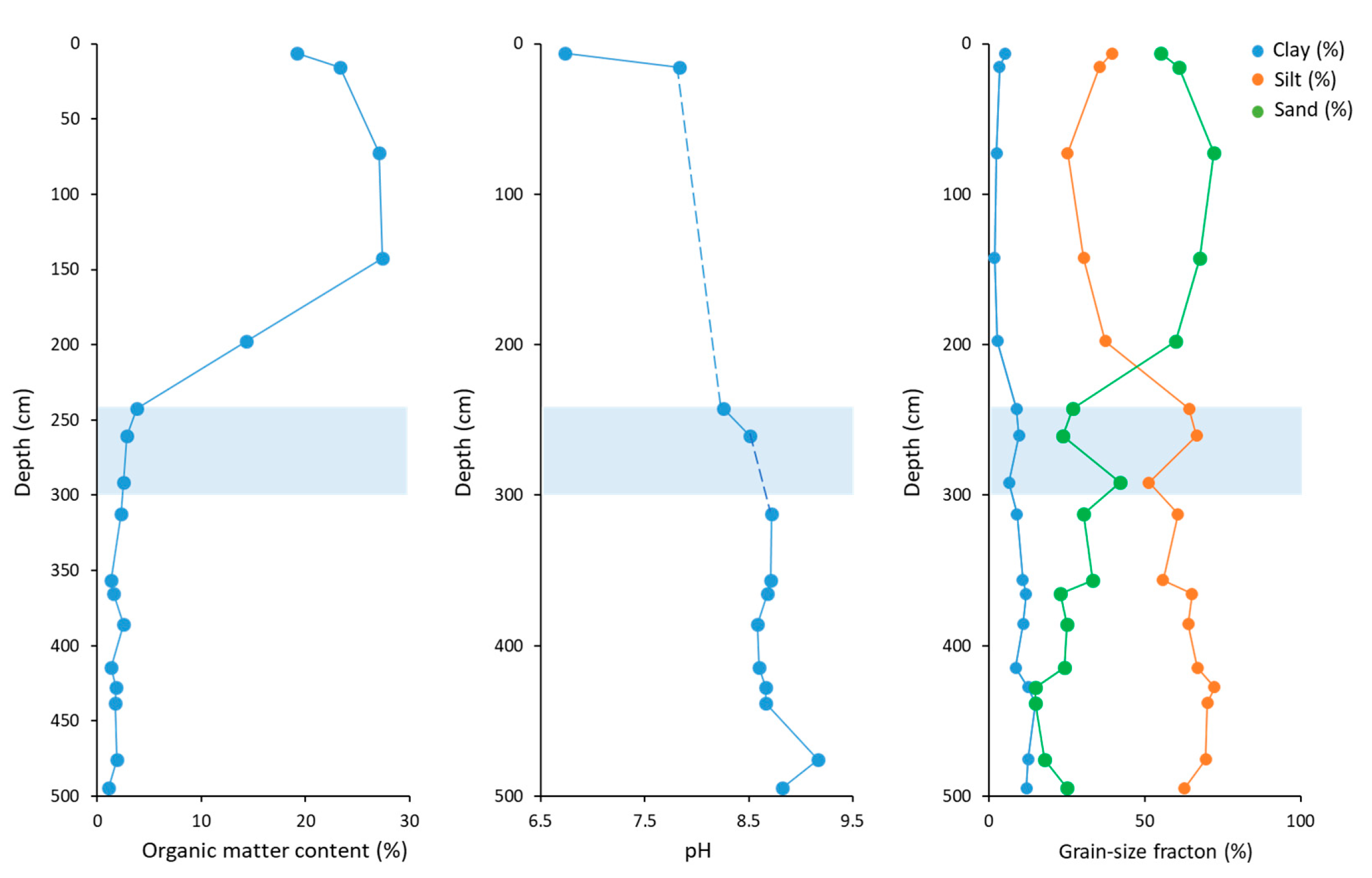
In core NER7, the upper unit is characterised by high organic matter content, lower pH values, and relatively high proportions of sand (Figure 3). Although sediment texture varies within this part of the core, silty sand is the dominant textural class (Table S3). Organic matter content is consistently high in the upper unit and reaches a maximum at 140–145 cm and then decreases from 14.3% at 195–200 cm to 3.78% at 240–245 cm (Figure 3).
Figure 3.
Downcore variations in organic matter content, pH, and grain-size composition in sediment core NER7. The shaded interval indicates the main sedimentological transition zone between approximately 245 and 300 cm depth. Dashed line indicates the absence of pH measurements for this interval.
Below approximately 300 cm, organic matter content remains low, and pH values are consistently alkaline (Figure 3). The deeper sediments are characterised by a predominance of silt over sand, reflecting an overall shift from sand-rich to silt-rich sediments with increasing depth.
4.3. Micropalaeontological Evidence of Depositional Change
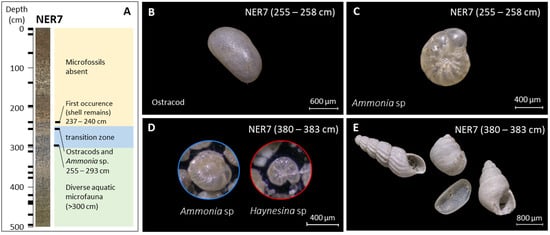
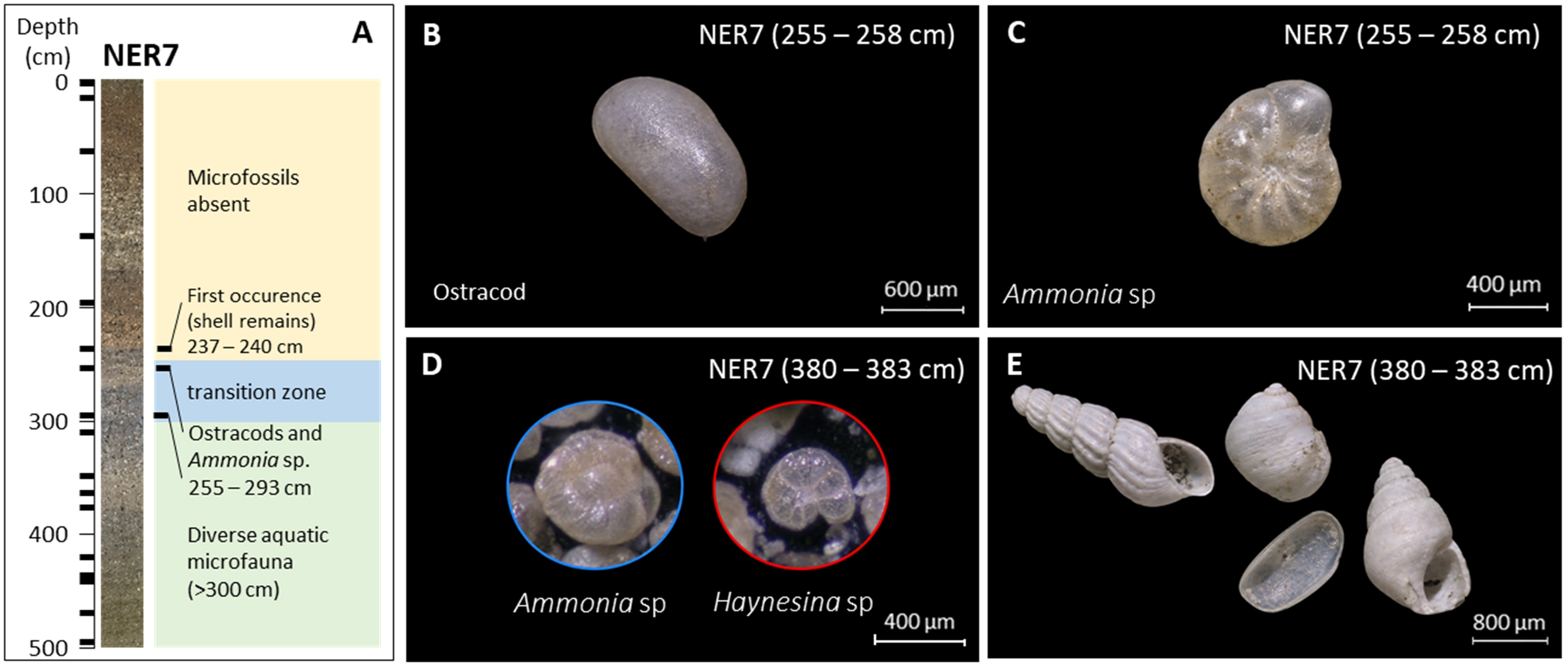
Microfossil occurrence showed a pronounced downcore change that broadly coincided with the sedimentological transition identified in NER7 (Figure 4). No microfossils were observed in the analysed intervals from the upper part of the core down to 192–195 cm (Table S1). These intervals were characterised by abundant plant remains and peat, consistent with the high organic matter content recorded in the upper part of the core. The first shell remains occurred at 237–240 cm, near the upper boundary of the transition zone. Ostracods and benthic foraminifera, including Ammonia sp., were first recorded at 255–258 cm and subsequently identified in several deeper intervals throughout the remainder of the core (Table S1).
Figure 4.
Micropalaeontological record of sediment core NER7: (A) Simplified vertical distribution of microfossils and principal micropalaeontological intervals, with sampled depth intervals marked at their corresponding positions along the depth scale; representative specimens of (B) ostracods, (C) Ammonia sp., (D) Ammonia sp. and Haynesina sp., and (E) gastropods and ostracod remains. Scale bars are indicated in each panel.
Below approximately 300 cm, microfossils became more abundant and taxonomically diverse, with assemblages comprising benthic foraminifera, ostracods, and molluscan remains. Among the observed foraminifera, Ammonia sp. was predominant, whereas Haynesina sp. was less frequently encountered, occurring alongside Ammonia sp. in several deeper intervals (350–353, 380–383, and 497–500 cm). Other foraminiferal taxa, including Porosononion sp., were observed only sporadically (Table S1). Gastropod and bivalve remains were also common in the lower part of the core, with Cerastoderma sp. identified at 417–420 cm.
4.4. Geochemical Organisation of Core NER7
Most elements exhibit broadly similar vertical distributions, with generally higher concentrations in the upper part of core NER7 and lower concentrations at depth, although individual deviations from this pattern occur (Table S4). These trends are particularly evident for elements commonly associated with lithogenic material, as reflected in strong positive Spearman correlations of Al with Fe (ρ = 0.94), K (ρ = 0.96), Li (ρ = 0.92), Ba (ρ = 0.91), Rb (ρ = 0.99), and Ti (ρ = 0.97). Strong correlations with Al are also observed for several trace elements, including Co (ρ = 0.96), Pb (ρ = 0.92), Sn (ρ = 0.97), and V (ρ = 0.99), whereas other elements, such as As, Cd, Cr, Mo, and Zn, exhibit less pronounced, but still positive, correlations with Al (ρ = 0.54–0.77; Table S6). The overall differences between the upper and lower parts of the core are particularly evident across the transition interval at approximately 245–300 cm. However, several elements exhibit additional localised variations. Cd, Cr, and Cu show moderately elevated concentrations at 137–140 cm, whereas Mo exhibits a much more pronounced peak at the same depth (15.42 mg/kg), reaching approximately 15 times the concentrations observed in some deeper intervals (~1 mg/kg). The organic matter maximum occurs in the adjacent interval at 140–145 cm, as geochemical and organic matter analyses were performed on separate sediment subsamples. Zn deviates from the general pattern, tending to increase towards the deeper intervals and reaching its highest concentration at 497–500 cm.
In contrast, Ca and Mg generally exhibit lower concentrations in the upper core and higher concentrations below the transition zone, showing negative correlations with Al (ρ = −0.62 and −0.66, respectively). Sr follows a similar pattern (ρ = −0.62). Na shows no meaningful monotonic relationship with Al (ρ = 0.01), while Mn exhibits a distinct vertical distribution, characterised by a concentration maximum near the upper boundary of the transition zone and a weak negative correlation with Al (ρ = −0.30).
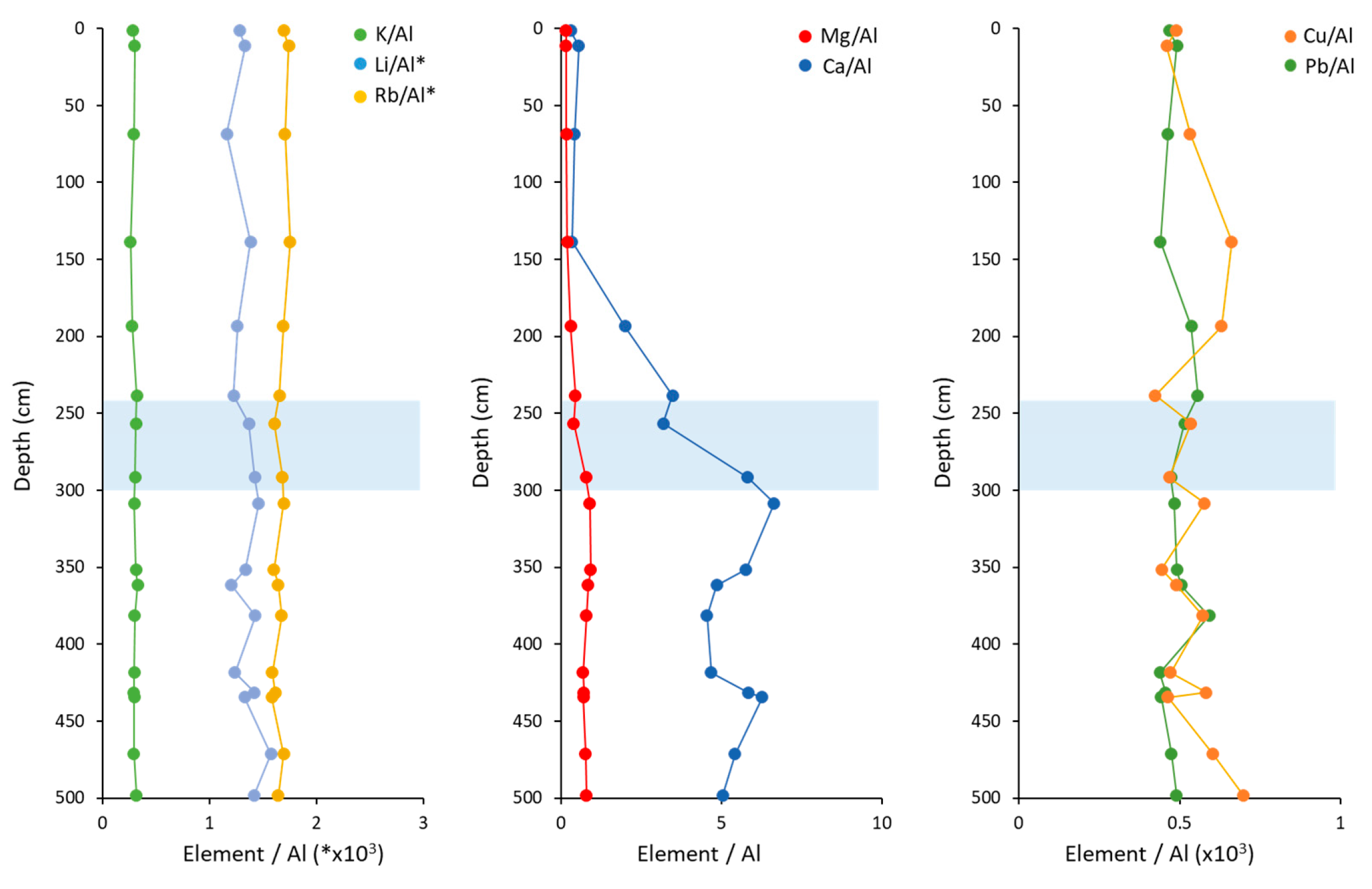
Element-to-Al concentration ratios were examined to facilitate comparison of element distributions relative to Al (Table S5). These ratios provide a descriptive representation of compositional differences along the core but do not independently identify mineralogical associations.
In contrast, Al-normalised Ca increases markedly with depth, emphasising the increasing relative contribution of the carbonate component. Pb and Cu show variations relative to Al in some shallow intervals, but these are not consistently expressed throughout the upper core.
5. Discussion
5.1. Geochemical Variability of Recent Depositional Environments
The surface sediments and shallow cores demonstrate pronounced small-scale variability among the recent depositional environments of the Neretva Delta (Figure 2; Tables S3 and S4). Beach sediments BL1–BL3 are strongly sand-dominated (90.5–95.5% sand) and contain only 0.18–0.33% organic matter (OM). A similarly coarse-grained character occurs at the river mouth, particularly at NU1 and NU3, with 93.7 and 94.3% sand, respectively, and OM contents of only 0.20 and 0.24%. In contrast, the marsh surface sediment MU contains 30.4% OM, while the uppermost MUJ interval (3–8 cm) contains 24.3% OM. These organic-rich marsh sediments are not uniformly fine-grained: sand still accounts for 65.9% at MU and 61.9% at MUJ 3–8 cm. With depth in MUJ, however, the sediment becomes finer, with sand decreasing to 44.2% at 46–51 cm and 42.5% at 63–68 cm, while silt and clay together increase to 55.8 and 57.5%, respectively. These contrasts highlight differences in sediment composition among the investigated depositional environments, as well as vertical variations within individual shallow cores. Although the limited number of sampling locations does not allow a comprehensive assessment of spatial variability across the Neretva River Delta, the observed differences demonstrate the influence of local depositional conditions on sediment characteristics. Moreover, they indicate that organic-rich marsh sediments at the investigated sites are not necessarily fine-grained and may exhibit considerable vertical variations in grain-size composition. Such site-specific variability is consistent with previous observations from the Neretva Delta, where sediment characteristics reflect local hydrodynamic conditions, riverine sediment supply, and depositional setting [12,16,20].
The sedimentological variability is accompanied by differences in element composition (Table S4). Al concentrations vary both among sites and between intervals within individual shallow cores. For example, Al is 46.0 g/kg in BL1 and 16.1 g/kg in MUJ at 3–8 cm but reaches 50.5 g/kg deeper in the same MUJ core, at 46–51 cm. These differences indicate spatially variable contributions of Al-bearing material. The common behaviour of Al and several other elements is also reflected in their Spearman correlations (Table S6). Comparable relationships have been reported in previous geochemical studies of the Neretva Delta, where strong associations between Al and V, Cr, and Ni were observed, although Al normalisation did not fully account for the variability of Cd, Cu, Pb, and Zn at all sampling sites [12]. These findings highlighted the importance of clay minerals and Fe- and Mn-bearing phases in controlling trace-element distributions. Similarly, Ni, Co, and Zn in surface sediments of the delta and adjacent coastal areas have been associated with the deposition of river-borne fine particles and shown to correlate with Al, Fe, and Mn [21].
Organic matter provides an additional control on sediment composition and trace-element behaviour. The contrast between the organic-rich marsh samples MU and upper MUJ and the organic-poor beach and river-mouth samples is particularly pronounced. Previous work in the Neretva Delta has shown that sedimentary organic matter can influence particle surface properties and trace-metal retention. This is illustrated by elevated Pb, Cu, and Cd concentrations near the river mouth, which have been linked to terrestrial organic matter [21], as well as observations from Kuti Lake, where organic matter degradation and associated redox conditions were found to influence the behaviour of redox-sensitive elements [20]. These findings suggest that the geochemical variability among the present samples reflects interacting mineralogical, granulometric, and organic matter controls rather than grain size alone.
Carbonate material represents a further compositional control. The Neretva drains a lithologically diverse catchment before entering a predominantly carbonate karst region, so terrigenous aluminosilicate material can occur together with carbonate derived from local geological and biogenic sources. Previous studies show that the relative importance of these components varies within the delta. In Kuti Lake, for example, authigenic calcite was identified as the dominant component of recent sediments, whereas terrigenous aluminosilicate material was supplied mainly during short-term flood events [20]. Such variability provides a mechanism by which bulk element concentrations can differ over short distances without requiring corresponding changes in contaminant input.
The distribution of potentially anthropogenic elements illustrates why this compositional heterogeneity must be considered. The highest Pb concentration in the recent dataset, 89.4 mg/kg, occurs in the beach sample BL1, whereas BL2 and BL3 do not show comparable Pb concentrations. Zn also shows isolated maxima, reaching 146 mg/kg in BL2 and 145 mg/kg in the BMJ1 marsh core. The highest As concentration, 20.3 mg/kg, occurs in the shallow DNJ interval at 3–8 cm. These maxima occur in contrasting depositional environments rather than defining a coherent spatial enrichment pattern. Previous studies have shown that trace-element distributions in the Neretva Delta reflect sediment provenance, mineralogical composition, depositional processes, and local anthropogenic influence [12,20]. While site-specific effects of anthropogenic modification have been reported [12], generally low levels of anthropogenic metal contamination have been observed in sediments of the delta and adjacent coastal areas [21]. Thus, the isolated enrichments observed here do not support widespread contamination as the dominant control on recent sediment geochemistry, although localised anthropogenic inputs cannot be excluded.
5.2. The 245–300 cm Transition and Evolution of the Neretva Delta
The transition between the two sedimentary units of core NER7 is supported by the combined sedimentological and micropalaeontological evidence rather than by any single parameter (Figure 3 and Figure 4). Changes in organic matter content, sediment texture, suspension pH, and microfossil occurrence collectively indicate a shift in depositional conditions around 245–300 cm depth. However, these changes do not occur at precisely the same depth: organic matter begins to decrease above the transition interval, while shell remains and aquatic microfossils first appear at different levels within or near it. The interval should therefore be regarded as an approximate depositional transition rather than a sharply defined boundary. Given the discrete and partly adjacent sampling intervals, neither the precise boundaries nor the rate of environmental change can be established.
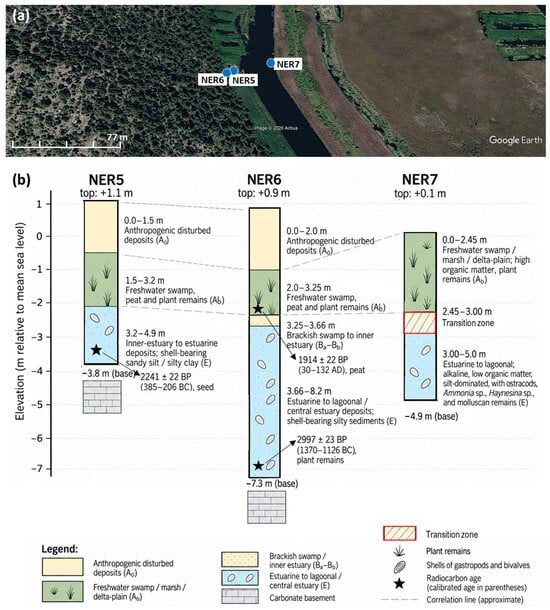
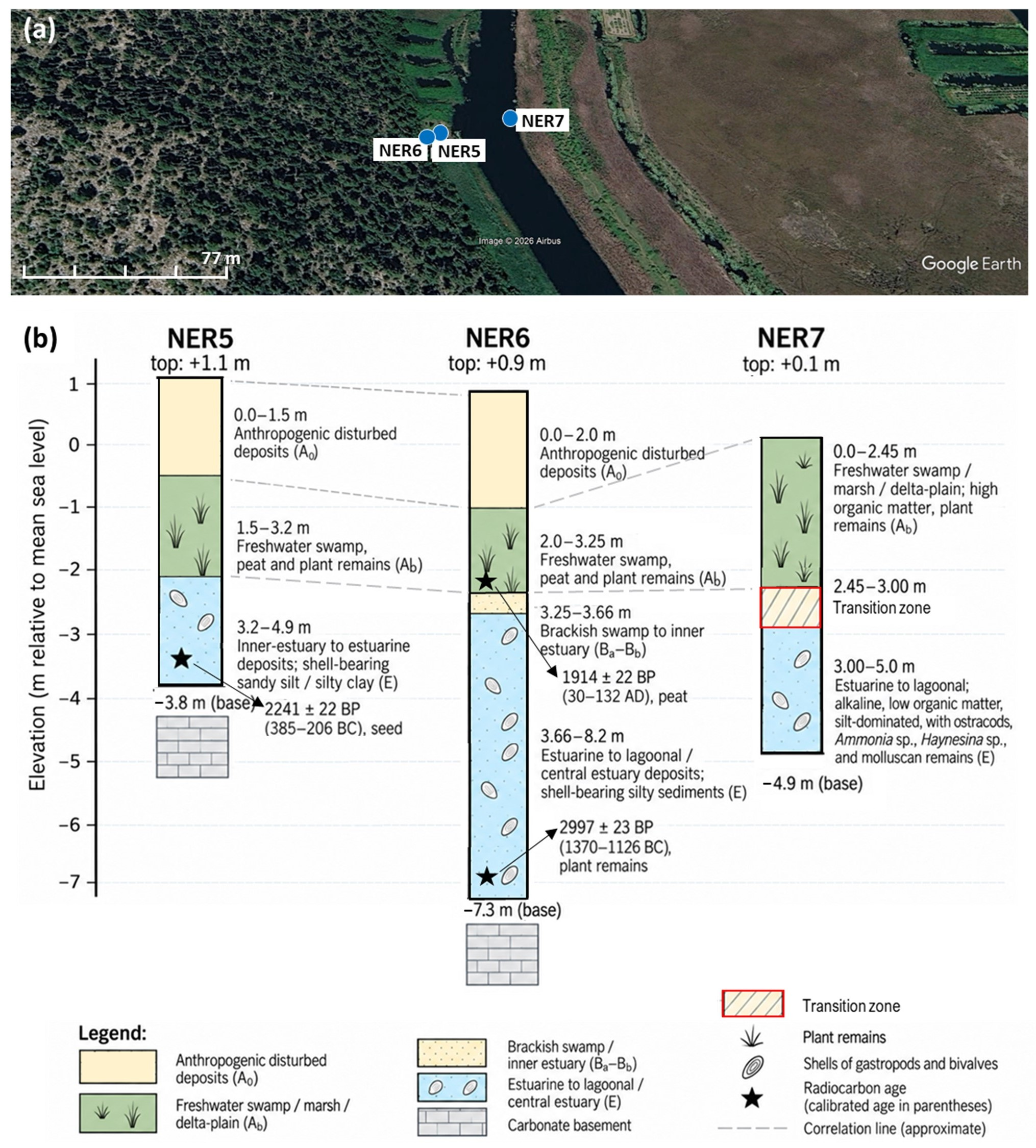
The deeper unit is interpreted as representing a carbonate-influenced estuarine-to-lagoonal environment. The occurrence of benthic foraminifera, ostracods, and molluscan remains, together with the sedimentological characteristics, is consistent with deposition under shallow aquatic conditions with brackish influence. In particular, the presence of Ammonia sp. and Haynesina sp. is compatible with environmentally variable marginal-marine and estuarine settings [22], although these taxa alone do not establish specific salinity conditions. The relatively greater abundance of Ca and Mg is also consistent with an increased carbonate contribution, although the mineralogical hosts of these elements were not directly determined. Comparable estuarine and lagoonal deposits have been described in nearby sediment cores NER5 and NER6 [3], providing a local stratigraphic context for the interpretation of NER7 (Figure 5).
Figure 5.
Comparison of sedimentary successions in the Neretva River Delta: (a) Locations of sediment cores NER5, NER6, and NER7 in Google Earth Pro V7.3.7. (15 October 2026). (b) Simplified stratigraphic profiles showing the vertical distribution of depositional facies in NER5 and NER6 (modified after Felja [3]) and NER7 (this study). Core profiles are presented relative to mean sea level. The shaded interval in NER7 indicates the main depositional transition between approximately 245 and 300 cm depth. Stratigraphic similarities are interpreted in terms of depositional environments and do not imply chronological equivalence.
In contrast, the upper unit reflects the development of a more terrestrialised marsh and delta-plain environment. Organic matter accumulation, abundant plant remains, and peat-like material support increasingly waterlogged conditions, while the absence of observed aquatic microfossils is consistent with a change in depositional setting. However, preservation and dilution effects may also have influenced microfossil occurrence. The textural variability of the upper unit further suggests that marsh development was accompanied by changing sediment supply, flooding, and local fluvial processes rather than the establishment of a uniform depositional environment. The variability observed among the modern marsh sediments provides a qualitative comparison for these conditions, although individual modern samples cannot be regarded as direct equivalents of specific NER7 intervals.
The succession recorded in NER7 is consistent with the regional Holocene evolution of the Neretva Delta, characterised by marine transgression, subsequent estuarine infilling, and progressive delta progradation [3,11,16]. Previous studies indicate that infilling of the Neretva estuary followed the relative stabilisation of sea level around 7500 BP, with delta progradation continuing during the subsequent millennia [2,3,11]. Radiocarbon dating of nearby cores NER5 and NER6 provides additional chronological context. In NER5, an age of approximately 2200 BP was obtained at a depth of 4.8 m, while NER6 yielded ages of approximately 1900 BP at 3 m and 3000 BP at 8 m depth [3] (Figure 5).
Radiochemical analyses of offshore sediments in the Neretva Channel reported recent accumulation rates of 1.9–8.5 mm yr−1, with higher values in areas strongly influenced by river discharge [23]. However, these ages and accumulation rates represent spatially distinct sedimentary records and, in the case of offshore accumulation rates, different depositional conditions and timescales. They therefore cannot be directly applied to NER7 or used to establish the age of its 245–300 cm transition. Direct dating is required to constrain the timing and duration of the recorded environmental change.
5.3. Natural Geochemical Controls and Anthropogenic Influence
The geochemical variability recorded in core NER7 appears to be strongly influenced by changes in sediment composition associated with the transition between depositional environments. The broadly coherent distributions of Al and numerous major and trace elements (Table S6) are consistent with variations in the contribution of terrigenous aluminosilicate material, as previously reported for sediments of the Neretva Delta and the eastern Adriatic [12,15,20]. However, the strong whole-core correlations may partly reflect the compositional contrast between the two sedimentary units and their shared depth trends rather than specific mineralogical associations. Conversely, the opposing behaviour of Ca and Mg, together with the increase in Ca/Al towards the deeper part of the core (Figure 6), suggests a greater contribution of Ca- and Mg-bearing material, potentially including carbonates, to the lower unit. Although the mineralogical hosts of these elements were not directly determined, such compositional differences may explain part of the apparently higher concentrations of Al-associated elements in the upper unit without necessarily implying increased external inputs [4,20].
Figure 6.
Downcore variations in selected element-to-Al mass concentration ratios in sediment core NER7. K/Al, Mg/Al, and Ca/Al are presented as unscaled dimensionless ratios, whereas Li/Al, Rb/Al, Cu/Al, and Pb/Al are expressed as dimensionless ratios multiplied by 103, consistent with Table S5. The blue-shaded interval indicates the main depositional transition between approximately 245 and 300 cm depth.
Superimposed on these compositional differences are variations that may reflect organic matter accumulation and early diagenetic processes. Several trace-element maxima occur close to the organic-rich section of the upper core, although the geochemical and physicochemical measurements were performed on adjacent rather than identical sediment intervals (Tables S3 and S4). This spatial association is compatible with the possible retention of trace elements by organic matter, fine mineral particles, and Fe-bearing phases, consistent with previous observations from the Neretva Delta [20]. The distinctive distributions of Mn, Mo, and Zn also suggest that processes other than variations in aluminosilicate abundance may influence their behaviour. Redox-related redistribution and interactions with Fe–Mn phases or organic matter represent possible mechanisms [5,6,20], but these interpretations remain tentative in the absence of independent redox and mineralogical evidence.
Potential anthropogenic contributions must be considered against this natural geochemical variability. Agricultural activities in the Neretva Delta, including the use of Cu-containing plant-protection products, have previously been identified as possible sources of trace elements [12,14]. Nevertheless, the NER7 record does not exhibit a consistent increase in Cu or Pb concentrations towards the core top, while their positive correlations with Al suggest a substantial compositional influence (Table S6). Localised variations in Cu/Al and Pb/Al ratios (Figure 6) may reflect additional inputs but cannot independently establish anthropogenic enrichment. Similarly, the heterogeneous distribution of trace-element maxima among the investigated recent sediments (Section 5.1) emphasises the difficulty of distinguishing localised anthropogenic contributions from natural sedimentological and geochemical variability.
An additional limitation is the absence of a suitable local geochemical background. Because the deeper estuarine unit differs substantially in composition from the upper marsh deposits, it cannot be treated as an uncontaminated reference against which enrichment in the upper core can be reliably assessed. Furthermore, although regional sea-level reconstructions provide a broader chronological context [24,25], they cannot establish the age of NER7 or directly associate its upper sediments with periods of intensive agricultural or other human activity. Quantifying anthropogenic contributions would therefore require a facies-appropriate geochemical background, independent dating, and additional source-sensitive indicators. Overall, the available evidence indicates that depositional and compositional changes are major controls on the NER7 geochemical record, potentially modified by early diagenetic processes, while localised anthropogenic inputs remain possible but cannot be quantified reliably.
6. Conclusions
The combined analysis of recent sediments and core NER7 demonstrates that sediment geochemistry in the Neretva River Delta is strongly controlled by depositional environment and sediment composition. Recent coastal and river-mouth sediments are predominantly sandy and organic-poor, whereas marsh and deltaic sediments show greater sedimentological variability and locally elevated organic matter contents. The modern samples therefore demonstrate that grain size, organic matter, and the relative contributions of aluminosilicate and carbonate material vary independently to some extent and must all be considered when interpreting element concentrations.
Core NER7 records a major environmental transition between approximately 245 and 300 cm depth. The deeper unit is characterised by low organic matter contents, alkaline conditions, higher relative contributions of Ca and Mg, and the persistent occurrence of ostracods, molluscan remains, and benthic foraminifera. In contrast, the upper unit contains substantially more organic matter, lacks the aquatic microfaunal assemblages observed at depth, and is characterised by higher concentrations of Al-associated elements. Together, the sedimentological, micropalaeontological, and geochemical evidence indicates a transition from a carbonate-influenced estuarine to lagoonal environment towards an organic-rich marsh and delta-plain setting during progressive infilling and continentalisation of the Neretva Delta. Downcore variations in element concentrations largely reflect changes in sediment composition associated with different depositional environments. The broadly coherent behaviour of Al and numerous major and trace elements suggests an important influence of terrigenous aluminosilicate material, whereas the contrasting distributions of Ca and Mg are consistent with a greater carbonate contribution in the deeper unit. Organic matter accumulation and possible early diagenetic processes may additionally influence the distributions of individual trace and redox-sensitive elements, although these mechanisms were not independently verified. Consequently, concentration differences between the upper and lower parts of the core should not be interpreted as evidence of enrichment without accounting for these compositional changes.
Local Cu and Pb variations cannot be unequivocally attributed to anthropogenic sources without a facies-appropriate geochemical background and independent source indicators. The absence of independent chronological control further prevents direct association of the upper sediments with the period of intensive human activity in the delta. Although regional chronologies place estuarine infilling and delta progradation within the last 7000–6000 years, direct dating of core NER7 remains necessary before the 245–300 cm transition can be assigned to a specific period of Holocene sea-level or climatic change. Nonetheless, the NER7 record demonstrates that a multiproxy, facies-based interpretation is essential for distinguishing natural geochemical variability from potential anthropogenic signals in karstic deltaic sediments.
Supplementary Materials
The following supporting information can be downloaded at https://www.mdpi.com/article/10.3390/geosciences16110455/s1, Table S1: Sampling locations, coordinates, and sample descriptions from the Neretva River Delta; Table S2: Instrumental and method detection limits, certified values, measured concentrations, and recoveries for the certified reference material (NBS SRM 1646, Estuarine Sediment); Table S3: Physicochemical and sedimentological properties of the collected sediment samples; Table S4: Element concentrations (expressed in mg/kg or *g/kg) in studied sediments; Table S5: Element-to-Al concentration ratios in the studied samples; Table S6: Spearman rank correlation coefficients (ρ) among element concentrations in (a) surface sediments and shallow sediment cores and (b) sediment core NER7. Figure S1: Original microscopy images and corresponding digitally isolated specimens shown in Figure 4: (1a) Original microscopy image; (1b) digitally isolated specimen from NER7, 255–258 cm: (2a) original microscopy image; (2b) digitally isolated specimen from NER7, 255–258 cm; (3a) original microscopy image; (3b) digitally isolated Ammonia sp. and Haynesina sp. from NER7, 380–383 cm; (4a) original microscopy image; (4b) digitally isolated molluscan remains from NER7, 380–383 cm.
Author Contributions
Conceptualisation, I.F. and Ž.F.; methodology, I.F. and Ž.F.; software, Ž.F.; validation, I.F. and Ž.F.; formal analysis, I.F., S.S., E.Š. and Ž.F.; investigation, I.F., S.S. and E.Š.; resources, I.F. and Ž.F.; writing—original draft preparation, I.F. and Ž.F.; writing—review and editing, I.F. and Ž.F.; visualisation, I.F. and Ž.F.; supervision, I.F. and Ž.F.; project administration, I.F.; funding acquisition, I.F. All authors have read and agreed to the published version of the manuscript.
Funding
This research was supported by the European Union—NextGenerationEU through the National Recovery and Resilience Plan 2021–2026 Institutional grants of the University of Zagreb Faculty of Science (PRGA).
Data Availability Statement
The data supporting the findings of this study are provided in the article and its Supplementary Materials. Additional underlying data are available from the corresponding author upon reasonable request.
Acknowledgments
The authors gratefully acknowledge Mavro Lučić for performing the multielement analysis and Tomislav Fiket for preparing the maps presented in this study. During the preparation of this manuscript, the authors used ChatGPT (GPT-5.6 Sol, OpenAI) to assist with the segmentation and isolation of selected specimens from microscopy images for figure preparation (Figure S1). The processed images were compared with the original micrographs to verify the preservation of diagnostic morphological and surface features. Scale bars were verified against the original image measurements and adjusted to account for image resizing. The authors take full responsibility for the resulting images and the content of this publication.
Conflicts of Interest
The authors declare no conflicts of interest.
References
- Stanley, D.J.; Warne, A.G. Worldwide initiation of Holocene marine deltas by deceleration of sea-level rise. Science 1994, 265, 228–231. [Google Scholar] [CrossRef] [Scilit]
- Syvitski, J.P.M.; Saito, Y. Morphodynamics of deltas under the influence of humans. Glob. Planet. Change 2007, 57, 261–282. [Google Scholar] [CrossRef] [Scilit]
- Felja, I. Karstic Estuaries along the Eastern Adriatic Coast: Late-Quaternary Evolution of the Mirna and Neretva River Mouths. Ph.D. Thesis, University of Zagreb, Zagreb, Croatia, 2017. [Google Scholar]
- Felja, I.; Romić, M.; Romić, D.; Bakić, H.; Pikelj, K.; Juračić, M. Application of an empirical model to predict background metal concentrations in mixed carbonate–aluminosilicate sediment, Adriatic Sea, Croatia. Mar. Pollut. Bull. 2016, 106, 190–199. [Google Scholar] [CrossRef] [Scilit]
- Calvert, S.E.; Pedersen, T.F. Sedimentary geochemistry of manganese: Implications for the environment of formation of manganiferous black shales. Econ. Geol. 1996, 91, 36–47. [Google Scholar] [CrossRef] [Scilit]
- Zaara Ben Mosbah, C.; Gueddari, M.; Mabrouk, A. Geochemical behaviour and distribution of Pb, Zn and Ni in the Sebkha of Ariana alluvial sediments (northeastern Tunisia): Inferred environmental impact. Afr. Geosci. Rev. 2009, 16, 257–270. [Google Scholar]
- Prohić, E.; Juračić, M. Heavy metals in sediments—Problems concerning determination of the anthropogenic influence: Study in the Krka River estuary, eastern Adriatic coast, Yugoslavia. Environ. Geol. Water Sci. 1989, 13, 145–151. [Google Scholar] [CrossRef] [Scilit]
- Correggiari, A.; Roveri, M.; Trincardi, F. Late Pleistocene and Holocene evolution of the North Adriatic Sea. Il Quat. 1996, 9, 697–704. [Google Scholar]
- Clark, P.U.; Dyke, A.S.; Shakun, J.D.; Carlson, A.E.; Clark, J.; Wohlfarth, B.; Mitrovica, J.X.; Hostetler, S.W.; McCabe, A.M. The Last Glacial Maximum. Science 2009, 325, 710–714. [Google Scholar] [CrossRef] [Scilit]
- Sikora, M.; Mihanović, H.; Vilibić, I. Paleo-coastline of the Central Eastern Adriatic Sea, and paleo-channels of the Cetina and Neretva rivers during the Last Glacial Maximum. Acta Adriat. 2014, 55, 3–18. [Google Scholar]
- Juračić, M. O nastanku i promjenama delte rijeke Neretve [On the formation and changes of the Neretva River Delta]. Dubrovnik 1998, 9, 228–232. (In Croatian) [Google Scholar]
- Kralj, D.; Romić, D.; Romić, M.; Cukrov, N.; Mlakar, M.; Kontrec, J.; Barišić, D.; Sirač, S. Geochemistry of stream sediments within the reclaimed coastal floodplain as an indicator of anthropogenic impact, River Neretva, Croatia. J. Soils Sediments 2016, 16, 1150–1167. [Google Scholar] [CrossRef] [Scilit]
- Krvavica, N.; Ružić, I. Assessment of sea-level rise impacts on salt-wedge intrusion in the idealized and Neretva River estuary. Estuar. Coast. Shelf Sci. 2020, 234, 106638. [Google Scholar] [CrossRef] [Scilit]
- Romić, D.; Romić, M.; Zovko, M.; Bakić, H.; Ondrašek, G. Trace metals in coastal soils developed from estuarine floodplain sediments in the Croatian Mediterranean region. Environ. Geochem. Health 2012, 34, 399–416. [Google Scholar] [CrossRef] [Scilit]
- Dolenec, T.; Faganeli, J.; Pirc, S. Major, minor and trace elements in surficial sediments from the open Adriatic Sea: A regional geochemical study. Geol. Croat. 1998, 51, 59–73. [Google Scholar]
- Benac, Č.; Juračić, M. Recent sedimentary processes in the Neretva River delta. Geol. Croat. 1998, 51, 151–162. [Google Scholar]
- Bieganowski, A.; Ryżak, M.; Sochan, A.; Barna, G.; Hernádi, H.; Beczek, M.; Polakowski, C.; Makó, A. Laser Diffractometry in the Measurements of Soil and Sediment Particle Size Distribution. Adv. Agron. 2018, 151, 215–279. [Google Scholar] [CrossRef] [Scilit]
- Folk, R.L. The distinction between grain size and mineral composition in sedimentary-rock nomenclature. J. Geol. 1954, 62, 344–359. [Google Scholar] [CrossRef] [Scilit]
- Salehi, M.H.; Hashemi Beni, O.; Beigi Harchegani, H.; Esfandiarpour Borujeni, I.; Motaghian, H.R. Refining soil organic matter determination by loss-on-ignition. Pedosphere 2011, 21, 473–482. [Google Scholar] [CrossRef] [Scilit]
- Ivanić, M.; Lojen, S.; Grozić, D.; Jurina, I.; Škapin, S.D.; Troskot-Čorbić, T.; Mikac, N.; Juračić, M.; Sondi, I. Geochemistry of sedimentary organic matter and trace elements in modern lake sediments from a transitional karstic land–sea environment of the Neretva River delta, Kuti Lake, Croatia. Quat. Int. 2018, 494, 286–299. [Google Scholar] [CrossRef] [Scilit]
- Jurina, I.; Ivanić, M.; Vdović, N.; Troskot-Čorbić, T.; Lojen, S.; Mikac, N.; Sondi, I. Deposition of trace metals in sediments of the deltaic plain and adjacent coastal area (the Neretva River, Adriatic Sea). J. Geochem. Explor. 2015, 157, 120–131. [Google Scholar] [CrossRef] [Scilit]
- Schönfeld, J.; Beccari, V.; Schmidt, S.; Spezzaferri, S. Biometry and taxonomy of Adriatic Ammonia species from Bellaria–Igea Marina. J. Micropalaeontol. 2021, 40, 195–223. [Google Scholar] [CrossRef] [Scilit]
- Giglio, F.; Romano, S.; Albertazzi, S.; Chiarini, F.; Ravaioli, M.; Ligi, M.; Capotondi, L. Sediment dynamics of the Neretva Channel (Croatia coast) inferred by chemical and physical proxies. Appl. Sci. 2020, 10, 807. [Google Scholar] [CrossRef] [Scilit]
- Dean, S.; Pappalardo, M.; Boschian, G.; Spada, G.; Forenbaher, S.; Juračić, M.; Felja, I.; Radić, D.; Miracle, P.T. Human adaptation to changing coastal landscapes in the Eastern Adriatic: Evidence from Vela Spila cave, Croatia. Quat. Sci. Rev. 2020, 244, 106503. [Google Scholar] [CrossRef] [Scilit]
- Vacchi, M.; Marriner, N.; Morhange, C.; Spada, G.; Fontana, A.; Rovere, A. Multiproxy assessment of Holocene relative sea-level changes in the western Mediterranean: Sea-level variability and improvements in the definition of the isostatic signal. Earth-Sci. Rev. 2016, 155, 172–197. [Google Scholar] [CrossRef] [Scilit]
Disclaimer/Publisher’s Note: The statements, opinions and data contained in all publications are solely those of the individual author(s) and contributor(s) and not of MDPI and/or the editor(s). MDPI and/or the editor(s) disclaim responsibility for any injury to people or property resulting from any ideas, methods, instructions or products referred to in the content. |
© 2026 by the authors. Licensee MDPI, Basel, Switzerland. This article is an open access article distributed under the terms and conditions of the Creative Commons Attribution (CC BY) license.