


Abstract
Campylobacter jejuni remains a leading cause of foodborne gastroenteritis worldwide, yet the epidemiological role of wild birds as reservoirs remains poorly understood. This study investigated the genetic diversity, transmission dynamics, and virulome architecture of 396 C. jejuni isolates collected in Croatia (2021–2025) from human, yellow-legged gull, broiler, bovine, and turkey sources. Whole-genome sequencing revealed high genomic diversity (), encompassing 124 sequence types across 25 clonal complexes. While classical MLST clustered 17.01% (n = 25/147, 95% CI: 11.83–23.82%) of gull isolates with human-associated lineages, high-resolution cg/wgMLST refined this overlap, segregating the majority of yellow-legged gull strains into a distinct, host-adapted ST-1275 clade (51.02%, n = 75/147). Furthermore, cg/wgMLST identified shared multi-host genotypes, such as CT6518 (ST-353) and CT3006 (ST-443), across wild gulls, domestic livestock, and clinical human cases. Virulome screening revealed a conserved pathogenic core alongside a lineage-specific periphery; the Guillain-Barré-syndrome-associated wlaN gene showed strong restriction to the dominant ST-21 generalist lineage, whereas the Type IV Secretion System was exceptionally rare (<1.5%). These findings demonstrate that, while most yellow-legged gull isolates constitute host-adapted lineages, gulls also harbor overlapping genotypes shared with livestock and clinical human isolates (6.80%, 95% CI: 3.69–12.18%), compatible with shared ecological niches and common contamination sources rather than direct bird-to-human transmission. This highlights their role as environmental sentinels and potential bridge reservoirs within One Health transmission interfaces. This study provides an indispensable baseline for integrated One Health biosecurity and surveillance strategies that bring together poultry production, ecosystem management, and public health infrastructure.
1. Introduction
Campylobacter jejuni is a significant public health concern for acute diarrheal diseases in humans, as it is one of the leading global causes of such diseases, according to the World Health Organization [1]. As of 2005, campylobacteriosis was the most frequently reported foodborne gastrointestinal infection in the European Union, with an increasing rate and a significant economic burden [2,3]. This bacterium is a common inhabitant of the intestinal microbiota of food-producing animals, including cattle, pigs, and poultry, particularly broilers and turkeys [4,5]. The majority of human infections originate from chicken reservoirs (50–80%), while the remaining proportion (20–30%) is associated with bovines and other sources [3,6]. Transmission routes for Campylobacter infections include foodborne pathways, such as the consumption of undercooked poultry, unpasteurized milk, and contaminated fresh produce [7,8], as well as direct contact with infected animals [9]. Additionally, environmental exposure, such as contaminated water sources, whether through agricultural runoff or inadequate sanitation during processing, represents another potential route of infection [10].
Recently, other emerging reservoirs, such as wild birds, have been identified as carriers of potential pathogens affecting both humans and animals. However, their roles are less thoroughly understood due to limited research and difficulties in verifying direct transmission [11,12]. Most studies focus on the prevalence of Campylobacter spp. in various wild bird species, and on understanding how wild bird biology influences the prevalence of these bacteria. Migratory species with opportunistic feeding behaviors and occurrence in environments shared with humans and livestock are of particular epidemiological relevance [13,14,15,16,17,18,19,20,21,22].
Recent genome analysis using Multilocus Sequence Typing (MLST) has identified a substantial diversity of C. jejuni genotypes originating from a wide range of sources. These have enabled the investigation of genetic variability and evolutionary relationships among strains, providing novel insights into their epidemiology and pathophysiology. Such findings are of critical importance for advancing food safety and protecting public health [23,24]. Studies thus far point to a complex population structure comprising highly genetically diverse host-specific strains, within which a smaller subset population of recurrent genotypes persists and spreads asymptomatically through vectors and reservoirs, leading to clinically relevant human infections [25]. Such strains are found in wild birds, which can introduce them to other populations [26]. Wild birds also serve as reservoirs of novel Campylobacter species. They may represent a source of genetic variants that introduce new genes into the gene pool of strains associated with humans or domestic animals [27]. However, wild birds are mostly colonized by species-specific, and thus host-adapted, clonal complexes (CCs), with only a small subset being shared with other hosts [28].
Given the limited data on Campylobacter strains circulating in wild birds in Croatia, most research has focused on yellow-legged gulls (Larus michahellis), showing a Campylobacter occurrence of 14.19%, with C. jejuni being the most frequently isolated bacterium [29]. Due to the widespread presence of the yellow-legged gull in Croatia and its adaptation to urban areas, where it lives in proximity to people and feeds opportunistically in both aquatic and terrestrial habitats, enabling pathogen transmission in both directions, this species has the potential to transmit Campylobacter. In Croatia, the most frequently isolated genotypes in yellow-legged gulls are host-specific to yellow-legged gulls and belong to CC ST-1275. This complex is well recognized for its association with wild birds, particularly members of the family Laridae. It has been identified in gull populations worldwide, including Australia, the United States, Canada, and Europe, despite the apparent absence of direct physical contact between these populations [29,30,31,32,33]. However, host-generalist genotypes belonging to CCs ST-21 and ST-45 have also been isolated from yellow-legged gulls; these CCs are commonly found in broilers and humans, indicating circulation of shared genotypes between these hosts [29,33].
Building on existing knowledge, this study aims to determine the genomic diversity, population structure, and virulome characteristics of C. jejuni across sympatric human, livestock, and yellow-legged gull reservoirs in Croatia, using high-resolution cgMLST and wgMLST. By identifying shared complex types (CTs) and host-segregated lineages, we evaluate the extent of genetic overlap and assess the role of yellow-legged gulls as wildlife reservoirs and environmental sentinels of clinically relevant genotypes. We will determine the sequence types (STs), CCs, and complex types (CTs) circulating in Croatia among yellow-legged gulls, humans, poultry and bovines. The identified strains will be compared across these hosts to evaluate genetic similarity, identify host-specific and generalist genotypes, and assess the presence of virulence-associated genes.
2. Materials and Methods
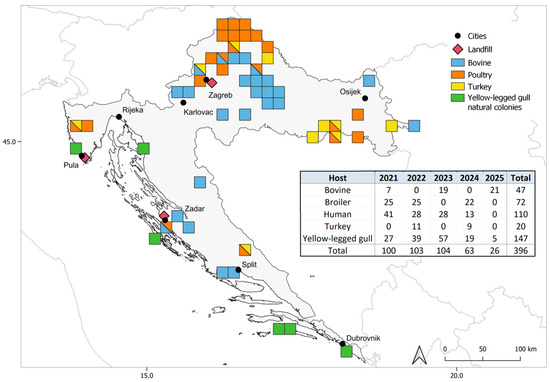
Campylobacter jejuni isolates. Between 2021 and 2025, biological specimens were collected across Croatia from five reservoir groups: yellow-legged gulls, bovines, broilers, turkeys, and humans were collected in different seasons and parts of Croatia (Figure 1). One thousand five hundred and thirty-three (n = 1533) cloacal swabs were collected from yellow-legged gulls from breeding colonies (n = 1320) and municipal landfills (n = 213). To guarantee isolate independence and prevent pseudo-replication, exactly one confirmed C. jejuni colony was selected per sampled individual. Clinical human isolates represented non-duplicate, single-patient diagnostic episodes. Broiler, turkey, and bovine isolates originated from distinct flocks or herds under national surveillance programs. Sampling of yellow-legged gulls was conducted across active breeding colonies (n = 109/147, 74.15%) and urban landfill foraging sites (n = 38/147, 25.85%). Detailed specimen metadata, collection years, and host origins are provided in Supplementary Table S1.
Figure 1.
Locations of host sampling with the number of Campylobacter jejuni isolates collected from 2021 to 2025. A different color represents each host, while human isolates were collected from four cities (Zagreb, Osijek, Pula and Split).
Human isolates were collected from gastroenteritis patients with diarrhea symptoms at four independent microbiology laboratories in Croatia, located in Zagreb, Split, Osijek, and Pula (Figure 1). Strains were isolated from primary sterile samples and stool samples.
Isolates from broilers (Gallus gallus), turkeys, and bovines were collected during the implementation of national monitoring programs for Campylobacter, in accordance with the amendment to Regulation (EC) 2073/2005 introducing a process hygiene criterion for Campylobacter, and Regulation (EC) No 2160/2003 [3].
Yellow-legged gulls were captured at breeding colonies (74.15%) and landfills on different sites in the continental and Mediterranean parts of Croatia (25.85%) (Figure 1, Supplementary Table S1). Gulls at landfills were captured using a cannon net. In breeding colonies, adults were captured using ‘walk-in’ traps at active nests with incubating eggs, while nestlings were caught before fledging by hand. Each bird was sampled using cloacal swabs with charcoal (Copan, Italy). Samples were stored at 4 °C and cultured within 3 days to be tested for the presence of thermophilic Campylobacter spp., according to the EN ISO 10272-1 method [34].
All strains were revived on blood agar supplemented with 10% defibrinated sheep blood (Columbia agar, Biomerieux, Marcy-l’Étoile, France) and incubated in microaerobic conditions (CampyGen, Thermo Scientific, Waltham, MA, USA) at 42 °C for 24–48 h. A multiplex PCR assay was used to confirm that the strains belonged to C. jejuni [35].
A final representative cohort of n = 396 non-duplicate viable isolates (yellow-legged gull: 147; human: 110; broiler: 72; bovine: 47; turkey: 20) was subjected to whole-genome sequencing (WGS). A structured flowchart outlining the process of the WGS analysis is presented in the Supplementary Figure S1.
Genomic DNA extraction was performed by taking a complete loop of fresh culture and dissolving it in 100 µL of Milli-Q water. The mixture was then treated using a NucleoSpin Microbial DNA Mini Kit (Macherey-Nagel, Düren, Germany) according to the manufacturer’s instructions, with the mechanical lysis step at 30 Hz for 12 min on a Tissuelyser (QIAGEN, Hilden, Germany). The quantity and concentration were estimated using a DeNovix DS-11 spectrophotometer (DeNovix, Wilmington, DE, USA) and a Qubit 4.0 fluorometer (Thermo Fisher Scientific, Waltham, MA, USA) with a dsDNA BR assay kit (Life Technologies, Eugene, OR, USA).
Most of the isolates analyzed in this genomic study were newly sequenced for comprehensive whole-genome typing. The exceptions were isolates from 42 human samples that were previously published in Šoprek et al. 2022 [36], and 8 isolates from human, 5 broiler and 2 yellow-legged gull samples because of the potential connection to human isolates published in Šoprek et al. 2023 [23]. The aforementioned isolates were added to this study not to duplicate previously published data, but to expand upon them by providing high-resolution 1602-locus cg/wgMLST and virulome data across the 2021–2025 cohorts.
Genomic Analysis. The extracted DNA was prepared according to the instructions and sent to MicrobesNG (Birmingham, UK) for sequencing. The sequencing was run on an Illumina platform with a 250 bp paired-end output. The results were obtained as raw trimmed reads and assembled fasta files.
The fundamental bioinformatic analysis was provided by MicrobesNG (Birmingham, UK). All obtained reads were put through a standard analysis pipeline. The quality of raw reads was assessed using the FastQC v.0.12.1 tool [37], and the adapter trimming was performed using the Trimmomatic v.0.36 tool [37]. The closest available reference genome was identified using Kraken2 version 2.1.2 (database 01/2026) [38], and the reads were mapped to this using BWA-MEM (Burrows–Wheeler Aligner) [39] to assess the quality of the data. Reads were de novo assembled into contigs using the SPAdes v.3.15.4 assembler [40], and the reads were mapped back to the resultant contigs, again using BWA-MEM v. 0.7.15 to obtain more quality metrics [39]. The quality of the assembled sequences was assessed using the QUAST v.5.2 tool [41], discarding contigs of less than 300 bp, and the initial assemblies met all QC criteria for 345 isolates.
Interspecies contamination was assessed using Kraken2 taxonomic profiling. For 51 samples showing reads matching non-target species, reads were mapped against the C. jejuni reference genome NC_002163 to extract target reads prior to de novo reassembly. Only assemblies achieving ≥ 90% core-genome locus call rates were retained. Sensitivity analyses demonstrated no systematic differences in core genome phylogeny or virulome repertoires between the reference-filtered (n = 51) and unfiltered (n = 345) cohorts (p > 0.05) (Supplementary Table S2). Consequently, zero genomes were excluded post-sequencing, yielding the final analyzed dataset of n = 396 genomes.
MLST, cg/wgMLST. MBioSEQ Ridom Typer v.12.0.0 software [42] was used for MLST and cgMLST/wgMLST typing, as well as epidemiological analysis of whole-genome sequence data. MLST and cgMLST/wgMLST raw reads with k-mer alignment were mapped against the MLST scheme based on seven housekeeping genes (PubMLST) [43], 637-locus cgMLST, and 958-locus accessory schemes (wgMLST = 1602 loci) sequences to identify the best-matched allele [43]. The MBioSEQ cgMLST has already been proven to be highly congruent with other typing schemes [25]. Epidemiological comparison of the 396 C. jejuni genome sequences was performed using a UPGMA radial tree based on a distance matrix of the core genomes of all isolates, pairwise ignoring missing values.
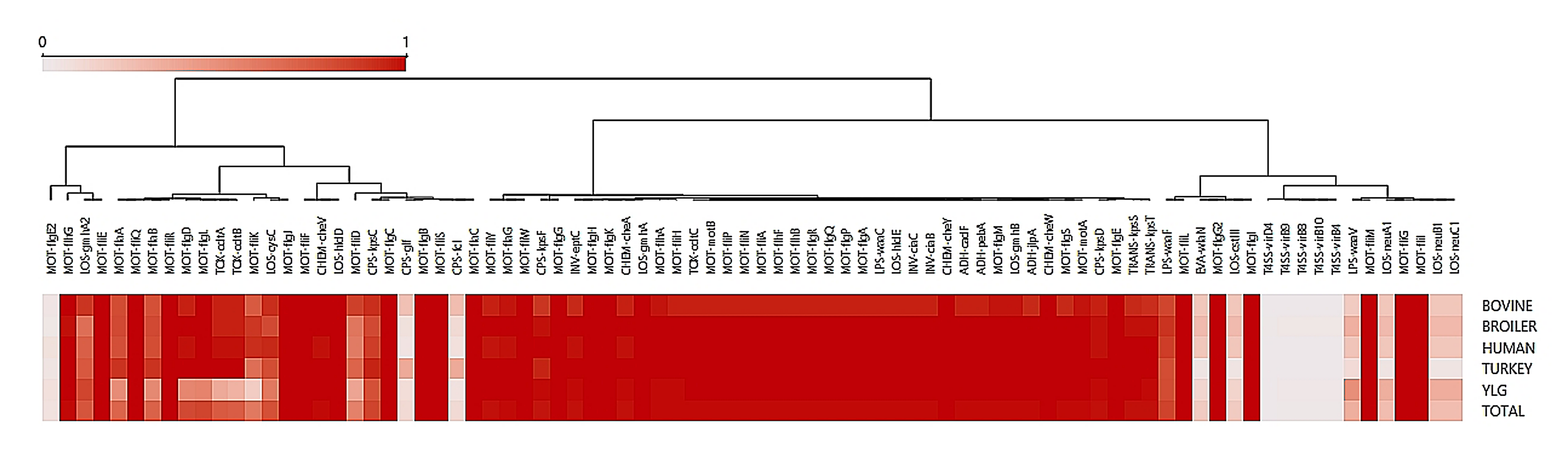
Virulence gene identification. MBioSEQ Ridom Typer v.12.0.0 software [42] was used to screen the C. jejuni isolates for 84 potential genes encoding virulence in the VFDB (updated 02/2026) [44] database with a 98% identity threshold and at least 80% coverage. Orange software version 3.40.0 [45] was used for the heatmap analysis using Euclidean distance clustering of virulence factors present and absent in C. jejuni according to virulence genes. Dark red dye indicates 100% presence, while white indicates the total absence of a virulence gene.
Statistical Analysis. Statistical analyses were conducted in R (v4.3.2). Categorical variables and gene presence frequencies across host reservoirs were evaluated using two-tailed Fisher’s exact tests or Pearson’s Chi-square (χ2) tests. p-values were adjusted for multiple hypothesis testing using the Benjamini–Hochberg False Discovery Rate (FDR) procedure α = 0.05). Bivariate associations between specific clonal lineages and virulence determinants were expressed as Odds Ratios (OR) with 95% confidence intervals (95% CI). Proportions and prevalence estimates are reported with Wilson score 95% confidence intervals. Simpson’s Index of Diversity (1-D) with 95% CI was calculated for MLST (ST, CC) and cg/wgMLST schemes. Species richness and sampling saturation across reservoirs were validated using sample-based rarefaction curves (Supplementary Figure S2).
3. Results
Extracted DNA. Three hundred and ninety-six C. jejuni strains were cultivated and confirmed to be C. jejuni. The concentration of extracted DNA ranged from 125 to 378 ng/µL, with a quality of 1.8 to 2.2 for both A260/A280 and A260/A230.
Genomic analysis. Samples were de novo assembled into a median contig count of 45 (IQR: 31–58, range: 9–699) with a median assembly coverage of 54x (IQR: 42.1–68.5x) and a median genome size of 1.8 Mb (IQR: 1.72–1.84 Mb). The median N50 of assemblies was 294.4 kb (IQR: 218.1–342.6 kb, range: 182.5–412.8 kb). Assemblies had a median GC content of 30.3% (IQR: 30.1–30.5%). Fifty-one samples showed evidence of interspecies contamination. Reads were mapped against reference strain NC_002163 to isolate C. jejuni reads prior to de novo re-assembly. A minimum of 90% core-gene locus calls was required for inclusion.
The sensitivity analysis comparing the full cohort (n = 396) versus the uncontaminated sub-cohort (n = 345) confirmed no reference-mapping bias in core genome clustering or virulome frequencies (p > 0.05, Table S3).
Sequence type and clonal complex distribution. The genome analysis covered a total of 1602 genes: 7 housekeeping genes, 637 core genes, and 958 accessory genes. We identified 124 different STs, of which 9 (7.26%) were novel (Table 1), detected in 11 isolates across three different host species. Among the nine novel STs, three exhibited previously unreported alleles: one ST contained a novel allele on glyA, while two STs possessed a new allele at the pgm locus. All nine novel STs and three new alleles (glyA, pgm) have been submitted to PubMLST. These STs were mainly present in one isolate, except for two STs, which were present in two isolates. Most of the new STs were identified in yellow-legged gulls (54.55%), broilers (27.27%), and human isolates (18.18%). Simpson’s discriminatory index for MLST typing in this study was 0.979 (95% CI: 0.974–0.983), indicating a high degree of diversity.
Table 1.
Clonal complexes (CCs) distribution and number of associated sequence types (STs) with isolate counts and host distribution.
The most represented ST was ST6461 (ST-353), detected in 7.07% (n = 28/396) of isolates, followed by ST50 (ST-21; 5.56%, n = 22/396), ST1223 (ST-1275; 5.05%, n = 20/396), ST1268 (ST-1275; 5.05%, n = 20/396), and ST51 (ST-443; 4.80%, n = 19/396). Within CC ST-1275 (n = 75), ST1223 (n = 20/75, 26.67%) and ST1268 (n = 20/75, 26.67%) were dominant and isolated exclusively from yellow-legged gulls. In CC ST-353, ST6461 predominated (53.85%) and was identified mainly in human isolates (60.71%). Similarly, ST50 was the predominant ST within CC ST-21 (37.93%) and was also primarily associated with human isolates (45.45%). In CC ST-443, ST51 was dominant (90.48%) and was most frequently isolated from humans (68.42%).
Strains tested in this study were grouped into 25 different CCs. Simpson’s discriminatory index for the CC typing in this research was 0.885 (95% CI: 0.867–0.903), indicating a high degree of diversity. Twenty-five known STs (21.74%), comprising 50 strains (12.63%), were not assigned to any CC. Eleven strains were part of nine newly defined STs (7.26%). The most abundant CC was ST-1275 (18.94%), which was specific to yellow-legged gulls. ST-21 and ST-353 followed with 14.65% and 13.13%, respectively, while ST-443 accounted for 5.3% of strains.
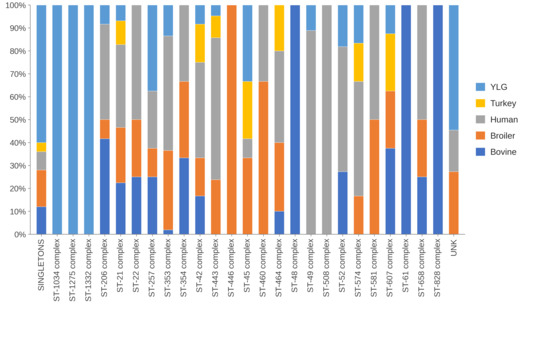
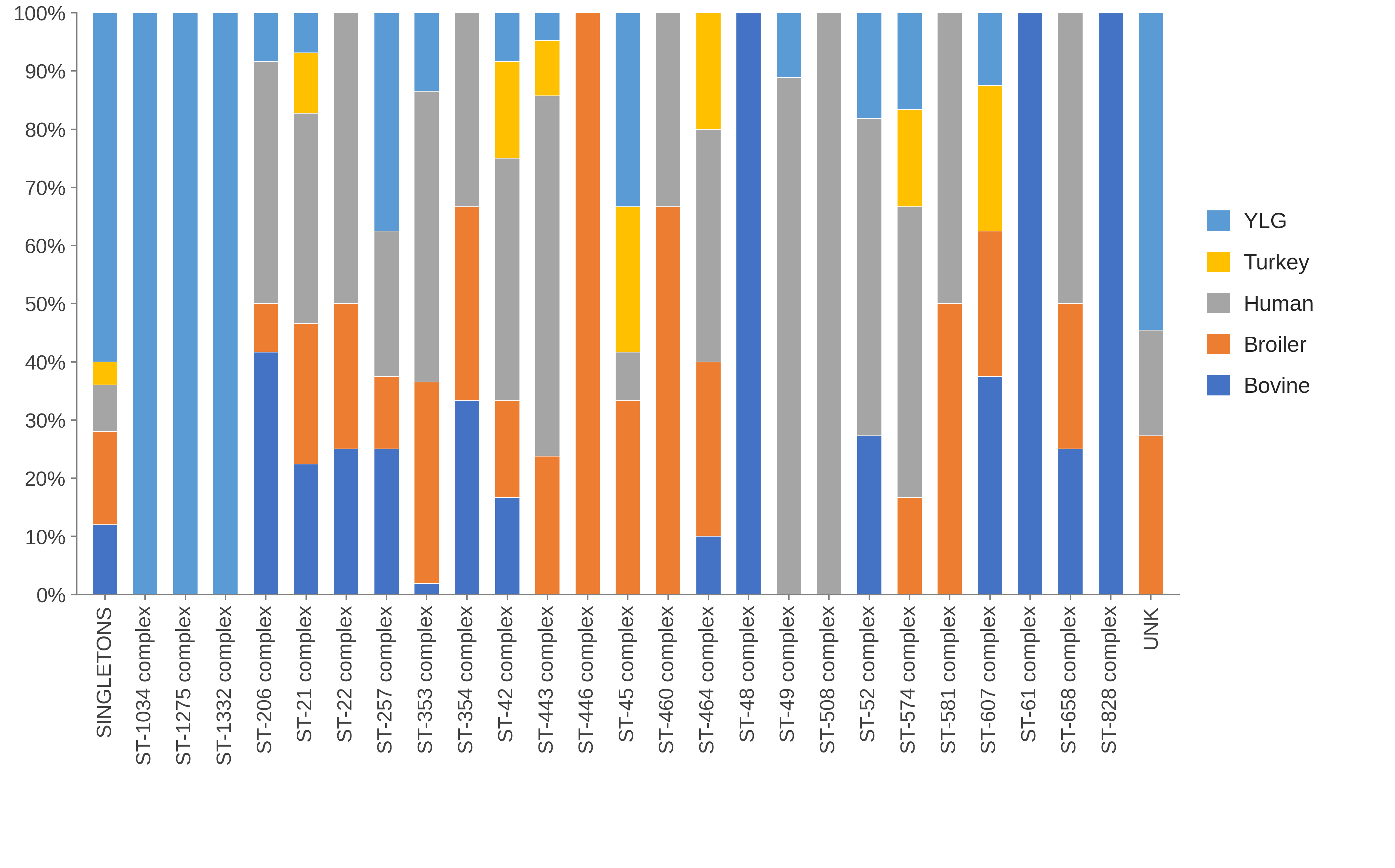
The most host-diverse CCs were those identified in all five different hosts tested. ST-21 and ST-42 were found in all hosts. ST-206, ST-257, ST-353, ST-443, ST-45, ST-464, ST-574, and ST-607 in four; and ST-22, ST-354, ST-52, ST-658 in three (Table 1, Figure 2).
Figure 2.
Relative host source distribution (expressed as percentages) of isolates across various multi-locus sequence typing (MLST) clonal complexes (CCs), singletons, and unknown lineages (UNK). The x-axis categorizes the isolates by specific CCs, while the y-axis indicates the percentage contribution of each source. Colored segments within each stacked bar correspond to distinct host reservoirs. The chart illustrates varying degrees of host specificity, showing lineages predominantly restricted to a single host (such as the ST-1034 complex in YLG or the ST-446 complex in Broiler) alongside highly diverse, multi-host generalist lineages, such as the ST-21 and ST-45 complexes.
ST-21 comprised 36.21% human, 24.14% broiler, 22.41% bovine strains, 10.34% turkey, and 6.90% yellow-legged gull strains, making it a generalist CC. ST-353 comprised 50.00% human and 34.62% broiler strains, while ST-443 comprised 61.90% human strains, making these clonal CCs the ones most frequently associated with human strains (Table 1).
Human isolates showed the highest diversity, comprising 17 different CCs, whereas turkey strains showed the least polymorphism with 7 different CCs (Table 2). Several CCs were represented by single isolates in specific reservoirs, such as ST-508 (n = 1/110) in humans, ST-61 (n = 1/47) and ST-828 (n = 2/47) in bovines, and ST-446 was detected only in broilers (n = 3/72). ST-1034 (n = 8/147, 5.44%), ST-1275 (n = 75/147, 51.02%), and ST-1332 (n = 2/147, 1.36%) were identified exclusively in yellow-legged gull isolates (Table 1).
Table 2.
Host-associated diversity of clonal complexes (CCs) and complex types (CTs) and their sequence types (STs), including STs with unknown CC assignment (novel STs).
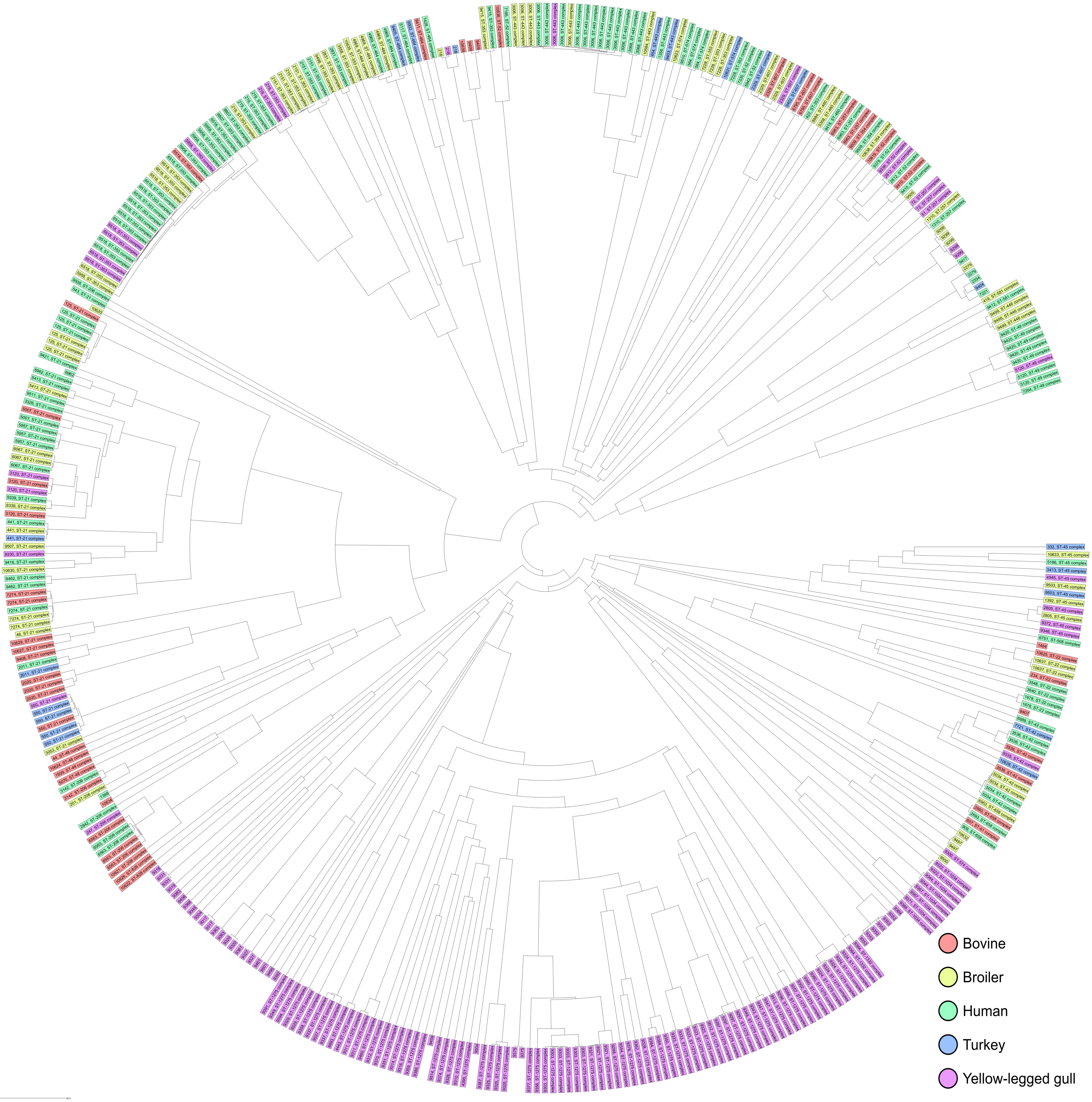
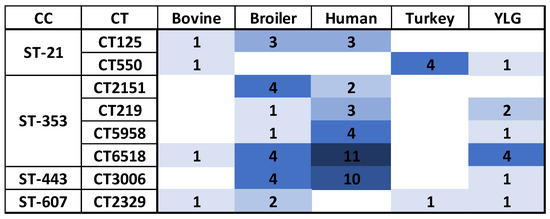
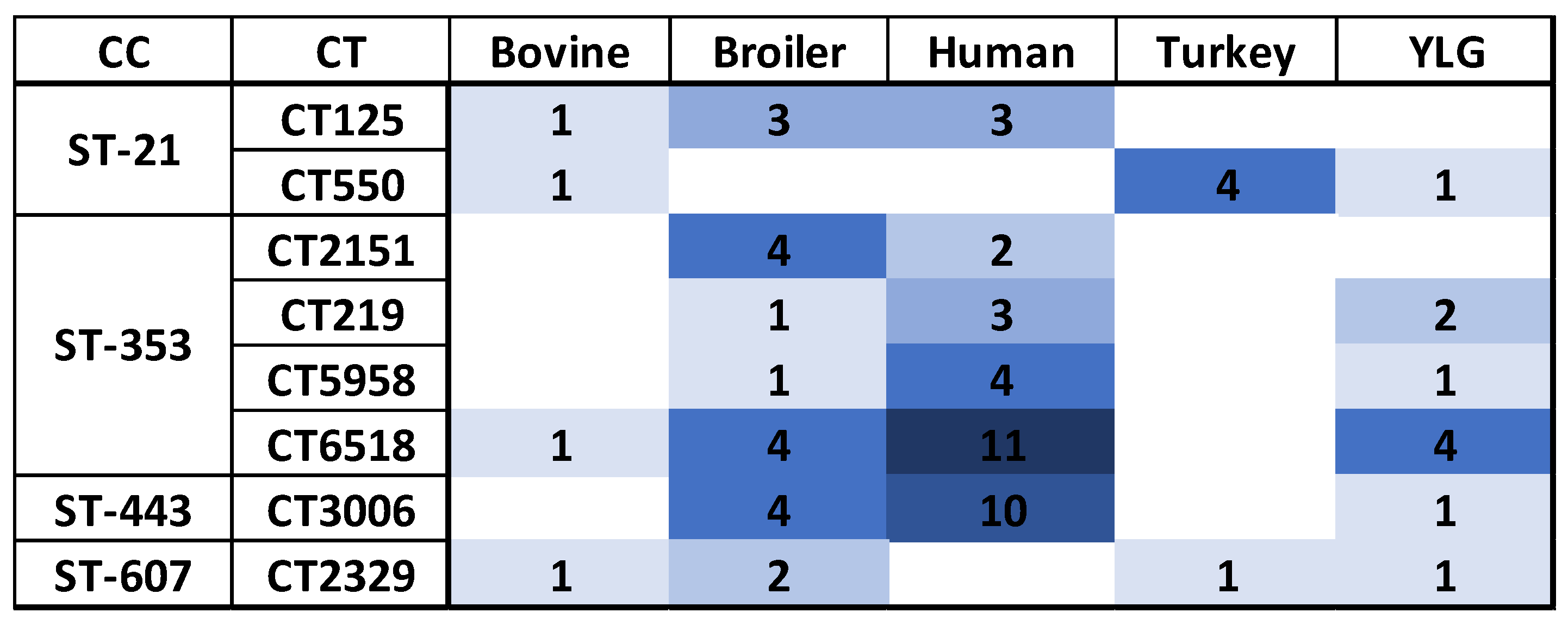
cgMLST and wgMLST results. Across the 396 isolates, 219 distinct complex types (CTs) were identified (represented across 222 ST–CT combinations due to three multi-ST complex types). Among these, 178 CTs were distributed across the 25 defined MLST CCs, while 42 CTs belonged to unassigned clonal lineages and novel sequence types (with CT6962 shared between ST-21 and an unassigned clinical isolate). The Simpson’s discriminatory index for cg/wgMLST typing was 0.993 (95% CI: 0.990–0.995). The most prevalent lineages were CT-6518 (ST-353) and CT-3006 (ST-443), representing 5.05% (n = 20) and 3.79% (n = 15) of the total samples, respectively. While several prominent CTs, such as CT-6518, CT-3006, CT-219, CT-550, and CT-2329, exhibited multi-host distribution across human, livestock, and avian reservoirs (Figure 3), the vast majority of the remaining genotypes were restricted to fewer than five isolates spanning only one to three distinct host species. This host-restricted pattern was particularly pronounced among wild bird and yellow-legged gull isolates (Figure 4), which were predominantly identified as host-specific CTs occurring in only one or two samples, with the notable exception of CT-9303 (n = 6) (Supplementary Table S1).
Figure 3.
Heatmap representing the distribution and abundance of major complex types (CTs) and corresponding clonal complexes (CCs) across five distinct host reservoirs: human, bovine, broiler, turkey, and gull. Rows depict specific clonal lineages, and columns represent host reservoirs. Cell values and color intensity reflect host-aggregated isolate counts per category (white—0 isolates; light blue—1–2 isolates; deep navy blue—3+ isolates). Shared multi-host genotypes reflect genetic overlap compatible with shared foraging niches or common contamination sources, but they do not imply direct cross-species transmission routes.
Figure 4.
UPGMA radial dendrogram displaying genetic relationships among 396 Campylobacter jejuni isolates based on wgMLST analysis across 1602 loci (pairwise missing values ignored). Outer ring labels indicate complex type (CT) and MLST clonal complex (CC). Nodes and branches are color coded according to host source: bovine (red), broiler (yellow), human (green), turkey (blue), and yellow-legged gull (purple). The scale bar represents an allelic distance of 100 core/accessory loci.
Virulome characterization. A total of 84 virulence genes were identified across the tested Campylobacter jejuni isolates (Supplementary Table S3). Twenty-four virulence genes were detected in all tested strains (28.57%), with the majority belonging to functional categories associated with motility (MOT-, n = 45) and chemotaxis (CHEM—cheA, cheV, cheW, cheY). Notably, a high prevalence was observed for core genes linked to host cell adhesion (ADH—cadF, jlpA, pebA), cellular invasion (INV—ciaB, ciaC, eptC), and lipooligosaccharide (LOS) biosynthesis (gmhA, gmhA2, gmhB, hldD, hldE). Variation was observed in sialylation-associated genes (LOS), including cstIII (18.69%), capsular polysaccharide (CPS), namely fcl (11.36%) and glf (10.86%), MOT—flgE2 (6.06%), and the neu cluster (neuA1—25.51%, neuB1 and neuC1—26.01%). The Type IV Secretion System (T4SS) gene cluster was least frequently detected in our samples, with a prevalence of 1.26% (n = 5/396, 95% CI: 0.54–2.92%) for virB4, virB8, virB9, and virB10, and 0.51% (n = 2/396, 95% CI: 0.14–1.82%) for virD4.
Broiler isolates harbored a significantly higher overall proportion of target virulence genes (83.55%, n = 5053/6048 locus tests) compared to yellow-legged gull isolates (79.02%, n = 9757/12,348 locus tests; χ2 = 54.21, FDR-adjusted p < 0.0001).
The molecular-mimicry-associated gene wlaN was identified in 18.43% (n = 73/396, 95% CI: 14.87–22.59%) of isolates across the total cohort. A strong clonal enrichment was observed within CC ST-21, where 75.86% of ST-21 isolates harbored wlaN (P (wlaN+|ST-21) = 44/58, 95% CI: 63.49–85.03%), compared to only 8.58% in non-ST-21 lineages (n = 29/338, 95% CI: 6.00–12.11%; Fisher’s Exact Test p < 0.0001, OR = 33.49, 95% CI: 16.29–68.82; Table 3). Consequently, ST-21 accounted for 60.27% (P (ST-21|wlaN+) = 44/73, 95% CI: 48.81–70.76%) of all wlaN-positive isolates detected in this study.
Table 3.
Contingency table showing the distribution of the wlaN gene in the dataset according to ST-21 CC.
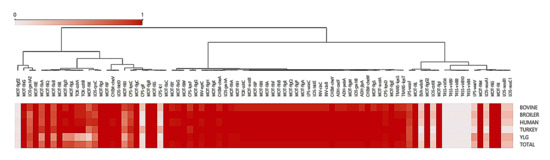
The lowest proportion of virulence genes was observed in yellow-legged gull isolates (79.02%), whereas broiler isolates harbored the highest proportion of the screened target genes (83.55%) (Figure 5).
Figure 5.
Heatmap and hierarchical clustering (Euclidean distance, average linkage) of host-aggregated virulence gene prevalence across five host reservoirs. Columns represent 84 virulence determinants grouped by functional class: motility (MOT), lipooligosaccharide biosynthesis (LOS), cytolethal distending toxin (TOX), capsular polysaccharide (CPS), chemotaxis (CHEM), invasion (INV), immune evasion (EVA), and Type IV secretion system (T4SS). Rows represent host cohorts and the total study population. Data are presented as host-aggregated prevalence metrics (ranging from 0.0 [0% presence, white] to 1.0 [100% presence, dark red]), rather than single-isolate binary profiles.
4. Discussion
4.1. Host Distribution and Genomic Diversity
To understand the population structure and transmission dynamics of C. jejuni in Croatia, 396 isolates collected over five years (2021–2025) were analyzed. The dataset encompassed five reservoirs: yellow-legged gulls (37.12%), humans (27.78%), broilers (18.18%), bovines (11.87%), and turkeys (5.05%). Genomic analysis revealed profound diversity, identifying 124 STs, including 9 newly defined STs, grouped into 25 CCs, with 25 STs remaining unassigned. The Simpson’s Diversity Index exceeded 0.8 for both ST and CC designations, consistent with global benchmarks indicating high genomic plasticity within this species [25,46]. Although C. jejuni is traditionally considered a fragile, microaerophilic organism, recurrent lineages often demonstrate enhanced survival through biofilm formation and environmental adaptation [25,46]. As Campylobacter typically demonstrates host adaptation, cross-species spillover events are relatively infrequent, while being of considerable epidemiological importance [29]. Transmission is heavily mediated by complex environmental networks, including agricultural runoff, wastewater pathways, and insect vectors [23,32]. Wild birds, acting as asymptomatic reservoirs, may contribute to the maintenance and potential dissemination of diverse genotypes across broad ecological niches. However, the presence of matching sequence types across wild birds and domestic animals reflects shared exposure to contaminated environmental sources rather than definitive direct transmission pathways [23].
4.2. Lineage Ecology
- Core Generalists vs. Host Specialists
The distribution of CCs highlighted distinct patterns of host-specificity and broad generalism across reservoirs; in humans, this was dominated by ST-353 (20.91%), ST-21 (17.27%), and ST-443 (11.82%). ST-508 was uniquely specific to humans. Among poultry hosts, broilers were dominated by ST-353 (25.00%) and ST-21 (19.44%), whereas turkeys predominantly harbored ST-21 (30.00%) and ST-45 (15.00%). In bovines, ST-21 dominated (27.66%), unclassified CCs (12.77%), and ST-206 (10.64%). Yellow-legged gulls harbored host-specific lineages including ST-1034 (5.44%), ST-1275 (51.02%), and ST-1332 (1.36%). Our data showed a high degree of host overlap, particularly within ST-21, a well-known global generalist found across all farm types and seasons [29]. Our bovine and broiler profiles overlapped by 60% with cattle and poultry strains reported in the UK, France, and Korea, where ST-21, ST-61, and ST-48 bridge livestock reservoirs to human infections [29,31,32]. Similarly, the overlap between our broiler and human strains reached 48.61%, revealing a striking 78% concordance with global human clinical genotypes. This mimics trends in Denmark and Switzerland, where poultry-specialist lineages (ST-257, ST-353, ST-354) display prolonged persistence across production cycles due to contaminated processing environments [31,47,48,49].
4.3. Resolution of cgMLST and Wildlife Transmission
While seven-gene MLST clustered 17.01% (n = 25/147, 95% CI: 11.83–23.82%) of gull isolates into multi-host clonal complexes shared with humans, high-resolution cg/wgMLST refined this cross-host overlap to 6.80% (n = 10/147, 95% CI: 3.69–12.18%). This marked reduction underscores the superior resolution of whole-genome gene-by-gene typing in resolving false-positive epidemiological linkages generated by the slow evolutionary rate of housekeeping loci. The majority of gull isolates formed a distinct, host-adapted clade dominated by CC ST-1275 (n = 75/147, 51.02%) (Figure 4), mirroring literature suggesting that migratory birds possess lower, host-isolated contamination profiles compared to sedentary birds [31]. Nevertheless, the detection of identical complex types, specifically CT6518 (ST-353) and CT3006 (ST-443), across gulls, poultry, cattle, and diarrheic patients highlights shared exposure niches. Because our cross-sectional genomic data cannot determine the directionality or specific chain of transmission, these shared complex types (e.g., CT6518, CT3006) are compatible with shared ecological niches, common contamination points at anthropogenic foraging grounds (e.g., open landfills, wastewater discharge), or diffuse environmental vectors, rather than direct bird-to-human transmission [46,50,51].
4.4. Pathogenic Landscape and Virulome Architecture
The C. jejuni virulome exhibited a dual structure: a highly rigid, universally conserved pathogenic core and a highly variable, lineage-specific peripheral virulome.
4.5. The Conserved Core Virulome
The machinery required for host colonization was characterized by the near-absolute conservation of determinants governing flagellar motility and chemotaxis. This baseline biological fitness aligns with the collective component paradigm established by Burnham and Hendrixson [52], where these systems drive navigation through nutrient-restricted enteric environments. This core was augmented by a uniform distribution of mucosal interaction factors, matching the near-ubiquitous presence of adhesion (cadF) and translocation (ciaB) mediators observed across human and poultry cohorts in Europe [53,54]. Similarly, foundational backbones for lipooligosaccharide (LOS), lipopolysaccharide (LPS), and capsular polysaccharide (CPS) biosynthesis were heavily conserved. This is consistent with the global characterization of surface polysaccharides as “softcore” or “essential core” elements required for cell wall integrity, environmental survival, and host immune evasion across diverse geographical regions [9,55,56].
4.6. Variable Loci, Sequelae, and Plasmid-Mediated Risk
Polymorphic diversity was restricted to specific loci associated with severe clinical sequelae and horizontal gene transfer. The EVA-wlaN gene, which drives the ganglioside-mimicking structures responsible for Guillain-Barré syndrome, was highly localized, appearing in 75.86% (n = 44/58) of isolates within the clinically dominant ST-21 lineage, with ST-21 comprising 60.27% (n = 44/73) of all wlaN-positive isolates across the entire collection. This strong clonal restriction represents a significantly higher regional risk compared with the global baseline prevalence of 15.2% noted by Wieczorek et al. [53], echoing localized virulence shifts described by Mohamed et al. [57]. Conversely, mobile virulence determinants were exceptionally rare. Components of the Type IV Secretion System (T4SS), a critical vector for plasmid-mediated virulence and antimicrobial resistance (AMR) amplification, were restricted to just five isolates (<1.5%) primarily associated with yellow-legged gulls and specific broiler lines. This sporadic detection is consistent with global database analyses demonstrating that plasmid-mediated virB/D loci are remarkably rare or absent in many continental populations [55]. While plasmid-borne T4SS gene clusters (virB/virD) were exceptionally rare (<1.5%), this does not imply a low overall risk of antimicrobial resistance dissemination. In C. jejuni, primary AMR mechanisms (such as point mutations in gyrA and 23S rRNA, or chromosomally integrated transposons) operate independently of T4SS-mediated conjugation. Future WGS resistome profiling and phenotypic susceptibility testing are essential to mapping resistance determinants across these Croatian reservoirs.
4.7. Public Health Implications and One Health Interventions
Targeted Surveillance and Food Safety
Because the majority of human Campylobacter infections in Croatia are attributed to poultry sources, interventions should focus substantially on biosecurity measures within processing plants. Implementing stringent hygiene protocols during slaughter and chilling is vital to curbing cross-contamination from persistent, farm-cycle strains [47]. Concurrently, targeted ecosystem management should address environmental reservoirs. Identical CTs that are shared between wild gulls, agricultural animals, and human patients enable wild bird surveillance at nesting colonies and landfills to provide valuable sentinel data on circulating environmental genotypes, independent of direct transmission routes.
4.8. Limitations and Future Outlook
While this study successfully employed high-resolution typing approaches to type Campylobacter jejuni strains circulating in Croatia, several limitations should be acknowledged. First, the cross-sectional sampling framework was geographically constrained within Croatia. It featured unequal sample distributions across host species (147 gulls, 110 humans, 72 broilers, 47 bovines, and 20 turkeys), reflecting the opportunistic integration of national surveillance and clinical diagnostics. Second, while high-resolution cgMLST identified shared CTs, genomic clustering without fine-scale spatio-temporal tracking cannot resolve the direction of transmission between wildlife, livestock, and humans. Third, the present study focused on MLST, cg/wgMLST, and virulome profiling; targeted resistome characterization and phenotypic antimicrobial susceptibility testing will be required to define the resistance dynamics in these reservoirs. Although even small sample sizes from less frequently studied hosts can provide valuable insights into critical epidemiological networks [16], future studies should expand both geographic coverage and host diversity. Transitioning toward longitudinal metagenomic surveillance will be essential for monitoring temporal genotype fluctuations, mapping interspecies transmission mechanics, and establishing an integrated, multidisciplinary One Health surveillance framework spanning veterinary, environmental, and public health sectors.
5. Conclusions
High-resolution cg/wgMLST demonstrated that Campylobacter jejuni populations in Croatia are structured into host-adapted lineages and shared multi-host genotypes. While the majority of yellow-legged gull isolates belong to a host-segregated CC ST-1275 clade (51.02%), a discrete subset (6.80%) shares identical complex types (e.g., CT6518, CT3006) with domestic livestock and clinical gastroenteritis patients. These findings are compatible with shared ecological niches and common contamination sources across anthropogenic interfaces. While our data do not determine the direction of transmission or establish wild birds as direct sources of human infection, gulls serve as informative environmental sentinels. Implementing biosecurity at processing facilities, managing landfill access, and sustaining integrated One Health genomic surveillance remain critical priorities.
Supplementary Materials
The following supporting information can be downloaded at: https://www.mdpi.com/article/10.3390/microorganisms14092000/s1, Table S1: Detailed specimen metadata, collection data, host origins and MLST and cgMLST/wgMLST results. Table S2A: Assembly Quality and Core-Genome Locus Call Rates, Table S2B: Virulome Repertoire and Virulence Gene Frequencies, Table S2C: Host and Lineage Distribution Across Cohorts. Table S3. Comprehensive statistical profiling and prevalence of 84 virulence-associated determinants across human, livestock, and yellow-legged gull reservoirs in Croatia (N = 396). Categorical comparisons across the five host reservoirs were evaluated using two-tailed Pearson's Chi-square (χ2) tests or Fisher's exact tests. p-values were adjusted for multiple testing across all 84 screened loci using the Benjamini–Hochberg False Discovery Rate (FDR) procedure (α = 0.05, q-value). Figure S1. Flowchart of Campylobacter jejuni isolate cohort formation and downstream whole-genome sequencing (WGS) genomic profiling. Figure S2. Analytical sample-based rarefaction curves and sampling adequacy assessments for Campylobacter jejuni across five host reservoirs in Croatia (2021–2025). (A) Expected Sequence Type (ST) richness [E(S)] plotted against the number of sampled isolates across hosts. Shaded areas represent 95% confidence intervals calculated using analytical variance formulations (Heck et al., 1975). (B) Rarefaction curves for MLST Clonal Complexes (CC), showing complete plateauing and asymptotic saturation of circulating clonal lineages (Good's coverage > 90% in all major hosts. (C) Rarefaction curves for 1,602-locus cg/wgMLST Complex Types (CT), illustrating ongoing fine-scale genomic diversification. (D) Good's sample coverage (%) across host reservoirs for CC, ST, and CT typing resolutions. The red dotted line indicates the 80% coverage threshold for representative epidemiological sampling.
Author Contributions
Conceptualization, S.D., B.J. and L.J.; formal analysis, all authors; investigation, B.J., L.T.T. and L.J.; resources, L.J., B.J. and S.D.; data curation, B.J. and S.D.; writing—original draft preparation S.D., B.J. and L.J.; writing—review and editing, F.K., V.M., A.H., G.K., A.B., E.P., I.R., M.C., D.D., S.Š.S., A.T.A., M.V.-L. and J.K.; project administration, B.J.; funding acquisition, L.J. All authors have read and agreed to the published version of the manuscript.
Funding
This research was funded by the Croatian Science Foundation (grant number: UIP-2020-02-2528). This study was conducted with the official authorization of the Ministry of Environmental Protection and Green Transition of the Republic of Croatia, which granted the necessary permits to carry out fieldwork and data collection in accordance with national environmental regulations.
Institutional Review Board Statement
The study was approved by the Institutional Review Boards: University Hospital for Infectious Diseases (approval number: 01-2582-2-2020, approved on 31 December 2020); University Hospital Centre Osijek (approval number: R2-208/2021, approved on 19 February 2021); Teaching Institute for Public Health, Split-Dalmatia County (approval number: 2181-103-01-20-1, approved on 30 December 2020); and Public Health Institute of Istria County (approval number: 02/01-234/11-20, approved on 14 December 2020).
Informed Consent Statement
Patient informed consent was waived, because only anonymized Campylobacter isolates were used in this study, and no identifiable personal data of patients were collected or analysed. Ethical approval for this work was obtained from the ethics committees of all four participating hospitals.
Data Availability Statement
The original contributions presented in the study are included in the article/Supplementary Material. Further inquiries can be directed to the corresponding author.
Acknowledgments
We would like to thank the Jaki Dečki ringing group for their help with catching yellow-legged gulls.
Conflicts of Interest
The authors declare no conflicts of interest.
References
- WHO’s First Ever Global Estimates of Foodborne Diseases Find Children Under 5 Account for Almost One Third of Deaths. Available online: https://www.who.int/news/item/03-12-2015-who-s-first-ever-global-estimates-of-foodborne-diseases-find-children-under-5-account-for-almost-one-third-of-deaths (accessed on 2 September 2025).
- EFSA. Campylobacter. Available online: https://www.efsa.europa.eu/en/topics/topic/campylobacter (accessed on 2 September 2025).
- Regulation-2160/2003-EN-EUR-Lex. Available online: https://eur-lex.europa.eu/eli/reg/2003/2160/oj/eng (accessed on 3 September 2025).
- Taema, M.M.; Bull, J.C.; Macgregor, S.K.; Flach, E.J.; Boardman, W.S.; Routh, A.D. Retrospective Study of Campylobacter Infection in a Zoological Collection. Appl. Environ. Microbiol. 2008, 74, 1332–1338. [Google Scholar] [CrossRef] [Scilit] [PubMed]
- Facciolà, A.; Riso, R.; Avventuroso, E.; Visalli, G.; Delia, S.A.; Laganà, P. Campylobacter: From Microbiology to Prevention. J. Prev. Med. Hyg. 2017, 58, E79–E92. [Google Scholar] [PubMed]
- Skarp, C.P.A.; Hänninen, M.-L.; Rautelin, H.I.K. Campylobacteriosis: The Role of Poultry Meat. Clin. Microbiol. Infect. 2016, 22, 103–109. [Google Scholar] [CrossRef] [Scilit] [PubMed]
- Nyati, K.K.; Nyati, R. Role of Campylobacter jejuni Infection in the Pathogenesis of Guillain-Barré Syndrome: An Update. BioMed Res. Int. 2013, 2013, 852195. [Google Scholar] [CrossRef] [Scilit] [PubMed]
- Davys, G.; Marshall, J.C.; Fayaz, A.; Weir, R.P.; Benschop, J. Campylobacteriosis Associated with the Consumption of Unpasteurised Milk: Findings from a Sentinel Surveillance Site. Epidemiol. Infect. 2020, 148, e16. [Google Scholar] [CrossRef] [Scilit] [PubMed]
- Aksomaitiene, J.; Novoslavskij, A.; Malakauskas, M. Whole-Genome Sequencing-Based Profiling of Antimicrobial Resistance Genes and Core-Genome Multilocus Sequence Typing of Campylobacter jejuni from Different Sources in Lithuania. Int. J. Mol. Sci. 2023, 24, 16017. [Google Scholar] [CrossRef] [Scilit] [PubMed]
- Friesema, I.H.M.; Havelaar, A.H.; Westra, P.P.; Wagenaar, J.A.; van Pelt, W. Poultry Culling and Campylobacteriosis Reduction among Humans, the Netherlands. Emerg. Infect. Dis. 2012, 18, 466–468. [Google Scholar] [CrossRef] [Scilit] [PubMed]
- Agunos, A.; Waddell, L.; Léger, D.; Taboada, E. A Systematic Review Characterizing On-Farm Sources of Campylobacter Spp. for Broiler Chickens. PLoS ONE 2014, 9, e104905. [Google Scholar] [CrossRef] [Scilit] [PubMed]
- Taff, C.C.; Weis, A.M.; Wheeler, S.; Hinton, M.G.; Weimer, B.C.; Barker, C.M.; Jones, M.; Logsdon, R.; Smith, W.A.; Boyce, W.M.; et al. Influence of Host Ecology and Behavior on Campylobacter jejuni Prevalence and Environmental Contamination Risk in a Synanthropic Wild Bird Species. Appl. Environ. Microbiol. 2016, 82, 4811–4820. [Google Scholar] [CrossRef] [Scilit] [PubMed]
- Waldenström, J.; Broman, T.; Carlsson, I.; Hasselquist, D.; Achterberg, R.P.; Wagenaar, J.A.; Olsen, B. Prevalence of Campylobacter jejuni, Campylobacter lari, and Campylobacter coli in Different Ecological Guilds and Taxa of Migrating Birds. Appl. Environ. Microbiol. 2002, 68, 5911–5917. [Google Scholar] [CrossRef] [Scilit] [PubMed]
- Colles, F.M.; Dingle, K.E.; Cody, A.J.; Maiden, M.C.J. Comparison of Campylobacter Populations in Wild Geese with Those in Starlings and Free-Range Poultry on the Same Farm. Appl. Environ. Microbiol. 2008, 74, 3583–3590. [Google Scholar] [CrossRef] [Scilit] [PubMed]
- Shyaka, A.; Kusumoto, A.; Asakura, H.; Kawamoto, K. Whole-Genome Sequences of Eight Campylobacter jejuni Isolates from Wild Birds. Genome Announc. 2015, 3, e00315-15. [Google Scholar] [CrossRef] [Scilit] [PubMed]
- Hock, L.; Herold, M.; Walczak, C.; Schoos, A.; Penny, C.; Cauchie, H.-M.; Ragimbeau, C. Environmental Dynamics of Campylobacter jejuni Genotypes Circulating in Luxembourg: What Is the Role of Wild Birds? Microb. Genom. 2023, 9, 001031. [Google Scholar] [CrossRef] [Scilit] [PubMed]
- Fallacara, D.M.; Monahan, C.M.; Morishita, T.Y.; Wack, R.F. Fecal Shedding and Antimicrobial Susceptibility of Selected Bacterial Pathogens and a Survey of Intestinal Parasites in Free-Living Waterfowl. Avian Dis. 2001, 45, 128–135. [Google Scholar] [CrossRef] [Scilit] [PubMed]
- Lillehaug, A.; Jonassen, C.M.; Bergsjø, B.; Hofshagen, M.; Tharaldsen, J.; Nesse, L.; Handeland, K. Screening of Feral Pigeon (Colomba livia), Mallard (Anas platyrhynchos) and Graylag Goose (Anser anser) Populations for Campylobacter spp., Salmonella spp., Avian Influenza Virus and Avian Paramyxovirus. Acta Vet. Scand. 2005, 46, 193. [Google Scholar] [CrossRef] [Scilit] [PubMed]
- Mohan, V.; Stevenson, M. Campylobacter jejuni Genomes Exhibit Notable GC Variation within Housekeeping Genes. [Version 1; Peer Review: 2 Not Approved]. F1000Research 2013, 2, 89. [Google Scholar] [CrossRef] [Scilit]
- Abdollahpour, N.; Zendehbad, B.; Alipour, A.; Khayatzadeh, J. Wild-Bird Feces as a Source of Campylobacter jejuni Infection in Children’s Playgrounds in Iran. Food Control 2015, 50, 378–381. [Google Scholar] [CrossRef] [Scilit]
- Mohan, V. Faeco-Prevalence of Campylobacter jejuni in Urban Wild Birds and Pets in New Zealand. BMC Res. Notes 2015, 8, 1. [Google Scholar] [CrossRef] [Scilit] [PubMed]
- Dudzic, A.; Urban-Chmiel, R.; Stępień-Pyśniak, D.; Dec, M.; Puchalski, A.; Wernicki, A. Isolation, Identification and Antibiotic Resistance of Campylobacter Strains Isolated from Domestic and Free-Living Pigeons. Br. Poult. Sci. 2016, 57, 172–178. [Google Scholar] [CrossRef] [Scilit] [PubMed]
- Šoprek, S.; Ujević, J.; Kompes, G.; Jurinović, L.; Tambić Andrašević, A. First Report of Campylobacter jejuni Strains Belonging to ST-21 Clonal Complex Isolated from Human, Poultry and Wild Birds in Croatia: Antimicrobial Resistance and Genetic Distance. Microorganisms 2023, 11, 1884. [Google Scholar] [CrossRef] [Scilit] [PubMed]
- Dingle, K.E.; Colles, F.M.; Ure, R.; Wagenaar, J.A.; Duim, B.; Bolton, F.J.; Fox, A.J.; Wareing, D.R.A.; Maiden, M.C.J. Molecular Characterization of Campylobacter jejuni Clones: A Basis for Epidemiologic Investigation. Emerg. Infect. Dis. 2002, 8, 949–955. [Google Scholar] [CrossRef] [Scilit]
- Nennig, M.; Llarena, A.-K.; Herold, M.; Mossong, J.; Penny, C.; Losch, S.; Tresse, O.; Ragimbeau, C. Investigating Major Recurring Campylobacter jejuni Lineages in Luxembourg Using Four Core or Whole Genome Sequencing Typing Schemes. Front. Cell. Infect. Microbiol. 2020, 10, 608020. [Google Scholar] [CrossRef] [Scilit] [PubMed]
- Llarena, A.-K.; Taboada, E.; Rossi, M. Whole-Genome Sequencing in Epidemiology of Campylobacter jejuni Infections. J. Clin. Microbiol. 2017, 55, 1269–1275. [Google Scholar] [CrossRef] [Scilit] [PubMed]
- Stevens, M.J.A.; Buvoli, G.N.; Kelbert, L.; Cernela, N.; Stephan, R. Campylobacter Species Isolated from Wild Birds in Switzerland and Comparison to Isolates from Food and Human Origin. MicrobiologyOpen 2025, 14, e70176. [Google Scholar] [CrossRef] [Scilit] [PubMed]
- Marotta, F.; Janowicz, A.; Di Marcantonio, L.; Ercole, C.; Di Donato, G.; Garofolo, G.; Di Giannatale, E. Molecular Characterization and Antimicrobial Susceptibility of C. jejuni Isolates from Italian Wild Bird Populations. Pathogens 2020, 9, 304. [Google Scholar] [CrossRef] [Scilit] [PubMed]
- Ječmenica, B.; Duvnjak, S.; Humski, A.; Taylor, L.T.; Kralj, J.; Krstulović, F.; Amšel Zelenika, T.; Mašović, V.; Jurinović, L. Age-Related Presence and Genetic Diversity of Campylobacter Spp. in Young and Adult Yellow-Legged Gulls (Larus michahellis) in Croatia. Environ. Microbiol. Rep. 2024, 16, e70017. [Google Scholar] [CrossRef] [Scilit] [PubMed]
- Griekspoor, P.; Engvall, E.O.; Åkerlind, B.; Olsen, B.; Waldenström, J. Genetic Diversity and Host Associations in Campylobacter jejuni from Human Cases and Broilers in 2000 and 2008. Vet. Microbiol. 2015, 178, 94–98. [Google Scholar] [CrossRef] [Scilit] [PubMed]
- Keller, J.I.; Shriver, W.G. Prevalence of three Campylobacter species, C. jejuni, C. coli, and C. lari, using multilocus sequence typing in wild birds of the mid‑Atlantic region, USA. J. Wildl. Dis. 2014, 50, 31–41. [Google Scholar] [CrossRef] [Scilit] [PubMed]
- Iglesias-Torrens, Y.; Miró, E.; Guirado, P.; Llovet, T.; Muñoz, C.; Cerdà-Cuéllar, M.; Madrid, C.; Balsalobre, C.; Navarro, F. Population Structure, Antimicrobial Resistance, and Virulence-Associated Genes in Campylobacter jejuni Isolated from Three Ecological Niches: Gastroenteritis Patients, Broilers, and Wild Birds. Front. Microbiol. 2018, 9, 1676. [Google Scholar] [CrossRef] [Scilit] [PubMed]
- Jurinović, L.; Duvnjak, S.; Kompes, G.; Šoprek, S.; Šimpraga, B.; Krstulović, F.; Mikulić, M.; Humski, A. Occurrence of Campylobacter jejuni in Gulls Feeding on Zagreb Rubbish Tip, Croatia; Their Diversity and Antimicrobial Susceptibility in Perspective with Human and Broiler Isolates. Pathogens 2020, 9, 695. [Google Scholar] [CrossRef] [Scilit] [PubMed]
- Standard’ s EN ISO 10272‑1: 2017; Microbiology of the food chain — horizontal method for detection and enumeration of Campylobacter spp. — Part 1: Detection method. European Committee for Standardization: Brussels, Belgium, 2017.
- Wang, G.; Clark, C.G.; Taylor, T.M.; Pucknell, C.; Barton, C.; Price, L.; Woodward, D.L.; Rodgers, F.G. Colony Multiplex PCR Assay for Identification and Differentiation of Campylobacter jejuni, C. coli, C. lari, C. upsaliensis, and C. fetus Subsp. Fetus. J. Clin. Microbiol. 2002, 40, 4744–4747. [Google Scholar] [CrossRef] [Scilit] [PubMed]
- Šoprek, S.; Duvnjak, S.; Kompes, G.; Jurinović, L.; Tambić Andrašević, A. Resistome Analysis of Campylobacter jejuni Strains Isolated from Human Stool and Primary Sterile Samples in Croatia. Microorganisms 2022, 10, 1410. [Google Scholar] [CrossRef] [Scilit] [PubMed]
- Andrews Babraham Bioinformatics—FastQC. A Quality Control Tool for High Throughput Sequence Data. Available online: https://www.bioinformatics.babraham.ac.uk/projects/fastqc/ (accessed on 1 February 2026).
- Wood, D.E.; Salzberg, S.L. Kraken: Ultrafast Metagenomic Sequence Classification Using Exact Alignments. Genome Biol. 2014, 15, R46. [Google Scholar] [CrossRef] [Scilit] [PubMed]
- Li, H.; Durbin, R. Fast and Accurate Short Read Alignment with Burrows–Wheeler Transform. Bioinformatics 2009, 25, 1754–1760. [Google Scholar] [CrossRef] [Scilit] [PubMed]
- Bankevich, A.; Nurk, S.; Antipov, D.; Gurevich, A.A.; Dvorkin, M.; Kulikov, A.S.; Lesin, V.M.; Nikolenko, S.I.; Pham, S.; Prjibelski, A.D.; et al. SPAdes: A New Genome Assembly Algorithm and Its Applications to Single-Cell Sequencing. J. Comput. Biol. 2012, 19, 455–477. [Google Scholar] [CrossRef] [Scilit] [PubMed]
- Gurevich, A.; Saveliev, V.; Vyahhi, N.; Tesler, G. QUAST: Quality Assessment Tool for Genome Assemblies. Bioinformatics 2013, 29, 1072–1075. [Google Scholar] [CrossRef] [Scilit] [PubMed]
- Jünemann, S.; Sedlazeck, F.J.; Prior, K.; Albersmeier, A.; John, U.; Kalinowski, J.; Mellmann, A.; Goesmann, A.; von Haeseler, A.; Stoye, J.; et al. Updating Benchtop Sequencing Performance Comparison. Nat. Biotechnol. 2013, 31, 294–296, Erratum in Nature Biotechnology 2013, 31, 1148. [Google Scholar] [CrossRef] [Scilit] [PubMed]
- Jolley, K.A.; Bray, J.E.; Maiden, M.C.J. Open-Access Bacterial Population Genomics: BIGSdb Software, the PubMLST.Org Website and Their Applications. Wellcome Open Res. 2018, 3, 124. [Google Scholar] [CrossRef] [Scilit] [PubMed]
- Liu, B.; Zheng, D.; Jin, Q.; Chen, L.; Yang, J. VFDB 2019: A Comparative Pathogenomic Platform with an Interactive Web Interface. Nucleic Acids Res. 2019, 47, D687–D692. [Google Scholar] [CrossRef] [Scilit] [PubMed]
- Demšar, J.; Curk, T.; Erjavec, A.; Gorup, Č.; Hočevar, T.; Milutinovič, M.; Možina, M.; Polajnar, M.; Toplak, M.; Starič, A.; et al. Orange: Data Mining Toolbox in Python. J. Mach. Learn. Res. 2013, 14, 2349–2353. [Google Scholar]
- Cody, A.J.; McCarthy, N.D.; Bray, J.E.; Wimalarathna, H.M.L.; Colles, F.M.; Jansen van Rensburg, M.J.; Dingle, K.E.; Waldenström, J.; Maiden, M.C.J. Wild Bird-associated Campylobacter jejuni Isolates Are a Consistent Source of Human Disease, in Oxfordshire, United Kingdom. Environ. Microbiol. Rep. 2015, 7, 782–788. [Google Scholar] [CrossRef] [Scilit] [PubMed]
- Reichelt, B.; Szott, V.; Epping, L.; Semmler, T.; Merle, R.; Roesler, U.; Friese, A. Transmission Pathways of Campylobacter Spp. at Broiler Farms and Their Environment in Brandenburg, Germany. Front. Microbiol. 2022, 13, 982693. [Google Scholar] [CrossRef] [Scilit] [PubMed]
- Joensen, K.G.; Sørensen, G.; Gymoese, P.; Dahl, L.G.; Nielsen, E.M. The Clonal Spread and Persistence of Campylobacter in Danish Broiler Farms and Its Association with Human Infections. Pathogens 2025, 14, 821. [Google Scholar] [CrossRef] [Scilit] [PubMed]
- Stevens, M.J.A.; Stephan, R.; Horlbog, J.A.; Cernela, N.; Nüesch-Inderbinen, M. Whole Genome Sequence-Based Characterization of Campylobacter Isolated from Broiler Carcasses over a Three-Year Period in a Big Poultry Slaughterhouse Reveals High Genetic Diversity and a Recurring Genomic Lineage of Campylobacter jejuni. Infect. Genet. Evol. 2024, 119, 105578. [Google Scholar] [CrossRef] [Scilit] [PubMed]
- Ghielmetti, G.; Seth-Smith, H.M.B.; Roloff, T.; Cernela, N.; Biggel, M.; Stephan, R.; Egli, A. Whole-Genome-Based Characterization of Campylobacter jejuni from Human Patients with Gastroenteritis Collected over an 18 Year Period Reveals Increasing Prevalence of Antimicrobial Resistance. Microb. Genom. 2023, 9, 000941. [Google Scholar] [CrossRef] [Scilit] [PubMed]
- Sheppard, S.K.; Colles, F.M.; McCarthy, N.D.; Strachan, N.J.C.; Ogden, I.D.; Forbes, K.J.; Dallas, J.F.; Maiden, M.C.J. Niche Segregation and Genetic Structure of Campylobacter jejuni Populations from Wild and Agricultural Host Species. Mol. Ecol. 2011, 20, 3484–3490. [Google Scholar] [CrossRef] [Scilit] [PubMed]
- Burnham, P.M.; Hendrixson, D.R. Campylobacter jejuni: Collective Components Promoting a Successful Enteric Lifestyle. Nat. Rev. Microbiol. 2018, 16, 551–565. [Google Scholar] [CrossRef] [Scilit] [PubMed]
- Wieczorek, K.; Wołkowicz, T.; Osek, J. Antimicrobial Resistance and Virulence-Associated Traits of Campylobacter jejuni Isolated from Poultry Food Chain and Humans with Diarrhea. Front. Microbiol. 2018, 9, 1508. [Google Scholar] [CrossRef] [Scilit] [PubMed]
- Wysok, B.; Wojtacka, J.; Hänninen, M.-L.; Kivistö, R. Antimicrobial Resistance and Virulence-Associated Markers in Campylobacter Strains from Diarrheic and Non-Diarrheic Humans in Poland. Front. Microbiol. 2020, 11, 1799. [Google Scholar] [CrossRef] [Scilit] [PubMed]
- Panzenhagen, P.; Portes, A.B.; dos Santos, A.M.P.; Duque, S.d.S.; Conte Junior, C.A. The Distribution of Campylobacter jejuni Virulence Genes in Genomes Worldwide Derived from the NCBI Pathogen Detection Database. Genes 2021, 12, 1538. [Google Scholar] [CrossRef] [Scilit] [PubMed]
- Habib, I.; Mohamed, M.-Y.I.; Lakshmi, G.B.; Al Marzooqi, H.M.; Afifi, H.S.; Shehata, M.G.; Khan, M.; Ghazawi, A.; Abdalla, A.; Anes, F. Quantitative Assessment and Genomic Profiling of Campylobacter Dynamics in Poultry Processing: A Case Study in the United Arab Emirates Integrated Abattoir System. Front. Microbiol. 2024, 15, 1439424. [Google Scholar] [CrossRef] [Scilit] [PubMed]
- Mohamed, M.-Y.I.; Khalifa, H.O.; Habib, I. The Role of Virulence Genes in Campylobacter Pathogenicity: A Perspective from the Gulf Cooperation Council Countries. Front. Cell. Infect. Microbiol. 2025, 15, 1584835. [Google Scholar] [CrossRef] [Scilit] [PubMed]

Disclaimer/Publisher’s Note: The statements, opinions and data contained in all publications are solely those of the individual author(s) and contributor(s) and not of MDPI and/or the editor(s). MDPI and/or the editor(s) disclaim responsibility for any injury to people or property resulting from any ideas, methods, instructions or products referred to in the content. |
© 2026 by the authors. Licensee MDPI, Basel, Switzerland. This article is an open access article distributed under the terms and conditions of the Creative Commons Attribution (CC BY) license.