


Abstract
The aim of the current study was to investigate the prevalence of Clostridium perfringens (C. perfringens) recovered from animal faeces, as well as to determine the antimicrobial susceptibility of such isolates. A total of 14 (14/100; 14%) C. perfringens isolates were isolated from the 100 analysed samples (twelve recovered from faecal samples collected from pigs and two from veal calves’ faecal samples). The preponderant genotype was type A, with all isolates being cpa-positive. The most potent antimicrobial agents against C. perfringens proved to be vancomycin, rifampicin and lincomycin. A strong resistance to tetracycline (71.4%), penicillin (64.2%), erythromycin (42.8%) and enrofloxacin (35.7%) was also observed. To the best of our knowledge, this is the first analysis regarding the prevalence, characterization and antimicrobial susceptibility of C. perfringens in food-producing animals in Romania, adding further evidence for the probable role of animals as a source of resistant C. perfringens strains.
1. Introduction
Clostridium perfringens (C. perfringens) is a ubiquitous, anaerobic, Gram-positive, spore-forming bacteria, extensively distributed in the environment, ranking amongst the most important pathogens living in the intestinal tracts of both humans and animals [1]. It causes a wide range of histotoxic and gastrointestinal infections, most of these being mediated by one or more toxins [2,3,4,5]. Based on the ability to produce six major toxins, namely alpha (α), beta (β), epsilon (ε), iota (ι), enterotoxin (CPE) and NetB, C. perfringens isolates are usually classified into seven different toxin types/biotypes (from A to G), with each distinct toxin type being generally associated with certain diseases [6,7]. The alpha toxin, encoded by the cpa gene, and located on the chromosome, is considered to be produced by all toxigenic types of C. perfringens. Type B produces the β and ε toxin, type C only produces the β toxin, type D the ε toxin, type E the ι toxin, while type G produces the NetB [8]. Type F strains are known to produce the enterotoxin (encoded by cpe), the main virulence factor implicated in foodborne gastroenteritis outbreaks, and have been previously known as cpe-positive C. perfringens type A strains [3,9]. Moreover, type F strains have been exclusively linked to food poisoning mediated by C. perfringens [10].
Each particular toxin type is considered to be associated with specific diseases. For instance, type A strains can cause enterocolitis in pigs and horses or necrotic enteritis in chicken, but are also responsible for gas gangrene in humans, while type B is involved in necrotizing enteritis in sheep and cattle. Type C strains are known to cause necrohaemorrhagic enteritis in piglets, horses or sheep and type D has been mainly associated with enterotoxaemia in goat, sheep or cattle. Type E strains also cause enteritis in different animal species, such as sheep or cattle. As previously mentioned, type F is considered to be linked mostly to food poisoning in humans and animals [3,6,10]. Therefore, the determination of the toxin type of various C. perfringens isolates is considered to be a critical step in properly evaluating the risk associated with such strains.
Different antimicrobial agents such as tetracycline, chloramphenicol, lincomycin, bacitracin, ampicillin, metronidazole and even imipenem have been used over the years in the prophylaxis and treatment of infections caused by C. perfringens [3,10,11]. Unfortunately, the long-term, as well as frequent, use of such agents has facilitated the emergence of antimicrobial resistance, compromising the efficacy of the available antimicrobial agents administered in the treatment of C. perfringens infections [12]. Several studies have indicated that, as a result, the antimicrobial resistance to specific drugs such as tetracycline, erythromycin, lincomycin or chloramphenicol has significantly increased in recent years, causing important difficulties in regard to clinical treatment as well [12]. Pathogens which are resistant to antimicrobials that are considered to be critically important in the treatment of human disease are associated with particularly important consequences [13].
Several antimicrobial resistance genes have also been identified in C. perfringens isolates originating from animals, which are known to play a major role in the transfer of resistance to other bacteria [14]. Genes encoding antimicrobial resistance determinants (ARD), carried by resistant bacteria, may be transferred to other bacteria of clinical significance, with the rapid development and dissemination of antimicrobial resistant bacteria resulting not only from intense antimicrobial selective pressure, but also from the exchange of ARD among the gut microbiota population. To date, various resistance genes have been identified in C. perfringens isolates, including tetA(P), tetB(P), tet(K), tet(L) (conferring resistance to tetracycline), erm(B), erm(Q) (macrolide resistance genes), lnu(A), lnu(B), lnu(P) (responsible for lincomycin resistance), catP and catQ (conferring resistance to chloramphenicol) and even optrA, as the first identification of oxazolidinone/phenicol resistance in C. perfringens isolates.
Despite being considered as one of the most common causes of foodborne illness worldwide, there is still much to be learned about the characteristics of C. perfringens, particularly in terms of prevalence and distribution in various environments.
Information about C. perfringens in the food supply chain in Romania is lacking. There are almost no data recorded about the prevalence, transfer and antimicrobial resistance of C. perfringens strains of animal origin and food of animal origin in our country.
Therefore, the current study was conducted in order to investigate the prevalence and toxin type of C. perfringens isolated from animal faeces, as well as to determine the antimicrobial susceptibility of the obtained isolates.
2. Materials and Methods
2.1. Sampling
A total of 100 samples of animal faeces, 60 from pigs and 40 from veal calves (as enterotoxaemia due to C. perfringens is more likely to affect calves), were collected from July to September 2022, from two geographically distinct farms located in the centre of Romania (46°44′02.23″ N, 23°53′59.11″ E and 45°54′42.80″ N, 23°20′36.57″ E, respectively). All the samples (approximately 50 g) were collected aseptically, using sterile cotton swabs, directly from the rectum, and then transported to the laboratory in ambient conditions, stored at 4 °C and processed within 24 h.
2.2. C. perfringens Isolation
Robertson cooked meat (RCM; Merck, Darmstadt, Germany) medium was used as an enrichment broth for the isolation of the target strains. The faecal samples were inoculated in the RCM medium and then incubated at 37 °C for 24 h, under anaerobic conditions (CO2GEN; Oxoid Ltd., Basingstoke, Hampshire, UK). The enrichment culture obtained was cultured onto tryptose sulfite cycloserine agar (TSC; Oxoid Ltd., Basingstoke, Hampshire, UK) and incubated at 37 °C, for a further 24 h (CO2GEN; Oxoid Ltd., Basingstoke, Hampshire, UK). The identification of C. perfringens isolates was achieved by observing the formation of specific black colonies, with a white halo and microscopic morphology. Vitek® 2 ANC cards for anaerobes (intended for use with the Vitek 2 system) (bioMérieux, Marcy l’Etoile, France) were further used for the biochemical confirmation of the strains.
2.3. Toxinotyping of the C. perfrigens Isolates
The genomic DNA was extracted with the help of the QIAamp DNA Micro Kit (Qiagen), according to the manufacturer’s instructions. Multiplex PCR was performed in order to detect the presence of four toxin genes, namely cpa, cpe, becA and becB, as previously reported [9]. Briefly, PCR was conducted in a final volume of 25 μL reaction mixture, comprising the following: 12.5 μL × 2 Multiplex PCR Master Mix (Qiagen), 0.4 μM primers for the cpa and cpb genes, 0.2 μM primers for becA and becB genes and 1 μL of template solution. PCR was performed under the following conditions: denaturation at 95 °C for 5 min, 30 cycles of denaturation at 95 °C for 30 s and a final extension step at 68 °C for 10 min. The PCR products were analysed by electrophoresis on 3% agarose gels. The sequences of the four pairs of primers used in order to amplify the above-mentioned genes are presented in Table 1. The DNA of C. perfringens type A isolate, which was already available in the laboratory, was used as a positive control during the PCR reactions, while reference strain Listeria monocytogenes ATCC 51776 was used as a negative control. The presence of the specific PCR products (324 bp for cpa, 233 bp for cpe, 400 bp for becA and 416 bp for becB, respectively) confirmed the possession of each mentioned gene.
Table 1.
Primers used to detect the presence of cpa, cpe, becA and becB toxin genes.
2.4. Antimicrobial Susceptibility Testing
Susceptibility to tetracyclines (tetracycline, 30 μg), macrolides (erythromycin, 15 μg), aminoglycosides (gentamicin, 10 μg), glycopeptides (vancomycin, 10 μg), rifamycins (rifampicin, 5 μg), β-lactams (penicillin, 10 units), polypeptides (bacitracin, 10 units), lincosamides (lincomycin, 2 μg) and fluoroquinolones (enrofloxacin, 5 μg) was determined by the disk diffusion method, on Mueller–Hinton agar (Merck, Darmstadt, Germany), according to the guidelines provided by the Clinical and Laboratory Standards Institute (CLSI) [18]. The agar plates were inoculated with cultures of C. perfringens, followed by the application of an antimicrobial paper disk. The plates were afterwards incubated at 37 °C, under anaerobic conditions, for 24 h. The diameters of the zone of inhibition around the disk were measured with the help of a digital calliper, with resistance being defined as follows: tetracycline < 24 mm; erythromycin < 22 mm; gentamicin < 19 mm; vancomycin < 17 mm; rifampicin < 26 mm; penicillin < 26 mm; bacitracin < 22 mm; lincomycin < 17 mm; enrofloxacin < 22 mm. Staphylococcus aureus ATCC 29213 was used as the reference strain. The antimicrobial agents used in order to carry out the antimicrobial susceptibility testing were selected based on their use in veterinary medicine, as well as on resistance profiles of C. perfringens isolates, as reported in previous studies [3,19].
3. Results
3.1. Prevalence of C. perfringens
A total of 14 C. perfringens isolates were recovered from the 100 analysed samples, with 12 isolates being detected in the faecal samples collected from pigs (12/60; 20%) and only 2 isolates being recovered from the veal calves’ faecal samples (2/40; 5%).
3.2. Toxinotyping of the C. perfringens Isolates
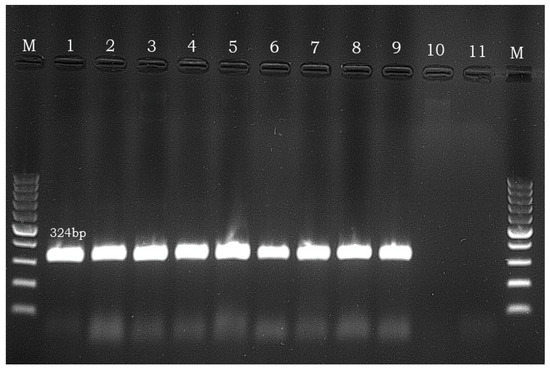
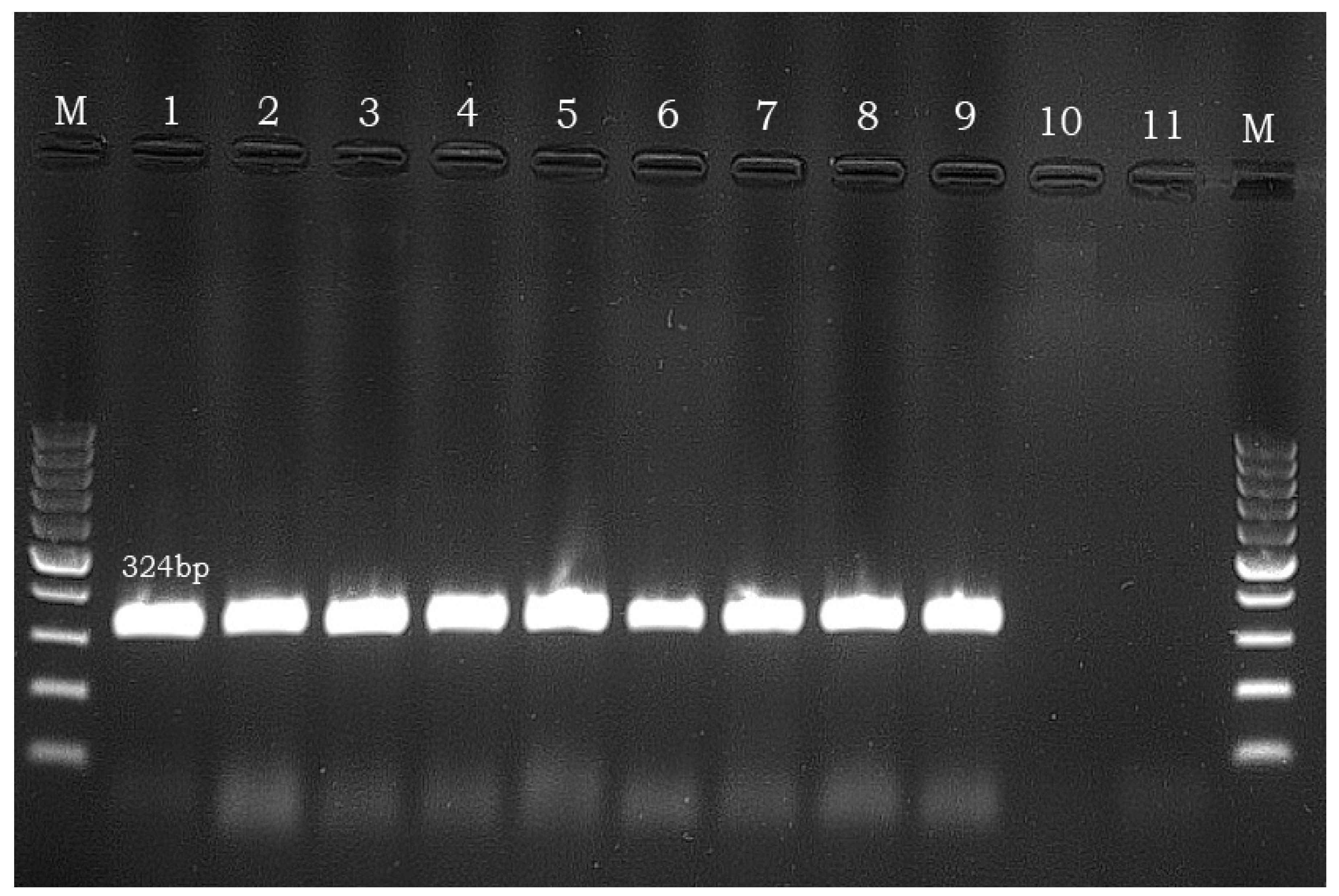
Toxin typing of the recovered 14 C. perfringens isolates revealed that all of these were type A, being positive only for the cpa gene, and negative for the cpe, becA and becB genes (Figure 1).
Figure 1.
Representative agarose gel run showing the PCR detection of the cpa gene. M: molecular weight marker; Lane 1: positive control (Clostridium perfringens type A-laboratory collection); Lanes 2–9: Clostridium perfringens isolates; Lane 10: negative result; Lane 11: negative control (Listeria monocytogenes strain ATCC 51776).
The susceptibility profiles of the C. perfrimgens isolates are presented in Table 2.
Table 2.
Antimicrobial susceptibility of the C. perfringens isolates.
The results indicate that all recovered C. perfringens isolates are susceptible to vancomycin, rifampicin and lincomycin. Resistance to tetracycline (71.4%), penicillin (64.2%), erythromycin (42.8%) and enrofloxacin (35.7%) was also observed. Nevertheless, only one C. perfringens isolate proved to be multidrug resistant, showing resistance to at least three different classes of antibiotics, namely tetracyclines (tetracycline), β-lactams (penicillin) and fluoroquinolones (enrofloxacin).
4. Discussion
The infection caused by C. perfringens has usually been associated with a wide range of histotoxic and gastrointestinal diseases in both humans and animals [20,21]. It is also considered to be one of the most prevalent foodborne pathogens [22]. Studies regarding the prevalence and antimicrobial resistance of C. perfrigens isolates performed so far have been mostly focused on humans, as well as food-producing animals including swine, chicken, turkey, cattle, but also sheep, goat, or dromedary camels [4,10,21,23,24,25].
To the best of our knowledge, in Romania, at the moment, there are almost no available data regarding the prevalence of C. perfringens isolated from food animals.
Overall, a total of 14 (14%) C. perfringens isolates were recovered from the 100 analysed samples, with the majority of these being detected in the faecal samples collected from pigs (12 isolates). Different studies have analysed the prevalence and distribution of C. perfringens in various countries, including India, South Korea, the United States, China, Thailand, Canada, Egypt, Turkey, Sweden, Norway, Denmark, Spain or Belgium [4,11,19,24,26,27,28,29,30,31,32,33]. The prevalence of C. perfringens identified in our study appears to be lower compared with previous studies performed in other countries, which reported a prevalence ranging from 10% to 72% [10,19,25,30,33,34,35,36].
For example, a study performed by Li et al. in China, which also included faecal samples collected from pigs and chickens, reported a high isolation rate of C. perfringens in pigs (72%), as well as in chickens (23.4%) [10]. However, another study which focused on identifying the prevalence of C. perfringens among different animal species in India reported a much lower overall prevalence of 10.76% compared to other studies performed in the same country [19]. Several other previous studies showed variable prevalence rates, such as 12.6% in Spain, 30% in the United States, 31.7% in Turkey, 41.7% in Egypt, 62% in Canada and 64% in the Czech Republic [4,31,33,37,38].
The samples were collected during summer (July to the beginning of September), which might explain the lower-than-expected recovery of C. perfringens isolates due to the warm and dry season. It has been previously reported that infections with C. perfringens are more frequent during the cold season, as well as in early winter [39].
The isolation levels of C. perfringens, which have been mentioned so far, might seem quite contrasting, although several studies showed that the incidence of C. perfringens in food-producing animals varies widely from one country to another. It is considered that such differences might be due to the use of different detection methods, and it has also been postulated that even if C. perfringens mainly colonizes the intestine, its prevalence rate is subject to the living environment of the host animal [29].
Moreover, C. perfringens isolates have also been frequently recovered from meat samples of different origins, such as chicken, beef or pork [3].
All the C. perfringens isolates recovered in the present investigation were identified as type A (cpa-positive), which is in accordance with earlier reports regarding the global dominance of type A, especially in pigs [19,25,37]. C. perfringens type A is considered to be the most common among the toxigenic types implicated in foodborne poisoning in the United States, Europe and Japan [40]. Moreover, all C. perfringens isolates proved to be cpe-negative. Other previous studies have also identified only cpa-positive C. perfringens isolates of different origins, suggesting that cpa might be a universal gene, specifically in C. perfringens isolated from meat samples [8,32,41,42]. Wen et al. also reported that all C. perfringens isolates from beef, chicken and pork meats recovered in their study were classified as type A. Moreover, another survey performed in Belgium found that 71 C. perfringens isolates from chicken meat were identified as type A, while Aras et al. also reported a high percentage of type A (cpa-positive) C. perfringens isolates from meat samples in Turkey [4]. The cpa gene is usually located on the chromosome, while the cpe gene may be located either on the chromosome or on the plasmids [6]. The cpe gene encodes the enterotoxin. However, only a low percentage of the C. perfringens isolates were proven to possess such a gene (less than 5%). Moreover, it has been previously reported that the loss or acquisition of plasmids might be responsible for the changes in toxin type observed in certain strains [8]. Jang et al., who also identified only cpa-positive/cpe-negative C. perfringens isolates, considered that such strains might have lost their mobile components, which could explain why only the cpa gene was identified in the C. perfringens strains [3].
When it comes to the antimicrobial susceptibility profiles of the isolated strains, the results were judged based on the inhibition zone diameters of Staphylococcus aureus (as there are no C. perfringens breakpoints available from CLSI). All C. perfringens isolates recovered in our study proved to be susceptible to vancomycin, rifampicin and lincomycin, which is consistent with other reported results [10,19]. A very low resistance to vancomycin has also been identified by Li et al. in faecal samples collected from chickens and pigs [10]. Such an outcome might be related to the negligible use of these particular antimicrobial agents in the treatment of C. perfringens infections in food-producing animals. However, higher lincomycin resistance rates have been reported by other authors [19,43].
A large proportion of the isolates were resistant to tetracycline (71.4%), penicillin (64.2%), erythromycin (42.8%) and enrofloxacin (35.7%). Antimicrobial resistance to these drugs (especially to tetracycline and erythromycin) has been previously highlighted in the case of other important foodborne pathogens isolated in Romania, including Salmonella spp., Escherichia coli or Campylobacter spp. [44]. Tetracycline resistance seems to be common among animal isolates of C. perfringens and has been well documented [10,19,25,26,28]. In a study performed by Anju et al., tetracycline resistance was found to be 40% among the recovered isolates. Similarly to our study, the same authors have also reported a low resistance to lincomycin, which was only identified in chicken and turkey isolates. This particular finding was considered to be related to the use of this antimicrobial substance in the treatment of necrotic enteritis in poultry [19]. Jang et al. have even shown that all C. perfringens isolates recovered from meat samples in their study were 100% resistant to tetracycline. Antimicrobials have long been used in livestock, either as growth promoters in certain countries, or to treat different infections. Antimicrobial drugs such as tetracycline are still used to control C. perfringens in many countries, including Brazil, Belgium, Denmark and Switzerland [41]. It is a well-known fact that the improper use of antimicrobials in animals influences and increases the bacterial resistance to such substances, even leading to the emergence of multidrug-resistant bacteria, as well as residues of antimicrobials in the environment. Moreover, bacteria are also capable of transferring resistant genes to each other, thus subsequently causing and promoting multidrug resistance. Resistance to tetracycline is attributed to many resistant genes, such as tetA(P), tetB(P), tet(M), tet(L) and tet(K) and these have been frequently identified in C. perfringens isolates [19].
The results reported in the current study, as well as the ones reported in several previous studies, reveal that the antimicrobial resistance profiles of C. perfringens may vary significantly between different countries.
In our study, the disk diffusion method was used in order to analyse the antimicrobial susceptibility of the recovered C. perfringens isolates. The method is frequently employed in such determinations due to its ease of use, although some authors consider that it is not as accurate for anaerobic organisms as it is for aerobic ones. Therefore, this particular aspect, as well as the sample size used in this study, which may be considered as low, might be considered as limitations of our work.
5. Conclusions
In conclusion, the study investigated the prevalence, toxin type, as well as the antimicrobial susceptibility of C. perfringens isolates recovered from faecal samples collected from pigs and veal calves. C. perfringens were detected in the majority of the pig faecal samples. All isolates were identified as type A and cpa-positive. The C. perfringens isolates recovered in the current study proved to be highly resistant to tetracycline, penicillin and erythromycin, but susceptible to vancomycin, rifampicin and lincomycin.
To the best of our knowledge, this is the first study reporting the prevalence and antimicrobial resistance of C. perfringens in food-producing animals in Romania.
Among the limitations of the study, we could mention the sample size which was relatively small. However, the study provides a baseline for the future surveillance and characterization of C. perfringens in food-producing animals, food and the environment in Romania. The results provide useful insight for veterinarians, as well as public health specialists implicated in the management of C. perfringens infections, and highlight the need for continued efforts to prevent and control the spread of this bacterium in the food supply.
Author Contributions
Conceptualization, L.C. and M.M.; data curation, C.B. and L.C.; formal analysis, R.M.; funding acquisition, L.C.; investigation, C.B., L.C. and A.T.; methodology, C.B., L.C. and A.T.; resources, M.M.; software, C.B., L.C. and R.M.; supervision, L.C. and M.M.; visualization, L.C. and M.M.; writing—original draft, C.B. and L.C.; writing—review and editing, L.C. and C.B. All authors have read and agreed to the published version of the manuscript.
Funding
This research was funded by the Executive Agency for Higher Education, Research, Development and Innovation Funding (UEFISCDI), Romania, grant no. PD 100/2020.
Data Availability Statement
Not applicable.
Acknowledgments
We acknowledge that this research was funded by the Executive Agency for Higher Education, Research, Development and Innovation Funding (UEFISCDI), Romania, grant no. PD 100/2020.
Conflicts of Interest
The authors declare no conflict of interest.
References
- Freedman, J.C.; Theoret, J.R.; Wisniewski, J.A.; Uzal, F.A.; Rood, J.I.; McClane, B.A. Clostridium perfringens type A–E toxinplasmids. Res. Microbiol. 2015, 166, 264. [Google Scholar] [CrossRef] [Scilit] [PubMed]
- Khan, M.A.; Bahadar, S.; Ullah, N.; Ullah, S.; Shakeeb, U.; Khan, A.Z.; Khan, I.U.; Kalhoro, N.H.; Shah, M.B.; Malik, M.I.U. Distribution and antimicrobial resistance patterns of Clostridium perfringens isolated from vaccinated and unvaccinated goats. Small Rumin. Res. 2019, 173, 70–73. [Google Scholar] [CrossRef] [Scilit]
- Jang, Y.-S.; Kim, D.-H.; Bae, D.; Kim, S.-H.; Kim, H.; Moon, J.-S.; Song, K.-Y.; Chon, J.-W.; Seo, K.-H. Prevalence, toxin-typing, and antimicrobial susceptibility of Clostridium perfringens from retail meats in Seoul, Korea. Anaerobe 2020, 64, 102235. [Google Scholar] [CrossRef] [Scilit] [PubMed]
- Aras, Z.; Hadimli, H.H. Detection and molecular typing of Clostridium perfringens isolates from beef, chicken and turkey meats. Anaerobe 2015, 32, 15–17. [Google Scholar] [CrossRef] [Scilit] [PubMed]
- Haider, Z.; Ali, T.; Ullah, A.; Basit, A.; Tahir, H.; Tariq, H.; Ilyas, S.Z.; Hayat, Z.; Rehman, S.-U. Isolation, toxinotyping and antimicrobial susceptibility testing of Clostridium perfringens isolated from Pakistan poultry. Anaerobe 2022, 73, 102499. [Google Scholar] [CrossRef] [Scilit]
- Rood, J.I.; Adams, V.; Lacey, J.; Lyras, D.; McClane, B.A.; Melville, S.B.; Moore, R.J.; Popoff, M.R.; Sarker, M.R.; Songer, J.G.; et al. Expansion of the Clostridium perfringens toxin-based typing scheme. Anaerobe 2018, 53, 5–10. [Google Scholar] [CrossRef] [Scilit]
- Azimirad, M.; Gholami, F.; Yadegar, A.; Knight, D.R.; Shamloei, S.; Aghdaei, H.A.; Zali, M.R. Prevalence and characterization of Clostridium perfringens toxinotypes among patients with antibiotic-associated diarrhea in Iran. Sci. Rep. 2019, 9, 7792. [Google Scholar] [CrossRef] [Scilit]
- Petit, L.; Gibert, M.; Popoff, M.R. Clostridium perfringens: Toxinotype and genotype. Trends Microbiol. 1999, 7, 104–110. [Google Scholar] [CrossRef] [Scilit]
- Yonogi, S.; Kanki, M.; Ohnishi, T.; Shiono, M.; Iida, T.; Kumeda, Y. Development and application of a multiplex PCR assay for detection of the Clostridium perfringens enterotoxin-encoding genes cpe and becAB. J. Microbiol. Methods 2016, 127, 172–175. [Google Scholar] [CrossRef] [Scilit]
- Li, J.; Zhou, Y.; Yang, D.; Zhang, S.; Sun, Z.; Wang, Y.; Wang, S.; Wu, C. Prevalence and antimicrobial susceptibility of Clostridium perfringens in chickens and pigs from Beijing and Shanxi, China. Vet. Microbiol. 2020, 252, 108932. [Google Scholar] [CrossRef] [Scilit]
- Johansson, A.; Greko, C.; Engström, B.; Karlsson, M. Antimicrobial susceptibility of Swedish, Norwegian and Danish isolates of Clostridium perfringens from poultry, and distribution of tetracycline resistance genes. Vet. Microbiol. 2004, 99, 251–257. [Google Scholar] [CrossRef] [Scilit] [PubMed]
- Hecht, D.W. Anaerobes: Antibiotic resistance, clinical significance, and the role of susceptibility testing. Anaerobe 2006, 12, 115–121. [Google Scholar] [CrossRef] [Scilit]
- Colobatiu, L.; Tabaran, A.; Flonta, M.; Oniga, O.; Mirel, S.; Mihaiu, M. First description of plasmid-mediated quinolone resistance determinants and β-lactamase encoding genes in non-typhoidal Salmonella isolated from humans, one companion animal and food in Romania. Gut. Pathog. 2015, 7, 16. [Google Scholar] [CrossRef] [Scilit]
- Kiu, R.; Hall, L.J. An update on the human and animal enteric pathogen Clostridium perfringens. Emerg. Microbes Infect. 2018, 7, 1–15. [Google Scholar] [CrossRef] [Scilit] [PubMed]
- Erol, I.; Goncuoglu, M.; Ayaz, N.; Ormanci, F.B.; Hildebrandt, G. Molecular typing of Clostridium perfringens isolated from turkey meat by multiplex PCR. Lett. Appl. Microbiol. 2008, 47, 31–34. [Google Scholar] [CrossRef] [Scilit] [PubMed]
- Meer, R.R.; Songer, J.G. Multiplex polymerase chain reaction assay for genotyping Clostridium perfringens. Am. J. Vet. Res. 1997, 58, 702–705. [Google Scholar] [PubMed]
- Yonogi, S.; Matsuda, S.; Kawai, T.; Yoda, T.; Harada, T.; Kumeda, Y.; Gotoh, K.; Hiyoshi, H.; Nakamura, S.; Kodama, T.; et al. BEC, a Novel Enterotoxin of Clostridium perfringens Found in Human Clinical Isolates from Acute Gastroenteritis Outbreaks. Infect. Immun. 2014, 82, 2390–2399. [Google Scholar] [CrossRef] [Scilit]
- Clinical and Laboratory Standards Institute (CLSI). Methods for Antimicrobial Susceptibility Testing of Anaerobic Bacteria, 9th ed.; CLSI document M07-A8; CLSI: Wayne, PA, USA, 2018. [Google Scholar]
- Anju, K.; Karthik, K.; Divya, V.; Mala Priyadharshini, M.L.; Sharma, R.K.; Manoharan, S. Toxinotyping and molecular characterization of antimicrobial resistance in Clostridium perfringens isolated from different sources of livestock and poultry. Anaerobe 2021, 67, 102298. [Google Scholar] [CrossRef] [Scilit]
- Willis, A.T. Anaerobic Bacteriology: Clinical and Laboratory Practice; Butterworths: Portsmouth, NH, USA, 1977; p. 360. [Google Scholar]
- Fayez, M.; Elsohaby, I.; Al-Marri, T.; Zidan, K.; Aldoweriej, A.; El-Sergany, E.; Elmoslemany, A. Genotyping and antimicrobial susceptibility of Clostridium perfringens isolated from dromedary camels, pastures and herders. Comp. Immunol. Microbiol. Infect. Dis. 2020, 70, 101460. [Google Scholar] [CrossRef] [Scilit]
- Lianou, A.; Panagou, E.Z.; Nychas, G.J.E. Meat Safety—I Foodborne Pathogens and Other Biological Issues. In Lawrie’s Meat Science; Toldra, F., Ed.; Woodhead Publishing: Boca Raton, FL, USA, 2017; pp. 521–552. [Google Scholar]
- Thitaram, S.N.; Frank, J.F.; Siragusa, J.R.; Bailey, J.S.; Dargatz, D.A.; Lombard, J.E.; Haley, C.A.; Lyon, S.A.; Fedorka-Cray, P.J. Antimicrobial susceptibility of Clostridium difficile isolated from food animals on farms. Int. J. Food Microbiol. 2016, 227, 1–5. [Google Scholar] [CrossRef] [Scilit]
- Álvarez-Pérez, S.; Blanco, J.L.; Astorga, R.J.; Gómez-Laguna, J.; Barrero-Domínguez, B.; Galán-Relaño, A.; Harmanus, C.; Kuijper, E.; Garcia, M. Distribution and tracking of Clostridium difficile and Clostridium perfringens in a free-range pig abattoir and processing plant. Food Res. Int. 2018, 113, 456–464. [Google Scholar] [CrossRef] [Scilit] [PubMed]
- Yadav, J.P.; Das, S.C.; Dhaka, P.; Vijay, D.; Kumar, M.; Mukhopadhyay, A.K.; Chowdhury, G.; Chauhan, P.; Singh, R.; Dhama, K.; et al. Molecular characterization and antimicrobial resistance profile of Clostridium perfringens type A isolates from humans, animals, fish and their environment. Anaerobe 2017, 47, 120–124. [Google Scholar] [CrossRef] [Scilit] [PubMed]
- Zhang, T.; Zhang, W.; Ai, D.; Zhang, R.; Lu, Q.; Luo, Q.; Shao, H. Prevalence and characterization of Clostridium perfringens in broiler chickens and retail chicken meat in central China. Anaerobe 2018, 54, 100–103. [Google Scholar] [CrossRef] [Scilit] [PubMed]
- Wen, Q.; McClane, B.A. Detection of Enterotoxigenic Clostridium perfringens Type A Isolates in American Retail Foods. Appl. Environ. Microbiol. 2004, 70, 2685–2691. [Google Scholar] [CrossRef] [Scilit] [PubMed]
- Hu, W.-S.; Kim, H.; Koo, O.K. Molecular genotyping, biofilm formation and antibiotic resistance of enterotoxigenic Clostridium perfringens isolated from meat supplied to school cafeterias in South Korea. Anaerobe 2018, 52, 115–121. [Google Scholar] [CrossRef] [Scilit] [PubMed]
- Wu, D.; Luo, R.; Gong, G.; Zhang, L.; Huang, J.; Cai, C.; Li, Y.; Irshad, I.; Song, R.; Suolang, S. Antimicrobial susceptibility and multilocus sequence typing of Clostridium perfringens isolated from yaks in Qinghai-Tibet plateau, China. Front. Vet. Sci. 2022, 9, 1562. [Google Scholar] [CrossRef] [Scilit]
- Ngamwongsatit, B.; Tanomsridachchai, W.; Suthienkul, O.; Urairong, S.; Navasakuljinda, W.; Janvilisri, T. Multidrug resistance in Clostridium perfringens isolated from diarrheal neonatal piglets in Thailand. Anaerobe 2016, 38, 88–93. [Google Scholar] [CrossRef] [Scilit]
- Osman, K.M.; Soliman, Y.A.; Amin, Z.M.S.; Aly, M.A.K. Prevalence of Clostridium perfringens type A isolates in commercial broiler chickens and parent broiler breeder hens in Egypt. Rev. Sci. Tech. 2012, 31, 931–941. [Google Scholar] [CrossRef] [Scilit] [PubMed]
- Gholamiandehkordi, A.; Eeckhaut, V.; Lanckriet, A.; Timbermont, L.; Bjerrum, L.; Ducatelle, R.; Haesebrouck, F.; Van Immerseel, F. Antimicrobial resistance in Clostridium perfringens isolates from broilers in Belgium. Vet. Res. Commun. 2009, 33, 1031–1037. [Google Scholar] [CrossRef] [Scilit]
- Chan, G.; Farzan, A.; Soltes, G.; Nicholson, V.M.; Pei, Y.; Friendship, R.; Prescott, J.F. The epidemiology of Clostridium perfringens type A on Ontario swine farms, with special reference to cpb2-positive isolates. BMC Vet. Res. 2012, 8, 156. [Google Scholar] [CrossRef] [Scilit]
- Athira, C.K.; Milton, A.A.P.; Reddy, A.; Rajendrakumar, A.M.; Abhishek; Verma, M.R.; Kumar, A.; Nagaleekar, V.K.; Agarwal, R.K. Diversity of toxin-genotypes among Clostridium perfringens isolated from healthy and diarrheic neonatal cattle and buffalo calves. Anaerobe 2018, 49, 99–102. [Google Scholar] [CrossRef] [Scilit] [PubMed]
- Uzal, F.A.; Vidal, J.E.; McClane, B.A.; Gurjar, A.A. Clostridium Perfringens Toxins Involved in Mammalian Veterinary Diseases. Open Toxinol. J. 2010, 3, 24–42. [Google Scholar] [CrossRef] [Scilit]
- Songer, J.G.; Uzal, F.A. Clostridial Enteric Infections in Pigs. J. Vet. Diagn. Investig. 2005, 17, 528–536. [Google Scholar] [CrossRef] [Scilit]
- Baker, A.A.; Davis, E.; Rehberger, T.; Rosener, D. Prevalence and Diversity of Toxigenic Clostridium perfringens and Clostridium difficile among Swine Herds in the Midwest. Appl. Environ. Microbiol. 2010, 76, 2961–2967. [Google Scholar] [CrossRef] [Scilit]
- De Cesare, A.; Borilova, G.; Svobodova, I.; Bondioli, V.; Manfreda, G. Clostridium perfringens occurrence and ribotypes in healthy broilers reared in different European countries. Poult. Sci. 2009, 88, 1850–1857. [Google Scholar] [CrossRef] [Scilit]
- Fancher, C.A.; Thames, H.T.; Colvin, M.G.; Zhang, L.; Nuthalapati, N.; Kiess, A.; Dinh, T.T.; Sukumaran, A.T. Research Note: Prevalence and molecular characteristics of Clostridium perfringens in “no antibiotics ever” broiler farms. Poult. Sci. 2021, 100, 101414. [Google Scholar] [CrossRef] [Scilit] [PubMed]
- Miki, Y.; Miyamoto, K.; Kaneko-Hirano, I.; Fujiuchi, K.; Akimoto, S. Prevalence and Characterization of Enterotoxin Gene-Carrying Clostridium perfringens Isolates from Retail Meat Products in Japan. Appl. Environ. Microbiol. 2008, 74, 5366–5372. [Google Scholar] [CrossRef] [Scilit] [PubMed]
- Llanco, L.; Nakano, V.; Ajp, F.; Avila-Campos, M. Toxinotyping and antimicrobial susceptibility of Clostridium perfringens isolated from broiler chickens with necrotic enteritis. Int. J. Microbiol. Res. 2012, 4, 290–294. [Google Scholar]
- Jeong, D.; Kim, D.-H.; Kang, I.-B.; Chon, J.-W.; Kim, H.; Om, A.-S.; Lee, J.-Y.; Moon, J.-S.; Oh, D.-H.; Seo, K.-H. Prevalence and toxin type of Clostridium perfringens in beef from four different types of meat markets in Seoul, Korea. Food Sci. Biotechnol. 2017, 26, 545–548. [Google Scholar] [CrossRef] [Scilit]
- Kouassi, K.A.; Dadie, A.T.; N’Guessan, K.F.; Dje, K.M.; Loukou, Y.G. Clostridium perfringens and Clostridium difficile in cooked beef sold in Côte d’Ivoire and their antimicrobial susceptibility. Anaerobe 2014, 28, 90–94. [Google Scholar] [CrossRef] [Scilit]
- Imre, K.; Herman, V.; Morar, A. Scientific Achievements in the Study of the Occurrence and Antimicrobial Susceptibility Profile of Major Foodborne Pathogenic Bacteria in Foods and Food Processing Environments in Romania: Review of the Last Decade. BioMed Res. Int. 2020, 2020, 5134764. [Google Scholar] [CrossRef] [Scilit] [PubMed]

Disclaimer/Publisher’s Note: The statements, opinions and data contained in all publications are solely those of the individual author(s) and contributor(s) and not of MDPI and/or the editor(s). MDPI and/or the editor(s) disclaim responsibility for any injury to people or property resulting from any ideas, methods, instructions or products referred to in the content. |
© 2023 by the authors. Licensee MDPI, Basel, Switzerland. This article is an open access article distributed under the terms and conditions of the Creative Commons Attribution (CC BY) license (https://creativecommons.org/licenses/by/4.0/).