


Abstract
This essay examines an experimental, site-specific performance of The Tempest conducted over a three-day immersive trip to Nantucket, where undergraduate students and faculty collaboratively engage in a practice of “not-acting” Shakespeare’s play. Drawing on Michael Kirby’s theory of “not-acting” and postdramatic theatre frameworks, the authors describe a pedagogical and performative model that minimises conventional acting—eschewing memorisation, rehearsal, costumes, and stable roles—while maximising environmental engagement. The Nantucket landscape itself becomes a dynamic stage, or “sea-marge”, in which natural elements, physical movement, and lived experience displace the primacy of character and narrative. Participants alternate fluidly between performer and spectator, reading the text aloud across shifting locations while responding to weather, terrain, and chance occurrences. This approach foregrounds presence over representation, allowing meaning to emerge through embodied interaction with place rather than through illusionistic performance. The essay situates this practice within broader discussions of postdramatic theatre, contrasting it with immersive productions that retain character-driven frameworks. Here, the fictional world of The Tempest coexists with, rather than subsumes, the real-world environment and identities of participants. Particular attention is given to the ethical and aesthetic implications of “not-acting”, especially in the portrayal of Caliban. By resisting full embodiment, the performance avoids reinscribing colonial and racialised stereotypes historically associated with the role. Designed for digital publication, the essay incorporates embedded video and photographic documentation of the performance.
“[O]utdoor performance and Shakespeare are now practically synonymous…and this overwhelming movement towards open-air performance is one in which the non-professionals have often led the way”.(Dobson 2013, p. 155)
* Please watch the short (less-than-one-minute) Video S1 before reading any further.
Have you ever brought a sleeping bag and your toothbrush to a performance of Shakespeare’s The Tempest? Have you ever been at or in a production that lasted two to three days instead of two to three hours? Have you ever alternated between being a performer, appearing as different characters in different scenes, and relaxing as a spectator for one and the same show? Have you ever taken an hour-long boat ride to and from an island in the ocean to perform The Tempest? Have you ever performed it on a 107-acre field station complete with a beach, blueberry bushes, boggy ponds, fens, horseshoe crabs, red oak, seagulls, seashells, seashore, tides, vernal pools, and an overgrown ivy that hides the trunk of a tree and sucks its “verdure out” (1.2.87)?1 (see Figure 1) A stage where the skeletal remains of Indigenous peoples were recently uncovered by shifting sandbanks?2. Have you ever not-acted The Tempest?
Figure 1.
Yvonne Vaillancourt shows students a tree drained of life by ivy around its bark.
According to Michael Kirby, in his influential essay, “On Acting and Not-Acting”, “There are numerous performances that do not use acting” (Kirby 1972, p. 3). Citing an abundance of 1960s “Happenings”, often unscripted events in which performers “generally tended to ‘be’ nobody or nothing other than themselves”, Kirby distinguishes between performing and acting: “The performer… never behaves as if he were anyone other than himself. He never represents elements of character. He merely carries out certain actions” (Kirby 1972, pp. 3, 5). Performances that do not use acting are indeed numerous. But Shakespearean performances that do not use acting—or that intentionally keep acting to a minimum—are few and far between. Essays about such performances are even fewer because in the absence of acting—and in the absence of an audience other than the performers—many scholars assume that whatever is happening does not count as a Shakespearean performance.
This essay is about an annual, weekend course offered to senior English majors at the University of Massachusetts Boston: “Tides, Tempests, & Shipwrecks”. The course started as a pedagogical experience but transformed into a performance experiment, a new and noteworthy addition to the long stage history and afterlife of The Tempest. Our performance, either despite or because of its minimal amount of acting, its complete absence of memorisation, rehearsals, and costumes, has proven as magical and moving as any professional production. Proof of this last claim requires hearing from the student performers themselves: their voices, therefore, are highlighted throughout the paper, starting here, with a comment that draws open the curtain on our weekend performance:
| Idris Abdullah (2023): Going to Nantucket to read and perform The Tempest was something that I wish for every English major to experience at one point or another. The reflection in front of you is one of drama, intrigue, and shipwrecks, but also one of nature, serendipity, and long conversations with shortly known friends… |
This is an immersive course that two English professors (Scott Maisano and Matthew Brown) and eight to ten undergraduate students perform over the course of three days at the UMass Boston Field Station on Nantucket Island—we are not there to see but to be Shakespeare’s The Tempest. In what follows, we describe the effects of combining a minimalist approach to acting with a maximalist scenography: the seashore of Nantucket is simultaneously the living stage and raucous star of our show. Our yearly performance of The Tempest turns the table-read into a beach-read: instead of sitting around a seminar room, we walk across the sand, through the surf, over the bluffs, and into the coppices surrounding the Field Station, all while reading the Arden edition of the play. Most of our students are reading The Tempest and visiting Nantucket for the first time. Attentive readers may already detect a tension, if not a contradiction, between, on the one hand, our description of the experience as an “immersive” opportunity “to be The Tempest”, and on the other hand, our comparison of the experience to a table-read, where performers first encounter a script and are not expected to memorise lines or to identify with the role they read through acting or costume. Can performers be “immersed” with only a surface-level familiarity with the text? Can there be immersion without “getting into” character? Without acting? And if we are not immersed in Shakespeare’s fictional matrices of character, situation, time, and place, then immersion in what? Answer: the sea-marge (see Figure 2).
Figure 2.
The shoreline of the Nantucket Field Station.
The “sea-marge”—as Iris calls it in the mythological masque (act 4, scene 1)—is our stage: it is a massive living space that we traverse over the course of several days, moving with each new scene, nine in all, from one locale to another. In a hic sunt dracones strain of performance history, scholars have warned against Shakespeare at the sea-marge: a 1933 New York Times review of an outdoor performance of As You Like It decried any open-air staging:
We have no quarrel with the claim made here: indeed, we agree that performers and audiences alike are better able to focus on Shakespeare’s words and the specifics of the text in a traditional theatre space. But the whole point of our performance is “to be expansive rather than precise”. To repeat: this essay describes a once-a-year opportunity for senior English majors; thus, the essay, like the trip itself, encompasses far more than the dramatic text of The Tempest. Because we perform the play in scheduled intervals over the course of three days, its characters and narrative are subsumed—and, at night, as we sleep, suspended—in the larger structure of our weekend. In some ways, this is a reversal of traditional dramatic theatre, in which stage time, the bodies of the actors, and even the materiality of the stage properties are absorbed within and made subordinate to story time, the fictional narrative represented, and the characters portrayed onstage. Just as the space of the performance is expanded and thus exposed to extratextual distractions, so too is the time of performance: among Shakespeare’s fortyish plays, only The Tempest unfolds in real-time, such that King Alonso’s recalling in the final scene how he and his royal entourage “three hours since/Were wrecked upon this shore” (5.1.136-7) underscores the near equivalence of the duration of the performance and the duration of the plot. What happens when Shakespeare’s most tightly-plotted play is forced to accommodate—even to incorporate—digressions, discussions, sunsets, pizza dinners, and a trip to the Nantucket Whaling Museum, where students learn that at the height of the whaling industry in the early 19th-century, the youngest member of a whaling crew oft had to strip naked and squeeze inside a rank whale skull to extract some last bits of baleen? One answer can be found here, in a student response that links this maritime detail to Ariel’s plight:The truth is that any Shakespearian play within four walls is a better thing than it can be in the most charming garden… In the open air acting and productions have to reckon with the distracting movement of the wind and the trees and the clouds in the sky, and perhaps it should also be assumed that the mind of the spectator, set to work out of doors, is apt to be expansive rather than precise.(qtd. in Dusinberre 2006, p. 66)
| Ava Freeman (2025): I saw how reality began to blur with the literature as I pictured Ariel racing throughout the world to collect “dew/From the still-vex’d Bermudas” (1.2.29) on Prospero’s whims as a parallel to the wealthy whale traders who profited off that poor farmer boy who had to crawl inside murdered whale skulls, naked. Making these connections between text, self, and place are what made the trip immersive. |
Our production might best be characterised as “postdramatic”, in the sense described by Hans-Thies Lehmman in his book Postdramatic Theatre. Reviewing the book, Marvin Carlson characterises postdramatic performances as “moving beyond the dramatic text into a more open event-based experience in which the physical body, the image and sound [in our case, sensory stimuli at and around the Field Station] replace the text as the centre of attention” (Carlson 2006, p. 315). Karen Jürs-Munby writes that this new dispensation for performance amounts to a kind of “theatre without drama, i.e., without the representation of a closed-off fictional, cosmos, the mimetic staging of a fable” (Jürs-Munby 2006, p. 3). In other words, in postdramatic theatre, performers do not pretend to be characters in a closed and coherent fictional world that exists across and separate from, thus holding up a mirror to audiences; indeed, one can see how postdramatic theatre embraces the very “expansiveness” the Times reviewer dreaded in 1933. Lehmann explains why, in terms of stage size, traditional “dramatic theatre” prefers a “medium space”: “the stage frame”, he says, “functions like a mirror”, enabling viewers to see the stability of their own reality reflected “in the equally coherent world of the drama” (p. 150). Dramatic theatre, by which Lehmann means a performance in which actors’ bodies and material props serve primarily as signs and signals interpreting the dramatic text, communicating its characters and setting to an offstage audience, becomes more difficult, if not impossible, within spaces either too small or too large. In tight quarters, according to Lehmann, “physical and physiological proximity (breath, sweat, panting, movement of the musculature, cramp, gaze)” transforms the space into one of “shared energies instead of transmitted signs” (Lehmann 2006, p. 150). Conversely, the “other threat to dramatic theatre is the vast space with a centrifugal effect. This can be a space that outweighs… the perception of all other elements simply through its enormous dimensions” (Lehmann 2006, p. 150, emphasis in original). Enter the Nantucket Field Station.
The seashore at the Nantucket Field Station makes for just such an enormous stage. Writing about Sleep No More, the production that arguably best exemplifies “postdramatic Shakespeare”, W.B. Worthen observes that “It is difficult to overstate the overwhelming impact of space in Punchdrunk Theatre’s Sleep No More”, an immersive theatrical experience based on Shakespeare’s Macbeth presented with minimal dialogue, focusing instead on physical storytelling, choreography, and the creation of an atmosphere in “three warehouses… [occupying] over 100,000 square feet of playing area… divided into about a hundred richly imagined rooms, spread over six floors” (Worthen 2014, p. 81). Worthen, who participated in Sleep No More five times, recounts not only his own experiences but also those of his students and other participants who posted about the production on Facebook, detailing how spectators “wander”, “stumbling”, taking an elevator “Down, up” to keep pace (Worthen 2014, p. 80). Though he includes several pages of first-person, point-of-view descriptions of what it was like to be in the McKittrick Hotel, the fictional setting for a modernised, Hitchcockian Macbeth, he insists that his narration “hardly does justice to the richness of the space”, adding that “the space itself is a performance, and one of the pleasures of this ‘immersive’ experience is simply moving through it slowly, taking the time to soak it in” (Worthen 2014, p. 83). As the embedded video at the beginning of our essays suggests, the same might be said for our performance. But in virtually every other respect, our performance differs from this paradigmatic postdramatic production of Shakespeare. Where Sleep No More is virtually wordless, we do not cut a single line; where Sleep No More is divided into spectators (who don masks) and actors (who do not), no one in our performance is a spectator for very long (a couple of scenes, but not consecutive scenes), and none of us wear costumes. While Punchdrunk uses “two hundred volunteers” to write letters and medical reports, which serve as props alongside “the dead bird in the detective’s desk, the edible candy in the candy shop, the mysterious grotto enfolded among a maze of packing cartons off the poolroom bar, [and] the vase of pickled eggs in the Macduff parlour” (Worthen 2014, p. 83), the props we employ are scavenged from students’ suitcases and backpacks and the Field Station and its environs. If the McKittrick is a dark, bloody, and claustrophobic hotel, befitting Macbeth, then Nantucket is an alternately stormy and sunlit, sublime and picturesque, dreamlike island, perfect for The Tempest.
Perhaps the starkest difference between Sleep No More and our performance is in relation to dramatic “character” and theatrical “realism”. As W.B. Worthen concludes, “despite the absence of Shakespeare’s language… Sleep No More nonetheless hews to a conventional conception of Shakespeare’s character-driven drama, and to a still powerful fantasy of text-based theatricality” (Worthen 2014, pp. 127–31). In other words, its wordlessness is not ultimately an example of “moving beyond the dramatic text”, in Marvin Carlson’s words, but moving into it: the fictional cosmos of Macbeth remains intact, albeit more tactile and intimate, while the language gets visually rewritten into the “objects in a thematically resonant environment” (Worthen 2014, p. 128). In contrast, despite keeping all of Shakespeare’s dialogue and asking our performers (who would normally be an audience rather than the actors of this play) to read for specific characters within a given scene, our performance does more to disrupt what Lehmann calls “the closed fictive cosmos” or “diegetic universe” of The Tempest than Sleep No More does to disturb the fable or “separate ‘made up’ reality” of Macbeth (Lehmann 2006, pp. 99–100). As a result, in our collective memories, it is hard to say where the natural island of Nantucket ends and the fictional island of The Tempest begins; likewise, strange affinities connect the characters and storylines within the textual world to ourselves and to our real-world experiences, but these two worlds are never conflated or collapsed into one, nor is the latter ever made subservient or “ministerial” to the former (Worthen 2014, quoting Robert Weimann, p. 19). In short, we do not exist inside Shakespeare’s play; it exists inside and alongside us.
We have carried out this three-day trip for three consecutive years (May 2023, 2024, and 2025). When we started, we did not think of our performances as performances; we merely thought of the excursion as an opportunity for English majors at UMass Boston, the city’s only public research university, to visit the Nantucket Field Station. Surrounded by so many private research universities in and around Boston, our university can often appear resource-deficient: our libraries and laboratories lack the robust funding available elsewhere. However, none of the other local colleges or universities has a “living laboratory for scientific exploration and discovery” located on Nantucket3. Still, as the emphasis on “scientific exploration” makes clear, even this resource has long been under-utilised by most faculty and students in humanities departments, which is a shame because Nantucket, 14 miles long end to end, is an island particularly well-suited to a production of The Tempest in a course titled “Tides, Tempests, and Shipwrecks”4. Home of the Shipwreck & Lifesaving Museum, Nantucket is subject to tempestuous storms, strong, unpredictable currents, dense fog, and hazardous shoals—maritime historians estimate that more than 700 shipwrecks have occurred in the waters around Nantucket since European settlement began in the 1600s. Not surprisingly, the waters surrounding Nantucket, Martha’s Vineyard, and Cape Cod are known as one of the graveyards of the Atlantic. More importantly, the thematic overlaps between island and play are many: the history of indigenous settlement and European colonisation on Nantucket informs our performance of The Tempest, as we discuss later in this essay. We certainly did not know when we pitched “Tides, Tempests, & Shipwrecks” that the experience of reading the entire play on Nantucket, moving from one Field Station locale to another as we performed all nine scenes, would lead to discoveries about the affordances of what Lehmann calls postdramatic theatre or what Michael Kirby calls “non-matrixed representation” or “received acting” for Shakespearean performance. But it has.
1. Not-Acting on Nantucket
One could argue that this overall set-up lends itself to a more traditional “acting” dynamic, wherein the professors cast roles for each student, select locations around the Field Station for particular scenes, etc.; in fact, one could even argue that any request to “read aloud” or “read aloud in a particular way” could be received as a directorial imperative, maybe not to act but to do something that feels closer to acting than not. Certainly, there are moments throughout the performance in which we facilitate the staging of scenes, say, by moving from the sea-marge to the cliffs above, or encourage the gathering of props by asking students to employ ready-to-hand materials—but these facilitations do not constitute directing nor a solicitation to act; rather, they establish the space and means for our not-acting. Despite the binarism within his title, Kirby begins by stressing that “the differences between acting and non-acting may be quite small” and then devotes the rest of the essay to “precisely these borderline cases” (Kirby 1972, p. 3). What most interests Kirby, and what interests us, are those moments when it is hard to tell if acting is happening or not; if not, what exactly is happening? From the start, Kirby defines acting as “to feign, to simulate, to represent, to impersonate” (Kirby 1972, p. 3). In other words, acting requires mentally and/or physically pretending to be someone or something other than oneself. With that definition in mind, Kirby constructs a spectrum or “scale that measures the amount or degree of representation, simulation, impersonation and so forth in performance behaviour” (Kirby 1972, p. 9). That last phrase, “performance behaviour”, is a salutary reminder that not everything in a staged spectacle is acting.
“Non-matrixed performing”, at the far left of Kirby’s scale, the extreme end of not-acting, is when the performer on stage is neither doing anything nor having anything done to them that would cause either themselves or others to identify them with a fictional context or framework, what Kirby refers to as “matrices of pretended or represented character, situation, place and time” (Kirby 1972, p. 4). Kirby offers the following example to illustrate “non-matrixed performing”:
In our performance of The Tempest, a clear example of momentary, non-matrixed performing occurs when one of us, Scott, takes out his iPhone to record moments of the performance. Scott is visibly present among the performers but is not assigned a speaking role and is thus “not included in the informational structure of the narrative”; he is viewed not as a character but as a cameraman, a technical assistant, a documenter, and not a director.Several Far Eastern theatres make use of stage attendants such as the Kurombo and Koken of Kabuki. These attendants move props into position and remove them, help with on-stage costume changes and even serve tea to the actors. Their dress distinguishes them from the actors, and they are not included in the informational structure of the narrative. Even if the spectator ignores them as people, however, they are not invisible. They do not act and yet they are part of the visual presentation.(Kirby 1972, p. 3)
With that first position on the scale securely in place, we now venture into the next phase of not-acting, “non-matrixed representation”. According to Kirby, “non-matrixed representation” is “that condition in which the performer does not act but his costume represents something or someone” (p. 4). Kirby makes clear that some performances in which performers are not-acting nonetheless include “matrices of pretended or represented character, situation, place, and time”, as we would expect in classical or Shakespearean dramatic performances (Kirby 1972, p. 4). Kirby cites Oedipus, a New Work, by John Perreault, noting how “the ‘main performer’, as Perreault refers to him rather than calling him an actor, limps,” but hastens to add that this performer “does not pretend to limp”, instead a “stick has been tied ‘to his right leg underneath his pants in such a way that he will be forced to limp’” (Kirby 1972, p. 4). But does this distinction really make a difference? For Kirby, yes: because “acting,” he explains,
Perreault’s Oedipus, a New Work makes it possible to keep the actual performer present before us even as elements of the fictional part he plays (Oedipus) are occasionally “applied to” him. Otherwise put, it is possible to present character and plot and to have a performer not-act while doing so.is active—it refers to feigning, simulation and so forth that is done by a performer. But representation, simulation, and other of the qualities that define acting may also be applied to the performer. The way in which a costume creates ‘character’ is one example of this.(Kirby 1972, pp. 3–4)
Kirby’s essay does not allude to but nonetheless calls to mind a passage from Walter Benjamin’s “The Work of Art in the Age of Mechanical Reproduction” where he writes, “Experts have long recognised that in film the greatest effects are almost always obtained by ‘acting’ as little as possible”, and then goes on to say:
This example from Benjamin takes us to Kirby’s next phase of not-acting, “received acting”, which is where things get especially interesting, because non-acting starts to look a lot like acting. The distance from “non-matrixed representation” to “received acting” is short, the differences between them subtle. Kirby gives another example of “non-matrixed representation”: in a “New York luncheonette before Christmas we might see ‘a man in a Santa Claus suit’ drinking coffee” (Kirby 1972, p. 5). Such a man, off-duty and not in character, does not drink coffee as Santa, despite remaining in costume. Even if a child walks by him in this luncheonette and perceives him to be either “acting like Santa” or, more alarmingly, the real Santa, he is still not acting no matter what the child thinks they mean when they cry, “Santa!” Similarly, “if exactly the same action were carried out on stage in a setting representing a rustic interior, we [the spectators] might see ‘Santa Claus drinking coffee in his home at the North Pole’” (Kirby 1972, p. 5). This performer is still not acting—he is not pretending to be Santa Claus while sipping his coffee—but because “the matrices are strong, persistent, and reinforce each other, we see an actor, no matter how ordinary the behaviour” (Kirby 1972, p. 5). With no added effort on the part of the performer, who is still not acting, such a fictionally framed performance, like the costumed film star’s startled behaviour in response to an unexpected gunshot in Benjamin’s example, qualifies as “received acting”.Let us assume that an actor is supposed to be startled by a knock at the door. If his reaction is not satisfactory, the director can resort to an expedient: when the actor happens to be at the studio again he has a shot fired behind him without his being forewarned of it. The frightened reaction can be shot now and cut into the screen version.(Benjamin 1969, p. 230, emphasis ours)
Here, in Figure 3, is Kirby’s scale of gradations from not-acting to acting (Kirby 1972, p. 8):
Figure 3.
Kirby’s scale from not-acting to acting.
Although we have not yet reached the “acting” side of the spectrum, it is worth pausing here to think about the opening scene of The Tempest, in which Prospero stages a performance—the shipwreck—for spectators (himself and Miranda) without the performers themselves acting because, in the fictional world of the play, they do not know they are in a performance. Indeed, Prospero not only anticipates Benjamin’s film director’s “expedient” but augments it tenfold. Just as the ‘actor’ in Benjamin’s example is not-acting frightened, the Master, Boatswain, Mariners, Alonso, Sebastian, Antonio, Ferdinand, and Gonzalo truly fear for their lives—caught in a tempest summoned by Prospero, they think that their ship is doomed, that the end is nigh. This very real panic is manufactured by Prospero for presentation to Miranda, who, as Prospero puts it, “heard’st [the men] cry” and “saw’st [their ship] sink” (1.2.32). Simply put, Prospero recognises the effect a group of performers who are not-acting (i.e., those on the ship) can have on an audience or a spectator (i.e., Miranda), as well as the effects that real trauma can have on their “performance”. So do we.
The first example of not-acting The Tempest in our performance on Nantucket, an example that sets the tone for everything to follow, was suggested to us by Rob Conkie, author of Writing Performative Shakespeares: New Forms for Performance Criticism and Robinson Distinguished Professor of Shakespeare Studies at the University of North Carolina Charlotte. Knowing we would be doing something like a “table read” on the beach, Rob urged us to “play with proximity”, specifically: “Read the first scene with everyone at significant distance from one another (the focus becomes being heard, not worrying about getting it right)” (Conkie 2023). Just as the main performer of Perreault’s Oedipus, a New Work does not act (that is, pretend, feign, or simulate) his limping, so our performers do not pretend to be shouting at the top of their lungs to be heard. The performers have no choice but to yell as loudly as possible because we place them on a beach and far enough apart for the wind gusts coming off the ocean to muffle even the heartiest cries of “Bestir! Bestir!” (1.1.4) and “Yare! Yare!” (1.1.6). Moreover, our performers do not inhabit or become the character of whichever role they are quickly assigned: Master, Boatswain, Gonzalo, etc. How could they? They have not read, let alone rehearsed, their lines. They are going into the play blind, jumping into the deep end, as it were. Nor are our performers costumed (they wear their own clothes), nor do they simulate the work of deckhands or the despair of soon-to-be-drowned royals. Our student performers are non-actors. They scream simply because they must scream to be heard on the sea-marge, amidst the ocean’s tide and whipping winds. And because, at this point, they are exhausted, hungry, and usually very cold5.
The contrast between the first and second scenes in Shakespeare’s text is stark: chaos and confusion aboard a sinking ship give way to a series of sustained dialogues about the distant past: first between Prospero and Miranda, then Prospero and Ariel, then Prospero (plus Miranda) and Caliban, and finally, returning to the present action, Prospero (plus Miranda) and Ferdinand.
To mark this shift away from panicked shouting to more deliberative discussion, our production moves up the bluffs, not far from the ocean’s roar, to a pair of picnic tables sitting outside the Field Station dormitory and overlooking the beach (see Figure 4). There, instead of standing and yelling, we sit and talk: five performers at one table take turns reading Miranda’s lines; five performers at the other take turns reading Prospero’s. At the end of each sentence and each speech, we collectively pause not only to clarify and question what is being said, but to debate how it could be said, and to discuss reasons why it might be said that way. Performance and pedagogy flow into each other: consequently, this second example of not-acting, a picnic-table read, if you will, opens the literary characters up and makes them comprehensible, but unlike the shift into simple or even complex acting, it keeps these characters distinct and at a distance from the performers reading their lines, as one student here observes:
| Olivia Pappas (2025): “If by your art, my dearest father, you have put the wild waters in this roar, allay them. The sky it seems, would pour down stinking pitch but that the sea, mounting to th’welkin’s cheek, dashes the fire out. O, I have suffered with those that I saw suffer—a brave vessel” (lines, 1–6). When I first saw these lines I said to myself “I will definitely be rereading this by phone light in the bunk house before we read again tomorrow”, but then the professors walked us step by step of what Miranda said and made us question her intent, Prospero’s intent and so forth. This breakdown and further discussion and breakdown of the text was extremely helpful and made me more comfortable with the reading. I could tell this may have had the same effect on other students as we started to get more into character. |
Figure 4.
The Prospero and Miranda Tables.
Not only do we have five performers taking turns reading for Miranda and Prospero, respectively, but over the course of their discussion, at least five different Mirandas and Prosperos emerge: some Mirandas are snarky, others submissive; some Prosperos solicitous while others are oblivious, even cruel, to his Mirandas. When Prospero finally puts Miranda to sleep so that he can confer with Ariel about what’s been done and what’s yet to come, we get up from the picnic tables, mix up the groups, so that not everyone playing Miranda automatically becomes Ariel, and move to a nearby grassy plot that slopes from the headland downward to the dormitory.
Standing at a significant distance from one another, the two groups carry on a conversation, but the group reading Ariel’s lines performs a simple act—they wave their arms as if they had wings—at which time, in Kirby’s words, “acting begins” (Kirby 1972, p. 6) According to Kirby,
Elevated by the ground beneath their feet, the group reading Ariel’s lines literally looks down on the group reading Prospero’s, but a subtler indication of their potential power, their capacity to do things that Prospero cannot, is how they cross the threshold from reciting lines to acting, thus becoming someone or something other than themselves. It is impossible, they soon discover, to flap their arms while reading a book they hold in their hands. We have found two solutions to this problem: the first two years, we had one of us (Scott, once more as a non-matrixed performer, a technical assistant) hold the book in front of one performer at a time as that performer read Ariel’s lines and all of the performers (including the reader) flapped their arms; the third year, we had students flap only one arm while holding and reading the book in their other hand. In the latter case, everyone always had their books in front of them; so we asked all five performers to recite Ariel’s lines in unison, resulting in an eerie, ethereal harmony. Either way, this tiny bit of acting, this perfunctory pantomime of an airy spirit, makes magic happen—and this brief shift into simple acting did not go unnoticed by the performers:If the performer does something to simulate, represent, impersonate, and so forth, he is acting. It does not matter… whether the action is part of a complete characterisation… No emotion needs to be involved… Acting can be said to exist in the smallest and simplest action that involves pretence.(Kirby 1972, p. 6)
| Lauren Hathaway (2025): … having half of us reading Ariel in unison while awkwardly flapping our arms is something I laugh about now, thinking about a group of adults over the age of 20, many graduating, chanting while pretending to fly. This scene had the emotional significance of all of us just becoming closer with people we didn’t know and laughing as we did this unconventional read, but it really did improve my understanding of Ariel. I remember thinking about it, and how I never would have thought to have Ariel speak through multiple people. Ava Freeman (2025): …it was not until Ariel enters in the following scene that I think we entered our groove as performers. There is something about embodying mythical, genderless beings that really make[s] you want to commit…you just can’t half-ass nonbinary deities, you’ll look silly. |
Indeed, two performers who only flapped one arm recall the moment as “embodying” and “understanding” Ariel, suggesting that the smallest step into simple acting can feel like a giant leap into character (which is why, as we explain below, we take a different approach to Caliban).
Though our performers are never reading ahead, let alone rehearsing their lines, they do start to act (feigning psychological states, including drunkenness and infatuation, while reading) as the dramatic characters and story come into clearer view. As such, our weekend on Nantucket begins at the far-left end of Kirby’s spectrum but gradually ventures towards the right, although we never reach anything close to “complex”, professional acting. Kirby is clear in his essay, however, that “more” acting does not guarantee a better production. To illustrate this point, we turn now from the drama’s second scene (Act 1, Scene 2) to its third (Act 2, Scene 1), and to our third example of not-acting on Nantucket, as evidenced by this short video: (”IMG 3386” in the Video S2)
| Ethan Derouin (2024): One of the more memorable moments on the trip was on the morning of the second day. Our scene was the beach, and we were tasked with walking and talking simultaneously, in the wind. The morning was cold and bitter, and the wind on my hands made them stiff, and the wind in my eyes made them burn… Classroom performances can sometimes be a bit dull and quiet, and this performance on the beach was anything but that. We all had to practically scream to be heard. I remember digging my hands into the warm beach sand in order to thaw them enough to flip the pages, curling into a ball to shield myself from the burning wind. |
Think about walking in sand. Now think about walking across a platform stage. Feel the difference? Our performers do not pretend to comb the beach; they do it for real. Moreover, stage actors pretending to walk the shoreline as a search party looking for the lost Prince Ferdinand cannot walk very far in one direction; thus, they usually do not end up walking at all. Both Gregory Doran (2017)’s 2016 RSC production and Antoni Cimolino (2019)’s 2018 Stratford Festival production bring half a dozen actors onstage with some urgency to start Act 2, Scene 1 (in the latter production, one actor hollers “Ferdinand” to indicate that an active, though entirely immobile, search for the prince is ongoing) only to have them fan out in a circle, thereby optimising offstage spectators’ sightlines, before becoming a virtual tableaux where little moves except the conversation. Any ambient noise of the sort we might expect to encounter on a seacoast—crashing waves, icy cross-winds, squawking sea birds, for example—has been sacrificed for the sake of audible dialogue. Our performers, in contrast, walk in one direction for the entire scene, and pieces of their conversations are often difficult to hear (fortunately, the rest of us are reading along) due to the noise of wet rocks clacking under foot. These details matter because the island is also not acting.
Performance is often spoken of as bringing Shakespeare’s—or any playwright’s—texts to life, getting them on their feet and letting them breathe. But something odd happens when staging The Tempest: Shakespeare’s island is more alive on the page than on the stage. According to Linda Charnes, “The island is the major source of agency in the play” (Charnes 2010, p. 73, emphasis in the original). Charnes insists that the island itself, rather than, say, Prospero’s books, is the condition of possibility for summoning and commanding spirits; Prospero does not bring magic to the island but derives magic from it. Noting how Sycorax, the mother of Caliban, “was similarly enabled by the island’s agency to exercise magical powers” (Charnes 2010, p. 72), Charnes compares the island of The Tempest to the sentient ocean in Stanislaw Lem’s science fiction novel, Solaris: both places operate more like inhuman and inscrutable characters. Charnes laments how two film adaptations of Lem’s novel—one by Andrei Tarkovsky in 1976 and another by Steven Soderbergh in 2002—privileged the interpersonal and psychological drama of its human characters at the expense of what she calls the “undiluted power of Place” in Solaris. Although Charnes confines her analysis to the play as a text and does not address its theatrical realisation, the same could be said for stagings of The Tempest.
Even without addressing performance or stage history, Charnes turns to a theatrical metaphor to explain what sets Shakespeare’s last solo play apart from the rest of his canon: “in most of Shakespeare’s plays, places are used as backdrops to work through matters of… politics and society… In The Tempest, however, Shakespeare does something radically different” (Charnes 2010, p. 68, emphasis ours). In other words, Shakespeare typically focuses on human drama and conversation, keeping the place or setting for such drama in the background; in The Tempest, however, the island itself ensorcells every character from start to finish, keeping them charmed and captivated, and adding to the actions a dreamlike or drugged dimension. When the play is staged and a literal “backdrop”—a painted cloth hung at the back of the stage to signify the setting—stands in for this animated island, what makes the play “radically different” is lost. Jennifer J. Edwards wonderfully explains the role “distraction” plays in “an open-air playing space”, such as Shakespeare’s Globe Theatre in London, where the weather “contributes to the variability, ‘liveness’, immediacy, and theatrical pleasure that the space can generate” (Edwards 2023, p. 26). Such distractions abound on Nantucket, especially on one’s first trip there; Shakespeare’s words have a hard time competing for attention. Our necessarily human-centric pedagogical and performance experiment makes no claim to be radically ecocritical, nor do we have time to explore what Todd Andrew Borlik identifies as “Shakespeare’s willingness to lend non-human nature agency and voice through paronomasia, apostrophe, and personification” (Borlik 2022, p. 11). Nonhuman nature nevertheless remains our constant scene partner and collaborator throughout the weekend. On Nantucket, the sea-marge imposes itself, creating the conditions on and through which the performance takes place.
In Shakespeare and Amateur Performance: A Cultural History, Michael Dobson recounts how Ben Greet, “the single most important populariser of outdoor Shakespeare” in the first decades of the 20th century, insisted that The Tempest “could only be performed adequately ‘out of doors, amidst the enchantments of nature’, since it needed ‘the idea of infinite space above and the mystery of the magic island beneath’” (Dobson 2013, pp. 172, 182). Dobson then describes how the Minack Theatre, “built into the precipitous Cornish cliffside… [which] boasts the Atlantic itself as a backdrop” (Dobson 2013, p. 162)—perfect for The Tempest—has been staging the play since 1932. Situating this seaside venue for the play in its original historical context, Dobson sees its “hyper-real Tempests” as “the perfect consummation of Victorian and Edwardian naturalism”, adding that the Minack offers “something the West End had never managed to provide even in the heyday of the proto-cinematic special effect, The Tempest with a real sea—and, more often than not, a real tempest” (Dobson 2013, pp. 187, 182). With characteristic humour, however, Dobson deflates the grandeur of the Minack’s stage and Greet’s theory at once by describing the open-air staging of this play (and other outdoorsy comedies) as “a strategy of which Peter Quince…would surely have approved”, suggesting that such performances are “especially suitable for audiences completely lacking in imagination” (Dobson 2013, p. 182).
Our performance does not lack imagination. How could it? The conditions on the island necessitate the scrabbling together of cast, props, and scenes out of what is discovered but never anticipated. After all, The Tempest is not just about performance in the natural world: it is as much about metatheatrical layering, stage magic, and even, to borrow Dobson’s phrase, “proto-cinematic special effects”. Indeed, its earliest performances include two at the court of King James, and scholars believe that the play was written with performance at the King’s Men’s newly acquired indoor theatre, The Blackfriars, in mind. Two scenes which rely on stage machinery not readily available at the Nantucket Field Station are the disappearing banquet in Act 3 and the Jacobean masque in Act 4: this kind of theatrical magic demands, in the wild climes of the north Atlantic, creativity, improvisation, and resourcefulness.
The Tempest is also about Prospero’s manic multitasking and his need to always stay one step ahead of everyone else. In the absence of stagehands, Scott must dash from the beach—where three students have performed Act 3, Scene 2, relishing the requirement to act drunk (they are not not-acting drunk), while the rest have played the part of what Augusto Boal calls spect-actors (Boal 1979), who intervene in the scene and suggest alternatives to make its action less exploitative and oppressive—up the hill to the bunkhouse-style dormitory to retrieve a stack of cold pizza boxes from the refrigerator, then place them as pleasingly as possible on one of the two picnic tables outside. Meanwhile, Matt stays down on the beach, very much not acting while keeping the students company as the “banquet” is being prepped on the bluff above for the next scene. Scott still remembers the first year (2023) standing high on the bluff and looking down on the rest of the makeshift theatrical company: even though he was one step ahead of everyone else in terms of where the story would go next, he was envious of their time together goofing around, laughing, and having fun. Scott still thinks he obtained a glimpse into Prospero’s point of view at that time, an insight he had never quite appreciated before, about the loneliness haunting the play’s resident puppet-master. Prospero is routinely—and rightly—viewed as the director, even at times the dictator, of events unfolding around him, but he is also reduced to the status of a mere spectator, frequently found at the fringes of the stage, a bystander quietly observing but not partaking in the actions that make a life. Scott was not the only one seeing himself doubled by characters in the play:
| Olivia Pappas (2025): When we had moments of downtime—like being in the downtown area of Nantucket, the characters did not leave our minds… Walking through the town was pleasant enough. I had my overstuffed backpack with me and my baseball cap on. Going into the shops felt odd though. The shop owners looked me up and down and never took their eyes off of me in the store. They could tell I didn’t belong and in that moment I felt like Ferdinand trying to plead with my eyes that I wasn’t some crook trying to shove their precious dainty sea souvenirs into my bag but their judgment screamed imposter. Between coming in on a “ship” or ferry, and feeling that first moment of judgement—it is hard not to make connections between the trip and the text. This was a moment for me that made me realise the difference between me and the exuberantly rich island goers (that totally could not be repeated if we tried this at Castle Island [located near our campus in South Boston]). |
2. Salvaged Spectacle: Pizza-Box Banquet and a Shoestring Masque
There is a kind of charmed serendipity, bordering on magic, that can only happen at this threshold of theatricality—where the differences between acting and not-acting, character and actor, fictional island and natural island, remain visible and valued precisely for their interplay—and that makes it possible for any student’s brightly coloured coat or scarf (not brought to the seashore as a theatrical costume) to become the raiment of Iris, the rainbow, in Prospero’s mythological masque, and for any driftwood stick to become Ferdinand’s sword or Prospero’s staff. In our improvised site-specific performance, a collection of discarded pizza boxes, a child’s plush toy, and a shoestring, among other things, are plucked from their previous purposes, but not completely divested of prior associations, and recast within the fabric of Shakespeare’s play. These objects, mostly mundane and materially impoverished, are not theatrical props in any conventional sense—they are not properties of any professional theatre—but become matrixed, to use Michael Kirby’s term, into the setting of The Tempest. A more polished or professional production with actor training and rehearsal practice, with a more localised and fixed stage, with a more conventional and predictable performance time, would, we think, prevent such “rough magic”, such inspired upcycling, from happening. A noteworthy exception, however, is Elizabeth Freestone’s production of The Tempest at the Royal Shakespeare Company in 2023, in which “everyone behind the show, from scenery builders and prop makers to the actors on stage is working together to create a sustainable Tempest that responds to and reflects the climate emergency” (Kingston 2023).
But what, some readers might wonder, does the appearance of the students’ personal items with their residues of previous events from beyond the world of the play add to the performance? Much like the performers themselves, these objects are also, in their own imminent way, mostly not acting, falling somewhere in-between a deliberate stage prop and a random piece of junk we happen upon, to slightly modify Kirby’s scale of gradations for the object world discovered on the island. They are not-acting props for not-acting actors.
The pizza-boxes, for example, partake of two temporalities—one mundane (a leftover meal in grease-stained cardboard) and one mythic (an enticing, sumptuous banquet conjured by Ariel)—which is something that no other scenography, technology, or special effects could signal. The pizza boxes are material remainders and reminders of a previous event, an event that happened our first night on the island, Friday night, just the night before, despite the fact that it feels longer ago because we have been in each other’s company now for more than twenty-four hours straight, most crucially an event outside the cosmos or textures of the play, an event where we get to know each other as people (what jobs do the students have off campus? What jobs did the professors have before becoming professors? How did we all end up becoming English majors? Is the Field Station or the island haunted and, if so, by what?) and break bread together. It is impossible not to see the pizza boxes as the detritus of that night even as they become the signs of something else within the world of the play: this creates a performative palimpsest in which the pizza boxes’ personal associations remain visible even as they are drawn into the fiction. Our inability to ignore the materiality of a prop—or to overlook its offstage history—and see it simply as a sign for something within the story is a hallmark of postdramatic aesthetics, which shifts the focus from pretence to presence, from the dramatic text as the central and defining element to a more holistic experience that encompasses the totality of the performance event and welcomes the performers’ full selves into it.
The opportunity for students to be fully present as themselves within a Shakespearean performance is also what makes the masque scene—or the play within the play—a highlight every year. Before we perform Act 4, Scene 1, which takes place the last morning of our stay, we have the students turn to the final pages of the revised Arden 3 edition, where they read that “Like many twenty-first-century directors, [Julie] Taymor concluded that Act 4’s masque was unplayable” (from Alden and Virginia Vaughan in Shakespeare 2011, p. 159). If even big-budget Hollywood film adaptations find the masque’s literal Deus ex machina stage direction—“Juno descends”, from the Folio—impossible to stage effectively, what hope does an amateur, virtually budget-less, outdoor production have to mount such a spectacle? Visual pyrotechnics are not the only—or even the primary—obstacle to the masque’s twenty-first century inclusion: there is also the problem of its verse. Dense and florid rhyming couplets create verbal images of vernal awakening: “Thy banks with pioned and twilled brims,/Which spongy April at thy hest betrims” (4.1.64-65). In stage performances of The Tempest, what the audience sees is at odds with the language they listen to (and even film adaptations have a hard time making shots of sodden greenery especially enchanting), but “spongy April” needs no gloss while we stand or sit outside on a May morning in New England. Likewise, the Arden editors explain Ceres’s reference to “My bosky acres and my unshrubbed down” (4.1.81) with a footnote that sounds as if it were describing the leeward half of the Field Station; but what we possess in “shrub-covered fields and bare undulating hills”, we lack in cranes and pulleys for lowering a goddess to the ground (Shakespeare 2011, p. 270). Nevertheless, each year without fail, we have found a Juno diminutive enough to be lowered by a shoestring from the slenderest of tree branches. One year, a student’s favourite plushie, brought as a kind of emotional support animal, stole the show; another year, a bunny keychain brought the house down.
The bunny keychain emerges not from a prop room or from professional set designers but off the zipper of a student’s backpack where it has dangled since before we boarded the ferry in Hyannis. The plush toy, not designed for theatrical use, exerts symbolic gravity in the role of Juno, not despite its small, soft shape but because of it. The shoestring by which these Junos are lowered—a wry theatrical pun on the production’s budget rendered material and visible—dissolves the majesty of Prospero’s magic and with it the supremacy of Shakespeare’s narrative, and best of all, it dissolves our group in laughter. The performance remains true to the spirit of the Jacobean masque in its self-aware theatricality and upstaging of a dramatic narrative with the help of outrageous spectacles even as it veers towards the experimental and postdramatic theatre of Tadeusz Kantor, which elevates every day (deeply personal, sometimes previously discarded) items to the status of art (Lehmann 2006, pp. 72–73).
The Tempest is a play about loss—and recovery. It is a play about what can be salvaged. Barbara Hodgdon has written beautifully about how the remainders of performance—old promptbooks, props, costumes, even rehearsal notes, ticket stubs, and photos—can be read in a way that re-stages past performances in the present. But what she calls the “lure of leftovers” (Hodgdon 2015, p. 1) takes on a different significance when not referring to materials collected as souvenirs from professional performances of the past but to the stuff (and stuffed animals) we can salvage and press into theatrical service at the eleventh hour. Of course, one cannot speak of “salvage”—or indeed of animals—in the context of The Tempest without speaking of Caliban.
3. Non-Matrixed Caliban
Since the “Names of the Actors” list appended to the play in the First Folio of 1623, Caliban has existed on the page as a “salvage [savage] and deformed slave” (Shakespeare 2011, pp. 162–63). For more than four centuries, actors and directors have restlessly reimagined how such a character might act—how such a creature might appear—on stage. “Of all the characters in The Tempest, Caliban is the most enigmatic and the most susceptible to drastic fluctuations in interpretation”, write Alden and Virginia Vaughan, adding that no other character
While this gallery of historically and culturally specific Calibans might at first glance appear like an “extreme range” of representations, the path from dehumanisation (a tortoise) to racialisation (a Caribbean slave) is a relatively short one. The play itself invites audiences to scrutinise the historical practice of depicting indigenous populations in colonised territories as monstrous when Trinculo, having initially identified the flattened Caliban as a fish, proclaims this “strange fish” to be “Legged like a man and his fins like arms” (2.2.27, pp. 32–33). Of course, Caliban does not have fins that resemble arms—he has arms. The “fins” are merely a vestigial hallucination, an indication that Trinculo is slow at best to let go of or to renounce his dehumanising colonial assumptions.in Shakespeare’s canon has undergone the extreme range of metamorphoses that have marked Caliban’s tumultuous career. He has variously been seen as a tortoise, a giant fish, a grotesque monster, a primitive everyman, an anthropoid missing link, and—especially nowadays—an American Indian or a Caribbean slave of African or mestizo ancestry.(Vaughan and Vaughan 1991, p. xiv)
According to Farah Karim-Cooper, it “seems unavoidable that Caliban would have been painted in black or brown face to represent his African heritage or American indigeneity as well as gesture to his ‘earthy’ status”, and it is also possible that he “may have been represented as ‘deformed’ according to Renaissance definitions” (and in keeping with the Folio’s paratextual language), but “it is also very likely that [Caliban] was not originally presented as deformed or disabled at all nor… staged as inhuman, or a grotesque monster with fish scales or animal-like features” (Karim-Cooper 2023, pp. 203–4). Karim-Cooper makes a persuasive case for Shakespeare’s inclusion of an electrifying “dramatic tension” between the visual appearance of Caliban, which audiences can see with their own eyes, and the verbal descriptions of him by shipwrecked Europeans: “Shakespeare’s text allows for a gap between what the characters say about [Caliban] and what the audience actually sees” (Karim-Cooper 2023, p. 204). Alas, if Karim-Cooper is right, as we suspect she is, about what spectators at Blackfriars or Whitehall would have seen circa 1610, there is no way to prove it; meanwhile, for more than four centuries, as Karim-Cooper ruefully recounts, Caliban has been repeatedly put on stage—and in paintings and other visual media—in ways that “speak to each generation’s distinctive fantasies of primitivity, monstrosity, or foreignness” (Karim-Cooper 2023, p. 204).
Given the description of Caliban in the “Names of the Actors” in the Folio, routinely reproduced in the scholarly editions consulted by dramaturgs today, dramatic theatre, in its attempt to inhabit and embody the fictional cosmos of the text, seems doomed to reanimate colonial and racist logics each time it matrixes an actor as the character: “Representations of Caliban as fish or ape or Indian or African imply”, according to Alden and Virginia Vaughan, “in most instances, a faithful rendering of Shakespeare’s text” (Vaughan and Vaughan 1991, p. xvii). This legacy of dramatic theatre with respect to Caliban is, to say the least, a troubling one. A quick glance at the index entry for Caliban in the Arden 3 edition of the play offers a potted history of the character, including but not limited to: “as African slave”, “as American Indian”, “as ape”, “his appearance”, “as cannibal”, “ as colonised native”, “his colour”, “deformity of”, “as demon”, “as earth”, “as fish”, “as human”, “as Irishman”, “as ‘missing link’”, “as monster”, “as savage”, and “as slave” (from Alden and Virginia Vaughan in Shakespeare 2011, p. 384). When contemporary stage productions matrix Caliban—when they create the full illusion of the character through costume (e.g., scales, mud, chains), physicality (stooping, crawling on all fours), and voice (e.g., growls, broken speech)—they risk resurrecting and reifying on stage colonial imagery and language from the seventeenth-century page.
There have also been countless attempts, of course, to humanise and dignify the role of Caliban in dramatic theatre, but even these efforts can do harm to actors and audiences alike. Alden and Virginia Vaughan note how starting in the 1960s, Caliban “had become a role often reserved for black actors… an essentially ‘black’ part”, just a generation after “Canada Lee first broke the colour barrier” in 1945 (Vaughan and Vaughan 1991, p. 189). But what does it mean to break the colour barrier when presenting a beast, a monster, and a slave, on stage? As Karim-Cooper notes, “Black and Asian (East and South) actors have played the part, but in many productions, they have been the only ethnic minority to be cast, which simply objectifies their difference” (Karim-Cooper 2023, p. 205). Relative to the number of debates over whether Black actors should play the role of Othello, discussions about whom to cast and how to play the role of Caliban are harder to find. Admittedly, Caliban is a much smaller part—nor does the play take its title from his name—but, as Vaughan and Vaughan point out, “unlike other Shakespearean characters, Caliban’s identification as a beast has been applied literally [in performance] rather than figuratively” (Vaughan and Vaughan 1991, p. xiv). When the actor is already from a marginalised or minoritised community, performance can reenact or aestheticise, instead of subverting, the legacies of colonial violence. Take, for example, Julie Taymor’s 2010 film adaptation, in which, according to the most recent Arden edition,
Even if the intention of a performance is to criticise the usual or historical portrayal of Caliban, adherence to the fictional text often invites the dehumanisation of the non-White performer’s body.Caliban, played by Djimon Hounsou, is… tied to the earth. With a face half black, half white, and one eye blue, the other brown, his mud-covered skin suggests the subterranean cave where he lives.(from Alden and Virginia Vaughan in Shakespeare 2011, p. 159)
There have been postcolonial approaches to staging The Tempest for more than half a century now. Take, for example, Janice Honeyman’s production, which, according to the most recent Arden edition, “originated at Capetown’s Baxter Theatre Centre” before being hosted by the Royal Shakespeare Company in Stratford in 2009:
What might the shift from a postcolonial to a postdramatic Caliban entail? What we discovered on Nantucket is that instead of eliciting an audience’s empathy for an enslaved monster, a non-matrixed Caliban would refuse legibility and consumption as “the Other”.South Africa’s most illustrious black actor, John Kani, played an aged Caliban, hunched over on canes, bent in anger and bent on getting his country back… When Kani’s dignified Caliban claimed, “This island’s mine”, the connection Honeyman intended between The Tempest and South Africa’s recent history was crystal clear… After Prospero left the stage, Caliban stood upright and, letting the canes fall, raised his arms in the air in a gesture of “Freedom”. The production’s resonance with Nelson Mandela’s South Africa struck some reviewers as overly simplistic, but for many it was the most compelling post-colonial production since Jonathan Miller initiated the approach in 1970.(from Alden and Virginia Vaughan in Shakespeare 2011, pp. 155–56)
A postdramatic Caliban would first and foremost refuse the illusionistic trappings of theatre that naturalise and normalise the “deformed slave” of the 1623 First Folio. A non-matrixed approach would highlight that Caliban is a colonial construction—a product of the European imagination—not, say, an authentic indigenous identity. By rejecting ‘becoming’ Caliban, the performer is freed from psychologising the role, freed from working to make the character appear authentic and real to audiences, and at the same time freed from internalising a monstrous subalternity. The non-matrixed approach resists the spectacle of racialised suffering and grotesquerie by reminding audiences that they are watching theatre, not reality, thereby encouraging critical reflection through the performance. The non-matrixed Caliban might break character (or never commit to it) and—as the actor—ask the audience: “Must I crawl?”, “Must I grunt?”, “Shall I wear chains? Mud? Fins? Who wrote this?”.
While the ending of the text is ambiguous and open-ended, the consensus among scholars and stage productions of The Tempest is that Caliban remains on the island at the end of the play. Most of what happened on Nantucket will stay on Nantucket, but ironically, if anything were to leave the island, were to migrate from our not-acted performance to become a mainstay of the professional and commercial stage—a portable piece of pedagogy and performance, if you will—perhaps it should be the idea of a non-matrixed Caliban.
We knew that we did not want any of our student performers to depict “deformity” or to play at slavery; we wondered whether professional actors had similar misgivings. Perhaps such questions and concerns get raised during table-reads but are gradually worked through and smoothed over so that the final, polished production presents a cogent and coherent Caliban, whether fish or flesh. Not-acting The Tempest on Nantucket enabled us to see things we had not expected, such as how minimising the amount of acting in a performance can counter the racism of the text. According to Karim-Cooper:
Our performance takes up Scott Manning Stevens’s challenge by casting not one but several different performers in the role of Caliban. Because these non-actors also play other roles in other scenes, it often happens that the very same performer who as Prospero called Caliban “tortoise” and/or as Trinculo called him “monster” will appear—looking no differently—as Caliban later in the play. This postdramatic casting practice makes evident the work of colonial language and power in determining—arbitrarily albeit absolutely—such existential identifications as “human”, “monster”, “master”, and “slave”. This non-matrixed approach, of course, does not remove race as an analytic (or interpretive frame) from our discussions of The Tempest, but it removes racialised impersonation as an act from the performance.During the 2021 Anti-racist Shakespeare Webinar on The Tempest hosted by the Globe, indigenous Shakespeare scholars Scott Manning Stevens and Madeline Sayet noted that when directors stage the play in literal terms, it often means people of colour end up ‘playing the monster,’ or, I would add, white actors are overly monster-fied, neither of which help us to interrogate the systems of power the play’s encounters rely upon. Stevens offers up an enticing challenge to theatre directors who want to decolonise the play more overtly: situate Caliban within the play’s beauty; undercut the language of ‘foulness’ by staging its opposite. Cast a beautiful actor.(Karim-Cooper 2023, pp. 207–8)
If, as Alden and Virginia Vaughan contend, “Caliban appeals to rebellious instincts because he challenges a dominant culture… thus becom[ing] a powerful symbol of resistance and transgression” (Vaughan and Vaughan 1991, p. xv), perhaps it is time for the dominant culture challenged, resisted, and transgressed to be the culture of dramatic theatre itself, where the actor must pretend to be the highly stylised and symbolically loaded figure of Caliban from Shakespeare’s text. And yet, admittedly, even our non-matrixed approach to Caliban did not prevent one performer from eventually identifying with the character and composing an impromptu sonnet in his honour:
| Joe Lennon-Phillips (2025): A great aspect of living The Tempest on Nantucket, with no permanent roles for the performance, was the ability to float between actor and audience member, the combination of both is a rare thing. No one ever gets to see a performance that they themselves take part in by necessity, but we did. The lack of permanent roles for the performance allowed me to float from directing and trying to save the sinking ship as the Boatswain, to pull the strings as the puppeteer in Prospero, and even to wax subordinate as the troubled Caliban… and as I continued playing the role of Caliban, I felt myself naturally identifying with him more, so much so that I wrote a sonnet titled “I, being on an island forcibly ta’en.” See Appendix B. |
4. Minimal Acting, or Shakespeare as Sandbox
Nantucket has significantly more life and more history than The Tempest—in fact, Moby Dick might object to the pride of place we afford the play over the weekend. We do not want students to approach Nantucket or the Field Station as an “empty space”, to borrow the title of Peter Brook’s well-known work, which we then appropriate or declare a bare stage for our purposes: rather, we want students to connect Nantucket’s deep history to plot points and performance details within the play itself. Prior to our departure, therefore, students read an article on whaling and “blubber capitalism” and Tiya Miles’s essay “Nantucket Doesn’t Belong to the Preppies”. Though we use its hillocks, sand, and beaches within our performance, we want these spaces to be animated by a series of overlapping backgrounds, histories, and stories—contexts that during the weekend, play within and alongside the Nantucket-of-the-popular imagination: an island known for its fabulous wealth and signature pink chinos. Immediately, then, we dispel the popular discovery myth that, in the early 17th century, Nantucket was “founded” and settled by English and Anglo-Americans who wanted to take advantage of the island’s many natural resources (i.e., fertile soil, diverse wildlife and maritime species), and who, later that century and into the next, transformed the island into the whaling capital of the world; during the “golden age” of whaling from roughly 1820–1860, so this story goes, Nantucket merchants and whalers “moved to take control of the [whaling] business by vertically integrating the harvesting, processing and distribution of oil and whalebone”, all while boasting an annual return rate of 15–20% (Saunders 2004, p. 96). Not only does this foundational myth gloss over the presence of the indigenous Wampanoag, who were decimated by pathogens, poverty, and indentured servitude after the arrival of the Europeans, but also the entwined histories of slavery (both Indigenous and African) and abolitionism on the island. Nantucket is home to the African Meeting House and the Boston-Higginbotham House, both located in the New Guinea neighbourhood of the island, where, as Tiya Miles reminds us, free Black families have worked and prospered since the mid-1700s: “Picture Nantucket, and you probably imagine whales and hydrangeas, white people swimming in white-capped waves. But that’s only part of the story. Although the Black community of New Guinea has passed into history, its mark on the landscape remains, a reminder that Nantucket was once a place of working-class ingenuity and Black daring” (Miles 2021). The future of Nantucket is clearly in our sights as well: rising sea levels, rapidly eroding shorelines, storm surges, coastal flooding, and the loss of eelgrass habitats are blaring alarm bells signalling how vulnerable the island is to rapid climate change: consequently, there is now a sense of urgency and sorrow within our course, as if we are seeing island habitats and species such as the yellow-throated warbler (see Figure 5) for the last time.
Figure 5.
Drawings by Devin Veilleux in her moleskin notebook.
For this reason, and many others, we encourage performers to make their own first-hand observations, notes, and recordings: each student is given a blank moleskin notebook in addition to their copy of the Arden 3 Revised edition. Thus, even while performing The Tempest in its entirety, we invite our performers to go off script, to see and appreciate parts of the island that do not easily map onto or find a counterpart in Shakespeare’s drama or the “official history” of the island. Dialling down the acting, the pretending, the feigning that we are fictional characters in a fictional place and time allows us to glimpse Nantucket beyond the Shakespearean part we have forced it to play this weekend.
The freedom for players to go off script and do their own thing is what defines so-called “sandbox-style” immersive experiences, whether in the theatre or in video games. In postdramatic theatre, where the fictional story and characters are but one element of the performance rather than all-encompassing, there is room to play within the play. During our most recent trip to Nantucket, for instance, the two actors playing Ferdinand and Miranda, seeing that they were in the final scene of the play but not “discovered” playing chess (or, in their case, an ocean-ecosystem version of Jenga made by and for biologists staying at the Field Station) until nearly 200 lines had been spoken by the other performers, busied themselves not only by actually playing Jenga but also by combing the beach and gathering seashells which they ultimately formed into the shape of a heart with the initials of their characters, not themselves, inside: F + M (see Figure 6). Were they in character while performing these activities? If not, what makes the making of this seashell heart, which Kirby would categorise as “received acting”, a Shakespearean performance?
Figure 6.
Seashells in the form of a heart surrounding “4EVER F+M”.
The answer, we suggest, lies not in the successful representation of character but in the conditions that organise attention, action, and relation. Across this project, those conditions are at once pedagogical, environmental, and material: instructors structure but do not direct; the island interrupts and reshapes intention; objects and landscapes introduce temporalities and meanings that exceed the play. What emerges is not the elimination of acting but its displacement by a looser field of performance in which reading, moving, waiting, noticing, and making all carry equal weight. By incorporating elements of sandbox-style immersive experiences, site-specific work, puppet theatre, and happenings—all of which might be said to travel under the broad banner of the postdramatic—our production of The Tempest does not transform the Nantucket Field Station into the island of Shakespeare’s First Folio, nor does it turn our performers into his characters. Instead, it redistributes performance across bodies, environments, and materials, such that the dramatic text becomes one component among many rather than the governing frame. In this sense, not-acting names not a lack but a shift: away from the disciplined production of a character or a scene and towards a mode of collective, situated engagement in which pedagogy and performance become indistinguishable. For three days and two nights, the dramatic text is subordinate to, thus never subsumes, performance: our labour of imagination, engagement, and making is the magic of real life.
Supplementary Materials
The following supporting information can be downloaded at: https://www.mdpi.com/article/10.3390/h15060072/s1, Video S1: Montage of 2023 Nantucket trip; Video S2: Excerpt from Act 2, Scene 1 in 2024.
Author Contributions
Conceptualization, S.M. and M.B.; methodology, S.M. and M.B.; formal analysis, S.M. and M.B.; investigation, S.M. and M.B.; resources, S.M. and M.B.; data curation, S.M. and M.B.; writing—original draft preparation, S.M. and M.B.; writing—review and editing, S.M. and M.B.; visualization, S.M. and M.B. All authors have read and agreed to the published version of the manuscript.
Funding
This research received no external funding.
Data Availability Statement
No new data were created or analyzed in this study. Data sharing is not applicable to this article.
Acknowledgments
We would like to acknowledge the written, oral, and performance contributions of all 29 student performers over the past 3 years: Idris Abdullah, Shannon Barry, Matthew Carlson, Khanh Dam, Briana Dowling, Jiaxin Huang, Brianna McCadden, Ciaran Olmstead, Samatrai Piam, Sydney Yskollari, Jack Allen, Amy Bang, Avery Becker, Georgia Berry, Caleb Craig, Ethan Derouin, Emily Fantasia, Katie Miraglia, Kace Pharris, Devin Veilleux, Owen Bourque, Ava Freeman, Lauren Hathaway, Joseph Lennon-Phillips, Ailish Olmstead, Olivia Pappas, Sophia Serra, Evan Sheehan, and Nathan Sleight. We would also like to acknowledge Sassy Nash, educational programming manager at the Nantucket Dreamland Theatre, who joined our performance for the entire weekend in May 2024. Many thanks are due to the CLA Dean’s Office at UMass Boston for generously funding this course; these funds cover all student costs, including transportation, food, housing, and supplies. What the CLA Dean’s Office does not cover, the English Department does, so many thanks are due as well to the Chair’s office for all additional funding and to Penelope MacDonald for coordinating all course logistics and expenses. Our biggest thanks, of course, are due to Yvonne Vaillancourt, the year-round, in-residence Director of the Nantucket Field Station. This experience would not be possible without Yvonne’s incredible hospitality, logistical nous, and deep generosity. We cannot thank her enough for her ongoing support of this course.
Conflicts of Interest
The authors declare no conflict of interest.
Appendix A. Itinerary
First Friday in May
Morning: Meet at Hy-Line Ferry terminal in Hyannis by 11:00 at the latest; ferry leaves at 11:55.
Afternoon: Arrive on ferry, grocery shop, get situated at the Field Station, snacks and tour.
Late Afternoon/Evening: Act 1 of The Tempest, pizza dinner, reflective writing time.
First Saturday in May
8:00–9:00 a.m.: Breakfast at Field Station.
9:00–noon: Act 2 and Act 3 of The Tempest.
Noon: Lunch.
1–2:00 p.m.: Act 4 of The Tempest (reflective writing if there is time).
2:00: Leave for Nantucket Whaling Museum.
2:30–4:00 p.m.: Nantucket Whaling Museum.
4:00–9:00 p.m.: Free time and dinner in town (budget for a night out in Nantucket!).
First Sunday in May
8:00–9:00 a.m.: Breakfast.
9:00–noon: Act 5 and Epilogue of The Tempest.
Noon: Lunch.
1:00–2:30 p.m.: Beach/nature walk/reflective writing time.
2:30–3:30 p.m.: Clean, pack, and prepare to depart.
3:30ish: Leave for ferry terminal to catch 4:35 ferry.
Appendix B. Joe Lennon-Phillips’s Sonnet
- I, being on an island forcibly ta’en,
- termed to dwell on the coloniser’s side,
- But more partial to the side of the slain,
- I dare not call them monsters in cruel chide—
- I see facts which to fiction do relate
- and how the burdened Caliban was made
- to bear weighty logs heavy on his pate,
- not painted in reptilic monster’s shade,
- his form is not his cause for vicious acts,
- nor was he heir to his most wicked will
- from grave inheritance of Sycorax,
- though in truth we ponder his actions still
- for those who prosper from their minions’ sweat
- heir riches gained incur a costlier debt.
Notes
| 1 | All in-text parenthetical citations of Shakespeare’s The Tempest (Shakespeare 2011) are to the Arden 3 Revised edition, edited by Virginia Mason Vaughan and Alden T. Vaughan (Bloomsbury, 2011). In Act 1, Scene 2 Prospero likens his brother Antonio to “The ivy which had hid my princely trunk/And sucked my verdure out on’t”. The Arden footnote explains: “Prospero employs the common emblem of a vine-covered tree, each plant nourishing the other, but in this instance the ivy extracted the tree’s vitality (verdure: ‘The fresh green colour characteristic of flourishing vegetation’ (cited in OED 1a)” (177n86-7). During our initial tour of the Nantucket Field Station, just minutes before we begin performing Act 1, performers encounter an oak tree drained of its verdure while the ivy wrapped around its trunk flourishes. From the beginning, one sees uncanny correspondences between the natural world of Nantucket and the fictional world of The Tempest: the two worlds seem to be in constant conversation but are never conflated. |
| 2 | For a moving and memorable account of a professor struggling “emotionally and spiritually” to teach The Tempest “on the original lands of the Anishinaabeg, Cree, Oji-Cree, Dakota, and Dene Peoples, which are also the homelands of the Métis Nation”, see Jaime Paris (2022)’s excellent online essay cited in our references. |
| 3 | Available online: https://www.umb.edu/nantucket/ (accessed on 15 May 2026). |
| 4 | Thanks to Sari Edelstein and Eve Sorum, our colleagues in the Department of English, who pioneered the invention of an intensive weekend course devoted to literary study at the Nantucket Field Station and who generously provided invaluable guidance about the logistics and overall design of our eventual course, “Tides, Tempests, & Shipwrecks”. |
| 5 | By the time we begin performing Act 1, Scene 1 on Friday evening, around 5 pm (see our itinerary, attached as Appendix A), everyone has been awake for at least 12 h: most students live in or near Boston, but many live an hour north or west, which adds an additional hour to the 90-min commute from Boston to Hyannis, where the Hy-Line Cruises’ fast ferry transports us to Nantucket. Once we arrive in Nantucket, we meet Yvonne, who picks us up at the docks and transports us in a van to the Field Station itself. Yvonne makes two trips in the van because some of us stay behind to buy groceries for the weekend. Once everyone is assembled at the Field Station, Yvonne gives an hour-long overview of the island’s history, the history of the Field Station on the island, and the rather complicated rules for recycling refuse. That initial introduction involves PowerPoint slides and takes place indoors. What happens next is an hour-long outdoor tour of the Field Station grounds and its environmental features, many of which anticipate specific lines from the play itself. |
References
- Benjamin, Walter. 1969. Illuminations. Edited by Hannah Arendt. Translated by Harry Zohn. New York: Schocken Books. [Google Scholar]
- Boal, Augusto. 1979. Theatre of the Oppressed. Translated by Charles A. McBride, Maria-Odilia Leal McBridge, and Emily Fryer. London: Pluto Press. [Google Scholar]
- Borlik, Todd Andrew. 2022. Shakespeare Beyond the Green World: Drama and Ecopolitics in Jacobean Britain. Oxford: Oxford University Press. [Google Scholar]
- Carlson, Marvin. 2006. Review: Postdramatic Theatre. By Hans-Thies Lehmann. Trans. Karen Jürs-Munby. Theatre Research International 31: 315–16. [Google Scholar]
- Charnes, Linda. 2010. Extraordinary Renditions: Character and Place Reconsidered. In Shakespeare After 9–11: How Social Trauma Shapes Interpretation. Edited by Julia Reinhard Lupton and Matthew Biberman. Lewiston: Edwin Mellen Press, pp. 57–79. [Google Scholar]
- Cimolino, Antoni, dir. 2019. The Tempest. Stratford Festival, Ontario, 2018. Produced by Barry Avrich, Susan Edwards and Melbar Entertainment Group, Canada. Directed by Barry Avrich. The Tempest. [Video/DVD] Stratford Festival. Available online: https://video.alexanderstreet.com/watch/the-tempest-7 (accessed on 15 May 2026).
- Conkie, Rob. 2023. WhatsApp message to Scott Maisano, April 25.
- Dobson, Michael. 2013. Shakespeare and Amateur Performance: A Cultural History. Cambridge: Cambridge University Press. [Google Scholar]
- Doran, Gregory, dir. 2017. The Tempest. Produced by Sarah Ellis, Kevin Fitzmaurice and Royal Shakespeare Company. [Video/DVD]. Royal Shakespeare Company. Available online: https://video.alexanderstreet.com/watch/the-tempest-5 (accessed on 15 May 2026).
- Dusinberre, Juliet, ed. 2006. Introduction. In As You Like It. London: The Arden Shakespeare. [Google Scholar]
- Edwards, Jennifer J. 2023. This Distracted Globe: Attending to Distraction in Shakespeare’s Theatre. Cambridge: Cambridge University Press. [Google Scholar]
- Hodgdon, Barbara. 2015. Shakespeare, Performance and the Archive. New York: Routledge. [Google Scholar]
- Jürs-Munby, Karen. 2006. “Introduction.” Postdramatic Theatre by Hans-Thies Lehmann. Abingdon and New York: Routledge. [Google Scholar]
- Karim-Cooper, Farah. 2023. The Great White Bard: How to Love Shakespeare While Talking About Race. New York: Viking. [Google Scholar]
- Kingston, Alex. 2023. Have a Rubbish Birthday. Available online: https://www.rsc.org.uk/blogs/whispers-from-the-wings/alex-kingston-the-tempest-sustainability (accessed on 15 May 2026).
- Kirby, Michael. 1972. On Acting and Not-Acting. The Drama Review: TDR 16: 3–15. [Google Scholar] [CrossRef] [Scilit]
- Lehmann, Hans-Thies. 2006. Postdramatic Theatre. Translated by Karen Jürs-Munby. Abingdon and New York: Routledge. [Google Scholar]
- Miles, Tiya. 2021. Nantucket Doesn’t Belong to the Preppies. The Atlantic, August 30. Available online: www.theatlantic.com/ideas/archive/2021/08/nantucket-doesnt-belong-to-the-preppies/619874/ (accessed on 15 May 2026).
- Paris, Jamie. 2022. On Teaching The Tempest in the Shadow of Unmarked Indian Residential School Graves. The Sundial, November 15. Available online: https://medium.com/the-sundial-acmrs/on-teaching-the-tempest-in-the-shadow-of-unmarked-indian-residential-school-graves-f6803fecbdda (accessed on 15 May 2026).
- Saunders, Laura. 2004. Blubber Capitalism. Forbes, October 1, p. 96.
- Shakespeare, William. 2011. The Tempest, rev. ed. Edited by Virginia Mason Vaughan and Alden T. Vaughan. London: Arden Shakespeare. [Google Scholar]
- Vaughan, Alden T., and Virginia Mason Vaughan. 1991. Shakespeare’s Caliban: A Cultural History. New York: Cambridge University Press. [Google Scholar]
- Worthen, William B. 2014. Shakespeare Performance Studies. Cambridge: Cambridge University Press. [Google Scholar]
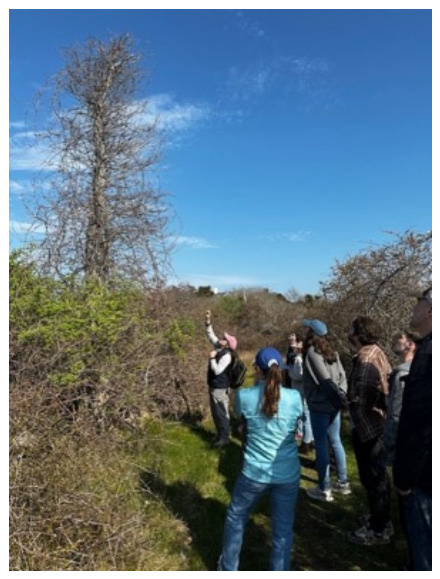
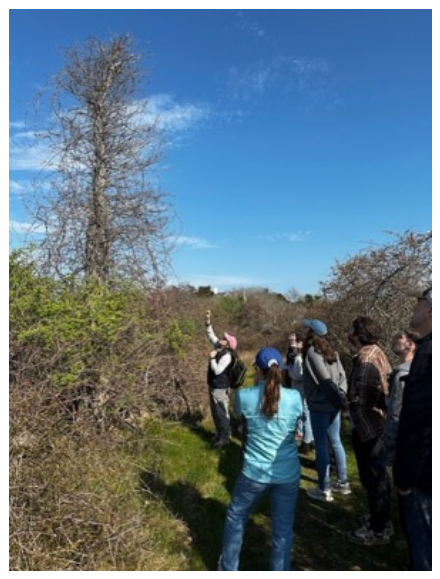
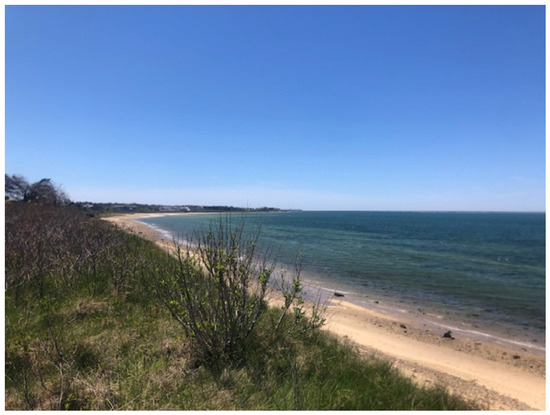
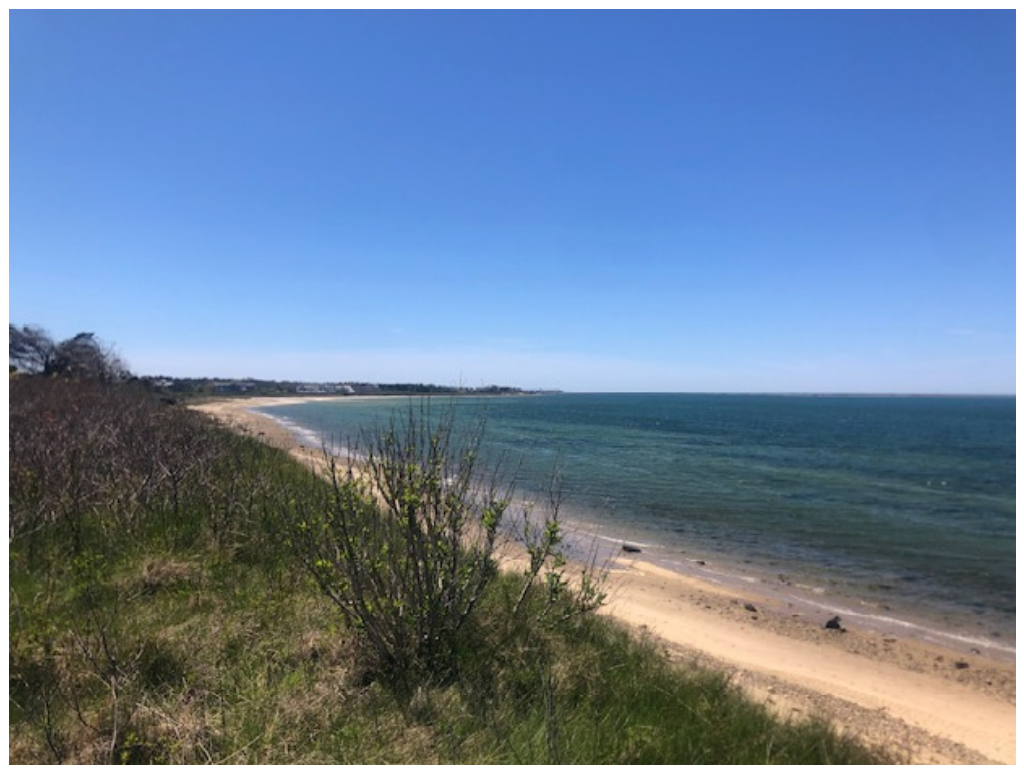


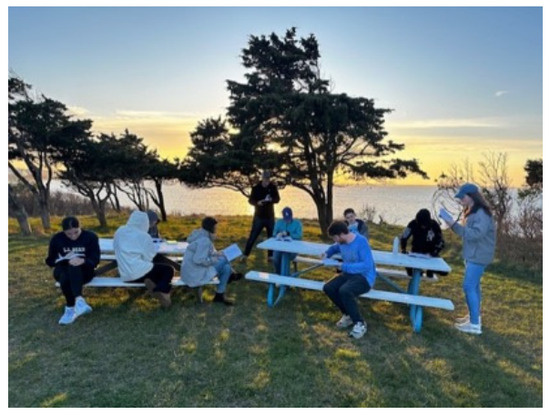
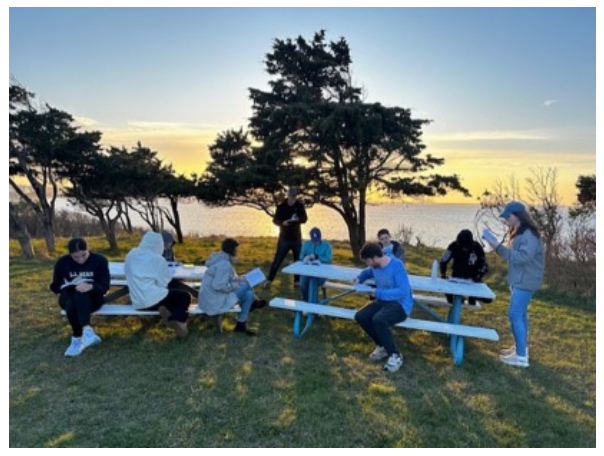
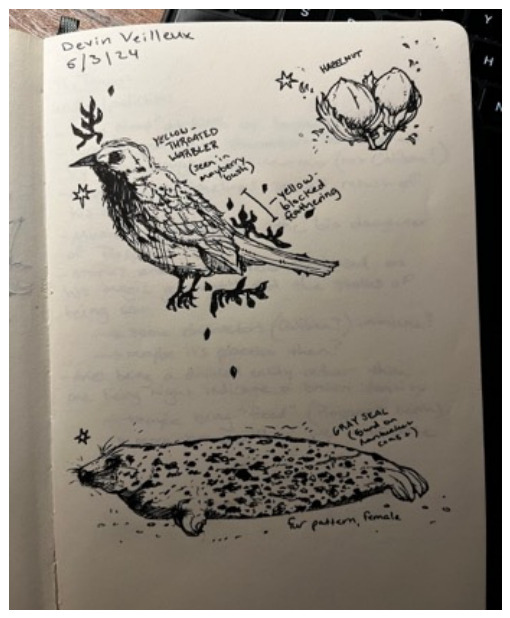
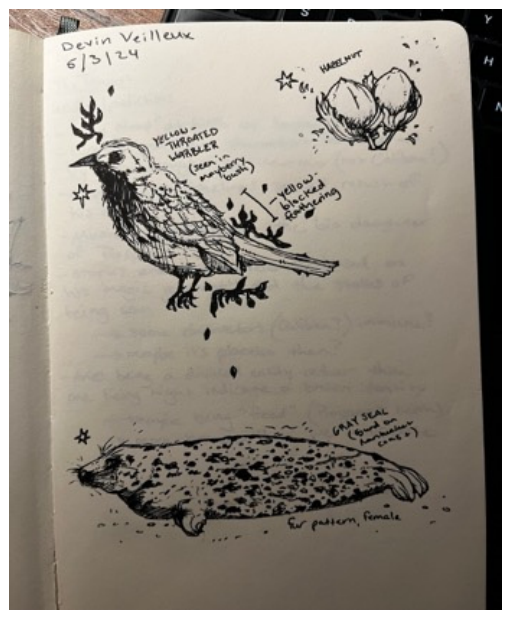
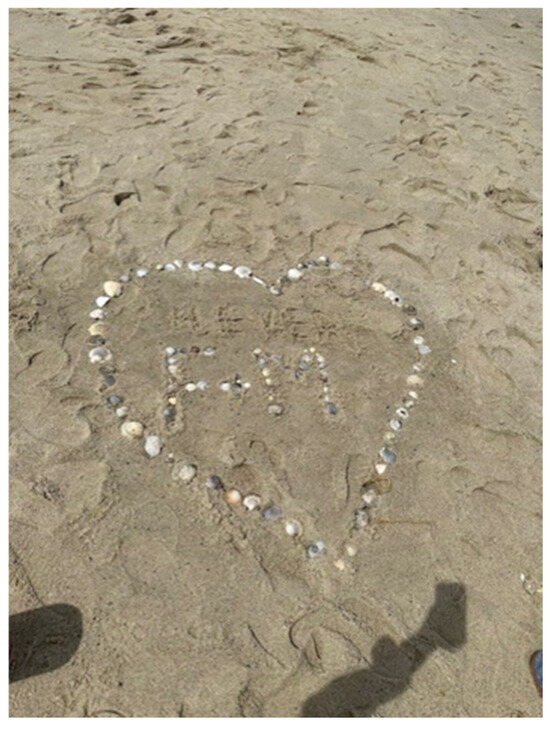
Disclaimer/Publisher’s Note: The statements, opinions and data contained in all publications are solely those of the individual author(s) and contributor(s) and not of MDPI and/or the editor(s). MDPI and/or the editor(s) disclaim responsibility for any injury to people or property resulting from any ideas, methods, instructions or products referred to in the content. |
© 2026 by the authors. Licensee MDPI, Basel, Switzerland. This article is an open access article distributed under the terms and conditions of the Creative Commons Attribution (CC BY) license.