


Abstract
This essay examines how textiles operate as violent aesthetic tools in the formation of Black existence during American slavery. While the American plantation relied on cotton production and the regulation of what the enslaved would wear, enslaved people transformed these fibers into instruments of refusal, creativity, and ontological reclamation. A study of textiles during American slavery exposes how the violence of enslavement was lived on the surface of the body through clothing. Reading art and runaway advertisements alongside narratives by Olaudah Equiano, John Brown, Booker T. Washington, and Harriet Jacobs, this article reveals how the enslaved resisted and rebelled against the textiles they were forced to wear. Bringing together visual art, runaway slave advertisements, and slave narratives, I argue that textiles form a crucial archive for understanding Black rebellion and resistance. This essay situates historical acts of resistance through textiles; it is through clothing that enslaved people articulated a radical insistence on their presence, thus turning fiber into flesh.
Keywords:
slave narratives; textiles; ontology; rebellion; violence; resistance; clothing; Black skin; slavery; Blackness 1. Introduction
The visual ubiquity of Black bodies in eighteenth- and nineteenth-century art and literature lies in the tragic commodification of bodies as draped commodities. The bodily draping in textiles represents an understanding of what it means to be human, to be enslaved, and to possess freedom. Slave narratives, and the very lives of these Black people, question our ontological understanding of the human based on what it means to be a free human, or what it means to be in and out of textiles. We must think of triangulation among textiles, Black bodies, and the idea of the human as existing synchronously in America, because the aesthetics of violence in American literature begins with these visual modalities. To drape oneself is to declare oneself present, so to discuss clothing is to examine the terms under which one exists1. As such, the very discussion of textiles in slave narratives becomes an archive of resistance. This article analyzes the violent visual aesthetic features of textiles in relation to slave narratives. In doing so, I not only highlight the importance of textiles in eighteenth- and nineteenth-century Black life, but also show how these Black bodies resisted the very logic of the plantation. I argue that textiles become a site of resistance, sometimes subtle and sometimes overt, where enslaved people reimagined their humanity in defiance of structures built to deny it. By cultivating a counter aesthetic through the same materials intended to erase their Being, enslaved clothing becomes an insurgent language where self-representation allows the enslaved to resist this Black pathology. This resistance reclaims textiles as a medium for autonomy. Aesthetic constructions of Black textiles in slave narratives are extensive and deserve further notice. When we study textiles in America, we find the radical spatial aesthetic form of cotton, and if Blackness and cotton are thought of together, they both exist everywhere, all at once. The aesthetic choices in cloth, color, or pattern carry political weight, where every stitch becomes an assertion that the enslaved had to express, shape, and preserve their Being, despite the system that sought to render them as commodity flesh.
In 2021, visual artist Kiyan Williams deep-fried an American Flag—twice. When later asked in 2023 by Them magazine how it felt to fry the American Flag, Williams responded that it was not meant to be “therapeutic”; instead, “it was fun. Let’s call it subversive play” (Sanders 2023). This radically disruptive act of frying a nylon American flag, which previously flew over the U.S. Capitol building, reflects the aesthetic power that textiles have in America while simultaneously showcasing how Blackness exists outside of this textile and perhaps this nation. Beyond the obvious political connotations of frying the flag, Williams also draws attention to the way this American textile marks the earth. By being made from nylon, a distinctly American, non-biodegradable synthetic polymer, Williams foregrounds the flag as a form of scientific harm to the ocean, the air, and the soil. The symbolism is that America, too, harms the earth. American textiles have always harmed the world and the people who live on it, and I begin this article by clearly discussing the violence of textiles by way of the representation of American slavery in art. Before the enslaved touch American soil, and before they are forcefully pushed onto the slave ship, their bodies are measured for wellness, and they are undraped. My article begins by contending that textiles create this mark of separation between human and nonhuman, and that slave narratives utilize the aesthetics of violence to display both the danger of textiles and how we are able and unable to craft narratives and resist whiteness with them.
The study of slave textiles begins with Shane and Graham White’s article “Slave Clothing and African American Culture in the Eighteenth and Nineteenth Centuries.” This isn’t to say that the connection between Blackness, textiles, and slavery hasn’t been studied before, but this article gives Black textiles its own focus rather than the usual discursive analysis we find in conversations about textiles and slavery. Shane and Graham White argue that “clothing was a vital and integral part of a culture that, fashioned out of adversity, made the lives of African Americans during the time of their enslavement bearable” (White and White 1995). While I agree with this thought, I would push it forward by saying that the engagement with textiles and the creation of a Black aesthetic vocabulary led to enslaved people creating an aesthetic culture that existed outside of whiteness. That is to say, the engagement with clothing for Black bodies marks “Negro clothing” as an unwanted commodity that must be resisted. This is both a dialectical resistance to whiteness and humanity because Blackness was made in opposition to both. Within this violent history, this article also shows how the enslaved forged acts of defiance that challenged these degradations by way of altering garments and wearing textiles in ways that were not authorized by white owners and by the law itself. These practices reveal a counter history of embodied resistance that complicates the narrative of slavery. By focusing on this method of textile analysis in eighteenth- and nineteenth-century slave narratives, we can examine how textiles shaped this idea of the human in new and complex ways. In this article, I approach the topic of textiles and slavery through visual, historical, literary, and textual analysis. My article brings together this diverse methodological approach to study how Black bodies respond to slavery via textiles. After briefly starting this article with a discussion on art, I will turn to historical documentations of runaway slave advertisements and, finally, slave narratives, which are the most clearly lived and articulated form of commodity violence, where the enslaved is always thinking about what it means to be Black, to be considered nonhuman, and to resist whiteness. Because Blackness already signifies an outsider status by way of American chattel slavery, it is crucial that we study the first moments of the aesthetics of textiles in art before we move on to how these violent fibers are complicated in even more nuanced ways by way of runaway slave advertisements and finally slave narratives.
2. Textiles and Black Being
How do textiles condition Black existence in America? The role of textiles and Blackness in aesthetic and commodity traditions in America shaped the eighteenth- and nineteenth-century American artistic tradition. In a creative and literary tradition formed by the reduction of Black lives to fungible objects, textiles, Blackness, and history are all violently intertwined. As such, the aesthetic commodification of the enslaved from art to historical textile analysis forms the central focus of this opening section. Indeed, what we find in the art I discuss is that Blackness is a uniform. The uniformity of Blackness begins under the violent aesthetic regulation of what textile(s) can and cannot drape the Black body. In early America, the Black body’s communal decision about what could and could not be worn was mandated by law. The term “negro clothes” or “slave clothes,” rooted in the Negro Act of 1735, highlights the inability or immobility of Black cultural agency through textiles (Rockman 2018, p. 170). While textiles, or the lack thereof, create this ungendered Blackness, textiles also create the initial understanding or regulation of the Black gendered body. Black textiles demonstrate the need for cultural collective worldmaking while having their communal aesthetic negated. Because the Black body was responsible for creating textiles through picking cotton, while also being restricted to what they could and could not wear, the extraction of cotton and the Black body form a tragic visual triangulation of commodity, violence, and aesthetic, which we find in the art of the time period. Black hands pick cotton for whiteness, Black backs get whipped by whiteness, and the Black body becomes draped by whiteness. In this way, textiles mark a separation between the enslaved and the human figure.
Our contemporary understanding of the importance of the aesthetics of textiles during slavery rests solely on the fact that slave clothing looked different from that of free people. What should be closely examined is the distinction between the enslaved monochromatic cotton textiles and what we might call polychromatic textiles of freedom.2 To better understand the importance of slave textiles and textiles of those who possess freedom, consider the two lithographs below, which are a part of James Richard Barfoot’s Progress of Cotton (Richard Barfoot 1840a, 1840b).
The description of these artworks, which begin in Figure 1 with Black bodies and end with white hands in Figure 2, details the role of Blackness in the aesthetic creation of textiles. More importantly, however, Barfoot accentuates the contrast between monochromatic unfreedom and polychromatic freedom. These art pieces help us to understand the relationship between art, slavery, and whiteness. As Anna Arabindan-Kesson writes in her analysis of these lithographs, “the density of cotton threatens to obscure our vision of all else” (Arabindan-Kesson 2021, p. 16). The aesthetic violence in these two pieces lies in this visuality of slavery pinned against this density of fabric. The aesthetic violence also lies in the fungible potential value of Blackness. Cotton itself has no real value during slavery until it is touched and moved by Black hands. It is this movement that creates market commodification and aesthetic value. The first figure details enslaved Black bodies draped in osnaburg unbleached fabric3 picking cotton under the surveillance of an overseer, himself draped in printed and dyed cotton. Osnaburg itself is a textile fabric made from flaxseed from the Scottish factories in Dundee and Edinburgh. As will be discussed later in this article, osnaburg was one of the violent “badges of slavery” to pull from Harriet Jacobs. As one might notice in the first figure, the textiles the enslaved are wearing are pristine and unnaturally white, which is an inaccurate depiction. What we don’t see in this figure is the physical violence against Blackness. We don’t see blood dripping, staining their shirts, sweat dripping from their faces, or scars covering their bodies. We don’t see the enslaved clothing dyed or stained, which was often the case, as I discuss in the following paragraph. The second figure presents this aesthetic textile beauty formed by Black hands. Not only are the textiles being printed beautifully arranged, but the workers themselves are draped in highly polychromatic ways, which represents freedom. I begin my focus on textiles from these two figures to close the gap of what else we don’t see, and it is the enslaved voice that closes this gap between the aesthetics of textiles and the visually ubiquitous violence put upon the Black body, in that if the plantation sought to turn textiles into a form of domination, enslaved people turned textiles into a vocabulary of survival and resistance.
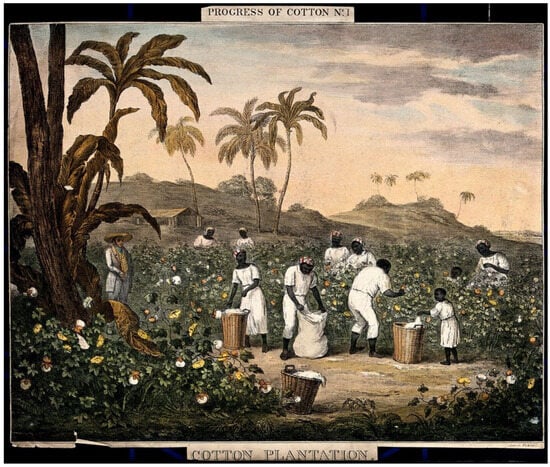
Figure 1.
James Richard Barfoot (1794–1863), Progress of Cotton: #1 Cotton Plantation (Richard Barfoot 1840a). Artstor.
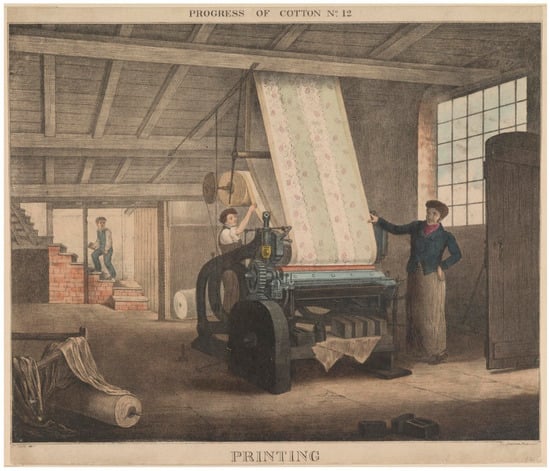
Figure 2.
James Richard Barfoot (1794–1863), Progress of Cotton: #12 Printing (Richard Barfoot 1840b). Artstor.
In an interview in the early twentieth century, Sarah Waggoner, a formerly enslaved woman, recalls the importance textiles had on her slave life and states, “You want to know what kind of clothes did we wear them days? I’m gwine to tell yer. I jes’ had two dresses. De best one was made out of plain, white muslin. I went out in de woods and got walnut bark to color it brown” (Bartlett 1941). Waggoner’s attention to monochromatic white textiles is similar to that of the first figure from Barfoot. That pristine whiteness in Barfoot’s work represents enclosure, violence, and an embellishment of slavery itself. Therefore, to resist textile regulation of that “plain, white muslin” dress by rubbing one’s clothes in dirt, or soil4 or against a tree is to resist the plantation’s attempt to regulate Black ontology, and as such, it is a rebellion against whiteness5. For the enslaved, they still managed to create their own Blackness and Black aesthetic through “Negro textiles”—even with the thought of the slave market thrust at them. Enslaved people understood that controlling one’s appearance was a form of asserting resistance beyond what the enslaver imagined. What might appear as an inconsequential act of resistance to slavery, this rebellion and the marking of one’s textile showcase the importance of textiles to the enslaved. In altering clothing, the enslaved person not only changed color but also altered meaning, thus transforming clothing from a symbol of deprivation, of serene labor, into a site of Black expression rooted against whiteness6. As such, we can read this rubbing of one’s textile against the earth as rubbing against whiteness. It is, on the one hand, a creative aesthetic expression. And, on the other hand, this act is a disruptive method of demarcating one’s perceived ontological absence as present. It is a literal rejection of whiteness and the Black pathological forces that it carries. Waggoner’s radical act rubs against the aesthetic market of the enslaved to reveal the stain of slavery. The creative expression of enslaved people concerning their textiles is seemingly endless. Because they were forced to wear unbleached or solid colored fabric, this gave the enslaved a canvas to create a wide variety of polychromatic styles. Such manipulation asserts that even within the most restrictive material conditions, enslaved people fashioned alternative ways of seeing and being seen. From dress to shirt to shoe to scarf, the enslaved learned to create and reinvent their Black textiles in ways that are not only expressive but also radical.
When we talk about the politics of the slave market or the politics of slavery, textiles are not at the forefront of the discussion. Nikole Hannah-Jones’ recently published The 1619 Project (Hannah-Jones et al. 2019) does, however, discuss in detail the role of cotton in the American economy during slavery. For Jones, cotton is discussed in terms of politics and the economy, though not necessarily in terms of resistance or rebellion. Conversations on the politics of slavery cannot exist without that conversation inevitably turning into a discussion about textiles. This violent, ubiquitous portrayal of textiles, or lack thereof, intertwined with Blackness, marks the often-signified connection between freedom and unfreedom. In other words, the very aesthetic beauty of textiles symbolizes the violence of slavery for Black beings. This Black aesthetic violence begins in the textiles and starts with blood dripping onto the cotton that Black bodies produced so that white bodies could consume. What is shown in numerous slave narratives is that Black bodies were not only aware but strongly against the quality of their textiles. These narratives tragically showcase what it means not to have access to your own body through textiles. As Walter Johnson notes, from a young age, slave children “learned to view their own bodies through two different lenses, one belonging to their masters, the other belonging to themselves” (p. 21). This double body is shaped through a double display of the body in textiles. That is to say, the aesthetic clothing of the enslaved shaped the communicative movements between Blackness and whiteness. The enslaved, therefore, created a Black aesthetic vocabulary through discussing textiles and clothing designs. These Black aesthetic textiles are the first instance of Black autonomy, solidarity, and resistance for the enslaved on the plantation. By creating a Black textiles vocabulary, these enslaved people made a certain collectiveness that expressed a resistance to slavery and racism itself.
In America, sometimes enslavers purposely draped Black bodies lavishly when they were attempting to sell them. Anna Arabindan-Kesson’s essay “Dressed up and Laying Bare: Fashion in the Shadow of the Market” notes that the value of an enslaved person’s body extends only as far as the value of their textiles. Thus, enslaved people were given clothes that “were meant to accentuate and highlight their physical features” (Arabindan-Kesson 2019). The enslaver used textiles to equate the dehumanizing transformation of Black draped bodies into chattel. The first step these enslavers took to purchase an enslaved person was either through the viewing of their bodies or the viewing of their textiles. Black bodies were often forced to dress well because it was believed this would yield the most significant monetary value. Many enslavers wanted their property to look exotic, so they would add jewelry, gloves, and other textiles to make them stand out. The politics of apparel are unique to Blackness, in that it is Blackness that was made to wear textiles uniformly in opposition to white bodies. This is where the commodification of Blackness has its roots—in the textiles of the enslaved. This uniformity is also where the un/gendering of Blackness transforms into what Hortense Spillers calls “captive [flesh]” (Spillers 1987, p. 67). The act of dressing up involves one staring at oneself to create a particular narrative: to see yourself reflected on yourself is a cultural desire that is ubiquitous in America. For slavery, whiteness can stare at whiteness, and whiteness can stare at Blackness, but Blackness cannot stare back. This reality is shown in detail during slavery, where whiteness can control the mode of expression of and for Black bodies, and we see this more clearly in runaway slave advertisements.
3. Flesh to Fiber, Fiber to Flesh
In most runaway slave advertisements, the textiles that the enslaved were wearing are mentioned in great detail7. The emphasis on clothing in runaway slave ads showcases property marked with textiles. In one such instance, when looking for a runaway enslaved man named Frank, an enslaver, William Jones, writes that Frank was “clothed in a Negro cotton jacket, old country, cloth waistcoat, and an osnaburg shirt, which if clean will appear stripped… but [Frank] may change his dress8.” When the runaway changes or leaves behind their textiles, this act of fugitive escape rejects the imposed textile identity—from fibered captivity to unbounded fugitive flesh. The proviso, here, that the runaway man Frank “may change his dress” indexes textiles as convertible, exchangeable, and unfixed. When fugitives altered their textiles, they enacted a tactical rebellion from the plantation’s semiotic apparatus, and by doing so, they destabilized the ontological categories through which owners sought to apprehend them. Changing clothes is therefore not only a fugitive disguise but a practice of ontological reorientation that moves from property to fugitive. The possibility of changing one’s textile also implies networks of alternative fabrics that lead to escape. The ads’ attention to the condition of garments, “if clean will appear stripped,” further underscores how visibility was always negotiated: dirt and stains, similar to Waggoner’s subversive act, could both betray whiteness and conceal the enslaved person’s fugitivity.
In another runaway slave advertisement, a “Mulatto Boy, named Arch,” ran away with a “small scar on his left cheek” and draped in “osnaburg trousers” and a shirt of the same fiber9. The connection here between fiber and flesh is most evident with this ad’s attention to Arch’s scar and his clothes. This connection between scar and osnaburg not only reveals how enslavers sought to fix Arch within a locatable form of property, but it also clarifies why altering, shedding, or refusing such textile constitutes an act of rebellion. To refuse textiles is to refuse whiteness. The plantation depended on a system in which fiber and flesh were made governable. By fleeing, Arch and other runaway enslaved bodies disrupt that governable order. The moment the enslaved run, and the moment the enslaved discards or transforms their clothing, they destabilize the visual code on which surveillance relies by marking the enslaved body as unintelligible to governance10. Rebellion emerges precisely in the gap between assumed permanence and radical improvisation, which is to say that textiles bind the enslaved to a given locatable permanence, and fugitivity or flight refuses this permanence. The enslaved know that these textiles mean they are property, and Olaudah Equiano gives readers an early insight into this. A question that emerges in Equiano’s narrative is what Black beings thought of textiles before and after they were enslaved. Unfortunately, we do not have many slave narratives that address this question, but Olaudah Equiano’s narrative does so in great detail.
Olaudah Equiano begins discussing textiles early in The Interesting Narrative of the Life of Olaudah Equiano (1789) by stating:
As our manners are simple, our luxuries are few. The dress of both sexes is nearly the same. It generally consists of a long piece of calico, or muslin, wrapped loosely round the body, somewhat in the form of a highland plaid. This is usually dyed blue, which is our favorite color. It is extracted from a berry, and is brighter and richer than any I have seen in Europe. Besides this, our women of distinction wear golden ornaments; which they dispose with some profusion on their arms and legs. When our women are not employed with the men in tillage, their usual occupation is spinning and weaving cotton.(Equiano 2009, p. 30)
Equiano’s attention to textiles in Africa serves as an act of rebellious remembering. In this quotation, Equiano is reminiscing on his youth, his family, and his culture. Equiano’s “nation,” that is to say, his village, in what is now southern Nigeria, enjoys these textile traditions. Equiano’s precise attention to textiles must be noted for his attention to detail, and his aesthetic memory of the specific types of cotton Africans wore in his village. His polychromatic visual memory rebels against the vision of the Black body in James Richard Barfoot’s paintings. Equiano presents both sexes as being draped in the same types of cotton: calico, muslin, and highland plaid. The sameness of this fabric concerning sexes must be understood differently from the sameness of the monochromatic textiles the enslaved were forced to drape themselves in. The use of color and dye in this description of textiles is essential because it is a tradition later applied by the enslaved on the plantation. The Black bodies’ position to textiles will also later change, from that of “spinning and weaving cotton” to the picking and laboring of it, and the Black bodies will no longer have access to what they can and cannot wear. Equiano’s memory of color operates as an act of resistance. By documenting the richness of African textiles, he dismantles the plantation’s attempt to make Blackness synonymous with plainness, sameness, and lack of cultural identity. His recollection insists on a pre-slavery aesthetic identity, which refuses the narrative that Black culture began at the point of capture.
As we see from Equiano’s attention to textiles, spinning and weaving were known to Africans, so much so that he recalls his younger self marveling at older Black Africans who would weave and create these “luxuries.” These luxuries of textiles are noted many times throughout Equiano’s narrative, and in each mention of them, he thinks of them as functioning under the same lens of autonomy: Equiano’s idea of freedom begins in textiles. Equiano details the importance of textiles as markers not only of identity but also of social distinctions.
As Equiano discusses the Siege of Louisbourg, he accentuates the ways the admirals were dressed when they boarded the ship:
When the ships were in the harbour we had the most beautiful procession on the water I ever saw. All the admirals and captains of the men of war, full dressed, and in their barges… some time after this the French governor and his lady, and other persons of note, came on board our ship to dine. On this occasion our ships were dressed with colours of all kinds… and this, with the firing of guns, formed a most grand and magnificent spectacle.(Equiano 2009, pp. 92–93)
The resonance of Equiano’s attention on the slave ship usually presents itself as a form of violence that is attenuated to death, which is to say that the ship, and therefore water, is always violent. However, in this moment of beauty for Equiano, the ship becomes a vessel through which white bodies display their glamor by draping themselves. Equiano’s attention to their textiles, in particular the very color of their textiles, tragically and violently compares his situation as an enslaved to theirs as free bodies. Though the admirals Equiano refers to are English and French, not American, the relationship between cotton or textiles and Blackness remains the same, primarily because Britain was the most significant consumer of American cotton.11 This moment in Equiano’s narrative also occurs directly after his time on US soil, where he began to view his Black body “anxiously” around whiteness. Equiano’s time on the plantation, his “weeding through grass” in preparation to growing cotton, occurs directly before he sees these textiles in motion. In other words, like Barfoot’s painting, Equiano visually sees the final product of American cotton on these admirals’ bodies. This aesthetic of violence in the passage, both through the act of their being in war and through the act of white bodies being free to drape themselves, presents textiles as social distinctions between Blackness and freedom. This “magnificent spectacle” is only grand insofar as it is inaccessible to Equiano. This inaccessibility to textiles is also shown, more explicitly, in later slave narratives. While I do not wish to trace Black textiles in slave narratives through an analytical approach, the fact that this connection between the enslaved and textiles appears in numerous slave narratives remains important to examine.
This thought brings into question why the enslaved discuss, in detail, what it means to drape their own bodies. Helen Bradley Foster’s chapter “Constructing Cloth and Clothing in the Antebellum South,” from New Raiments of Self (Foster 1997), traces the analytical use of Black textiles in numerous slave narratives and journals. Foster finds that enslaved Black bodies found textiles important both when dressing themselves and when it came to the enslaver dressing themselves. Draping the Black body was not simply the enslaver’s decision on what the enslaved could and could not wear; instead, draping the Black body was the law. The Negro Act of 1735 was a law specifically designed to control what enslaved Black people could and could not wear (White and White 1995). This act specifically states that authorized individuals, or white people, had the right to seize goods if they were to “find any such Negro slave having or wearing any sort of garment or apparel whatsoever, finer, or of greater value than Negro cloth, blue, linen, check linen, checked cottons, or scotched plaids” (McCord 1840, p. 397). When Equiano witnesses the Siege of Louisbourg, this moment comes directly after his time in Virginia. Equiano’s understanding of textiles and his admiration for the colors of the admirals’ textiles stem from his view of Black American textiles as existing outside this law. Though Equiano gives little to no description of textiles during his time in Virginia, we learn from other slave narratives the importance of textiles and Blackness, especially in Virginia.
In the early 19th century, John Brown, an enslaved person known as “Fed,” lived on Betty Moore’s plantation in Virginia. In his 1855 memoir Slave Life in Georgia: A Narrative of the Life, Sufferings, and Escape of John Brown, Brown recalls that it was customary for slave children of both sexes to “grow up quite naked, until they are ten to twelve years old” (Brown 1855, p. 4). These Black children only put on shirts when they were in the presence of their mistress or went up to the “great house” (p. 4). The hesitation for the enslaved to drape their Black body was due to the textiles they had to wear. Slave textiles were often made from osnaburg in solid colors, usually white, brown, or blue. Black slave textiles were frequently so uncomfortable that being naked was preferred by slave children. As these slave children came of age, it would seem like the transition from being naked to being draped was the transition from childhood to adulthood. However, as shown in other slave narratives, this was not the case (Johnson 1999).
The study of Black textiles during slavery leads us to a new analysis of gender, race, and resistance. And this study leads us to analyze the meaning of Blackness as it is understood through textiles and violence. Regarding Black slave textiles, violence, and the quantity and quality of textiles allowed for Black beings, John Brown writes:
The clothing of the men consists of a pair of thin cotton pantaloons, and a shirt of the same material, two of each being allowed them every year. The women wear a shirt similar to the men’s, and a cotton petticoat, which is kept on by means of braces passing over their shoulders. But when they are in the field, the shirt is thrown aside. They also have two suits allowed to them every year. These, however, are not enough. They are made of the lowest quality of material, and get torn in the bush, so that the garments soon become useless, even for the purposes of the barest decency. We slaves feel that this is not right, and we grow up with very little sense of shame….(Brown 1855, pp. 4–5)
This clothing, or lack thereof, given to the enslaved was purposely designed to restrict Black “decency” through the lack of Black expression. The expression of apparel is the entryway into the expression of self, and the expression of the self, for the enslaved, leads to rebellion. These descriptions from Brown catalog the experience of violence through the aesthetic creation and commodification of cotton. These experiences manage to refuse the speculative embodiment of textiles. The physical immobility that Brown discusses, of torn shirts, moves beyond readings of textiles as simple market aesthetics. Instead, these depictions of violence and textiles count the “rivulets of sweat, layers of sloughed cells, trickles of blood, and lines of scar tissue…” (Arabindan-Kesson 2021, p. 56). As such, by giving these enslaved people “the lowest quality of material,” enslavers were enforcing the pathological idea that these enslaved people are the lowest quality of beings. The attention to “decency” and “shame” here from Brown is critical when understanding what it means to be an enslaved Black body. The plantation’s manipulation of decency and shame as not existing for the enslaved functions as an attempt to further strip the enslaved of their claims for humanity. By providing textiles that are “the lowest material” and “useless,” enslavers weaponized clothing as social codes of propriety where the Black body exists outside the category of the human. But Brown’s insistence that this “is not right” signals the emergence of a self-awareness that contradicts the plantation’s logic. This is not only an emotional appeal to the reader but also a rebellious critique of the ontological system that shapes human existence. This attention to textile quality shows how the enslaved resist by recognizing their humanity.
Booker T. Washington talks capaciously about slave textiles and humanity, particularly his first pair of shoes and his osnaburg shirt, which he recalls being torturous to put on. On the quality of slave clothing, Washington writes:
The most trying ordeal that I was forced to endure as a slave boy was the wearing of a flax shirt. In the portion of Virginia where I lived it was common to use flax as part of the clothing for the slaves. Even to this day I can recall accurately the tortures that I underwent when putting on one of these [textiles]. But I had no choice.(Washington and Andrews 2000, pp. 8–9)
The textile Washington discusses here is the Scottish fabric known as Osnaburg. This violent fabric became synonymous with the brutality of enslavement in America and the West Indies. This fabric, manufactured in Scotland’s mills and exported globally, captures the transnational scope of slavery’s impact. Osnaburg, widely worn by enslaved people, became a daily reminder of the inescapable proximity to whiteness and colonial power. Through this material, we learn that slavery was not an isolated American phenomenon; rather, slavery was a transnational capitalist venture supported by European textile industries. As noted from Washington, this fabric was one of the “tortures” of slavery. This abrasive and uncomfortable material symbolizes a kind of inescapable white violence. This fabric, imposed on Black skin, served to erase Black sociality and reinforce Eurocentric social hierarchy. Washington goes on to add that the feeling of osnaburg was “equal to the feeling that one would experience if he had a dozen or more chestnut burrs, or a hundred small pin-points, in contact with his flesh. Even to this day I can recall accurately the tortures that I underwent when putting on one of these garments. The fact that my flesh was soft and tender added to the pain” (Washington and Andrews 2000, pp. 8–9). To solve this issue of abrasion, Washington and his brother creatively decide to smooth out this fabric. Washington explains, “my brother John, who is several years older than I am, performed one of the most generous acts that I ever heard of one slave relative doing for another. On several occasions when I was being forced to wear a new flax shirt, he generously agreed to put it on in my stead and wear it for several days, till it was “broken in” (Washington and Andrews 2000, p. 10). The refusal to accept textile degradation becomes a refusal to accept the ontological degradation it is meant to signify. The coarse fabric of osnaburg was designed not only to harm the skin but also to erode the enslaved account of bodily dignity. The violent fabric thus becomes part of one’s flesh. By deliberately softening this cloth and by Washington’s brother John refusing to let the plantation’s abrasive logic mold his little brother’s flesh, John enacts a form of resistance grounded in a similar preservation of decency that John Brown focused on. Equiano, Brown, Washington, and many other enslaved people not only discuss their distaste for Black slave textiles, but they also question how and why Black bodies must deal with these textiles. Enslaved people were given textiles that were essentially guaranteed to cause skin irritation. All enslaved people felt the pervasiveness of this irritation. It seems the case of whiteness had such a hold on Black skin that it ceased to exist even in the domestic spaces of Blackness. In other words, enslaved Black people could hardly relax even when away from whiteness because whiteness was seemingly ubiquitous—a sort of ether attached to their clothes. As such, what the enslaved does with these clothes is a direct exploitation and rebellion of the plantation and of whiteness. By criticizing fabric, questioning its purpose, and modifying its fibers, the enslaved reclaim agency through textiles.
In Jacobs (1861) ’ slave narrative, Incidents in the Life of a Slave Girl, Jacobs recalls being given a linsey-woolsey dress, which was made up of cotton and wool, and she calls this fabric one of the “badges of slavery.” The attention to this woolly dress marks another tragic European connection to slavery, in that the Welsh were producing and selling this fabric to America. The Welsh fabric of “Welsh Plains,” or wool, reached 7.7 million yards in 1812 (Prior 2019), demonstrating how Black bodies created wealth not just in America but worldwide. For Jacobs, clothes mark a kind of radical fugitive engagement. In chapter seventeen of her narrative, “The Flight,” Jacobs recalls telling her friend Sally to “take the clothes” from her trunk and “pack them in hers” (Jacobs 1861). As they search for Jacobs, the owners contend that she must have run away because her trunk was empty and that she had taken her clothes with her. Jacobs’ rebellion lies in understanding and manipulating the plantation order. Her flight subverts the enslaver’s surveillant system. Her decision to misplace her clothes reveals the radical and creative potential that textiles can manipulate the slave system. By taking her clothes and packing them into Sally’s trunk, Jacobs erases any trace of her identity and thereby disrupts the plantation’s economy. Through the ridding of these textiles, Jacobs subverts the very structure that sought to define her existence. In other words, by turning this badge into part of her escape, Jacobs enacts a rebellion and a run that are rooted in textile demarcation, where fiber becomes flesh becomes flight.
4. Conclusions
Black resistance for these enslaved people stems from resistance to the law and from this treatment of the Black body as a body that must conform to the laws of Black textiles. Throughout the eighteenth and nineteenth centuries, there were numerous slave rebellions, yet one rarely discussed rebellion was the rebellion against Black slave clothing. For the enslaved, every day was a battle within the power system of slavery and white supremacy. Enslavers attempted to create visual representations of the Black body as objects. While these enslavers succeeded in making the Black body seen as a form of commodity exchange, especially in the selling of these bodies, the enslaved still managed to fight back against this thought by creating, improvising, beautifying, and destroying their textiles. From art to literature to historical documents on runaway Black people, what emerges from this study of rebellion and textiles is a counter-archive of Black aesthetic and ontological assertion. Ultimately, I argue that textiles are not peripheral to the study of slavery: textiles are central to understanding how the enslaved navigated, contested, and redefined the boundaries imposed upon them. These narratives remind us that even with the threat of the slave market thrust upon them, Black creativity and refusal persisted and created new forms of Black possibility rooted in fiber and flesh.
Funding
This research was funded by the Initiative on Race and Resilience and the Nanovic Institute for European Studies at the University of Notre Dame, which included a research trip to Dundee, Scotland and the University of Edinburgh to study the history of osnaburg in Scotland.
Data Availability Statement
No new data were created or analyzed in this study. Data sharing is not applicable to this article.
Conflicts of Interest
The author declares no conflict of interest.
Notes
| 1 | As Monica L. Miller writes, “for whites and blacks, clothing and fashion were a means by which the status of the slave and master… were determined” (Miller 2009, p. 93). Clothing is determined for the enslaved and thus creates this violent “social signal,” as Morris (1977) writes. |
| 2 | Monochromatic meaning enslaved people were given one color to drape themselves with—either unbleached white cotton or blue linen. We can think of polychromatic as those textiles that have more colors, thereby aligned with freedom as shown later in this article in Equiano’s slave narrative. |
| 3 | Interestingly and often disregarded, is the fact that the Black enslaved bodies were the sole reason why the Scottish Osnaburg fabric sales soared from “0.5 million yards” to “2.2 million yards” as noted in Michael Andrew Žmolek’s “Capital and Industry” (Žmolek 2013, p. 468). Black bodies created wealth not just in America but worldwide. |
| 4 | For the enslaved soil, itself, also served as a type of resistance and rebellion. This attention to organic matter, slavery, and resistance can be found in the work of Kimberly Bain’s article “Black Soil” (Bain 2023). |
| 5 | If we are to understand textiles and fashion as political and social markers, then, as Roland Barthes writes, “every new fashion is a refusal to inherit, a subversion against the oppression of the preceding fashion…” (Barthes 1967). As such, we can read Waggoner and other enslaved people’s dyeing of clothes as a form of subversion to whiteness. |
| 6 | Beyond Sarah Waggoner, Rachel Cruze, Julia Woodberry, and Bob Mobley all talk about dyeing slave textiles, usually by rubbing them against bark, roots, or trees. See page 111 of New Raiments of Self: African American Clothing in the Antebellum South (Foster 1997) for more. |
| 7 | And, in slave narratives, some enslaved talk about their escape alongside clothing. In particular, one might recall the image from the Narrative of Sojourner Truth (1850), where Truth runs away with “her infant on one arm and her wardrobe on the other” (Truth 1850). |
| 8 | From a runaway slave advertisement in Virginia, Virginia Gazette & Alexandria Advertiser 20 May 1790. |
| 9 | From a runaway slave advertisement in Virginia, Virginia Journal & Alexandria Advertiser 29 July 1784. |
| 10 | Simone Browne talks about a similar surveillance in her chapter “B®anding Blackness: Biometric Technology and the Surveillance of Blackness.” Though she talks about slavery in relation to branding of the slave, we see the same surveillance and branding with textiles (Browne 2015). |
| 11 | Blackett (2002, p. 120). Equiano’s narrative was a key text for the British abolitionist movement, and one of the earliest depictions of textiles and the importance of them in relation to the enslaved. |
References
- Arabindan-Kesson, Anna. 2019. Dressed Up and Laying Bare: Fashion in the Shadow of the Market. Princeton: Princeton University. [Google Scholar]
- Arabindan-Kesson, Anna. 2021. Black Bodies, White Gold: Art, Cotton, and Commerce in the Atlantic World. Durham: Duke University Press. [Google Scholar]
- Bain, Kimberly. 2023. Black Soil. Social Text 41: 154. [Google Scholar] [CrossRef]
- Barthes, Roland. 1967. The Fashion System. New York: Hill and Wang. [Google Scholar]
- Bartlett, Gregory K. 1941. The Reckoning: Oral Histories of Enslaved Kentuckians. In Born in Slavery: Slave Narratives from the Federal Writers’ Project, 1936 to 1938. Washington, DC: Library of Congress. [Google Scholar]
- Blackett, Richard J. M. 2002. Building an Antislavery Wall: Black Americans in the Atlantic Abolitionist Movement, 1830–1860. Baton Rouge: LSU Press, p. 120. [Google Scholar]
- Brown, John. 1855. Slave Life in Georgia, a Narrative of the Life, Sufferings, and Escape of John Brown, a Fugitive Slave, Now in England. In Making of the Modern World. London: W. M. Watts. Available online: https://archive.org/details/06374405.4802.emory.edu (accessed on 7 October 2025).
- Browne, Simone. 2015. B®anding Blackness: Biometric Technology and the Surveillance of Blackness. In Dark Matters: On the Surveillance of Blackness. Durham: Duke University Press, pp. 89–130. [Google Scholar]
- Equiano, Olaudah. 2009. The Interesting Narrative of the Life of Olaudah Equiano, 1st ed. Auckland: Floating Press. [Google Scholar]
- Foster, Helen Bradley. 1997. New Raiments of Self: African American Clothing in the Antebellum South. Oxford: Berg. [Google Scholar]
- Hannah-Jones, Nikole, Matthew Desmond, Linda Villarosa, Jamelle Bouie, Wesley Morris, and Kevin M. Kruse. 2019. The 1619 Project. New York Times, August 18. [Google Scholar]
- Jacobs, Harriet. 1861. Incidents in the Life of a Slave Girl. Project Gutenberg eBook. Boston: Thayer & Eldridge. [Google Scholar]
- Johnson, Walter. 1999. Soul by Soul Life Inside the Antebellum Slave Market. Cambridge: Harvard University Press. [Google Scholar]
- McCord, David J., ed. 1840. The Statutes at Large of South Carolina. Containing the Acts Relating to Charleston, Courts, Slaves, and Rivers. Columbia, SC: A.S. Johnston, vol. 7, p. 397. [Google Scholar]
- Miller, Monica L. 2009. Slaves to Fashion: Black Dandyism and the Styling of Black Diasporic Identity. Durham: Duke University Press. [Google Scholar]
- Morris, Desmond. 1977. Manwatching: A Field Guide to Human Behavior. New York: H.N. Abrams. [Google Scholar]
- Prior, Neil. 2019. Slavery: Welsh weavers ‘implicated in US slave trade’. BBC News, June 16. [Google Scholar]
- Richard Barfoot, James. 1840a. Progress of Cotton: #1 Cotton Plantation. London: Darton. [Google Scholar]
- Richard Barfoot, James. 1840b. Progress of Cotton: #12 Printing. London: Darton. [Google Scholar]
- Rockman, Seth. 2018. Negro Cloth: Mastering the Market for Slave Clothing in Antebellum America. In American Capitalism: New Histories. New York: Columbia University Press, pp. 170–94. [Google Scholar]
- Sanders, Wren. 2023. Inside Kiyan Williams’ Earthen Odes to Ancestral Power. Them Magazine, April 21. [Google Scholar]
- Spillers, Hortense. 1987. Mama’s Baby, Papa’s Maybe: An American Grammar Book. Diacritics 17: 65–81. [Google Scholar] [CrossRef]
- Truth, Sojourner. 1850. Narrative of Sojourner Truth. The Project Gutenberg eBook. Boston: William Lloyd Garrison. [Google Scholar]
- Washington, Booker T., and William L. Andrews. 2000. Up from Slavery. Oxford: Oxford University Press. [Google Scholar]
- White, Shane, and Graham White. 1995. Slave Clothing and African-American Culture in the Eighteenth and Nineteenth Centuries. Past and Present 148: 149–86. [Google Scholar] [CrossRef]
- Žmolek, Michael Andrew. 2013. Capital and Industry. In Rethinking the Industrial Revolution. Leiden: Brill, pp. 461–506. [Google Scholar]
Disclaimer/Publisher’s Note: The statements, opinions and data contained in all publications are solely those of the individual author(s) and contributor(s) and not of MDPI and/or the editor(s). MDPI and/or the editor(s) disclaim responsibility for any injury to people or property resulting from any ideas, methods, instructions or products referred to in the content. |
© 2026 by the author. Licensee MDPI, Basel, Switzerland. This article is an open access article distributed under the terms and conditions of the Creative Commons Attribution (CC BY) license.