2. Platformativity: The Infrastructure
Live-streaming denotes video broadcast services on web-based platforms and mobile applications that facilitate real-time, cross-modal interaction through video, text, and images. In recent years, along with the development of platform technology, the Chinese live-streaming market has grown exponentially. Major platforms include Douyin (TikTok’s Chinese counterpart), Kuaishou, and Taobao Live, which are central to e-commerce live-streaming. Other platforms like RED (Xiaohongshu), WeChat, Weibo, and Bilibili also host live streams. While e-commerce is a huge focus that has produced some well-known Internet celebrities such as Li Jiaqi and Weiya, streamers also create a wide range of content, from gaming and travel to just chatting and special events. According to a recent Report on China Online Audio-Visual Development (
Zhou 2025), the number of live-streaming users in China reached 833 million by the end of 2024—an increase of 17.37 million from the previous year—accounting for 75.2% of all Internet users.
1 As scholars have observed, China’s live-streaming industry is “characterized by a rapidly evolving landscape of platforms with genre variety and a scale of participation and revenue generation orders of magnitude greater than Western formats. More than a media phenomenon, China’s live-streaming industry has come to play an acknowledged role in China’s remarkable economic and cultural transformation” (
Craig et al. 2021, p. 96).
Among the diverse forms of live-streaming content, entertainment live-streaming emerged first and continues to command the largest market share (
Lei 2025). It has revolutionized the way people socialize and consume entertainment. While the platforms provide a potentially affluent career opportunity for the streamers and have indeed produced many Internet celebrities and influencers—often called
wanghong or
zhubo, the viewers gain emotional satisfaction through interacting with the streamers and each other.
Research has found that social media has in general fostered democratic participation and connectivity (
Jenkins 2006;
Dijck 2013), and live-streaming can empower streamers to reprogram the surveillance of platform capitalism and encourage viewers to acknowledge their desires (
Brewer 2023, p. 314). For example,
S. Wang (
2020) observes that the circulation of same-sex affect on Blued live-streaming helps shape homonormativity. However, this emphasis on creator agency overlooks the structuration of the platform and industry. From the perspective of the industrial chain, the Chinese live-streaming industry encompasses multiple players, including content producers (streamers), platform operators, technical support providers, content regulation agencies, performer guilds (or agencies), advertisers, and e-commerce partners, where the streamer is only one segment within the structure in service of the profit-making industry (
Lei 2025). Moreover, the Chinese platforms add special features, such as cross-screen bullet comments (danmu), virtual gifting, and live call-in, to attract users. The bullet comment function highlights the centrality of audience participation, and the virtual gifting intensifies the sensation of public spending and monetizes desire. Consequently, desire is intimately intertwined with individual empowerment and capitalist exploitation (
Song 2021).
The contradictory tendencies of self-making and commodification of desire are best revealed in Hao Wu’s documentary film
People’s Republic of Desire (2018), which captures the rise of entertainment live-streaming in China during 2013–2016. Although live-streaming has since evolved into varying forms, the basic structure and mechanism remain the same. YY, one live-streaming service featured in the film,
2 utilizes the technologies of bullet comments and virtual gifting to convert the online space into a digital ecosystem where desire is both the source and product of monetary transactions. Whereas the live-streaming platform seemingly provides a utopian space to promote online connectivity and inspire individual dreams of self-entrepreneurship (
Dijck 2013, p. 42), the gifting mechanism nonetheless reveals the logic of commodification of desire. Although some argued that virtual gifting continues the traditional sharing economy that could help build communities and reciprocal relationships (
Baym 2011;
Veale 2003), research on Chinese online streaming suggests that the gift logic has been subsumed under the commodity logic and the gift form of online exchange has been “hijacked or coopted for the purpose of profit maximization on China’s live-streaming platforms” (
Zhang et al. 2019, p. 344).
The infrastructural design of the platform—including its technological and managerial innovations, both generates and conditions desire.
Desire, according to the Merriam-Webster dictionary, refers to a conscious impulse toward something that promises enjoyment or satisfaction in its attainment.
3 In Western philosophy, however, desire has been understood variously as lack, motivation, and productive force, not necessarily “conscious.” For instance, both Freud and Lacan framed desire as unconscious and structured by lack and repression, whereas thinkers such as Nietzsche, Deleuze, and Foucault challenged this model by emphasizing desire’s affirmative, productive, and historically constituted dimensions, shifting attention from individual psychology to power, discourse, and social structures. In Deleuze’s formulation, desire is explicitly identified with Nietzsche’s notion of “the will to power” (
Deleuze and Parnet 2002, p. 91), a principle that “underlies” the world, existence, and life. As
Deleuze and Guattari (
2009) articulate in
Anti-Oedipus, “Everything revolves around desiring-machines and the production of desire” (p. 380). “Desiring Machines” denote the impersonal or pre-individual forces or assemblages that envelop individuals. Therefore, human subjectivity can be understood as a consequence or an expression of desire.
Whether it is framed as “conscious” or “unconscious,” a “lack” or a “productive” force, desire is not just wanting an object; it is wanting what the object is imagined it could do for the self. In this regard, desire operates on multiple levels: instrumental/material (wealth, success), social/symbolic (fame, recognition), relational/affective (intimacy, attachment), existential/fantasy (sexual fantasy, inspirational idols). Different desires originate at different depths, follow different logics, respond to different kinds of lack, therefore cannot substitute for one another cleanly. As a result, wealth cannot cure loneliness; fame does not stabilize identity; sexual fantasy does not resolve existential anxiety, and idols never fulfill longing for “a different life.”
YY’s idol-making live-streaming platform smashes all these desires together and collapses the gaps between them, as if the showroom satisfies all levels of yearnings. It promises a dream that ordinary streamers can become Internet celebrities by simply joking, singing, or dancing for the audience before a webcam. They are usually not well-educated and not particularly beautiful or talented, yet in some way successful in connecting with their followers, turning them into fanatic fans. Fans see the streamers as inspirational role models or objects of sexual desire, or simply a medium of connecting with others. They can purchase virtual gifts to tip the host, gifts ranging from lollipops to airplanes, which represent real cash in various amounts. Wealthy big tippers can earn different titles in the online showroom, such as King or Duke, to impress the host and other audience members. In return, the host thanks them for the gifts, and ordinary audience members flatter the big tippers, all of which incites more spending in the room. A successful host can earn a substantial income, with monthly earnings reaching USD200k and surging to as much as USD1.5 million during the annual competition period.
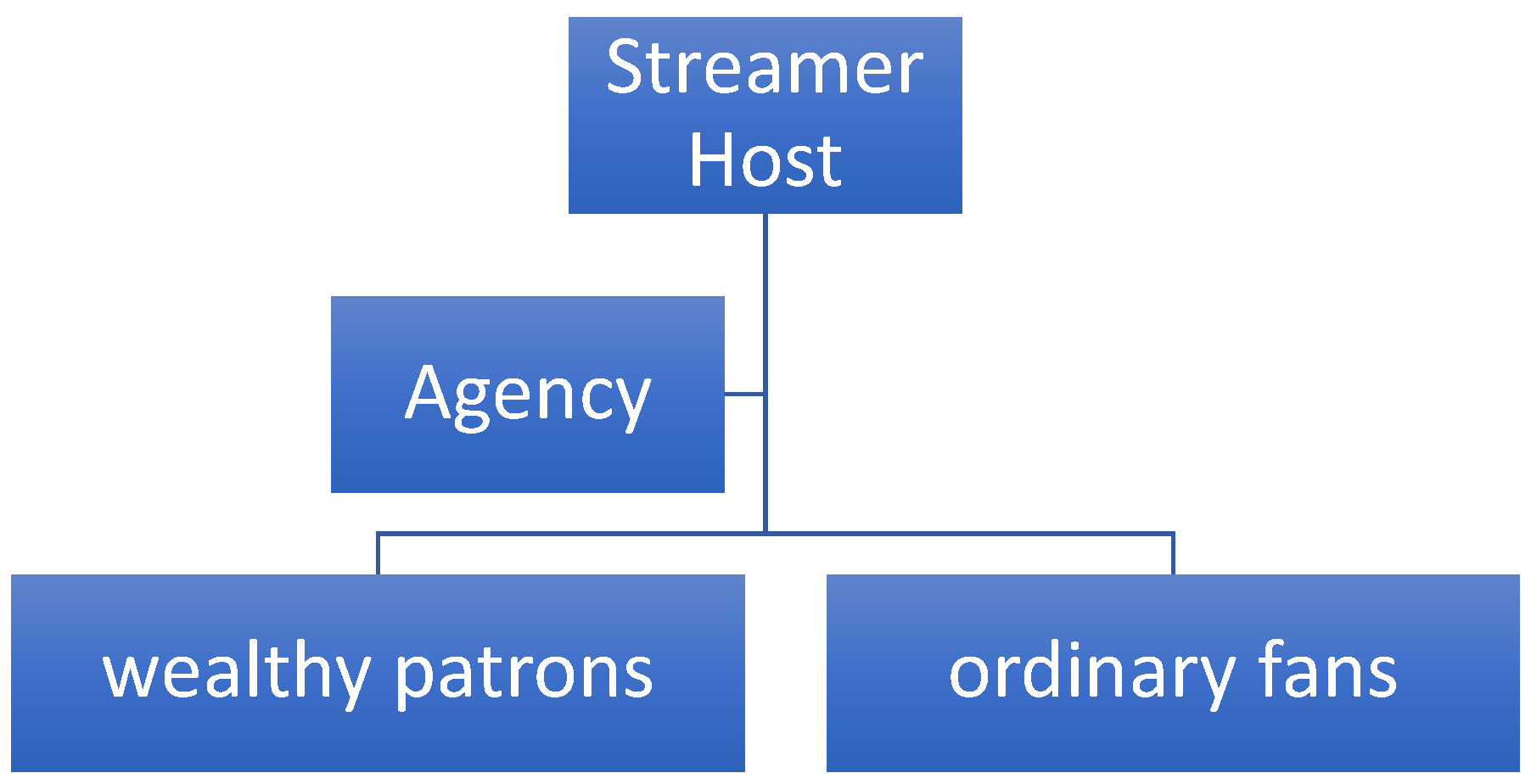
The relationships among the host, ordinary fans, and big tippers are not all that are involved in this digital ecosystem. Hao Wu shows that there are two other organizations indispensable for the live streamer’s destiny: the YY platform and the idol-making agency, or the guild. In general, YY designs the interactive interface, provides technological support, and offers basic training in using the webcam or live-streaming techniques, whereas the agency is charged with promoting certain idols under their contract. The agency invests in its favorite hosts by buying them handsome gifts to lift their popularity in the showroom. There is often an overlap between the big tippers and the agency, as it is often the case that some fan-loving wealthy patrons later decide to run agencies to profit from the business. The agency splits the income with the host.
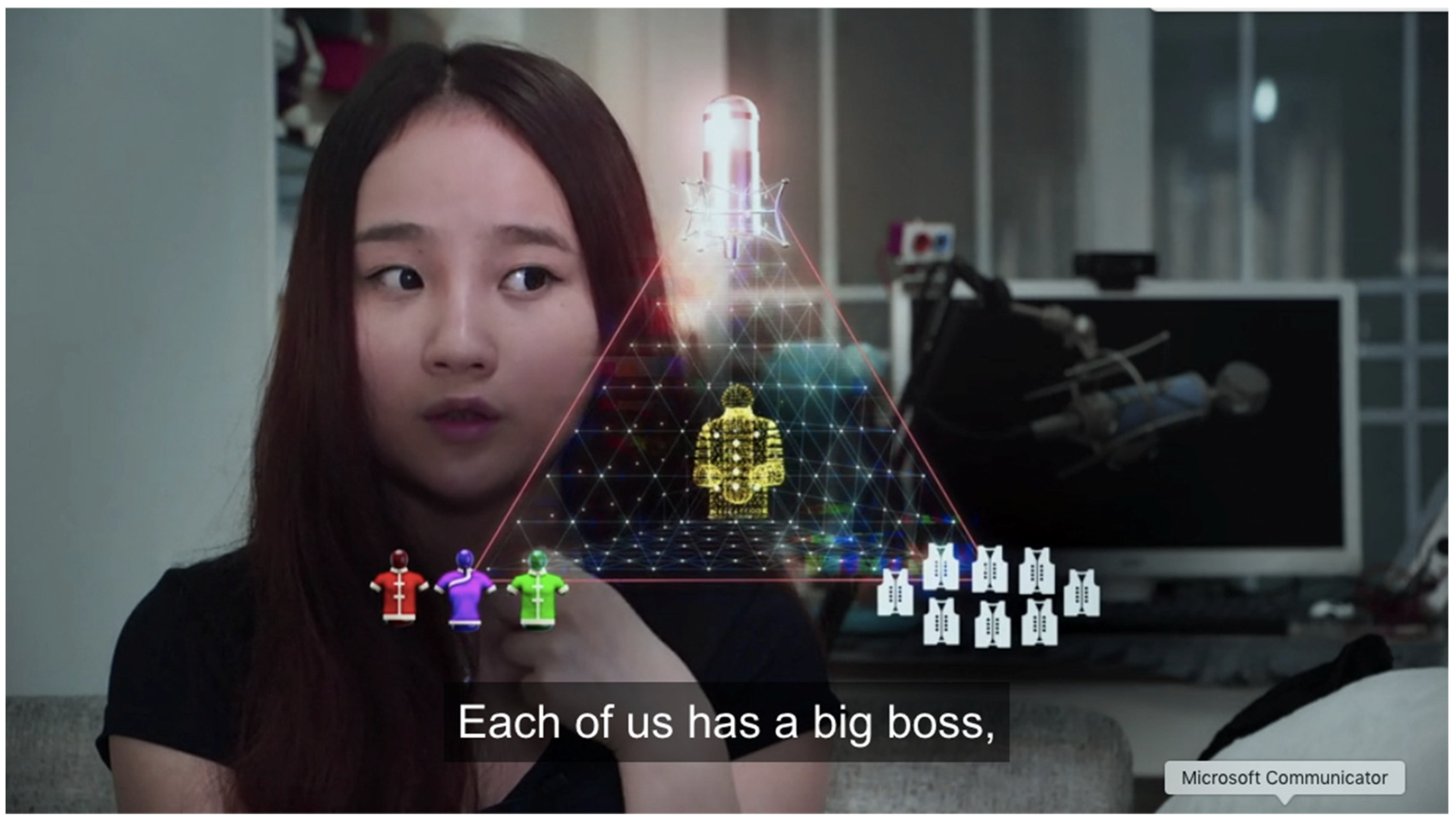
Consistent with his surrealistic filmmaking, Hao Wu draws a figure floating on the screen to specify the YY platform ecosystem (
Figure 1 and
Figure 2):
This figure exhibits a visual regime of desire: desires for wealth, success, recognition, attention, connection, and sexual fantasy are all mixed to flow intersubjectively within the digital space, where all parties’ interests converge. Whereas the triangular relationship between the streamer, ordinary fans, and wealthy patrons appears at the forefront of the showroom, circulating competitive admiration and jealousy, what remains in the center (as shown in the image) and invisible is the golden figure of the agency and the platform. Both can create “fake popularity” by investing in the streamer and manipulating algorithmic calculation. The agency can promote the streamer with a monetary value, and the platform treats both the streamer and audience as a “datafied asset.” The seemingly innocent popularity, hence, conceals the capitalist manipulation facilitated by the design of the platform.
For example, in the film, the director follows two idols who are more commonly called
wanghong.
Wanghong, literally “Internet famous,” refers to those who gain popularity native to the Internet. The term, according to
E. J. Zhao (
2021), is polysemic not only because it embodies a diverse range of individuals with various possibilities for commercialization but also because it is celebrated and stigmatized at once. In the film, the male idol Big Li is a 25-year-old young man from a Hebei village who went to Beijing to work as a construction worker at age 16. After undertaking live-streaming, he has become the pride of his extended family in the village. He openly shares his experiences and emotions in the showroom, attracting a large following for his hoarse-voiced silly jokes and off-key singing. Ordinary fans admire his achievement, taking him as an inspiration for their future. At the same time, the big patrons see him as an opportunity to gain recognition in the showroom. The overweight profiteer Song Ge, lonely and restless, unattractive in real life, enjoys the intense attention he gets after spending large sums of money on hosts. The virtual gifts he buys for them online come with floating crowns and titles attached to his digital name. Receiving admiration and flattery from ordinary fans, he experiences the power and influence of a king in the virtual space.
Another example is the female winner Shen Man. Shen Man is also a self-made idol performing for the camera. This 21-year-old nurse-turned-celebrity girl projects a modest and sexy image to attract people’s adoration. She is a goddess for some young male workers and a role model for girls. Behind her energetic and confident demeanor in the showroom is the uncommunicable childhood trauma—she was left with her grandparents in the countryside soon after birth, and her parents divorced when she was 8 years old. Growing up motherless, she also has a difficult relationship with her father who, remarried and bankrupt, moved in with her after she gained popularity online. As the breadwinner in her family, she needs to constantly strike a balance between her online persona and offline reality. Although in real life, she is mostly confined within her narrow apartment, online she must maintain an ongoing relationship with her fans by always being available, posting messages on social media, responding to fans’ comments, etc. To the wealthy male patrons who support her, she is flirtatious and consoling, trying to keep their affection yet at the same time deflect their advances.
Both Big Li and Shen Man’s success relies on the YY platform, which not only provides a stage for their performance but also brings about significant wealth. At the beginning of the film, Big Li tells his fans that being a live streamer has made him the second richest man in his home village, bringing him a comfortable life and a happy family. Similarly, Shen Man earns USD 40k a month for being a live streamer, something her ordinary fans consider an impossible achievement they can only dream of.
The multilayered relationships manifested on the YY platform remind one of what
Thomas LaMarre (
2018) calls “platformativity,” a term used to capture the infraindividual intra-action between the subject, the image, and the screen. LaMarre laments that previous psychoanalytic and Marxist theories, as well as Butler’s performativity theory, all downplay the function of the platform, taking media as merely a mirror to “suture” the subject and image. Ignoring the role of the platform or subordinating it to the subject can only lead to a general dematerialization of operations of power. To acknowledge the active function of platforms, LaMarre highlights the interactions beneath the level of discrete individuals and focuses instead on relations that produce experience and subjectivity across humans, screens, networks, and media formats. Therefore, platformativity redefines the triad of self, character, and platform, each of the terms taking on a degree of semblance with the other two: “As the platform becomes both character-like and selflike, so the character becomes platformlike the selflike, and the self becomes platform like and characterlike” (
LaMarre 2018, p. 208).
Indeed, this convergence and intra-action among the subjects (viewers), the platform, and the character (image) is perfectly manifested in the live-streaming on YY. While the host (character) occupies a platform assembling attention and inter-subjective identifications and thus becomes platformlike and selflike, the fans (self), by investing in the host, gain a sense of owning the showroom (platform) and therefore become platformlike and characterlike. Not to mention the YY platform itself, which, by providing basic training in live-streaming and hosting annual competitions, presents a strong human existence and a drive for success. It represents both the consumer (self) and the host (character) and hence becomes both characterlike and selflike.
However, the platformativity of YY does not stop at restoring the ontopower of a platform, or recognizing the materiality of media, as LaMarre asserts, but in effect reinforces the centrality of the platform, not just as an infrastructural precondition that makes all other parasocial relations possible, but as a structuring force that subsumes all other interactions, live streamers and audience alike. Indeed, the live-streaming platform is not just a screen or a visual interface, but a designer and moderator of rules, hierarchies, and relationships. This platformativity, at its core, embodies neoliberal capitalism that breeds all other forms of fantasies, desires, and material and immaterial labor that serve the ultimate drive for monetary profit. As
Zhang et al. (
2019) and others argue, the infrastructural design of platforms enables them to compel both streamers and viewers to construct an extensively commodified relationship. Moreover, to capitalize on the viewers’ fantasies and desires, the platforms have established specific norms of performativity that govern streamers’ self-stylizations and production of performative and affective content (
Zhang and Hjorth 2019).
LaMarre (
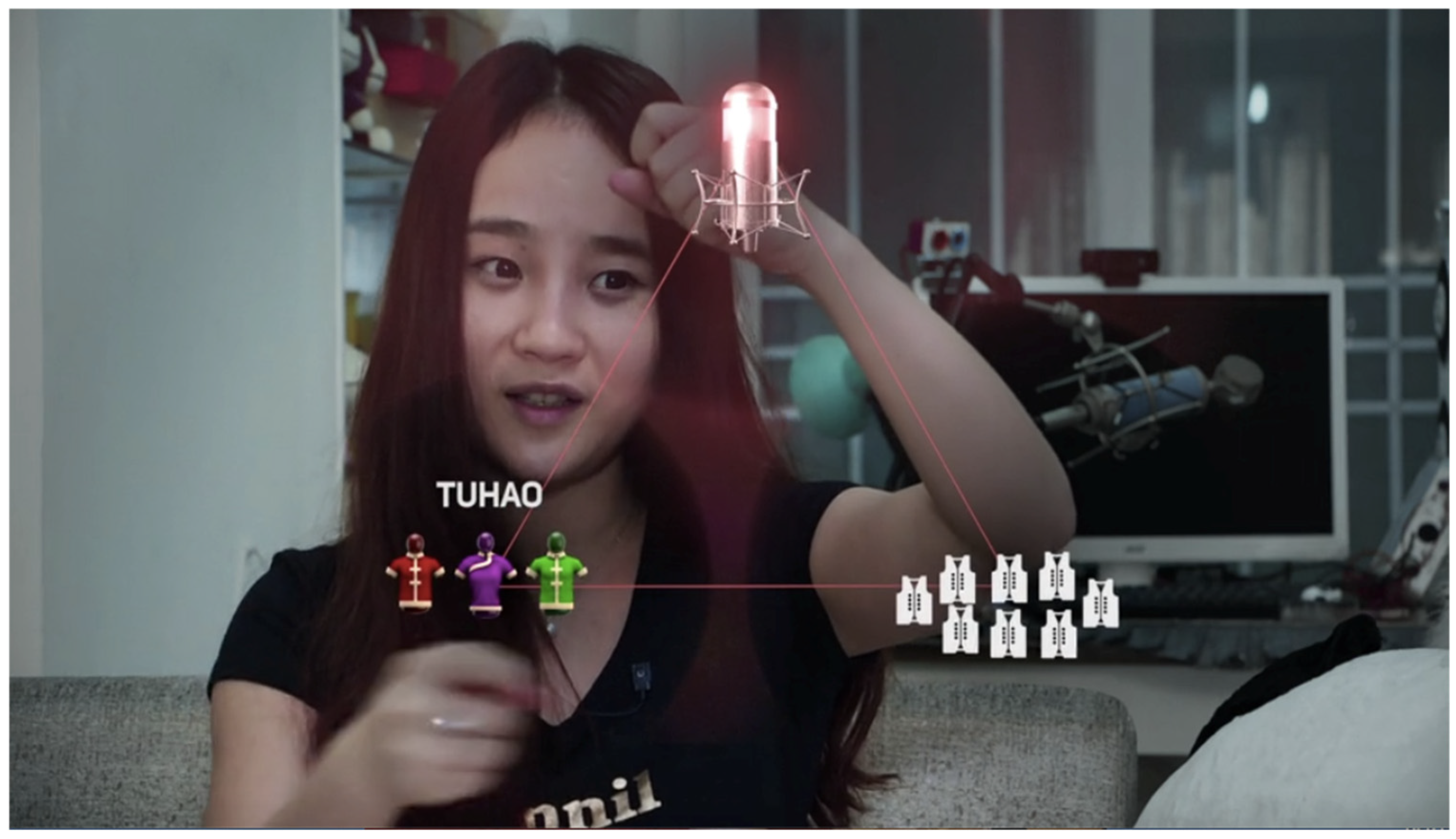
2018, p. 210) describes the tripartite relationship between platform, self, and character as a Reimannian triangle that entails curvature, or a musical tritone (the musical interval composed of three adjacent whole tones) that forms a topological manifold. Interestingly, Hao Wu identifies each participant in the YY showroom as in a Euclidean triangular relationship (
Figure 3), the quality of which is defined purely through money. The topological manifold LaMarre refers to is then reduced to a straight-lined triangle that simplifies the dynamic libidinal energies flowing on the platform, a combination of libidinal and political economies that assembles both the intensities and extensities blatantly displayed on the screen.
3. The Libidinal Economy: Labor in the Monetary Regime of Desire
One of the most disturbing aspects revealed in the film
People’s Republic of Desire is the relationship of labor, both affective and physical, submerged in the combination of affect management and monetary transactions. The overflowing desires across the screen blur the boundaries between producer and consumer, masking the exploitative relationship between labor and capital. When the hosts are packaged as self-made entrepreneurs and skillful managers of the audience’s affect, their precarious position as affective laborers is concealed (
Panneton 2023, p. 275). Affect here refers to pre-conscious, physiological, and relational intensities and capacities to affect and be affected in the showroom. When audiences are aroused to cheer for the streamer’s performance and compete for spending money, affect is circulating between bodies across the screen. On the other hand, when the migrant workers are presented as ordinary fans in the showroom and the product of their physical labor transformed into gifts to the hosts, their identity as laborers is obscured as well.
The entanglement of labor, desire, and capital makes Chinese entertainment live-streaming a unique case to discuss libidinal economy. Scholars have recognized the uniqueness of Chinese live-streaming, seeing it as part of China’s “alternative creator industry” that is “a wild card that may upset the accepted understanding of the way culture influence flows globally.” But they did not articulate what it is that underpins China’s “more diverse and potentially lucrative opportunities for creators than its Western counterparts” (
Cunningham and Craig 2021, p. 3). I would argue that the seeming “success” of China’s live-streaming lies in its libidinal economy through which desire is directly transformed into money in an intensely competitive environment. With various platform features such as bullet comments, virtual gifting, and annual competition, the platforms compete to create stickiness that harnesses users to the screen. By turning fans into prosumers and real-money investors, platforms consolidate fans’ loyalty to their idols and encourage escalating expenditures, generating sunk costs that further intensify this bond. Beneath the material façade of the monetary transactions, there are emotional, affective, and libidinal exchanges among the participants that mask the exploitation of labor. As demonstrated below, the excess of desire, or libidinal intensities, of the affective and physical laborers have been transformed into measurable emotional commodities to feed the platform economy.
Director Wu made a conscious effort to reveal the intertwined desires among different groups and the new exploitative form of labor in this libidinal economy. First, there is a level of genuine digital intimacy between the hosts and the ordinary fans. When the young migrant worker Yong remembers to buy votes for Big Li as soon as he receives a paycheck, or Big Li feels depressed for letting his fans down because he lost the competition, there is an inter-subjective, emotional bond between the host and his fans. Similarly, Shen Man, estranged from her mother and bankrupt father, finds her entire life occupied by interactions with fans online. Although she must maintain an ambiguously sexualized image to cater to the wealthy patrons, the attention and generous presents lavished on her also compensate for the lack of love and care at home.
Big Li and Shen Man’s popularity largely stems from their relatability as dispossessed individuals turned Internet celebrities. Both from humble and difficult backgrounds, they project an authentic persona that ordinary fans find familiar and endearing. Their success indicates a sense of hope for
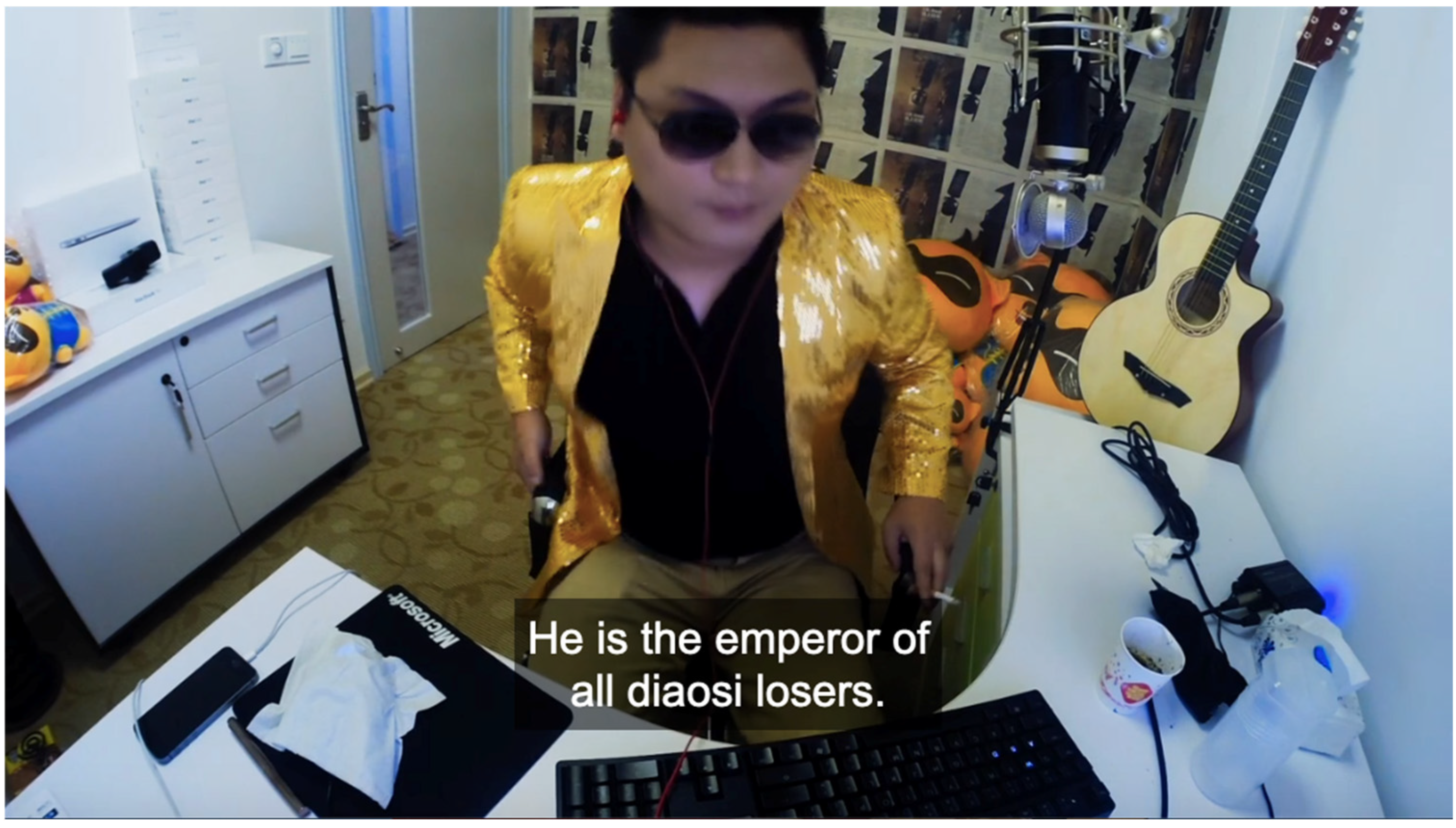
diaosi, a vulgar and derogatory term normally used to identify low-class people but later appropriated by hopeless fans to mock themselves as losers in society. When Big Li shares his own “rags to riches” story and calls himself “the emperor of
diaosi,” Yong and his friend smile at the screen, jokingly, “he is indeed a
diaosi” (
Figure 4). The projection and identification constitute a fantastical alliance between the host and ordinary fans. For fans, seeing one’s idol win is equivalent to one’s own victory; similarly, for the host, continuing to win is the only way to reciprocate fans’ love. This virtual alliance connects the affective and physical laborers together in a circuit of desire expressed by money.
In the film, several emotionally charged scenes testify to this codependent partnership: after Big Li’s failure in the third competition, his fans vow that they owe Big Li a championship and determine to support him the next time; his wife tears up for a loyal fan’s continuing support for Big Li; Big Li weeps before the camera while apologizing to his fans after the fourth competition, and Yong sheds tears seeing Big Li’s despondence. This long-term, mutually obligated connection suggests genuine digital intimacy in its affective capacity. The streamers’ self-entrepreneurial stories motivate a pseudo-gift economy that differs from commodity economy in that it generates communal connectivity through identification and voluntary gift giving. As researchers have demonstrated, the virtual gifting mechanism presents a potential shift away from seeing the audience as revenue streams toward seeing them as relational partners and community members (
Baym 2011;
Veale 2003).
Meanwhile, the wealthy patrons, identified as tuhao in the film, get a sense of accomplishment by arousing attention in the showroom. Besides feeling capable in front of the host, able to exert special power over him/her, they also get satisfaction from diaosi’s cheers. Their disguised identity (often called Brother so and so) promises a novel image celebrated by strangers. As one tuhao puts it, being tired of real-life excesses, he finds online patronizing more exciting. The mediated recognition, witnessed by ordinary fans, recalls a Lacanian mirror stage that fulfills an imaginary subjectivity, or, in a Foucauldian sense, a heterotopia alternative to the real-life existence.
These multifaceted desires converge on the YY platform; their intensities are measured by money accumulated and spent. While the streamers transform themselves from productive labor to affective labor, tuhao and diaosi become both consumers of enjoyment and producers of celebrities. This prosumer fantasy encourages more fervent attachment and more monetary spending, suggesting a libidinal economy that combines Freudian psychoanalysis and Marxist economic theories.
One often wonders whether to take the “economy” in Lyotard’s “libidinal economy” as a mechanism or as a socioeconomic condition. In the case of Chinese live-streaming, the term encompasses both. Seeing psychoanalysis and economics as both producing a universal language of exchange, Lyotard interwove desire into the intertwining process of psychic interaction and monetary circulation. Freud and Marx each invented a system of representation that focuses on “symptoms” concealing the real mechanism of exchange. For Freud, libido can assume multifaceted metamorphosis that can be displaced, sublimated, transferred, and converted, ranging across a wide spectrum of mental and physical behaviors that establish relations of equivalence between otherwise radically disparate phenomena in the animal economy. For Marx, commodity fetish is just a symptom that conceals the relations of production. While Marx viewed labor as a medium of creating surplus value, Freud would consider the body as a medium of creating surplus pleasure. However, whereas surplus value can be measured through corporate profit, surplus pleasure is hard to quantify in the monetary sense, as pleasure or desire considers intensity instead of extensity.
It is here that Lyotard’s libidinal economy comes into play.
Lyotard (
1993) disavowed Marxism and Freudianism for their logic of representation, arguing that libidinal intensities are beyond representation and quantification. Distancing himself from Western metaphysics, Lyotard sought to liberate desire from the repressive regime of representation and put intensity and enjoyment at the forefront of capitalist production. According to Lyotard, capital neither alienates (as in Marx) nor represses (as in Freudo-Marxists) desire. On the contrary, it generates innumerable new modes of
jouissance (enjoyment). Accordingly, there can be no appeal to an unalienated form of labor as the foundation for emancipatory politics; instead, the anarchic
jouissance of capital must be carried to its own logical conclusion.
This enjoyment of capital, or rather, the intense, surplus enjoyment of capital, is best manifested in the intersubjective transactions shown on the live-streaming platform. Live-streaming in contemporary China therefore offers a glimpse into the quantification of libido and desire, which paradoxically both conceals and reveals the exploitation of labor. In a sense, the host needs to produce intense enjoyment to appeal to the fans. The mediated intimacy creates a continuum, an open-ended game of attraction as the host strives to solicit attention continuously from the audience. S/he is not just an object of desire or a fetish as in a Freudian or Marxian sense of enclosed relationship, but a dynamic libidinal machine trained consistently to pump seduction into the audience. This libidinal machine should be a master of affect management, being in control of one’s own emotions as well as fans’ desires. Take Shen Man, for example—her performance constantly taps into her sexual allure, and yet she responds to sexual advances and verbal abuse coolly. The ability to ignore toxic comments and maintain a distance with overly zealous patrons is what is demanded of her as a live streamer.
4 Her job is to produce lasting feelings of admiration, identification, pleasure, sympathy, and desire, emotions that are registered on multiple levels and glue the fans to her showroom. The libidinal energy circulated in her showroom recalls what Lyotard describes as the libidinal intensity that attracts people to approach her:
[T]here is nothing the libido lacks in reality, nor does it lack regions to invest, the slender and very dark finger of her left hand which, in a conversation, the young woman, anxious because she is afraid of what she believes to be your erudition, passes over her eyebrow, while in the other hand she pulls at a cigarette—here is a real region to invest, one can die for it, one can give all one’s organicity, one’s ordered body, one’s functional arrangement of organs, one’s memory of organs, one’s socio-professional status, one’s supposed past and one’s supposed future, one’s agenda and one’s intimate theater, one can feel like paying very dearly, exorbitantly, for this finger which is like an engraver’s stylus and the whole orbital space, cranial, vaginal, that it engenders around the eye.
For Lyotard, the libido is produced not because it is prohibited or lacking, but because the interaction prompts one to desire to seize it. What is at stake in this cinematically elusive passage is the irrepressible desire that characterizes libidinal intensity. The fans voluntarily buy her gifts, even though they can only see her online, even though the monthly expenditure on her can amount to more than half of their salary. This seemingly irrational investment can only be explained through intense libidinal spending that resists rational analysis or representation. Unlike what
Eva Illouz (
2007) describes as “cold intimacies” measured by clear-headed calculation, the gift spending in the live-streaming showroom is individualized, incoherent, and without a clear goal for achievement.
On the other hand, the involvement of money pushes the libidinal intensity to an extreme. The annual competition hosted by platforms is seen as a bloodless warfare where money squandering sends one’s heart racing. Many platforms, including Douyin and Kuaishou, organize annual ranking competitions between streamers and talent agencies (
X. Wang 2020). Through fan donations and virtual gifts, the annual champion, runner-up, and third-place streamers and agencies are determined by the number of votes. The goal is to incentivize streamers and agencies to increase activity levels and earnings, while simultaneously boosting the platform’s overall popularity and users’ willingness to pay. Since winning means instant money and fame, all the hosts and fans are driven into the time-sensitive process of solicitation and extra spending. As one interviewee says in the film, watching wealthy patrons spend more money produces thrills for
diaosi, because they themselves have no ability to throw away money at ease. During the competition period, which typically lasts two to three weeks, increased spending attracts more participants and raises a host’s chances of winning; consequently, both wealthy patrons and the hosts themselves are expected to invest ever greater sums of money. At the same time, as participants are drawn into this escalating cycle of expenditure and watch vote counts and rankings fluctuate in real time, a pervasive sense of urgency intensifies, driving adrenaline levels ever higher until the final moment. As Yong describes it in the film, it is as if witnessing a spectacle or watching a serial drama; you want to know the ending by following the show and spending money online. It then becomes a vicious circle between libidinal intensity and money spending: they feed each other’s intensity and extensity until nobody can afford to lose. What is originally perceived as a friendly communication now becomes a fierce battle where money rules.
The intensity of the competition not only creates sleepless nights and mournful tears among the participants but also generates millions of dollars for the platforms. By the end of the film, both Big Li and Shen Man lose the fourth competition, foreshadowing their continuing decline.
5 However, even the winner fails to win in the monetary sense, since the ultimate winner is the YY platform. As Shen Man’s father explains, both Big Li and Picasso, the winner, lose money in this round of competition, because they both invest their own savings in the game. While fans and patrons spend a huge amount of money in a short time, the YY platform gets 60% of the revenue. The design of the game guarantees that nobody wins except for the YY platform.
In this sense, libidinal intensity becomes quantifiable and measurable in monetary terms. This dynamic corresponds to what Marx describes as the capitalist “coercive law of competition,” through which capitalists push exploitation and the alienation of labor to the utmost, extracting profit from surplus value. Here the platforms profit from creating surplus libido and draining participants’ wallets. The overall monetary value of the surplus libido amounts to the profit the platforms make and is proportionate to the intensity of participants’ willingness and capacity to spend money.
Yet unlike what Lyotard described as unprohibited libido, the surplus libido is seen as a response to what is suppressed in real life. As the YY CEO Chen Zhou relates in the film, the virtual world mimics the real world. The YY platform just releases the energy that is otherwise suppressed in reality: when people feel lonely, isolated, without dreams or prospects, YY live-streaming offers a fantasy space to fulfill their desires. By manipulating libido and creating a mechanism of milking money, the platform can pull strings on one’s mind and body. In this sense, digital platform transforms social production into two intertwined ways through which they control and capitalize on people’s online activities: one is “engineer [ing] connectedness and connectivity” (
Dijck 2013); the other is maximizing emotions and libidos. However, paradoxically, both alienate labor in the newly emerged prosumer fantasy.
4. The Political Economy: Labor and Tittytainment
The surplus libido cashed in by live-streaming companies testifies to the capitalist biopower in which the primary resource that corporations produce and the government must manage is affect, in the so-called attention economy. As discussed above, what the live streamers produce are not material commodities, but emotional, physiological exchange of energy, and what the platform does is amplify and intensify the volume of this energy. In Zizek’s observation, it is the libidinal exploitation of the subjects: “To simplify the issue to the utmost, it takes place when the Other (the system that exploits us) appropriates our (its subjects’) enjoyments, when we are serving and feeding the ‘enjoyment of the system (this is what exploitation ultimately stands for from the Freudo-Lacanian perspective)’” (
Zizek 2019).
The enjoyment of the system, for Zizek, means the enjoyment of capital, which not only exploits the surplus value of labor as they work overtime to feed the capitalist machine but also appropriates their surplus enjoyment by enticing them to the screen after work. As research has shown, the rapid urbanization in China has created many lonely souls who can only find comfort online. Moreover, China’s one-child policy—now reversed—has produced a profound gender imbalance, resulting in millions of so-called “lonely leftover men” (
Sun 2017). For many migrant workers and rural men, smartphones function not only as essential tools of communication but also as gateways to forms of entertainment and social interaction (
Craig et al. 2021, p. 105). The migrant workers in the film
People’s Republic of Desire represent the
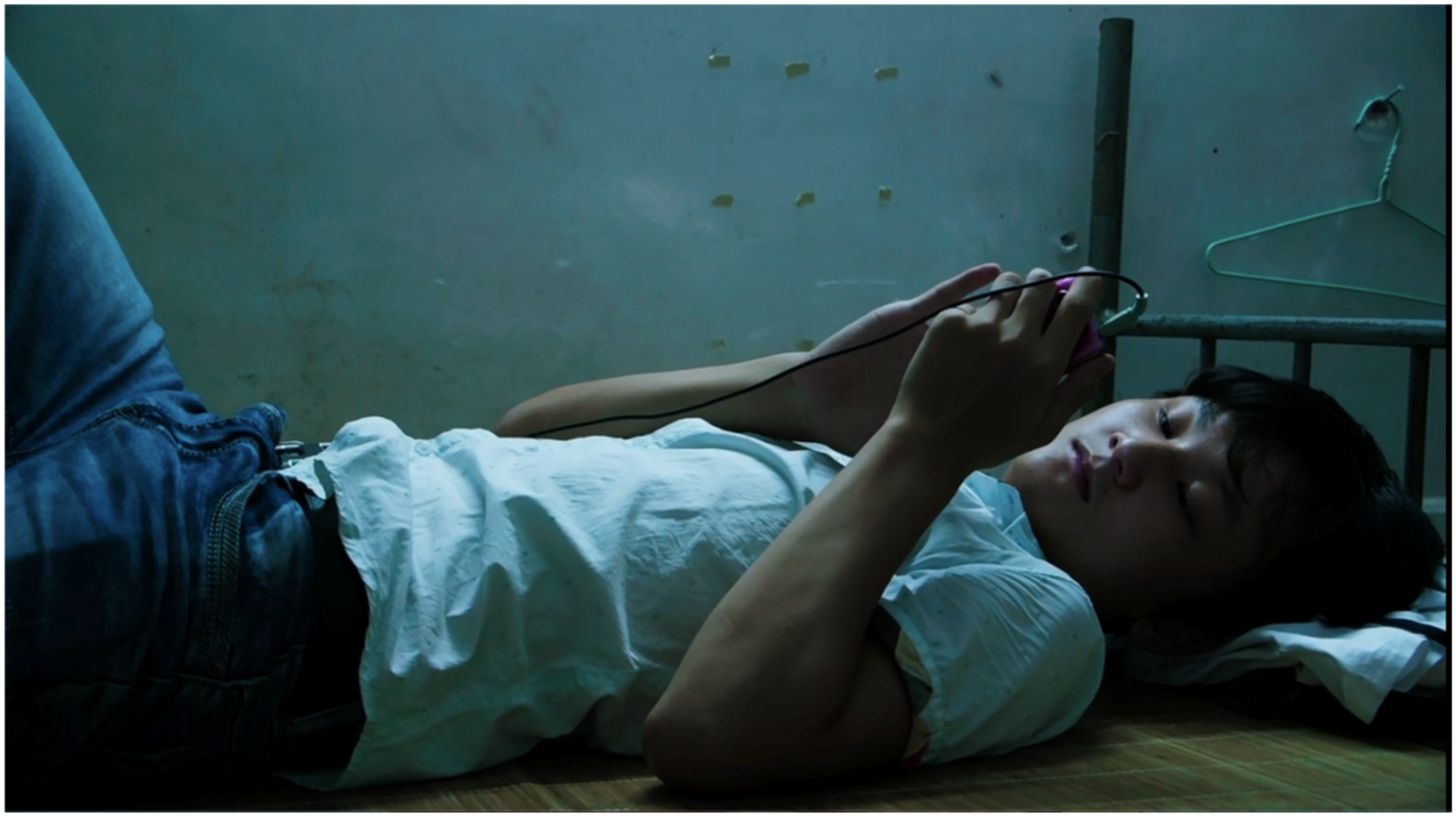
diaosi in the showroom. They are isolated, uneducated, and without hope for upward social mobility. The 18-year-old Yong, for instance, strikes the audience’s heart. He lost his father at age 3, and his mother subsequently remarried, leaving him with his grandparents in the countryside. Coming to the city to work at 14, he changes several poorly paid jobs throughout the film, making USD 200–400 a month, yet he spends a significant portion of his income on Big Li (
Figure 5). When Big Li laughs, he laughs; when Big Li cries, he cries. It is as if his own dream is tied to Big Li’s success. Holding the prosumer fantasy that they are creating something of their own, the fans experience intense satisfaction or disappointment from the YY showroom. When their time and energy are all consumed by heavy labor work and virtual interactions, there seems to be no prospect for meaningful political engagement, as they seem to “enjoy” the life they lead.
Similarly, the hosts, Big Li and Shen Man alike, face constant competition from other streamers. Their affective labor, measured by overtime engagement online and emotional investment in the audience, may or may not generate desirable results. They are no more than the libidinal machine easily replaceable on the platform.
This platform-mediated libidinal economy reminds one of French philosopher Bernard Stiegler’s critique of attention economy.
Stiegler (
2012) believes that attention-deficit disorders are the characteristic pathology of the new consumer culture. From browsing online constantly for new entertainment to short-term speculating in the financial market, fast-food cultural consumption and investment activities threaten with the loss of individuality and disintegration of community. This observation does not correspond seamlessly with the YY live-streaming, however, since fans seem to construct a stable online and sometimes offline community for their idols. The so-called stickiness of the platform, or the ability to retain users, is what platforms strive to maximize.
6 Nevertheless, Stiegler’s observation has some merit in that this kind of community is often loosely defined and carries no meaningful significance for individual growth. In addition, the fans do not share a common identity, either. As shown in the film, all the digital identities are marked with a monetary value. Whenever a gift is presented to the host, the buyer’s digital name lights up, while the wealthy patrons’ icons will be crowned with shining titles. The online social structure repeats power relations in real life, which perpetuates the capitalist hierarchy in a libidinal way.
Moreover, as
Q. Wang (
2020) points out, this kind of fandom circle is at most a simulacrum of a conventional community. On the one hand, there is an abstraction and flattening of the live streamer’s body, for what the fans attach to is her persona, not her real person. On the other hand, fans often create some particular language only comprehensible among themselves (such as puns or jokes called “geng” 梗), thus forming a semi-enclosed circle of communication. The micro-circles of entertainment thus replace the conventional communities imbued with collective significance. As a result, these circles, like communicative bubbles, constitute what Jean Baudrillard called simulacra of meaningful sociality. These bubbles blur the boundaries between public and private, between political and apolitical, between serious and non-serious, and between real and virtual. The formations of such social circles fail to generate solid ethical or political communities.
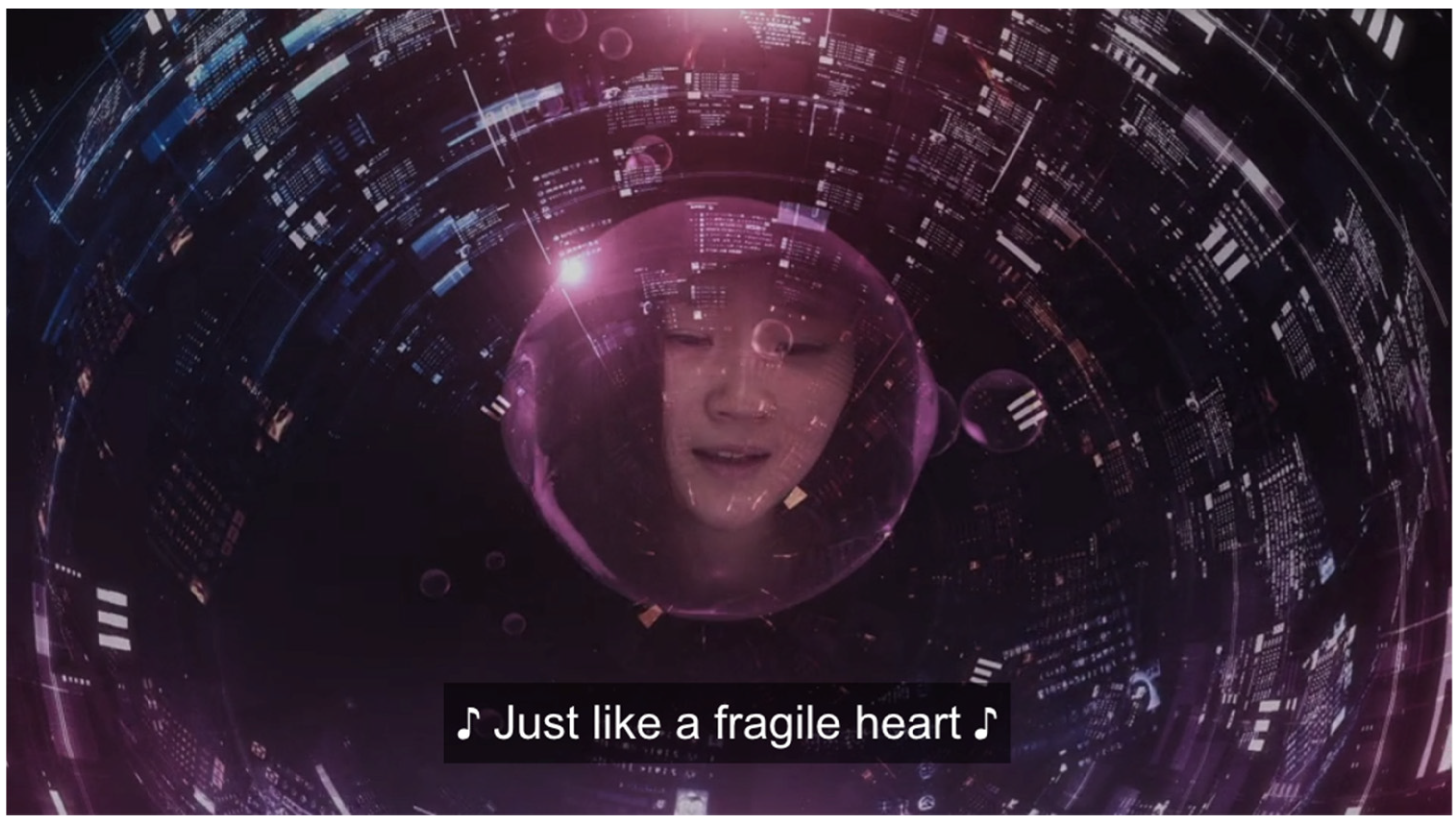
The metaphor of bubbles is literally presented at the end of the film when Shen Man’s image is placed in a transparent purple bubble, within a huge swirling ball that resembles a brightly lit city. The boundary of her bubble is liquid and changing, and her singing soon accompanies the rolling credits. Some of the lyrics read like this: “I should have known that bubbles burst on a gentle touch, just like a fragile heart.” The sequence concludes the film by suggesting the fragility of a YY showroom and the transience of an idol’s career (
Figure 6).
Loss of individuality and meaningful political engagement characterize the fans on the live-streaming platform as well as in other entertainment industries. But what distinguishes the Chinese fans from the others is their seemingly voluntary yet in effect coerced spending on the platforms. As director Hao Wu mentioned in a public screening, live-streaming in other countries usually profits through attracting viewing, not through direct monetary contribution from fans.
7 Wu speculates that this has to do with traditional Chinese pleasure quarter practice where customers lavish expensive presents on preferred courtesans in public to announce temporary ownership of their service.
The connection with a traditional practice of public display of power and money further exacerbates the prosumer fantasy and obscures the representation of labor. It prompts one to wonder why the Chinese government allows this type of entertainment and transactions. In the name of socialism with Chinese characteristics, the Chinese government still holds all the regulatory power over private businesses, not to mention the heavy censorship on the Internet. Any content that it deems sensitive, obscene, overly sexual, superstitious, or speculative with money will be censored online
8. Inasmuch as online content moderation creates consequences for public discourse, cultural production, and the fabric of society (
Gillespie 2018), it is surprising to see the thriving of entertainment live-streaming in China. Why does the Chinese government indulge this notorious display of capitalist exploitation and vulgar entertainment while critical discussions of social ills are censored? How may we understand the relationship between the corporations and the politics of the state?
Perhaps, one way to look at this question is through the notion of “tittytainment,” a term allegedly coined by American political scientist and presidential advisor Zbigniew Brzezinski that combines “tits” and “entertainment.” Some personal recollections indicate that Brzezinski proposed this term at a 1995 “The State of the World Forum” attended by some of the foremost world thinkers and leaders. Subsequently, the term appeared in a book by
Martin and Schumann (
1997, p. 29),
The Global Trap: Globalization and the Assault on Democracy and Prosperity. The authors reflect on the future of globalization by defining a possible “20/80 society”. In this possible society of the 21st century, 20 percent of the working-age population will be enough to keep the world economy going. The other 80 percent live on some form of welfare and are entertained with a concept called “tittytainment,” which aims at keeping the 80 percent of frustrated citizens happy with a mixture of predictable, easily comprehensible entertainment for the soul and nourishment for the body.
Although most Chinese citizens are far from living on social welfare, they are indeed fed by cheap and fast-changing online programs. Not only is live-streaming often labeled as “lowly” and “vulgar” (
Cheng 2022), but many other entertainment productions such as micro-net dramas (wei duan ju) are also frequently considered “toxic” (
Z. Zhao 2024). Online audiovisual media remains a powerful “time killer.” According to reports, in 2023 the average daily usage time per user for mobile audiovisual applications exceeded three hours.
9 The use of cell phones and participation in online entertainment have drained people’s time and energy, therefore perpetually locking them in the lower social strata. As one of Shen Man’s male fans says in the film, after a long day of hard work, his only pleasure is to watch Shen Man perform. Another female fan—also looks like a migrant worker—declares, “I don’t have any dream.” By providing tittytainment, the companies seem to offer a pacifier to the crying babies to comfort them, which contributes to social stability that the government values most. It is here where the capitalist and government desires converge. Encouraging fierce competition in visual sociality, the live-streaming platform deploys not only a technology of profit-making, but also a code of control. Disguised as a channel for upward mobility, live-streaming becomes no more than a tittytainment that prevents serious reflection on the precarious conditions of labor. While intellectuals in the West are concerned about media aggravation that could deepen the divisions within society, as the media tends to exaggerate newsworthy information to appeal to different social groups, in China, tittytainment has increasingly become the mainstream media production that numbs people’s minds.
In one sequence of the film, between beautifully lit high-rise buildings and busy streets, a giant screen on one building shows a girl live-streaming. The camera switches back and forth between the screen and self-absorbed people standing at the bus stop, on a bus, and subway. Everyone is occupied by his/her cell phone, while the girl’s seductively sweet voice sounds over their heads: “all live-streaming hosts are swindlers; some swindle your money; some are after your affection; some simply want your company. I hope we all remain oblivious, together living in these lies forever.”
5. Conclusions
In a time when video culture and live-streaming increasingly dominate people’s lives, where is the position of labor? When people spend an unprecedented amount of time on the screen, how to understand the interplay of emotional, libidinal, economic, and political forces in contemporary China? The success of some Internet celebrities and influencers in the thriving live-streaming business seems to offer new opportunities and possibilities for people in the platform economy. However, the documentary film
People’s Republic of Desire tells an alternative story. By revealing the mechanism of idol-making in the entertainment live-streaming platform, the film partially testifies to
Pierre Bourdieu’s (
1998) assertion that neoliberalism has successfully colonized all other discourses, including the psychological and the political, in its promotion of market logic. It is better to say “partially” because, in the Chinese context, neoliberalism has not colonized the political. In fact, as
Aiwa Ong (
2006) argues, neoliberalism has become a “technology of government,” by which the state can deploy market-driven calculations in the management of populations.
The collaboration of platform capitalism and political regulation underscores the ambivalent position of live-streaming and the precarity of labor in contemporary Chinese digital culture. The YY platform, by creating a visual regime of digital intimacy and prosumer fantasy, exploits the excess of desire, or libidinal intensity, to subsume the psychological, emotional, and affective into economic profit. The fans, although coming together for common interests, are in effect separated from the real person of the idol, only living in a simulacrum of a community. Their status as productive and affective labor is masked in the intense exchange of desire and money.
Meanwhile, the authoritarian government’s indulgence of such capitalist practice reminds one of tittytainment that is conducive to political stability. By censoring politically sensitive content in the cultural sphere and encouraging such libidinal-draining entertainment, the Chinese state helps platform capitalism thrive in the biggest domestic market in the world.
Although the film
People’s Republic of Desire was made before the COVID-19 pandemic, its exploration of the relationship that revolved around the live-streaming showroom remains valid, even more accurate in today’s China. In fact, it foreshadows the post-pandemic slowing down of the Chinese economy and the increasingly precarious position of labor. YY’s leading status in entertainment live-streaming has been surpassed by Douyin, Kuaishou, and other emerging platforms such as Weibo and Xiaohongshu (
Lei 2025), suggesting the fast-changing business landscape. But these other platforms all adopted similar mechanisms, including virtual gifting and annual competitions (
X. Wang 2020), to retain users. While the audience may recognize a few most successful
wanghong, the majority of streamers often struggle with visibility and earnings (
Guo et al. 2025). One report shows that as of 2024, the number of professional streamers (including e-commerce, e-sports, game, and entertainment streamers) has reached 38.8 million.
10 The sheer competition among streamers, embedded in the platform economy, exemplifies the culture of involution where intense investment of time, energy, and emotion does not necessarily generate a desirable result; on the contrary, the opportunities of success become fewer as the number of streamers grows exponentially (
Teng 2021).
Similarly, the workers in the audience face more challenging employment situations. An article published in 2020 reveals that Yong became an express delivery man after the film, whose schedule was tightly dictated by platform algorithms.
11 The fast delivery businesses in China are notorious for their fierce surveillance of delivery workers, subjecting them to intense levels of algorithmic pressure and tightly controlling their labor process. We do not know what has become of Yong ever since. But judging from his background, it is unlikely that he has escaped the precarious working condition. According to a report initiated by the International Labor Organization, unlike the steady decline in average working hours in many other countries, China’s average weekly working hours have been increasing year by year in the past few years (
Zeng et al. 2025). Moreover, there are workers who either have very short hours of work or very long hours of work in China. The proportions of both groups have been increasing in recent years. Researchers found that short hours of work are mainly driven by aggregate demand shortage during economic downturns, whereas competition in product markets, labor market monopsony, technological advancements, and declining labor supply contribute to long hours of work. The mismatch in working hours suggests poor employment quality that negatively influences the workers’ quality of life.
In this context, the entertainment live-streaming on YY foreshadows the deteriorating conditions of labor and increasing encroachment of capital into other spheres of everyday life. The collaboration between an authoritarian state and the technocratic companies effectively maximizes the libidinal economy and political economy of capitalism, speaking volumes about the exploitation of labor: disguised in self-making entrepreneurism and prosumer fantasy, the affective and manual labor together contribute to socialism with Chinese characteristics: People’s Republic of Desire.