1. Introduction
Natural gas is a crucial transitional energy in the global energy transition, accounting for 24% of primary energy consumption [
1]. By the end of 2025, the total length of global natural gas pipelines had reached approximately 1.49 million kilometers, and it is projected that China’s total natural gas pipeline length will exceed 163,000 km by 2025 [
2]. Since pipeline failure can easily lead to fires, explosions, and environmental pollution accidents, with the continuous expansion of pipeline networks, the safety of gas transmission pipelines has become a very important issue. After extensive data research and analysis, the Pipeline Research Council International (PRCI) concluded that pipeline failure factors mainly include nine categories, such as corrosion, third-party damage, and manufacturing defects, with corrosion considered a primary cause [
3]. Currently, there is extensive research on the development of corrosion defects, sealing performance, and mechanical properties of long-distance natural gas pipelines in service environments [
4]. However, under fatigue loading, corrosion pits can cause stress concentration, followed by rapid crack initiation from the pits, leading to a significant reduction in fatigue life. Studies have shown that corroded specimens can experience a 40% to 50% reduction in fatigue life [
5]. Sankaran et al. [
6] investigated the effect of pitting corrosion on the fatigue behavior of aluminum alloy 7075-T6 through simulation and experiments, finding that pitting corrosion reduced fatigue life by approximately 6 to 8 times. The alternating stress caused by pressure fluctuations generates a significant stress gradient concentration effect, thereby lowering the critical failure threshold [
7]. Therefore, for pipeline sections with existing corrosion defects, cyclic loading poses a significant threat to pipeline structural integrity.
After long-term development, pipelines constructed in different periods within natural gas networks often form multi-line systems with ring-branch composite topology, typically characterized by multiple gas sources and multiple users. The operation parameters of the network are not only time-varying but also need to consider various disturbance factors, such as dynamic allocation of gas source components, switching of transmission paths, and uneven gas demand from users. Especially in downstream pipeline sections with high user density, significant pressure fluctuations exist. Such periodic pressure load changes cause periodic reconstruction of the pipeline’s stress state, leading to cumulative material damage through high- and low-cycle fatigue mechanisms, ultimately causing pipeline integrity degradation [
8]. Many scholars have studied the fatigue characteristics of steel pipelines. Dakhel [
9] conducted high-cycle fatigue tests (100,000 cycles) on pipelines with welds of different grades and diameters, providing data for integrity assessment and remaining life calculation in pipeline integrity management systems. M.A. Khan simulated a seawater environment in the laboratory [
10] and, based on cyclic tests per ASTM G466, determined the fatigue life of X65 steel pipelines subjected to internal vibration loads in a seawater environment. Furthermore, numerous research institutions and scholars [
11,
12,
13] have conducted full-scale fatigue tests. Although high-cycle fatigue tests hold indispensable value in engineering validation, they are costly, time-consuming, and operationally complex, especially full-scale fatigue testing [
14]. The phase-field model (PFM) has shown great potential in handling fracture problems [
15], with a wide range of applications including dynamic fracture [
16,
17,
18], ductile fracture [
19,
20,
21], and micro-mechanisms [
22,
23,
24]. With the incorporation of fatigue effects, PFM is increasingly used to simulate fatigue crack propagation [
25,
26]. Jianxing Yu [
27] proposed a framework based on the phase-field method to simulate fatigue crack propagation in X70 pipelines with girth welds and conducted full-scale pipeline fatigue tests using the resonant bending fatigue method. However, due to the need for fine spatial resolution and the non-convexity of the governing equations [
28], the phase-field model is computationally demanding when performing cycle-by-cycle fatigue calculations, especially for high-cycle fatigue [
29]. In contrast, finite element fatigue simulation provides a more efficient and cost-effective method for simulating fatigue behavior under different conditions [
30]. Bagni [
31] employed finite element modeling to recover relevant stresses, which were then used as input for a stress-life (S-N) based analysis engine to estimate the fatigue life of the analyzed structure (a hybrid bonded joint in their study). Miao [
32] established a finite element model (FEM) for steel wires with corrosion pits and analyzed the S-N curves of wires with different pit diameters and stress ratios, quantifying the effects of pit depth, width, location, and stress amplitude on the fatigue life of steel wires. Wenhao Gong [
33] established a finite element model of a small branch socket weld with surface defects, investigated the stress distribution in such weld structures with varying defect depths and deviation angles, and determined the vibration fatigue characteristics of small branch socket weld structures with different surface defects. Their research highlights the advantages of the finite element method: relatively low cost, sufficiently accurate results for engineering application, and visualization of fatigue weak points.
In finite element analysis, it is crucial to accurately model or reasonably simplify corrosion defects, as this impacts the accuracy of life calculation results. Simplifying corrosion defects into rectangular shapes is a common practice [
34,
35,
36]. The aforementioned simplification has yielded favorable results in terms of burst pressure, indicating that rectangular simplification can effectively estimate the maximum stress of defective pipelines under various pressures. However, these studies did not address material fatigue analysis. Mokhtari [
37] demonstrated in the literature that idealizing pit-shaped morphologies (including semi-ellipsoidal and cuboidal forms) tends to underestimate the stress concentration factor (SCF). Consequently, it is inferred that the fatigue life of pitting corrosion in pipelines under sustained cyclic loading may be overestimated. He simulated the SCF calculation results for three defect simplification methods and pointed out that the SCF values obtained through semi-ellipsoidal and cuboidal simplifications differ significantly from those derived from actual defect modeling. However, the SCF merely reflects the ratio of maximum local stress σ
max to nominal stress σ
n, and its magnitude cannot be directly equated to the length of fatigue life. Currently, research on fatigue life simulation remains insufficient in the academic community.
In research on fatigue damage accumulation models, many new models are proposed annually, yet their general applicability is often difficult to judge. Hectors’ review [
38] pointed out that although many nonlinear damage models can achieve satisfactory results under specific experimental conditions, Miner’s rule remains the most widely used method in fatigue design under variable amplitude loading. Therefore, this paper will also adopt Miner’s rule for subsequent analysis.
In summary, research on pipeline fatigue life has established a relatively mature and widely validated methodological system, but the following shortcomings remain. Firstly, existing studies are mostly based on idealized cyclic loads, often employing assumed, regular, constant-amplitude stress variations, without fully accounting for actual operational pressure fluctuation behavior. Secondly, these studies primarily focus on the weld regions of pipelines, whereas research on fatigue failure at corrosion defects is relatively limited, and the understanding of the life evolution patterns under different defect sizes remains insufficient. Thirdly, although simplifying complex defects as rectangular pits introduces significant deviations in SCF calculations, its impact on fatigue life is still unclear. Therefore, based on the finite element method, this study parametrically characterizes the geometric features of corrosion defects and establishes a long-distance natural gas pipeline model incorporating various pipeline specifications and corrosion defect sizes. Using a set of field-collected actual pressure fluctuation data, the fatigue life of pipelines with different defect sizes is predicted. Based on data from the literature, the impact of defect simplification methods on the accuracy of fatigue life calculations is compared and inferred, indirectly verifying the correctness of the modeling in this study.
The impact of pressure fluctuations on fatigue life is quantitatively analyzed, and corresponding fatigue life calculation formulas are fitted. This study systematically integrates actual random pressure fluctuation load spectra with simplified parametric corrosion defect geometric models, quantifies the interaction between fluctuating pressure and defect characteristics, and subsequently establishes a preliminary empirical fatigue life correlation formula that comprehensively considers pipeline specifications, material properties, and defect parameters. This research further extends the field of residual strength study for long-distance pipelines, providing new research perspectives beyond burst pressure, weld fatigue, and strength analysis of defects under single-cycle loading. Additionally, the effectiveness analysis of three simplified methods for corrosion defects is supplemented, offering a theoretical reference for preventing pipeline fatigue failure and enhancing pipeline operational reliability.
2. Methods and Materials
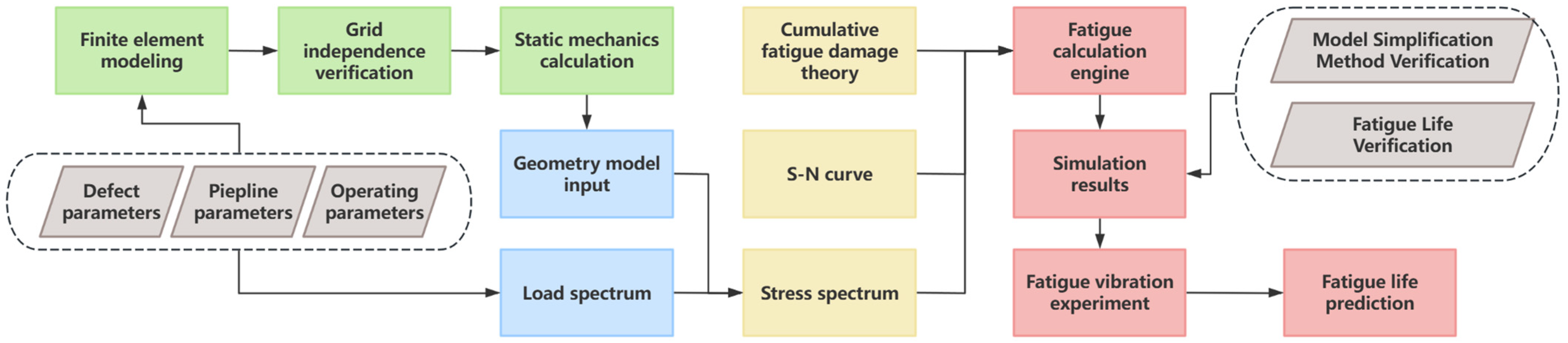
The methodology of this study includes material fatigue life calculation, construction of Pipeline Load Spectrum, finite element modeling of pipelines under pressure fluctuations, and predicting fatigue life under pressure using polynomial fitting [
39,
40]. The entire procedure is illustrated in
Figure 1.
This study on fatigue life encompasses five fundamental aspects: First, data collection and on-site measurements of long-distance pipelines are conducted to obtain information such as pipe diameter, wall thickness, size characteristics of corrosion defects, and operational pressure fluctuations. Next, the value range for finite element simulation is determined based on pipeline and defect parameters, and the load spectrum is established by analyzing pressure fluctuations in the pipeline [
41]. Then, a static analysis based on the finite element method is performed to derive the stress distribution under constant pressure, resulting in the stress spectrum. Subsequently, within the fatigue failure calculation engine, the fatigue life of pipelines with various specifications, materials, and defect characteristics is determined using cumulative fatigue damage theory, S-N curves, and the stress spectrum. The results are then validated and corrected by comparing them with literature data and verifying the defect simplification method. Finally, the calculated results are consolidated, and a formula for calculating the fatigue life of long-distance pipelines is derived via polynomial fitting. The commercial software packages employed in this study include Ansys 2023 R1 (encompassing SpaceClaim and nCode DesignLife modules) and Matlab 2024b.
2.1. Finite Element Model
2.1.1. Model Assumption
The actual operating environment of long-distance natural gas pipelines is complex, and the following assumptions can be made when evaluating their fatigue life [
42]:
- (1)
The study focuses on an independent straight section of a long-distance natural gas pipeline. The wall thickness is constant, and the material properties are uniform. The inner surface contains a single rectangular volumetric corrosion defect, while the outer surface is smooth and defect-free;
- (2)
The effects of the pipe’s self-weight, ground load, and transported medium are neglected. This is because, for long-distance pipelines, the weight of the pipe and the anti-corrosion coating is very small compared to the internal pressure. Additionally, due to the terrain and the pipeline’s installation method, deformation and buckling stress caused by the pipe’s self-weight can be disregarded. As the burial depth of the pipeline increases, the impact of surface pressure on the pipeline diminishes;
- (3)
Only the internal gas pressure is considered as the external load on the pipeline. This is because fatigue failure in pipelines is primarily induced by fluctuations in gas pressure, and the influence of self-weight and temperature loads is relatively small compared to internal pressure, thus not significantly altering the predicted fatigue life.
- (4)
The corrosion defect is projected and simplified as a rectangle. Such rectangular simplification is a common practice. This study aims to conduct a parametric trend analysis to investigate the relative importance and macroscopic influence of different defect geometric parameters (depth, length and width) on the overall fatigue life of pipelines under random pressure fluctuations. Adopting a standardized rectangular defect model facilitates extensive modeling and is easily understood by field engineers, enabling systematic and isolated examination of individual parameters and supporting the development of preliminary empirical correlations. However, this simplification has limitations, which will be discussed in detail in
Section 3.1. Model Validation.
- (5)
The pressure fluctuation data used in this paper were collected from central and eastern regions of China, where seasonal temperature extremes are absent and the underground environment is relatively stable compared to the surface. Compared to the stress amplitude caused by internal pressure fluctuations, the thermal stress amplitude induced by diurnal and seasonal temperature variations is generally smaller and occurs at lower frequencies (annual/daily cycles), thus contributing relatively little to high-cycle fatigue damage accumulation. For the high-pressure, large-diameter natural gas transmission pipelines studied here, the primary driver of high-cycle fatigue failure is the frequent and significant internal pressure fluctuations resulting from gas load balancing and uneven user consumption during transportation.
- (6)
In fatigue life assessment, it is assumed that the geometric dimensions of corrosion defects remain unchanged. This study aims to quantify the coupled effects of existing defects of specific sizes and random pressure fluctuations on fatigue life, and to establish an “instantaneous” risk assessment method. Within the typical inspection and maintenance cycle (3–5 years) of pipeline integrity management, significant growth in defect size usually requires a longer time scale, unless the pipeline is in an abnormally active corrosion environment. Treating the defect size as a fixed value provides a conservative and actionable basis for safety assessment within this time window. This is also a common practice in many engineering standards (such as ASME B31G, DNV-RP-F101) for assessing the load-bearing capacity of existing defects. The growth kinetics of corrosion and the accumulation of fatigue damage belong to different physical processes and time scales. In this study, the defect size is taken as an input parameter, with a focus on the latter. This helps to clearly reveal the independent mechanisms of pressure fluctuations and defect geometric parameters.
2.1.2. Pipeline and Corrosion Defect Dimensions
The outer diameters of the injection-molded pipelines are 1016 mm, 1219 mm, and 1422 mm, with wall thicknesses ranging from 18.2 mm to 26.4 mm, as listed in
Table 1.
Corrosion pits predominantly exhibit a planar morphology. The specific mechanism is as follows: Pitting initiates at defects in the passive film, forming tiny corrosion pits. Some of these pits cease growing due to repassivation, resulting in small open pits, while others surpass a critical size. Corrosion products then cover the pit openings, creating occluded regions. Within these occluded regions, an autocatalytic acidification process occurs, characterized by the accumulation of H
+ and the migration of Cl
−, which drives corrosion deeper. Simultaneously, the edges of the pit openings outside the occluded regions undergo active dissolution under the influence of factors such as medium erosion and concentration cells. The covering and rupture of corrosion products intensify material exchange, accelerating metal dissolution around the pit openings and leading to their lateral expansion (increase in length and width). As the rate of depth development slows relatively, lateral expansion becomes dominant. Consequently, the morphology of corrosion pits evolves from deep and narrow to wide and shallow open-type pits, with corrosion depths tending to become uniform within the same area [
43,
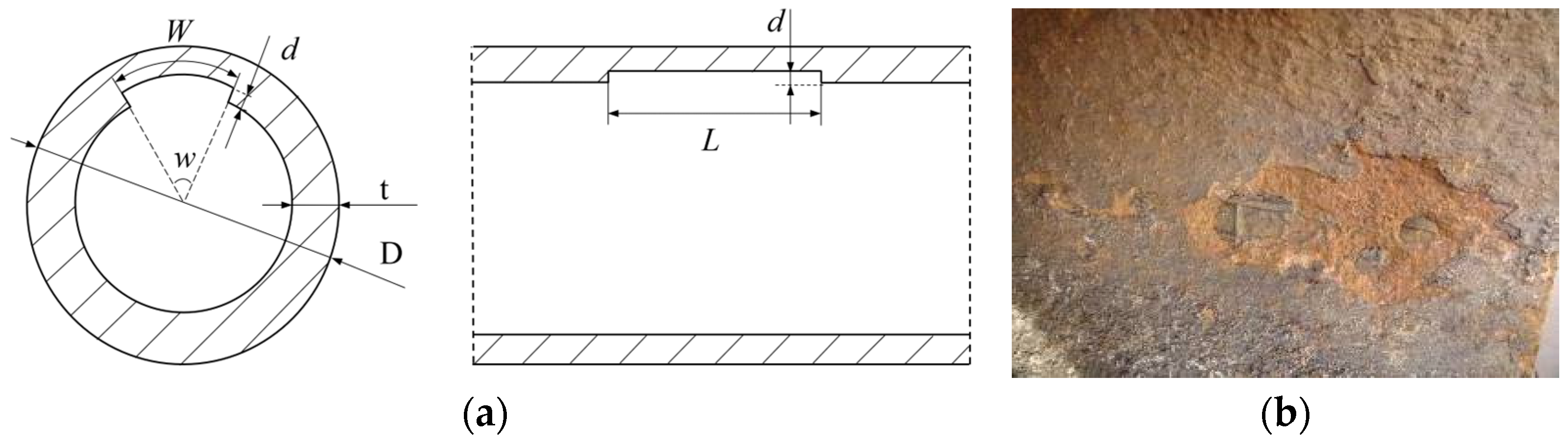
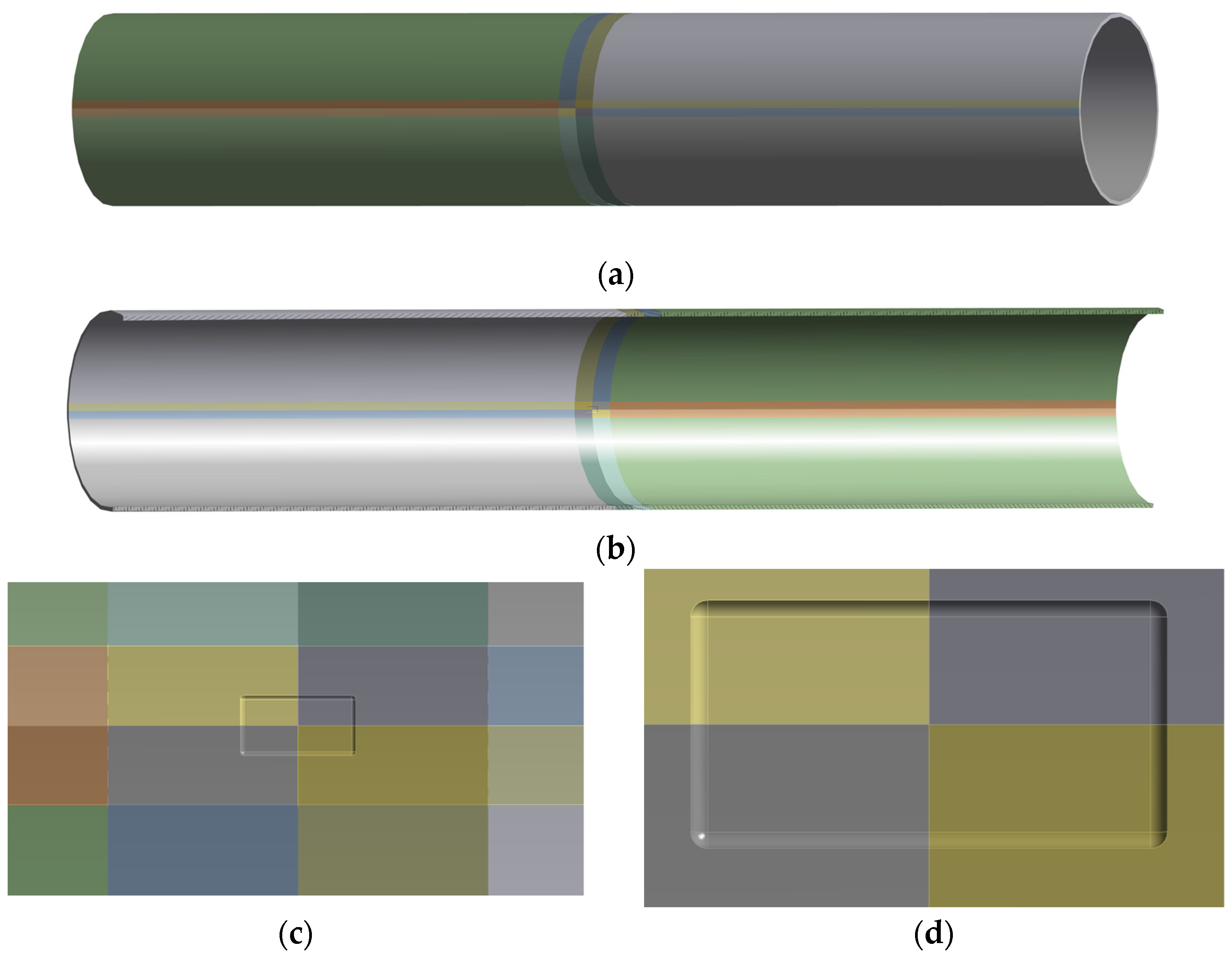
44]. For ease of calculation, the pits are simplified as square defects in three-dimensional modeling. The geometric description of the model is shown in
Figure 2a.
It should be noted that during finite element modeling, all four bottom edges of the defect, as well as the four corners of the rectangular defect, were treated with a filet radius equal to the depth of the defect. In practice, corrosion defects typically transition smoothly into the inner pipe wall, as shown in
Figure 2b. This filet treatment helps prevent excessive stress concentration at abrupt geometric discontinuities, which would otherwise lead to an unrealistically low fatigue life prediction.
To facilitate parallel comparison, a unified metric system was established to characterize the size of internal pipeline defects. When determining the characteristics of corrosion defects, the corrosion defect depth coefficient
k1, corrosion defect length coefficient
k2, and corrosion defect width coefficient
k3 are employed. The definitions of these three parameters are as follows (Equation (1)):
In this study, the dimensions of internal corrosion defects were determined based on in-line inspection data from a section of the Sichuan–East Gas Pipeline, a representative long-distance natural gas pipeline project in China. The pipeline section under consideration uses X70 steel pipe with a diameter of 1016 mm, a wall thickness of 21 mm, and a design pressure of 10 MPa. Among the 555 corrosion defects identified during inspection, the lengths ranged from 8 mm to 247 mm, widths from 10 mm to 305 mm, and depths from 1% to 13% of the wall thickness. After refining the data range and removing outliers, the distribution characteristics of defect depth, length, and width were quantified. The specific defect dimensions adopted in this study are summarized in
Table 2.
2.1.3. Finite Element Method
This paper utilizes the SpaceClaim module for modeling. The geometric model of the pipeline is shown in
Figure 3. Within the Ansys Workbench environment, the SOLID186 higher-order 3D 20-node hexahedral element—suitable for structural analysis and featuring a quadratic displacement pattern—is adopted to accurately capture stress gradients [
45,
46]. The dimensions and boundary conditions of the finite element model are carefully defined to ensure simulation accuracy while maintaining computational efficiency. In accordance with Saint-Venant’s principle, a pipe segment length of six times the outer diameter (6D) is utilized, a practice widely accepted in pipeline stress-analysis applications. This established approach ensures that the local stress concentration near corrosion defects is not influenced by the specific constraints applied at the remote ends. Additionally, frictionless supports are applied at both ends of the model, which restrain radial and circumferential displacements while permitting free axial movement. These conditions effectively simulate the behavior of a continuously supported long-distance pipeline by allowing axial strain due to the Poisson effect under internal pressure, thereby avoiding unrealistic axial stresses that would arise from fully fixed ends. In the analysis settings, the Weak Springs option is set to program-controlled, which employs adaptive stiffness coefficients to balance the suppression of rigid-body displacement against the fidelity of the stress field.
2.1.4. Model Meshing
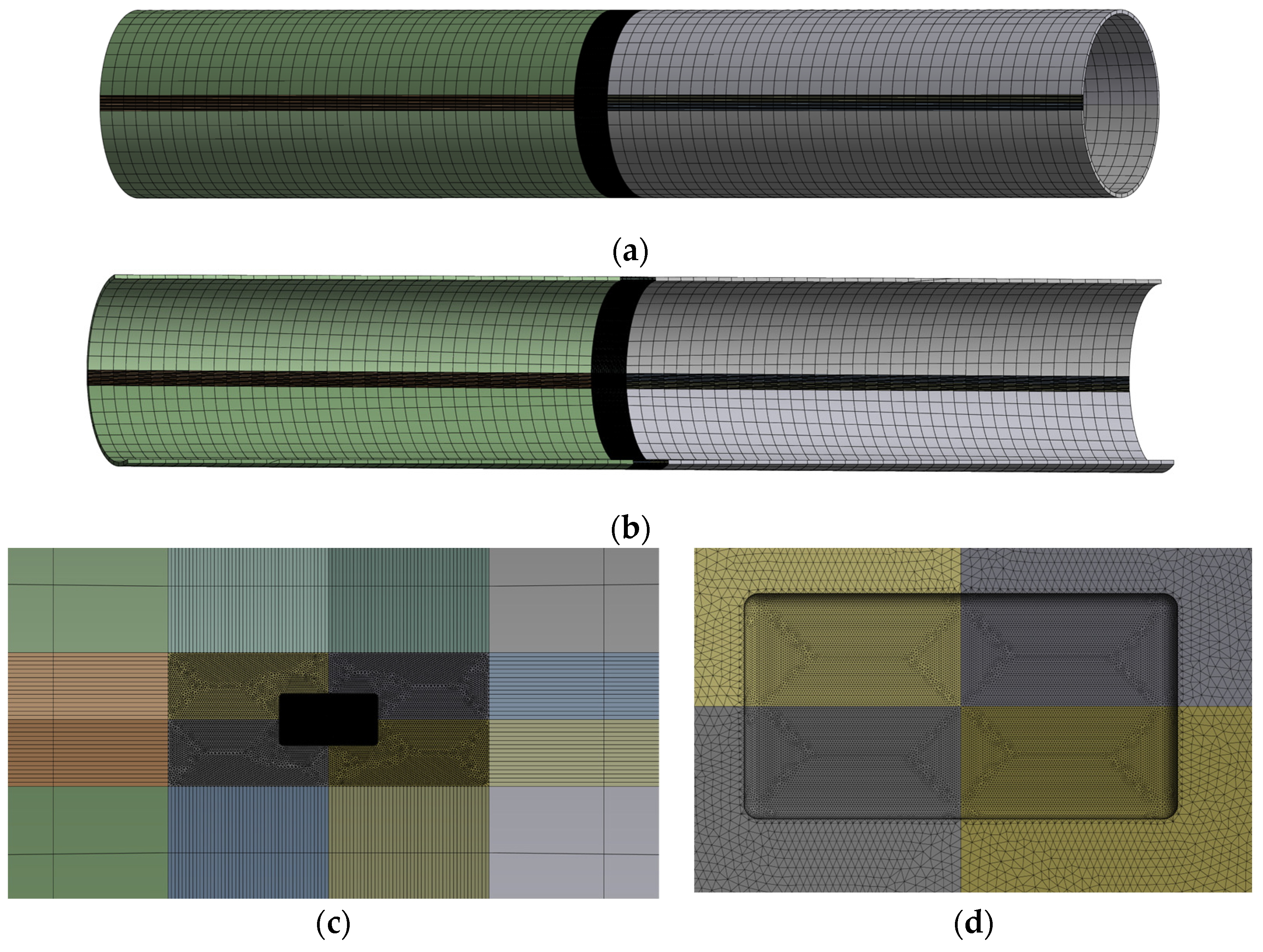
As the pipeline is an axisymmetric structure, hexahedral meshing with favorable numerical stability and convergence is adopted [
47,
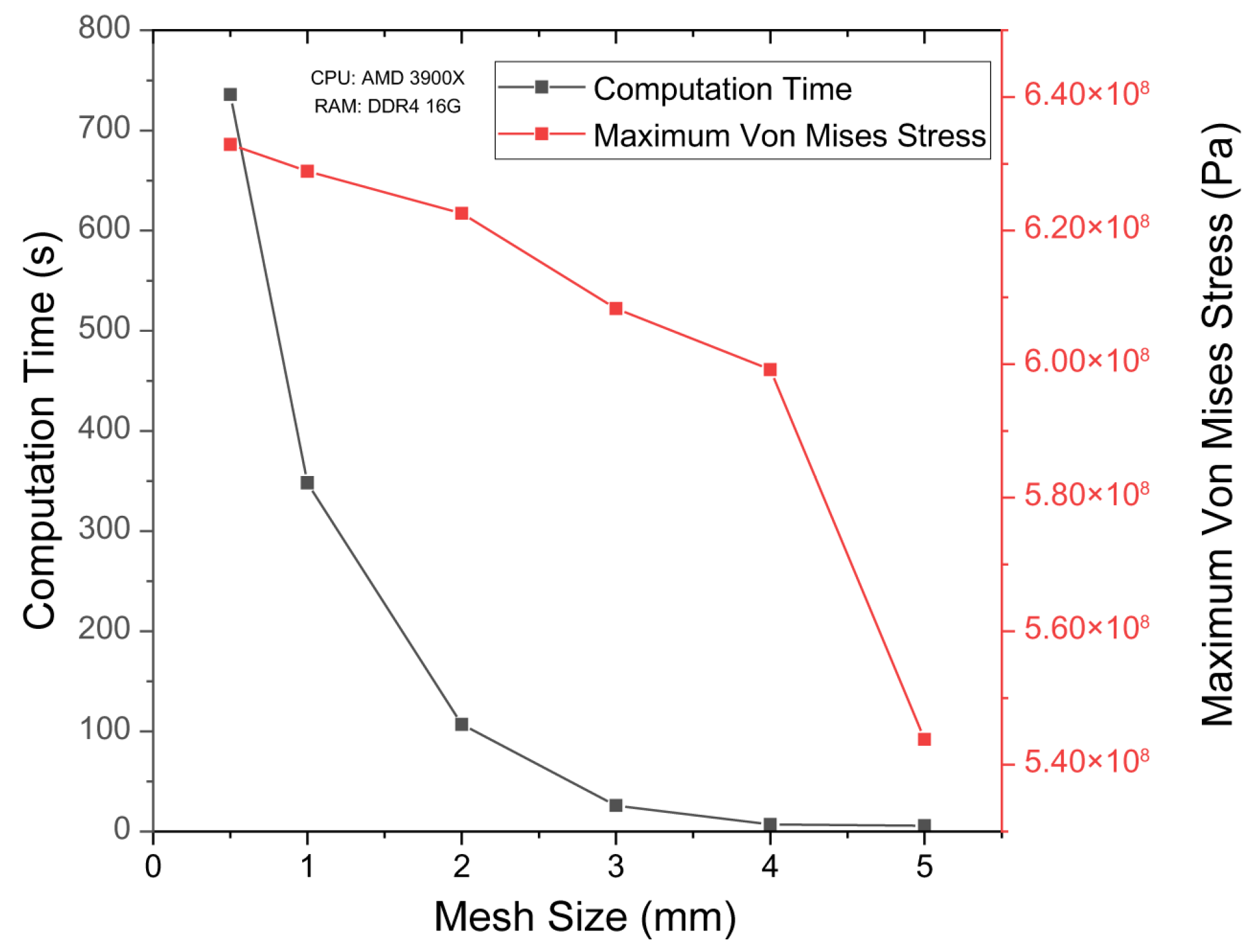
48]. To ensure the simulation results are independent of mesh size, a mesh independence study was conducted with defect region mesh sizes ranging from 5 mm to 0.5 mm. The mesh independence test results are shown in
Figure 4. The maximum von Mises stress under an internal pressure of 10 MPa and the computation time were used as evaluation criteria.
The results indicate that for mesh sizes between 3 mm and 0.5 mm, the error already falls below 3%, which is within an acceptable range. Within this range, the curve slope is steeper for mesh sizes of 3 mm to 2 mm than for 2 mm to 0.5 mm. Regarding computation time, the slope of the curve increases sharply as the mesh size decreases. Among the four tested mesh sizes—3 mm, 2 mm, 1 mm, and 0.5 mm—the computation times for 1 mm (348 s) and 0.5 mm (736 s) are significantly longer, being 13.4 times and 28.3 times longer, respectively, than that for 3 mm (26 s). Considering simulation accuracy, mesh quantity, and computation time, a mesh size of 2 mm (107 s) was selected. Under these test conditions, the final mesh consists of 192,576 nodes and 93,600 elements. The meshed pipeline model is shown in
Figure 5.
2.2. Material Properties
The long-distance natural gas pipeline simulated in this paper includes two materials: X70 and X80. The mechanical properties of these two pipeline steels at room temperature are detailed in
Table 3. The data for X70 steel are derived from the internal inspection report mentioned above, while the data for X80 steel are based on the mid-range values provided by API 5L [
49] and have been compared with the data in the literature [
50].
The fluctuation in pipeline pressure is characterized by small amplitude and high frequency, which indicates that the fatigue damage sustained by the pipeline is primarily high-cycle fatigue. High-cycle fatigue (HCF) is typically described and quantified using the S-N curve. The S-N curve illustrates the relationship between the constant stress amplitude (S) applied to a material or structure and the number of cycles (N) it undergoes until failure. This curve visually demonstrates the extent of “consumption” caused by a complete cycle on the pipeline at a given stress amplitude. A smaller number of cycles (N) indicates a more destructive effect of that stress amplitude.
Literatures [
51,
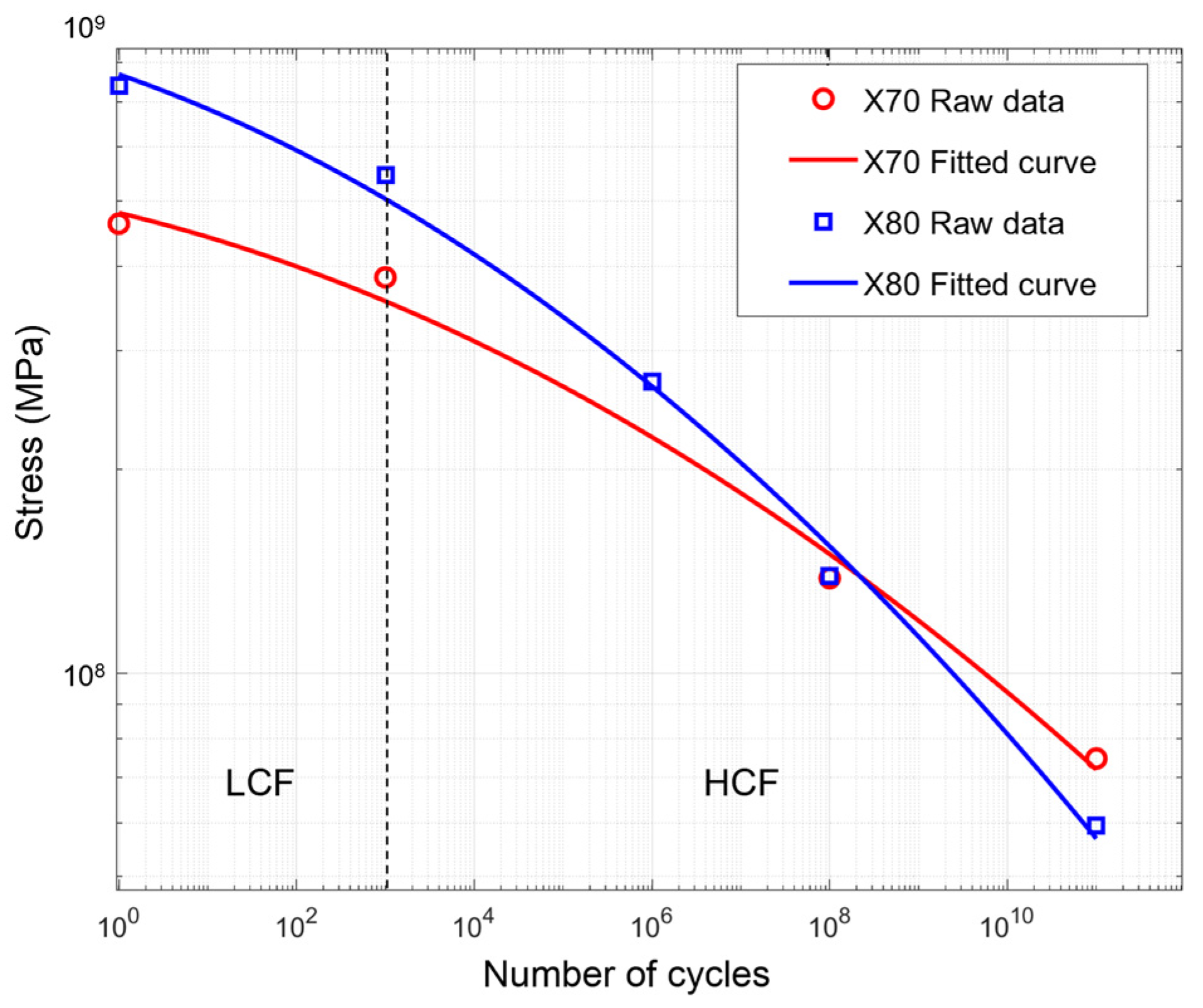
52] indicates that in nCode, “BS4360 Grade 40B” can be used for simulation because when simulating the fatigue behavior of X70 steel, using this built-in material data of nCode yields results that reasonably align with practical engineering experience. Moreover, the data for yield strength and tensile strength are relatively close (Yield Strength is around 400 MPa, Tensile Strength ranges from 340 to 500 MPa), thus allowing for the derivation of an approximate S-N curve. The S-N curve of this material is shown in
Figure 6, fitted using the software’s built-in fitting method. For the S-N curve of X80, this study adopts the fatigue characteristic calculation method provided by the Chinese standard [
53,
54]. For X80 steel with a tensile strength of 739 MPa, the reference data points for “unalloyed and low-alloy steels not exceeding 370 °C” were selected for interpolation calculations. After interpolation processing, standardized fatigue characteristic parameters were obtained. Using data fitting methods, the S-N curve for X80 was established, as shown in
Figure 6 as well. The stress ratio corresponding to the S-N curves is R = −1. The software integrates a small-cycle correction function based on the BS7608 standard [
55]: The dividing line in the S-N curve is used to distinguish between high-cycle and low-cycle fatigue. When the maximum stress cycle number is below the life corresponding to 10
3 in the S-N curve, it is defaulted as structural failure. Here, LCF denotes Low-cycle fatigue. During simulation, the software only calculates the HCF portion, and results falling within the LCF range will be displayed as “static failure”.
According to the data distribution, a power function was used for data fitting. The model is shown in Equation (2):
After taking logarithms, linear regression was used to fit the relationship between log(x) and log(y). The calculation yielded a = 7.63 × 10⁸, b = −0.0925, with an R2 value of approximately 0.885. According to the figure, the power-law model captures the general trend of the data and explains most of its variation. Given the inherent scatter in the data, the obtained error is considered acceptable. Due to the lack of publicly available high-cycle fatigue test data for X80 steel pipe base material, the current fitted curve is an estimate derived from the standards. It provides a useful reference for this study; however, for actual engineering applications, it is recommended to prioritize test data obtained from the specific pipe material and manufacturing process.
The S-N curve of X80 steel lies above that of X70 steel up to 108 cycles, indicating that X80 steel exhibits superior fatigue performance throughout the medium-to-high fatigue life range. In the high-life region, the two curves intersect, suggesting that under typical long-term cyclic loading in pipeline operations, the fatigue advantage of X80 steel becomes less pronounced or even inferior to that of X70.
2.3. Random Pressure Fluctuation
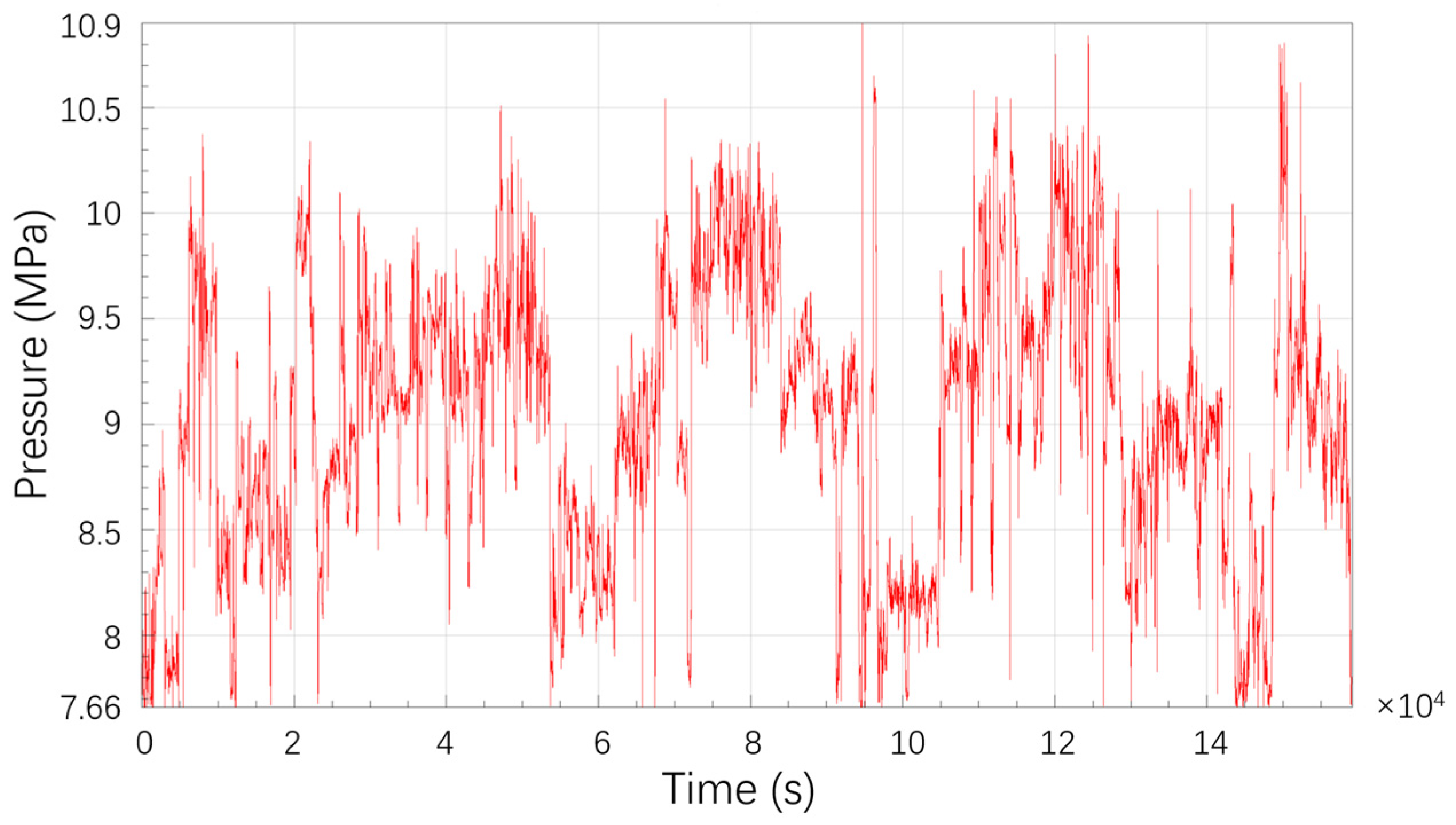
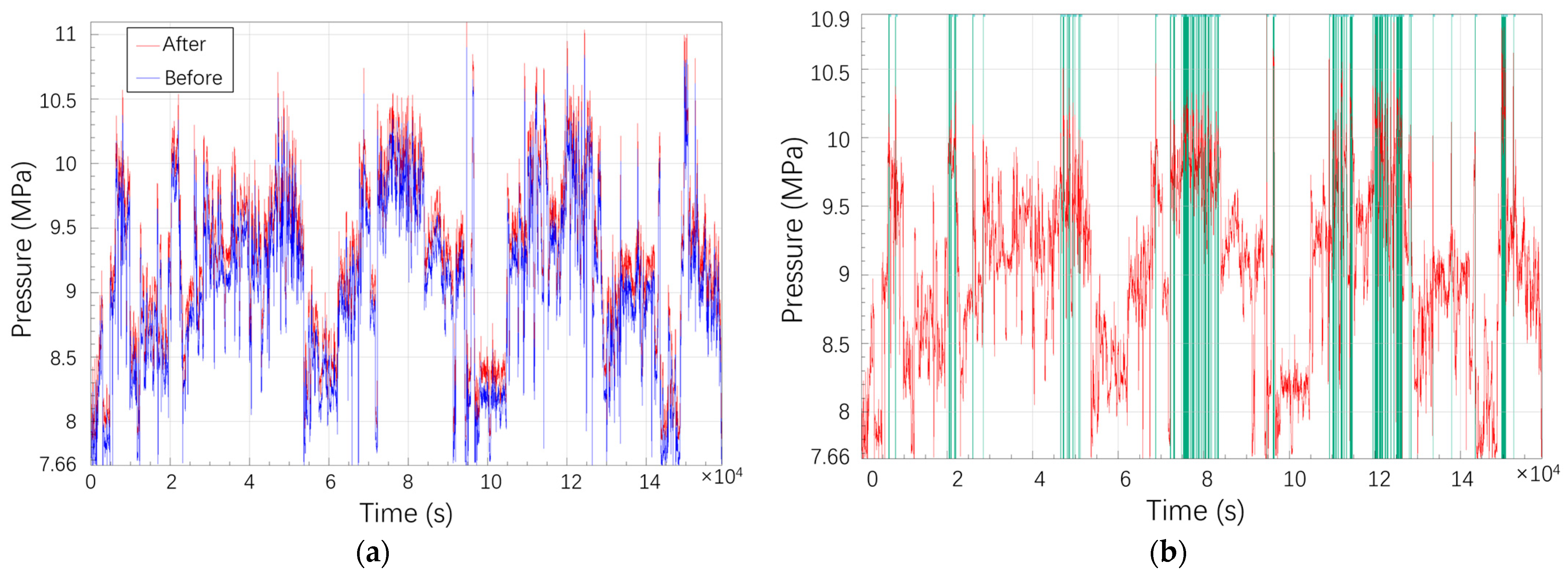
This study selects one year of pressure data from a section of the Sichuan-East Gas Pipeline, with a sampling frequency of 1 Hz. The data, recorded at 1 Hz over 365 days, were averaged per second, with two-day intervals used as time history units, as shown in
Figure 7. This data represents the averaged results, which smooth out random noise, highlight the main fluctuation trends, and make subsequent fatigue calculations more efficient, although occasional rapid pressure transient peaks may have been smoothed out. This approach is mainly because this study focuses on establishing a methodological framework, for which the data provides an engineering-representative load spectrum input.
Based on the failure mechanism of defective pipelines, the failure of defective pipelines under internal pressure is primarily determined by the hoop stress at the defect. Under internal pressure, the hoop stress experienced by the pipeline can be calculated using Equation (3) (Barlow’s formula):
where σ is the hoop stress experienced by the pipeline under internal pressure, MPa; P
r is the internal pressure of the pipeline, MPa; D is the nominal outer diameter of the pipeline, mm; t is the nominal wall thickness of the pipeline, mm.
The maximum stress exhibits a linear relationship with the pipeline design pressure. Therefore, it can be concluded that the fluctuation of pipeline stress load matches the variation in pipeline design pressure, and the time history of the internal pressure in the pipeline can be equivalently used as the load spectrum.
Since changes in the distribution, range, or frequency of the data may cause the statistical characteristics of the data to vary over time, the original pressure fluctuation data underwent zero-drift removal processing in the time history to ensure data accuracy and reliability. The final result after zero-drift removal is shown in
Figure 8a. Subsequently, to eliminate high-frequency noise or abnormal fluctuations in the signal, the drift-removed data were further subjected to deburring. These burrs may be caused by sensor errors, environmental interference, or system failures and could obscure the true load information. The final result after spike removal is shown in
Figure 8b. Both the zero-drift removal and deburring methods are built-in functions of the software, with the relevant parameters set to their default values.
According to this load spectrum, the highest fluctuating internal pressure for pipelines with a design pressure of 12 MPa is 10.9 MPa, and the lowest is 7.66 MPa. For pipelines with a design pressure of 10 MPa, the highest fluctuating internal pressure is 9.1 MPa, and the lowest is 6.4 MPa. The stress ratio for both types of loads is R = 0.7.
2.4. Fatigue Life Prediction Methods
Evaluating the fatigue life of structures subjected to vibration loads requires an analysis of damage accumulation. This study employs Miner’s linear damage accumulation theory [
56] to quantify the fatigue damage of pipelines under random loads, as detailed in Equation (4) [
57]:
In the above equation, S represents the cumulative fatigue damage, F denotes the stress amplitude, v is the average frequency of the random vibration load, and T indicates the operational service time of the pipeline. The function p(F) is the probability density function (PDF) of the structural stress response. Meanwhile, S(F) represents the fatigue life under stress amplitude F, a relationship typically defined by the S-N curve.
The S-N curve mentioned previously corresponds to R = −1, but in this study, the load under random pressure fluctuations is not symmetric cyclic, with R = 0.7. During simulation, the software performs correction through the built-in Goodman mean stress correction method [
42]. This method is a linear correction and tends to yield conservative life predictions under tensile mean stress. It serves as a safe choice for general metallic materials, especially when specific material data are lacking [
58,
59].
The fundamental assumption of Miner’s theory is that fatigue damage can be linearly accumulated across different stress cycles, independent of the sequence of load application. To apply this theory, the random load history must first be processed using the rainflow counting method [
60,
61,
62]. This method decomposes the complex stress-time history into a series of stress cycles, thereby transforming continuous random vibrations into calculable cyclic data. Each identified stress cycle, with its amplitude, can be correlated with the constant stress amplitude in the S-N curve to calculate the resulting damage.
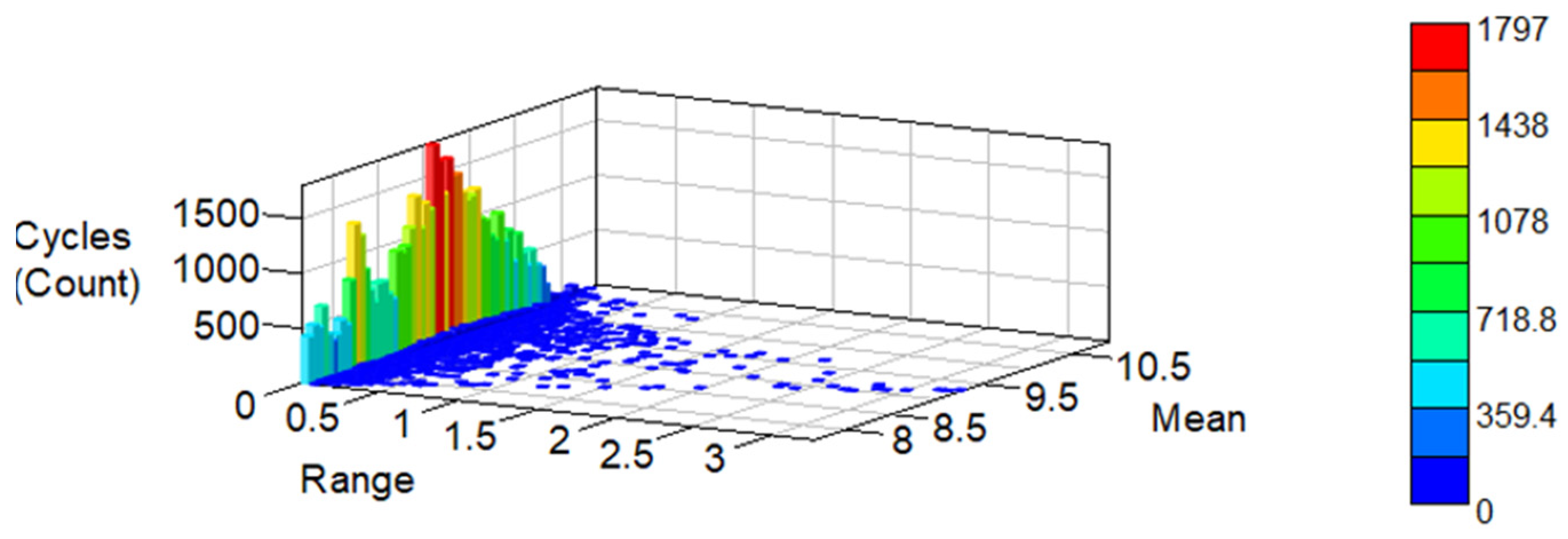
Figure 9 presents the statistical results obtained by applying the rainflow counting method to pipeline pressure fluctuation data in this study, visually illustrating the distribution of stress amplitude cycles. During simulation, the software utilizes these results, combined with Miner’s theory, to calculate the fatigue damage and fatigue life at various locations of the pipeline.
Corrosion defects within pipelines are discontinuities, so pipelines with defects can also be considered as notched components, making it essential to accurately understand the influence of notch features on fatigue strength. Traditional notch fatigue analysis methods are often based on fatigue test data from typical notched specimens. These empirical formulas often exhibit significant errors when applied to fatigue life prediction and struggle to meet the needs of modern structural integrity assessment for critical components [
63]. The nominal stress method (NSM) [
64] fails to consider the influence of notch stress distribution, leading to a reliance on extensive fatigue performance data during prediction; furthermore, the damage parameters used can hardly reflect the crack damage mechanism, resulting in large prediction errors under non-proportional loading conditions [
65]. Determining the critical distance in the critical distance method (CDM) [
66] is challenging. The local stress–strain method (LSSM) [
67] ignores the influence of stress gradients near the notch on fatigue life, often leading to conservative predictions. To improve the conservatism of LSSM predictions, many scholars have applied the stress gradient method (SGM) to notch analysis. Experiments show that the stress gradient can, to some extent, characterize the notch effect of components under multiaxial loading [
68]. Therefore, to ensure the accuracy of finite element simulation, this study will employ the stress gradient method for analysis, maintaining the activation of the Stress Gradients switch in nCode. In nCode, the stress gradient method is based on Haibach’s FKM guideline [
69]. The FKM method describes an approach in which the fatigue strength of a material is increased by a factor based on the surface normal stress gradient and the strength and type of the material. According to recent studies [
70,
71,
72], for fatigue notch effects, the FKM method can provide relatively accurate predictions when the modeling is reasonable and the analysis is conducted appropriately.
3. Result
3.1. Model Validation
Although previous studies and current standards, such as ASME B31G [
73], RSTRENG [
74], and DNV-RP-F101 [
75], often adopt a simplified rectangular form with uniform depth to characterize corrosion defects, actual corrosion pit shapes can be highly irregular. Such simplifications inevitably introduce modeling errors. To evaluate the influence of defect simplification methods on simulation results, this paper refers to the parameters from reference [
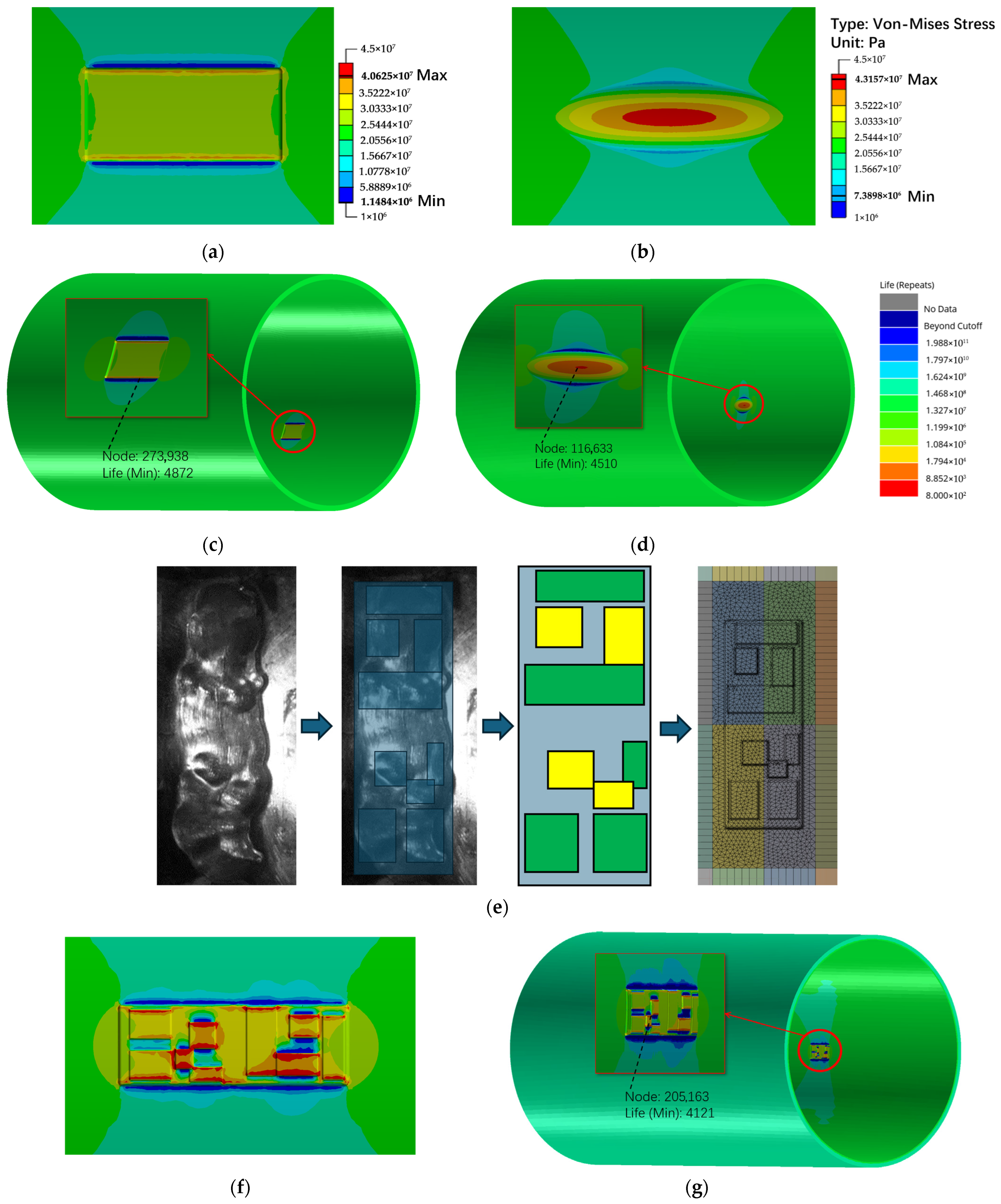
37] and shifts the defect from the outer wall to the inner wall of the pipeline. Rectangular idealized models, semi-ellipsoidal idealized models, and complex-shaped pit models were, respectively, constructed for comparative analysis, thereby verifying the accuracy of the model simplification method and its impact on fatigue life prediction deviations.
The stress concentration factor and fatigue life for three models were obtained through simulation, with the results shown in the accompanying
Figure 10 and
Table 4. In this simulation, the pipeline diameter is 762 mm, the wall thickness is 17.5 mm, and the pressure is 10.5 MPa. The defect dimensions are: length 200 mm, width 50 mm, and depth 4.4 mm, corresponding in this paper to
k1 = 0.25,
k2 = 1.73, and
k3 = 0.02.
In the simulation results, the stress concentration factors obtained from the three simplification methods do show differences. However, after further fatigue-life simulation, this difference diminishes: comparing the complex defect model with the Rectangular Idealized model, the SCF increases by 38%, but the fatigue life decreases by only 18%. The complex shape model constructed in this study, due to non-smooth transitions between different depth zones, results in a calculated stress concentration factor that is 27% higher than the reference value in the literature. However, the reduction in fatigue life is not significant, only 17%. Therefore, it is reasonable to believe that if a more precise modeling approach is adopted, its fatigue life results are expected to be closer to those of the rectangular idealized model. In the engineering practice of pipeline integrity management, where maintenance and inspection cycles are typically 3–5 years or longer, the accuracy level of the present model is sufficient to provide practical references for risk assessment and repair decisions on an engineering time scale.
The main reason for the observed errors lies in the fact that both burst pressure and fatigue life are more sensitive to defect depth. When the defect depth is consistent, the peak stresses obtained from the three models do not differ substantially. However, compared with the rectangular idealized model, where material is completely removed, the semi-ellipsoidal idealized model and the complex-shape pit retain more material in the defect region, leading to the following relationship in nominal stress related to the remaining cross-sectional area: complex-shape pit > semi-ellipsoidal idealized > rectangular idealized. According to the formula for the SCF, as shown in Equation (5) (where K
t denotes SCF, σ
max is the peak stress, and σ
n is the nominal stress), the difference in nominal stress ultimately results in a noticeable gap in SCF among the three models.
The fatigue-life calculation method employed in this study relies more heavily on peak stress; hence, although the SCF values differ among the three models, the variations in predicted fatigue lives are relatively small. This also indicates that a higher stress concentration factor does not strictly correspond to a shorter fatigue life. In practical engineering analysis and structural assessment, a more detailed discussion tailored to the specific subject of study is required.
3.2. Fatigue Life Prediction Results
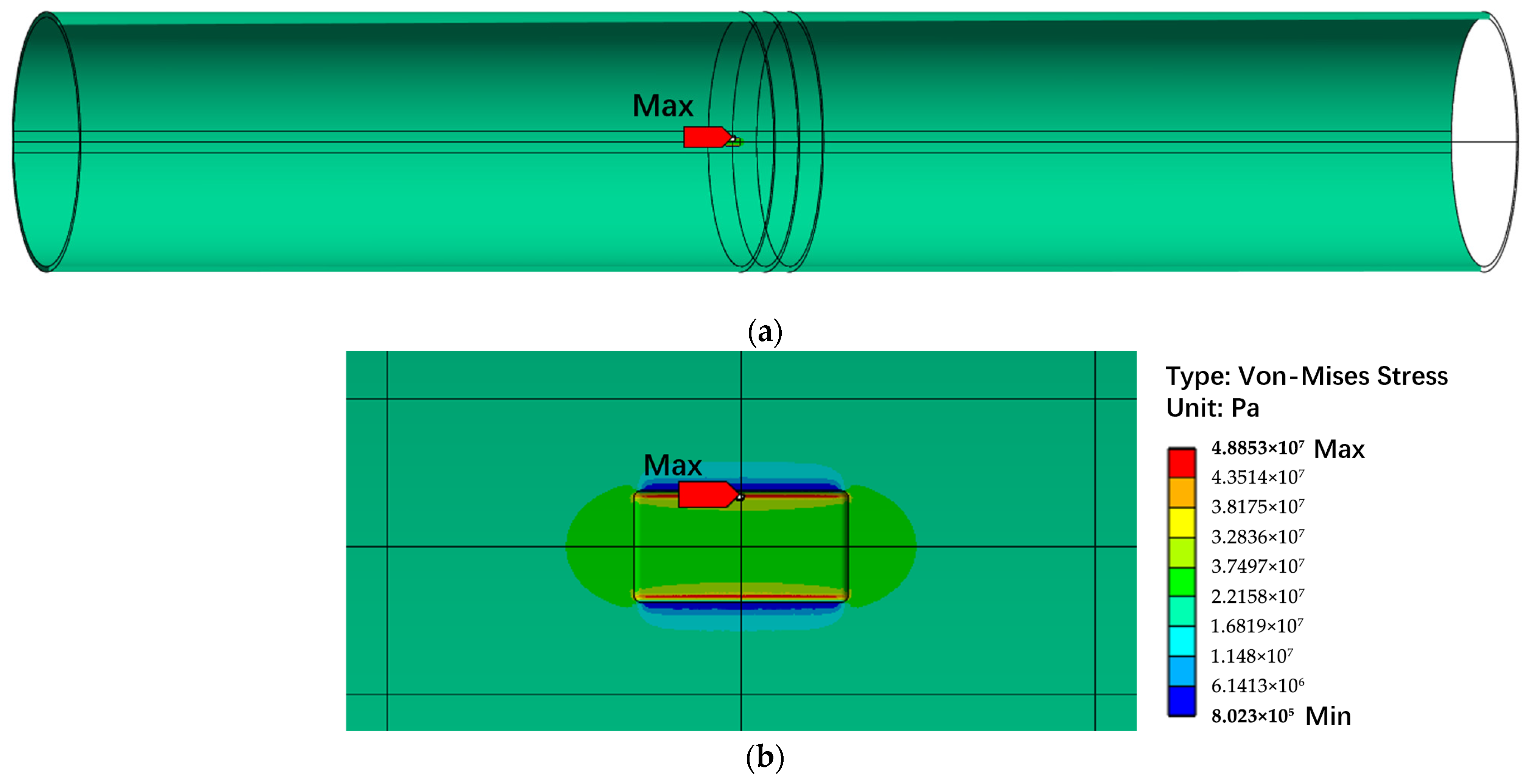
After setting various module parameters, the equivalent stress distribution of the pipeline was obtained. Under the condition of corrosion depth coefficient
k1 = 0.1, corrosion length coefficient
k2 = 0.5, and corrosion width coefficient
k3 = 0.02, the results are shown in
Figure 11. The maximum equivalent stress value is concentrated in the stress concentration area at the inner corner of the axial edge of the defect groove, with a maximum stress of 48.85 MPa, which is significantly lower than the material’s yield strength of 492 MPa.
In this study, we adopt the von Mises equivalent stress to characterize the possible local multiaxial stress state at corrosion defects and use it as input for stress-life (S-N) analysis in nCode. Although the internal pressure borne by the pipeline as a whole mainly generates uniaxial (hoop) stress, the stress state becomes multiaxial at the corners of rectangular defects. To apply the material S-N curve obtained from uniaxial tests to such multiaxial scenarios, the equivalent stress method (e.g., the von Mises criterion) is commonly used in engineering to convert a multiaxial stress state into an equivalent uniaxial stress [
76,
77]. For ductile steels such as X70/X80, within the high-cycle fatigue range, adopting the von Mises equivalent stress is a widely accepted and theoretically grounded engineering approach suitable for proportional loading or simple multiaxial stress states. Although more complex multiaxial fatigue criteria exist, for the objectives and loading conditions of this study, the von Mises criterion offers higher computational efficiency while ensuring engineering accuracy [
78,
79].
After importing the static equivalent stress simulation results into nCode, the fatigue analysis method was set to Miner’s rule, and the Stress Gradients function was enabled to account for notch effects (based on the FKM method). By inputting parameters such as material properties and loading conditions, the fatigue life of the pipeline was obtained for corrosion defect depth coefficients
k1 ranging from 0.05 to 0.25, length coefficients
k2 from 0.2 to 1.0, and width coefficients
k3 from 0.02 to 0.10. The fatigue life value directly output by the software represents the number of cycles the structure can withstand under the applied loading. For ease of discussion, this cycle count was converted into an equivalent service life in years. The fatigue load of the pipeline was obtained from high-precision sensors, collecting pressure values at a frequency of once per second (f
s = 1 Hz). After cleaning the original data, the formed effective load sequence contained n = 1.58 × 10
5 discrete points, each point corresponding to a time interval of Δt = 1 s. In the fatigue life analysis, a single complete cycle is defined as the process starting from the load initial point, traversing all data points, and returning to the initial state, with a time span of: t
cycle = n·Δt = 1.58 × 10
5 s. The fatigue life result obtained through simulation is expressed by the number of cycles N. For a convenient engineering assessment, it needs to be converted into actual service life in years. The relationship between the total time T
total and the number of cycles is: T
total = N·t
cycle = N·1.58 × 10
5 s. Further, through unit conversion, the total time is converted to years. Thus, the linear relationship between life in years and the number of cycles can be expressed as T
year = 0.00504 N. A subset of the simulation results is presented below. For the case with a corrosion depth coefficient
k1 = 0.1, length coefficient
k2 = 0.5, and width coefficient
k3 = 0.02, the corresponding data are summarized in
Table 5. In the table, the characteristic dimensions of the defects have been converted into actual sizes according to each pipeline specification.
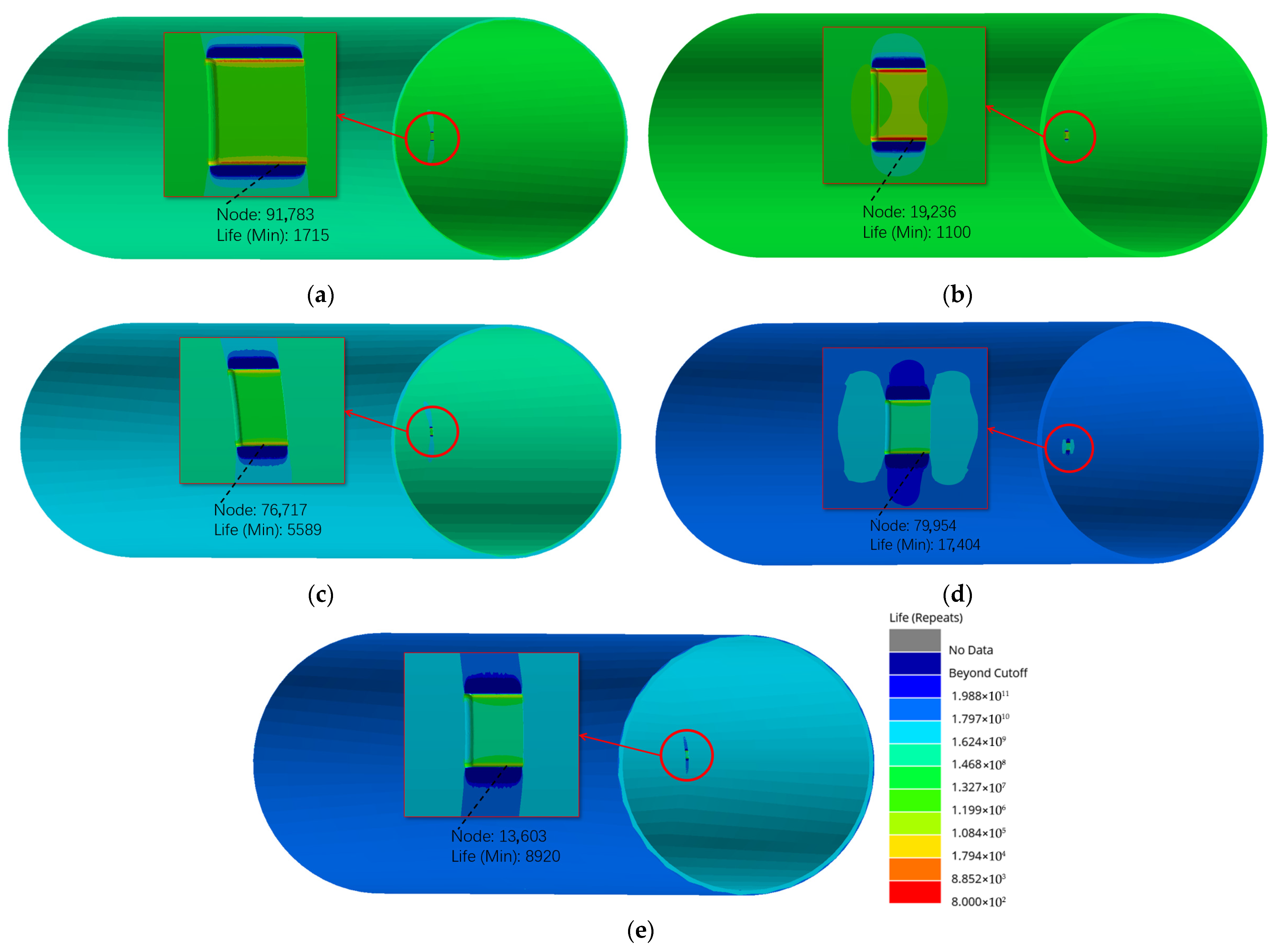
Figure 12 illustrates the fatigue life distribution corresponding to the parameter combinations listed above. In the figure, “Life” represents the remaining number of cycles the pipeline can withstand. Colors closer to red indicate shorter fatigue life, while those closer to blue indicate longer life. The color scale is standardized across the visualization, with a minimum value of 8 × 10
3 and a maximum of 2 × 10
11.
From the figure, it can be seen that the minimum fatigue life (which also corresponds to the maximum fatigue damage) occurs on the inner wall and highly coincides with the location of the maximum stress. The inner wall of the pipeline comes into direct contact with the alternating load, leading to cumulative damage and inducing fatigue cracks. The fatigue life distribution of pipelines with corrosion defects shows significant spatial gradient characteristics and circumferential-axial asymmetry. In the stress concentration area at the axial edge re-entrant corner of the defect groove, i.e., the location of the maximum depth of the corrosion defect, the fatigue life shows a high gradient red color, indicating a significant decline. At the axial edge, salient corner positions without corrosion depth, blue indicating long life dominates. For other areas of the pipe body far from the defect, the life is between the former two and closer to long life.
From the simulation results, the sensitivity of life attenuation is higher in the defect length direction (axial) than in the width direction (circumferential), and a sharp “red-blue” transition often occurs at the axial defect boundary, which is similar to the stress distribution. However, the area and gradient of numerical change in fatigue life are significantly higher than those of stress, indicating that stress concentration and material toughness form a dynamic competition here, and the interaction law between the factors affecting fatigue life is relatively complex.
For the five different pipeline parameters, under the above conditions, wall thickness is the most significant factor determining fatigue life. Comparing the contours, the fatigue life can be divided into three groups, representing high-performance steel with medium wall thickness, medium-performance steel with large wall thickness, and high-performance steel with small wall thickness. X80 steel, due to its high yield strength and fine-grained structure, generally has better fatigue performance than X70 steel of the same specification. However, since the wall thickness of X80 steel pipes is generally lower than that of X70 steel pipes, and the pressure of such pipelines is higher, the advantage in material performance is offset. For example, the remaining life of the 21.4 mm wall thickness Φ1422 mm X80 pipeline is 1.72 × 10³ cycles, significantly less than the 1.74 × 10⁴ cycles of the 21 mm wall thickness Φ1016 mm X70 pipeline.
4. Discussion
Results from finite element method analysis and verification indicate that under the same alternating stress level, pipeline diameter, wall thickness, material, as well as defect depth, width, and length, all affect fatigue life. When corrosion defects are present, the geometry of the defect becomes the most prominent factor affecting fatigue life. Therefore, the influence of attributes such as defect depth, width, and length on fatigue life under different pipeline parameter combinations will be discussed below.
4.1. Variation Law of Pipeline Fatigue Life Under Different Defect Widths
In this section, corrosion defect models with corrosion defect depth coefficient
k1 = 0.05–0.25, corrosion defect length coefficient
k2 = 0.5, and corrosion defect width coefficient
k3 = 0.02–0.10 were selected, and their fatigue life simulation results were extracted. The variation curves of pipeline fatigue life T
year with corrosion defect width coefficient
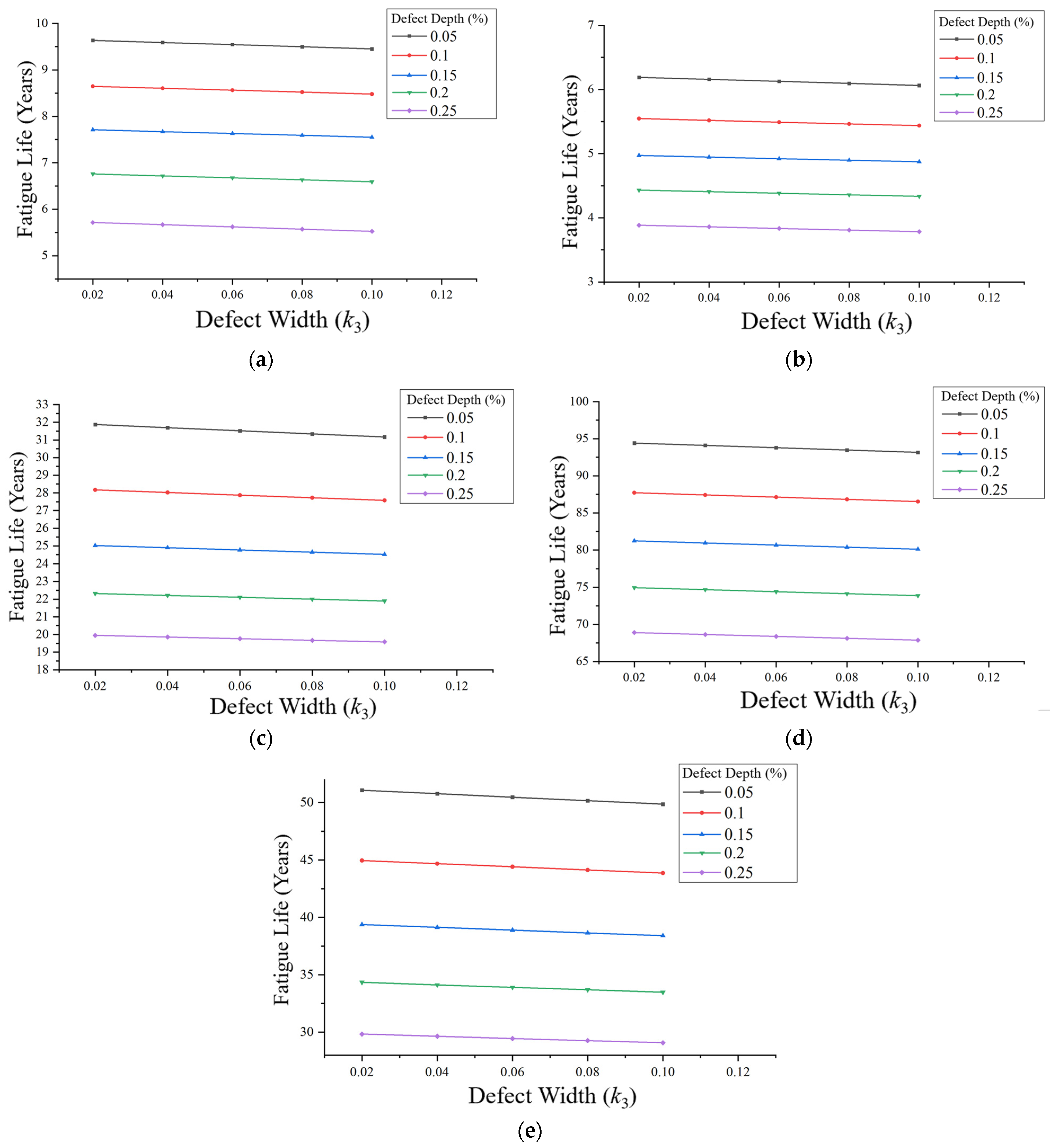
k3 under various corrosion defect depths are shown in
Figure 13.
Quantitative analysis results show that when the pipe material, diameter, and wall thickness remain constant, as the defect width k3 increases, the fatigue life of the pipeline overall shows a slightly fluctuating linear decreasing trend. And within the given defect width range in the figure, the decreasing trend is very small. Within the range of defect width coefficient k3 ∈ [0.02, 0.10], the decrease in fatigue life is between 1.9% and 3.4%. Compared to the influence of the depth coefficient, the sensitivity is very low. The reason can be attributed to the fact that the increase in defect width alters the stress diffusion path of surface cracks, and the circumferential stress distribution of the pipeline is not sensitive to changes in width. Regarding the influence of the defect depth coefficient k1, its effect exhibits a distinct gradient decay characteristic. This nonlinear characteristic primarily stems from the nonlinear relationship between the SCF and defect depth, as well as the power-law nature of the material’s S-N curve. Specifically, as the defect depth increases, the local stress concentration does not grow linearly, leading to a nonlinear rise in stress amplitude. According to the S-N curve relationship, fatigue life is extremely sensitive to changes in stress amplitude; therefore, even a modest increase in stress amplitude can cause a significant nonlinear decay in fatigue life.
For the five pipeline configurations, the numerical patterns indicate that the influence of material and pipeline size on fatigue life involves a synergistic effect. If the defect width is the same, the increase in defect depth causes the fastest decline in fatigue life for the 18.2 mm wall thickness Φ1016 mm X80, and the slowest for the 21.4 mm wall thickness Φ1016 mm X70. If the defect depth is the same, the increase in defect width causes the fastest decline in fatigue life for the 21.4 mm wall thickness Φ1422 mm X80, and the slowest for the 21.4 mm wall thickness Φ1016 mm X70. This difference may originate from the characteristics of the S-N curves of the two materials (with different advantageous ranges for fatigue life). In terms of pipeline size, the higher diameter-to-thickness ratio (D/t = 66.3) of the 21.4 mm wall thickness Φ1422 mm pipeline produces the strongest size effect, making it more prone to membrane stress intensification compared to the 21.4 mm wall thickness Φ1016 mm pipeline (with a D/t of only 48.4).
4.2. Variation Law of Pipeline Fatigue Life Under Different Defect Lengths
Corrosion defect models with corrosion defect depth coefficient
k1 = 0.05–0.25, corrosion defect length coefficient
k2 = 0.2–1.0, and corrosion defect width coefficient
k3 = 0.05 were selected, and their fatigue life simulation results were extracted. The variation curves of pipeline fatigue life T
year with corrosion defect length coefficient
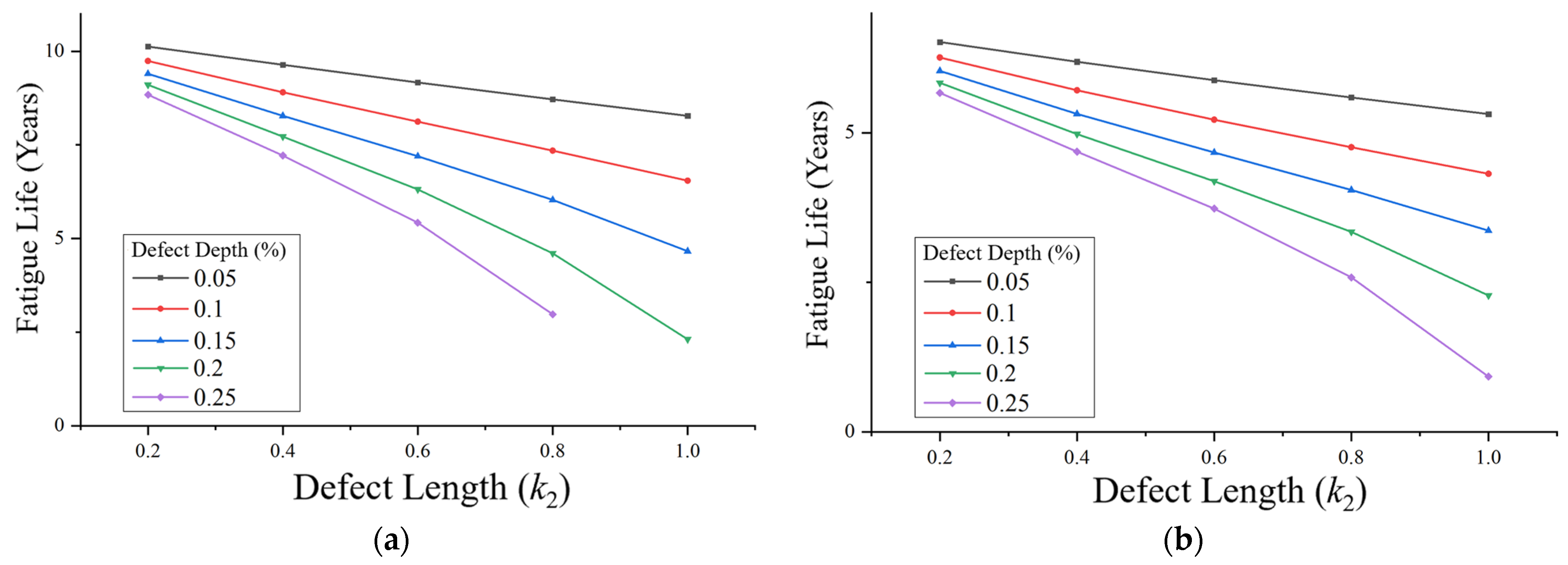
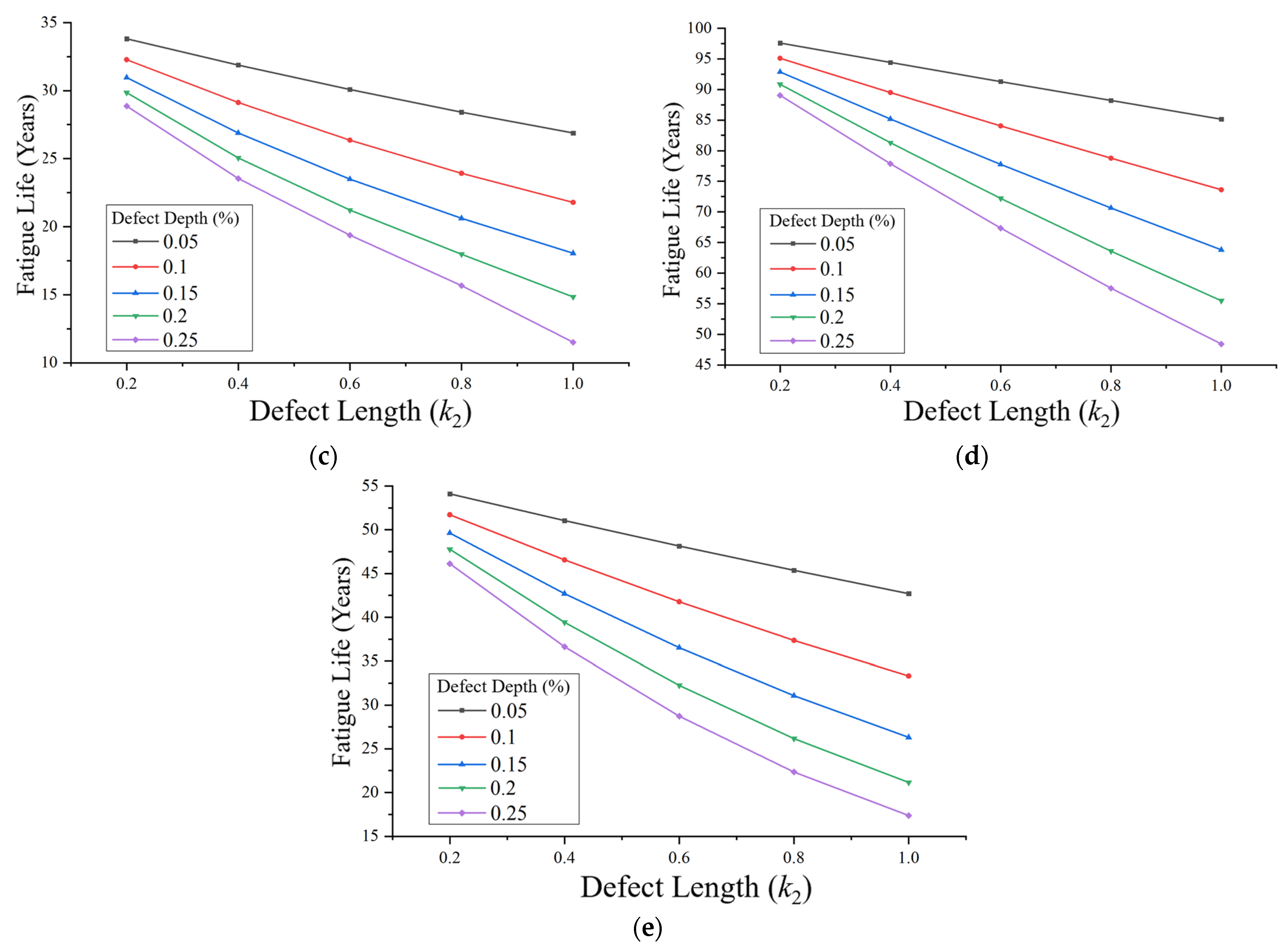
k2 under various corrosion defect depths are shown in
Figure 14.
For all pipeline specifications, as the corrosion defect length coefficient k2 increases, the fatigue life of the pipeline generally shows a decreasing trend. However, after comparison, it is found that the decreasing trends for different pipeline specifications are not identical. As the corrosion defect length increases, the impact of the defect on the overall bearing capacity of the pipeline gradually becomes apparent, stress concentration phenomena become more obvious, and fatigue life decreases. Taking the 21.4 mm wall thickness Φ1422 mm X80 and the 26.4 mm wall thickness Φ1219 mm X70 pipelines as examples, the rate of fatigue life decrease gradually accelerates as the defect length increases. The average decrease in life for the front end when k2 changes from 0.2 to 0.4 is 11.8%, while the decrease for the rear end when k2 changes from 0.8 to 1.0 expands to 37.7%. The declining trend of fatigue life for the 18.4 mm wall thickness Φ1219 mm X80 pipeline shows a characteristic of first slowing down and then speeding up, while for the other two specifications, it gradually slows down. This can be explained by the evolution law of the SCF. When the defect length and pipeline specification reach a critical value, the growth rate of the SCF will tend to flatten, leading to a slowing decline in fatigue life.
The comprehensive findings indicate that fatigue life is more sensitive to changes in the axial length of defects, particularly when defects are longer. This suggests that in pipeline in-line inspection data analysis and integrity assessments, special attention should be paid to corrosion defects with significant axial extension. When maintenance resources are limited, prioritizing the repair or close monitoring of elongated defects may be more effective in delaying overall fatigue failure and enhancing pipeline network reliability. Additionally, the axial resolution of inspection tools must be ensured to accurately capture the dimensional characteristics of such defects.
4.3. Pipeline Fatigue Life Calculation
Summarizing the patterns from the aforementioned research, regardless of pipeline specifications, the corrosion depth coefficient k1 has a significant impact on fatigue life. For every increase of 0.05 in k1, the average decay rate of the fatigue life can reach 23 ± 2%. Taking an X80 pipeline with a wall thickness of 21.4 mm and a pipe diameter of Φ1422 mm as an example, when k1 increases from 0.05 to 0.25, its fatigue life Tyear sharply decreases from 28.6 years to 9.3 years, a reduction of up to 67.5%. This phenomenon can be explained from a mechanical perspective: as k1 increases, the effective wall thickness of the pipeline thins, leading to a rapid decrease in the section modulus, which in turn causes an exponential increase in the nominal stress at the defect. From the perspective of microscopic damage mechanisms, the greater the corrosion defect depth k1, the more material is lost due to corrosion in the pipeline wall thickness, and the more significant the decline in the cross-sectional load-bearing capacity.
For the convenience of engineering applications, this study, based on numerical simulation results, employs the multiple linear regression method to establish an empirical Equation (6) for predicting the fatigue life of pipelines with corrosion defects. This formula comprehensively considers the combined effects of pipeline geometric parameters (diameter, wall thickness), material properties, and defect characteristics (depth, length, and width coefficient) on fatigue life. This formula aims to provide field engineers with a straightforward and reliable tool for life assessment.
The fitting coefficients of the formula are shown in
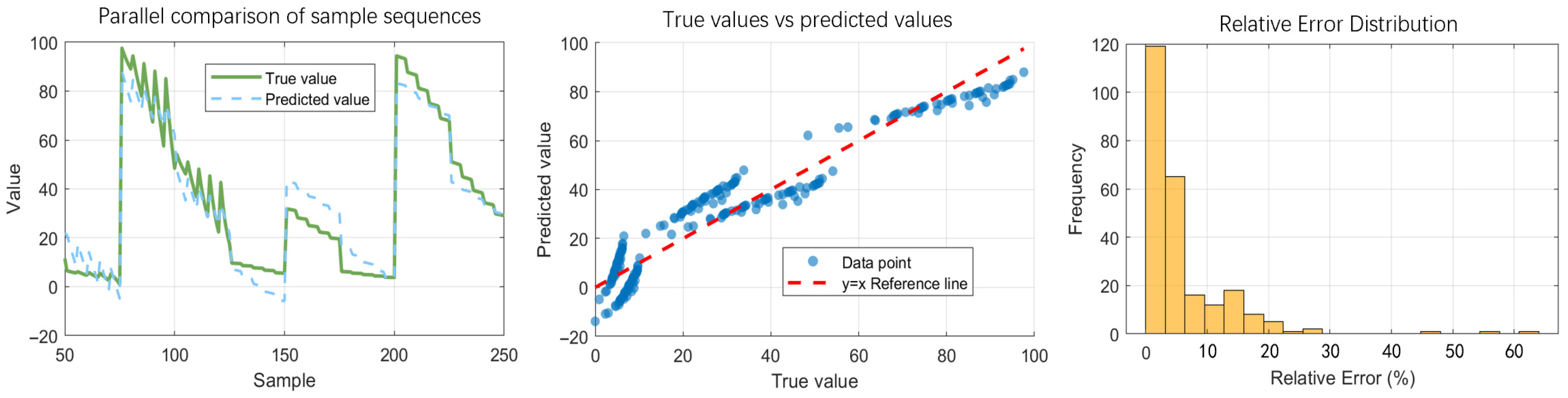
Table 6, which reflect the weight and direction of the influence of each parameter on fatigue life. The fitting effect is verified by comparing the predicted values with the simulated values, as shown in
Figure 15.
As shown in the figure, the predicted values demonstrate close alignment with the actual values. A further analysis of the distribution characteristics of the relative errors reveals that the errors are generally small, with no significant systematic bias observed. Specifically, the coefficient of determination R2 of the model is 0.93, indicating that the empirical formula explains 93% of the data variability. The root mean square error (RMSE) is 4.33, and the mean absolute scaled error (MASE) is 2.77, suggesting that the fitting accuracy and stability are at a moderate level. Nevertheless, the formula features a simple and intuitive structure. In engineering practice for pipeline integrity management, where maintenance and inspection cycles typically span several years, the current level of error remains acceptable. Therefore, this model can still provide valuable reference for the residual life assessment and maintenance decision-making of in-service natural gas pipelines. Moving forward, its engineering applicability can be further enhanced by expanding the dataset, refining the defect simplification methods and fatigue analysis approaches, and adopting more sophisticated and accurate regression tools.


_Su.png)