A Systematic Review of the Scalability of Building-Integrated Photovoltaics from a Multidisciplinary Perspective


 ,
, 

Abstract
1. Introduction
2. Methodology
2.1. Search Strategy and PRISMA Framework
2.2. Keyword Framework and Classification
2.3. Screening Process and Eligibility Criteria
2.4. Data Extraction
2.5. Thematic Synthesis Approach
3. Results
3.1. Overall Analysis
3.2. The Impact of Photovoltaic Façades on Building Thermal Performance
- (1)
- Thermal outcomes fall into bounded, repeatable ranges once the operating regime is aligned. Across ventilated cavities and PCM buffering, PV/module temperature moderation most often lies in the single-digit to low-double-digit °C band: modest airflow/operation changes typically yield ~1–2 °C, while effective ventilation or latent buffering repeatedly reports ~6–11 °C reductions. PCM solutions also provide time-domain benefits (peak delays of ~114–125 min) with modest electrical gains (typically ~0–5%, best-case ~4.8%) [13,14]. Under intensified (ducted/forced-flow) cooling, performance becomes more sensitive to airflow and geometry, including reported ~19% power increases and an engineering channel-depth ratio (e.g., b/L ≈ 0.11) proposed to reduce overheating and improve predictability [15].
- (2)
- Evidence is usually built through a “measurement → physics correlation/sensitivity → annual simulation” chain. Measurements anchor temperature rise, airflow, and heat-flux behavior; physics-based modeling generalizes results via geometry sensitivity (air gap, openings, channels) and boundary-condition handling. Several studies update/derive convection correlations (e.g., Nusselt-type formulations) to keep wind/no-wind cases comparable and note saturation effects (e.g., limited additional cooling beyond ~1 m/s in some regimes) [16,17]. Annual simulation (often multi-orientation or multi-climate) then translates façade behavior into building demand and seasonal balance, with multi-objective optimization emerging when daylight–thermal trade-offs become explicit [18,19,20,21].
- (3)
- Climate and mode selection change the mechanism and even the sign of outcomes. Subtropical numerical work reports season-matched PCM selection (higher melting temperature for summer insulation; lower for winter heat storage) and non-linear heat–electric coupling, with efficiency gains up to ~8.05% under certain settings [18]. Seasonal experiments on PCM-integrated ventilated PV windows report positive indoor temperature differences in heating mode (e.g., ~7.04 °C) versus negative differences in cooling mode (approximately −4.26 °C to −1.26 °C), motivating transitional-season mode switching [22]. In tropical contexts, thermal results are often framed through compliance-relevant envelope metrics (e.g., in situ U-value testing and Low-E pairing) as deployment enablers [23]. In cooling-dominated Hong Kong, results emphasize reduced solar heat gains and tilt-dependent trade-offs (overall benefit around ~20° vs. generation-maximizing around ~30°, with cooling-load saving potential up to ~69.16 kWh/m2·yr) [19,20].
- (4)
- Scalability is limited by boundary sensitivity and buildability, not only peak temperature drops. Several studies identify wind/external convection (hext) as performance-dominant, implying that transfer requires boundary-consistent reporting and, ideally, calibrated assumptions rather than defaults [24]. Practical constraints recur (cost, waterproofing/fire safety, structural integration), while certification-facing envelope metrics act as adoption gates in tropical façade work [13,23]. Control-oriented studies (e.g., ANN-based adaptive operation in plateau climates) further suggest that scalable performance depends on robust operating logic and fast prediction as well as component design [25].
3.3. The Impact of Photovoltaic Façades on Building Electrical Performance
- (1)
- Reported generation outcomes cluster into explainable bands once scale is aligned. PV-DSF electricity yield in cooler climates is frequently reported in the tens of kWh·m−2·yr−1 range (e.g., ~65 kWh·m−2·yr−1) [52], while mode-defined experiments on ventilated PV windows report explicit daily production (e.g., ~0.383 kWh) and peak power (~61.16 W) under heating-mode operation [E6]. For PV shading, geometry controls the net outcome: in Hong Kong, best overall benefit is reported around ~20° tilt (vs ~30° for maximum generation), with cooling-load saving potential up to ~69.16 kWh·m−2·yr−1 [20]; an optimization framework reports primary-energy reduction up to ~48.7% and annual generation exceeding building energy use by ~1034.4 kWh [59]. A dynamic PV light-shelf further reports an ~12% annual generation increase over a fixed configuration [60].
- (2)
- (3)
- Climate and operating context change the dominant mechanism: hot–humid glazed buildings (e.g., Singapore) emphasize net benefit under cooling/daylight trade-offs [E1], while cooling-dominated Hong Kong highlights solar-heat-gain reduction as a key driver of net electricity value [19,20]; Mediterranean PV-DSF results similarly depend on seasonal/operational framing [22,52].
- (4)
- Scalability is constrained by boundary sensitivity and adoption metrics: hext/wind assumptions are performance-dominant in naturally ventilated BIPV [24], high operating temperatures (up to ~64 °C) raise degradation concerns [54], and roof studies show payback divergence (e.g., 6.08 vs. 7.6 years) even under comparable annual generation [62]; self-sufficiency targets also introduce cost-threshold constraints [63]. These synthesized points provide the frame for reading the following strategy-based results as supporting evidence rather than standalone mini-reviews.
3.4. The Impact of Photovoltaic Façades on Building Optical Performance
3.5. The Impact of Photovoltaic Façades on Indoor Thermal Comfort
- (1)
- Application of Composite Systems in Seasonal Thermal Comfort Regulation
- (2)
- Dynamic Shading Control for Thermal Comfort Modulation
- (3)
- Influence of PV Construction Typologies on Indoor Temperature and Comfort
3.6. The Impact of Photovoltaic Façades on Visual Comfort
3.7. The Impact of Photovoltaic Façades on Air Purification Capacity
3.8. Policy Support for the Scalability of Building-Integrated Photovoltaics
3.9. Economic Feasibility for the Scalability of Building-Integrated Photovoltaics
4. Discussion
4.1. Key Challenges in the Adoption of BIPV Technology
4.1.1. Absence of Architectural Perspectives
4.1.2. Methodological Differences and Challenges in Real-World Applications
- Short-term studies are more suitable for revealing the performance mechanisms and component behavior of BIPV systems.
- Long-term monitoring can provide more realistic performance data under actual environmental conditions, capturing the influence of climate and human factors on BIPV. The conclusions are closer to real-world performance but contain uncontrollable variables, making them unsuitable for evaluating the ideal operating state of a BIPV system.
- System-level monitoring is more capable than component-level testing in capturing the multi-dimensional coupling between building, system, and environment, making it a key pathway for translating BIPV research outcomes into practical application assessments.
4.1.3. Economic Conflicts in Cost Calculation and Industry Coordination Issues
4.1.4. From Evidence to Repeatable Deployment: A Cross-Professional Integration Agenda
4.2. Field Experience and Lessons from International BIPV Applications
4.3. Architectural Aesthetics and Spatial Integration Potential of BIPV Systems
4.4. Limitations
5. Conclusions
Funding
Data Availability Statement
Conflicts of Interest
References
- Embodied Carbon. World Green Building Council. Available online: https://worldgbc.org/climate-action/embodied-carbon/ (accessed on 15 May 2025).
- IEA—International Energy Agency. Available online: https://www.iea.org/reports/world-energy-statistics (accessed on 15 May 2025).
- Green Building Investment Promotion Branch of China Building Energy Efficiency Association. China Building Energy Consumption and Carbon Emissions Research Report. 2022. Available online: https://www.aaachina.org/nd.jsp?id=273 (accessed on 15 May 2025).
- PARTNER COUNTRY SERIES_Building Energy Use in China. Available online: https://iea.blob.core.windows.net/assets/a63ded95-7da2-4d1d-bcf7-8870bb5d6aba/PARTNERCOUNTRYSERIESBuildingEnergy_WEB_FINAL.pdf (accessed on 11 January 2026).
- Curtius, H.C. The adoption of building-integrated photovoltaics: Barriers and facilitators. Renew. Energy 2018, 126, 783–790. [Google Scholar] [CrossRef]
- Faes, A.; Virtuani, A.; Quest, H.; Maturi, L.; Scognamiglio, A.; Frontini, F.; Schlueter, A.; Martin-Chivelet, N.; Reinders, A.; Ballif, C. Building-integrated photovoltaics. Nat. Rev. Clean Technol. 2025, 1, 333–350. [Google Scholar] [CrossRef]
- Summary: Challenges Opportunities for Building-Integrated Photovoltaics, R.F.I. Energy.gov. Available online: https://www.energy.gov/eere/solar/summary-challenges-and-opportunities-building-integrated-photovoltaics-rfi (accessed on 15 May 2025).
- Liberati, A.; Altman, D.G.; Tetzlaff, J.; Mulrow, C.; Gøtzsche, P.C.; Ioannidis, J.P.; Clarke, M.; Devereaux, P.J.; Kleijnen, J.; Moher, D. The PRISMA statement for reporting systematic reviews and meta-analyses of studies that evaluate healthcare interventions: Explanation and elaboration. BMJ 2009, 339, b2700. [Google Scholar] [CrossRef] [PubMed]
- Ziasistani, N.; Fazelpour, F. Comparative study of DSF, PV-DSF and PV-DSF/PCM building energy performance considering multiple parameters. Sol. Energy 2019, 187, 115–128. [Google Scholar] [CrossRef]
- Abdelsamie, M.M.; Ali, K.; Hassan Ali, M.I. Enhancing building efficiency: Multifunctional glazing windows with integrated semitransparent PV and selective liquid-filters. Appl. Energy 2025, 377, 124723. [Google Scholar] [CrossRef]
- Leite Didoné, E.; Wagner, A. Semi-transparent PV windows: A study for office buildings in Brazil. Energy Build. 2013, 67, 136–142. [Google Scholar] [CrossRef]
- Koyunbaba, B.K.; Yilmaz, Z.; Ulgen, K. An approach for energy modeling of a building integrated photovoltaic (BIPV) Trombe wall system. Energy Build. 2013, 67, 680–688. [Google Scholar] [CrossRef]
- Zheng, Y.; Li, X.; Zhang, W.; Wang, K.; Han, F.; Li, X.; Zhao, Y. Experimental Study of Phase Change Microcapsule Suspensions Applied in BIPV Construction. Sustainability 2022, 14, 10819. [Google Scholar] [CrossRef]
- Karthick, A.; Murugavel, K.K.; Ramanan, P. Performance enhancement of a building-integrated photovoltaic module using phase change material. Energy 2018, 142, 803–812. [Google Scholar] [CrossRef]
- Kaiser, A.; Zamora, B.; Mazón, R.; García, J.; Vera, F. Experimental study of cooling BIPV modules by forced convection in the air channel. Appl. Energy 2014, 135, 88–97. [Google Scholar] [CrossRef]
- Agathokleous, R.A.; Kalogirou, S.A. Part I: Thermal analysis of naturally ventilated BIPV system: Experimental investigation and convective heat transfer coefficients estimation. Sol. Energy 2018, 169, 673–681. [Google Scholar] [CrossRef]
- Agathokleous, R.A.; Kalogirou, S.A. Part II: Thermal analysis of naturally ventilated BIPV system: Modeling and Simulation. Sol. Energy 2018, 169, 682–691. [Google Scholar] [CrossRef]
- Shu, Z.-Y.; Huang, Y.-X.; He, J.-W.; Zhang, W.; Wang, H.-T.; Sun, S.-X.; Cai, Y.; Zhao, F.-Y. Functional ventilation building envelope integrated photovoltaic modules and phrase change material in subtropical climate: An in-depth numerical investigation. Energy 2024, 307, 132579. [Google Scholar] [CrossRef]
- Zhang, W.; Lu, L.; Peng, J.; Song, A. Comparison of the overall energy performance of semi-transparent photovoltaic windows and common energy-efficient windows in Hong Kong. Energy Build. 2016, 128, 511–518. [Google Scholar] [CrossRef]
- Zhang, W.; Lu, L.; Peng, J. Evaluation of potential benefits of solar photovoltaic shadings in Hong Kong. Energy 2017, 137, 1152–1158. [Google Scholar] [CrossRef]
- Yang, S.; Cannavale, A.; Di Carlo, A.; Prasad, D.; Sproul, A.; Fiorito, F. Performance assessment of BIPV/T double-skin façade for various climate zones in Australia: Effects on energy consumption. Sol. Energy 2020, 199, 377–399. [Google Scholar]
- Ke, W.; Ji, J.; Zhang, C.; Wang, C.; Xie, H.; Tian, X. A seasonal experimental study on a novel CdTe based multi-layer PV ventilated window system integrated with PCM under different operating modes. Energy 2023, 285, 129440. [Google Scholar] [CrossRef]
- Shabunko, V.; Badrinarayanan, S.; Pillai, D.S. Evaluation of in-situ thermal transmittance of innovative building integrated photovoltaic modules: Application to thermal performance assessment for green mark certification in the tropics. Energy 2021, 235, 121316. [Google Scholar] [CrossRef]
- Gonçalves, J.E.; van Hooff, T.; Saelens, D. Understanding the behaviour of naturally-ventilated BIPV modules: A sensitivity analysis. Renew. Energy 2020, 161, 133–148. [Google Scholar] [CrossRef]
- Wang, C.; Ji, J.; Yu, B.; Xu, L.; Wang, Q.; Tian, X. Investigation on the operation strategy of a hybrid BIPV/T façade in plateau areas: An adaptive regulation method based on artificial neural network. Energy 2022, 239, 122055. [Google Scholar] [CrossRef]
- Agathokleous, R.A.; Kalogirou, S.A.; Karellas, S. Exergy analysis of a naturally ventilated Building Integrated Photovoltaic/Thermal (BIPV/T) system. Renew. Energy 2018, 128, 541–552. [Google Scholar] [CrossRef]
- Yun, G.Y.; McEvoy, M.; Steemers, K. Design and overall energy performance of a ventilated photovoltaic façade. Sol. Energy 2007, 81, 383–394. [Google Scholar] [CrossRef]
- Zhang, T.; Yang, H. Flow and heat transfer characteristics of natural convection in vertical air channels of double-skin solar façades. Appl. Energy 2019, 242, 107–120. [Google Scholar] [CrossRef]
- Tonui, J.K.; Tripanagnostopoulos, Y. Performance improvement of PV/T solar collectors with natural air flow operation. Sol. Energy 2008, 82, 1–12. [Google Scholar] [CrossRef]
- Yang, J.; Cheng, Y.; Jia, J.; Du, Z.; Shi, Z.; Han, J. The impact of indoor air distributions on the thermal performance of a single layer semi-transparent photovoltaic façade. Build. Simul. 2019, 12, 69–77. [Google Scholar] [CrossRef]
- Xu, L.; Ji, J.; Yuan, C.; Cai, J.; Dai, L. Electrical and thermal performance of multidimensional semi-transparent CdTe PV window on offshore passenger ships in moored and sailing condition. Appl. Energy 2023, 349, 121672. [Google Scholar] [CrossRef]
- Wong, P.; Shimoda, Y.; Nonaka, M.; Inoue, M.; Mizuno, M. Semi-transparent PV: Thermal performance, power generation, daylight modelling and energy saving potential in a residential application. Renew. Energy 2008, 33, 1024–1036. [Google Scholar] [CrossRef]
- Fan, Z. Daylight performance assessment of atrium skylight with integrated semi-transparent photovoltaic for different climate zones in China. Build. Environ. 2021, 190, 107299. [Google Scholar] [CrossRef]
- Qiao, X.; Zhao, T.; Zhang, X.; Li, Y. Multi-objective optimization of building integrated photovoltaic windows in office building. Energy Build. 2024, 318, 114459. [Google Scholar] [CrossRef]
- Wheeler, V.M.; Kim, J.; Daligault, T.; Rosales, B.A.; Engtrakul, C.; Tenent, R.C.; Wheeler, L.M. Photovoltaic windows cut energy use and CO2 emissions by 40% in highly glazed buildings. One Earth 2022, 5, 1271–1285. [Google Scholar] [CrossRef]
- Pan, Z.; Liu, J.; Wu, H.; Luo, D.; Huang, J. Theoretical-experimental-simulation research on thermal-daylight-electrical performance of PV glazing in high-rise office building in the Greater Bay Area. Appl. Energy 2025, 378, 124739. [Google Scholar] [CrossRef]
- Wang, C.; Li, N.; Yu, B.; Uddin, M.; Ji, J. A novel solar spectrum-splitting utilization photocatalytic CdTe double-skin façade: Concept, design and performance investigation. Build. Environ. 2021, 195, 107776. [Google Scholar] [CrossRef]
- Zhang, C.; Ji, J.; Tang, Y.; Ke, W. Overall performance investigation of a CdTe double-skin ventilated façade integrated with a thermal catalytic air-type PV/T in heating and cooling seasons. Energy 2024, 292, 130488. [Google Scholar] [CrossRef]
- Saadon, S.; Gaillard, L.; Menezo, C.; Giroux-Julien, S. Exergy, exergoeconomic and enviroeconomic analysis of a building integrated semi-transparent photovoltaic/thermal (BISTPV/T) by natural. Renew. Energy 2020, 150, 981–989. [Google Scholar] [CrossRef]
- Huang, M.J.; Hewitt, N.J. An experimental investigation into the use of biomimetic methods for thermal regulation and heat retention with PCMs in buildings. Renew. Energy 2024, 236, 121435. [Google Scholar] [CrossRef]
- Chen, H.; Chen, X.; Hong, T.; Du, P.; Peng, M.; Deng, S.; Wang, Y. Investigation on the performance of a solar multifunctional photovoltaic/thermal window combining photocatalytic oxidation technology. Renew. Energy 2024, 235, 121371. [Google Scholar] [CrossRef]
- Chen, H.; Hong, T.; Peng, M.; Liu, Y.; Du, P.; Zhao, Y.; Wang, Y.; Yang, H. Performance analysis of a novel photocatalytic double-layer ventilation window. Energy Build. 2025, 326, 115062. [Google Scholar] [CrossRef]
- Luo, Y.; Zhang, L.; Liu, Z.; Su, X.; Lian, J.; Luo, Y. Coupled thermal-electrical-optical analysis of a photovoltaic-blind integrated glazing façade. Appl. Energy 2018, 228, 1870–1886. [Google Scholar] [CrossRef]
- Luo, Y.; Zhang, L.; Liu, Z.; Wang, Y.; Meng, F.; Wu, J. Thermal performance evaluation of an active building integrated photovoltaic thermoelectric wall system. Appl. Energy 2016, 177, 25–39. [Google Scholar] [CrossRef]
- Goncalves, J.E.; van Hooff, T.; Saelens, D. A physics-based high-resolution BIPV model for building performance simulations. Sol. Energy 2020, 204, 585–599. [Google Scholar] [CrossRef]
- Wang, C.; Yang, H.; Ji, J. Investigation on overall energy performance of a novel multi-functional PV/T window. Appl. Energy 2023, 352, 122000. [Google Scholar] [CrossRef]
- Wang, C.; Ji, J.; Yu, B.; Zhang, C.; Ke, W.; Wang, J. Comprehensive investigation on the luminous and energy-saving performance of the double-skin ventilated window integrated with CdTe cells. Energy 2022, 238, 121757. [Google Scholar] [CrossRef]
- Marchwinski, J.; Kurtz-Orecka, K. Influence of photovoltaic installation on energy performance of a nursery building in Warsaw (Central European conditions). J. Build. Eng. 2020, 32, 101630. [Google Scholar] [CrossRef]
- Mitsopoulos, G.; Kapsalis, V.; Tolis, A.; Karamanis, D. Innovative Photovoltaic Technologies Aiming to Design Zero-Energy Buildings in Different Climate Conditions. Appl. Sci. 2024, 14, 8950. [Google Scholar] [CrossRef]
- Nada, S.A.; El-Nagar, D.H. Possibility of using PCMs in temperature control and performance enhancements of free stand and building integrated PV modules. Renew. Energy 2018, 127, 630–641. [Google Scholar] [CrossRef]
- Peng, J.; Curcija, D.C.; Lu, L.; Selkowitz, S.E.; Yang, H.; Mitchell, R. Developing a method and simulation model for evaluating the overall energy performance of a ventilated semi-transparent photovoltaic double-skin façade. Prog. Photovolt. Res. Appl. 2016, 24, 781–799. [Google Scholar] [CrossRef]
- Peng, J.; Curcija, D.C.; Lu, L.; Selkowitz, S.E.; Yang, H.; Zhang, W. Numerical investigation of the energy saving potential of a semi-transparent photovoltaic double-skin façade in a cool-summer Mediterranean climate. Appl. Energy 2016, 165, 345–356. [Google Scholar] [CrossRef]
- Li, D.H.W.; Lam, T.N.T. An analysis of building energy performances and benefits using solar façades. Proc. Inst. Mech. Eng. Part A J. Power Energy 2008, 222, 299–308. [Google Scholar] [CrossRef]
- Kapsis, K.; Athienitis, A.K. A study of the potential benefits of semi-transparent photovoltaics in commercial buildings. Sol. Energy 2015, 115, 120–132. [Google Scholar] [CrossRef]
- Jun, Y.-J.; Han, T.-G.; Song, Y.-H.; Park, K.-S. A study on the enhancement of energy efficiency and indoor environment through the integration of solar photovoltaic modules in daylighting louver systems. Sol. Energy 2024, 282, 112931. [Google Scholar] [CrossRef]
- Oliveira Panao, M.J.N.; Gonçalves, H.J.P. Solar XXI building: Proof of concept or a concept to be proved? Renew. Energy 2011, 36, 2703–2710. [Google Scholar] [CrossRef]
- Wang, W.; Yang, H.; Xiang, C. The overall performance of a novel semi-transparent photovoltaic window with passive radiative cooling coating—A comparative study. Energy Build. 2024, 317, 114433. [Google Scholar] [CrossRef]
- Skandalos, N.; Karamanis, D. Investigation of thermal performance of semi-transparent PV technologies. Energy Build. 2016, 124, 19–34. [Google Scholar] [CrossRef]
- Liu, J.; Bi, G.; Gao, G.; Zhao, L. Optimal design method for photovoltaic shading devices (PVSDs) by combining geometric optimization and adaptive control model. J. Build. Eng. 2023, 69, 106101. [Google Scholar] [CrossRef]
- Wang, W.; Xu, K.; Xiang, C. Study on the application of a dynamic photovoltaic integrated light shelf for office buildings. Energy 2025, 314, 134205. [Google Scholar] [CrossRef]
- Ng, P.K.; Mithraratne, N.; Kua, H.W. Energy analysis of semi-transparent BIPV in Singapore buildings. Energy Build. 2013, 66, 274–281. [Google Scholar] [CrossRef]
- Wei, L.J.; Islam, M.; Hasanuzzaman, M.; Cuce, E. Energy consumption, power generation and performance analysis of solar photovoltaic module based building roof. J. Build. Eng. 2024, 90, 109361. [Google Scholar] [CrossRef]
- Kwag, B.C.; Kim, G.T.; Hwang, I.T. Integration of Photovoltaic Systems for Energy Self-Sufficient Low-Rise Multi-Family Residential Buildings in Republic of Korea. Buildings 2024, 14, 2522. [Google Scholar] [CrossRef]
- Cheng, Y.; Gao, M.; Dong, J.; Jia, J.; Zhao, X.; Li, G. Investigation on the daylight and overall energy performance of semi-transparent photovoltaic façades in cold climatic regions of China. Appl. Energy 2018, 232, 517–526. [Google Scholar] [CrossRef]
- Li, C.; Zhang, W.; Tan, J.; Liu, W.; Lyu, Y.; Tang, H. Energy performance of an innovative bifacial photovoltaic sunshade (BiPVS) under hot summer and warm winter climate. Heliyon 2023, 9, e18700. [Google Scholar] [CrossRef]
- Li, C.; Zhang, W.; Liu, F.; Li, X.; Wang, J.; Li, C. Multi-Objective Optimization of Bifacial Photovoltaic Sunshade: Towards Better Optical, Electrical and Economical Performance. Sustainability 2024, 16, 5977. [Google Scholar] [CrossRef]
- Vartiainen, E. Electricity benefits of daylighting and photovoltaics for various solar façade layouts in office buildings. Energy Build. 2001, 33, 113–120. [Google Scholar] [CrossRef]
- Su, X.; Zhang, L.; Luo, Y.; Liu, Z. Energy performance of a reversible window integrated with photovoltaic blinds in Harbin. Build. Environ. 2022, 213, 108861. [Google Scholar] [CrossRef]
- Sun, T.; Ji, G.; Liu, H.; He, Y. Research on the solar performance of folded dynamic BIPV shading. Sol. Energy 2024, 282, 112971. [Google Scholar] [CrossRef]
- Olivieri, L.; Caamaño-Martin, E.; Olivieri, F.; Neila, J. Integral energy performance characterization of semi-transparent photovoltaic elements for building integration under real operation conditions. Energy Build. 2014, 68, 280–291. [Google Scholar] [CrossRef]
- Zhang, C.; Ji, J.; Ke, W.; Tang, Y. Comprehensive performance investigation of a novel thermal catalytic semi-transparent PV double-skin ventilated window integrated with CdTe cells. Energy 2024, 300, 131470. [Google Scholar] [CrossRef]
- Jiang, Y.; Qi, Z.; Ran, S.; Ma, Q. A Study on the Effect of Dynamic Photovoltaic Shading Devices on Energy Consumption and Daylighting of an Office Building. Buildings 2024, 14, 596. [Google Scholar] [CrossRef]
- Gong, F.; Gao, Y.; Tian, X.; Wang, J.; Ji, J.; Shi, F.; Hong, X. Simulation of a novel curved photovoltaic (PV) window improving the annual daylighting and building energy performance simultaneously. Build. Simul. 2024, 17, 1951–1969. [Google Scholar] [CrossRef]
- Yao, G.; Ding, D.; Xie, C.; Tan, H. Optimized design and comparative analysis of double-glazed photovoltaic windows for enhanced light harvesting and energy efficiency in cold regions of China. Energy Build. 2024, 325, 115011. [Google Scholar] [CrossRef]
- Qiu, C.; Yi, Y.K.; Wang, M.; Yang, H. Coupling an artificial neuron network daylighting model and building energy simulation for vacuum photovoltaic glazing. Appl. Energy 2020, 263, 114624. [Google Scholar] [CrossRef]
- Jayakumari, S.D.S.; Imalka, S.T.; Yang, R.J.; Liu, C.; Yang, S.; Marschall, M.; Corradini, P.S.; Benito, A.F.; Benito, A.F. Energy and Daylighting Performance of Kinetic Building-Integrated Photovoltaics (BIPV) Façade. Sustainability 2024, 16, 9739. [Google Scholar] [CrossRef]
- Kyrou, E.; Goia, F.; Reith, A. Current performance and future development paths of transparent PV glazing in a multi-domain perspective. Energy Build. 2023, 292, 113140. [Google Scholar] [CrossRef]
- Tang, H.; Long, Q.; Li, C.; Li, C. Experimental study of a PV-PCM window under hot summer and warm winter climate. J. Energy Storage 2024, 96, 112724. [Google Scholar] [CrossRef]
- Zhou, Y. Demand response flexibility with synergies on passive PCM walls, BIPVs, and active air-conditioning system in a subtropical climate. Renew. Energy 2022, 199, 204–225. [Google Scholar] [CrossRef]
- Oh, S.; Choi, G.-S.; Kim, H. Climate-Adaptive Building Envelope Controls: Assessing the Impact on Building Performance. Sustainability 2024, 16, 288. [Google Scholar] [CrossRef]
- He, J.-W.; Shu, Z.-Y.; Huang, R.-N.; Liu, Z.-Q.; Huang, C.; Cai, Y.; Zhao, F.-Y. Numerical analysis and ANN performance prediction of solar composite ventilation wall for built environment regulation. Energy Convers. Manag. 2024, 311, 118512. [Google Scholar] [CrossRef]
- Martinopoulos, G.; Serasidou, A.; Antoniadou, P.; Papadopoulos, A.M. Building integrated shading and building applied photovoltaic system assessment in the energy performance and thermal comfort of office buildings. Sustainability 2018, 10, 4670. [Google Scholar] [CrossRef]
- Zhao, K.; Gou, Z. Optimizing semi-transparent BIPV windows for balanced daylighting and solar energy performance in office buildings. Sol. Energy 2025, 287, 113229. [Google Scholar] [CrossRef]
- Cannavale, A.; Hörantner, M.; Eperon, G.E.; Snaith, H.J.; Fiorito, F.; Ayr, U.; Martellotta, F. Building integration of semitransparent perovskite-based solar cells: Energy performance and visual comfort assessment. Appl. Energy 2017, 194, 94–107. [Google Scholar] [CrossRef]
- Qiu, C.; Yang, H. Daylighting and overall energy performance of a novel semi-transparent photovoltaic vacuum glazing in different climate zones. Appl. Energy 2020, 276, 115414. [Google Scholar] [CrossRef]
- Mandalaki, M.; Tsoutsos, T.; Papamanolis, N. Integrated PV in shading systems for Mediterranean countries: Balance between energy production and visual comfort. Energy Build. 2014, 77, 445–456. [Google Scholar] [CrossRef]
- Peng, J.; Curcija, D.C.; Thanachareonkit, A.; Lee, E.S.; Goudey, H.; Jonsson, J.; Selkowitz, S.E. Comparative study on the overall energy performance between photovoltaic and Low-E insulated glass units. Sol. Energy 2021, 214, 443–456. [Google Scholar] [CrossRef]
- Peng, J.; Curcija, D.C.; Thanachareonkit, A.; Lee, E.S.; Goudey, H.; Selkowitz, S.E. Study on the overall energy performance of a novel c-Si based semitransparent solar photovoltaic window. Appl. Energy 2019, 242, 854–872. [Google Scholar] [CrossRef]
- International Electrotechnical Commission. Photovoltaics in Buildings. Part 2: Requirements for Building-Integrated Photovoltaic Systems; International Electrotechnical Commission: Geneva, Switzerland, 2020. [Google Scholar]
- SIST-EN-50583-1-2016; Photovoltaics in Buildings—Part 1: BIPV Modules. Slovenian Institute for Standardization: Ljubljana, Slovenia, 2016.
- 2019 Energy Code Solar Ready Requirements. Available online: https://www.energy.ca.gov/sites/default/files/2021-04/2019_Energy_Code_Solar_Ready_Requirements_ADA.pdf (accessed on 11 January 2026).
- Government Procurement Support for Green Building Materials to Promote Improvement of Building Quality Policy Project Implementation Guidelines. Notice by the General Offices of the Ministry of Finance, Ministry of Housing and Urban-Rural Development, and Ministry of Industry and Information Technology of China, Cai Ban Ku [2023] No. 52. 22 March 2023. Available online: https://www.mof.gov.cn/gkml/caizhengwengao/wg2023/wg202304/202309/t20230922_3908746.htm (accessed on 11 January 2026).
- IEA-PVPS-Task-15-An-International-Collection-of-BIPV-Projects-Compr. Available online: https://www.scribd.com/document/894030555/IEA-PVPS-Task-15-an-International-Collection-of-BIPV-Projects-Compr (accessed on 11 January 2026).
- Yao, T.; Wang, J.; Wu, H.; Zhang, P.; Li, S.; Wang, Y.; Chi, X.; Shi, M. A photovoltaic power output dataset: Multi-source photovoltaic power output dataset with python toolkit. Sol. Energy 2021, 230, 122–130. [Google Scholar] [CrossRef]



| Category | Keywords |
|---|---|
| Photovoltaic Façades Related Terms | Photovoltaic Façades, Solar Façades, PV Façades, BIPV, Building-Integrated Photovoltaics, PV Wall, Photovoltaic Windows, Trombe Wall, Photovoltaic Building Integration, Solar Powered Façades |
| Building Performance Related Terms | Building Performance, Building Energy Consumption, Building Thermal Efficiency, Indoor Comfort, Energy Efficiency, Building Energy Performance, Energy Demand Reduction, Thermal Performance, Building Thermal Regulation |
| Building Design and Environmental Optimization | Daylighting, Natural Ventilation, Indoor Air Quality, Green Buildings, Thermal Environment, Building Thermal Comfort |
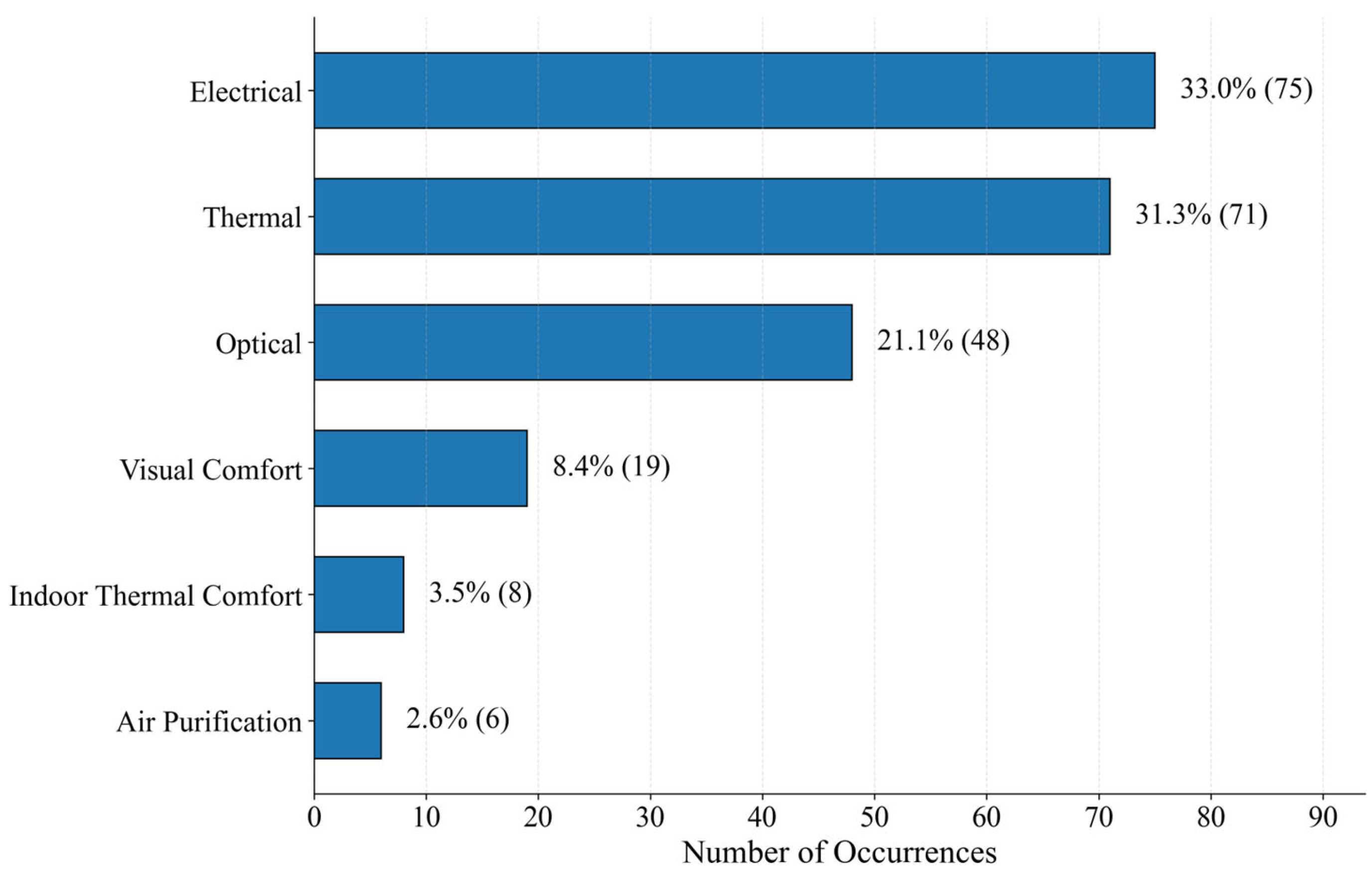
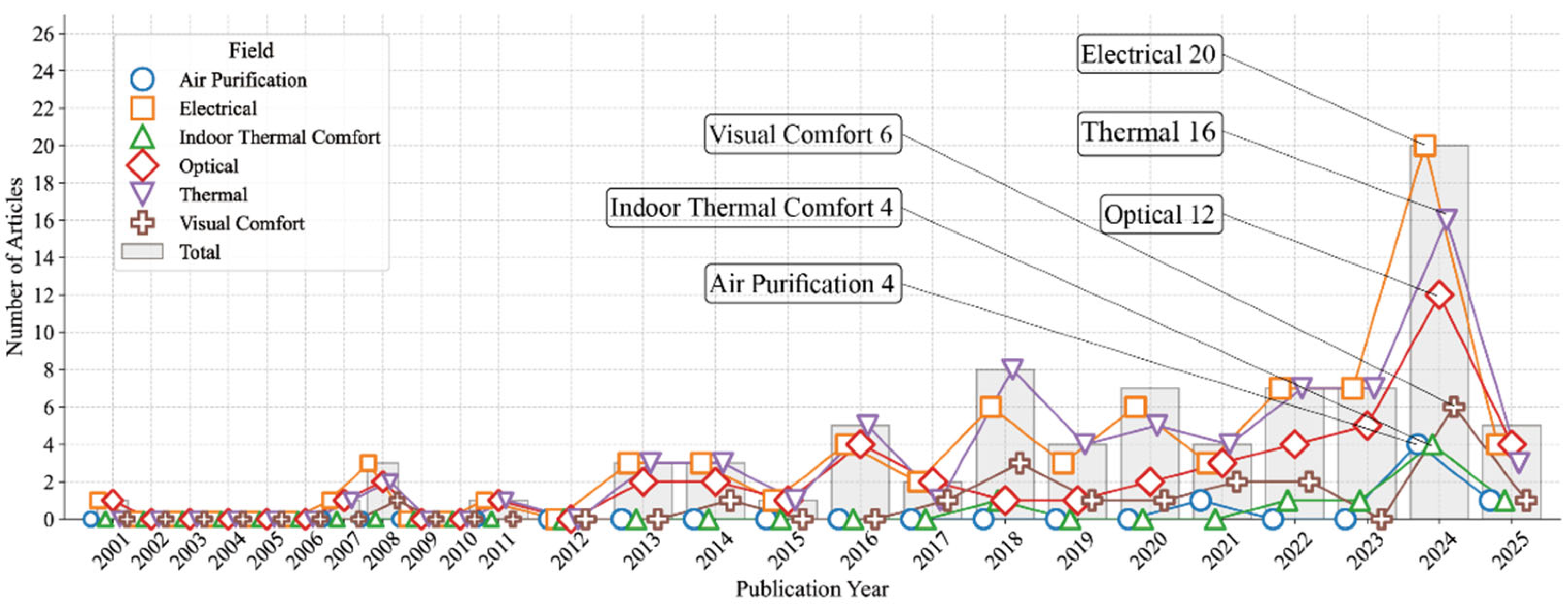
| Field | Total Count | First Appeared | Peak Year |
|---|---|---|---|
| Air Purification | 6 | 2021 | 2024 |
| Indoor Thermal Comfort | 8 | 2018 | 2024 |
| Visual Comfort | 19 | 2008 | 2024 |
| Optical | 48 | 2001 | 2024 |
| Thermal | 71 | 2007 | 2024 |
| Electrical | 75 | 2001 | 2024 |
| Reference | Measurement Type | Monitoring Duration | Research Object | Actual Measurement Period |
|---|---|---|---|---|
| Wang et al. [37] | System-level | Short-term + Annual simulation | STPV + PCM ventilated window | 3 days measurement, annual simulation |
| Ke et al. [22] | System-level | Long-term | CdTe multilayer PV ventilated window | 3 seasons measurement, annual simulation |
| Jun et al. [55] | System-level | Short-term + Annual simulation | Solar chimney + PCM system | Short-term: thermal response validation; annual simulation: energy saving and CO2 reduction prediction |
| Koyunbaba et al. [12] | System-level | Short-term (within long-term background) | BIPV-Trombe system | 4-month long-term operation, 4-day short-term analysis |
| Peng et al. [87] | System-level | Short-term | PV-IGU window | Typical clear day (several hours) |
| Wang et al. [47] | System-level | Short-term | STPV double-skin ventilated window | Several days typical clear-day measurement |
| Zhang et al. [71] | System-level | Short-term + Annual simulation | Thermo-catalytic + STPV double-skin façade | Short-term: thermal and power verification; annual simulation: regional adaptability analysis |
| Cheng et al. [64] | System-level | Short-term + Annual simulation | STPV | 3 days measurement, annual simulation |
| Xu et al. [31] | System-level | Short-term | STPV window | Typical clear-day, several days measurement |
| Shabunko et al. [23] | System-level | Short-term | BIPV glass | 72 h + multi-day validation |
| Tang et al. [78] | System-level | Short-term | PV-PCM window | Several days measurement (hot summer/warm winter zone) |
| Kaiser et al. [15] | System-level | Short-term | Air-cooled BIPV module | Several weeks measurement, hourly sampling |
| Tonui & Tripanagnostopoulos [29] | System-level | Short-term | Naturally ventilated PVT collector | Several weeks measurement, hourly sampling |
| Wang et al. [25] | System-level | Short-term | BIPVT hybrid façade (STPV + thermal recovery) | Several typical winter days measurement |
| Wong et al. [32] | System-level | Long-term | STPV system | Several months measurement, daily/hourly sampling |
| Oliveira Panao & Gonçalves [56] | System-level | Long-term | Solar XXI building | 3 years data, daily sampling |
| Agathokleous & Kalogirou [16] | System-level | Long-term | Naturally ventilated BIPV system | 2 months continuous measurement (10 s interval) |
| Wang et al. [60] | System-level | Short-term + Annual simulation | Dynamic PV light-guiding panel | Several hours measurement, time-interval sampling |
| Peng et al. [88] | System-level | Short-term + Annual simulation | c-Si semi-transparent PV window | Typical clear-day (08:00–18:00) |
| Wang et al. [57] | System-level | Short-term + Annual simulation | Semi-transparent PV window + passive radiative cooling film | Several days typical clear-day measurement, annual simulation |
| Chen et al. [42] | System-level | Short-term | Photocatalytic double-skin ventilated window | 1–2 days measurement |
| Pan et al. [36] | Component-level | Short-term + Annual simulation | PV insulating glass unit | Several hours measurement, annual simulation |
| Zhang et al. [19] | Component-level | Static parameters + Annual simulation | STPV module | Electrical efficiency and transmittance test for EnergyPlus simulation |
| Cannavale et al. [84] | Component-level | Static parameters + Annual simulation | Perovskite STPV module | Optical and electrical performance test for EnergyPlus simulation |
| Martinopoulos et al. [82] | Component-level | Static parameters + Annual simulation | BAPV and BIPV modules | Performance test for annual energy consumption simulation |
| Qiu et al. [75] | Component-level | Static parameters + Annual simulation | VPVW module | Electrical performance test, ANN + EnergyPlus simulation |
| Peng et al. [51] | Component-level | Short-term + Annual simulation | PV + PCM combination | Short-term measurement, annual simulation analysis |
| Karthick et al. [14] | Component-level | Short-term | BIPV + PCM module | Laboratory simulation, short-term sampling |
| Skandalos & Karamanis [58] | Component-level | Long-term | STPV module | 30-day measurement, thermal and electrical performance analysis |
| Olivieri et al. [70] | Component-level | Static parameters + Annual simulation | STPV module | Transmittance and electrical efficiency test, annual simulation for energy performance |
| Location | Context | Project | Performance | Integration | Highlights |
|---|---|---|---|---|---|
| North America (Canada) | Developed region | Performing Arts Centre | Electrical: 75 MWh/yr Thermal: High-performance envelope + heating Optical: PV on all façades, uniform texture Indoor comfort: Floor air supply | Multi-façade | Educational demo; emission reduction; PV as structure |
| N. Europe (Norway) | Developed region | Brynseng Primary School | Electrical: 105 MWh/yr façade PV Thermal: 90% heating from GSHP + borehole | South curtain wall | Educational; near-zero energy; subsidy support |
| W. Europe (Austria) | Developed region | Aktiv Energy Tower | Electrical: 630 m2 PV (roof + façade) Thermal: Geothermal + PV synergy Optical: 63% transparency Visual comfort: Transparent façade Indoor comfort: Ventilated PV curtain wall | Curtain walls (SE–W) | Brand showcase; transparent façade |
| C. Europe (Switzerland) | Developed region | MFH Hofwiesenstraße | Electrical: 750 m2 façade + 500 m2 CIGS balcony Thermal: Rear ventilation + low-conductivity connectors | Multi-façade + balcony | Colored modules; energy-positive demo |
| S. Europe (Italy) | Developed region | Single-family House (Lasa) | Electrical: Balcony + rooftop PV (>850 kWh/yr) Thermal: Electric water heating + control Optical: 37–38% semi-transparent stripes | Balcony + rooftop | Semi-transparent BIPV; shading |
| E. Asia (China) | Developing region | Singyes Solar Office | Electrical: 150,000 kWh/yr (4 PV systems) Thermal: PVT hot water (60,000 L/yr) Optical: Ceramic-like PV + transparent glass Indoor comfort: Ventilated wall + climate control Visual comfort: Lighting, airflow, shading | Curtain wall + canopy + louver + rooftop | Microgrid; multi-system synergy |
| E. Asia (Japan) | Developed region | NTT Aoba Dori Building | Electrical: 37 kWp façade + rooftop PV Thermal: Dry dehumidifying AC + ventilated wall | South façade wall | Post-disaster memorial; AC-heat integration |
| W. Europe (Netherlands) | Developed region | Social Housing Apartment | Electrical: 250 kWp façade + balcony + rooftop Thermal: Unit heat pumps + BIPV integration | Multi-façade + balcony | Policy-driven; rent-energy link |
| N. Europe (Sweden) | Developed region | Väla Gård Office | Electrical: 70 kWp rooftop PV Thermal: GSHP + insulation Indoor comfort: Occupant load consideration | S-facing pitched roof | Net-zero; occupant behavior focus |
Disclaimer/Publisher’s Note: The statements, opinions and data contained in all publications are solely those of the individual author(s) and contributor(s) and not of MDPI and/or the editor(s). MDPI and/or the editor(s) disclaim responsibility for any injury to people or property resulting from any ideas, methods, instructions or products referred to in the content. |
© 2026 by the authors. Licensee MDPI, Basel, Switzerland. This article is an open access article distributed under the terms and conditions of the Creative Commons Attribution (CC BY) license.
Share and Cite
Li, B.; Zhou, D.; Zhou, M.; Xu, D.; Zhang, Q.; Qi, Y.; Zhu, Z.; Yang, Y. A Systematic Review of the Scalability of Building-Integrated Photovoltaics from a Multidisciplinary Perspective. Buildings 2026, 16, 332. https://doi.org/10.3390/buildings16020332
Li B, Zhou D, Zhou M, Xu D, Zhang Q, Qi Y, Zhu Z, Yang Y. A Systematic Review of the Scalability of Building-Integrated Photovoltaics from a Multidisciplinary Perspective. Buildings. 2026; 16(2):332. https://doi.org/10.3390/buildings16020332
Chicago/Turabian StyleLi, Baitong, Dian Zhou, Mengyuan Zhou, Duo Xu, Qian Zhang, Yingtao Qi, Zongzhou Zhu, and Yujun Yang. 2026. "A Systematic Review of the Scalability of Building-Integrated Photovoltaics from a Multidisciplinary Perspective" Buildings 16, no. 2: 332. https://doi.org/10.3390/buildings16020332
APA StyleLi, B., Zhou, D., Zhou, M., Xu, D., Zhang, Q., Qi, Y., Zhu, Z., & Yang, Y. (2026). A Systematic Review of the Scalability of Building-Integrated Photovoltaics from a Multidisciplinary Perspective. Buildings, 16(2), 332. https://doi.org/10.3390/buildings16020332