Abstract
As unique forms of intangible cultural heritage of Inner Mongolia, traditional musical instruments from the region have undergone significant changes alongside socioeconomic development and evolving performance styles. The performance environment has transitioned from early outdoor and non-fixed venues to professional concert halls. Existing research has demonstrated a correlation between the acoustic quality of performance halls and their objective architectural acoustic parameters. However, no studies have been conducted in China on the acoustic parameters suitable for the performance environments of traditional Inner Mongolian musical instruments. This study determined the optimal acoustic environment for performances of traditional musical instruments, unique to Inner Mongolia, by employing computer simulations and subjective listening experiments in representative performance spaces. Participants were asked to select preferred audio samples of different reverberation times, generated by convolving the impulse responses of simulated spatial models with dry recordings of the instruments. Statistical analysis of the results revealed that the optimal reverberation times for traditional Inner Mongolian instruments are 1.2 s and 1.4 s in a theater space, and 0.9 s and 1.1 s in a rectangular space. Furthermore, under the influence of different factors, the four instruments exhibited distinct preferences for optimal reverberation values in the sampled spaces.
1. Introduction
In recent years, China has focused on the preservation of intangible cultural heritage with a series of policies. As a significant form of intangible cultural heritage of the Inner Mongolia Autonomous Region, traditional instrumental music has received extensive attention, with an increasingly popular market. Alongside socioeconomic development and evolving performance styles, the performance environments undergo significant changes [1,2,3], with outdoor shows and performances without fixed locations gradually giving way to indoor concerts [4]. Therefore, it is imperative to explore the acoustic environment of performance venues for traditional Inner Mongolian instrumental music.
Regarding the acoustic parameters of musical instruments within a performance space, numerous scholars have conducted systematic research around key parameters, including reverberation time, sound power, and loudness, obtaining data for certain instruments. Research on optimal reverberation time reveals significant instrument-specific differences and cultural diversity. Meng et al. conducted a subjective preference test to identify the optimal reverberation times for traditional Chinese instruments and found that the optimal reverberation times for pipa, erhu, and dizi were 1.2 s, 1.8 s, and 1.6 s, respectively, indicating the unique demands of different traditional instruments for acoustic environments [5]. Wang compared the differences between Chinese and Western music in regards to the musical culture and performance spaces. Based on field investigations and acoustic tests, she revealed that the optimal reverberation time for guqin ranged between 1.6 and 1.8 s [6]. This finding was consistent with Meng et al., suggesting that the performance of traditional Chinese musical instruments preferred shorter reverberation in a performance space.
In contrast, research has identified longer reverberation requirements for Western musical instruments and some other traditional instruments. Yang’s study of traditional Korean instruments, piri and daegeum, showed that the optimal reverberation times for these two instruments reach 2.6 s and 1.7 s, respectively [7]. Additionally, Takayuki [8] identified that the optimal reverberation times for piano and violin solos ranged from 1.2 to 2.0 s and 1.8 to 2.4 s, respectively, while the optimum value for the performance of both instruments was 1.8 to 2.0 s. Under certain circumstances, if C80 reached the maximum value, comfortable acoustic effects could be generated even if the range was exceeded. These studies suggested that the optimal reverberation time varied across different musical instruments, and further research was required for different instruments.
Most studies of sound power focus on quantifying the acoustic power output characteristics to provide evidence for objective evaluation and space design. Meyer [9] conducted a comprehensive analysis and synthesis of measurement data concerning the sound power levels of musical instruments. He presented values for the sound power levels and dynamic ranges of various orchestral instruments when performing sustained notes and single tones, and the average sound power levels of these instruments when performing sustained notes under forte playing conditions. These measurements were compiled and published in his book Acoustics and the Performance of Music. According to Meyer’s findings, the average sound power levels of the violin, viola, cello, and double bass are 89 dB, 87 dB, 90 dB, and 92 dB, respectively. Qi further extended and deepened this research. Through comparative experiments conducted in an anechoic chamber and a reverberation chamber, she determined the sound power levels of four Western bowed string instruments under strictly controlled conditions, and revealed the significant influence of string material, playing intensity, and acoustic environment on the measured results [10]. In the research of traditional Chinese musical instruments, Zhao analyzed the acoustic characteristics of pipa, identified the main sound energy band of the instrument to be between 500 Hz and 2000 Hz, and proposed an average sound power level of 85.7 dB, measured during scale performance at a specified playing intensity, as a representative value [11].
Regarding subjective auditory perception, loudness is a critical factor influencing listening experience. Lokki’s study demonstrated that when listening to music at different locations in concert halls, the loudness varies in correspondence with the musical dynamics. The loudness range fluctuated from below LAeq 60 dB for piano solos to LAeq 82 dB during full orchestral tuttis. This study systematically evaluated the influence of musical dynamics on auditory perception [12]. Regarding the listening preferences for traditional Chinese music, Qiu et al. found that loudness directly influenced subjective perceptions of loudness and clarity. Their research determined that the optimal loudness range for the appreciation of traditional Chinese music lay between 81 dB and 89 dB [13]. Gai used the Long-Term Average Spectrum (LTAS) analytical method and reported that the preferred average sound pressure level in Cantonese opera theatres was 79.0 dB(A), with an optimal range of 76.0–82.0 dB(A) [14].
Scholars have also examined other acoustic parameters. Guo [15] studied solos of traditional Chinese musical instruments, including dizi, pipa, guqin, and yangqin, and preliminarily determined the optimal ranges for the Initial Time Delay Gap (ITDG) and the Interaural Cross-Correlation Coefficient (IACC), which were within 20 ms and between 0.20 and 0.41, respectively. This provided preliminary quantitative parameter guidance for the multidimensional optimization of Chinese traditional music performance environments, particularly from the spatial impression and clarity perspectives.
In the study of traditional instruments across different countries and ethnic groups, the optimal reverberation times for the Korean traditional instruments Piri and Daegeum are 2.6 s and 1.7 s, respectively [7]. The optimal reverberation times for piano and violin solos are 1.2–2.0 s and 1.8–2.4 s, respectively. Furthermore, the clarity indices C80 and C80,3 must fall within the ranges of 0–2.4 dB and −1.6 to 0.7 dB, respectively, to achieve the most favorable reverberation effects for piano and violin [8]. The Norwegian folk instrument, the Hardanger fiddle, shares nearly identical low-frequency characteristics with the violin. Its overall sound power level averages 3 dB lower than that of a violin. In traditional small rooms or dry acoustic environments, the resonant strings provide a hall-like late reverberation, but without spatial immersion [16]. Regarding the optimal reverberation time for Indonesian Javanese gamelan, most musician respondents found RT 1.2 s most comfortable, while the audience group preferred a range of 1.2–1.6 s [17]. The fundamental frequency of the Malaysian Three-Rattle Angklung resonator is 1755 Hz, with the amplitude of the fundamental frequency standardized to 10.0 [18].
In conclusion, scholars have employed various research methods, including field measurement, software simulation, and subjective evaluation [19,20,21], to examine the acoustic parameters of musical instruments in performance spaces [5,6,11,22]. However, they mainly focused on Western instruments or selected traditional Chinese musical instruments. There remains a lack of systematic and in-depth exploration into the acoustic parameters of traditional Inner Mongolian musical instruments, which carry unique cultural characteristics of shape, material, sound production mechanism, and musical expression, in specific auditoriums. This study employed computer simulation and subjective listening to analyze the optimal reverberation times of performance environments for musical instruments unique to Inner Mongolia, specifically the optimal reverberation time ranges of different performance venues, the optimal reverberation time ranges of different musical instruments, and preferences for reverberation times by different groups of individuals.
The acoustic quality of performance spaces is evaluated through auditory perception, which is closely linked to the acoustic parameters of spatial design. Through surveys of audiences at theatres in Inner Mongolia, we found that 86% of attendees prefer greater clarity and richness when appreciating traditional instrumental performances. Clarity and richness are closely linked to reverberation time, while other parameters account for only 50–70% of preferences. Hence, this study selects reverberation time as its subject for subjective optimization research. Based on architectural acoustics principles, ten spatial samples with varying reverberation times were generated by adjusting the sound absorption coefficients of different surfaces. Experimental samples were obtained by convolving instrumental excerpts (as dry signals) with impulse responses corresponding to different reverberation times. A paired comparison method was used for reverberation time optimization experiments. Participants were divided into two groups: a professional group with instrumental performance experience and a general group without such experience. Subjects conducted listening tests on the experimental samples to determine the optimal range of reverberation times for the sample spaces. The findings were analyzed, primarily covering three factors: optimal reverberation time ranges for different performance spaces, optimal reverberation time ranges for various instruments, and audience preference for reverberation time across different demographics.
The traditional musical instruments of Inner Mongolia, one of the region’s most representative intangible cultural heritages, are included in China’s traditional musical instruments [4,23,24]. Acoustic research into these instruments not only enhances the preservation of unique forms of performance characteristic of Inner Mongolia but also addresses gaps in studies concerning the acoustic parameters of Chinese traditional instruments. Such research aligns with the international emphasis on cultural soundscape diversity.
2. Methods
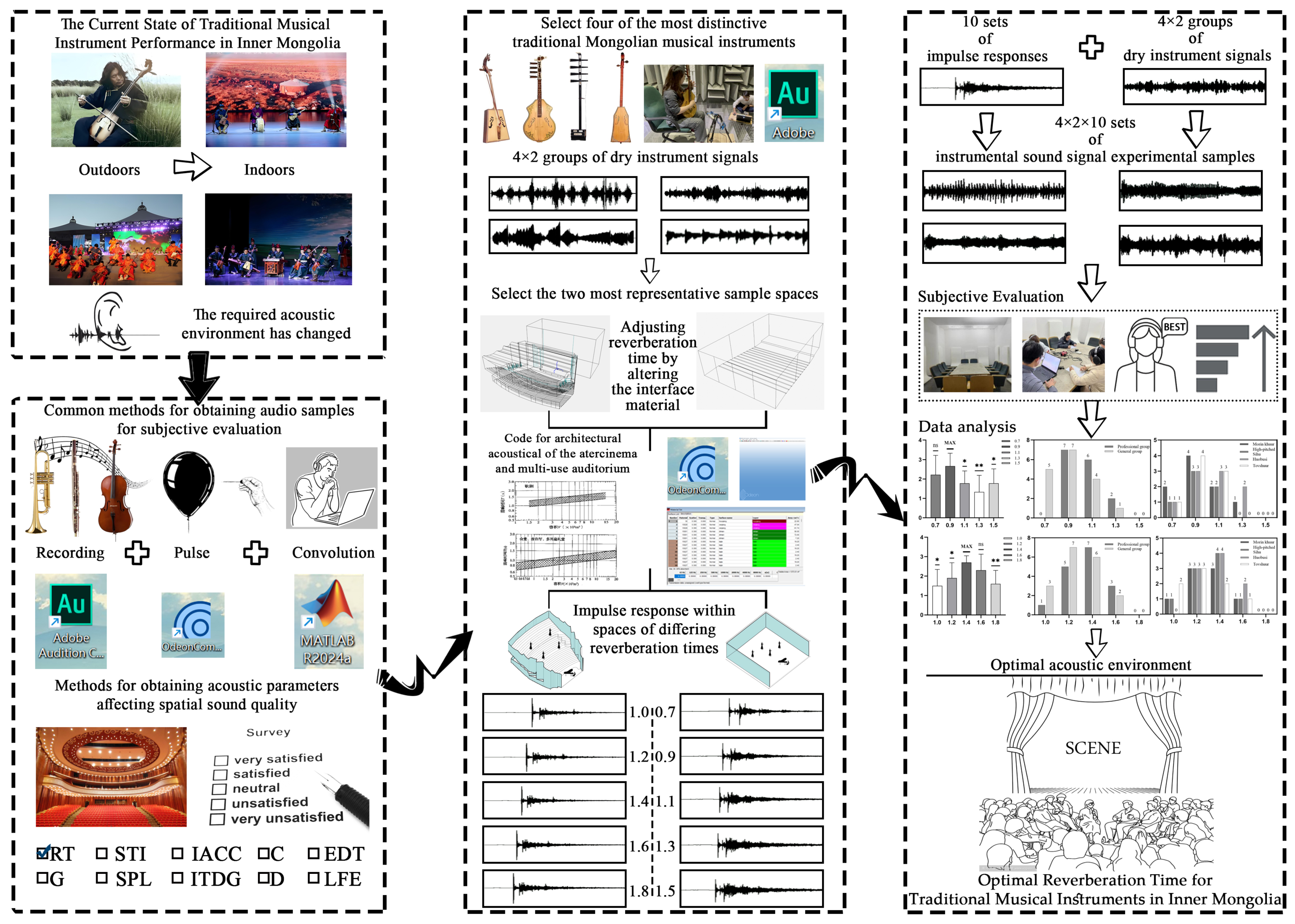
Two typical performance spaces and four representative instrumental excerpts were selected as the spatial models and experiment stimuli. By altering the material properties of the spatial surfaces, a series of impulse responses, corresponding to different reverberation times, was obtained. These impulse responses were subsequently convolved with music excerpts recorded in an anechoic chamber to generate the experimental stimuli. The resulting audio samples were employed in a subjective listening experiment, from which data were collected and analyzed. The procedures are presented in Figure 1.
Figure 1.
Experimental Procedure.
2.1. Model Selection and Parameter Setting
2.1.1. Selection of Models
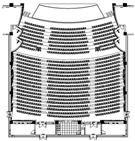
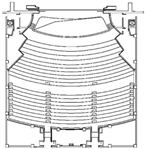
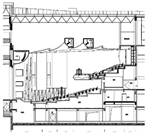
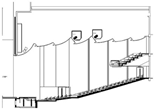
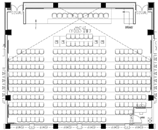
The diversity and complexity of performance space geometries directly influence their interior acoustic characteristics and the audience’s perceptual experience. Among the numerous spatial typologies, the rectangular and horseshoe-shaped configurations are two of the most widely adopted and representative archetypes. Rectangular halls, characterized by their regular geometry and relatively uniform sound field distribution, are commonly found in traditional theaters and multi-purpose auditoria. In contrast, horseshoe-shaped spaces emphasize visual intimacy and auditory envelopment. They are frequently employed in opera houses and venues that prioritize audiovisual interaction. These two typologies exhibit significant differences across acoustic parameters [25,26]. Therefore, several representative performance space types with clear distinctions in scale and morphology were considered in this study, from which two prototypical and acoustically balanced spaces (i.e., the Heze Theatre and Rectangular Space 2) were selected as the simulated spatial models for subsequent analysis. The details are presented in Appendix A (Table A1 and Table A2).
To prevent conclusions from applying solely to exceptional cases, highly representative and balanced spaces should be selected in terms of spatial dimensions, geometric configuration, interface materials, and fundamental acoustic parameters. This ensures that findings regarding optimal reverberation time remain applicable to the majority of practical scenarios rather than being confined to isolated instances. Hence, Heze Theatre and Rectangular Space 2 were chosen as the spatial samples for simulation in this experiment.
According to the “Code for Measurement of the Reverberation Time in Rooms” (GB/T 50076-2013) [27], the source and receiver positions were configured for the spatial models. In the theater model, the sound source positions for the individual instrumental signals were located on the stage centerline, 3 m behind the proscenium line, at a height of 1.5 m. In the rectangular space model, the sound source was placed at the center of the front edge of the podium, at a height of 1.5 m. For both models, the receiver positions were in the front seating area, ensuring a minimum distance of 1.5 m from the sidewalls and the central axis, with receiver height set at 1.5 m above the respective stepped floor level (Table 1). The sound source positions in both spatial models were configured to correspond to typical source locations used in actual performances, while the receiver positions were placed within the optimal audience listening area. The source and receiver heights were set to simulate the ear-level positions of a standing performer and a seated listener, respectively. In this experiment, the two performance spaces were modeled using computer software and subsequently imported into the acoustic simulation software Odeon9 for acoustic simulation and analysis.
Table 1.
Model information.
2.1.2. Classification of Reverberation Times for the Spatial Models
According to the “Code for Architectural Acoustical Design of Theater, Cinema and Multi-Use Auditorium” (GB/T 50356—2005) [28], the recommended reverberation times for theaters and multi-purpose halls, with volumes comparable to those of the spatial models in this study, are 1.1–1.6 s and 0.8–1.3 s, respectively, within the frequency range of 500 Hz to 1000 Hz. Furthermore, previous research indicates that the Just Noticeable Difference (JND) for reverberation time is ±10% of the nominal value [29]. To enhance the reliability and accuracy of the results, the reverberation time parameters were determined with comprehensive consideration of both the standards and JND. To improve perceptual distinguishability, the reverberation time intervals for the spatial models were set to 0.2 s, exceeding the JND threshold for reverberation time variation.
For each spatial model, five reverberation time values were selected. Three of these values fell within the recommended range specified by the Code, while the remaining two were chosen outside this range. By adopting this approach of sampling within and beyond the standard range, the selection of reverberation times was more comprehensive, reducing potential bias in the conclusions arising from a limited parameter range. Based on the above criteria, the reverberation times for the theater space were set at 1.0 s, 1.2 s, 1.4 s, 1.6 s, and 1.8 s, while those for the rectangular space were configured at 0.7 s, 0.9 s, 1.1 s, 1.3 s, and 1.5 s.
2.1.3. Model Parameter Setting
According to the Odeon user manual [30], the relevant parameters of the spatial models were configured as follows: 16,000 sound rays, a transition order of 2, an impulse response length of 2000 ms, and an impulse response sampling frequency of 0.12 s. The scattering coefficient of all the materials in the models was set to 0.3 [31]. The material parameters corresponding to each reverberation time for all frequency bands are listed in Table 2. With these parameters, the reverberation times of the theater space and the rectangular space were adjusted by varying the absorption coefficients of the surface materials (Table 3).
Table 2.
Sound absorption coefficients of various surfaces in spaces with different reverberation times at 500–1000 Hz.
Table 3.
Reverberation times at various frequencies for the model.
2.1.4. Impulse Responses in the Spatial Models
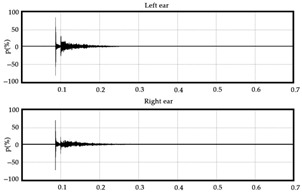
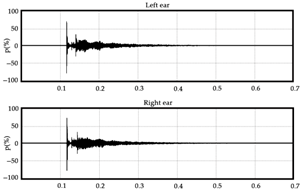
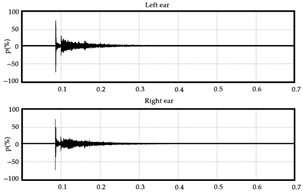
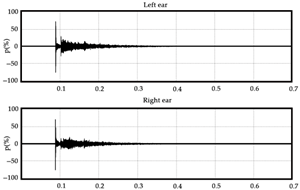
The impulse responses obtained at different reverberation times in the two model spaces are demonstrated in Table 4.
Table 4.
Impulse responses at different reverberation times in the model space.
2.2. The Selection of Experimental Stimuli and Players
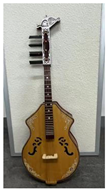
According to The Chronicles of Chinese Quyi: Inner Mongolia Edition and Traditional Musical Instruments of the Mongol Ethnic group [1,33], the musical instruments of Inner Mongolia exhibit strong regional characteristics, with significant differences in timbre and expressive capability across instrument types. Based on literature review [34,35,36] and an investigation of the performance frequency of instruments in local ensembles, solo pieces of the most representative traditional Inner Mongolian instruments, specifically plucked string instruments (huobusi and tovshuur) and bowed string instruments (morin khuur and high-pitched sihu), were selected as the experimental stimuli (Table 5).
Table 5.
Instrument details.
For each instrument, two musical excerpts with contrasting tempi (slow and fast) were selected to ensure that experimental results would not be biased by differences in tempo, timbre, or pitch. The excerpts were segmented based on the frequency characteristics and playing techniques of the pieces, ensuring the continuity and integrity of the musical content. Excerpts were taken from sections that were neither the beginning nor the end of the compositions, thereby maximizing the stability of the experimental stimuli. All dry audio signals in this experiment were recorded in an anechoic chamber, and all players were professional performers from the Inner Mongolia Folk Music Ensemble. The music excerpts selected for each instrument are presented in Table 6.
Table 6.
Audio characteristics of experimental music.
2.3. Experimental Instruments and Site
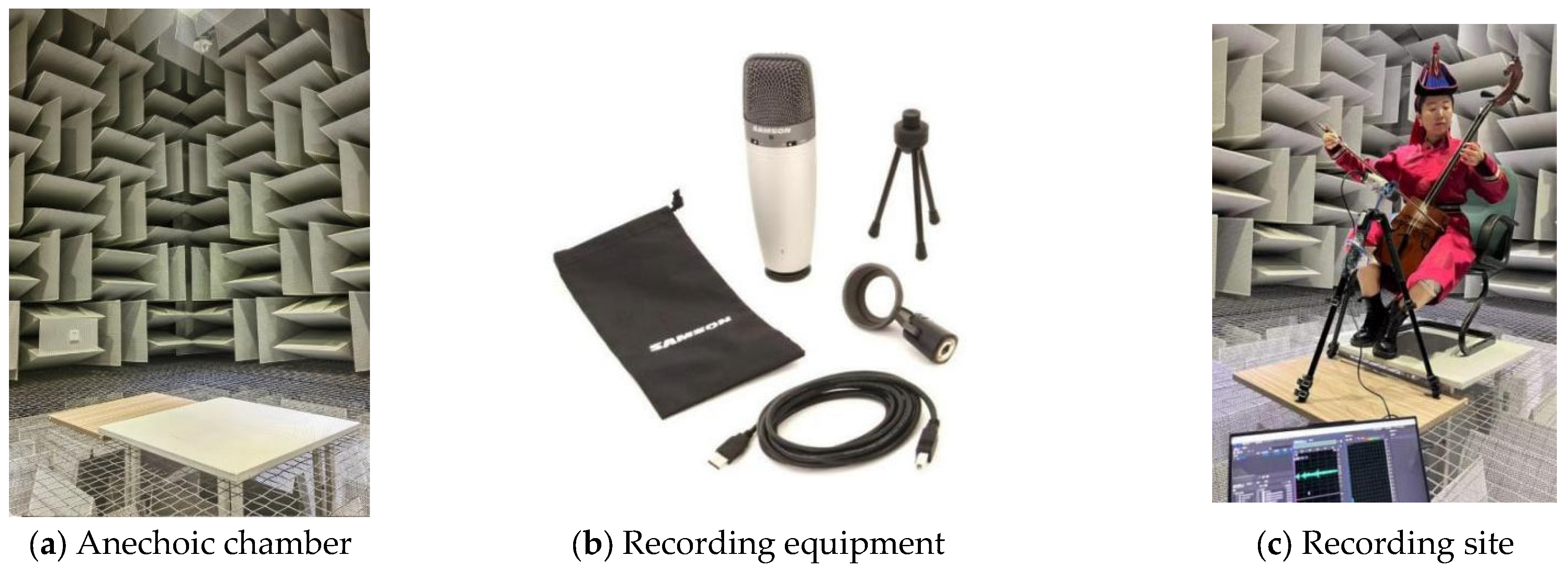
The dry signals needed for the experiment should be recorded in an anechoic chamber or a semi-anechoic chamber. Hence, a full anechoic chamber at the College of Architecture, Inner Mongolia University of Technology, was selected as the experimental site. The chamber’s clear-space dimensions were 3.9 m (length) × 3.65 m (width) × 3.25 m (height), and the background noise conformed to the NR-15 curve, with a cutoff frequency of 100 Hz. A consistent recording setup was employed. The microphone used was a SAMSON-C03U, positioned directly in front of the sound-producing body of the instrument at a seated playing height, with a fixed source-to-microphone distance of 10 cm. The recorded loudness levels ranged from 75–95 dB. Recordings were performed at a sampling frequency of 44.1 kHz, with a 32-bit depth. Both instruments were initially recorded in stereo; subsequently, the stereo dry signals were downmixed to mono. The final dry signals were stored in the.wav format. Throughout the recording process, the environment was kept silent, ensuring that no extraneous noise influenced the captured signals (Figure 2).
Figure 2.
Experimental instruments and facilities.
2.4. Preparation of Experimental Stimuli
The dry signals of traditional Inner Mongolian musical instruments, recorded in a full anechoic chamber, were convolved with room impulse responses (RIRs) generated via computational acoustic simulation, using MATLAB R2024a, to produce the audio samples for the listening experiment. Based on the selected reverberation times, each instrument within each simulated space yielded 2 × 2 × 5 audio files. A total of 2 × 2 × 5 × 4 audio samples were generated. The MATLAB convolution equation is as follows:
- (1)
- Import dry audio signal and impulse response
- (2)
- [y,fs] = audioread(‘D:\Files\Mongolian Folk Arts\Reverb\01Dry Model Import\Four-stringed Fiddle\Fast Melody.wav’);
- (3)
- [x,fs] = audioread(‘D:\Files\Mongolian Folk Arts\Reverb\03Sound Impulse\Rectangular Room Impulse\Four-stringed Fiddle\Long Melody 1516.1 Left Channel.Wav’);
- (4)
- Assigned coefficients: x1 = x × 0.5; y1 = y × 0.6;
- (5)
- Perform convolution: mix=conv(y1,x1);
- (6)
- Generate audio files: audiowrite(‘D:\Files\Mongolian Performing Arts\Reverb\04 Sound Convolution\Rectangular Space Erhu 1516 Left Channel.wav’, mix, fs);
2.5. Subjective Listening Experiment
This experiment employed the paired-comparison method [37], requiring evaluators to choose from a pair of samples one that was more aligned with a certain criterion, obtaining their preference for stimuli or their judgment of the differences. Pairs of audio samples derived from the same source material yet processed with different reverberation conditions were presented for paired-comparison preference judgments. Based on the listeners’ preference responses, the relative preference levels corresponding to each reverberation condition were calculated. Hence, the optimal reverberation range for each instrument was identified.
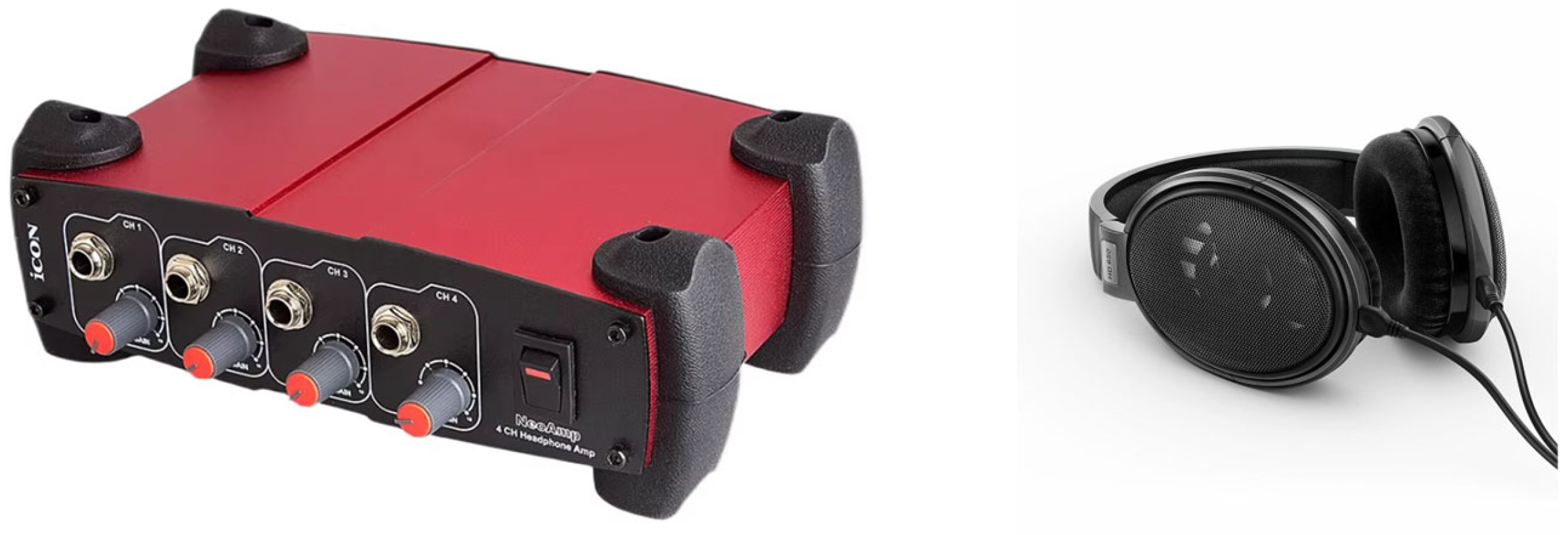
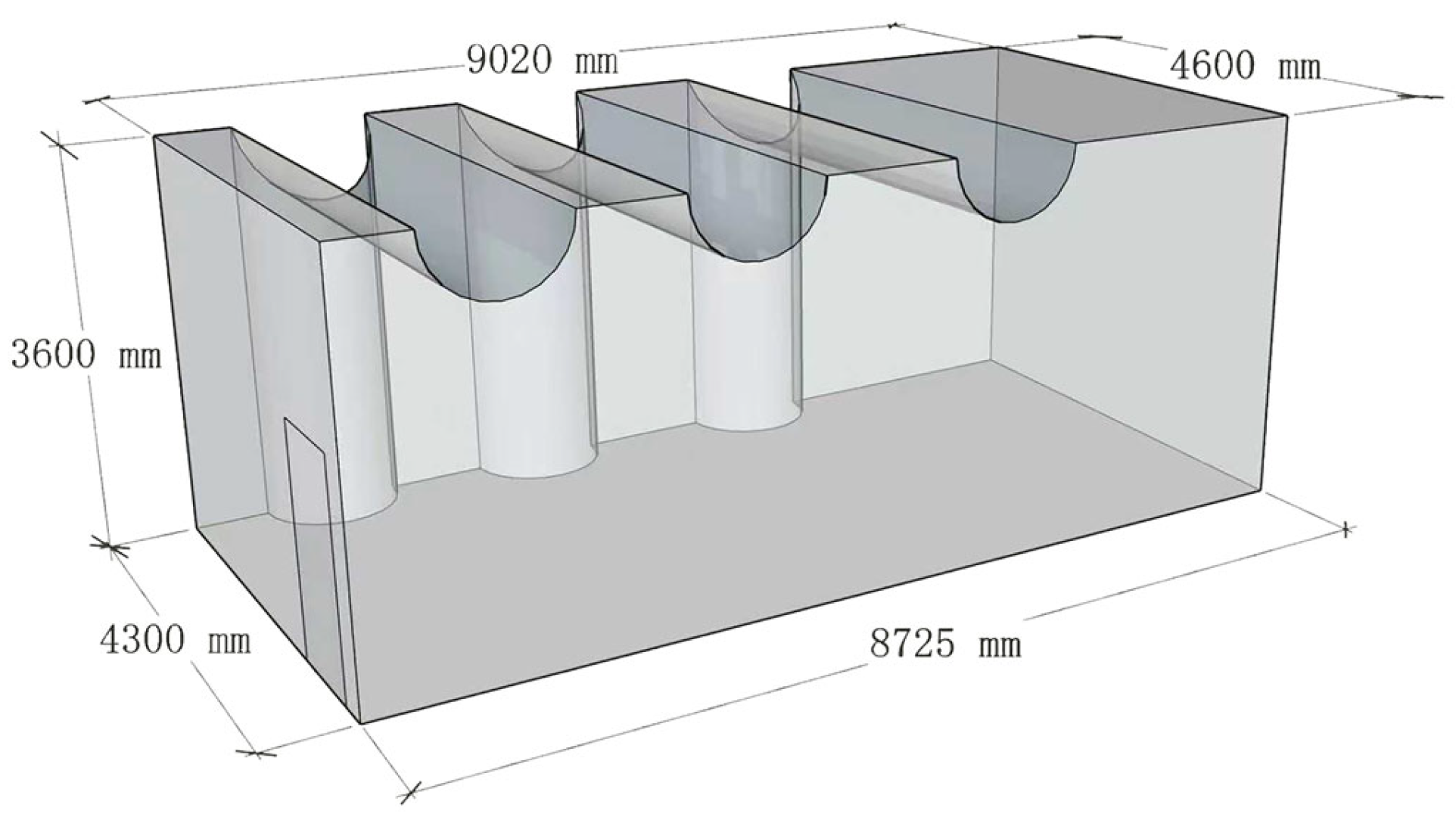
The experimental venue selected was an existing laboratory at Inner Mongolia University of Technology, measuring 8.9 m × 4.5 m × 3.6 m with a background noise level of 35 dB (Figure 3). Acoustic absorbers measuring 2 m in length, 1 m in width, and 0.1 m in thickness were positioned in the laboratory to fulfil the environmental requirements of the experiment. The apparatus employed comprised one laptop computer, four Sennheiser HD650 Hi-Fi headphones, and one ICON NEO AMP four-channel headphone amplifier (Figure 4). Professional-grade audio equipment was used, with headphone output calibrated to international standards for sound pressure level, ensuring subjects received 65 dB SPL. The audio played through the headphones was at 44.1 kHz, in stereo (left and right channels), closely matching the conditions of a real-world performance space that is free from external interference. The reverberation times corresponding to each condition are presented in Table 7.
Figure 3.
Laboratory.
Figure 4.
Laboratory equipment.
Table 7.
Reverberation times for each octave band.
The audio samples were categorized according to spatial type, instrument type, and tempo. For each instrument, musical excerpts were paired across different reverberation times to form two-by-two combinations. In each simulated space, 10 possible stimulus pairs were generated through random combination. Considering two tempo conditions of fast and slow, 20 pairs of audio samples were produced. In total, 80 pairs of stimuli were created for the four instruments. With two spatial conditions, the experiment comprised 160 pairs of audio samples (Table 8).
Table 8.
Basic pairing table for different reverberation times.
During the experiment, audio samples of each instrument with different reverberation times were randomly paired to form two-by-two combinations. Five randomized presentation sequences (groups I–V) were generated, ensuring that each group of participants listened to the stimuli in a unique order. To minimize auditory fatigue, each group chose only one spatial condition for listening. In total, eight sets of audio stimuli were prepared (8 × 5 × 2 musical excerpts). Participants were given an 8-min rest period between every two listening sessions, and the duration of each complete experimental session was approximately one hour.
The participants were divided into two groups: musically trained students who had received formal music education, and untrained students with no prior musical training. All the participants had normal hearing. After the playback of each audio pair, listeners were asked to report their preference for the perceived reverberation characteristics of the samples. A total of 44 participants took part in the experiment, including 24 musically trained and 20 untrained listeners. Detailed information on the subjects is provided in Table 9.
Table 9.
Basic Information of Subjects.
This study was conducted in accordance with the Declaration of Helsinki. The protocol was approved by the IMUT-ARCH-2025-012 Ethics Committee on 14 November 2025.
Participants were organized into 11 groups of four individuals each. The listening tests were conducted in a laboratory where the participants listened to sound signals with different reverberation times using headphones. Each group’s experimental session lasted approximately one hour. Each participant evaluated 80 pairs of audio samples, with each pair consisting of two identical sound excerpts differing only in reverberation time. After listening to each pair, the participant was instructed to immediately indicate which sample “sounded better” by marking “√” under the preferred stimulus. All the responses were statistically analyzed to determine the optimal range of reverberation times.
2.6. Data Validation Methods
2.6.1. Circular Triad Analysis
To eliminate erroneous judgments and enhance the reliability of the statistical analysis [38,39], this study employed circular triad analysis. The method examines the relationships among participants’ circular evaluations of three sound samples. The calculation is expressed as Equation (1):
Let three audio samples with different reverberation conditions be denoted as i, j, and k. During paired-comparison judgments, a circular triad occurs if any of the following three conditions are observed:
- Pij > 0 and Pjk ≥ 0, but Pik ≤ 0
- Pij = 0, but Pik ≠ Pjk
- Pij < 0 and Pjk ≤ 0, but Pik ≥ 0
In this experiment, the differences between audio samples were relatively subtle, and the judgment task was highly demanding, requiring the participants to maintain a high attention level. Therefore, a consistency coefficient in the range of 0.6–0.7 was selected as the threshold for experimental data validation [38,39]. An auxiliary check was performed based on the average consistency coefficient. If the average consistency coefficient exceeded 0.75 [40], results with a consistency coefficient below 0.6 were discarded. Conversely, if the average consistency coefficient was below 0.75, results with consistency coefficients below 0.7 were removed. The remaining data possessed high reliability.
2.6.2. Mean Value Analysis
After the removal of erroneous data, the evaluation results from the valid participants were aggregated for statistical analysis. For each paired comparison, the two audio samples within the same comparison group were assigned a binary score (“0–1”), where a higher score indicated a stronger subjective preference for that sample. Once all the comparisons were scored, the preference values for the same sample across all valid participants were summed and averaged arithmetically to obtain the final preference score for each audio sample.
2.6.3. One-Sample t-Tests
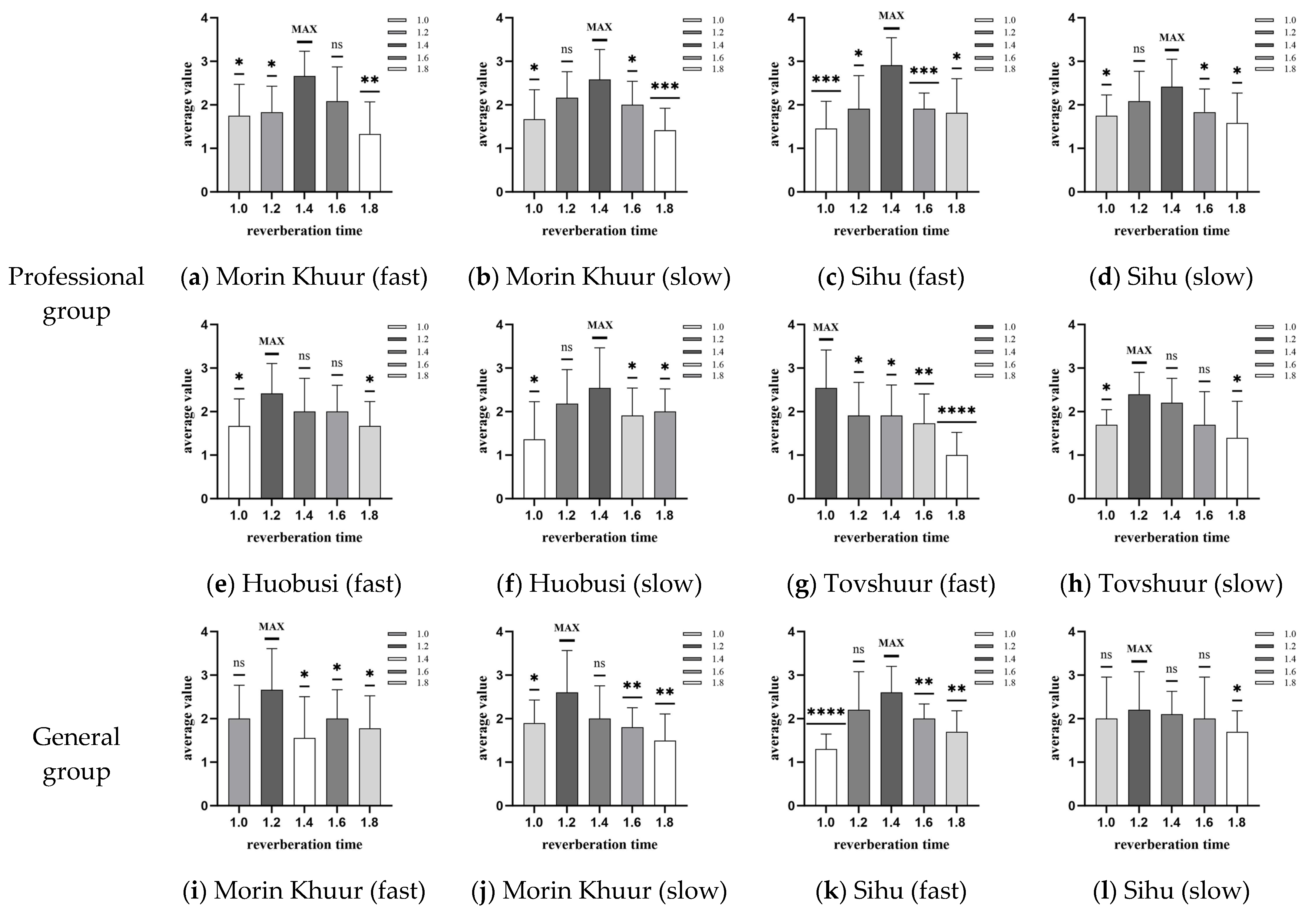
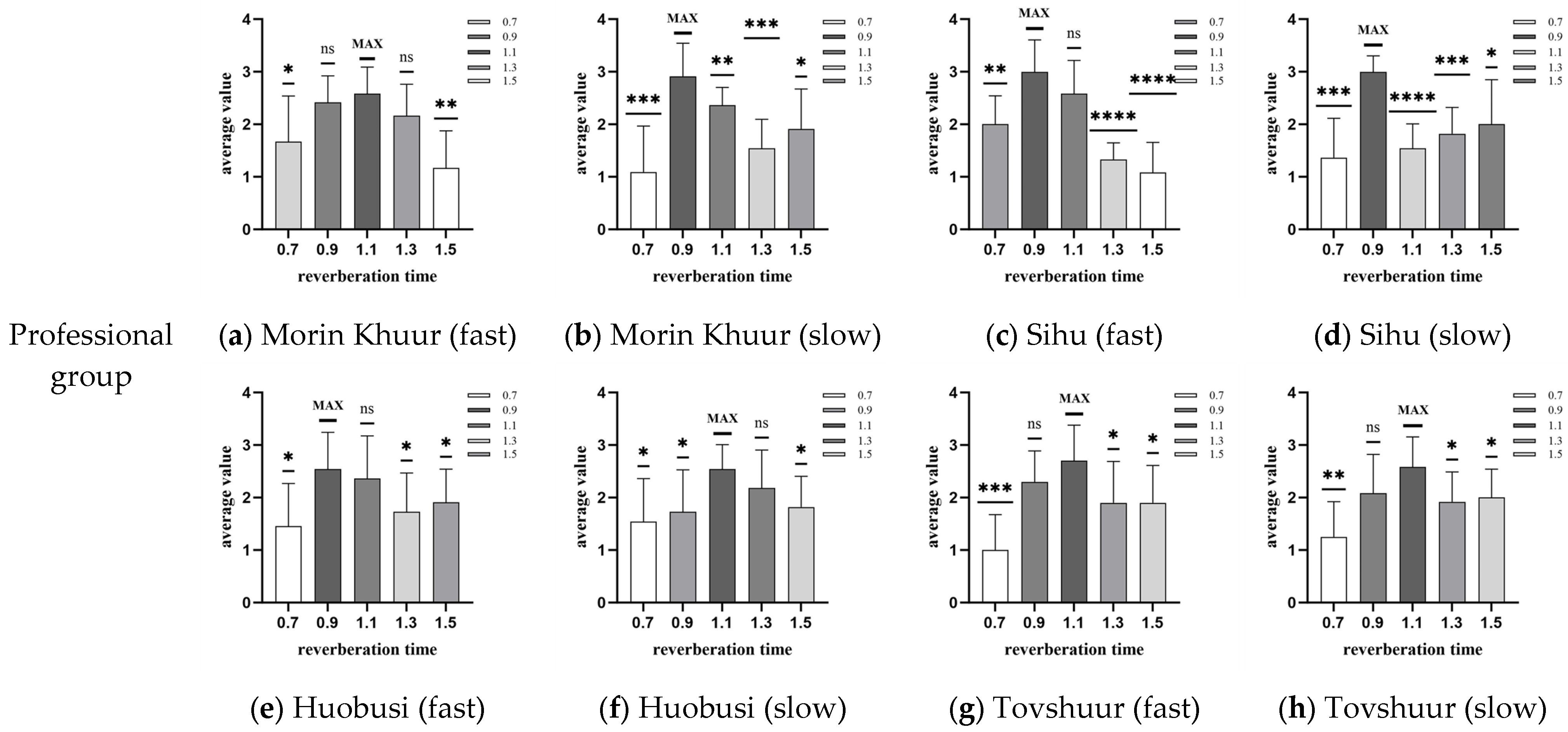
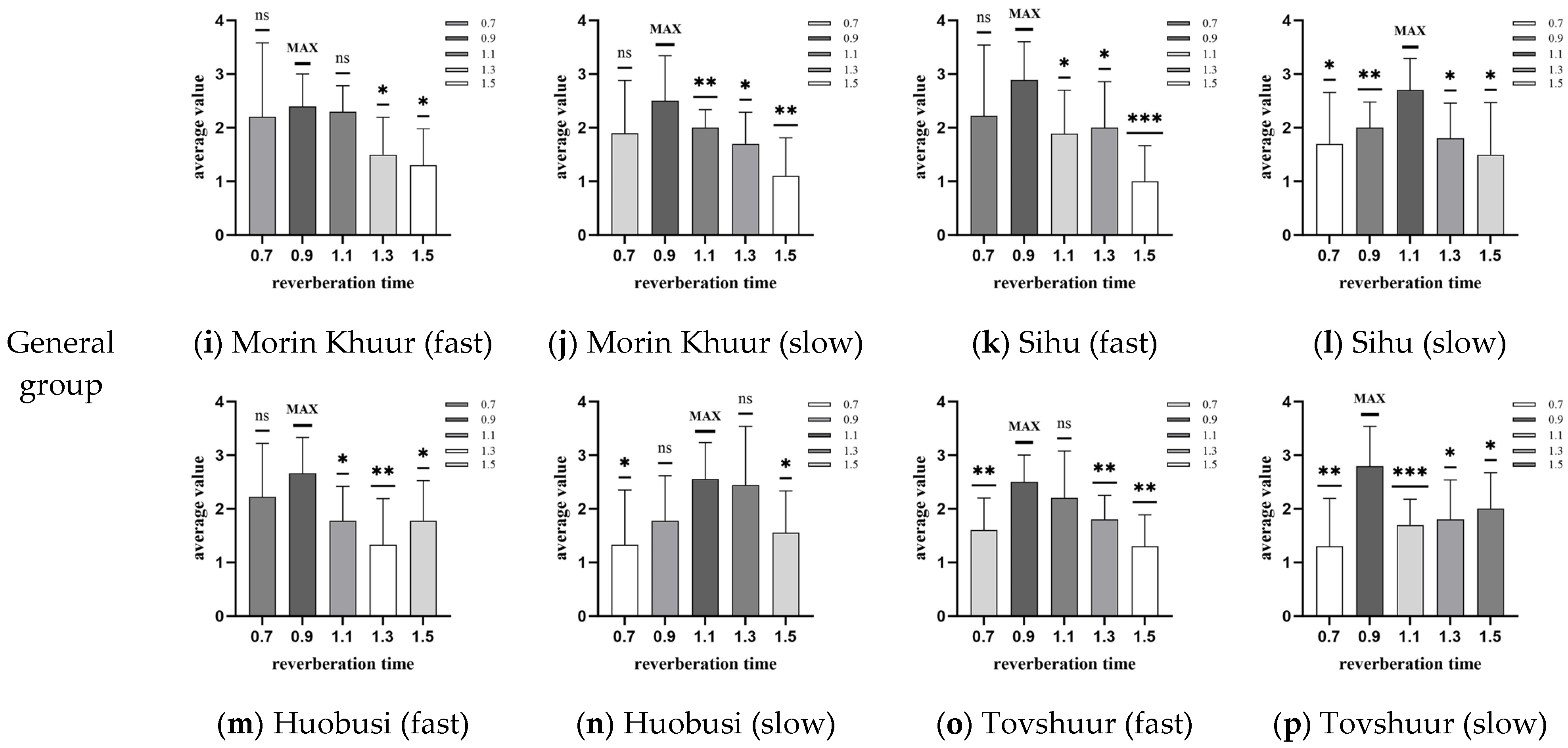
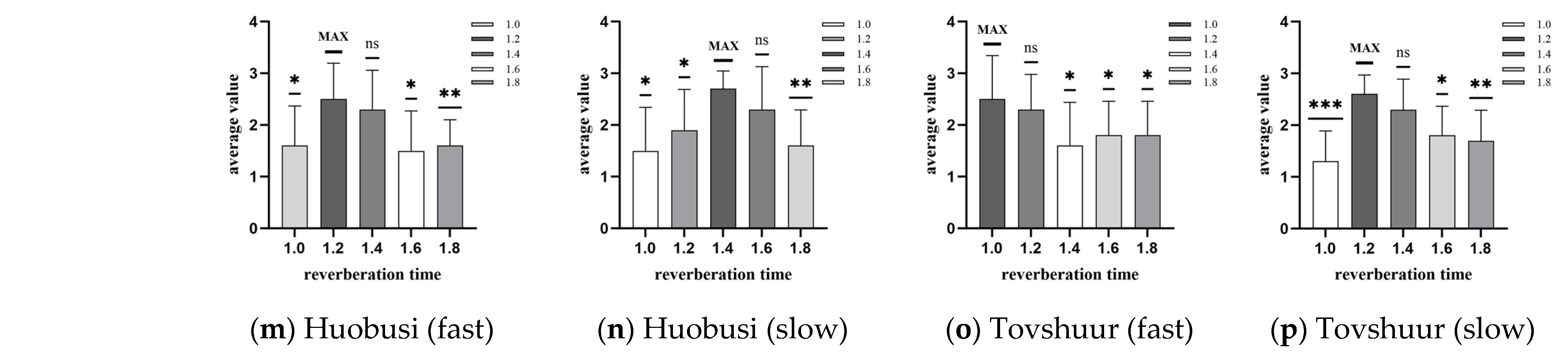
Statistically, the highest preference score does not necessarily indicate the optimal value. It is necessary to analyze whether this score differs significantly from the mean scores of other reverberation times for the same stimulus. Therefore, t-tests were conducted to compare, for each experimental stimuli, the reverberation condition corresponding to the highest mean score, with the other four reverberation conditions. This analysis was performed separately for the musically trained and the untrained group. The results are presented in Figure 5 and Figure 6.

Figure 5.
Results of the t-test for the mean of the rectangular space (Max denotes maximum mean, ns denotes no significant difference, * denotes significant difference, with more * indicating greater significance. The results were calculated using the statistical software IBM SPSS Statistics 27.01, with a confidence interval of 95%).

Figure 6.
Results of the t-test for the mean of the theatre Space (Max denotes maximum mean, ns denotes no significant difference, * denotes significant difference, with more * indicating greater significance. The results were calculated using the statistical software SPSS, with a confidence interval of 95%).
As shown in the figures, the significance of the t-test under different spatial conditions and reverberation times influences the determination of the optimal reverberation time range. Whether the highest mean preference score is statistically significantly different from the other mean scores determines the optimal range for each musical excerpt. Specifically, if the mean score of any sample, other than the highest, is significantly higher than the score of the sample with the maximum mean, a significant difference is considered to exist; otherwise, no significant difference is assumed. This procedure allows the identification of the optimal reverberation time for each instrument.
3. Results
The above analysis revealed that instrument type, music tempo, and participant group likely influenced the evaluation of reverberation time. These three factors were further analyzed to discuss the extent to which each factor affected the subjective evaluation of reverberation time. The optimal values of reverberation times under the comprehensive influence of the three factors were analyzed as well.
3.1. Optimal Values of Reverberation Times
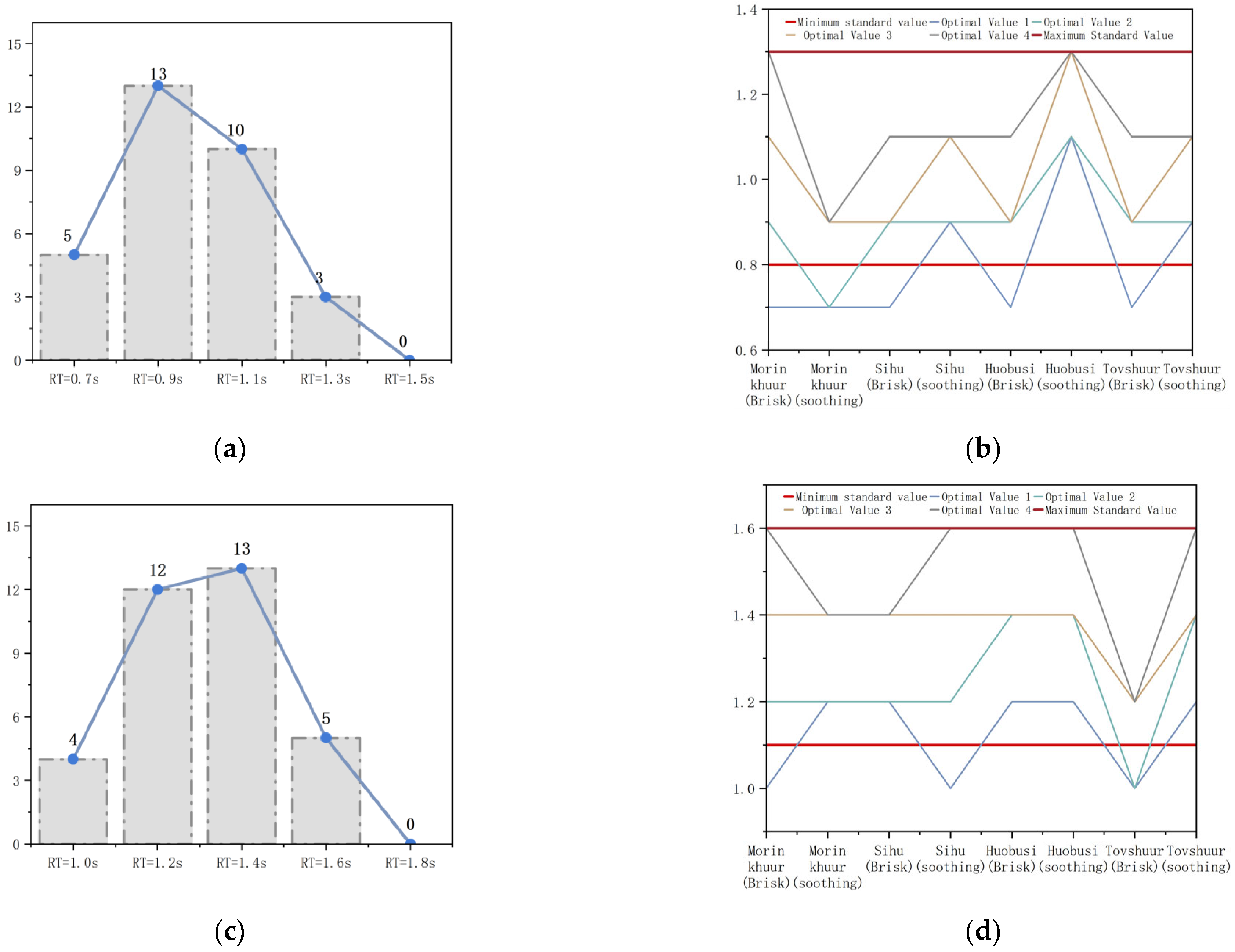
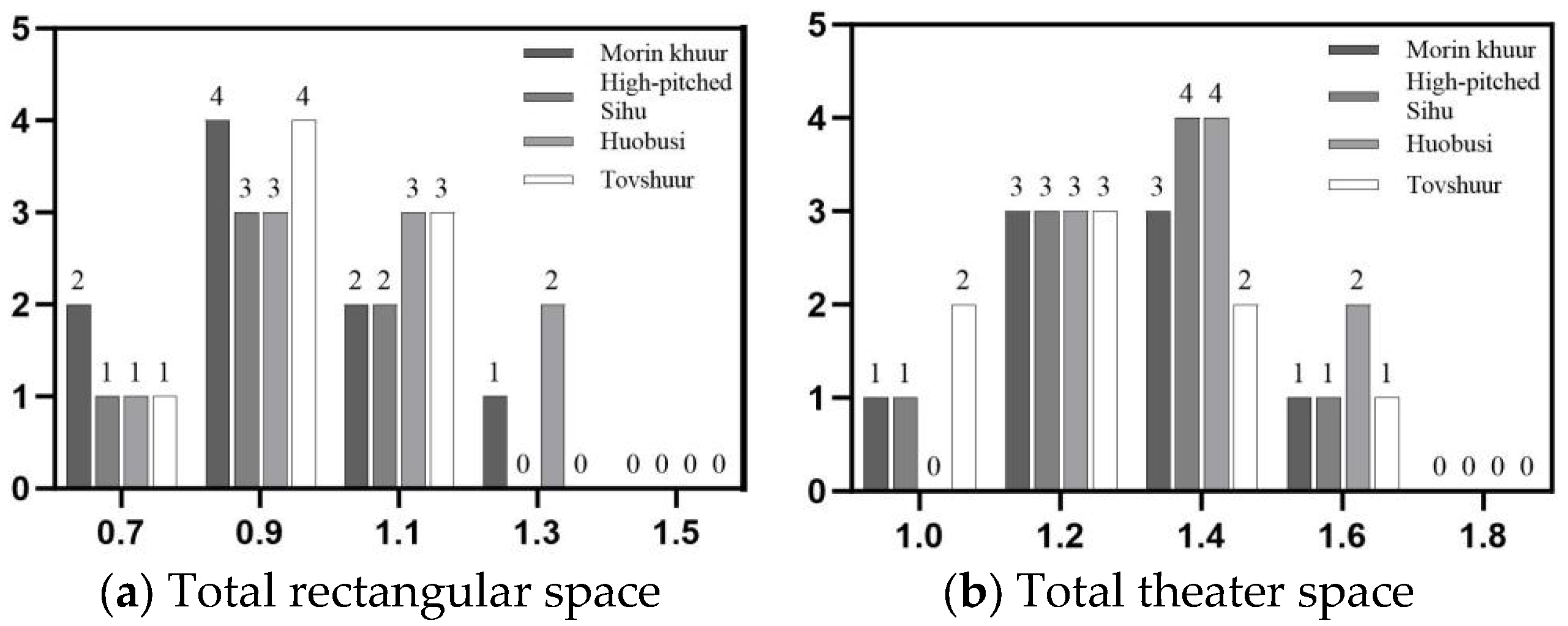
Using the highest mean value as a reference, values not exhibiting statistically significant differences from this maximum were retained, while those showing significant deviations were excluded. This procedure yielded optimal reverberation time (RT) ranges concentrated around 0.9–1.1 s for the rectangular space and 1.2–1.5 s for the theater space. Overall, the results fall within the optimal ranges specified by existing standards, with a tendency toward relatively shorter reverberation times. The results are presented in Table 10 and Figure 7.
Table 10.
Preferred reverb time values.
Figure 7.
Statistical chart of optimal reverberation times. (a) Total optimal values for rectangular spaces. (b) Comparison with the standard 3000 m3 multi-purpose hall reverberation time. (c) Total optimal values for theater spaces. (d) Comparison with the standard 12,000 m3 theater space reverberation time.
3.2. Optimal Reverberation Times for Different Instruments
Classification and statistical analysis of the optimal reverberation times for different musical instruments in the two representative performance spaces indicated that, in the rectangular space, the optimal reverberation times for four instrument types were generally concentrated around 0.9 s, except huobusi, whose optimal range extended to 1.1 s. In the theater space, the optimal reverberation times were 1.2 s for morin khuur, and tovshuur, and 1.4 s for high-pitched sihu and huobusi. Detailed values are presented in Table 11 and Figure 8.
Table 11.
Optimal reverberation time ranking for different instruments.
Figure 8.
Preference distribution of reverberation times for different instruments.
3.3. Optimal Reverberation Times Across Participant Groups
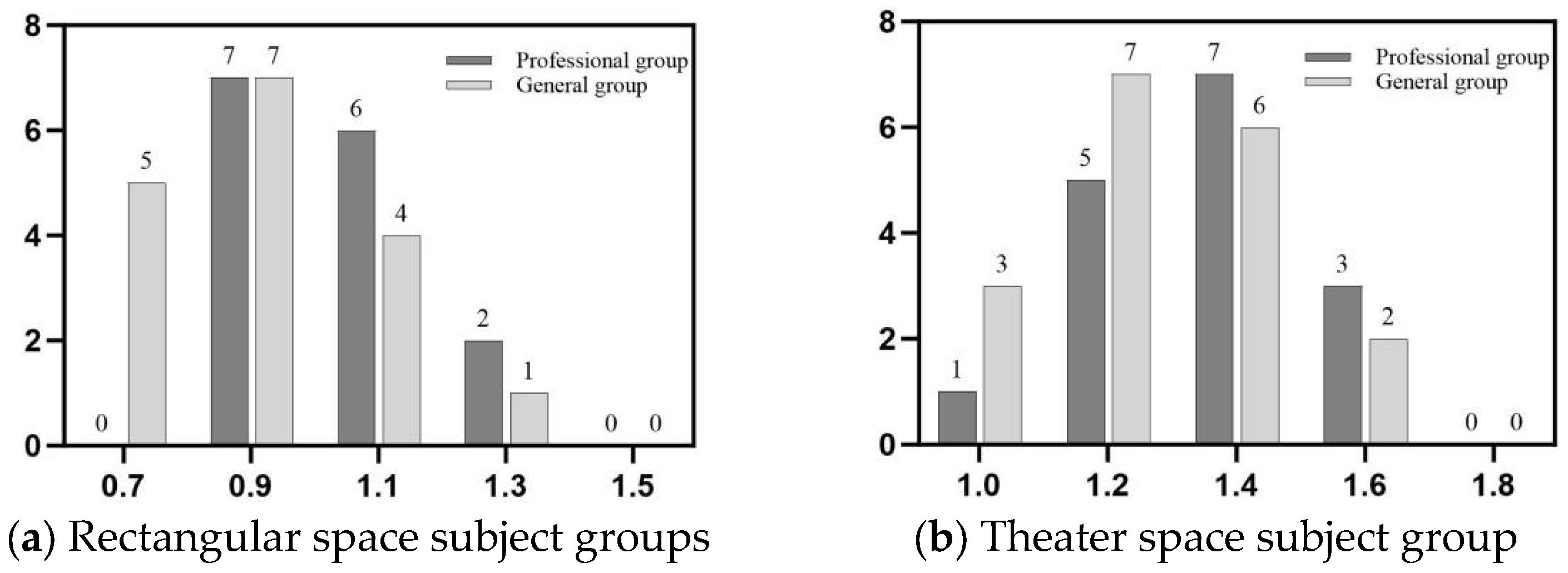
Classification and statistical analysis of the optimal reverberation times across different participant groups in two representative performance spaces revealed that, in the rectangular space, both professional and general participants predominantly selected a reverberation time of 0.9 s, with the general group exhibiting a wider selection range and the professional group demonstrating more concentrated choices. In the theater space, the professional group’s preferred reverberation time was 1.4 s, with 1.2 s chosen almost as frequently, whereas the general group most frequently selected a reverberation time of 1.2 s, followed by 1.4 s, indicating a preference for slightly shorter reverberation times among general listeners. Detailed results are provided in Table 12 and Figure 9.
Table 12.
Optimal ranking of reverberation values across different subject groups.
Figure 9.
Reverb value selection patterns for different subject groups.
3.4. Optimal Reverberation Times Based on Musical Tempo
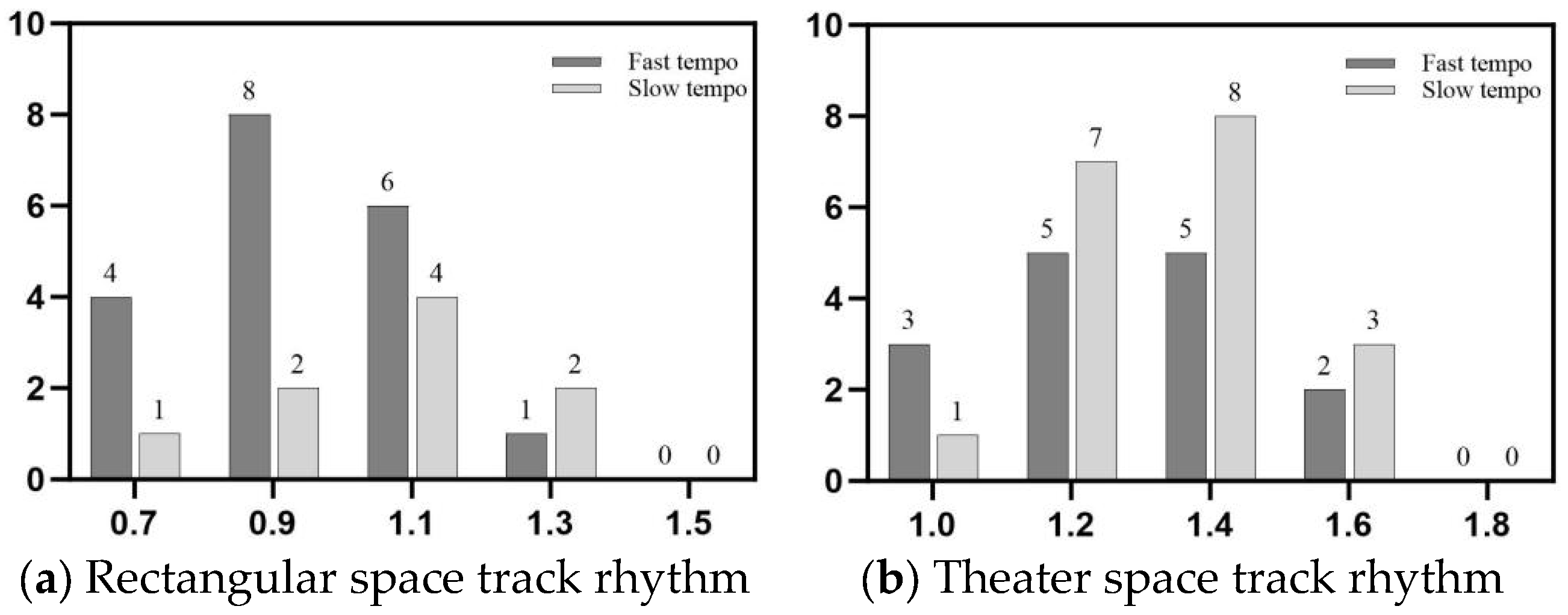
Classification and statistical analysis of optimal reverberation times in the two representative performance spaces based on musical tempo indicated that, in the rectangular space, the preferred reverberation time was 0.9 s. In the theater space, faster tempo pieces were associated with an optimal reverberation time of 1.2 s, whereas slower tempo pieces favored a reverberation time of 1.4 s. These results suggest that faster-tempo music prefers shorter reverberation times, while slower-tempo music benefits from longer reverberation times. Detailed data are presented in Table 13 and Figure 10.
Table 13.
Optimal reverb time sorting by track tempo.
Figure 10.
Preferred reverberation time values for different track rhythms.
4. Discussion
Regarding the influence of different factors, this study adopted an instrument-centered approach, integrating considerations such as the number of strings, sound production location, and register characteristics. The analysis indicated that, although the four instruments shared certain commonalities in their physical construction and acoustic characteristics, they exhibited distinctive differences. When balancing the preservation of timbral richness and clarity, there was a shared fundamental requirement for the acoustic environment, which resulted in similar preferences for optimal parameter values. However, due to the unique structural properties and instrument-specific performance dynamics, preferences for other acoustic parameters did not exhibit statistically significant patterns. This suggested that the acoustic environment contributing to optimal musical perception in performance spaces exhibited commonalities across instruments, while inter-instrument variability generated preferences that did not follow certain patterns.
In the rectangular space, the professional participants exhibited more concentrated choices than the general participants. This is attributable to professionals’ extensive experience of performing in diverse acoustic environments, which enhanced their sensitivity to reverberation and ability to discern its effects. Professionals could more accurately perceive how reverberation influenced timbre, spatial impression, and musical expression, and demonstrated superior discrimination of variations in reverberation time across different musical passages.
In contrast, the general participants exhibited lower sensitivity to reverberation. In some cases, they were unable to detect differences in reverberation time between pieces, resulting in a broader distribution of choices. In the theater space, the general participants preferred shorter reverberation times. This may be because their limited ability to discern variations in reverberation time shifted their focus toward aspects such as clarity. In environments with shorter reverberation, the sound can appear somewhat dry or unnatural, which allows professional participants to clearly perceive deficiencies in instrumental performance. Non-professional listeners, however, are not able to detect these nuances, which can influence the results.
For slower-tempo pieces, individual notes had longer durations and a stronger sense of spatial impression. Higher reverberation enhanced continuity, warmth, and emotional expressiveness in the sound. Conversely, faster-tempo pieces featured more compact and rapid rhythms, often exhibiting a wider dynamic range. Lower reverberation was more effective at preserving this dynamic range, allowing each note and beat to be perceived with greater clarity and definition. Consequently, during preference selection, participants favored higher reverberation for slower pieces, whereas faster pieces elicited a preference for lower reverberation.
The “Code for Architectural Acoustical Design of Theater, Cinema and Multi-Use Auditorium” (GB/T 50356—2005) specifies optimal reverberation time ranges for different performance spaces. According to this standard, for the theater space examined in this study, when it is used for drama, the recommended reverberation time is 1.1–1.6 s, with 1.3–1.5 s for opera, and 1.8–2.0 s for symphonic music. For the multi-purpose hall, the suggested reverberation time is 0.8–1.3 s. This study found that, for traditional Inner Mongolian instruments performing in a theater of this scale, the optimal reverberation time ranged from 1.2–1.4 s, whereas in a multi-purpose hall, it was 0.9–1.1 s. These results fall within the limits specified by the standard; however, they are slightly lower than the recommended mean values and exhibit a more concentrated distribution. The reason may be related to the historical development of the instruments.
Traditional instruments from Inner Mongolia were originally performed in non-fixed environments. Early inhabitants of the region primarily practiced nomadism and hunting, residing mainly in tents. Hence, these instruments were designed to be playable both indoors and outdoors, with indoors generally being small and exhibiting relatively short reverberation times. Consequently, the evolution of these instruments and their music composition was adapted to environments with short reverberation [29]. After the establishment of the People’s Republic of China, traditional instruments were gradually performed in professional performance spaces. However, the characteristics of short reverberation that were embedded in the development of the instruments and their music remained deeply ingrained. As a result, when participants made comparative selections, they preferred audio samples with shorter reverberation times in the ranges specified by the standard.
Based on this study, it is possible to further determine the suitable reverberation time ranges for traditional Inner Mongolian instruments when performing in spaces of different volumes and geometries. Generally, an increase in room volume leads to a corresponding lengthening of reverberation time; however, excessively long reverberation can mask the instruments’ unique timbral characteristics and reduce the clarity of the music. Therefore, optimal reverberation ranges should be established according to the type of instrument and the nature of the musical content. Additionally, the geometry of a space can influence the perception of reverberation and the blending of timbre. In the rectangular space, the preferred reverberation times were more concentrated than in the theater space. This may be attributed to the effects of room volume and the complexity of spatial geometry. Previous studies have shown that sound fields in complex geometries exhibit higher diffusion compared with those in simpler forms [41]. When room volumes are similar, elongated spaces are prone to flutter echoes, which can interfere with the musical coherence, whereas centrally symmetric or well-diffused geometries facilitate the formation of a uniform sound field. In such spaces, reverberation time can more effectively enhance spatial impression and the fullness of sound within a reasonable range [42]. Future research should integrate the acoustic characteristics of the instruments with the geometrical features of performance spaces to establish preliminary recommended reverberation time ranges for traditional Inner Mongolian music performances. This framework provides theoretical guidance and practical reference for the acoustic design of professional concert halls, theaters, and multi-purpose halls. It enhances the auditory experience while ensuring optimal and authentic presentation of traditional music.
5. Conclusions
In this study, experimental stimuli were generated by convolving impulse responses and instrumental audio recordings at different reverberation times in two selected spaces: a multi-purpose hall, with a volume of 3000 m3, and a theater space, with a volume of 12,000 m3. A subjective preference evaluation was conducted, in which participants selected their preferred sound samples of traditional musical instruments from Inner Mongolia. The experimental data were statistically analyzed, leading to the following conclusions:
- (1)
- Regarding instrument types, the optimal values for all four instruments in the rectangular space were 0.9 s, while those in the theater space were 1.2 s and 1.4 s. Other options did not follow certain patterns due to multiple factors.
- (2)
- Regarding the participant group, in the rectangular space, the optimal values for both groups were 0.9 s, while those for the professional and general groups in the theater space were 1.4 s and 1.2 s, respectively. In both spaces, the general group exhibited a larger range of preferred choices, and the professional group demonstrated preferences for higher reverberation.
- (3)
- Regarding the temporal characteristics of the musical pieces, in the rectangular space, the preferred reverberation time for all samples was 0.9 s. In the theatre space, faster-tempo samples were associated with a reverberation time of 1.2 s, whereas slower-tempo samples were associated with a reverberation time of 1.4 s. Faster-tempo compositions favored shorter reverberation times, while slower-tempo compositions were preferred with longer reverberation times.
- (4)
- In the subjective listening experiment, participants evaluated audio stimuli at varying reverberation times, and generated by convolving dry recordings of traditional Inner Mongolian musical instruments with impulse responses obtained from computationally simulated spatial models. The results indicated that the optimal reverberation times for the selected instruments were 1.2 s and 1.4 s in the theater space, and 0.9 s and 1.1 s in the rectangular space.
This study took the optimal acoustic conditions for traditional Inner Mongolian musical instruments in performance spaces as a starting point. By combining computational acoustic simulations with subjective preference experiments, it is the first to determine the optimal reverberation times for representative instruments, including the morin khuur, high-pitched sihu, huobusi, and tovshuur, when performed in a multi-purpose hall, with a volume of 3000 m3, and a theater space, with a volume of 15,000 m3. Although these optimal values fall within the recommended ranges specified by national standards for theatrical performance in spaces of comparable volume, their distribution may slightly lower than the mean of the standard-recommended values. This discrepancy highlights the subtle differences between the unique acoustic characteristics of traditional Inner Mongolian instruments and generalized national criteria. Therefore, the relatively lower range of optimal reverberation times identified in this study can be an ideal choice to preserve the clarity of the instruments’ distinctive timbres while maintaining adequate spatial impression. This study provides detailed acoustic parameters for professional performance spaces dedicated to traditional Mongolian instruments, which may serve as a direct basis for the acoustic design of such venues. Furthermore, this research outlines methodologies for establishing fundamental acoustic parameters for designing multifunctional integrated performance spaces. While prioritizing the acoustic requirements for traditional instrument performances, it employs adjustable technologies to enable flexible control of reverberation time, thereby accommodating diverse performance genres. This outcome facilitates optimization of the design process of performance venues, reduces construction costs and long-term operational complexity, and promotes the integration of artistic impact with economic efficiency, demonstrating clear practical significance.
The spatial samples selected for this study represent only relatively typical spatial configurations. Research into spaces with significantly larger or smaller volumes, more unusual shapes, or distinctive interface designs will be explored in greater depth in subsequent investigations. Furthermore, the musical instruments and sound samples were limited to those commonly found in and representative of Inner Mongolia. Regarding participant selection, the audience for the subjective listening experiments primarily comprised specialists in relevant fields and undergraduate students. The sample size and cultural background were relatively concentrated, lacking large-scale validation across broader age groups and diverse cultural contexts. The effects arising from the aforementioned spatial types, instrument categories, number of strings, and distinct sonic characteristics will be further analyzed in subsequent research.
Author Contributions
Conceptualization, X.Y. and X.Z.; Formal analysis, X.Y. and X.Z.; Funding acquisition, X.Z.; Investigation, X.Y., S.N., Z.Q., D.Y. and Z.X.; Methodology, X.Y.; Supervision, X.Z.; Visualization, X.Y.; Writing—original draft, X.Y.; Writing—review and editing, X.Y. All authors have read and agreed to the published version of the manuscript.
Funding
This study was supported by the National Natural Science Foundation of China [Grant No. U24A20160], National Natural Science Foundation of China [Grant No. 52568018], Natural Science Foundation of Inner Mongolia, China (NSFC) [Grant No. 2023LHMS05025].
Data Availability Statement
The datasets generated during and/or analyzed during the current study are available from the corresponding author on reasonable request.
Acknowledgments
We would like to thank you to the students from the School of Music at Inner Mongolia Normal University and the School of Architecture at Inner Mongolia University of Technology for their active cooperation in conducting subjective experiments.
Conflicts of Interest
The authors declare no conflicts of interest.
Appendix A
Table A1.
Basic Parameters of Selected Theater Spaces.
Table A1.
Basic Parameters of Selected Theater Spaces.
| Jinchang Theatre | Pinglu Theatre | Heze Theatre | Luoyang Theatre | |
|---|---|---|---|---|
| Floor Plan | ![]() | ![]() | ![]() | ![]() |
| Cross-Section | ![]() | ![]() | ![]() | ![]() |
| V (m3) | 9365 | 9464 | 11,860 | 12,760 |
| Rectangular S (m2) | 3718.7 | 3897.3 | 4349.3 | 4652.0 |
| Seating Qty (seats) | 1009 | 1309 | 1521 | 1420 |
| Each volume (m3) | 9.3 | 7.2 | 7.8 | 9.0 |
| Stage opening width (m) | 16 | 22 | 14.8 | 18 |
| Aspect ratio | 33.0/25.0 = 1.32 | 30.5/30.2 = 1.009 | 31.5/30.8 = 1.016 | 34.9/32.8 = 1.064 |
Table A2.
Basic Parameters of the Selected Rectangular Space.
Table A2.
Basic Parameters of the Selected Rectangular Space.
| Space 1 | Space 2 | Space 3 | Space 4 | |
|---|---|---|---|---|
| Floor Plan | ![]() | ![]() | ![]() | ![]() |
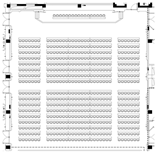
| Cross-Section | ![]() | ![]() | ![]() | ![]() |
| V (m3) | 5691.6 | 2480.6 | 1867.3 | 791.6 |
| Land area S (m2) | 1108.8 | 408.5 | 373.5 | 212.6 |
| Seating Qty (seats) | 612 | 314 | 204 | 300 |
| Each volume (m3) | 9.3 | 7.9 | 9.15 | 2.63 |
| Aspect ratio | 32.9/32.6 = 1.001 | 21.5/19.0 = 1.131 | 26.3/14.2 = 1.839 | 17.8/14.4 = 1.236 |
References
- National Editorial Committee for the Chinese Folk Art Gazetteer. Chinese Folk Art Gazetteer: Inner Mongolia Volume, 1st ed.; China ISBN Centre: Beijing, China, 2000. [Google Scholar]
- Institute of Ethnic Literature and Art, Central University for Nationalities. Encyclopaedia of Chinese Ethnic Musical Instruments, 1st ed.; New World Press: Beijing, China, 1986. [Google Scholar]
- Qing, G.L. A Study on the Distribution Patterns and Stylistic Schools of Contemporary Traditional Instrumental Ensembles Among the Mongolian Ethnic Group. Ph.D. Thesis, China Conservatory of Music, Beijing, China, 2019. [Google Scholar]
- Tong, L.G. Research on Mongolian Intangible Cultural Heritage: The Morin Khuur and Its Cultural Transformation. Ph.D. Thesis, Minzu University of China, Beijing, China, 2010. [Google Scholar]
- Meng, Z.H.; Zhao, F.J. Preliminary Experimental Study on Subjective Preference for Reverberation in Chinese Folk Music Fragments. Appl. Acoust. 2007, 1, 41–45. [Google Scholar]
- Wang, T.T. A Study on Performance Spaces for Traditional Chinese Musical Instruments. Ph.D. Thesis, Xi’an University of Architecture and Technology, Xi’an, China, 2020. [Google Scholar]
- Yang, W.; Kwak, K.H. Subjective acoustic survey of Korean traditional wind instruments, piri and daegeum, in a concert hall using auralisation techniques. Appl. Acoust. 2022, 185, 108421. [Google Scholar] [CrossRef]
- Hidaka, T.; Nishihara, N. Favorable reverberation time in concert halls revisited for piano and violin solos. J. Acoust. Soc. Am. 2022, 151, 2192–2206. [Google Scholar] [CrossRef] [PubMed]
- Meyer, J. Acoustics and the Performance of Music, 5th ed.; Springer: New York, NY, USA, 2009. [Google Scholar]
- Qi, Y.X. Sound Power Level Testing of Western Bowed String Instruments. Master’s Thesis, South China University of Technology, Guangzhou, China, 2023. [Google Scholar]
- Zhao, Y.Z.; Wu, S.X. Sound Power Measurement of the Pipa, a Traditional Chinese Musical Instrument. J. Tongji Univ. (Nat. Sci. Ed.) 2009, 37, 1270–1275. [Google Scholar]
- Lokki, T.; Mcleod, L. Perception of loudness and envelopment for different orchestral dynamics. J. Acoust. Soc. Am. 2020, 148, 2137–2145. [Google Scholar] [CrossRef]
- Qiu, J.Z.; Wu, S.X. Research on Optimal Loudness Values for Ethnic Music Performance Halls. Archit. J. China 2009, 3, 67–69. [Google Scholar]
- Gai, L. Vocal Characteristics of Cantonese Opera Performers and Subjective Selection of Optimal Performance Hall Acoustics. Ph.D. Thesis, South China University of Technology, Guangzhou, China, 2020. [Google Scholar]
- Guo, T.K. A Study on Subjective Preference Selection for ITDG and IACC in Chinese Ethnic Music Halls. Ph.D. Thesis, South China University of Technology, Guangzhou, China, 2014. [Google Scholar]
- Buen, A. Some aspects of the acoustics of the Hardangerfiddle. In Proceedings of the Baltic-Nordic Acoustic Meeting, Oslo, Norway, 3–5 May 2021. [Google Scholar]
- Suyatno, H.A.; Tjokronegoro, I.G.N.; Supanggah, R. Preference of reverberation time for musicians and audience of the javanese traditional gamelan music. J. Phys. Conf. 2016, 776, 012070. [Google Scholar] [CrossRef]
- Siswanto, W.A.; Tam, L. Sound characteristics and sound prediction of the traditional musical instrument the three-rattle angklung. Int. J. Acoust. Vib. 2012, 17, 120–126. [Google Scholar] [CrossRef]
- Sun, H.T.; Yang, Y. Research on Audiovisual Integration Based on Building Acoustics Simulation. J. South China Univ. Technol. (Nat. Sci. Ed.) 2023, 51, 71–79. [Google Scholar]
- Yan, M.C. Research on Reverberation Time Measurement Based on Indoor Impulse Response. J. Open Univ. Sci. Technol. 2023, 1, 23–27. [Google Scholar]
- Shi, Z.W. Analysis of Acoustic Measurement Systems for Chinese Traditional Musical Instruments. Master’s Thesis, China Conservatory of Music, Beijing, China, 2016. [Google Scholar]
- Wang, X.; Hao, X.Y. Research on Multi-Channel Audible Representation of Ethnic Musical Instruments. J. Commun. Univ. China (Nat. Sci. Ed.) 2020, 27, 29–35+40. [Google Scholar]
- Han, X.Y. The Current State and Innovative Potential of Compositions for the Mongolian Instrument Huobusi. Music Compos. 2017, 4, 144–145. [Google Scholar]
- Uligi, B. The Developmental History of the Mongolian Musical Instrument Tobshuur. Inn. Mong. Arts (Mong. Chin.) 2023, 3, 68–79. [Google Scholar]
- Cha, C.; Lee, H. Measurements of sound absorption coefficients of raked audience seating in a rectangular scale model room. Appl. Acoust. 2024, 217, 109872. [Google Scholar] [CrossRef]
- Kamisiński, T. Acoustic simulation and experimental studies of theatres and concert halls. Acta Phys. Pol. A 2010, 118, 78–82. [Google Scholar] [CrossRef]
- GB/T 50076-2013; Specification for Measuring Indoor Reverberation Time. School of Architecture, Tsinghua University; China Architecture & Building Press: Beijing, China, 2014.
- GB/T 50356-2005; Code for Acoustic Design of Theatres, Cinemas and Multipurpose Halls. China Planning Press: Beijing, China, 2005.
- Bork, I. Report on the 3rd round robin on room acoustical computer simulation—Part II: Calculations. Acta Acust. United Acust. 2005, 91, 753–763. [Google Scholar]
- Odeon User Manual. Available online: https://odeon.dk/downloads/user-manual/ (accessed on 15 September 2025).
- Zhu, X.D. The Influence of Interface Scattering in Performance Spaces on Acoustic Quality Parameters. Ph.D. Thesis, Tianjin University, Tianjin, China, 2023. [Google Scholar]
- Liu, J.P. Building Physics, 4th ed.; China Architecture & Building Press: Beijing, China, 2009. [Google Scholar]
- Buren, B. Traditional Musical Instruments of the Mongolian Ethnic Group, 1st ed.; Inner Mongolia University Press: Hohhot, China, 2007. [Google Scholar]
- Wang, J. Construction and Visualisation Design of the Cultural Gene Map of Chaor Musical Instruments. Master’s Thesis, Inner Mongolia Normal University, Hohhot, China, 2022. [Google Scholar]
- Huo, R.C.; Wen, Z. Artistic Characteristics of the Mongolian Four-Stringed Fiddle and the Horqin School. Art Panor. 2023, 23, 3–5. [Google Scholar]
- Uligi, B.; Qi, Q. A Study on the Musical Form Characteristics of Traditional Tobshuur Melodies of the Mongolian Ethnic Group. Inn. Mong. Arts (Mong. Chin.) 2023, 6, 55–64. [Google Scholar]
- Kousgaard, N. The application of binary paired comparisons to listening tests. Percept. Reprod. Sound 1987, 71–80. [Google Scholar]
- Parizet, E. Paired comparison listening tests and circular error rates. Acta Acust. United Acust. 2002, 88, 594–598. [Google Scholar]
- Mao, D.X.; Yu, W.Z. Data Verification and Criteria for Pairwise Comparative Subjective Evaluation of Sound Quality. J. Acoust. 2005, 5, 468–472. [Google Scholar]
- Otto, N.; Amman, S.; Eaton, C. Guidelines for jury evaluations of automotive sounds. SAE Tech. Pap. 2001, 35, 24–47. [Google Scholar]
- Yu, B.; Jiang, G.R. Spatial Distribution of Reverberation Time in Flat Spaces. In Proceedings of the 2010 International Conference on Building Environment Science and Technology, Wuxi, China, 7–9 May 2010. [Google Scholar]
- Beranek, L. Concert Halls and Opera Houses: Music, Acoustics, and Architecture, 2nd ed.; Springer: New York, NY, USA, 2004. [Google Scholar]
Disclaimer/Publisher’s Note: The statements, opinions and data contained in all publications are solely those of the individual author(s) and contributor(s) and not of MDPI and/or the editor(s). MDPI and/or the editor(s) disclaim responsibility for any injury to people or property resulting from any ideas, methods, instructions or products referred to in the content. |
© 2026 by the authors. Licensee MDPI, Basel, Switzerland. This article is an open access article distributed under the terms and conditions of the Creative Commons Attribution (CC BY) license.