


Abstract
The performance of New Zealand’s construction companies depends on the adaptability and skills of their workforce. The soft skills of the company’s building professionals are thought to contribute to the delivery of successful construction projects. This pilot study captures the perceptions of the importance of critical soft skills in semi-structured interviews with thirteen Quantity Surveyors (QSs) and fourteen Project Managers (PMs) working in New Zealand. For both cohorts the most important skill is communication, followed by workplace ethics. An exploratory Mann–Whitney U comparison suggests a difference in their ranking of emotional intelligence in interactions with other stakeholders, with PM deeming it more important than QS. Within-cohort Spearman rank correlation shows different patterns of association among soft-skill clusters for QS and PM, offering contextual insight rather than confirmatory inference. After communication and ethics, QS prioritise dispute resolution while PM value project reasoning. A combination of individual traits and practical experience influences the successful transition from a QS role to the broader PM role. The findings are limited by the small sample size but may be useful in professional development courses and recruitment efforts, contributing to a more adaptable and flexible construction workforce.
1. Introduction
Within the New Zealand construction industry, productivity, performance and quality goals must be met despite a challenging environment [1,2]. Between January and June 2022, twenty-five percent of New Zealand’s construction companies were liquidated, more than double the next highest sector, the accommodation and food service sector, with twelve percent liquidation [3]. This high failure rate has profound personal and economic consequences; over 2023 and 2024, 12% of all registered organisations were in the construction sector, which employed 10.7% of the New Zealand workforce and contributed $17.6 B annually to the economy [4,5]. The construction industry is typified by swift and continuous change, and organisations can only survive if they are responsive and adaptable to change [6,7]. Quantity Surveyors (QSs) and Project Managers (PMs) have a substantial influence on the profitability of any construction organisation [8,9], and if they readily adapt to changing conditions, for example, by being able to transition from a QS to a PM role, the organisation is more likely to survive.
The traditional contractor QS role (Contractor QS are those who are employed in a construction company that contracts to complete construction projects, as distinct from “Client” QS, who represent the client’s interests in a particular project.) involved working within a construction company and estimating quantities and costs of building projects and scheduling tasks. By comparison, the construction PM role is focused on the overall project planning needed to complete the project on time, within budget, and to the required quality, encompassing construction planning and procurement, contract consultancy, selection of contractors, loss adjustment, dispute resolution, and value management [10,11]. Over time the QS role has expanded to include many PM tasks [12,13,14,15,16,17]. The ability to successfully transition within the company from a QS role to a PM role depends on a range of both technical skills and soft skills [18,19]. The technical skills for both roles are well defined, but less is known about the soft skills. They are known to contribute to improved project outcomes and team behaviour [20,21,22] and are therefore likely to improve the survival of the organisation.
Soft skills are an abstract concept with no generally accepted definition but agreement that they are usually non-technical skills [23,24]. Previous researchers have termed them employability skills [25,26], key competencies [27,28,29,30], behavioural skills [31] and non-cognitive, people, personal and applied skills [32]. However, Gibb [33] highlighted that although the terms for soft skills differ, the acquisition of soft skills improves personal development and job performance, and this is reflected in Taylor’s [34] definition of soft skills as “intra-and inter-personal skills essential for personal development, social participation, and the ability to function in a specific employment environment”. Mahasneh [35] opines that the lack of consensus and standardisation of terms defining soft skills has limited the appreciation of their importance and undermined progress in this research field.
Considering the above, this study aims to investigate the soft skills required by QS and PM to successfully deliver projects in the New Zealand construction industry in an attempt to pinpoint essential soft skills for successful transition from the QS to the PM role. The research objectives are:
- Objective 1. To determine which soft skills are perceived by QS and PM to be important.
- Objective 2. To apply statistical tests to get a preliminary indication of any difference in the ranking of importance of soft skills by QS and PM.
- Objective 3. To establish which soft skills are important for QS to successfully transition to PM roles.
By identifying notable differences in the soft skills in QS and PM roles, this study can offer guidance to QS on the skills they need to acquire for a successful transition to PM roles. This will likely contribute to the robustness of the organisation during times of change in the construction environment.
In the next section, the definition of soft skills is explored in more detail, and the body of knowledge on important soft skills for construction QS and PM is reviewed.
2. Literature Review
In the previous section, the relationship between the survival of a construction company and the ability of that company’s QS to successfully transition to PM roles was introduced. The general concept of soft skills was discussed and is expanded here in a review of the theoretical frameworks for role transition and the influence of soft skills in the broader context and within the construction industry. Thereafter, the research on the important soft skills for QS and PM is reviewed.
2.1. Theoretical Frameworks for Role Transition and the Influence of Soft Skills
Role transition scholarship shows that new roles bring different expectations, relationships, and identity cues, so successful transition depends on adjustment and sensemaking, not only skill possession [36,37]. The learning process that happens during changes in professional roles can be considered in the context of theoretical frameworks such as boundary crossing [38] and professional socialisation [39,40]. Boundary crossing theory considers changes in boundaries related to function, knowledge application, social interaction and identity. Soft skills such as communication, collaboration and emotional intelligence facilitate these boundary crossings [41,42,43]. In the context of the QS-to-PM transition, function changes from cost-focused tasks to project oversight tasks, knowledge application changes from rule-based reasoning to personal judgement, social interaction broadens, and identity moves from specialist advisor to accountable leader. Boundary crossing theory identifies four learning mechanisms in the transition, namely, identification, coordination, reflection and transformation [38].
Professional socialisation theory focuses on the way individuals internalise the values, norms, behaviours and identity of changing roles and defines four areas of socialisation [40,44,45]. In the QS to PM transition, there is anticipatory socialisation (internalising the expectation of having to function in a broader role), formal socialisation in performing the new tasks, informal socialisation in learning to interact with a wide range of stakeholders and internalisation of being responsible for the entire project, rather than just the cost aspect [46,47]. The boundary crossing mechanisms are viewed as different socialisation processes.
Construction professionals with skill in communication, reasoning, leadership, and emotional intelligence tend to be successful at boundary crossing [48,49]. Similarly, these soft skills enable professionals to internalise their new identity [50,51]. In the “identification” phase, self-awareness and emotional intelligence enable QS to recognise that the PM role has very different expectations and authority, and this facilitates anticipatory socialisation. “Coordination” is part of the formal socialisation process and relies on communication, negotiation and conflict-management skills as the QS has interactions with clients, designers, and contractors in the PM role [52]. “Reflection” supports informal socialisation and is based on a variety of soft skills, including communication, ethics, emotional intelligence, and professional practice. The consolidation of both boundary crossing and professional socialisation represents “Transformation”, where leadership, adaptability, emotional intelligence and communication skills produce a PM whose competence is recognised both by themselves and by others. Research from other (non-construction) sectors reinforces the importance of soft skills during professional role change. In project-based and knowledge-intensive industries, transitions into managerial roles are associated with increased demands for communication, emotional regulation, and interpersonal influence [53,54]. Emotional intelligence, communication, adaptability, and leadership behaviours have been shown to foster trust, team cohesion, and job satisfaction, all of which influence project performance [55,56].
2.2. Soft Skills for the Construction Industry
In the construction industry, it is recognised that technical skills are readily improved through training, but soft skills, such as communication, are critical for career success and less easy to develop through training [57,58]. Van Heerden [32] suggested that construction professionals’ soft skills can be divided into a more controllable “training-based cluster” and a less controllable “trait-based cluster”. The training-based cluster includes soft skills that can be acquired through training, such as problem-solving, responsibility, decision-making, integrity, communication, work ethic, critical thinking/multi-disciplinary thinking, self-management/time management, enthusiasm/positive attitude, teamwork, leadership, and workplace professionalism. The trait-based cluster includes soft skills such as cross-cultural relationships, emotional intelligence, flexibility/adaptability, courtesy, creativity and curiosity. These are mostly inherent characteristics of an individual and are harder to change. Researchers have identified and classified a wide range of soft skills within construction sector jobs. For example, Mahasneh [35] identified 120 construction-related soft skills and grouped them into 12 clusters, namely communication skills, workplace thinking, conflict resolution, teamwork and collaboration, stress management, workplace professionalism, workplace productivity, workplace ethics, workplace diversity, planning and organising, self-intelligence and social intelligence. Van Heerden [21] identified 23 soft skills and proposed a complex soft skills interaction model with 11 groups of skills, including leadership, communication, problem-solving/critical thinking, flexibility and attitude, negotiation, conflict resolution, decision-making, teamwork, stress management, work ethics/integrity and motivation. This research proposes ten clusters of soft skills (Table 1) based on a review of the literature.

Table 1.
Soft skills clusters and their main attributes.
2.3. Soft Skills in Quantity Surveyors and Project Managers
A recent literature review indicated the importance of employability skills of surveyor graduates with a focus on those in the QS field [65]. The best job candidates need both hard and soft skills, with critical soft skills being those relating to communication, leadership, teamwork, critical thinking, and emotional intelligence (both of the individual and other people they interact with). Employers are increasingly seeking QS who combine technical skills with leadership skills, self-confidence, critical thinking skills, the ability to work under pressure and ethical/professional behaviour [29,66]. Soft skills are often lacking, and educators should address this by working in collaboration with the construction industry and using role-playing activities and project-based learning.
A systematic literature review by Oliveros [67] shows similar findings for construction PM, namely that their personal attributes and leadership skills are critical for project success and that there is a need for collaboration between the construction industry and academia on the best way to develop soft skills. Emotional intelligence is linked to better social skills, including relationship management, motivation, teamwork, tolerance, effective communication, and conflict resolution and, ultimately, better project outcomes [68]. Gardner [28] noted that recruiters need to find a PM with both technical and soft skills and that teaching interpersonal skills, conflict resolution, negotiation strategies, teamwork and critical problem-solving techniques is important in PM degrees and ongoing development courses.
2.4. Summary of the Literature
A review of the literature shows broad agreement that soft skills matter for leadership and project performance in construction, but the evidence base is dominated by lists and taxonomies of skills rather than theory-driven explanations of how skills translate across professional role boundaries [61]. Several researchers have shown that managers with good leadership qualities and high emotional intelligence have a positive impact on the organisation’s productivity, efficiency and financial success [35,63,69]. Building on the boundary crossing and professional socialisation frameworks, this study considers the change in role from QS to PM as a process where soft skills influence successful transition. The contribution is both descriptive (identifying important soft skills clusters) and explanatory; it extends general role transition concepts to a construction-specific area and identifies which soft skills appear most “boundary-relevant” for QS moving to PM roles in the New Zealand context.
3. Research Method
A mixed-method approach was used in this study. A seven-point Likert scale questionnaire provided quantitative data by numerically ranking the participant’s perceptions (which are inherently qualitative in nature), and semi-structured interviews based on open-ended questions provided qualitative data. Justification for using this method is as follows. The seven-point Likert scale provides more subtle responses than Likert scales with fewer options [70,71]. Semi-structured interviews capture the personal experiences of interviewees and allow the interviewer to interpret the context and substance of the responses [72], but it is acknowledged that they may be less reliable than their structured-form counterparts [73].
The questions were reviewed by construction industry experts and modified, firstly, with clearer explanations of the attributes in each soft skill cluster (Table 1) and, secondly, with the separation of the skills cluster “Emotional Intelligence” into two separate clusters relating to self-emotions and others’ emotions. The research was recorded by the Massey University Human Ethics Committee with low-risk notification ID: 4000025691.
3.1. Data Sample and Participant Demographics
Purposive convenience sampling was used to select the QS and PM participants from people working in New Zealand construction organisations involved in residential, commercial and infrastructure projects. For this pilot study, there were twenty-seven participants, of whom thirteen were in QS roles and fourteen in PM roles. The small sample size is a limitation of the research but is sufficient for this exploratory study [73]. The participant demographics are shown in Table 2.
Table 2.
Demographics of the participants.
Over 80% of the participants were between thirty and forty-nine years of age, and most (74%) had been involved in fifteen or more completed projects.
Interview data were collected from December 2023 to May 2024. Participants attended individual online meetings lasting approximately 45 min, during which they answered both quantitative and qualitative questions, the latter being recorded.
3.2. Data Analysis
The quantitative data consisted of participants ranking their perception of the importance of the soft skills listed in Table 1. The responses used a standardised seven-point Likert scale, with 1 for “not important at all”, 2 for “low importance”, 3 for “slightly important”, 4 for “neutral importance”, 5 for “moderately important”, 6 for “very important” and 7 for “extremely important”. The mean, standard deviation and variance in the ranking of importance of each soft skill cluster is reported for QS and PM. The Spearman correlation coefficient (ρ) was used to test the strength and direction of linear relationships between pairs of soft skills clusters, and the values are plotted on a correlogram. These analyses address objective 1, determining which soft skills are perceived by QS and PM to be important.
The Shapiro-Wilk test showed that the QS and PM rankings of each soft skills cluster did not have a normal distribution. Therefore, the Mann–Whitney U test was used to explore whether there was evidence of any difference in the ranking of soft skills between the two (QS and PM) cohorts (addressing objective 2). The null hypothesis, H0 was tested for each of the soft skills clusters in Table 1, where:
H0.
There is no difference between the two cohorts (QS and PM).
Statistical significance was determined by the p-value, accepting H0 for p > 0.05 and using the following interpretation of the U test results [74]:
- p < 0.01: highly significant difference between the two cohorts.
- p < 0.05: significant difference between the two cohorts.
It is noted that a small p-value means that H0 is statistically unlikely and not that it is definitively false. Similarly, a large p-value does not confirm that H0 is true, but rather that there is not enough evidence to reject it [74]. The results are only exploratory and should be interpreted cautiously as indicating possible effect directions and practical differences rather than dichotomous significance.
In the final part of the interview, participants were asked to select the three soft skills clusters that they perceived to be most important in their role and to rank these “Apex” soft skills in order of importance, from first (most important) to third. The data were used to determine which soft skills would be important for QS to successfully transition to PM roles (objective 3).
4. Results and Discussion
4.1. Ranking of the Perceived Importance of Soft Skills Clusters by QS and PM (Objective 1)
The participants were asked to rate the importance of each of the soft skills listed in Table 1 in their role as QS or PM, using the seven-point Likert scale. The mean value, , the standard deviation, , and the variance, , are summarised in Table 3.
Table 3.
Perceived importance of soft skills clusters of QS and PM participants.
For all participants, all of the soft skills clusters ranked greater than 4, i.e., above neutral importance. Project diversity was ranked as the least important soft skills cluster by both QS and PM (with a mean ranking of 4.77 and 4.86, respectively), while communication and document control was ranked as the most important soft skills cluster (with a mean ranking of 6.69 and 6.93, respectively). There was closest agreement (i.e., smallest standard deviation) in the ranking of the importance of communication and document control and greatest variation in the ranking of the importance of project diversity. QS ranked three soft skills clusters, namely communication and document control, workplace ethics and dispute resolution, at a value of 6 or higher on the Likert scale, i.e., between very important and extremely important. By contrast, PM ranked seven soft skills clusters (communication and document control, workplace ethics, emotional intelligence related to others, project reasoning, professional code of practice, team effort and partnership and emotional intelligence related to oneself) between very important and extremely important. Figure 1 shows the percentage of QS and PM who ranked each soft skills cluster as either 6 (very important) or 7 (extremely important) on the Likert scale.
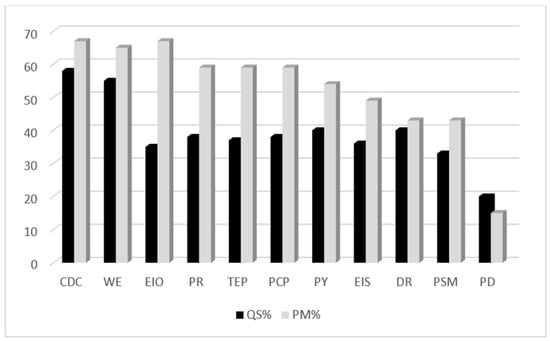
Figure 1.
Comparison between percentage of QS and PM ranking soft skills clusters as either very important or extremely important.
With the exception of project diversity (PD), more PM than QS perceive the remaining soft skills clusters to be either very or extremely important. The greatest disparity between the two cohorts is in their ranking of emotional intelligence as it relates to managing other people’s emotions (EIO).
Project diversity ranked as the least important of the soft skills clusters in both QS and PM roles. This may be because New Zealand’s construction industry has two unique characteristics. Firstly, it encompasses several different cultures, namely Māori, Pacific Islander, European and Asian. Secondly, it is comparatively small and focused primarily on domestic construction projects. Consequently, QS and PM may feel that they are already familiar with the country’s cultural milieu and that they are unlikely to need insight into other international cultures.
4.2. Strength of Correlation Between Pairs of Soft Skills Clusters
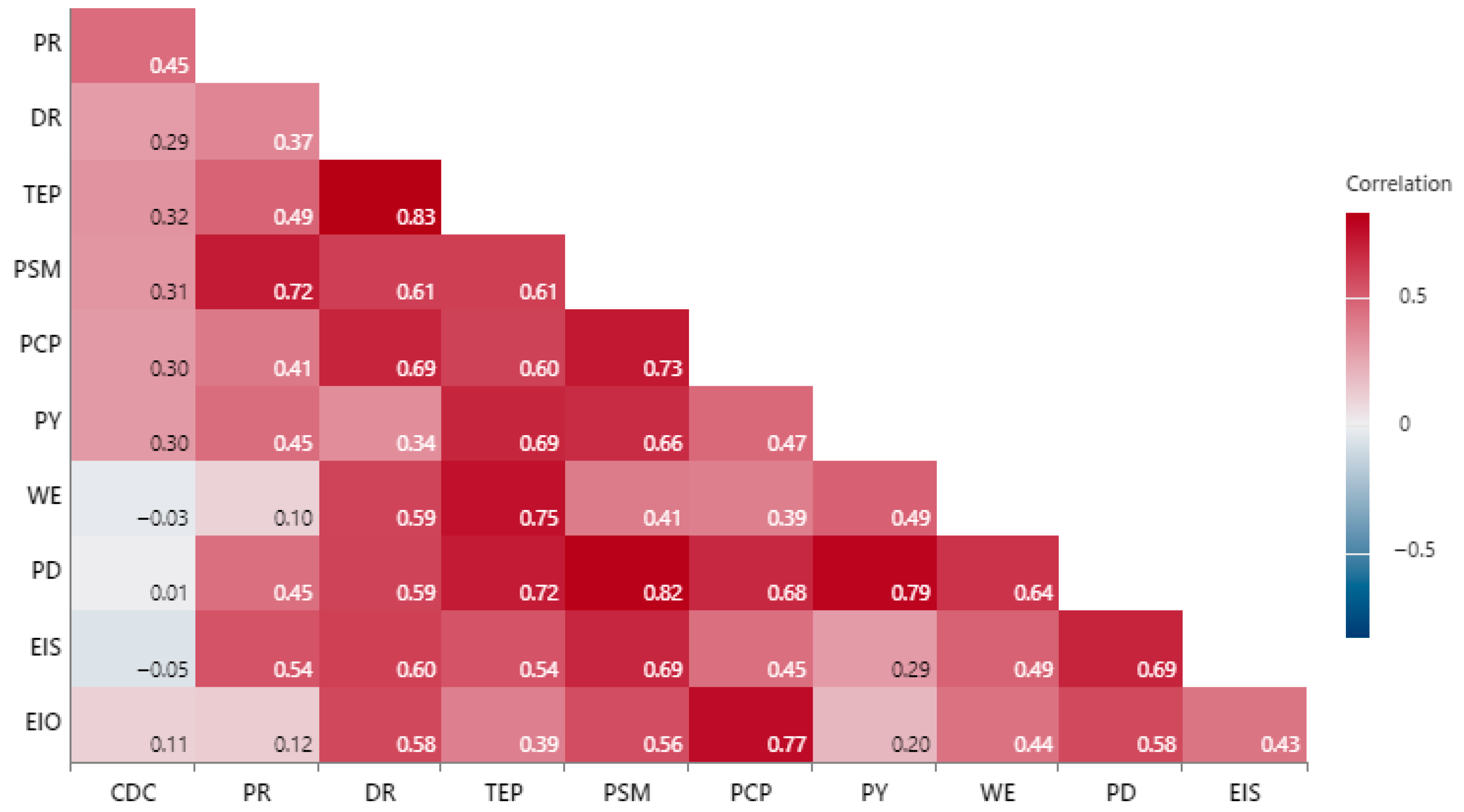
The Spearman correlation coefficient was used to assess the strength and direction of the relationship between the rankings of two soft skill clusters. For ordinal data and small sample sizes, Spearman’s correlation is a more suitable measure than Pearson’s correlation [75]. Figure 2 shows the correlogram of the Likert scale ranking data on the perceived importance of soft skills clusters for the QS respondents.
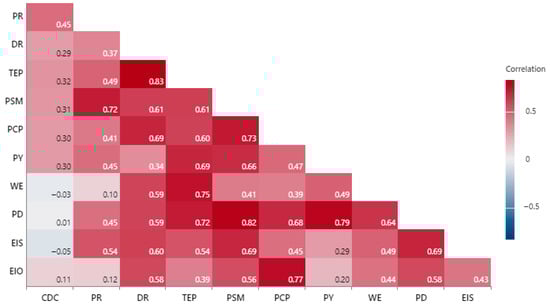
Figure 2.
Correlogram for the QS ranking of importance of soft skills.
For QS the correlation coefficients between perceived importance of soft skills clusters are mostly positive, showing that the perceived importance of one soft skill implies the perceived importance of other soft skills. The strongest correlation is between dispute resolution (DR) and team effort (TEP), with a statistically strong positive correlation (ρ = 0.83), according to Schober [76]. This suggests that QS respondents who value dispute resolution also place high importance on team effort and partnership in the workplace. Another notable correlation (ρ = 0.82) exists between the importance of project stress management (PSM) and project diversity (PD). This may indicate that QS perceive stress to be better managed in inclusive team environments. The third highest correlation (ρ = 0.79) is between project yield (PY) and project diversity, suggesting that prioritising productivity may be related to inclusive team environments.
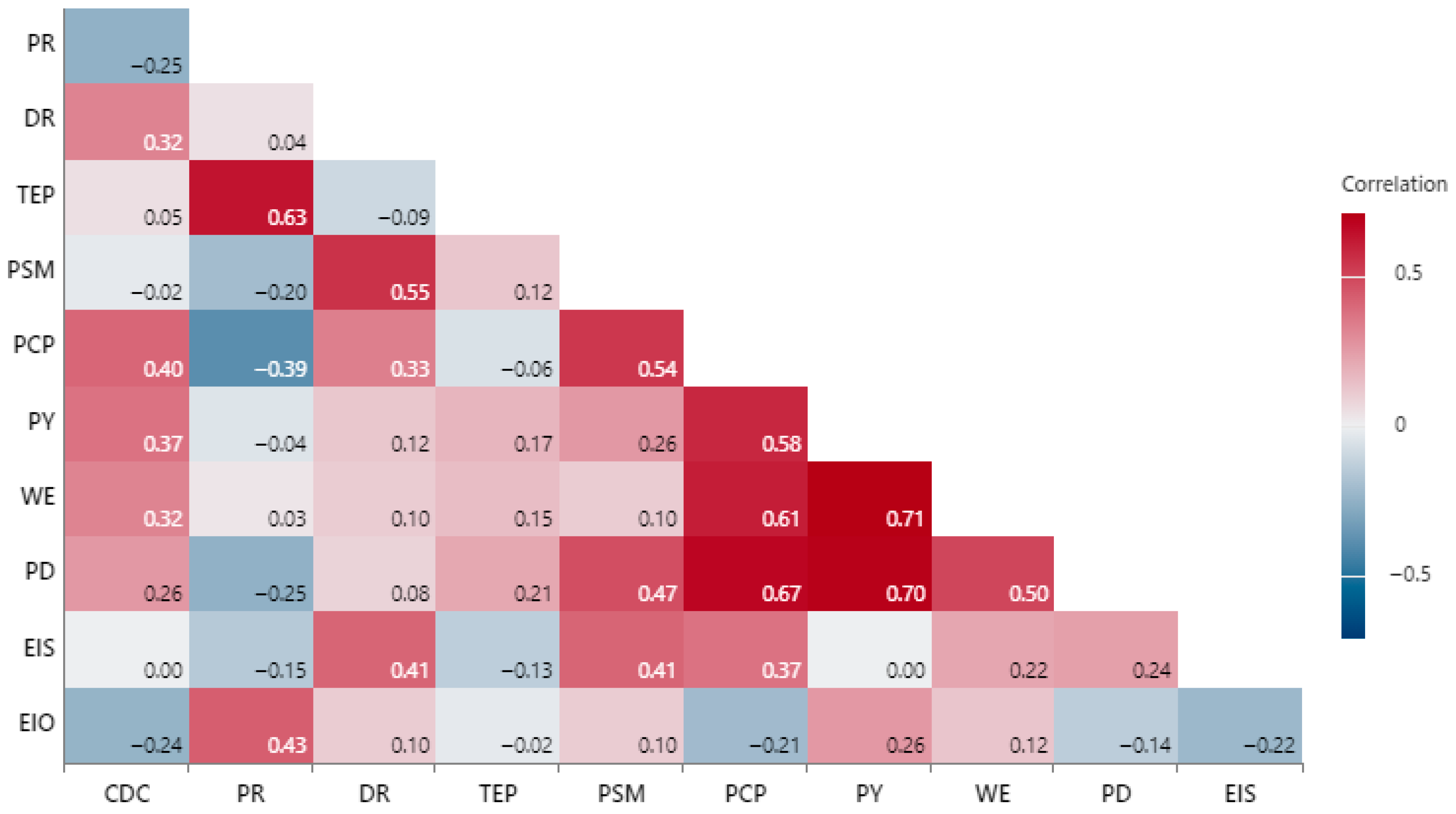
Figure 3 shows the correlogram of the Likert scale data on the perceived importance of soft skills clusters for the PM respondents.
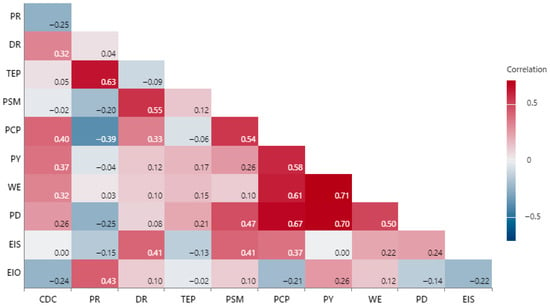
Figure 3.
Correlogram for the PM ranking of importance of soft skills clusters.
For PM, there are both positive and negative correlations between Likert scale perceptions of the importance of soft skills clusters, and the correlations are weaker than those observed among QS respondents. The strongest positive correlation (ρ = 0.71) exists between project yield and workplace ethics (WE). This suggests that PMs who prioritise productivity outcomes are also likely to place high importance on maintaining ethical standards in the workplace. Another notable correlation exists between project yield and project diversity (PD) (ρ = 0.70), indicating that, like QS, PM have the same perception of the relationship between productivity and inclusive teams.
4.3. Applying Statistical Tests to Get a Preliminary Indication of Difference in the Ranking of the Importance of Soft Skills Clusters by QS and PM (Objective 2)
Table 4 shows the results of the Mann–Whitney U test on comparisons of QS and PM rankings across the soft skill clusters. For most clusters, there was insufficient evidence to reject H0 at p > 0.05, which in this pilot study is interpreted as inconclusive rather than evidence of equivalence between roles. Emotional intelligence as it relates to managing the emotions of other people has the strongest indication of difference (p = 0.011) between QS and PM in their perceived importance of this soft skill. The mean ranking of this soft skill (Table 3) is 5.69 for QS (somewhere between moderately and very important) and 6.57 for PM (between very and extremely important). The same disparity is evident in Figure 1.
Table 4.
Mann–Whitney U comparison of the difference in QS and PM ranking of the importance of soft skills clusters.
While not meeting the test for statistical significance, two other soft skill clusters with the smallest p-value, and therefore the greatest difference in ranking for the two cohorts, are project reasoning and professional code of practice. The small sample size of the underlying data limits the validity of these findings.
The soft skill cluster with the closest agreement of perceived importance ranking (the largest p-value) between QS and PM is workplace ethics, with mean rankings of 6.46 and 6.57, respectively (Table 3).
4.4. Apex Soft Skills for QS and PM
In the next part of the interview, participants were asked to name the three soft skills clusters most important to their role (termed “Apex” soft skills), in order of importance. Limiting their choice to only three has been shown to force participants to prioritise the options, which improves discrimination [77,78]. This was used to validate their earlier Likert ranking of the soft skills clusters. Table 5 and Table 6 show the ranking for QS and PM, respectively.
Table 5.
Apex soft skills cluster rankings by QS (N = 13).
Table 6.
Apex soft skills cluster rankings by PM (N = 14).
Communication and document control was ranked the most important soft skills cluster by both the QS and PM cohorts, followed by workplace ethics in second place. These results validate the Likert ranking results. Tied as the third most important soft skills cluster for QS was dispute resolution (as in the Likert ranking), but also emotional intelligence as it relates to the emotions of others. For PM, the third most important soft skills cluster was project reasoning.
The implication of these findings is that training programmes and professional development initiatives should not be entirely standardised across QS and PM roles. Because QS and PM differ significantly in how they rank apex soft skill clusters, development pathways for QS transitioning into PM roles should place particular emphasis on enhancing emotional intelligence (especially managing others’ emotions), project reasoning, professionalism and team effort. Standard content on communication and workplace ethics can be shared across cohorts, but transition-focused training should be tailored to the distinct soft skill priorities of each role.
4.5. Participant Comments on Transitioning from QS to PM Roles
In the final part of the interview, participants were asked to comment on anything relating to skills (both soft skills and technical skills) that might be important for QS to successfully transition to PM roles. The PM participants indicated an overall endorsement of QS transitioning to PM roles, noting that QS have many important skills such as a comprehensive understanding of financial aspects, dispute resolution, problem-solving, and written communication. The PM expressed some reservations about the successful transition, with comments such as:
- QS have “excessive preoccupation with numerical data”; “they mostly deal with a computer, they need to develop a wider point of view and learn to talk to people”; QS “want everything to fit, they need to be adaptive”; QS require “higher empathy”; QS can be “unemotional”.
- PM roles require “lots of nuance and grey areas where being right is not necessarily the best solution for the outcome of the project”; “teamwork is required by PM, less so for QS”; “PM roles require dealing with people”; PMs need “diverse communication competencies”; “a lot of QS do not like talking to sub-contractors and don’t know that you have to be able to have a yarn with them”; “some QS have the ‘gift of the gab’ and appear to know it”; and QS need to “relate to people and develop leadership”.
- QS already has “good people skills and knows how to be part of a team. They need to know how a building goes together, construction methodology and programming”; QS require “technical skills and project programming skills”; QS require “more practical experience”.
This reinforces the earlier findings, namely that PM value emotional intelligence. Other studies have shown that construction professionals with strong emotional intelligence provide firm decision-making, good team leadership, empathetic resolution of disputes and better team collaboration [79,80].
The comments from QS were similar to those from PM; they felt that some, but not all, QS could excel as PM. QS regarded their strengths as being “analytical and detailed by nature” and “having the ability to break down work into processes and critically analyse each part of it”. They acknowledged that the PM requires “a broader world view”, the ability to “manage the whole flow”, and “big picture thinking”. It was also apparent that QS were frustrated about the lack of communication, stating their biggest gripe was “why has no-one told me or passed on the information?”
It is apparent that individual traits influence successful transition from QS to PM; QS who can speak easily and persuasively (i.e., have the ‘gift of the gab’) are more likely to succeed. The comments from both cohorts show that diverse communication skills and emotional intelligence are important, alongside the need to acquire practical experience in dealing with the broader challenges and complex decisions related to the entire construction project. The challenges faced by QS are narrower, being predominantly technical and contractual issues in a small part of the whole project. Similarly, QS have interactions with fewer stakeholders, mainly discussing financial and contractual aspects with clients and contractors. By contrast, PMs regularly interact with a broader spectrum of clients, contractors, vendors, and other team members and must possess empathy and diplomacy to effectively navigate challenges in negotiations, resolve conflicts, and sustain constructive working relationships. PM needs to balance the sometimes-conflicting client and construction team needs to ensure the timely completion of all the component tasks of the overall project.
5. Conclusions
This research considers the soft skills required to successfully transition from a QS role to a PM role in the New Zealand construction industry, based on semi-structured interviews of twenty-seven professionals. The respondents felt that all soft skills are critical for success in both roles. Communication (both verbal and written) is ranked as the most important skill, followed by workplace ethics. QS perceive dispute resolution to be an important soft skill, while PM value emotional intelligence, project reasoning, professionalism and team effort. This is likely a reflection of the key tasks for the two roles; QS are frequently involved in financial and contractual disputes, while PM manage the interactions between many more stakeholders, balancing the complex needs of clients, contractors and the construction team. Team diversity is ranked the least important of the soft skills, but this is likely because New Zealand’s construction industry already embraces a multi-cultural workforce. The latter is supported in both QS and PM by the strong correlation between the perceived importance of project diversity and project yield.
In this pilot study, the strongest evidence of a difference between QS and PM was observed in the perceived importance of emotional intelligence as it relates to managing the emotions of other people, with QS ranking it less important than PM. Given the small sample and multiple comparisons across clusters, this result should be interpreted as preliminary and hypothesis-generating rather than definitive. If QS are to function in PM roles, they will need to become less logic-based and introverted and more people-oriented and empathetic, cultivating more diplomatic and persuasive verbal skills.
For QS, the strongest correlations between perceived importance of soft skills clusters exist for dispute resolution and team effort and between project stress management and project diversity. By contrast, for PM the strongest correlation exists between project yield and workplace ethics. These correlations are likely tied to the major roles of each cohort. QS and PM differ in their ranking of apex soft skills, with important implications for the transition from CQS to CPM roles since soft skills are enablers for spanning the boundaries and internalising the changes in role transition.
Comments from the respondents reinforce these findings and suggest two additional aspects. Firstly, individual traits affect the successful transition from QS to PM roles; some QS have an inherent ability to communicate well with different stakeholders, while others must learn the skill. Secondly, the transition to the broader PM role and the complexities of managing the entire construction project are skills that can only be acquired through practice and ongoing education. Tertiary education institutions should collaborate with the construction industry to expose students to “real world” construction projects that require teamwork, communication and critical problem-solving. The research provides new information on critical soft skills for QS and PM and the changes in soft skills needed for successful transition from QS to PM roles. These insights may be key to the ability of construction companies to survive and adapt to changing conditions.
The research has the following limitations. The QS participants all worked for construction organisations, as distinct from QS who operate within a QS firm representing clients’ interests. The findings are only applicable to transitions from QS to PM roles within a construction organisation. The participants were sourced only from the New Zealand construction industry, which consists mostly of small and medium-sized construction companies with multi-cultural teams involved in local projects. In countries where the construction enterprises are larger, team diversity may be less inherent and consequently perceived as a more important soft skill. Finally, the number of respondents is small, limiting accurate analysis of the statistical significance of the data. Future research should include a larger sample of QS and PM to address this limitation. Research into soft skills training and testing personality traits within QS and PM professions would provide a better understanding of how to create high-performance construction teams.
Author Contributions
Conceptualisation, A.v.H. and C.F.; data collection, B.R.; methodology, A.v.H., B.R. and C.F.; validation, A.v.H. and C.F.; formal analysis, A.v.H. and C.F.; investigation, A.v.H., C.F. and B.R.; resources, B.R., A.v.H. and C.F.; data curation, B.R., A.v.H. and C.F.; writing—original draft preparation, A.v.H. and C.F.; writing—review and editing, A.v.H. and C.F.; project administration A.v.H. All authors have read and agreed to the published version of the manuscript.
Funding
This research received no external funding.
Institutional Review Board Statement
The study was conducted in accordance with the Massey University Code of Ethical Conduct for Research and received Low Risk Notification ID 4000025691 dated 4 April 2022.
Informed Consent Statement
Informed consent was obtained from all subjects involved in the study.
Data Availability Statement
The data supporting the reported results can be requested from the corresponding author, subject to the terms and conditions established during the comprehensive ethics evaluation conducted at Massey University.
Conflicts of Interest
Author Brian Reardon was employed by the company Reardon Consulting Ltd. The remaining authors declare that the research was conducted in the absence of any commercial or financial relationships that could be construed as a potential conflict of interest.
Abbreviations
The following abbreviations are used in this manuscript:
| QS | Quantity surveyors |
| PM | Project managers |
| CDC | Communication and document control |
| PR | Project reasoning |
| DR | Dispute resolution |
| TEP | Team effort and partnership |
| PSM | Project stress management |
| PCP | Professional code of practice |
| PY | Project yield |
| WE | Workplace ethics |
| PD | Project diversity |
| EIS | Emotional intelligence (self) |
| EIO | Emotional intelligence (others) |
References
- Darlow, G.; Rotimi, J.O.B.; Shahzad, W.M. Automation in New Zealand’s offsite construction (OSC): A status update. Built Environ. Proj. Asset Manag. 2022, 12, 38–52. [Google Scholar] [CrossRef]
- Likita, A.J.; Jelodar, M.B.; Vishnupriya, V.; Rotimi, J.O.B.; Vilasini, N. Lean and BIM implementation barriers in New Zealand construction practice. Buildings 2022, 12, 1645. [Google Scholar] [CrossRef]
- McLaughlin, K. Stuff. Here’s What You Need to Know About Struggling Construction Firms. 2022. Available online: https://www.stuff.co.nz/business/300643804/heres-what-you-need-to-know-about-struggling-construction-firms (accessed on 5 August 2025).
- Ministry of Business, Innovation and Employment (MBIE). Building and Construction Sector Trends—Annual Report 2023; Ministry of Business, Innovation & Employment (MBIE): Wellington, New Zealand, 2024; pp. 1–52. Available online: https://www.mbie.govt.nz/assets/building-and-construction-sector-trends-annual-report-2023.pdf (accessed on 5 August 2025).
- Somers, E. Interest. Construction Sector Faces Rising Number of Liquidations as Business Credit Defaults Also Climb Across the Industry According to Credit Bureau Centrix. 2024. Available online: https://www.interest.co.nz/business/129995/construction-sector-faces-rising-number-liquidations-business-credit-defaults-also (accessed on 5 August 2025).
- Adafin, J.; Wilkinson, S.; Rotimi, J.O.B.; MacGregor, C.; Tookey, J.; Potangaroa, R. Creating a case for innovation acceleration in the New Zealand building industry. Constr. Innov. 2021, 22, 185–204. [Google Scholar] [CrossRef]
- Chen, X.; Chang-Richards, A.Y.; Pelosi, A.; Jia, Y.; Shen, X.; Siddiqui, M.K.; Yang, N. Implementation of technologies in the construction industry: A systematic review. Eng. Constr. Archit. Manag. 2022, 29, 3181–3209. [Google Scholar] [CrossRef]
- van Eck, E.; Burger, M. Effective utilisation of generation Y Quantity Surveyors. Acta Structilia 2016, 23, 57–78. [Google Scholar] [CrossRef]
- Castro, M.; Barcaui, A.; Bahli, B.; Figueiredo, R. Do the Project Manager’s Soft Skills Matter? Impacts of the Project Manager’s Emotional Intelligence, Trustworthiness, and Job Satisfaction on Project Success. Adm. Sci. 2022, 12, 141–157. [Google Scholar] [CrossRef]
- Khadim, N.; Thaheem, M.J.; Ullah, F.; Mahmood, M.N. Quantifying the cost of quality in construction projects: An insight into the base of the iceberg. Qual. Quant. 2023, 57, 5403–5429. [Google Scholar] [CrossRef]
- Shafiei, I.; Eshtehardian, E.; Nasirzadeh, F.; Arabi, S. Dynamic modeling to reduce the cost of quality in construction projects. Int. J. Constr. Manag. 2023, 23, 24–37. [Google Scholar] [CrossRef]
- Baloi, D.; Price, A.D.F. Modelling global risk factors affecting construction cost performance. Int. J. Proj. Manag. 2003, 21, 261–269. [Google Scholar] [CrossRef]
- Elhag, T.M.S.; Boussabaine, A.H.; Ballal, T.M.A. Critical determinants of construction tendering costs: Quantity surveyors’ standpoint. Int. J. Proj. Manag. 2005, 23, 538–545. [Google Scholar] [CrossRef]
- Ashworth, A. Contractual Procedures in the Construction Industry, 6th ed.; Routledge: Oxfordshire, UK, 2012; p. 448. [Google Scholar]
- Frei, M.; Mbachu, J.; Phipps, R. Critical success factors, opportunities and threats of the cost management profession: The case of Australasian quantity surveying firms. Int. J. Proj. Organ. Manag. 2013, 5, 4–24. [Google Scholar] [CrossRef]
- Wao, J.O.; Flood, I. The role of quantity surveyors in the international construction arena. Int. J. Constr. Manag. 2016, 16, 126–137. [Google Scholar] [CrossRef]
- Hoffman, D.J.; Booyens, D.E.; Trusler, K. Agents for Change—Profiling South African Construction Quantity Surveyors. In Intelligent Sustainable Systems: Selected Papers of WorldS4 2022; Springer Nature: Singapore, 2023; Volume 1, pp. 541–552. [Google Scholar] [CrossRef]
- Pretorius, S.; Steyn, H.; Bond-Barnard, T.J. The relationship between project management maturity and project success. J. Mod. Proj. Manag. 2022, 10, 218–231. [Google Scholar]
- Ghorbani, A. A Review of Successful Construction Project Managers’ Competencies and Leadership Profile. J. Rehabil. Civ. Eng. 2023, 11, 76–95. [Google Scholar] [CrossRef]
- Rehman, S.; Mehmood, A. Employability skills: The need of the graduates and the employer. VSRD Int. J. Bus. Manag. Res. 2014, 4, 133–138. [Google Scholar]
- Van Heerden, H.H.G. The Road to Purpose-Fit Selection of the Construction Manager. Doctoral Dissertation, University of Pretoria (South Africa), Pretoria, South Africa, 2018; pp. 1–266. [Google Scholar]
- Alvarenga, J.C.; Branco, R.R.; Guedes, A.L.A.; Soares, C.A.P.; da Silveria e Silva, W. The project manager core competencies to project success. Int. J. Manag. Proj. Bus. 2020, 13, 277–292. [Google Scholar] [CrossRef]
- Matteson, M.L.; Anderson, L.; Boyden, C. “Soft skills”: A phrase in search of meaning. Portal Libr. Acad. 2016, 16, 71–88. [Google Scholar] [CrossRef]
- Touloumakos, A.K. Expanded yet restricted: A mini review of the soft skills literature. Front. Psychol. 2020, 11, 2207. [Google Scholar] [CrossRef]
- Johnston, S.; McGregor, H. Recognizing and supporting a scholarship of practice: Soft skills are hard! Asia-Pac. J. Coop. Educ. 2005, 6, 1–6. [Google Scholar]
- Cinque, M. Moocs and soft skills: A comparison of different courses on creativity. J. E-Learn. Knowl. Soc. 2017, 13, 83–96. [Google Scholar]
- Kechagias, K. (Ed.) Teaching and Assessing Soft Skills; MASS Project, September; 1st Second Chance School of Thessaloniki (Neapolis): Thessaloniki, Greece, 2011; pp. 1–189. ISBN 978-960-9600-00-2. [Google Scholar]
- Gardner, S.T.; Reid, S.; Barry, S. Successful managerial attributes of construction project managers: Empirical evidence from Australia. Pac. Rim Prop. Res. J. 2024, 29, 66–96. [Google Scholar]
- Oni, O.J.; Aina, Y.J. Employers’ perspectives on critical quantity surveying soft skills. Int. J. Innov. Res. Adv. Stud. 2020, 7, 139–144. [Google Scholar]
- Qizi, K.N.U. Soft skills development in higher education. Univers. J. Educ. Res. 2020, 8, 1916–1925. [Google Scholar] [CrossRef]
- Wilhelm, W.J.; Logan, J.; Smith, S.M.; Szul, L.F. Meeting the Demand: Teaching “Soft” Skills; Delta Pi Epsilon: Prescott, AZ, USA, 2002; pp. 1–82. Available online: https://files.eric.ed.gov/fulltext/ED477252.pdf (accessed on 5 August 2025).
- Van Heerden, A.H.; Jelodar, M.B.; Chawynski, G.; Ellison, S. A study of the soft skills possessed and required in the construction sector. Buildings 2023, 13, 522. [Google Scholar] [CrossRef]
- Gibb, S. Soft skills assessment: Theory development and the research agenda. Int. J. Lifelong Educ. 2014, 33, 455–471. [Google Scholar]
- Taylor, E. Investigating the perception of stakeholders on soft skills development of students: Evidence from South Africa. Interdiscip. J. E-Ski. Life Long Learn. 2016, 12, 1–18. [Google Scholar] [CrossRef]
- Mahasneh, J.K.; Thabet, W. Developing a normative soft skills taxonomy for construction education. J. Civ. Eng. Archit. Res. 2016, 3, 1468–1486. [Google Scholar]
- George, M.M.; Wittman, S.; Rockmann, K.W. Transitioning the study of role transitions: From an attribute-based to an experience-based approach. Acad. Manag. Ann. 2022, 16, 102–133. [Google Scholar] [CrossRef]
- Akkermans, J.; da Motta Veiga, S.P.; Hirschi, A.; Marciniak, J. Career transitions across the lifespan: A review and research agenda. J. Vocat. Behav. 2024, 148, 103957. [Google Scholar] [CrossRef]
- Akkerman, S.F.; Bakker, A. Boundary crossing and boundary objects. Rev. Educ. Res. 2011, 81, 132–169. [Google Scholar] [CrossRef]
- Van Maanen, J.; Schein, E.H. Toward a theory of organizational socialization. Res. Organ. Behav. 1979, 1, 209–264. [Google Scholar]
- Trede, F.; Macklin, R.; Bridges, D. Professional identity development. Stud. High. Educ. 2012, 37, 365–384. [Google Scholar] [CrossRef]
- Akkerman, S.F.; Bruining, T. Multilevel boundary crossing in a professional development school partnership. J. Learn. Sci. 2016, 25, 240–284. [Google Scholar] [CrossRef]
- Snoek, M.; Bekebrede, J.; Hanna, F.; Creton, T.; Edzes, H. The contribution of graduation research to school development: Graduation research as a boundary practice. Eur. J. Teach. Educ. 2017, 40, 361–378. [Google Scholar] [CrossRef]
- Kerosuo, H.; Engeström, Y. Boundary crossing and learning in creation of new work practice. J. Workplace Learn. 2003, 15, 345–351. [Google Scholar] [CrossRef]
- Trede, F.; McEwen, C. Developing a critical professional identity: Engaging self in practice. In Practice-Based Education: Perspectives and Strategies; Higgs, J., Barnett, R., Billett, S., Hutchings, M., Trede, F., Eds.; Springer Science & Business Media, Sense Publishers: Rotterdam, The Netherlands, 2013; pp. 27–40. ISBN 9462091285. [Google Scholar]
- Hodges, J. Organization Development: How Organizations Change and Develop Effectively; Bloomsbury Publishing: London, UK, 2020; ISBN 1352009285. [Google Scholar]
- Dainty, A.; Moore, D.; Murray, M. Communication in Construction, 1st ed.; Routledge: London, UK, 2007; ISBN 978-0203358641. [Google Scholar] [CrossRef]
- Crawford, L.; Morris, P.; Thomas, J.; Winter, M. Practitioner development: From trained technicians to reflective practitioners. Int. J. Proj. Manag. 2006, 24, 722–733. [Google Scholar] [CrossRef]
- Whyte, J.; Stasis, A.; Lindkvist, C. Managing change in the delivery of complex projects: Configuration management, asset information and ‘big data’. Int. J. Proj. Manag. J. 2016, 34, 339–351. [Google Scholar] [CrossRef]
- Walker, D.; Lloyd-Walker, B. Collaborative Project Procurement Arrangements; Project Management Institute Inc.: Newtown Square, PA, USA, 2015; Available online: https://www.pmi.org/learning/library/collaborative-project-project-procurement-arrangements-11645 (accessed on 22 November 2025).
- Crawford, L.; Cooke-Davies, T.; Hobbs, B.; Labuschagne, L.; Remington, K.; Chen, P. Governance and support in the sponsoring of projects. Proj. Manag. J. 2008, 39, S43–S55. [Google Scholar] [CrossRef]
- Bakhshi, J.; Ireland, V.; Gorod, A. Clarifying the project complexity construct: Past, present and future. Int. J. Proj. Manag. 2016, 34, 1199–1213. [Google Scholar] [CrossRef]
- Bechky, B.A. Making Organizational Theory Work: Institutions, occupations, and negotiated orders. Organ. Sci. 2011, 22, 1157–1167. [Google Scholar] [CrossRef]
- Succi, C.; Canovi, M. Soft skills to enhance graduate employability: Comparing students and employers’ perceptions. Stud. High. Educ. 2020, 45, 1834–1847. [Google Scholar]
- Norbash, A. Transitional leadership: Leadership during times of transition, key principles, and considerations for success. Acad. Radiol. 2017, 24, 734–739. [Google Scholar] [CrossRef]
- Rezvani, A.; Chang, A.; Wiewiora, A.; Ashkanasy, N.M.; Jordan, P.J.; Zolin, R. Manager emotional intelligence and project success: The mediating role of job satisfaction and trust. Int. J. Proj. Manag. 2016, 34, 1112–1122. [Google Scholar] [CrossRef]
- Tabassi, A.A.; Roufechaei, K.M.; Abu Bakar, A.H.; Yusof, N. Linking team condition and team performance: A transformational leadership approach. Proj. Manag. J. 2017, 48, 22–38. [Google Scholar] [CrossRef]
- Zulch, B.G. The Construction Project Manager as Communicator in the Property Development and Construction Industries. Doctoral Dissertation, University of the Free State (South Africa), Bloemfontein, South Africa, 2012; pp. 1–241. [Google Scholar]
- Bora, B. The essence of soft skills. Int. J. Innov. Res. Pract. 2015, 3, 7–22. Available online: https://www.academia.edu/22419076/The_Essence_of_Soft_Skills (accessed on 22 November 2025).
- Cimatti, B. Definition, development, assessment of soft skills and their role for the quality of organizations and enterprises. Int. J. Qual. Res. 2016, 10, 97–130. Available online: http://www.ijqr.net/journal/v10-n1/5.pdf (accessed on 22 November 2025).
- Thompson, S. The power of pragmatism: How project managers benefit from coaching practice through developing soft skills and self-confidence. Int. J. Evid. Based Coach. Mentor. 2019, S13, 4–15. [Google Scholar] [CrossRef]
- Capaldo, G.; Capone, V.; Babiak, J.; Bajcar, B.; Kuchta, D. Efficacy beliefs, empowering leadership, and project success in public research centers: An Italian–polish study. Int. J. Environ. Res. Public Health 2021, 18, 6763. [Google Scholar]
- Robles, M.M. Executive perceptions of the top 10 soft skills needed in today’s workplace. Bus. Commun. Q. 2012, 75, 453–465. [Google Scholar] [CrossRef]
- Bhatti, S.H.; Kiyani, S.K.; Dust, S.B.; Zakariya, R. The impact of ethical leadership on project success: The mediating role of trust and knowledge sharing. Int. J. Manag. Proj. Bus. 2021, 14, 982–998. [Google Scholar] [CrossRef]
- Princes, E.; Said, A. The impacts of project complexity, trust in leader, performance readiness and situational leadership on financial sustainability. Int. J. Manag. Proj. Bus. 2022, 15, 619–644. [Google Scholar] [CrossRef]
- Mustaffa, M.; Husain, S.H. Unravelling the Key Ingredients of Employability Skills for Surveyor Graduates: A Systematic Literature Review. Pertanika J. Soc. Sci. Humanit. 2024, 32, 69–92. [Google Scholar] [CrossRef]
- Chamikara, P.B.S.; Perera, B.S.; Rodrigo, M.N. Competencies of the quantity surveyor in performing for sustainable construction. Int. J. Constr. Manag. 2020, 20, 237–251. [Google Scholar]
- Oliveros, J.; Vaz-Serra, P. Construction project manager skills: A systematic literature review. In Proceedings of the International Conference of the Architectural Science Association, Melbourne, Australia, 28 November–1 December 2018; pp. 185–192. [Google Scholar]
- Jayaweera, M.; Perera, B.A.K.S.; Liyanawatta, T.N. Use of Emotional Intelligence to Enhance the Leadership Skills of Project Managers in Construction: A Qualitative Delphi Study. J. Leg. Aff. Disput. Resolut. Eng. Constr. 2025, 17, 04525011. [Google Scholar] [CrossRef]
- Doan, T.T.T.; Nguyen, L.C.T.; Nguyen, T.D.N. Emotional intelligence and project success: The roles of transformational leadership and organizational commitment. J. Asian Financ. Econ. Bus. 2020, 7, 223–233. [Google Scholar] [CrossRef]
- Fellows, R.F.; Liu, A.M. Research Methods for Construction; John Wiley & Sons: Bognor Regis, UK, 2015; p. 320. [Google Scholar]
- Joshi, A.; Kale, S.; Chandel, S.; Pal, D. Likert Scale: Explored and Explained. Br. J. Appl. Sci. Technol. 2015, 7, 396–403. [Google Scholar] [CrossRef]
- Cassell, C.; Symon, G. Raising the profile of qualitative methods in organizational research. In The Real Life Guide to Accounting Research; Elsevier: Amsterdam, The Netherlands, 2004; pp. 491–508. [Google Scholar]
- Knight, A.; Ruddock, L. (Eds.) Advanced Research Methods in the Built Environment; Wiley-Blackwell: Oxford, UK, 2009; pp. 1–256. ISBN 978-1405161107. [Google Scholar]
- Motulsky, H. Intuitive Biostatistics: A Nonmathematical Guide to Statistical Thinking, 3rd ed.; Oxford University Press: New York, NY, USA, 2014; pp. 1–540. ISBN 9780199946648. [Google Scholar]
- Field, A. Discovering Statistics Using IBM SPSS Statistics, 5th ed.; Sage Publications: Los Angeles, CA, USA, 2018; pp. 1–1104. ISBN 9781526419514. [Google Scholar]
- Schober, P.; Boer, C.; Schwarte, L.A. Correlation coefficients: Appropriate use and interpretation. Anesth. Analg. 2018, 126, 1763–1768. [Google Scholar] [CrossRef] [PubMed]
- Brown, A.; Maydeu-Olivares, A. How IRT can solve problems of ipsative data in forced-choice questionnaires. Psychol. Methods 2013, 18, 36–52. [Google Scholar] [CrossRef]
- Louviere, J.J.; Flynn, T.N.; Marley, A.A.J. Best–Worst Scaling: Theory, Methods and Applications; Cambridge University Press: Cambridge, UK, 2015; pp. 1–342. ISBN 9781107043152. [Google Scholar]
- Kukah, A.S.; Akomea-Frimpong, I.; Jin, X.; Osei-Kyei, R. Emotional intelligence (EI) research in the construction industry: A review and future directions. Eng. Constr. Archit. Manag. 2022, 29, 4267–4286. [Google Scholar]
- Sanusi, A.N. Review of Influence of Emotional Intelligence (EI) on Collaboration Among Employees from Diverse Cultural Backgrounds in the Construction Industry. J. Adv. Artif. Intell. Eng. Technol. 2025, 1, 39–46. Available online: https://artificial-intelligence.engineering-technology.wren-research-journals.com/1/article/view/39 (accessed on 22 November 2025).
Disclaimer/Publisher’s Note: The statements, opinions and data contained in all publications are solely those of the individual author(s) and contributor(s) and not of MDPI and/or the editor(s). MDPI and/or the editor(s) disclaim responsibility for any injury to people or property resulting from any ideas, methods, instructions or products referred to in the content. |
© 2026 by the authors. Licensee MDPI, Basel, Switzerland. This article is an open access article distributed under the terms and conditions of the Creative Commons Attribution (CC BY) license.