Article

Parameter Optimization for Climate-Resilient IEQ Assessment: Validating Essential Metrics in the PICSOU Framework Across Divergent Climate Zones


1
Department of Civil Engineering and Architecture, Tallinn University of Technology, 19086 Tallinn, Estonia
2
Department of Architecture, Chengdu University of Technology, Chengdu 611059, China
3
School of Architecture, Southwest Jiaotong University, Chengdu 611032, China
4
Department of Civil Engineering, Aalto University, 02150 Espoo, Finland
*
Author to whom correspondence should be addressed.
Buildings 2026, 16(2), 283; https://doi.org/10.3390/buildings16020283
Submission received: 12 December 2025 / Revised: 31 December 2025 / Accepted: 5 January 2026 / Published: 9 January 2026

Abstract

To enhance the climate adaptability and diagnostic precision of university sustainability frameworks, this study presents a critical advancement to the PICSOU (Performance Indicators for Core Sustainability Objectives of Universities) framework’s Indoor Environmental Quality (IEQ) module. The research employs a comparative approach across two distinct climate zones: the campus of Chengdu Jincheng College in a humid subtropical climate (CDJCC; Köppen Cwa) with natural ventilation, and the campus of Tallinn University of Technology in a temperate climate (TalTech; Köppen Dfb) with mechanical ventilation. A key innovation at CDJCC was the deployment of a novel, integrated sensor that combines a Frequency-Modulated Continuous Wave (FMCW) radar module for real-time occupancy detection with standard IEQ sensor suite (CO2, PM2.5, temperature, humidity), enabling unprecedented analysis of occupant-IEQ dynamics. At TalTech, comprehensive IEQ monitoring was conducted using standard sensors. Results demonstrated that mechanical ventilation (TalTech) effectively decouples indoor conditions from external fluctuations. In contrast, natural ventilation (CDJCC) exhibits strong seasonal coupling, reflected by a Seasonal Ventilation Efficacy Coefficient ( λ season ), indicating that seasonal differences in effective ventilation are present but vary by indoor space type under occupied conditions. Consistent with this stronger indoor–outdoor linkage, PM2.5 infiltration was also pronounced in naturally ventilated spaces, as evidenced by a high infiltration factor ( I / O ratio) that remained consistently elevated. This work conclusively validates a conditional, climate-resilient workflow for PICSOU’s IEQ category, integrating these empirical coefficients to transform its IEQ assessment into a dynamic and actionable tool for optimizing campus sustainability strategies globally.

1. Introduction

1.1. Current Status of Sustainability Assessment in University Campuses

University campuses, as core sites for knowledge innovation and talent development, hold significant strategic importance in global sustainable development and carbon emission reduction. University campuses typically contain large building stocks and complex end-use energy profiles [1,2,3]. Combined with high population density, these characteristics can make campuses a non-trivial contributor to urban carbon emissions [4,5,6,7]. Higher education institutions (HEIs) have increasingly contributed to carbon-neutrality agendas through systematic campus sustainability actions [5,8,9]. These actions commonly include green-campus programs, energy management, renewable energy deployment, and low-carbon mobility measures [1,2,3,6]. Beyond operational decarbonization, universities exert broader influence through education, research, and public engagement [7,10,11]. This institutional influence supports the diffusion of sustainability concepts and can shape pro-environmental social behaviors [5,6,12,13]. From a broader perspective, HEIs are now recognized as ideal testbeds for implementing the UN Sustainable Development Goals (SDGs), and are expected to embed sustainability principles into core strategies, curricula, and organizational culture rather than treating them as peripheral add-ons [7,12]. As forerunners of transformation, universities shape campus populations’ habits and societal mindsets in ways that can either accelerate or impede sustainable development [7].
From an energy-systems perspective, university campuses operate as diversified, high-intensity loads within urban grids, combining laboratory baselines, extended-hours teaching spaces, residential services, and shared infrastructures (e.g., district heating). This end-use portfolio produces pronounced schedule-driven peaks alongside persistent baseloads, while long asset lifecycles and centralized procurement create path dependencies in HVAC, envelopes, and controls that lock in energy-use intensity and emissions trajectories for decades. At the same time, campuses offer distinctive potential for demand flexibility—load shifting, demand response, and progressive electrification of heat—provided interventions respect academic calendars and IEQ constraints. Consequently, credible governance must move beyond design intent toward measured performance: end-use disaggregation, weather-normalized baselines, occupancy-aware setpoints, and lifecycle cost analysis that links operational decisions to verifiable energy and carbon outcomes [14,15,16]. Recent zero-carbon campus action plans reinforce this perspective by explicitly treating campuses as a small-scale city model and proposing scalable frameworks for energy and emissions accounting that can be applied across campus types, geographies, and climatic contexts [17].
Assessment systems for university campuses have evolved from green building rating schemes such as LEED (Leadership in Energy and Environmental Design) and BREEAM (Building Research Establishment Environmental Assessment Method) [10,18,19] to sustainable campus ranking systems like UI GreenMetric and STARS (Sustainability Tracking, Assessment and Rating System) [20,21,22] and further to post-occupancy evaluation (POE) and real-time monitoring [23,24,25,26,27]. However, many frameworks rely on overly complex indicator sets and suffer from data inconsistency and limited comparability across institutions [4,28,29]. In addition, their adaptability across diverse space types and climatic contexts remains insufficient, which constrains generalizability [30,31,32]. Importantly, IEQ is often underweighted or treated in a largely static manner, limiting support for climate-resilient operations [10,33]. Among these, LEED and BREEAM primarily focus on individual building design, often falling short in covering overall campus operations and activities, and involve high implementation and data collection costs [10,34]. UI GreenMetric and STARS employ extensive indicator sets suffering from issues of data inconsistency and poor comparability, making it difficult to quantify actual carbon reduction contributions [20,21,22]. Moreover, their IEQ-related items are largely static and policy-oriented (e.g., the existence of guidelines or certifications) and provide little explicit guidance on how assessment criteria, thresholds, or weights should be adapted across different climate zones, which limits their practicality for climate-resilient campus operation [17]. General corporate or supply chain frameworks like ISO 14001 and Global Reporting Initiative (GRI) are not optimized for the unique structure and functions of HEIs [14,31]. Recent campus case studies in arid and Mediterranean climates further highlight that sustainability and IEQ strategies must be explicitly tailored to local climatic and cultural conditions rather than relying on globally uniform indicators, with social infrastructure, green space, and hybrid ventilation strategies all needing climate-responsive design [35,36].
Aiming to resolve the limitations from the above-mentioned tools, the diagnostic framework of PICSOU (Performance Indicators for Core Sustainability Objectives of Universities) was identified to measure carbon footprint and socio-economic performance through six categories comprising approximately 20 core indicators while balancing universality and local adaptability, thereby facilitating cross-institutional comparison and cost–benefit analysis. Its structure enhances comprehension and implementation for university administrators and enables the quantification of improvement measures. By prioritizing areas with significant greenhouse gas emissions and social impacts, the framework improves the targeting and effectiveness of emission reduction strategies, serving as a robust tool for advancing campus carbon neutrality and sustainable development [37].

1.2. The Core Role of IEQ in University Sustainability

With the global advancement of sustainable development and healthy campus initiatives, IEQ in university settings has become an interdisciplinary research focus spanning architecture, environmental science, and public health. University students and staff spend more than 80% of their daily time indoors, including dormitories, classrooms, laboratories, and libraries [38,39,40]. In these settings, air quality, thermal comfort, lighting, and acoustics can directly affect health, well-being, and learning-related outcomes [14,24,41,42]. Improving IEQ is not only a matter of building design but also a critical component of educational equity, public health, and sustainable development [14,39,43]. Recent studies have further strengthened this evidence base by explicitly linking IEQ conditions to cognitive performance, productivity, and health outcomes. Experimental and review work in offices shows that combinations of thermal, acoustic, visual, and air-quality parameters can significantly affect attention, task performance, creativity, and perceived comfort, and that moving conditions toward high-performance IEQ ranges yields measurable gains in cognitive functioning [44,45,46,47,48]. Qualitative and survey-based studies in HEIs likewise report that suboptimal thermal, acoustic, and air-quality conditions undermine concentration, emotional state, and learning processes, whereas better IEQ and human-centered or biophilic design strategies are associated with higher satisfaction, fewer symptoms, and enhanced perceived academic performance [49,50,51,52].
In parallel, dynamic and model-based IEQ assessment frameworks have emerged that treat the indoor environment as a time-varying system rather than a static condition. A representative example is the ALDREN TAIL scheme, which operationalizes IEQ rating by linking category levels to the fraction of (occupied) time that measured conditions remain within the corresponding boundaries. In this approach, higher-quality categories are awarded when exceedances beyond the target boundaries are sufficiently rare, providing a transparent bridge between time-resolved monitoring data and categorical compliance statements [53]. Deep learning and other advanced time series methods, initially developed for environmental and industrial process monitoring, have shown strong capabilities in capturing nonlinear dynamics and forecasting multi-variable quality indicators [54,55,56,57]. In the educational context, human-centric AIoT-based IEQ modeling has been proposed to integrate dense sensor networks with deep learning algorithms and multimodal occupant feedback, enabling the prediction of multidimensional IEQ conditions and their potential impacts on occupant wellbeing in real time [25]. These developments illustrate a broader shift towards data-driven, predictive, and adaptive IEQ management, and further emphasize the need for campus sustainability frameworks to better reflect dynamic, occupancy-aware, and climate-responsive IEQ performance rather than relying solely on static indicators.
Given the significant influence of IEQ on health, academic performance, and sustainable development of university campuses, the IEQ module of the PICSOU framework naturally constitutes a key focus of current research. In the EU policy context, the Commission’s Technical Guidance for Technical Building Systems and Indoor Environmental Quality (EPBD recast; Articles 13, 23 and 24) emphasizes IEQ as an operational outcome supported by monitoring and inspection. The recommended core IEQ scope includes thermal conditions (e.g., indoor temperature), humidity, ventilation-related indicators (e.g., CO2), and exposure to pollutants such as particulate matter (e.g., PM2.5). Accordingly, the IEQ indicator set and reference categories adopted in this study (see Section 2.4.5) are designed to be consistent with this EU guidance, improving interpretability across building types and climate contexts [58].
However, the IEQ component of the PICSOU framework currently exhibits certain limitations. The IEQ section faces four main constraints:
  • In the selection of pollutant indicators, the PICSOU framework mainly emphasizes ventilation rates and thermal comfort, overlooking critical pollutants such as CO2 and PM2.5. Extensive reviews and empirical studies have demonstrated that these pollutants are closely linked to health, cognition, and comfort, and often exceed standards in university spaces, including dormitories and classrooms [14,15,18,24,59,60].
  • The use of static indicators in the PICSOU framework fails to capture dynamic processes such as actual occupancy, window-opening behaviors, and fluctuating occupant numbers. Research indicates that indoor air quality and thermal comfort are highly dependent on dynamic occupancy, ventilation behavior, and real-time control, particularly in high-density spaces like classrooms and dormitories where CO2 concentration and PM2.5 levels can fluctuate rapidly [14,16,25,59,61].
  • Developed initially for a temperate climate, the PICSOU framework has limited adaptability across diverse climate zones. Similar to many existing studies, IEQ research has predominantly focused on single regions, lacking multi-climatic zone validation and adaptability analysis [24,26,61,62].
  • The omission of distinctions among space types—such as dormitories, classrooms, and offices—in the PICSOU framework makes it difficult to address differentiated IEQ issues. Studies indicate that dormitories are prone to elevated CO2 and PM2.5; classrooms often experience CO2 accumulation and inadequate thermal comfort. Different spaces therefore present distinct problems and optimization needs, requiring category-specific management and evaluation [23,24,27,43,62].
This study aims to address the current limitations of the PICSOU framework in IEQ assessment by: (1) expanding beyond the narrow range of pollutant indicators to comprehensively include key health and comfort factors such as thermal comfort, CO2 and PM2.5; (2) moving beyond static evaluation methods through the introduction of dynamic monitoring and real-time occupancy analysis; (3) transcending its temperate climate origins by validating its applicability in subtropical climatic conditions; and (4) refining space-type classifications such as dormitories, classrooms, and offices to better reflect campus environmental diversity.
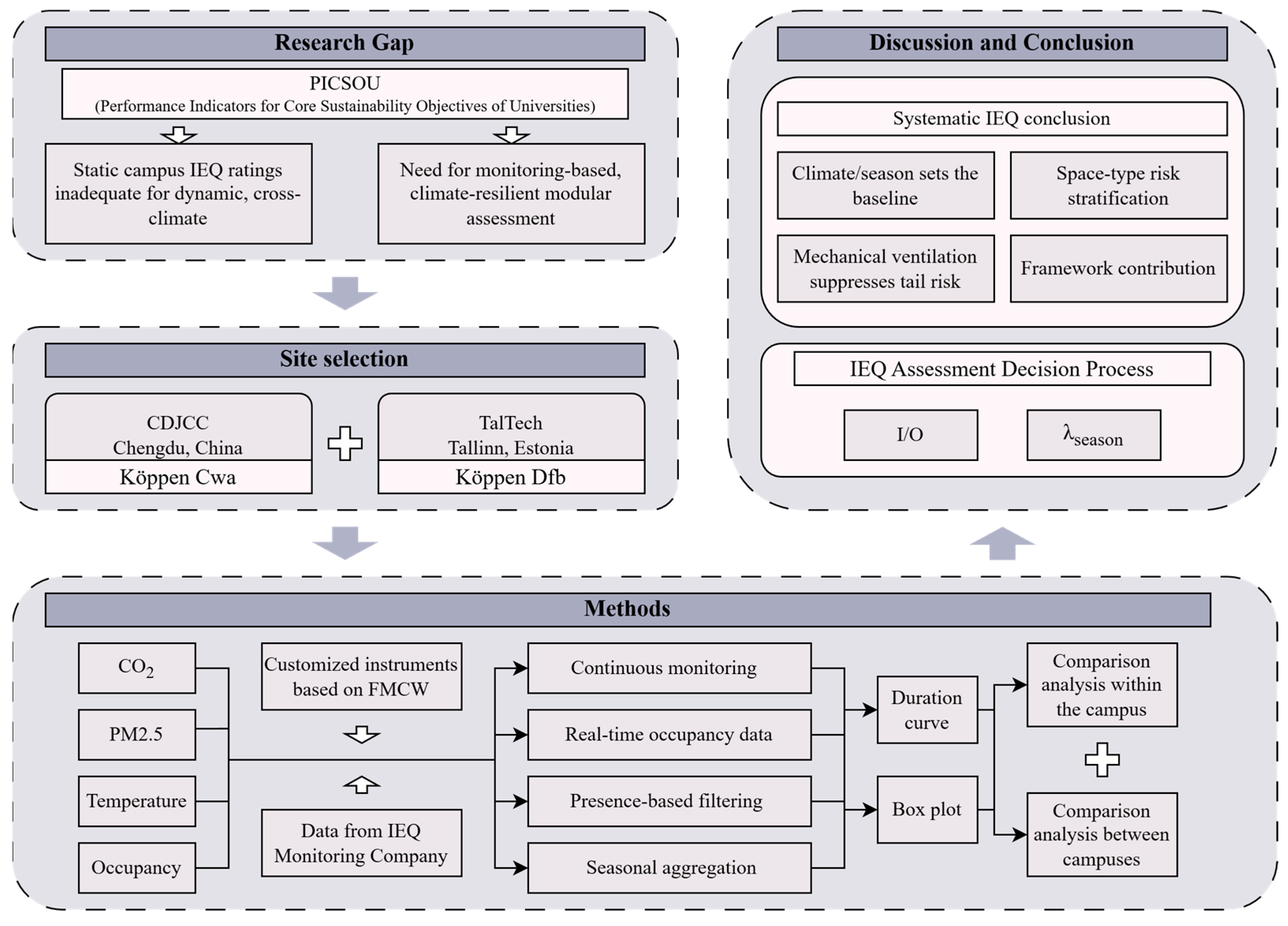
Targeting these four issues, the study conducts a specific enhancement and optimization of the IEQ module within the PICSOU framework, incorporating multi-pollutant monitoring, dynamic assessment methods, cross-climate applicability, and space-type differentiation, thereby providing a more scientific, universally adaptable, and operationally viable pathway for sustainable campus development. The methodological workflow, from monitoring design to IEQ optimization, is illustrated in Figure 1

2. Materials and Methods

To establish the universality of the PICSOU framework across divergent climatic and cultural contexts, particularly in its IEQ category, a parallel IEQ monitoring campaign was conducted during the 2024–2025 academic year at two university campuses: Chengdu Jincheng College (CDJCC), China, and Tallinn University of Technology (TalTech), Estonia. The distinct environmental settings and methodological approaches employed at each site are summarized in Table 1, providing a foundational overview of the experimental design for the subsequent analysis.

2.1. Site Selection for Two Climate Zones

This study utilized locally available IEQ sensors to assess IEQ across the spring and autumn semesters at two sites—CDJCC and TalTech. The campuses lie in distinct climate zones, enabling cross-climatic conclusions of broader applicability.

2.1.1. CDJCC

Chengdu Jincheng College (CDJCC) is located in Pidu District, Chengdu—the fourth largest city in China, with a population of 21.4 million as of Q2 2025. Located in a subtropical monsoon climate (Cwa in the Köppen climate classification), the metropolis of Chengdu has distinct seasons characterized by hot, rainy summers, mild, damp winters and persistently high humidity. The CDJCC campus harbors 31,000 students and 1771 teaching staff, covers approximately 1.4 km2 and includes a variety of indoor environments such as dormitories, classrooms, and offices. Ventilation operates in mixed-mode, consisting mostly of natural ventilation with supplemental air-conditioning running during summer and winter months when thermal comfort cannot be maintained.
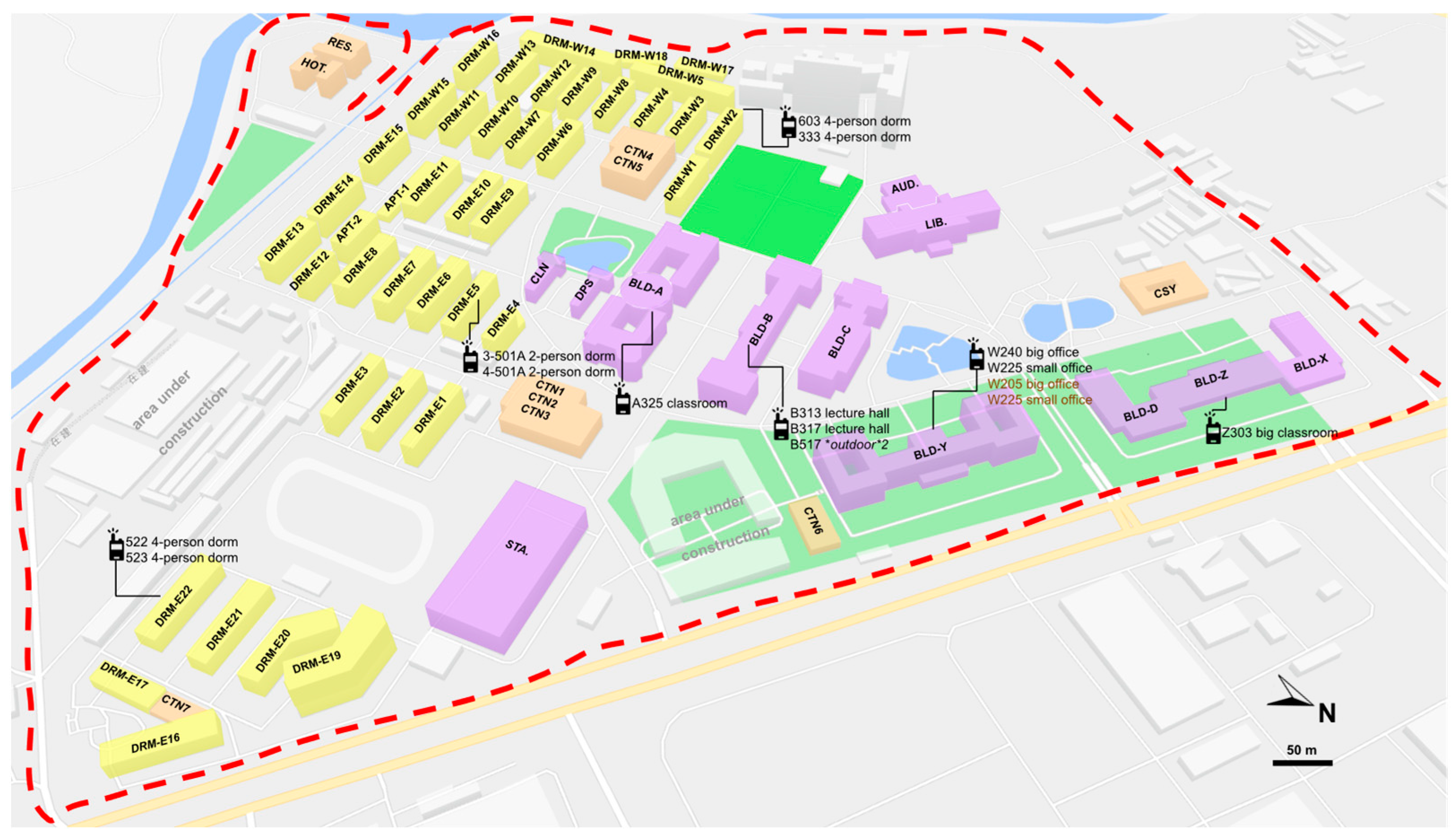
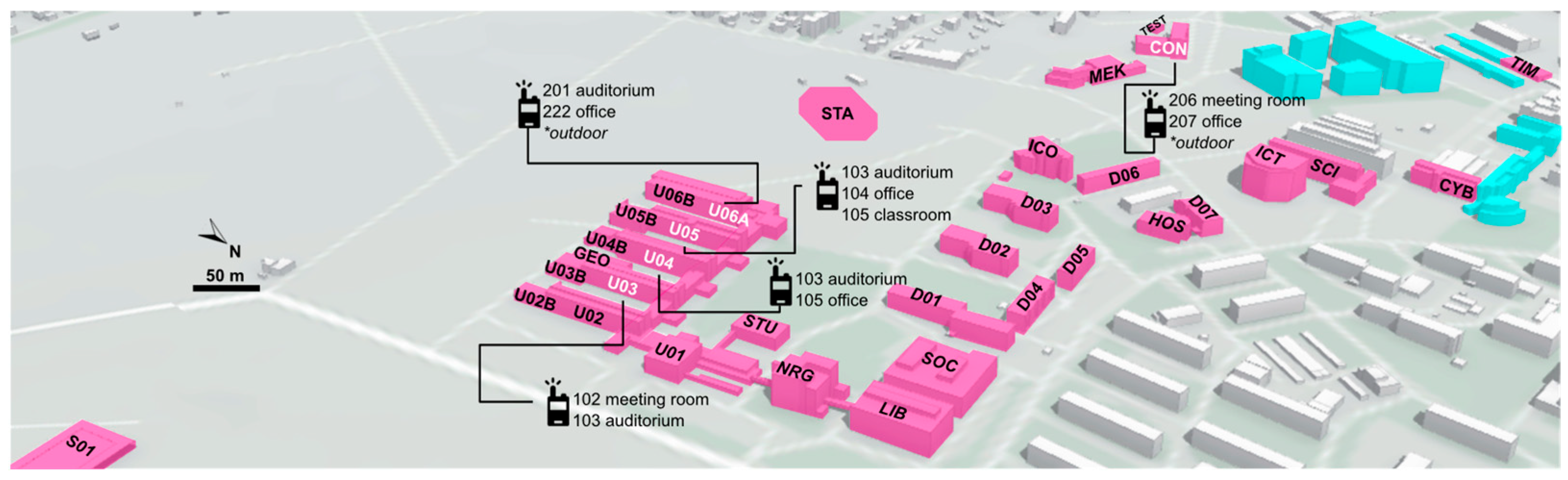
During the autumn semester, we deployed 13 sensors across 6 dormitories, 2 offices, 4 classrooms, and 1 outdoor location. During the spring semester, we adopted a mostly identical sensor deployment scheme (changed only two office locations due to limited accessibility during the testing period) with 1 additional outdoor location for enhanced verification of outdoor air quality (Figure 2). In both the spring and autumn semesters, data were sampled at 1 min intervals, capturing real-time IEQ parameters including CO2, PM2.5, temperature, and relative humidity. Each semester comprised 15 days of measurements, accompanied by synchronized records of occupant presence detected by the same IEQ sensor at each location.

2.1.2. TalTech

Tallinn University of Technology (TalTech) is located in Tallinn, the capital of the Republic of Estonia. Situated on the country’s north coast, Tallinn has a population of approximately 440,000, the largest in the nation. The city sits in the transitional zone between temperate oceanic climate and temperate continental climate (Dfb in the Köppen climate classification)—mild and humid year-round, with evenly distributed precipitation, and significant differences in daylight hours between seasons thanks to its high latitude.
The university occupies 29 buildings with a total floor area of 108,312 m2, serving 9100 students, 1240 faculty members and 1002 staff as of Q4 2024. Mechanical ventilation is used year-round across the campus; systems operate continuously, and district heating is activated during cold months (normally lasts from 1 October to 31 March; exact start and end dates may vary depending on weather conditions).
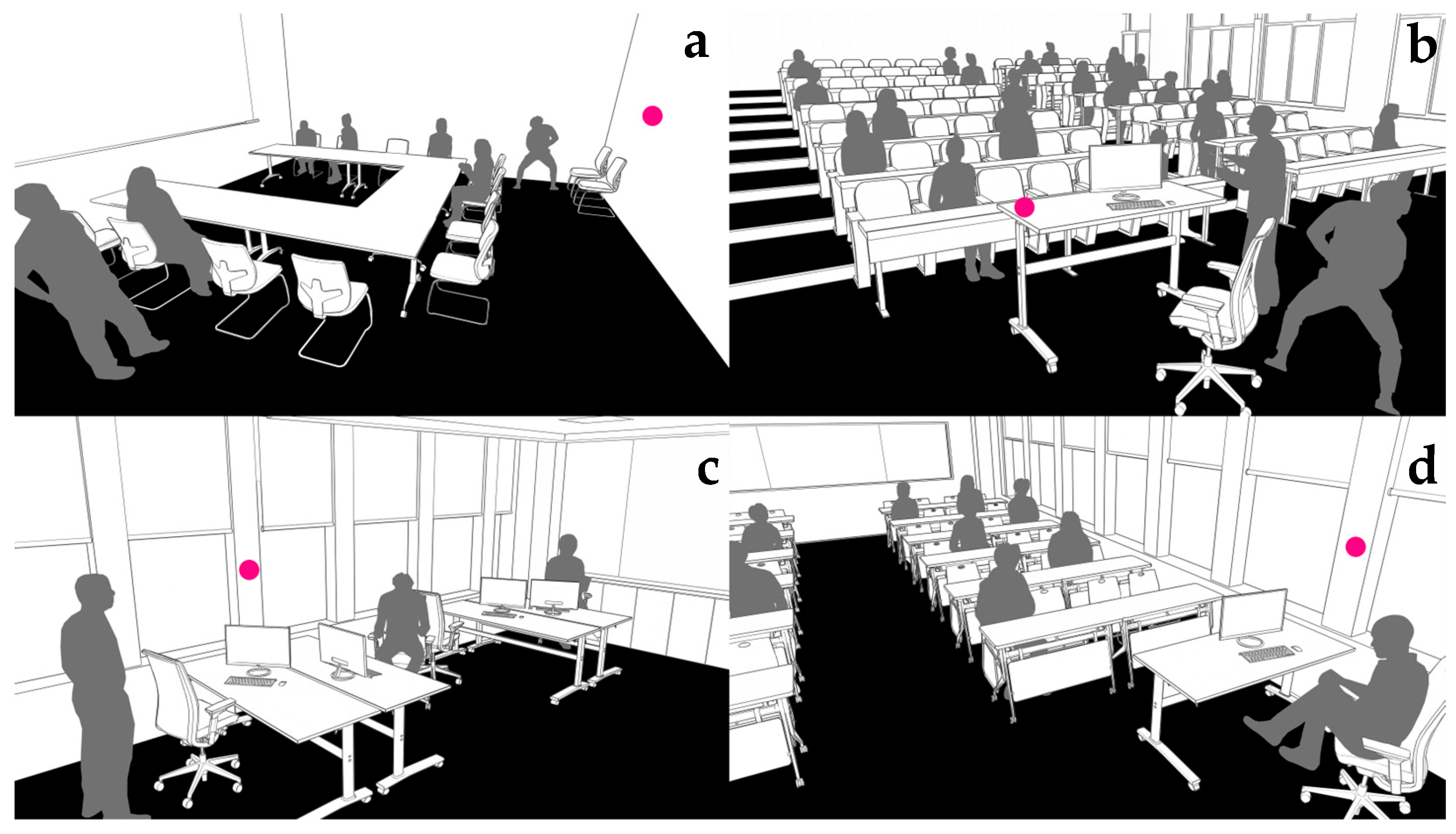
Leveraging the widespread deployment of permanently installed sensors on campus, we compiled a dataset from 13 sensors—7 classrooms/auditoriums/meeting rooms, 4 offices, and 2 outdoor locations (Figure 3) over extensive periods throughout the academic year. Measurements were logged at 10 min intervals, capturing core IEQ parameters: CO2, PM2.5, temperature and relative humidity. Due to the absence of an occupancy detection module within the sensors, no real-time records of occupant presence were documented on the TalTech site.

2.2. Sensors Specifications

2.2.1. Sensors at CDJCC

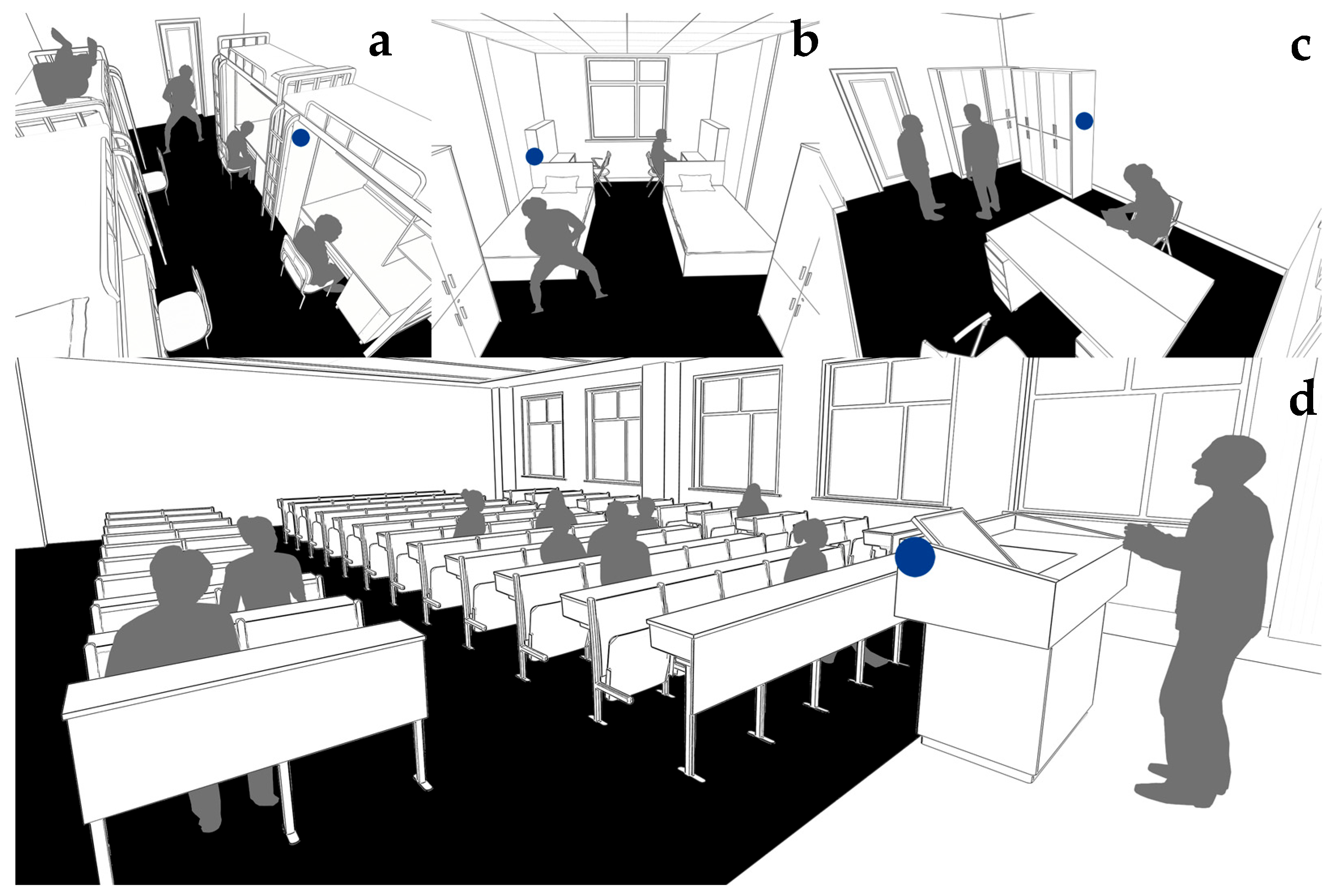
On the CDJCC site, we custom-built sensor units by integrating dedicated modules for IEQ measurement with human presence detection based on frequency-modulated continuous-wave (FMCW) radar into a single device. All sensors shared identical parameters and specifications (Table 2). Installation locations in representative space types (4-person dormitory, 2-person dormitory, office and classroom) are shown in Figure 4.

2.2.2. Sensors at TalTech

On the TalTech site, IEQ monitoring is outsourced to specialized industrial partner. All sensors shared identical parameters and specifications; sensor specifications are summarized in Table 3, and installation locations in representative space types (meeting room/classroom/auditorium and office) are shown in Figure 5.

2.3. Data Collection and Preparation

2.3.1. Data-Period Designation

This study compares campus IEQ performance under different ventilation modes within various climate zones. Accordingly, we analyzed monitoring data from representative autumn and spring semesters at two universities.
At CDJCC, the typical autumn semester (September–January) and spring semester (February–June) were each monitored for 15 days (during the autumn semester: 17 December–31 December; during the spring semester: 9 May–23 May). In total, we collected over 3.8 million records, comprising 13 datasets in autumn semester and 14 datasets in spring semester, with each dataset containing 21,600 time-steps and 5 attributes (CO2, PM2.5, temperature, relative humidity and real-time occupancy status).
At TalTech, the typical autumn semester runs September–December and the spring semester February–June. For analysis, in order to fully overlap with teaching activities and the district-heating run time, we defined a winter period of 22 September–20 December, we also defined a summer period of 2 May–21 June to coincide with teaching and mechanical cooling, the period between January and April was omitted as it is the extended heating season during the spring semester. We compiled over 1.52 million records in total, spanning 55 spring datasets and 65 autumn datasets, where each dataset contained a single-indicator time series.

2.3.2. Data Processing

Prior to conducting the comparative analysis, we subjected all raw monitoring data from the two campuses to systematic cleaning and structural preprocessing to ensure temporal completeness and the reliability of subsequent statistical procedures.
For the CDJCC dataset, where each exported record contains multiple monitored parameters associated with a single timestamp, a complete 1 min time series was first generated for each designated monitoring period. All collected records were then Boolean-matched to this full-period sequence to ensure accurate alignment at every time point. Based on the aligned data, we further quantified the overall data coverage separately for the spring (corresponding to the summer monitoring period) and autumn (corresponding to the winter monitoring period) semesters. In the spring semester, 302,400 theoretical timestamps were expected, among which, 273,461 valid entries were recorded and 28,939 were missing, yielding a loss rate of 9.57%. In the autumn semester, 280,800 timestamps were expected, with 263,175 valid entries and 17,625 missing, corresponding to a loss rate of 6.28%. Most lost points were attributed to accidental sensor power interruptions or operational mishandling. To avoid artificial smoothing effects that could bias the interpretation of tail behavior in duration-curve analysis, all missing values were retained as NaN without interpolation or model-based reconstruction.
The TalTech dataset differs fundamentally from CDJCC in structure, as each timestamp corresponds to only one IEQ parameter, forming a set of single-indicator time series. Based on the three key parameters required for subsequent analysis (CO2, PM2.5, and temperature), all relevant records were extracted from the operator-provided database for both the winter (corresponding to the autumn semester) and summer (corresponding to the spring semester) monitoring windows, and the seasonal data availability was quantified accordingly. The results reveal substantial seasonal and inter-indicator variation in data coverage. During the winter monitoring period, the loss rates were 26.82% for PM2.5, 22.34% for CO2, and 22.33% for temperature. In contrast, during the summer monitoring period, the loss rates were significantly lower, amounting to 4.87% for PM2.5, 4.99% for CO2, and 4.99% for temperature. These missing values reflect the intrinsic recording limitations of the single-indicator monitoring system across seasons and parameters; therefore, all missing points were retained as NaN, without interpolation, so as to preserve the true coverage profile of each indicator.
Regarding extreme-value handling, all extreme observations were retained in the dataset rather than being removed. High or low IEQ values typically correspond to meaningful transient conditions—such as CO2 accumulation under high occupancy, PM2.5 ingress during window-opening events, or short-term ventilation or infiltration fluctuations—and thus contain valuable diagnostic information. Because the duration curve is a central analytical tool in this study, and its interpretive power relies on retaining the full distribution, especially the upper and lower tails, discarding extreme values would directly weaken its ability to characterize the frequency and persistence of exceedances. It should also be noted that box plots were constructed using the 1.5 × IQR rule, which suppresses the display of outliers; therefore, retaining extreme values does not affect box-plot readability but is essential for ensuring accurate duration-curve-based assessments.

2.4. Analytical Method

2.4.1. Duration Curve

A duration curve (also called a duration–exceedance curve) orders a variable from high to low over the observation period and plots the proportion (or probability) of time the variable exceeds a given value, thereby providing an intuitive view of its distribution across time using Equation (1).
P X x i = m N + 1
Here, X denotes the monitored indicator (e.g., PM2.5 level or CO2 concentration); x i is the ith observation after sorting; m is the number of samples greater than or equal to that observation; and N is the total number of observations. Using N + 1 avoids boundary probabilities of 0 or 1 and yields a more reasonable exceedance distribution. This probability reflects the share of time during which the indicator exceeds a given value and is used to plot the duration curve, thereby revealing the occurrence frequency of different concentration levels and their persistence over the monitoring period.
In this study, we applied the duration curve method to analyze three IEQ parameters—CO2 concentration, PM2.5 level, and temperature—separately for the spring and autumn semesters to reveal seasonal differences. For each parameter, observations collected during occupied periods were first filtered and then sorted from high to low; the corresponding exceedance probabilities were calculated to construct the duration curve. This approach statistically characterizes the relationship between a variable’s magnitude and the percentage of time it is equaled or exceeded, providing an intuitive view of the distribution and persistence of indoor air quality over time and facilitating the identification and comparison of extremes.

2.4.2. Occupancy Probability

The custom-built sensor units deployed at CDJCC are capable of monitoring IEQ data and real-time human presence simultaneously thanks to their multi-modular configuration. Since there has been no widely documented precedent of a single, integrated device that combines an FMCW radar module with a standard IEQ sensor suite (CO2, PM2.5, temperature, relative humidity) for simultaneous monitoring, it is crucial to conduct a comprehensive verification of the reliability of the FMCW radar module within the sensors. To this aim, in addition to examining the continuity of the time-stamped occupancy data, we also adopted the dimensionless quantity of occupancy probability to be used together with duration curves to better observe the correlation between the average IEQ values within a space type and the overall occupancy of the same space type. At any given timestamp, occupancy probability is designated as the proportion of the total number of occupied rooms over the total number of rooms within the same space type. For example, a 0.5 occupancy probability in classrooms denotes that human presence is detected in half of all the classrooms at the timestamp of observation. To solve for occupancy probability, we adopted Equation (2):
O d r m / o f f / c l s = i = 1 n O i N d r m / o f f / c l s
in which, O d r m / o f f / c l s is the occupancy probability at a given timestamp within one of the 3 space types at CDJCC (dormitory/office/classroom), n is the number of rooms with detected human presence within a specific space type, O i is a binary value designated as the Occupancy Detection Contributor, when O i = 1, human presence is detected in a room, when O i = 0, no human presence is detected in a room. N d r m / o f f / c l s is the total number of sensors dedicated to a specific space type. At CDJCC, N d r m = 6, N o f f = 2, N c l s = 4.
To solve for the average IEQ value within a space type at a given timestamp, we adopted Equation (3):
X ¯ = i = 1 N d r m / o f f / c l s ( C i / P i / T i / H i ) D i i = 1 N d r m / o f f / c l s D i
in which X ¯ is the average IEQ value from one of the 4 IEQ indicators (CO2, PM2.5, temperature and relative humidity) at a given timestamp within one of the 3 space types (dorm/office/classroom) represented by Ci, Pi, Ti and Hi. N d r m / o f f / c l s has the same definition as in Equation (2). D i is a binary value introduced as an error-proofing mechanism designated as the Denominator Contributor. When D i = 1, a sensor is functioning as intended and IEQ data is documented, whereas D i = 0 denotes a mishap with no data documented. Verification of reliability of the FMCW radar module was carried out during the autumn semester’s monitoring period at CDJCC, from which, a documented 6.28% of the total data were lost due to reasons such as mis-operation or/and accidental/unauthorized unplugging, in the event of an unpredicted data loss, D i helps automatically adjust the number of properly functioning sensors so that the average IEQ value is always correctly solved for.

2.4.3. Box Plot

Coined in 1977, box plot is a nonparametric visualization based on the five-number summary. It displays the minimum, maximum, median, and the lower and upper quartiles. It is used to describe the central tendency and dispersion of numerical data and to identify outliers [63].
For IEQ indicators such as PM2.5 level and CO2 concentration, box plots require no normality assumption and, in the presence of skewness and short-lived peaks, provide a robust way to compare typical levels and anomalous fluctuations across different spaces, periods, or operating conditions. Relevant equations are as follows (see Equations (4)–(11)):
x 1 x 2 x n
Q 1 = q u a n t i l e x , 0.25
Q 2 = m e d i a n x
Q 3 = q u a n t i l e x , 0.75
IQR = Q 3 Q 1
L fence = Q 1 1.5 IQR
U fence = Q 3 + 1.5 IQR
outlier   if   x i < L fence   or   x i > U fence
here, Q 1 is the lower quartile (25%), the median Q 2 is at the 50%, and the upper quartile Q 3 is at the 75%. The interquartile range IQR = Q 3 Q 1 describes the dispersion of the middle 50% of the data. L fence and U fence denote the whisker ends, the minimum/maximum observations. Outside the range of [ L fence , U fence ] is classified as an outlier.
To characterize IEQ across climate zones, seasons, and space types and to enable macro-level comparisons, this study employs box plots using Tukey’s 1.5 × IQR rule—with whiskers limited to Q 1     1.5 IQR , Q 3   +   1.5   IQR —to estimate typical levels and thereby reveal overall differences among spaces. Applying the 1.5 × IQR criterion provides a more precise view of central tendency and spread for the overall picture. In view of inevitable extremes, outliers are not displayed to improve readability; these conditions are instead depicted using duration curves.

2.4.4. Occupation Determination

In this study, occupied periods at CDJCC were identified using the instruments’ built-in presence-detection module, which labeled the occupant-presence status at the corresponding timestamps.
In the campus buildings of TalTech, occupant presence was primarily inferred from the CO2 time series. Outdoor CO2 background levels typically fluctuate slightly within a narrow range; indoors, since human respiration is the main CO2 source, a pronounced rise in CO2 concentration within a given time window generally indicates that the space is occupied. Conversely, if the concentration remains stable or declines, the space is considered unoccupied. Indoor CO2 is also affected by mechanical-ventilation operation and outdoor-background variability, and the collection of time-series data is subject to sensor acquisition delays, leading to a lag in the data timestamps relative to actual occupancy.
Based on the above principles, the collected time-series data can be analyzed using Equations (12) and (13) to determine whether occupants were present at each time step.
Δ C ( t ) = C ( t ) C ( t 1 )
O t = 1 , if   Δ C t > 0   and   C t > 550 0 , otherwise
In this formulation, let Δ C ( t ) denote the CO2 concentration at time t . The increment between adjacent time steps is defined as Δ C t = C t C ( t 1 ) . On this basis, we construct an occupancy indicator O t : assign “ O t   =   1 ” if and only if Δ C t   >   0 and C t   >   550 ; otherwise assign “ O t   =   0 ”. This rule emphasizes increases relative to the preceding time step and incorporates an absolute threshold to reduce the risk of misclassification.

2.4.5. Identification of Critical IEQ Reference Values

Based on commonly used Chinese standards [64,65], relevant EU standards [66], and international standards [67]—together with recent findings on occupant health and comfort—and using the summer and winter thresholds specified in these standards, we determined the following key IEQ reference values (see Table 4). This selection of core IEQ indicators and the category-based interpretation is also consistent with the EU Commission’s technical guidance on indoor environmental quality monitoring and assessment under the EPBD recast [58]. Values highlighted in bold are the thresholds used as benchmarks for the IEQ assessment in this study.

2.4.6. T-Distribution Confidence Intervals for Key Room-Level Indicators

In this study, Student’s t-distribution (Equation (14)) [68,69] is used in an estimation framework to quantify the uncertainty of two key conclusions, rather than solely for classical null-hypothesis significance testing. For each campus–season–space-type combination, room-level indicators, namely the seasonal CO2 ratio λ season and the room-level PM2.5  I / O ratio, are treated as independent observations. Within each group, the parameter of interest is the mean value of the room-level indicator, and its 95% confidence interval is constructed using the t-distribution.
Specifically, for a generic room-level indicator x , the 95% confidence interval for the group mean is given by
x ¯ ± t 0.975 , n 1 s n
where x ¯ is the sample mean across rooms, s is the sample standard deviation between rooms, n is the number of rooms (or sensor points) in the group, and t 0.975 , n 1 is the two-sided 97.5th percentile of Student’s t-distribution with n   1 degrees of freedom. This formulation explicitly accounts for the fact that the population variance is unknown and must be estimated from the sample, which is particularly important given the relatively small number of rooms in some campus–space-type groups.
The resulting t-distribution confidence intervals are then used to examine whether the empirically observed room-level indicators are consistent with the two main conclusions of this study (regarding the seasonal CO2 ratios λ season and the PM2.5   I / O behavior), following current recommendations that emphasize estimation and interval interpretation rather than reliance on point estimates or p-values alone [69].

3. Results

3.1. Reliance Verification of CDJCC Sensors’ FMCW Radar Module

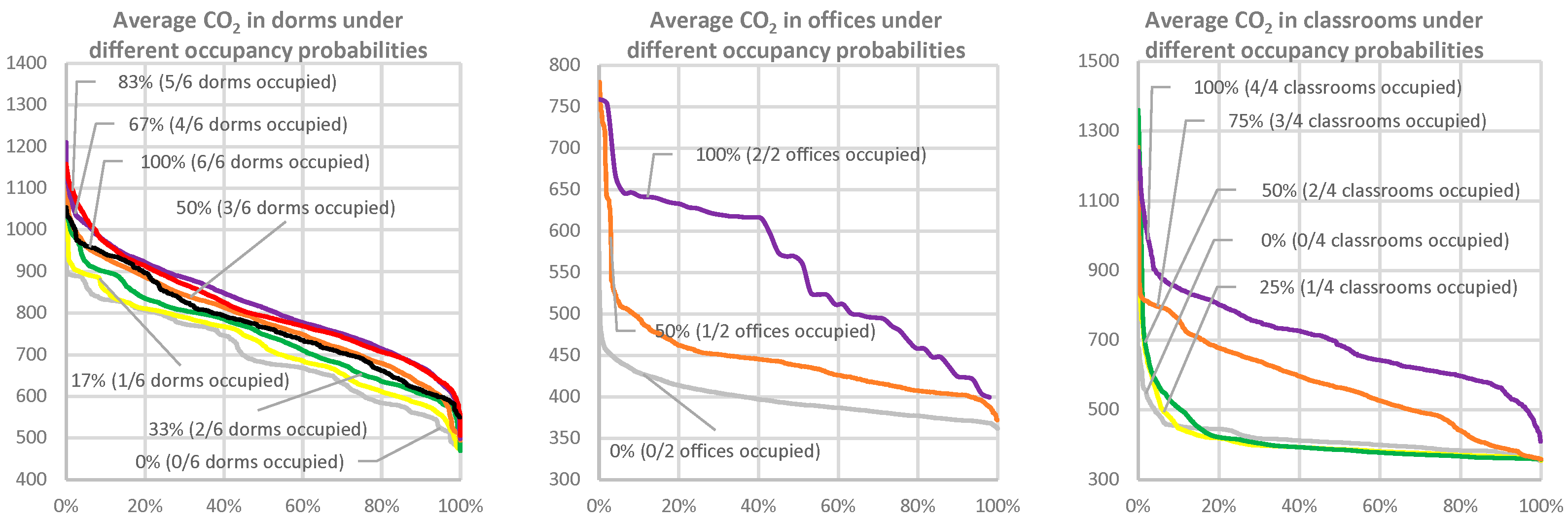
We conducted reliance verification on the FMCW radar module from custom-built sensors used at CDJCC during the autumn semester’s monitoring period by plotting the duration curve of each space type’s average CO2 value under different occupancy probabilities (see Figure 6).
Figure 6 indicates a positive correlation between average CO2 concentration and occupancy probability across all space types, which aligns with the established principle that CO2 level serves as a reliable proxy for human presence, although such correlation can be coincidental and does not necessarily suggest any direct causality between increased occupancy probability and increased average CO2 value of occupied rooms within the same space type, as each occupied room’s peak CO2 value can greatly vary due to ventilation efficiency and occupant behavior, the fact that all non-zero occupancy probabilities’ duration curves appear above that of the 0% occupancy probability suggests that the FMCW radar module: (1) was not producing grossly incorrect occupancy detection results; (2) produced occupancy detection that was at least directionally correct (occupied rooms have higher average CO2 value than empty ones); (3) was not systematically misclassifying occupancy in a way that violates such fundamental physical relationship. Additionally, an anomaly is observed in dormitories, where the duration curves for 83% and 67% occupancy probabilities largely overlap and exceed the curve for 100% occupancy probability. This inverse relationship can be attributed to the small spatial volume of dormitories; higher occupancy probability increases the probability of door or window opening for natural ventilation, thereby reducing CO2 accumulation. In contrast, larger spaces like offices and classrooms exhibit a stronger positive correlation, void of such anomaly, likely due to reduced ventilation interventions stemming from social inhibition among occupants. The overall realism of the duration curves validates the synchronous data collection of the FMCW radar module and its IEQ suite counterpart, confirming that the FMCW radar module was working as intended.
To further assess the methodological comparability between the FMCW radar-based occupancy detection at CDJCC and the CO2-based occupancy inference used at TalTech, we conducted a targeted cross-validation using the CDJCC dataset. The analysis was restricted to the same space types as at TalTech, namely offices and classrooms, and to periods in the spring and autumn semesters when both FMCW radar–derived occupancy flags and indoor CO2 measurements were simultaneously available. On this subset of data, we reproduced the TalTech rule-based occupancy model exactly: a room is classified as “occupied” if the indoor CO2 concentration remains above 550 ppm over a 10 min interval, and the resulting binary occupancy status is inferred solely from the CO2 time series without using any radar information. The CO2-based occupancy labels were then temporally aligned with the FMCW-based occupancy labels, and all time steps with both labels available were used to quantify their agreement.
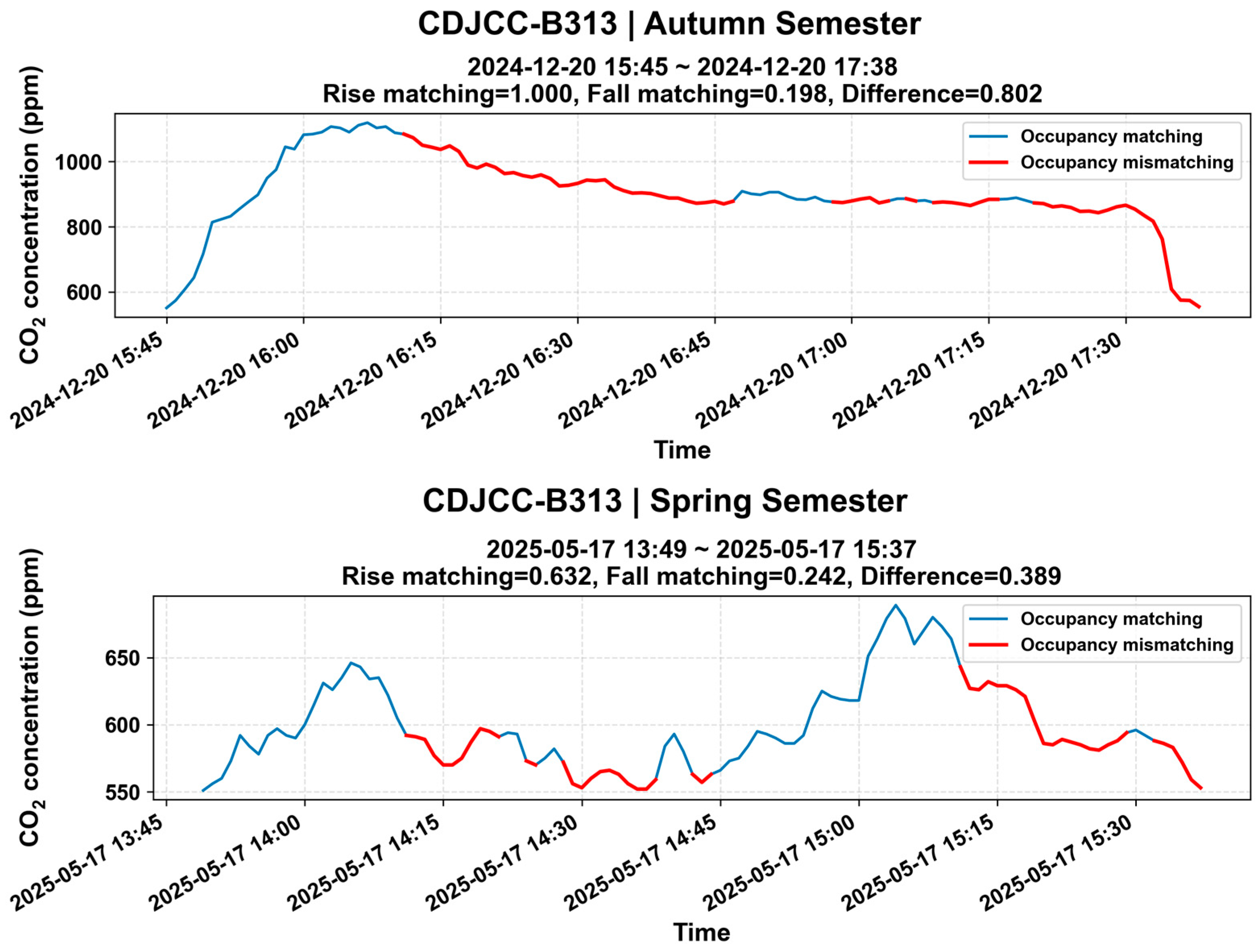
The cross-validation results can be summarized in two main points. For clarity, we report the summary statistics in Table 5 and illustrate two representative episodes in Figure 7.
First, during “standard growing phases” of CO2 (i.e., periods when indoor CO2 exhibits a sustained increase without pronounced reversals), the CO2-based occupancy estimates derived from the TalTech rule show a high level of agreement with the FMCW-based occupancy labels at CDJCC. This indicates that, for typical situations in which occupants enter the room and remain there for some time so that indoor CO2 accumulates monotonically, the CO2-based inference and the radar-based detection identify occupied states in a broadly comparable manner. These phases form the core of the clearly occupied periods that underpin the cross-campus analysis in this study.
Second, once indoor CO2 no longer increases monotonically but instead exhibits plateaus, declines, or repeated oscillations, discrepancies between the two methods become much more pronounced. Under the mixed-mode ventilation conditions at CDJCC, window opening, door opening, and short absences tend to dilute indoor CO2, so that even when people are still present, CO2 may temporarily decrease or fluctuate substantially; when the number of occupants is small or the occupancy level varies rapidly, indoor CO2 can also remain at comparatively low levels for extended periods. Because the TalTech rule requires CO2 to remain above 550 ppm and to display a rising tendency over the 10 min interval, such “occupied but CO2-decreasing or low-CO2” episodes are systematically classified as “unoccupied” and thus omitted from the CO2-based occupancy record. It should be noted that, although TalTech employs a purely mechanical ventilation system and therefore tends to exhibit smoother and more nearly linear CO2 buildup during occupancy, periods with few occupants or rapidly changing occupancy can still produce oscillations or short-term decreases in CO2, which are likewise prone to being excluded as “unoccupied” under the same rule.
Taken together, these findings suggest that the two campuses are methodologically comparable with respect to clearly occupied periods characterized by sustained CO2 buildup: in such intervals, the TalTech CO2-based method and the CDJCC FMCW-based detection provide consistent “occupied” classifications, and our cross-campus comparisons are intentionally based primarily on this robust subset of occupied states. Consequently, the moderate overall matching ratio reported in Table 5 should not be interpreted as low FMCW radar accuracy, but rather as a reflection of the conservative nature of the CO2-based inference, which systematically excludes certain occupied intervals by design. At the same time, the cross-validation also reveals that the current TalTech CO2-based approach structurally omits part of the occupancy dynamics, specifically those situations in which people are present but indoor CO2 decreases or remains low due to strong ventilation or low occupant density. From a methodological standpoint, complementing CO2-based inference with non-intrusive, direct occupancy sensing technologies such as FMCW radar in TalTech-type settings would enable a more complete representation of occupied periods spanning both CO2 accumulation and decay phases, and would further strengthen the robustness of cross-campus occupancy comparisons.

3.2. Spring–Autumn Semester Comparisons for Each Campus

In this comparative analysis, the portion from Q1 to Q3 in the box plots represents the middle 50% of the data for each room type, reflecting the general IEQ level under typical conditions; we refer to this as the “typical interval.” The upper and lower whiskers represent the fluctuation range of IEQ indicators under special conditions for each space type, referred to here as the “extreme-value interval.”
In this study, the large data volume produced too many outliers in the box plots, making them difficult to read. The duration curve compensates for this limitation by more completely displaying each room’s special behavior during occupied periods.

3.2.1. Spring–Autumn Semester Comparisons at CDJCC

  • CO2
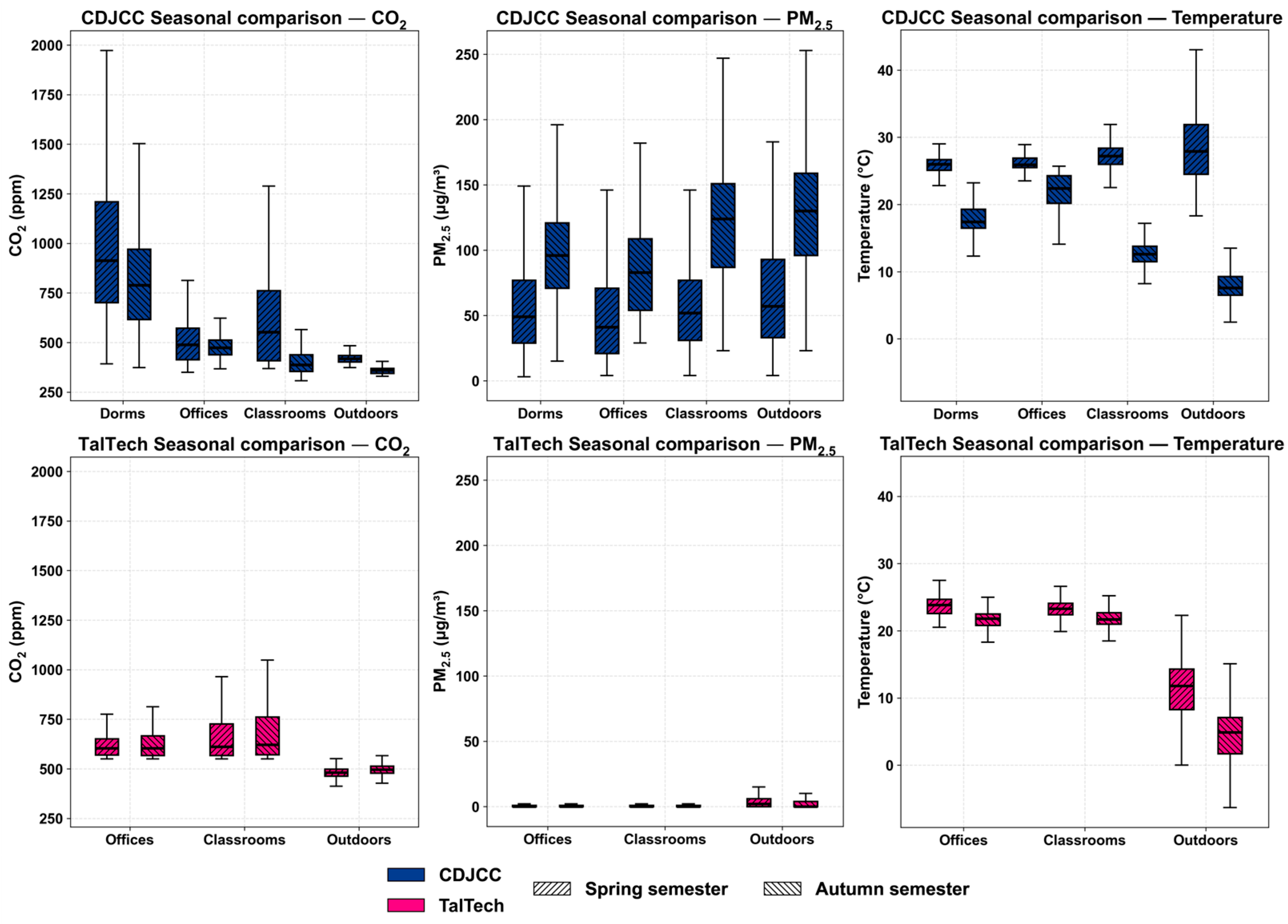
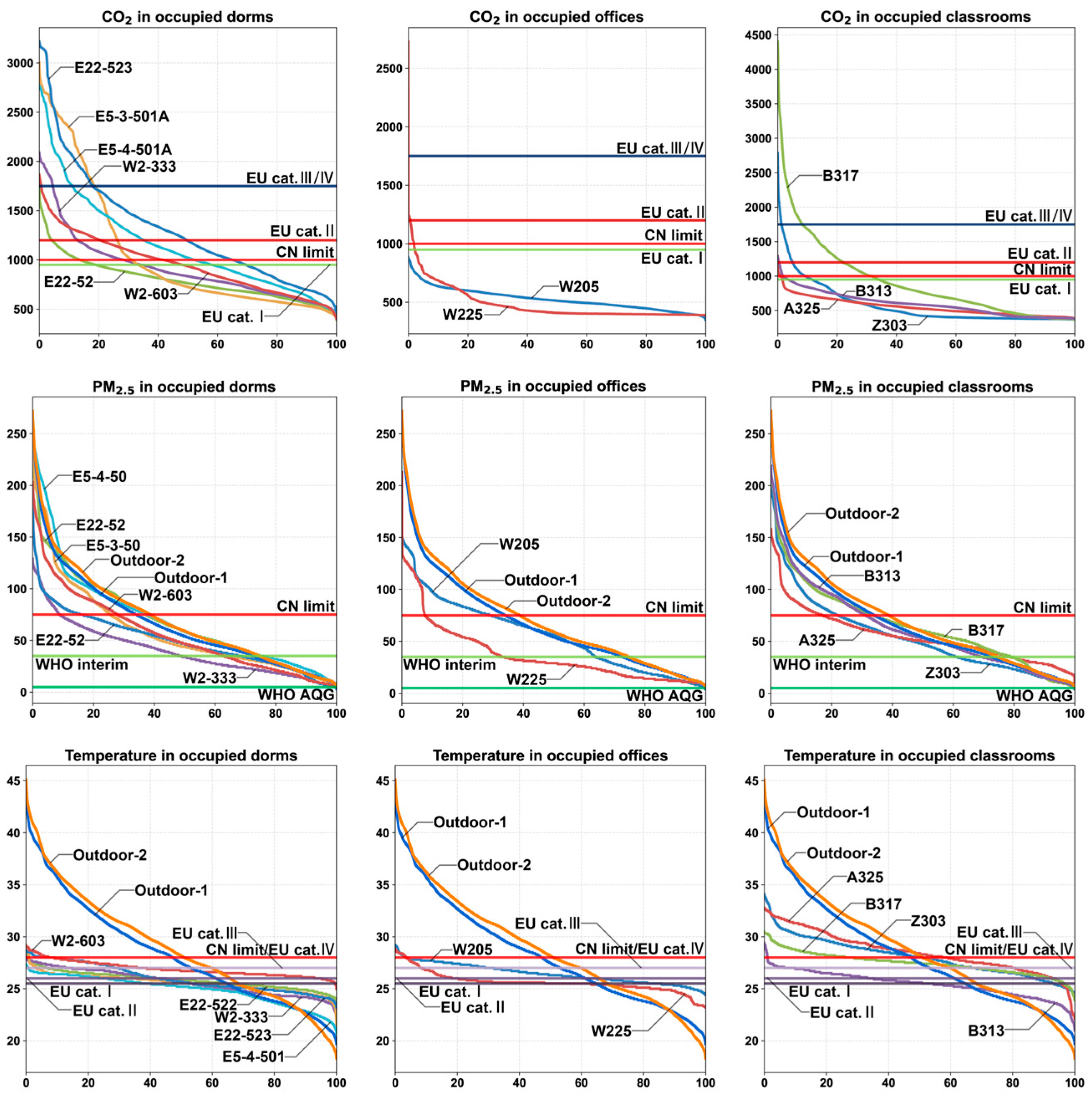
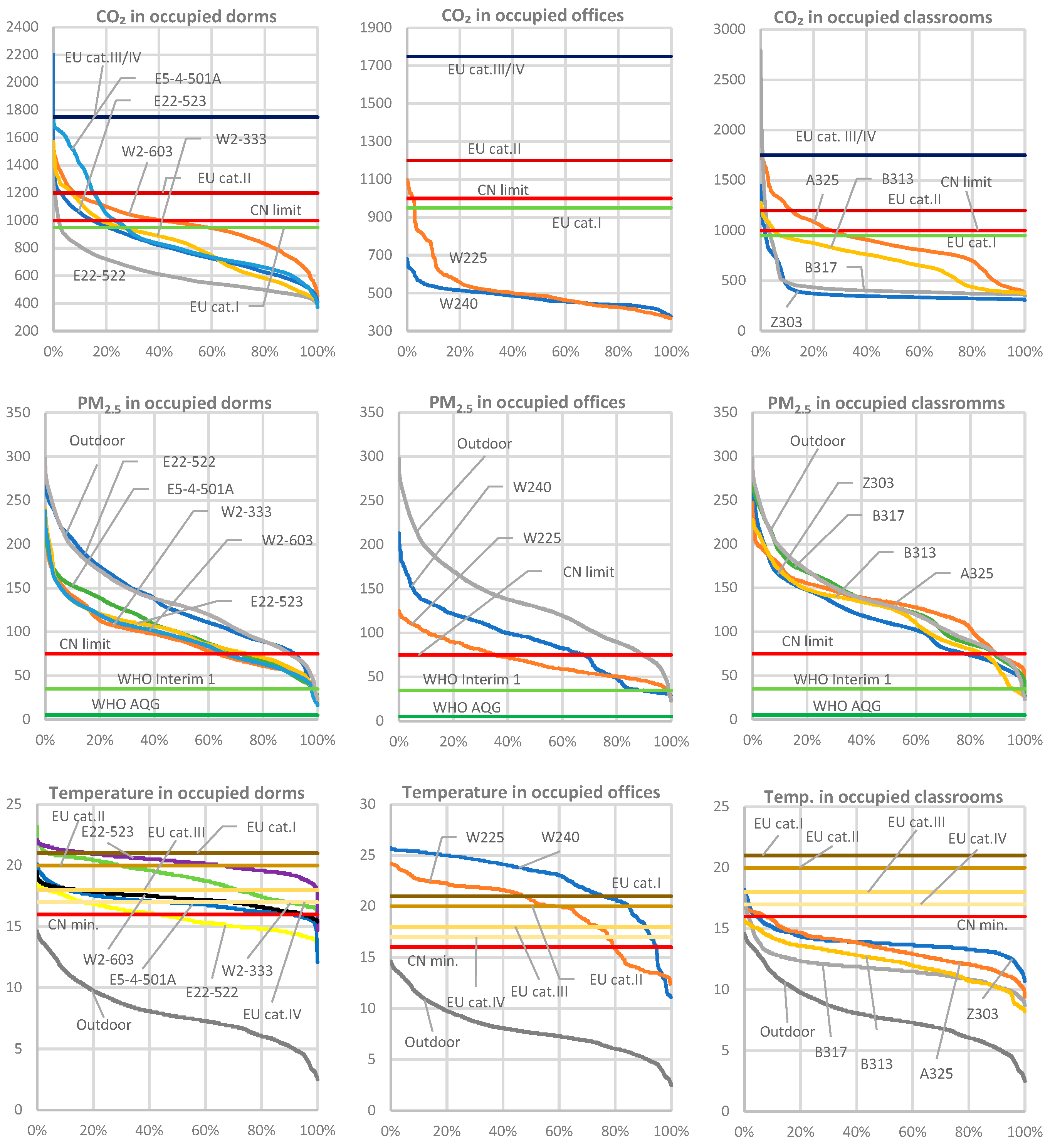
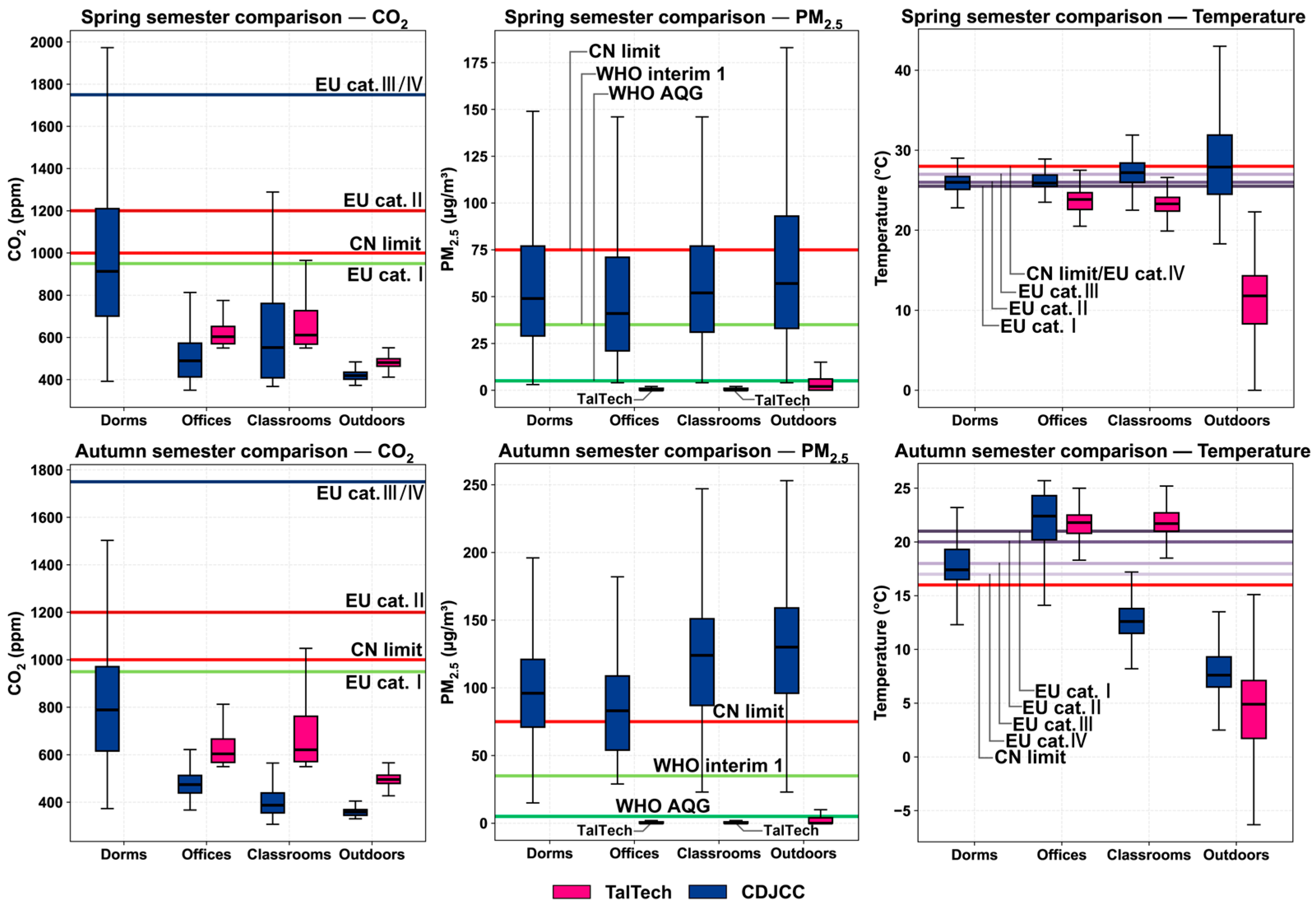
In the spring semester at CDJCC (Figure 8, Figure 9 and Figure 10 and Table 6), the median CO2 concentrations for dormitories/offices/classrooms/outdoors were 913/489/552/419 ppm, with the median ranking from high to low being dormitories > classrooms > offices. The typical CO2 concentrations (box range) in dormitories exceeded the EU cat. II summer limit of 1200 ppm in 2% of cases; by contrast, those for all other space types remained below their respective standard thresholds. Dormitories and classrooms showed relatively long box ranges, which indicates larger typical fluctuation. When interpreted in conjunction with the duration curves, the results indicate that, in the spring semester, CO2 concentrations in dormitories and classrooms exhibit larger typical fluctuations with occasional extreme values.
In the autumn semester, the medians for dormitories/offices/classrooms/outdoors were 789/474/388/359 ppm. The recorded outdoor CO2 concentrations dipping below the 400 ppm baseline is attributed to a combination of the campus’s ultra-high vegetation coverage, which may create a localized carbon sink effect, and a potential sensor offset in the lower range. However, for the core objective of assessing indoor IEQ, this anomaly is inconsequential. Any such low-range sensor inaccuracy diminishes non-linearly and becomes negligible at the higher CO2 concentrations typical of occupied indoor spaces. Therefore, no compensation was applied to the outdoor data, as the indoor assessments remain valid when benchmarked against the unadjusted outdoor readings. The typical indoor CO2 concentrations (box ranges) for all space types were below the winter limit set by the adopted CN standard (1000 ppm). The median ranking from high to low was dormitories > offices > classrooms. Dormitories had relatively longer box ranges, which indicates larger typical fluctuation. When interpreted in conjunction with the duration curves, the results indicate that, in the autumn semester, CO2 concentrations in dormitories exhibit larger typical fluctuations with occasional extreme values.
Comparing spring and autumn across space types shows that both the median and the typical CO2 concentrations (box ranges) were generally lower in the autumn semester than in the spring semester, with the exception that office CO2 concentration was similar between the two semesters. For offices and classrooms, the box ranges in the autumn semester were shorter than in the spring semester, implying smaller typical fluctuations and the absence of extremely high values in the autumn semester. Dormitories showed similar patterns across the two terms. The overall drop in the autumn semester medians and the marked shortening of office/classroom boxes may reflect the combined effects of greater indoor–outdoor temperature differences (enhancing buoyancy-driven ventilation and infiltration) together with relatively lower outdoor CO2 concentration, which dilutes extremes and tightens the typical interval. The spring–autumn similarity in offices may result from stable occupancy and operating strategies. Dormitories retained long boxes in the autumn semester, suggesting that differences in residential behavior and nighttime door/window closures persist across seasons, limiting the dampening effect of seasonal change.
  • PM2.5
In the spring semester (Figure 8, Figure 9 and Figure 10 and Table 6), the median PM2.5 levels for dormitories/offices/classrooms/outdoors were 49/41/52/57 µg/m3, with the median ranking classroom > dormitory > office. In dormitories, 4% of the typical PM2.5 levels (box range) exceeded the summer limit of 75 μg/m3 specified by the adopted CN standard, whereas the box ranges for all other space types remained below this limit. Across space types, the typical ranges were relatively long; classroom levels were nearly at outdoor levels and tracked outdoor trends, indicating larger typical fluctuations, likely influenced by outdoor PM2.5 levels. When interpreted in conjunction with the duration curves, the results indicate that, in the spring semester, PM2.5 levels exhibit larger typical fluctuations with periods of extreme values.
In the autumn semester, medians for dormitories/offices/classrooms/outdoors were 96/83/124/130 µg/m3, ranked classroom > dormitory > office. Typical PM2.5 ranges for all space types were above the WHO Interim Target 1 limit (35 μg/m3), and exceeded the winter limit under the adopted CN standard in 92% of dormitory cases, 62% of office cases, and 100% of classroom cases. Overall, typical ranges were long; classroom values were again close to outdoor levels and mirrored outdoor trends, consistent with the spring pattern.
Comparison between the two semesters shows that both the medians and the typical PM2.5 levels (box ranges) were higher in the autumn semester than in the spring semester. In both semesters, the ranking remained classroom > dormitory > office, and classroom values were closest to outdoor levels. Because PM2.5 exposure is primarily governed by outdoor infiltration and ventilation rates, the seasonal rise in medians and typical ranges is likely driven by higher outdoor backgrounds and variability rather than changes in indoor sources.
  • Temperature
In the spring semester (Figure 8, Figure 9 and Figure 10 and Table 6), the median temperatures for dormitories/offices/classrooms/outdoors were 26.0/25.9/27.2/27.9 °C, with the median ranking classroom > dormitory > office. Typical temperature ranges for all space types were below the summer upper limit specified by the adopted CN standard (28 °C), except in classrooms, where 17% exceeded the limit; indoor temperatures were generally lower than outdoors. Typical ranges across space types were similar and relatively short in the spring semester except for classrooms. When interpreted in conjunction with the duration curves, the results indicate that, in the spring semester, typical temperature fluctuations were modest and episodes of extreme variation were limited, except in classrooms.
In the autumn semester, the medians for dormitories/offices/classrooms/outdoors were 17.4/22.4/12.6/7.6 °C, ranked office > dormitory > classroom. Typical temperature ranges differed markedly across space types: the office box lay above the winter lower limit set by EU cat. II (20 °C), the dormitory box above the winter lower limit set by the adopted CN standard (16 °C), and the classroom box below the winter lower limit set by the adopted CN standard (16 °C). Overall, typical temperature ranges were relatively short, indicating small typical fluctuations across space types. When interpreted in conjunction with the duration curves, the results indicate that, in the autumn semester, offices exhibited generally stable temperatures, classrooms were overall colder, and both dormitories and classrooms displayed larger temperature extremes.
Comparison between spring and autumn shows that, due to outdoor temperature effects, typical ranges and medians were higher in the spring semester. Relative to spring, the autumn boxes for dormitories and offices were longer. Classrooms showed a much larger overall decrease in temperature relative to spring, with the same pattern as before and the closest alignment with outdoor conditions. This indicates larger typical fluctuations in dormitories and offices in the autumn semester, with dormitories showing larger extremes and offices showing larger low-temperature extremes, while classrooms were more influenced by outdoor temperatures. A plausible explanation is that autumn brings outdoor cooling, intermittent heating, and natural ventilation operating simultaneously, leading to mostly stable but occasionally low temperatures in offices, greater variability in dormitories, and classrooms that are overall colder and more closely track outdoor conditions.

3.2.2. Spring–Autumn Semester Comparisons at TalTech

  • CO2
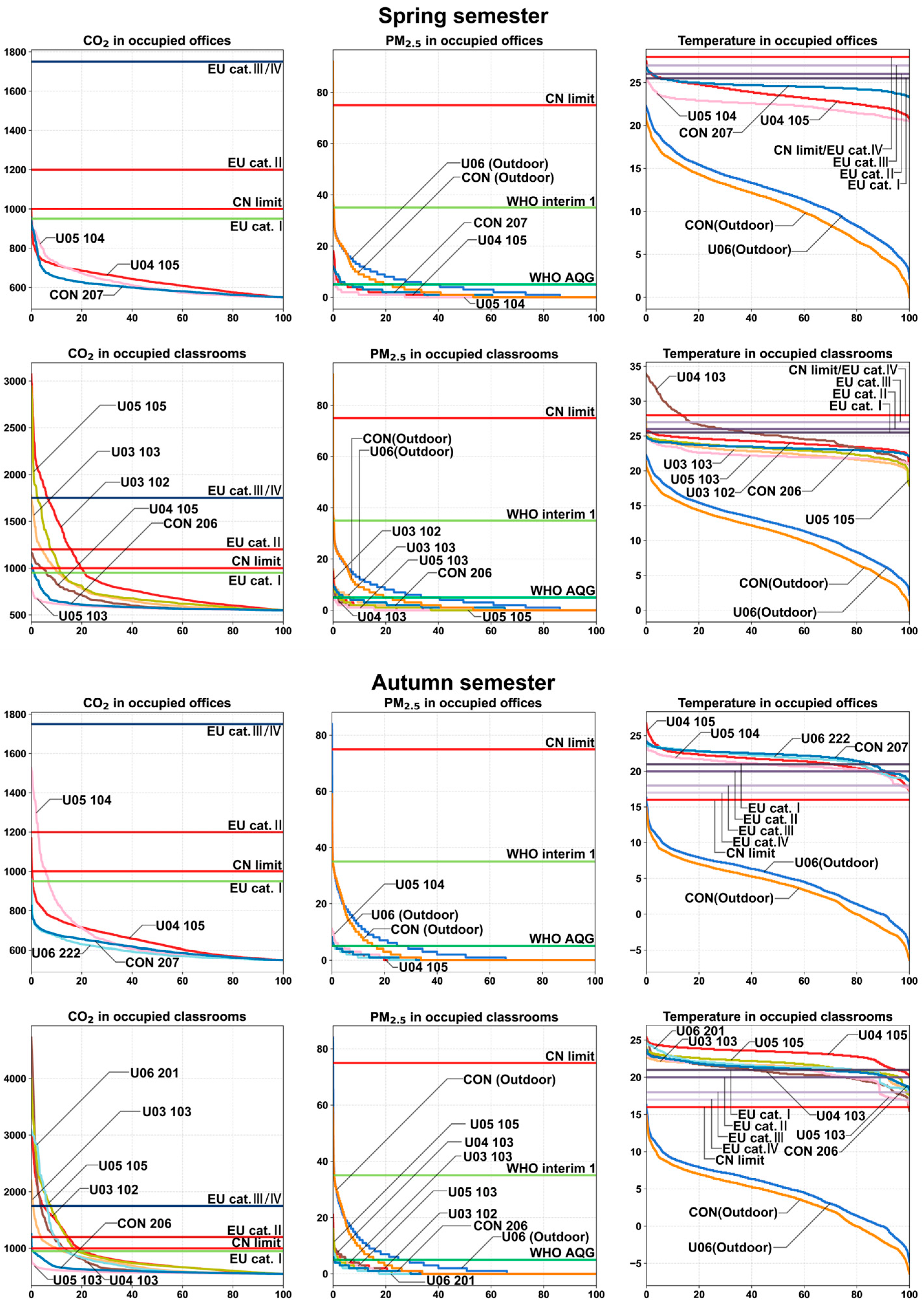
In the spring semester at TalTech (Figure 8 and Figure 11 and Table 6), the median CO2 values for offices/classrooms/outdoors were 604/611/481 ppm. There was no clear difference among space types in the medians, and the typical concentration intervals (box ranges) were similar. All space types were below the limit set by EU cat. I (950 ppm); the classroom box was relatively long with a low-positioned median, indicating relatively larger fluctuations within the typical range and occasional extremely high values.
In the autumn semester, the medians for offices/classrooms/outdoors were 604/621/496 ppm, again with no clear differences among space types. The typical concentration intervals for all spaces were below the limit set by EU cat. I (950 ppm), with no obvious change from the spring pattern.
Comparing the two semesters, the upper quartiles of the autumn semester boxes were slightly higher than in the spring semester in spite of unchanged ventilation strategies, likely due to weather-driven reduced outdoor activities leading to a higher indoor occupancy.
  • PM2.5
In the spring semester (Figure 8 and Figure 11 and Table 6), the median PM2.5 values for offices/classrooms/outdoors were 0/0/2. There were no obvious differences among spaces, and all typical concentration intervals were below the WHO AQG guideline (5 μg/m3).
In the autumn semester, the medians for offices/classrooms/outdoors were 0/0/0, with no obvious differences among spaces; all typical concentration intervals were below the WHO AQG guideline (5 μg/m3).
Comparing spring and autumn, the outdoor typical concentration interval was slightly higher in the spring semester than in the autumn semester, whereas the indoor typical intervals were fairly constant. This suggests that filtration in the mechanical ventilation system keeps indoor pollutant levels consistently low.
  • Temperature
In the spring semester (Figure 8 and Figure 11 and Table 6), the median temperatures for offices/classrooms/outdoors were 23.9/23.3/11.8 °C, with no substantial differences among spaces. Typical temperature intervals for all spaces were below the summer upper limit set by EU cat. I (25.5 °C); the typical intervals were similar and relatively short, indicating limited indoor temperature fluctuations within a narrow range.
In the autumn semester, the median temperatures for offices/classrooms/outdoors were 21.8/21.7/4.9 °C, again with no substantial differences among spaces. Typical temperature intervals were mostly above the EU cat. I winter lower limit (21 °C), except in offices, where 20% fell below the EU cat. I winter lower limit (21 °C). Differences among space types were small, indicating limited indoor temperature fluctuations within a narrow range.
Comparing the spring semester and the autumn semester, typical temperature intervals and medians were generally lower in the autumn semester than in the spring semester; outdoors, both the typical interval and the median were lower in the autumn semester, with no obvious change in the overall pattern. The outdoor difference exceeded the indoor difference, highlighting the advantage of mechanical ventilation in maintaining indoor thermal comfort.

3.2.3. Comparative Analysis of CDJCC and TalTech

  • CO2
Comparing the spring semesters at CDJCC and TalTech (Figure 8, Figure 9, Figure 10, Figure 11 and Figure 12 and Table 6), the outdoor CO2 typical interval and median at TalTech were slightly higher than at CDJCC, with broadly similar trends. The medians for offices/classrooms at TalTech were slightly higher than at CDJCC. However, CDJCC showed longer typical intervals than TalTech, indicating greater variability within the typical range and more pronounced high-end extremes in offices/classrooms at CDJCC.
Comparing the autumn semesters, TalTech again had a slightly higher outdoor CO2 typical interval and median than CDJCC, with similar overall trends. The classroom median at TalTech sat lower within its typical interval relative to CDJCC, indicating a tendency toward high-end fluctuations in the autumn semester.
Given that CDJCC uses mixed-mode ventilation (mostly natural ventilation with supplemental air-conditioning) while TalTech uses mechanical ventilation with district heating, these differences reflect the advantage of mechanical systems in controlling indoor CO2 concentrations.
  • PM2.5
In the spring semester (Figure 8, Figure 9, Figure 10, Figure 11 and Figure 12 and Table 6), the outdoor PM2.5 typical interval and median at CDJCC were markedly higher than at TalTech, and indoor spaces at both campuses followed the same trend. At both campuses, indoor typical intervals and medians were lower than outdoors.
In the autumn semester, the pattern was similar to spring. Overall, indoor PM2.5 levels were driven primarily by outdoor infiltration; filtration in mechanical ventilation can provide supplementary reduction.
  • Temperature
In the spring semester (Figure 8, Figure 9, Figure 10, Figure 11 and Figure 12 and Table 6), CDJCC’s outdoor typical temperature interval and median were significantly higher than TalTech’s; office/classroom typical intervals and medians were slightly higher at CDJCC than at TalTech. Space-type-wise temperature trends were broadly similar, but CDJCC showed a tighter coupling between indoor and outdoor temperatures.
In the autumn semester, CDJCC’s outdoor typical interval and median were slightly higher, while TalTech’s outdoor temperature fluctuated more. CDJCC offices had a slightly higher median but longer typical intervals, indicating greater variability and more low-temperature extremes. CDJCC classrooms had a markedly lower typical interval and median than TalTech, with similar trends, implying a substantially lower overall temperature range in the autumn semester at CDJCC.
Overall, TalTech exhibited more stable indoor temperature control with weaker coupling to outdoor conditions, whereas CDJCC showed weaker stability in offices and classrooms during autumn, larger inter-room differences, and stronger coupling to outdoor temperatures.

4. Discussion and Implications

4.1. Cross-Campus Summary of Empirical IEQ Findings

4.1.1. Climate Zones/Seasons and Ventilation Modes

In cross-climate and cross-ventilation-mode comparisons, this study corroborates three points: (1) under a predominantly natural-ventilation scenario, the climate zone and season primarily determine the baseline values of CO2 and PM2.5 in campus IEQ, whereas temperature can generally be kept thermally comfortable by air-conditioning; (2) the ventilation-system configuration chiefly determines indoor temperature variability—that is, the lengths of the whiskers and box ranges in Figure 8 and Figure 12, as well as the steepness of each room’s duration curves in Figure 9, Figure 10 and Figure 11; and (3) system configuration exerts a stronger influence on IEQ than climate differences alone.
In mechanically ventilated spaces with effective filtration, high-end CO2 and PM2.5 tails shrink, temperature exceedance times drop, and overall IEQ variability decreases. Under natural ventilation without dedicated outdoor-air systems, IEQ outcomes become highly sensitive to window-opening and operational strategies, and in unfavorable seasons CO2, PM2.5 and temperature fluctuate more strongly, highlighting the role of ventilation and filtration in controlling extremes.
Within a given climate zone, season effectively sets the IEQ baseline. Winter typically raises overall CO2 and particulate levels, and where ventilation is weak or relies on natural ventilation, winter pollution and low temperatures together with summer overheating more readily combine to create indoor extremes.

4.1.2. Space-Type IEQ Risk and Staged Control Strategy

Across space types, poorly adapted airflow organization is the main risk, especially in high-occupancy, high-density rooms. Dormitories and classrooms often have insufficient outdoor-air supply and thus show persistently elevated CO2 and more extremes, whereas lower-density offices exhibit more moderate IEQ conditions. This indicates that high-occupancy/high-density spaces require stronger outdoor-air provision and more responsive demand-controlled ventilation to reduce the risk of extremes.
Improvement/remedial strategies should use the overall patterns by space type in the box plots for global control and take above/below-threshold durations in the duration curves as core indicators, following the sequence “secure the median first, then control variability.” (1) First, improve overall comfort through effective airflow organization and ventilation systems so that the medians and box ranges of over-limit spaces gradually converge toward compliance. (2) At the individual-space level, implement context-specific operational optimization to make box ranges and whiskers converge, thereby reducing the frequency and magnitude of above/below-limit tail exceedances in the duration curves and stabilizing overall comfort and health.

4.2. Conditional Evaluation Workflow

Through a systematic comparative analysis of campus buildings in a temperate climate and a subtropical monsoon climate, this study developed and validated a new conditional evaluation workflow based on two empirical indicators designated as the seasonal ventilation coefficient indicator λ season and the infiltration factor ( I / O ).

4.2.1. Seasonal Ventilation Effectiveness Coefficient

The seasonal ventilation coefficient indicator λ season characterizes the relative indoor CO2 concentration under comparable occupancy density between the spring semester and the autumn semester, thereby quantifying the “effective ventilation difference” attributable to season. It is defined as the ratio of the average indoor CO2 concentration in the autumn semester to that in the spring semester (see Equation (15)).
λ season = C O 2 ¯ Autumn C O 2 ¯ Spring
in which: λ season is the “seasonal ventilation effectiveness coefficient,” representing the relative difference in effective ventilation between the spring semester and the autumn semester under comparable occupancy conditions. C O 2 ¯ Spring denotes the average indoor CO2 during occupied periods in the spring semester; C O 2 ¯ Autumn denotes the average indoor CO2 during occupied periods in the autumn semester. Ground-truth occupant counts (and per-room occupancy probabilities) were not available in this campaign; therefore, occupied periods were identified using binary presence flags (CDJCC) and CO2-based inference (TalTech), and λ season   is not normalized on a per capita basis. Mathematically, λ season   >   1 means that indoor CO2 is higher (and effective ventilation is weaker) in the autumn semester than in the spring semester; conversely, λ season   <   1 indicates lower CO2 (i.e., stronger effective ventilation) in the autumn semester under comparable occupancy conditions. When computing this coefficient, comparable occupancy density/activity intensity, consistent instrument calibration, and specified averaging method and time window should be ensured as prerequisites.
λ season is used to quantify the change in effective ventilation attributable to seasonal differences: under comparable occupancy density and activity intensity (e.g., identical class schedules/office hours), take the autumn-to-spring ratio of the indoor CO2 averages over corresponding time spans (preferably the median or mean during occupied periods). Under a well-mixed condition, indoor CO2 concentration is approximately inversely proportional to the effective air-change rate; therefore, λ season   >   1 indicates weaker effective ventilation in the autumn semester than in the spring semester. To achieve the same indoor CO2 target in the autumn semester as in the spring semester, the ventilation rate would need to be increased by approximately λ season .
For example, for CDJCC indoor spaces we obtained a campus-level mean λ season   = 0.9076 (95% CI: 0.7490–1.0661), indicating a weak tendency toward lower CO2 (i.e., slightly stronger effective ventilation) in the autumn semester relative to the spring semester under the present monitoring conditions; however, the confidence interval overlaps unity, suggesting that the campus-wide seasonal effect is not robust at the 95% confidence level under the current assumptions.
In this study, the proposed seasonal ventilation coefficient λ season was further examined using the monitoring data from the CDJCC and TalTech campuses. For each monitoring point, daily mean indoor CO2 concentrations were first computed separately for the spring semester and the autumn semester. All spring-semester daily means were then fully crossed with all autumn-semester daily means within the same point to generate a set of inter-semester CO2 ratio samples, from which a representative λ season was derived for each room. The resulting room-level λ season values were subsequently grouped by campus and indoor space type (classrooms, dorms/bedrooms, and offices). For each group, the number of rooms, the mean λ season , its standard deviation, and the 95% confidence interval were estimated using a t-distribution–based approach (t critical value multiplied by the standard error of the mean) (Equation (14)). This room-based procedure treats rooms as independent observational units and uses the t-distribution confidence intervals as an empirical consistency check: it demonstrates that, for the present dataset, the observed seasonal ventilation coefficients across different campuses and indoor space types fall within ranges compatible with the conceptual interpretation of λ season given above. The summary statistics of λ season for each group are reported in Table 7.
From a comparative perspective, the room-level λ season values in Table 7 reveal clear differences both within and between campuses. At CDJCC, dorms and offices have mean λ season below unity, while classrooms are close to unity; the campus-wide indoor mean is λ season   = 0.9076 with a 95% confidence interval of 0.7490–1.0661, indicating a weak overall tendency toward lower CO2 (i.e., slightly stronger effective ventilation) in the autumn semester, while the confidence interval overlaps unity. Among CDJCC indoor spaces, classrooms exhibit the largest between-room variability, whereas offices show the most clustered room-level coefficients and dorms fall in between, suggesting heterogeneous operational and occupant-driven effects across room types. At TalTech, by contrast, the mean λ season for both classrooms and offices is above unity, and the campus-wide indoor confidence interval lies entirely above 1, implying weaker effective ventilation in the autumn semester than in the spring semester for this dataset. Outdoor λ season behaves differently across the two campuses: it is close to unity at TalTech, whereas it is noticeably below 1 at CDJCC in this dataset, indicating that outdoor background CO2 seasonality may not be negligible; therefore, indoor λ season should be interpreted in conjunction with outdoor conditions (and, where relevant, the I / O indicator). Overall, these patterns support the intended interpretation of λ season as a room-level indicator of seasonal ventilation differences and illustrate how the proposed coefficient behaves across different room types and campuses.

4.2.2. Infiltration Factor

The infiltration factor ( I / O ) is derived from paired indoor–outdoor monitoring and is defined as the ratio of the seasonal indoor average PM2.5 level to the outdoor average PM2.5 level over the same period (see Equation (16)).
I / O = P M 2.5 ¯ indoor P M 2.5 ¯ outdoor
where I / O is the “infiltration factor,” measuring the coupling strength between indoor and outdoor; P M 2.5 ¯ indoor denotes the synchronized average indoor PM2.5 level, and P M 2.5 ¯ outdoor the synchronized average outdoor PM2.5 level.
An I / O close to 1 indicates high coupling (frequent window opening, weak filtration, strong outdoor penetration); values well below 1 indicate effective filtration/enclosure (substantial attenuation of particles entering indoors); values greater than 1 typically suggest indoor sources (e.g., cooking, printing, cleaning, dust resuspension) or issues with time pairing/instrument drift and should be reviewed. As a practical guide, 0.5–0.8 indicates moderate coupling; 0.8–0.95 indicates high coupling.
Linking to ventilation strategy: when I / O is high and outdoor pollution is high, reduce natural intake and/or strengthen filtration; when indoor PM2.5 level is high but outdoor air is clean (e.g., after rain or at dawn), opportunistic ventilation can lower indoor PM2.5 level at low cost.
In this study, the room-level PM2.5 indoor–outdoor ratio I / O , as defined in the conceptual framework, is further examined using monitoring data from the CDJCC and TalTech campuses. For each monitoring point, continuous PM2.5 observations were first aggregated into hourly mean indoor and outdoor concentrations separately for the spring semester and the autumn semester. Within each monitoring point and semester, hourly PM2.5  I / O values were then obtained by pairing indoor and outdoor hourly means at the same hour. These semester-specific hourly I / O samples were subsequently aggregated to the room level by taking the arithmetic mean over all valid hours, yielding a room-level PM2.5  I / O indicator for each semester.
The resulting room-level I / O values were grouped by campus, semester (spring vs. autumn), and indoor space type (classrooms, dorms and offices). For each group, the number of rooms, the mean room-level I / O , its standard deviation, and the 95% confidence interval were estimated using a t-distribution–based approach (t critical value multiplied by the standard error of the mean) (Equation (14)). Because PM2.5 concentrations at TalTech are frequently at or near the sensor’s effective resolution, some groups can exhibit near-zero central tendencies; under a t-distribution CI formulation, this may yield a negative lower bound, which should be interpreted as a statistical artifact rather than a physically negative infiltration. In this context, rooms are treated as independent observational units, and the t-distribution confidence intervals are used as an empirical consistency check of the proposed I / O indicator, rather than as the basis for deriving it. The summary statistics for all campus–semester–room-type combinations are reported in Table 8 and should be interpreted as a data-based demonstration of how the PM2.5  I / O behaves under real monitoring conditions.
From a comparative perspective, the room-level PM2.5  I / O values in Table 8 reveal systematic differences both within and between campuses. At CDJCC, indoor I / O values are generally close to or moderately below unity in the spring semester, and tend to decrease further in the autumn semester, indicating that indoor PM2.5 is on average similar to, or somewhat lower than, outdoor levels, with a modest seasonal enhancement of indoor removal or shielding in autumn. Among CDJCC room types, dorms exhibit both lower mean I / O and larger between-room variability than classrooms and offices, consistent with a stronger influence of occupant-controlled window opening and other room-specific behaviors.
At TalTech, by contrast, room-level PM2.5  I / O values are substantially below unity in both semesters, and the campus-wide indoor confidence intervals lie well below 1, especially in the autumn semester. We note that ratios involving near-zero indoor PM2.5 values can be mathematically sensitive; therefore, TalTech I / O results—especially for groups with very low indoor PM2.5—should be read primarily as evidence of strong attenuation rather than as a precise point estimate. This pattern indicates a stronger overall reduction in outdoor PM2.5 indoors, reflecting more effective removal, filtration, or infiltration/ventilation characteristics in the TalTech building stock for the present dataset. The relatively wide confidence intervals for some spring-semester groups, particularly where the number of rooms is small, suggest notable between-room variability and the influence of episodic events, but the combined spring–autumn statistics still consistently point to I / O values markedly below 1. Overall, these results illustrate that the PM2.5  I / O indicator, as proposed in this study, behaves in a physically meaningful way across campuses, semesters, and room types, and provide an empirical validation of its usefulness for comparing effective particle removal between indoor environments.

5. Conclusions

5.1. IEQ Assessment Decision Process

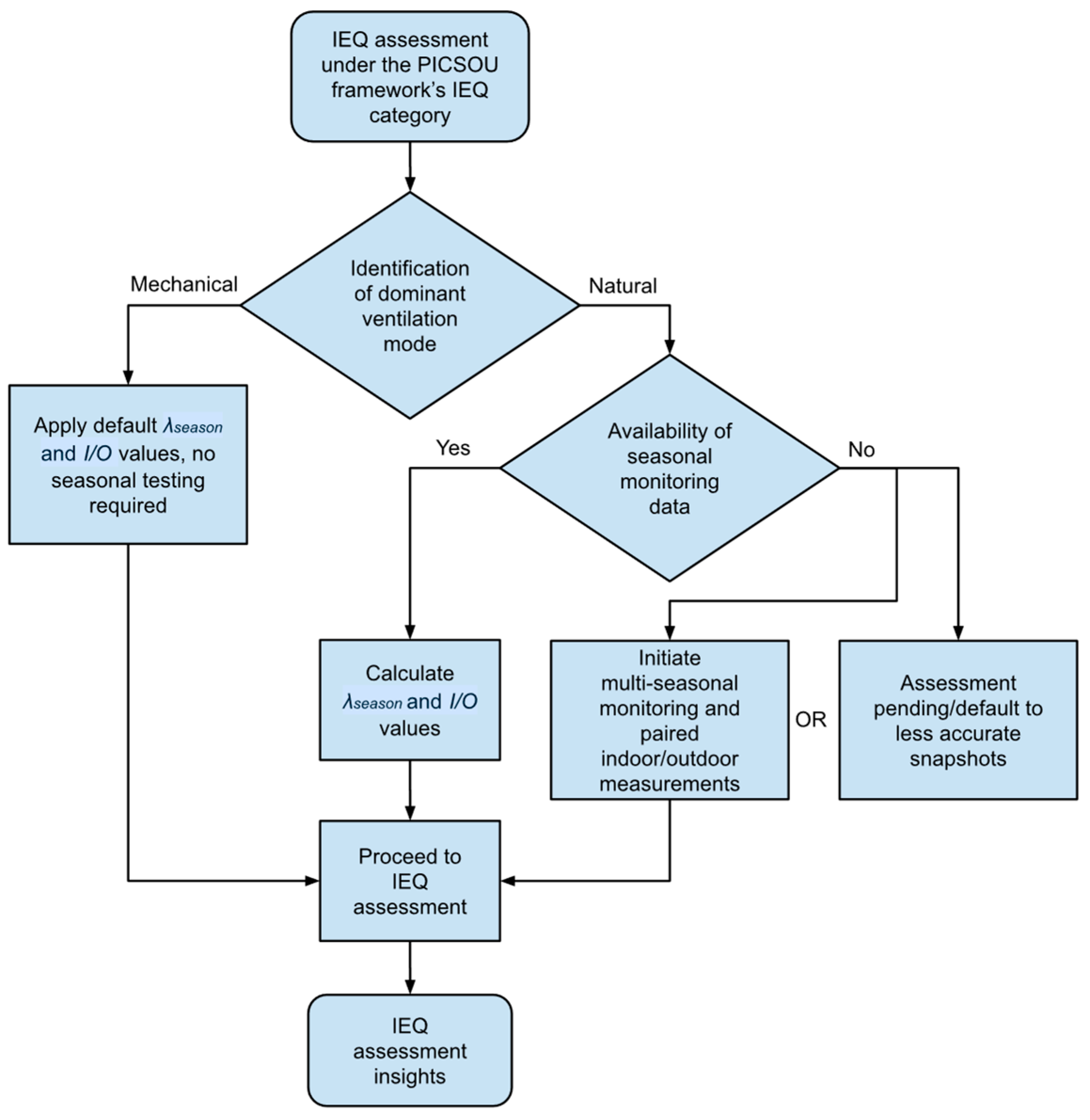
Upon introduction of the two empirical indicators, the IEQ assessment decision workflow can be summarized using the workflow illustrated in Figure 13.

5.2. Natural Ventilation Strategy Recommendations

For naturally ventilated buildings, our diagnostic workflow yields three pragmatic, actionable measures:
  • User-centered ventilation scheduling. A quantified λ season (e.g., 2.0) provides the evidence base for structured winter ventilation intervals: briefly open windows fully during periods when outdoor PM2.5 levels are low (guided by real-time outdoor AQI, e.g., between classes) to quickly dilute accumulated CO2 concentration while minimizing thermal-comfort loss and particulate matter ingress.
  • Supplemental filtration during low-ventilation periods. Even when outdoor air quality is generally good, a high I / O indicates the need for air purifiers so that, with windows closed in winter, indoor PM2.5 levels are decoupled from outdoor pollution—without changing the basic natural-ventilation strategy.
  • Operations tuned to outdoor AQI coupling. For example, when the summer I / O is about 0.95, prioritize ventilation during rainfall or immediately afterward, when outdoor PM2.5 levels are naturally lower; window opening then provides the largest net purification benefit.

5.3. Overall Contributions and Implications

This study addresses the common shortcoming in campus sustainability and IEQ work—static “pass/fail” assessments that do not inform operations—by proposing and validating a closed-loop pathway of assessment → decision → operation. The pathway is comparable across climates, and directly answers operational questions (when to boost airflow or open windows, whether and how much to filter, and how to calibrate winter–summer baselines), thereby turning evaluation into action.
We introduce FMCW radar module into the IEQ sensing stack as a privacy-preserving, low-power, and scalable method for presence/occupancy detection (occupied vs. unoccupied) and space-use monitoring. FMCW markedly improves the timeliness and usability of data while lowering deployment and maintenance burdens. It tightens the assessment–decision link—e.g., triggering airflow increases when occupied and shifting to energy-saving modes when unoccupied—thereby providing a practical sensing foundation for fine-grained operations in naturally ventilated buildings.
We combine box plots (to read cross-space patterns) with duration curves (to quantify exceedance probabilities for CO2, PM2.5, and temperature), enabling nuanced spatial comparisons. We further propose two actionable metrics: λ season to calibrate winter–summer baselines (i.e., how much to scale the ventilation rate) and I / O to guide opportunistic ventilation and filter strength (i.e., indoor–outdoor coupling). Together, these translate static compliance into executable, day-to-day “how-to-optimize” rules.
For naturally ventilated existing buildings, we offer a scalable approach: replace heavy, permanent deployments with low-cost sampling of λ season and I / O , and adopt time-segmented operation that fuses outdoor air quality with time of day (opportunistic window opening, demand-based filtration). Within this framework, the presence signal picked up by the sensor’s FMCW radar module acts as a core trigger, strengthening the assessment–decision–operation loop, lowering data and infrastructure thresholds, and making campus-scale closed-loop control feasible.
Compared with TalTech, CDJCC shows longer box-range (typical-interval) spans and—considered with duration curves—greater within-range variability with more pronounced high-end extremes in offices and classrooms. We also identify a structural paradox: mechanically ventilated buildings often possess rich BMS (Building Management Systems) data but require less seasonal validation, whereas naturally ventilated buildings most need empirical, seasonal validation yet lack ready data. This mismatch constrains the scaling of climate-resilient IEQ assessments and highlights the urgency of baseline data collection and lightweight validation systems for naturally ventilated stock.
Overall, this work advances the PICSOU framework’s IEQ category from static compliance to a comparable, governable, and transferable decision layer, with real-time occupancy-enabled data collection as a practical catalyst for closed-loop, low-cost, and scalable operations.

6. Limitations and Future Work

6.1. Limitations of Monitoring Design and Data Coverage

This study has several limitations related to monitoring design and data coverage, particularly with respect to monitoring duration, the number of devices, and variation in teaching activities across semesters.
First, the monitoring campaigns were designed around typical spring and autumn teaching semesters at the two campuses, and were conducted over finite periods within each semester rather than as continuous, multi-year observations. The relatively limited monitoring duration means that the datasets are well suited to characterizing representative conditions for the selected weeks, but they do not capture the full range of inter-annual variability or conditions during other parts of the academic year (for example, early spring, late autumn, or summer recess). Short-term episodes such as rare pollution or heat events may also be underrepresented. In addition, the selected monitoring windows did not include holiday breaks or other atypical occupancy periods, so IEQ responses during these special periods could not be explicitly compared or evaluated. While structuring the analysis by semester improves comparability between the two campuses and between spring–autumn terms, the finite duration of each campaign inevitably constrains how far the results can be generalized in time.
Second, the spatial coverage and number of devices are constrained by practical considerations. Only a limited number of sensors could be deployed, and these were distributed across a subset of buildings and space types on each campus, with a focus on typical teaching and office spaces. Within individual buildings, sensor locations were influenced by access, installation feasibility, safety, and maintenance requirements. As a result, some space typologies—such as certain laboratories, shared learning hubs, recreational areas, and support spaces—are underrepresented or not captured, and the monitored rooms may not span the full spectrum from “best-performing” to “worst-performing” IEQ spaces. For derived indicators such as λ season and I / O , additional data-completeness criteria further reduce the number of usable devices, rooms, and days in the robustness analysis, introducing a further level of selection into the underlying samples.
Third, variation in teaching activities and space use across semesters introduces additional uncertainty. Although the monitored periods were selected to represent regular teaching weeks, there remain unavoidable differences between semesters and years in course timetables, classroom allocation, student numbers, and occupancy patterns (e.g., examination weeks, project weeks, or minor timetable changes). These factors influence how intensively rooms are used and how ventilation systems are operated, and thus may partly contribute to differences observed between semesters and between campuses. The present analysis cannot fully disentangle the effects of climate and ventilation configuration from those of changing teaching activities. In addition, building-envelope performance (e.g., airtightness and thermal properties) was not measured or harmonized across buildings/campuses, so its influence cannot be separated from the observed climate- and ventilation-mode effects.
Taken together, these limitations mean that the present results should be viewed as indicative for the studied campuses and their monitored spring and autumn semesters, rather than as an exhaustive characterization of all campus spaces, seasons, and operational conditions. They also motivate future extensions with longer monitoring periods, a larger number of devices and monitored rooms, and more systematic documentation of teaching and occupancy patterns, which would help to further strengthen the robustness and generality of the conclusions.

6.2. Limitations of Occupancy Representation and Cross-Campus Comparability

A further limitation of this study lies in the different ways in which occupancy is represented at the two campuses. As discussed in Section 3.1, these differences have been examined empirically; here, they are summarized as constraints on the occupancy information used in the analysis.
At CDJCC, all custom-built IEQ sensor units are integrated with an FMCW radar module, and the present study uses radar-based presence as the occupancy signal. This provides a direct, privacy-preserving indication of whether a room is occupied, and forms the basis for linking occupancy to IEQ patterns and for illustrating the assessment–decision–operation loop. At TalTech, by contrast, no dedicated occupancy sensor was available, and occupancy had to be inferred solely from CO2 time-series patterns. The two campuses therefore differ not only in sensing hardware but also in how “human presence” enters the analysis: one site uses a direct signal, the other relies on an indirect proxy.
The CO2-based occupancy proxy at TalTech is inherently less specific than radar-based detection. CO2 dynamics reflect the combined influence of human emissions and air exchange, so elevated or declining concentrations cannot be uniquely attributed to changes in occupancy. Section 3.1 uses CDJCC data as a reference to compare FMCW-derived occupancy with CO2-based inference, and shows that systematic deviations can occur in certain periods and space types. These findings indicate that a simplified CO2-only method may misclassify some occupied and unoccupied intervals, and that such biases are difficult to quantify or correct at TalTech, where no independent ground truth is available.
Taken together, these factors mean that the occupancy information used in this study should be regarded as uneven in strength across the two campuses: CDJCC benefits from direct radar-based presence detection, whereas TalTech relies on a CO2-driven proxy. Although Section 3.1 demonstrates that the two approaches are broadly comparable for the purposes of this study, the remaining discrepancies highlight a limitation in cross-campus comparisons that condition on occupancy, and motivate future work toward more consistent, privacy-preserving occupancy sensing and integrated use of CO2 and direct presence signals.

6.3. Future Directions for PICSOU’s IEQ Category

Based on this study, the PICSOU framework’s IEQ module will continue to develop along three main directions.
To keep PICSOU’s IEQ category aligned with the evolving EU technical guidance and practice, future updates can formalize a clearly defined indicator set that reflects both health relevance and operational measurability. At minimum, this would include thermal conditions (e.g., operative/air temperature), humidity (RH), ventilation adequacy (e.g., CO2 and/or ventilation-rate proxies), and key exposure-related pollutants (e.g., PM2.5; with VOCs where feasible), while allowing optional extensions for acoustics and lighting when instrumentation is available. Methodologically, adopting an exceedance-based, time-fraction interpretation (as exemplified by TAIL) would allow PICSOU to translate monitoring time series into concise category-level compliance statements, improving robustness across climates and space types [58].
First, the indicator set within the CO2/PM2.5/temperature triad will be expanded and better weighted against learning- and health-relevant outcomes. Additional IEQ dimensions (e.g., humidity, noise, or lighting) can be incorporated in a modular way, allowing the IEQ module to evolve from a minimal, three-indicator set toward a broader, but still interpretable, indicator system that reflects both regulatory limits and outcome-oriented priorities.
Second, the IEQ module will move from largely static interpretations toward more dynamic evaluation, explicitly treating indoor air as a time-varying system rather than as a collection of averages. Building on the duration-curve and box-plot approach used in this study, future work will place greater emphasis on temporal patterns—such as the timing, frequency, and persistence of exceedances—and on how these patterns coincide with occupancy and operation. This opens the door to a tighter coupling between PICSOU’s IEQ category, occupancy sensing (e.g., FMCW radar–based presence signals), and operational data, so that the framework can support near-real-time feedback, event detection (e.g., persistent under-ventilation), and rule-based or data-driven control strategies.
Third, PICSOU’s IEQ category will be strengthened in terms of cross-climate and cross-space robustness. The present λ season and I / O indicators provide an initial step toward comparable baselines and “how-much-to-adjust” rules across seasons and ventilation modes; future work will extend these concepts by building parameter libraries and baseline ranges across multiple climate zones, campus types, and space categories (e.g., classrooms, dormitories, offices, laboratories). As more campuses and building types are monitored, these libraries can be iteratively refined into a generalizable evaluation system that allows both within-campus benchmarking and cross-campus comparison, while acknowledging local operational constraints.
Overall, these developments aim to advance PICSOU’s IEQ category from a compact, proof-of-concept implementation to a more complete, results-oriented and transferable decision-making workflow, one that is capable of integrating more nuanced occupancy information, supporting dynamic operation, while remaining scalable for campus-wide deployment.

Author Contributions

Conceptualization, Q.J. and J.K.; methodology, Q.J., Z.C. and J.K.; software, Q.J. and Z.C.; validation, Q.J., Z.C. and J.K.; formal analysis, Q.J., Z.C. and J.K.; investigation, Q.J. and Z.C.; resources, C.L., C.W., H.S. and J.K.; data curation, Q.J., C.L., C.W., Z.C. and J.K.; writing—original draft preparation, Q.J., C.L., C.W. and Z.C.; writing—review and editing, Q.J., Z.C. and J.K.; visualization, Q.J., Z.C. and J.K.; supervision, H.S. and J.K.; project administration, Q.J., C.L., Z.C. and J.K.; funding acquisition, J.K. All authors have read and agreed to the published version of the manuscript.

Funding

This work was supported by the Estonian Research Council grant (PRG2154) and by the Estonian Center of Excellence in Energy Efficiency, ENER (grant TK230), funded by the Estonian Ministry of Education and Research.

Data Availability Statement

The original contributions presented in the study are included in the article; further inquiries can be directed to the corresponding author. The specific make and model of the sensors used in this study are available from the corresponding author upon request.

Acknowledgments

The authors would also like to extend their sincere gratitude to the research team from Chengdu Jincheng College, whose members, Hezhi Zhu, Yingtao Wang, Xinyi Fang, Yilan Hong, Lu Huang, Yingjie Yang and Chuhan Dong, have contributed to this study by providing critical assistance.

Conflicts of Interest

The authors declare no conflicts of interest.

References

  1. Abu Qdais, H.; Saadeh, O.; Al-Widyan, M.; Al-tal, R.; Abu-Dalo, M. Environmental Sustainability Features in Large University Campuses: Jordan University of Science and Technology (JUST) as a Model of Green University. Int. J. Sustain. High. Educ. 2019, 20, 214–228. [Google Scholar] [CrossRef]
  2. Biancardi, A.; Colasante, A.; D’Adamo, I.; Daraio, C.; Gastaldi, M.; Uricchio, A.F. Strategies for Developing Sustainable Communities in Higher Education Institutions. Sci. Rep. 2023, 13, 20596. [Google Scholar] [CrossRef] [PubMed]
  3. Sen, G.; Chau, H.-W.; Tariq, M.A.U.R.; Muttil, N.; Ng, A.W.M. Achieving Sustainability and Carbon Neutrality in Higher Education Institutions: A Review. Sustainability 2021, 14, 222. [Google Scholar] [CrossRef]
  4. Albareda-Tiana, S.; Vidal-Raméntol, S.; Fernández-Morilla, M. Implementing the Sustainable Development Goals at University Level. Int. J. Sustain. High. Educ. 2018, 19, 473–497. [Google Scholar] [CrossRef]
  5. Berchin, I.I.; De Aguiar Dutra, A.R.; Guerra, J.B.S.O.D.A. How Do Higher Education Institutions Promote Sustainable Development? A Literature Review. Sustain. Dev. 2021, 29, 1204–1222. [Google Scholar] [CrossRef]
  6. Shawe, R.; Horan, W.; Moles, R.; O’Regan, B. Mapping of Sustainability Policies and Initiatives in Higher Education Institutes. Environ. Sci. Policy 2019, 99, 80–88. [Google Scholar] [CrossRef]
  7. Žalėnienė, I.; Pereira, P. Higher Education for Sustainability: A Global Perspective. Geogr. Sustain. 2021, 2, 99–106. [Google Scholar] [CrossRef]
  8. Alshuwaikhat, H.; Adenle, Y.; Saghir, B. Sustainability Assessment of Higher Education Institutions in Saudi Arabia. Sustainability 2016, 8, 750. [Google Scholar] [CrossRef]
  9. Udas, E.; Wölk, M.; Wilmking, M. The “Carbon-Neutral University”—A Study from Germany. Int. J. Sustain. High. Educ. 2018, 19, 130–145. [Google Scholar] [CrossRef]
  10. Amaral, L.P.; Martins, N.; Gouveia, J.B. Quest for a Sustainable University: A Review. Int. J. Sustain. High. Educ. 2015, 16, 155–172. [Google Scholar] [CrossRef]
  11. Menon, S.; Suresh, M. Synergizing Education, Research, Campus Operations, and Community Engagements towards Sustainability in Higher Education: A Literature Review. Int. J. Sustain. High. Educ. 2020, 21, 1015–1051. [Google Scholar] [CrossRef]
  12. Abo-Khalil, A.G. Integrating Sustainability into Higher Education Challenges and Opportunities for Universities Worldwide. Heliyon 2024, 10, e29946. [Google Scholar] [CrossRef] [PubMed]
  13. Alba-Hidalgo, D.; Benayas Del Álamo, J.; Gutiérrez-Pérez, J. Towards a Definition of Environmental Sustainability Evaluation in Higher Education. High Educ. Policy 2018, 31, 447–470. [Google Scholar] [CrossRef]
  14. Jia, L.-R.; Han, J.; Chen, X.; Li, Q.-Y.; Lee, C.-C.; Fung, Y.-H. Interaction between Thermal Comfort, Indoor Air Quality and Ventilation Energy Consumption of Educational Buildings: A Comprehensive Review. Buildings 2021, 11, 591. [Google Scholar] [CrossRef]
  15. Leccese, F.; Rocca, M.; Salvadori, G.; Belloni, E.; Buratti, C. Towards a Holistic Approach to Indoor Environmental Quality Assessment: Weighting Schemes to Combine Effects of Multiple Environmental Factors. Energy Build. 2021, 245, 111056. [Google Scholar] [CrossRef]
  16. Tan, X.; Guan, J.; Zhang, Z.; Chen, S.; Guo, Q.; Xu, J.; Song, W. University Building Energy Consumption and Indoor Environment Quality: A Review of Optimization Strategies. In The International Symposium on Heating, Ventilation and Air Conditioning; Wang, Z., Zhu, Y., Wang, F., Wang, P., Shen, C., Liu, J., Eds.; Springer: Singapore, 2019; pp. 1045–1052. [Google Scholar]
  17. Islam, M.S.; Liu, G.; Xu, D.; Chen, Y.; Li, H.; Chen, C. University-Campus-Based Zero-Carbon Action Plans for Accelerating the Zero-Carbon City Transition. Sustainability 2023, 15, 13504. [Google Scholar] [CrossRef]
  18. Zhang, H.; Srinivasan, R.; Yang, X.; Ganesan, V.; Zhang, J.; Zhang, H. Quantifying Indoor Air Quality Determinants in Green-Certified Buildings Using a Hybrid Machine Learning Method: A Case Study in Florida. Indoor Air 2025, 2025, 2150075. [Google Scholar] [CrossRef]
  19. Farag, A.A.; Doheim, R.M.; Badawi, S. Evaluating Heat Island Effect at University Campus with Reference to LEED V4. Int. J. Proc. Sci. Technol. 2019, 2, 1–13. [Google Scholar] [CrossRef]
  20. E Doocy, L.; Zarmehr, A.; T Kider, J., Jr. A Critical Review of the Effectiveness of the Sustainability Tracking, Assessment & Rating System (STARS) Framework on Campus Sustainability. In Proceedings of the 17th Building Simulation Conference, Bruges, Belgium, 1–3 September 2021. [Google Scholar]
  21. Puertas, R.; Marti, L. Sustainability in Universities: DEA-GreenMetric. Sustainability 2019, 11, 3766. [Google Scholar] [CrossRef]
  22. Alawneh, R.; Jannoud, I.; Rabayah, H.; Ali, H. Developing a Novel Index for Assessing and Managing the Contribution of Sustainable Campuses to Achieve UN SDGs. Sustainability 2021, 13, 11770. [Google Scholar] [CrossRef]
  23. Hua, Y.; Göçer, Ö.; Göçer, K. Spatial Mapping of Occupant Satisfaction and Indoor Environment Quality in a LEED Platinum Campus Building. Build. Environ. 2014, 79, 124–137. [Google Scholar] [CrossRef]
  24. Weng, J.; Zhang, Y.; Chen, Z.; Ying, X.; Zhu, W.; Sun, Y. Field Measurements and Analysis of Indoor Environment, Occupant Satisfaction, and Sick Building Syndrome in University Buildings in Hot Summer and Cold Winter Regions in China. Int. J. Environ. Res. Public Health 2022, 20, 554. [Google Scholar] [CrossRef] [PubMed]
  25. Lee, M.J.; Zhang, R. Human-Centric Artificial Intelligence of Things–Based Indoor Environment Quality Modeling Framework for Supporting Student Well-Being in Educational Facilities. J. Comput. Civ. Eng. 2024, 38, 04024002. [Google Scholar] [CrossRef]
  26. Bortolini, R.; Forcada, N. Association between Building Characteristics and Indoor Environmental Quality through Post-Occupancy Evaluation. Energies 2021, 14, 1659. [Google Scholar] [CrossRef]
  27. Kim, Y.K.; Abdou, Y.; Abdou, A.; Altan, H. Indoor Environmental Quality Assessment and Occupant Satisfaction: A Post-Occupancy Evaluation of a UAE University Office Building. Buildings 2022, 12, 986. [Google Scholar] [CrossRef]
  28. Dawodu, A.; Dai, H.; Zou, T.; Zhou, H.; Lian, W.; Oladejo, J.; Osebor, F. Campus Sustainability Research: Indicators and Dimensions to Consider for the Design and Assessment of a Sustainable Campus. Heliyon 2022, 8, e11864. [Google Scholar] [CrossRef]
  29. Silva-da-Nóbrega, P.I.; Chim-Miki, A.F.; Castillo-Palacio, M. A Smart Campus Framework: Challenges and Opportunities for Education Based on the Sustainable Development Goals. Sustainability 2022, 14, 9640. [Google Scholar] [CrossRef]
  30. Elnaklah, R.; Walker, I.; Natarajan, S. Moving to a Green Building: Indoor Environment Quality, Thermal Comfort and Health. Build. Environ. 2021, 191, 107592. [Google Scholar] [CrossRef]
  31. Eppinga, M.B.; Lozano-Cosme, J.; De Scisciolo, T.; Arens, P.; Santos, M.J.; Mijts, E.N. Putting Sustainability Research into Practice on the University Campus: An Example from a Caribbean Small Island State. Int. J. Sustain. High. Educ. 2020, 21, 54–75. [Google Scholar] [CrossRef]
  32. Yang, D.; Mak, C.M. Relationships between Indoor Environmental Quality and Environmental Factors in University Classrooms. Build. Environ. 2020, 186, 107331. [Google Scholar] [CrossRef]
  33. Amaral, A.R.; Rodrigues, E.; Gaspar, A.R.; Gomes, Á. A Review of Empirical Data of Sustainability Initiatives in University Campus Operations. J. Clean. Prod. 2020, 250, 119558. [Google Scholar] [CrossRef]
  34. Alghamdi, N.; Den Heijer, A.; De Jonge, H. Assessment Tools’ Indicators for Sustainability in Universities: An Analytical Overview. Int. J. Sustain. High. Educ. 2017, 18, 84–115. [Google Scholar] [CrossRef]
  35. Noaime, E.; Alshenaifi, M.; Albaqawy, G.; Abuhussain, M.A.; Abdelhafez, M.H.H.; Alnaim, M.M. Beyond Buildings: How Does Sustainable Campus Design Shape Student Lives? Hail University as a Case Study. Buildings 2025, 15, 1468. [Google Scholar] [CrossRef]
  36. Romero, P.; Miranda, M.T.; Isidoro, R.; Arranz, J.I.; Valero-Amaro, V. Thermal Comfort and Sustainability in University Classrooms: A Study in Mediterranean Climate Zones. Appl. Sci. 2025, 15, 694. [Google Scholar] [CrossRef]
  37. Jiang, Q.; Kurnitski, J. Performance Based Core Sustainability Metrics for University Campuses Developing towards Climate Neutrality: A Robust PICSOU Framework. Sustain. Cities Soc. 2023, 97, 104723. [Google Scholar] [CrossRef]
  38. Brink, H.W.; Loomans, M.G.L.C.; Mobach, M.P.; Kort, H.S.M. Classrooms’ Indoor Environmental Conditions Affecting the Academic Achievement of Students and Teachers in Higher Education: A Systematic Literature Review. Indoor Air 2021, 31, 405–425. [Google Scholar] [CrossRef]
  39. Sadrizadeh, S.; Yao, R.; Yuan, F.; Awbi, H.; Bahnfleth, W.; Bi, Y.; Cao, G.; Croitoru, C.; De Dear, R.; Haghighat, F.; et al. Indoor Air Quality and Health in Schools: A Critical Review for Developing the Roadmap for the Future School Environment. J. Build. Eng. 2022, 57, 104908. [Google Scholar] [CrossRef]
  40. Torriani, G.; Lamberti, G.; Fantozzi, F.; Babich, F. Exploring the Impact of Perceived Control on Thermal Comfort and Indoor Air Quality Perception in Schools. J. Build. Eng. 2023, 63, 105419. [Google Scholar] [CrossRef]
  41. Azzazy, S.; Ghaffarianhoseini, A.; GhaffarianHoseini, A.; Naismith, N.; Doan, D.T.; Hollander, J.B. The Significance of Indoor Thermal Comfort on Occupants’ Perception: In University Buildings in Auckland, New Zealand. Build. Res. Inf. 2025, 53, 19–39. [Google Scholar] [CrossRef]
  42. Liu, F.; Chang-Richards, A.; Wang, K.I.-K.; Dirks, K.N. Effects of Indoor Environment Factors on Productivity of University Workplaces: A Structural Equation Model. Build. Environ. 2023, 233, 110098. [Google Scholar] [CrossRef]
  43. Tahsildoost, M.; Zomorodian, Z.S. Indoor Environment Quality Assessment in Classrooms: An Integrated Approach. J. Build. Phys. 2018, 42, 336–362. [Google Scholar] [CrossRef]
  44. Seyedrezaei, M.; Awada, M.; Becerik-Gerber, B.; Lucas, G.; Roll, S. Interaction Effects of Indoor Environmental Quality Factors on Cognitive Performance and Perceived Comfort of Young Adults in Open Plan Offices in North American Mediterranean Climate. Build. Environ. 2023, 244, 110743. [Google Scholar] [CrossRef]
  45. Keene, K.; McCord, K.; Dehwah, A.H.A.; Jung, W. Meta-Analysis and Regression Modeling of the Impacts of Four Indoor Environmental Quality Metrics on Office Performance. Indoor Air 2025, 2025, 6840369. [Google Scholar] [CrossRef]
  46. Deng, Z.; Dong, B.; Guo, X.; Zhang, J. Impact of Indoor Air Quality and Multi-domain Factors on Human Productivity and Physiological Responses: A Comprehensive Review. Indoor Air 2024, 2024, 5584960. [Google Scholar] [CrossRef]
  47. Fissore, V.I.; Fasano, S.; Puglisi, G.E.; Shtrepi, L.; Astolfi, A. Indoor Environmental Quality and Comfort in Offices: A Review. Buildings 2023, 13, 2490. [Google Scholar] [CrossRef]
  48. Karimi, H.; Adibhesami, M.A.; Bazazzadeh, H.; Movafagh, S. Green Buildings: Human-Centered and Energy Efficiency Optimization Strategies. Energies 2023, 16, 3681. [Google Scholar] [CrossRef]
  49. Brink, H.W.; Lechner, S.C.M.; Loomans, M.G.L.C.; Mobach, M.P.; Kort, H.S.M. Understanding How Indoor Environmental Classroom Conditions Influence Academic Performance in Higher Education. Facilities 2024, 42, 185–200. [Google Scholar] [CrossRef]
  50. Afifi, S.; Kamel, T.; Ezzeldin, S. Indoor Environmental Quality Assessment of Naturally-Ventilated School Classrooms within a Dense Arid Urban Setting of Cairo, Egypt. Sci. Rep. 2025, 15, 16245. [Google Scholar] [CrossRef]
  51. Asojo, A.; Hazazi, F. Biophilic Design Strategies and Indoor Environmental Quality: A Case Study. Sustainability 2025, 17, 1816. [Google Scholar] [CrossRef]
  52. Marzban, S.; Candido, C.; Avazpour, B.; Mackey, M.; Zhang, F.; Engelen, L.; Tjondronegoro, D. The Potential of High-Performance Workplaces for Boosting Worker Productivity, Health, and Creativity: A Comparison between WELL and Non-WELL Certified Environments. Build. Environ. 2023, 243, 110708. [Google Scholar] [CrossRef]
  53. Wargocki, P.; Wei, W.; Bendžalová, J.; Espigares-Correa, C.; Gerard, C.; Greslou, O.; Rivallain, M.; Sesana, M.M.; Olesen, B.W.; Zirngibl, J.; et al. TAIL, a New Scheme for Rating Indoor Environmental Quality in Offices and Hotels Undergoing Deep Energy Renovation (EU ALDREN Project). Energy Build. 2021, 244, 111029. [Google Scholar] [CrossRef]
  54. Xu, R.; Hu, S.; Wan, H.; Xie, Y.; Cai, Y.; Wen, J. A Unified Deep Learning Framework for Water Quality Prediction Based on Time-Frequency Feature Extraction and Data Feature Enhancement. J. Environ. Manag. 2024, 351, 119894. [Google Scholar] [CrossRef] [PubMed]
  55. Ren, L.; Jia, Z.; Laili, Y.; Huang, D. Deep Learning for Time-Series Prediction in IIoT: Progress, Challenges, and Prospects. IEEE Trans. Neural Netw. Learn. Syst. 2024, 35, 15072–15091. [Google Scholar] [CrossRef] [PubMed]
  56. Meng, X.; Liu, Q.; Yang, C.; Zhou, L.; Cheung, Y.-M. A Novel Deep Learning-Based Robust Dual-Rate Dynamic Data Modeling for Quality Prediction. IEEE Trans. Ind. Informat. 2024, 20, 1324–1334. [Google Scholar] [CrossRef]
  57. Lv, Z.; Song, X.; Feng, J.; Xia, Q.; Xia, B.; Li, Y. Reduced-Order Prediction Model for the Cahn–Hilliard Equation Based on Deep Learning. Eng. Anal. Bound. Elem. 2025, 172, 106118. [Google Scholar] [CrossRef]
  58. European Commission. Technical Building Systems, Indoor Environmental Quality and Inspections (Articles 13, 23 and 24); Annex 10 to the Commission Notice Providing Guidance on New or Substantially Modified Provisions of the Recast Energy Performance of Buildings Directive (EU) 2024/1275; European Commission: Brussels, Belgium, 2025. [Google Scholar]
  59. Dong, Z.; Luo, X.; Zhao, K.; Ge, J.; Chan, I.Y.S. Comprehensive Assessment Method for Building Environmental Performance: Trade-off between Indoor Environmental Quality and Life Cycle Carbon Emissions. Build. Environ. 2025, 272, 112598. [Google Scholar] [CrossRef]
  60. Al Mindeel, T.; Spentzou, E.; Eftekhari, M. Energy, Thermal Comfort, and Indoor Air Quality: Multi-Objective Optimization Review. Renew. Sustain. Energy Rev. 2024, 202, 114682. [Google Scholar] [CrossRef]
  61. Ogundiran, J.; Asadi, E.; Gameiro Da Silva, M. A Systematic Review on the Use of AI for Energy Efficiency and Indoor Environmental Quality in Buildings. Sustainability 2024, 16, 3627. [Google Scholar] [CrossRef]
  62. Bughio, M.; Schuetze, T.; Mahar, W.A. Comparative Analysis of Indoor Environmental Quality of Architectural Campus Buildings’ Lecture Halls and Its’ Perception by Building Users, in Karachi, Pakistan. Sustainability 2020, 12, 2995. [Google Scholar] [CrossRef]
  63. McGill, R.; Tukey, J.W.; Larsen, W.A. Variations of Box Plots. Am. Stat. 1978, 32, 12–16. [Google Scholar] [CrossRef]
  64. GB/T 18883-2022; Standardization Administration of China, Indoor Air Quality Standard. China Standards Press: Beijing, China, 2022.
  65. T/ASC 02-2021; Architectural Society of China, Technical Standard for Healthy Building Evaluation. China Architecture & Building Press: Beijing, China, 2021.
  66. EN 16798-1:2019; European Committee for Standardization, Energy Performance of Buildings-Ventilation for Buildings-Part 1: Indoor Environmental Input Parameters for Design and Assessment of En Ergy Performance of Buildings Addressing Indoor Air Quality, Thermal Environment, Lighting and Acoustics-Module M1-6. CEN: Brussels, Belgium, 2019.
  67. World Health Organization. WHO Global Air Quality Guidelines 2021 (AQG 2021); WHO European Centre for Environment and Health: Bonn, Germany, 2021. [Google Scholar]
  68. Student. The Probable Error of a Mean. Biometrika 1908, 6, 1–25. [Google Scholar] [CrossRef]
  69. Cumming, G.; Finch, S. Inference by Eye: Confidence Intervals and How to Read Pictures of Data. Am. Psychol. 2005, 60, 170–180. [Google Scholar] [CrossRef]
Figure 1. Graphical abstract of the study.
Buildings 16 00283 g001
Figure 2. Map of CDJCC with sensor locations.
Buildings 16 00283 g002
Figure 3. Map of TalTech with sensor locations.
Buildings 16 00283 g003
Figure 4. CDJCC sensor layout in typical space types: (a) 4-person dorms, (b) 2-person dorms, (c) offices, (d) classrooms.
Buildings 16 00283 g004
Figure 5. TalTech sensor layout in typical space types: (a) meeting rooms, (b) auditoriums, (c) offices, (d) classrooms.
Buildings 16 00283 g005
Figure 6. Average CO2 in different space types under different occupancy probabilities.
Buildings 16 00283 g006
Figure 7. Representative CO2 concentration cycles used to illustrate the methodological comparability between radar-based and CO2-based occupancy detection.
Buildings 16 00283 g007
Figure 8. CDJCC and TalTech: same room type, within-campus spring vs. autumn.
Buildings 16 00283 g008
Figure 9. CDJCC Spring semester: duration curves under occupancy, by room.
Buildings 16 00283 g009
Figure 10. CDJCC Autumn semester: duration curves under occupancy, by room.
Buildings 16 00283 g010
Figure 11. TalTech Spring and Autumn semester: duration curves under occupancy, by room.
Buildings 16 00283 g011
Figure 12. Spring–Autumn IEQ within same room types: CDJCC compared with TalTech.
Buildings 16 00283 g012
Figure 13. Decision workflow for climate-resilient IEQ assessment under the PICSOU framework.
Buildings 16 00283 g013
Table 1. Overview of the experimental design.
AspectCDJCC CampusTalTech Campus
Site LocationChengdu, ChinaTallinn, Estonia
Climate ZoneSubtropical monsoon climateTemperate oceanic/continental climate
Monitoring Period15 calendar days in autumn semester, 2024;
15 calendar days in spring semester, 2025
90 calendar days in autumn semester, 2024;
51 calendar days in spring semester, 2025
Space TypesDormitories, classrooms, officesClassrooms/auditoriums/meeting rooms, offices
Occupancy Tracking MethodFMCW radar module for real-time human presence detectionN/A
IEQ Parameters MeasuredCO2, PM2.5, temperature, relative humidityCO2, PM2.5, temperature, relative humidity
Data Resolution1 min intervals for all parameters10 min intervals for all parameters
Primary FocusValidating IEQ under subtropical conditions, focusing on thermal comfort and PM2.5 infiltrationValidating IEQ under temperate conditions, establishing baseline performance without occupancy influence
Connection to PICSOUField validation of the PICSOU’s IEQ category in a non-Nordic context, highlighting need for climate-specific adaptationsBaseline validation of PICSOU’s IEQ metrics under temperate climate in a pure mechanically ventilated context
Contribution to PICSOUDemonstrated necessity for modular adjustments in PICSOU to account for regional challenges Provided reference datasets for temperate climate zone, reinforcing PICSOU’s core IEQ metrics without occupancy complexities
Unique ChallengesHigh humidity (70–80%), winter PM2.5 peaks, lack of mechanical heating leading to cold stressStandardized monitoring in controlled environments, but with potential gaps due to lack of occupancy correlation
Table 2. CDJCC sensor specifications.
DeviceModelModuleAccuracyResolutionRange
Buildings 16 00283 i001air quality monitor AN-PCT (Rmikey PCB Co. Ltd., Shenzhen, China)CO2≤± 40 ppm, ±3% of reading1 ppm0–9999 ppm
PM2.5±10 μg @ 0–100 μg/m3
±10% @ 101–500 μg/m3
1 μg/m30–999 μg/m3
Temperature≤± 0.2 °C0.1 °C0–65 °C
Relative
Humidity
≤± 3%0.10%0–99%
Occupancy
(FMCW)
N/AN/A±60 degrees,
6 m
Table 3. TalTech sensor specifications.
DeviceModelModuleAccuracyResolutionRange
Buildings 16 00283 i002airPurity indoor climate monitoring sensor (Thinnect OÜ, Tallinn, Estonia)CO2≤± 40 ppm, ± 3% of reading1 ppm10–40,000 ppm
PM2.5±10 μg @ 0–100 μg/m3
±10% @ 101–1000 μg/m3
1 µg/m30–1000 μg/m3
Temperature≤± 0.8 °C0.1 °C−10–60 °C
Relative
Humidity
≤± 6%0.10%0–100%
Table 4. Critical IEQ reference values.
SemesterIssuerStandardCO2,
ppm
PM2.5,
μg/m3
Temperature,
°C
Relative
Humidity, %
SpringChinaGB/T 18883-2022 [64]100075 (24 h avg.)Summer: 22–28Summer: 40–80
T/ASC 02-2021 [65]100035 (Max. 5 days/1 y)
or 15(1 y avg.)
N/AN/A
EUEN 16798-1:2019 [66]I: 950N/AI: 23.5–25.5N/A
II: 1200II: 23–26
III: 1750III: 22–27
IV: 1750IV: 21–28
WHOAQG 2021 [67]N/AAQG: 5N/AN/A
Interim 4/3/2/1:
10/15/25/35
AutumnChinaGB/T 18883-2022 [64]100075 (24 h avg.)Winter: 16–24Winter: 30–60
T/ASC 02-2021 [65]100035 (Max.5 days/1 y)
or 15(1 y avg.)
N/AN/A
EUEN 16798-1:2019 [66]I: 950N/AI: 21–23N/A
II: 1200II: 20–24
III: 1750III: 19/18–25
IV: 1750IV: 17–25
WHOAQG 2021 [67]N/AAQG: 5N/AN/A
Interim 4/3/2/1:
10/15/25/35
Table 5. Cross-validation of CO2-based occupancy inference against FMCW-based occupancy detection at CDJCC for spring and autumn semester datasets.
MetricSpring-Semester DatasetAutumn-Semester DatasetSpring + Autumn Combined
Number of rows with CO2-based occupancy prediction18,396768126,077
Fraction of predicted rows in growing phase0.4830.4490.473
Fraction of predicted rows in decaying phase0.5170.5510.527
Number of matching rows (prediction = FMCW)11,177476515,942
Matching ratio0.6080.620.611
Matching in growth phase0.7520.7760.758
Matching in decay phase0.4730.4940.479
Table 6. Occupied-period CO2, PM2.5 and temperature (Med, IQR) with category-compliance labels based on the 5% criterion.
Campus
(Semester)
Space TypeCO2, ppm
(Med; IQR; Labels)
PM2.5, μg/m3
(Med; IQR; Labels)
Temperature, °C
(Med; IQR; Labels)
CDJCC
(Spring)
Dormitory913; 509; outside of EU cat.III49; 48; outside of CN limit26.0; 1.8; CN limit
Office489; 160; EU cat.I41; 50; outside of CN limit25.9; 1.9; CN limit
Classroom552; 352; EU cat.III52; 46; outside of CN limit27.2; 2.4; outside of CN limit
Outdoor419; 72; N/A57; 60; outside of CN limit27.9; 7.4; N/A
TalTech
(Spring)
Office604; 84; EU cat.I0; 1; WHO AQG23.9; 2.2; EU cat.I
Classroom611; 159; EU cat.III0; 1; WHO AQG23.3; 1.8; EU cat.I
Outdoor481; 72; N/A2; 6; WHO Interim 111.8; 6.0; N/A
CDJCC
(Autumn)
Dormitory789; 355; EU cat.III96; 50; outside of CN limit17.4; 2.8; outside of CN limit
Office474; 74; EU cat.I83; 54.8; outside of CN limit22.4; 4.1; outside of CN limit
Classroom388; 84; CN limit124; 64; outside of CN limit12.6; 2.3; outside of CN limit
Outdoor359; 52; N/A130; 63; outside of CN limit7.6; 2.8; N/A
TalTech
(Autumn)
Office604; 98; EU cat.I0; 1; WHO AQG21.8; 1.7; EU cat.III
Classroom621; 191; EU cat.III0; 1; WHO AQG21.7; 1.7; EU cat.III
Outdoor496; 52; N/A0; 4; WHO Interim 14.9; 5.4; N/A
Table 7. t-distribution-based 95% confidence interval test results for λ season using the CDJCC and TalTech CO2 datasets as examples.
CampusGroupNMeanSDCI95_LowCI95_High
CDJCCclassrooms40.98220.42910.29941.665
dorms60.84860.13260.70940.9877
offices20.93530.00390.90050.9701
outdoors20.84960.00050.84470.8545
CDJCCindoor120.90760.24950.7491.0661
TalTechclassrooms61.11170.11190.99431.2292
office31.02210.01640.98141.0628
outdoors21.03070.00420.99311.0684
TalTechindoor91.08190.09951.00531.1584
Table 8. t-distribution-based 95% confidence interval test results for I / O using the CDJCC and TalTech PM2.5 datasets as examples (CI is reported as computed without truncation; negative lower bounds may occur when values are near zero).
CampusSeasonGroupNMeanSDCI95_LowCI95_High
CDJCCspring semesterclassrooms41.05430.05190.97171.0951
dorms60.87370.09780.77110.9798
offices20.99420.0320.70691.0192
all120.9540.11240.88260.9919
autumn semesterclassrooms40.94960.05920.85541.0266
dorms60.79970.0910.70430.7917
offices20.77430.02670.53431.1910
all120.84540.10390.77940.8669
spring and autumn semester240.89970.11950.84930.9502
TalTechspring semesterclassrooms60.35320.3869−0.05281.0444
office30.3790.3018−0.37082.6886
all90.36180.34130.09940.9863
autumn semesterclassrooms70.16810.09810.07740.4744
office40.22440.0730.10820.6135
all110.18860.09050.12780.4034
spring and autumn semester200.26650.24740.15080.3823
Disclaimer/Publisher’s Note: The statements, opinions and data contained in all publications are solely those of the individual author(s) and contributor(s) and not of MDPI and/or the editor(s). MDPI and/or the editor(s) disclaim responsibility for any injury to people or property resulting from any ideas, methods, instructions or products referred to in the content.