


Abstract
Recent years have witnessed active construction of multi-storey residential buildings. The scale of construction, its timing and limitations in financing contribute to the emergence of risk factors affecting the key parameters of cost and duration of projects. The purpose of this research is to develop the most effective mathematical model to reveal, study and estimate in a timely manner the influence of risk factors on stable implementation of a construction project during its life cycle. The mathematical model of the study is based on the theory of fuzzy sets, including 25 rules used to estimate the influence of a risk factor. An expert survey of leading specialists in the construction industry was performed and risk factors distributed over the stages of the life cycle were listed. Risk factors affecting the sustainability of the life cycle of a multi-storey residential building were identified and ranked. The result of the study shows that the application of the mathematical model will significantly increase the success of construction projects by identifying the critical risk factors in the phases of their life cycle. Since the proposed model is relatively new in Russia, it should be considered as a starting point for a new assessment of the impact of risk factors on projects. The methodology can be improved, and many aspects are still to be analyzed.
1. Introduction
One of the priorities of each state is to provide affordable, comfortable and safe housing for its citizens. Currently, the purchase of residential real estate requires large financial investments and, in most cases, is associated with multi-year credits (mortgages) and interest-bearing loans. When buying houses for years, possibly for life, people pay special attention to the aesthetics of the building, the comfortable layout and the view from the window, the availability of parking spaces, infrastructure, and the environmental friendliness and safety of the residential area.
In recent years the volume of construction of multi-storey residence buildings with individual architectural and constructive solutions has been growing rapidly. For example, in Russia about 90 million square meters of residential space have been commissioned annually in the last 5 years. [1] The uniqueness of the adopted volume-planning and constructive solutions, the use of new technologies, the scale of construction, the large number of parties involved, tight deadlines and limited funding contribute to the risks affecting the implementation of such projects [2].
The study of project risk factors in recent years has had a vital role in the construction industry, and hundreds of factors have been identified [3,4], affecting the parameters of the cost and duration of a project. Works by Fahimeh Allahi, Lucia Cassettari and Muhammad Saiful Islam note that the cost of a project due to the influence of a factor can increase by up to 20%, and the duration of large construction projects can grow by up to 30% [5,6] Many authors have determined the project risk concept in different ways. Risks may have both positive and negative impacts, affecting the life cycle of a project [7,8,9,10]. Risk is closely related to the state of uncertainty, but it is fair to say that in most cases it has a negative impact on the project parameters [11]. There are many risk factors at all stages of the life cycle of a project: organizational, technological, technical, and economic [12,13]. In addition to organizational and technical complexities, managers take into account a growing number of additional parameters, including environmental and social ones. In such circumstances, it is important to understand the real practice of risk analysis and, above all, to assess the risk-driving factors at each stage of the life cycle of the construction project. Nowadays the theme of risks in the construction industry is a relevant and priority issue, and the vector of research in this area should be aimed at developing methods to reduce factors affecting the occurrence of risks in the life cycle of a project and achieve the required technical and economic performance.
However, the Russian Federation still lacks any model of the life cycle of a construction project with the technical risk factors included at each stage of construction, whereas complete and up-to-date documentation may contribute to mitigation of technical, industrial and natural risks.
Taking this into account, this research was focused on selected stages of the life cycle of a construction project exposed to risk factors in the construction of multi-storey residential buildings. As a result of an extensive study of scientific and technical literature, the authors identified, grouped and systematized life cycle risk factors by stages. The description of studies of the stages of the life cycle of a construction project in which the risks occurred, and the systematization of risk factors by project cycle, are presented in more detail in the articles [12,14,15,16,17]. Each stage was assigned a risk factor, which in turn enabled the assignment of an identification number to the risk factor and subsequent assessment and control. In addition, the authors chose the expert assessment method to determine the weights of the assessed parameters of risk factors in the absence of statistical data on the above topic of the study. Experts were required to assess risk factors on a five-point scale of probability of risk occurrence, as well as the impact of risks on the cost and duration of the construction project.
The authors applied fuzzy set theory, fuzzy logic and the Dempster-Shafer theory (DS), which allowed establishing the relationship between the results and obtaining a model of risk factors at the considered stages. To assess the impact of risk factors on the construction project it was necessary not only to allocate risk to the right stage and conduct an expert evaluation of the risk factor, but also to process mathematically the results in order to determine the degree of influence and the probability of the impact of factors on such parameters as cost and duration.
As a result, a model showing the factors of risk occurrence at the life cycle stages of a multi-storey residential building construction project was developed, which allows timely assessment of the level of possible risks and their impact on the cost and duration. The results of the study make it possible to model and assess risks in an attempt to investigate real, favorable ways of development at each stage of the life cycle of the construction project, including by mitigating or timely eliminating the risk factors.
The contribution of this article to the construction industry can be described at several levels. The first level is a literature review in which the main direction is residential buildings, risk factors, the life cycle of buildings and structures, mathematical models for analyzing research data are studied. At the second level, an improved life cycle model for a multi-storey residential building in a cramped building is presented and factors are considered and analyzed through mathematical models. At the third level, based on the analysis of the selected mathematical models, critical risks are determined in real time, and the dependences of time and cost are shown.
This approach allows the reader to form a comprehensive structure of the object and quickly predict the integrity of the object’s life cycle in the time interval.
2. Literature Review
Understanding the risk scenarios of complex projects is an important step towards achieving the expected level of accuracy in contingencies. This section briefly discusses some relevant research related to understanding the risk scenarios of complex projects in different parts of the world.
The cost of building a residential building is very dynamic and changeable [18]. Price fluctuations may be related to the prices of building materials, human resources and other costs used in construction. This economic uncertainty can have a serious impact on business, especially on long-term projects [18]. To minimize the risk of uncertainty of investment costs for the construction of a residential building, it is necessary to predict the cost of building a residential building.
Compared to classical risk assessment methods, the modified Fuzzy Bayesizan Belief Network (FBBN) system has certain advantages for risk assessment in an uncertain and complex project environment because it shows risk cause-and-effect networks more efficiently. This helps understanding of the root causes of cost overrun risks and requires significantly less probabilistic data to obtain information from experts, which not only saves time and effort for data collection, but also reduces the computational load on the model compared to the widely used FBBN models [19].
Project management plays a big role, project management is now appearing in many organizations, and this trend is constantly growing. However, in today’s dynamic environment, the success of such projects is influenced not only by the level of the project management method and the quality of the management team, but the success of the project can also be supported by effective risk management [20,21]. Risk and uncertainty are an integral part of project management [22]. If risk management can be integrated into an organization and used effectively, certain benefits and resource savings can be obtained [23,24,25]. Risk management also plays a key role in terms of the sustainability of a construction company [26].
It is also worth noting that the choice of the appropriate method of project implementation is one of the most important management decisions, since it has a direct impact on the success of the project and affects key performance indicators such as cost, quality, schedule and safety.
3. Methods
3.1. Data Sourcing
The first stage of the research method involved an extensive review of the scientific literature, focusing on risks in the design and construction of residence buildings, as well as an analysis of already built facilities with identified factors that impact the parameters of duration and cost.
The first stage was not limited only to collecting data on risk factors, since the purpose of the study is related to the residential building life cycle. More importantly, the aim here is to identify risk factors and assign them to each stage of the multi-storey residence building life cycle.
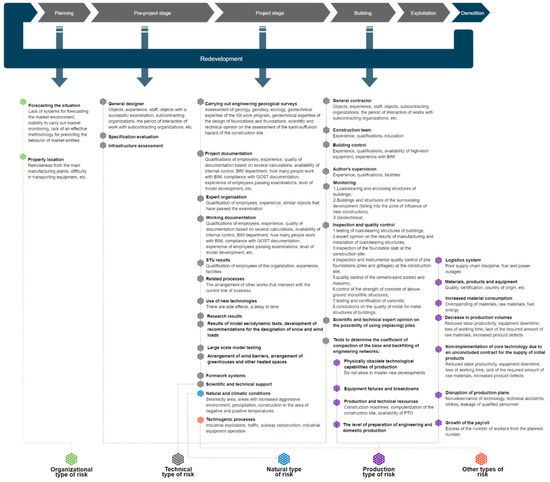
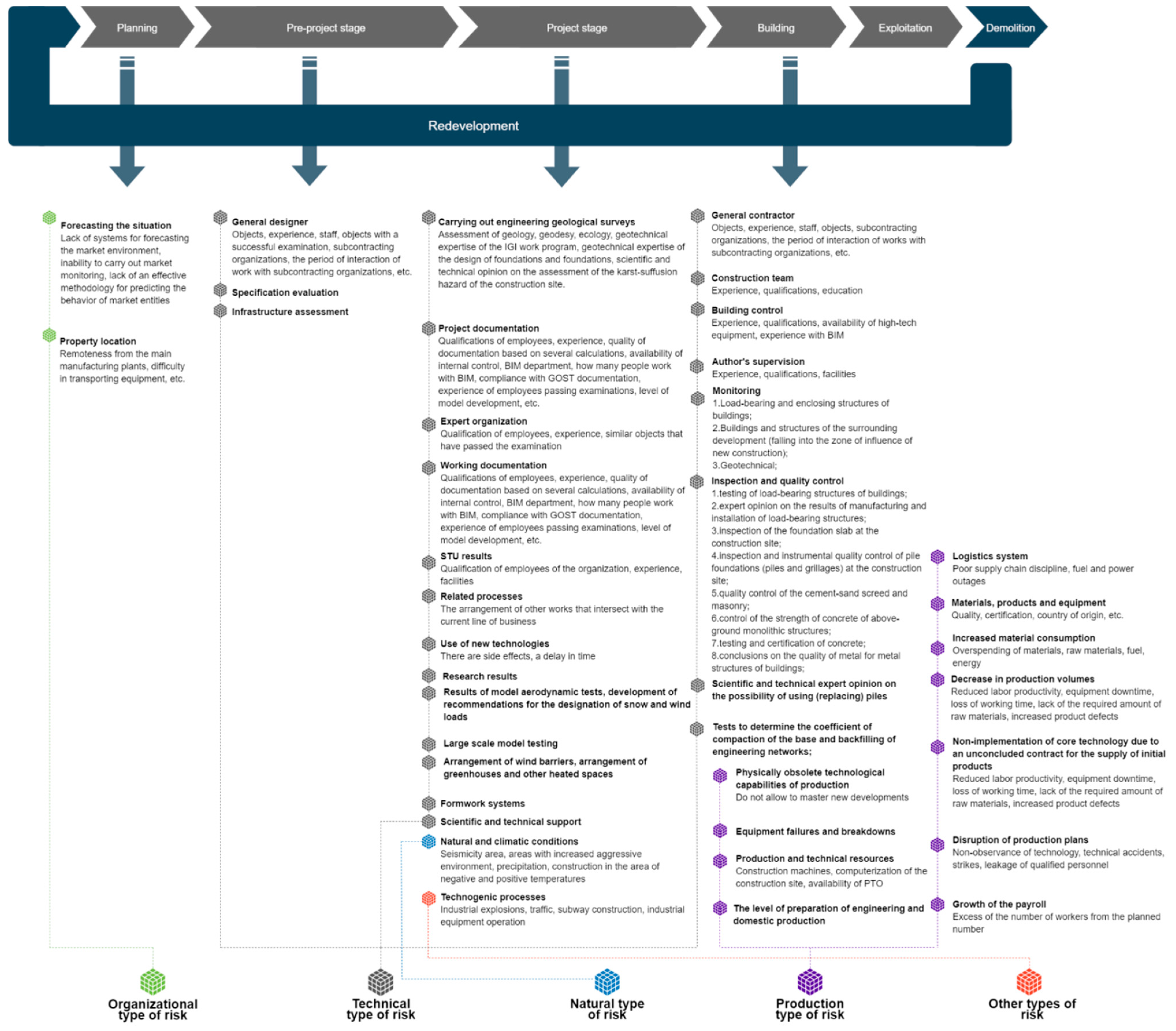
The selected risk factors were analyzed and divided into risk groups, as well as assigned to the stages of the project’s life cycle. Figure 1 presents the construction project’s life cycle, taking into account risk factors [12]. This model contains all the stages of the life cycle of an object. The essence of this model is that it contains all the risk factors considered in this work. The risks are divided into groups and correlated to the stages. The selection of these factors was carried out by analyzing the scientific literature and studying the objects of analogues, in the documentation of which the quality department recorded the risks that arose at the stage of work.
Figure 1.
Object life cycle model with risk factors included.
Moreover, this model was complemented by the method of expert assessment, given that it allows determining which risk factor parameters have the most significant impact on the multi-storey residential building life cycle.
The method utilized here consisted of an expert assessment of the proposed risk factors for a 20-storey residence building in Moscow. The experts were required to assess the risk factors on a five-point scale Likert scale of risk occurrence probability, impact on cost, and impact on duration.
The most dangerous stages in the life cycle of a building object are:
- Planning
- Pre-project stage
- Project stage
Expert examination was conducted among the specialists of the construction industry; 60 experts took part in the selection in accordance with the requirements of competencies for an expert, and the number of experts was determined by the proposed method of Ruposov V.L. [27,28].
Basic requirements:
- Academic degree or academic qualification.
- Participation in international scientific and technical cooperation.
- At least 10 years of professional experience.
- Member of NOPRIZ (National Association of Designers and Surveyors) and (or) NOSTROY (National Association of Builders).
The expert’s questionnaire is shown in Supplementary Materials Expert questionnaire. As a result of the analysis of the expert assessment, weight indicators of the estimated risk factor parameters were determined.
3.2. Mathematical Model of Data Analysis
To assess the impact of risk factors on the construction project’s life cycle, it is required not only to allocate the risk to the desired stage and conduct an expert assessment of the risk factor, but the data of the expert survey should be calculated mathematically to determine not only the degree of impact, but also the likelihood of the factor impacting such parameters as cost and duration.
The mathematical model for the analysis of expert evaluation is based on two theories:
- Fuzzy set theory, fuzzy logic.
- Dempster-Schafer theory (DS).
The fuzzy set theory is a method of experiment planning that is widely used in quantitative analysis of a machine process, especially for quality and risk assessment in engineering [29]. The main limitation of the method is related to the use of statistical mathematics and probability theory in the analysis. A probabilistic attempt is insufficient when the data are scant, as knowledge of their values becomes inaccurate or incomplete [30].
One of the possible solutions for cases where the data is scant is a non-parametric maximum likelihood estimate [31,32]. At the end of the twentieth century, a method based on the idea of fuzzy logic associated with L.A. Zadeh [33] was developed taking into account the possibility of describing the so-called linguistic variable. An example of applying the idea to the perceived risk assessment in the project is presented in the articles [34,35].
Fuzzy logic was first introduced by Professor L.A. Zadeh in 1965 and began to be applied in the 1970s [33,34]. Fuzzy logic is a successful application in the context of fuzzy sets in which the variables are linguistic rather than numeric. Since its development in 1965, it has become the optimal choice for handling data-related inaccuracies and uncertainties in risk assessment tasks [36].
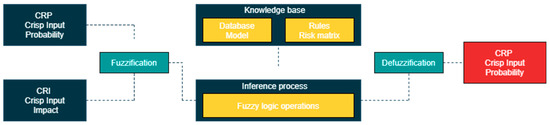
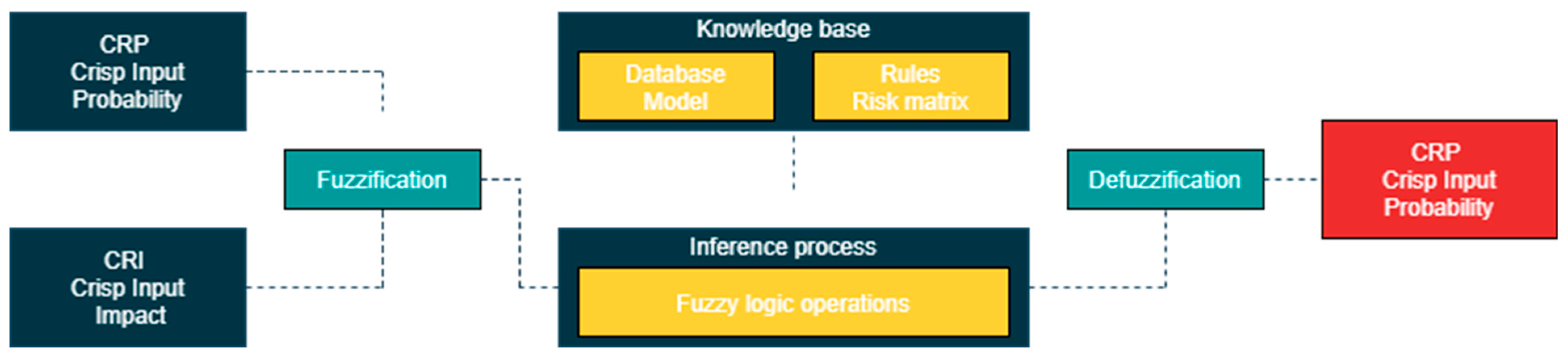
Fuzzy logic is different from binary or Aristotelian logic, which sees everything as binary: yes or no, black or white, zero or one. The values in this logic vary from zero to one [37]. Figure 2 shows the architecture of the fuzzy inference system.
Figure 2.
Fuzzy inference system [17].
A fuzzy inference system [17] usually consists of the following components:
- Fuzzificator
- Risk matrix
- Fuzzy inference mechanism
- Defuzzificator
The components of the fuzzy inference system for risk assessment are described below [17,37]. The process of converting explicit variables into linguistic variables is called fuzzification.
Fuzzification is the establishment of a correspondence between the numerical value of the input variable of the fuzzy inference system and the value of the membership function of the corresponding term of the linguistic variable [38].
The input and output data of the fuzzy inference system must first be fuzzy in a fuzzy inference system. The probability of occurrence and the severity of the impact of the risk are considered as two inputs, and the level of risk is considered as the output of the system of fuzzy inferences.
The linguistic expressions and fuzzy sets used for defining the input and output data of a fuzzy inference system are presented in Table 1 [17,38,39].
Table 1.
Linguistic terms.
For the functioning of the fuzzy logic system, referring to the standard risk matrix is required.
The risk matrix is a tool of the threat management process designed to increase the objectivity of its interpretation [17]. To place an item in the matrix, you must assign it a probability and damage rating.
The degree of risk is determined on the basis of the risk matrix [13] and, accordingly, this component of the developed fuzzy inference system for risk assessment is a knowledge base and fuzzy rules, including 25 fuzzy “if” rules, which are presented in Table 2.
Table 2.
Mathematical model rule table.
Table 3.
Risk Matrix.
Table 4.
Risk matrix with ranks.
The next component of the developed fuzzy inference system for risk assessment is the fuzzy inference mechanism. The inference engine evaluates and makes logical inference to the rules using inference algorithms, and after the inference rules are aggregated by the defuzzifier block they are converted to an explicit or numeric value. The fuzzy inference mechanism is the Mamdani algorithm [17]. The optimum method is used to aggregate the output data, and the center of gravity method is used for defuzzification.
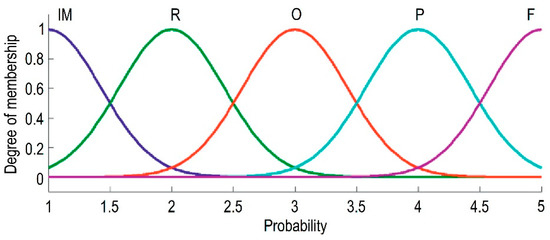
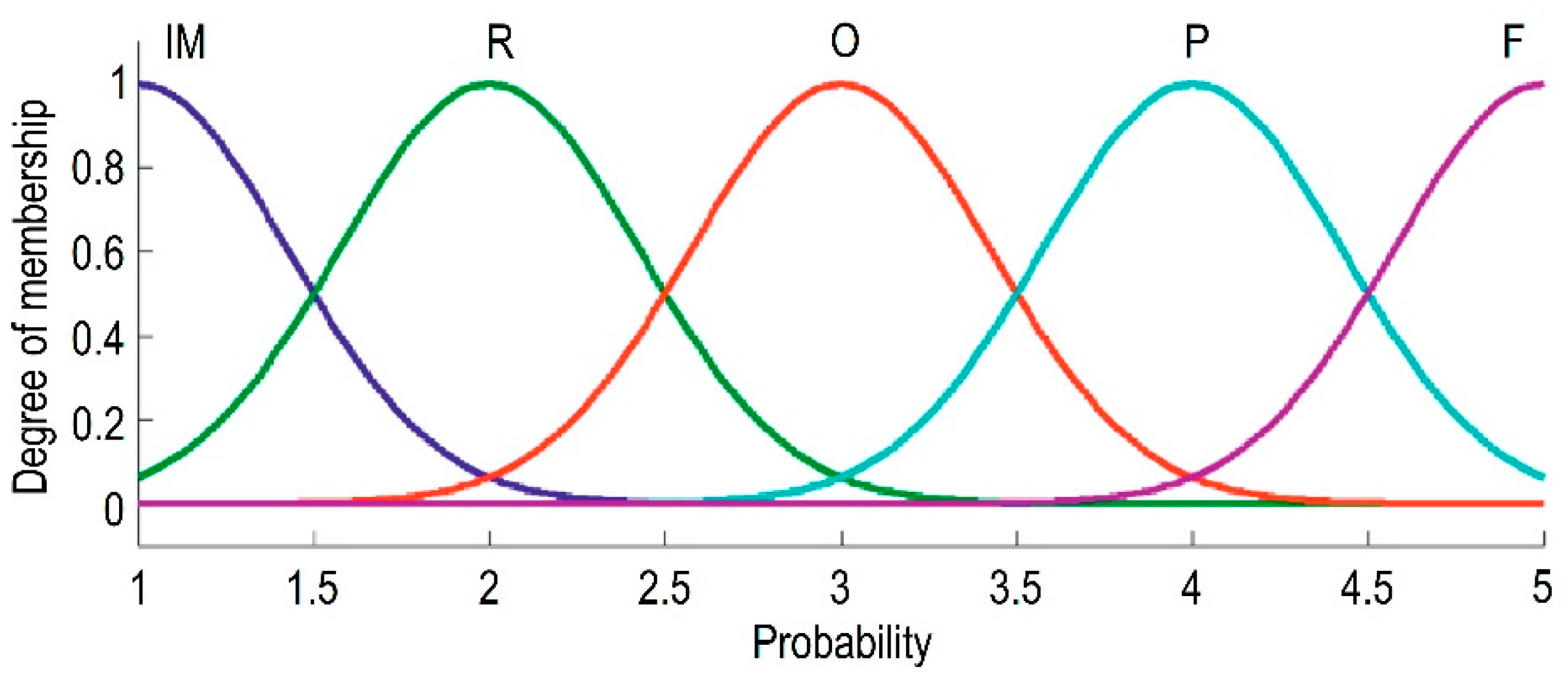
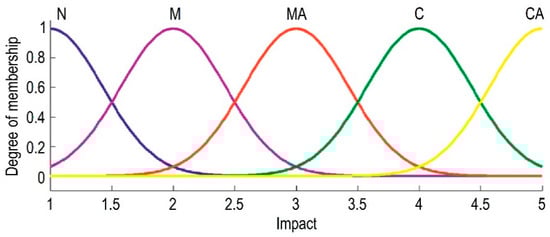
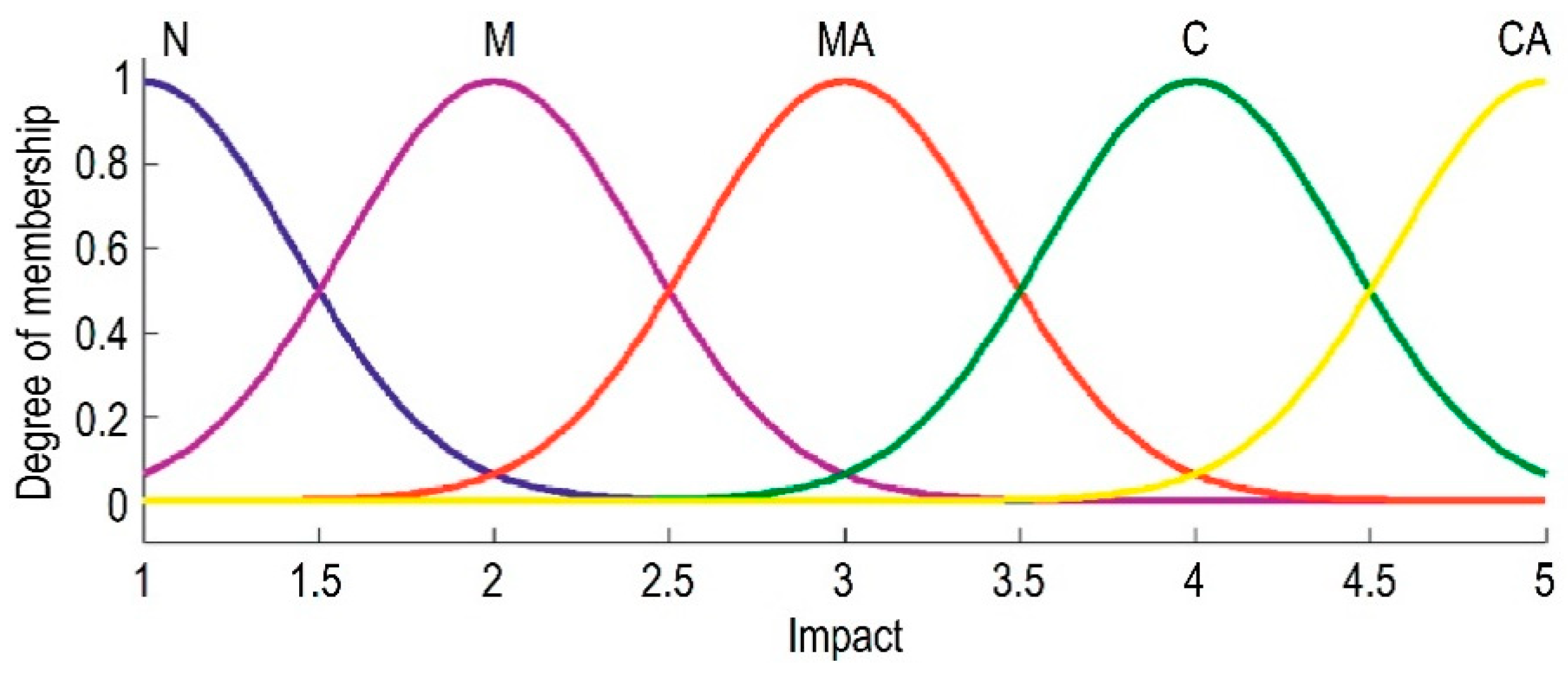
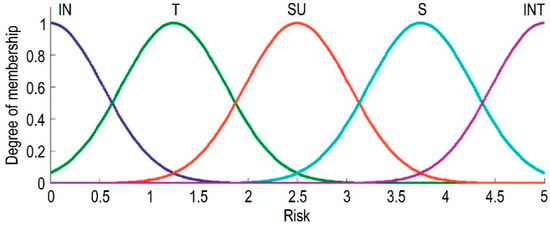
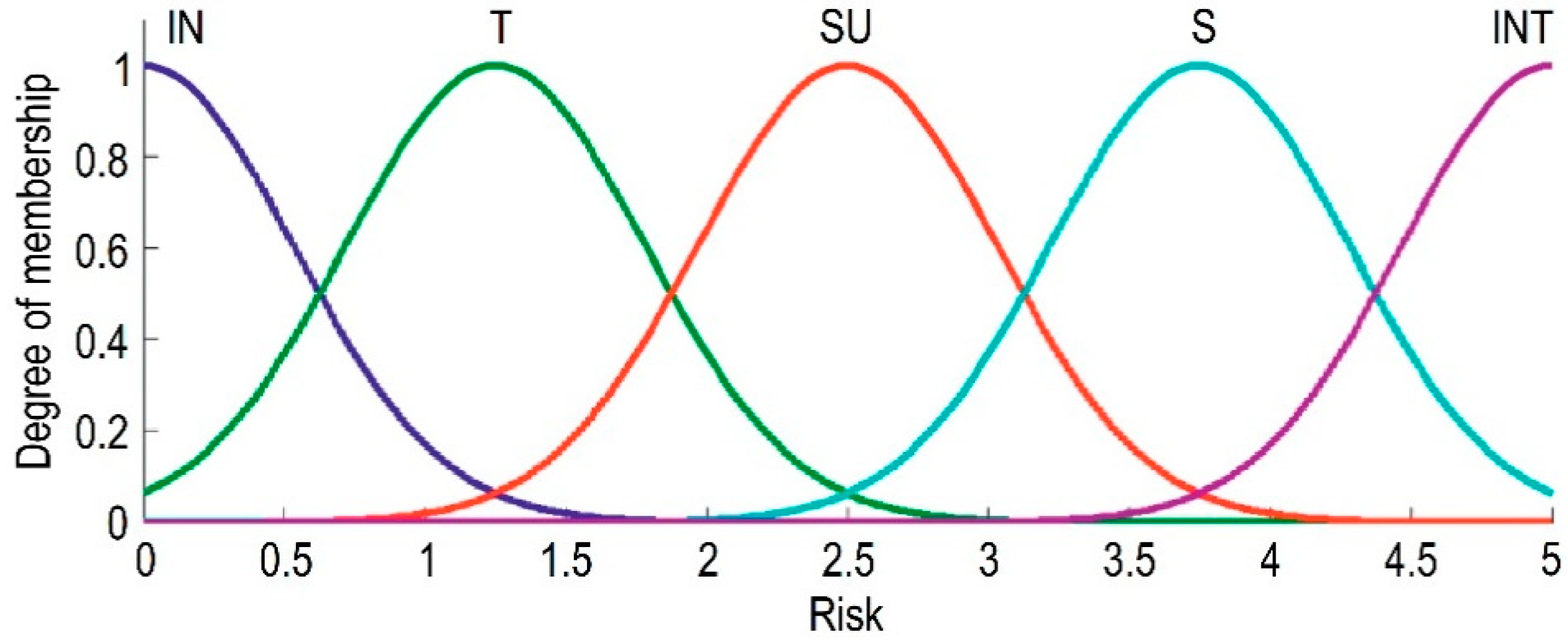
The fuzzy risk assessment index is considered as an output parameter, and varies from 0 to 5. In this article, the risk is divided into five equal parts, as shown in Figure 3, Figure 4 and Figure 5. Risks are represented by fuzzy sets, the ranges of which coincide with the linguistic terms given in Table 1. Using the appropriate transformation scale, the linguistic terms are converted into fuzzy ratings. One of the key points in fuzzy modeling is the definition of fuzzy numbers, which are vague concepts and expressed in inaccurate terms in natural language [36].
Figure 3.
Membership function for the probability level.
Figure 4.
Membership function for the influence level.
Figure 5.
Membership function for the risk level.
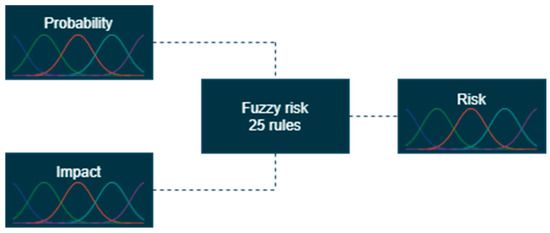
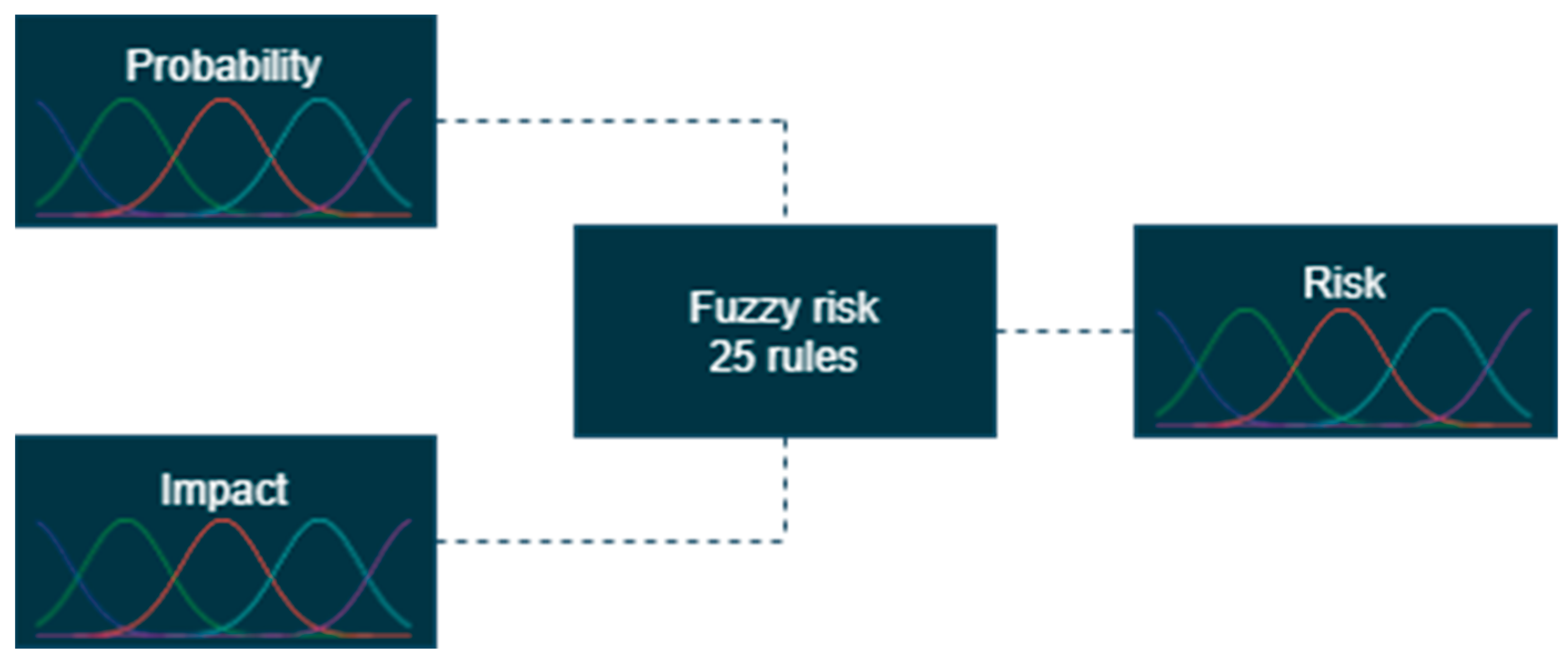
In this work, fuzzification distributes system variables, including probability (P), impact level (I) and risk levels (R) with clear numbers. The structure of the fuzzy model is shown in Figure 6.
Figure 6.
Fuzzy model inference structure.
Twenty-five rules were introduced to the mathematical model in Table 2, performing the defuzzification process [38,39]. Defuzzification in fuzzy inference systems is the process of transition from the membership function of an output linguistic variable to its clear (numerical) value. The purpose of defuzzification is to use the results of the accumulation of all output linguistic variables to obtain quantitative values for each output variable used by devices external to the fuzzy inference system [17,39].
The last step in the approximation is defuzzification. This step contains the process of replacing a fuzzy value with a clear inference, consisting of a procedure for weighing and averaging the outputs of all individual fuzzy rules. In total, there are six defuzzification methods [40]:
- Centroid Average (CA)
- Center of Gravity (COG)
- Maximum Center Average (MCA)
- Medium of the Maximum (MOM)
- Smallest of the Maximum (SOM)
- Largest of the Maximum (LOM)
Center of gravity (COG) is one of the most popular defuzzification methods, chosen because of its simple calculations and intuitive plausibility [41].
COG is defined by the following equation:
where:
- Z—defuzzified result.
- x—output variable.
- μi (x)—aggregated membership function.
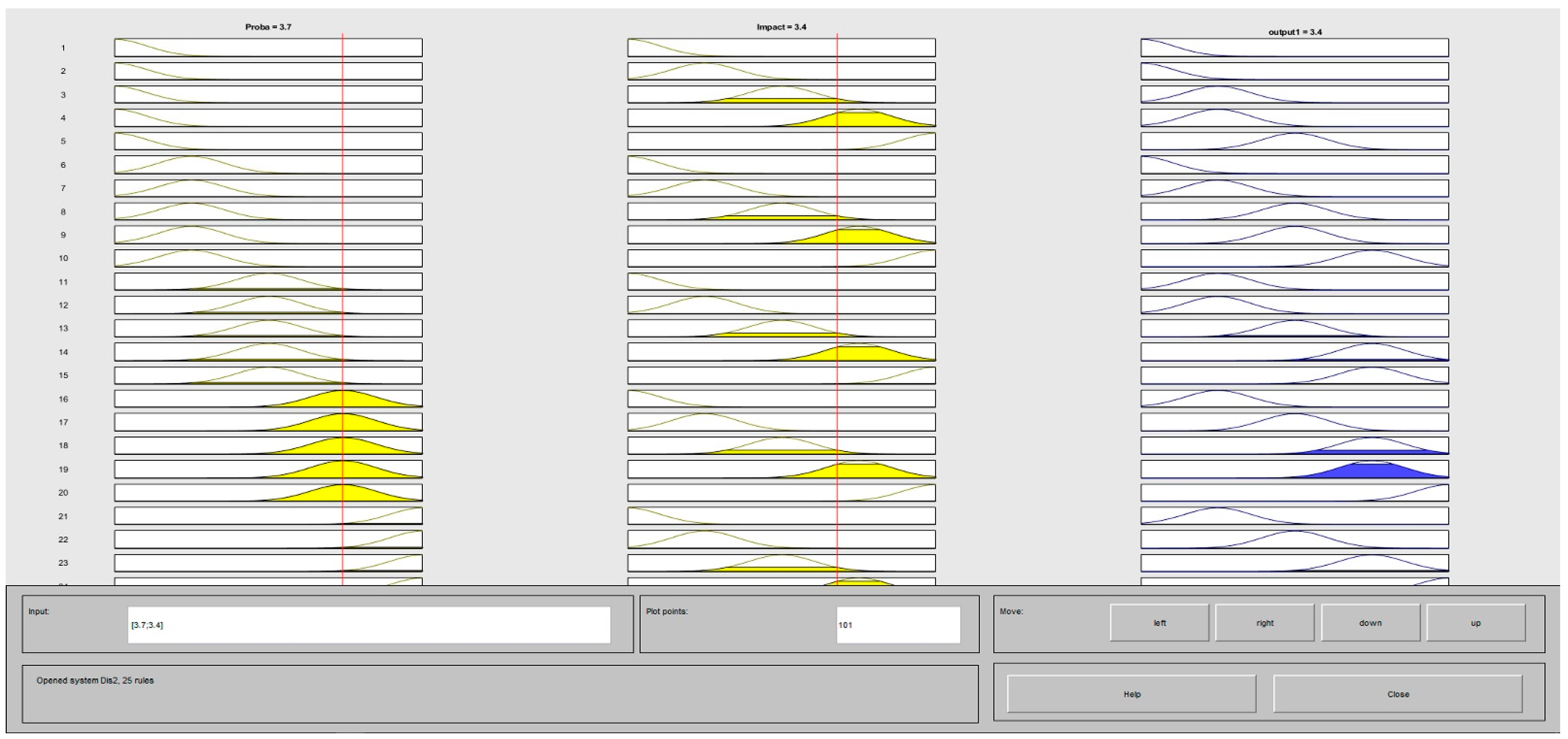
The defuzzification process creates a clear value from fuzzy sets that reflect the risk of the project, as in Figure 7.
Figure 7.
Output from Polyspace software package based on 25 rules.
The data of mathematical calculation of expert assessments are presented in Table 5.
The DS method is a more general form of the Bayesian approach that retains all its advantages. For example, in the DS method, as in the Bayesian method, available a priori information can be included in the inaccurate output of uncertain indicators and inferred results. Nevertheless, the use of a priori information in the DS method is not mandatory. This is one of the advantages of the DS theory [42,43].
where:
- m(A)—degree of reliability.
- maxF = max{fj| j ∈ [1, n]};
- minF = min{fj| j ∈ [1, n]};
- n—number of factors
Compared with other probabilistic methods, such as the Bayesian method, the DS method does not require the calculation of a priori probability; it has a flexible and understandable mass function, and the formation of a mass function is convenient and simple. The computational complexity of this method is much less than that of the Bayesian method [41,44].
For the processing of expert data, a risk matrix, the Dempster-Shaffer theory and a mathematical model of fuzzy logic were used. The processed results of the study are presented in Section 3.
Dempster-Shafer cell data were obtained by mathematical calculation according to formula 2. Fuzzy logic output data, defuzzification results, were obtained by mathematical modeling through the Polyspace software package. The inference algorithm was used. After aggregating the output rules by the defuzzifier block, we obtained an explicit numerical value as the result of fuzzy inference.
The data of mathematical calculations are presented in Section 3. The values of FLRC and FLRT are ranked in ascending order, according to the fuzzy inference group.
4. Result and Discussion
The following values of probability and impact on project parameters were obtained during the expert survey of Section 3.1. The results of the expert survey are presented in Table 5.
Table 5.
Analysis of the expert survey results.
To understand the operation of the mathematical model in the life cycle of a multistorey residential building, each factor at different stages of the project was considered and the rank of the factor was determined by fuzzy logic, as this was the main tool in our study, with 25 preprogrammed rules.
The data of the expert survey are the input data for the mathematical model presented in Section 3.2. The results of the mathematical model are presented in Table 6.
Table 6.
Comparative analysis of the obtained data.
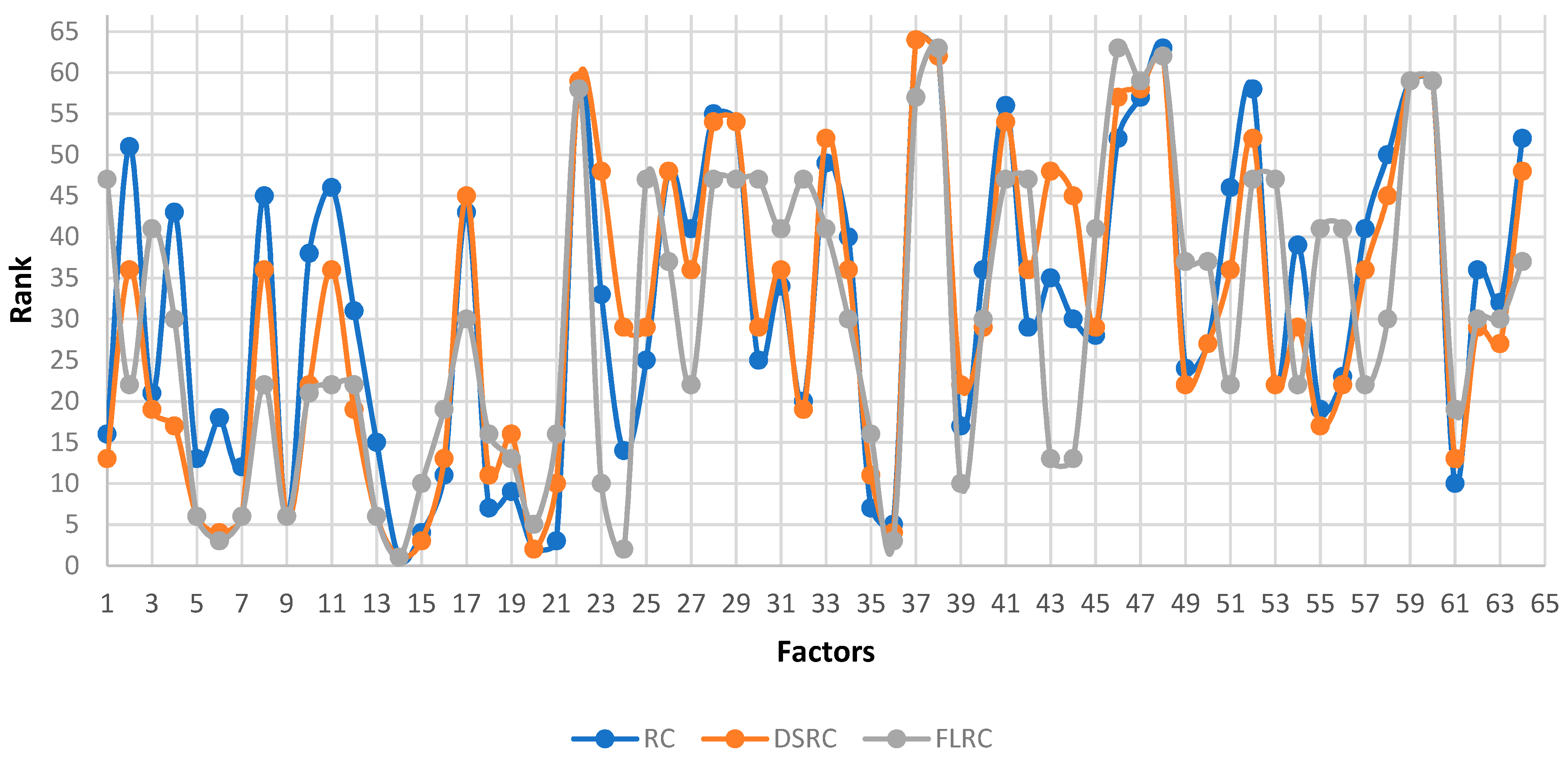
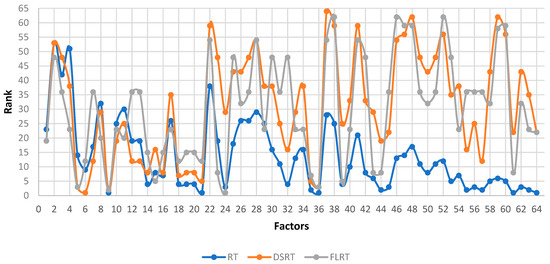
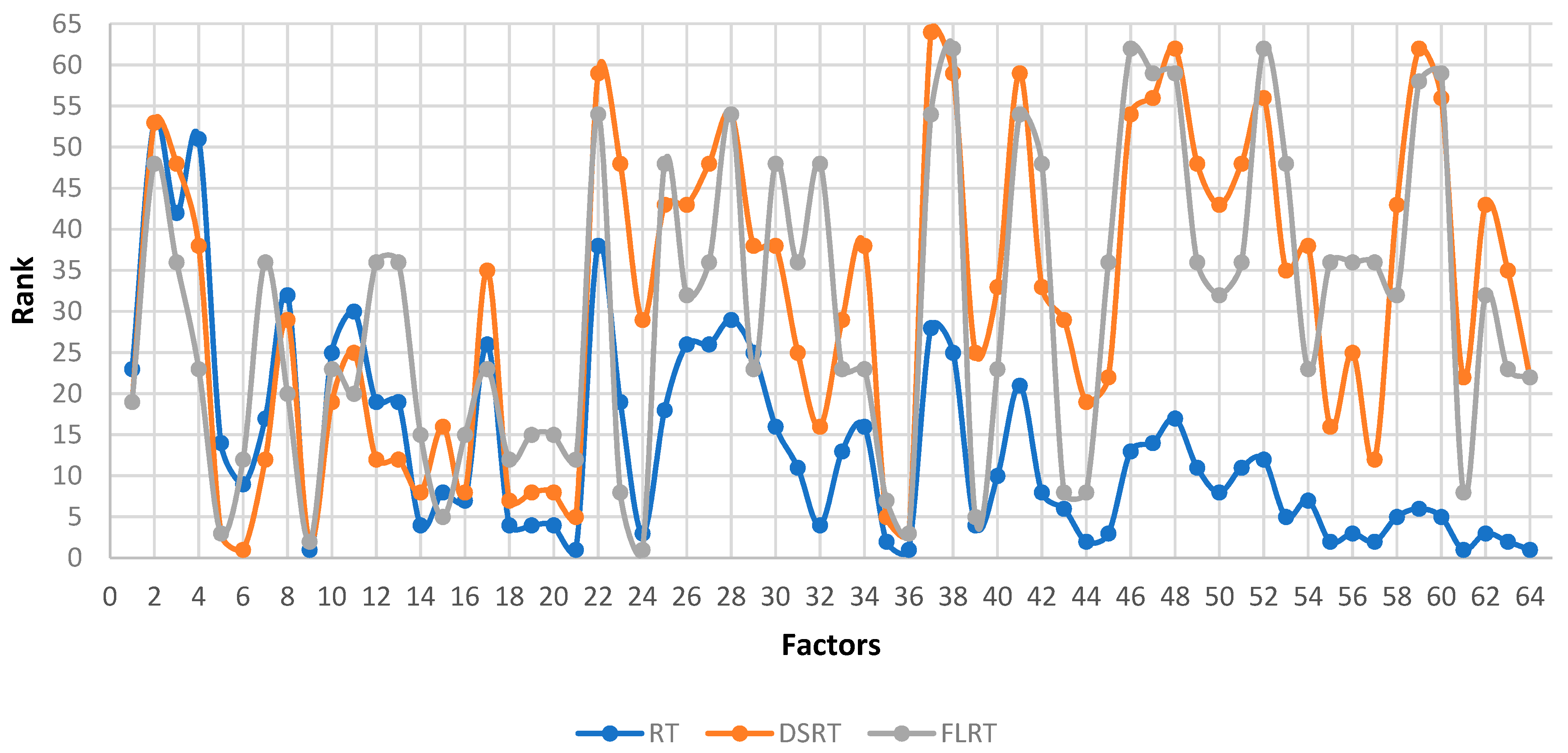
After analyzing the results of mathematical calculations, a diagram with factors and their ranks can be constructed as shown in Figure 8 and Figure 9. The data are presented without ranking by the magnitude of the influence.
Figure 8.
Distribution diagram of the impact of risk factor on the cost by ranks.
Figure 9.
Diagram of the distribution of the impact of risk factor on the duration by ranks.
The diagram shows 64 factors, with each ranked in relation to another; due to this we see a clearer picture of the distribution of risk factors by measurement value, both in cost and in time.
The study identified the most dangerous risk factors that affect the key parameters of the life cycle of a multi-storey residential building.
Mathematical calculations showed that the most effective mathematical apparatus is fuzzy logic based on 25 given rules. Dempster Schaffer’s theory has small deviations from fuzzy logic, but this spread is within the acceptable limit. The standard risk matrix has large deviations in data reliability, as it excludes the presence of the said risk factor definition rules.
The final step was to determine the magnitude of the impact of the main factors identified in Table 6, on the parameters of cost and duration of the construction project.
Table 7 shows the results of the analysis of the obtained data. The cost and duration values were determined by the experts in Supplementary, Section 3.1.
Table 7.
Critical risk factor analysis.
The factors in Table 7 are in the Significant category of Table 1. Mitigation measures must be taken to reduce the risks. These are critical risks that have serious consequences and a high probability of occurrence. High priority means immediate action is required to eliminate or mitigate possible consequences.
Factors not included in the table are not excluded; they are part of the whole project system and are subject to the rules of Table 1.
The following data were obtained as a result of the analysis of key risk factors:
- Twenty most hazardous risk factors categorized as “Significant” were identified.
- A high level of increase in duration and costs was observed at the design stage.
- The indicators of increase in the value at each stage of the project life cycle were determined; the amount of damage caused by the factors is ≈$1.5 mln.
- The indicators of increase in duration at each stage of the project life cycle were determined; increase in duration is ≈7 months.
The difference in the rank values of the risk factors presented in Figure 8 and Figure 9 shows that the choice of mathematical tool plays an important role in determining the rank of risk factors.
The results obtained during the study will help to predict project risks and allow taking the right steps in due time to manage them and to adjust the budget and resources.
5. Discussion
A key component of the experiment was focused on the analysis of the influence of various risk factors that affect the stages of important parameters of the building life cycle. The experiment showed the performance of the mathematical model and identified critical factors. This technique allows work on one structure, that is, the life cycle of an object with all its parameters and the mathematical apparatus for taking into account the influence of factors, which allows a response to their impact in a timely manner. In general, the study of the influence of factors on the life cycle of an object will allow creating a common interconnection environment focused on successful implementation and improvement of informed decisions that can bring maximum benefit to stakeholders.
The use of two mathematical models for assessing the risk factor is not comprehensive today, but it copes well with the tasks set; namely, it takes into account the requirements and rules laid down by the operator for each object. However, for future buildings, actual data on behavior is not available, there are no public registries, no record of the maximum influencing factors is kept, which is a hot topic these days, and often the data are confidential. Hence, co-modeling by integrating BIM with a robust risk analysis model is one of the most appropriate methods to solve this problem. It is convenient when each factor has its own individual number, tracked in real time at each stage of work in the BIM system.
This study has the following unsolved problems. The scope of the simulation experiment was limited both in terms of the simulation time period and the space coverage of the object data. Over time, more participation from experts from the construction industry is required. More designs, materials and design approaches need to be evaluated as the pace of construction continues to be high and every year we see new technologies emerging in the construction industry. Simulation results will be more coherent and informative if it is possible to expand the range of data collection on the objects under study; the functions of joint modeling can be improved as research progresses.
Since the proposed model is relatively new, it should be considered a starting point for a new assessment of the impact of risk factors on the project. The methodology is subject to improvement, and many aspects remain to be studied. Of course, this model will allow managers of organizations to significantly reduce costs, correctly form the tasks set, identify and eliminate risk factors in a timely manner, and identify weaknesses in the company that will lead to financial losses.
Future research in this area should focus on identifying risk factors and managing them during the project cycle. It is worth introducing an electronic database of risk factors, so the percentage of risks can be reduced and projects implemented more efficiently.
6. Conclusions
This article proposes a scientifically justified mathematical model of the life cycle of a multi-storey residential building. The model allows competent determination and ranking of the influence of risk factors at each stage of the project. The presented methodology was developed to assess the impact of risk factors on the main parameters of the project. The stages of the life cycle for a residential building were analyzed, the risk factors arising at each stage identified, and their impact assessed by an expert survey. The expert survey involved 60 experts who are professionals in the construction industry, with more than 10 years of experience. The experts were requested to assess the impact of factors on both the cost and the duration. As a result, the following conclusions can be made.
- The mathematical model based on the fuzzy set theory with 25 programmable rules identified critical project factors and shows a small deviation from the Dempster-Schafer theory.
- The most hazardous risk factors with the influence on the life cycle of the project, affecting the parameters of the duration and cost of the project, were identified and ranked. There are 31.25% of them in the life cycle. All factors should have an identification number to track them. This data will help to predict the consequences in a timely manner and take measures to eliminate them.
- Particular attention should be paid to the design phase, as the highest concentration of risk factors is observed in this category, i.e., 65.63%.
- Analysis of the data showed that under the influence of critical risk factors on the project, the cost of the project grows by 1.5 million dollars, and the duration increases by 7 months.
Supplementary Materials
The following are available online at https://www.mdpi.com/article/10.3390/buildings12040484/s1, Table S1: Expert Questionnaire.
Author Contributions
Conceptualization, A.L.; methodology, A.L. and D.T.; software, O.C.; data analysis, D.T.; investigation, O.C. and T.K.; data curation, D.T. and T.K.; writing—original draft preparation, O.C. and T.K.; writing—review and editing, O.C. and T.K.; final conclusions, O.C. and T.K. All authors have read and agreed to the published version of the manuscript.
Funding
This work was financially supported by the Ministry of Science and Higher Education of Russian Federation (grant NO. 075-15-2021-686).
Institutional Review Board Statement
Not applicable.
Informed Consent Statement
Not applicable.
Data Availability Statement
Not applicable.
Conflicts of Interest
The authors declare no conflict of interest.
References
- Kevesh, A.L. Construction in Russia. Stat. Sat./Rosstat M 2018, 56–60. [Google Scholar]
- Asaul, A.N. Risks in the Activity of a Construction Organization; Economic Problems and Organizational Solutions to Improve Investment and Construction Activities: A Collection of Scientific Papers; State Architecture Builds University: Saint Petersburg, Russia, 2004; Volume 2, pp. 8–12. [Google Scholar]
- Allahi, F.; Cassettari, L.; Mosca, M. Stochastic Risk Analysis and Cost Contingency Allocation Approac for Construction Projects Applying Monte Carlo Simulation. In Proceedings of the World Congress on Engineering, London, UK, 5–7 July 2017; Volume I, pp. 385–391. [Google Scholar]
- Renuka, S.; Kamal, S.; Umarani, C. A model to estimate the time overrun risk in construction projects. Empir. Res. Urban Manag. 2017, 12, 64–76. [Google Scholar]
- Islam, M.S.; Nepal, M.P.; Skitmore, M.; Drogemuller, R. Risk induced contingency cost modeling for power plant projects. Autom. Constr. 2021, 123, 103519. [Google Scholar] [CrossRef] [Scilit]
- Assaf, S.A.; Al-Hejji, S. Causes of delay in large construction projects. Int. J. Proj. Manag. 2006, 24, 349–357. [Google Scholar] [CrossRef] [Scilit]
- Andersson, R.; Kövecses, S.; Bargalló, E.; Nordt, A. Challenges in Technical Risk Management for High-Power Accelerators. J. Phys. Conf. Ser. 2018, 1021, 012003. [Google Scholar] [CrossRef] [Scilit]
- Ishin, A.V. Obligatory certification of specialists of companies-a guarantee of safety and quality of their work. Technol. Organ. Constr. Prod. 2013, 3, 23–24. [Google Scholar]
- Lapidus, A.A. The impact of modern and organizational measures on the achievement of the planned results of construction projects. Technol. Organ. Constr. Prod. 2013, 2, 1. [Google Scholar]
- Sarkar, D.; Panchal, S. Integrated interpretive structural modeling and fuzzy approach for project risk management of ports. Int. J. Constr. Proj. Manag. 2015, 1, 17–31. [Google Scholar]
- Lapidus, A.A.; Safaryan, G.B. Quantitative analysis of risk modeling of production and logistics processes in construction. Technol. Organ. Constr. Prod. 2017, 3, 4. [Google Scholar]
- Lapidus, A.A.; Chapidze, O.D. Factors and sources of risk in housing consruction. Constr. Prod. 2020, 3, 2–9. [Google Scholar]
- Kozień, E. Assessment of technical risk in maintenance and improvement of a manufacturing process. Open Eng. 2020, 10, 658–664. [Google Scholar] [CrossRef] [Scilit]
- Darko, A.; Chan, A.P.; Yang, Y.; Tetteh, M.O. Building information modeling (BIM)-based modular integrated construction risk management—Critical survey and future needs. Comput. Ind. 2020, 123, 103327. [Google Scholar] [CrossRef] [Scilit]
- Renuka, S.M.; Umarani, C.; Kamal, S. A Review on Critical Risk Factors in the Life Cycle of Construction Projects. J. Civ. Eng. Res. 2014, 4, 31–36. [Google Scholar] [CrossRef]
- Zhao, Z.Y.; Lv, Q.L.; Zuo, J.; Zillante, G. Prediction System for Change Management in Construction Project. J. Constr. Eng. Manag. 2010, 136, 659–669. [Google Scholar] [CrossRef] [Scilit]
- Yazdani-Chamzini, A. Proposing a new methodology based on fuzzy logic for tunnelling risk assessment. J. Civ. Eng. Manag. 2014, 20, 82–94. [Google Scholar] [CrossRef] [Scilit]
- Elfahham, Y. Estimation and Prediction of Construction Cost Index Using Neural Net-works, Time Series, and Regression. Alex. Eng. J. 2019, 58, 499–506. [Google Scholar] [CrossRef] [Scilit]
- Guan, L.; Liu, Q.; Abbasi, A.; Ryan, M.J. Developing a comprehensive risk assessment model based on fuzzy bayesian belief network (fbbn). J. Civ. Eng. Manag. 2020, 26, 614–634. [Google Scholar] [CrossRef] [Scilit]
- Asadabadi, M.R.; Zwikael, O. Integrating risk into estimations of project activities’ time and cost: A stratified approach. Eur. J. Oper. Res. 2019, 291, 482–490. [Google Scholar] [CrossRef] [Scilit]
- Filippetto, A.S.; Lima, R.; Barbosa, J.L.V. A risk prediction model for software project management based on similarity analysis of context histories. Inf. Softw. Technol. 2020, 131, 106497. [Google Scholar] [CrossRef] [Scilit]
- Nguyen, P.T.; Pham, C.P.; Phan, P.T.; Vu, N.B.; Duong, M.T.H.; Nguyen, Q.L.H.T.T. Exploring critical risk factors of office building projects. J. Asian Financ. Econ. Bus. 2021, 8, 309–315. [Google Scholar]
- Osuszek, L.; Ledzianowski, J. Decision support and risk management in busi-ness context. J. Decis. Syst. 2020, 29, 413–424. [Google Scholar] [CrossRef] [Scilit]
- An, J.; Mikhaylov, A. Russian energy projects in South Africa. J. Energy S. Afr. 2020, 31, 58–64. [Google Scholar] [CrossRef] [Scilit]
- Lopatin, E. Methodological approaches to research resource saving industrial enterprises. Int. J. Energy Econ. Policy 2019, 9, 181–187. [Google Scholar] [CrossRef] [Scilit]
- Schulte, J.; Villamil, C.; Hallstedt, S. Strategic Sustainability Risk Management in Product Development Companies: Key Aspects and Conceptual Approach. Sustainability 2020, 12, 10531. [Google Scholar] [CrossRef] [Scilit]
- Ruposov, V.L.; Chernykh, A.A. Processing formalized swot-analysis expert evaluation data. Proc. Irkutsk. State Tech. Univ. 2017, 21, 81–89. [Google Scholar] [CrossRef] [Scilit]
- Ruposov, V.L. Methods of Determining the Number of Experts; Herald of Irkutsk State Technical University: Eastern Siberia, Russia, 2015; Volume 3, pp. 286–292. [Google Scholar]
- Fisher, R.A. The Design of Experiments; Oliver and Boyd Press: Edinburgh, UK, 1935. [Google Scholar]
- Pietraszek, J. Metody Planowania Badań Doświadczalnych Eksploatowanych Maszyn i Urządzeń; Monografia nr 378; Wydawnictwo Politechniki Krakowskiej: Kraków, Poland, 2010. [Google Scholar]
- Owen, A.B. Empirical Likelihood; CRC Press: Boca Raton, FL, USA, 2001. [Google Scholar] [CrossRef] [Scilit]
- Pietraszek, J.; Dwornicka, R.; Krawczyk, M.; Kolomycki, M. The nonparametric approach to the quantification of the uncertainity in the design of experiments modelling. In UNCECOMP 2017: Proceedings of the 2nd International Conference on Uncertainty Quantification in Computational Sciences and Engineering, Rhodes Island, Greece, 15–17 June 2017; Papadrakakis, M., Papadopoulos, V., Stefanou, G., Eds.; Institute of Structural Analysis and Antiseismic Research, School of Civil Engineering, National Technical University of Athens: Athens, Greece, 2017; pp. 598–604. [Google Scholar]
- Zadeh, L. Probability measures of Fuzzy events. J. Math. Anal. Appl. 1968, 23, 421–427. [Google Scholar] [CrossRef] [Scilit]
- Kozien, E.; Kozien, M.S. Using the fuzzy logic description for the ex-ante risk assessment in the project. In Economic and Social Development. Book of Proceedings: 35th International Scientific Conference on Economic and Social Development, Lisbon, Portugal, 15–16 November 2018; Ribeiro, H., Naletina, D., da Silva, A.L., Eds.; Varazdin Development and Entrepreneurship Agency: Varazdin, Croatia, 2018; pp. 224–231. [Google Scholar]
- Moreno-Cabezali, B.M.; Fernandez-Crehuet, J.M. Application of a fuzzy-logic based model for risk assessment in additive manufacturing R&D projects. Comput. Ind. Eng. 2020, 145, 106529. [Google Scholar] [CrossRef] [Scilit]
- Singh, H.; Gupta, M.M.; Meitzler, T.; Hou, Z.G.; Garg, K.K.; Solo, A.M.; Zadeh, L.A. Real-life applications of fuzzy logic. Adv. Fuzzy Syst. 2013. [Google Scholar] [CrossRef] [Scilit]
- Urbina, A.G.; Aoyama, A. Measuring the benefit of investing in pipeline safety using fuzzy risk assessment. J. Loss Prev. Process Ind. 2017, 45, 116–132. [Google Scholar] [CrossRef] [Scilit]
- Rubanov, V.G.; Filatov, A.G. Intelligent automatic control systems fuzzy control in technical systems. In Tutorial; BSTU im. V. G. Shukhova: Belgorod, Russia, 2010; p. 170. [Google Scholar]
- Jaderi, F.; Ibrahim, Z.Z.; Zahiri, M.R. Criticality analysis of petrochemical assets using risk based maintenance and the fuzzy inference system. Process Saf. Environ. Prot. 2018, 121, 312–325. [Google Scholar] [CrossRef] [Scilit]
- Nieto-Morote, A.; Ruz-Vila, F. A fuzzy approach to construction project risk assessment. Int. J. Proj. Manag. 2011, 29, 220–231. [Google Scholar] [CrossRef] [Scilit]
- Wong, B.K.; Monaco, J.A. A bibliography of expert system applications for business (1984–1992). Eur. J. Oper. Res. 1995, 85, 416–432. [Google Scholar] [CrossRef] [Scilit]
- Dempster, A.P. A generalization of Bayesian inference. J. R. Stat. Soc. Ser. B Stat. Methodol. 2001, 64, 205–232. [Google Scholar]
- Shafer, G. A Mathematical Theory of Evidence; Princeton University Press: Princeton, NJ, USA, 1977; Volume 83, pp. 667–672. [Google Scholar]
- Jamshidi, A.; Yazdani-Chamzini, A.; Yakhchali, S.H.; Khaleghi, S. Developing a new fuzzy inference system for pipeline risk assessment. J. Loss Prev. Process Ind. 2013, 26, 197–208. [Google Scholar] [CrossRef] [Scilit]

Publisher’s Note: MDPI stays neutral with regard to jurisdictional claims in published maps and institutional affiliations. |
© 2022 by the authors. Licensee MDPI, Basel, Switzerland. This article is an open access article distributed under the terms and conditions of the Creative Commons Attribution (CC BY) license (https://creativecommons.org/licenses/by/4.0/).