


Abstract
Environmental rights scholarship commonly evaluates legal protection through express constitutional recognition and direct judicial enforceability. China presents a different institutional configuration: although its Constitution does not establish a standalone and directly justiciable individual environmental right, environmental interests acquire legal significance through constitutional obligations, statutory duties, administrative procedures, participatory mechanisms, and public-interest remedies. Using doctrinal legal research and normative reconstruction, this article develops the concept of functional environmental rights to explain this intermediate form of protection. Functional environmental rights refer to a legally grounded and institutionally mediated structure in which environmental interests are identified by positive law, connected with corresponding duties and procedural positions, and protected through legally authorized remedies without being converted into universally held subjective rights. The analysis identifies four interrelated layers: state environmental obligations, substantive environmental interests, procedural safeguards, and institutional remedies. It further explains how members of the public, regulated entities, qualified social organizations, procuratorial organs, public authorities, and directly injured persons occupy differentiated legal positions within this structure. The article argues that functional environmental rights provide a more precise account of environmental interest protection in China than either the conventional rights-policy binary or a purely governance-centered explanation. The framework clarifies how a state-centered environmental legal order may generate limited but genuine rights-protective effects through information access, participation, supervision, representative enforcement, ecological restoration, and compensation.
1. Introduction
Over the past several decades, environmental protection has increasingly been framed in rights-based terms. Constitutional provisions concerning environmental protection have expanded across jurisdictions, while courts, legislatures, and international institutions have developed different approaches to recognizing and protecting environmental interests. This trend was further reinforced in 2022, when the United Nations General Assembly recognized the right to a clean, healthy, and sustainable environment as a human right. These developments have encouraged environmental constitutionalism and comparative scholarship on the legal recognition, institutional protection, and judicial enforceability of environmental rights (Boyd 2012; May and Daly 2015; United Nations General Assembly 2022).
China presents a different legal configuration. Articles 9 and 26 of the Constitution require the state to protect natural resources, improve the living and ecological environment, and prevent and control pollution, but they do not expressly establish a freestanding environmental right that individual citizens may directly invoke before courts. At the same time, environmental interests receive legal protection through environmental legislation, administrative regulation, ecological and environmental impact assessment, information disclosure, public participation, environmental public-interest litigation, ecological and environmental damage compensation, ecological restoration, and liability mechanisms (Mu et al. 2014; Tang and Spijkers 2022; Wang 2024; Xie and Xu 2021). The Chinese framework therefore cannot be fully explained either by an approach focused exclusively on directly enforceable subjective rights or by an account that treats environmental protection merely as non-binding policy.
Existing scholarship has clarified important aspects of this legal structure. One strand examines environmental constitutionalism and the legal significance of constitutional environmental provisions. A second focuses on procedural environmental rights, particularly access to environmental information, public participation in decision-making, and access to justice. A third examines the state-centered and administration-led features of China’s environmental governance. These approaches illuminate important but separate dimensions of environmental protection. They do not yet provide a sufficiently integrated explanation of how environmental interests acquire binding legal significance within a system that lacks a standalone and directly justiciable individual environmental right.
First, comparative scholarship on environmental constitutionalism has focused primarily on the express constitutional recognition of environmental rights and their enforcement by courts (Boyd 2012; May and Daly 2015). This literature has made an important contribution by demonstrating that constitutional rights and judicial remedies can strengthen environmental protection. However, constitutional environmental protection is not limited to directly enforceable individual rights. Weis (2018), for example, shows that constitutional directive principles and state obligations may possess legal significance even where they do not create direct individual causes of action. This broader perspective is particularly relevant to China. Wang (2024) characterizes China’s environmental constitutionalism as predominantly state-based rather than rights-based, while recent Chinese scholarship has examined the normative expression, constitutional status, and doctrinal limits of environmental rights (Tang 2025; W. Zhang 2025; L. Zhang 2026). These studies demonstrate that the absence of an express individual environmental right does not render constitutional environmental provisions legally irrelevant. Nevertheless, they do not fully explain how constitutional obligations are translated into statutory duties, administrative procedures, participatory mechanisms, and institutional remedies.
Second, scholarship on procedural environmental rights has emphasized the importance of access to information, public participation, and access to justice in environmental matters (Gellers and Jeffords 2018; Jendrośka 2024). At the international level, these three dimensions are reflected in Principle 10 of the Rio Declaration and elaborated in the Aarhus Convention. The Convention is therefore relevant here as an institutional reference point rather than as a substitute for scholarly analysis. Research on China has examined the gradual institutionalization of environmental information disclosure, public participation in environmental impact assessment, and environmental public-interest litigation (Xie and Xu 2021). Recent Chinese research has also situated public participation within the broader construction of the ecological-civilization institutional system (Li and Shan 2025). This literature shows that Chinese law provides legally structured procedural positions and representative remedies even without a universal individual right to bring environmental litigation. However, it generally focuses on particular procedures or institutions and does not fully explain their relationship to constitutional obligations, substantive environmental interests, and restorative remedies.
Third, scholarship on state-centered environmental governance emphasizes the central role of legislation, administrative agencies, regulatory enforcement, ecological-civilization policies, and institutional coordination (Mu et al. 2014; Wang 2024). More specialized research has examined environmental public-interest litigation, ecological restoration, and eco-environmental damage compensation as mechanisms for addressing collective environmental harm (Li and Song 2024; Xie and Xu 2021). This body of scholarship accurately reflects the state-centered and administration-led characteristics of China’s environmental legal order. Yet an explanation focused primarily on governance capacity or administrative implementation may leave insufficiently examined the legal character of the environmental interests protected through these institutions. The relevant issue is not only whether public authorities govern effectively, but also how environmental interests become legally cognizable, procedurally expressible, and institutionally enforceable.
This article addresses that question through the concept of functional environmental rights. The term does not refer to a complete subjective environmental right held directly and uniformly by every individual. Nor does it imply that all environmental values automatically become judicially enforceable claims. Rather, it describes an intermediate legal form in which environmental interests receive rights-protective effects through the combined operation of legally defined duties, procedural positions, institutional powers, and remedial mechanisms. Environmental interests, in this sense, include legally protected interests in pollution prevention, ecological integrity, environmental information, participation, ecological restoration, and protection against environmental conditions that threaten public health. Their legal protection may be exercised through different actors and mechanisms: members of the public may obtain information, participate, and supervise; qualified social organizations and procuratorial organs may bring public-interest litigation; and state-designated bodies may pursue ecological and environmental damage compensation.
The article therefore asks two questions. First, through which legal mechanisms do environmental interests acquire binding legal significance in China? Second, how should the relationship among constitutional environmental obligations, statutory duties, procedural safeguards, and institutional remedies be characterized in doctrinal terms? It argues that the combined operation of these mechanisms creates a legally grounded and institutionally mediated structure of environmental protection. This structure is stronger than a mere policy commitment but remains distinct from a comprehensive individual environmental right.
The article proceeds as follows. Section 2 explains the doctrinal methodology and scope of analysis. Section 3 identifies the constitutional, statutory, procedural, and remedial foundations through which environmental interests are protected in China. Section 4 develops the concept of functional environmental rights, clarifies the legal character and holders of the interests involved, and explains the four-layer institutional structure through which protection operates. Section 5 considers the implications and limitations of this framework for sustainable governance in China. Section 6 concludes.
2. Methodology
This article employs doctrinal legal research to examine how environmental interests are protected within China’s existing legal order. Doctrinal analysis is used to identify, interpret, and systematize the relevant constitutional provisions, statutes, administrative rules, judicial mechanisms, and other authoritative legal materials, with particular attention to the legal duties, procedures, and remedies they establish (Hutchinson and Duncan 2012). Building on this analysis, the article uses normative reconstruction as an analytical strategy to determine whether these dispersed legal norms and institutions form a coherent rights-protective structure.
The inquiry is guided by two questions. First, through which legal mechanisms do environmental interests acquire binding legal significance in China? Second, how should the relationship among state environmental obligations, procedural safeguards, and public-interest remedies be characterized in doctrinal terms? The analysis focuses on the content, structure, and interaction of positive-law materials rather than on the empirical effectiveness of the institutions examined. Normative reconstruction is therefore used in a limited sense: it clarifies the legal implications of existing norms and institutional arrangements but does not infer a standalone or directly justiciable individual environmental right in the absence of a clear legal basis (Van Hoecke 2015).
2.1. Legal Materials and Selection Criteria
This study examines primary legal materials that establish environmental obligations, procedural safeguards, and remedial mechanisms within China’s legal system. The legal corpus was updated through 23 August 2026. It includes the Constitution of the People’s Republic of China, with particular attention to Articles 9 and 26 and the 2018 constitutional amendment; the Ecological and Environmental Code; relevant provisions of the Civil Code, the Civil Procedure Law, and the Administrative Procedure Law; the Measures for Public Participation in Environmental Impact Assessment; and judicial interpretations governing environmental public-interest litigation, eco-environmental damage compensation, ecological restoration, and environmental liability. For purposes of tracing institutional development, the former Environmental Protection Law and the former Environmental Impact Assessment Law are also examined as predecessor statutes (Environmental Impact Assessment Law of the People’s Republic of China 2018; Environmental Protection Law of the People’s Republic of China 2014). National institutional documents concerning eco-environmental damage compensation are used where necessary to explain the design and development of the relevant remedial mechanisms.
The materials were selected according to three criteria. First, they had to possess national legal or institutional authority, including constitutional provisions, statutes, administrative regulations, departmental rules, judicial interpretations, and formally issued national institutional documents. Second, they had to relate directly to at least one of the article’s analytical dimensions: state environmental obligations, legally protected environmental interests, procedural safeguards, or institutional remedies. Third, the selected materials had to provide coverage across the principal stages of environmental protection, including ex ante risk prevention, information disclosure and public participation, administrative implementation, and ex post accountability and ecological restoration. Officially published guiding and typical cases are used only to illustrate the operation of particular legal mechanisms and are not treated as an empirical dataset (Hutchinson and Duncan 2012). Secondary scholarship is used to interpret and contextualize the primary materials but does not form part of the legal corpus.
The Ecological and Environmental Code was adopted on 12 March 2026 and entered into force on 15 August 2026. Pursuant to Article 1242 of the Code, ten environmental statutes, including the former Environmental Protection Law and the former Environmental Impact Assessment Law, were repealed upon the Code’s entry into force. Accordingly, this article treats the Code as the principal environmental legislation currently in force and refers to the repealed statutes only as predecessor legal sources. Because the Code had been in force for only a short period by the updated closing date of this study, the analysis distinguishes its current normative status from the longer-term question of its administrative and judicial implementation.
2.2. Analytical Method
This study applies doctrinal legal analysis in three stages. First, textual interpretation is used to determine whether the selected legal materials: (a) identify a legally protected environmental interest; (b) impose a corresponding duty on a public authority, regulated entity, or legally authorized actor; (c) establish a procedure through which that interest may be expressed, considered, or supervised; or (d) provide a legal consequence in the form of review, liability, compensation, or ecological restoration. Doctrinal legal research is appropriate because the inquiry concerns the interpretation and systematic organization of authoritative legal materials rather than the empirical measurement of institutional performance (Hutchinson and Duncan 2012).
Second, systematic interpretation examines how constitutional provisions, statutes, administrative rules, judicial interpretations, and remedial mechanisms interact across four analytical dimensions: state environmental obligations, substantive environmental interests, procedural safeguards, and institutional remedies. These dimensions are used as analytical categories rather than treated as predetermined findings. A legal mechanism is included in the analysis only where it has an identifiable basis in positive law and performs a discernible protective, procedural, or accountability function.
Third, normative reconstruction is used to assess whether the combined operation of these rules and institutions can be understood as a coherent, rights-oriented structure. Teleological considerations—including ecological protection, pollution prevention, environmental risk control, public health, and sustainable development—are used only to clarify the legally expressed purposes of relevant provisions where their meaning is uncertain. They do not supply legal elements that have not been recognized in positive law. Accordingly, the reconstruction does not derive a general, standalone, or directly justiciable individual environmental right. Its more limited purpose is to explain the rights-protective effects generated by existing legal arrangements (Van Hoecke 2015).
2.3. Scope of Analysis
This article focuses on the legal structure through which environmental interests receive institutional protection within China’s national legal system. The analysis examines the normative content and interaction of constitutional provisions, statutory rules, administrative procedures, legally defined participatory positions, and public-interest and restorative remedies. It does not assess the implementation of these institutions across individual provinces or local administrative authorities, nor does it measure their empirical effectiveness.
The article is not a comprehensive comparative-law study. References to international environmental-rights scholarship and foreign legal materials are used only to clarify the broader theoretical context in which the Chinese institutional configuration is examined. They do not provide the basis for a separate comparison of legal systems. The central analytical task is instead to explain how environmental interests acquire legally significant protection within China through the interaction of state obligations, statutory duties, procedural safeguards, authorized actors, and institutional remedies.
3. Legal Foundations of Environmental Interest Protection in China
3.1. Beyond the Rights–Policy Binary
The conventional opposition between enforceable legal rights and non-binding policy statements provides an incomplete account of environmental protection in China. If environmental rights are understood exclusively as individual entitlements that may be directly invoked before a court, the Chinese Constitution does not establish a standalone environmental right of this kind (Wang 2024). It would, however, be equally inaccurate to treat constitutional and statutory environmental provisions as merely aspirational. These provisions impose legal duties, structure administrative decision-making, create procedural safeguards, and support mechanisms of public-interest accountability (Weis 2018). The relevant doctrinal question is therefore not simply whether China conforms to a classical model of subjective environmental rights, but how environmental interests acquire legal consequences through existing legal institutions.
Environmental interests also differ from many individualized private-law interests. Environmental harm may affect shared natural resources, ecosystem functions, public health, local communities, and future generations, while its causes and consequences often involve cumulative effects and scientific uncertainty (Boyd 2012; May and Daly 2015). Such interests cannot always be allocated to a single right holder or adequately protected through individual litigation alone. Chinese environmental law accordingly relies on a combination of preventive, participatory, administrative, and remedial mechanisms, including environmental impact assessment, information disclosure, public participation, environmental public-interest litigation, ecological restoration, and eco-environmental damage compensation (Xie and Xu 2021). These mechanisms do not themselves establish a general individual right to a healthy environment. They do, however, demonstrate that environmental interests are legally relevant to administrative decision-making, public supervision, judicial accountability, and ecological restoration.
This article therefore moves beyond the rights–policy binary by adopting a more differentiated inquiry. The analysis asks whether positive law identifies a protected environmental interest, imposes corresponding duties on public authorities or regulated entities, provides procedures through which that interest may be expressed or supervised, and attaches legal consequences to non-compliance. Where these elements are present, environmental interests cannot be reduced to discretionary policy preferences, even though they may not constitute fully individualized and directly enforceable subjective rights. This conceptual premise provides the basis for the following examination of constitutional environmental obligations and statutory mechanisms in China.
3.2. Constitutional Foundations: State Environmental Obligations
Articles 9 and 26 of the Constitution provide the principal constitutional basis for environmental protection in China. Article 9 requires the state to ensure the rational use of natural resources and to protect rare animals and plants. Article 26 requires the state to protect and improve the living and ecological environment, prevent and control pollution and other public hazards, and organize and encourage afforestation. Both provisions are located in Chapter I, “General Principles,” rather than Chapter II, “Fundamental Rights and Obligations of Citizens” (Constitution of the People’s Republic of China 1982, arts. 9 and 26).
The wording and location of these provisions indicate that they are principally directed toward the state. They establish constitutional responsibilities concerning natural-resource use, environmental protection, environmental improvement, and pollution control, but they do not expressly identify individual environmental right holders or define a standalone environmental entitlement. Nor do Articles 9 and 26 themselves establish an independent cause of action through which an individual may seek judicial relief solely on the basis of environmental quality. China’s constitutional environmental structure is therefore predominantly state-based rather than centered on an expressly enumerated and directly enforceable individual environmental right (Wang 2024).
The 2018 constitutional amendment reinforced this state-centered structure in two respects. First, it incorporated the coordinated development of ecological civilization into the seventh paragraph of the Preamble. Second, it amended Article 89(6) by adding ecological conservation to the matters directed and managed by the State Council (Constitution of the People’s Republic of China 1982, Preamble and art. 89(6)). These amendments increased the constitutional prominence of environmental protection and connected ecological objectives more directly with national administrative responsibility. They did not, however, introduce a separate environmental right for individual citizens.
The legal significance of these provisions is therefore primarily foundational rather than directly remedial. They constitutionalize environmental protection as a responsibility and objective of the state, provide normative direction for environmental legislation and administration, and supply an interpretive context for the development of statutory procedures and remedies. Concrete rights to information or participation, standing in public-interest litigation, compensation obligations, and ecological-restoration remedies must nevertheless be traced to legislation, administrative rules, or judicial interpretations rather than derived directly from Articles 9 and 26. This distinction avoids both overstating the existence of individual environmental rights in Chinese positive law and understating the constitutional significance of environmental protection.
3.3. Statutory, Procedural, and Remedial Mechanisms
Under the legal framework in force since 15 August 2026, constitutional environmental obligations are given more concrete legal effect primarily through the Ecological and Environmental Code, together with the Civil Code, procedural legislation, implementing rules, and relevant judicial interpretations. The Code consolidates and reorganizes a number of mechanisms previously distributed among the Environmental Protection Law, the Environmental Impact Assessment Law, and other sectoral statutes. References to those repealed statutes therefore identify predecessor legal sources, while the analysis of current law rests principally on the corresponding provisions of the Code. These mechanisms do not establish a general substantive environmental right that every individual may directly enforce. They nevertheless create specific procedural entitlements, impose corresponding duties on public authorities and regulated entities, and attach preventive or remedial consequences to environmental harm. Three groups of mechanisms are particularly relevant: environmental information and participation, environmental public-interest litigation, and ecological restoration and damage compensation.
The Ecological and Environmental Code expressly recognizes procedural positions held by members of the public. Article 137 provides that citizens, legal persons, and other organizations have the right, in accordance with law, to obtain ecological and environmental information and to participate in and supervise ecological and environmental protection. Article 84 encourages relevant entities, experts, and the public to participate in ecological and environmental impact assessment. Article 90 requires public participation in the assessment of certain plans, while Article 101 requires a project developer, before submitting an environmental impact report for a project that may have significant ecological or environmental effects, to explain the relevant circumstances to potentially affected members of the public and fully solicit opinions. Article 103 further requires disclosure of project environmental impact reports and corrective consultation where public opinions have not been adequately solicited. Article 143 provides a general statutory requirement for hearings, public consultation, and other forms of participation in environmental planning, standard setting, and impact assessment. The Measures for Public Participation in Environmental Impact Assessment provide more detailed procedural rules and should now be read together with, and subject to, the Code (Ecological and Environmental Code of the People’s Republic of China 2026, arts. 84, 90, 101, 103, 137, and 143; Measures for Public Participation in Environmental Impact Assessment 2018).
These rules do not give members of the public a legal veto over planning or project approval. Their significance lies in establishing legally defined opportunities to obtain information, express environmental concerns, and supervise decision-making, together with corresponding procedural duties imposed on planning authorities, project developers, and environmental regulators. Environmental impact assessment also performs a preventive function by requiring foreseeable environmental effects to be identified and evaluated before relevant plans or construction projects are implemented. Environmental interests thereby become legally relevant considerations within administrative decision-making rather than matters left entirely to policy discretion.
Environmental public-interest litigation provides a representative judicial mechanism for protecting collective and diffuse environmental interests. Article 147 of the Ecological and Environmental Code authorizes qualifying social organizations to bring civil public-interest proceedings concerning conduct that pollutes the environment, damages ecosystems, and harms the public interest. Article 1075 further provides that procuratorial organs or qualifying social organizations may bring proceedings where unlawful pollution or ecological damage harms the public interest. Article 1076 authorizes procuratorial organs to initiate proceedings where a local government or an authority with ecological and environmental supervisory responsibilities unlawfully exercises its powers or fails to act, thereby causing loss to the state or harming the public interest. The procedural operation of these mechanisms is further governed by the Civil Procedure Law, the Administrative Procedure Law, and relevant judicial interpretations (Administrative Procedure Law of the People’s Republic of China 1989; Civil Procedure Law of the People’s Republic of China 1991; Ecological and Environmental Code of the People’s Republic of China 2026, arts. 147 and 1075–1076; Supreme People’s Court and Supreme People’s Procuratorate 2018).
The Nanping forest-damage case illustrates the representative and restorative functions of environmental civil public-interest litigation. Friends of Nature and the Fujian Green Home Environmental Friendly Center brought proceedings against four individuals whose mining activities had seriously damaged 28.33 mu of forest land. The court ordered restoration of the damaged forest, including replanting and maintenance, and awarded compensation for the loss of ecological service functions during the restoration period. The case did not recognize an individualized environmental right held by a particular resident. Instead, it demonstrated that qualified organizations may represent public environmental interests and seek restoration-oriented remedies before the courts (Supreme People’s Court 2015).
Ecological and environmental damage compensation provides a related but distinct remedial mechanism. Articles 1234 and 1235 of the Civil Code authorize state-designated organs or legally authorized organizations to request ecological restoration and compensation for specified losses and expenses resulting from ecological and environmental damage. The 2017 Reform Plan for the Eco-Environmental Damage Compensation System further established a framework covering the identification of responsible parties and claimants, damage assessment, consultation, restoration, compensation, and litigation. Restoration is prioritized where it is feasible; where restoration cannot be achieved, monetary compensation may be required for alternative restoration and other legally recognized losses (Civil Code of the People’s Republic of China 2020, arts. 1234 and 1235; Reform Plan for the Eco-Environmental Damage Compensation System 2017).
These mechanisms produce different but complementary legal effects. Information disclosure and public participation provide procedural entitlements; environmental impact assessment introduces ex ante prevention; public-interest litigation enables legally authorized actors to represent collective environmental interests; and ecological damage compensation converts environmental harm into obligations of restoration and compensation. Their combined effect is not the creation of a single comprehensive subjective environmental right. Rather, they make environmental interests legally identifiable, procedurally relevant, and capable of institutional enforcement.
4. Functional Environmental Rights as an Intermediate Legal Form
The analysis in Section 3 demonstrates that environmental interests in China receive legally significant protection through constitutional obligations, statutory duties, procedural safeguards, and remedial mechanisms, notwithstanding the absence of a standalone and directly enforceable individual environmental right. The interaction of these legal arrangements requires a doctrinal explanation that neither equates environmental protection with complete subjective rights nor reduces it to administrative policy.
This section develops functional environmental rights as a doctrinal category for explaining that institutional configuration. It first defines the concept and its constitutive elements, then examines its four-layer structure and the pathways through which environmental interests are transformed into legally protected positions. It further considers the systematizing significance of the Ecological and Environmental Code and addresses the conceptual objections and legal boundaries of the framework.
4.1. Definition, Scope, and Legal Character of Functional Environmental Rights
Functional environmental rights refer to a legally grounded and institutionally mediated form of environmental interest protection. The concept applies where positive law identifies an environmental interest as legally relevant, imposes corresponding duties on public authorities or regulated entities, provides procedures through which that interest may be expressed, considered, or supervised, and attaches legal consequences to its violation or impairment. Those consequences may include administrative review, legal liability, ecological restoration, compensation, or representative public-interest litigation. The concept is intended as an analytical category for describing a particular legal structure; it does not assume that China recognizes a comprehensive and directly enforceable individual environmental right.
The starting point is the distinction between environmental interests and subjective rights. An environmental interest is an environmental value, condition, or relationship that positive law identifies as deserving protection, consideration, restoration, or supervision. It may be protected through a legal duty without necessarily giving every affected person an individual claim against the state or another private actor. In this respect, the legal protection of an interest does not automatically create a complete subjective right with a determinate right holder, correlative duty bearer, and universal judicial remedy (Hohfeld 1913; Raz 1984). Environmental interests may therefore acquire binding legal significance even where the applicable rule primarily takes the form of an objective duty, administrative obligation, procedural safeguard, or representative remedy.
The relevant environmental interests are both anthropocentric and ecologically oriented. They include pollution prevention, environmental quality, ecological integrity, biodiversity, the restoration of damaged ecosystems, access to environmental information, and participation in environmental decision-making. Public health should be understood within this framework as an environmental interest only where environmental pollution, ecological degradation, or environmental risk affects conditions necessary for human health and well-being. It is not a separate and unrestricted health right derived from environmental law. Rather, it represents the human-centered dimension of environmental protection, while ecological integrity, biodiversity, and ecosystem restoration represent its ecological dimension. Functional environmental rights do not establish rights of nature or confer legal personhood on ecosystems. They describe the legal protection of environmental interests whose beneficiaries may be individuals, communities, the public, future generations, or the ecological environment itself as an object of statutory protection.
The scope and holders of these legally protected positions vary according to the applicable legal rule. Citizens, legal persons, and other organizations have statutory rights to obtain ecological and environmental information and to participate in and supervise ecological and environmental protection (Ecological and Environmental Code of the People’s Republic of China 2026, art. 137). These are procedural positions rather than a general right to require a particular environmental outcome. Qualified social organizations may bring environmental civil public-interest litigation where environmental pollution or ecological damage harms the social public interest (art. 147). Procuratorial organs may also bring public-interest litigation in accordance with Article 1075, while local governments or their designated departments and institutions may seek ecological and environmental damage compensation under Article 1073. Individuals who suffer direct harm to their personal or property interests may pursue ordinary private-law remedies under applicable civil-law rules. Functional environmental rights therefore do not belong to a single and uniform rights holder. Their protective effects arise through different legal positions held by members of the public, qualified social organizations, procuratorial organs, public authorities, and directly affected persons.
On this basis, functional environmental rights rest on four constitutive elements. The first is a basis in positive law. General aspirations concerning ecological protection or sustainable development are not sufficient by themselves. The relevant environmental interest must be reflected in constitutional provisions, legislation, administrative rules, judicial interpretations, or other legally authoritative materials. The second element is an identifiable protected environmental interest. Its content must be determined by the applicable legal rule rather than inferred solely from broad environmental values or policy objectives.
The third element is the allocation of a corresponding legal position, institutional power, or legal duty. Such protection may take the form of a procedural entitlement held by members of the public, a statutory duty imposed on administrative authorities or regulated entities, representative standing granted to qualified organizations or procuratorial organs, or a remedial power exercised by legally authorized state institutions. Institutional mediation is therefore central to the concept: environmental interests obtain legal protection through the coordinated operation of duties, procedures, powers, and remedies rather than through a single constitutional rights clause.
The fourth element is legally defined accountability. Environmental interests cannot be regarded as functionally protected where public authorities or regulated entities remain free to disregard them without procedural or remedial consequences. Information-disclosure duties, ecological and environmental impact assessment requirements, public-participation procedures, public-interest litigation, restoration orders, compensation obligations, and liability rules demonstrate that non-compliance may trigger legal responses. The existence of such consequences distinguishes legally protected environmental interests from discretionary policy preferences.
Functional environmental rights thus remain distinct from complete subjective environmental rights. They do not confer on every individual a general entitlement to a specified level of environmental quality, universal standing to bring environmental litigation, or an independent cause of action based solely on an asserted environmental right. Nor may courts or scholars derive such an entitlement without a sufficient basis in positive law. The concept instead describes an intermediate legal form in which environmental interests receive genuine but differentiated protection through state obligations, procedural positions, institutional powers, and remedial mechanisms.
4.2. The Four-Layer Institutional Structure
Functional environmental rights operate through four analytically distinct but interdependent layers: state environmental obligations, substantive environmental interests, procedural safeguards, and institutional remedies. The term “layer” does not imply a hierarchy of legal rank or a mechanically linear process. Rather, it identifies four different legal functions. State obligations provide the normative foundation for environmental protection; substantive environmental interests identify the objects and values protected by law; procedural safeguards enable those interests to enter regulated decision-making and public supervision; and institutional remedies attach consequences to environmental harm, unlawful conduct, or administrative inaction.
The first layer consists of state environmental obligations. Articles 9 and 26 of the Constitution require the state to ensure the rational use of natural resources, protect and improve the living and ecological environment, and prevent and control pollution and other public hazards. The 2018 constitutional amendment further incorporated ecological civilization into the Preamble and added ecological conservation to the responsibilities of the State Council under Article 89(6) (Constitution of the People’s Republic of China 1982, arts. 9, 26, and 89(6)). The Ecological and Environmental Code further specifies these constitutional commitments through duties imposed on governments, enterprises, other organizations, and citizens (Ecological and Environmental Code of the People’s Republic of China 2026, arts. 6–10). This layer establishes the public-law foundation of environmental protection, but it does not itself create a freestanding individual cause of action based on environmental quality.
The second layer consists of substantive environmental interests. These are the environmental objects, conditions, and values to which positive law gives legal relevance, including natural resources, environmental quality, ecological integrity, biodiversity, pollution prevention, ecological restoration, environmental information, and environmental conditions affecting public health. This layer identifies what public authorities and regulated entities must protect, prevent from being harmed, restore, or take into account in decision-making. Its content must be determined by the applicable legal provision rather than inferred from a general environmental-rights formula. Accordingly, substantive environmental interests do not automatically become individualized rights; some protect collective, diffuse, or intergenerational interests whose enforcement depends on public duties or representative mechanisms.
The third layer consists of procedural safeguards. Article 137 of the Ecological and Environmental Code recognizes the rights of citizens, legal persons, and other organizations to obtain ecological and environmental information and to participate in and supervise ecological and environmental protection. Articles 84, 90, 101, 103, and 143–146 further regulate public participation, consultation, information disclosure, reporting channels, and feedback in ecological and environmental decision-making and impact assessment (Ecological and Environmental Code of the People’s Republic of China 2026, arts. 84, 90, 101, 103, 137, and 143–146). The Measures for Public Participation in Environmental Impact Assessment provide more detailed requirements concerning disclosure, opinion solicitation, the treatment of public comments, and public-participation statements. These mechanisms give the public concrete procedural positions and require administrative authorities and project developers to respond to legally prescribed procedures. They do not, however, confer a general veto power over environmental decisions or guarantee that every opinion will determine the final administrative outcome.
The fourth layer consists of institutional remedies. Administrative enforcement, environmental civil public-interest litigation, procuratorial public-interest litigation, ecological restoration, and eco-environmental damage compensation provide mechanisms through which environmental harm or unlawful inaction may generate legal responsibility. Article 147 of the Ecological and Environmental Code grants qualified social organizations standing to bring environmental civil public-interest litigation. Article 1075 provides a legal basis for public-interest litigation by procuratorial organs or qualified social organizations, while Article 1076 addresses procuratorial administrative public-interest litigation. Article 1073 establishes negotiation and litigation mechanisms for ecological and environmental damage compensation. Articles 1234 and 1235 of the Civil Code continue to provide legal bases for restoration and compensation for ecological and environmental damage (Ecological and Environmental Code of the People’s Republic of China 2026, arts. 147 and 1073–1076; Civil Code of the People’s Republic of China 2020, arts. 1234–1235). These remedies make collective environmental interests capable of representative and restorative enforcement, but they do not establish universal individual standing.
The four layers therefore operate as an interconnected legal structure rather than as independent categories. Constitutional and statutory obligations establish why environmental protection is legally required; substantive environmental interests identify what the law protects; procedural safeguards determine how affected persons and the public may obtain information, participate, and supervise; and institutional remedies specify who may seek accountability, restoration, or compensation. The relationship is not automatic. Constitutional obligations do not directly generate individual claims, and environmental interests become procedurally or judicially enforceable only where positive law allocates a relevant legal position, duty, procedure, or remedy. The four-layer structure thus explains how environmental protection in China produces differentiated rights-protective effects without being concentrated in a single, comprehensive subjective environmental right.The four-layer institutional structure of functional environmental rights is summarized in Table 1.
Table 1.
Four-Layer Institutional Structure of Functional Environmental Rights.
4.3. Pathways of Institutional Transformation
Institutional transformation refers to the process through which general constitutional and statutory environmental commitments become more specific legal duties, procedures, and remedies. The four pathways discussed below are analytical categories rather than terms formally used in Chinese legislation. They are interconnected in practice and do not form a rigid chronological sequence. Their significance lies in showing how environmental interests may receive differentiated forms of legal protection through distinct legal actors and institutional mechanisms.
Legislative concretization gives determinate legal content to general environmental obligations. Constitutional provisions establish environmental protection as a responsibility of the state, while legislation, administrative rules, and judicial interpretations specify duty bearers, protected interests, standards of conduct, procedural requirements, and legal consequences. Environmental quality standards, pollution-control duties, ecological and environmental impact assessment requirements, information-disclosure obligations, public-participation procedures, ecological-restoration duties, and liability rules illustrate this process. Legislative concretization therefore identifies both the environmental interests requiring protection and the institutional responsibilities through which protection is to be achieved.
Administrative implementation gives practical effect to these legal arrangements. Environmental authorities apply legal standards through planning, licensing, ecological and environmental impact assessment review, monitoring, inspection, enforcement, rectification, and supervision of ecological restoration. This administrative function is central to China’s environmental legal order. Its rights-protective significance does not arise merely from the pursuit of environmental objectives; it depends on whether administrative power is exercised under legally defined duties, procedures, standards, and accountability mechanisms. Administrative discretion remains necessary in technically complex environmental matters, but it is structured and limited by positive law.
Procedural articulation enables environmental interests to enter administrative decision-making and public supervision. Information disclosure, opinion solicitation, hearings, ecological and environmental impact assessment participation, and reporting mechanisms allow affected persons, experts, social organizations, and members of the public to obtain information and express environmental concerns. These procedures create differentiated legal positions. Members of the public may obtain information, participate, supervise, or report unlawful conduct; administrative authorities and project developers may be required to disclose information, solicit opinions, consider relevant concerns, and explain their decisions. Procedural articulation therefore transforms environmental concerns from informal political demands into legally cognizable considerations within decision-making and supervision.
Remedial institutionalization connects environmental harm, unlawful conduct, or administrative inaction with legally authorized responses. Environmental civil public-interest litigation, procuratorial public-interest litigation, ecological and environmental damage compensation, ecological restoration, and environmental liability enable qualified social organizations, procuratorial organs, state-designated bodies, directly injured persons, and other authorized actors to seek accountability within the limits of their respective legal powers. These mechanisms may result in cessation of harmful conduct, restoration, compensation, rectification, or other forms of legal responsibility. Their importance lies in making collective and diffuse environmental interests capable of representative and restorative enforcement.
Taken together, the four pathways explain how environmental interests move from general normative recognition to concrete legal protection. Legislative concretization specifies protected interests, duty bearers, and legal standards; administrative implementation gives those rules operational effect; procedural articulation makes environmental interests visible and expressible within decision-making; and remedial institutionalization provides legally defined routes to accountability, restoration, and compensation. Functional environmental rights therefore operate as a distributed institutional structure in which protection is exercised through differentiated legal positions and authorized actors rather than through a single, comprehensive individual environmental right.
Figure 1 presents functional environmental rights as an interconnected institutional structure. Constitutional and statutory foundations establish state environmental obligations and identify legally protected environmental interests. Procedural safeguards create differentiated legal positions for members of the public, regulated entities, and public institutions, while institutional remedies allocate representative and restorative powers to legally authorized actors. Together, these mechanisms may generate rights-protective effects and contribute to sustainable governance, provided that each duty, procedure, legal position, and remedy has an identifiable basis in positive law.
Figure 1.
Analytical Framework of Functional Environmental Rights in China.
4.4. The Systematizing Effect of the Ecological and Environmental Code
The Ecological and Environmental Code has become the central coordinating framework of China’s environmental legal system since its entry into force on 15 August 2026. Its principal significance lies in the consolidation and systematic reorganization of rules that had previously been distributed across the Environmental Protection Law, the Environmental Impact Assessment Law, and sector-specific legislation concerning pollution control, ecological protection, and green development. The Code therefore provides a more integrated legislative framework for examining the relationship among environmental obligations, protected interests, participation, restoration, and liability. Because it had been in force for only a short period by the closing date of this study, however, the present analysis concerns its enacted normative structure rather than its long-term practical effects.
The Code is relevant to functional environmental rights because it brings previously dispersed protective mechanisms into a more coherent legislative structure. Article 1 identifies the protection of public health and ecological and environmental rights and interests among the purposes of the legislation. Articles 7–10 allocate environmental duties among individuals, public authorities, enterprises, and other regulated entities. The General Provisions further contain distinct chapters on ecological and environmental impact assessment and on information disclosure and public participation. Article 137 recognizes the rights of citizens, legal persons, and other organizations to obtain ecological and environmental information and to participate in and supervise ecological and environmental protection. Articles 143–147 provide further mechanisms for public participation, supervision, reporting, confidentiality, feedback, protection against retaliation, and environmental civil public-interest litigation by qualified social organizations (Ecological and Environmental Code of the People’s Republic of China 2026, arts. 1, 7–10, 137, and 143–147).
The Code also strengthens the legal connections among prevention, participation, restoration, and accountability. Its provisions on ecological and environmental impact assessment require environmental consequences to be assessed before relevant plans and projects are implemented. Its rules on information disclosure, public participation, reporting, and supervision allow environmental concerns to enter legally regulated decision-making. Its provisions on ecological restoration, liability, environmental civil public-interest litigation, ecological and environmental damage compensation, and procuratorial public-interest litigation provide pathways through which environmental harm or unlawful inaction may produce legal consequences. In this respect, codification makes the four-layer structure identified in this article more visible and accessible: state obligations establish the normative foundation; protected environmental interests identify the object of protection; procedural safeguards create channels for participation and supervision; and institutional remedies provide differentiated forms of enforcement.
The systematizing effect of the Code should nevertheless not be overstated. It does not establish a general substantive environmental right that every individual may directly enforce, nor does it provide the complete legal basis for every remedy relevant to environmental protection. Procuratorial public-interest litigation continues to operate together with the Civil Procedure Law, the Administrative Procedure Law, and relevant judicial interpretations. Ecological restoration and ecological and environmental damage compensation also remain connected to Articles 1234 and 1235 of the Civil Code and to other specialized rules. The Code should therefore be understood as the legislative center of China’s environmental protection system, rather than as an exhaustive source of all environmental rights, procedures, and remedies.
From the perspective developed in this article, the Code’s principal contribution is codificatory rather than constitutive. It does not create functional environmental rights from nothing. Instead, it consolidates and coordinates the legal duties, protected interests, procedural positions, authorized actors, and accountability mechanisms through which environmental interests already receive differentiated protection. Whether this formal coherence will improve institutional coordination, public participation, administrative implementation, judicial enforcement, and substantive environmental outcomes remains a question for future empirical and doctrinal research.
4.5. Conceptual Objections and Doctrinal Boundaries
The concept of functional environmental rights may first be challenged on the ground that rights terminology is inappropriate where individuals lack a general cause of action based solely on environmental quality. This objection identifies an important boundary, but it does not require all legally protected environmental interests to be reduced to policy objectives. Hohfeld’s analysis demonstrates that legal rights and related legal positions cannot be treated as a single undifferentiated category, while Raz’s interest-based account connects rights with interests capable of justifying duties imposed on others (Hohfeld 1913; Raz 1984). The present article does not claim that every citizen holds a universal claim-right to a specified level of environmental quality. It uses functional environmental rights to describe a legally structured combination of protected interests, procedural entitlements, corresponding duties, institutional powers, representative standing, and remedial mechanisms.
The use of rights terminology is justified only where positive law provides an identifiable legal structure. A general environmental objective or policy preference is insufficient. The relevant norm must identify or protect an environmental interest, impose a duty on a public authority or regulated entity, establish a procedure through which the interest may be expressed or supervised, or attach a legal consequence to its violation. These requirements distinguish functional environmental rights from non-binding environmental aspirations. They also prevent the concept from being used to characterize every environmental policy or administrative program as a legal right.
A second objection is that functional environmental rights merely repackage administrative governance as rights-based protection. Environmental administration in China necessarily involves technical judgment and regulatory discretion, particularly in environmental impact assessment, licensing, monitoring, pollution control, and ecological restoration. The existence of administrative discretion, however, does not mean that environmental interests are optional considerations. Where legislation establishes disclosure duties, participation procedures, environmental standards, review requirements, or liability consequences, administrative discretion is structured by law. Functional environmental rights therefore do not eliminate legitimate administrative judgment; they identify the legally protected interests and procedural constraints within which that judgment must be exercised.
Functional environmental rights must also be distinguished from ecological civilization and sustainable governance. Ecological civilization provides a constitutional and policy orientation for environmental protection, while sustainable governance describes broader objectives such as prevention, participation, coordination, accountability, and long-term ecological protection. Functional environmental rights perform a narrower doctrinal function. They identify the positive-law relationships through which environmental interests become legally cognizable, procedurally relevant, and capable of institutional protection. Governance values may assist in interpreting existing provisions, but they cannot independently supply a right holder, duty bearer, cause of action, or remedy that positive law has not established.
This distinction also defines the proper limits of legal interpretation. Textual interpretation may clarify the environmental interests, duties, procedures, and remedies expressed in legal provisions. Systematic interpretation may explain how constitutional obligations, statutory rules, administrative procedures, and remedial mechanisms interact. Teleological interpretation may assist in resolving uncertainty by reference to legally expressed purposes such as pollution prevention, ecological protection, public health, and sustainable development. None of these methods, however, may replace legislation or create a standalone and directly enforceable individual environmental right without a sufficient basis in positive law.
Functional environmental rights should therefore be understood as a limited and institution-dependent analytical category. They do not establish universal individual standing, replace formal legislation, eliminate administrative discretion, or transform broad environmental values into judicially enforceable claims. Their function is to explain how environmental interests may receive genuine legal protection through existing duties, procedures, institutional powers, and remedies while remaining distinct from complete subjective environmental rights.
5. Discussion
Having established the legal foundations, constitutive elements, and institutional operation of functional environmental rights, this section considers the implications of the framework for sustainable environmental governance in China and the institutional conditions under which environmental interests may receive effective legal protection. These implications do not alter the doctrinal limits identified in the preceding section: governance objectives acquire rights-protective significance only where they are connected with legally defined duties, procedures, powers, or remedies.
5.1. Implications for Sustainable Governance in China
The implications of functional environmental rights for sustainable governance are institutional rather than empirical. This article does not establish that the legal mechanisms examined necessarily produce effective environmental outcomes in practice. Instead, the framework identifies the legal conditions under which environmental interests can become stable and reviewable considerations in governance: environmental duties must be specified in positive law, procedural requirements must be capable of review, authorized actors must be able to invoke relevant remedies, and restoration obligations must be connected with implementation and follow-up supervision.
The first implication concerns the implementation of the Ecological and Environmental Code. Its codificatory value lies in bringing environmental obligations, regulatory mechanisms, public participation, ecological restoration, and legal liability into a more coherent legislative framework. The principal challenge is therefore not merely the existence of a unified Code, but whether its provisions can be translated into consistent administrative procedures and effective remedies. Implementation should maintain a clear connection between general environmental principles and the specific duties, procedures, responsible authorities, and legal consequences through which those principles operate. The Code allocates environmental duties among public authorities, enterprises, other organizations, and citizens, while also recognizing legally defined positions concerning participation, supervision, public-interest litigation, and ecological and environmental damage compensation (Ecological and Environmental Code of the People’s Republic of China 2026, arts. 7–10, 137, 147, and 1073–1076). General references to ecological protection or ecological and environmental rights and interests should not be treated as self-executing individual claims. Their practical legal significance depends on supporting rules, technical standards, administrative procedures, and remedial provisions that identify who must act, what procedures must be followed, and what consequences arise from non-compliance.
The second implication concerns the reviewability of procedural safeguards. The task is not simply to introduce additional participation requirements, but to ensure compliance with the procedures already established by law. Under the Measures for Public Participation in Environmental Impact Assessment, project developers must collect and analyze public comments, explain why relevant opinions are not accepted, prepare a public-participation statement, and disclose that statement before submitting an environmental impact report for approval. The competent ecological and environmental authority must review whether the participation procedure complies with the Measures and may require renewed consultation where public opinions have not been adequately solicited (Measures for Public Participation in Environmental Impact Assessment 2018, arts. 18–27). Meaningful participation therefore requires procedural records that permit administrative and, where applicable, judicial review. The relevant questions are whether environmental information was disclosed in an accessible form, whether legally relevant concerns were examined, whether non-acceptance was explained as required, and whether procedural defects produced an appropriate legal response.
The same reviewability logic applies to environmental information disclosure. Existing rules require covered enterprises to disclose environmental information in a timely, truthful, accurate, complete, and comprehensible form and to maintain records supporting that disclosure (Measures for the Administration of Law-Based Disclosure of Enterprise Environmental Information 2021, arts. 4–5). The governance implication is not merely that more information should be published. Rather, disclosure obligations should be linked to standardized content, reliable data sources, supervision, correction of incomplete or inaccurate information, and legal consequences for non-compliance. Information becomes rights-protective when members of the public can use it to understand environmental risks, participate in relevant procedures, and exercise public supervision.
The third implication concerns coordination among administrative enforcement, ecological and environmental damage compensation, environmental public-interest litigation, and ecological restoration. These mechanisms have different legal bases, authorized actors, and procedural purposes; they should not be merged into a single undifferentiated remedy. Nevertheless, effective restoration requires structured coordination. The 2025 joint Opinion on Further Advancing the Reform of the Eco-Environmental Damage Compensation System calls for regular liaison, information sharing, referral of case leads, coordinated investigation, evidentiary and technical support, communication with courts and procuratorial organs, supervision of restoration, and assessment of restoration outcomes (Opinion on Further Advancing the Reform of the Eco-Environmental Damage Compensation System 2025, sec. 11–14). The institutional task is therefore to implement these coordination requirements while avoiding duplicate recovery, conflicting restoration obligations, and gaps in supervision.
A further implication concerns the state-centered character and participatory limits of functional environmental rights. Rights-based approaches are often associated with bottom-up claims through which individuals challenge public power. The Chinese framework does not replace its state-centered and administration-led structure with such a model. Public authorities retain the principal responsibility for standard setting, regulatory approval, monitoring, enforcement, and ecological restoration, while the public does not possess a general power to veto environmental decisions or a universal right to bring environmental litigation. Functional environmental rights should therefore not be presented as equivalent to a comprehensive individual environmental right. Their significance lies instead in creating legally defined channels through which environmental interests may enter decision-making, supervision, and representative enforcement. Information access, participation, reporting, public-interest litigation, and ecological restoration mechanisms can make public authorities and regulated entities more accountable, even though the relevant legal positions remain differentiated and institutionally mediated (Wang 2024).
These implications illustrate the limited but practical contribution of functional environmental rights to sustainable governance. The framework does not require all environmental interests to be converted into comprehensive individual rights. It emphasizes the traceability of environmental principles into concrete legal duties, the reviewability of procedural safeguards, the allocation of authority among different actors, and the coordination of accountability with ecological restoration. Sustainable governance acquires rights-protective significance when environmental interests are not merely declared as policy objectives but are connected with identifiable duties, transparent procedures, authorized actors, and enforceable consequences.
5.2. Limitations and Future Research
This study is limited by its doctrinal and theoretical design. It reconstructs the normative relationships among constitutional obligations, statutory duties, protected environmental interests, procedural safeguards, and institutional remedies, but it does not measure their practical effectiveness. The analysis therefore cannot determine whether environmental information is disclosed adequately, whether public participation substantively influences administrative decisions, whether public-interest litigation and ecological and environmental damage compensation produce consistent restorative outcomes, or whether these mechanisms operate differently across regions and institutions.
A second limitation concerns the analytical character of functional environmental rights. The concept is intended to explain a legally grounded and institutionally mediated structure of protection; it is not a claim that Chinese law has established a comprehensive subjective environmental right. Its explanatory value depends on close attention to the positive-law basis, authorized actors, procedural requirements, and remedial limits applicable in each context. Future doctrinal research should therefore examine how courts, procuratorial organs, administrative authorities, and social organizations interpret and apply these legal positions in specific disputes. Such research would clarify whether functional environmental rights remain primarily an analytical description of the legal system or gradually acquire more stable practical significance.
Future empirical research should test how the legal structure identified in this article operates in practice. Studies of ecological and environmental impact assessment could examine compliance with information-disclosure and public-participation requirements, the treatment of public comments, and the consequences of procedural defects. Research on environmental public-interest litigation and ecological and environmental damage compensation could analyze standing, evidentiary practices, restoration orders, compensation calculations, coordination among administrative authorities and procuratorial organs, and the subsequent supervision of restoration. Comparative empirical studies across regions could further assess whether differences in administrative capacity, institutional coordination, and access to legal remedies affect the protection of environmental interests.
The implementation of the Ecological and Environmental Code presents a further field for research. Because the Code had been in force for only a short period by the closing date of this study, sufficient administrative and judicial practice was not available for a comprehensive assessment of its long-term effects. Subsequent research should examine how implementing rules, administrative practice, and judicial interpretation develop the Code’s provisions on information disclosure, public participation, ecological and environmental impact assessment, public-interest litigation, ecological restoration, and legal liability. Such research will be necessary to determine whether codification improves institutional coherence and practical protection rather than merely reorganizing existing legal norms.
Finally, future research may examine the relationship between functional environmental rights and the broader development of environmental rights with Chinese characteristics. In particular, it may consider whether more robust procedural safeguards, access to environmental information, representative litigation, and judicial review can gradually strengthen the position of affected individuals and communities without presupposing the direct transplantation of a foreign model of a right to a healthy environment. This question requires careful examination of the constitutional structure, allocation of institutional authority, and procedural conditions of China’s legal system. It should therefore be approached as a question of legal adaptation and institutional development rather than as a simple choice between accepting or rejecting an external environmental-rights model.
6. Conclusions
This article has examined how environmental interests acquire legally significant protection in China despite the absence of a standalone and directly enforceable individual environmental right. The analysis demonstrates that the conventional opposition between complete subjective rights and non-binding policy objectives does not adequately explain China’s environmental legal structure. Environmental interests are protected through constitutional obligations, statutory duties, administrative implementation, procedural safeguards, public supervision, representative litigation, ecological restoration, compensation, and liability mechanisms. These arrangements do not collectively establish a comprehensive individual environmental right, but neither can they be reduced to discretionary policy instruments.
The article has developed the concept of functional environmental rights to describe this intermediate legal form. Functional environmental rights refer to a legally grounded and institutionally mediated structure in which positive law identifies protected environmental interests, allocates duties and legal positions among different actors, provides procedures for participation and supervision, and attaches remedial consequences to environmental harm or non-compliance. The concept does not treat all environmental interests as individualized rights. Rather, it explains how different forms of protection are exercised by different actors: members of the public may obtain information, participate, supervise, and report; qualified social organizations and procuratorial organs may pursue public-interest litigation; public authorities may enforce regulatory duties and seek ecological and environmental damage compensation; and directly injured persons may rely on applicable private-law remedies.
The four-layer structure developed in this article clarifies this institutional arrangement. State environmental obligations provide the normative foundation for protection; substantive environmental interests identify the objects and values protected by law; procedural safeguards enable those interests to enter decision-making and public supervision; and institutional remedies provide differentiated forms of accountability, restoration, and compensation. The pathways of legislative concretization, administrative implementation, procedural articulation, and remedial institutionalization explain how these elements operate together without automatically converting constitutional environmental commitments into universal individual claims.
This framework also clarifies the implications of functional environmental rights for sustainable governance in China. The system remains state-centered and administration-led: public authorities retain primary responsibility for standard setting, approval, monitoring, enforcement, and restoration, while the public does not possess a general veto power or universal standing in environmental litigation. Nevertheless, legally defined procedures for information access, participation, supervision, reporting, representative litigation, and restoration make environmental interests more visible, reviewable, and enforceable within that institutional structure. Functional environmental rights therefore describe limited but genuine rights-protective effects rather than a complete subjective environmental right.
The Ecological and Environmental Code provides an increasingly coherent legislative framework through which these previously dispersed duties, procedures, and remedies are coordinated. Its long-term significance will depend on implementing rules, administrative practice, judicial interpretation, institutional coordination, and the practical operation of participatory and restorative mechanisms. Functional environmental rights should therefore be understood as a limited analytical category grounded in positive law. It offers a more precise account of how environmental interests are legally protected in China while preserving the distinction between institutionally mediated protection and a directly enforceable individual environmental right.
Author Contributions
Conceptualization, Y.Z.; methodology, Y.Z.; investigation, L.Z.; writing—original draft preparation, Y.Z.; writing—review and editing, J.H.C.; supervision, J.H.C. All authors have read and agreed to the published version of the manuscript.
Funding
This research received no external funding.
Institutional Review Board Statement
Not applicable.
Informed Consent Statement
Not applicable.
Data Availability Statement
No new empirical data were created or analyzed in this study. The legal materials analyzed in this article are publicly available.
Acknowledgments
During the preparation of this manuscript, the first author used ChatGPT (GPT-6, OpenAI) for translation from Chinese to English and language editing. The authors reviewed and edited the output and take full responsibility for the content of this publication.
Conflicts of Interest
The authors declare no conflict of interest.
References
- Administrative Procedure Law of the People’s Republic of China. 1989, As Amended in 2017. Available online: https://english.court.gov.cn/2015-09/11/c_761292.htm (accessed on 23 August 2026). (In Chinese)
- Boyd, David R. 2012. The Environmental Rights Revolution: A Global Study of Constitutions, Human Rights, and the Environment. Vancouver: UBC Press. [Google Scholar]
- Civil Code of the People’s Republic of China. 2020. Book VII, Chapter VII. Available online: https://www.beijing.gov.cn/zhengce/zhengcefagui/202006/t20200602_1913330.html (accessed on 23 August 2026). (In Chinese)
- Civil Procedure Law of the People’s Republic of China. 1991. As Amended in 2023. Available online: http://www.china.org.cn/english/government/207343.htm (accessed on 23 August 2026). (In Chinese)
- Constitution of the People’s Republic of China. 1982. As Amended in 2018. Preamble and Arts. 9 and 26. Available online: https://www.cac.gov.cn/2018-03/22/c_1122572643.htm (accessed on 22 August 2026). (In Chinese)
- Ecological and Environmental Code of the People’s Republic of China. 2026. Adopted by the Fourth Session of the Fourteenth National People’s Congress on 12 March 2026; Entered into Force on 15 August 2026. Available online: https://www.mee.gov.cn/ywgz/fgbz/fl/202603/t20260313_1146496.shtml (accessed on 23 August 2026). (In Chinese)
- Environmental Impact Assessment Law of the People’s Republic of China. 2018. Amendment. Art. 5. Repealed on 15 August 2026 Pursuant to Article 1242 of the Ecological and Environmental Code. Available online: https://jjjcz.mee.gov.cn/djfg/gjflfg/fl/200210/t20021001_444291.html (accessed on 23 August 2026). (In Chinese)
- Environmental Protection Law of the People’s Republic of China. 2014. Revision. Arts. 5, 53, and 58. Repealed on 15 August 2026 Pursuant to Article 1242 of the Ecological and Environmental Code. Available online: https://jjjcz.mee.gov.cn/djfg/gjflfg/fl/201404/t20140401_444481.html (accessed on 22 August 2026). (In Chinese)
- Gellers, Joshua C., and Chris Jeffords. 2018. Toward Environmental Democracy? Procedural Environmental Rights and Environmental Justice. Global Environmental Politics 18: 99–121. [Google Scholar] [CrossRef] [Scilit]
- Hohfeld, Wesley Newcomb. 1913. Some Fundamental Legal Conceptions as Applied in Judicial Reasoning. Yale Law Journal 23: 16–59. [Google Scholar] [CrossRef] [Scilit]
- Hutchinson, Terry, and Nigel Duncan. 2012. Defining and Describing What We Do: Doctrinal Legal Research. Deakin Law Review 17: 83–119. [Google Scholar] [CrossRef] [Scilit]
- Jendrośka, Jerzy. 2024. The Substantive Right to Environment and the Procedural Environmental Rights under the Aarhus Convention—Part I. The Opole Studies in Administration and Law 21: 141–69. [Google Scholar] [CrossRef] [Scilit]
- Li, Quanxi, and Jingze Shan. 2025. Exploring Paths for Upholding and Improving the Ecological Civilization System from the Perspective of Public Participation. Tribune of Study 4: 26–33. (In Chinese) [Google Scholar]
- Li, Xin, and Zongyue Song. 2024. A Critical Examination of Environmental Public Interest Litigation in China: Reflection on China’s Environmental Authoritarianism. Humanities and Social Sciences Communications 11: 644. [Google Scholar] [CrossRef] [Scilit]
- May, James R., and Erin Daly. 2015. Global Environmental Constitutionalism. Cambridge, MA: Cambridge University Press. [Google Scholar]
- Measures for Public Participation in Environmental Impact Assessment. 2018. Available online: https://www.mee.gov.cn/xxgk2018/xxgk/xxgk02/201808/t20180803_629536.html (accessed on 21 August 2026). (In Chinese)
- Measures for the Administration of Law-Based Disclosure of Enterprise Environmental Information. 2021. Available online: https://www.mee.gov.cn/xxgk2018/xxgk/xxgk02/202112/t20211221_964837.html (accessed on 21 August 2026). (In Chinese)
- Mu, Zhilin, Shuchun Bu, and Bing Xue. 2014. Environmental Legislation in China: Achievements, Challenges and Trends. Sustainability 6: 8967–79. [Google Scholar] [CrossRef] [Scilit]
- Opinion on Further Advancing the Reform of the Eco-Environmental Damage Compensation System. 2025. Available online: https://www.mee.gov.cn/xxgk2018/xxgk/xxgk03/202501/t20250123_1101234.html (accessed on 21 August 2026). (In Chinese)
- Raz, Joseph. 1984. Legal Rights. Oxford Journal of Legal Studies 4: 1–21. [Google Scholar] [CrossRef] [Scilit]
- Reform Plan for the Eco-Environmental Damage Compensation System. 2017, General Office of the Central Committee of the Communist Party of China and General Office of the State Council. Available online: https://www.mee.gov.cn/zcwj/zyygwj/201912/t20191225_751564.shtml (accessed on 21 August 2026). (In Chinese)
- Supreme People’s Court. 2015. Beijing Chaoyang Friends of Nature Environmental Research Institute and Fujian Green Home Environmental Friendly Center v. Xie Zhijin et al., Civil Public-Interest Litigation Case Concerning Forest Damage. December 29. Available online: https://www.court.gov.cn/zixun/xiangqing/16396.html (accessed on 23 August 2026). (In Chinese)
- Supreme People’s Court and Supreme People’s Procuratorate. 2018. Interpretation on Several Issues Concerning the Application of Law in Procuratorial Public Interest Litigation. Available online: https://www.court.gov.cn/zixun/xiangqing/83642.html (accessed on 22 August 2026). (In Chinese)
- Tang, Ke, and Otto Spijkers. 2022. The Human Right to a Clean, Healthy and Sustainable Environment in China. Chinese Journal of Environmental Law 6: 87–107. [Google Scholar] [CrossRef] [Scilit]
- Tang, Tang. 2025. The Normative Expression of Environmental Rights under the Concept of “Harmony between Humanity and Nature”. Journal of Social Sciences 6: 138–49. (In Chinese) [Google Scholar]
- United Nations General Assembly. 2022. The Human Right to a Clean, Healthy and Sustainable Environment. A/RES/76/300, July 28. Available online: https://digitallibrary.un.org/record/3983329?ln=en&v=pdf (accessed on 23 August 2026).
- Van Hoecke, Mark. 2015. Methodology of Comparative Legal Research. Law and Method, 1–35. [Google Scholar] [CrossRef] [Scilit]
- Wang, Evelyn Li. 2024. Environmental Constitutionalism in China: A Constitution without Constitutionalism? Journal of Environmental Law 36: 187–202. [Google Scholar] [CrossRef] [Scilit]
- Weis, Lael K. 2018. Environmental Constitutionalism: Aspiration or Transformation? International Journal of Constitutional Law 16: 836–69. [Google Scholar] [CrossRef] [Scilit]
- Xie, Lei, and Lu Xu. 2021. Environmental Public Interest Litigation in China: A Critical Examination. Transnational Environmental Law 10: 441–65. [Google Scholar] [CrossRef] [Scilit]
- Zhang, Lu. 2026. Rational Understanding and Systematic Interpretation of Ecological Environmental Rights and Interests. China Population, Resources and Environment 36: 37–46. (In Chinese) [Google Scholar]
- Zhang, Wanting. 2025. Conditions and Limits for Environmental Rights as Emerging Rights to Become Constitutional Rights. Human Rights 4: 165–82. (In Chinese) [Google Scholar]
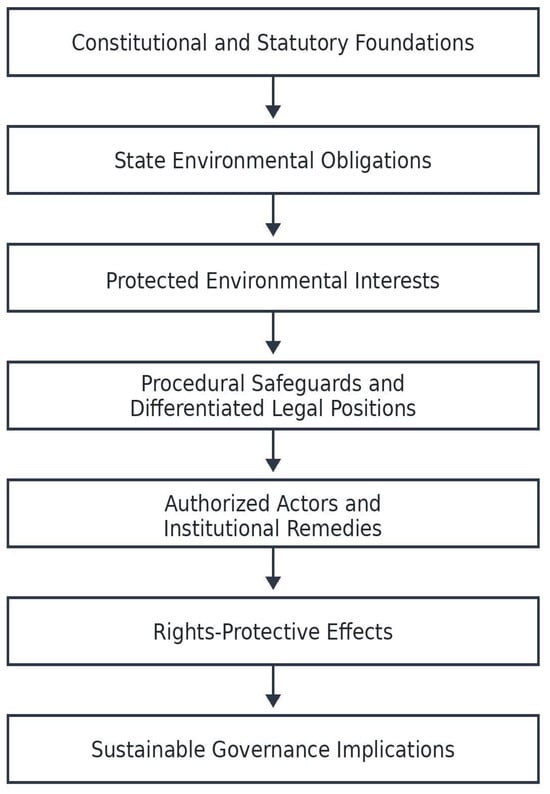
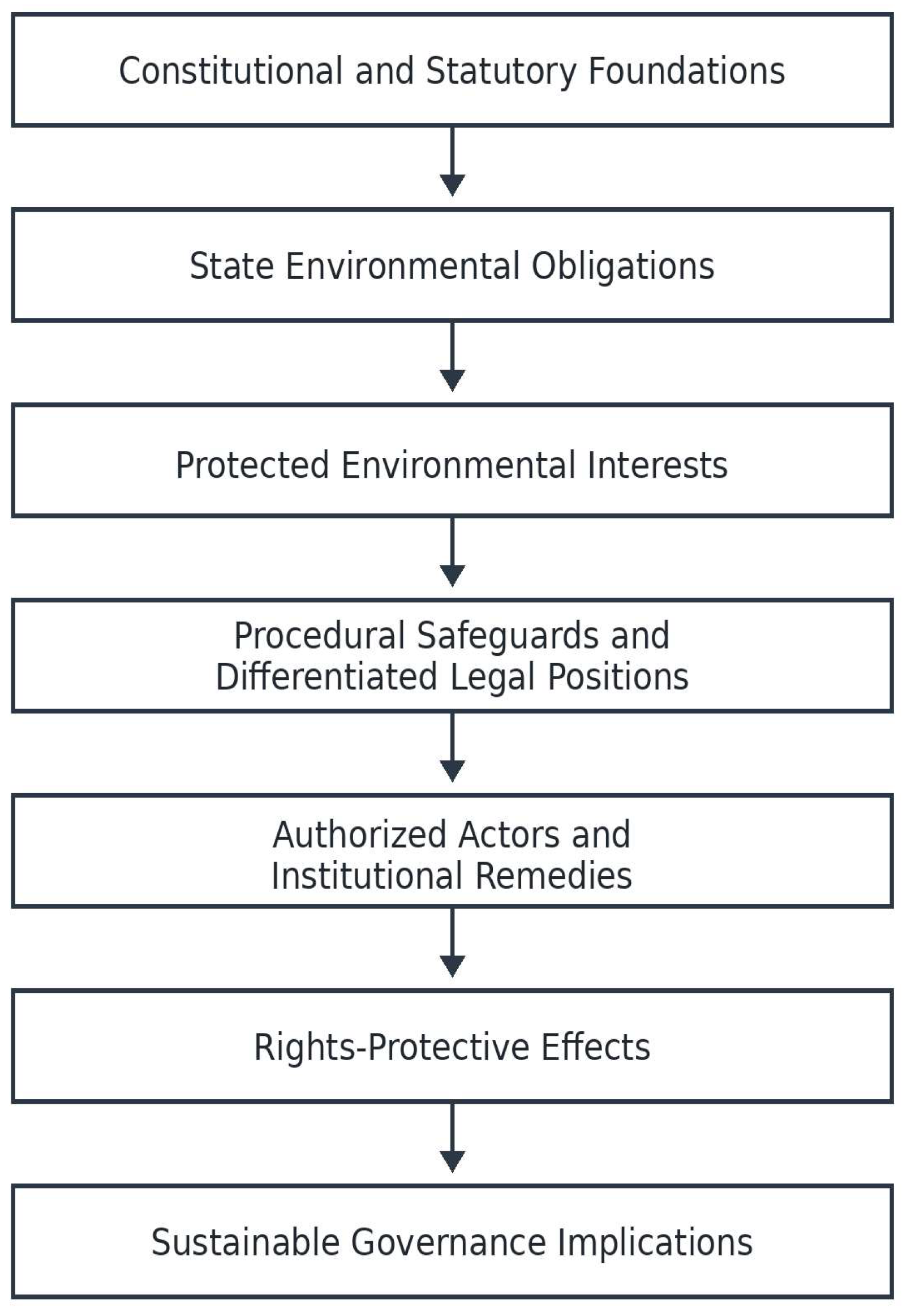

Disclaimer/Publisher’s Note: The statements, opinions and data contained in all publications are solely those of the individual author(s) and contributor(s) and not of MDPI and/or the editor(s). MDPI and/or the editor(s) disclaim responsibility for any injury to people or property resulting from any ideas, methods, instructions or products referred to in the content. |
© 2026 by the authors. Licensee MDPI, Basel, Switzerland. This article is an open access article distributed under the terms and conditions of the Creative Commons Attribution (CC BY) license.