


Abstract
Freedom of movement enables young Europeans to pursue work across borders. An intention to work abroad may nevertheless also represent a potential “transnational exit” when domestic employment does not offer sufficiently predictable conditions, effective rights, or credible worker voice. This socio-legal article combines a cross-sectional survey of Hungarians aged 18–30 with doctrinal and institutional analysis of EU and Hungarian labour law. The survey yielded 265 usable responses; analyses of work-related variables used the employed subsample (N = 146). Meaningful work was negatively associated with personal intention to work abroad. Overall precariousness had no statistically significant direct association with that intention, but it was associated with a more positive general attitude towards foreign work and showed an indirect association with intention through lower meaningfulness. At high levels of meaningful work, the precariousness-intention association was positive and statistically significant. The findings support a retention policy that respects free movement while making staying a genuine choice through enforceable rights, effective inspection, protection against retaliation, and accessible collective voice.
1. Introduction
International mobility is a central feature of young adults’ transitions from education to work. It can widen professional opportunities, develop skills, and support personal autonomy. At the same time, mobility intentions may reflect anxiety about job stability, limited career prospects, insufficient income, or weak protection at work. The International Labour Organization’s recent global assessment emphasizes that insecurity, temporary employment, and concern about prospects remain salient features of youth labour markets (International Labour Organization 2024). The legal significance is particularly pronounced in the European Union, where cross-border work is not merely a market outcome, but an individual right protected by Article 45 TFEU (European Union 2016a).
The right to move and work abroad must be distinguished from the conditions that make mobility appear to be the only credible route to secure or dignified employment. This article uses “transnational exit” to describe the latter possibility: cross-border mobility as a potential response to limited capacity to correct domestic or organizational conditions through individual enforcement or collective voice. The term is analytical, not a classification of respondents’ motives. A retention policy that constrained mobility would conflict with free movement. A policy that improves the predictability and enforceability of domestic working conditions can instead expand substantive choice: young people may still leave, but staying becomes a viable option rather than continued exposure to insecurity.
Since the 2010s, emigration, labour shortages, return migration, and the presence of third-country workers have become interrelated elements of the Hungarian labour market. Research shows that mobility from Hungary is socially selective and varies with age, education, family situation, and labour-market position (Blaskó and Gödri 2014). Long-term studies of migration potential also demonstrate that intentions and plans are meaningful social indicators even though they are not equivalent to actual migration (Sik and Szeitl 2016). Hungarian labour-market analyses connect emigration to structural tensions and continuing labour shortages (Hárs 2016, 2024), while demographic research treats international migration as a major component of population change (Horváth 2024). Return migration further shows that mobility pathways are often circular and temporally variable rather than permanent, one-directional departures (Obádovics et al. 2022).
Hungary provides a distinctive context for examining youth mobility because relatively favourable aggregate labour-market indicators coexist with a markedly more vulnerable position among younger labour-market participants. According to the Hungarian Central Statistical Office (KSH), the overall unemployment rate was 4.4% in 2025, whereas unemployment among 15–24-year-olds was substantially higher. Quarterly youth unemployment rates ranged between 13.5% and 14.8% during 2025, compared with 4.3–4.5% for the population as a whole. The KSH’s annual indicator similarly shows that unemployment among young people remained more than three times the national average (KSH 2025a, 2025b). The contrast remains visible within the age range relevant to the present research: in the final quarter of 2025, unemployment was 13.8% among 15–24-year-olds and 5.0% among those aged 25–29 (KSH 2025b) Labour-market participation also changes sharply across the early adult life course. In the fourth quarter of 2025, the employment rate was 45.2% among persons aged 20–24, compared with 81.0% among those aged 25–29 (KSH 2025a). These figures partly reflect continued participation in education, but they also illustrate the heterogeneous labour-market position of the 18–30 age group studied here. Eurostat data additionally show that combining formal education and employment remains relatively uncommon in Hungary: in 2023 only 6.1% of people aged 15–29 in formal education were employed, one of the lowest proportions in the EU (Eurostat 2024). By 2024, only 0.8% of young people in formal education in Hungary were simultaneously classified as unemployed and actively seeking work. These patterns indicate that the transition between education and employment in Hungary is strongly shaped by the sequencing of education and labour-market entry rather than by widespread simultaneous participation in both. From a legal perspective, Hungarian labour law does not create a separate employment regime for young adults once they have reached the age of majority. Their protection is primarily provided through the general rules of the Labour Code, employment-supervision legislation, occupational health and safety requirements, and the implementation of Directive (EU) 2019/1152 on transparent and predictable working conditions. Worker voice also operates within a relatively weak collective-representation environment. According to Eurofound, trade-union density in Hungary was approximately 7.4% in the first quarter of 2020. Estimates of collective-bargaining coverage vary by data source: for 2019, the European Company Survey table reported 13.0%, whereas the OECD–AIAS database reported 21.8% (Matheika et al. 2024b). Eurofound also notes that collective bargaining in Hungary takes place predominantly at company level (Matheika et al. 2024a, 2024b).
This article investigates whether the current work experiences of Hungarians aged 18–30 are associated with their personal intention to work abroad. It focuses on perceived employment precariousness, meaningful work, and satisfaction of basic psychological needs at work, while distinguishing personal readiness to move from a generally positive attitude towards foreign work. The legal inquiry asks how those perceptions relate to three regulatory fields: predictable working conditions, practical access to enforcement, and worker voice. This distinction prevents an overly simple reading of mobility as an automatic response to unfavorable employment.
The article makes three contributions to the field. Empirically, it brings together variables that Hungarian migration and work-quality research have usually examined separately. Doctrinally, it maps the survey constructs onto Article 45 TFEU, Articles 27, 28, and 31 of the Charter, Directive (EU) 2019/1152, and the Hungarian rules on employment supervision and workplace representation. Institutionally, it examines the distance between rights on the books and the mechanisms through which young workers can make those rights effective. The study does not test the effect of a statute and cannot determine whether any employer violated legal rules. It does, however, capture perceived instability, limited influence, insufficient income, and vulnerability to unfair or unlawful treatment: experiences that engage labour law’s concern with unequal bargaining power, dignity, and the practical exercise of rights (Davidov 2016). Its central claim is that meaningful work and protective institutions are complements, not substitutes. When voice and enforcement are weak, a worker may seek to continue valued work elsewhere rather than abandon the occupation itself.
This study is positioned at the intersection of labour law and regulatory policy. Its objective is not to reinterpret existing legal rules but to contribute empirical evidence that may inform future legislative development, regulatory priorities and the practical implementation of labour-law protections affecting young workers.
2. Socio-Legal and Theoretical Framework
2.1. Mobility Between Career Agency and Transnational Exit
Economic and life-course approaches explain foreign work as an investment in earnings, skills, autonomy, or a preferred future (Sjaastad 1962; King 2012; Cairns 2014). This is especially relevant during the transition from education to work, and young people’s pathways may include temporary mobility, settlement, and return rather than permanent one-way emigration (Faggian et al. 2017; Harris et al. 2020). An intention to work abroad must therefore not be presumed to express dissatisfaction or involuntary departure.
Hirschman’s distinction between exit and voice adds a different question: when conditions deteriorate, can members influence the organization, or do they leave it (Hirschman 1970)? In employment relations, voice concerns workers’ capacity to express interests and influence decisions, individually or collectively; exit includes leaving an employer. EU free movement adds a transnational option. Migration research shows that exit, voice, and loyalty may overlap across borders rather than operate as mutually exclusive choices (Hoffmann 2010), while precarious migrants may use mobility strategically to escape constrained employment settings (Alberti 2014). This article extends that insight cautiously to pre-migration intention: considering foreign work may be career agency, potential transnational exit, or both. The survey does not identify which motive applies to a particular respondent.
2.2. Precarious Employment, Work Quality, and Meaningful Work
Employment precariousness is broader than fixed-term or otherwise atypical contractual status. It combines insecurity and unpredictability with individual exposure to risk and weak control over working conditions (Kalleberg 2009). The multidimensional Employment Precariousness Scale (EPRES) accordingly covers temporariness, disempowerment, vulnerability, wages, access to rights, and the ability to exercise rights (Vives et al. 2010, 2015).
This multidimensionality is important for young workers and is not confined to people with low qualifications (R. Fedor and Fónai 2017). It may be experienced through uncertainty about continued employment, inadequate income, limited influence, or fear that asserting a right will trigger adverse consequences. Studies of young migrants likewise show that insecurity, autonomy, future planning, and professional opportunity can coexist in mobility narratives (Bygnes 2015; Cuzzocrea and Mandich 2016).
Objective status does not exhaust job quality. Hungarian and comparative research also emphasizes autonomy, learning, workplace innovation, and work organization (Fazekas et al. 2019; Makó et al. 2020). Meaningful work captures whether workers experience their activity as significant and connected to personal growth or wider contribution (Rosso et al. 2010; Steger et al. 2012). Self-determination theory supplies a concise complementary account: autonomy, competence, and relatedness support motivation and well-being at work (Deci et al. 2017). Hungarian validations support the use of both constructs in the present empirical setting (Csordás et al. 2022, 2023). Measurement details are reported in Section 3.3.2.
Meaningfulness may anchor a person to an occupation without binding that person to a particular employer or country. Valuable work can still be insecure, underpaid, authoritarian, or difficult to sustain. The construct must therefore not be romanticized or treated as a substitute for legal protection. Conversely, labour law cannot guarantee a worker’s subjective experience of meaning. The legally relevant question is whether it secures the material, dignitary, and participatory conditions within which meaningful work can be pursued without compelled tolerance of insecurity or mistreatment.
2.3. Free Movement, Dignity, and Predictable Working Conditions
Article 45 TFEU secures freedom of movement for workers and prohibits nationality discrimination in employment, remuneration, and other working conditions (European Union 2016b). Article 15 of the Charter recognizes the freedom to choose an occupation and the right of Union citizens to seek employment in any Member State, while Article 31 protects health, safety, dignity, working-time limits, rest, and paid leave (European Union 2016a). Working abroad is therefore an exercise of legal freedom. Where mobility results in a cross-border employment relationship, the practical enforceability of labour rights may also depend on the rules determining which courts have jurisdiction over a subsequent dispute (Glavanits 2014). The legal concern arises when weak domestic protection narrows the practical alternatives available to that right-holder.
EU social policy also addresses precariousness more directly. Principle 5 of the European Pillar of Social Rights calls for fair and equal treatment, transitions towards open-ended employment, and prevention of employment relationships that produce precarious working conditions (European Parliament, Council and Commission 2017). Directive (EU) 2019/1152 establishes minimum rights to timely information and, for covered workers, limits on probation, protection for parallel employment, minimum predictability, a route to request more secure and predictable work, and mandatory training. Crucially, Articles 16–19 require effective and impartial dispute resolution, protection against adverse treatment and dismissal, appropriate burden-of-proof rules, and effective, proportionate, and dissuasive penalties. Articles 14 and 21 also recognize collective agreements and the role of social partners in implementation (European Parliament and Council of the European Union 2019).
Hungary transposed the Directive principally (Act LXXIV 2022), which amended Act I of 2012 on the Labour Code and related legislation. Section 46 of the Labour Code now requires written information on core conditions within seven days of commencement, and the broader Code regulates scheduling, remuneration, termination, and collective labour relations. These provisions supply a statutory floor. They do not create a general, individually justiciable entitlement to subjectively meaningful work. Meaningfulness is connected to labour law indirectly through dignity and fair conditions under Article 31 and through participation and collective autonomy under Articles 27 and 28 of the Charter.
2.4. The Enforcement Gap: From Formal Entitlement to Effective Protection
Labour-law effectiveness depends on more than the enactment of substantive standards. An enforcement gap arises when a worker is formally entitled to protection but cannot detect, report, prove, or remedy non-compliance without unacceptable cost or risk. Enforcement scholarship therefore distinguishes rights on the books from compliance in practice and emphasizes strategic inspection, deterrence, access to remedies, and institutions capable of addressing systemic rather than isolated violations (Dickens 2012; Weil 2008). The distinction is particularly important for young or insecure workers, because fear of non-renewal, loss of hours, or dismissal may suppress complaints even where anti-retaliation rules exist.
Hungary’s Employment Supervision Act assigns the authority responsibility for monitoring employers’ compliance with statutory minimum requirements. Inspections commence ex officio, may take place without prior notice, and can use documentary and on-site evidence. The legislation also provides confidential treatment where a worker or complainant may face serious adverse consequences (Act CXXXV 2020). Government Decree (2021) specifies the authority’s procedures, powers, measures, and sanctions. This is a significant public-enforcement architecture, but its legal existence does not answer whether violations are detected or whether an affected worker obtains an effective individual remedy.
Official inspection data demonstrate the practical relevance of that distinction. In 2024 the employment supervision authorities inspected 13,031 employers and found labour-law violations at 67% of them, affecting 58% of the 49,343 workers whose employment was examined. Frequent findings concerned undeclared work, late or defective wage payment, working-time arrangements, and working-time records (Hungarian Employment Supervision Authority 2025). These are targeted inspection results, not representative prevalence estimates for the Hungarian labour market. They nevertheless show that non-compliance is not merely hypothetical in the workplaces selected for inspection. The ILO Committee of Experts has additionally asked Hungary to ensure that work-permit control does not interfere with inspectors’ primary protective functions and to continue supplying statistics on inspectors and visits. Its separate direct request called for regular, sufficiently complete annual inspection reports (International Labour Organization Committee of Experts 2026a, 2026b).
The survey cannot connect any response to an inspected employer, a complaint, or a legal outcome. Its legal-vulnerability items instead identify perceived compelled tolerance of mistreatment, unpaid work, minor violations, or health-endangering work. Those perceptions are relevant precisely because Directive 2019/1152 treats redress, non-retaliation, and dismissal protection as integral to predictability. In this article, an enforcement gap is therefore a legally informed interpretive lens, not a finding that the Hungarian state or a particular employer breached EU law.
2.5. Worker Voice as a Condition of Effective Rights
Worker voice has both intrinsic and enforcement functions. It gives workers a say in decisions that affect them and can reveal workplace practices that external authorities cannot readily observe (Budd 2004). Collective organizations may also reduce the personal cost of asserting individual rights, aggregate recurring problems, and support enforcement that produces workplace-wide change rather than a remedy only for the worker able to complain (Colling 2006; Fine and Gordon 2010). Voice does not replace inspection or adjudication, but it can improve detection, information, representation, and protection against isolation.
The legal basis is substantial. Articles 27 and 28 of the Charter protect timely information and consultation and recognize collective bargaining and collective action (European Union 2016b). Part Three of the Hungarian Labour Code regulates works councils and trade unions. Sections 235–269 provide workplace-participation institutions, while Section 272 authorizes trade unions to inform workers, request information, initiate consultation, represent interests, and, with authorization, act for members before courts and authorities (Act I 2012). Directive 2019/1152 itself protects workers’ representatives against adverse treatment and requires social-partner involvement in implementation.
The practical reach of these channels is uneven. Eurofound reports that Hungarian trade-union density declined to 7.4% in the 2020 survey series and that available 2019 estimates of collective-bargaining coverage ranged from 13% to 21.8%, with no current national database capable of producing a definitive coverage rate. Bargaining is predominantly company-level, while workplace representation depends on actual organization and statutory size thresholds (Matheika et al. 2024a, 2024b). These indicators do not show whether any respondent had access to representation. They do establish why meaningful work cannot be translated into legal protection through individual psychology alone: many workers may lack a collective channel with the capacity to make concerns consequential.
The resulting research gap shown in Table 1 is socio-legal. Hungarian research has examined migration potential, work quality, meaningfulness, and workplace needs, but has rarely integrated these variables with enforcement and collective voice in a model of young workers’ intention to work abroad. Labour-law analysis, in turn, often assesses protective norms without direct evidence about how perceived employment conditions relate to cross-border career plans. This study connects the two literatures while maintaining a strict boundary between statistical association and legal evaluation.
Table 1.
Empirical constructs and their labour-law implications.
3. Materials and Methods
3.1. Design, Research Questions, and Hypotheses
The study used a cross-sectional, quantitative online survey together with a contextual legal and institutional analysis. The primary empirical question was whether uncertain, unpredictable, and vulnerable employment is associated with a stronger personal intention to work abroad among Hungarians aged 18–30, and whether meaningful work changes that association. A secondary empirical question distinguished personal mobility intention from a generally positive attitude towards foreign work. The socio-legal question was how these perceptions relate to the enforceability of predictable conditions and the availability of individual and collective voice.
Three hypotheses were specified. H1 predicted that higher perceived employment precariousness would be associated with a stronger personal intention to work abroad. H2 predicted that higher meaningful work would be associated with a weaker personal intention to work abroad. H3 predicted that greater satisfaction of basic psychological needs at work would be associated with a weaker personal intention to work abroad. The analysis also tested two theoretically motivated extensions: whether meaningful work statistically carried an indirect association between precariousness and mobility intention, and whether meaningful work moderated the precariousness-intention association. Because the design is cross-sectional, the term “indirect association” is used in preference to a causal interpretation of mediation.
3.2. Participants and Procedure
Participants were Hungarian adults aged 18–30, including university students and young adults who had completed at least upper-secondary education, the latter is not intentional but the characteristic of the dataset. Recruitment used direct outreach through higher-education institutions and student communities together with targeted social-media recruitment. The questionnaire was administered through Google Forms in April and May 2026. Participation was voluntary. Respondents received written information about the research purpose, participation, data processing, and the absence of personal-data collection.
The survey received 273 responses. Before analysis, responses were screened for eligibility and response quality. Cases were excluded if the respondent selected the same response option across all substantive questionnaire items (straight-lining) or reported being older than 30 years. After data cleaning, 265 usable cases remained. Mean age was 21.91 years (SD = 2.29). At the time of data collection, 146 respondents were employed and 119 were not in an employment relationship. Analyses involving employment precariousness, meaningful work, or psychological needs required current work experience and were therefore conducted on the employed subsample (N = 146). The two mobility measures were available for the broader analytical sample (N = 265). Recruitment was non-probability based; the sample is not representative of all Hungarian young adults.
3.3. Measures
3.3.1. Employment Precariousness
Employment precariousness was measured with a study-specific item set informed by the multidimensional logic of EPRES and EPRES-2010 (Vives et al. 2010, 2015). The instrument was not a direct translation or validated Hungarian adaptation of EPRES. An initial 31-item pool was developed for the circumstances of young workers. Exploratory factor analysis and item-level psychometric assessment were used to remove weak, ambiguous, or persistently cross-loading items.
The dimensionality of the final 14-item employment-precariousness measure was examined in the employed subsample (N = 146) using exploratory factor analysis based on a Pearson correlation matrix. Factors were extracted using the minimum residual method and an oblimin rotation, because correlations between the dimensions were theoretically expected. The number of factors was determined by parallel analysis. Primary loadings of at least 0.40 were treated as salient, while secondary loadings of 0.30 or above were considered potentially problematic cross-loadings. Sampling adequacy was assessed using the Kaiser–Meyer–Olkin measure and Bartlett’s test of sphericity. Internal consistency was evaluated using Cronbach’s alpha, item–rest correlations, and alpha if item deleted.
Parallel analysis supported a four-factor solution. The overall KMO measure was 0.778, with item-level measures of sampling adequacy ranging from 0.627 to 0.880. Bartlett’s test of sphericity was statistically significant, χ2(91) = 690, p < 0.001, indicating that the correlation matrix was suitable for factor analysis. Salient factor loadings ranged from 0.465 to 0.908, and no secondary loading reached the 0.30 cross-loading threshold. Item uniqueness ranged from 0.146 to 0.656. The total 14-item scale demonstrated acceptable internal consistency (Cronbach’s α = 0.802). Item–rest correlations ranged from 0.264 to 0.622, and deletion of individual items did not materially improve reliability (α if item deleted = 0.773–0.803). The final instrument contained 14 items in four dimensions, summarized in Table 2, the dimensions explained in Table 3.
Table 2.
Pattern matrix for the 14-item employment-precariousness measure.
Table 3.
Dimensions of the study-specific employment-precariousness measure.
The total scale showed acceptable internal consistency (Cronbach’s alpha = 0.802). The five-item legal-vulnerability dimension showed good internal consistency (Cronbach’s alpha = 0.824), and the five-item employment-insecurity dimension was acceptable (Cronbach’s alpha = 0.741). For the two-item limited-autonomy dimension, the inter-item correlation was r = 0.482 (p < 0.001) and the Spearman–Brown coefficient was 0.650. For the two-item income-insufficiency dimension, the inter-item correlation was r = 0.693 (p < 0.001) and the Spearman–Brown coefficient was 0.819. The measure should be understood as an exploratory, sample-specific operationalization of perceived precariousness, not as an EPRES substitute and not as proof of legal non-compliance.
3.3.2. Meaningful Work and Basic Psychological Needs
Meaningful work was measured with the ten-item Hungarian Work and Meaning Inventory (WAMI) on a five-point scale (Steger et al. 2012; Csordás et al. 2022). Because WAMI scores entered the indirect-association and moderation analyses, their structure was examined in the employed subsample (N = 146) using ordinal confirmatory factor analysis with WLSMV estimation. We compared a one-factor model, the correlated three-factor structure of Positive Meaning (PM), Meaning Making through Work (MM), and Greater Good Motivation (GG), the published Hungarian specification with residual covariances between Items 1–8, 4–5, and 7–9, and its second-order version. The one-factor model showed inadequate fit, χ2(35) = 178.62, CFI = 0.933, TLI = 0.914, RMSEA = 0.168, SRMR = 0.078. The correlated three-factor model improved fit but retained an elevated RMSEA, χ2(32) = 116.83, CFI = 0.960, TLI = 0.944, RMSEA = 0.135, SRMR = 0.060. The Hungarian specification provided the closest fit, χ2(29) = 60.35, CFI = 0.985, TLI = 0.977, RMSEA = 0.086, SRMR = 0.046, with standardized loadings ranging from 0.518 to 0.912. However, the PM–MM correlation was 0.988, and the second-order model produced an inadmissible solution. The data therefore supported neither strict unidimensionality nor an admissible higher-order structure. Accordingly, the total score was retained only as an exploratory omnibus composite and was not interpreted as evidence of a single latent dimension. Its internal consistency was high (Cronbach’s α = 0.892; McDonald’s ω = 0.895), but all total-score indirect and moderation findings were additionally examined using the three WAMI subscales.
Satisfaction of autonomy, competence, and relatedness was assessed with the nine-item Hungarian Psychological Basic Needs at Work Questionnaire on a seven-point scale; internal consistency was high (alpha = 0.871) (Csordás et al. 2023).
3.3.3. Intention and Attitude Towards Working Abroad
A study-specific six-item, five-point Likert instrument assessed foreign-work orientation (Cronbach’s alpha = 0.807). Exploratory factor analysis yielded two interpretable dimensions. The first, personal intention to work abroad, comprised active foreign job search (loading 0.736), readiness to move abroad soon if an appropriate opportunity arose (0.869), and willingness to live and work abroad for a longer period (0.579). The second, positive attitude towards working abroad, comprised perceptions that foreign opportunities are more favorable (0.556), support for young people’s foreign work experience (0.773), and the perceived later domestic benefits of such experience (0.686). The two dimensions were correlated (r = 0.504, p < 0.001) but empirically distinguishable.
3.4. Legal and Documentary Analysis
The legal analysis examined the text and regulatory function of Article 45 TFEU; Articles 27, 28, and 31 of the Charter; Directive (EU) 2019/1152; the Hungarian Labour Code; the Employment Supervision Act; and Government Decree 115/2021. Institutional context was drawn from the Hungarian authority’s 2024 inspection report, the ILO supervisory comments published in 2026, and Eurofound’s Hungarian industrial-relations profile. Sources were selected for authority and direct relevance rather than as a systematic review corpus. The analysis is doctrinal and contextual: it maps empirical constructs onto legal purposes and enforcement institutions but does not evaluate transposition completeness, adjudicated compliance, or the legal position of any respondent.
3.5. Statistical Analysis and Ethics
Analyses were conducted in Jamovi version 2.7. Pearson correlations examined bivariate associations. A bootstrap indirect-association model tested meaningful work as an intervening statistical variable between precariousness and personal intention to work abroad. Moderation analysis tested the precariousness-by-meaningful-work interaction and estimated simple slopes at low, average, and high levels of meaningful work. Statistical significance was evaluated at p < 0.05.
The study received ethical approval on 13 April 2026 from the research ethics committee. Informed consent was obtained from all participants. The survey did not collect directly identifying personal data.
4. Findings
4.1. Correlations and Hypothesis Tests
Item-level descriptives localized perceived precariousness in particular aspects of employment. With all retained items coded so that higher scores indicated greater precariousness, the highest mean concerned inability to cover unexpected expenses (M = 3.28, SD = 1.31), followed by the absence of a genuine opportunity to negotiate pay (M = 3.15, SD = 1.50), limited influence over work and working conditions (M = 2.94, SD = 1.30), and inability to cover basic needs (M = 2.82, SD = 1.31). Scores of 4 or 5 were reported by 45.9%, 43.2%, 35.6%, and 32.2% of respondents, respectively. Because only the first two means exceeded the scale midpoint and no inferential comparisons between item means were conducted, these results are interpreted as relative concentrations rather than uniformly or significantly elevated levels of precariousness.
Personal intention to work abroad was negatively correlated with meaningful work (r = −0.253, p = 0.002). Respondents who experienced their current work as more meaningful reported weaker personal mobility intention. By contrast, neither overall employment precariousness (r = 0.157, p = 0.058) nor satisfaction of basic psychological needs at work (r = −0.104, p = 0.213) showed a statistically significant bivariate association with personal intention. H2 was therefore supported at the correlational level, whereas H1 and H3 were not supported.
The two mobility measures were moderately and positively correlated (r = 0.504, p < 0.001). However, they exhibited different relationships with work experience. Precariousness was positively associated with a favorable general attitude towards working abroad (r = 0.270, p < 0.001), whereas meaningful work (r = −0.104, p = 0.212) and basic-needs satisfaction (r = 0.052, p = 0.536) were not. Precariousness may therefore increase the perceived attractiveness of foreign work without necessarily translating into a respondent’s immediate personal intention to leave. Table 4 reports the correlation matrix.
Table 4.
Correlations among work experience and foreign-work orientation.
4.2. Indirect and Conditional Associations
In the bootstrap model, higher precariousness was associated with lower meaningful work (B = −0.3704, SE = 0.0691, 95% CI [−0.5096, −0.2341], p < 0.001). Controlling for precariousness, meaningful work remained negatively associated with personal intention to work abroad (B = −0.0897, SE = 0.0392, 95% CI [−0.1680, −0.0094], p = 0.022). The indirect association through meaningful work was statistically significant (B = 0.0332, SE = 0.0161, 95% bootstrap CI [0.0035, 0.0683], p = 0.039). The direct association of precariousness with intention was not significant (B = 0.0237, SE = 0.0346, 95% CI [−0.0414, 0.0877], p = 0.494), and the total association narrowly missed the conventional significance threshold (B = 0.0569, SE = 0.0303, 95% CI [−0.0061, 0.1139], p = 0.060). Given the cross-sectional design, this pattern is evidence of a statistical indirect association, not a temporal or causal mechanism.
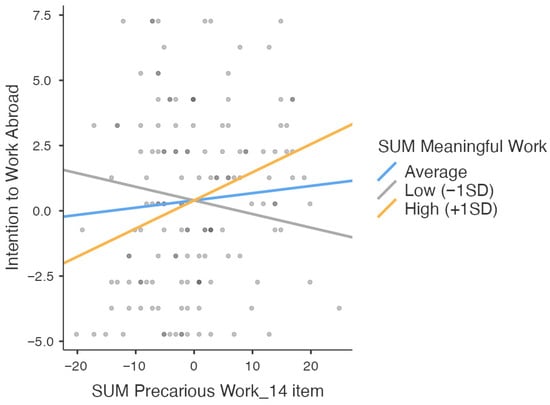
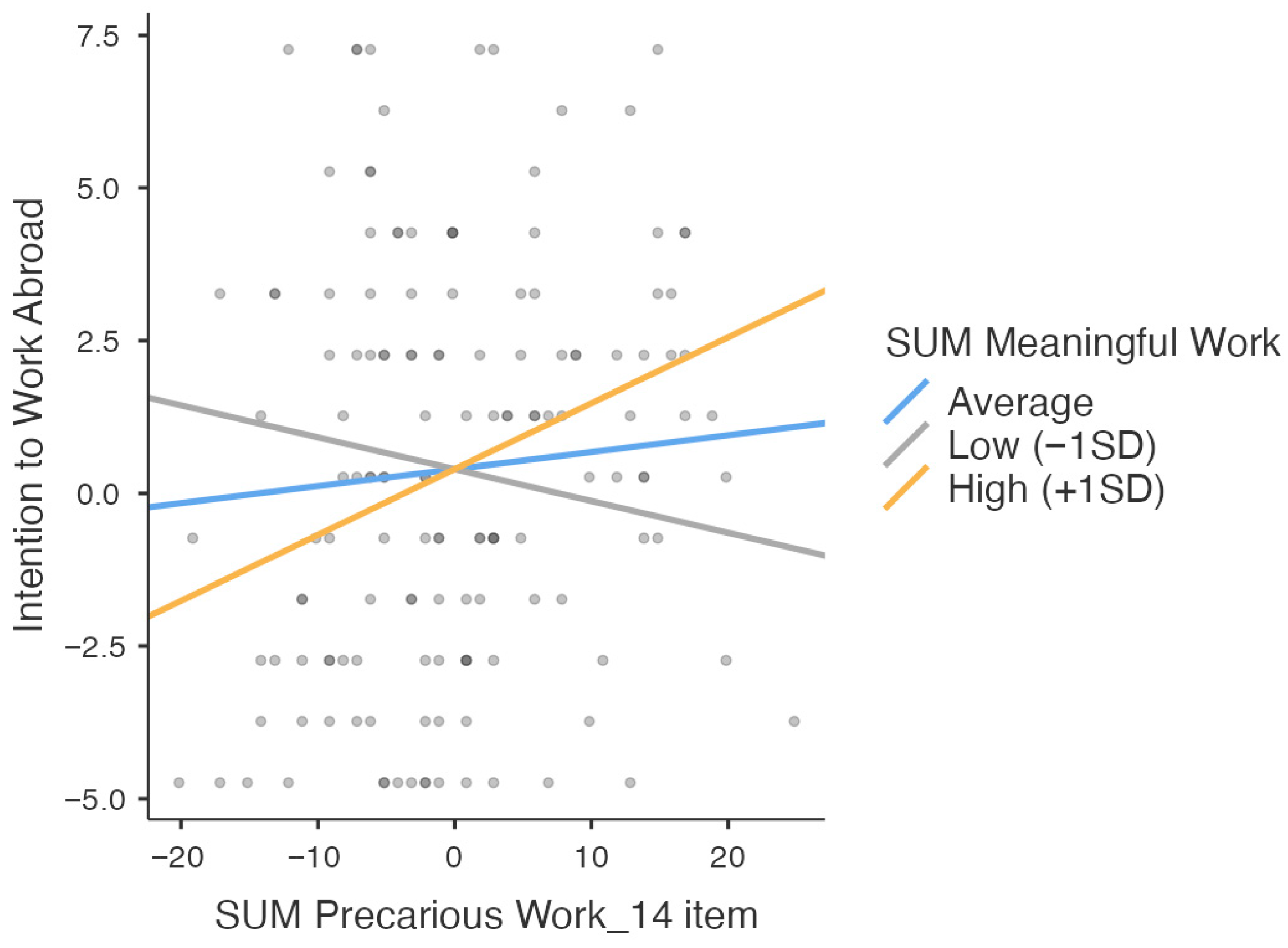
The moderation model showed a statistically significant interaction between precariousness and meaningful work in predicting personal intention to work abroad (B = 0.0095, SE = 0.0030, p = 0.002). The main association of precariousness was not significant (B = 0.0278, p = 0.327), while meaningful work was negatively associated with intention (B = −0.1138, p < 0.001). Simple-slope analysis indicated no significant association between precariousness and intention at low meaningful work (B = −0.0522, p = 0.150) or at the mean (B = 0.0278, p = 0.340). At high meaningful work, however, precariousness was positively associated with intention (B = 0.1078, p = 0.010), as illustrated in Figure 1.
Figure 1.
The moderating role of meaningful work in the association between employment precariousness and personal intention to work abroad. The figure displays fitted lines at low (−1 SD), mean, and high (+1 SD) meaningful work.
Meaningfulness thus did not operate as a universal buffer against precariousness. It was generally associated with lower mobility intention, but workers who found their jobs highly meaningful were more likely to consider working abroad as precariousness increased. A plausible interpretation is that they wished to continue work they valued under more secure or dignified conditions. This interpretation remains inferential and requires longitudinal or qualitative testing.
5. Discussion
5.1. Interpretation of the Main Findings
The findings do not support a simple push-factor account. Overall precariousness was not directly associated with personal intention to work abroad at the conventional significance level, although it was associated with a more positive attitude towards foreign work and with lower meaningfulness. This distinction is important because a favorable attitude towards foreign employment does not necessarily imply preparation to move (Sik and Szeitl 2016).
Meaningful work was the clearest bivariate correlate of personal mobility intention, but its role was conditional. When high meaningfulness coexisted with greater precariousness, the association between precariousness and intention became positive. The indirect-association model provided a complementary result: precariousness was associated with lower meaningfulness, which in turn was associated with stronger intention. Taken together, these findings suggest that meaningfulness may attach workers to an occupation without necessarily attaching them to a particular employer or national labour market. The cross-sectional data, however, cannot establish temporal or causal order.
Basic-needs satisfaction was strongly related to meaningful work and negatively related to precariousness, but it was not directly associated with mobility intention. The exploratory career-ambition composite likewise did not predict intention. Psychological needs are therefore best treated here as indicators of work quality rather than as the article’s principal explanatory or normative framework.
5.2. Socio-Legal Interpretation of the Empirical Findings
The use of empirical evidence for evaluating the practical operation of legal rules is consistent with contemporary approaches to better regulation and regulatory policy. The European Commission’s Better Regulation framework treats monitoring and evaluation as integral stages of the legislative cycle and applies an “evaluate first” principle when existing legislation is reconsidered. Evaluations are expected to examine, on the basis of evidence, whether legislation remains effective, relevant and coherent in practice (European Commission 2021a, 2021b). Similarly, the OECD regards ex post evaluation as a central component of evidence-based regulatory policy, requiring policymakers to collect data on real-world outcomes, compare those outcomes with the objectives of regulation, and identify unintended consequences (OECD 2025). In this sense, empirical socio-legal research can provide a complementary form of regulatory feedback by examining whether the vulnerabilities that legal rules are intended to mitigate remain visible in the experiences and perceptions of regulated actors. This approach reflects the contemporary development of socio-legal scholarship, in which doctrinal analysis is complemented by empirical evidence capable of informing the monitoring, evaluation, and future development of legal regulation.
Accordingly, the purpose of the legal analysis is not to determine whether individual employers complied with labour-law obligations or whether particular statutory provisions are effective in isolation. Rather, the study adopts a socio-legal perspective that treats empirical evidence as one element of the broader evaluation of labour regulation. Labour law seeks to reduce structural labour-market vulnerability through predictable working conditions, effective enforcement, and opportunities for worker participation. The present survey therefore examines whether the forms of vulnerability that labour law is designed to address continue to be perceived by young workers. In this sense, the empirical findings contribute to the post-legislative evaluation and monitoring of labour-law institutions by identifying areas in which the objectives of labour regulation may not yet be fully realised from the perspective of workers themselves.
The empirical constructs chosen in the survey were not selected independently of the legal analysis. Each dimension of the questionnaire corresponds to a recognised regulatory objective of labour law, including predictability of employment, protection against legal vulnerability, effective enforcement, and worker participation. The survey therefore operationalises legally relevant forms of labour-market vulnerability rather than abstract psychological attitudes.
5.3. Formal Rights and the Enforcement Gap
The legal significance of the results lies less in the content of a single statutory entitlement than in the relationship between predictability and effective enforcement. Directive (EU) 2019/1152 does not treat information as sufficient by itself. It couples substantive minimum rights with redress, protection against adverse treatment and dismissal, evidential rules, and sanctions. This design recognizes that opacity and dependency may persist where a worker cannot safely invoke the rule (European Parliament and Council of the European Union 2019).
The survey’s legal-vulnerability dimension is relevant at the implementation stage. Perceived compelled tolerance can arise before a claim is filed and may prevent a dispute from becoming visible. Confidentiality and anti-retaliation protections are therefore necessary, but they must be accompanied by understandable information, reachable complaint channels, timely remedies, and credible consequences for non-compliance. The ILO supervisory comments add an institutional caution: additional immigration-control functions should not displace inspectors’ primary worker-protection role, and adequate public statistics are necessary to assess system performance (International Labour Organization Committee of Experts 2026a, 2026b).
Although the items concerning compelled tolerance of possible infringements had lower means, their response distributions identified a smaller but legally salient group. Scores of 4 or 5 were reported by 20.5% for not protesting minor infringements because income was needed, 18.5% for tolerating poor treatment because the job was needed, and 14.4% for accepting minor infringements to obtain professional experience. The corresponding proportions were 9.6% for willingness to work while ill and 7.5% for willingness to perform unpaid overtime to avoid job loss. These items measure perceived willingness or constraint rather than verified employer conduct or the actual incidence of legal violations. They nevertheless operate as warning signals of potential enforcement deficits and support confidential and accessible reporting routes, effective protection against retaliation, and risk-based scrutiny of wage and working-time records (Dickens 2012; Weil 2008).
Read together with the applicable legal framework, these warning signals identify four regulatory priorities for further attention. First, information duties should be implemented as usable predictability through clear schedules, timely notice of changes, intelligible pay statements, and reasoned responses to requests for more secure work. Second, risk-based inspection should give particular attention to legally verifiable aspects of remuneration and working time, including timely wage payment, pay statements, working-time records, and overtime compensation. Inspection policy should also publish comparable data on staffing, visits, complaints, detected violations, compliance orders, sanctions, and follow-up, while preserving workers’ anonymity. Third, anti-retaliation rules require confidential and practically accessible reporting routes, timely remedies, and credible protection against adverse consequences, rather than formal prohibitions alone. Fourth, enforcement strategies should draw on worker and representative knowledge to identify recurring and workplace-wide problems rather than only isolated infringements (Weil 2008; Fine and Gordon 2010). These priorities are legally and institutionally informed. The present survey identifies perceived vulnerabilities but does not establish the prevalence of legal violations or test the effects of the proposed interventions.
5.4. Worker Voice, Collective Labour Law, and Meaningful Work
The limited-autonomy items concern respondents’ capacity to express opinions, interests, or concerns, but they do not measure union membership, works-council access, consultation quality, or collective-bargaining coverage. They cannot therefore be equated with legal worker voice. Their narrower legal relevance is that they indicate whether workers perceive themselves as able to influence the conditions under which valued work is organized.
Individual grievance procedures and collective representation perform different functions. While internal reporting channels remain dependent on organizational responsiveness, trade unions and elected representatives can aggregate claims, preserve institutional knowledge, and support workers in exercising their rights. The Hungarian Labour Code assigns monitoring and participation functions to works councils and information, consultation, representation, and bargaining rights to trade unions (Act I 2012). Articles 27 and 28 of the Charter provide the corresponding EU fundamental-rights framework (European Union 2016b).
The practical reach of these rights is constrained by low union density, limited collective-bargaining coverage, and predominantly company-level bargaining in Hungary (Matheika et al. 2024a, 2024b). Workers in fragmented or weakly organized workplaces may consequently possess individual statutory rights without an effective collective actor capable of supporting their exercise. This constitutes both a representation gap and an enforcement gap. Comparative research suggests that cooperation between public authorities and trusted worker organizations can improve the detection of workplace-wide problems, although such arrangements must be adapted to the Hungarian and EU institutional context (Fine and Gordon 2010). Alongside formal grievance and representative channels, workplace mediation may provide a complementary means of addressing individual employment conflicts and may thereby support employee retention (Glavanits et al. 2026).
Meaningful work is not itself an enforceable employment term defined by a worker’s WAMI score. Its legal relevance lies instead in the capacity of individual and collective voice to influence workload, scheduling, autonomy, training, professional development, and the distribution of insecurity. Meaningful job design may complement, but cannot substitute for, adequate remuneration, stable working time, health protection, and effective remedies.
5.5. Free Movement and the Possibility of Transnational Exit
Article 45 TFEU rules out a retention strategy based on restricting access to foreign employment. The legitimate objective is to make domestic employment a substantively credible alternative. Hirschman’s framework clarifies the institutional point: when voice is unavailable or ineffective, exit becomes relatively more attractive—in the EU, that exit may cross a national border. Yet transnational exit is not necessarily permanent or disloyal, and it may coexist with later return or continuing engagement with the country of origin (Hoffmann 2010).
The present results support only a conditional version of this argument. Overall precariousness did not significantly predict personal intention at the conventional threshold, and intention is not behavior. At the same time, precariousness was linked to a more favorable attitude towards foreign work, to lower meaningfulness, and, among those reporting high meaningfulness, to stronger personal intention. A plausible interpretation is that some young workers wish to preserve valued occupational activity while changing the legal, organizational, or economic conditions under which it is performed. The data do not establish that destination-country conditions would be better or that mobility was compelled.
Retention policy should therefore be assessed against substantive choice, not the reduction of mobility statistics alone. Predictable conditions, effective remedies, non-retaliation, inspection capacity, and collective voice can make staying more credible without diminishing the right to leave. This framing also avoids instrumentalizing worker protection merely to retain labour: enforceable rights and voice are required by dignity and democratic employment relations even where they do not reduce migration.
5.6. Limitations and Future Research
Several limitations constrain interpretation. First, the cross-sectional design does not establish temporal order or causation. The indirect and moderation models identify conditional statistical associations only. Longitudinal follow-up should test whether changes in precariousness and meaningful work predict later job search, migration, return, or sustained domestic employment.
Second, recruitment was non-probability based and focused on 18–30-year-olds, with many participants connected to higher education. Work-related analyses used only the employed subsample of. The findings are exploratory and cannot be generalized to the entire Hungarian youth population. Larger probability samples should be stratified by education, occupation, region, contract type, and family status.
Third, two central measures were study-specific. The precariousness instrument retained EPRES’s multidimensional logic but was neither a translation nor a validated Hungarian EPRES adaptation. Confirmatory factor analysis, measurement-invariance testing, and external validation are needed. The foreign-work instrument yielded interpretable intention and attitude factors, but it also requires independent validation.
Fourth, self-report data may reflect common-method variance and subjective appraisal. Future studies should combine perceptions with contract duration, schedule variability, wage adequacy, recorded overtime, union membership, access to a works council or other representation, complaint experience, inspection contact, remedy, and employer-level information. Qualitative interviews could examine whether respondents first attempted individual or collective voice and how that experience affected mobility plans.
Finally, intention is not behavior, and the legal analysis is contextual rather than an assessment of transposition quality or adjudicated compliance. The inspection statistics are targeted administrative data and cannot estimate national violation prevalence. Personal plans may also change in response to family, housing, language, recruitment, or destination-country opportunities. A panel design linking work experiences, verified contractual conditions, voice and enforcement episodes, and actual job transitions would provide a stronger basis for legal and mobility policy. Comparative studies could then test whether more effective enforcement and representation reduce involuntary exit without diminishing voluntary mobility.
6. Conclusions
Young workers’ intention to work abroad cannot be understood through wages or formal employment status alone. In this Hungarian sample, meaningful work was associated with a lower personal intention, while overall precariousness was associated with a more favorable attitude towards foreign work rather than a statistically significant direct intention to leave. Precariousness also showed an indirect association through lower meaningfulness, and its association with intention became positive among respondents reporting high meaningful work.
The legal implication is not that mobility should be prevented. Free movement is a protected opportunity. The central issue is whether domestic labour law supplies a genuine alternative in practice. Directive (EU) 2019/1152 links predictable conditions to redress and protection against retaliation. Hungarian law provides inspection and representation institutions, while official and industrial-relations evidence shows why their practical reach remains a legitimate object of scrutiny. Meaningful work without enforceable security can become fragile, and individual rights without worker voice may remain difficult to exercise. Retention consistent with EU law should therefore be understood as expanding substantive choice through effective enforcement and collective participation, not holding workers in place.
The legal contribution of this study lies in demonstrating how empirical evidence on young workers’ experiences can complement doctrinal labour-law analysis. Rather than assessing the effectiveness of individual legal provisions, the study contributes to the broader post-legislative evaluation of labour-law institutions by examining whether the vulnerabilities that labour law seeks to mitigate remain present in workers’ perceptions. Such evidence cannot establish legal compliance, but it can support evidence-based law-making by identifying areas in which legal protection may require institutional strengthening, improved enforcement, or further legislative attention. Accordingly, the study demonstrates how empirical socio-legal research can contribute to the continuous monitoring and evidence-based evaluation of labour-law institutions without equating workers’ perceptions with legal compliance.
Funding
The author received no financial support for the research, authorship, and/or publication of this article.
Institutional Review Board Statement
This study involved an anonymous, voluntary questionnaire survey of adults conducted in Hungary. No directly identifying personal data were collected, and participants were informed about the purpose of the research, the use of the data for academic publication, and their right to discontinue participation at any time without consequence, proceeding with the questionnaire was taken as informed consent. The dataset was stored securely and analyzed in aggregate form only, with open-ended responses reported using anonymized excerpts to prevent deductive identification. The study was conducted in line with recognized principles of research integrity and data protection and supported by the Ethics Committee declaration Nr. SZE/ETT-52/2026 (IV.13), approval date: 13 April 2026.
Informed Consent Statement
Informed consent was obtained from all subjects involved in the study.
Data Availability Statement
Data (original raw data in csv-file in Hungarian) is provided by the Author by request. Please note that the original questionnaire (also provided upon request) is in Hungarian language.
Acknowledgments
During preparation of this manuscript (as the primary text was made in Hungarian), the author used OpenAI Codex, operating on a GPT-5-based model (accessed August 2026), for English translation, language revision, structural editing, and preparation of the journal-formatted draft. The author takes full responsibility for the content of the publication.
Conflicts of Interest
The author declares no conflicts of interest.
References
- Act CXXXV. 2020. Act CXXXV of 2020 on Employment-Promotion Services and Supports and on Employment Supervision (évi CXXXV. törvény a foglalkoztatást elősegítő szolgáltatásokról és támogatásokról, valamint a fog-lalkoztatás felügyeletéről). National Legislation Database. Available online: https://njt.jog.gov.hu/jogszabaly/2020-135-00-00 (accessed on 14 August 2026).
- Act I. 2012. Act I of 2012 on the Labour Code (évi I. törvény a munka törvénykönyvéről). National Legislation Database. Available online: https://njt.jog.gov.hu/jogszabaly/2012-1-00-00 (accessed on 14 August 2026).
- Act LXXIV. 2022. Act LXXIV of 2022 Amending Certain Employment-Related Acts (évi LXXIV. törvény egyes foglalkoztatási tárgyú törvények módosításáról). National Legislation Database. Available online: https://njt.jog.gov.hu/jogszabaly/2022-74-00-00 (accessed on 14 August 2026).
- Alberti, Gabriella. 2014. Mobility strategies, “mobility differentials” and “transnational exit”: The experiences of precarious migrants in London’s hospitality jobs. Work, Employment and Society 28: 865–81. [Google Scholar] [CrossRef] [Scilit]
- Blaskó, Zsuzsa, and Irén Gödri. 2014. Kivándorlás Magyarországról: Szelekció és célország-választás az „új migránsok” körében [Emigration from Hungary: Selection and destination-country choice among “new migrants”]. Demográfia 57: 271–307. Available online: http://demografia.hu/hu/kiadvanyok/demografia/16-demografia-2014-4 (accessed on 14 August 2026).
- Budd, John W. 2004. Employment with a Human Face: Balancing Efficiency, Equity, and Voice. Ithaca: Cornell University Press. [Google Scholar]
- Bygnes, Susanne. 2015. Are they fleeing because of the crisis? The sociological framing of recent Spanish migration to Norway. Sociology 49: 246–61. [Google Scholar] [CrossRef] [Scilit]
- Cairns, David. 2014. Youth Transitions, International Student Mobility and Spatial Reflexivity: Being Mobile? Basingstoke: Palgrave Macmillan. [Google Scholar] [CrossRef] [Scilit]
- Colling, Trevor. 2006. What space for unions on the floor of rights? Trade unions and the enforcement of statutory individual employment rights. Industrial Law Journal 35: 140–60. [Google Scholar] [CrossRef] [Scilit]
- Csordás, Georgina, Balázs Matuszka, Viola Sallay, and Tamás Martos. 2022. Assessing meaningful work among Hungarian employees: Testing psychometric properties of the Work and Meaning Inventory in employee subgroups. BMC Psychology 10: 56. [Google Scholar] [CrossRef] [Scilit] [PubMed]
- Csordás, Georgina, Balázs Matuszka, Viola Sallay, and Tamás Martos. 2023. A Pszichológiai Alapszükségletek a Munkában Kérdőív pszichometriai mutatóinak és validitásának vizsgálata [Psychometric properties and validity of the Psychological Basic Needs at Work Questionnaire]. Magyar Pszichológiai Szemle 78: 345–56. [Google Scholar] [CrossRef] [Scilit]
- Cuzzocrea, Valentina, and Giuliana Mandich. 2016. Students’ narratives of the future: Imagined mobilities as a way to deal with the uncertain transition from education to work? Journal of Youth Studies 19: 552–67. [Google Scholar] [CrossRef] [Scilit]
- Davidov, Guy. 2016. A Purposive Approach to Labour Law. Oxford: Oxford University Press. [Google Scholar] [CrossRef] [Scilit]
- Deci, Edward L., Anja H. Olafsen, and Richard M. Ryan. 2017. Self-determination theory in work organizations: The state of a science. Annual Review of Organizational Psychology and Organizational Behavior 4: 19–43. [Google Scholar] [CrossRef] [Scilit]
- Dickens, Linda. 2012. Fairer workplaces: Making employment rights effective. In Making Employment Rights Effective: Issues of Enforcement and Compliance. Edited by Linda Dickens. Oxford: Hart Publishing, pp. 2015–228. [Google Scholar]
- European Commission. 2021a. Better Regulation Toolbox (SWD(2021) 305 final). Brussels: European Commission. [Google Scholar]
- European Commission. 2021b. Communication from the Commission to the European Parliament, the Council, the European Economic and Social Committee and the Committee of the Regions: Better Regulation: Joining Forces to Make Better Laws (COM(2021) 219 final—Better regulation: Joining forces to make better laws Eur-Lex). Brussels: European Commission. [Google Scholar]
- European Parliament and Council of the European Union. 2019. Directive (EU) 2019/1152 of 20 June 2019 on transparent and predictable working conditions in the European Union. Official Journal of the European Union L 186: 105–21. Available online: https://eur-lex.europa.eu/eli/dir/2019/1152/oj (accessed on 14 August 2026).
- European Parliament, Council and Commission. 2017. Interinstitutional Proclamation on the European Pillar of Social Rights (2017/C 428/09). Official Journal of the European Union C 428: 10–15. Available online: https://eur-lex.europa.eu/legal-content/EN/TXT/?uri=CELEX:32017C1213(01) (accessed on 14 August 2026).
- European Union. 2016a. Charter of Fundamental Rights of the European Union. Official Journal of the European Union C 202: 389–405. Available online: https://eur-lex.europa.eu/eli/treaty/char_2012/oj/eng (accessed on 14 August 2026).
- European Union. 2016b. Consolidated version of the Treaty on the Functioning of the European Union. Official Journal of the European Union C 202: 47–200. Available online: https://eur-lex.europa.eu/eli/treaty/tfeu_2016/oj (accessed on 14 August 2026).
- Eurostat. 2024. A Quarter of Young People Employed While in Education. Eurostat. November 25. Available online: https://ec.europa.eu/eurostat/en/web/products-eurostat-news/w/ddn-20241125-1?utm (accessed on 14 August 2026).
- Faggian, Alessandra, Jonathan Corcoran, and Francisco Rowe. 2017. Special issue on youth and graduate migration. The Annals of Regional Science 59: 571–75. [Google Scholar] [CrossRef] [Scilit]
- Fazekas, Károly, Márton Csillag, Zoltán Hermann, and Ágota Scharle, eds. 2019. Munkaerőpiaci tükör 2018 [The Hungarian Labour Market 2018]. Budapest: Közgazdaság- és Regionális Tudományi Kutatóközpont. Available online: https://kti.krtk.hu/wp-content/uploads/2020/01/mt_2018_hun.pdf (accessed on 14 August 2026).
- Fine, Janice, and Jennifer Gordon. 2010. Strengthening labour standards enforcement through partnerships with workers’ organizations. Politics & Society 38: 552–85. [Google Scholar] [CrossRef] [Scilit]
- Glavanits, Judit. 2014. Határon átnyúló munkaügyi jogviták—A joghatóság kérdése [Cross-border labour disputes: The question of jurisdiction]. LEX HR-Munkajog: Jogi Szaklap HR és Munkaügyi Szakembereknek 11–12: 7–12. [Google Scholar]
- Glavanits, Judit, Eszter Bata, and Adrienn Székely. 2026. A mediáció, mint munkaerő-megtartó eszköz az egyéni munkaügyi konfliktusokban [Mediation as an employee-retention tool in individual employment conflicts]. In A Mediáció Ereje és Határai: Konfliktuskezelés az Iskolától a Munkahelyig. Edited by Judit Glavanits. Győr: Széchenyi István Egyetem Deák Ferenc Állam- és Jogtudományi Kar, Modern Technológiai és Kiberbiztonsági Jogi Tanszék, pp. 95–108. [Google Scholar]
- Government Decree. 2021. Government Decree 115/2021 on the Activities of the Employment Supervision Authority. Korm. rendelet a foglalkoztatás-felügyeleti hatóság tevékenységéről. National Legislation Database. Available online: https://njt.jog.gov.hu/jogszabaly/2021-115-20-22 (accessed on 14 August 2026).
- Harris, Anita, Loretta Baldassar, and Shanti Robertson. 2020. Settling down in time and place? Changing intimacies in mobile young people’s migration and life courses. Population, Space and Place 26: e2357. [Google Scholar] [CrossRef] [Scilit]
- Hárs, Ágnes. 2016. Magyarok a külföldi munkaerőpiacokon [Hungarians in foreign labour markets]. In Társadalmi Riport 2016. Edited by Tamás Kolosi and István György Tóth. Budapest: TÁRKI, pp. 231–52. Available online: https://www.tarki.hu/hu/publications/SR/2016/12hars.pdf (accessed on 14 August 2026).
- Hárs, Ágnes. 2024. Migráció, munkaerőhiány, vendégmunka [Migration, labour shortages, and guest work]. In Társadalmi Riport 2024. Edited by Tamás Kolosi, Iván Szelényi and István György Tóth. Budapest: TÁRKI, pp. 235–56. [Google Scholar] [CrossRef] [Scilit]
- Hirschman, Albert O. 1970. Exit, Voice, and Loyalty: Responses to Decline in Firms, Organizations, and States. Cambridge: Harvard University Press. [Google Scholar]
- Hoffmann, Bert. 2010. Bringing Hirschman back in: “Exit,” “voice,” and “loyalty” in the politics of transnational migration. The Latin Americanist 54: 57–73. [Google Scholar] [CrossRef] [Scilit]
- Horváth, Veronika. 2024. Nemzetközi vándorlás [International migration]. In Demográfiai Portré 2024. Edited by Judit Monostori and Péter Őri. Budapest: Hungarian Demographic Research Institute, pp. 155–83. Available online: https://demografia.hu/kiadvanyokonline/index.php/demografiaiportre/article/view/2889/2783 (accessed on 14 August 2026).
- Hungarian Employment Supervision Authority. 2025. A foglalkoztatás-felügyeleti hatósági ellenőrzések tapasztalatai (2024. január 1.–december 31.) [Experiences of Employment-Supervision Inspections, 1 January–31 December 2024]. Available online: https://mvff.munka.hu/api/file/direct-download-by-fileid/150446 (accessed on 14 August 2026).
- International Labour Organization. 2024. Global Employment Trends for Youth 2024: Decent Work, Brighter Futures. Geneva: International Labour Office. Available online: https://www.ilo.org/publications/major-publications/global-employment-trends-youth-2024 (accessed on 14 August 2026).
- International Labour Organization Committee of Experts on the Application of Conventions and Recommendations. 2026a. Direct Request (CEACR), Adopted 2025: Hungary, Labour Inspection Convention, 1947 (No. 81) and Labour Inspection (Agriculture) Convention, 1969 (No. 129). NORMLEX. Available online: https://normlex.ilo.org/dyn/nrmlx_en/f?p=1000:13100:0::NO:13100:P13100_COMMENT_ID,P13100_LANG_CODE:4447695,en (accessed on 14 August 2026).
- International Labour Organization Committee of Experts on the Application of Conventions and Recommendations. 2026b. Observation (CEACR), Adopted 2025: Hungary, Labour Inspection Convention, 1947 (No. 81) and Labour Inspection (Agriculture) Convention, 1969 (No. 129). NORMLEX. Available online: https://normlex.ilo.org/dyn/nrmlx_en/f?p=1000:13100:0::NO:13100:P13100_COMMENT_ID,P13100_COUNTRY_ID:4447699,102679 (accessed on 14 August 2026).
- Kalleberg, Arne L. 2009. Precarious work, insecure workers: Employment relations in transition. American Sociological Review 74: 1–22. [Google Scholar] [CrossRef] [Scilit]
- King, Russell. 2012. Theories and Typologies of Migration: An Overview and a Primer. Willy Brandt Series of Working Papers in International Migration and Ethnic Relations 3/12. Malmö: Malmö Institute for Studies of Migration, Diversity and Welfare, Malmö University. Available online: https://www.diva-portal.org/smash/get/diva2:1901265/FULLTEXT01.pdf (accessed on 14 August 2026).
- KSH—Hungarian Central Statistical Office. 2025a. Changes in the Unemployment Rate [Statistical table 20.2.1.10.]. Budapest: KSH. [Google Scholar]
- KSH—Hungarian Central Statistical Office. 2025b. Changes in the Employment Rate of the Population Aged 15–64 [Statistical table 20.2.1.8.]. Budapest: KSH. [Google Scholar]
- Makó, Csaba, Miklós Illéssy, and Saeed Nosratabadi. 2020. Munkahelyi innováció és a munka minősége: Magyarország európai összehasonlításban [Workplace innovation and job quality: Hungary in European comparison]. Vezetéstudomány/Budapest Management Review 51: 2–16. [Google Scholar] [CrossRef] [Scilit]
- Matheika, Zoltán, Szilvia Borbély, and Nóra Krokovay. 2024a. Actors and institutions in Hungary. In Working Life Country Profile for Hungary. Brussels: Eurofound. Available online: https://www.eurofound.europa.eu/en/countries/hungary/actors-and-institutions (accessed on 14 August 2026).
- Matheika, Zoltán, Szilvia Borbély, and Nóra Krokovay. 2024b. Collective bargaining in Hungary. In Working Life Country Profile for Hungary. Brussels: Eurofound. Available online: https://www.eurofound.europa.eu/en/countries/hungary/collective-bargaining (accessed on 14 August 2026).
- Obádovics, Csilla, László Kulcsár, and Irén Gödri. 2022. A külföldről hazatérő magyarok demográfiai-társadalmi jellegzetességei és mobilitásukra ható tényezők vizsgálata [Demographic and social characteristics of Hungarians returning from abroad and factors affecting their mobility]. Demográfia 65: 55–84. [Google Scholar] [CrossRef] [Scilit]
- OECD. 2025. Better Regulation Practices Across the European Union 2025. Paris: OECD Publishing. [Google Scholar] [CrossRef] [Scilit]
- R. Fedor, Anita, and Mihály Fónai. 2017. A magasan kvalifikált fiatal munkavállalói csoportok elemzésének új megközelítési lehetősége: A prekariátus [A new approach to analysing highly qualified young worker groups: The precariat]. Különleges Bánásmód 3: 7–17. [Google Scholar] [CrossRef] [Scilit]
- Rosso, Brent D., Kathryn H. Dekas, and Amy Wrzesniewski. 2010. On the meaning of work: A theoretical integration and review. Research in Organizational Behavior 30: 91–127. [Google Scholar] [CrossRef] [Scilit]
- Sik, Endre, and Blanka Szeitl. 2016. A migrációs potenciál Magyarországon, 1993–2015 [Migration potential in Hungary, 1993–2015]. In Munkaerőpiaci tükör, 2015. Edited by Zsuzsa Blaskó and Károly Fazekas. Budapest: MTA Közgazdaság- és Regionális Tudományi Kutatóközpont Közgazdaság-tudományi Intézet, pp. 54–58. [Google Scholar]
- Sjaastad, Larry A. 1962. The costs and returns of human migration. Journal of Political Economy 70: 80–93. [Google Scholar] [CrossRef] [Scilit]
- Steger, Michael F., Bryan J. Dik, and Ryan D. Duffy. 2012. Measuring meaningful work: The Work and Meaning Inventory. Journal of Career Assessment 20: 322–37. [Google Scholar] [CrossRef] [Scilit]
- Vives, Alejandra, Francisca González, Salvador Moncada, Clara Llorens, and Joan Benach. 2015. Measuring precarious employment in times of crisis: The revised Employment Precariousness Scale (EPRES) in Spain. Gaceta Sanitaria 29: 379–82. [Google Scholar] [CrossRef] [Scilit] [PubMed]
- Vives, Alejandra, Marcelo Amable, Montserrat Ferrer, Salvador Moncada, Clara Llorens, Carles Muntaner, Fernando G. Benavides, and Joan Benach. 2010. The Employment Precariousness Scale (EPRES): Psychometric properties of a new tool for epidemiological studies among waged and salaried workers. Occupational and Environmental Medicine 67: 548–55. [Google Scholar] [CrossRef] [Scilit] [PubMed]
- Weil, David. 2008. A strategic approach to labour inspection. International Labour Review 147: 349–75. [Google Scholar] [CrossRef] [Scilit]

Disclaimer/Publisher’s Note: The statements, opinions and data contained in all publications are solely those of the individual author(s) and contributor(s) and not of MDPI and/or the editor(s). MDPI and/or the editor(s) disclaim responsibility for any injury to people or property resulting from any ideas, methods, instructions or products referred to in the content. |
© 2026 by the author. Licensee MDPI, Basel, Switzerland. This article is an open access article distributed under the terms and conditions of the Creative Commons Attribution (CC BY) license.