


Abstract
When a company is wound up, employee compensation is recognised, but it usually occupies a vulnerable position. Although most insolvency systems grant priority to unpaid wages, termination benefits, and accrued employment entitlements, substantive recovery often remains uncertain due to asset insufficiency and interactions with secured creditor claims. This article examines how judicial interpretation mediates the relationship between formal priority and actual recovery in corporate insolvency. The study adopts a doctrinal and comparative case law approach based on the analysis of leading insolvency decisions in Malaysia and Australia. The findings indicate that courts in both jurisdictions consistently uphold statutory hierarchy but differ in their interpretive engagement with employee vulnerability and asset characterisation. Australian cases more often involve questions of circulating assets, receivership, and estate scope, and operate within a framework supplemented by the Fair Entitlements Guarantee (FEG) scheme. Malaysian courts generally adopt a more formalist interpretive posture within insolvency distribution law, where employee recovery remains more directly dependent on statutory priority and the sufficiency of the insolvent estate. The article contributes to comparative insolvency scholarship by clarifying how interpretive choices and structural constraints shape employee protection in practice.
1. Introduction
Corporate insolvency law provides the legal framework through which financially distressed companies resolve obligations while balancing creditor, employee, and broader economic interests. Historically, insolvency was primarily associated with liquidation and the orderly distribution of assets among creditors (Zhou et al. 2023; Dávalos 2017). Contemporary insolvency policy extends beyond liquidation to include business preservation and mitigation of the social and economic consequences of corporate failure (Cepec et al. 2024; Gant 2014, 2015). Modern regimes therefore balance creditor recovery with broader goals such as employment preservation and economic stability (Gant 2014, 2015).
Within this framework, employee compensation occupies a distinctive and contested position. Employee claims arise from labour rather than voluntary credit transactions (Aziz et al. 2024). Workers generally lack the ability to diversify risk or negotiate comparable protections. In insolvency, employees risk losing both accrued entitlements and their primary source of livelihood. For this reason, many insolvency regimes recognise employees as a vulnerable category of creditors (Aziz et al. 2024; Karaleu 2020b).
Most modern insolvency systems address this vulnerability by granting statutory priority to certain employee entitlements. These typically include unpaid wages, termination benefits, and accrued leave. Priority reflects recognition of employees as economically dependent stakeholders within the distribution hierarchy (Karaleu 2020b). Consequently, employee claims are frequently ranked ahead of ordinary unsecured creditors (Kimhi 2015).
Despite this formal recognition, the practical effectiveness of employee protection remains widely debated. Statutory priority does not ensure meaningful compensation (Karaleu 2020a). Recovery depends on asset availability after secured creditors and insolvency expenses (Bhadily and Hosie 2016). These structural features often limit value available for employee claims (Joyce 2019). As a result, employees may receive only partial or no recovery in asset-deficient estates (Kimhi 2015).
Existing scholarship has largely examined employee protection through legislative design and policy reform (Atan et al. 2025; Mucciarelli 2017). Studies focus on priority structures, creditor hierarchy, and normative justification for employee protection (Nuryanto et al. 2024; Finch 2009). Comparative research has also explored institutional mechanisms such as wage-guarantee schemes (Karaleu 2020a).
However, comparatively less attention has been devoted to the role of courts in shaping how employee priority operates in practice (Davis et al. 2026; Nsubuga 2018). While statutes establish formal ranking, their operation depends on judicial interpretation (Aziz et al. 2024; Nsubuga 2018). Courts determine how provisions apply, how entitlements are classified, and how conflicts between employees and secured creditors are resolved (Lamandini and Muñoz 2023). Judicial reasoning therefore plays a key role in determining whether statutory protection translates into actual compensation (Nsubuga 2018).
This article examines the role of judicial interpretation in shaping employee compensation outcomes in corporate insolvency. It compares Malaysia and Australia, two common-law jurisdictions that recognise employee priority but differ institutionally. Malaysia relies primarily on statutory priority within insolvency distribution. Australia combines statutory priority with the Fair Entitlements Guarantee (FEG), a public safety-net mechanism for eligible employees who lose employment because of employer liquidation or bankruptcy and who cannot recover certain unpaid entitlements through other means. FEG is therefore relevant to actual recovery, but it remains subject to eligibility requirements, statutory caps, exclusions, and recovery arrangements (Australian Government Department of Employment and Workplace Relations n.d.; Atan et al. 2025). Malaysia does not have an equivalent public wage-guarantee scheme for employees affected by employer insolvency.
The study adopts a doctrinal and comparative case-law approach analysing reported insolvency decisions involving employee claims.
This article argues that judicial interpretation functions as a mediating mechanism between statutory priority rules and employee compensation outcomes. While courts cannot reorder priorities, interpretive choices influence their application and classification of claims (Aziz et al. 2024). Judicial reasoning therefore represents an important analytical dimension in understanding employee protection in practice (Nuryanto et al. 2024).
The analysis distinguishes between formal statutory priority and actual recovery, since employee protection depends not only on legal ranking but also on asset sufficiency, secured creditor claims, and the classification of entitlements. The remainder of this article proceeds as follows. Section 2 outlines the legal context of employee protection; Section 3 and Section 4 analyse Malaysian and Australian case law; Section 5 provides comparative analysis; Section 6 discusses implications; and Section 7 concludes.
2. Legal Context of Employee Protection
2.1. Statutory and Distributional Frameworks in Malaysia and Australia
The comparative analysis must first be situated within the statutory order of distribution in each jurisdiction. In both Malaysia and Australia, employee priority is not a freestanding guarantee of full compensation. It is a statutory ranking rule that operates only after the available asset pool has been identified and after prior claims, especially secured creditor rights and insolvency administration expenses, have been accounted for (Australian Law Reform Commission 1988; Brown 2019).
In Malaysia, employee protection in corporate liquidation is located principally within the Companies Act 2016. Fixed security over particular assets generally sits outside the ordinary unsecured distribution, while floating charge assets may be affected by statutory priority rules. The practical sequence is therefore that secured claims are first considered according to the nature of the security, winding-up costs and expenses are then met from available assets, specified preferential debts are paid according to the statutory order, and any residue is distributed among ordinary unsecured creditors. Employee claims obtain preferential treatment only where they fall within the categories recognised by Section 527, including prescribed claims for wages or salary and other employment-related debts recognised by the statute (Companies Act 2016, ss. 524, 527).
Australia adopts a comparable priority model, but with a more elaborate statutory architecture. Section 555 of the Corporations Act 2001 (Cth) states the pari passu principle for debts and claims proved in winding up, subject to statutory exceptions. Section 556 then ranks specified priority debts, including liquidation expenses and employee entitlements.
Symes’ analysis of employee statutory priority in Australian corporate insolvency supports this contextual reading of Section 556. He argues that Australian employee priority has a long historical foundation and reflects a legislative judgment that wages and accrued employment entitlements should receive protection ahead of ordinary unsecured creditors (Symes 1998). At the same time, the priority remains a statutory priority within the insolvency distribution framework, not a general judicial mandate to re-order secured creditor rights. This is important because it explains why Australian law protects employees through defined priority categories while still requiring courts to work within the statutory structure of asset availability, secured creditor claims, and circulating asset rules.
Employee recovery may also depend on sections 433 and 561, which deal with the payment of employee claims from circulating assets where those assets are subject to a circulating security interest. Australian case law therefore often turns not only on whether the claim is an employee entitlement, but also on whether the relevant assets form part of the distributable estate and whether they are properly characterised as circulating assets (Corporations Act 2001 (Cth), ss. 433, 555, 556, 561; Australian Law Reform Commission 1988; Brown 2019).
This statutory context explains the recurring gap between formal priority and actual recovery. Malaysian cases commonly turn on whether an employee claim falls within the protected statutory language and whether sufficient assets remain after prior claims. Australian cases more often involve the interaction between employee priority, secured creditor rights, receivership, circulating assets, and the wider insolvency estate. Courts in both jurisdictions therefore decide employee protection within a statutory hierarchy rather than through a general discretion to redistribute assets on fairness grounds.
2.2. The Fair Entitlements Guarantee and the Absence of an Equivalent Malaysian Wage-Guarantee Scheme
A key institutional difference between Australia and Malaysia is that Australia supplements statutory insolvency priority with the Fair Entitlements Guarantee (FEG), while Malaysia does not have an equivalent public wage-guarantee scheme for employees affected by employer insolvency. The FEG operates as a legislative safety net for eligible employees who lose employment because of their employer’s liquidation or bankruptcy and are unable to recover their entitlements through ordinary insolvency processes (Australian Government Department of Employment and Workplace Relations n.d.). It is discussed here as a domestic Australian safety-net mechanism, rather than as evidence that Australia accepted the guarantee-institution obligations under Part III of ILO Convention No. 173.
The scheme is important because it separates employee protection from the asset limits of the insolvent estate. FEG may cover unpaid wages for up to 13 weeks, annual leave, long service leave, payment in lieu of notice capped at 5 weeks, and redundancy pay capped at 4 weeks for each full year of service. However, it does not cover unpaid superannuation guarantee amounts (Australian Government Department of Employment and Workplace Relations n.d.). This means that FEG strengthens employee protection in Australia, but it does not eliminate all gaps between statutory entitlement and actual recovery.
FEG therefore improves the practical position of employees in Australia, but its effectiveness should not be overstated. The scheme reduces employee dependence on the asset pool of the insolvent employer because eligible claims may be paid from public funds where recovery through liquidation or bankruptcy is unavailable. At the same time, FEG remains a limited statutory safety net rather than a comprehensive wage guarantee. Its protection is subject to eligibility requirements, claim procedures, statutory caps, and excluded entitlements, including unpaid superannuation guarantee amounts (Australian Government Department of Employment and Workplace Relations n.d.). The scheme also operates with a recovery dimension. The FEG Recovery Program seeks to recover amounts paid by the Commonwealth, including by supporting liquidators to pursue assets or other funds that may be used to meet employee entitlements (Australian Government Department of Employment and Workplace Relations n.d.). On the available official guidance, FEG can therefore be described as a significant institutional supplement to insolvency priority, but not as a mechanism that eliminates the gap between formal entitlement and actual recovery.
Malaysia’s position is materially different. Malaysian employees depend primarily on statutory priority within liquidation, together with separate employment, provident fund, and social security obligations where applicable. These mechanisms do not amount to a general public guarantee fund equivalent to FEG. The consequence is that Malaysian employee recovery remains more directly exposed to the sufficiency of the insolvent estate and to the prior claims of secured creditors and insolvency expenses. This institutional difference is central to the comparison in this article. In Australia, courts interpret employee priority within a framework that includes a public safety-net mechanism. In Malaysia, courts operate within a framework where statutory priority remains the principal insolvency-based mechanism for employee recovery.
2.3. Employee Priority in Insolvency Law
Having outlined the jurisdiction-specific distributional frameworks and the institutional difference created by FEG, it remains necessary to explain why employee priority is commonly used as a protective technique in insolvency law.
Employee protection within corporate insolvency law is commonly implemented through statutory priority rules that elevate certain employment-related claims above the claims of ordinary unsecured creditors (Gant 2021). Most modern insolvency regimes recognise that employees occupy a structurally distinct position within the creditor hierarchy because their claims arise from labour rather than voluntary credit transactions. Unlike financial creditors, employees generally lack the ability to diversify risk or negotiate contractual protections that would mitigate the consequences of employer insolvency (Gant 2021). As a result, insolvency law in many jurisdictions treats employee claims as deserving of particular consideration within the statutory order of distribution (Nuryanto et al. 2024).
Statutory priority for employee claims commonly covers unpaid wages, accrued leave entitlements, termination benefits, and other employment-related obligations that arise before insolvency proceedings, although the scope of protected claims depends on the wording of the applicable domestic statute (Mucciarelli 2017; Gant 2021; Karaleu 2020a; Symes 1998). These protections reflect the broader policy recognition that employees are economically dependent stakeholders whose livelihood may be directly affected by corporate failure (Gant 2021). By granting priority status to certain employee entitlements, insolvency legislation seeks to mitigate the social and economic consequences of business insolvency while preserving the integrity of creditor distribution frameworks (Vaccari and Ho 2023).
The recognition of employee priority also reflects a broader normative tension within insolvency law between creditor-oriented distribution principles and social protection objectives. Traditional insolvency doctrine emphasises the orderly distribution of assets according to pre-existing creditor rights, with secured creditors occupying the highest position in the hierarchy due to their proprietary interests in specific assets (Eidenmueller 2023). Within this framework, employee claims historically ranked alongside unsecured creditors and were therefore highly vulnerable in asset-deficient insolvency estates (Vaccari and Ho 2023). The introduction of statutory priority for certain employee claims represents an attempt to recalibrate this distributional structure without fundamentally displacing the primacy of secured credit (Hardman and MacPherson 2023).
However, employee priority does not operate as an absolute guarantee of compensation. Instead, it functions primarily as a ranking mechanism that determines the order in which claims are satisfied once the costs of insolvency administration and secured creditor interests have been addressed (Aziz et al. 2024). In many insolvency systems, employee claims rank above ordinary unsecured creditors but remain subordinate to secured creditors and certain insolvency-related expenses (Mucciarelli 2017). As a result, the practical effectiveness of employee priority depends heavily on the availability of distributable assets within the insolvency estate (Rosmiati et al. 2021).
Consequently, the legal recognition of employee priority does not necessarily translate into meaningful recovery for workers affected by corporate insolvency. While statutory provisions formally elevate employee claims within the creditor hierarchy, the structural features of insolvency distribution frequently limit the value available to satisfy these claims. This tension between formal recognition and practical recovery forms a central feature of the legal landscape surrounding employee protection in corporate insolvency (Gant 2021).
2.4. Structural Limits of Employee Recovery
Although statutory priority provisions recognise employee claims as deserving of protection, the practical operation of insolvency distribution often imposes significant structural limits on employee recovery (Gant 2021). Insolvency law is fundamentally designed to administer the distribution of limited assets among competing creditors (Kokorin 2021). Where insolvency estates contain insufficient assets to satisfy all claims, distribution is governed by the statutory hierarchy of creditor priorities (Nuryanto et al. 2024).
Within this hierarchy, secured creditors typically occupy a dominant position because their claims are supported by proprietary security interests over specific assets of the debtor company (Joyce 2019; Kasak 2019). Security interests allow creditors to enforce their rights against the secured assets independently of the general pool of unsecured claims (Pomelli 2022). Consequently, a substantial portion of a company’s asset base may be effectively removed from the distributable estate before employee claims are considered (Bebchuk and Fried 1996).
In addition to secured creditor claims, insolvency distribution frameworks also prioritise the costs and expenses associated with the administration of the insolvency process itself. These expenses may include liquidator remuneration, legal costs, and other administrative expenditures necessary for the orderly conduct of the winding-up process (Hardman and MacPherson 2023). These expenses may rank ahead of employee claims in the applicable distribution hierarchy, further reducing the pool of assets available to satisfy employee entitlements (Alarifi 2021).
Asset insufficiency therefore represents a central structural constraint on the practical effectiveness of employee protection in insolvency law. Even where employee claims are recognised and classified within statutory priority categories, recovery may remain limited or entirely unavailable if the insolvency estate lacks sufficient assets after secured creditor enforcement and administrative expenses have been satisfied. This structural feature explains why statutory priority alone may not guarantee substantive employee compensation.
These structural limitations have prompted ongoing scholarly debate regarding the adequacy of creditor-oriented insolvency frameworks in addressing employee vulnerability. Some commentators argue that priority rules are insufficient because they operate only within the confines of the existing insolvency estate (Kimhi 2015; Mucciarelli 2015). Others contend that wage-guarantee schemes or social insurance may provide more effective protection because recovery is not confined to residual estate assets (Karaleu 2020a; Mucciarelli 2017).
Understanding these structural constraints is essential for analysing the role of courts in insolvency proceedings. Judicial interpretation occurs within the institutional framework established by insolvency legislation and creditor hierarchy rules. Courts may interpret statutory provisions governing employee claims, but their capacity to alter distributive outcomes is often limited by the underlying architecture of insolvency distribution.
2.5. International Labour Standards on Insolvency and Wage Protection
The vulnerability of employees in corporate insolvency has also been recognised at the international level through the development of labour standards addressing the protection of workers’ claims. One of the most significant international instruments in this area is the International Labour Organization Convention No. 173 concerning the Protection of Workers’ Claims in the Event of the Insolvency of their Employer (ILO Convention No. 173).
ILO Convention No. 173 establishes normative principles aimed at ensuring that workers’ claims receive adequate protection when employers become insolvent. The Convention recognises that employees may face significant financial hardship when employers fail to meet their wage obligations due to insolvency. To address this risk, the Convention encourages member states to adopt legal mechanisms that safeguard employee entitlements and provide workers with a reasonable degree of financial protection.
ILO Convention No. 173 has different legal significance in Australia and Malaysia. Australia has ratified the Convention and accepted the obligations of Part II, which concerns the protection of workers’ claims by privilege. Malaysia has not ratified Convention No. 173 (International Labour Organization n.d.-a; Parliament of Australia 2014). This distinction is important because the Convention cannot be treated as imposing the same legal obligation on both jurisdictions. In the Australian context, Convention No. 173 provides a relevant international standard against which statutory employee priority may be understood. In the Malaysian context, it operates as a comparative and normative benchmark rather than as a binding treaty obligation.
Malaysia’s non-ratification of Convention No. 173 does not mean that international labour standards are irrelevant to Malaysian wage protection. Malaysia has ratified ILO Convention No. 95 concerning the Protection of Wages, which is directly relevant to employee claims in employer insolvency (International Labour Organization n.d.-b). Convention No. 95 defines wages broadly as remuneration or earnings payable under a written or unwritten contract of employment, and Article 11 provides that, in bankruptcy or judicial liquidation, workers shall be treated as privileged creditors for wages due for service rendered before bankruptcy or liquidation. Article 11 also provides that wages constituting a privileged debt shall be paid in full before ordinary creditors may establish a claim to a share of the assets, while leaving the relative priority of wage claims and other privileged debts to national law (International Labour Organization 1949). For Malaysia, Convention No. 95 is therefore relevant to the privileged treatment of wages, but it does not create the broader guarantee-institution model contemplated by Convention No. 173.
The distinction between protection by privilege and protection through a guarantee institution is also important. Convention No. 173 recognises two broad mechanisms for protecting workers’ claims in employer insolvency. One is protection by privilege, under which workers’ claims are paid from the assets of the insolvent employer before non-privileged creditors. The other is protection through a guarantee institution where payment cannot be made by the employer because of insolvency (International Labour Organization 1992). Australia’s FEG may therefore be discussed as a domestic institutional safety-net mechanism, but Malaysia’s non-ratification means that any argument for a Malaysian wage-guarantee scheme should be framed as policy reform or comparative learning, not as compliance with a binding Convention No. 173 obligation.
The international framework reflected in ILO Convention No. 173 highlights the broader policy recognition that employee protection in insolvency law extends beyond the technical allocation of creditor priorities. Instead, it reflects a wider concern with balancing economic efficiency, creditor rights, and social protection objectives within insolvency systems. These considerations provide an important contextual background for analysing how courts interpret employee priority provisions within national insolvency regimes. These comparative pathways are summarised in Figure 1.
Figure 1.
Comparative pathways from statutory priority to employee recovery in Malaysia and Australia. Fair Entitlements Guarantee (FEG).
The institutional architecture through which employee protection operates differs between Malaysia and Australia, notwithstanding the formal similarity of statutory priority regimes. In both jurisdictions, employee compensation is filtered through judicial interpretation and constrained by secured credit and asset insufficiency. However, Australia’s Fair Entitlements Guarantee scheme introduces an additional institutional mechanism that supplements insolvency distribution and partially mitigates these structural limits.
Understanding the international normative framework also assists in situating national approaches to employee protection within a comparative perspective. While jurisdictions differ in the institutional mechanisms they employ to safeguard workers’ claims, the underlying concern with protecting employees from the consequences of employer insolvency remains a common feature across many insolvency systems.
3. Methods
This study adopts a doctrinal and comparative case-law methodology to examine the judicial treatment of employee compensation in corporate insolvency. The research focuses on the analysis of reported insolvency decisions from Malaysia and Australia. The comparative design was selected because both jurisdictions operate within common law traditions and formally recognise employee priority within corporate insolvency law, while differing in institutional practice, judicial approach, and the broader architecture of employee protection.
The analysis is grounded in close doctrinal examination of judicial decisions involving employee compensation and priority disputes arising in corporate insolvency proceedings. Particular attention is given to how courts interpret statutory priority provisions, classify employee entitlements, characterise relevant assets, and resolve conflicts between employee claims and secured creditor interests. Legislative materials are considered where necessary to contextualise judicial interpretation, but the primary focus of the analysis remains on judicial reasoning and its role in shaping the practical operation of employee protection within insolvency distribution.
Case selection was guided by doctrinal relevance and practical impact. Appellate decisions and influential first-instance decisions were prioritised where they clarified the scope of employee priority, addressed the classification of employee entitlements, or examined the interaction between employee claims and competing creditor interests within insolvency proceedings. Cases were selected where judicial reasoning addressed the interpretation of employee-related claims or the structural constraints affecting compensation outcomes. Purely procedural or low-impact decisions were excluded from the analysis.
The selected cases fall into several functional categories. The first category concerns the classification of employee-related claims, including whether a claim falls within the statutory language of wages, salary, leave, retrenchment, or other protected entitlements. The second concerns procedural supervision in insolvency administration, including proof of debt, liquidator conduct, court directions, and compliance with statutory sequencing. The third concerns conflict between employee priority and competing creditor claims, especially secured creditor claims and insolvency expenses. The fourth, most visible in Australia, concerns asset characterisation and estate scope, where courts decide whether assets are available for employee-priority distribution. This typology explains why the case analysis includes decisions that do not decide all employee entitlement status directly. Their common concern is whether statutory employee protection can operate within the actual structure of the insolvent estate.
The final case matrix comprises ten principal cases, four from Malaysia and six from Australia. The Malaysian cases were selected because they illustrate the main doctrinal issues arising in employee compensation disputes, including wage classification, statutory priority limits, secured creditor conflict, and employee protection through separate statutory regimes. The Australian cases were selected because they illustrate the broader range of litigation issues generated by the Australian framework, including employee entitlement enforcement, receivership, circulating assets, trust assets, insolvency expenses, and the interaction between employee priority and secured creditor claims. The number of cases is therefore not intended to produce a statistical sample. It reflects a purposive doctrinal sample of leading or illustrative decisions that expose the legal mechanisms through which employee priority operates in practice. First-instance decisions are included where they provide detailed reasoning on statutory priority, asset characterisation, insolvency administration, or FEG-related recovery, especially where appellate authority on the same specific issue is limited.
The comparative analysis proceeds in three stages. First, the legal and institutional context of employee protection in each jurisdiction is outlined in order to situate the operation of employee priority within the broader insolvency framework. Second, leading judicial decisions from Malaysia and Australia are examined separately to identify how courts interpret and apply employee priority rules within corporate insolvency proceedings. Third, the judicial reasoning across both jurisdictions is analysed comparatively to identify recurring interpretive patterns concerning statutory hierarchy, structural constraints on recovery, and the recognition of employee vulnerability. These comparative findings are synthesised through the case-based analytical framework.
4. Findings
This section presents the findings derived from doctrinal analysis of reported insolvency cases from Malaysia and Australia. The findings identify how courts interpret employee priority rules and how judicial reasoning interacts with structural constraints such as secured creditor primacy, asset insufficiency, and institutional support mechanisms.
The case analysis is organised by recurring litigation questions rather than by chronology. Each case is discussed only to the extent necessary to identify the insolvency setting, the employee-related issue, the statutory question, and the legal significance of the decision. This approach avoids a lengthy narrative of facts while providing sufficient context for understanding why each decision matters to the relationship between formal priority and actual employee recovery. The analysis therefore examines each recurring issue separately, beginning with Malaysian cases on statutory classification, priority limits, and secured creditor conflict, before turning to Australian cases on entitlement enforcement, circulating assets, receivership, asset characterisation, and the interaction between employee priority and the Fair Entitlements Guarantee.
4.1. Judicial Treatment of Employee Compensation in Malaysia
4.1.1. Statutory Classification and Procedural Fidelity
Against the Malaysian statutory framework outlined in Section 2.1, the cases discussed below show how courts classify employee-related claims within the limits of the Companies Act 2016 rather than treating employee loss as a general compensation claim. The Malaysian case law demonstrates a consistent judicial approach characterised by strict adherence to statutory hierarchy and procedural regularity (Atan et al. 2025). Courts supervise insolvency proceedings, authorise distributions, and adjudicate disputes relating to the classification and ranking of employee claims (Atan et al. 2025). Judicial reasoning consistently emphasises that winding-up proceedings constitute a statutory enforcement mechanism governed by the Companies Act 2016 (Shafiee et al. 2024).
Table 1 should be read as a summary of how Malaysian insolvency law converts employment-related losses into legally recognised priority claims. It distinguishes the type of employee entitlement, the statutory basis for priority, the usual litigation question, and the practical effect on employees. The table does not suggest that employee priority guarantees payment. Rather, it shows that recovery depends on statutory classification, statutory limits, asset sufficiency, and the position of prior-ranking claims.
Table 1.
Malaysia: Judicial treatment of employee entitlements in corporate insolvency.
Within this framework, courts acknowledge the legal significance of employee compensation but interpret employee priority provisions narrowly (Atan et al. 2025). Judicial intervention is primarily directed toward procedural compliance rather than recalibrating distributive outcomes (Atan et al. 2025).
This interpretive posture produces a pattern in which employee claims are formally recognised but substantively constrained by statutory limits, asset insufficiency, and the superior position of secured creditors (Aziz et al. 2024; Atan et al. 2025).
4.1.2. Priority Limits, Secured Creditor Conflict and Employee Recovery
Analysis of Malaysian insolvency cases reveals that employee recovery is strongly shaped by statutory definitions and priority limits. Judicial reasoning frequently centres on questions such as:
- whether particular entitlements fall within the statutory definition of “wages or salary”;
- whether claims fall within statutory time or monetary limits;
- whether employee claims succumb to secured creditor interests.
These interpretive questions directly affect the classification and ranking of employee claims. Where claims fall outside statutory definitions or exceed statutory limits, courts reclassify them as unsecured debts (Atan et al. 2025).
The decision in Sheikh Mohamad Moqhtar v WMM Holdings Sdn Bhd illustrates how Malaysian courts apply statutory employee priority within the strict confines of insolvency legislation. The dispute concerned claims for unpaid employment entitlements following winding-up. The central legal question concerned the scope of employee priority and whether certain employment-related claims fell within the protected category of “wages or salary”.
In resolving the dispute, the court adopted a textual interpretation of the relevant statutory provisions governing employee claims in liquidation. While acknowledging the legitimacy of employee claims, it emphasised that employee priority is defined by statute and cannot be extended beyond express limits. Recovery was confined to the statutory wage cap.
The decision demonstrates the formal character of Malaysian insolvency jurisprudence in relation to employee protection. Judicial reasoning emphasises statutory fidelity, treating employee priority as a statutory ranking mechanism rather than a broader equitable principle.
The Federal Court decision in Wong Weng Foo & Co v Lim San Peen provides an important Malaysian example of statutory classification. The case arose after liquidation, when the court had to determine whether termination-related payments claimed by former employees fell within the statutory phrase “wages or salary” for preferential payment. The court adopted a narrow textual approach and treated “wages or salary” as confined by the wording of the priority provision. The outcome was that the disputed benefits were not accorded preferential status as “wages or salary” and were instead left to ordinary unsecured ranking. Its significance lies in confirming that Malaysian courts recognise employee claims only within the statutory language and do not convert employment-related loss into a broader priority claim.
Additional Malaysian decisions further illustrate how judicial recognition of employee claims frequently results in limited practical recovery within the insolvency framework. The distribution of liquidation proceeds must follow the statutory hierarchy prescribed under the Companies Act 2016, confirming that employee claims remain subordinate to secured creditor interests despite their recognised status (Aziz et al. 2024; Atan et al. 2025). Earlier disputes such as Goh Ying Ying v Reliance Shipping & Travel Agencies (Sarawak) Sdn Bhd, Cynthia Wong Kah Wei v Reliance Shipping & Travel Agencies (Sarawak) Sdn Bhd, and Ma Ai Chung v Reliance Shipping & Travel Agencies (Sarawak) Sdn Bhd demonstrate that courts may acknowledge procedural deficiencies while remaining constrained in translating findings into meaningful financial recovery.
Collectively, these cases reflect a recurring doctrinal pattern in which courts enforce procedural justice while maintaining fidelity to statutory hierarchy.
4.1.3. Limited Doctrinal Flexibility
Although Malaysian courts generally adopt a formalist interpretive approach, limited doctrinal flexibility occasionally appears where employee protection is grounded in separate social legislation rather than insolvency distribution rules.
The case of Lembaga Kumpulan Wang Simpanan Pekerja v Serba Dinamik IT Solutions Sdn Bhd illustrates how employee protection may arise from statutory obligations outside insolvency distribution. The dispute concerned unpaid Employees Provident Fund (EPF) contributions owed by the employer.
The court adopted a purposive interpretation of the Employees Provident Fund Act 1991 and emphasised that EPF contributions constitute statutory obligations imposed on employers for the benefit of employees. The court recognised that the statutory framework imposes personal liability on directors in certain circumstances.
This decision demonstrates that employee protection in Malaysian law may arise through legal mechanisms external to insolvency priority rules. While insolvency law remains formalist, separate statutory regimes may provide alternative avenues for safeguarding employee entitlements.
Overall, Malaysian insolvency jurisprudence demonstrates a consistent pattern in which courts enforce procedural justice and statutory hierarchy while exercising limited distributive flexibility. Taken together, the Malaysian decisions demonstrate a coherent doctrinal pattern. Courts consistently acknowledge employee entitlements but interpret priority provisions within tightly defined limits. Judicial reasoning emphasises statutory text, procedural regularity, and orderly distribution. Where flexibility appears, it arises through separate statutory regimes rather than expansion of insolvency priority rules. As a result, employee protection operates primarily through formal statutory recognition rather than judicial redistribution.
4.2. Judicial Treatment of Employee Compensation in Australia
Against the Australian statutory framework outlined in Section 2.1, the cases discussed below show why employee recovery often depends on asset characterisation, circulating assets, receivership arrangements, and the interaction between employee priority and secured creditor rights. Table 2 distinguishes between statutory insolvency priority and FEG coverage. This distinction is important because FEG covers several employment entitlements, but it does not cover unpaid superannuation guarantee amounts.
Table 2.
Australia: Judicial treatment of employee entitlements in corporate insolvency and the Fair Entitlements Guarantee scheme.
Table 2 summarises the Australian framework by separating insolvency priority from FEG coverage. This distinction is important because statutory priority determines the ranking of claims within insolvency distribution, while FEG operates as a separate public safety-net mechanism for eligible unpaid entitlements. The table also explains why Australian litigation often focuses on whether assets are circulating assets or otherwise available for employee-priority distribution. It should not be read as treating FEG as a complete substitute for insolvency recovery, since the scheme remains subject to eligibility requirements, statutory caps, exclusions, and recovery arrangements.
4.2.1. Procedural Supervision of Insolvency Administration
Australian courts play an active supervisory role in insolvency proceedings, particularly in relation to the conduct of liquidators and the administration of employee claims. Courts frequently provide directions regarding asset distribution, resolve disputes involving employee priority, and ensure compliance with statutory sequencing requirements under the Corporations Act 2001.
In cases such as Fair Work Ombudsman v Foot & Thai Massage Pty Ltd. (in liquidation) (No 4), the Federal Court documented significant procedural failures by the employer, including falsified wage records and unlawful employment practices. Judicial reasoning emphasised the importance of procedural justice, transparency, and evidential integrity in protecting employee interests within insolvency proceedings.
However, despite strong procedural oversight, judicial findings rarely translate into enhanced distributive outcomes where insolvency estates lack sufficient assets.
4.2.2. Asset Characterisation and Priority Activation
The Australian asset-characterisation cases discussed in this section are not employee entitlement cases in a narrow sense. They concern the anterior question of whether particular assets form part of the insolvency estate, or fall within a statutory category that can activate employee priority. Their relevance to employee compensation is therefore indirect but important. If the asset is not available for distribution, or is not characterised as a circulating asset for the purposes of the relevant priority provisions, employee claims may receive little practical benefit from their formal statutory ranking. For this reason, Australian employee-priority litigation often depends on estate-scope and asset-characterisation questions as much as on the definition of the employee entitlement itself.
The High Court decision in Carter Holt Harvey Woodproducts Australia Pty Ltd. v Commonwealth represents a significant authority on the interaction between secured creditor rights and employee priority in Australian insolvency law. The case concerned whether the trustee’s right of indemnity constituted property subject to statutory employee priority.
The central legal issue involved the classification of the trustee’s right of indemnity and whether it formed part of the circulating assets available for distribution under statutory priority provisions.
In its reasoning, the Court recognised that the trustee’s right of indemnity constituted property of the company that could be applied to meet liabilities incurred in the administration of the trust. By characterising the indemnity as available property, the Court clarified when statutory priority provisions could operate in favour of employee claims.
The Federal Court decision in Department of Employment and Workplace Relations v Howell arose from an insolvency dispute involving the availability of assets for employee-priority distribution. The issue for the court was whether the relevant assets were circulating assets capable of supporting employee priority under the Corporations Act 2001 (Cth). Its significance lies in showing that Australian employee recovery may depend on asset characterisation rather than only on the existence of a recognised employee entitlement.
In applying this reasoning, the court examined the structure of the company’s security arrangements and concluded that the assets in question fell within the category of circulating assets. This classification enabled statutory employee priority provisions to operate and allowed employee entitlements to be satisfied ahead of certain creditor claims.
Additional Australian authorities further illustrate how asset characterisation and statutory sequencing influence employee priority. Kite v Mooney (in the matter of Mooney’s Contractors Pty Ltd. (in liq)) (No 2) concerned whether trust assets were available for employee-priority distribution. The court confirmed that statutory employee priority does not automatically extend to trust assets, thereby limiting recovery despite procedural participation. Similarly, Re Condev Construction Pty Ltd. (in liquidation) demonstrates how statutory sequencing affects whether assets remain available for employee entitlements after prior-ranking claims have been addressed.
Together, these decisions reinforce the importance of judicial interpretation in determining whether statutory employee priority provisions are activated in practice within Australian insolvency law.
4.2.3. Structural Constraints on Distributive Justice
Despite occasional purposive interpretations, Australian courts remain bound by statutory sequencing rules that frequently prioritise insolvency expenses and secured creditor claims.
The decision in Commonwealth of Australia v Tonks provides an example of the structural limits of employee priority.
The New South Wales Court of Appeal was required to determine whether employee-related claims could rank ahead of liquidator remuneration and expenses.
In its reasoning, the court emphasised that insolvency legislation establishes a clear hierarchy of claims and that administration costs occupy a superior position within that hierarchy. As a result, liquidator expenses must be satisfied before employee entitlements.
In Commonwealth of Australia v Tonks, the New South Wales Court of Appeal confirmed that liquidator expenses rank ahead of employee-related claims, emphasising that statutory text does not permit expansion of employee priority beyond defined limits.
These decisions illustrate that while courts may recognise employee vulnerability, distributive outcomes remain constrained by statutory hierarchy and structural features of insolvency law.
The Australian cases therefore reveal a distinct doctrinal dynamic. Courts remain bound by statutory sequencing, but judicial interpretation plays a more visible role in determining how employee priority operates, particularly in relation to asset characterisation and circulating security interests. The presence of the Fair Entitlements Guarantee scheme also alters the institutional context, reducing reliance on insolvency distribution alone. Nevertheless, jurisprudence confirms that even purposive interpretation cannot override the structural hierarchy embedded in insolvency legislation.
4.3. Comparative Patterns in Judicial Reasoning
Comparative analysis of Malaysian and Australian cases reveals several recurring patterns in judicial reasoning.
First, courts in both jurisdictions consistently affirm the primacy of statutory hierarchy in insolvency distribution. Judicial reasoning emphasises fidelity to statutory text and the superior position of secured creditors.
Second, judicial interpretation plays a mediating role in determining how employee priority operates in practice (Nsubuga 2018). Courts influence outcomes through interpretive choices on asset classification, entitlement definitions, and statutory scope (Nsubuga 2018).
Third, employee vulnerability is acknowledged in judicial reasoning but rarely results in redistribution of priority rights (Mucciarelli 2017). Courts recognise employee hardship while maintaining statutory allocation rules (Mucciarelli 2017).
These patterns demonstrate that employee compensation outcomes in corporate insolvency are shaped by the interaction between statutory design, judicial interpretation, and structural constraints such as asset insufficiency and secured creditor priority (Mucciarelli 2015). These comparative patterns are summarised in Table 3.
Table 3.
Comparative case-matrix on judicial reasoning, litigation function, constraints, and employee compensation outcomes in Malaysia and Australia. Note: The table groups cases by litigation function, including entitlement classification, procedural supervision, secured creditor conflict, separate statutory protection, and estate-scope or asset-characterisation issues. Estate-scope and asset-characterisation cases are included because asset availability affects whether employee priority produces actual recovery.
Table 3 operates as a comparative case matrix rather than a chronological list of authorities. It groups the selected cases by litigation function, including entitlement classification, procedural supervision, secured creditor conflict, and estate-scope or asset-characterisation issues. The table compares the judicial interpretive posture, structural constraint, recognition of employee vulnerability, effect on employees, and doctrinal implication of each case. The pattern shown is that courts in both jurisdictions preserve statutory hierarchy, but employee recovery may be narrowed or strengthened depending on statutory classification, asset availability, and institutional context.
5. Discussion
This section draws together the comparative findings from the Malaysian and Australian case law. It first identifies the main patterns in judicial treatment, then assesses the findings against international labour standards, and finally considers the practical relationship between statutory priority, secured creditor rights, institutional protection, and employee recovery.
5.1. Comparative Patterns in Judicial Treatment
The comparative analysis reveals a shared judicial commitment to statutory hierarchy, but different interpretive patterns in how that hierarchy is applied. Courts in both jurisdictions naturally treat insolvency distribution as governed by legislatively prescribed priority rules. They do not generally treat employee vulnerability as a basis for reordering claims outside the statutory framework. The difference lies in how each jurisdiction’s statutory and institutional setting shapes the judicial task.
In Malaysia, courts adopt a formalist approach that emphasises statutory language, procedural regularity, and claim classification. This approach is illustrated by Wong Weng Foo & Co v Lim San Peen, where disputed termination-related benefits were not treated as preferential “wages or salary” and were left to ordinary unsecured ranking. The case demonstrates that Malaysian courts may recognise the hardship suffered by employees while still confining priority to the limits of the statutory text.
Australian courts are similarly constrained by statutory hierarchy, but the case law shows broader interpretive engagement in areas such as asset characterisation, receivership, circulating assets, and the scope of the insolvency estate. In Australia, some of the employee-related cases operate indirectly because estate-scope and asset-characterisation findings determine whether employee priority can attach to available assets. Judicial reasoning therefore affects employee recovery not only by classifying entitlements, but also by determining whether the relevant assets are available for priority distribution.
Judicial discretion also operates differently across the two jurisdictions. In Malaysia, discretion is primarily procedural and rarely extends to substantive distributive adjustment. In Australia, courts exercise discretion more visibly in supervising insolvency administration and interpreting statutory scope, although they remain unable to reorder priorities outside the legislative framework.
A further comparative theme concerns recognition of employee vulnerability. Courts in both jurisdictions acknowledge that employees occupy a vulnerable position in insolvency, but such recognition rarely translates into redistribution of priority rights. These differences also have policy significance because employee protection must be balanced against the predictability of secured creditor recovery, a point developed in Section 6.3.
These comparative patterns demonstrate that judicial interpretation functions as a mediating mechanism within insolvency law. Courts influence classification and application of priority rules, but employee compensation outcomes remain shaped by statutory design, asset availability, secured creditor rights, and the presence or absence of complementary institutional protection.
5.2. Alignment with the Protective Objectives of ILO Convention No. 173
The comparative findings may be assessed against ILO Convention No. 173, which addresses the protection of workers’ claims in employer insolvency (International Labour Organization 1992). The Convention has different legal significance in the two jurisdictions. Australia has ratified Convention No. 173 and accepted Part II on protection by privilege, whereas Malaysia has not ratified the Convention (International Labour Organization n.d.-a; Parliament of Australia 2014). It is therefore used here as a relevant international standard for Australia and as a comparative benchmark for possible Malaysian reform, not as a binding treaty obligation on Malaysia. Although Malaysia has not ratified Convention No. 173, its ratification of Convention No. 95 remains relevant to the privileged treatment of wage claims in insolvency, while leaving the detailed order of priority to domestic law (International Labour Organization 1949, n.d.-b).
Convention No. 173 recognises two main protective approaches. The first is protection by privilege, under which workers’ claims arising out of employment are paid from the assets of the insolvent employer before non-privileged creditors. In domestic insolvency law, this is commonly reflected through statutory priority rules. The second is protection through a guarantee institution where payment cannot be made by the employer because of insolvency (International Labour Organization 1992). These two mechanisms are distinct. A jurisdiction may recognise employee priority within insolvency distribution without necessarily establishing a public guarantee institution.
Malaysia demonstrates partial normative alignment because it recognises employee claims through statutory priority, but recovery remains limited by asset dependency, statutory classification, and the absence of a public wage-guarantee scheme equivalent to Australia’s FEG. Australia demonstrates closer institutional alignment with the Convention’s broader protective objectives because statutory priority is supplemented by FEG. However, FEG is treated in this article as a domestic safety-net scheme, not as evidence that Australia accepted Part III of Convention No. 173 (Australian Government Department of Employment and Workplace Relations n.d.; International Labour Organization 1992; Parliament of Australia 2014).
5.3. Institutional Dimensions of Employee Protection
The comparative findings reveal an important institutional dimension in employee protection, but the broader institutional architecture differs significantly.
In Malaysia, employee protection remains embedded within insolvency distribution (Wahab et al. 2025), but effectiveness depends on asset availability (Bhadily and Hosie 2016). By contrast, the Australian system includes the FEG scheme, which provides government-funded compensation; this alters the context in which judicial interpretation occurs. This institutional difference affects the role of courts but cannot overcome asset insufficiency (Bhadily and Hosie 2016). In systems with guarantee mechanisms, protection is partially shifted beyond insolvency law (Karaleu 2020a). The comparison suggests that employee protection cannot be understood solely through statutory priority or judicial interpretation.
5.4. Judicial Capacity and the Limits of Court-Centred Protection
The comparative analysis highlights structural limits of relying on courts for employee protection (Lipson and Jacoby 2016). Insolvency frameworks allocate limited assets through statutory hierarchies (Lubben 2015).
In both jurisdictions, courts emphasise statutory sequencing. Judicial reasoning focuses on interpretation, supervision, and classification of claims (Symes 2016); they rarely alter distributive outcomes (Lipson and Jacoby 2016).
Courts operate as interpreters rather than redistributive authorities (Casey and Macey 2024; Gurrea-Martínez 2024); judicial interpretation cannot generate additional value.
The comparison illustrates how institutional design shapes judicial capacity. In Malaysia, courts operate within limited frameworks (Atan et al. 2025; Wahab et al. 2025). In Australia, the FEG scheme provides an external mechanism (Bhadily and Guthrie 2024).
These findings confirm that employee protection depends on interaction between judicial interpretation, statutory design, and institutional mechanisms (Mucciarelli 2015, 2017).
6. Implications for Law and Insolvency Practice
The comparison has three practical implications. Courts determine classification and asset scope within statutory limits, practitioners translate those rulings into distribution decisions and communication, and legislatures or public institutions must address shortfalls that interpretation cannot cure.
6.1. Implications for Judicial Practice
Courts in Malaysia and Australia emphasise statutory hierarchy and orderly administration, but interpretive choices still affect the classification of entitlements, the characterisation of assets, and conflicts with secured creditors (Arner et al. 2017; Stoop and Hutchison 2017). Their role is therefore mediating rather than redistributive: they translate statutory rules into case-specific outcomes without creating a new priority order.
That constraint makes clear reasoning important. Courts can improve doctrinal coherence and procedural fairness by identifying the applicable category, explaining the limits of recovery, and stating how statutory sequencing affects employees. They cannot, however, cure asset insufficiency or displace legislatively prescribed priorities.
6.2. Implications for Insolvency Practitioners
For liquidators and administrators, consistent judicial reasoning on priority and asset classification improves certainty in claim assessment and distribution. It can reduce classification disputes and enable more realistic estimates of employee recovery (Murniati and Selvya 2019; Wood 2011; Joyce 2019).
Transparency is equally important. Practitioners should explain how claims were classified, which assets are available, which prior-ranking claims apply, and why payment may differ from formal entitlement. Clear communication cannot increase the estate, but it can reduce avoidable uncertainty and support procedural fairness (Karaleu 2020a; Stoop and Hutchison 2017).
6.3. Implications for Policy and Institutional Design
Statutory priority remains dependent on the assets available after secured claims and administration costs. Predictable priority rules also protect legitimate creditor reliance, credit pricing, and restructuring decisions. Expanding employee priority beyond statutory language may assist an individual claimant but create wider uncertainty (Bebchuk and Fried 1996; Eidenmueller 2023; Hardman and MacPherson 2023; Paterson 2018).
The institutional comparison therefore matters. Malaysian employees remain principally dependent on Section 527 and the residual estate. Australian employees also rely on statutory priority, including circulating-asset rules, but eligible claims may be paid through FEG. FEG covers specified wages, leave, payment in lieu of notice, and redundancy entitlements subject to eligibility rules and caps; it does not cover unpaid superannuation guarantee amounts (Fair Entitlements Guarantee Act 2012 (Cth), ss. 19–24; Australian Government Department of Employment and Workplace Relations n.d.).
The preferable reform path is clear legislation and complementary institutional protection rather than ad hoc judicial redistribution. Defined categories, transparent limits, and a wage-guarantee or comparable safety-net mechanism could reduce the gap between formal priority and payment while preserving predictable creditor ordering (Australian Law Reform Commission 1988; Brown 2019; Karaleu 2020a).
6.4. Implications for Employee Protection Architecture
Employee claims arise from labour rather than voluntary credit and employees usually cannot diversify insolvency risk or negotiate security comparable to financial creditors (Nyombi 2013; Hargovan and Todd 2017). Effective protection therefore depends on the interaction between statutory ranking, claim administration, asset availability, judicial interpretation, and any external guarantee mechanism.
This architecture should distinguish legal entitlement, procedural access, statutory priority, and actual recovery. Keeping those elements separate avoids treating a correct ranking decision as proof of adequate compensation and identifies which reforms require legislative funding or institutional design rather than broader judicial discretion.
6.5. Broader Implications for Insolvency Scholarship
Insolvency scholarship has concentrated on legislative design, creditor hierarchy, and policy reform (Mucciarelli 2015). This study adds judicial reasoning as a distinct analytical dimension because courts shape classification, asset scope, and the administration of statutory priority.
An integrated analysis of legislation, adjudication, professional practice, and institutional support offers a more accurate account of employee protection. It also avoids overstating what courts can achieve when the decisive constraint is an asset-deficient estate or the absence of an external guarantee mechanism.
7. Conclusions
This article examined how judicial reasoning shapes employee compensation outcomes in corporate insolvency through a comparative analysis of Malaysia and Australia. The analysis demonstrates that although both jurisdictions formally recognise employee claims through statutory priority rules, the translation of this formal recognition into substantive recovery is uneven and highly dependent on the interaction between judicial interpretation and structural constraints within insolvency systems.
Across both jurisdictions, courts function as mediators between legislative design and practical outcomes. Judicial reasoning determines how statutory priority provisions are interpreted, how employee entitlements are classified, and how conflicts between employee claims and competing creditor interests are resolved. In this sense, courts play a critical role in shaping the operational meaning of employee protection within insolvency proceedings. However, the findings also show that judicial interpretation operates within narrow institutional limits. Courts consistently affirm statutory hierarchy and rarely depart from legislatively prescribed priorities, even where employee vulnerability is explicitly acknowledged.
The Malaysian jurisprudence illustrates a predominantly formalist judicial approach. Courts consistently apply statutory priority provisions within the strict confines of legislative hierarchy, emphasising procedural regularity and fidelity to statutory text. While employee compensation is recognised as a legitimate legal entitlement, recovery remains structurally constrained by statutory limits, asset insufficiency, and secured creditor primacy. Judicial reasoning therefore reinforces the institutional boundaries of insolvency distribution rather than expanding the substantive protection available to employees.
Australian jurisprudence demonstrates a somewhat broader interpretive engagement with employee protection, particularly in relation to asset characterisation and the policy objectives underlying statutory priority provisions. Nevertheless, Australian courts similarly maintain adherence to statutory hierarchy and creditor priority rules. The practical effectiveness of employee protection in Australia is shaped not only by judicial interpretation but also by the institutional presence of the Fair Entitlements Guarantee scheme, which operates alongside insolvency law to provide an external mechanism for employee recovery (Rawling and Schofield-Georgeson 2018).
The comparison also confirms that employee protection in insolvency cannot be assessed by statutory priority alone. In Malaysia, employee recovery remains principally dependent on statutory priority within liquidation and is therefore vulnerable to asset insufficiency, secured creditor enforcement, and insolvency administration expenses. In Australia, statutory employee priority is supplemented by circulating asset rules and the Fair Entitlements Guarantee, although FEG remains subject to eligibility requirements, statutory caps, exclusions, and recovery arrangements (Australian Government Department of Employment and Workplace Relations n.d.). The central distinction is therefore between formal priority and actual recovery. Courts may clarify statutory classification, asset availability, and the application of priority provisions, but they do not have a general mandate to redistribute insolvency value outside the statutory framework. Reform should therefore focus on clear statutory categories, predictable priority rules, and complementary institutional mechanisms capable of reducing the gap between legal recognition and employee payment (Symes 1998; Australian Law Reform Commission 1988; Brown 2019).
Understanding this mediating role of courts contributes to a more institutionally grounded account of employee protection in insolvency law. Rather than viewing insolvency outcomes solely through the lens of statutory priority rules, the analysis demonstrates that compensation outcomes emerge from the interaction between legislative design, judicial interpretation, and the broader institutional mechanisms that support or constrain employee recovery. Future research may therefore explore how complementary mechanisms, such as wage guarantee schemes or alternative institutional safeguards, interact with judicial interpretation to address the structural vulnerability of employees in corporate insolvency.
Author Contributions
Conceptualization, M.Y.A. and A.A.; methodology, M.Y.A.; formal analysis, M.Y.A.; investigation, M.Y.A.; writing—original draft preparation, M.Y.A.; writing—review and editing, M.Y.A. and A.A.; supervision, A.A. All authors have read and agreed to the published version of the manuscript.
Funding
This research was funded by Management and Science University.
Data Availability Statement
No new data were created or analysed in this study. The analysis is based on publicly available reported cases and legal materials. The study did not involve human participants, animal subjects, interventional research, or experimental or quantitative datasets; therefore, ethical approval was not required.
Acknowledgments
The authors acknowledge the constructive comments received on earlier drafts of this manuscript. Any remaining errors are the responsibility of the authors. During the preparation of this manuscript, the authors used OpenAI’s ChatGPT (GPT-5.6) for language refinement and structural editing. The tool was not used to generate legal analysis, case interpretation, or substantive research content. The authors reviewed and edited all outputs and take full responsibility for the content of this publication.
Conflicts of Interest
The authors declare no conflicts of interest.
Abbreviations
The following abbreviations are used in this manuscript:
| Abbreviation | Meaning |
| EPF | Employees Provident Fund |
| FEG | Fair Entitlements Guarantee |
| ILO | International Labour Organization |
| C173 | ILO Convention No. 173 Concerning the Protection of Workers’ Claims in the Event of the Insolvency of their Employer |
| EPF Act | Employees Provident Fund Act 1991 |
| CA 2016 | Companies Act 2016 (Malaysia) |
| Corporations Act | Corporations Act 2001 (Australia) |
References
Primary Sources
Companies Act 2016 (Malaysia). 2016. Act 777.Corporations Act 2001 (Cth). 2001. No. 50 of 2001.Fair Entitlements Guarantee Act 2012 (Cth).Secondary Sources
- Alarifi, Fahad. 2021. The bankruptcy law of Saudi Arabia: Policy, operation and comparison. PSU Research Review 7: 201–17. [Google Scholar] [CrossRef] [Scilit]
- Arner, Douglas W., Christopher Booth, Pierre Lejot, and Berry F. Hsu. 2017. Property Rights, Collateral, Creditor Rights, and Insolvency in East Asia. In Routledge eBooks. London: Informa, p. 25. [Google Scholar] [CrossRef] [Scilit]
- Atan, Muhamad Yohaniz, Aimi Anuar, and Saslina Kamaruddin. 2025. Examining Procedural and Legal Exclusion of Employees in Malaysian Corporate Insolvency. Malaysian Journal of Social Sciences and Humanities 10: e003539. [Google Scholar] [CrossRef] [Scilit]
- Australian Government Department of Employment and Workplace Relations. n.d. Fair Entitlements Guarantee; Canberra: Australian Government Department of Employment and Workplace Relations. Available online: https://www.dewr.gov.au/fair-entitlements-guarantee (accessed on 5 July 2026).
- Australian Law Reform Commission. 1988. General Insolvency Inquiry; Report No. 45. Canberra: Australian Government Publishing Service. Available online: https://www.alrc.gov.au/publication/general-insolvency-inquiry-alrc-report-45/ (accessed on 6 July 2026).
- Aziz, Hartinie Abd, Zuhairah Ariff Abd Ghadas, Norizan Remli, Nurhidayah Abdullah, Hazrai Afizi bin Che Haron Shafiee, and Assane Buana Ossofo. 2024. Business Continuity and Creditor Rights: Unsecured Creditors’ Protection in Malaysia’s Compulsory Winding-Up Process. In Opportunities and Risks in AI for Business Development: Volume 2. Cham: Springer Nature, pp. 549–59. [Google Scholar] [CrossRef] [Scilit]
- Bebchuk, Lucian A., and Jesse M. Fried. 1996. The Uneasy Case for the Priority of Secured Claims in Bankruptcy. The Yale Law Journal 105: 857. [Google Scholar] [CrossRef] [Scilit] [PubMed]
- Bhadily, Md Abdul, and Peter Hosie. 2016. Australian Employee Entitlements in the Event of Insolvency: Is an Insurance Scheme an Effective Protective Measure? Adelaide Law Review 37: 247–81. [Google Scholar]
- Bhadily, Md Abdul, and Richard Guthrie. 2024. Insolvency Protection for Employee Entitlements: International Alternatives to GEER Scheme. SSRN Electronic Journal. [Google Scholar] [CrossRef] [Scilit]
- Brown, Catherine. 2019. Revisiting the Priority of Taxation in Corporate Insolvency: An Application of Dworkin’s Rights Thesis and Equality Theories. Doctoral thesis, Queensland University of Technology, Brisbane, Australia. [Google Scholar]
- Casey, Anthony J., and Jonathan C. Macey. 2024. Insolvency Courts: General Principles for Systems Design. International Insolvency Review 33: 23–39. [Google Scholar] [CrossRef] [Scilit]
- Cepec, Jaka, Peter Grajzl, and Barbara Mörec. 2024. The Impact of Institutionalized Representation: Creditors’ Committees and the Resolution of Corporate Liquidation Bankruptcies. European Journal of Law and Economics 58: 397–425. [Google Scholar] [CrossRef] [Scilit]
- Davis, Kevin E., Mariana Pargendler, and Maria Eduarda Lessa. 2026. Legal Heterodoxy in the Global South: Priority of Workers versus Secured Creditors in Insolvency. The American Journal of Comparative Law 74: 1–45. [Google Scholar] [CrossRef] [Scilit]
- Dávalos, Sergio. 2017. The Rejection of Executory Contracts: A Comparative Economic Analysis. Mexican Law Review 1: 69–101. [Google Scholar] [CrossRef] [Scilit][Green Version]
- Eidenmueller, Horst. 2023. Comparative Corporate Insolvency Law, Second Edition. SSRN Electronic Journal. [Google Scholar] [CrossRef] [Scilit]
- Finch, Vanessa. 2009. Corporate Insolvency Law: Perspectives and Principles. Cambridge: Cambridge University Press. [Google Scholar]
- Gant, Jennifer L. 2014. Social Policy and Insolvency: Struggles towards Convergence. Nottingham Business and Insolvency Law e-Journal 2: 49–79. [Google Scholar] [CrossRef] [Scilit]
- Gant, Jennifer L. 2015. Path Dependent Obstacles to Cross-Border Insolvency: A Social Darwinian Perspective. SSRN Electronic Journal 3: 101–34. [Google Scholar] [CrossRef] [Scilit]
- Gant, Jennifer L. 2021. Employees as Stakeholders in Restructuring and Insolvency: Acquired Rights and Business Transfers. In Research Handbook on Corporate Restructuring. Edited by Jennifer L. Gant and Paul Omar. Cheltenham: Edward Elgar Publishing. [Google Scholar]
- Gurrea-Martínez, Aurelio. 2024. Insolvency Law as a Catalyst for Growth. In Reinventing Insolvency Law in Emerging Economies. Cambridge: Cambridge University Press, pp. 3–22. [Google Scholar]
- Hardman, Jonathan, and Alisdair MacPherson. 2023. Small and state-funded: An empirical study of liquidations in Scotland. International Insolvency Review 32: 420–46. [Google Scholar] [CrossRef] [Scilit]
- Hargovan, Anil, and Thomas M. Todd. 2017. Financial Twilight Re-Appraisal: Ending the Judicially Created Quagmire of Fiduciary Duties to Creditors. University of Pittsburgh Law Review 78: 135. [Google Scholar] [CrossRef] [Scilit]
- International Labour Organization. 1949. Protection of Wages Convention, 1949 (No. 95). Geneva: International Labour Organization. Available online: https://www.ilo.org/resource/c95-protection-wages-convention-1949 (accessed on 5 July 2026).
- International Labour Organization. 1992. Protection of Workers’ Claims (Employer’s Insolvency) Convention, 1992 (No. 173). Geneva: International Labour Organization. [Google Scholar]
- International Labour Organization. n.d.-a. Ratifications of ILO Conventions: Ratifications for Malaysia. Geneva: International Labour Organization. Available online: https://normlex.ilo.org/dyn/nrmlx_en/f?p=1000:11200:0::NO:11200:P11200_COUNTRY_ID:102960 (accessed on 5 July 2026).
- International Labour Organization. n.d.-b. Up-to-Date Conventions Not Ratified by Malaysia. Geneva: International Labour Organization. Available online: https://normlex.ilo.org/dyn/normlex/en/f?p=1000:11210:0::NO:11210:P11210_COUNTRY_ID:102960 (accessed on 5 July 2026).
- Joyce, Yvonne. 2019. Building Trust in Crisis Management: A Study of Insolvency Practitioners and the Role of Accounting Information and Processes. Contemporary Accounting Research 37: 1622–57. [Google Scholar] [CrossRef] [Scilit]
- Karaleu, Yury. 2020a. Interaction between Institutional Technologies, Wage Guarantee Schemes and Corporate Social Responsibility in Respect of the Protection of Workers’ Benefits in Case of Company Insolvency. RUDN Journal of Economics 28: 225–38. [Google Scholar] [CrossRef] [Scilit]
- Karaleu, Yury. 2020b. Social Responsibility Aspects of Companies’ Insolvency. Journal of Corporate Responsibility and Leadership 5: 7. [Google Scholar] [CrossRef] [Scilit]
- Kasak, Andri. 2019. Is Full Preference for a Secured Claim in Insolvency Proceedings Justified? Juridica International 28: 112. [Google Scholar] [CrossRef] [Scilit][Green Version]
- Kimhi, Ofer. 2015. Getting More than Justice on Paper: Bankruptcy Priorities and the Crisis of Unpaid Wages. Hofstra Law Review 44: 107. [Google Scholar]
- Kokorin, Ilya. 2021. Insolvency of Significant Non-Financial Enterprises: Lessons from Bank Failures and Bank Resolution. European Business Law Review 32: 521–56. [Google Scholar] [CrossRef] [Scilit]
- Lamandini, Marco, and Diego R. Muñoz. 2023. Courts and the Law of Liability for Misstatements in Securities Offerings. In Finance, Law, and the Courts. Oxford: Oxford University Press, p. 339. [Google Scholar] [CrossRef] [Scilit]
- Lipson, Jonathan C., and Melissa B. Jacoby. 2016. Brief for Amici Curiae Law Professors in Support of Petitioners, In Re Jevic. SSRN Electronic Journal. [Google Scholar] [CrossRef] [Scilit]
- Lubben, Stephen J. 2015. The Overstated Absolute Priority Rule. SSRN Electronic Journal. [Google Scholar] [CrossRef] [Scilit][Green Version]
- Mucciarelli, Federico M. 2015. Employee Priorities in Insolvency Proceedings and Wage Guarantees: A Critical Assessment. SSRN Electronic Journal. [Google Scholar] [CrossRef] [Scilit][Green Version]
- Mucciarelli, Federico M. 2017. Employee Insolvency Priorities and Employment Protection in France, Germany, and the United Kingdom. Journal of Law and Society 44: 255–82. [Google Scholar] [CrossRef] [Scilit]
- Murniati, Rilda, and Desma Cahya Selvya. 2019. Separatist Creditors vs Preferred Creditors Rights in the Bankruptcy Case Based on the Decision of Constitutional Court of 2013. Fiat Justisia Jurnal Ilmu Hukum 13: 231–40. [Google Scholar] [CrossRef] [Scilit]
- Nsubuga, Hamiisi J. 2018. The Interpretative Approach to Bankruptcy Law. International Journal of Law and Management 60: 824–41. [Google Scholar] [CrossRef] [Scilit]
- Nuryanto, Ahmad Dwi, Reza Octavia Kusumaningtyas, and Bukhadyrov Habibullo. 2024. The Imperative of Social Justice on the Insolvency and Workers’ Wage. Journal of Sustainable Development and Regulatory Issues 2: 209–32. [Google Scholar] [CrossRef] [Scilit]
- Nyombi, Chrispas. 2013. Employees’ Rights during Insolvency. International Journal of Law and Management 55: 417–28. [Google Scholar] [CrossRef] [Scilit]
- Parliament of Australia. 2014. Appendix 3: International Labour Organisation conventions in effect in Australia. In Government’s Approach to Re-Establishing the Australian Building and Construction Commission; Senate Education and Employment References Committee Report. Canberra: Parliament of Australia. Available online: https://www.aph.gov.au/Parliamentary_Business/Committees/Senate/Education_and_Employment/ABCC_Reference/Report/~/media/Committees/Senate/committee/eet_ctte/ABCC/Report/report.pdf (accessed on 5 July 2026).
- Paterson, Sarah. 2018. Finding Our Way: Secured Transactions and Corporate Bankruptcy Law and Policy in America and England. Journal of Corporate Law Studies 18: 247–76. [Google Scholar] [CrossRef] [Scilit]
- Pomelli, Andrea. 2022. Inside Debt Financing: Theory, Practice, and Regulatory Approaches. SSRN Electronic Journal. [Google Scholar] [CrossRef] [Scilit]
- Rawling, Michael, and Eugene Schofield-Georgeson. 2018. Industrial Legislation in Australia in 2017. Journal of Industrial Relations 60: 378–96. [Google Scholar] [CrossRef] [Scilit]
- Rosmiati, Mima, Yeti Sumiati, Efik Yusdiansyah, and Annisa Z. P. Ramadhani. 2021. Employee’s Position as Privileged Creditors When Debt of Bankruptcy Is Larger Than Bankruptcy Assets. In Proceedings of the Social and Humanities Research Symposium (SORES 2020). Advances in Social Science, Education and Humanities Research; Dordrecht: Atlantis Press. [Google Scholar] [CrossRef] [Scilit]
- Shafiee, Hazrai Afizi Che Haron, Hartinie Abd Aziz, Zuhairah Ariff Abd Ghadas, Norizan Remli, and Nurhidayah Abdullah. 2024. Takaful as a Mechanism for Protecting Unsecured Creditors: Legal and Operational Considerations in Malaysia. Yustisia Jurnal Hukum 13: 246–60. [Google Scholar] [CrossRef] [Scilit]
- Stoop, Hennie, and Andrew Hutchison. 2017. Post-Commencement Finance—Domiciled Resident or Uneasy Foreign Transplant? Potchefstroom Electronic Law Journal 20: 1–41. [Google Scholar] [CrossRef] [Scilit][Green Version]
- Symes, Christopher F. 1998. Do Not Dismiss the Employee as a Statutory Priority Creditor in Corporate Insolvency. Australian Business Law Review 26: 450–67. [Google Scholar]
- Symes, Christopher F. 2016. Statutory Priorities in Corporate Insolvency Law: An Analysis of Preferred Creditor Status. London: Routledge. [Google Scholar]
- Vaccari, Eugenio, and Tara Van Ho. 2023. Insolvency Law through the Lens of Human Rights Theories. In Re-Examining Insolvency Law and Theory. Cheltenham: Edward Elgar Publishing, pp. 190–215. [Google Scholar]
- Wahab, Norintan A., Hariati Mansor, Mohd Bahrain Othman, and Norziana Lokman. 2025. Corporate Rescue Mechanism: Employee’s Position During Business Rescue in Malaysia. International Journal of Research and Innovation in Social Science 9: 956–61. [Google Scholar] [CrossRef] [Scilit]
- Wood, Roderick J. 2011. Priorities and Judicial Authority under the CCAA: Century Services Inc. v. Canada (Attorney General). Canadian Business Law Journal 51: 118. [Google Scholar]
- Zhou, Yuwen, Zeyu Qi, and Shixuan Jiang. 2023. A Survey of Research on Efficiency of Insolvency/Bankruptcy Institutions and Financial Distress. In Advances in Economics, Business and Management Research. Dordrecht: Atlantis Press. [Google Scholar] [CrossRef] [Scilit] [PubMed]
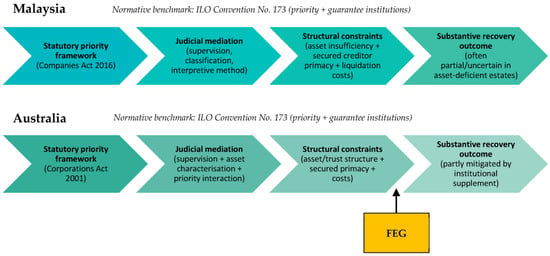

Disclaimer/Publisher’s Note: The statements, opinions and data contained in all publications are solely those of the individual author(s) and contributor(s) and not of MDPI and/or the editor(s). MDPI and/or the editor(s) disclaim responsibility for any injury to people or property resulting from any ideas, methods, instructions or products referred to in the content. |
© 2026 by the authors. Licensee MDPI, Basel, Switzerland. This article is an open access article distributed under the terms and conditions of the Creative Commons Attribution (CC BY) license.