


Abstract
Legal transplants have consolidated as a core issue of contemporary comparative law, although their study remains marked by significant theoretical and methodological tensions. This article presents a PRISMA-informed structured systematic review of 25 studies published between 2008 and 2025 and retrieved through SciSpace, Google Scholar, PubMed, and Web of Science-supported searching, with the aim of identifying conceptual frameworks, recurrent conditions of validity, and practical limitations in recent legal-transplant scholarship. The search yielded 960 exported records; after deduplication and screening, 30 articles were assessed in full text, of which 25 were available and included. The revised article identifies the 25 studies individually and links the descriptive claims to a study-by-study coding table. The findings show five recurrent theoretical lenses: positivist transfer models, culturalist critiques, diffusion mechanisms and multicausal models, communicative metaphors, and mixed transplant concepts. The corpus covers studies in Europe, China, Asia-Pacific, Vietnam, Japan, India, Afghanistan, Pakistan, Hungary, Brazil, Africa, Latin America, and transnational settings. The evidence does not support universal causal claims, but it consistently suggests that contextual compatibility, institutional capacity, local legitimacy, and interpretive adaptation shape the effectiveness of legal transplants, while linguistic barriers, interpretive mismatches, coercive imposition, and weak implementation capacity constrain them. The corpus remains concentrated in corporate law, intellectual property, constitutional law, criminal law, and drug policy, with a predominance of comparative, doctrinal, case-study, and conceptual methodologies.
1. Introduction
The concept of legal transplant has occupied a prominent place in the comparative law debate ever since Alan Watson argued, in the 1970s, that rules could be transferred between systems with relative autonomy from their social and cultural contexts (Watson 1974). This positivist-leaning thesis prompted culturalist responses that insisted on the inseparability of norms from their interpretive and social environments. In recent years, multicausal diffusion models, communicative metaphors, and notions of mixed transplant have been incorporated into the discussion, seeking to displace the sharp opposition between universalism and particularism. Nevertheless, fundamental disagreements persist regarding the feasibility, the conditions for success, and the practical limits of legal transplants, which introduces uncertainty for academia and for those designing legislative and institutional reforms.
The practical dimension of the debate has intensified in recent decades due to the proliferation of reforms driven by international organizations, trade agreements, and processes of regional harmonization. Numerous countries undergoing economic and political transition have broadly incorporated norms originating in other legal systems, with mixed results ranging from functional integration to institutional rejection or distorted application. The recent literature documents significant examples in jurisdictions such as Afghanistan, China, Japan, Vietnam, Hungary, India, Pakistan, and Brazil, where recurrent patterns of success and failure emerge that demand both empirical and theoretical systematization.
Despite the volume of case studies and the richness of conceptual reflection, there is a noticeable absence of systematic syntheses that articulate recent empirical evidence with ongoing debates. Available narrative reviews tend to privilege particular theoretical approaches without subjecting empirical evidence to critical examination, while empirical works rarely engage explicitly with the dominant frameworks. This fragmentation makes it difficult to delimit generalizable conditions of success and failure, as well as to assess the relative explanatory strength of the different models.
This article addresses that gap through a PRISMA-informed structured systematic review of literature published between 2008 and 2025 on legal transplants with checklist that can be seen in Supplementary Material in Table S1. Its aim is not to claim exhaustive coverage of the entire comparative-law tradition, but to synthesize a defined and auditable corpus in order to identify dominant theoretical frameworks, empirically reported conditions of validity and success, and recurrent practical limitations across jurisdictional contexts and branches of law. The analysis integrates bibliometric description, structured thematic extraction, and narrative synthesis, while recognizing that the corpus is too small and heterogeneous to support strong causal ranking of the identified conditions.
The results of this review carry both theoretical and practical implications. On the theoretical level, the synthesis of conceptual frameworks makes it possible to assess the complementarity or tension between different perspectives and to delimit areas in which empirical evidence supports or calls into question certain theses. On the practical level, the identification of conditions of success and recurrent limitations provides concrete guidance to legislators, normative drafters, and promoters of institutional reforms who must decide on the adoption or adaptation of foreign norms. Lastly, the review locates gaps in the current literature and proposes future lines of research that could strengthen the empirical and theoretical foundations of the field.
2. Methodology
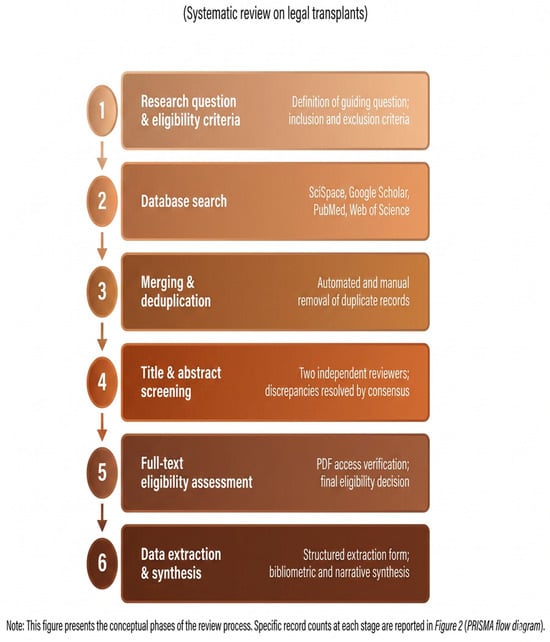
The review was designed as a PRISMA-informed structured systematic review. PRISMA 2020 was used as a transparency and reporting framework for identification, screening, eligibility, and inclusion, while the legal and doctrinal heterogeneity of the corpus required a narrative and thematic synthesis rather than meta-analysis. The methodological process was developed in six sequential phases: definition of the research question and eligibility criteria, systematic search in multiple databases, merging and deduplication of records, screening by title and abstract, full-text evaluation, and data extraction and synthesis. Each phase was documented to enable auditing and replication. In accordance with PRISMA 2020 item 24a on protocol registration, the review protocol, eligibility criteria, search strings, screening matrices, and data extraction form were deposited in the Open Science Framework (OSF) repository under the persistent identifier https://doi.org/10.17605/OSF.IO/SBMEA.
The research question was formulated in broad terms in order to capture the theoretical and empirical diversity of the field: What theoretical frameworks, reported conditions of validity and success, and practical limitations are identified in recent academic literature on legal transplants? The inclusion criteria required that studies explicitly address legal transplants, legal borrowing, legal transfer, legal reception, legal diffusion, or closely related concepts; were published between 2008 and 2025; were retrievable through the academic databases or discovery tools queried; and were available in full text in English, Spanish, French, German, or Portuguese. Excluded were works that treated transplants exclusively as metaphor without substantive legal analysis, as well as editorials, book reviews without original analytical content, and studies without access to full text.
The search was carried out in SciSpace, Google Scholar, PubMed, and Web of Science-supported searching. SciSpace was used as a discovery layer to locate potentially relevant records and related publications, not as a substitute for source verification; all candidate studies were checked against their original publication records. Google Scholar was used because of its breadth in legal and interdisciplinary scholarship, PubMed was retained only as a control source for legal-transplant vocabulary appearing in biomedical or regulatory contexts, and Web of Science was used for cross-checking and topic-field searches. The exported search log recorded 404 SciSpace records, 500 additional records through related-article and full-text expansion, 53 Google Scholar records, and 3 PubMed records, for a gross total of 960 exported records. The Web of Science contribution was integrated during searching and deduplication but was not preserved as a separately auditable count in the export log; this limitation is now expressly acknowledged. Specialized legal databases such as HeinOnline, Westlaw, LexisNexis, and Dalloz were not queried, which narrows the legal coverage of the review and is treated as a limitation rather than as evidence that the corpus exhausts the field.
The 960 records retrieved were exported to a bibliographic manager and underwent an automated merging and deduplication procedure, followed by manual review. A total of 796 duplicate records were identified and eliminated, resulting in 164 unique records. These 164 records were subjected to title and abstract screening in accordance with the predefined inclusion and exclusion criteria. Two independent reviewers evaluated each record, and discrepancies were resolved through discussion and consensus. The screening excluded 134 records for not meeting the eligibility criteria, yielding 30 articles included for full-text evaluation.
The 30 eligible articles were evaluated in full text to verify compliance with the inclusion criteria and the availability of PDF access. Of these 30 articles, 5 were excluded due to lack of access to the full text, despite multiple attempts at retrieval through institutional repositories, contact with authors, and interlibrary loan services. The remaining 25 studies were incorporated into the final synthesis. It should be noted that the universe of eligible articles was 30, and the exclusion of 5 due to lack of PDF produced the final corpus of 25 studies, with no additional figures of articles with PDF outside this universe.
Data extraction was carried out through a structured form that gathered bibliographic information, methodological characteristics, theoretical frameworks, jurisdictions, legal areas, case studies, conditions of success, practical limitations, and main conclusions. Two reviewers extracted data independently for a sample of 20 percent of the studies, achieving agreement above 90 percent; subsequently, one reviewer completed extraction of the remaining corpus under supervision of the second reviewer. The extracted data were coded through an inductive-deductive scheme combining categories derived from classical transplant literature with emergent categories identified during reading. Table A1 in Appendix A identifies the 25 included studies individually and records, for each study, its jurisdictional scope, legal area, methodological design, and principal coding tags, so that the descriptive tables in the Section 3 can be audited against the corpus.
For data synthesis, a complementary approach was used involving bibliometric description, structured thematic synthesis, and narrative synthesis. The bibliometric component examined annual publication patterns, geographical location of case studies, methodological approaches, and legal areas addressed. The structured thematic synthesis organized the findings around the five identified theoretical lenses, the conditions of validity and success, and the practical limitations observed. The methodological quality of the studies was assessed qualitatively according to transparency of design, explicitness of sources, fit between evidence and conclusions, and reflexivity on limitations. A formal quality-appraisal scale was not applied because of the methodological heterogeneity of the corpus; consequently, the findings are presented as a structured synthesis of reported patterns rather than as statistically weighted causal estimates.
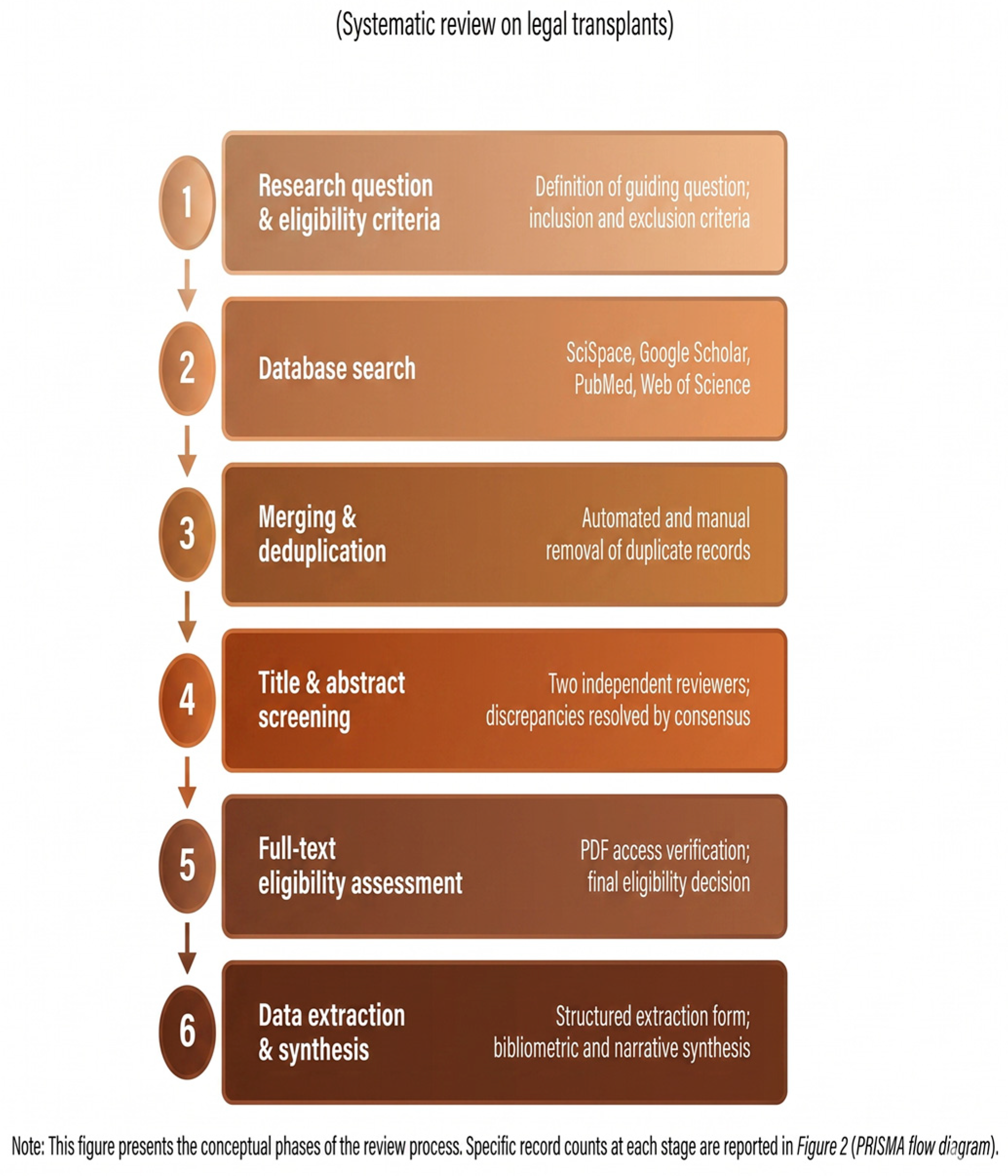
Figure 1 summarizes the six-phase methodological itinerary followed in this systematic review, from the formulation of the research question to the final synthesis of the data. Description of all phases and screened records can be found at Supplementary Material Table S2.
Figure 1.
Six-phase methodology diagram. Six-phase methodological process of the systematic review. The figure shows the sequence from the definition of the research question and eligibility criteria, through the search in four main databases (SciSpace, Google Scholar, PubMed, Web of Science), the merging and deduplication of 960 records into 164 unique ones, the title and abstract screening that selected 30 eligible articles, the full-text evaluation that excluded 5 due to lack of PDF access, up to the data extraction and synthesis of the 25 included studies. Each phase was thoroughly documented to ensure transparency and reproducibility.
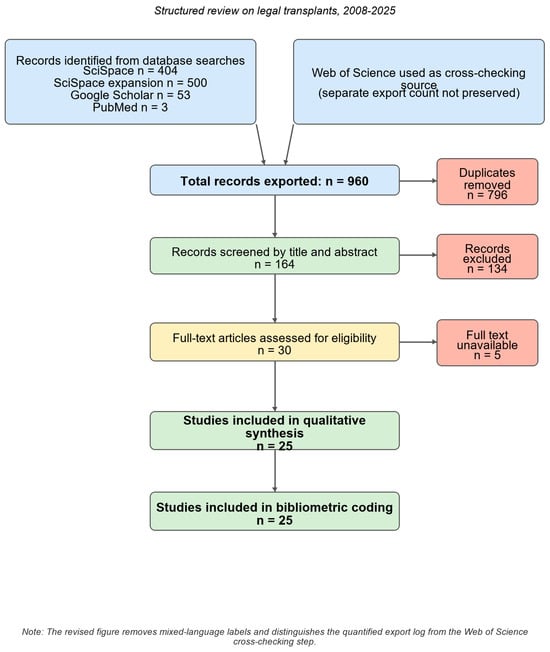
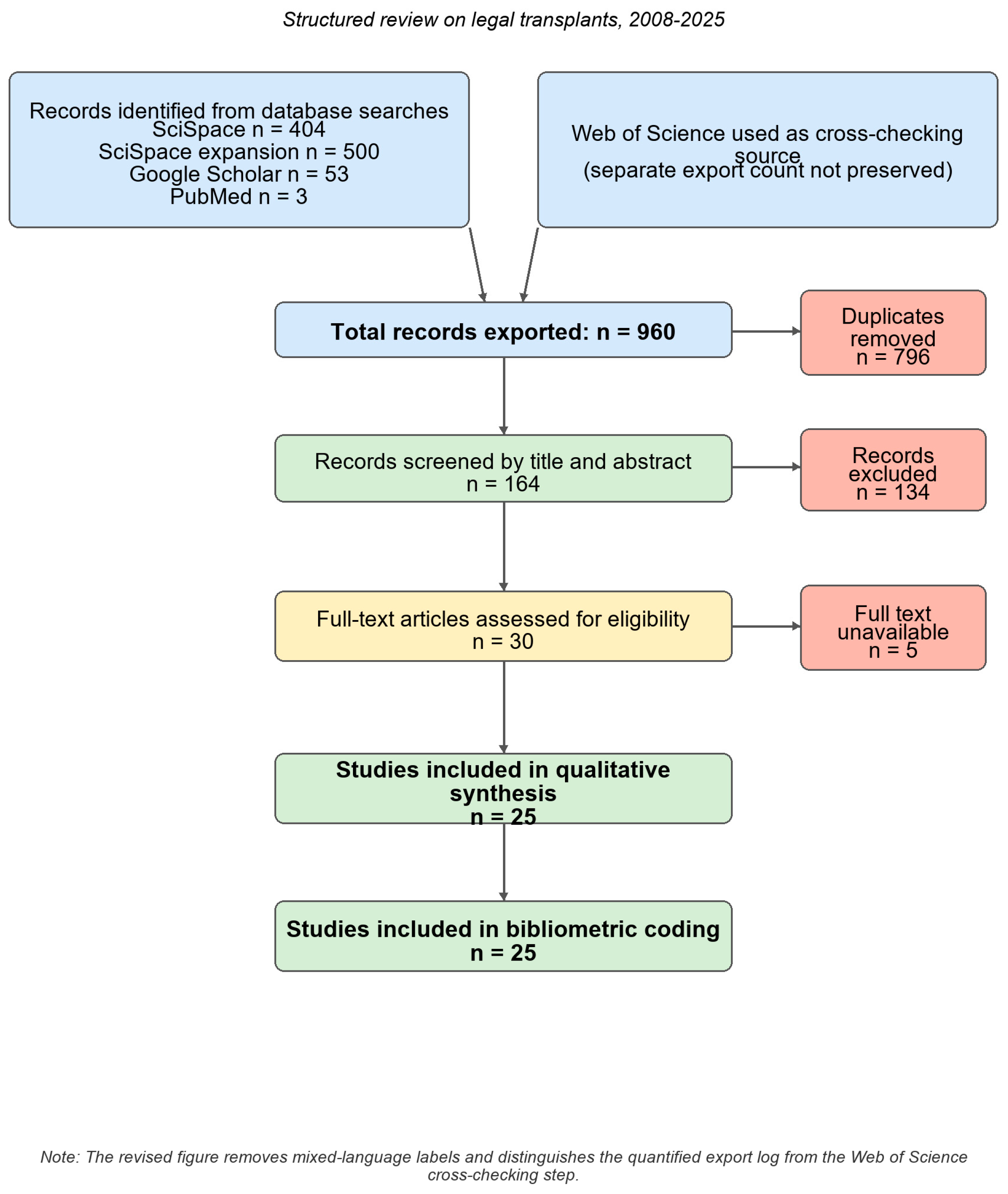
The PRISMA 2020 flow diagram is presented in Figure 2, specifying the number of records at each stage of the selection process, from initial identification to final inclusion, and allowing assessment of the comprehensiveness and transparency of the review.
Figure 2.
Revised PRISMA 2020 flow diagram of the study selection process. The figure reports 960 exported records, 796 duplicates removed, 164 records screened, 30 full-text articles assessed, and 25 studies included in qualitative and bibliometric synthesis. It also clarifies that Web of Science was used as a cross-checking source but was not preserved as a separately countable export in the search log.
3. Results
The results are presented along five main dimensions: temporal distribution, geographical location, theoretical frameworks, methodological approaches and legal areas, and reported conditions of validity and practical limitations. To improve auditability, Table A1 lists the 25 included studies and provides the study-level coding behind the descriptive tables. The numerical claims in Table 1, Table 2, Table 3 and Table 4 should therefore be read as descriptive counts or codings from a small and heterogeneous corpus, not as population-level estimates of the field as a whole.
Table 1.
Temporal distribution of publications on legal transplants (2008–2025).
Table 2.
Geographical distribution of case studies in the literature on legal transplants.
Table 3.
Distribution of methodological approaches in the literature on legal transplants.
Table 4.
Distribution of legal areas covered in the literature on legal transplants.
3.1. Temporal Distribution
The temporal analysis of the 25 included studies highlights an irregular distribution across the 2008–2025 period, including an explicit zero count for 2017–2018. The revised table separates the early period from the years with no included studies in order to avoid implying a continuous distribution where the corpus contains none.
As shown in Table 1, the early period 2008–2016 accounts for 6 studies (24.0 percent), while no included studies were identified for 2017–2018. The years 2019–2020 account for 4 studies (16.0 percent), 2021 for 4 studies (16.0 percent), 2022 for 2 studies (8.0 percent), 2023 for 5 studies (20.0 percent), and 2024–2025 for 4 studies (16.0 percent). The pattern therefore shows sustained but uneven production, with a renewed concentration in the most recent triennium rather than a smooth upward trend.
3.2. Geographical Distribution
The geographical examination of the 25 included studies shows extensive coverage of jurisdictions in Europe, Asia, Africa, and Latin America, with a marked concentration in Asian and European cases. It should be specified that the geographical data record occurrences of mentions within the studies, not unique studies per country, given that several investigations cover multiple jurisdictions or carry out transnational comparisons. This clarification is essential for properly interpreting the totals presented in Table 2.
Table 2 indicates that multi-jurisdictional and transnational research dominates the corpus, with 11 occurrences (27.5 percent) covering studies that frame legal transplants at theoretical, historical, or comparative level rather than around specific national cases. Among country-specific jurisdictions, Anglo-American legal orders (United States, United Kingdom, Canada, and Australia) act as comparator systems in 5 occurrences (12.5 percent), reflecting their role as source jurisdictions in much of the corpus. East Asia (China, Japan) records 5 occurrences, and South Asia (India, Pakistan, Bangladesh, Sri Lanka) records 8 across four studies on constitutional borrowing and competition-law transfer. Southeast Asia (Vietnam, Indonesia) is covered in 4 occurrences. Central and Eastern Europe (Hungary, Germany, Poland) appears in 4 occurrences, mainly through studies on civil-code transplantation and post-socialist transition. Latin American jurisdictions (Colombia, Brazil) are present in 2 occurrences, while global developing-country comparisons (intellectual-property diffusion) add 2 further mentions. The total of 40 geographical occurrences across the 25 included studies confirms that most works address multiple jurisdictions or develop comparative analyses of transnational scope.
The primacy of European and Asian cases in the corpus analyzed appears to respond both to the concentration of academic production in those regions and to the historical and current relevance of legal transplants in scenarios of regional integration, economic transition, and institutional reform. In Europe, processes of legal harmonization and incorporation of community norms into national legal systems have been recurrent; in Asia, large-scale legal reforms have been linked to economic openness and integration into the global trading system. The prominent presence of China, Vietnam, and Japan in the set of studies reflects interest in the processes of normative reception in transition economies and in hybrid legal systems that combine civilian, socialist, and customary traditions.
The inclusion of Brazil as a specific case with 1 occurrence gains relevance when considering that Latin America, in general, is underrepresented in the literature on legal transplants, despite the long trajectory of normative receptions in the region (Rodríguez Villabona 2009), from nineteenth-century codification to the most recent constitutional and regulatory reforms. The studies relating to Brazil examine constitutional transplants and reception processes in public law, contributing to broaden the empirical base beyond the dominant Asian and European cases (Setti and Fachin 2023). The scarce presence of Africa and Latin America as a whole suggests an important gap in the literature, which limits the scope of generalization of the findings and demands greater attention in future research.
The cases of Afghanistan, India, and Pakistan illustrate transplant processes in contexts of international intervention, postcolonial reform, and regional regulatory competition, respectively. Afghanistan represents an extreme case of imposed transplant in a post-conflict reconstruction scenario, in which legitimacy and institutional capacity face severe challenges. India and Pakistan offer a contrast between legal systems with common colonial roots that have evolved divergently, allowing assessment of the role of institutions and historical trajectory in normative reception (Darr 2019; Akon et al. 2024). Hungary, in turn, exemplifies transplants within the framework of European integration and post-socialist transition, where the adaptation of community norms to national legal traditions generates tensions and interpretive adjustments (Fuglinszky 2020).
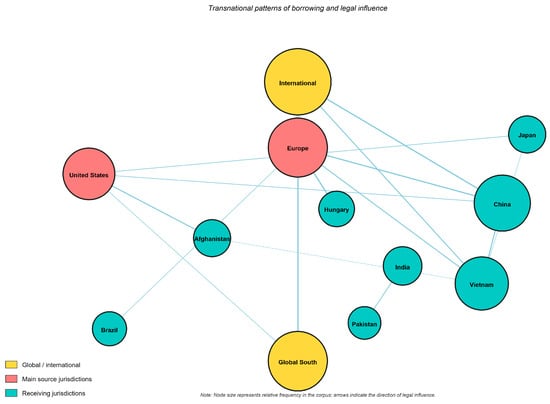
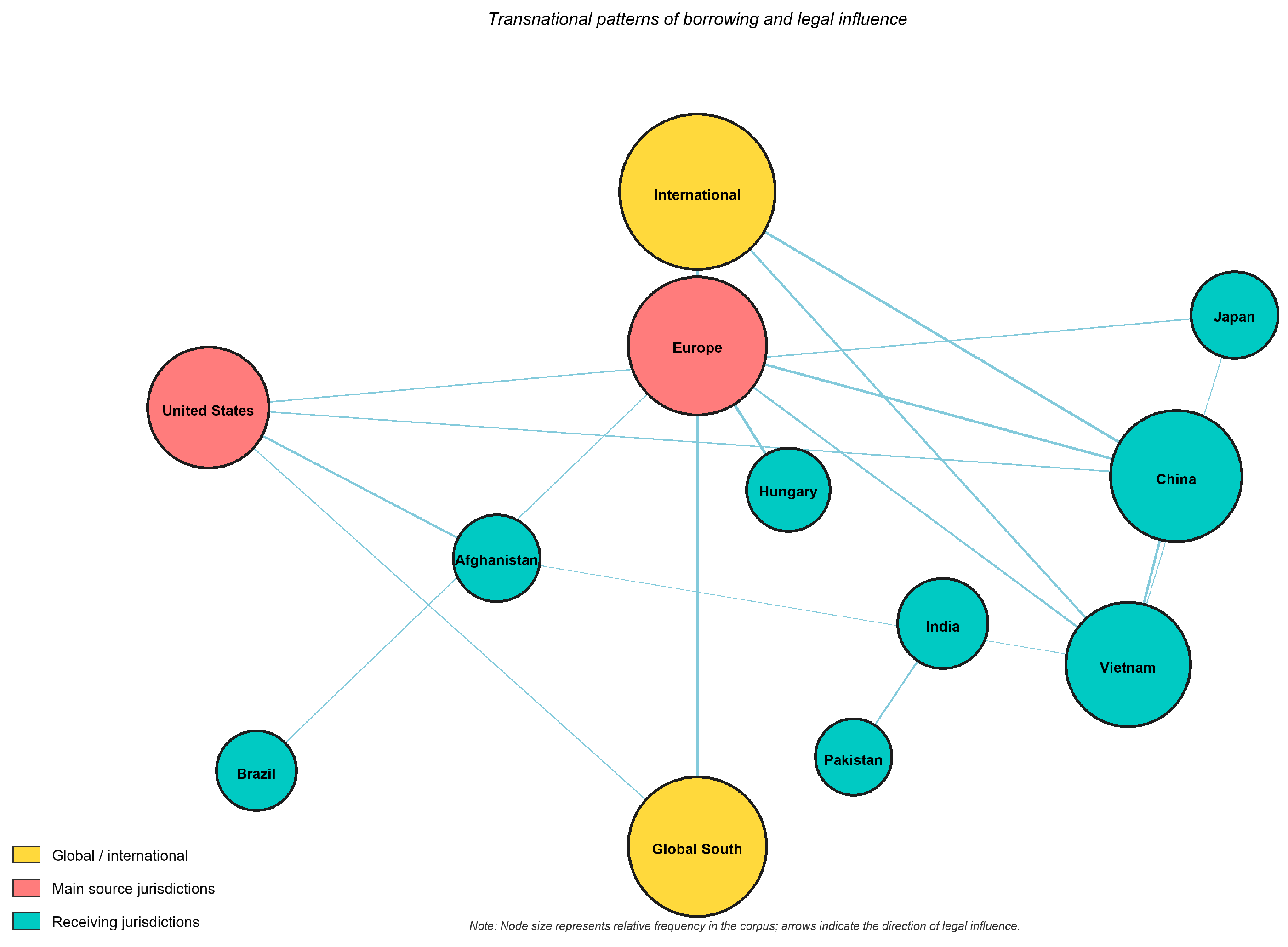
The Figure 3 represents the geographical network of legal transplant flows identified in the corpus analyzed, showing the relationships between source and destination jurisdictions of transplanted norms, as well as the intensity of the connections based on the number of studies that document each flow.
Figure 3.
Geographical network of jurisdictions studied. Revised geographical network of legal-transplant flows. The figure replaces the previous Spanish-language labels with English labels and represents source jurisdictions, receiving jurisdictions, transnational nodes, and the direction of documented legal influence within the 25-study corpus.
The geographical network reveals patterns of legal circulation that point to historical, economic, and political ties between jurisdictions. Movements from Europe and the United States toward Asia, Latin America, and Africa appear to confirm the persistence of North–South flows and the gravitational pull of hegemonic legal systems in legal reform processes on a global scale. However, South–South exchanges and forms of selective reception are also recorded, which question simplistic readings of unidirectional imposition. The incorporation of Brazil into the network allows the observation of concrete links between Latin American and European legal systems, as well as constitutional reception trajectories that broaden the understanding of legal transplants in consolidated democratic contexts.
3.3. Dominant Theoretical Frameworks
The thematic analysis of the 25 studies considered identifies five theoretical frameworks that organize the academic debate on legal transplants: positivist transfer models, culturalist critiques, diffusion mechanisms and multicausal models, communicative metaphors, and mixed transplant concepts. They are not mutually exclusive, and several works combine elements of more than one perspective; nevertheless, each contributes its own conceptual lens to explain how and why norms move between systems and what factors influence their success or failure.
The positivist transfer model, historically associated with Alan Watson, Watson (1974) holds that legal rules can be transferred between legal orders with relative autonomy from their social and cultural environments. This approach emphasizes the technical dimension of legislation and the capacity of those drafting norms to formally adjust foreign rules to local needs. In the corpus examined, this framework is observed in studies on comparative legislative technique and in guides aimed at legislators seeking to import norms. Its defenders affirm that transplantability depends on the technical quality of the drafting, the conceptual clarity of the provisions, and the expertise of local legal practitioners in interpreting and applying the incorporated rules. Even so, recent works qualify this position by noting that even technically well-executed transplants can fail when they overlook fundamental institutional or cultural incompatibilities.
The culturalist critiques, developed by authors such as Pierre Legrand and others, Legrand (1997) emphasize that law is deeply embedded in social practices, interpretive traditions, and legal habitus that do not automatically accompany formal norms. From this perspective, transplants would be impossible or, in any case, necessarily transformative, since imported rules are reread through the conceptual frameworks and institutional practices of the receiving system. In the corpus analyzed, this approach appears in research that shows how transplanted norms modify their meaning when applied by judges and local practitioners who interpret them in light of their own traditions. Studies on Japan, for example, document that contracts designed using American models are interpreted through Japanese hermeneutic techniques, which produces results that significantly depart from the expectations of the original drafters (Hoshi 2021).
Diffusion models and multicausal approaches, developed in political science and the sociology of law, address transplants as policy circulation processes driven by multiple mechanisms that operate sequentially or simultaneously. Among these mechanisms are coercion (imposition by powerful actors), contractualization (adoption as a condition for accessing benefits), socialization (internalization of norms through professional and epistemic networks), and regulatory competition (adoption to attract investment or improve reputation). In the corpus analyzed, this framework is reflected in quantitative studies on the diffusion of intellectual property protections in developing countries, which show that an initial phase of coercion may bring about formal adoption, but that effective implementation subsequently depends on processes of socialization and contractualization. These works also point out that a single mechanism rarely explains the outcome and that the temporal sequence in which they act conditions the results.
Communicative metaphors and legal reception models conceive transplants as communicative exchanges between legal orders, in which imported norms must “speak the language” of the receiving system (Uliasz 2023; Trikoz and Gulyaeva 2023) in order to be understood and effectively applied. This approach highlights the linguistic and semiotic dimension of the transplant, since legal concepts are imbued with meanings specific to each tradition and a literal translation can give rise to misunderstandings or distortions. In the corpus analyzed, this approach is identified in studies on mixed systems and in multilingual contexts, where it is shown that received norms need to be recoded in the conceptual terms of the destination system to become operational. Works on Vietnam and other mixed systems show that the simultaneous reception of rules originating from civilian and common law traditions causes semantic tensions that demand sustained interpretive work on the part of judges and local academia (Erie and Ha 2021; Van Quan and Cu 2023; Tran et al. 2019).
The concept of mixed or hybrid transplant proceeds from the fact that numerous contemporary legal orders simultaneously incorporate norms from various traditions, giving rise to hybrid configurations that are difficult to ascribe to a single legal family (Tran et al. 2019; Trikoz and Gulyaeva 2023). This approach calls attention to the risks of systemic incoherence that emerge when norms from potentially incompatible traditions coexist without adequate conceptual integration, while at the same time highlighting the possibilities of legal innovation that open up through creative combinations of elements from different origins. In the corpus analyzed, this approach is observed in studies on Vietnam, China, and other systems that have received, at different historical moments, civilian, socialist, and common law norms (Deng 2022; Erie and Ha 2021; Van Quan and Cu 2023; Tran et al. 2019). These works gather both the coherence problems faced by legal practitioners when applying hybrid norms and the interpretive strategies they deploy to manage the plurality of sources and traditions.
It should be noted that the analysis of reception in public law, present in some studies of the corpus, does not constitute an autonomous theoretical framework, but is integrated as a sub-theme within the positivist and mixed approaches. These studies examine the transplant of constitutional and administrative doctrines between legal orders, addressing the particularities of these transfers in domains closely linked to political structures and traditions of sovereignty. It is shown, moreover, that public law transplants face specific challenges of legitimacy and institutional compatibility, distinct from those that characterize private law, although they are analyzed using the same general conceptual frameworks.
The simultaneous presence of these five theoretical frameworks in the recent literature highlights the complexity of legal transplant and the difficulty of capturing it from a single conceptual perspective. The available data indicate that each framework illuminates different facets of the process and that the selection of the most appropriate approach depends on the type of norm, the institutional context, and the research question. The most elaborate studies of the corpus articulate components from several frameworks and assume that legal transplants are simultaneously technical, cultural, political, and communicative processes that require multilevel analysis.
The examination of the methodological approaches employed in the 25 included studies reveals a variety of research designs in line with the interdisciplinary character of legal-transplant scholarship. Table 3 reports the primary methodological approach assigned to each study for descriptive purposes; the corresponding study-level assignments are summarized in Table A1.
Table 3 indicates that comparative doctrinal analysis is the most frequent primary approach, with 7 studies (28.0 percent of the corpus). Single-jurisdiction case studies account for 4 (16.0 percent), followed by comparative case studies with 3 (12.0 percent). Theoretical, conceptual, and reference works total 6 (24.0 percent); quantitative diffusion analysis, 2 (8.0 percent); historical legal analysis, 1 (4.0 percent); and systematic review combined with linguistic analysis, 2 (8.0 percent). The distribution shows that the field combines a strong doctrinal–comparative core with substantial theoretical–conceptual work and a smaller but distinctive empirical–quantitative thread anchored in the intellectual-property-diffusion literature.
The predominance of comparative doctrinal analysis is due to the eminently legal imprint of the study of legal transplants and the relevance of the comparative method in the discipline. In this vein, doctrinal studies contrast normative texts, jurisprudence, and academic production between different systems to identify convergences, divergences, and dynamics of reciprocal influence. Such an approach is especially suitable for tracing the origin of transplanted norms, assessing their formal incorporation into the destination legal order, and examining the judicial interpretations that define their operational scope. However, this type of analysis shows limits for capturing social, political, and economic dimensions of transplants, areas that demand complementary empirical methods.
Qualitative case studies constitute the second most widespread approach and allow a meticulous examination of transplant processes in specific jurisdictions. They usually combine documentary analysis with interviews, observation, and a study of the environment that facilitates understanding of how transplanted norms function in practice and what factors favor or hinder their implementation. The cases relating to Afghanistan, China, Japan, Vietnam, Hungary, India, Pakistan, and Brazil present in the corpus clearly illustrate the capacity of this approach to capture the contextual complexity of legal transplants. However, they face problems of generalization and require solid strategies for case selection and systematic comparison if transferable findings are to be produced.
Historical–legal analysis incorporates a temporal dimension into the study of transplants, since it follows reception processes over decades or centuries and assesses how imported norms transform and adjust over time. This approach is especially valuable for understanding path-dependence phenomena, in which initial transplant decisions condition subsequent alternatives and generate institutional lock-in effects. The historical works of the corpus show that colonial transplants, nineteenth-century codifications, and reforms following political transitions continue to shape contemporary legal systems, often in ways not foreseen by those who promoted the reforms.
Literature reviews and quantitative diffusion analyses, although less present, play a relevant conceptual role in the set examined. The reviews organize accumulated knowledge and identify patterns, gaps, and controversies in the academic discussion, contributing to the theoretical consolidation of the field. For their part, quantitative diffusion studies use panel data, legal protection indices, and statistical models to recognize causal mechanisms and temporal sequences in the adoption of norms across multiple jurisdictions. With this, they provide evidence on the relative frequency of various diffusion mechanisms and allow contrasting theoretical hypotheses through analyses with extensive samples of countries.
Interviews and fieldwork, although they appear less frequently, provide direct evidence on perceptions, motivations, and experiences of actors involved in legal transplant processes, including legislators, judges, lawyers, officials, and recipients of reforms. This approach is especially pertinent for assessing the perceived legitimacy of transplants, detecting practical obstacles to their implementation, and recovering tacit knowledge that does not appear in official documents. The studies on Afghanistan included in the corpus draw on interviews to gauge the local acceptance of transplanted laws in post-conflict contexts, and they highlight tensions between formal legitimacy and social legitimacy.
Linguistic and conceptual analysis, also a minority approach, addresses a critical aspect of transplants that often goes unnoticed in conventional doctrinal or empirical works. It examines how legal concepts are translated between languages and traditions, and warns of the risks of misunderstandings, semantic distortions, and loss of nuance. The linguistic studies of the corpus indicate that the possibility of transplanting legal concepts depends not only on their normative content, but also on their semantic load and the existence of functional equivalents in the receiving system.
The analysis of the legal areas covered in the 25 included studies shows a broad distribution across corporate law, intellectual property, constitutional law, criminal law, contract law, competition law, and other specialized fields. The data in Table 4 correspond to multiple legal-area codings per study, not unique studies per area; Table A1 identifies the principal legal areas associated with each included study.
Table 4 indicates that corporate and company law is the most frequently treated area, with 42 occurrences equivalent to 20.4 percent of total codings. Constitutional law records 38 occurrences (18.4 percent) and, following that, intellectual property reaches 35 (17.0 percent). Criminal law and crime policy total 28 (13.6 percent); contract law, 24 (11.7 percent); competition law, 18 (8.7 percent); administrative law, 12 (5.8 percent); and public international law, 9 (4.4 percent). Overall, 206 codings are recorded distributed across 25 studies, suggesting that most works address several legal areas in an integrated manner.
The pre-eminence of corporate and company law in the corpus analyzed is associated with the centrality of corporate governance reforms in contexts of economic globalization and transit from planned economies to market economies. The studies on China, Japan, and Vietnam document transplants of rules concerning fiduciary duties, protection of minority shareholders, and corporate body designs, transferred from common law and civilian systems to hybrid or transforming environments. A closer examination reveals that these transplants face their own difficulties stemming from differences in ownership structures, corporate governance practices, and business cultures, factors that condition the effectiveness of imported norms.
Second place in frequency corresponds to constitutional law, which reflects interest in comparative constitutionalism, the circulation of constitutional doctrines (Cohn 2024; Akon et al. 2024; Setti and Fachin 2023), and the transplant of catalogs of fundamental rights. In the corpus, the studies relating to India, Pakistan, Brazil, and other legal orders analyze the transfer of doctrines such as the margin of appreciation, constitutional review, and social rights between diverse constitutional traditions. It is highlighted that these transplants pose specific challenges of democratic legitimacy and congruence with local political structures, given that constitutional norms are more closely linked to national identities and political projects than the rules typical of private law.
Intellectual property occupies third place and highlights the influence of international trade agreements and processes of regulatory harmonization on the expansion of protection standards. Quantitative studies on the diffusion of protections in developing countries show that mechanisms of coercion, contractualization, socialization, and regulatory competition drive the adoption of international standards (Morin and Gold 2014), often in contexts in which the local economic benefits of such protections are uncertain. In this way, tensions become visible between external pressures to harmonize and internal demands to maintain margins of regulatory flexibility.
Criminal law and crime policy, contract law, and competition law have a significant presence in the corpus. In criminal matters, transplants of procedural norms, drug policies, and international criminal law are examined in scenarios of international intervention and post-conflict reforms. For their part, works on contract law study the transfer of drafting techniques, interpretation guidelines, and contractual remedies between systems with divergent interpretive traditions. As for competition law, transplants of antitrust norms and market regulation are analyzed (Darr 2019) in processes of economic liberalization and regional integration.
Administrative law and public international law appear less frequently, although they present features that particularly affect the transplantability of norms. In administrative law, the analyses concentrate on administrative procedures, judicial review of administration, and sectoral regulation (Xanthaki 2008), underscoring the dependence of these rules on institutional configurations and traditions of state–society relations. In public international law, the studies deal with the incorporation of international norms into domestic law and with the tensions between monism and dualism, as well as between national sovereignty and international obligations.
This PRISMA-informed structured review of 25 studies published between 2008 and 2025 provides a defined and auditable synthesis of recent legal-transplant scholarship. The revised analysis shows theoretical pluralism, methodological diversity, and fragmented empirical evidence; for that reason, the conclusions are framed as reported patterns within the reviewed corpus rather than as universal claims about the entire field.
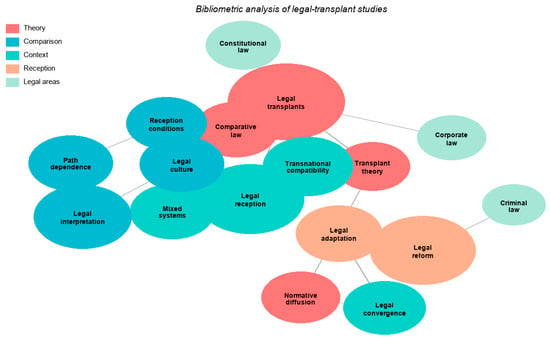
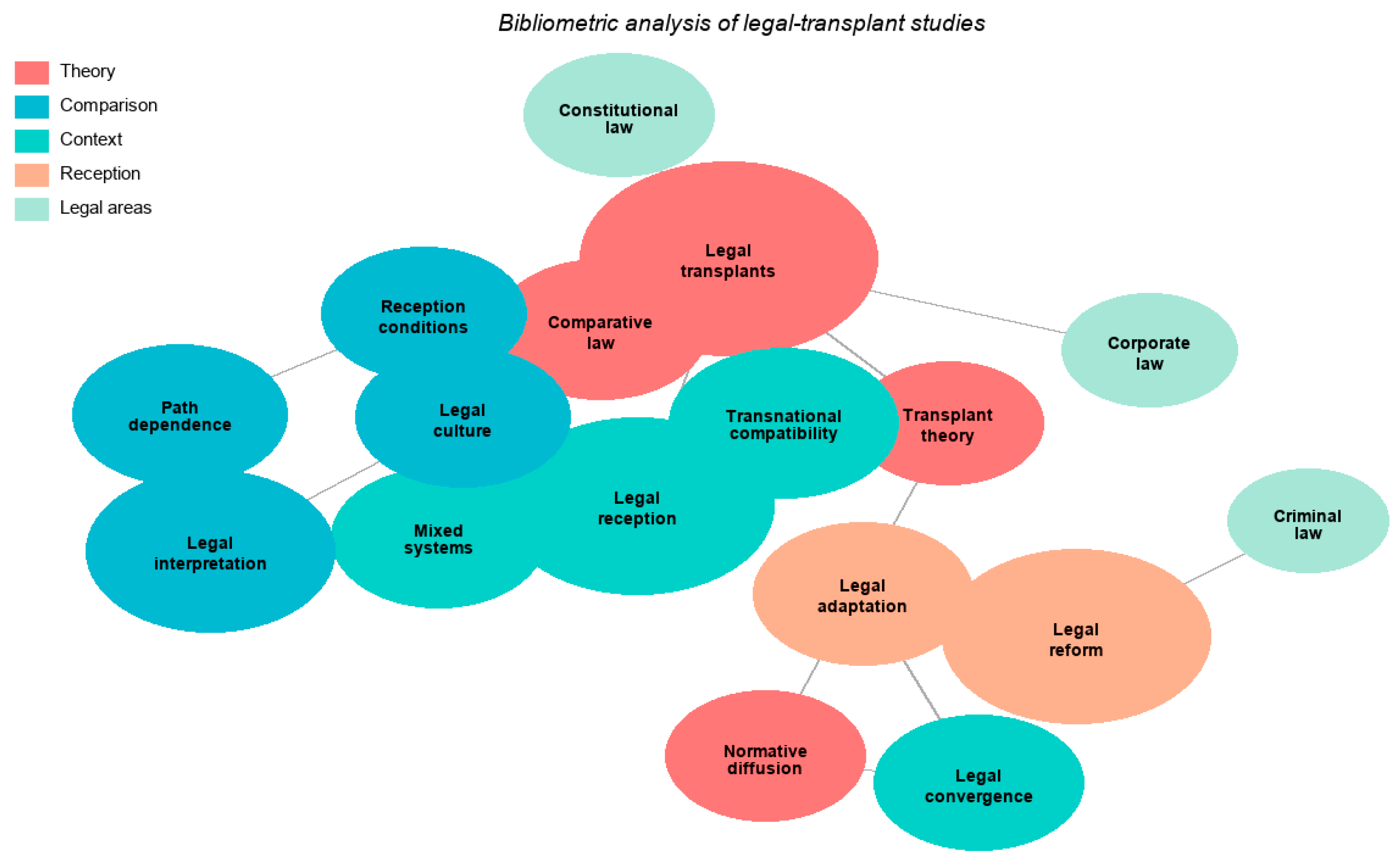
The keyword co-occurrence network in Figure 4 was constructed from the keywords assigned by the authors in the 25 included studies, with the aim of identifying terms that frequently appear together in the same work. From this network, it is possible to outline the concepts that organize the field and, at the same time, recognize thematic clusters that group studies with related approaches or interests.
Figure 4.
Revised keyword co-occurrence network in English. The figure groups recurrent concepts into clusters concerning theory, comparison, context, reception, and legal areas, based on the keywords and coding terms extracted from the 25 included studies.
The network shows that “legal transplant,” “comparative law,” and “legal reception” occupy nodal positions, confirming that these concepts organize the field and articulate the different thematic clusters. As for the diffusion mechanisms, terms such as “coercion,” “socialization,” and “contractualization” form a clearly differentiated cluster, indicative of the imprint of political science and the sociology of law in this area. For their part, the terms linked to mixed systems, interpretation, and local adaptation are grouped in another cluster that highlights interest in the processes of reception and transformation of transplanted norms. Lastly, the terms associated with specific legal areas are located on the periphery of the network in the form of clusters that link the general debate on transplants with applications in specialized branches of law.
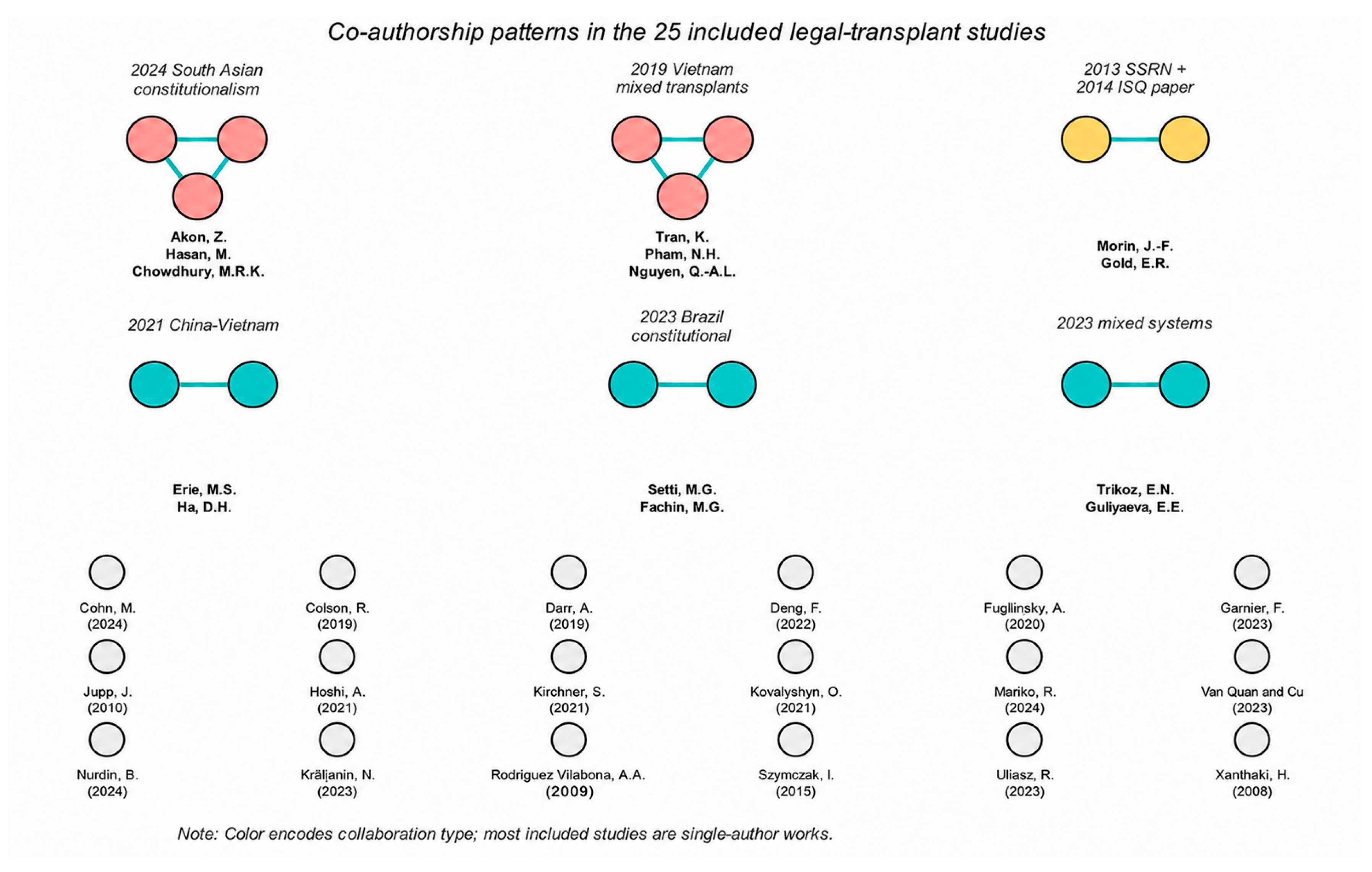
The author collaboration network was developed from the co-authorships detected in the 25 studies, so that joint publications and the research communities present in the field would be visible. With this input, it is possible to distinguish authors with central positions, consolidated teams, and patterns of international collaboration as can be seen in Figure 5.
Figure 5.
Revised author collaboration network. The network was constructed from the co-authorships identified in the 25 studies included in the review corpus. Colors indicate collaboration structure: grey nodes represent single-author studies; blue nodes represent isolated two-author collaborations; pink nodes represent three-author collaborative teams; and yellow nodes identify the repeated or closely related two-author contribution associated with the working-paper and journal versions of the intellectual-property diffusion study. The “Author + Year” labels are bibliographic identifiers of the studies represented in the network and correspond to the following references: Xanthaki (2008), Jupp (2010), Morin and Gold (2014), Szymczak (2015), Rodríguez Villabona (2009), Colson (2019), Darr (2019), Tran et al. (2019), Fuglinszky (2020), Erie and Ha (2021), Hoshi (2021), Kirchner (2021), Kovalyshyn (2021), Deng (2022), Kršljanin (2023), Garnier (2023), Van Quan and Cu (2023), Setti and Fachin (2023), Trikoz and Gulyaeva (2023), Uliasz (2023), Akon et al. (2024), Cohn (2024), Nurdin (2024), and Mańko (2024). Full bibliographic details and DOI/URL identifiers are provided in the References section and in Appendix A, Table A1.
In Figure 5, colors are used to distinguish the type of authorship or collaboration structure identified in the 25 included studies. Grey nodes represent single-author studies, which constitute the predominant pattern in the corpus. Blue nodes identify two-author collaborations appearing as isolated dyads within the review. Pink nodes represent three-author collaborative teams, while yellow nodes indicate the only repeated or closely related two-author collaboration in the corpus, corresponding to the working-paper and journal versions of the same intellectual-property diffusion study. Therefore, the colors serve exclusively to clarify the structure of co-authorship and to support the interpretation that the field is fragmented, with most studies produced individually or by small, topic-specific teams.
In structural terms, the network appears fragmented and composed of numerous small and disconnected components, indicating that most works are individually authored or respond to one-off co-authorships without recurrence. Such a pattern suggests the absence of consolidated communities and a relatively isolated functioning of researchers, without the formation of stable teams or networks sustained over time. The largest components correspond to specific teams that have published jointly on narrow topics, including diffusion in intellectual property, mixed transplants in Vietnam, mixed systems, comparative constitutionalism, and China–Vietnam relations.
The non-existence of authors with multiple publications within the corpus examined (except for Jean-Frédéric Morin, present in working and published versions of the same study) indicates that, in the period considered, no prolific figures concentrating recent production on legal transplants are observed. This author dispersion may be due to the interdisciplinary character of the field, which brings together specialists in comparative law, political science, sociology of law, legal history, and other areas that intervene occasionally without dedicating their agenda exclusively to the topic.
The thematic analysis of the 25 studies gathered allows the identification of a recurrent set of factors that, depending on the cases, favor or hinder the success of legal transplants. Although the size of the corpus imposes caution when extrapolating the results, the available evidence points to contextual compatibility, institutional capacity, local legitimacy, interpretive adaptation, the appropriate sequencing of diffusion mechanisms, and pre- and post-transplant comparison as central determinants of the effectiveness of transplanted norms.
Contextual compatibility emerges as a decisive condition in numerous studies of the corpus. Legal transplants tend to function better when imported norms fit the social, economic, political, and cultural conditions of the receiving system, rather than being literally transferred from the source system. The works on China, Japan, and Vietnam show that the active adaptation of transplanted norms to local environments—through drafting adjustments, reinterpretations, and application guidelines—increases the likelihood of effective implementation. In contrast, the studies relating to Afghanistan show that the imposition of foreign norms without attention to contextual compatibility generates institutional and social rejection, with the consequent decrease in legitimacy and effectiveness of legal reforms.
Institutional capacity emerges as another decisive condition in the corpus analyzed. Legal transplants require structures capable of interpreting, applying, and enforcing imported norms: competent courts, effective regulatory agencies, and properly trained legal professionals. The evidence on India and Pakistan indicates that, even in similar contexts, differences in institutional capacity produce divergent results in the adoption of competition norms; where institutions are stronger, greater compatibility and legitimacy are observed. In the case of Afghanistan, deep institutional weakness prevents the implementation of transplanted norms even when there is political will for reform.
Local legitimacy and participation in adoption processes appear as factors that significantly condition the success of legal transplants. According to the studies of the corpus, transplants imposed coercively by external actors, or approved without consultation with local actors, face higher risks of rejection and resistance compared to those adopted through participatory processes that favor internal appropriation. In Afghanistan, the perception that transplanted norms constitute foreign impositions reduces their legitimacy and increases the probability of destabilizing effects. Conversely, the cases of China and Vietnam show that selective adaptation and local reinterpretation of foreign-origin norms can generate appropriation and legitimacy.
Interpretive adaptation and judicial activism act as mechanisms through which receiving systems adjust transplanted norms to their own traditions and needs. In China, it has been documented that courts developed local interpretations of fiduciary duties imported from common law, giving rise to a hybrid doctrine that combines foreign elements with principles of Chinese civil law. In Japan, judges interpret contracts drafted according to American models using Japanese hermeneutic techniques, with results that differ from the drafters’ expectations but prove functional in the Japanese context. All this suggests that transplantability does not depend only on the formal compatibility of the norms, but also on the capacity and willingness of local legal practitioners to adjust them through creative interpretation.
The sequence of diffusion mechanisms influences the results of legal transplants, as indicated by the quantitative studies of the corpus. In intellectual property matters, diffusion analyses show that coercion can precipitate formal adoption, but effective implementation is conditional on subsequent processes of socialization, contractualization, and regulatory competition. This temporal sequence indicates that transplants constitute long-term processes that require multiple support mechanisms to consolidate; when initial imposition lacks follow-up, the result is superficial adoption without real changes in institutional practices.
Comparative analysis before and after the transplant is revealed as an essential tool for mitigating the risks of failure. The studies relating to Hungary and other European systems show that comparative examination prior to adoption allows detecting potential incompatibilities and designing suitable adaptations, while subsequent analysis helps identify implementation problems and formulate corrective adjustments. It is therefore highlighted that comparative law is not only an academic discipline, but also a practical instrument for legislators and judges who must decide on legal transplants.
The thematic analysis of the 25 included studies identifies a recurrent set of practical limitations that hinder the effective implementation of legal transplants, even when the conditions of validity discussed above are present. These limitations include risks of translation and language, mismatches in interpretive cultures, superficial copying by legislators, legitimacy deficits due to coercive imposition, institutional mismatches, and partial or incomplete transplants.
The risks of translation and language have been recognized, in multiple studies of the corpus, as a first-order limitation. Legal concepts are loaded with meanings specific to each tradition and frequently do not have exact equivalents in other languages or systems. Research on transplants from European law and international law to national systems records that the literal translation of technical terms tends to generate misunderstandings, produces semantic distortions, and entails the loss of conceptual nuances. In multilingual systems, it has also been observed that linguistic differences affect not only the comprehension of transplanted norms, but also their legal effect, given that local legal practitioners interpret the translated terms from their own conceptual frameworks.
Mismatches between interpretive cultures appear as another recurrent practical limitation. Different systems employ hermeneutic techniques ranging from formalist and literal reading to teleological and evolutionary approaches, and such divergences condition the way transplanted norms are read and applied. In Japan, it has been documented that contracts drafted according to American models are interpreted through Japanese techniques, with results that differ from the expectations of those who drafted them. In China, similarly, it has been shown that common law norms are reinterpreted through frameworks conceptualized from civilian traditions, which gives rise to hybrid doctrines that combine elements of both traditions in unanticipated ways.
Superficial copying by legislators without commitment to transplant theory or rigorous comparative analysis constitutes a practical limitation highlighted in studies on legislative drafting. It is noted that those who import normative texts without understanding their conceptual foundations, their institutional presuppositions, or their effects in the source system run the risk of producing inapplicable norms that waste resources and generate confusion. Hence, it is recommended that legislators considering legal transplants engage with the specialized literature, carry out systematic comparative analyses, and consult experts in the source and destination systems.
The legitimacy deficits derived from coercive imposition represent an especially severe limitation in contexts of international intervention and post-conflict reform. Studies on Afghanistan show that norms transplanted and imposed by international donors without due consultation with local actors are perceived as foreign impositions lacking social legitimacy, which reduces their acceptance and increases the risk of destabilizing effects. In matters of drug policy, it has been observed that the imposition of prohibitionist models (Colson 2019) through international treaties generates resistance in jurisdictions that prefer public health approaches, producing tensions between international obligations and local preferences.
Institutional mismatches and implementation gaps arise when transplanted norms presuppose institutional structures or regulatory capacities that do not exist in the receiving system. As shown by the studies of the corpus, norms that require specialized courts, technical regulatory agencies, or legal professionals with specific training fail when these institutions or capacities are not present. The experience of India and Pakistan illustrates how differences in institutional capacity lead to divergent results in the implementation of similar norms, confirming that transplantability depends not only on the intrinsic quality of the norms, but also on the quality of the receiving institutions.
Partial or incomplete transplants constitute a practical limitation when there is an attempt to transfer practices, techniques, or doctrines without incorporating the contextual or institutional elements that sustain them. In contractual drafting and judicial procedures, several studies have documented that the adoption of drafting styles or procedural techniques produces hybrid results that do not replicate the effects of the source system. Works on Hungary distinguish between complete transplants, limping transplants (which function partially), and surprising transplants (which generate unanticipated effects), highlighting that transplantability is gradual and that partial transplants are more frequent than complete ones (Fuglinszky 2020).
4. Discussion
The results of this systematic review highlight an academic field marked by theoretical pluralism, methodological diversity, and fragmented empirical evidence that hinders the formulation of general conclusions on the viability and conditions of success of legal transplants. The five theoretical frameworks identified (positivist transfer models, culturalist critiques, diffusion mechanisms and multicausal models, communicative metaphors, and mixed transplant concepts) offer perspectives that complement each other in certain aspects but turn out to be partially incompatible regarding how and why legal norms move between systems and which factors determine their success or failure. This theoretical plurality reflects fundamental disagreements about the nature of law, the relationship between norms and social contexts (Kovalyshyn 2021), and the scope of generalization in comparative law.
The debate between positivists and culturalists about the relative autonomy of law from its social and cultural contexts remains open in recent literature. Positivist analyses emphasize the technical dimension of legislation and the expertise of normative drafters in adapting foreign rules through formal adjustments; for their part, culturalist approaches maintain that norms cannot be detached from the interpretive and social environments in which they acquire meaning. The evidence available in the corpus analyzed indicates that both perspectives capture relevant facets of the phenomenon of legal transplants, although neither fully explains it. Studies on China, Japan, and Vietnam show that transplanted norms are simultaneously technical and cultural, and that their performance depends both on the quality of the drafting and on compatibility with local interpretive traditions.
Multicausal diffusion models offer a middle ground that recognizes the complexity of transplant processes without reducing them to exclusively technical or cultural factors. In the quantitative studies on the diffusion of intellectual property in the corpus, it is observed that the adoption of norms results from the interaction of multiple mechanisms (coercion, contractualization, socialization, regulatory competition) that act sequentially and reinforce each other. This multicausal reading is congruent with the qualitative evidence from case studies that document the interaction between political, economic, institutional, and cultural factors in determining the results of legal transplants. However, these models face difficulties of operationalization and measurement, and the literature lacks works that disaggregate the relative effects of different mechanisms in specific contexts.
Communicative metaphors and mixed transplant concepts introduce novel approaches that emphasize the linguistic and semiotic dimension of legal transplants and recognize the broad presence of hybrid configurations in contemporary legal systems. In particular, they prove useful for understanding transplant processes in multilingual and multi-tradition systems such as Vietnam, China, and other environments that have received norms from various sources. However, these approaches are less developed at the theoretical and empirical levels than the positivist, culturalist, and diffusion frameworks, and the literature lacks studies that operationalize concepts such as “legal communication” or “legal hybridity” in a way that allows their systematic empirical evaluation.
The identification of reported conditions of validity and success in the corpus (contextual compatibility, institutional capacity, local legitimacy, interpretive adaptation, sequence of diffusion mechanisms, and pre- and post-transplant comparative analysis) provides practical guidance for legislators and institutional reformers; however, these conditions remain general and require contextual specification. The available data suggest, rather than prove, that their relative importance varies according to the type of norm, the area of law, the institutional environment, and the historical moment. For example, the reviewed studies indicate that local legitimacy may be especially visible in constitutional, criminal, and post-conflict transplants, while institutional capacity appears particularly salient in regulatory and competition-law transplants. These observations should be treated as hypotheses for further research, not as ranked causal findings.
The literature lacks studies that systematically evaluate the relative importance of the different conditions of success in concrete contexts or that identify their interactions. One may ask: can high institutional capacity compensate for low local legitimacy, or are both conditions necessary for success? Does contextual compatibility weigh more in the initial phases of adoption or in the later stages of implementation? Does the sequence of diffusion mechanisms modify the relative importance of the other conditions? These questions require research designs that allow systematic comparison of cases with variation in specific conditions, something the corpus analyzed does not offer.
The corpus confirms the continued relevance of five theoretical lenses: positivist transfer models, culturalist critiques, multicausal diffusion models, communicative approaches, and mixed-transplant concepts. These frameworks are best understood as complementary analytical tools. Recent studies rarely show legal transplantation as a purely technical act or as an impossible cultural transfer; instead, they depict it as a process shaped by drafting choices, institutional conditions, legal culture, political incentives, language, and local interpretation.
The geographical distribution of case studies in the corpus analyzed shows a concentration in Europe and Asia, while Latin America, Africa, and other regions appear underrepresented. This pattern seems to respond, on the one hand, to the greater intensity of academic activity in comparative law in Europe and Asia and, on the other, to the availability of funding to investigate legal transplants in those areas. The lower presence of studies on Latin America and Africa reduces the scope of generalization and may tilt the understanding of the phenomenon toward contexts of regional integration and economic transition, displacing to the background scenarios of democratic reform, transitional justice, and institutional strengthening that are pertinent in other regions.
The inclusion of Brazil in the corpus constitutes an advance, although two studies are not enough to reflect the heterogeneity of Latin American experiences in legal transplants. The region has a long trajectory of legal receptions, from nineteenth-century codification to recent constitutional and regulatory reforms; from this, relevant lessons can be drawn on transplants in contexts of legal pluralism, presidential systems, and traditions of judicial activism that differ from the European and Asian cases predominant in the literature. The lack of works on Mexico, Argentina, Colombia, and other Latin American reference systems constitutes a substantive gap that should be addressed in future research.
The coverage of legal areas in the corpus is concentrated in corporate, constitutional, intellectual property, criminal, and contract law, while less attention is given to labor law, environmental law, family law, and other matters equally crossed by transplant processes. Such a distribution may be due both to the economic and political weight of the most studied areas and to the availability of resources to investigate them. However, the scant presence of labor law and environmental law is striking, given that both have been the subject of important dynamics of international harmonization and standard transplant in recent decades.
The methodological diversity observed constitutes a strength of the field, although it poses challenges of articulation and synthesis. Comparative doctrinal studies, qualitative case studies, historical–legal analyses, literature reviews, quantitative diffusion analyses, interviews and fieldwork, as well as linguistic and conceptual analyses, operate with dissimilar languages, evidentiary thresholds, and validity criteria that hinder the direct comparison of results. There is, in the literature, a lack of greater presence of mixed-methods designs that systematically integrate diverse approaches to respond to specific questions about legal transplants.
The reviewed studies recurrently associate more workable transplants with contextual compatibility, institutional capacity, local legitimacy, interpretive adaptation, sequencing of diffusion mechanisms, and comparative analysis before and after adoption. These conditions should not be read as a ranked causal formula. The corpus is too small and heterogeneous for that purpose. It does, however, identify hypotheses that future comparative and mixed-methods research can test across legal areas and jurisdictions.
The absence of prolific authors with multiple contributions in the corpus (with the exception of Jean-Frédéric Morin) suggests that the field lacks stable intellectual leadership and that production is dispersed among numerous researchers who intervene sporadically without exclusive dedication to the topic. This dispersion can be healthy insofar as it avoids the hegemony of specific schools, although it complicates the theoretical and methodological consolidation of the field.
The limitations of this review deserve to be made explicit. The corpus of 25 studies is small relative to the breadth and age of comparative-law scholarship on legal transplants, which restricts the possibility of broad generalization. The search relied on SciSpace, Google Scholar, PubMed, and Web of Science-supported searching and did not include specialized legal databases such as HeinOnline, Westlaw, LexisNexis, or Dalloz; relevant legal scholarship may therefore have been missed. The use of discovery platforms and search engines also introduces potential indexing, ranking, and recommendation-system bias, because the visibility of records depends partly on platform infrastructures rather than only on scholarly relevance. The exclusion of 5 studies due to lack of full-text access may have introduced additional bias. Finally, the absence of a formal quality-appraisal scale and the coding by a small review team mean that the synthesis should be read as a structured and transparent map of recent literature, not as a definitive measurement of the field.
Even with these caveats, the review offers a structured and auditable synthesis of a defined recent corpus and provides a basis for future research. The results indicate that legal transplants are complex and multidimensional phenomena that require multilevel analysis, and that several conditions identified in classical literature remain visible in contemporary studies. The review also identifies relevant gaps, including the underrepresentation of Latin America and Africa, the scarcity of studies on labor and environmental law, the limited use of mixed-methods designs, and the absence of studies that systematically assess the relative importance of different conditions of success in comparable contexts.
5. Conclusions
The main practical limitations are linguistic and conceptual translation problems, mismatches between interpretive cultures, superficial legislative copying, legitimacy deficits produced by coercive imposition, weak implementation capacity, and partial or incomplete transplantation. These limitations are consistent with classical comparative-law debates, but recent studies add concrete examples of how they operate in China, Vietnam, Japan, Afghanistan, Hungary, India, Pakistan, Brazil, and transnational regulatory fields.
The review also reveals important gaps. Europe and Asia are much more visible than Latin America and Africa; corporate law, intellectual property, constitutional law, criminal law, and contract law dominate over labor, environmental, family, and other fields; and specialized legal databases were not included in the search. Future research should therefore expand database coverage, include multilingual and regional sources, apply explicit quality-appraisal tools, and build study designs capable of comparing outcomes across contexts rather than merely cataloguing transplant episodes.
In practical terms, the findings support a cautious approach to legal borrowing. Legislators, reform agencies, and institutional designers should examine the source and receiving systems before adoption, involve local legal actors, assess implementation capacity, translate concepts rather than merely words, and monitor transplanted norms after enactment. The central lesson is not that legal transplants succeed or fail in general, but that their effects depend on the interaction between the imported norm and the institutional, linguistic, political, and interpretive environment into which it is received.
Supplementary Materials
The following supporting information can be downloaded at: https://www.mdpi.com/article/10.3390/laws15040067/s1, Table S1: PRISMA 2020 Checklist; Table S2: PRISMA 2020 Flow Summary.
Author Contributions
Conceptualization, J.A.V.O., L.F.G.G. and J.L.C.C.; methodology, J.A.V.O., L.F.G.G. and J.L.C.C.; validation, J.L.C.C. and N.I.J.G.; formal analysis, R.A.B.D. and D.A.G.A.; investigation, J.A.V.O., R.A.B.D., M.G.G. and N.I.J.G.; resources, M.G.G.; data curation, R.A.B.D. and D.A.G.A.; writing—original draft preparation, J.A.V.O., R.A.B.D. and D.A.G.A.; writing—review and editing, J.A.V.O., L.F.G.G., J.L.C.C., M.G.G. and N.I.J.G.; visualization, D.A.G.A.; supervision, J.A.V.O. and L.F.G.G.; project administration, J.A.V.O.; funding acquisition, L.F.G.G. All authors have read and agreed to the published version of the manuscript.
Funding
This research and APC was funded by Universidad Autónoma del Perú. Grant number PI 11-26.
Institutional Review Board Statement
Not applicable.
Informed Consent Statement
Not applicable.
Data Availability Statement
The 25 studies included in the corpus are individually identified in Table A1 of this article and are also listed in the References section together with background literature. The complete research project—including the protocol, search strings, screening matrices, bibliometric raw data, full-text records of the 25 included studies where available, the data extraction form, and Supplementary Materials supporting the synthesis—has been deposited in the Open Science Framework (OSF) repository under the persistent identifier https://doi.org/10.17605/OSF.IO/SBMEA. The OSF deposit provides the underlying extraction and screening materials, while Table A1 allows readers to distinguish the analyzed corpus from the broader theoretical and contextual references cited in the article.
Conflicts of Interest
The authors declare no conflicts of interest.
Appendix A. Included Studies and Coding Matrix
Table A1 identifies the 25 studies included in the review corpus and summarizes the study-level coding used to support the descriptive counts in the Section 3. Background and classical works cited for theoretical context remain in the References section but are not part of this corpus unless listed here.
Table A1.
Included Studies and Coding Matrix.
References
- Akon, Zobayer, Mahmudul Hasan, and Minhajul Chowdhury. 2024. Borrowing and Transplant in South Asian Constitutionalism: Comparative Analysis. Public and Private International Law Bulletin 44: 149–96. [Google Scholar] [CrossRef] [Scilit]
- Cohn, Margit. 2024. Legal Transplants: A Theoretical Framework and a Case Study from Public Law. In The Cambridge Handbook of Comparative Law. Edited by Mathias Siems and Po Jen Yap. Cambridge: Cambridge University Press, pp. 522–40. [Google Scholar] [CrossRef] [Scilit]
- Colson, Renaud. 2019. Fixing Transnational Drug Policy: Drug Prohibition in the Eyes of Comparative Law. Journal of Law and Society 46: S62–S82. [Google Scholar] [CrossRef] [Scilit]
- Darr, Amber. 2019. The Role of Institutions in Generating Successful Legal Transplants: A Comparative Analysis of the Adoption of Competition Laws in India and Pakistan. Asian Journal of Comparative Law 14: 217–47. [Google Scholar] [CrossRef] [Scilit]
- Deng, Fei. 2022. Legal Transplant as a Device of Legal Change in Transitional Economies: The Case of Importing Common-Law-Style Corporate Fiduciary Duties into Contemporary China. Doctoral dissertation, University of Glasgow, Glasgow, UK. Enlighten Theses. [Google Scholar] [CrossRef]
- Erie, Matthew S., and Do Hai Ha. 2021. Law and Development Minus Legal Transplants: The Example of China in Vietnam. Asian Journal of Law and Society 8: 372–99. [Google Scholar] [CrossRef] [Scilit]
- Fuglinszky, Ádám. 2020. Legal Transplants: Snapshots of the State of the Art and a Case Study from Central Europe—Post Transplantation-adjustment of Contractual Liability in the New Hungarian Civil Code. European Review of Contract Law 16: 213–42. [Google Scholar] [CrossRef] [Scilit]
- Garnier, Florent. 2023. Review of Commerce, Citizenship and Identity in Legal History, by D. De ruysscher, A. Cordes, S. Dauchy, S. Gialdroni, & H. Pihlajamäki. Revue Historique de Droit Français et Étranger (1922-) 1: 71–73. Available online: https://www.jstor.org/stable/27402875 (accessed on 20 June 2026).
- Hoshi, Akio. 2021. Interpretation of Corporate Acquisition Contracts in Japan: A Legal Transplant through Contract Drafting. Asian Journal of Comparative Law 16: 218–45. [Google Scholar] [CrossRef] [Scilit]
- Jupp, John. 2010. An Evaluation of the Interim Criminal Procedure Code 2004 and the Counter Narcotics Law 2005 in Afghanistan. Doctoral dissertation, University of London, London, UK. SOAS Research Online. Available online: https://hdl.handle.net/10779/uos.23384879 (accessed on 15 February 2026).
- Kirchner, Stefan. 2021. Limits of legal transplants. International Comparative Jurisprudence 7: 132–41. [Google Scholar] [CrossRef]
- Kovalyshyn, Oleksandr. 2021. Legal transplants and related legal concepts. Naukovij Vìsnik Mìžnarodnogo Gumanìtarnogo Unìversitetu 60: 9–12. [Google Scholar] [CrossRef] [Scilit]
- Kršljanin, Nina. 2023. Legal transplants. In Encyclopedia of the Philosophy of Law and Social Philosophy. Edited by Mortimer Sellers and Stephan Kirste. Dordrecht: Springer. [Google Scholar] [CrossRef] [Scilit]
- Legrand, Pierre. 1997. The impossibility of ‘legal transplants’. Maastricht Journal of European and Comparative Law 4: 111–24. [Google Scholar] [CrossRef] [Scilit]
- Mańko, Rafał. 2024. Legal Transplants, Legal Survivals and Legal Revivals: Towards a Reconceptualisation of the Circulation of Legal Forms in Time and Space (December 01, 2024). Acta Universitatis Lodziensis. Folia Iuridica. Available online: https://ssrn.com/abstract=5084281 (accessed on 20 June 2026). [CrossRef] [Scilit]
- Morin, Jean-Frédéric, and Edward Richard Gold. 2014. An Integrated Model of Legal Transplantation: The Diffusion of Intellectual Property Law in Developing Countries. International Studies Quarterly 58: 781–92. [Google Scholar] [CrossRef] [Scilit]
- Nurdin, Boy. 2024. A Legal Transplantation by The Rule of Law, Comparative Study, Legal Culture and History. Jurnal Ilmiah Kebijakan Hukum 18: 155–72. [Google Scholar] [CrossRef] [Scilit]
- Rodríguez Villabona, Andrés Abel. 2009. La interacción entre ordenamientos jurídicos: Trasplante, recepción, adaptación e influencia en el Derecho. Revista Iusta 2: 99–122. [Google Scholar] [CrossRef] [Scilit]
- Setti, Matheus Gomes, and Melina Girardi Fachin. 2023. Entre Resistência, Convergência e Engajamento: Direito constitucional comparado e migrações constitucionais. Revista Direito e Práxis 15: e63748. [Google Scholar] [CrossRef] [Scilit]
- Szymczak, Iwona. 2015. Dobór ekwiwalentnych rozwiązań prawnych w procesie transplantacji prawa. Ruch Prawniczy, Ekonomiczny i Socjologiczny 77: 41–53. [Google Scholar] [CrossRef] [Scilit]
- Tran, Kien, Nam Ho Pham, and Quynh-Anh Lu Nguyen. 2019. Negotiating Legal Reform through Reception of Law: The Missing Role of Mixed Legal Transplants—ADDENDUM. Asian Journal of Comparative Law 14: 211–34. [Google Scholar] [CrossRef] [Scilit]
- Trikoz, Elena N., and Elena Gulyaeva. 2023. The Communicative Function of Legal Transplants in Mixed Legal Systems. Kutafin Law Review 10: 515–43. [Google Scholar] [CrossRef] [Scilit]
- Uliasz, Roman. 2023. The transplantation of legal concepts by means of language: A private law perspective. Cambridge International Law Journal 12: 235–54. [Google Scholar] [CrossRef] [Scilit]
- Van Quan, Nguyen, and Vu Thanh Cu. 2023. Legal Transplant in Vietnam. VNU Journal of Science: Legal Studies 39: 37–47. [Google Scholar] [CrossRef] [Scilit]
- Watson, Alan. 1974. Legal Transplants: An Approach to Comparative Law. Edinburgh: Scottish Academic Press. [Google Scholar]
- Xanthaki, Helen. 2008. Legal transplants in legislation: Defusing the trap. International and Comparative Law Quarterly 57: 659–73. [Google Scholar] [CrossRef] [Scilit]

Disclaimer/Publisher’s Note: The statements, opinions and data contained in all publications are solely those of the individual author(s) and contributor(s) and not of MDPI and/or the editor(s). MDPI and/or the editor(s) disclaim responsibility for any injury to people or property resulting from any ideas, methods, instructions or products referred to in the content. |
© 2026 by the authors. Licensee MDPI, Basel, Switzerland. This article is an open access article distributed under the terms and conditions of the Creative Commons Attribution (CC BY) license.