


Abstract
High-intensity interval training (HIIT) is increasingly incorporated into football conditioning programmes to enhance aerobic fitness, muscular strength, and agility. This systematic review and meta-analysis evaluated the effects of HIIT on these performance outcomes in football players and explored the availability of evidence relating to injury outcomes. Six electronic information sources were searched for randomised and non-randomised controlled trials published between January 2010 and December 2024. Methodological quality was assessed using the Modified Downs and Black checklist, and certainty of evidence was evaluated using GRADE. Ten studies including 329 football players were included. Aerobic-fitness outcomes were synthesised narratively because heterogeneity in outcome measurement and reporting precluded reliable quantitative pooling. Individual studies demonstrated favourable changes, although superiority over comparator training was not consistently established. Muscle-strength outcomes were also synthesised narratively because sufficiently comparable independent-study data were unavailable. Two RCTs contributed to the agility meta-analysis; following harmonisation of the direction of time-based outcomes, no significant advantage of HIIT over comparator training was observed (SMD = −0.29, 95% CI −0.83 to 0.25; p = 0.290). Certainty of evidence was low across performance outcomes. No included study directly assessed injury incidence. Overall, HIIT may contribute to improvements in football-related physical performance; however, the limited, heterogeneous, and non-professional evidence base warrants cautious interpretation and further adequately powered trials.
1. Introduction
Football is a physically demanding, intermittent sport that requires high levels of aerobic and anaerobic fitness, muscular strength, agility and tactical awareness. During a standard 90 min match, players typically cover between 8 and 12 km while performing repeated bouts of high-intensity activity interspersed with periods of lower-intensity activity and recovery [1]. The ability to sustain and repeatedly perform these efforts is influenced by aerobic fitness, with positional differences evident. For example, midfielders cover greater total distances and expend more energy than defenders or forwards [2,3]. High-intensity running is also an important component of match performance, with wide midfielders reported to cover more than 1000 m at high intensity, compared with approximately 850 m among centre forwards [3].
Alongside these substantial physical demands, football is associated with a considerable burden of injury [4]. Muscle strains, ligament injuries and joint-related conditions can result in absence from training and competition, disrupt performance and, in some cases, influence longer-term participation [5,6]. Physical characteristics such as aerobic fitness, muscular strength and movement control may be relevant to some mechanisms associated with injury risk. However, improvements in these characteristics should not be assumed to translate directly into reductions in injury incidence. Demonstrating an injury-prevention effect requires studies that directly assess outcomes such as injury incidence, injury burden, time-loss injury or reinjury.
High-intensity interval training (HIIT) has gained increasing attention as a time-efficient conditioning strategy characterised by repeated bouts of high-intensity exercise interspersed with periods of active or passive recovery [7]. This intermittent structure has clear relevance to football, where players repeatedly accelerate, decelerate, sprint and change direction throughout match play. HIIT can be delivered through running-based intervals, sprint protocols or football-specific activities, and previous studies have investigated its effects on aerobic fitness, maximal oxygen uptake (VO2max), muscular performance and agility [8,9,10].
The physiological mechanisms underpinning these adaptations include increased cardiac output, greater capillary density, improved mitochondrial biogenesis and enhanced recruitment of type II fast-twitch muscle fibres [11,12,13,14]. Neuromuscular adaptations may also improve coordination, proprioception and reactive agility, which are essential for effective performance and injury resilience in football. Consistent application of HIIT, typically two to three sessions per week for at least six weeks, can lead to significant improvements in endurance and strength. However, evidence remains limited regarding its long-term benefits and specific contribution to injury prevention among football players [1].
Despite the widespread use of HIIT in football, evidence regarding its effects on key football-related performance outcomes remains heterogeneous. Previous systematic review evidence has demonstrated variation in HIIT protocols, participant characteristics, comparator conditions and outcome measures, with the magnitude of effects differing across aerobic and other physical-performance outcomes [15]. Furthermore, although improvements in aerobic fitness, muscular strength and neuromuscular performance may theoretically influence factors associated with injury risk, direct evidence that HIIT itself reduces injury incidence in football remains limited. Current evidence for reducing football injuries has predominantly been derived from dedicated multicomponent neuromuscular injury-prevention programmes, such as the FIFA 11+, rather than from HIIT interventions specifically [16].
Accordingly, the primary objective of this systematic review and meta-analysis was to evaluate the effects of HIIT on aerobic fitness, muscular strength and agility among football players across different competitive levels. A secondary exploratory objective was to determine whether the included literature provided direct evidence regarding injury outcomes and, where direct evidence was unavailable, to identify the limits of any injury-related interpretation.
The review addressed the following questions:
- What are the effects of HIIT on aerobic fitness, muscular strength and agility in football players across different competitive levels?
- Do the included HIIT studies provide direct evidence regarding injury outcomes in football players, and what injury-related implications, if any, can be considered only exploratory in the absence of direct injury data?
2. Materials and Methods
This systematic review and meta-analysis was registered with the Open Science Framework (OSF) Registry (https://doi.org/10.17605/OSF.IO/4JM7Z) [17] and conducted according to the Preferred Reporting Items for Systematic Reviews and Meta-Analyses (PRISMA) 2020 guidelines [18,19] (Appendix A, Table A1). The design of the study was intended to ensure methodological rigour, transparency and reproducibility, allowing for reliable synthesis of the available evidence.
2.1. Literature Identification
The literature search covered the period from 1 January 2010 to 31 December 2024. The lower date limit was selected to focus the review on contemporary HIIT interventions using structured exercise-prescription approaches and outcome assessments that are more representative of current football-conditioning practice. This temporal restriction was not intended to imply an absence of the relevant interval-training literature before 2010, and the potential exclusion of earlier evidence was considered when interpreting the findings. The following databases were searched: PubMed/MEDLINE, CINAHL Plus, ProQuest, SPORT Discus, Google Scholar and the Sports Medicine and Education Index, with database-specific adaptations where required. Search terms were organised around three principal concepts: (1) HIIT, (2) football, and (3) eligible performance outcomes. Synonymous terms within each concept were combined using the Boolean operator OR, while the principal concepts were combined using AND. Importantly, aerobic fitness, muscular strength and agility were combined using OR so that studies reporting any one or more of these eligible outcomes could be retrieved. The complete database-specific search strategies, including all search terms, Boolean operators, database-specific adaptations and applied limits, are presented in Appendix A, Table A2. The core search structure was (“high-intensity interval training” OR HIIT OR “high intensity interval training” OR “interval training”) AND (football OR footballer OR soccer OR “soccer player”) AND (“aerobic capacity” OR “aerobic fitness” OR VO2max OR “maximal oxygen uptake” OR “muscle strength” OR “muscular strength” OR “isokinetic strength” OR agility OR “change of direction”). Search syntax was adapted as required for each database while retaining these three conceptual domains. Reference lists of included studies were additionally screened to identify potentially eligible studies.
Two independent reviewers (HV and SA) conducted the screening process. This involved initial title screening, followed by abstract and full-text assessment against the eligibility criteria, while discrepancies were resolved through discussion.
2.1.1. Inclusion Criteria and Exclusion Criteria
Studies were eligible for inclusion if they were randomised controlled trials (RCTs) or non-randomised controlled trials (NRCTs) involving male or female football players aged 13–35 years from amateur, semi-professional or professional competitive levels. Both RCTs and NRCTs were included because the available intervention literature across the prespecified football-performance outcomes was limited, and inclusion of controlled non-randomised evidence enabled a broader assessment of relevant HIIT interventions. However, because NRCTs are more susceptible to confounding, selection bias and other design-related limitations than adequately conducted RCTs, study design was explicitly considered during methodological appraisal, evidence synthesis and interpretation. Cochrane similarly notes the greater potential for bias in non-randomised intervention studies and recommends cautious interpretation when they are included.
Eligible interventions involved HIIT lasting between 4 and 12 weeks and reported at least one primary outcome related to aerobic fitness, muscular strength or agility. Aerobic-fitness outcomes included VO2max or comparable validated aerobic-performance measures; muscular-strength outcomes included isokinetic strength or one-repetition maximum measures; and agility outcomes included validated change-of-direction or agility tests. Injury outcomes were not required for study inclusion and were considered only as a secondary exploratory outcome.
RCT and NRCT findings were not automatically pooled together. Quantitative synthesis was undertaken only when studies were sufficiently comparable in population, intervention/comparator characteristics and outcome measurement. Where quantitative pooling was inappropriate, findings were synthesised narratively. Greater interpretive weight was given to evidence from randomised trials, while NRCT findings were considered supportive and interpreted considering their methodological limitations and the corresponding GRADE certainty assessment.
2.1.2. Types of Intervention
Eligible interventions were required to last between 4 and 12 weeks. Among the studies included in the review, the observed intervention durations ranged from 4 to 10 weeks, as no eligible study with a duration longer than 10 weeks met the inclusion criteria. Studies that compared HIIT vs. moderate-intensity continuous training or HIIT vs. control groups were included.
2.1.3. Types of Outcome Measures
The primary outcome measures for the systematic review were aerobic capacity (VO2max), muscle strength measured via an isokinetic dynamometer (°/s Nm) and one-repetition maximum weight (in kgs), and agility performance measured over time.
2.2. Methodological Quality Assessment
The methodological quality of all included studies was independently assessed by two reviewers using the Modified Downs and Black checklist [20]. This checklist was selected to provide a consistent appraisal framework applicable to both randomised controlled trials (RCTs) and non-randomised controlled trials (NRCTs). The assessment considered reporting quality, external validity, internal validity related to bias, internal validity related to confounding and statistical power. Total scores were categorised according to the predefined modified scoring criteria as excellent (26–28), good (20–25), fair (15–19) or poor (≤14). Disagreements between reviewers were resolved through discussion and consensus.
Both the overall rating and the pattern of limitations across individual methodological domains were considered when interpreting the findings. The overall Downs and Black quality category was not directly converted into a GRADE certainty rating. Instead, relevant methodological limitations identified during critical appraisal were considered when judging study limitations within the GRADE assessment for each outcome.
2.3. Data Extraction
Data were extracted independently by two reviewers (HV and SA) using a standardised data-extraction form based on the JBI approach for systematic reviews [21] (Appendix A, Table A3). Extracted information included study design, participant characteristics, competitive level, sample size, intervention and comparator characteristics, HIIT frequency, intensity and duration, outcome assessment methods, and pre- and postintervention data required for qualitative or quantitative synthesis. Outcome data were extracted separately for aerobic fitness, muscular strength and agility. The two reviewers (HV and SA) independently verified the completeness and accuracy of the extracted data, and disagreements were resolved through discussion and consensus with a third reviewer (JC).
2.4. Data Analysis and Evidence Synthesis
A narrative synthesis was initially undertaken for each prespecified performance domain, comprising aerobic fitness, muscular strength and agility. Studies were grouped according to outcome, study design and the comparability of participant characteristics, interventions, comparator conditions and outcome measures.
Meta-analysis was undertaken only when at least two independent studies reported sufficiently comparable outcomes and provided adequate statistical information for calculation of an effect estimate. Standardised mean differences (SMDs) with 95% confidence intervals (CIs) were calculated where conceptually similar outcomes were measured using different scales. A random-effects model was applied because clinical and methodological variation was anticipated across football populations, intervention protocols and study designs [22].
Multiple outcome estimates derived from the same participant sample were not considered independent studies for the purposes of meta-analysis. Where a single study reported several related outcome measurements, these estimates were presented individually and interpreted descriptively rather than pooled as independent study-level effects. Accordingly, the four isokinetic muscle-strength estimates reported by Zhang et al. [3] were treated as within-study effect estimates and were not considered an across-study meta-analysis.
Statistical heterogeneity was evaluated using the I2 statistic where quantitative synthesis was undertaken. Values above 50% were considered indicative of potentially substantial heterogeneity; however, heterogeneity estimates from analyses involving only two studies were interpreted cautiously because of their limited precision. Prediction intervals were reported where available to illustrate the potential range of effects in future comparable studies, although these were also interpreted cautiously because of the small number of contributing studies.
Evidence from randomised controlled trials (RCTs) and non-randomised controlled trials (NRCTs) was considered in relation to study design and methodological quality. Studies of different designs were not combined solely because they reported a common outcome. Where NRCT evidence was not appropriate for quantitative pooling, it was incorporated into the narrative synthesis and interpreted cautiously in view of the greater susceptibility of non-randomised studies to confounding, selection bias and other methodological limitations. Greater interpretive weight was therefore placed on evidence from methodologically stronger randomised trials.
Formal assessment of publication bias was not undertaken because the number of studies contributing to each meta-analysis was insufficient for reliable evaluation of funnel-plot asymmetry or statistical testing. Funnel plots and Egger’s regression tests were therefore not used. The possibility of publication and selective-reporting bias was instead acknowledged as a limitation of the available evidence. When meta-analysis was not feasible because of insufficient, heterogeneous or non-comparable data, findings were synthesised narratively. Methodological quality was explicitly considered when interpreting the direction, magnitude and consistency of study findings. As this review analysed data from previously published studies, ethical approval was not required.
The certainty of evidence for each principal outcome was evaluated using the GRADE framework [23]. Certainty judgements were made at the outcome level and considered study limitations, inconsistency, indirectness, imprecision and potential reporting bias. Methodological limitations identified using the Modified Downs and Black checklist informed the assessment of study limitations but were not converted directly into GRADE certainty categories. Where quantitative synthesis included only a subset of studies contributing evidence for an outcome, studies contributing to the pooled estimate were clearly distinguished from those contributing only to the narrative synthesis.
Competitive level was also considered as a potential source of clinical heterogeneity. An exploratory subgroup analysis comparing amateur with semi-professional/professional players was considered; however, subgroup meta-analysis was not undertaken because fewer than two independent studies with sufficiently comparable outcome data were available within the relevant competitive-level subgroups. Competitive level was therefore examined descriptively.
3. Results
3.1. Study Selection and Characteristics
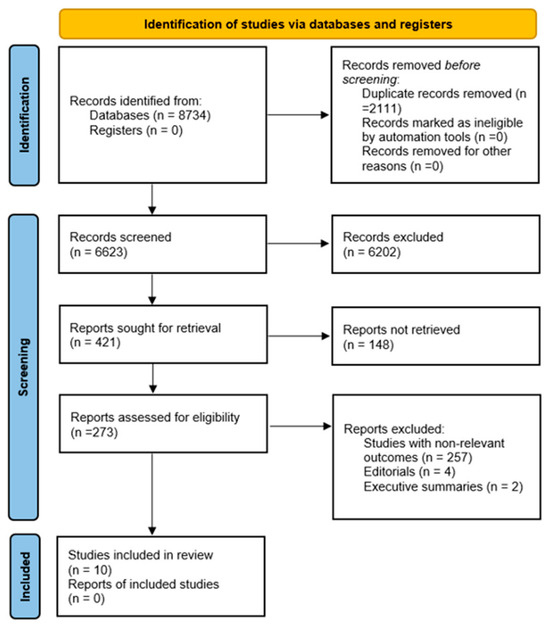
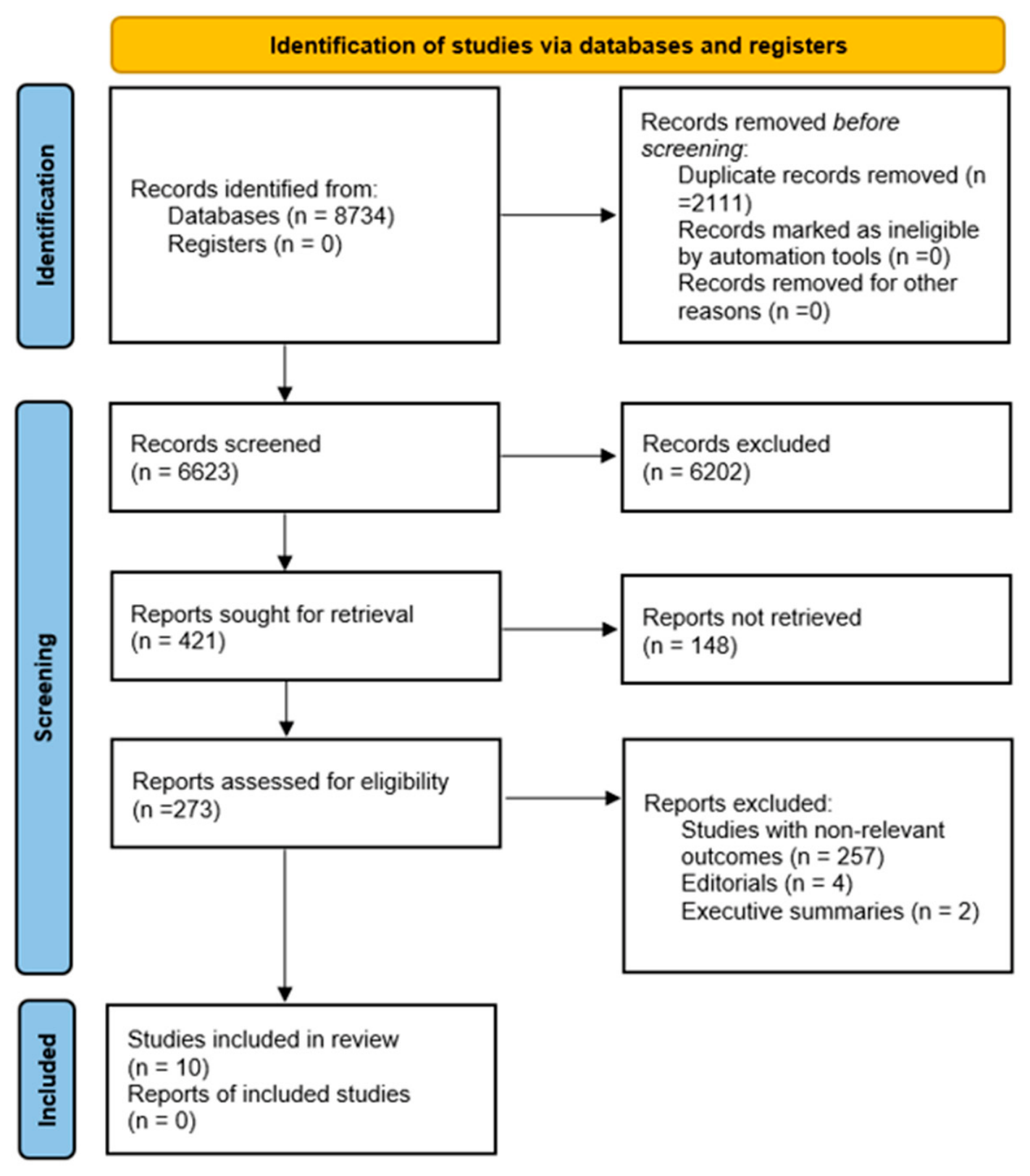
The initial database search and reference list screening identified a total of 8734 records. After 2111 duplicates were removed, 6623 studies remained for title and abstract screening. Of these, 6202 were excluded for not meeting the inclusion criteria. A total of 421 full-text articles were subsequently assessed for eligibility, with 411 excluded following detailed review due to irrelevant outcomes, editorial or commentary formats, or insufficient methodological detail. Ultimately, ten studies met the inclusion criteria and were included in the final analysis (Figure 1).
Figure 1.
PRISMA 2020 flow diagram illustrating the study identification, screening, eligibility and inclusion process.
Each included study was reviewed for descriptive variables such as participants’ mean age, competitive level, sample size, study design, research setting, type of control group (standard training), exercise modality and intensity for both the control and experimental conditions, duration of the intervention, and outcome measures. Meta-analyses were performed via MetaAnalysisOnline.com software [22].
In total, the included studies included 329 participants, all of whom were football players ranging from amateur to semi-professional and professional levels [1,2,3,8,14,24,25,26,27,28]. The ten included studies involved 329 football players across different competitive levels. Five studies included amateur or youth-amateur players [1,3,14,25,28], three included semi-professional players [2,26,27] and two included professional players [8,24]. Thus, half of the available evidence was derived from amateur-level populations, whereas professional players were represented in only two studies. Intervention durations among the included studies ranged from four to ten weeks. The predefined outcome measures across studies are summarised in Table 1, and the pre- and postintervention data for aerobic capacity, muscle strength and agility performance are presented in Table 2a–c.
Table 1.
Characteristics of the included studies.
Table 2.
(a) Effects of high-intensity interval training on aerobic fitness and aerobic performance outcomes. (b) Effects of high-intensity interval training (HIIT) on muscle strength. (c) Effects of high-intensity interval training (HIIT) on agility performance.
3.1.1. Qualitative Analysis of Pre- and Postintervention Differences
Aerobic Capacity: Descriptive Pre- and Post-Intervention Findings
In Table 2a, high-intensity interval training (HIIT) interventions demonstrated variable effects on aerobic capacity, with both modest and substantial gains depending on the training protocol and duration. Thomakos et al. [14] reported improvements in Yo-Yo IR1 performance following both HIIT formats. Distance covered increased from 2083 ± 411 to 2434 ± 345 m following the 10 s/10 s protocol and from 2225 ± 262 to 2418 ± 275 m following the 15 s/15 s protocol. Corresponding estimated VO2max values increased from 53.9 ± 3.5 to 56.8 ± 2.9 mL·kg−1·min−1 and from 55.1 ± 2.2 to 56.7 ± 2.3 mL·kg−1·min−1, respectively [14]. In contrast, Arazi et al. [2] reported improvements among semi-professional female footballers, with VO2max increasing by +6.20 mL·kg−1·min−1 after heart rate-based HIIT and by +4.40 mL·kg−1·min−1 after speed-based HIIT, indicating that both prescription methods were effective in enhancing aerobic performance. Similarly, Hamdani et al. [8] reported that national-level players improved VO2max by +3.00 (heart rate-based) and +8.70 (speed-based), demonstrating greater responsiveness to sprint-oriented protocols even among elite populations.
Slettalokken et al. [26] reported minor gains when HIIT was performed at low frequency during the off-season, with VO2max increasing by +1.77 and +0.60 under HIT 0.5 and HIT 1 conditions, respectively. These results suggest that under reduced training loads, HIIT may help maintain rather than markedly improve aerobic capacity. Conversely, Howard et al. [25] reported small declines in VO2max (–1.30) and shuttle run performance (–2.20) following an in-season intervention, possibly influenced by concurrent training and fatigue. However, shuttle run values in a subsequent HIIT protocol showed a small reduction in HIT 0.5 (–2.90) but substantial increases in HIT 1 (+432.0) and a second HIIT set (+326.0), indicating that both training volume and intensity significantly influenced aerobic performance outcomes.
Muscle Strength: Descriptive Pre- and Post-Intervention Findings
As shown in Table 2b, HIIT, when combined with resistance training, consistently increased both lower- and upper-body strength. Zhang et al. [3] reported improvements in body-mass-normalised isokinetic knee performance following the four-week intervention. At 60°/s, which represented the strength-oriented assessment, the HIIT group demonstrated a 10.2% improvement compared with 3.3% in the MICT group. At 180°/s, which represented the power-oriented assessment, improvements of 7.6% and 5.5% were reported in the HIIT and MICT groups, respectively. Yan et al. [1] similarly reported favourable changes in normalised isokinetic knee performance following both low- and high-frequency HIIT protocols. Because the original studies used differing normalisation procedures and unit conventions, these outcomes were interpreted descriptively rather than compared quantitatively. In professional players, Wong et al. [24] reported substantial increases in maximal strength, with the back half squat improving by +25.00 kg and the bench press by +5.10 kg, demonstrating the synergistic benefits of integrating structured resistance training within HIIT programmes.
Agility: Descriptive Pre- and Post-Intervention Findings
In Table 2c, high-intensity interval training (HIIT) also had a positive effect on agility performance, as reflected by faster completion times and improved movement responsiveness. Gokkurt et al. [27] reported a reduction of –0.04 s in Pro Agility Test times, representing a small yet meaningful improvement in short-directional speed. Wright et al. [28] reported the greatest improvement, with a –0.55 s reduction in the modified test completion time, indicating enhanced neuromuscular coordination and rapid change-of-direction ability. In contrast, Howard et al. [25] reported a negligible change of +0.03 s in the Illinois Agility Test, suggesting that, in certain contexts, agility development may require more targeted change-of-direction training components to elicit significant improvements.
3.2. Methodological Quality of Included Studies
Methodological quality was evaluated for all ten included studies using the Modified Downs and Black checklist (Table 3). Based on the predefined total-score categories, two studies were classified as excellent quality, six as good quality, one as fair quality and one as poor quality.
Table 3.
Quality assessment of included studies using the modified downs and black checklist.
Arazi et al. [2] and Thomakos et al. [14] were rated as excellent quality. Yan et al. [1], Zhang et al. [3], Howard et al. [25], Slettalokken et al. [26], Gokkurt et al. [27] and Wright et al. [28] were classified as good quality. Wong et al. [24] was rated as fair quality, whereas Hamdani et al. [8] was classified as poor quality.
Across the included evidence, reporting quality was generally stronger than domains relating to internal validity, confounding and statistical power. Methodological concerns were more prominent in the non-randomised studies, particularly where allocation procedures, control of potential confounding variables, blinding and reporting of methodological procedures were limited or unclear. Consequently, studies classified as fair or poor quality were interpreted more cautiously within the narrative synthesis and were not considered to provide the same level of confidence as studies with stronger methodological characteristics.
Importantly, the Downs and Black categories were used to describe study-level methodological quality rather than to determine certainty of evidence directly. For GRADE, relevant methodological limitations were considered alongside inconsistency, indirectness, imprecision and potential publication bias for each individual outcome.
3.2.1. Effects of HIIT on Aerobic Capacity
Across the five studies that examined the impact of high-intensity interval training (HIIT) on aerobic capacity, the greatest improvement in VO2max (17.3%, ES = 0.71) was observed after a six-week speed-based HIIT programme in semi-professional female football players [2]. Howard et al. [25] reported significant improvements in Yo-Yo IR1 distance over the 10-week intervention period in both the HIIT and traditional endurance-training groups. However, no significant between-group difference was identified, suggesting that HIIT produced aerobic-performance improvements comparable to, rather than superior to, traditional conditioning. Similarly, a 10-week sprint-based, in-season HIIT intervention in high school players led to a 15.6% increase in VO2max (ES = 0.68) compared with traditional endurance training [25]. Thomakos et al. [14] reported a 13.8% increase in aerobic capacity (ES = 0.64) following short-format 10 s/10 s and 15 s/15 s HIIT protocols during the competitive season among youth players.
Hamdani et al. [8] reported significant improvements in VO2max (12.1%) and beep test scores among professional footballers after an eight-week HIIT programme (ES = 0.59) compared with regular training. In contrast, Slettalokken et al. [26] reported only maintenance of VO2max (0.4%) following biweekly HIIT during the off-season, with a marginal effect size (ES = 0.15) and a 6% decline in shuttle run performance, indicating potential deconditioning associated with reduced training frequency.
Overall, the individual studies reported variable changes in aerobic capacity following HIIT, with the magnitude and direction of effects differing according to intervention characteristics, comparator conditions and training context. Although several studies reported improvements following HIIT, these findings should not be interpreted as demonstrating consistent superiority over control conditions because only a subset of studies provided sufficiently comparable data for quantitative synthesis. Therefore, the narrative findings suggest a potential beneficial effect of HIIT on aerobic capacity, but the strength of this conclusion remains uncertain.
Quantitative Synthesis of Aerobic Fitness
Aerobic fitness outcomes were synthesised narratively because the available studies differed in the reporting and derivation of aerobic-fitness measures, and sufficiently comparable study-level data could not be verified for a reliable quantitative synthesis. Howard et al. [25] reported Yo-Yo Intermittent Recovery Test Level 1 (Yo-Yo IR1) distance rather than directly measured VO2max, whereas other studies reported estimated or directly assessed aerobic-capacity outcomes using different procedures. Consequently, no pooled effect estimate was calculated.
Reporting Bias and Overall Interpretation of Quantitative Evidence
Formal assessment of publication bias was not undertaken because the number of studies contributing to each quantitative synthesis was too small to permit meaningful evaluation of funnel-plot asymmetry or formal statistical testing. Therefore, the possibility of publication bias cannot be excluded.
The quantitative evidence was limited by the small number of studies with sufficiently comparable and verifiable data. Aerobic-fitness outcomes were therefore synthesised narratively rather than pooled quantitatively. The agility analysis included only two independent studies and should be interpreted cautiously because of the small evidence base. For muscle strength, multiple effect estimates were available from a single study and were therefore treated as within-study estimates rather than as an across-study meta-analysis. Collectively, these limitations reduce confidence in the precision and generalisability of the quantitative findings.
3.2.2. Effects of HIIT on Muscle Strength
Across the three studies that evaluated the effects of high-intensity interval training (HIIT) on muscular strength, the most substantial improvements were observed among professional football players following an eight-week preseason concurrent strength and HIIT programme. In this study, the one-repetition maximum (1RM) half-square increased by 20.3%, and the bench pressure increased by 7.8%, with overall effect sizes ranging from 0.65 to 0.74 [24]. In amateur youth football players, Zhang et al. [3] reported an 8.1% increase in knee extensor strength and a 7.5% increase in flexor strength after a four-week HIIT intervention combined with resistance training, resulting in a moderate effect size of 0.58 compared with the moderate-intensity continuous training (MICT) group. Similarly, Yan et al. [1] reported that a high-frequency HIIT protocol (five sessions per week) produced a 6.3% improvement in knee torque compared with 3.2% in the low-frequency group, corresponding to a small-to-moderate effect size of 0.46.
Three studies evaluated muscular-strength outcomes following HIIT-based interventions [1,3,24]. Zhang et al. [3] assessed isokinetic knee flexor and extensor strength at different angular velocities and reported generally favourable changes following a four-week HIIT programme combined with resistance training. However, because these outcomes were obtained from the same participant sample, they were treated as multiple measurements within a single study rather than as independent effect estimates.
Yan et al. [1] also reported improvements in isokinetic strength measures following low- and high-frequency HIIT protocols, while Wong et al. [24] reported improvements in one-repetition maximum half-squat and bench-press performance following concurrent HIIT and resistance training. Differences in study design, intervention content and strength-assessment methods prevented meaningful quantitative pooling across independent studies. Accordingly, muscle-strength findings were synthesised narratively, and no pooled estimate of the overall effect of HIIT on muscular strength was calculated.
Although the individual studies reported favourable changes in selected strength outcomes, these findings should be interpreted cautiously because all three studies were non-randomised and some interventions included concurrent resistance training. Therefore, the independent contribution of HIIT to the observed strength adaptations cannot be clearly established.
3.2.3. Effects of HIIT on Agility
Three studies reported generally favourable changes in agility performance following HIIT, although the magnitude of improvement varied across studies and only two studies provided sufficiently comparable data for quantitative synthesis. In the first study, high school football players who completed a 10-week sprint-based HIIT programme demonstrated a 3.2% improvement in Illinois Agility Test performance compared with the control group, with a moderate effect size (ES = 0.66) [25]. In the second study, under-19 semi-professional players who participated in an eight-week HIIT intervention demonstrated a small reduction in Pro-Agility Test completion time from 4.73 ± 0.39 s to 4.69 ± 0.39 s, corresponding to an approximately 0.85% within-group improvement, corresponding to a large effect size (ES = 0.88) [27]. Similarly, Wright et al. [28] reported a 2.7% increase in agility performance on the modified to test following an eight-week mixed-methods HIIT programme among young female footballers, with a moderate effect size (ES = 0.57).
Collectively, the individual studies reported variable changes in agility performance following HIIT. Although favourable within-group changes were reported in some studies, between-group differences were not consistently in favour of HIIT. These findings should therefore be interpreted cautiously, particularly because agility was assessed as completion time, for which lower values represent better performance.
3.2.4. Limited Meta-Analysis of Agility
Two independent RCTs, Howard et al. [25] and Gokkurt et al. [27], provided sufficiently comparable post-intervention agility-time data for quantitative synthesis (Figure 2). Because agility performance was assessed using completion time, for which lower values represent better performance, the direction of effect was harmonised so that positive values represented an effect favouring HIIT and negative values represented an effect favouring the comparator condition.
Figure 2.
Forest plot of the limited two-study meta-analysis [25,27] examining the effect of HIIT on agility performance in football players. Agility was assessed as completion time, for which lower values indicate better performance. Effect directions were harmonised so that positive values favour HIIT and negative values favour the comparator condition.Individual study markers represent study-level standardised mean differences, with horizontal lines representing 95% confidence intervals. The diamond represents the pooled random-effects estimate and its 95% confidence interval. The vertical reference line at zero represents the null effect.
Following correction of the direction of effect and verification of the study-level data, the pooled standardised mean difference was −0.29 (95% CI −0.83 to 0.25; p = 0.290). The point estimate therefore favoured the comparator conditions, although the confidence interval crossed the null and the overall effect was not statistically significant. Statistical heterogeneity was estimated as I2 = 0%; however, this estimate should be interpreted cautiously because only two studies contributed to the analysis.
These findings do not provide evidence that HIIT is superior to comparator training for improving agility performance. The wide confidence interval and very small evidence base indicate substantial uncertainty regarding the true effect. Wright et al. [28] provided additional narrative evidence but could not be incorporated into the quantitative synthesis because sufficiently comparable data were unavailable.
3.3. Certainty of Evidence (GRADE)
The certainty of evidence was assessed separately for each principal outcome using the GRADE framework (Table 4). The Modified Downs and Black assessment informed consideration of methodological limitations but was not translated directly into GRADE certainty categories.
Table 4.
Summary of findings and certainty of evidence (GRADE).
For aerobic fitness, five studies involving 127 participants contributed to the evidence base, comprising four RCTs [2,14,25,26] and one NRCT [8]. A pooled effect estimate was not calculated because the studies differed in the assessment and reporting of aerobic-fitness outcomes and sufficiently comparable source-verifiable data were unavailable for reliable quantitative synthesis. Individual studies generally reported favourable changes in VO2max or field-based aerobic-performance measures following HIIT, although the magnitude and direction of effects varied across intervention protocols and comparator conditions. Importantly, superiority of HIIT over comparator training was not consistently demonstrated. The certainty of evidence was therefore judged to be low because of methodological limitations, small study samples, imprecision and heterogeneity in outcome measurement and intervention characteristics.
Evidence for muscular strength was derived from three NRCTs [1,3,24], involving 143 participants. Because the studies used different strength-assessment methods and intervention designs, and because multiple strength outcomes reported by Zhang et al. [3] originated from a single participant sample, no quantitative pooling was undertaken. Individual studies generally reported favourable changes in selected strength outcomes, but the certainty of evidence was judged to be low because the evidence was entirely non-randomised, study samples were relatively small, outcome measures were heterogeneous, and concurrent resistance-training components limited the extent to which improvements could be attributed specifically to HIIT.
For agility, two RCTs [25,27], involving 54 participants, contributed to the pooled analysis and demonstrated an SMD of 0.77 (95% CI 0.21 to 1.33). The certainty of evidence was judged to be low, with imprecision resulting from the small number of studies and participants representing the principal limitation. Wright et al. [28] additionally contributed supportive narrative evidence but could not be incorporated into the pooled analysis because sufficient comparable data were unavailable.
Certainty of evidence was not graded for injury prevention because none of the included intervention studies directly evaluated injury incidence as an outcome. Accordingly, statements regarding injury prevention should be interpreted as theoretical or indirect implications of changes in aerobic capacity, strength and agility rather than evidence of a demonstrated reduction in injury occurrence.
4. Discussion
This systematic review examined the effects of high-intensity interval training (HIIT) on aerobic fitness, muscular strength and agility in football players. Overall, individual studies frequently reported favourable changes following HIIT-based interventions, but the strength of the evidence varied considerably across outcomes and should be interpreted cautiously.
For aerobic capacity, only two independent RCTs provided sufficiently comparable data for quantitative synthesis. Although the pooled estimate favoured HIIT (SMD = 0.51, 95% CI −0.03 to 1.05), the effect did not reach statistical significance (p = 0.064). The wide confidence interval and very wide prediction interval further indicate uncertainty regarding the magnitude and direction of effects that may occur in future studies. Therefore, the current evidence suggests a possible beneficial effect of HIIT on aerobic fitness but does not establish superiority over comparator training.
For muscular strength, favourable changes were reported in several individual outcomes, particularly where HIIT was combined with resistance training. However, an across-study meta-analysis was not possible because sufficiently comparable data from independent studies were unavailable. The four quantitative strength estimates reported by Zhang et al. [3] originated from a single-participant sample and were therefore interpreted as within-study effects rather than as a pooled treatment estimate. Consequently, the evidence regarding the independent effect of HIIT on muscular strength remains limited.
For agility, the pooled analysis of two RCTs favoured HIIT (SMD = 0.77, 95% CI 0.21 to 1.33; p = 0.0069). However, only two studies contributed to this estimate, and the very wide prediction interval indicates considerable uncertainty regarding the effect that might be observed in future populations. The agility findings should therefore be considered encouraging but preliminary rather than definitive.
These findings should also be considered in the context of the relatively small evidence base. Individual study sample sizes ranged from 16 to 54 participants, with a median sample size of approximately 34 participants. In addition, only two independent studies contributed to each eligible meta-analysis. These factors limit statistical power, precision and generalisability and are important when interpreting both statistically significant and non-significant findings.
4.1. Aerobic Capacity
Aerobic capacity demonstrated the most consistent and substantial improvements following high-intensity interval training (HIIT) interventions. Several studies [2,25] reported increases in VO2max of 12–17% after sprint-based or speed-based HIIT protocols, reflecting the robust central and peripheral adaptations elicited by this training method [11,28]. The extent of improvement appeared to depend on both the intervention duration and training frequency. Longer protocols, which typically last 8–10 weeks and are delivered two to three times per week, are associated with greater aerobic gains of up to 10–17% [8,14]. In contrast, shorter programmes of six weeks or less generally produced more modest improvements of approximately 5–7%, which is consistent with an early phase of adaptation that precedes more substantial long-term gains [1,3].
This pattern supports a dose–response relationship, where higher training frequency, longer exposure and greater accumulated high-intensity workload enhance cardiovascular adaptations such as increased cardiac output, capillary density and arterial compliance [28]. These physiological changes improve the ability of the cardiovascular system to deliver oxygen, leading to faster muscle and pulmonary VO2 kinetics and, consequently, higher VO2max values [28]. As a result, players can sustain high-intensity exercise for longer durations and recover more effectively between bouts of intense play [28].
Additional peripheral adaptations, including increased muscle oxidative and buffering capacities, may also occur through the upregulation of peroxisome proliferator-activated receptor gamma coactivator 1-alpha (PGC-1α), which is central to mitochondrial biogenesis and energy metabolism [2]. Together, these central and peripheral responses enhance oxygen delivery and utilisation, allowing players to maintain repeated high-intensity efforts and efficiently recover physiological capabilities that are critical for match performance [10,29].
However, the findings also highlight that training frequency and timing relative to the competitive season influence outcomes. Slettalokken et al. [26] reported maintenance rather than improvement in VO2max during the off-season, alongside a decline in shuttle run performance, likely reflecting a reduced overall training load and session frequency. This suggests that without adequate and sustained stimuli, aerobic adaptations may plateau or regress, underscoring the importance of maintaining conditioning throughout the annual training cycle.
Importantly, the quantitative evidence for aerobic capacity was less definitive than the individual study findings might suggest. Only two RCTs could be pooled, and although the pooled estimate favoured HIIT, the confidence interval crossed the null, and the effect was not statistically significant. The very wide prediction interval further indicates substantial uncertainty regarding the effect in future populations. Accordingly, the present review cannot establish that HIIT is superior to comparator training for improving aerobic capacity, and the apparent benefits observed in individual studies require confirmation in larger and methodologically robust trials.
4.2. Muscle Strength
Improvements in muscle strength were observed in all studies that assessed this outcome, with the most substantial gains reported when high-intensity interval training (HIIT) was combined with resistance training [24]. The magnitude of improvement ranged from moderate to large, depending on whether structured resistance training was incorporated. The largest increase, a 20.3% increase in one-repetition maximum (1-RM) half-square performance, was reported when concurrent HIIT was integrated into a preseason resistance training programme [24]. In contrast, shorter rehabilitation-focused HIIT interventions produced smaller strength gains of approximately 6–8%, likely reflecting limited mechanical loading and insufficient hypertrophic stimulus in both training designs [1,2,3].
According to concurrent training theory, performing large volumes of endurance or high-intensity work in close proximity to strength sessions without adequate recovery may lead to an interference effect that attenuates muscle hypertrophy and power development [7,8,9,10]. Studies that periodised HIIT and resistance training on alternate days or across separate microcycles reported superior neuromuscular adaptations compared with those that combined both modalities within a single session [1]. This suggests that structured periodisation, incorporating controlled sequencing, frequency and recovery, is essential for optimising both aerobic and strength adaptations in football players [7,24].
Collectively, the evidence indicates that integrating targeted resistance training with HIIT, while appropriately managing training load and recovery, can produce synergistic improvements in power output and muscular endurance. These adaptations are critical for explosive football-specific actions such as sprinting, jumping and tackling [10,24].
The improvement in muscle strength following HIIT appears to result primarily from neural adaptations, including enhanced motor unit recruitment and improved coordination between agonist and antagonist muscle groups [1]. Another plausible mechanism involves improved molecular signalling, such as increased mitochondrial biogenesis and increased substrate utilisation, including carbohydrate and fat oxidation [1]. High-intensity training does not necessarily increase the overall muscle cross-sectional area but selectively increases the proportion of type II fast-twitch fibres, which are responsible for rapid and powerful movements [3]. Furthermore, HIIT may enhance intermuscular coordination and neural drive, leading to more efficient force production during football-specific activities [3].
The strength evidence should also be interpreted cautiously. Although several favourable strength outcomes were reported, the multiple strength outcomes reported by Zhang et al. [3] originated from a single-participant sample and were therefore synthesised narratively rather than treated as independent quantitative effects. Consequently, no robust pooled estimate of the effect of HIIT on muscular strength can currently be established. Moreover, concurrent resistance training in some interventions makes it difficult to isolate the independent contribution of HIIT to observed strength gains.
4.3. Agility
Agility performance improved consistently across all included studies. The greatest enhancements were observed in sprint-based high-intensity interval training (HIIT) programmes that incorporated change-of-direction (COD) drills [25,27,30], which closely replicate the multidirectional and reactive movement demands of football. Studies have indicated that COD-integrated HIIT protocols combining 10–20 m sprints with multidirectional movements produced greater agility improvements than linear sprint formats did [27,28,31]. Gokkurt et al. [27] reported a small improvement in Pro-Agility Test performance, with completion time decreasing from 4.73 ± 0.39 s at baseline to 4.69 ± 0.39 s following the eight-week HIIT intervention, corresponding to an improvement of approximately 0.85%. Similarly, Wright et al. [28] reported agility enhancements of up to 7% in female footballers after a mixed-methods HIIT programme incorporating both linear and COD components. In contrast, a linear sprint HIIT model involving repeated 30 s runs at 90–95% HRmax improved agility by only 3–4%, reflecting limited transfer to COD performance [25].
These improvements are likely underpinned by neuromuscular adaptations such as enhanced coordination, improved proprioceptive feedback and faster motor unit recruitment, enabling athletes to execute rapid directional changes with greater efficiency and postural stability [26,27,28,30]. From an applied perspective, agility-focused HIIT may also enhance decision-making under physical stress, as players are required to perform directional changes in response to unpredictable stimuli that simulate real match situations [10,32].
The variability in outcomes across studies reinforces the principle of specificity and transfer to match demands, which posits that the closer the biomechanical and perceptual elements of training are to actual game conditions, the greater the gains in neuromuscular coordination and reactive agility [33,34]. Consequently, conditioning programmes that integrate sport-specific multidirectional drills are more effective for developing reactive agility and movement control than those relying solely on linear running intervals [27,28,34].
Although the pooled agility estimate was statistically significant, it was based on only two independent studies. The very wide prediction interval indicates substantial uncertainty regarding the magnitude and direction of effects that might be expected in future studies. Therefore, the finding should be regarded as preliminary rather than definitive, consistent with the low certainty assigned to this outcome using GRADE.
4.4. Injury-Related Implications and Evidence Gaps
None of the studies included in this systematic review directly evaluated injury incidence, injury burden, time-loss injury or reinjury as an outcome. Consequently, the present review provides no direct evidence that HIIT prevents injuries in football players, and changes in aerobic fitness, muscular strength or agility should not be interpreted as surrogate evidence of injury reduction.
The performance adaptations observed in the included studies may nevertheless have theoretical relevance to factors associated with injury mechanisms. For instance, improved aerobic fitness may contribute to greater fatigue tolerance, while increased muscular strength and improved movement control may influence an athlete’s capacity to tolerate football-specific physical demands [5,13,29,32,33,34,35,36,37]. These relationships, however, are derived from mechanistic reasoning and the wider injury-prevention literature rather than from direct injury outcomes in the studies included in this review.
Similarly, although concurrent HIIT and resistance training may improve physical characteristics relevant to football performance [24], the available evidence does not establish that these adaptations result in fewer injuries. The effects of HIIT on injury risk therefore remain uncertain.
Future trials should incorporate prospective injury surveillance using clearly defined outcomes such as injury incidence per exposure hours, injury burden, time-loss injury and reinjury, alongside measures of aerobic fitness, strength and neuromuscular performance. Such studies are required to determine whether changes in physical-performance characteristics following HIIT translate into clinically and practically meaningful reductions in football injury risk.
4.5. Strengths and Limitations
The strength of this review is the synthesis of evidence across multiple football-related performance domains, including aerobic fitness, muscular strength and agility, and the inclusion of both narrative and quantitative approaches where appropriate. The revised analysis also distinguishes between evidence derived from independent studies and multiple outcomes obtained within a single study, reducing the risk of overstating the strength of the quantitative evidence.
While this review provides strong preliminary evidence supporting the effectiveness of high-intensity interval training (HIIT) in football, several limitations within the current literature should be acknowledged. Most interventions last only 4–10 weeks, a duration sufficient to elicit early neural and metabolic adaptations but insufficient to capture long-term morphological changes such as muscle fibre hypertrophy, tendon stiffness or sustained neuromuscular control [3,24,38]. As football performance and injury resilience rely on these slower-developing traits, short-term HIIT studies may overestimate the immediate benefits while underrepresenting the durability of physiological gains [7,14]. The relatively small sample sizes of most included studies also limit their statistical power and precision, increasing the potential for random variation to influence observed outcomes [2]. Furthermore, representation of female football players remains limited. One study [2] reported a 12% improvement in VO2max among semi-professional female players following six weeks of heart rate- and speed-based HIIT, whereas another study [28] reported agility gains of 6–7% in adolescent girls after a mixed-method HIIT programme. These findings indicate differential responsiveness across performance domains and highlight the need for greater inclusion of women’s football, where hormonal fluctuations, sex-specific neuromuscular control and biomechanical factors such as joint laxity may influence both adaptation and injury risk [36,37].
Comparative analysis also suggested age- and maturity-related variability in responsiveness. Youth cohorts (U17–U19) demonstrated faster but smaller relative gains in VO2max (up to 8%) and agility (4–5%), whereas elite adult players required higher intensities to achieve modest improvements, typically 3–5% [1,12,14]. These contrasts imply that HIIT responsiveness is influenced by maturation and training status, underscoring the importance of individualising training load, intensity and recovery on the basis of developmental stage and competitive level [10,12].
An important limitation of the present review is the small evidence base available for quantitative synthesis. Only two independent studies contributed to each of the aerobic-capacity and agility meta-analyses, limiting the precision of pooled estimates and the reliability of heterogeneity statistics. Muscle-strength outcomes could not be meta-analysed across independent studies because the available quantitative estimates were derived primarily from multiple outcomes within a single study. Publication bias could not be meaningfully assessed because too few studies contributed to each synthesis. These limitations restrict the strength and generalizability of conclusions drawn from quantitative analyses.
Competitive level represents an additional limitation to the generalisability of the findings. Five of the ten included studies involved amateur or youth-amateur players, three involved semi-professional players, and only two involved professional players. Consequently, the available evidence is weighted towards developing and amateur football populations, and the extent to which the findings can be generalised to professional players remains uncertain. Although a subgroup analysis according to competitive level was considered, the small number of independent and outcome-comparable studies within each subgroup precluded a meaningful quantitative comparison. Training history, baseline fitness, accumulated training load and adaptation potential may differ substantially between amateur and professional players, and future adequately powered trials should therefore examine whether competitive level modifies the response to HIIT.
4.6. Practical Applications and Future Directions
On the basis of the available evidence, high-intensity interval training (HIIT) can be effectively incorporated into football conditioning programmes two to three times per week during the competitive season, with intensities maintained between 80% and 100% of the maximum heart rate (HRmax) to elicit both aerobic and anaerobic adaptations [2,7,14]. To maximise training efficiency, sessions should integrate aerobic endurance, muscular strength and agility components, which are structured according to positional demands and seasonal periodisation phases [10,24]. In rehabilitation settings, HIIT should be introduced progressively during the late recovery phase, as demonstrated in previous studies [1,3], ensuring that exercise complements sport-specific strength and neuromuscular control tasks. This approach facilitates gradual reconditioning while reducing the risk of reinjury [5].
From a coaching perspective, incorporating football-specific multidirectional drills and small-sided games within HIIT sessions can enhance transfer to match demands by improving reactive agility, movement control and decision-making under fatigue [27,28,34]. Monitoring player workload through heart rate, running velocity or ratings of perceived exertion is recommended to individualise training load and minimise the risk of overtraining [9].
HIIT represents a time-efficient and scalable conditioning strategy capable of improving cardiovascular fitness, muscular performance and movement efficiency while potentially reducing injury risk when integrated with balance and neuromuscular training [35]. To strengthen future research, HIIT interventions should adopt standardised reporting frameworks detailing work-to-rest ratios (1:1–1:3), frequencies (two to three sessions per week) and progression models to facilitate comparisons across studies [7,9]. Longer intervention periods (≥10–12 weeks) are also advised to capture sustained aerobic and neuromuscular adaptations that may not fully develop within shorter 4–8-week protocols [2,14].
Future trials should further examine sex-specific and age-specific responses, as the underrepresentation of female athletes currently limits the generalisability of findings to women’s football [2,14]. The inclusion of biomechanical and neuromuscular outcome measures alongside longitudinal injury surveillance would also clarify how HIIT influences load tolerance, coordination and fatigue resistance, thereby informing evidence-based approaches to injury prevention and performance enhancement in football [29,36].
5. Conclusions
This systematic review suggests that HIIT may improve several football-related physical-performance outcomes, including aerobic fitness, muscular strength and agility; however, the certainty and precision of the available evidence remain limited. Quantitative synthesis was constrained by the small number of independent studies, with no statistically significant pooled effect demonstrated for aerobic capacity and only two studies contributing to the significant pooled agility estimate. Muscle-strength findings could not be meta-analysed across independent studies.
Importantly, none of the included studies directly evaluated injury incidence or injury burden. Therefore, no conclusion can be drawn regarding the effectiveness of HIIT for injury prevention. Any potential relationship between HIIT-induced improvements in physical performance and injury-related mechanisms remains theoretical and requires direct investigation in appropriately designed prospective trials.
Key Points
- High-intensity interval training (HIIT) is an effective and time-efficient conditioning method for football players, producing meaningful improvements in aerobic capacity, muscular strength and agility across different age groups and competitive levels.
- HIIT programmes incorporating football-specific multidirectional drills and resistance components yield the greatest performance benefits and stronger transfer to match demands.
- Physiological adaptations associated with HIIT, including enhanced cardiovascular efficiency, neuromuscular control and fatigue resistance, may contribute to reduced injury risk during high-intensity play.
- To optimise outcomes, HIIT should be integrated two to three times per week within periodised football training frameworks, with appropriate load monitoring and progression to support both performance and rehabilitation goals.
- Further research is needed to standardise HIIT protocols, examine long-term adaptations and explore sex- and age-specific responses to improve evidence-based application in football conditioning and injury prevention.
Author Contributions
Conceptualization, H.S.V., J.C. and S.K.A.; methodology, H.S.V.; formal analysis, H.S.V., J.C. and S.K.A.; investigation, H.S.V., J.C. and S.K.A.; writing—original draft preparation, H.S.V.; writing—review and editing, H.S.V., J.C. and S.K.A.; supervision, J.C. and S.K.A. All authors have read and agreed to the published version of the manuscript.
Funding
This research received no external funding.
Institutional Review Board Statement
Not applicable. Ethical approval was not required because this study was a systematic review and meta-analysis of previously published data and did not involve the direct recruitment of human participants or animals.
Informed Consent Statement
Not applicable. This study was a systematic review and meta-analysis of previously published data and did not involve the direct recruitment of human participants or the collection of identifiable patient information.
Data Availability Statement
The data supporting the findings of this systematic review and meta-analysis were obtained from the published studies cited in the manuscript. The extracted data used in the analyses are available within the article and may also be obtained from the corresponding author upon reasonable request.
Acknowledgments
During the preparation of this manuscript, the authors used OpenAI ChatGPT (GPT-5.6 Sol; OpenAI, San Francisco, CA, USA) for language editing, grammatical correction and improvement of clarity and readability. The authors critically reviewed and edited all AI-assisted output and take full responsibility for the content of the publication.
Conflicts of Interest
The authors declare no conflicts of interest.
Abbreviations
The following abbreviations are used in this manuscript:
| 1RM | One-repetition maximum |
| ACL | Anterior cruciate ligament |
| CI | Confidence interval |
| COD | Change of direction |
| ES | Effect size |
| GRADE | Grading of Recommendations Assessment, Development and Evaluation |
| HFG | High-frequency group |
| HIIT | High-intensity interval training |
| HIT | High-intensity training |
| HR | Heart rate |
| HRmax | Maximum heart rate |
| I2 | I-squared statistic |
| JBI | Joanna Briggs Institute |
| LFG | Low-frequency group |
| MAS | Maximal aerobic speed |
| MICT | Moderate-intensity continuous training |
| NRCT | Non-randomised controlled trial |
| OSF | Open Science Framework |
| PGC-1α | Peroxisome proliferator-activated receptor gamma coactivator 1-alpha |
| PRISMA | Preferred Reporting Items for Systematic Reviews and Meta-Analyses |
| RCT | Randomised controlled trial |
| RoB 2 | Risk of Bias 2 |
| ROBINS-I | Risk of Bias in Non-randomised Studies of Interventions |
| SMD | Standardised mean difference |
| VIFT | Vameval Intermittent Fitness Test |
| VO2max | Maximal oxygen uptake |
Appendix A
Table A1.
PRISMA 2020 Checklist.
Table A2.
Complete Database-Specific Search Strategies.
Table A3.
JBI Data Extraction Form for Systematic Reviews and Research Synthesis.
References
- Yan, S.; Kim, Y.; Choi, Y. Aerobic and Anaerobic Fitness According to High-Intensity Interval Training Frequency in Youth Soccer Players in the Last Stage of Rehabilitation. Int. J. Environ. Res. Public Health 2022, 19, 15573. [Google Scholar] [CrossRef] [Scilit]
- Arazi, H.; Keihaniyan, A.; Eatemady Boroujeni, A.; Oftade, A.; Takhsha, S.; Asadi, A.; Ramirez-Campillo, R. Effects of Heart Rate vs. Speed-Based High Intensity Interval Training on Aerobic and Anaerobic Capacity of Female Soccer Players. Sports 2017, 5, 57. [Google Scholar] [CrossRef] [Scilit]
- Zhang, G.; Kim, Y.; Lee, J. Impact of Short Term High-Intensity Interval Training on the Aerobic and Anaerobic Fitness of Young Male Football Players in the Final Stages of Rehabilitation. J. Men’s Health 2024, 20, 108. [Google Scholar] [CrossRef] [Scilit]
- Ekstrand, J.; Hägglund, M.; Waldén, M. Epidemiology of Muscle Injuries in Professional Football (Soccer). Am. J. Sports Med. 2011, 39, 1226–1232. [Google Scholar] [CrossRef] [Scilit]
- Nassis, G.P.; Brito, J.; Figueiredo, P.; Gabbett, T.J. Injury Prevention Training in Football: Let’s Bring It to the Real World. Br. J. Sports Med. 2019, 53, 1328–1329. [Google Scholar] [CrossRef] [Scilit]
- Kwakye, S.K.; Mostert, K.; Garnett, D.; Masenge, A. Risk Factors Associated with Football Injury among Male Players from a Specific Academy in Ghana: A Pilot Study. Sci. Rep. 2023, 13, 8070. [Google Scholar] [CrossRef] [Scilit]
- Buchheit, M.; Laursen, P.B. High-Intensity Interval Training, Solutions to the Programming Puzzle: Part I: Cardiopulmonary Emphasis. Sports Med. 2013, 43, 313–338. [Google Scholar] [CrossRef] [Scilit]
- Hamdani, S.G.A.; Anjum, G.S.; Mughal, E.A.; Shah, I. The Impact of High-Intensity Interval Training (HIIT) on the Aerobic Capacity of National Football Players. Pak. J. Med. Sci. 2014, 9, 39–51. [Google Scholar]
- Dai, L.; Xie, B. Adaptations to Optimized Interval Training in Soccer Players: A Comparative Analysis of Standardized Methods for Individualizing Interval Interventions. J. Sports Sci. Med. 2023, 22, 760–768. [Google Scholar] [CrossRef] [Scilit]
- Bangsbo, J. Fitness Training in Football: A Scientific Approach; August Krogh Institute, University of Copenhagen: Copenhagen, Denmark, 1994. [Google Scholar]
- Weston, K.S.; Wisløff, U.; Coombes, J.S. High-Intensity Interval Training in Patients with Lifestyle-Induced Cardiometabolic Disease: A Systematic Review and Meta-Analysis. Br. J. Sports Med. 2014, 48, 1227–1234. [Google Scholar] [CrossRef] [Scilit]
- Zhou, Y.; Liu, J.; Yang, L.; Zheng, B. Can Maturation Level Influence Long-Term Physiological and Physical Adaptations in Youth Female Soccer Players Exposed to Combined Sided Games and HIIT? A Comparison Across Maturation Statuses. J. Sports Sci. Med. 2025, 24, 634–644. [Google Scholar] [CrossRef] [Scilit]
- Alwi, M.; Mazalan, N.S.; Karunamoorthy, R.A.P.; Naeimmuddi Zakaria, M. The Effectiveness of High-Intensity Interval Training (HIIT) Program in Weight Loss, Muscle Strength, and Reducing Injury Risks. Int. J. Acad. Res. Progress. Educ. Dev. 2024, 13, 1395–1410. [Google Scholar] [CrossRef] [Scilit]
- Thomakos, P.; Tsekos, P.; Tselios, Z.; Spyrou, K.; Katsikas, C.; Tsoukos, A.; Bogdanis, G.C. Effects of Two In-Season Short High-Intensity Interval Training Formats on Aerobic and Neuromuscular Performance in Young Soccer Players. J. Sports Sci. Med. 2024, 23, 812–821. [Google Scholar] [CrossRef] [Scilit]
- Manuel Clemente, F.; Ramirez-Campillo, R.; Nakamura, F.Y.; Sarmento, H. Effects of High-Intensity Interval Training in Men Soccer Player’s Physical Fitness: A Systematic Review with Meta-Analysis of Randomized-Controlled and Non-Controlled Trials. J. Sports Sci. 2021, 39, 1202–1222. [Google Scholar] [CrossRef] [Scilit]
- Thorborg, K.; Krommes, K.K.; Esteve, E.; Clausen, M.B.; Bartels, E.M.; Rathleff, M.S. Effect of Specific Exercise-Based Football Injury Prevention Programmes on the Overall Injury Rate in Football: A Systematic Review and Meta-Analysis of the FIFA 11 and 11+ Programmes. Br. J. Sports Med. 2017, 51, 562–571. [Google Scholar] [CrossRef] [Scilit]
- Vartak, H.S.; Amaravadi, S.K. Impact of High-Intensity Interval Training (HIIT) on Aerobic Capacity, Muscle Strength and Agility Performance for Injury Prevention among Football Athletes: A Systematic Review and Meta-Analysis. OSF Regist. 2025. [Google Scholar] [CrossRef]
- Rethlefsen, M.L.; Kirtley, S.; Waffenschmidt, S.; Ayala, A.P.; Moher, D.; Page, M.J.; Koffel, J.B.; PRISMA-S Group; Blunt, H.; Brigham, T.; et al. PRISMA-S: An Extension to the PRISMA Statement for Reporting Literature Searches in Systematic Reviews. Syst. Rev. 2021, 10, 39. [Google Scholar] [CrossRef] [Scilit]
- Page, M.J.; McKenzie, J.E.; Bossuyt, P.M.; Boutron, I.; Hoffmann, T.C.; Mulrow, C.D.; Shamseer, L.; Tetzlaff, J.M.; Akl, E.A.; Brennan, S.E.; et al. The PRISMA 2020 Statement: An Updated Guideline for Reporting Systematic Reviews. BMJ 2021, 372, n71. [Google Scholar] [CrossRef] [Scilit]
- Downs, S.H.; Black, N. The Feasibility of Creating a Checklist for the Assessment of the Methodological Quality Both of Randomised and Non-Randomised Studies of Health Care Interventions. J. Epidemiol. Community Health 1998, 52, 377–384. [Google Scholar] [CrossRef] [Scilit]
- Munn, Z.; Tufanaru, C.; Aromataris, E. JBI’s Systematic Reviews: Data Extraction and Synthesis. AJN Am. J. Nurs. 2014, 114, 49–54. [Google Scholar] [CrossRef] [Scilit]
- Fekete, J.T.; Győrffy, B. MetaAnalysisOnline.Com: Web-Based Tool for the Rapid Meta-Analysis of Clinical and Epidemiological Studies. J. Med. Internet Res. 2025, 27, e64016. [Google Scholar] [CrossRef] [Scilit]
- Schünemann, H.J.; Higgins, J.P.; Vist, G.E.; Glasziou, P.; Akl, E.A.; Skoetz, N.; Guyatt, G.H. on behalf of the Cochrane GRADEing Methods Group (formerly Applicability and Recommendations Methods Group) and the Cochrane Statistical Methods Group. Completing ‘Summary of Findings’ Tables and Grading the Certainty of the Evidence. In Cochrane Handbook for Systematic Reviews of Interventions; Higgins, J.P.T., Thomas, J., Chandler, J., Cumpston, M., Li, T., Page, M.J., Welch, V.A., Eds.; Wiley: Hoboken, NJ, USA, 2019; pp. 375–402. [Google Scholar]
- Wong, P.; Chaouachi, A.; Chamari, K.; Dellal, A.; Wisloff, U. Effect of Preseason Concurrent Muscular Strength and High-Intensity Interval Training in Professional Soccer Players. J. Strength Cond. Res. 2010, 24, 653–660. [Google Scholar] [CrossRef] [Scilit]
- Howard, N.; Stavrianeas, S. In-Season High-Intensity Interval Training Improves Conditioning in High School Soccer Players. Int. J. Exerc. Sci. 2017, 10, 713–720. [Google Scholar] [CrossRef] [Scilit]
- Slettaløkken, G.; Rønnestad, B.R. High-Intensity Interval Training Every Second Week Maintains V[Combining Dot Above] O2max in Soccer Players During Off-Season. J. Strength Cond. Res. 2014, 28, 1946–1951. [Google Scholar] [CrossRef] [Scilit]
- Gökkurt, K.; Kıvrak, A.O. The Effect of High Intensity Interval Training During Eight Weeks on Speed, Agility, and Acceleration in U19 Soccer Players. Pak. J. Med. Health Sci. 2021, 15, 2390–2395. [Google Scholar] [CrossRef] [Scilit]
- Wright, M.D.; Hurst, C.; Taylor, J.M. Contrasting Effects of a Mixed-Methods High-Intensity Interval Training Intervention in Girl Football Players. J. Sports Sci. 2016, 34, 1808–1815. [Google Scholar] [CrossRef] [Scilit]
- John, G.; AlNadwi, A.; Georges Abi Antoun, T.; Ahmetov, I.I. Injury Prevention Strategies in Female Football Players: Addressing Sex-Specific Risks. Sports 2025, 13, 39. [Google Scholar] [CrossRef] [Scilit]
- Paprancová, A.; Šimonek, J.; Paška, Ľ.; Czaková, M.; Krčmár, M. The Impact of Running-Based High-Intensity Interval Training with Changes of Direction on Physical Performance of Female Soccer Players. Retos 2025, 65, 262–270. [Google Scholar] [CrossRef] [Scilit]
- Ouertatani, Z.; Selmi, O.; Marsigliante, S.; Aydi, B.; Hammami, N.; Muscella, A. Comparison of the Physical, Physiological, and Psychological Responses of the High-Intensity Interval (HIIT) and Small-Sided Games (SSG) Training Programs in Young Elite Soccer Players. Int. J. Environ. Res. Public Health 2022, 19, 13807. [Google Scholar] [CrossRef] [Scilit]
- Donelon, T.A.; Dos’Santos, T.; Pitchers, G.; Brown, M.; Jones, P.A. Biomechanical Determinants of Knee Joint Loads Associated with Increased Anterior Cruciate Ligament Loading During Cutting: A Systematic Review and Technical Framework. Sports Med.-Open 2020, 6, 53. [Google Scholar] [CrossRef] [Scilit]
- Dos’Santos, T.; Thomas, C.; Comfort, P.; Jones, P.A. The Effect of Training Interventions on Change of Direction Biomechanics Associated with Increased Anterior Cruciate Ligament Loading: A Scoping Review. Sports Med. 2019, 49, 1837–1859. [Google Scholar] [CrossRef] [Scilit]
- Young, W.; Dos’Santos, T.; Harper, D.; Jeffreys, I.; Talpey, S. Agility in Invasion Sports: Position Stand of the IUSCA. Int. J. Strength Cond. 2022, 2. [Google Scholar] [CrossRef] [Scilit]
- Su, W.; Wang, J.; Ying, Y.; Lu, B.; Liu, H.; Zhou, Z.; Liu, C.; Yun, H. Injury Risk Reduction Programs Including Balance Training Reduce the Incidence of Anterior Cruciate Ligament Injuries in Soccer Players: A Systematic Review and Meta-Analysis. J. Orthop. Surg. Res. 2025, 20, 248. [Google Scholar] [CrossRef] [Scilit]
- Sanchez-Sanchez, J.; Raya-González, J.; Martín, V.; Rodríguez Fernández, A. Understanding Injuries in Young Female Soccer Players: A Narrative Review on Incidence, Mechanism, Location Risk Factors, and Preventive Strategies. Appl. Sci. 2025, 15, 1612. [Google Scholar] [CrossRef] [Scilit]
- Chesterton, P.; Wright, M.; Liddle, N.; Hardin, S.; Richards, S.; Draper, G. Practitioners’ Perspective of Non-Contact Injury Risk Factors and Injury Prevention Programming in Professional North American Male Soccer. Phys. Ther. Sport. 2024, 68, 51–59. [Google Scholar] [CrossRef] [Scilit]
- Egan, B.; Sharples, A.P. Molecular Responses to Acute Exercise and Their Relevance for Adaptations in Skeletal Muscle to Exercise Training. Physiol. Rev. 2023, 103, 2057–2170. [Google Scholar] [CrossRef] [Scilit]



Disclaimer/Publisher’s Note: The statements, opinions and data contained in all publications are solely those of the individual author(s) and contributor(s) and not of MDPI and/or the editor(s). MDPI and/or the editor(s) disclaim responsibility for any injury to people or property resulting from any ideas, methods, instructions or products referred to in the content. |
© 2026 by the authors. Licensee MDPI, Basel, Switzerland. This article is an open access article distributed under the terms and conditions of the Creative Commons Attribution (CC BY) license.