


Simple Summary
Polarization is a property of light that humans hardly perceive, although some animals can detect and use it. Circular polarization is extremely rare in nature, and sensitivity to circularly polarized light has been demonstrated only in the compound eyes of certain stomatopod crustaceans. These animals use this visual capability for communication based on the circularly polarized signals originating from their species-specific cuticle. The scarab beetles Anomala dubia, Anomala vitis, Anomala corpulenta, Cetonia aurata and Protaetia cuprea possess strongly circularly polarizing exocuticles. However, previous behavioural studies have suggested that they do not use this optical signal for mate- or food-seeking. Because receptor-level physiological studies were lacking, we studied sensitivity to circularly polarized light in C. aurata. Our results showed that the visual system of C. aurata is insensitive to circularly polarized light. Furthermore, we found that the compound eyes of both C. aurata and P. cuprea contain two types of photoreceptors. The identified UV- and green-sensitive photoreceptors may enable dichromatic colour vision in these beetles.
Abstract
Circular polarization sensitivity has been shown only in the compound eyes of certain stomatopod crustacean species. These animals use this visual capability for inter- and/or intraspecies communication based on the circularly polarized signals originating from their species-specific cuticle. In stomatopods, circular polarization sensitivity is evidenced both receptor-physiologically and behaviourally. It has been behaviourally evidenced that Anomala dubia, Anomala vitis, Anomala corpulenta, Cetonia aurata and Protaetia cuprea scarab beetles, possessing strongly circularly polarizing exocuticle, are not attracted to, and their mating/food-seeking behaviour is not influenced by, circular polarization. The circular polarization insensitivity in the above-mentioned five scarab species was shown only by choice experiments, but receptor-physiological studies were lacking. To fill this gap, in this work we studied the electroretinographic responses of the scarab beetle Cetonia aurata to circular polarization and found no detectable differences in response. Furthermore, in electroretinographic recordings, we revealed the presence of UV- and green-sensitive photoreceptors potentially allowing dichromatic colour vision in C. aurata and P. cuprea.
1. Introduction
The occurrence of circularly/elliptically polarized light in abiotic and biotic nature has been summarized by Horváth and Varjú [1]. In the abiotic optical environment, after total reflection from the water-air interface outside the Snell window, for example, underwater linearly polarized light becomes circularly polarized [2] (p. 149). Light reflected from metals or transmitted through certain crystals also has a circularly polarized component [1].
In the biotic environment, there are some examples of circular polarization. Circularly and linearly polarized light together represent the two extreme cases of elliptically polarized light. The light passing through the semitransparent body of dinoflagellates is more or less circularly polarized [3]. Depending on the angle of incidence, some tiny spots on the wings of certain butterflies can reflect circularly polarized light [2] (p. 84). The left and right lanterns of the larvae of fireflies Photuris lucicrescens and Photuris versicolor emit left-handed and right-handed circularly polarized green light, respectively [4].
The circularly polarized signals of the exoskeleton and the circular polarization vision in certain stomatopod crustacean species have been reviewed by Marshall et al. [5]. Certain regions of the body surface of some stomatopods reflect not only linearly, but also circularly polarized light, and both are used for intra- and/or interspecies communication. The uropods of male Odontodactylus cultrifer and the antennal scales, uropods and legs of Gonodactylus falcatus are circularly polarizing [6,7]. The red circularly polarized signal is sexually dimorphic in Odontodactylus cultrifer, which can behaviourally distinguish between right- and left-handed circular polarization [6]. Circular polarization sensitivity has so far only been shown to exist in the stomatopod compound eye, in which a special cell functioning as a quarter-wave retarder above a linear polarization-sensitive rhabdom converts circularly polarized light to linearly polarized light, which is analysed by cells sensitive to linear polarization, thereby ensuring circular polarization sensitivity.
The circular polarization of light reflected from the metallic shiny exocuticle of the golden scarab beetle, Plusiotis resplendens, was discovered by Michelson [8]. Remarkably, the circularly polarizing characteristic of insect exocuticle has evolved only in scarab beetles [9,10]. This feature of some Scarabaeoidea beetle species was studied with imaging polarimetry [11], and no sexual differences were found in the optical characteristics (reflection spectrum as well as linear and circular polarization) of the exocuticle of these beetles. After Michelson’s discovery in 1911 [8], it has been assumed that the circular polarization of scarab exocuticle plays a role in the visual communication of scarab beetles: because the plant environment of scarabs is practically not circularly polarizing, the circularly polarized signal from the exocuticle of scarabs staying in the foliage would be a striking optical signal which could help scarab mates/conspecifics find each other, if they could sense circular polarization.
However, in thorough choice experiments investigating mating and food-searching behaviour, it turned out that the scarab species Anomala dubia (Scopoli 1763), Anomala vitis (Fabricius 1775), Anomala corpulenta (Motschulsky 1854) (Coleoptera, Scarabaeidae, Rutelinae) as well as Cetonia aurata (Linnaeus 1761) and Protaetia cuprea (Fabricius 1775) (Coleoptera, Scarabaeidae, Cetoniinae) cannot distinguish left- and right-handed circular polarization, and they are not attracted to a left-circularly polarized signal, in spite of the fact that their exocuticle is strongly left-circularly polarizing [12,13,14]. In finding their mate and conspecifics, the pheromone-based attraction plays a much more important role than vision. The circular polarization insensitivity of scarab beetles with circularly polarizing exocuticle has been surveyed by Horváth et al. [15] and Horváth [16].
The circular polarization insensitivity in the above-mentioned five scarab species has been shown only by behavioural choice experiments, but a receptor-electrophysiological study was lacking. To fill this gap, in this work we applied electroretinography to differently adapted individuals to investigate sensitivity to circular polarization in the scarab beetle Cetonia aurata, with our results indicating no detectable response differences. We also measured the spectral sensitivity of the compound eyes in C. aurata and in a closely related beetle species, Protaetia cuprea, with electroretinography.
2. Materials and Methods
2.1. Studied Beetles
C. aurata and P. cuprea scarab individuals were collected from blooming hawthorn bushes (Crataegus monogyna) near Pétervására in Northern Hungary (48°00′19.7″ N, 20°05′38.1″ E). The beetles were kept in plastic containers under natural illumination conditions, and apple pieces were provided ad libitum for them as food.
2.2. Beetle Preparation
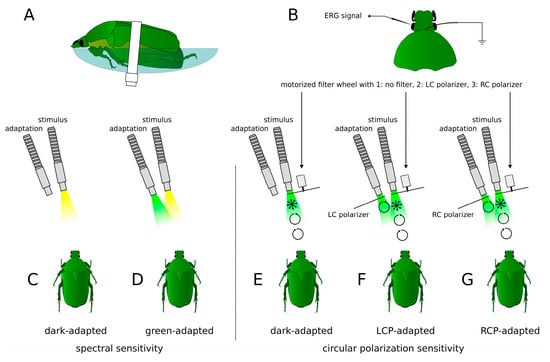
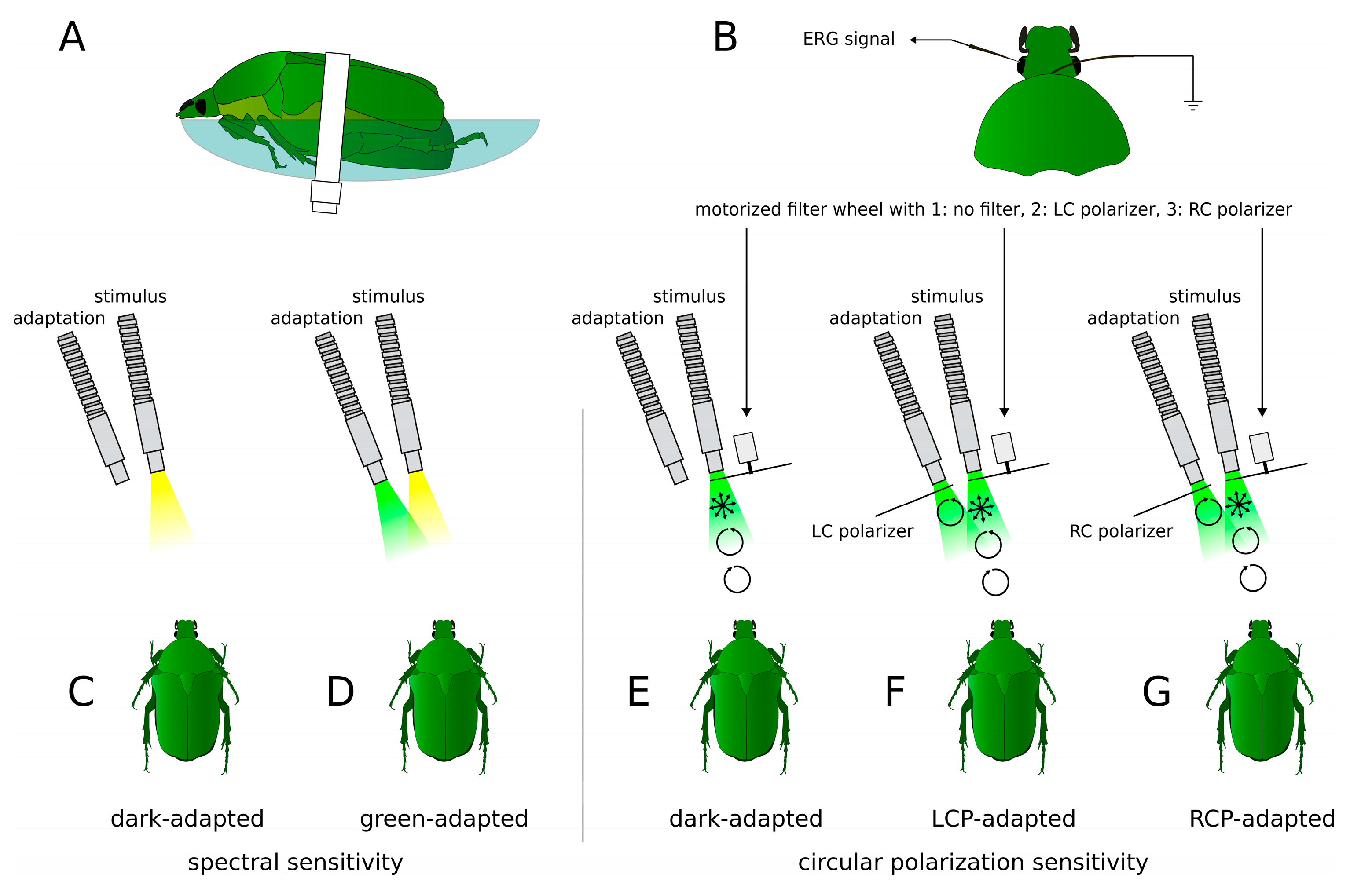
We placed the beetles in a piece of plastic with a curved surface and secured it with a zip tie (Figure 1A). The mouthparts rested against the rim of the plastic piece, and the entire specimen was firmly and stably secured. We used 0.08 mm diameter tungsten wire electrodes. The reference electrode was a simple tungsten wire manually pushed into the body just behind the head (Figure 1B). The recording electrode was etched in saturated KNO2 solution and was inserted into the left eye through a hole on the surface of the compound eye, which was manually created with an injection needle under a stereo microscope.
Figure 1.
Schematic diagram of the experiments. (A) Beetle preparation. (B) Position of the tungsten electrodes. (C,D) Spectral sensitivity measurement on a dark-adapted (C) and a green-adapted preparation (D). (E–G) Circular polarization sensitivity measurement on a dark-adapted (E), LCP-adapted (F) and RCP-adapted (G) eye stimulated by unpolarized, LCP (Left Circularly Polarized) and RCP (Right Circularly Polarized) light.
2.3. Light Stimuli
For visual stimulation, a custom-built LED light source was used to create light stimuli at 16 different wavelengths and various intensities. The peak wavelengths (±half bandwidth) of the available light stimuli were 348 nm (±5 nm), 372 nm (±4 nm), 389 nm (±6 nm), 401 nm (±5 nm), 424 nm (±7 nm), 435 nm (±7 nm), 448 nm (±9 nm), 468 nm (±10 nm), 503 nm (±17 nm), 520 nm (±16 nm), 549 nm (±18 nm), 594 nm (±7 nm), 622 nm (±8 nm), 642 nm (±9 nm), 664 nm (±9 nm) and 742 nm (±10 nm). The stimuli were directed to the eye preparations through a Moritex SOHC4S3.5-1500S quartz light guide (Moritex Corporation, Tokyo, Japan). The light source contained a circular disc equipped with 16 power LEDs. Each LED could be positioned in front of the light guide input terminal by rotating the disc. The light intensity of the LEDs was controlled with (i) pulse width modulation (modulation frequency ≈ 1 kHz), and (ii) neutral density filters, which enabled us to apply stimulus intensities over several orders of magnitude.
2.4. Data Acquisition
The photoreceptor responses were amplified with a Model 3000 AC/DC Differential Amplifier (A-M Systems, Carlsborg, WA, USA). The amplified photoreceptor responses were recorded into the left channel of a stereo 16-bit WAV file (sampling frequency = 8 kHz) with a USB sound card modified for DC recordings [17]. The linearity of the sound card inputs was verified within the ±1 V voltage range; thus, amplification was set to keep signals below this limit. A reference signal indicating the presence of the light stimuli was recorded on the right channel, which facilitated the identification of responses in the left channel of the audio file.
2.5. Spectral Sensitivity Measurement
The spectral sensitivity of the compound eye was measured by directing a light stimulus sequence to the beetle preparation. The stimulus sequence consisted of several 200 ms long stimuli and 2 s long inter-stimulus periods. For a given wavelength, 9–16 stimuli were created with logarithmically increasing intensities (intensity step ≈ 0.5 log unit). First, wavelengths were applied in decreasing and then in increasing order. The inter-stimulus period was 5 s long when the wavelength was switched. The previously described stimulus sequence contained a total of 470 stimuli and was repeated 3–4 times.
Photoreceptor response amplitudes elicited by a light stimulus were extracted from the recordings by obtaining the magnitude of negative potential jumps occurring in the first 100 ms of the stimuli. For each wavelength, the response amplitudes were plotted as a function of log stimulus intensity, and a sigmoid exposure-response curve was fitted to the data [18,19]; the critical light intensity needed to elicit a critical response amplitude (20% of maximal photoreceptor response for the whole recording) was extracted. The spectral sensitivity was obtained by calculating the reciprocals of these critical stimulus intensities for all 16 wavelengths. Finally, the spectral sensitivity was normalized with the value at 520 nm.
Spectral sensitivity recordings were performed on dark- and green-adapted individuals (Figure 1C,D). The light guide terminal was positioned 3.5 cm from the eye preparation, and the stimuli reached the whole eye. The intensity of the applied stimuli varied between 6.8 × 10¹⁰ and 2.8 × 10¹⁵ photons cm−2 s−1. Dark adaptation prior to recording lasted 40 min. For green adaptation, the light of a 550 nm (±17 nm) green LED was directed to the preparation through an optical fibre (Moritex Corporation, Tokyo, Japan). The adapting light guide terminal was positioned 6 cm from the eye preparation, and the intensity of the adapting light was 3.1 × 10¹⁴ photons cm−2 s−1 at the preparation. The angle between the optical axes of the stimulating and adapting light guides was 4°. In the case of chromatic adaptation, the green light was constantly on during the measurement.
The purpose of light adaptation of the eyes during the recordings was to reveal the existence of more than one photoreceptor type in the compound eye. Adaptation to green light desensitizes the green-sensitive receptors, but influences the potential shorter wavelength receptors (e.g., UV- or blue-sensitive types) to a lesser extent, resulting in relatively higher measured eye sensitivity at shorter wavelengths. Light adaptation was 15 min long and was performed after 40 min of dark adaptation.
A total of 12 (4 females + 8 males) dark-adapted C. aurata and 13 green-adapted (5 females + 8 males) C. aurata eye preparations were tested. Regarding P. cuprea, the spectral sensitivity of 4 dark-adapted and 4 green-adapted females was measured.
2.6. Circular Polarization Sensitivity Measurement
To test whether the visual system of C. aurata is able to perceive circular polarization of light at the photoreceptor level, we used a method analogous to the previously mentioned chromatic adaptation, which is widely used for detecting distinct photoreceptor types. Based on our assumption that the potential circular polarization sensitivity operates on the same principle as it does in Odontodactylus stomatopod crustacean species [6], we performed the following.
A repeated sequence of stimuli created with the same light source as described above for the spectral sensitivity measurements was directed to the eye preparation. In short, the sensitivity was measured for three types of 549 nm (±18 nm) light: unpolarized (UP), left circularly polarized (LCP) and right circularly polarized (RCP). The measurement of the sensitivity for these three cases was very similar to that for a given wavelength of light described previously. For UP, LCP and RCP light, light stimuli of 15 logarithmically increasing intensities were used. The lengths of stimuli and inter-stimulus periods were 200 ms and 2 s, respectively. Finally, this sequence of 45 stimulations was repeated 7–24 times. In other words, 7–24 triads of stimulations were performed. Each of the three members of a stimulation triad consisted of 15 stimuli with logarithmically increasing intensities.
The UP light was produced by simply using the stimuli of our light source. The LCP and RCP light stimuli were created, respectively, by automatically positioning a left circular (LC) and a right circular (RC) polarizer (type: CP42HE; ITOS, Mainz, Germany) in front of the light guide terminal with a motorized filter wheel.
The reason behind choosing 549 nm light for stimulation was twofold: (i) Due to the width of the λ/4 phase retarder sheet included in our LC and RC polarizers, they transmitted perfectly circularly polarized light at the wavelength of ~560 nm. (ii) In Hungarian populations, the reflectance spectrum of the metal-green C. aurata cuticle peaks around 565 nm [13]. We therefore concentrated on the metal-green C. aurata and did not perform circular polarization sensitivity measurements on the more metal-reddish P. cuprea. Sensitivity to circular polarization of a total of 8 (4 females + 4 males) C. aurata individuals was tested.
The whole above-mentioned stimulation sequence was applied to eye preparations adapted to darkness, LCP and RCP light. The total numbers of stimulation triads applied on dark-, LCP- and RCP-adapted beetle preparations were 134, 116 and 113, respectively. Adaptation to LCP or RCP light was 15 min long and was performed after 40 min of dark adaptation. For all 8 preparations, for all three types of adaptations and for all members of the stimulation triads, sensitivity to UP, LCP and RCP light was calculated with the same sigmoid exposure-response curve fitting method, as explained in the previous section. For all stimulation triads, the measured sensitivity to LCP and RCP light was normalized with the sensitivity to the UP light. Thus, in an eye being not able to distinguish between LCP and RCP light, irrespective of the adaptation (dark-adapted, LCP-adapted, RCP-adapted), one can expect both these two normalized sensitivities to LCP and RCP light around T = 0.45, which is the transmittance value of the LC and RC polarizers at around 560 nm. The primary objective of this work was to test whether normalized sensitivity to LCP and RCP light differed significantly when the eyes were adapted to LCP and RCP light. Analogous to chromatic adaptation, in which green adaptation can enhance relative UV sensitivity when distinct UV- and green-sensitive receptors are present, one might expect that LCP adaptation will enhance sensitivity to RCP light, and RCP adaptation will enhance sensitivity to LCP light.
2.7. Statistics
2.7.1. Spectral Sensitivity
Normalized spectral sensitivity of dark-adapted C. aurata females and males was compared wavelength-by-wavelength with Wilcoxon Rank Sum tests. In addition, spectral sensitivity of dark-adapted females of C. aurata and P. cuprea was also compared with Wilcoxon Rank Sum tests.
2.7.2. Circular Polarization Sensitivity
To compare the normalized sensitivity values to LCP and RCP light in the case of all three adaptation types, we applied two different statistics. (1) We simply compared the individual-level means of normalized sensitivity values to LCP and RCP light with Wilcoxon Rank Sum tests on the pooled data of females and males. (2) To examine sensitivity to circularly polarized stimuli and adaptations, we included all obtained sensitivity data (N = 363 [total number of stimulation triads] × 2 [normalized sensitivity to LCP/RCP light] = 726) in a Bayesian generalized linear model with a log link and Gamma likelihood. We estimated the mean and scale parameters of the sensitivity distribution separately for each stimulus type and adaptation condition, together with their 89% credible intervals. For the mean parameter, we specified a normal prior on the logarithmic scale [mean = ln(T = 0.45), standard deviation = 0.5]. This prior was chosen to be informative about the expected magnitude of sensitivity while allowing the data to influence the posterior estimates. For the scale parameter, we used an exponential prior with a rate parameter of 1. Posterior distributions were estimated using Hamiltonian Markov Chain Monte Carlo (MCMC) in R version 4.5.1 [20] with the rethinking package https://github.com/rmcelreath/rethinking(accessed on 15 November 2026). Results were interpreted on the original non-log scale using 89% credible intervals of the posterior distribution (indicating the range in which the parameter lies with 89% posterior probability) and counterfactual differences (which quantify how much the predicted outcomes differ under different light adaptations and stimulus types).
3. Results
3.1. Spectral Sensitivity
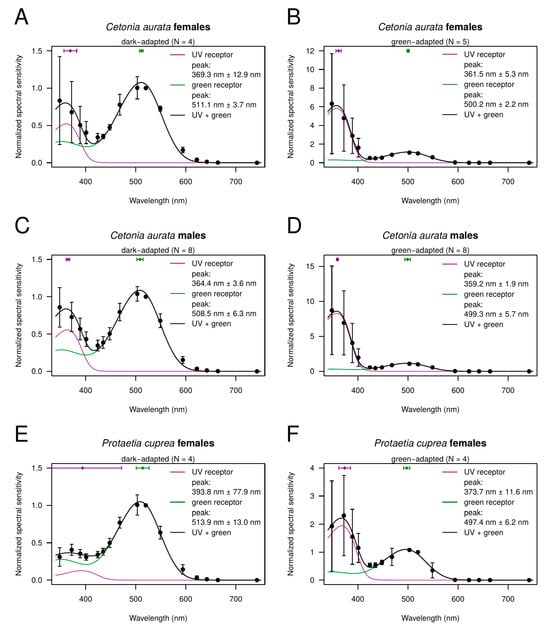
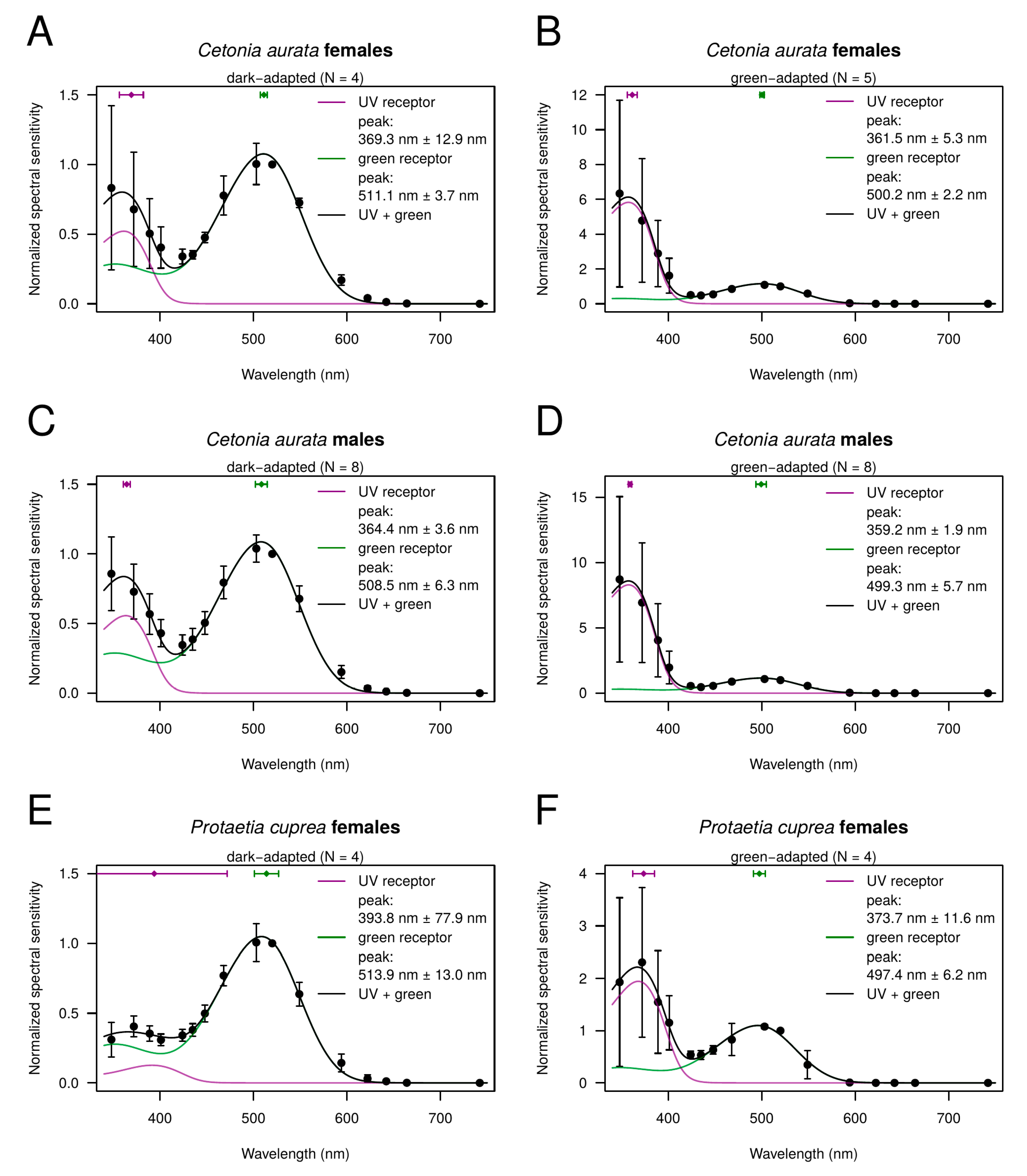
Normalized spectral sensitivities of dark-adapted C. aurata females and males were bimodal curves, both peaking in the green spectral range and possessing a secondary sensitivity peak in the UV range (Figure 2A,C). In the case of green-adapted eye preparations, the relative sensitivity to UV light was much higher than in the dark-adapted case, both for females (Figure 2B) and males (Figure 2D). This clearly indicates the presence of distinct UV- and green-sensitive photoreceptors. However, no sensitivity peak appeared in the blue range when green-adapted eye preparations were tested (Figure 2B,D), which would be expected if a blue-sensitive receptor were present [21,22].
Figure 2.
Mean normalized spectral sensitivity curves of scarab compound eyes, where vertical bars denote standard deviation (SD). (A) Dark-adapted female C. aurata. The black curve shows the fitted sum of two Govardovskii templates. The purple and green curves indicate the templates for the supposed UV and green photoreceptors, respectively. For the assumed UV and green receptors, horizontal error bars at the top of the graph show the mean ± SD of template peak wavelengths obtained for the measured preparations. The corresponding numerical values are also shown in the inset legend. (B) Green-adapted female C. aurata. (C) Dark-adapted male C. aurata. (D) Green-adapted male C. aurata. (E) Dark-adapted female P. cuprea. (F) Green-adapted female P. cuprea.
According to Wilcoxon Rank Sum tests, there were no statistically significant differences in normalized spectral sensitivity between female and male C. aurata at any wavelength at the α = 0.1 significance level. Similarly, the spectral sensitivity of C. aurata and P. cuprea females did not differ significantly at the same α = 0.1 significance level.
Fitting the sum of two Govardovskii pigment templates enabled us to estimate the sensitivity peaks of each assumed photoreceptor type. For estimating the sensitivity peak of the UV and green photoreceptors, we used the results of recordings performed on green- and dark-adapted eye preparations, respectively (Figure 2). Thus, the sensitivity peaks of green receptors in C. aurata females and males were at 511 nm ± 4 nm and 509 nm ± 6 nm (W = 21, p = 0.4606, not significant) (Figure 2A,C), while the UV receptors of females and males had peaks at 362 nm ± 5 nm and 359 nm ± 2 nm (W = 23, p = 0.7242, not significant) (Figure 2B,D), respectively. In the case of P. cuprea females, the green receptor’s sensitivity peaked at 514 nm ± 13 nm (Figure 2E), while the sensitivity maximum of the UV receptor was at 374 nm ± 12 nm (Figure 2F). No significant difference was found between the sensitivity peaks of green receptors of C. aurata and P. cuprea females (W = 19, p = 0.6828), which was also true for the UV receptors (W = 17, p = 0.1111).
Due to the lack of statistically significant differences, by averaging all obtained sensitivity maxima separately for the UV and green receptors, we conclude that the females and males of Cetonia aurata and the females of Protaetia cuprea possess green-sensitive and UV-sensitive photoreceptors with sensitivity maxima at 511 nm ± 8 nm and 363 nm ± 8 nm, respectively.
3.2. Circular Polarization Sensitivity
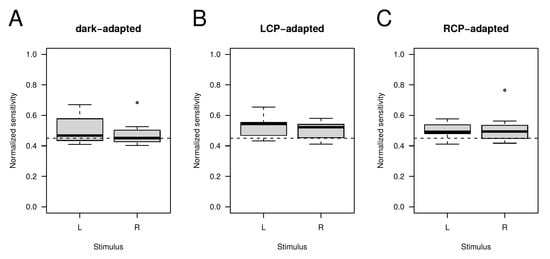
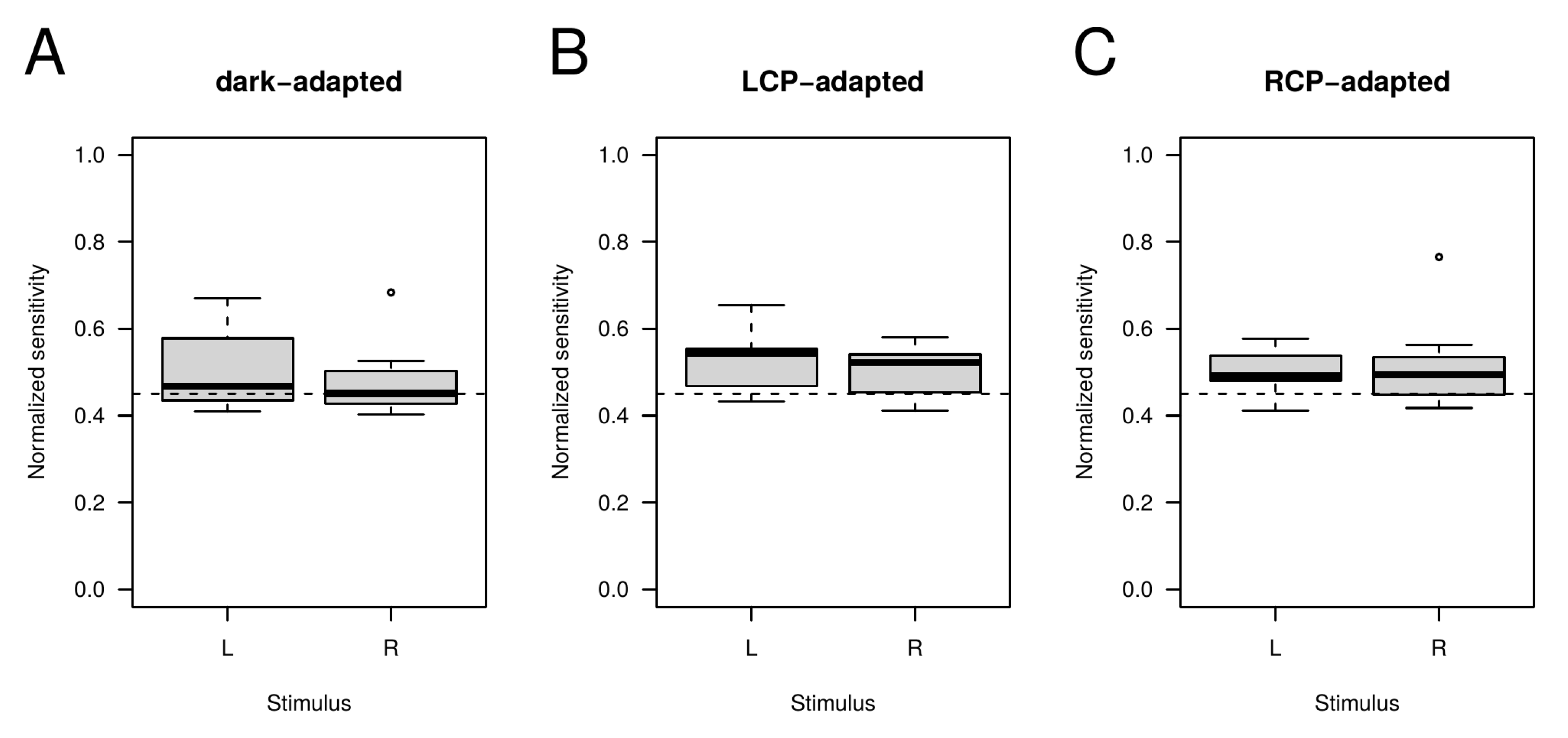
The normalized sensitivities of dark-adapted eye preparations to LCP and RCP light did not differ significantly, as indicated by the Wilcoxon Rank Sum test (W = 26, p = 0.5737; Figure 3A). Because our recordings were extracellular, this result is consistent with the expectation that LCP and RCP light should elicit comparable responses under dark-adapted conditions. A difference in sensitivity would be expected only following adaptation to circularly polarized light. However, neither LCP-adapted (W = 23, p = 0.3823) nor RCP-adapted (W = 31, p = 0.9591) preparations exhibited a statistically significant difference in normalized sensitivity between LCP and RCP stimuli (Figure 3B,C).
Figure 3.
Normalized sensitivity to LCP and RCP light for different eye adaptations when the sexes were pooled together. Normalization was performed with the sensitivity to unpolarized light. Each box consists of eight points, as this was the number of C. aurata preparations, the circular polarization sensitivity of which was measured. The boxes show the interquartile range (IQR), and dots indicate outliers beyond 1.5 × IQR from the first or third quartile. The thick solid lines show the median value of the eight data points. Horizontal dashed lines show the transmittance T = 0.45 of the LC and RC polarizers. (A) Dark-adapted. (B) LCP-adapted. (C) RCP-adapted.
In the dark-adapted case, according to one-sample Wilcoxon signed-rank tests, the distribution of sensitivities did not differ significantly from the level of T = 0.45 (dashed line in Figure 3), which is the transmittance value of the LC and RC polarizers that we used to create the circularly polarized stimuli (LCP: W = 27, p = 0.25; RCP: W = 22, p = 0.6406). Note that the unpolarized stimuli, to which responses to circularly polarized light were normalized, were created with no polarizer in the light path, and the circularly polarized stimuli were created by inserting the polarizer into the light path. Consequently, the normalized sensitivity to LCP and RCP light should theoretically be equal to T = 0.45. In the case of LCP- and RCP-adapted (Figure 3B,C) preparations, the sensitivity values were slightly above the T-level. This enhancement is the consequence of smaller photoreceptor responses due to light adaptation, while the noise level was the same.
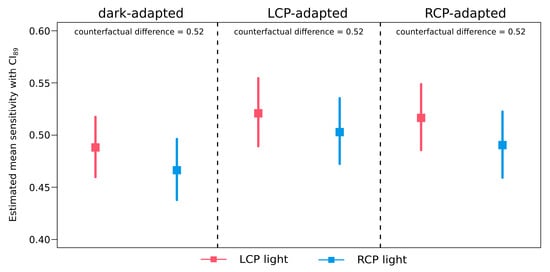
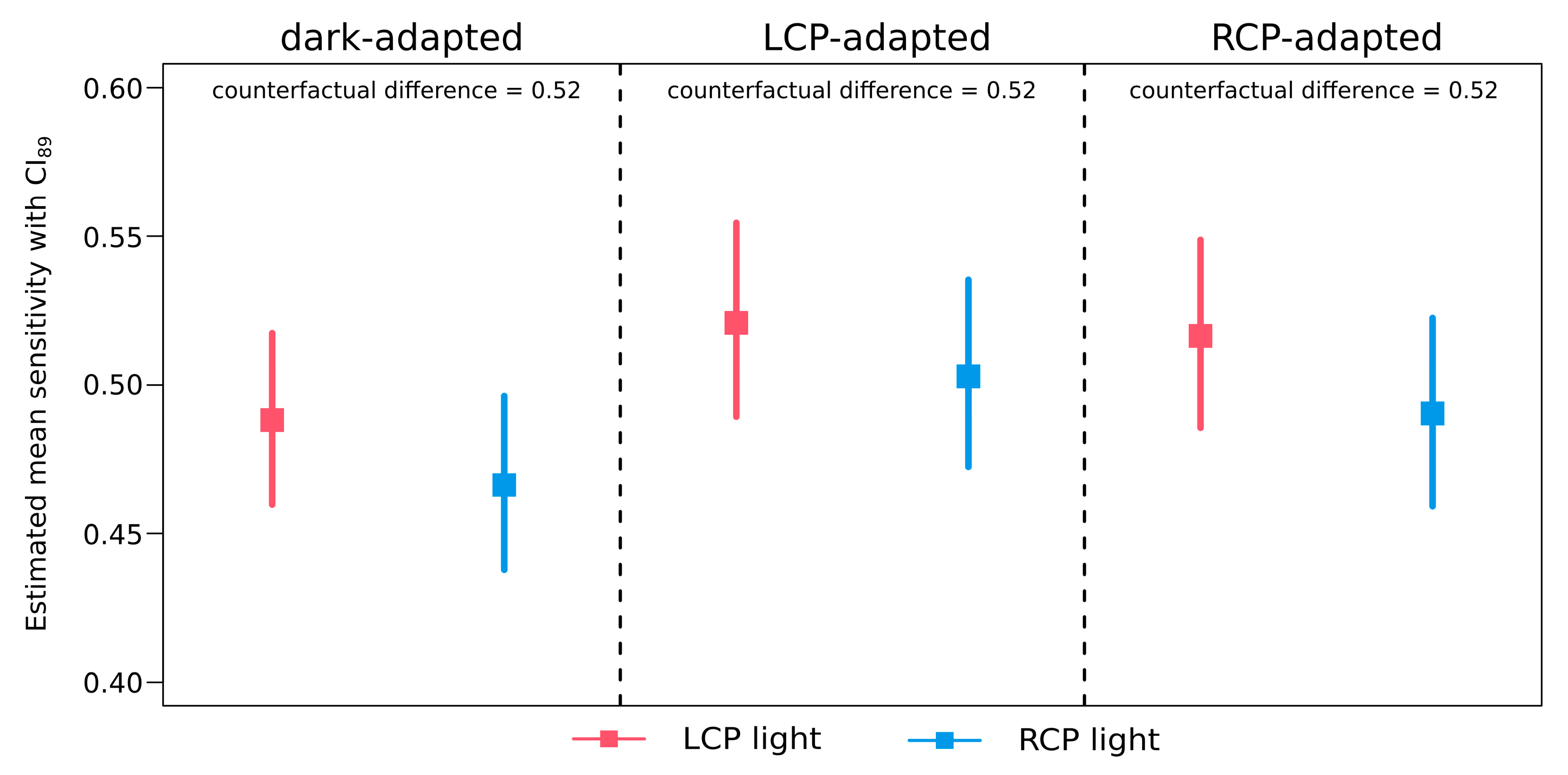
According to our Bayesian approach, we found no clear evidence for a difference in sensitivity to LCP or RCP light in the case of different adaptations (Figure 4; model parameters and diagnostics in Table 1), as the 89% credible intervals overlapped and the counterfactual difference was around 50% between stimulus types in the case of all adaptations. Thus, there is no detectable relevance of handedness (L or R) of circularly polarized light under the conditions tested. In this experimental setup, this can be interpreted as meaning that Cetonia aurata does not sense circular polarization.
Figure 4.
Means (squares) and 89% credible intervals (bars) of the estimated sensitivities to LCP and RCP light under different adaptation conditions. The latter show the interval where the parameter lies with 89% probability. The interval differs from the median because we estimated the mean and not the shape of the gamma distribution in our model. Red and blue colours present sensitivity for LCP and RCP, respectively.
Table 1.
Parameter estimates and CI89 (89% credible interval) on the original (non-log) scale of measured sensitivity to different handedness of circularly polarized light as functions of different light adaptation types. The estimated posterior distributions (range of 89% CI) provide no evidence for an effect, as they overlap in the case of similar light adaptations. Based on the values of rhat (indicator of convergence in Markov chains; values around 1 indicate that separate chains converged and explored the same posterior distribution) and ess_bulk (describes how well the Monte Carlo sampling procedure explored the posterior distribution; values above the sampling step number are considered exceptionally good), the MCMC (Markov Chain Monte Carlo) performed well in sampling the posterior distribution (MCMC was run with 4 chains, 2000 warmup and 2000 sampling steps).
4. Discussion
Until now, circular polarization sensitivity has been shown only in the compound eyes of certain stomatopod crustacean species [6]. These animals use this visual capability for (i) inter- and intraspecies communication based on the circularly polarized signals originating from their species-specific carapace, and perhaps (ii) food finding based on the circularly polarized light from their prey, which ability was, however, demonstrated only in artificial situations under laboratory conditions [5,7]. Nevertheless, in stomatopods the circular polarization sensitivity and its use have been evidenced both receptor-physiologically and behaviourally.
The contrary is true for certain scarab beetle species possessing circularly polarizing exocuticle: It was behaviourally evidenced that Anomala dubia, Anomala vitis, Anomala corpulenta, Cetonia aurata and Protaetia cuprea scarabs are not attracted to circular polarization; furthermore, their mating and food-seeking behaviour is not influenced by circular polarization [12,13], although they reflect circularly polarized light [8,9,10,11]. Furthermore, in the present work we showed that the photoreceptors of Cetonia aurata are not sensitive to circular polarization. The same is possible for Anomala dubia, Anomala vitis, Anomala corpulenta and Protaetia cuprea, for which further investigations are needed.
In this work, we used selective adaptation to LCP and RCP light and did not find any difference in relative eye sensitivity to LCP and RCP light. However, this does not prove that the photoreceptors of Cetonia aurata are not sensitive to circular polarization. The measurement of polarization sensitivity is conventionally achieved by intracellular recordings, when the responses of only one photoreceptor are recorded. In the case of ERG, the summed signal of multiple photoreceptors from several ommatidia is recorded, which makes it difficult to study the responses of a given photoreceptor type alone.
In an idealized ommatidium similar to that of a stomatopod, an orthogonal analyser pair of receptors is located proximally behind a proximal cell functioning as a quarter-wave retarder [6]. In the case of dark adaptation, incident circular polarization will stimulate one receptor in the pair, while unpolarized light will stimulate both. The ERG signal will be identical in the case of LCP or RCP light, and very similar for unpolarized light.
However, selective adaptation to LCP or RCP light could desensitize one or the other member of the orthogonal receptor pair. Thus, adapting with LCP light should preferentially reduce the corresponding receptor’s contribution to the ERG signal. As a result, the ERG-determined sensitivity is expected to be greater to RCP light than to LCP light. Adaptation to RCP light should produce the converse shift.
We admit that our negative result does not imply that C. aurata cannot sense circular polarization. Our post-adaptation ERG recordings might have the potential to reveal some signature of circular polarization sensitivity only if the relative number of photoreceptors being responsible for the assumed circular polarization sensitivity is sufficiently high compared to the number of other, potentially not polarization-sensitive ones. It is also possible that, during our ERG recordings, the stimulation reached eye regions that are not sensitive to circular polarization. However, due to systematic positioning of the insects relative to the light source, eye regions that are sensitive to circular polarization may not have been illuminated. In summary, selective adaptation with circular polarization and ERG cannot unambiguously prove or disprove the case for circular polarization detection. Further research should therefore focus on intracellular recordings to characterize the polarization sensitivity of individual photoreceptors in scarab beetles.
Li et al. [14] studied the influence of LCP light on the mating behaviour of Anomala corpulenta scarab beetles. They manipulated the elytra of some A. corpulenta scarabs with non-metallic green paint and disrupted the LCP of elytra-reflected light. They found that the number of mating pairs of A. corpulenta differed between the scarab groups with and without green elytra-painting. Given their results, they hypothesized that the LCP light reflected from the exocuticle of female A. corpulenta may be sensed by the males. However, finally they emphasized that a decisive conclusion cannot be drawn about the circular polarization sensitivity of this scarab species, and further behavioural investigations are necessary.
The circularly polarizing feature of the scarab exocuticle is the result of the spatial arrangement of chitin fibres similar to that of cholesteric liquid crystals [23,24]. According to the findings of earlier behavioural studies that scarabs A. dubia, A. vitis, A. corpulenta, C. aurata and P. cuprea do not respond (are not attracted) to circular polarization, the function of the helically ordered chitinous structure of their exocuticle is not to induce circularly polarized reflected light for intraspecies visual communication. It is imaginable that the helical structure provides mechanical or chemical protection of the exocuticle against mechanical strains or chemical damage.
Although there are several exceptions, insect eyes typically contain three types of photoreceptors that are maximally sensitive to UV, blue and green light [25]. In Coleoptera, the blue-sensitive photoreceptor was lost before the origin of modern beetles, but subsequently was regained multiple times presumably as a result of UV opsin gene duplication [26]. To our knowledge, among beetles having circularly polarizing exocuticle, the spectral sensitivity has been measured in only one species, Anomala corpulenta [27]. Its compound eyes exhibit two main sensitivity peaks, one in the near ultraviolet (~400 nm) and the other in the yellow-green spectral region (498–562 nm). A very weak sensitivity peak in the blue spectral range (~460 nm) was also identified when electroretinography measurements were performed at night. Jiang et al. [27] also tested the effects of white-light adaptation and reported the presence of distinct UV-sensitive receptors.
In C. aurata and P. cuprea, using chromatic adaptation, we also demonstrated the presence of distinct UV- and green-sensitive photoreceptors. However, we found no evidence of blue-sensitive receptors. Our results suggest that these two beetle species have the physiological apparatus capable only of dichromatic colour vision. Because these beetles reflect relatively low amounts of UV light [13], one might expect their circular polarization vision to be mediated by their green-sensitive photoreceptors. Because the major reflectance peak of C. aurata (~565 nm) was much closer to the sensitivity peak of the green-sensitive photoreceptors (sensitivity peak at ~511 nm) than the major reflectance peak of P. cuprea (~665 nm) [13], we focused our circular polarization sensitivity measurements on C. aurata. However, our experimental setup did not detect any evidence of circular polarization sensitivity in C. aurata, which we assume to also be true in the case of P. cuprea.
Nevertheless, research on the photoreceptor properties of the scarab beetles mentioned in this work is of great importance, as they are often regarded as horticultural and agricultural pests [13,27,28]. Studying their potential colour vision, for example, is a promising direction of future research.
Author Contributions
Conceptualization, Á.E., G.H., G.K.; methodology, Á.E., M.J.; software, Á.E., M.J.; formal analysis, Á.E., M.J.; resources, Á.E., G.K.; data curation, Á.E., M.J.; writing—original draft, Á.E., G.H.; writing—review and editing, Á.E., G.H., M.J., G.K.; visualization, Á.E., M.J. All authors have read and agreed to the published version of the manuscript.
Funding
This work was supported by the EKÖP-26 University Research Scholarship Program of the Ministry of Science and Technology from the source of the National Research, Development and Innovation Fund. Funder name: Nemzeti Kutatási, Fejlesztési és Innovációs Alap; Funder ID: 2026-2.1.1-EKÖP; Grant ID: EKÖP-26-2-III-ELTE-20260211.
Data Availability Statement
Data is contained within the article.
Acknowledgments
We are grateful to Jan Gershoj (Gershoj Energia Kft, Hungary) for his kind support.
Conflicts of Interest
The authors declare no conflicts of interest.
Abbreviations
The following abbreviations are used in this manuscript:
| UP | Unpolarized |
| LCP | Left Circularly Polarized |
| RCP | Right Circularly Polarized |
| LC | Left Circular |
| RC | Right Circular |
| UV | Ultraviolet |
References
- Horváth, G.; Varjú, D. Circularly Polarized Light in Nature. In Polarized Light in Animal Vision; Springer: Berlin/Heidelberg, Germany; New York, NY, USA, 2004; pp. 100–103. [Google Scholar]
- Können, G.P. Polarized Light in Nature; Cambridge University Press: Cambridge, UK, 1985. [Google Scholar]
- Shashar, N.; Cronin, T.W.; Johnson, G.; Wolff, L.B. Portable Imaging Polarized Light Analyzer. Proc. SPIE Proc. 1995, 2426, 28–35. [Google Scholar] [CrossRef] [Scilit]
- Wynberg, H.; Meijer, E.W.; Hummelen, J.C.; Dekkers, H.P.J.M.; Schippers, P.H.; Carlson, A.D. Circular Polarization Observed in Bioluminescence. Nature 1980, 286, 641–642. [Google Scholar] [CrossRef] [Scilit]
- Marshall, J.; Roberts, N.; Cronin, T. Polarisation Signals. In Polarized Light and Polarization Vision in Animal Sciences; Horváth, G., Ed.; Springer: Berlin/Heidelberg, Germany; New York, NY, USA, 2014; pp. 407–442. [Google Scholar]
- Chiou, T.-H.; Kleinlogel, S.; Cronin, T.; Caldwell, R.; Loeffler, B.; Siddiqi, A.; Goldizen, A.; Marshall, J. Circular Polarization Vision in a Stomatopod Crustacean. Curr. Biol. 2008, 18, 429–434. [Google Scholar] [CrossRef] [Scilit]
- Gagnon, Y.L.; Templin, R.M.; How, M.J.; Marshall, N.J. Circularly Polarized Light as a Communication Signal in Mantis Shrimps. Curr. Biol. 2015, 25, 3074–3078. [Google Scholar] [CrossRef] [Scilit]
- Michelson, A.A. On Metallic Colouring of Birds and Insects. Philos. Mag. 1911, 21, 554–567. [Google Scholar] [CrossRef] [Scilit]
- Bagge, L.E.; Kenton, A.C.; Lyons, B.A.; Wehling, M.F.; Goldstein, D.H. Mueller Matrix Characterizations of Circularly Polarized Reflections from Golden Scarab Beetles. Appl. Opt. 2020, 59, F85–F93. [Google Scholar] [CrossRef] [Scilit]
- Finlayson, E.D.; McDonald, L.T.; Vukusic, P. Optically Ambidextrous Circularly Polarized Reflection from the Chiral Cuticle of the Scarab Beetle Chrysina resplendens. J. R. Soc. Interface 2017, 14, 20170129. [Google Scholar] [CrossRef] [Scilit]
- Hegedüs, R.; Szél, G.; Horváth, G. Imaging Polarimetry of the Circularly Polarizing Cuticle of Scarab Beetles (Coleoptera: Rutelidae, Cetoniidae). Vis. Res. 2006, 46, 2786–2797. [Google Scholar] [CrossRef] [Scilit]
- Miao, J.; Wu, Y.-Q.; Li, K.-B.; Jiang, Y.-L.; Gong, Z.; Duan, Y.; Li, T. Evidence for Visually Mediated Copulation Frequency in the Scarab Beetle Anomala corpulenta. J. Insect Behav. 2015, 28, 175–182. [Google Scholar] [CrossRef] [Scilit]
- Blahó, M.; Egri, Á.; Hegedűs, R.; Jósvai, J.; Tóth, M.; Kertész, K.; Biró, L.P.; Kriska, G.; Horváth, G. No Evidence for Behavioral Responses to Circularly Polarized Light in Four Scarab Beetle Species with Circularly Polarizing Exocuticle. Physiol. Behav. 2012, 105, 1067–1075. [Google Scholar] [CrossRef] [Scilit]
- Li, T.; Jiang, Y.; Yang, X.; Li, H.; Gong, Z.; Qin, Y.; Zhang, J.; Lu, R.; Wei, G.; Wu, Y.; et al. The effects of circularly polarized light on mating behavior and gene expression in Anomala corpulenta (Coleoptera: Scarabaeidae). Front. Physiol. 2023, 14, 1172542. [Google Scholar] [CrossRef] [Scilit]
- Horváth, G.; Blahó, M.; Egri, Á.; Hegedüs, R.; Szél, G. Circular Polarization Vision of Scarab Beetles. In Polarized Light and Polarization Vision in Animal Sciences; Horváth, G., Ed.; Springer: Berlin/Heidelberg, Germany; New York, NY, USA, 2014; pp. 147–170. [Google Scholar]
- Horváth, G. Circular Polarization Insensitivity in Scarab Beetles with Circularly Polarizing Exocuticle. In Polarization Vision and Environmental Polarized Light; Horváth, G., Ed.; Springer: Berlin/Heidelberg, Germany; New York, NY, USA, 2024; pp. 181–186. [Google Scholar]
- Kecskeméti, S.; Geösel, A.; Fail, J.; Egri, Á. In Search of the Spectral Composition of an Effective Light Trap for the Mushroom Pest Lycoriella Ingenua (Diptera: Sciaridae). Sci. Rep. 2021, 11, 12770. [Google Scholar] [CrossRef] [Scilit]
- Naka, K.I.; Rushton, W.A.H. An Attempt to Analyse Colour Reception by Electrophysiology. J. Physiol. 1966, 185, 556–586. [Google Scholar] [CrossRef] [Scilit]
- Skorupski, P.; Chittka, L. Photoreceptor Spectral Sensitivity in the Bumblebee, Bombus Impatiens (Hymenoptera: Apidae). PLoS ONE 2010, 5, e12049. [Google Scholar] [CrossRef] [Scilit]
- R Core Team. R: A Language and Environment for Statistical Computing; R Foundation for Statistical Computing: Vienna, Austria, 2025. [Google Scholar]
- Egri, Á.; Tholt, G.; Viczián, O.; Mergenthaler, E.; Kecskeméti, S.; Erdei, A.L.; Molnár, B.P. Visual and Olfactory Evidence of Host Plant Recognition by Cacopsylla pruni. J. Insect Physiol. 2026, 173, 105039. [Google Scholar] [CrossRef] [Scilit]
- Telles, F.J.; Lind, O.; Henze, M.J.; Rodríguez-Gironés, M.A.; Goyret, J.; Kelber, A. Out of the Blue: The Spectral Sensitivity of Hummingbird Hawkmoths. J. Comp. Physiol. A 2014, 200, 537–546. [Google Scholar] [CrossRef] [Scilit]
- Jewell, S.A.; Vukusic, P.; Roberts, N.W. Circularly Polarized Colour Reflection from Helicoidal Structures in the Beetle Plusiotis boucardi. New J. Phys. 2007, 9, 99. [Google Scholar] [CrossRef] [Scilit]
- Neville, A.C.; Caveney, S. Scarabaeid Beetle Exocuticle as an Optical Analogue of Cholesteric Liquid Crystals. Biol. Rev. 1969, 44, 531–562. [Google Scholar] [CrossRef] [Scilit]
- van der Kooi, C.J.; Stavenga, D.G.; Arikawa, K.; Belušič, G.; Kelber, A. Evolution of Insect Color Vision: From Spectral Sensitivity to Visual Ecology. Annu. Rev. Entomol. 2021, 66, 435–461. [Google Scholar] [CrossRef] [Scilit]
- Sharkey, C.R.; Fujimoto, M.S.; Lord, N.P.; Shin, S.; McKenna, D.D.; Suvorov, A.; Martin, G.J.; Bybee, S.M. Overcoming the Loss of Blue Sensitivity Through Opsin Duplication in the Largest Animal Group, Beetles. Sci. Rep. 2017, 7, 8. [Google Scholar] [CrossRef] [Scilit]
- Jiang, Y.; Guo, Y.; Wu, Y.; Li, T.; Duan, Y.; Miao, J.; Gong, Z.; Huang, Z. Spectral Sensitivity of the Compound Eyes of Anomala Corpulenta Motschulsky (Coleoptera: Scarabaeoidea). J. Integr. Agric. 2015, 14, 706–713. [Google Scholar] [CrossRef] [Scilit]
- Shehaj, M.; Shehaj, E.; Çekaj, E.; Naqa, A.; Krasniqi, B. European Rose Chafer Prevalence on Cultivated Highbush Blueberries. Hortic. Sci. 2025, 52, 155–161. [Google Scholar] [CrossRef] [Scilit]

Disclaimer/Publisher’s Note: The statements, opinions and data contained in all publications are solely those of the individual author(s) and contributor(s) and not of MDPI and/or the editor(s). MDPI and/or the editor(s) disclaim responsibility for any injury to people or property resulting from any ideas, methods, instructions or products referred to in the content. |
© 2026 by the authors. Licensee MDPI, Basel, Switzerland. This article is an open access article distributed under the terms and conditions of the Creative Commons Attribution (CC BY) license.