


Abstract
The galaxy size–mass relation (SMR) is a key scaling relation used to constrain the physical processes that build galaxy structure, yet it is almost always measured in a single rest-frame optical band, where the light traces the bulk of the old stellar mass. Tracing younger populations with flux-weighted ages of ∼100–500 Myr and low-metallicity stars, the rest-frame near-ultraviolet opens a new stellar window on this scaling relation. Because each process redistributes the light of young and old stars differently, the same mechanism shifts the slope and zero point of the SMR by different amounts in the two wavelength regimes. Here we review and synthesize the effects of main physical processes on the form of the SMR for star-forming and quiescent galaxies in the rest-UV and optical. For each process, we start from its underlying physics, the galaxy stellar masses it affects, and the light it adds/removes/rearranges, anchoring the predictions to observations and simulations. We validate the predicted imprints with forward Monte Carlo modelling. The two-wavelength view breaks several degeneracies that single-band analyses cannot, most notably between minor mergers, dry major mergers, and adiabatic expansion. These results motivate joint rest-UV and optical SMR measurements with current and upcoming wide-field imaging surveys.
1. Introduction
Galaxies follow a tight power-law correlation between effective radius and stellar mass since at least [1,2,3,4,5,6,7,8,9,10,11,12,13,14,15,16]. This size–mass relation (SMR) is commonly parametrized as
where and are fitting parameters (zero point and slope, respectively), and is a normalization mass. Studies often choose the fiducial normalization mass to be so that approximately gives the characteristic size of a Milky Way-massed galaxy [17]. This fiducial mass also coincides with the knee of the galaxy stellar mass function (; [18]), and lies in the regime where both star-forming and quiescent populations are sufficiently well sampled to constrain and jointly.
Star-forming galaxies (SFGs) and quiescent galaxies (QGs) populate distinct loci in the size–stellar mass plane. At any given redshift and stellar mass, SFGs tend to have larger characteristic sizes than QGs except at very high masses () [1,3,8,10]. Although the SMR slope is uniform for SFGs at , the slope for QGs changes at a pivot stellar mass, , where the QGs exhibit a steeper relation at higher masses than lower masses [8,10,19]. The differences in the SMR parameters between SFGs, low-mass QGs and high-mass QGs arise because these parameters encode the cumulative imprint of the processes that build galaxy structure—in situ star formation, bulge growth, mergers, accretion, environmental harassment, ram-pressure and tidal stripping, and the population-level effect of progenitor bias (for reviews, see [20,21,22]). Tracing the evolution of the SMRs over cosmic time is therefore a useful tool for exploring the physical processes that shape galaxies.
One of the best ways to trace galaxy evolution in the size–mass plane would be to use the mass-weighted effective radius (half-mass radius, ; [23,24]). However, measuring is observationally more demanding than measuring the half-light radius, , because the former requires the mass-to-light ratio () as a function of radius. Furthermore, pinning down that spatially varying needs spatially resolved photometry over a broad wavelength range. Measuring from a single-band sky image, by contrast, is far more straightforward. A vast majority of observational works therefore use light-weighted in analysing the SMR.
However, light-weighted sizes are sensitive to the wavelength at which they are measured because different types of stars dominate the flux density in different wavelength regimes. In addition, the mapping from rest-frame to the observed band is redshift-dependent. Hence, it is important to use multi-band data to trace the SMR evolution in the same rest-frame wavelength across cosmic time. In practice, at least since the cosmic noon, observational works commonly infer the SMR in a single rest-frame optical/near-IR band, where light traces the old, mass-dominant stellar population [25,26].
The rest-frame near-UV is, however, a complementary tracer: it is sensitive to a flux-weighted age of ∼300 Myr [25,27,28] and to low-metallicity stars [29,30], and thus probes a different stellar component of the same galaxies. Galaxies generally have negative colour gradients with bluer outskirts [23,24,31] and UV sizes are systematically larger than optical sizes in both SFGs and QGs [10,11]. Because each physical process in galaxy evolution transforms the SMR in its own way, the UV and optical SMRs respond to each process with varying sensitivity and, in some cases, in opposite directions. The two-wavelength comparison (UV vs. optical) therefore breaks several degeneracies that single-band analyses are subject to.
The motivation for this synthesis is twofold. First, a growing body of multi-band SMR and structural-evolution work has emerged in recent years. This includes spatially resolved colour-gradient studies [23,24,31,32,33], bulge+disk decompositions across wavelengths [34,35,36,37], and statistical UV+optical SMR measurements at [10,11]. The theoretical interpretations of these results illustrate how the same physical processes leave qualitatively different fingerprints in the different bands. These differences call for a unified theoretical framework in which the SMRs in rest-frame UV and optical are analysed in tandem. This can disentangle process-specific signatures far more effectively than any single wavelength band alone.
Second, recent and upcoming multi-wavelength imaging datasets are making it possible to study the evolution of the SMR at multiple rest-frame wavelengths for very large galaxy samples. Deep U-band imaging from CFHT–CLAUDS [38], combined with Subaru HSC-SSP deep optical imaging [39,40], already delivers joint U+optical photometry over ∼18.6 square degrees. The Ultraviolet Near-Infrared Optical Northern Survey (UNIONS; [41]) extends this coverage to ∼6250 square degrees of the northern sky at shallower depth. Looking ahead, the Vera C. Rubin Observatory’s LSST [42], Euclid [43], and Roman [44] will extend the joint UV+optical SMR into the low-mass regime for – galaxies. The Euclid NISP and Roman WFI near-IR channels in particular will additionally deliver rest-frame ∼1 m sizes for these very large samples—a regime that traces the bulk old stellar mass even more faithfully than the rest-optical and is largely insensitive to dust attenuation. Together, these datasets extend the two-wavelength comparison developed here to a UV/optical/near-IR triplet for the same galaxies.
In this paper we review and synthesize how the multi-wavelength SMR enabled by such multi-wavelength surveys can be used to discriminate between the physical processes that drive galaxy evolution. Working process by process, we ask how each mechanism redistributes UV-bright and optical-bright stellar light in individual galaxies, what trajectory this implies in the size–stellar-mass plane, and what the population-level signature is on the slope and zero point of the SMR in each wavelength regime.
This paper is organized as follows. Section 2 defines the wavelength contrast and our standard SMR baseline. Section 3 provides a process-by-process discussion, organized into a subsection for SFGs (Section 3.1) and a subsection for QGs (Section 3.2). For every process we describe (1) the process itself, (2) how it redistributes UV-bright and optical-bright stellar light in individual galaxies, (3) the trajectory of an individual galaxy in the size–mass plane, (4) the mass range in which the process is most efficient, and (5) the resulting changes in the slope and zero point of the SMR in UV versus optical. Section 4 discusses degeneracies (age–metallicity, dust, the UV upturn, and single-Sérsic versus bulge+disk biases) that complicate the empirical separation of these effects. Table 1 compiles the qualitative directions for both populations and Figure 1 and Figure 2 visualize them. We close in Section 5 with a set of testable diagnostics for ongoing and upcoming surveys.
Table 1.
Predicted directions of the changes in the slope and zero point of the galaxy size–mass relation in rest-frame UV and rest-frame optical, process by process, separately for star-forming galaxies and quiescent galaxies. The signs and wavelength contrasts derive from the literature synthesized in Section 3. Symbols: ↑ increase, ↓ decrease, ∼ negligible. “UV > Opt” denotes that the magnitude of the shift is larger in UV than in optical; sign columns indicate the direction in each wavelength separately. The last column grades the population-averaged amplitude of each process over from order-of-magnitude estimates, which combine the measured rates, timescales, affected population fractions, and size–mass-plane tracks compiled in Section 3.
Figure 1.
Wavelength-dependent effects of six physical processes on the SMR of SFGs. Each row corresponds to one process and contains four panels. Before and After render a representative SFG as a barred-spiral icon (deep-blue bar and cyan spiral arms) enclosed by two effective-radius rings: a dashed cyan ring at and a solid deep-blue ring at . The Process panel (header names the process) sketches the physical mechanism with purple iconography: cold-gas streams, merging galaxies, ICM wind, infalling satellites, or radial outflows. Faint grey ghosts of the Before-state rings are overlaid on the After panel. Hence, the size and morphology change is visible at a glance. The rightmost panel (SMR shift; title shown only on the top row) is a schematic of how the population size–mass relation moves: the grey line is the pre-process reference (shared across rows so the comparison isolates the differential effect of each process), and the dashed cyan and solid deep-blue lines are the post-process size–mass relations in rest-frame UV and rest-frame optical, respectively; right-anchored labels identify the lines. Signs and the relative magnitudes of the UV vs. optical shifts follow the literature synthesis of Section 3.1 and Table 1; line slopes and intercepts in the inset are illustrative, not numerical predictions.
Figure 2.
As Figure 1 but for QGs. The QG host is rendered as a smooth red gradient ellipsoid; the size rings are dashed darkorange for and solid red for . Process iconography includes merging galaxies, accreted satellites, post-feedback adiabatic outflows, and tidal perturbers; the bottom row (progenitor bias) is rendered differently because the effect is population-level rather than individual-galaxy: the Before panel shows two groups of galaxies at the same (small QGs at left, larger SFGs at right) and the After panel shows the enlarged QG sample after the SFG cohort quenches and joins it. Hence, the mean at fixed rises without any individual galaxy growing. The SMR-shift convention is identical to Figure 1 with the QG-family colours substituted (dashed orange = UV, solid red = optical). Signs and wavelength contrasts follow Section 3.2 and the lower half of Table 1.
Throughout the text, we use “UV”/“near-UV” to mean the rest-frame near-UV at Å and “optical” to mean rest-frame optical at Å. The two choices are motivated by stellar-population physics. The ∼3000 Å is short enough to be dominated by main-sequence A and late-B stars (flux-weighted age ∼ yr) yet long enough to lie above the “UV upturn” contribution from extreme-horizontal-branch and post-AGB stars in old populations at Å (Section 4). The ∼5000 Å samples the FGK main-sequence and the giant-branch stars that hold most of the stellar mass, and it is also the wavelength range at which the great majority of published SMRs are measured, enabling direct comparability with the literature.
We note that the rest-frame near-IR (∼1–1.6 m) is a much better tracer of total stellar mass as it is weighted toward K and M dwarfs and giants and much less affected by dust. Therefore, the predictions we develop here for the optical regime apply a fortiori to the near-IR, with IR–UV wavelength contrasts that should be comparable to or larger than those of the optical–UV. Similarly, our interpretations of the rest-frame UV can be easily extended to other star formation tracers, such as the H emission line.
2. Framework: The Two-Wavelength SMR
Rest-frame UV light is dominated by main-sequence A and late-B stars and by the outer envelopes of intermediate-mass stars [25,26,27], while the rest-frame optical is dominated by the ensemble of FGK main-sequence and giant-branch stars that hold most of the stellar mass. For a single stellar population this difference translates into a flux-weighted age of ∼ yr in the UV versus ∼ yr in the optical [25,26]. For a composite population with ongoing or recent star formation, the UV light is preferentially produced in regions of high specific star-formation rate (sSFR), while the optical light tracks the spatial distribution of the bulk of the old stellar mass.
Two consequences follow from this wavelength contrast. First, any process that changes where the most intense star formation occurs (such as in situ growth, inside-out quenching, harassment-induced starbursts, wet mergers; [45,46,47,48]) will reshape the UV light profile—and therefore the UV-derived —more than the optical profile. Second, any process that adds, removes, or kinematically rearranges the bulk old stellar mass, which alters its radial population mix (dry major mergers, adiabatic expansion, deep tidal stripping of the relaxed component; [49,50,51]), will reshape the optical and UV profiles by comparable amounts. One further channel modulates this dichotomy: at fixed old age, metal-poor populations remain UV-brighter [29,30]. Any process that builds up or strips the metal-poor, ex situ outer envelopes of QGs (minor mergers/accretion and tidal stripping; Section 3.2.2 and Section 3.2.5) carry a UV-side bias even in the absence of young stars. Even before any process acts, a typical galaxy’s negative colour gradient makes its UV size exceed its optical size (we return to this topic in Section 4. The differential response of the UV and optical SMRs to a given physical process is what we denote here as its “wavelength contrast”. In Section 3 we work through twelve such processes; their predicted wavelength contrasts are compiled in Table 1 and visualized in Figure 1 (for SFGs) and Figure 2 (for QGs).
To make this differential response transparent, in each panel of Figure 1 and Figure 2 a grey reference line shows an idealized SMR before the physical process acts on the population; the post-process SMRs in rest-UV (dashed) and rest-optical (solid) are overlaid in the colours of the population (cyan/blue for SFGs, orange/red for QGs). In reality, the UV and optical SMRs of the unmodified population would themselves differ at the ≲0.1 dex level, but using a single shared baseline across panels isolates the differential effect of the processes on the SMR in two wavelengths, which is the quantity of interest.
In this synthesis, we focus on the well-measured, well-sampled part of each SMR, namely for SFGs and (the pivot mass) for QGs. We reach below these limits only where a process acts specifically there, as with the dwarf and sub- systems shaped by environmental stripping.
3. Process-by-Process Synthesis
In this section we work through twelve physical processes that shape galaxy structure—six for star-forming galaxies in Section 3.1 (illustrated in Figure 1) and six for quiescent galaxies in Section 3.2 (illustrated in Figure 2)—and ask, for each, how its effect on the size–mass relation differs between rest-frame UV and rest-frame optical. Within each population the six processes span three physical categories: in situ growth and quenching, mergers and accretion, and environmental transformation. The qualitative wavelength contrasts for all twelve processes are compiled in Table 1.
To establish which of these processes matter at the population level, we accompany each with a qualitative amplitude estimate over a common baseline, which is obtained by combining its measured occurrence rate, timescale, affected population fraction, and size–mass-plane track from the literature, and cross-checked with simple Monte Carlo population models (see Appendix A for details). The resulting amplitude grades appear in the last column of Table 1.
A recurring result of these estimates is that several processes carry robust per-galaxy signatures (high-velocity encounters, ram-pressure and tidal stripping) yet appear strongly diluted in a fit to the global galaxy population, because only a small fraction of galaxies inhabit the dense clusters and groups where they operate. This dilution is an artefact of mixing environments in a single fit rather than a sign that the processes are weak. Once the sample is split by environment, these same processes become considerable in the dense-environment satellite subpopulation. The channels that act on the general population (in situ growth, mergers and accretion, progenitor bias), by contrast, dominate the evolution of the fitted relations for the full sample.
3.1. Star-Forming Galaxies
3.1.1. In-Situ Star Formation and Inside-Out Disk Growth
Cosmologically averaged star formation in disk-dominated SFGs proceeds inside-out: the radial profile of star formation rate (SFR) surface density is shallower than that of stellar-mass surface density (equivalently, the sSFR rises outward). Star formation deposits new stars at progressively larger radii with cosmic time. This is supported observationally by spatially resolved maps from 3D-HST [45,52,53], by stacked CANDELS profiles [54,55,56], by IFS surveys such as MaNGA and SAMI [57,58,59], and by colour-gradient analyses [23,24]. Analytic “equilibrium” models also predict the same inside-out behaviour. In these models the SFR is set by the balance between cosmological gas inflow1, star formation, and outflows. Gas accreted at later times carries higher specific angular momentum and therefore settles and forms stars at progressively larger radii, while the central regions are assembled early from the low-angular-momentum gas accreted first, supplemented by gas transported inward through the disk [65,66].
Because star formation proceeds inside-out, new young stars appear preferentially in the outer disk, where they radiate strongly in the rest-UV. This freshly added light broadens the UV emission, and the UV grows rapidly. The rest-optical traces the older and more centrally concentrated disk, and its grows more slowly, lagging modestly behind the UV. However, secular radial migration works in the opposite direction to inside-out growth, carrying old, optically bright but UV-faint stars outward through repeated scattering by spiral arms [67,68,69]. This builds an extended outer disk that grows the optical size slightly and narrows the usual excess of UV size over optical.
In the size–mass plane an individual SFG therefore moves up and to the right, with a steeper trajectory if the sizes are measured based on rest-frame UV rather than optical light profiles. Because the main-sequence sSFR decreases with stellar mass [70,71,72,73], the fractional size growth is larger for SFGs with lower masses. Thus, the low-mass end of the relation is lifted more than the high-mass end and the slope of the SMR flattens. The flattening is, however, of comparable magnitude in the two bands: the offset between the growth track and the relation is nearly band-independent, because the ratio of the recent star formation extent to the stellar extent itself increases with stellar mass [3,53], compensating for the heavier UV weighting of the newly formed stars. Net effect: both slopes flatten by comparable, modest amounts; the UV zero point rises at least as fast as the optical zero point. Thus, the baseline UV–optical characteristic size offset of the population (∼0.1 dex) is maintained or grows slowly over time.
3.1.2. Bulge Growth and Inside-Out Quenching
In SFGs, bulges are built initially by star formation. Gas driven inward by secular bar and spiral-arm torques [69,74] and by gas-rich minor mergers [75,76] fuels a compact central starburst that grows a dense stellar core. At high redshift, the same central starburst is driven still more strongly by wet compaction of gas-rich disks [62,77,78,79], typically near at –4, whereas at it is the secular and gas-rich merger channels that dominate. Once this core becomes dense enough, it stabilizes the residual gas disk against fragmentation and shuts off star formation from the inside out (morphological quenching; [36,80,81,82]). Whereas bar and spiral torques mainly grow a disky pseudobulge, the merger and compaction channels build the old, dispersion-supported classical bulge whose stars come to dominate the galaxy’s central optical light.
Old, metal-rich classical bulges [83,84,85] contribute disproportionately in the optical. They are dimmer in UV both because of their stellar age and because the sites of ongoing star formation are pushed outward, into the disk [46,86,87]. As the bulge grows, the global single-Sérsic optical of the host galaxy shrinks (the central concentration increases and the outer disk is de-emphasized), while the UV shrinks much less or, in the inside-out-quenching limit, can briefly remain steady or grow as star formation migrates outward [10,32,55,88].
In the size–mass plane an individual galaxy therefore moves down and slightly to the right in the optical (modest central mass growth, shrinking global ) but nearly horizontally in the UV. However, bulges are more prominent in massive SFGs than in low-mass systems [89,90], and the central 1 kpc stellar-mass surface density , a measure of central concentration, is highest in the most massive disks [10,87,91]. Bulge-driven compaction therefore acts preferentially at . Net effect: the optical zero point drops while the UV zero point is nearly unchanged; the optical slope flattens measurably while the UV slope is nearly unchanged; and the UV–optical size difference of SFGs grows because the central concentration becomes higher in the optical than in the UV.
3.1.3. Wet Major Mergers
Gas-rich major mergers (mergers between galaxies of comparable masses; mass ratio above 1:4) between SFGs torque cold gas to the centre on ≲ yr timescales. Such an event ignites a compact nuclear starburst, building a young classical bulge, and leaving the remnant more centrally concentrated than either progenitor [48,92,93,94,95,96,97,98].
The nuclear starburst is intensely UV-bright but also dust-obscured [99,100,101], while the longer-lived optical light remains dominated by the disrupted progenitor disks. The UV light therefore tracks the compact nuclear starburst more closely than does the extended optical envelope. Hence, the UV drops further than the optical [94,96,98,102]. However, in the most heavily obscured phases, dust can suppress the nuclear UV and temporarily weaken this signature (Section 4).
In the size–mass plane the remnant moves down and to the right (stellar mass roughly doubles in a single event, decreases). The galaxy major-merger rate at is weakly mass-dependent above [103,104,105], while the cold-gas fraction—and with it the dissipative shrinkage per event—decreases with stellar mass [94,106,107,108]. These two mass dependences act on the fitted slope in opposite directions (gas-rich low-mass remnants shrink more per event, while the higher event rate of massive galaxies transports compacted remnants up-mass) and largely cancel, and hence, the slope of the SMR is barely affected; the dominant effect is on the zero point. Two population-level effects further temper the wavelength signature. Firstly, the UV-compact starburst phase lasts only ≲0.5–1 Gyr. Therefore, few SFGs exhibit it at any given epoch (and heavy nuclear obscuration can temporarily reverse it; Section 4). Secondly, a fraction of remnants quenches rapidly and exits the star-forming sample altogether, transferring the most compact merger products to the quiescent relation [109,110]. Net effect: both slopes are nearly unchanged, both zero points fall, and the time-averaged zero-point drop is only slightly larger in UV than in optical.
3.1.4. Minor Mergers and Accretion
A minor merger (mass ratio below 1:4) delivers gas and stars to different places. The gas sinks to the centre and feeds the bulge [75,76,111]. In contrast, the satellite’s stars are collisionless and sink slowly. These accreted stars settle in the outer envelope building a diffuse stellar halo and increase the size [49,112,113,114,115,116,117,118]. Unlike a dry merger that drives only the envelope channel (Section 3.2.2), a gas-rich merger, typical of SFGs, drives both. Dry mergers are approximately dissipationless (i.e., their mechanical energy is conserved rather than radiated away). A combination of the virial theorem with this energy conservation gives the scaling relation for the final product: [49,115]. SFG disks, on the other hand, fall short of this track because gas is diverted to the centre and the diffuse debris adds little light-weighted (ex situ fractions ∼5–15%; [119]).
In SFGs, the wavelength contrast is modest, because minor mergers grow the UV and optical by comparable amounts. When a satellite is disrupted, its stars are tidally stripped and spread smoothly through the host’s outer envelope, which is a diffuse addition of light at large radii rather than discrete clumps. Light added at large radii enlarges in both the UV and the optical. What sets the contrast between the two bands is the colour of that added envelope light relative to the host’s existing outskirt, not how bright the outskirt already is. In a QG, the outskirt is old and red, and the accreted stars are relatively bluer. They add proportionally more UV light at large radii, and the UV grows far more than the optical (Section 3.2). In an SFG, by contrast, the outer disk is already blue and the added light either matches it in colour or is slightly redder. Hence, the two bands then grow alike. The contrast, if any, runs opposite to the QG case, because the infalling gas feeds a compact blue starburst that draws the UV inward and leaves the optical marginally the larger of the two [75,76,111].
Minor-merger-driven growth is more efficient for high-mass hosts, both because their merger rate is higher [88,120,121,122] and because their accreted-to-in situ ratio rises with mass (shown most clearly for massive centrals by [123]; and extended to disk-host morphologies by [119]; see also [118,124]). Hence, this process steepens the slope of the SFG SMR. Net effect: a small but mass-dependent increase in zero point and slope, in both wavelengths to a similar degree.
3.1.5. High-Velocity Encounters
High-velocity flyby encounters with other cluster members and the cluster potential (historically termed galaxy harassment) heat stellar disks, strip loosely bound material, and can drive gas inwards to ignite a short-lived central starburst [47,125,126,127,128,129,130]. Unlike a merger, the galaxies move too fast to coalesce, and it is the cumulative effect of many such impulsive shocks that reshapes the galaxy.
The UV traces the loosely bound young outer disk, which the encounters strip first. That truncation makes the UV profile more compact, and with no fresh gas to replenish it, the smaller UV size persists. A tidally triggered nuclear starburst can shrink the UV size further still, but only transiently, fading within a few hundred Myr [131]. The optical light responds more weakly because the old stars that dominate it sit in a more centrally concentrated profile and are tightly bound. Some of these old stars also populate the outer disk, and stripping it removes optical light at a large radius, contracting the optical size modestly, much less than the UV. The heating also thickens the survivors, but that puffing is mostly vertical and does not shrink the projected optical size further.
An individual SFG shifts to slightly lower stellar mass and a smaller size, with the UV shrinking more than the optical. The stripping that truncates the outer disk beats the heating that inflates it, and the net size falls. The effect is largest for low-mass, extended SFGs, which have the shallowest potentials and most loosely bound disks. The observational evidence for this is a size offset confined to the low-mass end, where cluster SFGs are measurably smaller than their field counterparts, with no such offset at higher mass [132]. Even so, this strong shrinkage is reached only on the rare orbits that cross the dense cluster core [129]. Net effect: within pure cluster samples, both slopes steepen and both zero points fall, with UV more than optical. Averaged across the SFG population as a whole, these shifts are negligible.
3.1.6. Ram-Pressure and Tidal Stripping
Two distinct mechanisms strip infalling cluster SFGs. Ram pressure acts hydrodynamically, as the intracluster medium sweeps the cold gas from the disk and removes the fuel for future star formation, while leaving the existing stars in place [133,134,135,136,137,138,139]. Tidal stripping acts gravitationally, as tides from massive neighbours and the cluster potential pull loosely bound stars and dark matter from the outer envelope [51,140,141,142,143,144,145].
Because cold gas (and the young stars it would form) sits preferentially in the disk outskirts, ram-pressure stripping truncates the UV-bright periphery first, leaving the older optical disk and bulge largely intact [135,137,138,139,146]. Tidal disruption, meanwhile, removes a modest fraction of the loosely bound outer stellar envelope along with the surrounding subhalo—for low-mass satellites on deep-pericentre orbits the total (dark-matter-dominated) mass loss is severe (∼80–90%, with the inner stellar cores far more resilient) [147,148]. The net result for an individual stripped SFG is a disproportionately larger reduction in UV size than in optical size.
Stripping is most efficient for low-mass galaxies, which have a smaller restoring force, and for extended ones [132,149,150]. It therefore steepens the SMR slope and lowers the zero point, more strongly in the UV. The SMR changes in the optical band share the same signs but stay weak, because ram pressure removes gas rather than the old stars that determine the optical size. These shifts become negligible in pure gas-only stripping, and appear only when the accompanying tidal forces also strip stars or the quenched outer disk fades. Net effect: the UV slope steepens and the UV zero point drops, while the optical follows weakly or not at all. The wavelength contrast is large, and the UV-side drop can persist for ∼ yr, set by the main-sequence lifetimes of the A and late-B stars that dominate the rest-frame UV. Few SFGs are being stripped at any epoch, and those fully stripped quench and leave the star-forming sample within ∼1 Gyr. Hence, as with high-velocity encounters, the effect on general population is small, though prominent, in cluster samples.
3.2. Quiescent Galaxies
3.2.1. Dry Major Mergers
Mergers between gas-poor, spheroid-dominated QGs are the canonical pathway to growing the most massive ellipticals [49,122,151,152,153,154,155]. For an equal-mass dry merger, a simple virial-theorem argument predicts that the remnant roughly doubles both its stellar mass and its half-light radius. The galaxy therefore climbs a merger track of unit slope, , confirmed by controlled N-body experiments [49,115].
Because both progenitors are old, the merger does not strongly redistribute UV-bright versus optical-bright stellar light: UV and optical grow by similar amounts. The wavelength contrast is therefore small, except for a residual UV-upturn contribution from extreme-horizontal-branch and post-AGB stars in the most massive QGs (Section 4).
During the merger, a single galaxy climbs up and to the right along its own merger track, not along the population SMR. This track runs at , steeper than the relation (). The major-merger rate rises mildly with stellar mass, roughly [104,156,157], and simulations place the strongest mass dependence above ∼ [158]. Integrating this rate over gives of order –1 major mergers per massive QG, enough to raise the zero point by ∼0.05–0.1 dex (Appendix A). Because the track is steeper than the relation, it also steepens the slope mildly. This steepening is only a sub- tendency, and its amplitude and even its sign depend on the assumed track slope and on the mass dependence of the rate. Over the same interval, these mergers supply only ∼15–20% of the observed QG size growth. Net effect: the zero point rises in both UV and optical, the slope steepens mildly in both bands, and the wavelength contrast is negligible.
3.2.2. Minor Mergers and Accretion
Minor mergers and smooth accretion are now widely seen as the dominant driver of QG size growth at [49,113,114,115,118,119,120,122,154,159]. A galaxy accreting this material climbs a steep merger track, gaining size about twice as fast as mass (/) [49,115]. That is twice the slope of the equal-mass dry-merger track introduced above in Section 3.2.1.
Unlike the dry-major case, the accreted satellites are typically less massive and, crucially, their stars are younger or more metal-poor than the old in-situ population [123,160]. They settle preferentially in the extended outer envelope [118]. There, their young, metal-poor stars contribute a larger share of the UV light than of the stellar mass. The QG outer envelope therefore becomes UV-brighter than the in situ core, and the half-light radius of an individual QG grows faster in the UV than in the optical.
The single galaxy moves up and to the right in the size–mass plane, with a small mass change but a large size change, and its outer envelope becomes UV-brighter than its centre. Both the accreted-to-in situ fraction and the minor-merger rate peak at high mass, above / [121,123,124]. The high-mass end therefore grows most, which steepens the SMR slope and raises the zero point, with both effects larger in the UV than in the optical. Net effect: the slope steepens and the zero point rises in both bands more strongly in the UV. This large UV-biased contrast is one of the cleanest empirical fingerprints of minor mergers and accretion in the QG SMR.
3.2.3. Adiabatic Expansion
Adiabatic expansion shapes a QG at the moment it quenches. The final starburst, together with any quasar-mode AGN activity, expels a large fraction of the central baryons from the potential [50,161]. When this loss is slow compared with the local dynamical time, the stellar orbits re-equilibrate into a less bound configuration and conserve the adiabatic invariant [162]. In this adiabatic limit grows in inverse proportion to the enclosed mass, and idealized models give a factor of ∼2 for a mass loss – [50,163]. Such large expellable gas fractions exist only during this gas-rich quenching event. Once quenched, galaxies at hold low molecular-gas fractions of order a few per cent [164,165]. Hence, any later gas expulsion enlarges only modestly.
Adiabatic expansion moves each star outward by a factor set only by the mass removed inside its orbit, regardless of its age. In an evolved QG the ongoing mass loss comes from the material that aging stars shed, which follows the stellar distribution. Therefore, expelling it stretches the galaxy nearly uniformly, and the UV and optical sizes grow by nearly the same factor, whatever the colour gradient. The one exception is the central gas expelled at the quenching event. Being more centrally concentrated than the stars, the expelled gas makes the inner regions expand more. This uneven expansion can stretch a pre-existing radial age gradient into a small difference between the UV and optical sizes. However, that difference happens while quenching (not after quenching), and its effect on the population is negligible. Adiabatic expansion therefore grows both bands by nearly the same amount, unlike the wavelength-asymmetric mergers and stripping.
The galaxy moves nearly straight up in the size–mass plane, gaining size while losing little mass. The two feedback channels act at opposite ends of the mass function. Quasar-mode episodes affect the massive compact progenitors, but they are triggered only at quenching and setting the size of newly quenched galaxies [153,161,166]. Within the established population, the ongoing expansion is driven instead by the material still expellable, dominated at late times by the slow removal of aging stars [163,167,168]. This fraction is largest in low-mass systems with shallow potentials. Adiabatic expansion therefore lifts the low-mass end of the QG SMR most. Net effect: the slope flattens, the zero point rises in both bands, and the wavelength contrast is negligible.
3.2.4. High-Velocity Encounters
For QGs in galaxy clusters, the same high-velocity encounters that affect SFGs continue to operate but without the gas-driven nuclear starbursts [47,125,127,129,130]. Repeated tidal shocks heat the stellar distribution, strip outer material, and increase the central concentration of the remnant. The observational evidence comes from the early-type dwarf populations of nearby clusters such as Virgo and Hydra I [130,169], whose structural properties are reproduced by N-body high-speed encounter simulations [129].
The wavelength response is set by the metallicity of the removed material, because a metal-poor outer shell stays UV-bright even when it is old (Section 2). Both the binding energy of the outskirts and their metallicity contrast rise steeply with mass [119]. A massive QG therefore holds a tightly bound, metal-poor, ex-situ envelope, whereas a low-mass dwarf has only a loosely bound, in situ, near-solar outskirt whose removal carries no wavelength contrast in .
Above the pivot mass considered here, fast flybys heat that outer envelope but rarely unbind it, and most orbits strip no stars at all [129]. Its removal is instead the work of the sustained cluster tide (Section 3.2.5), leaving high-velocity encounters with no measurable imprint on the QGs we study. The effect is significant only below the SMR pivot point, a mass regime absent from Figure 2, where repeated shocks compact loosely bound dwarfs [127,130]. Net effect: above the pivot the QG slope and zero point are essentially unchanged with no UV–optical contrast, and any effect is confined to the out-of-scope low-mass regime.
3.2.5. Tidal Stripping
Tidal interactions in galaxy groups, clusters, and the central regions of host haloes can remove stars from the loosely bound outer envelopes of QGs [51,140,141,142,143,144,145,169,170]. This envelope is the diffuse, low-surface-brightness ex situ stellar halo at large radius (roughly beyond ∼), structurally distinct from the compact in situ core. Like high-velocity encounters, tidal stripping preferentially removes this outermost material, but the two differ in dynamical regime. The former proceeds through impulsive flyby encounters that shock-heat the stellar distribution at all radii, whereas the latter acts adiabatically through the smooth host potential and leaves the inner stellar core relatively undisturbed. That structural distinction sets which stars are removed, while the wavelength contrast developed below follows from the metallicity gradient of the removed material rather than from the impulsive or adiabatic character of the removal.
The outer envelope of a massive QG is built by past minor mergers [118,124]. As we mention in Section 3.2.2, this accreted material is more metal-poor than the in situ core at the same old age, and therefore UV-brighter [10,123,160]. Because it shines disproportionately in the UV, adding or removing it changes the UV size more than the optical. Minor mergers build this envelope in the field galaxies and raise their UV size, whereas tidal stripping removes it from cluster galaxies and shrinks their UV size more than the optical one.
A tidally stripped QG moves down and to the left, but not along the relation. Removing the outer envelope shrinks the faster than , giving a steep track () well above , and the galaxy drops below the SMR rather than sliding along it. Stripping effects are strongest at the lower-mass end of the QG range, where satellite fractions are higher and potentials shallower [144,171,172]. That end therefore drops furthest, and both slopes steepen. Because the removed envelope is metal-poor and UV-bright, its loss drops the UV more than the optical, and the UV slope steepens more. The per-galaxy deficit is large, with cluster QGs observed being smaller than the field [11,170], though only a minority are deeply stripped, leaving the population amplitude small. Net effect: Both slopes steepen and both zero points fall, more strongly in the UV than in the optical. This is the time-reverse of minor-merger growth, which raises the UV zero point faster than the optical.
3.2.6. Progenitor Bias
Progenitor bias is a population-level effect rather than a physical process on individual galaxies. When an SFG quenches, it joins the QG population as a newcomer. At fixed stellar mass, that newcomer is larger than the QGs which quenched earlier and have since compacted through mergers and stripping [7,10,87,173,174,175,176,177,178,179]. The relation shifts not because any galaxy grows or gains mass, but because the size distribution at fixed mass steadily gains larger members, raising the mean and lifting the zero point. This zero point offset survives a ∼10–30% disk-fading correction and a mild bias of quenching systems toward the compact side of the star-forming size distribution. Most galaxies that quench are of modest mass (–), simply because low-mass galaxies far outnumber high-mass ones [18,180,181], even though any single massive galaxy is more likely to quench [72,89,182]. This picture applies more to the secular, non-merger quenching that dominates at these masses, whereas merger-driven quenching instead compacts the newcomer and is already captured by the merger channels above.
A newcomer arrives with an extended young disk [86,87,183,184], often bearing the transitional morphology of the green valley, where quenching disks show a surplus of rings and lenses [185,186]. Because its young stars are UV-bright, this disk makes the newcomer’s UV size larger than its optical size at first. The disk then fades from the UV within ∼1 Gyr, set by the lifetimes of A and late-B main-sequence stars, but keeps shining in the optical for several Gyr. A newcomer’s UV size therefore shrinks more quickly than its optical size, and the optical zero point of the QG SMR accordingly receives a larger boost than the UV zero point. This optical-over-UV contrast is modest, and it weakens toward higher redshift. There, rapid recent quenching leaves many QGs still inside their ∼1 Gyr UV-bright window, and their surviving UV disks increase the UV zero point on par with the optical zero point.
The newcomer influx peaks at modest masses (–), and their continuous addition increases the optical zero point of the QG SMR. Because they arrive preferentially near and below the pivot point, they raise the low-mass sizes more than the massive end and therefore flatten . The UV zero point also rises but with a smaller amplitude because each newcomer’s UV light fades within ∼1 Gyr while its optical light persists. Net effect: the optical zero point rises more than the UV, and both slopes flatten. At the newcomer flux multiplies the low-mass QG number density by a factor of ∼2–3 at while barely affecting the massive end [18,187]. Progenitor bias therefore reshapes the low-mass slope, while minor mergers steepen the massive end, and the observed slope is the net of the two. Progenitor bias, adiabatic expansion, and minor-merger accretion all raise the QG intercept, and their UV–optical contrasts, optical-strong, neutral, and UV-strong, are what separate the three.
4. Caveats and Degeneracies
The idealized wavelength contrasts predicted in Section 3 are subject to several observational systematics that compete with the process-driven signals in amplitude and limit the quantitative interpretation of any UV+optical SMR measurement. Below we flag, in order, the stellar-population caveats (age–metallicity degeneracy, dust attenuation, UV upturn, AGN contamination), the structural-modelling caveats (single-Sérsic vs. bulge+disk decompositions), and the measurement-systematics caveats (baseline colour gradients, PSF/resolution mismatch, surface-brightness dimming).
Age–metallicity degeneracy. Both stellar age and stellar metallicity affect the strength of the 4000 Å break and the slope of the rest-UV continuum [29,30,188]. A metal-poor old population can mimic the UV brightness of a younger metal-rich population and therefore inflate the apparent UV size of an old galaxy. The cleanest discriminant is spatially resolved spectroscopy from instruments such as MUSE, ERIS, NIRSpec IFU, and GIRMOS [189,190,191,192,193,194,195], which allows direct measurement of stellar-population gradients. In practice, this route is limited by the low surface brightness of galaxy outskirts, which is exactly where the population gradients matter most, and it is cleanest for galaxies whose outer regions stay bright enough to reach adequate signal-to-noise ratio per radial bin.
Dust attenuation. Dust reddens galaxies unevenly across their light profiles [33,53,196,197,198,199,200,201]. Because dust is centrally concentrated, it suppresses the central UV light and biases UV size measurements upward mimicking intrinsic inside-out growth [53,202]. The bias is largest for the most strongly star-forming SFGs and for wet-merger remnants. Dust content is small but not negligible in transitional and recently quenched QGs (post-starburst, K+A, fading-disk newcomers; Section 3.2.6), where residual ISM and centrally concentrated dust lanes can still bias UV size measurements during the first ∼1 Gyr after quenching. Resolved attenuation maps from JWST/MIRI and ALMA, combined with energy-balance SED fitting, are well suited to correct for dust effects. A spatially resolved multi-band UV-optical-NIR SED fit, performed pixel-by-pixel or in radial annuli, can also recover the attenuation as a function of radius and correct the inferred UV sizes. The mid-IR and sub-mm data are ideal rather than essential.
UV upturn in old populations. Hot extreme-horizontal-branch stars and post-AGB stars in the most massive, oldest QGs produce a “UV upturn” that contributes non-negligible flux at Å [203,204,205,206,207,208,209]. The rest-frame near-UV at ∼3000 Å adopted here lies longward of the upturn and avoids most of this contamination. A residual concern is a broad-band filter that at certain redshifts still samples Å, which can mimic extended UV light from a young population and is worst in the most massive QGs at [206].
AGN contamination. Unresolved nuclear UV point sources from low-luminosity AGN inflate the inferred central Sérsic concentration and bias downward relative to , mimicking the compact-nuclear-starburst signature attributed to wet major mergers (Section 3.1.3) and the post-quasar phase invoked in adiabatic expansion. Multi-wavelength AGN identification (X-ray, mid-IR, radio) is required to flag affected systems before fitting.
Single-Sérsic versus bulge+disk biases. Many of the predictions above assume that the global measured by a single-Sérsic fit responds to bulge growth and disk evolution together. A growing body of evidence shows that the global can deviate substantially from the disk when the bulge becomes structurally distinct [34,35,37,210]. The clearest test of the predictions in Table 1 is therefore at the level of bulge+disk decompositions, not single-band single-component fits. However, such a decomposition carries roughly twice the free parameters of a single-Sérsic fit, and the bulge and disk become degenerate at low signal-to-noise and coarse resolution. Reliable decompositions are therefore feasible only for bright, well-resolved galaxies, while fainter and smaller systems remain limited to single-Sérsic sizes.
Baseline colour gradients. Galaxies have negative colour gradients (bluer outskirts) at essentially all masses and redshifts [23,24,31,32,211,212,213], which generically produces regardless of which of the twelve processes above is at work. The predictions in Table 1 are therefore differential signals (changes in the wavelength contrast) on top of this universal baseline. The absolute UV-vs-optical size comparisons cannot be interpreted process-by-process without first subtracting it. Because this baseline is nearly a constant offset, subtracting it preserves the process-induced signals rather than erasing them, though how cleanly each is recovered depends on its amplitude relative to the residual baseline scatter. The near-neutral processes, most notably adiabatic expansion, carry the smallest differential contrast and are the hardest to recover against the residual baseline scatter. The strong-contrast channels, such as minor-merger accretion and progenitor bias, remain clearly separable above it.
PSF and resolution. The angular resolution (PSF) of both ground-based and space-based imaging is wavelength-dependent. This effect biases UV-vs-optical size differences in ways that depend on intrinsic profile shape and S/N. Although forward-modelled, PSF-matched single-Sérsic fits or PSF-convolved bulge+disk decompositions can mitigate this issue, extensive simulations are required to quantify the biases in the size measurements [10,11].
Surface-brightness limits. Although cosmological dimming is purely geometric and wavelength-independent [214], the recovered is not. Magnitude-limited imaging imposes limits on the surface brightness of the outer profile regions that can be traced. These surface brightness limits, especially at the outskirts, can have a negative impact on the measured sizes. Since the intrinsic rest-UV profile is typically more extended than the optical [3,10,11], UV sizes have a stronger negative bias than the optical sizes. This wavelength-dependent bias partly masks the intrinsic contrast. These biases can be quantified and corrected by the same forward-modelling injection-recovery simulations used for the PSF caveat above, run at the effective surface-brightness limit of each band.
5. Summary, Diagnostics, and Outlook
We have reviewed, process by process, the response of the galaxy size–mass relation in rest-frame UV and rest-frame optical, separately for SFGs and QGs, and set out the expected qualitative direction of each response, compiled in Table 1 and visualized in Figure 1 and Figure 2.
The central observation is that a comparison of the UV size–mass relation with the optical size–mass relation lifts several of the degeneracies that affect single-band analyses. Three cases deserve emphasis here. First, in QGs the three processes that raise the zero point the SMR—minor mergers and accretion, adiabatic expansion, and progenitor bias—predict different wavelength contrasts: minor-merger growth raises the UV intercept more than the optical, adiabatic expansion raises both nearly equally (the near-neutral case hardest to separate from the baseline colour gradient; Section 4), and progenitor bias raises the optical intercept slightly more than the UV. The relative ranking of UV and optical zero-point evolution at fixed , combined with the sign of the slope change (steepening for minor mergers, flattening for the other two), therefore directly diagnoses the dominant channel2. Second, in SFGs the apparent deceleration of size growth at [3,10,37] can be ascribed either to a pause in inside-out growth or to bulge-driven contraction of the global . These two processes yield opposite UV–optical contrasts in SFG SMR evolution (bulge growth lowers the optical more than the UV; inside-out growth raises the UV at least as fast as the optical) and are therefore empirically separable in surveys with both rest-UV and rest-optical imaging. Third, environmental processes (harassment, ram-pressure and tidal stripping) leave a wavelength fingerprint biased to the UV side in SFGs but much weaker in QGs—where only tidal stripping of the UV-bright accreted envelope retains a UV bias, harassment being nearly wavelength-neutral—providing an independent test of cluster-vs-field SMR comparisons [11,215,216,217].
These considerations translate into four specific, near-term diagnostics:
- The sign of for SFGs at discriminates inside-out growth from bulge-driven inside-out quenching. Bulge growth decreases the optical at high and flattens the optical slope while leaving the UV slope nearly unchanged, driving positive; pure inside-out growth flattens the two slopes by comparable amounts, keeping while increasing the UV zero point. A significantly positive at fixed z therefore signals bulge-driven quenching, whereas a null slope difference accompanied by a rising UV intercept favours disk-dominated inside-out growth. Extending the joint UV+optical size–mass relation measurements from CLAUDS+HSC [10] at to higher redshifts with LSST, Euclid, Roman and JWST/NIRCam will map the cosmic epochs at which each channel dominated SFG structural evolution, and in particular when bulge growth begins to compete with disk assembly.
- Bulge growth decelerates the SFG global (single-Sérsic) zero-point evolution in the optical relative to the UV, whereas the disk zero point evolves at comparable rates in both bands, tilted only mildly UV-ward by inside-out growth. The two channels (bulge growth shrinking the optical global ; inside-out growth increasing the UV disk ) act in opposite directions on the two measurements. The UV-versus-optical split in the global single-Sérsic SMR slope can flag which channel dominates, because bulge growth flattens the optical slope while leaving the UV slope nearly unchanged, whereas inside-out growth flattens both alike. However, two-wavelength bulge–disk decompositions (e.g., [35,37]) are then needed to measure the bulge and disk zero points separately to confirm the findings of single-Sérsic modelling.
- Cluster–field SMR differences are larger in UV than in optical, with the contrast more pronounced in SFGs than in QGs. Ram-pressure stripping (SFGs only) and tidal stripping (both populations) preferentially remove UV-bright outer material—gas-rich disks in SFGs and ex situ accreted envelopes in QGs [47,129,218]. We therefore predict for both populations at fixed , testable at with existing rich-cluster and field surveys (e.g., [10,11,215]), unless preprocessing is more important than cluster-specific processes. This prediction is also testable at , treated as a distinct regime, with JWST/NIRCam plus Roman, where the high-redshift (proto)cluster environments host a different member population and mass function and must be compared at fixed redshift and halo mass.
- The intrinsic scatter of the UV SMR exceeds that of the optical SMR for both SFGs and QGs. Several of the processes that show wavelength contrast in SMR evolution (mergers, stripping, in situ growth) produce stochastic, transient UV-bright outliers even when their effect on the median size–mass relation is modest. Initial evidence from CLAUDS+HSC over the COSMOS field at [10] already shows the UV scatter exceeding the optical; extending the measurement to the wider area and higher redshifts probed by LSST, Euclid, Roman and JWST/NIRCam will test whether the same wavelength asymmetry holds across cosmic time.
The diagnostic predictions here are qualitative and directional rather than numerical, but they are testable in exactly this differential form. These diagnostics (the sign of , the cluster–field UV-versus-optical size contrast, and the excess UV scatter) can each be measured with joint UV+optical imaging. The per-process prescriptions of Appendix A are equally portable and can be incorporated into semi-analytic and semi-empirical models of galaxy evolution to turn these qualitative directions into quantitative, model-specific predictions.
The unifying message is that the joint UV+optical size–mass relation is no longer a niche measurement: with CLAUDS+HSC, LSST, Euclid, and Roman now or soon delivering rest-frame UV and optical imaging out to for samples of – galaxies, two-rest-frame-wavelength SMR analysis can become a standard observable. The addition of rest-frame near-IR sizes from Euclid NISP and Roman WFI will extend this to a three-wavelength view in which the near-IR anchors the bulk-mass radius even more robustly than the optical. Confronting it with the process-by-process predictions of Table 1 should allow the community to identify which structural-evolution channels dominate at which mass and redshift, and to use the residuals as a direct test of the sub-grid feedback prescriptions in cosmological simulations.
Author Contributions
Conceptualization, A.G., M.S. and I.D.; methodology, A.G.; investigation, A.G.; writing—original draft preparation, A.G.; writing—review and editing, A.G., M.S. and I.D.; visualization, A.G.; supervision, M.S. and I.D.; funding acquisition, M.S. and I.D. All authors have read and agreed to the published version of the manuscript.
Funding
This research was supported by the Institute of Astronomy and Astrophysics, Academia Sinica (ASIAA), and by Saint Mary’s University, Halifax. M.S. and I.D. acknowledge support from Discovery Grants (RGPIN-2018-05425, DDG-2024-00004, RGPIN-2020-06023, and RGPAS-2020-00065) from the Natural Sciences and Engineering Research Council (NSERC) of Canada.
Data Availability Statement
No new observational data were created or analysed in this study. The theoretical modelling frameworks and synthesized results are fully presented within the article and its appendix.
Acknowledgments
We thank the anonymous referees for their comments that helped us improve the quality of this manuscript. This synthesis grew out of the doctoral research of A.G. under the supervision of I.D. and M.S. at Saint Mary’s University, and builds on data products from the CFHT Large-Area U-band Deep Survey (CLAUDS; [38]) and the Subaru Hyper Suprime-Cam Strategic Program (HSC-SSP; [39,40]). This work is based in part on observations obtained at the Canada–France–Hawaii Telescope (MegaCam) and at the Subaru Telescope (HSC). The analysis made use of 1.26.4 [219], SciPy 1.15.2 [220], and Matplotlib 3.10.8 [221]. During the preparation of this manuscript, the authors used AI for language editing, figure-code drafting, and literature cross-checking, and take full responsibility for all reviewed and edited output.
Conflicts of Interest
The authors declare no conflicts of interest. The funders had no role in the design of the study; in the collection, analyses, or interpretation of data; in the writing of the manuscript; or in the decision to publish the results.
Abbreviations
The following abbreviations are used in this manuscript:
| SMR | Size–mass relation |
| SFG | Star-forming galaxy |
| QG | Quiescent galaxy |
| UV | Ultraviolet |
| SF | Star formation |
| SFR | Star formation rate |
| sSFR | Specific star formation rate |
| SFMS | Star-forming main sequence |
| IFS | Integral field spectroscopy |
| ICM | Intracluster medium |
| AGN | Active galactic nucleus |
| SN | Supernova |
| IMF | Initial mass function |
| ORCID | Open Researcher and Contributor ID |
| NSERC | Natural Sciences and Engineering Research Council (Canada) |
| ASIAA | Institute of Astronomy and Astrophysics, Academia Sinica |
| CFHT | Canada–France–Hawaii Telescope |
| CLAUDS | CFHT Large-Area U-band Deep Survey |
| HSC-SSP | Hyper Suprime-Cam Subaru Strategic Program |
| LSST | Legacy Survey of Space and Time |
Appendix A. Toy Models Used to Test Each Process
Appendix A.1. Forward Monte Carlo Framework
To determine the relative strength of the impact of the processes considered in Section 3 on the SMR, we build a common forward model of the SMR and apply each process to it. We first seed a mock population on a power-law baseline,
where is the half-light radius, the stellar mass, the slope, and the intrinsic (Gaussian) scatter in dex. The normalization is the characteristic size, defined at the fiducial mass (, the knee of the Davidzon et al. [18] mass function), and it is at that we report every zero-point shift. The SFGs follow a single slope with and dex. The QGs follow a continuous broken power law whose slope changes from to at the pivot mass , with and dex [3,8,10]. Stellar masses are drawn by inverse-cumulative sampling of the Davidzon et al. [18] double-Schechter functions.
Each process then displaces every affected galaxy along its own size–mass track,
where s is the track slope and the change in stellar mass. Writing for the mean change in of galaxies that start at mass , each galaxy ends at a mass and a size . Differentiating the new size with respect to the new mass gives a refitted slope . For the zero point, a galaxy that ends at began at and has therefore gained in size relative to the original relation. Hence, to first order,
where is the change in slope, the change in the characteristic size at , and and are the mass gradients of the growth and of the track slope. The adopted track slopes follow the virial arguments of Naab et al. [49] and Bezanson et al. [152]. For a track whose slope does not vary with mass (), the slope change reduces to . We adopt a single representative slope near the fiducial mass for every channel except wet major mergers, where the dissipative compaction makes s explicitly mass-dependent (Appendix A.3). Equation (A3) therefore serves as an order-of-magnitude cross-check on the Monte Carlo rather than an exact result.
Equation (A3) serves as an analytic cross-check of the full Monte Carlo, in which discrete channels (mergers, stripping) are Poisson-sampled over , smooth channels (in situ growth, stellar mass return) are applied continuously by integrating their rates over the same interval, and is built from the measured event rate, per-event mass change and mass-dependent affected fraction [70,103,104]. We assign each galaxy a rest-UV (3000 Å) and a rest-optical (5000 Å) half-light radius from its stellar light in one of two ways. The first applies an evolving colour-gradient law that sets how much larger the UV size is than the optical [3]. The second treats the galaxy as its separate stellar components (bulge, disk, envelope) and gives each an age-dependent brightness in each band from single-population fading curves (piecewise power-law fits to the luminosity-per-unit-mass of Bruzual and Charlot [25] and FSPS [222]). Thus, young components are UV-bright and old ones are UV-faint. Then we measure in each band. Either way, we fit the relation in Equation (A1) separately to the optical size and UV size.
Two channels need their own displacement rule. When a central mass fraction f is removed, the system re-equilibrates to a larger size from its initial size . In the slow (adiabatic) limit,
and in the fast (impulsive) limit , which diverges as [162,163]. A fast tidal encounter is instead governed by the ratio of the injected energy to the target’s binding energy ,
for a perturber of mass passing a target galaxy of mass m, half-mass radius , and internal velocity dispersion , at impact parameter b and relative speed V, using the virial scaling [47,125,223,224]. The final proportionality , with the mean density, shows that diffuse low-mass systems are the most susceptible.
These are deliberately simplified forward models meant to check the sign and rough amplitude of each imprint, validated against the sign conventions of Table 1, not precise quantitative predictions. All toy UV profiles are attenuation-free. Therefore, the quoted UV–optical contrasts are intrinsic stellar-population contrasts and exclude dust gradients.
Appendix A.2. Adopted Tracks, Affected Fractions, and Wavelength Splits
Appendix A.3. Additional Notes on Individual Processes
We provide additional notes only for the processes whose toy-model amplitude estimates (Table A1) depend on a specific adopted parameter or formula that needs justification. The remaining channels (in situ growth, bulge growth, dry major mergers, and ram-pressure stripping) follow straightforward track slopes and affected fractions there.
Wet major mergers. The collisionless remnant grows along the dissipationless track [49,75]. In a gas-rich merger the cold gas dissipates, sinks to the centre, and forms a compact nuclear starburst, and the remnant ends up smaller than the dissipationless expectation [225,226,227]. We capture this with a per-event displacement , where is the merger mass ratio, for which we adopt a mean of and hence a per-event growth dex, and the cold-gas fraction at coalescence [107]. The compaction scale is adopted, within the range – that the dissipation models motivate [225,226,227]. The effective slope falls with gas fraction and turns negative for gas-rich low-mass mergers. Because declines with stellar mass, rises with mass, and this is the one channel for which we propagate a mass-dependent track slope, that is in Equation (A3). During the starburst the young light is centrally concentrated, giving a transient per-event UV size drop of dex relative to the optical [102]. The merger rate meanwhile rises weakly with mass as [104], giving , and the two gradients enter with opposite signs and largely cancel. Massive galaxies are moreover gas-poor, hence the population-level imprint stays small, with and dex.
Table A1.
Toy-model ingredients and recovered imprints for the twelve processes. The track slope is , and is the mean log-mass growth (dex) at the fiducial mass . The recovered and (dex) are over , optical unless noted, with the amplitude grade of Table 1 in parentheses.
High-velocity encounters. From Equation (A5) the susceptibility scales as , which favours low-mass extended disks. We therefore taper the effect above with the factor , following the decline of stripping efficiency toward higher mass reported by Boselli and Gavazzi [128] and Boselli et al. [149]. Summing the tidal-shock energy from each encounter along a realistic cluster orbit gives a cumulative well below unity for a median orbit, consistent with the N-body result that more than three quarters of orbits produce no stellar mass loss even for the loosely bound early-type dwarfs of Virgo-like clusters [129]. For QGs the removal scale is the King tidal radius [228], where is the pericentric distance and the host mass enclosed within it. Massive QGs above the pivot sit in deeper potentials than those dwarfs; hence, remains well outside their stellar body on a typical orbit and a single encounter strips at most a few per cent of their stars. The QG track slope nearly matches the relation slope above the pivot, which pushes the imprint toward zero independently of the population dilution.
Minor mergers and accretion. For dry spheroids the accreted low-density satellites are deposited at a large radius and grow in size as ( in the energy argument for accreted material with negligible internal binding; [49]), and N-body experiments of 1:5 mass ratio mergers give once the satellites retain their dark-matter haloes [115]. We adopt for QGs. This dry-spheroid scaling does not carry over to gas-rich disk hosts, where accreted gas can sink to the centre and ongoing in situ star formation dilutes the size growth. For SFGs we therefore adopt a lower, low-confidence , bracketed by the dry-spheroid limit () and a strong central-star-formation offset (; [111]).
Tidal stripping of quiescent galaxies. We strip a galaxy by truncating an Sérsic profile at radius and solving from the curve of growth , where is the lower incomplete gamma function and the Sérsic constant [229]. Averaged over retained-mass fractions of – this gives a track slope for , and for . The UV light is more extended () and hence, the same physical cut removes a larger UV fraction and the per-galaxy contrast is [124]. The affected fraction , the product of the satellite fraction and the stripped-satellite fraction, dilutes this to dex at the population level.
Adiabatic expansion of quiescent galaxies. Equation (A4) gives expansion factors – for a removed fraction –, the range set by the gas-rich quenching event [50,163]. The impulsive form unbinds the system at . For already-quiescent galaxies at the only steady expellable reservoir is stellar-evolution mass return, at the fiducial mass [230], driving a near-vertical effective track with expulsion efficiency and dark-matter fraction . This returns dex over , at or below the measurement yardstick.
Progenitor bias. This is the one channel modelled as a change in the population mixture rather than a displacement of individual galaxies. At each mass a fraction of today’s QGs quenched since , where is the quiescent number-density growth. We adopt at [187,231], which gives . These newcomers enter at their quench-epoch star-forming size, larger at fixed mass than the incumbent quiescent galaxies. The relation therefore shifts by , with the mean newcomer size offset. Because falls with mass, the low-mass end is lifted most and the slope flattens. Each newcomer stays UV-bright only while its disk survives, for under 1 Gyr after quenching, and fades to a mild excess afterward. Averaged over arrival times this gives a mean UV weight and a weak UV-minus-optical signal below dex whose sign is not robust. The result is a slope change with a zero-point lift dex at the fiducial mass.
Notes
| 1 | This late-time, high-angular-momentum supply is delivered largely by cold accretion from the cosmic web [60,61,62], whose most extreme structural signature is the extended-UV (XUV) disk, where GALEX reveals young stars forming well beyond the optical edge of nearby SFGs [63,64]. |
| 2 | Dry major mergers also raise the SMR intercept with a mild slope steepening tendency. However, this change is much lower than that from minor mergers and accretion. Additionally, due to lack of its wavelength contrast, the major merger-driven change is significantly different from minor-merger accretion. |
References
- Shen, S.; Mo, H.J.; White, S.D.M.; Blanton, M.R.; Kauffmann, G.; Voges, W.; Brinkmann, J.; Csabai, I. The Size Distribution of Galaxies in the Sloan Digital Sky Survey. Mon. Not. R. Astron. Soc. 2003, 343, 978–994. [Google Scholar] [CrossRef] [Scilit]
- Trujillo, I.; Rudnick, G.; Rix, H.W.; Labbé, I.; Franx, M.; Daddi, E.; van Dokkum, P.G.; Förster Schreiber, N.M.; Kuijken, K.; Moorwood, A.; et al. The Luminosity-Size and Mass-Size Relations of Galaxies out to z ~ 3. Astrophys. J. 2004, 604, 521–533. [Google Scholar] [CrossRef] [Scilit] [PubMed][Green Version]
- van der Wel, A.; Franx, M.; van Dokkum, P.G.; Skelton, R.E.; Momcheva, I.G.; Whitaker, K.E.; Brammer, G.B.; Bell, E.F.; Rix, H.W.; Wuyts, S.; et al. 3D-HST+CANDELS: The Evolution of the Galaxy Size-Mass Distribution since z = 3. Astrophys. J. 2014, 788, 28. [Google Scholar] [CrossRef] [Scilit]
- Lange, R.; Driver, S.P.; Robotham, A.S.G.; Kelvin, L.S.; Graham, A.W.; Alpaslan, M.; Andrews, S.K.; Baldry, I.K.; Bamford, S.; Bland-Hawthorn, J.; et al. Galaxy And Mass Assembly (GAMA): Mass-Size Relations of z < 0.1 Galaxies Subdivided by Sérsic Index, Colour and Morphology. Mon. Not. R. Astron. Soc. 2015, 447, 2603–2630. [Google Scholar] [CrossRef] [Scilit]
- Mowla, L.A.; van Dokkum, P.; Brammer, G.B.; Momcheva, I.; van der Wel, A.; Whitaker, K.; Nelson, E.; Bezanson, R.; Muzzin, A.; Franx, M.; et al. COSMOS-DASH: The Evolution of the Galaxy Size-Mass Relation since z ∼ 3 from New Wide-field WFC3 Imaging Combined with CANDELS/3D-HST. Astrophys. J. 2019, 880, 57. [Google Scholar] [CrossRef] [Scilit]
- Damjanov, I.; Zahid, H.J.; Geller, M.J.; Utsumi, Y.; Sohn, J.; Souchereau, H. Quiescent Galaxy Size and Spectroscopic Evolution: Combining HSC Imaging and Hectospec Spectroscopy. Astrophys. J. 2019, 872, 91. [Google Scholar] [CrossRef] [Scilit]
- Damjanov, I.; Sohn, J.; Geller, M.J.; Utsumi, Y.; Dell’Antonio, I. Size and Spectroscopic Evolution of HectoMAP Quiescent Galaxies. Astrophys. J. 2023, 943, 149. [Google Scholar] [CrossRef] [Scilit]
- Kawinwanichakij, L.; Silverman, J.D.; Ding, X.; George, A.; Damjanov, I.; Sawicki, M.; Tanaka, M.; Taranu, D.S.; Birrer, S.; Huang, S.; et al. Hyper Suprime-Cam Subaru Strategic Program: A Mass-dependent Slope of the Galaxy Size-Mass Relation at z < 1. Astrophys. J. 2021, 921, 38. [Google Scholar] [CrossRef] [Scilit]
- Cutler, S.E.; Whitaker, K.E.; Mowla, L.A.; Brammer, G.B.; van der Wel, A.; Marchesini, D.; van Dokkum, P.G.; Momcheva, I.G.; Song, M.; Akhshik, M.; et al. Diagnosing DASH: A Catalog of Structural Properties for the COSMOS-DASH Survey. Astrophys. J. 2022, 925, 34. [Google Scholar] [CrossRef] [Scilit]
- George, A.; Damjanov, I.; Sawicki, M.; Arnouts, S.; Desprez, G.; Gwyn, S.; Picouet, V.; Birrer, S.; Silverman, J. Two Rest-Frame Wavelength Measurements of Galaxy Sizes at z < 1: The Evolutionary Effects of Emerging Bulges and Quenched Newcomers. Mon. Not. R. Astron. Soc. 2024, 528, 4797–4828. [Google Scholar] [CrossRef] [Scilit]
- George, A.; Damjanov, I.; Sawicki, M.; Williams, D.J.; Chen, L.; Desprez, G.; Annunziatella, M.; Arnouts, S.; Gwyn, S.; Marchesini, D.; et al. Effects of Environment on the Size Evolution of Quiescent Galaxies: Comparing Galaxies in Clusters and in the Field at Two Rest-frame Wavelengths. Astrophys. J. 2025, 987, 45. [Google Scholar] [CrossRef] [Scilit]
- Ito, K.; Valentino, F.; Brammer, G.; Faisst, A.L.; Gillman, S.; Gómez-Guijarro, C.; Gould, K.M.L.; Heintz, K.E.; Ilbert, O.; Jespersen, C.K.; et al. Size–Stellar Mass Relation and Morphology of Quiescent Galaxies at z ≥ 3 in Public JWST Fields. Astrophys. J. 2024, 964, 192. [Google Scholar] [CrossRef] [Scilit]
- Martorano, M.; van der Wel, A.; Baes, M.; Bell, E.F.; Brammer, G.; Franx, M.; Nersesian, A. The Size–Mass Relation at Rest-frame 1.5 μm from JWST/NIRCam in the COSMOS-WEB and PRIMER-COSMOS Fields. Astrophys. J. 2024, 972, 134. [Google Scholar] [CrossRef] [Scilit]
- Ormerod, K.; Conselice, C.J.; Adams, N.J.; Harvey, T.; Austin, D.; Trussler, J.; Ferreira, L.; Caruana, J.; Lucatelli, G.; Li, Q.; et al. EPOCHS VI: The Size and Shape Evolution of Galaxies since z ∼ 8 with JWST Observations. Mon. Not. R. Astron. Soc. 2024, 527, 6110–6125. [Google Scholar] [CrossRef] [Scilit]
- Ward, E.; de la Vega, A.; Mobasher, B.; McGrath, E.J.; Iyer, K.G.; Calabrò, A.; Costantin, L.; Dickinson, M.; Holwerda, B.W.; Huertas-Company, M.; et al. Evolution of the Size–Mass Relation of Star-forming Galaxies Since z = 5.5 Revealed by CEERS. Astrophys. J. 2024, 962, 176. [Google Scholar] [CrossRef] [Scilit]
- Westcott, L.; Conselice, C.J.; Harvey, T.; Austin, D.; Adams, N.; Ferrari, F.; Ferreira, L.; Trussler, J.; Li, Q.; Rusakov, V.; et al. EPOCHS. XI. The Structure and Morphology of Galaxies in the Epoch of Reionization to z ∼ 12.5. Astrophys. J. 2025, 983, 121. [Google Scholar] [CrossRef] [Scilit]
- Licquia, T.C.; Newman, J.A. Improved Estimates of the Milky Way’s Stellar Mass and Star Formation Rate from Hierarchical Bayesian Meta-Analysis. Astrophys. J. 2015, 806, 96. [Google Scholar] [CrossRef] [Scilit]
- Davidzon, I.; Ilbert, O.; Laigle, C.; Coupon, J.; McCracken, H.J.; Delvecchio, I.; Masters, D.; Capak, P.; Hsieh, B.C.; Fèvre, O.L.; et al. The COSMOS2015 Galaxy Stellar Mass Function—Thirteen Billion Years of Stellar Mass Assembly in Ten Snapshots. Astron. Astrophys. 2017, 605, A70. [Google Scholar] [CrossRef] [Scilit]
- Mowla, L.; van der Wel, A.; van Dokkum, P.; Miller, T.B. A Mass-dependent Slope of the Galaxy Size-Mass Relation out to z ∼ 3: Further Evidence for a Direct Relation between Median Galaxy Size and Median Halo Mass. Astrophys. J. 2019, 872, L13. [Google Scholar] [CrossRef] [Scilit]
- Conselice, C.J. The Evolution of Galaxy Structure Over Cosmic Time. Annu. Rev. Astron. Astrophys. 2014, 52, 291–337. [Google Scholar] [CrossRef] [Scilit]
- Pillepich, A.; Springel, V.; Nelson, D.; Genel, S.; Naiman, J.; Pakmor, R.; Hernquist, L.; Torrey, P.; Vogelsberger, M.; Weinberger, R.; et al. Simulating Galaxy Formation with the IllustrisTNG Model. Mon. Not. R. Astron. Soc. 2018, 473, 4077–4106. [Google Scholar] [CrossRef] [Scilit]
- Man, A.; Belli, S. Star Formation Quenching in Massive Galaxies. Nat. Astron. 2018, 2, 695–697. [Google Scholar] [CrossRef] [Scilit]
- Mosleh, M.; Tacchella, S.; Renzini, A.; Carollo, C.M.; Molaeinezhad, A.; Onodera, M.; Khosroshahi, H.G.; Lilly, S. Connection between Stellar Mass Distributions within Galaxies and Quenching Since z = 2. Astrophys. J. 2017, 837, 2. [Google Scholar] [CrossRef] [Scilit]
- Suess, K.A.; Kriek, M.; Price, S.H.; Barro, G. Half-Mass Radii for ∼7000 Galaxies at 1.0 ≤ z ≤ 2.5: Most of the Evolution in the Mass-Size Relation Is Due to Color Gradients. Astrophys. J. 2019, 877, 103. [Google Scholar] [CrossRef] [Scilit]
- Bruzual, G.; Charlot, S. Stellar Population Synthesis at the Resolution of 2003. Mon. Not. R. Astron. Soc. 2003, 344, 1000–1028. [Google Scholar] [CrossRef] [Scilit]
- Conroy, C. Modeling the Panchromatic Spectral Energy Distributions of Galaxies. Annu. Rev. Astron. Astrophys. 2013, 51, 393–455. [Google Scholar] [CrossRef] [Scilit]
- Calzetti, D. Local Starbursts: Perspectives from the Optical. In Proceedings of the Starbursts; De Grijs, R., González Delgado, R.M., Eds.; Springer: Dordrecht, The Netherlands, 2005; pp. 97–102. [Google Scholar] [CrossRef] [Scilit]
- Martin, D.C.; Fanson, J.; Schiminovich, D.; Morrissey, P.; Friedman, P.G.; Barlow, T.A.; Conrow, T.; Grange, R.; Jelinsky, P.N.; Milliard, B.; et al. The Galaxy Evolution Explorer: A Space Ultraviolet Survey Mission. Astrophys. J. 2005, 619, L1–L6. [Google Scholar] [CrossRef] [Scilit] [PubMed]
- Worthey, G. Comprehensive Stellar Population Models and the Disentanglement of Age and Metallicity Effects. Astrophys. J. Suppl. Ser. 1994, 95, 107. [Google Scholar] [CrossRef] [Scilit]
- de Meulenaer, P.; Narbutis, D.; Mineikis, T.; Vansevičius, V. Deriving Physical Parameters of Unresolved Star Clusters—II. The Degeneracies of Age, Mass, Extinction, and Metallicity. Astron. Astrophys. 2014, 569, A4. [Google Scholar] [CrossRef] [Scilit][Green Version]
- La Barbera, F.; de Carvalho, R.R.; de La Rosa, I.G.; Lopes, P.A.A.; Kohl-Moreira, J.L.; Capelato, H.V. SPIDER—I. Sample and Galaxy Parameters in the grizYJHK Wavebands. Mon. Not. R. Astron. Soc. 2010, 408, 1313–1334. [Google Scholar] [CrossRef] [Scilit]
- Suess, K.A.; Kriek, M.; Price, S.H.; Barro, G. Dissecting the Size-Mass and Σ1-Mass Relations at 1.0 < z < 2.5: Galaxy Mass Profiles and Color Gradients as a Function of Spectral Shape. Astrophys. J. 2021, 915, 87. [Google Scholar] [CrossRef] [Scilit]
- Salim, S.; Boquien, M.; Lee, J.C. Dust Attenuation Curves in the Local Universe: Demographics and New Laws for Star-forming Galaxies and High-redshift Analogs. Astrophys. J. 2018, 859, 11. [Google Scholar] [CrossRef] [Scilit]
- Mosleh, M.; Hosseinnejad, S.; Hosseini-ShahiSavandi, S.Z.; Tacchella, S. Galaxy Sizes Since z = 2 from the Perspective of Stellar Mass Distribution within Galaxies. Astrophys. J. 2020, 905, 170. [Google Scholar] [CrossRef] [Scilit]
- Robotham, A.S.G.; Bellstedt, S.; Driver, S.P. ProFuse: Physical Multiband Structural Decomposition of Galaxies and the Mass-Size-Age Plane. Mon. Not. R. Astron. Soc. 2022, 513, 2985–3012. [Google Scholar] [CrossRef] [Scilit]
- Hashemizadeh, A.; Driver, S.P.; Davies, L.J.M.; Robotham, A.S.G.; Bellstedt, S.; Foster, C.; Holwerda, B.W.; Jarvis, M.; Phillipps, S.; Siudek, M.; et al. Deep Extragalactic Visible Legacy Survey (DEVILS): The Emergence of Bulges and Decline of Disc Growth since z = 1. Mon. Not. R. Astron. Soc. 2022, 515, 1175–1198. [Google Scholar] [CrossRef] [Scilit]
- Kawinwanichakij, L.; Glazebrook, K.; Nanayakkara, T.; Kacprzak, G.G.; Chittenden, H.G.; Jacobs, C.; Chandro-Gómez, Á.; Lagos, C.; Marchesini, D.; Martínez-Marín, M.; et al. Connecting Environment, Star Formation History, and Morphology of Massive Quiescent Galaxies at 3 < z < 4 with JWST. Astrophys. J. 2026, 997, 29. [Google Scholar] [CrossRef] [Scilit]
- Sawicki, M.; Arnouts, S.; Huang, J.; Coupon, J.; Golob, A.; Gwyn, S.; Foucaud, S.; Moutard, T.; Iwata, I.; Liu, C.; et al. The CFHT Large Area U-band Deep Survey (CLAUDS). Mon. Not. R. Astron. Soc. 2019, 489, 5202–5217. [Google Scholar] [CrossRef] [Scilit]
- Aihara, H.; Arimoto, N.; Armstrong, R.; Arnouts, S.; Bahcall, N.A.; Bickerton, S.; Bosch, J.; Bundy, K.; Capak, P.L.; Chan, J.H.H.; et al. The Hyper Suprime-Cam SSP Survey: Overview and Survey Design. Publ. Astron. Soc. Jpn. 2018, 70, S4. [Google Scholar] [CrossRef] [Scilit]
- Aihara, H.; AlSayyad, Y.; Ando, M.; Armstrong, R.; Bosch, J.; Egami, E.; Furusawa, H.; Furusawa, J.; Harasawa, S.; Harikane, Y.; et al. Third Data Release of the Hyper Suprime-Cam Subaru Strategic Program. Publ. Astron. Soc. Jpn. 2022, 74, 247–272. [Google Scholar] [CrossRef] [Scilit]
- Gwyn, S.; McConnachie, A.W.; Cuillandre, J.C.; Chambers, K.C.; Magnier, E.A.; de Boer, T.; Hudson, M.J.; Oguri, M.; Furusawa, H.; Hildebrandt, H.; et al. UNIONS: The Ultraviolet Near-infrared Optical Northern Survey. Astron. J. 2025, 170, 324. [Google Scholar] [CrossRef] [Scilit]
- Ivezić, Ž.; Kahn, S.M.; Tyson, J.A.; Abel, B.; Acosta, E.; Allsman, R.; Alonso, D.; AlSayyad, Y.; Anderson, S.F.; Andrew, J.; et al. LSST: From Science Drivers to Reference Design and Anticipated Data Products. Astrophys. J. 2019, 873, 111. [Google Scholar] [CrossRef] [Scilit]
- Scaramella, R.; Amiaux, J.; Mellier, Y.; Burigana, C.; Carvalho, C.S.; Cuillandre, J.C.; Silva, A.D.; Derosa, A.; Dinis, J.; Maiorano, E.; et al. Euclid Preparation—I. The Euclid Wide Survey. Astron. Astrophys. 2022, 662, A112. [Google Scholar] [CrossRef] [Scilit]
- Akeson, R.; Armus, L.; Bachelet, E.; Bailey, V.; Bartusek, L.; Bellini, A.; Benford, D.; Bennett, D.; Bhattacharya, A.; Bohlin, R.; et al. The Wide Field Infrared Survey Telescope: 100 Hubbles for the 2020s. arXiv 2019, arXiv:1902.05569. [Google Scholar]
- Nelson, E.J.; van Dokkum, P.G.; Förster Schreiber, N.M.; Franx, M.; Brammer, G.B.; Momcheva, I.G.; Wuyts, S.; Whitaker, K.E.; Skelton, R.E.; Fumagalli, M.; et al. Where Stars Form: Inside-out Growth and Coherent Star Formation from HST Hα Maps of 3200 Galaxies across the Main Sequence at 0.7 < z < 1.5. Astrophys. J. 2016, 828, 27. [Google Scholar] [CrossRef] [Scilit]
- Tacchella, S.; Carollo, C.M.; Renzini, A.; Förster Schreiber, N.M.; Lang, P.; Wuyts, S.; Cresci, G.; Dekel, A.; Genzel, R.; Lilly, S.J.; et al. Evidence for Mature Bulges and an Inside-out Quenching Phase 3 Billion Years after the Big Bang. Science 2015, 348, 314–317. [Google Scholar] [CrossRef] [Scilit] [PubMed]
- Moore, B.; Katz, N.; Lake, G.; Dressler, A.; Oemler, A. Galaxy Harassment and the Evolution of Clusters of Galaxies. Nature 1996, 379, 613–616. [Google Scholar] [CrossRef] [Scilit]
- Barnes, J.E.; Hernquist, L. Transformations of Galaxies. II. Gasdynamics in Merging Disk Galaxies. Astrophys. J. 1996, 471, 115. [Google Scholar] [CrossRef] [Scilit]
- Naab, T.; Johansson, P.H.; Ostriker, J.P. Minor Mergers and the Size Evolution of Elliptical Galaxies. Astrophys. J. Lett. 2009, 699, L178–L182. [Google Scholar] [CrossRef] [Scilit]
- Fan, L.; Lapi, A.; De Zotti, G.; Danese, L. The Dramatic Size Evolution of Elliptical Galaxies and the Quasar Feedback. Astrophys. J. 2008, 689, L101. [Google Scholar] [CrossRef] [Scilit]
- Merritt, D. Relaxation and Tidal Stripping in Rich Clusters of Galaxies. I. Evolution of the Mass Distribution. Astrophys. J. 1983, 264, 24–48. [Google Scholar] [CrossRef] [Scilit] [PubMed]
- Nelson, E.J.; van Dokkum, P.G.; Brammer, G.; Förster Schreiber, N.; Franx, M.; Fumagalli, M.; Patel, S.; Rix, H.W.; Skelton, R.E.; Bezanson, R.; et al. Spatially Resolved Hα Maps and Sizes of 57 Strongly Star-forming Galaxies at z ~ 1 from 3D-HST: Evidence for Rapid Inside-out Assembly of Disk Galaxies. Astrophys. J. Lett. 2012, 747, L28. [Google Scholar] [CrossRef] [Scilit]
- Nelson, E.J.; van Dokkum, P.G.; Momcheva, I.G.; Brammer, G.B.; Wuyts, S.; Franx, M.; Schreiber, N.M.F.; Whitaker, K.E.; Skelton, R.E. Spatially Resolved Dust Maps from Balmer Decrements in Galaxies at z ~ 1.4. Astrophys. J. Lett. 2016, 817, L9. [Google Scholar] [CrossRef] [Scilit]
- van Dokkum, P.G.; Leja, J.; Nelson, E.J.; Patel, S.; Skelton, R.E.; Momcheva, I.; Brammer, G.; Whitaker, K.E.; Lundgren, B.; Fumagalli, M.; et al. The Assembly of Milky-Way-like Galaxies Since z ~ 2.5. Astrophys. J. 2013, 771, L35. [Google Scholar] [CrossRef] [Scilit]
- van Dokkum, P.G.; Nelson, E.J.; Franx, M.; Oesch, P.; Momcheva, I.; Brammer, G.; Förster Schreiber, N.M.; Skelton, R.E.; Whitaker, K.E.; van der Wel, A.; et al. Forming Compact Massive Galaxies. Astrophys. J. 2015, 813, 23. [Google Scholar] [CrossRef] [Scilit]
- Wuyts, S.; Förster Schreiber, N.M.; Nelson, E.J.; van Dokkum, P.G.; Brammer, G.; Chang, Y.Y.; Faber, S.M.; Ferguson, H.C.; Franx, M.; Fumagalli, M.; et al. A CANDELS-3D-HST Synergy: Resolved Star Formation Patterns at 0.7 < z < 1.5. Astrophys. J. 2013, 779, 135. [Google Scholar] [CrossRef] [Scilit]
- Ibarra-Medel, H.J.; Sánchez, S.F.; Avila-Reese, V.; Hernández-Toledo, H.M.; González, J.J.; Drory, N.; Bundy, K.; Bizyaev, D.; Cano-Díaz, M.; Malanushenko, E.; et al. SDSS IV MaNGA: The Global and Local Stellar Mass Assemby Histories of Galaxies. Mon. Not. R. Astron. Soc. 2016, 463, 2799–2818. [Google Scholar] [CrossRef] [Scilit]
- García-Benito, R.; Delgado, R.M.G.; Pérez, E.; Fernandes, R.C.; Cortijo-Ferrero, C.; Fernández, R.L.; de Amorim, A.L.; Lacerda, E.a.D.; Asari, N.V.; Sánchez, S.F. The Spatially Resolved Star Formation History of CALIFA Galaxies—Cosmic Time Scales. Astron. Astrophys. 2017, 608, A27. [Google Scholar] [CrossRef] [Scilit]
- Ellison, S.L.; Sánchez, S.F.; Ibarra-Medel, H.; Antonio, B.; Mendel, J.T.; Barrera-Ballesteros, J. Star Formation Is Boosted (and Quenched) from the inside-out: Radial Star Formation Profiles from MaNGA. Mon. Not. R. Astron. Soc. 2018, 474, 2039–2054. [Google Scholar] [CrossRef] [Scilit]
- Kereš, D.; Katz, N.; Weinberg, D.H.; Davé, R. How Do Galaxies Get Their Gas? Mon. Not. R. Astron. Soc. 2005, 363, 2–28. [Google Scholar] [CrossRef] [Scilit]
- Sancisi, R.; Fraternali, F.; Oosterloo, T.; van der Hulst, T. Cold Gas Accretion in Galaxies. Astron. Astrophys. Rev. 2008, 15, 189–223. [Google Scholar] [CrossRef] [Scilit]
- Dekel, A.; Birnboim, Y.; Engel, G.; Freundlich, J.; Goerdt, T.; Mumcuoglu, M.; Neistein, E.; Pichon, C.; Teyssier, R.; Zinger, E. Cold Streams in Early Massive Hot Haloes as the Main Mode of Galaxy Formation. Nature 2009, 457, 451–454. [Google Scholar] [CrossRef] [Scilit] [PubMed]
- de Paz, A.G.; Madore, B.F.; Boissier, S.; Swaters, R.; Popescu, C.C.; Tuffs, R.J.; Sheth, K.; Kennicutt, J.R.C.; Bianchi, L.; Thilker, D.; et al. Discovery of an Extended Ultraviolet Disk in the Nearby Galaxy NGC 4625. Astrophys. J. 2005, 627, L29. [Google Scholar] [CrossRef] [Scilit] [PubMed]
- Thilker, D.A.; Bianchi, L.; Meurer, G.; Gil de Paz, A.; Boissier, S.; Madore, B.F.; Boselli, A.; Ferguson, A.M.N.; Muñoz-Mateos, J.C.; Madsen, G.J.; et al. A Search for Extended Ultraviolet Disk (XUV-Disk) Galaxies in the Local Universe. Astrophys. J. Suppl. Ser. 2007, 173, 538–571. [Google Scholar] [CrossRef] [Scilit]
- Lilly, S.J.; Carollo, C.M.; Pipino, A.; Renzini, A.; Peng, Y. Gas Regulation of Galaxies: The Evolution of the Cosmic Specific Star Formation Rate, the Metallicity-Mass-Star-formation Rate Relation, and the Stellar Content of Halos. Astrophys. J. 2013, 772, 119. [Google Scholar] [CrossRef] [Scilit]
- Pezzulli, G.; Fraternali, F. Accretion, Radial Flows and Abundance Gradients in Spiral Galaxies. Mon. Not. R. Astron. Soc. 2016, 455, 2308–2322. [Google Scholar] [CrossRef] [Scilit]
- Radburn-Smith, D.J.; Roškar, R.; Debattista, V.P.; Dalcanton, J.J.; Streich, D.; de Jong, R.S.; Vlajić, M.; Holwerda, B.W.; Purcell, C.W.; Dolphin, A.E.; et al. Outer-Disk Populations in NGC 7793: Evidence for Stellar Radial Migration. Astrophys. J. 2012, 753, 138. [Google Scholar] [CrossRef] [Scilit]
- Yoachim, P.; Roškar, R.; Debattista, V.P. Spatially Resolved Spectroscopic Star Formation Histories of Nearby Disks: Hints of Stellar Migration. Astrophys. J. 2012, 752, 97. [Google Scholar] [CrossRef] [Scilit]
- Sellwood, J.A. Secular Evolution in Disk Galaxies. Rev. Mod. Phys. 2014, 86, 1–46. [Google Scholar] [CrossRef] [Scilit]
- Speagle, J.S.; Steinhardt, C.L.; Capak, P.L.; Silverman, J.D. A Highly Consistent Framework for the Evolution of the Star-Forming “Main Sequence” from z ~ 0–6. Astrophys. J. Suppl. Ser. 2014, 214, 15. [Google Scholar] [CrossRef] [Scilit]
- Whitaker, K.E.; Franx, M.; Leja, J.; van Dokkum, P.G.; Henry, A.; Skelton, R.E.; Fumagalli, M.; Momcheva, I.G.; Brammer, G.B.; Labbé, I.; et al. Constraining the Low-mass Slope of the Star Formation Sequence at 0.5 < z < 2.5. Astrophys. J. 2014, 795, 104. [Google Scholar] [CrossRef] [Scilit]
- Schreiber, C.; Pannella, M.; Elbaz, D.; Béthermin, M.; Inami, H.; Dickinson, M.; Magnelli, B.; Wang, T.; Aussel, H.; Daddi, E.; et al. The Herschel View of the Dominant Mode of Galaxy Growth from z = 4 to the Present Day. Astron. Astrophys. 2015, 575, A74. [Google Scholar] [CrossRef] [Scilit]
- Mérida, R.M.; Sawicki, M.; Iyer, K.G.; Noirot, G.; Willott, C.J.; Bradač, M.; Desprez, G.; Martis, N.S.; Muzzin, A.; Rihtaršič, G.; et al. Probing the Star Formation Main Sequence down to 107 M⊙ at 1 < z < 9. Astron. Astrophys. 2026, 707, A5. [Google Scholar] [CrossRef] [Scilit]
- Athanassoula, E. On the Nature of Bulges in General and of Box/Peanut Bulges in Particular: Input from N-body Simulations. Mon. Not. R. Astron. Soc. 2005, 358, 1477–1488. [Google Scholar] [CrossRef] [Scilit]
- Hopkins, P.F.; Bundy, K.; Hernquist, L.; Wuyts, S.; Cox, T.J. Discriminating between the Physical Processes That Drive Spheroid Size Evolution. Mon. Not. R. Astron. Soc. 2010, 401, 1099–1117. [Google Scholar] [CrossRef] [Scilit]
- Brooks, A.; Christensen, C. Bulge Formation via Mergers in Cosmological Simulations. In Galactic Bulges; Laurikainen, E., Peletier, R., Gadotti, D., Eds.; Springer International Publishing: Cham, Switzerland, 2016; pp. 317–353. [Google Scholar] [CrossRef] [Scilit]
- Dekel, A.; Burkert, A. Wet Disc Contraction to Galactic Blue Nuggets and Quenching to Red Nuggets. Mon. Not. R. Astron. Soc. 2014, 438, 1870–1879. [Google Scholar] [CrossRef] [Scilit]
- Zolotov, A.; Dekel, A.; Mandelker, N.; Tweed, D.; Inoue, S.; DeGraf, C.; Ceverino, D.; Primack, J.R.; Barro, G.; Faber, S.M. Compaction and Quenching of High-z Galaxies in Cosmological Simulations: Blue and Red Nuggets. Mon. Not. R. Astron. Soc. 2015, 450, 2327–2353. [Google Scholar] [CrossRef] [Scilit]
- Tacchella, S.; Dekel, A.; Carollo, C.M.; Ceverino, D.; DeGraf, C.; Lapiner, S.; Mandelker, N.; Primack, J.R. Evolution of Density Profiles in High-z Galaxies: Compaction and Quenching inside-Out. Mon. Not. R. Astron. Soc. 2016, 458, 242–263. [Google Scholar] [CrossRef] [Scilit]
- Martig, M.; Bournaud, F.; Teyssier, R.; Dekel, A. Morphological Quenching of Star Formation: Making Early-Type Galaxies Red. Astrophys. J. 2009, 707, 250–267. [Google Scholar] [CrossRef] [Scilit]
- Saintonge, A.; Tacconi, L.J.; Fabello, S.; Wang, J.; Catinella, B.; Genzel, R.; Graciá-Carpio, J.; Kramer, C.; Moran, S.; Heckman, T.M.; et al. The Impact of Interactions, Bars, Bulges, and Active Galactic Nuclei on Star Formation Efficiency in Local Massive Galaxies. Astrophys. J. 2012, 758, 73. [Google Scholar] [CrossRef] [Scilit]
- Sachdeva, S.; Saha, K.; Singh, H.P. Growth of Bulges in Disk Galaxies Since z ∼ 1. Astrophys. J. 2017, 840, 79. [Google Scholar] [CrossRef] [Scilit]
- Kormendy, J.; Kennicutt, R.C., Jr. Secular Evolution and the Formation of Pseudobulges in Disk Galaxies. Astron. Astrophys. 2004, 42, 603–683. [Google Scholar] [CrossRef] [Scilit]
- Moorthy, B.K.; Holtzman, J.A. Stellar Populations in Bulges of Spiral Galaxies. Mon. Not. R. Astron. Soc. 2006, 371, 583–608. [Google Scholar] [CrossRef] [Scilit]
- Barbuy, B.; Chiappini, C.; Gerhard, O. Chemodynamical History of the Galactic Bulge. Astron. Astrophys. 2018, 56, 223–276. [Google Scholar] [CrossRef] [Scilit]
- Belli, S.; Newman, A.B.; Ellis, R.S. MOSFIRE Spectroscopy of Quiescent Galaxies at 1.5 < z < 2.5. II. Star Formation Histories and Galaxy Quenching. Astrophys. J. 2019, 874, 17. [Google Scholar] [CrossRef] [Scilit]
- Estrada-Carpenter, V.; Papovich, C.; Momcheva, I.; Brammer, G.; Simons, R.C.; Cleri, N.J.; Giavalisco, M.; Matharu, J.; Trump, J.R.; Weiner, B.; et al. CLEAR: The Morphological Evolution of Galaxies in the Green Valley. Astrophys. J. 2023, 951, 115. [Google Scholar] [CrossRef] [Scilit]
- Tacchella, S.; Carollo, C.M.; Förster Schreiber, N.M.; Renzini, A.; Dekel, A.; Genzel, R.; Lang, P.; Lilly, S.J.; Mancini, C.; Onodera, M.; et al. Dust Attenuation, Bulge Formation, and Inside-out Quenching of Star Formation in Star-forming Main Sequence Galaxies at z ∼ 2. Astrophys. J. 2018, 859, 56. [Google Scholar] [CrossRef] [Scilit]
- Bluck, A.F.L.; Mendel, J.T.; Ellison, S.L.; Moreno, J.; Simard, L.; Patton, D.R.; Starkenburg, E. Bulge Mass Is King: The Dominant Role of the Bulge in Determining the Fraction of Passive Galaxies in the Sloan Digital Sky Survey. Mon. Not. R. Astron. Soc. 2014, 441, 599–629. [Google Scholar] [CrossRef] [Scilit]
- Tacchella, S.; Diemer, B.; Hernquist, L.; Genel, S.; Marinacci, F.; Nelson, D.; Pillepich, A.; Rodriguez-Gomez, V.; Sales, L.V.; Springel, V.; et al. Morphology and Star Formation in IllustrisTNG: The Build-up of Spheroids and Discs. Mon. Not. R. Astron. Soc. 2019, 487, 5416–5440. [Google Scholar] [CrossRef] [Scilit]
- Whitaker, K.E.; Bezanson, R.; van Dokkum, P.G.; Franx, M.; van der Wel, A.; Brammer, G.; Förster-Schreiber, N.M.; Giavalisco, M.; Labbé, I.; Momcheva, I.G.; et al. Predicting Quiescence: The Dependence of Specific Star Formation Rate on Galaxy Size and Central Density at 0.5 < z < 2.5. Astrophys. J. 2017, 838, 19. [Google Scholar] [CrossRef] [Scilit]
- Barnes, J.E.; Hernquist, L. Dynamics of Interacting Galaxies. Astron. Astrophys. 1992, 30, 705–742. [Google Scholar] [CrossRef]
- Springel, V.; Hernquist, L. Formation of a Spiral Galaxy in a Major Merger. Astrophys. J. 2005, 622, L9–L12. [Google Scholar] [CrossRef] [Scilit] [PubMed]
- Hopkins, P.F.; Hernquist, L.; Cox, T.J.; Kereš, D. A Cosmological Framework for the Co-Evolution of Quasars, Supermassive Black Holes, and Elliptical Galaxies. I. Galaxy Mergers and Quasar Activity. Astrophys. J. Suppl. Ser. 2008, 175, 356. [Google Scholar] [CrossRef] [Scilit] [PubMed]
- Hopkins, P.F.; Cox, T.J.; Younger, J.D.; Hernquist, L. How Do Disks Survive Mergers? Astrophys. J. 2009, 691, 1168–1201. [Google Scholar] [CrossRef] [Scilit]
- Wellons, S.; Torrey, P.; Ma, C.P.; Rodriguez-Gomez, V.; Vogelsberger, M.; Kriek, M.; van Dokkum, P.; Nelson, E.; Genel, S.; Pillepich, A.; et al. The Formation of Massive, Compact Galaxies at z = 2 in the Illustris Simulation. Mon. Not. R. Astron. Soc. 2015, 449, 361–372. [Google Scholar] [CrossRef] [Scilit]
- Wellons, S.; Torrey, P.; Ma, C.P.; Rodriguez-Gomez, V.; Pillepich, A.; Nelson, D.; Genel, S.; Vogelsberger, M.; Hernquist, L. The Diverse Evolutionary Paths of Simulated High-z Massive, Compact Galaxies to z = 0. Mon. Not. R. Astron. Soc. 2016, 456, 1030–1048. [Google Scholar] [CrossRef] [Scilit][Green Version]
- Cibinel, A.; Daddi, E.; Sargent, M.T.; Le Floc’h, E.; Liu, D.; Bournaud, F.; Oesch, P.A.; Amram, P.; Calabrò, A.; Duc, P.A.; et al. Early- and Late-Stage Mergers among Main Sequence and Starburst Galaxies at 0.2 ≤ z ≤ 2. Mon. Not. R. Astron. Soc. 2019, 485, 5631–5651. [Google Scholar] [CrossRef] [Scilit]
- Sanders, D.B.; Mirabel, I.F. Luminous Infrared Galaxies. Annu. Rev. Astron. Astrophys. 1996, 34, 749–792. [Google Scholar] [CrossRef] [Scilit]
- Lonsdale, C.J.; Farrah, D.; Smith, H.E. Ultraluminous Infrared Galaxies. In Astrophysics Update 2; Mason, J.W., Ed.; Springer: Berlin/Heidelberg, Germany, 2006; pp. 285–336. [Google Scholar] [CrossRef] [Scilit] [PubMed]
- Calzetti, D.; Kennicutt, R.C.; Engelbracht, C.W.; Leitherer, C.; Draine, B.T.; Kewley, L.; Moustakas, J.; Sosey, M.; Dale, D.A.; Gordon, K.D.; et al. The Calibration of Mid-Infrared Star Formation Rate Indicators*. Astrophys. J. 2007, 666, 870. [Google Scholar] [CrossRef] [Scilit] [PubMed]
- Wuyts, S.; Cox, T.J.; Hayward, C.C.; Franx, M.; Hernquist, L.; Hopkins, P.F.; Jonsson, P.; van Dokkum, P.G. On Sizes, Kinematics, M/L Gradients, and Light Profiles of Massive Compact Galaxies at z ~ 2. Astrophys. J. 2010, 722, 1666–1684. [Google Scholar] [CrossRef] [Scilit]
- Lotz, J.M.; Jonsson, P.; Cox, T.J.; Croton, D.; Primack, J.R.; Somerville, R.S.; Stewart, K. The Major and Minor Galaxy Merger Rates at z < 1.5. Astrophys. J. 2011, 742, 103. [Google Scholar] [CrossRef] [Scilit]
- Xu, C.K.; Zhao, Y.; Scoville, N.; Capak, P.; Drory, N.; Gao, Y. Major-Merger Galaxy Pairs in the COSMOS Field—Mass-dependent Merger Rate Evolution since z = 1. Astrophys. J. 2012, 747, 85. [Google Scholar] [CrossRef] [Scilit]
- Conselice, C.J.; Bluck, A.F.L.; Mortlock, A.; Palamara, D.; Benson, A.J. Galaxy Formation as a Cosmological Tool—I. The Galaxy Merger History as a Measure of Cosmological Parameters. Mon. Not. R. Astron. Soc. 2014, 444, 1125–1143. [Google Scholar] [CrossRef] [Scilit]
- Catinella, B.; Saintonge, A.; Janowiecki, S.; Cortese, L.; Davé, R.; Lemonias, J.J.; Cooper, A.P.; Schiminovich, D.; Hummels, C.B.; Fabello, S.; et al. xGASS: Total Cold Gas Scaling Relations and Molecular-to-Atomic Gas Ratios of Galaxies in the Local Universe. Mon. Not. R. Astron. Soc. 2018, 476, 875–895. [Google Scholar] [CrossRef] [Scilit]
- Tacconi, L.J.; Genzel, R.; Saintonge, A.; Combes, F.; García-Burillo, S.; Neri, R.; Bolatto, A.; Contini, T.; Förster Schreiber, N.M.; Lilly, S.; et al. PHIBSS: Unified Scaling Relations of Gas Depletion Time and Molecular Gas Fractions. Astrophys. J. 2018, 853, 179. [Google Scholar] [CrossRef] [Scilit]
- Janowiecki, S.; Catinella, B.; Cortese, L.; Saintonge, A.; Wang, J. xGASS: Cold Gas Content and Quenching in Galaxies below the Star-Forming Main Sequence. Mon. Not. R. Astron. Soc. 2020, 493, 1982–1995. [Google Scholar] [CrossRef] [Scilit]
- Ellison, S.L.; Wilkinson, S.; Woo, J.; Leung, H.H.; Wild, V.; Bickley, R.W.; Patton, D.R.; Quai, S.; Gwyn, S. Galaxy Mergers Can Rapidly Shut down Star Formation. MNRASL 2022, 517, L92–L96. [Google Scholar] [CrossRef] [Scilit]
- Quai, S.; Byrne-Mamahit, S.; Ellison, S.L.; Patton, D.R.; Hani, M.H. The Interconnection between Galaxy Mergers, AGN Activity, and Rapid Quenching of Star Formation in Simulated Post-Merger Galaxies. Mon. Not. R. Astron. Soc. 2023, 519, 2119–2137. [Google Scholar] [CrossRef] [Scilit]
- Kaviraj, S. The Importance of Minor-Merger-Driven Star Formation and Black Hole Growth in Disc Galaxies. Mon. Not. R. Astron. Soc. 2014, 440, 2944–2952. [Google Scholar] [CrossRef] [Scilit]
- Naab, T.; Johansson, P.H.; Ostriker, J.P.; Efstathiou, G. Formation of Early-Type Galaxies from Cosmological Initial Conditions. Astrophys. J. 2007, 658, 710–720. [Google Scholar] [CrossRef] [Scilit]
- Oser, L.; Ostriker, J.P.; Naab, T.; Johansson, P.H.; Burkert, A. The Two Phases of Galaxy Formation. Astrophys. J. 2010, 725, 2312–2323. [Google Scholar] [CrossRef] [Scilit]
- Oser, L.; Naab, T.; Ostriker, J.P.; Johansson, P.H. The Cosmological Size and Velocity Dispersion Evolution of Massive Early-type Galaxies. Astrophys. J. 2012, 744, 63. [Google Scholar] [CrossRef] [Scilit]
- Hilz, M.; Naab, T.; Ostriker, J.P. How Do Minor Mergers Promote Inside-out Growth of Ellipticals, Transforming the Size, Density Profile and Dark Matter Fraction? Mon. Not. R. Astron. Soc. 2013, 429, 2924–2933. [Google Scholar] [CrossRef] [Scilit]
- Monachesi, A.; Bell, E.F.; Radburn-Smith, D.J.; Bailin, J.; de Jong, R.S.; Holwerda, B.; Streich, D.; Silverstein, G. The GHOSTS Survey—II. The Diversity of Halo Colour and Metallicity Profiles of Massive Disc Galaxies. Mon. Not. R. Astron. Soc. 2016, 457, 1419–1446. [Google Scholar] [CrossRef] [Scilit]
- Streich, D.; de Jong, R.S.; Bailin, J.; Bell, E.F.; Holwerda, B.W.; Minchev, I.; Monachesi, A.; Radburn-Smith, D.J. Extragalactic Archeology with the GHOSTS Survey—I. Age-resolved Disk Structure of Nearby Low-Mass Galaxies. Astron. Astrophys. 2016, 585, A97. [Google Scholar] [CrossRef] [Scilit][Green Version]
- Williams, D.J.; Damjanov, I.; Sawicki, M.; Souchereau, H.; Chen, L.; Desprez, G.; George, A.; Annunziatella, M.; Arnouts, S.; Gwyn, S.; et al. The Growth of Galaxy Stellar Haloes over 0.2 ≤ z ≤ 1.1. Astrophys. J. 2025, 989, 107. [Google Scholar] [CrossRef] [Scilit]
- Rodriguez-Gomez, V.; Pillepich, A.; Sales, L.V.; Genel, S.; Vogelsberger, M.; Zhu, Q.; Wellons, S.; Nelson, D.; Torrey, P.; Springel, V.; et al. The Stellar Mass Assembly of Galaxies in the Illustris Simulation: Growth by Mergers and the Spatial Distribution of Accreted Stars. Mon. Not. R. Astron. Soc. 2016, 458, 2371–2390. [Google Scholar] [CrossRef] [Scilit]
- Hopkins, P.F.; Bundy, K.; Croton, D.; Hernquist, L.; Keres, D.; Khochfar, S.; Stewart, K.; Wetzel, A.; Younger, J.D. Mergers and Bulge Formation in ΛCDM: Which Mergers Matter? Astrophys. J. 2010, 715, 202–229. [Google Scholar] [CrossRef] [Scilit]
- Bluck, A.F.L.; Conselice, C.J.; Buitrago, F.; Grützbauch, R.; Hoyos, C.; Mortlock, A.; Bauer, A.E. The Structures and Total (Minor + Major) Merger Histories of Massive Galaxies up to z ~ 3 in the HST GOODS NICMOS Survey: A Possible Solution to the Size Evolution Problem. Astrophys. J. 2012, 747, 34. [Google Scholar] [CrossRef] [Scilit]
- van Dokkum, P.G.; Whitaker, K.E.; Brammer, G.; Franx, M.; Kriek, M.; Labbé, I.; Marchesini, D.; Quadri, R.; Bezanson, R.; Illingworth, G.D.; et al. The Growth of Massive Galaxies Since z = 2. Astrophys. J. 2010, 709, 1018–1041. [Google Scholar] [CrossRef] [Scilit]
- Pillepich, A.; Vogelsberger, M.; Deason, A.; Rodriguez-Gomez, V.; Genel, S.; Nelson, D.; Torrey, P.; Sales, L.V.; Marinacci, F.; Springel, V.; et al. Halo Mass and Assembly History Exposed in the Faint Outskirts: The Stellar and Dark Matter Haloes of Illustris Galaxies. Mon. Not. R. Astron. Soc. 2014, 444, 237–249. [Google Scholar] [CrossRef] [Scilit]
- Pulsoni, C.; Gerhard, O.; Arnaboldi, M.; Pillepich, A.; Rodriguez-Gomez, V.; Nelson, D.; Hernquist, L.; Springel, V. The Stellar Halos of ETGs in the IllustrisTNG Simulations—II. Accretion, Merger History, and Dark Halo Connection. Astron. Astrophys. 2021, 647, A95. [Google Scholar] [CrossRef] [Scilit]
- Moore, B.; Lake, G.; Katz, N. Morphological Transformation from Galaxy Harassment. Astrophys. J. 1998, 495, 139–151. [Google Scholar] [CrossRef] [Scilit]
- Moore, B.; Lake, G.; Quinn, T.; Stadel, J. On the Survival and Destruction of Spiral Galaxies in Clusters. Mon. Not. R. Astron. Soc. 1999, 304, 465–474. [Google Scholar] [CrossRef] [Scilit]
- Mastropietro, C.; Moore, B.; Mayer, L.; Debattista, V.P.; Piffaretti, R.; Stadel, J. Morphological Evolution of Discs in Clusters. Mon. Not. R. Astron. Soc. 2005, 364, 607–619. [Google Scholar] [CrossRef] [Scilit]
- Boselli, A.; Gavazzi, G. Environmental Effects on Late-Type Galaxies in Nearby Clusters. Publ. Astron. Soc. Pac. 2006, 118, 517–559. [Google Scholar] [CrossRef] [Scilit]
- Smith, R.; Sánchez-Janssen, R.; Beasley, M.A.; Candlish, G.N.; Gibson, B.K.; Puzia, T.H.; Janz, J.; Knebe, A.; Aguerri, J.A.L.; Lisker, T.; et al. The Sensitivity of Harassment to Orbit: Mass Loss from Early-Type Dwarfs in Galaxy Clusters. Mon. Not. R. Astron. Soc. 2015, 454, 2502–2516. [Google Scholar] [CrossRef] [Scilit]
- La Marca, A.; Peletier, R.; Iodice, E.; Paolillo, M.; Choque Challapa, N.; Venhola, A.; Forbes, D.A.; Cantiello, M.; Hilker, M.; Rejkuba, M.; et al. Galaxy Populations in the Hydra I Cluster from the VEGAS Survey. I. Optical Properties of a Large Sample of Dwarf Galaxies. Astron. Astrophys. 2022, 659, A92. [Google Scholar] [CrossRef] [Scilit]
- Moss, C.; Whittle, M. An Hα Survey of Eight Abell Clusters: The Dependence of Tidally Induced Star Formation on Cluster Density. Mon. Not. R. Astron. Soc. 2000, 317, 667–686. [Google Scholar] [CrossRef] [Scilit]
- Maltby, D.T.; Aragón-Salamanca, A.; Gray, M.E.; Barden, M.; Häußler, B.; Wolf, C.; Peng, C.Y.; Jahnke, K.; McIntosh, D.H.; Böhm, A.; et al. The Environmental Dependence of the Stellar-Mass–Size Relation in STAGES Galaxies. Mon. Not. R. Astron. Soc. 2010, 402, 282–294. [Google Scholar] [CrossRef] [Scilit]
- Gunn, J.E.; Gott, J.R., III. On the Infall of Matter Into Clusters of Galaxies and Some Effects on Their Evolution. Astrophys. J. 1972, 176, 1. [Google Scholar] [CrossRef] [Scilit] [PubMed]
- Vollmer, B.; Cayatte, V.; Balkowski, C.; Duschl, W.J. Ram Pressure Stripping and Galaxy Orbits: The Case of the Virgo Cluster. Astrophys. J. 2001, 561, 708. [Google Scholar] [CrossRef] [Scilit] [PubMed]
- Cortese, L.; Marcillac, D.; Richard, J.; Bravo-Alfaro, H.; Kneib, J.P.; Rieke, G.; Covone, G.; Egami, E.; Rigby, J.; Czoske, O.; et al. The Strong Transformation of Spiral Galaxies Infalling into Massive Clusters at Z ≈ 0.2. Mon. Not. R. Astron. Soc. 2007, 376, 157–172. [Google Scholar] [CrossRef] [Scilit]
- Vollmer, B.; Soida, M.; Braine, J.; Abramson, A.; Beck, R.; Chung, A.; Crowl, H.H.; Kenney, J.D.P.; van Gorkom, J.H. Ram Pressure Stripping of the Multiphase ISM and Star Formation in the Virgo Spiral Galaxy NGC 4330. Astron. Astrophys. 2012, 537, A143. [Google Scholar] [CrossRef] [Scilit]
- Boselli, A.; Voyer, E.; Boissier, S.; Cucciati, O.; Consolandi, G.; Cortese, L.; Fumagalli, M.; Gavazzi, G.; Heinis, S.; Roehlly, Y.; et al. The GALEX Ultraviolet Virgo Cluster Survey (GUViCS)—IV. The Role of the Cluster Environment on Galaxy Evolution. Astron. Astrophys. 2014, 570, A69. [Google Scholar] [CrossRef] [Scilit]
- Jaffé, Y.L.; Poggianti, B.M.; Moretti, A.; Gullieuszik, M.; Smith, R.; Vulcani, B.; Fasano, G.; Fritz, J.; Tonnesen, S.; Bettoni, D.; et al. GASP. IX. Jellyfish Galaxies in Phase-Space: An Orbital Study of Intense Ram-Pressure Stripping in Clusters. Mon. Not. R. Astron. Soc. 2018, 476, 4753–4764. [Google Scholar] [CrossRef] [Scilit]
- Roberts, I.D.; van Weeren, R.J.; Timmerman, R.; Botteon, A.; Gendron-Marsolais, M.; Ignesti, A.; Rottgering, H.J.A. LoTSS Jellyfish Galaxies—III. The First Identification of Jellyfish Galaxies in the Perseus Cluster. Astron. Astrophys. 2022, 658, A44. [Google Scholar] [CrossRef] [Scilit]
- Aguilar, L.A.; White, S.D.M. The Density Profiles of Tidally Stripped Galaxies. Astrophys. J. 1986, 307, 97. [Google Scholar] [CrossRef] [Scilit] [PubMed]
- Gnedin, O.Y. Tidal Effects in Clusters of Galaxies. Astrophys. J. 2003, 582, 141–161. [Google Scholar] [CrossRef] [Scilit]
- Blom, C.; Forbes, D.A.; Foster, C.; Romanowsky, A.J.; Brodie, J.P. The SLUGGS Survey: New Evidence for a Tidal Interaction between the Early-Type Galaxies NGC 4365 and NGC 4342. Mon. Not. R. Astron. Soc. 2014, 439, 2420–2431. [Google Scholar] [CrossRef] [Scilit]
- Łokas, E.L. Tidal Evolution of Galaxies in the Most Massive Cluster of IllustrisTNG-100. Astron. Astrophys. 2020, 638, A133. [Google Scholar] [CrossRef] [Scilit]
- Mayes, R.J.; Drinkwater, M.J.; Pfeffer, J.; Baumgardt, H.; Liu, C.; Ferrarese, L.; Côté, P.; Peng, E.W. Contribution of Stripped Nuclei to the Ultracompact Dwarf Galaxy Population in the Virgo Cluster. Mon. Not. R. Astron. Soc. 2021, 501, 1852–1867. [Google Scholar] [CrossRef] [Scilit]
- Yi, J.; Rey, S.C.; Kim, S.; Lee, Y. Formation Pathways of Compact Elliptical Galaxies: Perspective of Internal Structures. Astrophys. J. 2025, 989, 32. [Google Scholar] [CrossRef] [Scilit]
- Koopmann, R.A.; Kenney, J.D.P. Hα Morphologies and Environmental Effects in Virgo Cluster Spiral Galaxies. Astrophys. J. 2004, 613, 866. [Google Scholar] [CrossRef] [Scilit]
- Ghigna, S.; Moore, B.; Governato, F.; Lake, G.; Quinn, T.; Stadel, J. Density Profiles and Substructure of Dark Matter Halos: Converging Results at Ultra-High Numerical Resolution. Astrophys. J. 2000, 544, 616–628. [Google Scholar] [CrossRef] [Scilit]
- Kravtsov, A.V.; Gnedin, O.Y.; Klypin, A.A. The Tumultuous Lives of Galactic Dwarfs and the Missing Satellites Problem. Astrophys. J. 2004, 609, 482–497. [Google Scholar] [CrossRef] [Scilit]
- Boselli, A.; Boissier, S.; Cortese, L.; Gavazzi, G. The Origin of Dwarf Ellipticals in the Virgo Cluster. Astrophys. J. 2008, 674, 742. [Google Scholar] [CrossRef] [Scilit] [PubMed]
- Brown, T.; Catinella, B.; Cortese, L.; Lagos, C.d.P.; Davé, R.; Kilborn, V.; Haynes, M.P.; Giovanelli, R.; Rafieferantsoa, M. Cold Gas Stripping in Satellite Galaxies: From Pairs to Clusters. Mon. Not. R. Astron. Soc. 2017, 466, 1275–1289. [Google Scholar] [CrossRef] [Scilit]
- Naab, T.; Khochfar, S.; Burkert, A. Properties of Early-Type, Dry Galaxy Mergers and the Origin of Massive Elliptical Galaxies. Astrophys. J. 2006, 636, L81–L84. [Google Scholar] [CrossRef] [Scilit]
- Bezanson, R.; van Dokkum, P.G.; Tal, T.; Marchesini, D.; Kriek, M.; Franx, M.; Coppi, P. The Relation Between Compact, Quiescent High-redshift Galaxies and Massive Nearby Elliptical Galaxies: Evidence for Hierarchical, Inside-Out Growth. Astrophys. J. 2009, 697, 1290–1298. [Google Scholar] [CrossRef] [Scilit]
- Trujillo, I.; Ferreras, I.; de La Rosa, I.G. Dissecting the Size Evolution of Elliptical Galaxies since Z∼ 1: Puffing-up versus Minor-Merging Scenarios. Mon. Not. R. Astron. Soc. 2011, 415, 3903–3913. [Google Scholar] [CrossRef] [Scilit]
- Newman, A.B.; Ellis, R.S.; Bundy, K.; Treu, T. Can Minor Merging Account for the Size Growth of Quiescent Galaxies? New Results from the CANDELS Survey. Astrophys. J. 2012, 746, 162. [Google Scholar] [CrossRef] [Scilit]
- Mancillas, B.; Duc, P.A.; Combes, F.; Bournaud, F.; Emsellem, E.; Martig, M.; Michel-Dansac, L. Probing the Merger History of Red Early-Type Galaxies with Their Faint Stellar Substructures. Astron. Astrophys. 2019, 632, A122. [Google Scholar] [CrossRef] [Scilit]
- López-Sanjuan, C.; Le Fèvre, O.; Ilbert, O.; Tasca, L.A.M.; Bridge, C.; Cucciati, O.; Kampczyk, P.; Pozzetti, L.; Xu, C.K.; Carollo, C.M.; et al. The Dominant Role of Mergers in the Size Evolution of Massive Early-Type Galaxies since z ~ 1. Astron. Astrophys. 2012, 548, A7. [Google Scholar] [CrossRef] [Scilit]
- Robotham, A.S.G.; Driver, S.P.; Davies, L.J.M.; Hopkins, A.M.; Baldry, I.K.; Agius, N.K.; Bauer, A.E.; Bland-Hawthorn, J.; Brough, S.; Brown, M.J.I.; et al. Galaxy And Mass Assembly (GAMA): Galaxy Close Pairs, Mergers and the Future Fate of Stellar Mass. Mon. Not. R. Astron. Soc. 2014, 444, 3986–4008. [Google Scholar] [CrossRef] [Scilit]
- Rodriguez-Gomez, V.; Genel, S.; Vogelsberger, M.; Sijacki, D.; Pillepich, A.; Sales, L.V.; Torrey, P.; Snyder, G.; Nelson, D.; Springel, V.; et al. The Merger Rate of Galaxies in the Illustris Simulation: A Comparison with Observations and Semi-Empirical Models. Mon. Not. R. Astron. Soc. 2015, 449, 49–64. [Google Scholar] [CrossRef] [Scilit]
- Pulsoni, C.; Gerhard, O.; Arnaboldi, M.; Coccato, L.; Longobardi, A.; Napolitano, N.R.; Moylan, E.; Narayan, C.; Gupta, V.; Burkert, A.; et al. The Extended Planetary Nebula Spectrograph (ePN.S) Early-Type Galaxy Survey: The Kinematic Diversity of Stellar Halos and the Relation between Halo Transition Scale and Stellar Mass. Astron. Astrophys. 2018, 618, A94. [Google Scholar] [CrossRef] [Scilit]
- Cooper, A.P.; D’Souza, R.; Kauffmann, G.; Wang, J.; Boylan-Kolchin, M.; Guo, Q.; Frenk, C.S.; White, S.D.M. Galactic Accretion and the Outer Structure of Galaxies in the CDM Model. Mon. Not. R. Astron. Soc. 2013, 434, 3348–3367. [Google Scholar] [CrossRef] [Scilit]
- Damjanov, I.; McCarthy, P.J.; Abraham, R.G.; Glazebrook, K.; Yan, H.; Mentuch, E.; Le Borgne, D.; Savaglio, S.; Crampton, D.; Murowinski, R.; et al. Red Nuggets at z ~ 1.5: Compact Passive Galaxies and the Formation of the Kormendy Relation. Astrophys. J. 2009, 695, 101–115. [Google Scholar] [CrossRef] [Scilit]
- Hills, J.G. The Effect of Mass Loss on the Dynamical Evolution of a Stellar System—Analytic Approximations. Astrophys. J. 1980, 235, 986–991. [Google Scholar] [CrossRef] [Scilit] [PubMed]
- Ragone-Figueroa, C.; Granato, G.L. Puffing up Early-Type Galaxies by Baryonic Mass Loss: Numerical Experiments. Mon. Not. R. Astron. Soc. 2011, 414, 3690–3698. [Google Scholar] [CrossRef] [Scilit]
- Young, L.M.; Bureau, M.; Davis, T.A.; Combes, F.; McDermid, R.M.; Alatalo, K.; Blitz, L.; Bois, M.; Bournaud, F.; Cappellari, M.; et al. The ATLAS3D Project—IV. The Molecular Gas Content of Early-Type Galaxies. Mon. Not. R. Astron. Soc. 2011, 414, 940–967. [Google Scholar] [CrossRef] [Scilit]
- Spilker, J.; Bezanson, R.; Barišić, I.; Bell, E.; del P. Lagos, C.; Maseda, M.; Muzzin, A.; Pacifici, C.; Sobral, D.; Straatman, C.; et al. Molecular Gas Contents and Scaling Relations for Massive, Passive Galaxies at Intermediate Redshifts from the LEGA-C Survey. Astrophys. J. 2018, 860, 103. [Google Scholar] [CrossRef] [Scilit]
- Setton, D.J.; Verrico, M.; Bezanson, R.; Greene, J.E.; Suess, K.A.; Goulding, A.D.; Spilker, J.S.; Kriek, M.; Feldmann, R.; Narayanan, D.; et al. The Compact Structures of Massive z ∼ 0.7 Post-starburst Galaxies in the Sample. Astrophys. J. 2022, 931, 51. [Google Scholar] [CrossRef] [Scilit]
- Ragone-Figueroa, C.; Granato, G.L.; Ferraro, M.E.; Murante, G.; Biffi, V.; Borgani, S.; Planelles, S.; Rasia, E. BCG Mass Evolution in Cosmological Hydro-Simulations. Mon. Not. R. Astron. Soc. 2018, 479, 1125–1136. [Google Scholar] [CrossRef] [Scilit]
- Sales, L.V.; Navarro, J.F.; Schaye, J.; Vecchia, C.D.; Springel, V.; Booth, C.M. Feedback and the Structure of Simulated Galaxies at Redshift z = 2. Mon. Not. R. Astron. Soc. 2010, 409, 1541–1556. [Google Scholar] [CrossRef] [Scilit]
- Lisker, T.; Glatt, K.; Westera, P.; Grebel, E.K. Virgo Cluster Early-Type Dwarf Galaxies with the Sloan Digital Sky Survey. II. Early-Type Dwarfs with Central Star Formation. Astron. J. 2006, 132, 2432–2452. [Google Scholar] [CrossRef] [Scilit]
- Chamba, N.; Hayes, M.J.; LSST Dark Energy Science Collaboration. The Impact of Environment on Size: Galaxies Are 50% Smaller in the Fornax Cluster Compared to the Field. Astron. Astrophys. 2024, 689, A28. [Google Scholar] [CrossRef] [Scilit]
- Smith, R.; Choi, H.; Lee, J.; Rhee, J.; Sanchez-Janssen, R.; Yi, S.K. The Preferential Tidal Stripping of Dark Matter versus Stars in Galaxies. Astrophys. J. 2016, 833, 109. [Google Scholar] [CrossRef] [Scilit]
- Rhee, J.; Smith, R.; Choi, H.; Yi, S.K.; Jaffé, Y.; Candlish, G.; Sánchez-Jánssen, R. Phase-Space Analysis in the Group and Cluster Environment: Time Since Infall and Tidal Mass Loss. Astrophys. J. 2017, 843, 128. [Google Scholar] [CrossRef] [Scilit]
- van Dokkum, P.G.; Franx, M. Morphological Evolution and the Ages of Early-Type Galaxies in Clusters. Astrophys. J. 2001, 553, 90–102. [Google Scholar] [CrossRef] [Scilit] [PubMed]
- Saglia, R.P.; Sánchez-Blázquez, P.; Bender, R.; Simard, L.; Desai, V.; Aragón-Salamanca, A.; Milvang-Jensen, B.; Halliday, C.; Jablonka, P.; Noll, S.; et al. The Fundamental Plane of EDisCS Galaxies. The Effect of Size Evolution. Astron. Astrophys. 2010, 524, A6. [Google Scholar] [CrossRef] [Scilit]
- Carollo, C.M.; Bschorr, T.J.; Renzini, A.; Lilly, S.J.; Capak, P.; Cibinel, A.; Ilbert, O.; Onodera, M.; Scoville, N.; Cameron, E.; et al. Newly Quenched Galaxies as the Cause for the Apparent Evolution in Average Size of the Population. Astrophys. J. 2013, 773, 112. [Google Scholar] [CrossRef] [Scilit]
- Cassata, P.; Giavalisco, M.; Williams, C.C.; Guo, Y.; Lee, B.; Renzini, A.; Ferguson, H.; Faber, S.F.; Barro, G.; McIntosh, D.H.; et al. Constraining the Assembly of Normal and Compact Passively Evolving Galaxies from Redshift z = 3 to the Present with CANDELS. Astrophys. J. 2013, 775, 106. [Google Scholar] [CrossRef] [Scilit]
- Belli, S.; Newman, A.B.; Ellis, R.S. Stellar Populations from Spectroscopy of a Large Sample of Quiescent Galaxies at Z > 1: Measuring the Contribution of Progenitor Bias to Early Size Growth. Astrophys. J. 2015, 799, 206. [Google Scholar] [CrossRef] [Scilit]
- Fagioli, M.; Carollo, C.M.; Renzini, A.; Lilly, S.J.; Onodera, M.; Tacchella, S. Minor Mergers or Progenitor Bias? The Stellar Ages of Small and Large Quenched Galaxies. Astrophys. J. 2016, 831, 173. [Google Scholar] [CrossRef] [Scilit]
- Genel, S.; Nelson, D.; Pillepich, A.; Springel, V.; Pakmor, R.; Weinberger, R.; Hernquist, L.; Naiman, J.; Vogelsberger, M.; Marinacci, F.; et al. The Size Evolution of Star-Forming and Quenched Galaxies in the IllustrisTNG Simulation. Mon. Not. R. Astron. Soc. 2018, 474, 3976–3996. [Google Scholar] [CrossRef] [Scilit]
- Muzzin, A.; Marchesini, D.; Stefanon, M.; Franx, M.; McCracken, H.J.; Milvang-Jensen, B.; Dunlop, J.S.; Fynbo, J.P.U.; Brammer, G.; Labbé, I.; et al. The Evolution of the Stellar Mass Functions of Star-forming and Quiescent Galaxies to z = 4 from the COSMOS/UltraVISTA Survey. Astrophys. J. 2013, 777, 18. [Google Scholar] [CrossRef] [Scilit]
- Tomczak, A.R.; Quadri, R.F.; Tran, K.V.H.; Labbé, I.; Straatman, C.M.S.; Papovich, C.; Glazebrook, K.; Allen, R.; Brammer, G.B.; Kacprzak, G.G.; et al. Galaxy Stellar Mass Functions from ZFOURGE/CANDELS: An Excess of Low-mass Galaxies since z = 2 and the Rapid Buildup of Quiescent Galaxies. Astrophys. J. 2014, 783, 85. [Google Scholar] [CrossRef] [Scilit]
- Peng, Y.j.; Lilly, S.J.; Kovač, K.; Bolzonella, M.; Pozzetti, L.; Renzini, A.; Zamorani, G.; Ilbert, O.; Knobel, C.; Iovino, A.; et al. Mass and Environment as Drivers of Galaxy Evolution in SDSS and zCOSMOS and the Origin of the Schechter Function. Astrophys. J. 2010, 721, 193–221. [Google Scholar] [CrossRef] [Scilit]
- Suess, K.A.; Kriek, M.; Price, S.H.; Barro, G. Color Gradients along the Quiescent Galaxy Sequence: Clues to Quenching and Structural Growth. Astrophys. J. Lett. 2020, 899, L26. [Google Scholar] [CrossRef] [Scilit]
- Yano, M.; Kriek, M.; van der Wel, A.; Whitaker, K.E. The Relation between Galaxy Structure and Spectral Type: Implications for the Buildup of the Quiescent Galaxy Population at 0.5 < z < 2.0. Astrophys. J. 2016, 817, L21. [Google Scholar] [CrossRef] [Scilit]
- Kelvin, L.S.; Bremer, M.N.; Phillipps, S.; James, P.A.; Davies, L.J.M.; De Propris, R.; Moffett, A.J.; Percival, S.M.; Baldry, I.K.; Collins, C.A.; et al. Galaxy and Mass Assembly (GAMA): Variation in Galaxy Structure across the Green Valley. Mon. Not. R. Astron. Soc. 2018, 477, 4116–4130. [Google Scholar] [CrossRef] [Scilit]
- Smith, D.; Haberzettl, L.; Porter, L.E.; Porter-Temple, R.; Henry, C.P.A.; Holwerda, B.; López-Sánchez, Á.R.; Phillipps, S.; Graham, A.W.; Brough, S.; et al. Galaxy And Mass Assembly: Galaxy Morphology in the Green Valley, Prominent Rings, and Looser Spiral Arms. Mon. Not. R. Astron. Soc. 2022, 517, 4575–4589. [Google Scholar] [CrossRef] [Scilit]
- Moutard, T.; Arnouts, S.; Ilbert, O.; Coupon, J.; Davidzon, I.; Guzzo, L.; Hudelot, P.; McCracken, H.J.; Van Waerbeke, L.; Morrison, G.E.; et al. The VIPERS Multi-Lambda Survey. II. Diving with Massive Galaxies in 22 Square Degrees since z = 1.5. Astron. Astrophys. 2016, 590, A103. [Google Scholar] [CrossRef] [Scilit]
- Tang, B.; Worthey, G. On Distinguishing Age from Metallicity with Photometric Data. Mon. Not. R. Astron. Soc. 2013, 429, 3174–3180. [Google Scholar] [CrossRef] [Scilit]
- Urrutia, T.; Wisotzki, L.; Kerutt, J.; Schmidt, K.B.; Herenz, E.C.; Klar, J.; Saust, R.; Werhahn, M.; Diener, C.; Caruana, J.; et al. The MUSE-Wide Survey: Survey Description and First Data Release. Astron. Astrophys. 2019, 624, A141. [Google Scholar] [CrossRef] [Scilit]
- Foster, C.; Mendel, J.T.; Lagos, C.D.P.; Wisnioski, E.; Yuan, T.; D’Eugenio, F.; Barone, T.M.; Harborne, K.E.; Vaughan, S.P.; Schulze, F.; et al. The MAGPI Survey: Science Goals, Design, Observing Strategy, Early Results and Theoretical Framework. Publ. Astron. Soc. Aust. 2021, 38, e031. [Google Scholar] [CrossRef] [Scilit]
- Davies, R.; Esposito, S.; Schmid, H.M.; Taylor, W.; Agapito, G.; Agudo Berbel, A.; Baruffolo, A.; Biliotti, V.; Biller, B.; Black, M.; et al. ERIS: Revitalising an Adaptive Optics Instrument for the VLT. In Proceedings of the Ground-Based and Airborne Instrumentation for Astronomy VII; SPIE: Bellingham, WA, USA, 2018; Volume 10702, p. 1070209. [Google Scholar] [CrossRef] [Scilit]
- Böker, T.; Arribas, S.; Lützgendorf, N.; Alves de Oliveira, C.; Beck, T.L.; Birkmann, S.; Bunker, A.J.; Charlot, S.; de Marchi, G.; Ferruit, P.; et al. The Near-Infrared Spectrograph (NIRSpec) on the James Webb Space Telescope. III. Integral-field Spectroscopy. Astron. Astrophys. 2022, 661, A82. [Google Scholar] [CrossRef] [Scilit]
- Jakobsen, P.; Ferruit, P.; Alves de Oliveira, C.; Arribas, S.; Bagnasco, G.; Barho, R.; Beck, T.L.; Birkmann, S.; Böker, T.; Bunker, A.J.; et al. The Near-Infrared Spectrograph (NIRSpec) on the James Webb Space Telescope. I. Overview of the Instrument and Its Capabilities. Astron. Astrophys. 2022, 661, A80. [Google Scholar] [CrossRef] [Scilit]
- Conod, U.; Jackson, K.; Turri, P.; Chapman, S.; Lardière, O.; Lamb, M.; Correia, C.; Sivo, G.; Sivanandam, S.; Véran, J.P. The Adaptive Optics System for the Gemini Infrared Multi-Object Spectrograph: Performance Modeling. Publ. Astron. Soc. Pac. 2023, 135, 105001. [Google Scholar] [CrossRef] [Scilit]
- Hayoz, J.; Bonse, M.J.; Dannert, F.; Garvin, E.O.; Cugno, G.; Patapis, P.; Gebhard, T.D.; Balmer, W.O.; De Rosa, R.J.; Agudo Berbel, A.; et al. High-Contrast Spectroscopy with the New VLT/ERIS Instrument: Molecular Maps and Radial Velocity of the Gas Giant AF Lep b. Astron. Astrophys. 2025, 698, A87. [Google Scholar] [CrossRef] [Scilit]
- Calzetti, D.; Armus, L.; Bohlin, R.C.; Kinney, A.L.; Koornneef, J.; Storchi-Bergmann, T. The Dust Content and Opacity of Actively Star-forming Galaxies. Astrophys. J. 2000, 533, 682–695. [Google Scholar] [CrossRef] [Scilit]
- Salim, S.; Narayanan, D. The Dust Attenuation Law in Galaxies. Annu. Rev. Astron. Astrophys. 2020, 58, 529–575. [Google Scholar] [CrossRef] [Scilit]
- Lin, L.; Ellison, S.L.; Pan, H.A.; Thorp, M.D.; Su, Y.C.; Sánchez, S.F.; Belfiore, F.; Bothwell, M.S.; Bundy, K.; Chen, Y.M.; et al. ALMaQUEST. IV. The ALMA-MaNGA QUEnching and STar Formation (ALMaQUEST) Survey. Astrophys. J. 2020, 903, 145. [Google Scholar] [CrossRef] [Scilit]
- Magnelli, B.; Gómez-Guijarro, C.; Elbaz, D.; Daddi, E.; Papovich, C.; Shen, L.; Haro, P.A.; Bagley, M.B.; Bell, E.F.; Buat, V.; et al. CEERS: MIRI Deciphers the Spatial Distribution of Dust-Obscured Star Formation in Galaxies at 0.1 < z < 2.5. Astron. Astrophys. 2023, 678, A83. [Google Scholar] [CrossRef] [Scilit]
- Tadaki, K.i.; Kodama, T.; Koyama, Y.; Suzuki, T.L.; Mitsuhashi, I.; Ikeda, R. Spatial Extent of Molecular Gas, Dust, and Stars in Massive Galaxies at z ∼ 2.2–2.5 Determined with ALMA and JWST. Astrophys. J. Lett. 2023, 957, L15. [Google Scholar] [CrossRef] [Scilit]
- Li, N.; Li, C. Estimating Dust Attenuation from Galactic Spectra. III. Radial Variations of Dust Attenuation Scaling Relations in MaNGA Galaxies. Astrophys. J. 2024, 975, 234. [Google Scholar] [CrossRef] [Scilit]
- Nedkova, K.V.; Rafelski, M.; Teplitz, H.I.; Mehta, V.; DeGroot, L.; Ravindranath, S.; Alavi, A.; Beckett, A.; Grogin, N.A.; Häußler, B.; et al. UVCANDELS: The Role of Dust on the Stellar Mass–Size Relation of Disk Galaxies at 0.5 ≤ z ≤ 3.0. Astrophys. J. 2024, 970, 188. [Google Scholar] [CrossRef] [Scilit]
- Code, A.D.; Welch, G.A. Ultraviolet Photometry from the Orbiting Astronomical Observatory. XXVI. Energy Distributions of Seven Early-Type Galaxies and the Central Bulge of M31. Astrophys. J. 1979, 228, 95–104. [Google Scholar] [CrossRef] [Scilit]
- Greggio, L.; Renzini, A. Clues on the Hot Star Content and the Ultraviolet Output of Elliptical Galaxies. Astrophys. J. 1990, 364, 35. [Google Scholar] [CrossRef] [Scilit] [PubMed]
- Yi, S.K.; Yoon, S.J.; Kaviraj, S.; Deharveng, J.M.; Rich, R.M.; Salim, S.; Boselli, A.; Lee, Y.W.; Ree, C.H.; Sohn, Y.J.; et al. Galaxy Evolution Explorer Ultraviolet Color-Magnitude Relations and Evidence of Recent Star Formation in Early-Type Galaxies. Astrophys. J. 2005, 619, L111. [Google Scholar] [CrossRef] [Scilit] [PubMed]
- Le Cras, C.; Maraston, C.; Thomas, D.; York, D.G. Modelling the UV Spectrum of SDSS-III/BOSS Galaxies: Hints towards the Detection of the UV Upturn at High-z. Mon. Not. R. Astron. Soc. 2016, 461, 766–793. [Google Scholar] [CrossRef] [Scilit]
- Lonoce, I.; Maraston, C.; Thomas, D.; Longhetti, M.; Parikh, T.; Guarnieri, P.; Comparat, J. Stellar Population Properties of Individual Massive Early-Type Galaxies at 1.4 < z < 2. Mon. Not. R. Astron. Soc. 2020, 492, 326–351. [Google Scholar] [CrossRef] [Scilit]
- Akhil, K.R.; Kartha, S.S.; Kizhuprakkat, N.; Ujjwal, K.; P, N. Deciphering the Properties of UV Upturn Galaxies in the Virgo Cluster. Mon. Not. R. Astron. Soc. 2024, 534, 4063–4071. [Google Scholar] [CrossRef] [Scilit]
- Martocchia, S.; Boselli, A.; Maraston, C.; Thomas, D.; Boquien, M.; Roehlly, Y.; Fossati, M.; Seillé, L.M.; Amram, P.; Boissier, S.; et al. A Virgo Environmental Survey Tracing Ionised Gas Emission (VESTIGE): XVIII. Reconstructing the Star Formation History of Early-Type Galaxies through the Combination of Their UV and Hα Emission. Astron. Astrophys. 2025, 696, A79. [Google Scholar] [CrossRef] [Scilit]
- Davari, R.H.; Ho, L.C.; Mobasher, B.; Canalizo, G. Detection of Prominent Stellar Disks in the Progenitors of Present-day Massive Elliptical Galaxies. Astrophys. J. 2017, 836, 75. [Google Scholar] [CrossRef] [Scilit]
- Dimauro, P.; Huertas-Company, M.; Daddi, E.; Pérez-González, P.G.; Bernardi, M.; Caro, F.; Cattaneo, A.; Häußler, B.; Kuchner, U.; Shankar, F.; et al. The Structural Properties of Classical Bulges and Discs from z ∼ 2. Mon. Not. R. Astron. Soc. 2019, 489, 4135–4154. [Google Scholar] [CrossRef] [Scilit]
- Casura, S.; Liske, J.; Robotham, A.S.G.; Brough, S.; Driver, S.P.; Graham, A.W.; Häußler, B.; Holwerda, B.W.; Hopkins, A.M.; Kelvin, L.S.; et al. Galaxy And Mass Assembly (GAMA): Bulge-Disc Decomposition of KiDS Data in the Nearby Universe. Mon. Not. R. Astron. Soc. 2022, 516, 942–974. [Google Scholar] [CrossRef] [Scilit]
- Nedkova, K.V.; Häußler, B.; Marchesini, D.; Brammer, G.B.; Feinstein, A.D.; Johnston, E.J.; Kartaltepe, J.S.; Koekemoer, A.M.; Martis, N.S.; Muzzin, A.; et al. Bulge+disc Decomposition of HFF and CANDELS Galaxies: UVJ Diagrams and Stellar Mass–Size Relations of Galaxy Components at 0.2 ≤ z ≤ 1.5. Mon. Not. R. Astron. Soc. 2024, 532, 3747–3777. [Google Scholar] [CrossRef] [Scilit]
- Tolman, R.C. On the Estimation of Distances in a Curved Universe with a Non-Static Line Element. Proc. Natl. Acad. Sci. USA 1930, 16, 511–520. [Google Scholar] [CrossRef] [Scilit] [PubMed]
- Matharu, J.; Muzzin, A.; Brammer, G.B.; van der Burg, R.F.J.; Auger, M.W.; Hewett, P.C.; van der Wel, A.; van Dokkum, P.; Balogh, M.; Chan, J.C.C.; et al. HST/WFC3 Grism Observations of z ∼ 1 Clusters: The Cluster versus Field Stellar Mass-Size Relation and Evidence for Size Growth of Quiescent Galaxies from Minor Mergers. Mon. Not. R. Astron. Soc. 2019, 484, 595–617. [Google Scholar] [CrossRef] [Scilit]
- Chan, J.C.C.; Beifiori, A.; Saglia, R.P.; Mendel, J.T.; Stott, J.P.; Bender, R.; Galametz, A.; Wilman, D.J.; Cappellari, M.; Davies, R.L.; et al. The KMOS Cluster Survey (KCS). II. The Effect of Environment on the Structural Properties of Massive Cluster Galaxies at Redshift 1.39 < z < 1.61*. Astrophys. J. 2018, 856, 8. [Google Scholar] [CrossRef] [Scilit]
- Afanasiev, A.V.; Mei, S.; Fu, H.; Shankar, F.; Amodeo, S.; Stern, D.; Cooke, E.A.; Gonzalez, A.H.; Noirot, G.; Rettura, A.; et al. The Galaxy Mass-Size Relation in CARLA Clusters and Proto-Clusters at 1.4 < z < 2.8: Larger Cluster Galaxy Sizes. Astron. Astrophys. 2023, 670, A95. [Google Scholar] [CrossRef] [Scilit]
- Boselli, A.; Fossati, M.; Sun, M. Ram Pressure Stripping in High-Density Environments. Astron. Astrophys. Rev. 2022, 30, 3. [Google Scholar] [CrossRef] [Scilit]
- Harris, C.R.; Millman, K.J.; van der Walt, S.J.; Gommers, R.; Virtanen, P.; Cournapeau, D.; Wieser, E.; Taylor, J.; Berg, S.; Smith, N.J.; et al. Array Programming with NumPy. Nature 2020, 585, 357–362. [Google Scholar] [CrossRef] [Scilit] [PubMed]
- Virtanen, P.; Gommers, R.; Oliphant, T.E.; Haberland, M.; Reddy, T.; Cournapeau, D.; Burovski, E.; Peterson, P.; Weckesser, W.; Bright, J.; et al. SciPy 1.0: Fundamental Algorithms for Scientific Computing in Python. Nat. Methods 2020, 17, 261–272. [Google Scholar] [CrossRef] [Scilit] [PubMed]
- Hunter, J.D. Matplotlib: A 2D Graphics Environment. Comput. Sci. Eng. 2007, 9, 90–95. [Google Scholar] [CrossRef] [Scilit]
- Conroy, C.; Gunn, J.E.; White, M. The Propagation of Uncertainties in Stellar Population Synthesis Modeling. I. The Relevance of Uncertain Aspects of Stellar Evolution and the Initial Mass Function to the Derived Physical Properties of Galaxies. Astrophys. J. 2009, 699, 486–506. [Google Scholar] [CrossRef] [Scilit]
- Spitzer, L., Jr. Disruption of Galactic Clusters. Astrophys. J. 1958, 127, 17. [Google Scholar] [CrossRef] [Scilit]
- Binney, J.; Tremaine, S. Galactic Dynamics, 2nd ed.; Princeton University Press: Princeton, NJ, USA, 2008. [Google Scholar]
- Covington, M.; Dekel, A.; Cox, T.J.; Jonsson, P.; Primack, J.R. Predicting the Properties of the Remnants of Dissipative Galaxy Mergers. Mon. Not. R. Astron. Soc. 2008, 384, 94–106. [Google Scholar] [CrossRef] [Scilit]
- Covington, M.D.; Primack, J.R.; Porter, L.A.; Croton, D.J.; Somerville, R.S.; Dekel, A. The Role of Dissipation in the Scaling Relations of Cosmological Merger Remnants. Mon. Not. R. Astron. Soc. 2011, 415, 3135–3152. [Google Scholar] [CrossRef] [Scilit]
- Hopkins, P.F.; Cox, T.J.; Dutta, S.N.; Hernquist, L.; Kormendy, J.; Lauer, T.R. Dissipation and Extra Light in Galactic Nuclei. II. “Cusp” Ellipticals. Astrophys. J. Suppl. Ser. 2009, 181, 135–182. [Google Scholar] [CrossRef] [Scilit]
- King, I. The Structure of Star Clusters. I. an Empirical Density Law. Astron. J. 1962, 67, 471. [Google Scholar] [CrossRef] [Scilit] [PubMed]
- Graham, A.W.; Driver, S.P. A Concise Reference to (Projected) Sérsic R1/n Quantities, Including Concentration, Profile Slopes, Petrosian Indices, and Kron Magnitudes. Publ. Astron. Soc. Aust. 2005, 22, 118–127. [Google Scholar] [CrossRef] [Scilit]
- Leitner, S.N.; Kravtsov, A.V. Fuel Efficient Galaxies: Sustaining Star Formation with Stellar Mass Loss. Astrophys. J. 2011, 734, 48. [Google Scholar] [CrossRef] [Scilit]
- Moustakas, J.; Coil, A.L.; Aird, J.; Blanton, M.R.; Cool, R.J.; Eisenstein, D.J.; Mendez, A.J.; Wong, K.C.; Zhu, G.; Arnouts, S. PRIMUS: Constraints on Star Formation Quenching and Galaxy Merging, and the Evolution of the Stellar Mass Function from z = 0–1. Astrophys. J. 2013, 767, 50. [Google Scholar] [CrossRef] [Scilit]
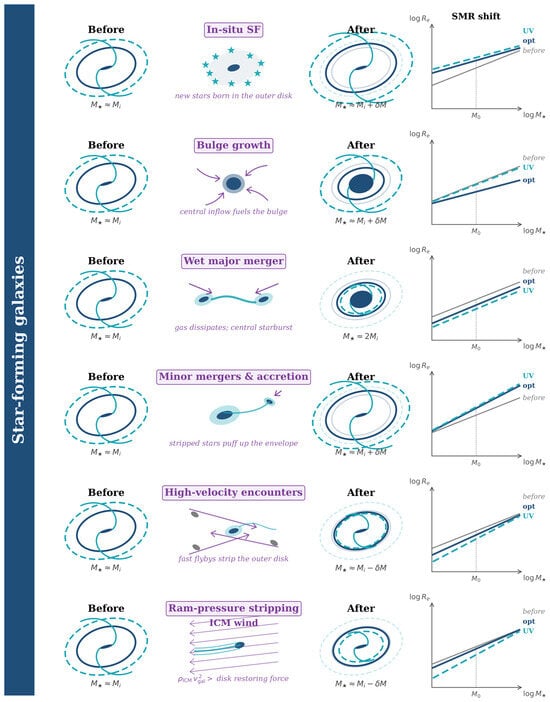
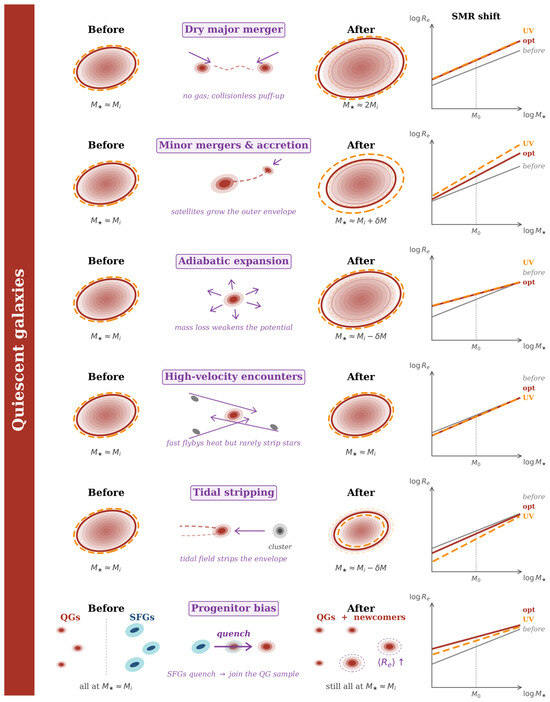

Disclaimer/Publisher’s Note: The statements, opinions and data contained in all publications are solely those of the individual author(s) and contributor(s) and not of MDPI and/or the editor(s). MDPI and/or the editor(s) disclaim responsibility for any injury to people or property resulting from any ideas, methods, instructions or products referred to in the content. |
© 2026 by the authors. Licensee MDPI, Basel, Switzerland. This article is an open access article distributed under the terms and conditions of the Creative Commons Attribution (CC BY) license.