


Abstract
A decade after the first direct detection of gravitational waves, the growing catalog of hundreds of confirmed events is revealing new insights into the spins of stellar-mass black holes. Spin measurements have long been heralded as a promising tracer of compact-object binary formation and evolution, as different formation channels predict distinct spin signatures on a population level. In this review, we summarize the astrophysics, phenomenology, and current measurements of black hole spins. We begin with an overview of the predictions for black hole spin magnitudes and orientations from leading formation channels—isolated binary evolution, dynamical formation in clusters, formation in AGN disks, and hierarchical triples. We then describe the imprint of spin effects on the gravitational waveform and the measurability of spin in individual events. Finally, we review current population-level constraints on spin magnitudes, orientations, and effective spin parameters, including correlations with mass and redshift, and discuss their astrophysical implications. We conclude by highlighting open questions and future prospects, emphasizing how improved detector sensitivity will enable increasingly precise spin measurements for both individual events and the binary black hole population as a whole.
1. Introduction
A decade after the first direct detection of gravitational waves, the catalog of sources detected by the LIGO-Virgo-KAGRA (LVK) collaboration has grown to include hundreds of binary black hole (BBH) mergers, two binary neutron stars, and a few neutron star–black hole (NSBH) mergers [1,2,3]1. Astrophysical black holes are characterized by only two parameters2—their masses and spins—which leave imprints on the gravitational waveform of each compact-object merger event. Thus, analyses of the gravitational-wave (GW) strain data recorded in interferometric detectors, which correspond to physical perturbations on the order of [5,6,7,8,9,10], allow us to constrain the parameters characterizing each binary and the population as a whole. These observations have been used for quantitative tests of general relativity, as well as to constrain the cosmic expansion history, search for signatures of gravitational lensing, astrophysically calibrate our detectors, and learn about the astrophysical processes shaping the formation and evolution of compact-object binaries (e.g., [11,12,13,14,15])3.
The main theoretical BBH formation channels are predicted to leave distinct imprints on their population-level spin distribution. However, the spins of individual GW events are generally measured with large uncertainties, complicating the prospects of using spin as an astrophysical tracer. In this review, we provide an overview of gravitational-wave measurements of black hole spins, from astrophysical and dynamical predictions to individual-event and population-level measurements. We begin with an overview of the predictions of the main theoretical formation channels for black hole spin magnitudes and orientations in Section 2. In Section 3, we describe the impact of spin on the gravitational waveform and characterize our ability to constrain spins for individual events, highlighting a few events with exceptional spin measurements. Population-level analyses are summarized in Section 4, including spin magnitudes, orientations, and correlations with other parameters. Finally, we conclude in Section 5 by highlighting some of the main open questions and future prospects for measuring spins with gravitational waves.
2. Spin as a Tracer of Binary Formation and Evolution
The formation channels of binary black holes fall broadly into two categories: isolated binary evolution, and dynamical formation (see [21,22] for recent reviews). The canonical picture of isolated binary evolution in the field involves a common envelope phase following the formation of the first black hole, which shrinks the orbit by several orders of magnitude via dynamical friction if the common envelope is successfully ejected (e.g., [23,24,25,26,27,28]). Alternatively, stable mass transfer (SMT) may proceed via Roche-lobe overflow, depending on the binary mass ratio, shrinking the orbit via angular momentum conservation [29,30,31,32]. Finally, binaries born in tight orbits in low-metallicity environments may avoid stellar mergers via chemically homogeneous evolution, leaving behind a BBH system [33,34,35].
On the other hand, binaries may form via dynamical interactions including exchanges, direct collisions, and tidal captures that occur in dense environments like globular clusters or nuclear star clusters [36,37,38,39]. The binary is “hardened” by any strong gravitational encounter that drains orbital energy, shrinking the orbit. Around active galactic nuclei (AGN), gas torques can eventually align the orbits of stellar-mass black holes in the nuclear star cluster with the disk, enabling binary formation via migration and orbital hardening via angular momentum exchange with the surrounding gas (e.g., [40,41,42,43,44,45]).
Finally, the formation of BBHs from stellar triples or higher-multiplicity systems incorporates elements of both isolated and dynamical formation (e.g., [46,47,48,49,50]), where Lidov–Kozai oscillations induced by the outer object excite significant eccentricity in the inner binary, leading to efficient orbital shrinking via the emission of bursts of gravitational radiation [51,52,53,54]. Below, we describe the predictions for binary black hole spin magnitudes and angles for each of these pathways, which are summarized in Figure 1.
Figure 1.
Schematic summarizing the formation of binary black holes via several leading formation channels: isolated binary evolution including either stable mass transfer or a common envelope phase, chemically homogeneous evolution, dynamical formation in clusters, formation in the disks of active galactic nuclei (AGN), and hierarchical triples. Panels 1–3 are adapted and reprinted from Ref. [21] with permission from Elsevier.
2.1. Spin Magnitudes
The natal spin of a black hole depends primarily on the efficiency of angular momentum transport in its massive star progenitor. Black hole spins are typically reported in terms of a dimensionless spin parameter, , where m is the black hole mass and its spin angular momentum, which reaches for a maximally spinning black hole but can exceed for rapidly rotating massive stars [55,56]. Recent asteroseismic observations suggest that angular momentum transport in low-mass stars is more efficient than theoretical models based on purely hydrodynamic processes had previously predicted (e.g., [57,58,59,60,61,62,63,64]). Instead, the magnetohydrodynamical instability known as the (modified) Tayler–Spruit dynamo provides a viable mechanism to explain this enhanced efficiency [65,66,67,68,69]. In this process, magnetic torques convert any differential rotation inside the star to rigid-body rotation, allowing angular momentum to be transported from the contracting core to the outer layers of the star, which are eventually ejected as the star evolves. The end result is a slowly-spinning core that collapses to a slowly-spinning black hole, with natal spins on the order of () for the modified (classic) dynamo mechanism [68,70,71]. The observation of maximally spinning black hole high-mass X-ray binaries challenges this picture, as spin-up is not expected to be effective enough over the short accretion timescales in these systems to achieve such high spins, albeit with potentially significant uncharacterized systematic measurement uncertainties (e.g., [72]).
Large natal spins are still possible in binary black holes where tidal spin-up is efficient. This can occur in binaries that form via chemically homogeneous evolution (CHE) from very massive, low-metallicity progenitors on tight orbits [33,34,35]. The rotation rates of the stars become synchronized to the orbital rotation via tidal locking, ensuring efficient chemical mixing in their interiors, which prevents the development of the core–envelope structure required for efficient angular momentum transport. However, the pulsational pair-instability supernova process can facilitate angular momentum loss in the lowest-metallicity stars undergoing CHE [73,74]. Alternatively, tidal spin-up of the progenitor of the second-born black hole can occur in post-common-envelope binaries consisting of a black hole and a Wolf–Rayet star [75,76,77,78,79,80]. In both cases, the efficiency of tidal spin-up depends on the binary separation, which, in turn, depends on the metallicity and the progenitor mass via the efficiency of mass loss from stellar winds, which act to widen the binary. This implies that the black hole spin will be correlated with redshift (via the metallicity-dependent cosmic star formation history) and mass [35,74,81]. Tidal spin-up is not expected to be efficient in binaries that form via SMT, as these generally have larger orbital separations during the black hole/Wolf–Rayet phase [74,82] (although see Ref. [83] for tidal spin-up predictions for SMT binaries with unequal masses).
While black holes formed from stellar collapse in dynamical environments are expected to have small natal spins based on the efficient angular momentum transport arguments presented above, they can be spun up via accretion from stellar collisions. Recent work has found that up to of black holes in clusters may have spin due to previous stellar collisions, although the exact spin distribution is sensitive to the unknown accretion efficiency [84]. A subpopulation of high-spin black holes is also expected for dynamically formed binaries due to hierarchical mergers, where the remnant of a previous merger is retained in the cluster and goes on to merge again (see [85] for a review). These second-generation (2G) black holes should have based on conservation of angular momentum in the merger of two slow-spinning, approximately equal-mass black holes [86,87,88]. The probability of merger remnant retention and, hence, of hierarchical mergers depends sensitively on the escape speed of the environment, as the final black hole produced in a merger receives a recoil kick with velocity , the magnitude of which depends on the spins and mass ratio of the component black holes [89,90,91,92,93]. For globular clusters with typical escape velocities ∼10–100 km/s, around ∼10% of mergers may include a 2G black hole [94]. Mergers including higher-generation black holes are rare, as 2G black holes are rapidly spinning, which enhances the recoil kick velocity and reduces the retention probability [95,96,97,98]. In fact, recoil kick velocities can reach for some spin configurations, which would lead to ejection from any host galaxy [99,100,101,102]. Meanwhile, mergers including a hierarchical component are predicted to be an order of magnitude more likely in nuclear star clusters, where escape velocities can exceed [103,104,105,106], and in AGN disks, where nearly all merger remnants are retained due to the deep potential well of the central supermassive black hole and the effect of gas damping [45]. Up to ∼25–50% of mergers in AGN disks can include a hierarchical component [45,107,108], and the rate of mergers including at least a third-generation black hole can exceed the rate of first-generation mergers later in the AGN lifetime due to the efficiency of repeated mergers in migration traps [44,109,110].
2.2. Spin Orientations
The spins of BBHs formed through isolated binary evolution are expected to be aligned to the orbital angular momentum due to the effects of tides in the progenitor stars, which work to align their spin axes to the orbit (e.g., [24,25,28,33,35,111,112,113,114]). Moderate misalignments can be imparted by supernova natal kicks, in which an asymmetric supernova explosion tilts the orbital plane of the binary, misaligning the black hole’s spin axis [111,115]. The magnitudes and directions of black hole natal kicks are subject to significant uncertainties; theoretical modeling suggests that the magnitudes should be suppressed by fallback onto the black hole [116,117,118], while some black hole X-ray binary observations are consistent with large ∼100 km/s kick magnitudes (e.g., [119,120,121,122,123]). Meanwhile, correlations between the proper motions and spin axes of some pulsars suggest that neutron star natal kicks may be preferentially oriented along their spin axes [124,125,126,127], but it is unknown whether the same astrophysical processes leading to this correlation would apply for black holes. Binary population synthesis simulations generally assume that black hole natal kicks are isotropically distributed, with magnitudes drawn from a Maxwellian distribution [128,129,130,131,132,133], and predict black hole spin tilts , with larger values of the velocity dispersion leading to larger tilts [134]. The degree of misalignment imparted by the kick depends primarily on the ratio of the kick velocity to the relative orbital velocity of the binary components, and on the kick angle with respect to the orbital plane. For binaries that merge within a Hubble time, the required tight orbital separation at birth implies large orbital velocities and, hence, small misalignment angles. The kick velocity must be several times larger than the orbital velocity to achieve a large misalignment, but this increases the probability of binary disruption. As such, tilts misaligned to the orbital angular momentum () are difficult to explain with isolated binary evolution (e.g., [135]). However, these arguments assume that the black hole inherits the spin direction of its progenitor star [136], which may not be the case if instead the spin axis is tossed in a random direction at birth [137], as suggested for neutron stars by the large spin misalignment angles observed in some binary pulsars [138].
Meanwhile, the spins of black holes formed dynamically in clusters are expected to be isotropically distributed [37,38,113,139,140], as repeated dynamical interactions scramble the spin orientations. The hierarchical triple channel uniquely predicts an excess of black holes with in-plane spins [47,49,141,142,143] due to competing precession effects of the inner vs outer binaries. The spins of the inner binary are initially aligned to its orbital angular momentum, , as described above for isolated binaries, which must be nearly perpendicular to for mergers facilitated by Lidov–Kozai oscillations. At large separations, the spin evolution is dominated by the precession of around , so the precession axis is aligned to and the angle between the spin vectors and the precession axis is . At small separations, the precession axis gradually aligns to , but is an adiabatic invariant, so the angle between the inner binary spin vectors and the precession axis—and hence, —is maintained to be perpendicular through the merger of the inner binary [144].
Finally, the AGN disk channel is expected to produce BBHs with spins either aligned or anti-aligned to the orbital angular momentum. This alignment occurs through the stellar-mass analog of the Bardeen–Petersen effect [145]. First, any orbital inclination with respect to the disk is dissipated, so that the binary orbital angular momentum is either aligned or anti-aligned to the angular momentum of the accretion disk [146,147]. A circumbinary disk will form around the binary, with minidisks around each black hole, which exert gas torques to keep the black hole spin aligned to the angular momentum of the disks [148]. While recent works suggest that the distribution of spin tilts for binaries formed in AGN disks should favor aligned over anti-aligned binaries, the exact fraction is subject to considerable modeling uncertainties, affected by the unknown ratio of retrograde to prograde orbits [149], the role of binary–single encounters [150], and the stability of retrograde configurations [151,152].
3. Measuring Spin with Gravitational Waves
3.1. The Effect of Spin on the GW Waveform
A quasi-circular compact-object binary is fully characterized by 17 free parameters, . Seven parameters describe the relative position and orientation of the binary with respect to the observer; these include two parameters for the sky location of the source (right ascension and declination), the phase and time at coalescence, the luminosity distance and inclination of the orbital plane relative to the line of sight of the observer, and the polarization angle. The remaining ten parameters are intrinsic to the binary, including the masses, tidal deformabilities (which are assumed to be zero for black holes), and spin vectors of each component, where the more massive component of the binary is called the primary (). The spins are typically parameterized in terms of the dimensionless spin magnitude, , a tilt angle with respect to the orbital angular momentum, , and two azimuthal angles, and . Each of these parameters affects the gravitational waveform observed in the frequency band of ground-based GW detectors, which can be described in the inspiral regime using the post-Newtonian (PN) approximation (e.g., [153]), providing an expansion of the general relativistic equations of motion in orders of the velocity of the moving bodies. Binaries only spend the last few minutes to seconds before merger in this frequency band, compared to the delay times expected between formation and merger.
Spins have two primary effects on the evolution of a compact-object binary and its emitted gravitational radiation. If the spins are misaligned to the orbital angular momentum, , for most parameter configurations, the binary will undergo simple precession [154], which imprints characteristic amplitude modulations on the waveform, as shown in the bottom panel of Figure 2. In this case, the spin and orbital angular momentum vectors precess about the total angular momentum, , at a frequency that is small compared to the frequency of the GW radiation. A comparable-mass binary that sweeps through the band of ground-based GW detectors from ∼10 to 500 Hz will undergo precession cycles, with most of these precession cycles occurring at low frequencies [155]. The exact dynamics depend on the relative magnitude and orientation of and ; when or and are nearly aligned, the precession cone around is narrower, leading to less extreme amplitude modulations in the waveform. The degree of amplitude modulation of the waveform also depends strongly on the inclination angle of the observer [154,156]. This effect is enhanced for binaries with nearly edge-on inclinations, where the observer can see both sides of the orbital plane as it oscillates in the extreme case.
Figure 2.
Time-domain gravitational-wave strain for a simulated event with different values of (top) and (bottom), with all other binary parameters consistent with those inferred for the heavy BBH merger GW190521. We use the SEOBNRv5PHM waveform model and a reference frequency of . The vertical lines show the start time of each waveform from a frequency of .
A special case of simple precession occurs when the binary configuration corresponds to a “spin–orbit resonance”; the two component spin vectors and the orbital angular momentum vector align to form a 2D plane and jointly precess about [157]. Rather than circulating freely, the azimuthal angle between the in-plane projections of the component spins is restricted to two specific values: if and if [158]. These resonant configurations are more likely to occur in isolated binaries, since the initial tilt angles must be small but nonzero. Binaries where the heavier black hole forms first (standard mass ratio) will end up with , since on average, as the first-formed black hole experiences two supernova kicks [134,158].
When spin–spin couplings become significant, simple precession is replaced with generic two-spin precession that includes nutation, in which the polar angle between and oscillates [159]. For some parameter configurations, when is small, a nutational resonance called “transitional precession” occurs, causing the total angular momentum vector to tumble in space, bringing and along with it [160]. While nutation is expected to be prevalent among isolated binaries [161], the likelihood of observing the GW emission from a binary undergoing transitional precession is low [154]. In extreme cases, nutation can result in a complete flip of the black hole’s spin direction with respect to the orbital angular momentum [162,163,164]. A related dynamical instability occurs in “up–down” binaries, where the more massive black hole is aligned to the orbit and the secondary is anti-aligned [165,166]. Deviations from exact alignment in these “up–down” binaries lead to an instability that causes such systems to evolve towards the spin–orbit resonance [167].
Even for binaries with spins (anti-)aligned to the orbital angular momentum, the spin contributes to the accumulated orbital phase [156]. As illustrated in the top panel of Figure 2, the merger is delayed for systems with large prograde spins relative to a non-spinning binary with otherwise identical parameters due to the orbital hangup effect, while for systems with large retrograde spins, the merger is hastened [168]. The effect on the phasing is dominated by the contribution of spin–orbit couplings, which enter the waveform at 1.5 PN order. Spin–spin couplings enter at 2 PN and are generally weak unless the spin magnitudes are large [153,169]. Both kinds of couplings affect both the phasing and the precessional dynamics described above.
The leading-order spin correction to the secular inspiral phasing depends only on the mass-weighted spin components aligned to the orbital angular momentum, which can be conveniently parameterized as
where is the binary mass ratio [170,171,172,173]. This parameter enters the GW phase at 1.5 PN order and is conserved through 2 PN when averaging over the orbital motion [174],
where , is the chirp mass, and is the symmetric mass ratio. An analogous quantity has been defined to encapsulate the effects of precession [175],
although updated definitions that more robustly capture the effects of GW radiation in higher-order multipoles and variations occurring on the precessional timescale have been proposed [176,177]. Alternatively, the measurability of precession can be captured via the precessing signal-to-noise ratio (SNR), by decomposing the waveform into a series of non-precessing harmonics that beat against each other to generate the amplitude and phase modulations imprinted by precession [178,179,180].
3.2. Measurability of Spin in Individual Events
The spins of compact-object binaries are measured using Bayesian inference, by comparing the GW strain data to waveforms from across the parameter space of interest. Stochastic sampling techniques are used to obtain samples from the posterior probability distribution on the binary parameters, where the likelihood of observing frequency-domain strain data given some choice of binary parameters is given by (e.g., [181,182])
where T is the duration of the analyzed data segment and is the detector noise power spectral density (PSD). Mass priors are chosen based on the properties of each event identified by the matched-filter search pipelines, which currently cover the sub-solar to several-hundred-solar-mass regime, with mass ratios , although the exact details vary between search pipelines and observing runs (e.g., [17,183,184,185,186]). Spin priors for the analyses of individual events are typically assumed to be uniform in magnitude and isotropic in direction.
In Figure 3 and Figure 4, we show the spin constraints on the individual component spin magnitudes, tilts, and for all of the events in the fourth LVK catalog (GWTC-4) [14] and the five exceptional events from later in the fourth observing run (O4) [15,187,188,189]. In general, the effective spin parameters and can be measured more accurately than the component spin magnitudes and angles [190], for which current constraints are weak. However, measurements of are strongly correlated with mass ratio along lines of constant (Equation (3)), particularly for low-mass, inspiral-dominated signals with non-precessing spins [191], although a similar correlation with mass ratio has also been identified for heavy binaries [192]. Precession effects help to break this degeneracy [193], leading to improvements in the measurements of both the spins and the extrinsic parameters [194,195,196], since both sets of parameters dictate the extent to which amplitude and phase modulations are discernible in the waveform. Given that dictates the precessional dynamics, spins are better measured in systems with large spin magnitudes [197].
Figure 3.
Maximum posterior value and highest-posterior density 90% credible interval for the (a) spin magnitudes and (b) tilts for all the events with from GWTC-4, and the five exceptional events from later in O4. Events are ordered by the maximum posterior value of the primary for magnitudes and tilts independently.
Figure 4.
ordered by the maximum posterior value for all the events with from GWTC-4, and the five exceptional events from later in O4. The error bars span the highest-posterior density 90% credible interval.
Spins can also be measured more precisely for unequal-mass systems [198], as the term in Equation (3) proportional to vanishes for exactly equal-mass systems. Equal-mass systems are subject to a labeling degeneracy, where the spins of the more and less massive black holes cannot be distinguished. Instead, sorting the binary components by their spin magnitudes [199] or using machine learning methods to determine the optimal sorting scheme for each event [200] allows for more precise spin posteriors subject to fewer multimodalities. Including the GW radiation in higher-order modes, which is enhanced for unequal-mass systems viewed at edge-on inclinations, improves both the accuracy and precision with which spins, and precession effects in particular, can be measured [178,201,202,203,204]. Particularly for unequal-mass systems, two-spin effects become difficult to discern, and the spin of the secondary object is largely unconstrained [190].
Early studies using waveform mismatch calculations suggested that configurations corresponding to different spin–orbit resonances may be distinguishable amongst themselves and from freely precessing systems [205,206,207], but updated works using modern waveform models generally find that the spin tilt and azimuthal angles are difficult to measure [208] with the precision needed to identify resonances, even with large signal-to-noise ratios [209]. While can be well constrained in certain parts of the binary parameter space [210,211], the constraints are improved when measured at a reference frequency closer to merger, as the waveform is more sensitive to variations in these parameters in this regime [212].
A few individual BBH events have noteworthy spin measurements, as shown in Figure 5. GW190412 was the first event with a measurable unequal mass ratio ()4 and contribution from higher-order modes [213]. The primary object is confidently constrained to be spinning, with . More recently, the observation of the events GW241011_233834 and GW241110_124123 (henceforth, GW241011 and GW241110, respectively) provided the strongest evidence of mergers formed hierarchically, as both of these events have unequal mass ratios and primary spin magnitudes characteristic of second-generation black holes: for GW241011, and for GW241110 [187]. Both primary spin vectors are misaligned to the orbital angular momentum, while likely pointing in opposite directions for the two events—another indication of dynamical formation.
Figure 5.
Spin disk plots for exceptional GW events with notable spin measurements: (a) GW190412, (b) GW190521, (c) GW231123, (d) GW241011, and (e) GW241110. The left (right) hemisphere of each panel shows the inferred spin of the primary (secondary) object. The radial direction indicates the spin magnitude and the angular direction of the tilt angle with respect to the orbital angular momentum. The shading conveys the posterior probability, with regions of higher probability indicated by a darker color in each plot.
The observation of the event GW231123_135430 (henceforth, GW231123) [188] suggests the presence of a growing subpopulation of high-mass, high-spin events, as it joins GW190521 in this part of the parameter space [214]. Both of these events broke the record for the most massive event at the time of their detection, and both are consistent with the primary black hole being maximally spinning, with and for GW231123 and GW190521, respectively. The spin constraints on these high-mass events and signatures of precession are difficult to square with the intuition developed in the previous section, which implies that spin information is predominantly imprinted in the inspiral, as only the last few inspiral cycles are detectable for such high-mass events, which are instead merger- and ringdown-dominated in the band of the LVK detectors.
What drives the spin information for such massive events is one of the active, open questions in the field. Ongoing work suggests that uncertainties in the spin parameters do not necessarily increase monotonically with mass [209,215]. For example, large aligned spins are better constrained for heavy systems than those without significant SNR in the merger and ringdown. It is also easier to measure spin alignment than precession in heavy systems [209,215,216]. Noise fluctuations alone are not enough to explain the informative precession measurement in GW190521 [209,217] or the high masses and spin magnitudes inferred for GW231123 [218]. For GW190521, the ability to obtain informative measurements of instead hinges on the relationship between the inspiral and merger/ringdown portions of the signal [219] and depends sensitively on the exact six-dimensional spin configuration [209], while the choice of extrinsic parameters does not have as significant an effect [219]. Additionally, the short inspiral for such massive systems means that precession effects can be confused for eccentricity [217,220,221,222], since waveform models do not currently include both effects.
Spin inferences are also particularly sensitive to data quality issues. Non-Gaussian, transient noise artifacts known as “glitches” can bias spin measurements if they overlap with an astrophysical source [223,224,225]. For example, the significance of the evidence for precession in GW200129_065458 varies depending on the glitch mitigation technique [226,227,228], and the interpretation of the misaligned spin in GW191109_010717 also depends on the assumed glitch model [229]. The inference of spin in short, high-mass systems like GW231123 [230] is particularly sensitive to data quality issues, especially since common glitch types with similar durations and time–frequency morphologies can masquerade as massive, high-spin BBHs when fitted with an astrophysical source model [231].
4. The Population of Black Hole Spins
Once posteriors on the binary parameters of each individual BBH event are available, population-level analyses typically seek to constrain a set of hyper-parameters, , common to all events that describe the population-level distributions from which are drawn. Some binaries are easier to detect than others (like those with large positive [232]), so the observed population is a biased representation of the underlying astrophysical distribution. The likelihood of observing an ensemble of events with data given hyper-parameters accounts for these selection effects [233,234,235]:
where is the population model. In the selection effects correction, represents the probability of detecting an event drawn from a population with hyper-parameters , and is the probability of detecting an event with parameters , which is typically calculated using a simulated observing campaign [236,237].
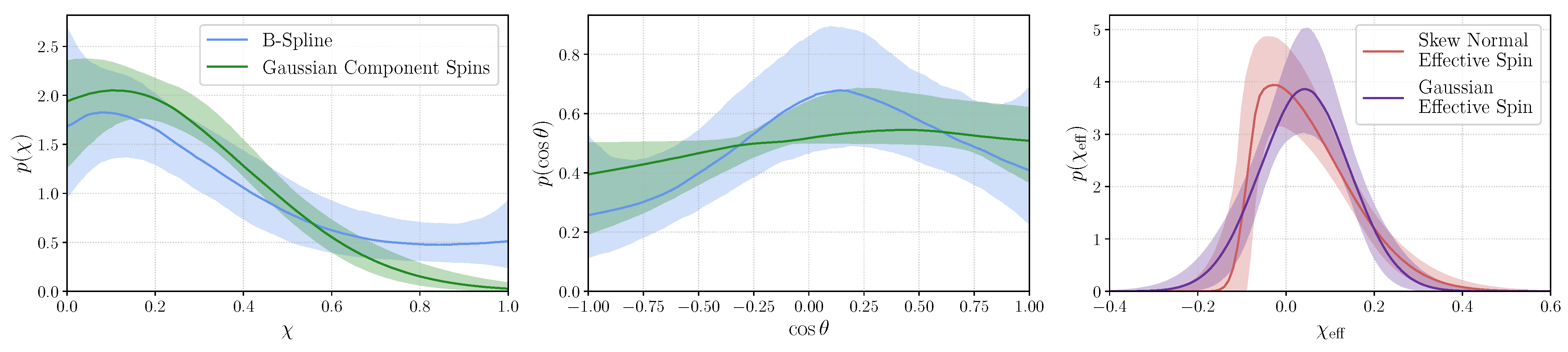
The population models themselves are usually characterized based on the strength of their assumptions, trading off interpretability for flexibility. Strongly-modeled approaches include simple phenomenological distributions designed to capture broad features (e.g., [238,239,240,241]), like the skew normal distribution used to fit the global peak and extended positive tail in the distribution shown in the right panel of Figure 6 [241], and astrophysically motivated models targeting specific effects, like direct comparisons of the data against the outputs of population synthesis simulations to infer the common envelope efficiency or mixture fraction between specific formation channels (e.g., [82,242,243,244]). Meanwhile, weakly modeled or non-parametric approaches use more generic distributions like splines [245,246,247], Gaussian processes [248] and mixture models [249], and binned histograms [250,251] to let the data speak for themselves. These two approaches together provide a more complete picture of black hole population properties and can be compared against each other to identify model misspecification. For example, the increased probability at large spin magnitudes identified by the flexible spline model shown in the left panel of Figure 6 suggests that the strongly-modeled Gaussian distribution is insufficiently flexible to adequately capture this feature.
Given the distinct spin predictions for different binary formation channels described above in Section 2, population-level measurements of spins have long been regarded as a promising discriminator between BBH formation channels. Early works using both Bayes factors [252] and hierarchical inference [239,253] typically predicted that the mixture fraction between channels could be measured using spin orientations (isotropic vs aligned) with as few as 100 events. If a single channel dominated and spin magnitudes were large, formation channels could be distinguished with as few as events [253,254,255]. Similar optimistic predictions were made for the prospects of distinguishing hierarchical mergers [256] and using their unique features to measure mixture fractions between channels [257]. However, we are now in the regime of catalogs including hundreds of events, and the picture has proven more complicated than these early works imagined.
Figure 6.
Population-level spin distributions for the BBHs in GWTC-4 with [11,258]. The component spin magnitude analyses do not distinguish between the primary and secondary spins in the binary. The shaded regions bound the 90% credible intervals for each model, and the solid lines represent the medians. Left: Inferred spin magnitude distribution using a strongly modeled truncated Gaussian distribution (green) and a weakly modeled B-spline (blue). Middle: distribution inferred using a phenomenological mixture model between isotropic and truncated Gaussian subpopulations (green) and B-splines (blue). Right: distribution inferred using skew normal (red) and truncated Gaussian (purple) population models.
4.1. Spin Magnitudes
Strongly modeled approaches using beta distributions [255,259,260,261] or truncated Gaussians [11] have found consistent evidence for an excess of small spin magnitudes among all black holes in compact-object binaries since the first catalog of LVK observations (GWTC-1), and this has been reinforced with non-parametric analyses of more recent catalogs [245,246,248] (see the left panel of Figure 6). A complementary picture emerges from analyses that fit the population-level distribution of instead of directly, where the global distribution of effective spin peaks at small but positive values, [11,240,261,262,263]. One of the open questions in the field is just how small these spin magnitudes are, and whether there is evidence for a subpopulation of non-spinning black holes, which has been explored using both the spin magnitude [264,265,266,267,268,269] and distributions [263,270]. These analyses generally find that up to 80% of the BBH population can be non-spinning, but they cannot rule out the possibility that the entire population consists of binaries with two spinning black holes.
Most analyses looking at BBH spin magnitudes assume that the spins of the primary and secondary black hole in each binary are independently and identically distributed from the same underlying astrophysical distribution. Under this assumption, the population-level distributions of the spin-sorted spin magnitudes suggest that the more rapidly spinning black hole in each binary (labeled A rather than 1 for the more massive) has typical spin , while the more slowly spinning black hole is consistent with [261,269]. However, this assumption has been relaxed in recent analyses to look for differences across the distributions of , including those that may be imprinted by singly spinning binaries as expected for tidal spin-up in systems formed via common envelope evolution. These works generally find modest evidence for two spin subpopulations: one with spin magnitudes around , and a subdominant population consisting of ∼ of binaries with [271,272]. While conclusions about the secondary spin distribution vary based on the model assumptions and dataset [271,272,273], determining which of the distributions favors higher spins encodes key information about formation channels, like the contribution of hierarchical mergers where is expected (see Section 4.3), and the prevalence of mass ratio reversal in isolated binaries, which would imply that the more massive black hole formed second from the initially less massive star and was tidally spun up [268].
Despite the small population of neutron star–black hole (NSBH) mergers, early analyses suggest that the spins of black holes paired with neutron stars may be smaller than those paired with black holes [274,275,276]. Since most neutron star–black hole (NSBH) systems are expected to form via isolated binary evolution [277], the black hole is only expected to acquire significant spin if it forms second under mass ratio reversal, which may happen in up to ∼20% of such systems [278,279]. A larger population will be required to determine whether these early indications of small spins are robust, and to begin probing neutron star-black hole (NSBH) spin orientations.
4.2. Spin Orientations
Spin tilts have typically been fitted with a mixture model between aligned and isotropic components [239], motivated by the predictions for isolated vs dynamical binaries discussed in Section 2.2. Recent works that relax the assumption of alignment in phenomenological models (as shown in the middle panel of Figure 6) have found no evidence for a preferentially aligned subpopulation [280], with a low-significance peak near in-plane spins instead emerging across both strongly and weakly modeled analyses [11,144,245,246,248]. This excess of in-plane spins can be explained if a significant fraction of BBHs form in hierarchical triples, but more data will be required to determine whether this is a robust population feature, as evidence for spurious peaks can be inferred with catalogs of the current size [281], and its exact properties and significance are model-dependent [282]. Beyond the spin tilt angles, analyses of the azimuthal angles are beginning to reveal hints of spin–orbit resonances at the population level [283,284]. However, simulation studies suggest that accurate and precise recovery of spin angle distributions is difficult for populations consisting of a mixture of aligned and isotropic systems, and that care should be taken when interpreting the measured mixture fraction parameter, as its recovery is model- and population-dependent [281,284,285].
While and are lossy parameters, their population-level distributions also carry information about spin orientations and are measured more precisely. Regardless of the population model used, the inferred distribution favors more aligned () than anti-aligned systems [11]. Whether this preference is driven by a peak in the distribution at positive values or by a long tail at positive values in a distribution peaked at depends on the population model (see the right panel of Figure 6) [240,241,263]. Meanwhile, the distribution peaks away from zero, but its inference is more sensitive to analysis settings governing convergence of Monte Carlo integrals [11,286,287]. Systems with significant spin misalignments () have been found to represent ∼20–40% of the population using analyses of both and , with implications for the fraction of BBHs formed dynamically [11].
4.3. Spin Correlations
While the results presented above have assumed that the BBH mass, spin, and redshift distributions are independent, the formation channels discussed in Section 2 naturally imply correlations between these parameters, and ignoring such correlations can lead to bias in the inferred marginal distributions [288]. Two main approaches have been explored to search for such correlations, evidence for which has been identified since the third LVK catalog [261]. The first approach explicitly models the dependence of the hyper-parameters governing one distribution on the other binary parameters. For example, Refs. [289,290,291] all allow the mean and width of the distribution to evolve linearly with mass and/or redshift, while Ref. [247] relaxes this assumption and fits the relationship with a spline. The distribution was found to broaden with redshift, which indicates that BBHs were born with larger spin in the cosmic past [11,247,291]. Such a trend could be explained by tidal spin-up—which is more efficient in close binaries that also merge faster at higher redshifts—by reduced efficiency of stellar winds carrying away angular momentum in BBH progenitors at low metallicities and high redshifts or by an increasing fraction of hierarchical mergers at large redshift [70,74,292]. There is also evidence for a correlation between either the mean or width and the binary mass ratio [11,290,293,294], which could be explained by the AGN channel, in which hierarchical mergers are more common, and the heavier black hole is more likely to have been spun up and aligned due to accretion in the disk [149,152].
Another approach involves looking for subpopulations across the mass, spin, and redshift parameter space with distinct properties (e.g., [295,296,297,298,299,300,301,302,303,304]). The GWTC-4 data are beginning to reveal signatures of three subpopulations: one peaked at , with a broad range of mass ratios and small but aligned spins consistent with isolated binary evolution; another peaked around , strongly favoring equal mass ratios and isotropically distributed spins that could correspond to first-generation mergers in clusters [305,306,307,308]; and a smaller subpopulation including both high masses and spins whose properties are more uncertain, which could represent the confluence of multiple subdominant formation channels including hierarchical mergers, CHE, and formation in AGN disks [309,310]. The low-mass subpopulation can be explained via the SMT channel [311] or as a consequence of “compactness peaks” in the distribution of progenitor masses that decrease explodability and, hence, increase the likelihood of black hole formation [297,312,313,314,315].
Analyses targeting evidence for hierarchical mergers have employed both approaches, including mixture models between generational subpopulations [103,266,267,316] and looking for correlations between the spin distribution and the primary mass [317,318,319] or mass ratio [320,321]. Current data hint at the presence of two subpopulations of hierarchical mergers: one at low primary masses consistent with GW241011 and GW241110, and another above the pair instability supernova mass gap around [322,323,324,325,326,327,328,329], where black holes are not expected to form from direct stellar collapse [318,319,320,330]. These hierarchical subpopulations may have different mass ratio and redshift distributions from the rest of the population, potentially explaining the observed –mass ratio and –redshift correlations [292,321].
5. Conclusions and Open Questions
The first decade of gravitational-wave observations has provided a new window into the spins of stellar-mass black holes. Although expectations based on observations of black hole X-ray binaries were that black holes in merging compact-object binaries would have large spins (e.g., [72]), the growing catalog of gravitational-wave sources has revealed that these objects generally have small spin magnitudes. This makes it more difficult to obtain precise measurements of the component spins both for individual events and on the population level. Despite this challenge, gravitational-wave spin constraints have already provided a bounty of astrophysical insights into the processes shaping the formation and evolution of compact-object binaries.
The small observed spin magnitudes in most binaries are consistent with the picture of efficient angular momentum transport in their stellar progenitors. The preference for positive effective spins suggests that isolated binary evolution dominates among the formation channels, as large misalignments required for negative values are difficult to explain with this channel. However, the evidence for misaligned tilts and negative values at the population level indicates that some binaries form dynamically, even if this channel is subdominant. This picture is corroborated by recent analyses looking for BBH subpopulations and correlations in the mass–spin–redshift parameter space. Evidence for hierarchical mergers continues to grow, via both the detection of individual events and a subpopulation of BBHs with the signature spin of predicted for the remnant of a previous merger. Meanwhile, tentative evidence for alternative formation channels is beginning to appear with low significance, like the correlation between BBH mass ratio and effective spin that can be naturally explained by the AGN channel, or the hint of an excess of in-plane spins that only the hierarchical triple channel predicts.
In spite of this significant progress in connecting gravitational-wave spin observations to theory, several open questions remain. One key question revolves around the measurability of spin in high-mass systems, and how precession effects in particular are encoded in the waveform over only a few inspiral cycles. The ability to measure spin tilts on a population level represents another significant open question, as this parameter has long been heralded as a promising way to distinguish formation channels, but its population-level measurements are prone to biases and spurious features, even as the population grows. Finally, the tension between the small spins inferred with gravitational waves and the large spins observed in X-ray binaries remains unexplained. Significant development will be required to achieve parity between the understanding of X-ray binary selection effects and spin measurement systematics compared to the gravitational-wave case, where such errors are currently subdominant to large statistical uncertainties.
The next decade of gravitational-wave astronomy will see the growth of the catalog of compact-object binaries by an order of magnitude [331], and the growth of the detector network to include LIGO-India [332], before next-generation detectors come online to detect hundreds of BBH mergers per day [333,334]. This increase in detector sensitivity will facilitate improvements in the spin constraints for individual events (e.g., [335,336,337,338]), which will be detected with increasing SNR. The detection of the astrophysical stochastic gravitational-wave background of BBH mergers before the era of next-generation detectors will also provide a glimpse into the spin properties of high-redshift sources that are individually undetectable [339], allowing us to better constrain population-level correlations. These advances will provide a sharper view of the spins of black holes in merging compact-object binaries, revealing a concordant picture of their formation and evolution.
Funding
S.B. is supported by NSF grant number PHY-2513246.
Data Availability Statement
All data behind the figures and values quoted in this manuscript are publicly available on Zenodo [258,340,341,342,343,344].
Acknowledgments
S.B. thanks Michael Zevin for completing the internal LVK document review. She also thanks the organizers of the “Taking Spin Measurements for a Spin: Recent Progress on Black Hole Spin Measurements Across the Electromagnetic and Gravitational Spectra” Workshop at Wake Forest University in September 2025 for triggering insightful discussions that led to the preparation of this manuscript. This material is based upon work supported by NSF’s LIGO Laboratory, which is a major facility fully funded by the National Science Foundation. LIGO was constructed by the California Institute of Technology and Massachusetts Institute of Technology with funding from the National Science Foundation and operates under cooperative agreement PHY-0757058. The author is grateful for computational resources provided by the Caltech LIGO Laboratory supported by NSF PHY-0757058 and PHY-0823459. This paper carries LIGO document number LIGO-P2600283. During the preparation of this manuscript, ChatGPT v5.5 was used for the purposes of synthesizing references and generating Figure 1. The author has reviewed and edited the output and takes full responsibility for the content of this publication.
Conflicts of Interest
The author declares no conflicts of interest.
Abbreviations
The following abbreviations are used in this manuscript:
| O4 | Fourth observing run |
| BBH | Binary black hole |
| LVK | LIGO-Virgo-KAGRA |
| PN | Post-Newtonian |
| SNR | Signal-to-noise ratio |
| GW | Gravitational wave |
| PSD | Power spectral density |
| CHE | Chemically homogeneous evolution |
| AGN | Active galactic nuclei |
| SMT | Stable mass transfer |
| 2G | Second-generation |
| NSBH | Neutron star–black hole |
| FAR | False alarm rate |
Notes
| 1 | The exact number of sources depends on the threshold used to distinguish significant events, with recent catalogs typically using false alarm rate (FAR) . |
| 2 | While black holes may also be charged, astrophysical black holes are expected to be effectively neutral due to interactions with surrounding plasma (e.g., [4]). |
| 3 | In the late stages of the preparation of this manuscript, the LVK collaboration released their fifth catalog, GWTC-5, including over 100 new BBH events [16,17,18,19,20]. This review focuses on the population of GW black holes reported in GWTC-4 and exceptional events from later in O4, but the general spin trends discussed here are robust in GWTC-5 data. |
| 4 | Reported quantities in this work are the maximum posterior value with highest-posterior density 90% credible interval unless otherwise noted. |
References
- Abac, A.G. et al. [LIGO-Virgo-KAGRA Collaboration] GWTC-4.0: Methods for Identifying and Characterizing Gravitational-wave Transients. Astrophys. J. Lett. 2026, 1004, L21. [Google Scholar] [CrossRef] [Scilit]
- Abac, A.G. et al. [LIGO-Virgo-KAGRA Collaboration] GWTC-4.0: Updating the Gravitational-Wave Transient Catalog with Observations from the First Part of the Fourth LIGO-Virgo-KAGRA Observing Run. Astrophys. J. Lett. 2026, 1004, L22. [Google Scholar] [CrossRef] [Scilit]
- Abac, A.G. et al. [LIGO-Virgo-KAGRA Collaboration] GWTC-4.0: An Introduction to Version 4.0 of the Gravitational-Wave Transient Catalog. Astrophys. J. Lett. 2025, 995, L18. [Google Scholar] [CrossRef] [Scilit]
- Blandford, R.D.; Znajek, R.L. Electromagnetic extractions of energy from Kerr black holes. Mon. Not. R. Astron. Soc. 1977, 179, 433–456. [Google Scholar] [CrossRef] [Scilit]
- Capote, E.; Jia, W.; Aritomi, N.; Nakano, M.; Xu, V.; Abbott, R.; Abouelfettouh, I.; Adhikari, R.X.; Ananyeva, A.; Appert, S.; et al. Advanced LIGO detector performance in the fourth observing run. Phys. Rev. D 2025, 111, 062002. [Google Scholar] [CrossRef] [Scilit]
- Aasi, J. et al. [LIGO Scientific Collaboration] Advanced LIGO. Class. Quant. Grav. 2015, 32, 074001. [Google Scholar] [CrossRef] [Scilit]
- Acernese, F.; Agathos, M.; Agatsuma, K.; Aisa, D.; Allemandou, N.; Allocca, A.; Amarni, J.; Astone, P.; Balestri, G.; Ballardin, G.; et al. Advanced Virgo: A second-generation interferometric gravitational wave detector. Class. Quant. Grav. 2015, 32, 024001. [Google Scholar] [CrossRef] [Scilit]
- Aso, Y.; Michimura, Y.; Somiya, K.; Ando, M.; Miyakawa, O.; Sekiguchi, T.; Tatsumi, D.; Yamamoto, H. Interferometer design of the KAGRA gravitational wave detector. Phys. Rev. D 2013, 88, 043007. [Google Scholar] [CrossRef] [Scilit]
- Somiya, K. Detector configuration of KAGRA: The Japanese cryogenic gravitational-wave detector. Class. Quant. Grav. 2012, 29, 124007. [Google Scholar] [CrossRef] [Scilit]
- Akutsu, T. et al. [KAGRA Collaboration] Overview of KAGRA: Detector design and construction history. Prog. Theor. Exp. Phys. 2021, 2021, 05A101. [Google Scholar] [CrossRef] [Scilit]
- Abac, A.G. et al. [LIGO-Virgo-KAGRA Collaboration] GWTC-4.0: Population Properties of Merging Compact Binaries. Astrophys. J. Lett. 2026, 1005, L51. [Google Scholar] [CrossRef] [Scilit]
- Abac, A.G. et al. [LIGO-Virgo-KAGRA Collaboration] GWTC-4.0: Searches for Gravitational-Wave Lensing Signatures. arXiv 2025. [Google Scholar] [CrossRef] [Scilit]
- Abac, A.G. et al. [LIGO-Virgo-KAGRA Collaboration] GWTC-4.0: Tests of General Relativity. I. Overview and General Tests. arXiv 2026. [Google Scholar] [CrossRef] [Scilit]
- Abac, A.G. et al. [LIGO-Virgo-KAGRA Collaboration] GWTC-4.0: Constraints on the Cosmic Expansion Rate and Modified Gravitational-wave Propagation. arXiv 2025. [Google Scholar] [CrossRef] [Scilit]
- Abac, A.G. et al. [LIGO-Virgo-KAGRA Collaboration] GW240925 and GW250207: Astrophysical Calibration of Gravitational-wave Detectors. arXiv 2026. [Google Scholar] [CrossRef] [Scilit]
- Abac, A.G. et al. [LIGO-Virgo-KAGRA Collaboration] GWTC-5.0: An Introduction to Version 5.0 of the Gravitational-Wave Transient Catalog. arXiv 2026. [Google Scholar] [CrossRef] [Scilit]
- Abac, A.G. et al. [LIGO-Virgo-KAGRA Collaboration] GWTC-5.0: Methods for Identifying and Characterizing Gravitational-wave Transients. arXiv 2026. [Google Scholar] [CrossRef] [Scilit]
- Abac, A.G. et al. [LIGO-Virgo-KAGRA Collaboration] GWTC-5.0: Observations from the Second Part of the Fourth LIGO-Virgo-KAGRA Observing Run and Updates to the Gravitational-Wave Transient Catalog. arXiv 2026. [Google Scholar] [CrossRef] [Scilit]
- Abac, A.G. et al. [LIGO-Virgo-KAGRA Collaboration] GWTC-5.0: Population Properties of Merging Compact Binaries. arXiv 2026. [Google Scholar] [CrossRef] [Scilit]
- LIGO-VIRGO-KAGRA Collaboration. GWTC-5.0: Constraints on the Cosmic Expansion Rate and Modified Gravitational-wave Propagation. arXiv 2026. [Google Scholar] [CrossRef] [Scilit]
- Mandel, I.; Farmer, A. Merging stellar-mass binary black holes. Phys. Rep. 2022, 955, 1–24. [Google Scholar] [CrossRef] [Scilit]
- Mapelli, M. Formation Channels of Single and Binary Stellar-Mass Black Holes. In Handbook of Gravitational Wave Astronomy; Springer: Singapore, 2021; pp. 1–65. [Google Scholar] [CrossRef] [Scilit]
- Smarr, L.L.; Blandford, R. The binary pulsar: Physical processes, possible companions, and evolutionary histories. Astrophys. J. 1976, 207, 574–588. [Google Scholar] [CrossRef] [Scilit] [PubMed]
- Postnov, K.A.; Yungelson, L.R. The Evolution of Compact Binary Star Systems. Living Rev. Relativ. 2014, 17, 3. [Google Scholar] [CrossRef] [Scilit] [PubMed]
- Tutukov, A.V.; YungelSon, L.R. The merger rate of neutron star and black hole binaries. Mon. Not. R. Astron. Soc. 1993, 260, 675–678. [Google Scholar] [CrossRef] [Scilit]
- Kalogera, V.; Belczynski, K.; Kim, C.; O’Shaughnessy, R.W.; Willems, B. Formation of Double Compact Objects. Phys. Rep. 2007, 442, 75–108. [Google Scholar] [CrossRef] [Scilit]
- Ivanova, N.; Justham, S.; Chen, X.; De Marco, O.; Fryer, C.L.; Gaburov, E.; Ge, H.; Glebbeek, E.; Han, Z.; Li, X.-D.; et al. Common Envelope Evolution: Where we stand and how we can move forward. Astron. Astrophys. Rev. 2013, 21, 59. [Google Scholar] [CrossRef] [Scilit]
- Belczynski, K.; Holz, D.E.; Bulik, T.; O’Shaughnessy, R. The first gravitational-wave source from the isolated evolution of two 40-100 Msun stars. Nature 2016, 534, 512. [Google Scholar] [CrossRef] [Scilit] [PubMed]
- Inayoshi, K.; Hirai, R.; Kinugawa, T.; Hotokezaka, K. Formation pathway of Population III coalescing binary black holes through stable mass transfer. Mon. Not. R. Astron. Soc. 2017, 468, 5020–5032. [Google Scholar] [CrossRef] [Scilit]
- Pavlovskii, K.; Ivanova, N.; Belczynski, K.; Van, K.X. Stability of mass transfer from massive giants: Double black hole binary formation and ultraluminous X-ray sources. Mon. Not. R. Astron. Soc. 2017, 465, 2092–2100. [Google Scholar] [CrossRef] [Scilit]
- van den Heuvel, E.P.J.; Portegies Zwart, S.F.; de Mink, S.E. Forming short-period Wolf–Rayet X-ray binaries and double black holes through stable mass transfer. Mon. Not. R. Astron. Soc. 2017, 471, 4256–4264. [Google Scholar] [CrossRef] [Scilit]
- Neijssel, C.J.; Vigna-Gómez, A.; Stevenson, S.; Barrett, J.W.; Gaebel, S.M.; Broekgaarden, F.; de Mink, S.E.; Szécsi, D.; Vinciguerra, S.; Mandel, I. The effect of the metallicity-specific star formation history on double compact object mergers. Mon. Not. R. Astron. Soc. 2019, 490, 3740–3759. [Google Scholar] [CrossRef] [Scilit]
- Mandel, I.; de Mink, S.E. Merging binary black holes formed through chemically homogeneous evolution in short-period stellar binaries. Mon. Not. R. Astron. Soc. 2016, 458, 2634–2647. [Google Scholar] [CrossRef] [Scilit]
- de Mink, S.E.; Mandel, I. The chemically homogeneous evolutionary channel for binary black hole mergers: Rates and properties of gravitational-wave events detectable by advanced LIGO. Mon. Not. R. Astron. Soc. 2016, 460, 3545–3553. [Google Scholar] [CrossRef] [Scilit]
- Marchant, P.; Langer, N.; Podsiadlowski, P.; Tauris, T.M.; Moriya, T.J. A new route towards merging massive black holes. Astron. Astrophys. 2016, 588, A50. [Google Scholar] [CrossRef] [Scilit]
- Portegies Zwart, S.F.; McMillan, S. Black hole mergers in the universe. Astrophys. J. Lett. 2000, 528, L17. [Google Scholar] [CrossRef] [Scilit] [PubMed]
- Sigurdsson, S.; Hernquist, L. Primordial black holes in globular clusters. Nature 1993, 364, 423–425. [Google Scholar] [CrossRef] [Scilit]
- Miller, M.; Lauburg, V.M. Mergers of Stellar-Mass Black Holes in Nuclear Star Clusters. Astrophys. J. 2009, 692, 917–923. [Google Scholar] [CrossRef] [Scilit]
- Portegies Zwart, S.F.; Baumgardt, H.; Hut, P.; Makino, J.; McMillan, S.L.W. The Formation of massive black holes through collision runaway in dense young star clusters. Nature 2004, 428, 724. [Google Scholar] [CrossRef] [Scilit] [PubMed]
- McKernan, B.; Ford, K.E.S.; Lyra, W.; Perets, H.B. Intermediate mass black holes in AGN disks: I. Production & Growth. Mon. Not. R. Astron. Soc. 2012, 425, 460. [Google Scholar] [CrossRef] [Scilit]
- Bellovary, J.M.; Mac Low, M.M.; McKernan, B.; Ford, K.E.S. Migration Traps in Disks Around Supermassive Black Holes. Astrophys. J. Lett. 2016, 819, L17. [Google Scholar] [CrossRef] [Scilit]
- Bartos, I.; Kocsis, B.; Haiman, Z.; Márka, S. Rapid and Bright Stellar-mass Binary Black Hole Mergers in Active Galactic Nuclei. Astrophys. J. 2017, 835, 165. [Google Scholar] [CrossRef] [Scilit]
- Stone, N.C.; Metzger, B.D.; Haiman, Z. Assisted inspirals of stellar mass black holes embedded in AGN discs: Solving the ‘final au problem’. Mon. Not. R. Astron. Soc. 2017, 464, 946–954. [Google Scholar] [CrossRef] [Scilit]
- Secunda, A.; Bellovary, J.; Mac Low, M.M.; Saavik Ford, K.E.; McKernan, B.; Leigh, N.; Lyra, W.; Sándor, Z. Orbital Migration of Interacting Stellar Mass Black Holes in Disks around Supermassive Black Holes. Astrophys. J. 2019, 878, 85. [Google Scholar] [CrossRef] [Scilit]
- Tagawa, H.; Haiman, Z.; Kocsis, B. Formation and Evolution of Compact Object Binaries in AGN Disks. Astrophys. J. 2020, 898, 25. [Google Scholar] [CrossRef] [Scilit]
- Silsbee, K.; Tremaine, S. Lidov-Kozai Cycles with Gravitational Radiation: Merging Black Holes in Isolated Triple Systems. Astrophys. J. 2017, 836, 39. [Google Scholar] [CrossRef] [Scilit]
- Liu, B.; Lai, D. Black Hole and Neutron Star Binary Mergers in Triple Systems: Merger Fraction and Spin–Orbit Misalignment. Astrophys. J. 2018, 863, 68. [Google Scholar] [CrossRef] [Scilit]
- Antonini, F.; Toonen, S.; Hamers, A.S. Binary black hole mergers from field triples: Properties, rates and the impact of stellar evolution. Astrophys. J. 2017, 841, 77. [Google Scholar] [CrossRef] [Scilit]
- Antonini, F.; Rodriguez, C.L.; Petrovich, C.; Fischer, C.L. Precessional dynamics of black hole triples: Binary mergers with near-zero effective spin. Mon. Not. R. Astron. Soc. Lett. 2018, 480, L58–L62. [Google Scholar] [CrossRef] [Scilit]
- Stegmann, J.; Antonini, F.; Moe, M. Evolution of massive stellar triples and implications for compact object binary formation. Mon. Not. R. Astron. Soc. 2022, 516, 1406–1427. [Google Scholar] [CrossRef] [Scilit]
- von Zeipel, H. Sur l’application des séries de M. Lindstedt à l’étude du mouvement des comètes périodiques. Astron. Nachrichten 1910, 183, 345. [Google Scholar] [CrossRef] [Scilit]
- Lidov, M.L. The evolution of orbits of artificial satellites of planets under the action of gravitational perturbations of external bodies. Planet. Space Sci. 1962, 9, 719–759. [Google Scholar] [CrossRef] [Scilit]
- Kozai, Y. Secular perturbations of asteroids with high inclination and eccentricity. Astron. J. 1962, 67, 591–598. [Google Scholar] [CrossRef] [Scilit] [PubMed]
- Naoz, S. The Eccentric Kozai-Lidov Effect and Its Applications. Ann. Rev. Astron. Astrophys. 2016, 54, 441–489. [Google Scholar] [CrossRef] [Scilit]
- Brott, I.; de Mink, S.E.; Cantiello, M.; Langer, N.; de Koter, A.; Evans, C.J.; Hunter, I.; Trundle, C.; Vink, J.S. Rotating Massive Main-Sequence Stars I: Grids of Evolutionary Models and Isochrones. Astron. Astrophys. 2011, 530, A115. [Google Scholar] [CrossRef] [Scilit]
- de Mink, S.E.; Langer, N.; Izzard, R.G.; Sana, H.; de Koter, A. The rotation rates of massive stars: The role of binary interaction through tides, mass transfer and mergers. Astrophys. J. 2013, 764, 166. [Google Scholar] [CrossRef] [Scilit]
- Beck, P.G.; Montalban, J.; Kallinger, T.; De Ridder, J.; Aerts, C.; García, R.A.; Hekker, S.; Dupret, M.-A.; Mosser, B.; Eggenberger, P.; et al. Fast core rotation in red-giant stars revealed by gravity-dominated mixed modes. Nature 2012, 481, 55. [Google Scholar] [CrossRef] [Scilit] [PubMed]
- Mosser, B.; Goupil, M.J.; Belkacem, K.; Marques, J.P.; Beck, P.G.; Bloemen, S.; De Ridder, J.; Barban, C.; Deheuvels, S.; Elsworth, Y.; et al. Spin down of the core rotation in red giants. Astron. Astrophys. 2012, 548, A10. [Google Scholar] [CrossRef] [Scilit]
- Tayar, J.; Pinsonneault, M.H. Implications of Rapid Core Rotation in Red Giants for Internal Angular Momentum Transport in Stars. Astrophys. J. Lett. 2013, 775, L1. [Google Scholar] [CrossRef] [Scilit]
- Deheuvels, S.; Doğan, G.; Goupil, M.J.; Appourchaux, T.; Benomar, O.; Bruntt, H.; Campante, T.L.; Casagrande, L.; Ceillier, T.; Davies, G.R.; et al. Seismic constraints on the radial dependence of the internal rotation profiles of six Kepler subgiants and young red giants. Astron. Astrophys. 2014, 564, A27. [Google Scholar] [CrossRef] [Scilit]
- Fuller, J.; Lecoanet, D.; Cantiello, M.; Brown, B. Angular Momentum Transport via Internal Gravity Waves in Evolving Stars. Astrophys. J. 2014, 796, 17. [Google Scholar] [CrossRef] [Scilit]
- Cantiello, M.; Mankovich, C.; Bildsten, L.; Christensen-Dalsgaard, J.; Paxton, B. Angular momentum transport within evolved low-mass stars. Astrophys. J. 2014, 788, 93. [Google Scholar] [CrossRef] [Scilit]
- Hermes, J.J.; Gaensicke, B.T.; Kawaler, S.D.; Greiss, S.; Tremblay, P.E.; Fusillo, N.P.G.; Raddi, R.; Fanale, S.M.; Bell, K.J.; Dennihy, E.; et al. White Dwarf Rotation as a Function of Mass and a Dichotomy of Mode Linewidths: Kepler Observations of 27 Pulsating DA White Dwarfs Through K2 Campaign 8. Astrophys. J. 2017, 232, 23. [Google Scholar] [CrossRef] [Scilit]
- Gehan, C.; Mosser, B.; Michel, E.; Samadi, R.; Kallinger, T. Core rotation braking on the red giant branch for various mass ranges. Astron. Astrophys. 2018, 616, A24. [Google Scholar] [CrossRef] [Scilit]
- Tayler, R.J. The Adiabatic Stability of Stars Containing Magnetic Fields–I: T OROIDAL F IELDS. Mon. Not. R. Astron. Soc. 1973, 161, 365–380. [Google Scholar] [CrossRef] [Scilit]
- Spruit, H.C. Dynamo action by differential rotation in a stably stratified stellar interior. Astron. Astrophys. 2002, 381, 923–932. [Google Scholar] [CrossRef] [Scilit]
- Fuller, J.; Piro, A.L.; Jermyn, A.S. Slowing the Spins of Stellar Cores. Mon. Not. R. Astron. Soc. 2019, 485, 3661–3680. [Google Scholar] [CrossRef] [Scilit]
- Fuller, J.; Ma, L. Most Black Holes are Born Very Slowly Rotating. Astrophys. J. Lett. 2019, 881, L1. [Google Scholar] [CrossRef] [Scilit]
- Ma, L.; Fuller, J. Angular momentum transport in massive stars and natal neutron star rotation rates. Mon. Not. R. Astron. Soc. 2019, 488, 4338–4355. [Google Scholar] [CrossRef] [Scilit]
- Belczynski, K.; Klencki, J.; Fields, C.E.; Olejak, A.; Berti, E.; Meynet, G.; Fryer, C.L.; Holz, D.E.; O’Shaughnessy, R.; Brown, D.A.; et al. The evolutionary roads leading to low effective spins, high black hole masses, and O1/O2 rates of LIGO/Virgo binary black holes. Astron. Astrophys. 2020, 636, A104. [Google Scholar] [CrossRef] [Scilit]
- Spera, M.; Trani, A.A.; Mencagli, M. Compact Binary Coalescences: Astrophysical Processes and Lessons Learned. Galaxies 2022, 10, 76. [Google Scholar] [CrossRef] [Scilit]
- Reynolds, C.S. Observational Constraints on Black Hole Spin. Ann. Rev. Astron. Astrophys. 2021, 59, 117–154. [Google Scholar] [CrossRef] [Scilit]
- Zevin, M.; Bavera, S.S. Suspicious Siblings: The Distribution of Mass and Spin across Component Black Holes in Isolated Binary Evolution. Astrophys. J. 2022, 933, 86. [Google Scholar] [CrossRef] [Scilit]
- Bavera, S.S.; Fishbach, M.; Zevin, M.; Zapartas, E.; Fragos, T. The χeff – z correlation of field binary black hole mergers and how 3G gravitational-wave detectors can constrain it. Astron. Astrophys. 2022, 665, A59. [Google Scholar] [CrossRef] [Scilit]
- Kushnir, D.; Zaldarriaga, M.; Kollmeier, J.A.; Waldman, R. GW150914: Spin based constraints on the merger time of the progenitor system. Mon. Not. R. Astron. Soc. 2016, 462, 844–849. [Google Scholar] [CrossRef] [Scilit]
- Hotokezaka, K.; Piran, T. Implications of the low binary black hole aligned spins observed by LIGO. Astrophys. J. 2017, 842, 111. [Google Scholar] [CrossRef] [Scilit]
- Zaldarriaga, M.; Kushnir, D.; Kollmeier, J.A. The expected spins of gravitational wave sources with isolated field binary progenitors. Mon. Not. R. Astron. Soc. 2018, 473, 4174–4178. [Google Scholar] [CrossRef] [Scilit]
- Qin, Y.; Fragos, T.; Meynet, G.; Andrews, J.; Sørensen, M.; Song, H.F. The spin of the second-born black hole in coalescing binary black holes. Astron. Astrophys. 2018, 616, A28. [Google Scholar] [CrossRef] [Scilit]
- Bavera, S.S.; Fragos, T.; Zevin, M.; Berry, C.P.L.; Marchant, P.; Andrews, J.J.; Coughlin, S.; Dotter, A.; Kovlakas, K.; Misra, D.; et al. The impact of mass-transfer physics on the observable properties of field binary black hole populations. Astron. Astrophys. 2021, 647, A153. [Google Scholar] [CrossRef] [Scilit]
- Ma, L.; Fuller, J. Tidal Spin-up of Black Hole Progenitor Stars. Astrophys. J. 2023, 952, 53, Erratum in Astrophys. J. 2024, 965, 191. [Google Scholar] [CrossRef] [Scilit]
- Wang, Z.Y.; Qin, Y.; Hu, R.C.; Wang, Y.Z.; Meynet, G.; Song, H.F. Reassessing the Spin of Second-born Black Holes in Coalescing Binary Black Holes and Its Connection to the chi_eff-q Correlation. Astron. Astrophys. 2026, 708, A62. [Google Scholar] [CrossRef] [Scilit]
- Zevin, M.; Bavera, S.S.; Berry, C.P.L.; Kalogera, V.; Fragos, T.; Marchant, P.; Rodriguez, C.L.; Antonini, F.; Holz, D.E.; Pankow, C. One Channel to Rule Them All? Constraining the Origins of Binary Black Holes Using Multiple Formation Pathways. Astrophys. J. 2021, 910, 152. [Google Scholar] [CrossRef] [Scilit]
- Olejak, A.; Klencki, J.; Xu, X.T.; Wang, C.; Belczynski, K.; Lasota, J.P. Unequal-mass highly spinning binary black hole mergers in the stable mass transfer formation channel. Astron. Astrophys. 2024, 689, A305. [Google Scholar] [CrossRef] [Scilit]
- Kıroğlu, F.; Kremer, K.; Biscoveanu, S.; Prieto, E.G.; Rasio, F.A. Black Hole Accretion and Spin-up through Stellar Collisions in Dense Star Clusters. Astrophys. J. 2025, 979, 237. [Google Scholar] [CrossRef] [Scilit]
- Gerosa, D.; Fishbach, M. Hierarchical mergers of stellar-mass black holes and their gravitational-wave signatures. Nat. Astron. 2021, 5, 749–760. [Google Scholar] [CrossRef] [Scilit]
- Pretorius, F. Evolution of Binary Black Hole Spacetimes. Phys. Rev. Lett. 2005, 95, 121101. [Google Scholar] [CrossRef] [Scilit] [PubMed]
- Scheel, M.A.; Boyle, M.; Chu, T.; Kidder, L.E.; Matthews, K.D.; Pfeiffer, H.P. High-accuracy waveforms for binary black hole inspiral, merger, and ringdown. Phys. Rev. D 2009, 79, 024003. [Google Scholar] [CrossRef] [Scilit]
- Borchers, A.; Ye, C.S.; Fishbach, M. Gravitational-wave Kicks Impact the Spins of Black Holes from Hierarchical Mergers. Astrophys. J. 2025, 987. [Google Scholar] [CrossRef] [Scilit]
- Gonzalez, J.A.; Sperhake, U.; Bruegmann, B.; Hannam, M.; Husa, S. Total recoil: The Maximum kick from nonspinning black-hole binary inspiral. Phys. Rev. Lett. 2007, 98, 091101. [Google Scholar] [CrossRef] [Scilit] [PubMed]
- Campanelli, M.; Lousto, C.O.; Zlochower, Y.; Merritt, D. Large merger recoils and spin flips from generic black-hole binaries. Astrophys. J. Lett. 2007, 659, L5–L8. [Google Scholar] [CrossRef] [Scilit] [PubMed]
- Schnittman, J.D.; Buonanno, A. The Distribution of Recoil Velocities from Merging Black Holes. Astrophys. J. Lett. 2007, 662, L63. [Google Scholar] [CrossRef] [Scilit]
- Lousto, C.O.; Zlochower, Y.; Dotti, M.; Volonteri, M. Gravitational Recoil From Accretion-Aligned Black-Hole Binaries. Phys. Rev. D 2012, 85, 084015. [Google Scholar] [CrossRef] [Scilit]
- Gerosa, D.; Hébert, F.; Stein, L.C. Black-hole kicks from numerical-relativity surrogate models. Phys. Rev. D 2018, 97, 104049. [Google Scholar] [CrossRef] [Scilit]
- Rodriguez, C.L.; Zevin, M.; Amaro-Seoane, P.; Chatterjee, S.; Kremer, K.; Rasio, F.A.; Ye, C.S. Black holes: The next generation—Repeated mergers in dense star clusters and their gravitational-wave properties. Phys. Rev. D 2019, 100, 043027. [Google Scholar] [CrossRef] [Scilit]
- Torniamenti, S.; Mapelli, M.; Périgois, C.; Sedda, M.A.; Artale, M.C.; Dall’Amico, M.; Vaccaro, M.P. Hierarchical binary black hole mergers in globular clusters: Mass function and evolution with redshift. Astron. Astrophys. 2024, 688, A148. [Google Scholar] [CrossRef] [Scilit]
- Morawski, J.; Giersz, M.; Askar, A.; Belczynski, K. MOCCA-SURVEY Database I: Assessing GW kick retention fractions for BH–BH mergers in globular clusters. Mon. Not. R. Astron. Soc. 2018, 481, 2168–2179. [Google Scholar] [CrossRef] [Scilit]
- Antonini, F.; Gieles, M.; Gualandris, A. Black hole growth through hierarchical black hole mergers in dense star clusters: Implications for gravitational wave detections. Mon. Not. R. Astron. Soc. 2019, 486, 5008–5021. [Google Scholar] [CrossRef] [Scilit]
- Zevin, M.; Holz, D.E. Avoiding a Cluster Catastrophe: Retention Efficiency and the Binary Black Hole Mass Spectrum. Astrophys. J. Lett. 2022, 935, L20. [Google Scholar] [CrossRef] [Scilit]
- Campanelli, M.; Lousto, C.O.; Zlochower, Y.; Merritt, D. Maximum gravitational recoil. Phys. Rev. Lett. 2007, 98, 231102. [Google Scholar] [CrossRef] [Scilit] [PubMed]
- Gonzalez, J.A.; Hannam, M.D.; Sperhake, U.; Bruegmann, B.; Husa, S. Supermassive recoil velocities for binary black-hole mergers with antialigned spins. Phys. Rev. Lett. 2007, 98, 231101. [Google Scholar] [CrossRef] [Scilit] [PubMed]
- Lousto, C.O.; Zlochower, Y. Hangup Kicks: Still Larger Recoils by Partial Spin/Orbit Alignment of Black-Hole Binaries. Phys. Rev. Lett. 2011, 107, 231102. [Google Scholar] [CrossRef] [Scilit] [PubMed]
- Merritt, D.; Milosavljevic, M.; Favata, M.; Hughes, S.A.; Holz, D.E. Consequences of gravitational radiation recoil. Astrophys. J. Lett. 2004, 607, L9–L12. [Google Scholar] [CrossRef] [Scilit]
- Li, G.P. Constraining hierarchical mergers of binary black holes detectable with LIGO-Virgo. Astron. Astrophys. 2022, 666, A194. [Google Scholar] [CrossRef] [Scilit]
- Sedda, M.A.; Mapelli, M.; Spera, M.; Benacquista, M.; Giacobbo, N. Fingerprints of binary black hole formation channels encoded in the mass and spin of merger remnants. Astrophys. J. 2020, 894, 133. [Google Scholar] [CrossRef] [Scilit]
- Mapelli, M.; Santoliquido, F.; Bouffanais, Y.; Sedda, M.A.; Artale, M.C.; Ballone, A. Mass and rate of hierarchical black hole mergers in young, globular and nuclear star clusters. Symmetry 2021, 13, 1678. [Google Scholar] [CrossRef] [Scilit]
- Mapelli, M.; Dall’Amico, M.; Bouffanais, Y.; Giacobbo, N.; Arca Sedda, M.; Artale, M.C.; Ballone, A.; Di Carlo, U.N.; Iorio, G.; Santoliquido, F.; et al. Hierarchical black hole mergers in young, globular and nuclear star clusters: The effect of metallicity, spin and cluster properties. Mon. Not. R. Astron. Soc. 2021, 505, 339–358. [Google Scholar] [CrossRef] [Scilit]
- Li, G.P. Time-dependent stellar-mass binary black hole mergers in AGN disks: Mass distribution of hierarchical mergers. Phys. Rev. D 2022, 105, 063006. [Google Scholar] [CrossRef] [Scilit]
- Li, G.P.; Lin, D.B.; Yuan, Y. Comparing hierarchical black hole mergers in star clusters and active galactic nuclei. Phys. Rev. D 2023, 107, 063007. [Google Scholar] [CrossRef] [Scilit]
- McKernan, B.; Ford, K.E.S.; Cook, H.E.; Delfavero, V.; McPike, E.; Nathaniel, K.; Postiglione, J.; Ray, S.; O’Shaughnessy, R. McFACTS I: Testing the LVK AGN Channel with Monte Carlo for AGN Channel Testing and Simulation (McFACTS). Astrophys. J. 2025, 990, 217. [Google Scholar] [CrossRef] [Scilit]
- Delfavero, V.; Ford, K.E.S.; McKernan, B.; Cook, H.E.; Nathaniel, K.; Postiglione, J.; Ray, S.; McPike, E.; O’Shaughnessy, R. McFacts III: Compact binary mergers from AGN disks over an entire synthetic universe. Astrophys. J. 2025, 989, 67. [Google Scholar] [CrossRef] [Scilit]
- Kalogera, V. Spin orbit misalignment in close binaries with two compact objects. Astrophys. J. 2000, 541, 319–328. [Google Scholar] [CrossRef] [Scilit] [PubMed]
- Grandclement, P.; Ihm, M.; Kalogera, V.; Belczynski, K. Searching for gravitational waves from the inspiral of precessing binary systems: Astrophysical expectations and detection efficiency of ’spiky’ templates. Phys. Rev. D 2004, 69, 102002. [Google Scholar] [CrossRef] [Scilit]
- Rodriguez, C.L.; Zevin, M.; Pankow, C.; Kalogera, V.; Rasio, F.A. Illuminating Black Hole Binary Formation Channels with Spins in Advanced LIGO. Astrophys. J. Lett. 2016, 832, L2. [Google Scholar] [CrossRef] [Scilit]
- Stevenson, S.; Vigna-Gómez, A.; Mandel, I.; Barrett, J.W.; Neijssel, C.J.; Perkins, D.; de Mink, S.E. Formation of the first three gravitational-wave observations through isolated binary evolution. Nat. Commun. 2017, 8, 14906. [Google Scholar] [CrossRef] [Scilit] [PubMed]
- Kalogera, V. Orbital characteristics of binary systems after asymmetric supernova explosions. Astrophys. J. 1996, 471, 352. [Google Scholar] [CrossRef] [Scilit]
- Fragos, T.; Tremmel, M.; Rantsiou, E.; Belczynski, K. Black Hole Spin-Orbit Misalignment in Galactic X-ray Binaries. Astrophys. J. Lett. 2010, 719, L79. [Google Scholar] [CrossRef] [Scilit]
- Dominik, M.; Belczynski, K.; Fryer, C.; Holz, D.; Berti, E.; Bulik, T.; Mandel, I.; O’Shaughnessy, R. Double Compact Objects I: The Significance of the Common Envelope on Merger Rates. Astrophys. J. 2012, 759, 52. [Google Scholar] [CrossRef] [Scilit]
- Fryer, C.L.; Belczynski, K.; Wiktorowicz, G.; Dominik, M.; Kalogera, V.; Holz, D.E. Compact Remnant Mass Function: Dependence on the Explosion Mechanism and Metallicity. Astrophys. J. 2012, 749, 91. [Google Scholar] [CrossRef] [Scilit]
- Willems, B.; Henninger, M.; Levin, T.; Ivanova, N.; Kalogera, V.; Timmes, F.X.; Fryer, C.L. Understanding compact object formation and natal kicks. 1. Calculation methods and the case of GRO J1655-40. Astrophys. J. 2005, 625, 324–346. [Google Scholar] [CrossRef] [Scilit] [PubMed]
- Fragos, T.; Willems, B.; Kalogera, V.; Ivanova, N.; Rockefeller, G.; Fryer, C.L.; Young, P.A. Understanding Compact Object Formation and Natal Kicks: II. The case of XTE J1118+480. Astrophys. J. 2009, 697, 1057–1070. [Google Scholar] [CrossRef] [Scilit]
- Repetto, S.; Nelemans, G. Constraining the formation of black-holes in short-period Black-Hole Low-Mass X-ray Binaries. Mon. Not. R. Astron. Soc. 2015, 453, 3341–3355. [Google Scholar] [CrossRef] [Scilit]
- Atri, P.; Miller-Jones, J.C.A.; Bahramian, A.; Plotkin, R.M.; Jonker, P.G.; Nelemans, G.; Maccarone, T.J.; Sivakoff, G.R.; Deller, A.T.; Chaty, S.; et al. Potential Kick Velocity distribution of black hole X-ray binaries and implications for natal kicks. Mon. Not. R. Astron. Soc. 2019, 489, 3116–3134. [Google Scholar] [CrossRef] [Scilit]
- Kimball, C.; Imperato, S.; Kalogera, V.; Rocha, K.A.; Doctor, Z.; Andrews, J.J.; Dotter, A.; Zapartas, E.; Bavera, S.S.; Kovlakas, K.; et al. A Black Hole Kicked at Birth: MAXI J1305-704. Astrophys. J. Lett. 2023, 952, L34. [Google Scholar] [CrossRef] [Scilit]
- Willems, B.; Andrews, J.; Kalogera, V.; Belczynski, K. Polar kicks and the spin period - eccentricity relation in double neutron stars. AIP Conf. Proc. 2008, 983, 464–468. [Google Scholar] [CrossRef] [Scilit]
- Johnston, S.; Hobbs, G.; Vigeland, S.; Kramer, M.; Weisberg, J.M.; Lyne, A.G. Evidence for alignment of the rotation and velocity vectors in pulsars. Mon. Not. R. Astron. Soc. 2005, 364, 1397–1412. [Google Scholar] [CrossRef] [Scilit]
- Noutsos, A.; Schnitzeler, D.; Keane, E.; Kramer, M.; Johnston, S. Pulsar Spin-Velocity Alignment: Kinematic Ages, Birth Periods and Braking Indices. Mon. Not. R. Astron. Soc. 2013, 430, 2281. [Google Scholar] [CrossRef] [Scilit]
- Kaplan, D.L.; Chatterjee, S.; Gaensler, B.M.; Anderson, J. A Precise Proper Motion for the Crab Pulsar, and the Difficulty of Testing Spin-Kick Alignment for Young Neutron Stars. Astrophys. J. 2008, 677, 1201. [Google Scholar] [CrossRef] [Scilit] [PubMed]
- Hobbs, G.; Lorimer, D.R.; Lyne, A.G.; Kramer, M. A Statistical study of 233 pulsar proper motions. Mon. Not. R. Astron. Soc. 2005, 360, 974–992. [Google Scholar] [CrossRef] [Scilit]
- Hurley, J.R.; Tout, C.A.; Pols, O.R. Evolution of binary stars and the effect of tides on binary populations. Mon. Not. R. Astron. Soc. 2002, 329, 897. [Google Scholar] [CrossRef] [Scilit]
- Giacobbo, N.; Mapelli, M. The progenitors of compact-object binaries: Impact of metallicity, common envelope and natal kicks. Mon. Not. R. Astron. Soc. 2018, 480, 2011–2030. [Google Scholar] [CrossRef] [Scilit]
- Breivik, K.; Coughlin, S.; Zevin, M.; Rodriguez, C.L.; Kremer, K.; Ye, C.S.; Andrews, J.J.; Kurkowski, M.; Digman, M.C.; Larson, S.L.; et al. COSMIC Variance in Binary Population Synthesis. Astrophys. J. 2020, 898, 71. [Google Scholar] [CrossRef] [Scilit]
- Riley, J.; Agrawal, P.; Barrett, J.W.; Boyett, K.N.K.; Broekgaarden, F.S.; Chattopadhyay, D.; Gaebel, S.M.; Gittins, F.; Hirai, R.; Howitt, G.; et al. Rapid Stellar and Binary Population Synthesis with COMPAS. Astrophys. J. Suppl. Ser. 2022, 258, 34. [Google Scholar] [CrossRef] [Scilit]
- Fragos, T.; Andrews, J.J.; Bavera, S.S.; Berry, C.P.L.; Coughlin, S.; Dotter, A.; Giri, P.; Kalogera, V.; Katsaggelos, A.; Kovlakas, K.; et al. POSYDON: A General-Purpose Population Synthesis Code with Detailed Binary-Evolution Simulations. Astrophys. J. Suppl. Ser. 2023, 264, 45. [Google Scholar] [CrossRef] [Scilit]
- Gerosa, D.; Berti, E.; O’Shaughnessy, R.; Belczynski, K.; Kesden, M.; Wysocki, D.; Gladysz, W. Spin orientations of merging black holes formed from the evolution of stellar binaries. Phys. Rev. D 2018, 98, 084036. [Google Scholar] [CrossRef] [Scilit]
- Bavera, S.S.; Fragos, T.; Qin, Y.; Zapartas, E.; Neijssel, C.J.; Mandel, I.; Batta, A.; Gaebel, S.M.; Kimball, C.; Stevenson, S. The origin of spin in binary black holes: Predicting the distributions of the main observables of Advanced LIGO. Astron. Astrophys. 2020, 635, A97. [Google Scholar] [CrossRef] [Scilit]
- Baibhav, V.; Kalogera, V. Revising the Spin and Kick Connection in Isolated Binary Black Holes. arXiv 2024. [Google Scholar] [CrossRef] [Scilit]
- Tauris, T.M. Tossing Black Hole Spin Axes. Astrophys. J. 2022, 938, 66. [Google Scholar] [CrossRef] [Scilit]
- Farr, W.M.; Kremer, K.; Lyutikov, M.; Kalogera, V. Spin Tilts in the Double Pulsar Reveal Supernova Spin Angular-Momentum Production. Astrophys. J. 2011, 742, 81. [Google Scholar] [CrossRef] [Scilit]
- Portegies Zwart, S.; McMillan, S.; Gieles, M. Young massive star clusters. Ann. Rev. Astron. Astrophys. 2010, 48, 431–493. [Google Scholar] [CrossRef] [Scilit]
- Benacquista, M.J.; Downing, J.M. Relativistic Binaries in Globular Clusters. Living Rev. Relativ. 2013, 16, 4. [Google Scholar] [CrossRef] [Scilit] [PubMed]
- Rodriguez, C.L.; Antonini, F. A Triple Origin for the Heavy and Low-spin Binary Black Holes Detected by LIGO/VIRGO. Astrophys. J. 2018, 863, 7. [Google Scholar] [CrossRef] [Scilit]
- Yu, H.; Ma, S.; Giesler, M.; Chen, Y. Spin and Eccentricity Evolution in Triple Systems: From the Lidov-Kozai Interaction to the Final Merger of the Inner Binary. Phys. Rev. D 2020, 102, 123009. [Google Scholar] [CrossRef] [Scilit]
- Su, Y.; Lai, D.; Liu, B. Spin-orbit misalignments in tertiary-induced binary black-hole mergers: Theoretical analysis. Phys. Rev. D 2021, 103, 063040. [Google Scholar] [CrossRef] [Scilit]
- Stegmann, J.; Antonini, F.; Olejak, A.; Biscoveanu, S.; Raymond, V.; Rinaldi, S.; Flanagan, E. Gravitational-wave Observations Suggest Most Black Hole Mergers Form in Triples. Astrophys. J. Lett. 2026, 1000, L59. [Google Scholar] [CrossRef] [Scilit]
- Bardeen, J.M.; Petterson, J.A. The Lense-Thirring Effect and Accretion Disks around Kerr Black Holes. Astrophys. J. Lett. 1975, 195, L65. [Google Scholar] [CrossRef] [Scilit]
- Lubow, S.H.; Martin, R.G.; Nixon, C. Tidal Torques on Misaligned Disks in Binary Systems. Astrophys. J. 2015, 800, 96. [Google Scholar] [CrossRef] [Scilit]
- Moody, M.S.L.; Shi, J.M.; Stone, J.M. Hydrodynamic Torques in Circumbinary Accretion Disks. Astrophys. J. 2019, 875, 66. [Google Scholar] [CrossRef] [Scilit]
- King, A.R.; Lubow, S.H.; Ogilvie, G.I.; Pringle, J.E. Aligning spinning black holes and accretion discs. Mon. Not. R. Astron. Soc. 2005, 363, 49–56. [Google Scholar] [CrossRef] [Scilit]
- Cook, H.E.; McKernan, B.; Ford, K.E.S.; Delfavero, V.; Nathaniel, K.; Postiglione, J.; Ray, S.; McPike, E.J.; O’Shaughnessy, R. McFACTS. II. Mass Ratio–Effective Spin Relationship of Black Hole Mergers in the Active Galactic Nucleus Channel. Astrophys. J. 2025, 993, 163. [Google Scholar] [CrossRef] [Scilit]
- Tagawa, H.; Haiman, Z.; Bartos, I.; Kocsis, B. Spin Evolution of Stellar-mass Black Hole Binaries in Active Galactic Nuclei. Astrophys. J. 2020, 899, 26. [Google Scholar] [CrossRef] [Scilit]
- Dittmann, A.J.; Dempsey, A.M.; Li, H. The Evolution of Inclined Binary Black Holes in the Disks of Active Galactic Nuclei. Astrophys. J. 2024, 964, 61. [Google Scholar] [CrossRef] [Scilit]
- McKernan, B.; Ford, K.E.S.; O’Shaughnessy, R.; Wysocki, D. Monte Carlo simulations of black hole mergers in AGN discs: Low χeff mergers and predictions for LIGO. Mon. Not. R. Astron. Soc. 2020, 494, 1203–1216. [Google Scholar] [CrossRef] [Scilit]
- Blanchet, L. Gravitational Radiation from Post-Newtonian Sources and Inspiralling Compact Binaries. Living Rev. Relativ. 2002, 5, 3. [Google Scholar] [CrossRef] [Scilit] [PubMed]
- Apostolatos, T.A.; Cutler, C.; Sussman, G.J.; Thorne, K.S. Spin-induced orbital precession and its modulation of the gravitational waveforms from merging binaries. Phys. Rev. D 1994, 49, 6274–6297. [Google Scholar] [CrossRef] [Scilit] [PubMed]
- Cutler, C.; Apostolatos, T.A.; Bildsten, L.; Finn, L.S.; Flanagan, E.E.; Kennefick, D.; Markovic, D.M.; Ori, A.; Poisson, E.; Sussman, G.J.; et al. The Last three minutes: Issues in gravitational wave measurements of coalescing compact binaries. Phys. Rev. Lett. 1993, 70, 2984–2987. [Google Scholar] [CrossRef] [Scilit] [PubMed]
- Kidder, L.E. Coalescing binary systems of compact objects to (post)5/2-Newtonian order. V. Spin effects. Phys. Rev. D 1995, 52, 821–847. [Google Scholar] [CrossRef] [Scilit] [PubMed]
- Schnittman, J.D. Spin-Orbit Resonance and the Evolution of Compact Binary Systems. Phys. Rev. D 2004, 70, 124020. [Google Scholar] [CrossRef] [Scilit]
- Gerosa, D.; Kesden, M.; Berti, E.; O’Shaughnessy, R.; Sperhake, U. Resonant-plane locking and spin alignment in stellar-mass black-hole binaries: A diagnostic of compact-binary formation. Phys. Rev. D 2013, 87, 104028. [Google Scholar] [CrossRef] [Scilit]
- Kesden, M.; Gerosa, D.; O’Shaughnessy, R.; Berti, E.; Sperhake, U. Effective potentials and morphological transitions for binary black-hole spin precession. Phys. Rev. Lett. 2015, 114, 081103. [Google Scholar] [CrossRef] [Scilit] [PubMed]
- Zhao, X.; Kesden, M.; Gerosa, D. Nutational resonances, transitional precession, and precession-averaged evolution in binary black-hole systems. Phys. Rev. D 2017, 96, 024007. [Google Scholar] [CrossRef] [Scilit]
- Steinle, N.; Kesden, M. Signatures of spin precession and nutation in isolated black-hole binaries. Phys. Rev. D 2022, 106, 063028. [Google Scholar] [CrossRef] [Scilit]
- Lousto, C.O.; Healy, J.; Nakano, H. Spin flips in generic black hole binaries. Phys. Rev. D 2016, 93, 044031. [Google Scholar] [CrossRef] [Scilit]
- Lousto, C.O.; Healy, J. Unstable flip-flopping spinning binary black holes. Phys. Rev. D 2016, 93, 124074. [Google Scholar] [CrossRef] [Scilit]
- Gerosa, D.; Lima, A.; Berti, E.; Sperhake, U.; Kesden, M.; O’Shaughnessy, R. Wide nutation: Binary black-hole spins repeatedly oscillating from full alignment to full anti-alignment. Class. Quant. Grav. 2019, 36, 105003. [Google Scholar] [CrossRef] [Scilit]
- Varma, V.; Mould, M.; Gerosa, D.; Scheel, M.A.; Kidder, L.E.; Pfeiffer, H.P. Up-down instability of binary black holes in numerical relativity. Phys. Rev. D 2021, 103, 064003. [Google Scholar] [CrossRef] [Scilit]
- Gerosa, D.; Kesden, M.; O’Shaughnessy, R.; Klein, A.; Berti, E.; Sperhake, U.; Trifirò, D. Precessional instability in binary black holes with aligned spins. Phys. Rev. Lett. 2015, 115, 141102. [Google Scholar] [CrossRef] [Scilit] [PubMed]
- Mould, M.; Gerosa, D. Endpoint of the up-down instability in precessing binary black holes. Phys. Rev. D 2020, 101, 124037. [Google Scholar] [CrossRef] [Scilit]
- Campanelli, M.; Lousto, C.O.; Zlochower, Y. Spinning-black-hole binaries: The orbital hang up. Phys. Rev. D 2006, 74, 041501. [Google Scholar] [CrossRef] [Scilit]
- Kidder, L.E.; Will, C.M.; Wiseman, A.G. Spin effects in the inspiral of coalescing compact binaries. Phys. Rev. D 1993, 47, R4183–R4187. [Google Scholar] [CrossRef] [Scilit] [PubMed]
- Damour, T. Coalescence of two spinning black holes: An effective one-body approach. Phys. Rev. D 2001, 64, 124013. [Google Scholar] [CrossRef] [Scilit]
- Ajith, P.; Hannam, M.; Husa, S.; Chen, Y.; Brügmann, B.; Dorband, N.; Müller, D.; Ohme, F.; Pollney, D.; Reisswig, C.; et al. Inspiral-merger-ringdown waveforms for black-hole binaries with non-precessing spins. Phys. Rev. Lett. 2011, 106, 241101. [Google Scholar] [CrossRef] [Scilit] [PubMed]
- Ajith, P. Addressing the spin question in gravitational-wave searches: Waveform templates for inspiralling compact binaries with nonprecessing spins. Phys. Rev. D 2011, 84, 084037. [Google Scholar] [CrossRef] [Scilit]
- Santamaría, L.; Ohme, F.; Ajith, P.; Brügmann, B.; Dorband, N.; Hannam, M.; Husa, S.; Mösta, P.; Pollney, D.; Reisswig, C.; et al. Matching post-Newtonian and numerical relativity waveforms: Systematic errors and a new phenomenological model for non-precessing black hole binaries. Phys. Rev. D 2010, 82, 064016. [Google Scholar] [CrossRef] [Scilit]
- Racine, E. Analysis of spin precession in binary black hole systems including quadrupole-monopole interaction. Phys. Rev. D 2008, 78, 044021. [Google Scholar] [CrossRef] [Scilit]
- Schmidt, P.; Ohme, F.; Hannam, M. Towards models of gravitational waveforms from generic binaries II: Modelling precession effects with a single effective precession parameter. Phys. Rev. D 2015, 91, 024043. [Google Scholar] [CrossRef] [Scilit]
- Gerosa, D.; Mould, M.; Gangardt, D.; Schmidt, P.; Pratten, G.; Thomas, L.M. A generalized precession parameter χp to interpret gravitational-wave data. Phys. Rev. D 2021, 103, 064067. [Google Scholar] [CrossRef] [Scilit]
- Thomas, L.M.; Schmidt, P.; Pratten, G. New effective precession spin for modeling multimodal gravitational waveforms in the strong-field regime. Phys. Rev. D 2021, 103, 083022. [Google Scholar] [CrossRef] [Scilit]
- Green, R.; Hoy, C.; Fairhurst, S.; Hannam, M.; Pannarale, F.; Thomas, C. Identifying when Precession can be Measured in Gravitational Waveforms. Phys. Rev. D 2021, 103, 124023. [Google Scholar] [CrossRef] [Scilit]
- Fairhurst, S.; Green, R.; Hannam, M.; Hoy, C. When will we observe binary black holes precessing? Phys. Rev. D 2020, 102, 041302. [Google Scholar] [CrossRef] [Scilit]
- Fairhurst, S.; Green, R.; Hoy, C.; Hannam, M.; Muir, A. Two-harmonic approximation for gravitational waveforms from precessing binaries. Phys. Rev. D 2020, 102, 024055. [Google Scholar] [CrossRef] [Scilit]
- Romano, J.D.; Cornish, N.J. Detection methods for stochastic gravitational-wave backgrounds: A unified treatment. Living Rev. Relativ. 2017, 20, 2. [Google Scholar] [CrossRef] [Scilit] [PubMed]
- Veitch, J.; Raymond, V.; Farr, B.; Farr, W.; Graff, P.; Vitale, S.; Aylott, B.; Blackburn, K.; Christensen, N.; Coughlin, M.; et al. Parameter estimation for compact binaries with ground-based gravitational-wave observations using the LALInference software library. Phys. Rev. 2015, D91, 042003. [Google Scholar] [CrossRef] [Scilit]
- Dal Canton, T.; Harry, I.W. Designing a template bank to observe compact binary coalescences in Advanced LIGO’s second observing run. arXiv 2017. [Google Scholar] [CrossRef] [Scilit]
- Mukherjee, D.; Caudill, S.; Magee, R.; Messick, C.; Privitera, S.; Sachdev, S.; Blackburn, K.; Brady, P.; Brockill, P.; Cannon, K.; et al. Template bank for spinning compact binary mergers in the second observation run of Advanced LIGO and the first observation run of Advanced Virgo. Phys. Rev. D 2021, 103, 084047. [Google Scholar] [CrossRef] [Scilit]
- Sakon, S.; Tsukada, L.; Fong, H.; Kennington, J.; Niu, W.; Hanna, C.; Adhicary, S.; Baral, P.; Baylor, A.; Cannon, K.; et al. Template bank for compact binary mergers in the fourth observing run of Advanced LIGO, Advanced Virgo, and KAGRA. Phys. Rev. D 2024, 109, 044066. [Google Scholar] [CrossRef] [Scilit]
- Alléné, C.; Aubin, F.; Bentara, I.; Buskulic, D.; Guidi, G.M.; Juste, V.; Lethuillier, M.; Marion, F.; Mobilia, L.; Mours, B.; et al. The MBTA pipeline for detecting compact binary coalescences in the fourth LIGO-Virgo-KAGRA observing run. Class. Quant. Grav. 2025, 42, 105009. [Google Scholar] [CrossRef] [Scilit]
- Abac, A.G. et al. [LIGO-Virgo-KAGRA Collaboration] GW241011 and GW241110: Exploring Binary Formation and Fundamental Physics with Asymmetric, High-spin Black Hole Coalescences. Astrophys. J. Lett. 2025, 993, L21. [Google Scholar] [CrossRef] [Scilit]
- Abac, A.G. et al. [LIGO-Virgo-KAGRA Collaboration] GW231123: A Binary Black Hole Merger with Total Mass 190–265 M⊙. Astrophys. J. Lett. 2025, 993, L25. [Google Scholar] [CrossRef] [Scilit]
- Abac, A.G. et al. [LIGO-Virgo-KAGRA Collaboration] GW250114: Testing Hawking’s Area Law and the Kerr Nature of Black Holes. Phys. Rev. Lett. 2025, 135, 111403. [Google Scholar] [CrossRef] [Scilit] [PubMed]
- Pürrer, M.; Hannam, M.; Ajith, P.; Husa, S. Testing the validity of the single-spin approximation in inspiral-merger-ringdown waveforms. Phys. Rev. D 2013, 88, 064007. [Google Scholar] [CrossRef] [Scilit]
- Baird, E.; Fairhurst, S.; Hannam, M.; Murphy, P. Degeneracy between mass and spin in black-hole-binary waveforms. Phys. Rev. D 2013, 87, 024035. [Google Scholar] [CrossRef] [Scilit]
- Kang, K.; Miller, S.J.; Chatziioannou, K.; Ferguson, D. Mapping Parameter Correlations in Spinning Binary Black Hole Mergers. Phys. Rev. D 2025, 112, 064020. [Google Scholar] [CrossRef] [Scilit]
- Chatziioannou, K.; Cornish, N.; Klein, A.; Yunes, N. Spin-Precession: Breaking the Black Hole–Neutron Star Degeneracy. Astrophys. J. 2014, 798, L17. [Google Scholar] [CrossRef] [Scilit]
- van der Sluys, M.V.; Röver, C.; Stroeer, A.; Raymond, V.; Mandel, I.; Christensen, N.; Kalogera, V.; Meyer, R.; Vecchio, A. Gravitational-Wave Astronomy with Inspiral Signals of Spinning Compact-Object Binaries. Astrophys. J. Lett. 2008, 688, L61. [Google Scholar] [CrossRef] [Scilit]
- Lang, R.N.; Hughes, S.A.; Cornish, N.J. Measuring parameters of massive black hole binaries with partially aligned spins. Phys. Rev. D 2011, 84, 022002. [Google Scholar] [CrossRef] [Scilit]
- Pankow, C.; Sampson, L.; Perri, L.; Chase, E.; Coughlin, S.; Zevin, M.; Kalogera, V. Astrophysical Prior Information and Gravitational-wave Parameter Estimation. Astrophys. J. 2017, 834, 154. [Google Scholar] [CrossRef] [Scilit]
- Chatziioannou, K.; Lovelace, G.; Boyle, M.; Giesler, M.; Hemberger, D.A.; Katebi, R.; Kidder, L.E.; Pfeiffer, H.P.; Scheel, M.A.; Szilágyi, B. Measuring the properties of nearly extremal black holes with gravitational waves. Phys. Rev. D 2018, 98, 044028. [Google Scholar] [CrossRef] [Scilit]
- Pratten, G.; Schmidt, P.; Buscicchio, R.; Thomas, L.M. Measuring precession in asymmetric compact binaries. Phys. Rev. Res. 2020, 2, 043096. [Google Scholar] [CrossRef] [Scilit]
- Biscoveanu, S.; Isi, M.; Vitale, S.; Varma, V. A new spin on LIGO-Virgo binary black holes. Phys. Rev. Lett. 2021, 126, 171103. [Google Scholar] [CrossRef] [Scilit] [PubMed]
- Gerosa, D.; De Renzis, V.; Tettoni, F.; Mould, M.; Vecchio, A.; Pacilio, C. Which Is Which? Identification of the Two Compact Objects in Gravitational-Wave Binaries. Phys. Rev. Lett. 2025, 134, 121402. [Google Scholar] [CrossRef] [Scilit] [PubMed]
- Cho, H.S.; Ochsner, E.; O’Shaughnessy, R.; Kim, C.; Lee, C.H. Gravitational waves from BH-NS binaries: Effective Fisher matrices and parameter estimation using higher harmonics. Phys. Rev. D 2013, 87, 024004. [Google Scholar] [CrossRef] [Scilit]
- O’Shaughnessy, R.; Farr, B.; Ochsner, E.; Cho, H.S.; Raymond, V.; Kim, C.; Lee, C.H. Parameter Estimation of Gravitational Waves from Precessing BH-NS Inspirals with higher harmonics. Phys. Rev. D 2014, 89, 102005. [Google Scholar] [CrossRef] [Scilit]
- O’Shaughnessy, R.; Farr, B.; Ochsner, E.; Cho, H.S.; Kim, C.; Lee, C.H. Parameter Estimation of Gravitational Waves from Nonprecessing BH-NS Inspirals with higher harmonics: Comparing MCMC posteriors to an Effective Fisher Matrix. Phys. Rev. D 2014, 89, 064048. [Google Scholar] [CrossRef] [Scilit]
- Krishnendu, N.V.; Ohme, F. Interplay of spin-precession and higher harmonics in the parameter estimation of binary black holes. Phys. Rev. D 2022, 105, 064012. [Google Scholar] [CrossRef] [Scilit]
- Gupta, A.; Gopakumar, A. Probing evolution of binaries influenced by the spin–orbit resonances. Class. Quant. Grav. 2014, 31, 105017. [Google Scholar] [CrossRef] [Scilit]
- Gerosa, D.; O’Shaughnessy, R.; Kesden, M.; Berti, E.; Sperhake, U. Distinguishing black-hole spin-orbit resonances by their gravitational-wave signatures. Phys. Rev. D 2014, 89, 124025. [Google Scholar] [CrossRef] [Scilit]
- Afle, C.; Gupta, A.; Gadre, B.; Kumar, P.; Demos, N.; Lovelace, G.; Choi, H.G.; Lee, H.M.; Mitra, S.; Boyle, M.; et al. Detection and characterization of spin-orbit resonances in the advanced gravitational wave detectors era. Phys. Rev. D 2018, 98, 083014. [Google Scholar] [CrossRef] [Scilit]
- Vitale, S.; Lynch, R.; Veitch, J.; Raymond, V.; Sturani, R. Measuring the spin of black holes in binary systems using gravitational waves. Phys. Rev. Lett. 2014, 112, 251101. [Google Scholar] [CrossRef] [Scilit] [PubMed]
- Biscoveanu, S.; Isi, M.; Varma, V.; Vitale, S. Measuring the spins of heavy binary black holes. Phys. Rev. D 2021, 104, 103018. [Google Scholar] [CrossRef] [Scilit]
- Trifirò, D.; O’Shaughnessy, R.; Gerosa, D.; Berti, E.; Kesden, M.; Littenberg, T.; Sperhake, U. Distinguishing black-hole spin-orbit resonances by their gravitational wave signatures. II: Full parameter estimation. Phys. Rev. D 2016, 93, 044071. [Google Scholar] [CrossRef] [Scilit]
- Johnson-McDaniel, N.K.; Phukon, K.S.; Krishnendu, N.V.; Gupta, A. Distinguishing binary black hole precessional morphologies with gravitational wave observations. Phys. Rev. D 2023, 108, 103003. [Google Scholar] [CrossRef] [Scilit]
- Varma, V.; Isi, M.; Biscoveanu, S.; Farr, W.M.; Vitale, S. Measuring binary black hole orbital-plane spin orientations. Phys. Rev. D 2022, 105, 024045. [Google Scholar] [CrossRef] [Scilit]
- Abbott, R. et al. [LIGO-Virgo Collaboration] GW190412: Observation of a Binary-Black-Hole Coalescence with Asymmetric Masses. Phys. Rev. D 2020, 102, 043015. [Google Scholar] [CrossRef] [Scilit]
- Abbott, R. et al. [LIGO-Virgo Collaboration] GW190521: A Binary Black Hole Merger with a Total Mass of 150M⊙. Phys. Rev. Lett. 2020, 125, 101102. [Google Scholar] [CrossRef] [Scilit] [PubMed]
- Vitale, S.; Lynch, R.; Raymond, V.; Sturani, R.; Veitch, J.; Graff, P. Parameter estimation for heavy binary-black holes with networks of second-generation gravitational-wave detectors. Phys. Rev. D 2017, 95, 064053. [Google Scholar] [CrossRef] [Scilit]
- Pürrer, M.; Hannam, M.; Ohme, F. Can we measure individual black-hole spins from gravitational-wave observations? Phys. Rev. D 2016, 93, 084042. [Google Scholar] [CrossRef] [Scilit]
- Xu, Y.; Hamilton, E. Measurability of precession and eccentricity for heavy binary-black-hole mergers. Phys. Rev. D 2023, 107, 103049. [Google Scholar] [CrossRef] [Scilit]
- Bini, S.; Król, K.; Chatziioannou, K.; Isi, M. The impact of waveform systematics and Gaussian noise on the interpretation of GW231123. Phys. Rev. D 2026, 113, 083036. [Google Scholar] [CrossRef] [Scilit]
- Miller, S.J.; Isi, M.; Chatziioannou, K.; Varma, V.; Hourihane, S. Measuring spin precession from massive black hole binaries with gravitational waves: Insights from time-domain signal morphology. Phys. Rev. D 2025, 112, 104046. [Google Scholar] [CrossRef] [Scilit]
- Romero-Shaw, I.M.; Lasky, P.D.; Thrane, E.; Bustillo, J.C. GW190521: Orbital eccentricity and signatures of dynamical formation in a binary black hole merger signal. Astrophys. J. Lett. 2020, 903, L5. [Google Scholar] [CrossRef] [Scilit]
- Gayathri, V.; Healy, J.; Lange, J.; O’Brien, B.; Szczepanczyk, M.; Bartos, I.; Campanelli, M.; Klimenko, S.; Lousto, C.O.; O’Shaughnessy, R. Eccentricity estimate for black hole mergers with numerical relativity simulations. Nat. Astron. 2022, 6, 344–349. [Google Scholar] [CrossRef] [Scilit]
- Tibrewal, S.; Zimmerman, A.; Lange, J.; Shoemaker, D. Misinterpreting Spin Precession as Orbital Eccentricity in Gravitational-Wave Signals. arXiv 2026. [Google Scholar] [CrossRef] [Scilit]
- Hourihane, S.; Chatziioannou, K.; Wijngaarden, M.; Davis, D.; Littenberg, T.; Cornish, N. Accurate modeling and mitigation of overlapping signals and glitches in gravitational-wave data. Phys. Rev. D 2022, 106, 042006. [Google Scholar] [CrossRef] [Scilit]
- Lecoeuche, Y.; McIver, J.; Knee, A.M.; Udall, R.; Rink, K.; Hourihane, S.; Miller, S.J.; Chatziioannou, K.; Massinger, T.J.; Davis, D. Coalescing Compact Binary Parameter Estimation with Gravitational Waves in the Presence of non-Gaussian Transient Noise. arXiv 2026. [Google Scholar] [CrossRef] [Scilit]
- Udall, R.; Bini, S.; Chatziioannou, K.; Davis, D.; Hourihane, S.; Lecoeuche, Y.; McIver, J.; Miller, S. Inferring the spins of merging black holes in the presence of data-quality issues. Phys. Rev. D 2026, 113, 042005. [Google Scholar] [CrossRef] [Scilit]
- Hannam, M.; Hoy, C.; Thompson, J.E.; Fairhurst, S.; Raymond, V.; Colleoni, M.; Davis, D.; Estellés, H.; Haster, C.J.; Helmling-Cornell, A.; et al. General-relativistic precession in a black-hole binary. Nature 2022, 610, 652–655. [Google Scholar] [CrossRef] [Scilit] [PubMed]
- Payne, E.; Hourihane, S.; Golomb, J.; Udall, R.; Davis, D.; Chatziioannou, K. The curious case of GW200129: Interplay between spin-precession inference and data-quality issues. Phys. Rev. D 2022, 106, 104017. [Google Scholar] [CrossRef] [Scilit]
- Macas, R.; Lundgren, A.; Ashton, G. Revisiting the evidence for precession in GW200129 with machine learning noise mitigation. Phys. Rev. D 2024, 109, 062006. [Google Scholar] [CrossRef] [Scilit]
- Udall, R.; Hourihane, S.; Miller, S.; Davis, D.; Chatziioannou, K.; Isi, M.; Deshong, H. The anti-aligned spin of GW191109: Glitch mitigation and its implications. Phys. Rev. D 2025, 111, 024046. [Google Scholar] [CrossRef] [Scilit]
- Ray, A.; Banagiri, S.; Thrane, E.; Lasky, P.D. GW231123: Extreme spins or microglitches? arXiv 2025. [Google Scholar] [CrossRef] [Scilit]
- Ashton, G.; Thiele, S.; Lecoeuche, Y.; McIver, J.; Nuttall, L.K. Parameterised population models of transient non-Gaussian noise in the LIGO gravitational-wave detectors. Class. Quant. Grav. 2022, 39, 175004. [Google Scholar] [CrossRef] [Scilit]
- Ng, K.K.Y.; Vitale, S.; Zimmerman, A.; Chatziioannou, K.; Gerosa, D.; Haster, C.J. Gravitational-wave astrophysics with effective-spin measurements: Asymmetries and selection biases. Phys. Rev. D 2018, 98, 083007. [Google Scholar] [CrossRef] [Scilit]
- Thrane, E.; Talbot, C. An introduction to Bayesian inference in gravitational-wave astronomy: Parameter estimation, model selection, and hierarchical models. Publ. Astron. Soc. Aust. 2019, 36, e010. [Google Scholar] [CrossRef] [Scilit]
- Mandel, I.; Farr, W.M.; Gair, J.R. Extracting distribution parameters from multiple uncertain observations with selection biases. Mon. Not. R. Astron. Soc. 2019, 486, 1086–1093. [Google Scholar] [CrossRef] [Scilit]
- Vitale, S.; Gerosa, D.; Farr, W.M.; Taylor, S.R. Inferring the Properties of a Population of Compact Binaries in Presence of Selection Effects. In Handbook of Gravitational Wave Astronomy; Bambi, C., Katsanevas, S., Kokkotas, K.D., Eds.; Springer: Singapore, 2022; p. 45. [Google Scholar] [CrossRef] [Scilit]
- Essick, R. Semianalytic sensitivity estimates for catalogs of gravitational-wave transients. Phys. Rev. D 2023, 108, 043011. [Google Scholar] [CrossRef] [Scilit]
- Essick, R.; Coughlin, M.W.; Zevin, M.; Chatterjee, D.; Clarke, T.A.; Colloms, S.; Mali, U.; Miller, S.; Steinle, N.; Baral, P.; et al. Compact binary coalescence sensitivity estimates with injection campaigns during the LIGO-Virgo-KAGRA Collaborations’ fourth observing run. Phys. Rev. D 2025, 112, 102001. [Google Scholar] [CrossRef] [Scilit]
- Fishbach, M.; Holz, D.E. Where Are LIGO’s Big Black Holes? Astrophys. J. Lett. 2017, 851, L25. [Google Scholar] [CrossRef] [Scilit]
- Talbot, C.; Thrane, E. Determining the population properties of spinning black holes. Phys. Rev. D 2017, 96, 023012. [Google Scholar] [CrossRef] [Scilit]
- Miller, S.; Callister, T.A.; Farr, W. The Low Effective Spin of Binary Black Holes and Implications for Individual Gravitational-Wave Events. Astrophys. J. 2020, 895, 128. [Google Scholar] [CrossRef] [Scilit]
- Banagiri, S.; Callister, T.A.; Adamcewicz, C.; Doctor, Z.; Kalogera, V. Structure and Skewness of the Effective Inspiral Spin Distribution of Binary Black Hole Mergers. Astrophys. J. 2025, 990, 147. [Google Scholar] [CrossRef] [Scilit]
- Wong, K.W.K.; Breivik, K.; Kremer, K.; Callister, T. Joint constraints on the field-cluster mixing fraction, common envelope efficiency, and globular cluster radii from a population of binary hole mergers via deep learning. Phys. Rev. D 2021, 103, 083021. [Google Scholar] [CrossRef] [Scilit]
- Bouffanais, Y.; Mapelli, M.; Santoliquido, F.; Giacobbo, N.; Di Carlo, U.N.; Rastello, S.; Artale, M.C.; Iorio, G. New insights on binary black hole formation channels after GWTC-2: Young star clusters versus isolated binaries. Mon. Not. R. Astron. Soc. 2021, 507, 5224–5235. [Google Scholar] [CrossRef] [Scilit]
- Cheng, A.Q.; Zevin, M.; Vitale, S. What You Don’t Know Can Hurt You: Use and Abuse of Astrophysical Models in Gravitational-wave Population Analyses. Astrophys. J. 2023, 955, 127. [Google Scholar] [CrossRef] [Scilit]
- Edelman, B.; Farr, B.; Doctor, Z. Cover Your Basis: Comprehensive Data-Driven Characterization of the Binary Black Hole Population. Astrophys. J. 2023, 946, 16. [Google Scholar] [CrossRef] [Scilit]
- Golomb, J.; Talbot, C. Searching for structure in the binary black hole spin distribution. Phys. Rev. D 2023, 108, 103009. [Google Scholar] [CrossRef] [Scilit]
- Heinzel, J.; Biscoveanu, S.; Vitale, S. Probing correlations in the binary black hole population with flexible models. Phys. Rev. D 2024, 109, 103006. [Google Scholar] [CrossRef] [Scilit]
- Callister, T.A.; Farr, W.M. A Parameter-Free Tour of the Binary Black Hole Population. Phys. Rev. X 2024, 14, 021005. [Google Scholar] [CrossRef] [Scilit]
- Tiwari, V. VAMANA: Modeling binary black hole population with minimal assumptions. Class. Quant. Grav. 2021, 38, 155007. [Google Scholar] [CrossRef] [Scilit]
- Ray, A.; Hernandez, I.M.; Mohite, S.; Creighton, J.; Kapadia, S. Non-parametric inference of the population of compact binaries from gravitational wave observations using binned Gaussian processes. Astrophys. J. 2023, 957, 37. [Google Scholar] [CrossRef] [Scilit]
- Heinzel, J.; Mould, M.; Álvarez López, S.; Vitale, S. PixelPop: High Resolution Nonparameteric Inference of Gravitational-Wave Populations in Multiple Dimensions. Phys. Rev. D 2025, 111, 063043. [Google Scholar] [CrossRef] [Scilit]
- Vitale, S.; Lynch, R.; Sturani, R.; Graff, P. Use of gravitational waves to probe the formation channels of compact binaries. Class. Quant. Grav. 2017, 34, 03LT01. [Google Scholar] [CrossRef] [Scilit]
- Stevenson, S.; Berry, C.P.L.; Mandel, I. Hierarchical analysis of gravitational-wave measurements of binary black hole spin–orbit misalignments. Mon. Not. R. Astron. Soc. 2017, 471, 2801–2811. [Google Scholar] [CrossRef] [Scilit]
- Farr, B.; Holz, D.E.; Farr, W.M. Using Spin to Understand the Formation of LIGO and Virgo’s Black Holes. Astrophys. J. Lett. 2018, 854, L9. [Google Scholar] [CrossRef] [Scilit]
- Wysocki, D.; Lange, J.; O’Shaughnessy, R. Reconstructing phenomenological distributions of compact binaries via gravitational wave observations. Phys. Rev. D 2019, 100, 043012. [Google Scholar] [CrossRef] [Scilit]
- Fishbach, M.; Holz, D.E.; Farr, B. Are LIGO’s Black Holes Made From Smaller Black Holes? Astrophys. J. Lett. 2017, 840, L24. [Google Scholar] [CrossRef] [Scilit]
- Baibhav, V.; Gerosa, D.; Berti, E.; Wong, K.W.K.; Helfer, T.; Mould, M. The mass gap, the spin gap, and the origin of merging binary black holes. Phys. Rev. D 2020, 102, 043002. [Google Scholar] [CrossRef] [Scilit]
- LIGO-Virgo-KAGRA Collaboration. GWTC-4.0: Population Properties of Merging Compact Binaries. Zenodo. 2025. Available online: https://zenodo.org/records/16911563 (accessed on 4 June 2026). [CrossRef]
- Abbott, B. et al. [LIGO-Virgo Collaboration] Binary Black Hole Population Properties Inferred from the First and Second Observing Runs of Advanced LIGO and Advanced Virgo. Astrophys. J. Lett. 2019, 882, L24. [Google Scholar] [CrossRef] [Scilit]
- Abbott, R. et al. [LIGO-Virgo Collaboration] Population Properties of Compact Objects from the Second LIGO-Virgo Gravitational-Wave Transient Catalog. Astrophys. J. Lett. 2021, 913, L7. [Google Scholar] [CrossRef] [Scilit]
- Abbott, R. et al. [LIGO-Virgo-KAGRA Collaboration] Population of Merging Compact Binaries Inferred Using Gravitational Waves through GWTC-3. Phys. Rev. X 2023, 13, 011048. [Google Scholar] [CrossRef] [Scilit]
- Roulet, J.; Zaldarriaga, M. Constraints on binary black hole populations from LIGO–Virgo detections. Mon. Not. R. Astron. Soc. 2019, 484, 4216–4229. [Google Scholar] [CrossRef] [Scilit]
- Roulet, J.; Chia, H.S.; Olsen, S.; Dai, L.; Venumadhav, T.; Zackay, B.; Zaldarriaga, M. Distribution of Effective Spins and Masses of Binary Black Holes from the LIGO and Virgo O1-O3a Observing Runs. Phys. Rev. D 2021, 104, 083010. [Google Scholar] [CrossRef] [Scilit]
- Galaudage, S.; Talbot, C.; Nagar, T.; Jain, D.; Thrane, E.; Mandel, I. Building better spin models for merging binary black holes: Evidence for non-spinning and rapidly spinning nearly aligned sub-populations. Astrophys. J. Lett. 2021, 921, L15. [Google Scholar] [CrossRef] [Scilit]
- Tong, H.; Galaudage, S.; Thrane, E. The population properties of spinning black holes using Gravitational-wave Transient Catalog 3. Phys. Rev. D 2022, 106, 103019. [Google Scholar] [CrossRef] [Scilit]
- Kimball, C.; Talbot, C.; Berry, C.P.L.; Carney, M.; Zevin, M.; Thrane, E.; Kalogera, V. Black hole genealogy: Identifying hierarchical mergers with gravitational waves. Astrophys. J. 2020, 900, 177. [Google Scholar] [CrossRef] [Scilit]
- Kimball, C.; Talbot, C.; Berry, C.P.L.; Zevin, M.; Thrane, E.; Kalogera, V.; Buscicchio, R.; Carney, M.; Dent, T.; Middleton, H.; et al. Evidence for hierarchical black hole mergers in the second LIGO–Virgo gravitational-wave catalog. Astrophys. J. Lett. 2021, 915, L35. [Google Scholar] [CrossRef] [Scilit]
- Mould, M.; Gerosa, D.; Broekgaarden, F.S.; Steinle, N. Which black hole formed first? Mass-ratio reversal in massive binary stars from gravitational-wave data. Mon. Not. R. Astron. Soc. 2022, 517, 2738–2745. [Google Scholar] [CrossRef] [Scilit]
- Szemraj, L.; Biscoveanu, S. Disentangling spinning and nonspinning binary black hole populations with spin sorting. Class. Quant. Grav. 2026, 43, 085005. [Google Scholar] [CrossRef] [Scilit]
- Callister, T.A.; Miller, S.J.; Chatziioannou, K.; Farr, W.M. No evidence that the majority of black holes in binaries have zero spin. Astrophys. J. Lett. 2022, 937, L13. [Google Scholar] [CrossRef] [Scilit]
- Adamcewicz, C.; Guttman, N.; Lasky, P.D.; Thrane, E. Do both black holes spin in merging binaries? Evidence from GWTC-4 and astrophysical implications. Astrophys. J. 2025, 994, 261. [Google Scholar] [CrossRef] [Scilit]
- Hussain, A.; Isi, M.; Zimmerman, A. Hints of Spin-magnitude Correlations and a Rapidly Spinning Subpopulation of Binary Black Holes. Astrophys. J. 2026, 996, 71. [Google Scholar] [CrossRef] [Scilit]
- Adamcewicz, C.; Lasky, P.D.; Thrane, E.; Mandel, I. No Evidence for a Dip in the Binary Black Hole Mass Spectrum. Astrophys. J. 2024, 975, 253. [Google Scholar] [CrossRef] [Scilit]
- Biscoveanu, S.; Landry, P.; Vitale, S. Population properties and multimessenger prospects of neutron star–black hole mergers following GWTC-3. Mon. Not. R. Astron. Soc. 2022, 518, 5298–5312. [Google Scholar] [CrossRef] [Scilit]
- Zhu, J.P.; Wu, S.; Qin, Y.; Zhang, B.; Gao, H.; Cao, Z. Population Properties of Gravitational-Wave Neutron Star–Black Hole Mergers. Astrophys. J. 2022, 928, 167. [Google Scholar] [CrossRef] [Scilit]
- Abac, A.G. et al. [LIGO-Virgo-KAGRA Collaboration] Observation of Gravitational Waves from the Coalescence of a 2.5–4.5 M ⊙ Compact Object and a Neutron Star. Astrophys. J. Lett. 2024, 970, L34. [Google Scholar] [CrossRef] [Scilit]
- Mandel, I.; Broekgaarden, F.S. Rates of compact object coalescences. Living Rev. Relativ. 2022, 25, 1. [Google Scholar] [CrossRef] [Scilit]
- Broekgaarden, F.S.; Berger, E.; Neijssel, C.J.; Vigna-Gómez, A.; Chattopadhyay, D.; Stevenson, S.; Chruslinska, M.; Justham, S.; de Mink, S.E.; Mandel, I. Impact of massive binary star and cosmic evolution on gravitational wave observations I: Black hole–neutron star mergers. Mon. Not. R. Astron. Soc. 2021, 508, 5028–5063. [Google Scholar] [CrossRef] [Scilit]
- Chattopadhyay, D.; Stevenson, S.; Broekgaarden, F.; Antonini, F.; Belczynski, K. Modelling the formation of the first two neutron star–black hole mergers, GW200105 and GW200115: Metallicity, chirp masses, and merger remnant spins. Mon. Not. R. Astron. Soc. 2022, 513, 5780–5789. [Google Scholar] [CrossRef] [Scilit]
- Vitale, S.; Biscoveanu, S.; Talbot, C. Spin it as you like: The (lack of a) measurement of the spin tilt distribution with LIGO-Virgo-KAGRA binary black holes. Astron. Astrophys. 2022, 668, L2. [Google Scholar] [CrossRef] [Scilit]
- Vitale, S.; Mould, M. Long road to alignment: Measuring black hole spin orientation with expanding gravitational-wave datasets. Phys. Rev. D 2025, 112, 083015. [Google Scholar] [CrossRef] [Scilit]
- Wolfe, N.E.; Vitale, S.; Zevin, M. No model-independent evidence for a peak in binary black hole spin (mis)alignments. arXiv 2026, arXiv:2605.05300. [Google Scholar] [CrossRef] [Scilit]
- Varma, V.; Biscoveanu, S.; Isi, M.; Farr, W.M.; Vitale, S. Hints of spin-orbit resonances in the binary black hole population. Phys. Rev. Lett. 2022, 128, 031101. [Google Scholar] [CrossRef] [Scilit] [PubMed]
- Biscoveanu, S. Probing Spin–Orbit Resonances with the Binary Black Hole Population. Astrophys. J. 2025, 996, 95. [Google Scholar] [CrossRef] [Scilit]
- Miller, S.J.; Ko, Z.; Callister, T.; Chatziioannou, K. Gravitational waves carry information beyond effective spin parameters but it is hard to extract. Phys. Rev. D 2024, 109, 104036. [Google Scholar] [CrossRef] [Scilit]
- Talbot, C.; Golomb, J. Growing pains: Understanding the impact of likelihood uncertainty on hierarchical Bayesian inference for gravitational-wave astronomy. Mon. Not. R. Astron. Soc. 2023, 526, 3495–3503. [Google Scholar] [CrossRef] [Scilit]
- Kobayashi, K.; Iwaya, M.; Morisaki, S.; Hotokezaka, K.; Kinugawa, T. Impact of Spin Priors on the Population Inference of Merging Binary Black Holes. arXiv 2026, arXiv:2602.12509. [Google Scholar] [CrossRef] [Scilit]
- Alvarez-Lopez, S.; Heinzel, J.; Mould, M.; Vitale, S. Nowhere left to hide: Revealing realistic gravitational-wave populations in high dimensions and high resolution with PixelPop. Astrophys. J. Lett. 2026, 1006, L5. [Google Scholar] [CrossRef] [Scilit]
- Safarzadeh, M.; Farr, W.M.; Ramirez-Ruiz, E. A trend in the effective spin distribution of LIGO binary black holes with mass. Astrophys. J. 2020, 894, 129. [Google Scholar] [CrossRef] [Scilit]
- Callister, T.A.; Haster, C.J.; Ng, K.K.Y.; Vitale, S.; Farr, W.M. Who Ordered That? Unequal-mass Binary Black Hole Mergers Have Larger Effective Spins. Astrophys. J. Lett. 2021, 922, L5. [Google Scholar] [CrossRef] [Scilit]
- Biscoveanu, S.; Callister, T.A.; Haster, C.J.; Ng, K.K.Y.; Vitale, S.; Farr, W. The binary black hole spin distribution likely broadens with redshift. Astrophys. J. Lett. 2022, 932, L19. [Google Scholar] [CrossRef] [Scilit]
- Farah, A.M.; Vijaykumar, A.; Fishbach, M. The Steep Redshift Evolution of the Hierarchical Binary Black Hole Merger Rate May Cause the z-χeff Correlation. Astrophys. J. Lett. 2026, 1001, L40. [Google Scholar] [CrossRef] [Scilit]
- Adamcewicz, C.; Thrane, E. Do unequal-mass binary black hole systems have larger χeff? Probing correlations with copulas in gravitational-wave astronomy. Mon. Not. R. Astron. Soc. 2022, 517, 3928–3937. [Google Scholar] [CrossRef] [Scilit]
- Adamcewicz, C.; Lasky, P.D.; Thrane, E. Evidence for a correlation between binary black hole mass ratio and black-hole spins. Astrophys. J. 2023, 958, 13. [Google Scholar] [CrossRef] [Scilit]
- Godfrey, J.; Edelman, B.; Farr, B. Cosmic Cousins: Identification of a Subpopulation of Binary Black Holes Consistent with Isolated Binary Evolution. arXiv 2024, arXiv:2304.01288. [Google Scholar] [CrossRef] [Scilit]
- Banagiri, S.; Thrane, E.; Lasky, P.D. Evidence for Three Subpopulations of Merging Binary Black Holes at Different Primary Masses. Phys. Rev. Lett. 2026, 137, 021403. [Google Scholar] [CrossRef] [Scilit] [PubMed]
- Galaudage, S.; Lamberts, A. Compactness peaks: An astrophysical interpretation of the mass distribution of merging binary black holes. Astron. Astrophys. 2025, 694, A186. [Google Scholar] [CrossRef] [Scilit]
- Ray, A.; Mukherjee, S.; Zevin, M.; Kalogera, V. On the Astrophysical Origin of Binary Black Hole Subpopulations: A Tale of Three Channels? Astrophys. J. Lett. 2026, 1005, L55. [Google Scholar] [CrossRef] [Scilit]
- Berti, E.; Crescimbeni, F.; Franciolini, G.; Mastrogiovanni, S.; Pani, P.; Pierra, G. Inferring black hole formation channels in GWTC-4.0 via parametric mass-spin correlations derived from first principles. Phys. Rev. D 2026, 113, 043048. [Google Scholar] [CrossRef] [Scilit]
- Afroz, S.; Mukherjee, S. Binary Black Hole Phase Space Discovers the Signature of Pair Instability Supernovae Mass Gap. arXiv 2025, arXiv:2509.09123. [Google Scholar] [CrossRef] [Scilit]
- Afroz, S.; Mukherjee, S. Phase Space of Binary Black Holes from Gravitational Wave Observations to Unveil its Formation History. Phys. Rev. D 2025, 112, 023531. [Google Scholar] [CrossRef] [Scilit]
- Cheng, A.Q.; Toubiana, A.; Biscoveanu, S.; Gair, J. Reversible-jump MCMC reveals binary black hole subpopulations with distinct redshift evolution. arXiv 2026. [Google Scholar] [CrossRef] [Scilit]
- Padhyegurjar, S.; Mukherjee, S. BBH-Genesis: Disentangling Binary Black Hole Formation Channels with GWTC-4. arXiv 2026. [Google Scholar] [CrossRef] [Scilit]
- Padhyegurjar, S.; Mukherjee, S. The First Detection of Sub-Populations in the Delay-Time Distribution of Binary Black Holes in GWTC-4 of LIGO-Virgo-KAGRA. arXiv 2026. [Google Scholar] [CrossRef] [Scilit]
- Rodriguez, C.L.; Haster, C.J.; Chatterjee, S.; Kalogera, V.; Rasio, F.A. Dynamical formation of the GW150914 binary black hole. Astrophys. J. Lett. 2016, 824, L8. [Google Scholar] [CrossRef] [Scilit]
- Park, D.; Kim, C.; Lee, H.M.; Bae, Y.B.; Belczynski, K. Black hole binaries dynamically formed in globular clusters. Mon. Not. R. Astron. Soc. 2017, 469, 4665–4674. [Google Scholar] [CrossRef] [Scilit]
- Antonini, F.; Gieles, M.; Dosopoulou, F.; Chattopadhyay, D. Coalescing black hole binaries from globular clusters: Mass distributions and comparison to gravitational wave data from GWTC-3. Mon. Not. R. Astron. Soc. 2023, 522, 466–476. [Google Scholar] [CrossRef] [Scilit]
- Sedda, M.A.; Paiella, L.; Ugolini, C.; Santoliquido, F.; Mestichelli, B.; Usai, I.; Simonato, F.; Branchesi, M. Isolated or Dynamical? Tracing Black Hole Binary Formation through the Population of Gravitational-Wave Sources. arXiv 2026, arXiv:2603.20430. [Google Scholar] [CrossRef] [Scilit]
- Li, Y.J.; Wang, Y.Z.; Tang, S.P.; Chen, T.; Fan, Y.Z. Revealing the χeff-q correlation among Coalescing Binary Black Holes and Tentative Evidence for AGN-driven Hierarchical Mergers. Astrophys. J. 2025, 987, 65. [Google Scholar] [CrossRef] [Scilit]
- Li, Y.J.; Wang, Y.Z.; Tang, S.P.; Fan, Y.Z. Aligned Hierarchical Black Hole Mergers in AGN disks revealed by GWTC-4. Phys. Rev. Lett. 2026, 137, 021407. [Google Scholar] [CrossRef] [Scilit] [PubMed]
- van Son, L.A.C.; de Mink, S.E.; Renzo, M.; Justham, S.; Zapartas, E.; Breivik, K.; Callister, T.; Farr, W.M.; Conroy, C. No Peaks without Valleys: The Stable Mass Transfer Channel for Gravitational-wave Sources in Light of the Neutron Star–Black Hole Mass Gap. Astrophys. J. 2022, 940, 184. [Google Scholar] [CrossRef] [Scilit]
- Burrows, A.; Wang, T.; Vartanyan, D. Physical Correlations and Predictions Emerging from Modern Core-collapse Supernova Theory. Astrophys. J. Lett. 2024, 964, L16. [Google Scholar] [CrossRef] [Scilit]
- Schneider, F.R.N.; Podsiadlowski, P.; Laplace, E. Bimodal Black Hole Mass Distribution and Chirp Masses of Binary Black Hole Mergers. Astrophys. J. Lett. 2023, 950, L9. [Google Scholar] [CrossRef] [Scilit]
- Willcox, R.; Schneider, F.R.N.; Laplace, E.; Podsiadlowski, P.; Maltsev, K.; Mandel, I.; Marchant, P.; Sana, H.; Li, T.G.F.; Hertog, T. Good things always come in 3s: Trimodality in the binary black-hole chirp-mass distribution supports bimodal black-hole formation. arXiv 2025, arXiv:2510.07573. [Google Scholar] [CrossRef] [Scilit]
- Galaudage, S. Compactness Peaks and Subpopulations: Probing Stellar Physics and Formation Channels of Merging Binary Black Holes. arXiv 2026. [Google Scholar] [CrossRef] [Scilit]
- Doctor, Z.; Wysocki, D.; O’Shaughnessy, R.; Holz, D.E.; Farr, B. Black Hole Coagulation: Modeling Hierarchical Mergers in Black Hole Populations. Astrophys. J. 2020, 893, 35. [Google Scholar] [CrossRef] [Scilit]
- Antonini, F.; Romero-Shaw, I.M.; Callister, T. Star Cluster Population of High Mass Black Hole Mergers in Gravitational Wave Data. Phys. Rev. Lett. 2025, 134, 011401. [Google Scholar] [CrossRef] [Scilit] [PubMed]
- Antonini, F.; Romero-Shaw, I.M.; Callister, T.; Dosopoulou, F.; Chattopadhyay, D.; Ginat, Y.B.; Gieles, M.; Mapelli, M. Gravitational-wave constraints on the pair-instability mass gap and nuclear burning in massive stars. Nat. Astron. 2026, 10, 1049–1056. [Google Scholar] [CrossRef] [Scilit] [PubMed]
- Tong, H.; Callister, T.A.; Fishbach, M.; Thrane, E.; Antonini, F.; Stevenson, S.; Romero-Shaw, I.M.; Dosopoulou, F. A subpopulation of low-mass, spinning black holes: Signatures of dynamical assembly. arXiv 2025, arXiv:2511.05316. [Google Scholar] [CrossRef] [Scilit]
- Plunkett, C.; Callister, T.; Zevin, M.; Vitale, S. Signatures of a subpopulation of hierarchical mergers in the GWTC-4 gravitational-wave dataset. Phys. Rev. Lett. 2026, 137, 021404. [Google Scholar] [CrossRef] [Scilit] [PubMed]
- Vijaykumar, A.; Farah, A.M.; Fishbach, M. The Maximum Mass Ratio of Hierarchical Binary Black Hole Mergers May Cause the q–χeff Correlation. Astrophys. J. Lett. 2026, 999, L30. [Google Scholar] [CrossRef] [Scilit]
- Fowler, W.A.; Hoyle, F. Neutrino Processes and Pair Formation in Massive Stars and Supernovae. Astrophys. J. Suppl. Ser. 1964, 9, 201–319. [Google Scholar] [CrossRef] [Scilit] [PubMed]
- Barkat, Z.; Rakavy, G.; Sack, N. Dynamics of Supernova Explosion Resulting from Pair Formation. Phys. Rev. Lett. 1967, 18, 379–381. [Google Scholar] [CrossRef] [Scilit]
- Rakavy, G.; Shaviv, G. Instabilities in Highly Evolved Stellar Models. Astrophys. J. 1967, 148, 803. [Google Scholar] [CrossRef] [Scilit]
- Fraley, G.S. Supernovae Explosions Induced by Pair-Production Instability. Astrophys. Space Sci. 1968, 2, 96–114. [Google Scholar] [CrossRef] [Scilit]
- Heger, A.; Woosley, S.E. The nucleosynthetic signature of population III. Astrophys. J. 2002, 567, 532–543. [Google Scholar] [CrossRef] [Scilit]
- Woosley, S.E.; Blinnikov, S.; Heger, A. Pulsational pair instability as an explanation for the most luminous supernovae. Nature 2007, 450, 390. [Google Scholar] [CrossRef] [Scilit] [PubMed]
- Woosley, S.E. Pulsational Pair-Instability Supernovae. Astrophys. J. 2017, 836, 244. [Google Scholar] [CrossRef] [Scilit]
- Farmer, R.; Renzo, M.; de Mink, S.E.; Marchant, P.; Justham, S. Mind the Gap: The Location of the Lower Edge of the Pair-instability Supernova Black Hole Mass Gap. Astrophys. J. 2019, 887, 53. [Google Scholar] [CrossRef] [Scilit]
- Tong, H.; Fishbach, M.; Thrane, E.; Mould, M.; Callister, T.A.; Farah, A.M.; Guttman, N.; Banagiri, S.; Beltran-Martinez, D.; Farr, B.; et al. Evidence of the pair-instability gap from black-hole masses. Nature 2026, 652, 874–877. [Google Scholar] [CrossRef] [Scilit] [PubMed]
- Abbott, B.P. et al. [LIGO-Virgo-KAGRA Collaboration] Prospects for observing and localizing gravitational-wave transients with Advanced LIGO, Advanced Virgo and KAGRA. Living Rev. Relativ. 2016, 19, 1. [Google Scholar] [CrossRef] [Scilit] [PubMed]
- Saleem, M.; Rana, J.; Gayathri, V.; Vijaykumar, A.; Goyal, S.; Sachdev, S.; Suresh, J.; Sudhagar, S.; Mukherjee, A.; Gaur, G.; et al. The science case for LIGO-India. Class. Quant. Grav. 2022, 39, 025004. [Google Scholar] [CrossRef] [Scilit]
- Evans, M.; Adhikari, R.X.; Afle, C.; Ballmer, S.W.; Biscoveanu, S.; Borhanian, S.; Brown, D.A.; Chen, Y.; Eisenstein, R.; Gruson, A.; et al. A Horizon Study for Cosmic Explorer: Science, Observatories, and Community. arXiv 2021. [Google Scholar] [CrossRef] [Scilit]
- Branchesi, M.; Maggiore, M.; Alonso, D.; Badger, C.; Banerjee, B.; Beirnaert, F.; Belgacem, E.; Bhagwat, S.; Boileau, G.; Borhanian, S.; et al. Science with the Einstein Telescope: A comparison of different designs. J. Cosmol. Astropart. Phys. 2023, 07, 068. [Google Scholar] [CrossRef] [Scilit]
- Vitale, S.; Evans, M. Parameter estimation for binary black holes with networks of third generation gravitational-wave detectors. Phys. Rev. D 2017, 95, 064052. [Google Scholar] [CrossRef] [Scilit]
- Knee, A.M.; McIver, J.; Cabero, M. Prospects for Measuring Off-axis Spins of Binary Black Holes with Plus-era Gravitational-wave Detectors. Astrophys. J. 2022, 928, 21. [Google Scholar] [CrossRef] [Scilit]
- Pieroni, M.; Ricciardone, A.; Barausse, E. Detectability and parameter estimation of stellar origin black hole binaries with next generation gravitational wave detectors. Sci. Rep. 2022, 12, 17940. [Google Scholar] [CrossRef] [Scilit] [PubMed]
- Cho, H.S. Improvement of the parameter measurement accuracy by the third-generation gravitational wave detector Einstein Telescope. Class. Quant. Grav. 2022, 39, 085006. [Google Scholar] [CrossRef] [Scilit]
- Smith, R.J.E.; Talbot, C.; Hernandez Vivanco, F.; Thrane, E. Inferring the population properties of binary black holes from unresolved gravitational waves. Mon. Not. R. Astron. Soc. 2020, 496, 3281–3290. [Google Scholar] [CrossRef] [Scilit]
- LIGO-Virgo-KAGRA Collaboration. GWTC-3: Compact Binary Coalescences Observed by LIGO and Virgo During the Second Part of the Third Observing Run—Parameter Estimation Data release. Zenodo. 2021. Available online: https://zenodo.org/records/5546663 (accessed on 4 June 2026). [CrossRef]
- LIGO-Virgo Collaboration. GWTC-2.1: Deep Extended Catalog of Compact Binary Coalescences Observed by LIGO and Virgo During the First Half of the Third Observing Run—Parameter Estimation Data Release. Zenodo. 2022. Available online: https://zenodo.org/records/6513631 (accessed on 4 June 2026). [CrossRef]
- LIGO-Virgo-KAGRA Collaboration. GWTC-4.0: Parameter Estimation Data Release. Zenodo. 2025. Available online: https://zenodo.org/records/16053484 (accessed on 4 June 2026). [CrossRef]
- LIGO Scientific Collaboration, Virgo Collaboration and KAGRA Collaboration. GW250114 Discovery Paper Figure Scripts. Zenodo. 2025. Available online: https://zenodo.org/records/16877102 (accessed on 4 June 2026). [CrossRef]
- LIGO-Virgo-KAGRA Collaboration. Data Release for GW240925 and GW250207: Astrophysical Calibration of Gravitational-Wave Detectors. Zenodo. 2026. Available online: https://zenodo.org/records/18600070 (accessed on 4 June 2026). [CrossRef]
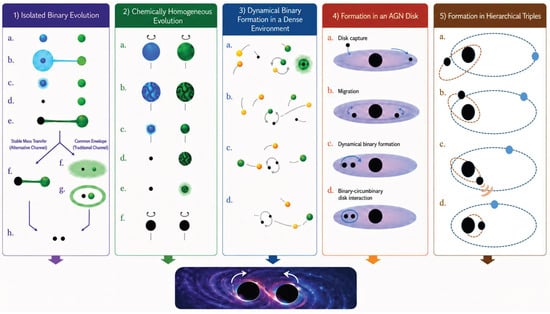
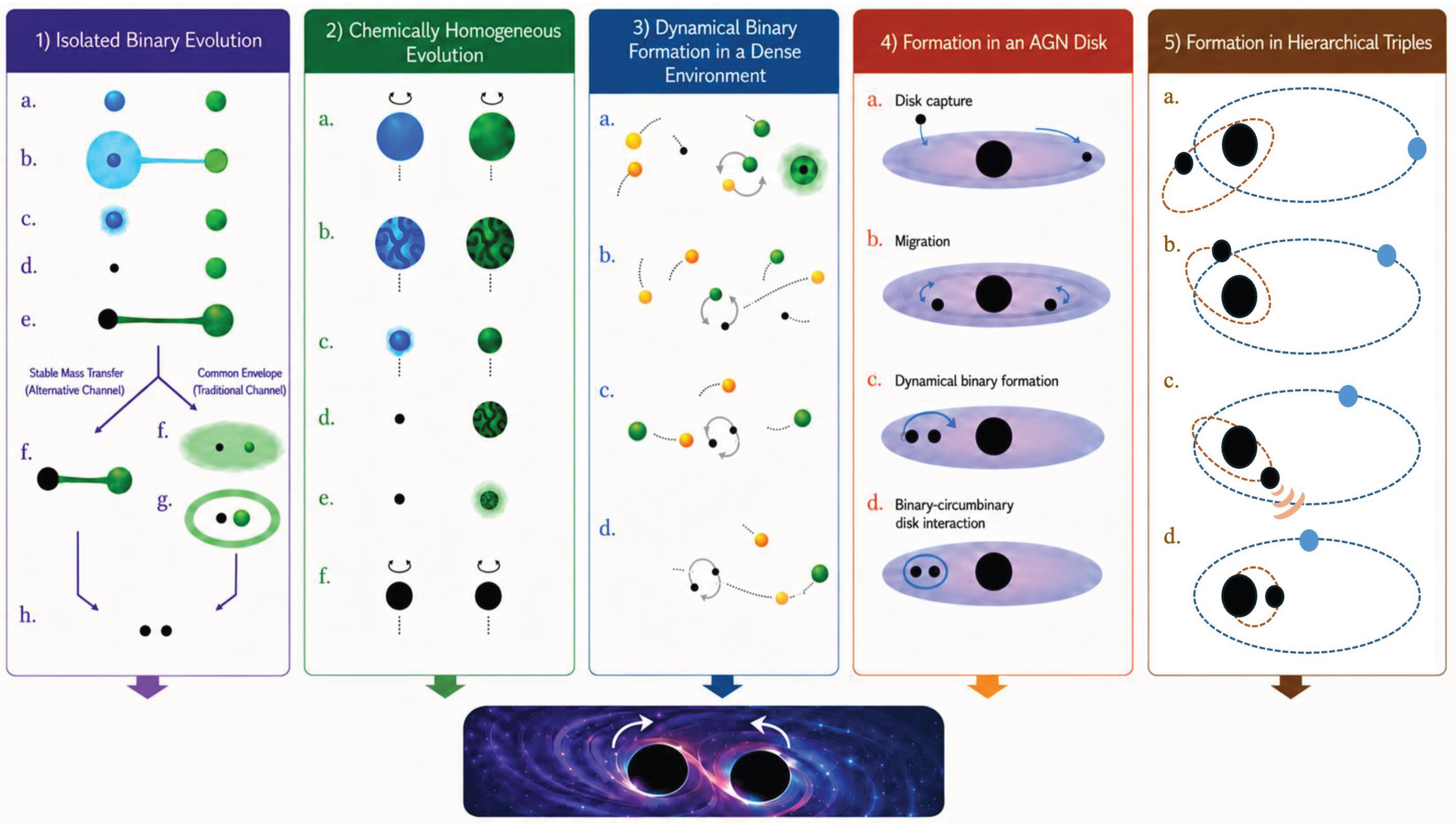
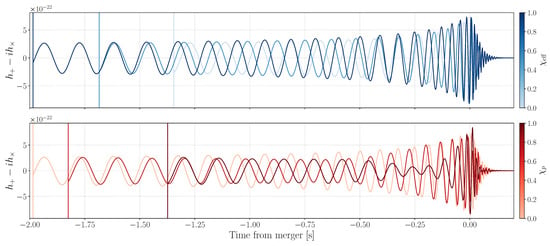
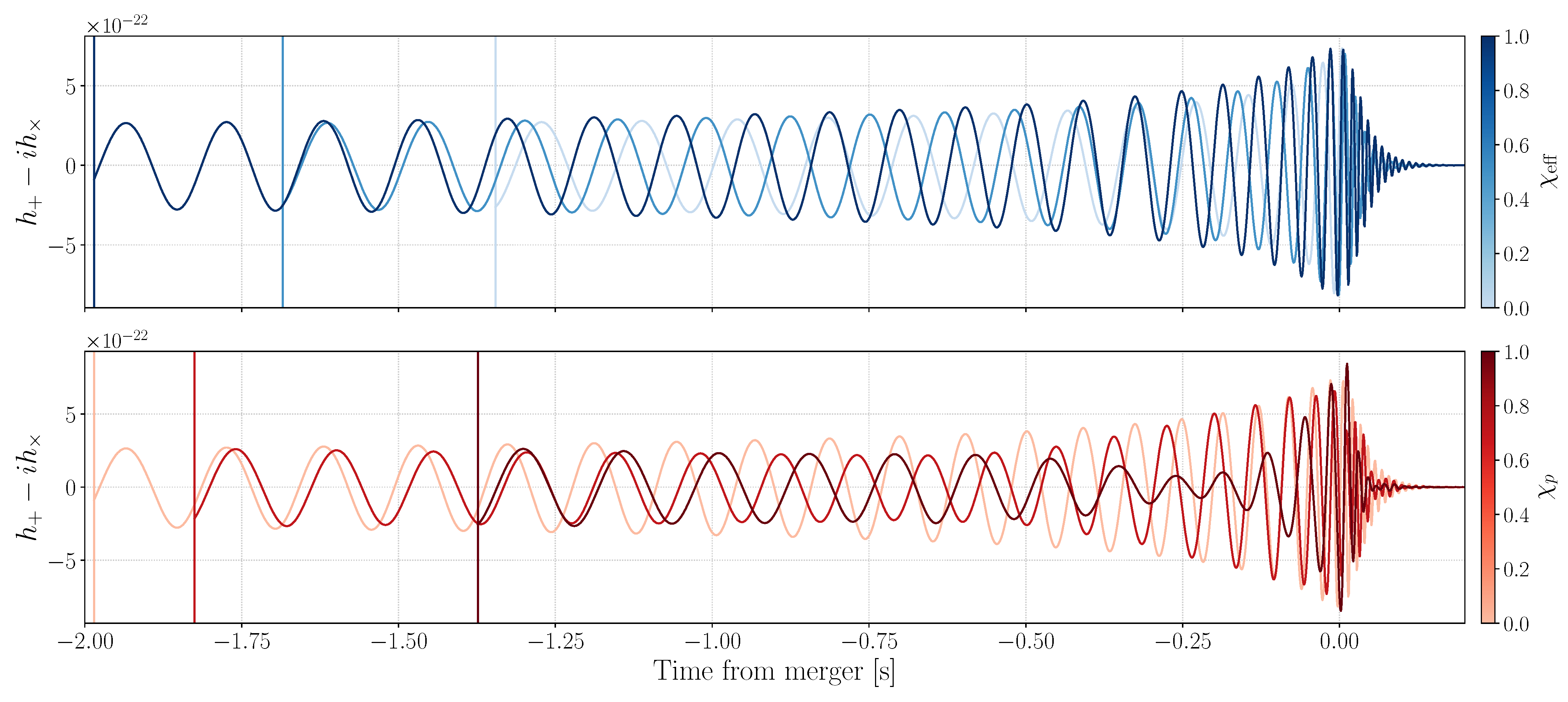
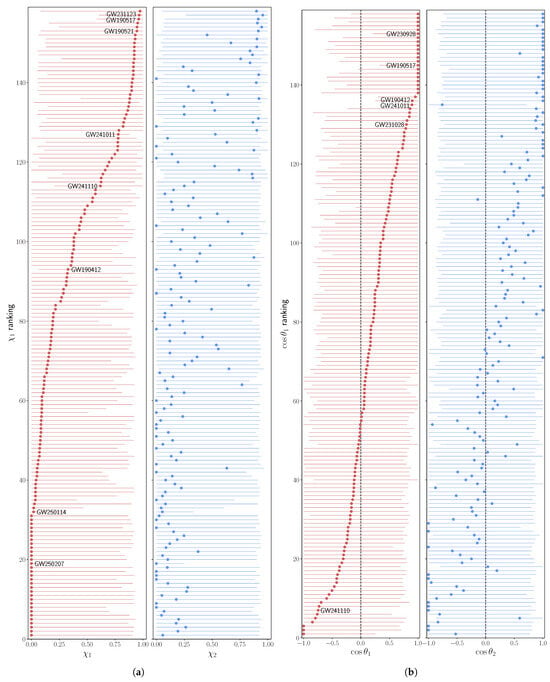
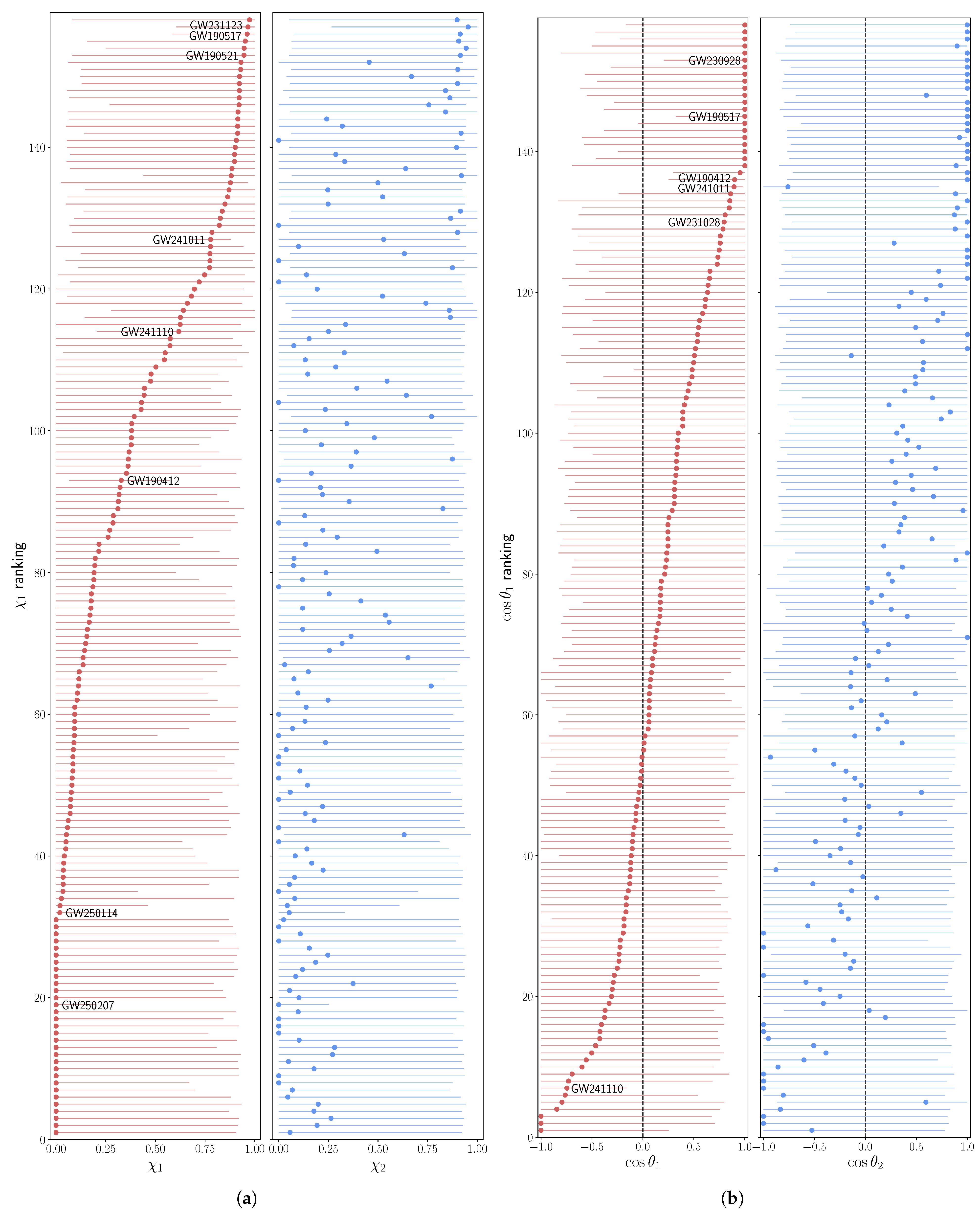
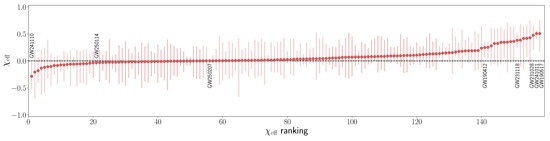
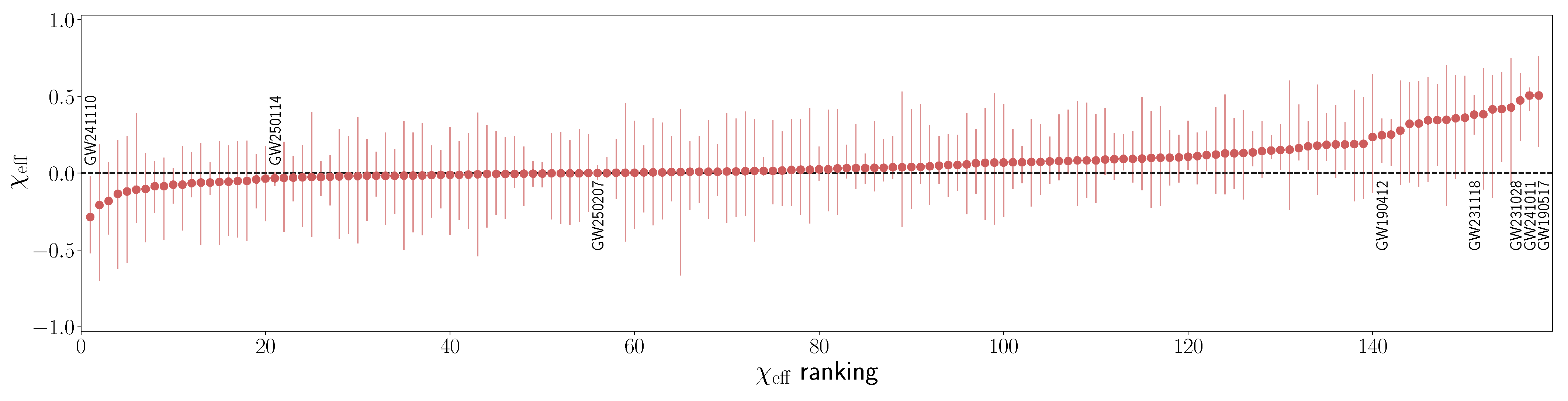
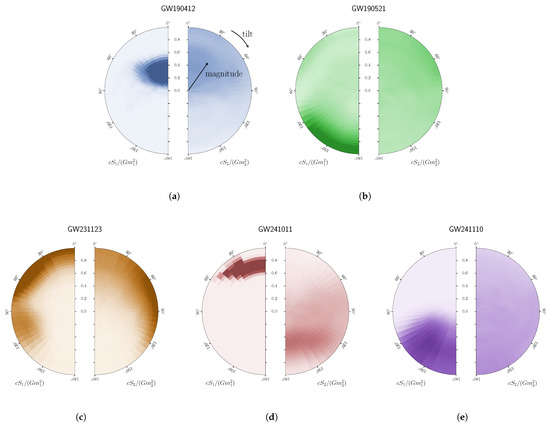
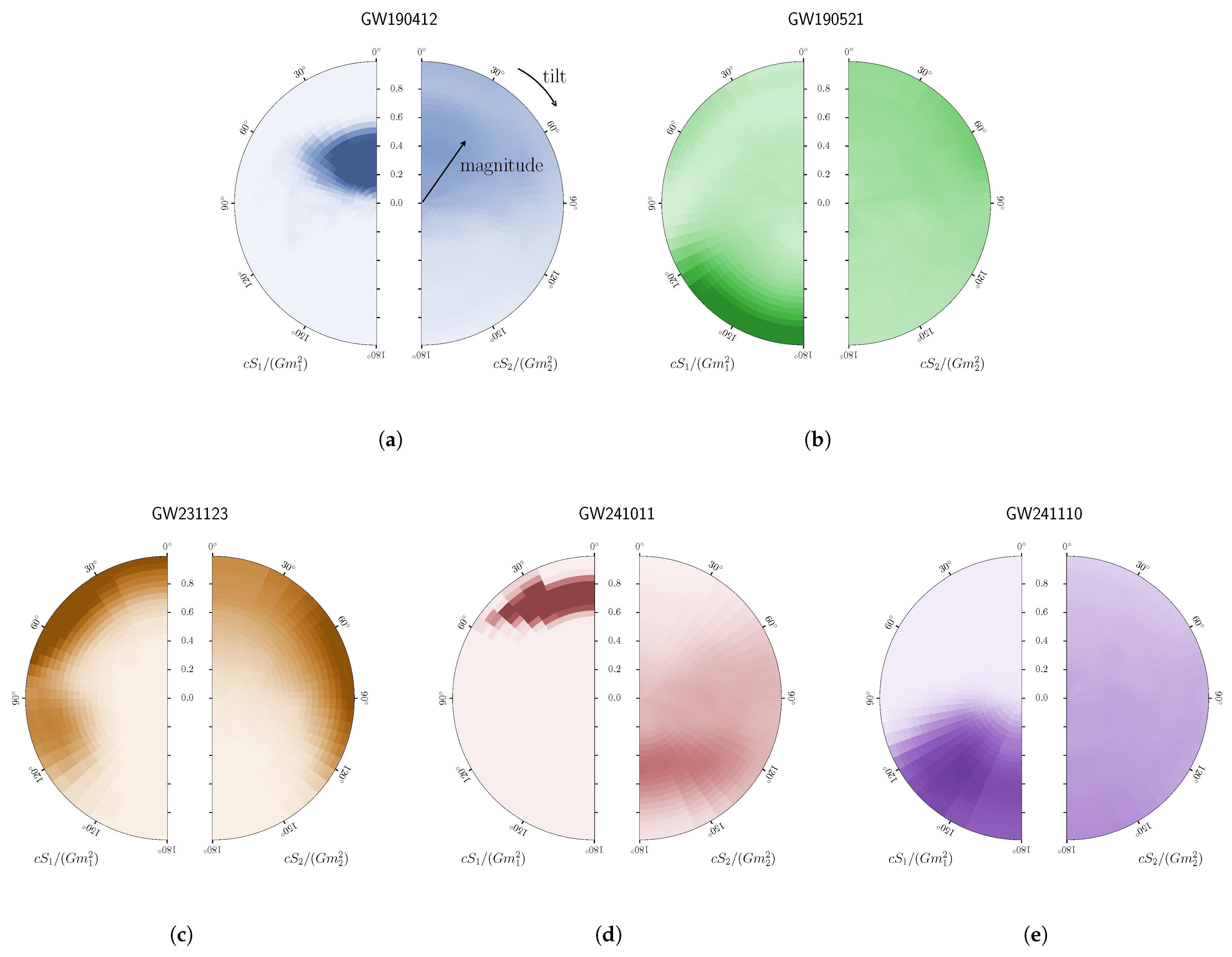
Disclaimer/Publisher’s Note: The statements, opinions and data contained in all publications are solely those of the individual author(s) and contributor(s) and not of MDPI and/or the editor(s). MDPI and/or the editor(s) disclaim responsibility for any injury to people or property resulting from any ideas, methods, instructions or products referred to in the content. |
© 2026 by the author. Licensee MDPI, Basel, Switzerland. This article is an open access article distributed under the terms and conditions of the Creative Commons Attribution (CC BY) license.