


Abstract
Background/Objectives: The age item of the 2022 American College of Rheumatology (ACR) and the European Alliance of Associations for Rheumatology (EULAR) criteria for Takayasu arteritis (TAK) (the 2022 ACR/EULAR criteria) limits the reclassification of TAK among patients aged over 61 who were classified as TAK according to the 1990 ACR criteria. Therefore, we evaluated the clinical significance of the age item of the 2022 ACR/EULAR criteria. Methods: We included 22 previously TAK-diagnosed patients aged over 61 (TAK patient aged >61 years) and 41 TAK-reclassified patients aged 50–60 (controls) in this study and retrospectively reviewed their medical records. We compared the satisfied items of the 2022 ACR/EULAR criteria between the two groups and further investigated whether these 22 TAK patients aged >61 years fulfilled the criteria for other relevant diseases. Results: In terms of absolute requirements, TAK patients aged >61 years were significantly older than TAK-reclassified patients aged 50–60. However, there were no further significant differences in the additional clinical and imaging criteria between the two groups. TAK patients aged >61 years exhibited a significantly higher frequency of ascending aorta involvement than TAK-reclassified patients aged 50–60 (18.2% vs. 0%, p = 0.012). Among the 22 TAK patients aged >61 years, ten were categorized as clinically isolated aortitis, and three of the ten patients with CIA could additionally be categorized as restrictively defined-isolated aortitis. Conclusions: Our findings support the need for external validation of the current age threshold in larger cohorts from different ethnic and geographical populations.
1. Introduction
Takayasu arteritis (TAK) is a large-vessel vasculitis that primarily affects the aorta and its major first branches and is characterized by granulomatous inflammation mediated by IL-6- and IL-17-mediated immune responses in its pathophysiology [1]. Because TAK often occurs among relatively younger patients compared to giant cell arteritis (GCA), another large vessel vasculitis, an age-related item has been included or mentioned in the classification criteria for TAK to date [2,3]. The classification criteria for TAK, which were suggested by the American College of Rheumatology (ACR) in 1990 (the 1990 ACR criteria or the previous criteria), include ‘age at disease onset ≤40 years’ as one of the six items [2]. The new classification criteria for TAK, which were proposed by a joint group of the ACR and the European Alliance of Associations for Rheumatology (EULAR) in 2022 (the 2022 ACR/EULAR criteria), include ‘age ≤60 years at diagnosis’ as an absolute requirement together with ‘evidence of vasculitis on imaging’ [3]. The 1990 ACR criteria can be applied to TAK-suspected patients aged over 61 years, and when three or more items of the criteria are met, TAK can be classified regardless of age. Conversely, when only two absolute requirements of the 2022 ACR/EULAR criteria are met, the age criterion is then applied. Therefore, based on the 2022 ACR/EULAR criteria, TAK cannot be classified among patients aged over 61 years, even though TAK is strongly suspected [2,3].
In real clinical settings, we may encounter two confusing situations. One is that patients previously diagnosed with TAK and classified as having TAK according to the 1990 ACR criteria can no longer be classified as TAK according to the 2022 ACR/EULAR criteria when they are aged over 61 years at diagnosis (TAK patients aged >61 years) [2,3,4]. The other is that although new patients meet the 2022 ACR/EULAR criteria, except for the age item, they can no longer be classified as TAK according to the 2022 ACR/EULAR criteria when they are aged over 61 years (TAK-suspected patients aged over 61) [4,5,6]. In this study, we evaluated the clinical significance of the age item of the 2022 ACR/EULAR criteria. We selected 22 TAK patients aged >61 years from the cohort of Korean patients with TAK and assessed the frequency of patients fulfilling each item of the 2022 ACR/EULAR criteria except for the age item. We compared the variables between 22 TAK patients aged >61 years and 41 TAK-reclassified patients aged 50–60 (controls). Additionally, we investigated whether these 22 TAK patients aged >61 years fulfilled the criteria for other relevant diseases and explored the clinical implications of these alternative classification categories.
2. Materials and Methods
2.1. Patient and Control Selection
We screened 145 patients enrolled in the cohort of Korean patients with TAK. We selected both TAK patients aged >61 years and TAK-reclassified patients aged 50–60 (controls) from the cohort of Korean patients with TAK and retrospectively reviewed their medical records. The inclusion criteria were as follows: (i) classification of TAK according to the 1990 ACR criteria for TAK [2], (ii) fulfilment of the 2022 ACR/EULAR criteria for TAK (except for the age item for the 22 TAK aged >61 years patients) [3], (iii) first diagnosis at this tertiary university hospital by vasculitis-specific rheumatologists from 2005 to 2023, (iv) presence of sufficient evidence of vasculitis in the aorta and its major first branches on imaging with related clinical manifestations at diagnosis [1,3], (v) absence of supporting evidence suggesting any other vasculitides such as GCA or medical conditions other than TAK at diagnosis [3,7], (vi) presence of sufficient medical records regarding clinical, laboratory, and radiological data at diagnosis, (vii) no coexisting serious medical conditions mimicking TAK such as malignancies or hospitalisation-requiring infectious diseases, and (viii) no previous exposure to immunosuppressive drugs or glucocorticoids for TAK treatment within 4 weeks before diagnosis. Finally, 22 TAK patients aged >61 years and 41 TAK-reclassified patients aged 50–60 (controls) were included in this study.
2.2. Ethics Disclosure
This study was approved by the Institutional Review Board (IRB) of Severance Hospital (Seoul, Republic of Korea, IRB No. 4-2022-1075) and was conducted in accordance with the Declaration of Helsinki. Given the retrospective design of the study and the use of anonymised patient data, the requirement for written informed consent was waived by the IRB.
2.3. Definitions of Patients
In this study, “diagnosis” refers to the clinical diagnosis established by vasculitis-specific rheumatologists, whereas “classification” refers to fulfilment of established classification criteria. (1) ‘TAK patients aged >61 years’ were defined as those aged over 61 years at diagnosis who were previously diagnosed with TAK, classified as having TAK according to the 1990 ACR criteria, and met the 2022 ACR/EULAR criteria except for the age item, which meant that those could not be reclassified as TAK according to the 2022 ACR/EULAR criteria due to the age item [2,3]. (2) ‘TAK-reclassified patients aged 50–60’ were defined as those aged 50–60 years at diagnosis who were previously diagnosed with TAK, classified as having TAK according to the 1990 ACR criteria, and could be reclassified as TAK according to the 2022 ACR/EULAR criteria [2,3]. These patients were selected as controls for the reinvestigation of the validity of the age cut-off of 61 years. (3) ‘TAK-suspected patients aged over 61′ were defined as those aged over 61 who were strongly suspected of TAK, however, who could not be classified as TAK according to the 2022 ACR/EULAR criteria due to the age item [3]. Throughout this study, age refers to age at diagnosis.
2.4. Vascular Sites Affected by TAK
Imaging methods approved in this study included the four modalities, such as conventional angiography, computed tomography (CT) angiography, F-18 fluorodeoxyglucose-positron emission tomography (FDG-PET), and magnetic resonance (MR) angiography at diagnosis [4,8]. We investigated the frequency of vascular sites affected by TAK according to the following items: (i) ascending aorta; (ii) aortic arch; (iii) descending aorta; (iv) right subclavian artery; (v) right common carotid artery; (vi) left common carotid artery; (vii) left subclavian artery; (viii) celiac axis; (ix) superior mesenteric artery; (x) inferior mesenteric artery; (xi) bilateral renal artery; and (xii) infra-renal aorta [8].
2.5. Suggested Diseases for Patients Aged over 61
In this study, given the clinical, laboratory, and radiological data at diagnosis, particularly the affected vascular sites including the aorta and its first major branches, we considered the following suggested diseases for both TAK patients aged >61 years and TAK-suspected patients aged over 61: GCA [1,7,8]; polyarteritis nodosa [1,9]; antineutrophil cytoplasmic antibody-associated vasculitis [1,10,11,12,13,14]; immune complex small vessel vasculitis [1,15,16]; Behcet’s syndrome [1,17,18]; Cogan’s syndrome [1,19]; clinically isolated aortitis (CIA)/restrictively defined-isolated aortitis (RD-IA) [1,20,21,22]; lupus vasculitis [1,23]; rheumatoid vasculitis [1,24]; sarcoid vasculitis [1,25]; hepatitis B virus (HBV)/hepatitis C virus (HCV)-associated vasculitis [1,26]; syphilis-associated vasculitis (aortitis) [1,27]; cancer-associated vasculitis [1,28]; IgG4-related disease [1,29]; tuberculosis-associated vasculitis [1,30]; and other infectious aortitis [1,31].
2.6. Definition of CIA and RD-IA
To avoid or minimise the confusion in the differential diagnoses, in this study, we proposed two types of idiopathic aortitis using the following operational definitions: CIA was defined as evidence of inflammation in the aorta regardless of the first branch involvement, whereas RD-IA was defined as only evidence of inflammation in the ascending aorta, aortic arch, and descending aorta without inflammation in the first aortic major branch, unlike typical CIA [20,21,22].
2.7. Statistical Analysis
All statistical analyses were performed using SPSS version 26 (IBM Corporation, Armonk, NY, USA) for Windows (Microsoft Corporation, Redmond, WA, USA). Continuous and categorical variables were expressed as medians (interquartile ranges [IQR]) and numbers (percentages). Significant differences between two categorical variables were analysed using the Chi-square and Fisher’s exact tests. The Mann–Whitney U test was used to compare significant differences between two continuous variables. A p-value <0.05 was considered to be statistically significant.
3. Results
3.1. Comparative Analysis Between TAK Patients Aged >61 Years and TAK-Reclassified Patients Aged 50–60
In terms of absolute requirements, TAK patients aged >61 years were significantly older than TAK-reclassified patients aged 50–60 (64.5 years vs. 55.0 years, p <0.001). In terms of additional clinical criteria, no significant differences were observed between the two groups. In terms of additional imaging criteria, all patients exhibited evidence of vasculitis in the aorta and its first major branches on imaging; however, there were no significant differences between the two groups (Table 1).
Table 1.
Comparative analysis of the satisfied items of the 2022 ACR/EULAR criteria between TAK patients aged >61 years and TAK-reclassified patients aged 50–60.
3.2. Comparative Analysis of Affected Vascular Sites Between TAK Patients Aged >61 Years and TAK-Reclassified Patients Aged 50–60
TAK patients aged >61 years exhibited a significantly higher frequency of ascending aorta involvement than TAK-reclassified patients aged 50–60 (18.2% vs. 0%, p = 0.012). However, among the remaining vascular sites, no significant differences in the distribution of radiological features of TAK involvement were observed between the two groups (Table 2).
Table 2.
Comparative analysis of affected vascular sites between TAK patients aged >61 years and TAK-reclassified patients aged 50–60.
3.3. Suggested Diseases for Patients Aged over 61
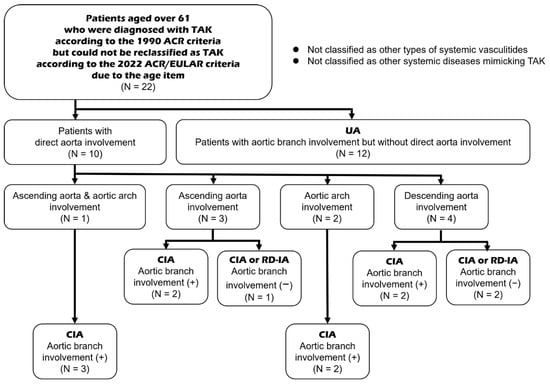
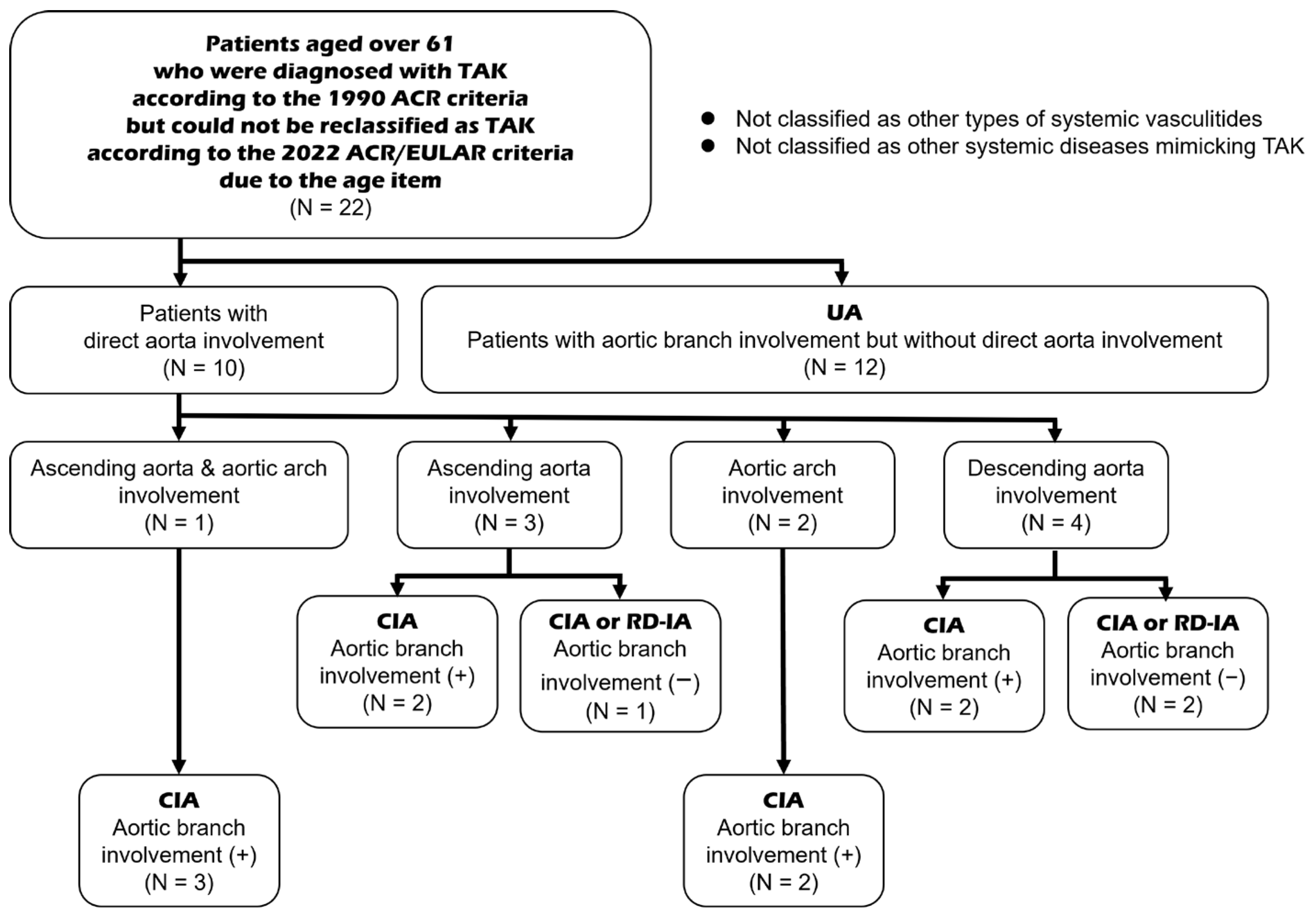
Based on the clinical, laboratory, and radiological data recorded in the medical records and the sites of the involved vessels, we applied the diagnostic/classification criteria or the operational definition for each suggested disease to TAK patients aged >61 years. Among the 22 TAK patients aged >61 years, ten were categorized as CIA, and three of the ten patients were additionally categorized as RD-IA. However, none fulfilled the criteria for the remaining 15 suggested diseases (Table 3). Among the ten patients compatible with CIA/RD-IA, one, three, two, and four patients exhibited evidence of inflammation in the ascending aorta and aortic arch, ascending aorta, aortic arch, and descending aorta, respectively. Among the 10 patients, seven patients who exhibited evidence of inflammation in the aorta, as well as in the first aortic branches, were categorized as CIA, whereas the remaining three patients who had evidence of inflammation only in the aorta without inflammation in the first aortic branches were categorized as RD-IA (Figure 1). On the other hand, apart from ten patients compatible with CIA/RD-IA, 12 of the 22 did not fulfil any of the criteria for the other suggested diseases and were categorized as unclassifiable vasculitis (UV) because they had no evidence of inflammation in the aorta, although they had evidence of inflammation in the first aortic major branches [32] (Figure 1).
Table 3.
Suggested diseases for patients aged over 61 years who were no longer classified as TAK.
Figure 1.
Algorithm for the classification of TAK, CIA, RD-IA, and UV. (+) indicates the presence of aortic branch involvement, whereas (−) indicates its absence. TAK: Takayasu arteritis; ACR: the American College of Rheumatology; EULAR: the European Alliance of Associations for Rheumatology; UV: unclassifiable vasculitis; CIA: clinically isolated aortitis; and RD-IA: restrictively defined-isolated aortitis.
4. Discussion
The purpose of this study was to reconsider the medical situation in which patients aged over 61, who were diagnosed with TAK and classified as having TAK based on the 1990 ACR criteria, could no longer be reclassified as TAK due to the age item of the 2022 ACR/EULAR criteria [2,3]. Therefore, in this study, we defined a new concept of TAK patients for ‘TAK aged >61 years patients’ as follows: patients were defined as those aged over 61 years who were previously diagnosed with TAK and classified as having TAK according to the 1990 ACR criteria, and who met the 2022 ACR/EULAR criteria except for the age item, but who could not be reclassified as TAK according to the 2022 ACR/EULAR criteria due to the age item. We compared the variables between 22 TAK patients aged >61 years and 41 TAK-reclassified patients aged 50–60 (controls) and obtained two findings: One is that, except for the age item, there was no difference in the frequency of satisfied items of the 2022 ACR/EULAR criteria between TAK patients aged >61 years and TAK-reclassified patients aged 50–60. The other is that there were no significant differences in the vascular sites affected by TAK between the two groups, except for the ascending aortic involvement. However, given the small number of events and the comparison of multiple vascular territories, this isolated difference should not be interpreted as evidence of a specific vascular phenotype. With these results, we cautiously proposed that an absolute requirement of ‘age ≤60 years’ be changed to a more flexible item in actual clinical practice and suggest that the cut-off for the age-related absolute requirement of the 2022 ACR/EULAR criteria warrants external validation across different ethnic and geographical populations.
From the perspective of suggested diseases for TAK aged >61 years patients, this study revealed that only ten patients were categorized as CIA, and further three of them were categorized as RD-IA. In addition, the 12 patients who were not compatible with CIA/RD-IA were provisionally categorized as UV. Categorization of CIA and/or RD-IA may have potential clinical implications in terms of therapeutic approach and monitoring for progression to other systemic vasculitides such as GCA, granulomatosis with polyangiitis, or IgG4-RD [22]. Nonetheless, we would like to emphasise that patients who were not classifiable as TAK because they were aged over 61 years, despite fulfilling the remaining components of the 2022 ACR/EULAR criteria for TAK, should not necessarily be categorized as CIA/RD-IA, and their established clinical diagnosis and management should be maintained based on clinical judgment.
The medical situations in which the classification of TAK among patients aged over 61 years is difficult should be considered in two ways: ‘TAK patients aged >61 years’ and ‘TAK-suspected patients aged over 61’ [2,3]. First of all, categorization of these patients as UV for classification purposes may carry the following limitations: (i) a lack of theoretical reasons for the administered immunosuppressive drugs for the treatment of TAK [33]; (ii) a lack of evidence for active intervention in regular outpatient follow-up [34]; and (iii) a discontinuation of insurance benefits as the designation as a rare and incurable disease [35]. Therefore, for patients aged over 61 years at diagnosis who had been classified as TAK according to the 1990 ACR criteria, failure to fulfil the 2022 ACR/EULAR criteria solely because of age should not prompt a change in the clinical diagnosis of TAK.
Conversely, however, the initial application of the 2022 ACR/EULAR criteria to subjects who are suspected of TAK despite an age of 61 years or greater is not allowed in principle. Given the results of this study, a significant number of patients will likely be classified as UV, which will pose significant constraints in developing treatment strategies due to the limitations mentioned above [32]. Therefore, we assume that if the age cut-off for classifying TAK is adjusted upward to 70 years in patients aged over 61 years, a considerable number of patients aged over 61 years meeting the new criteria for TAK will be eligible for TAK classification [4], and we suggest that the cut-off for the age-related absolute requirement of the 2022 ACR/EULAR criteria needs external validation across different ethnic and geographical populations.
The reasons for selecting and including patients aged between 50 and 60 years who were classified as TAK according to the 2022 ACR/EULAR criteria as controls in this study were as follows: (i) of the 22 patients aged over 61 years, 21 were under 70 years of age. Therefore, patients aged 50 to 60 years, up to 10 years younger than the critical cut-off of 60 years, were selected as controls; (ii) TAK is characterized by a relatively high proportion of female patients. Therefore, given that the general age of menopause is around 50 years, to minimise the impact of menopause on clinical data at diagnosis, patients aged between 50 and 60 years were selected as controls [36]; and (iii) setting the age of the new criteria for TAK at 60 years or younger may be to differentiate it from GCA, but also from atherosclerosis, of which risk increases along with age. Given the age pattern of metabolic syndrome at 50–60 years [37], to minimise the impact of metabolic syndrome on atherosclerosis occurrence, patients aged between 50 and 60 years were included in this study as controls.
The strength of this study was that it was the first to demonstrate the clinical significance of the age item of the 2022 ACR/EULAR criteria for TAK among not only TAK patients aged >61 years but also TAK-suspected patients aged over 61 by comparing variables between TAK patients aged >61 years and TAK-reclassified patients aged 50–60.
This study has several limitations. The small number of patients, a single-centre study, and the retrospective study design were critical limitations of this study. In particular, the relatively small number of controls may have limited the statistical power to detect differences between the two groups. Furthermore, because fulfilment of the 2022 ACR/EULAR criteria except for the age item was an inclusion criterion for TAK aged >61 years patients, the observed similarity in the additional clinical and imaging criteria between the two groups may have been partly influenced by the study inclusion criteria. Therefore, these findings should be interpreted primarily as exploratory real-world observations. However, we are confident that this pilot study will have clinical significance in that it analytically proposed issues regarding the classification of both ‘TAK patients aged >61 years’ and ‘TAK-suspected patients aged over 61’. A future prospective multi-centric study with a large number of patients of various age groups of more or less than 60 years will provide more reliable information on a flexible age-related item for the classification of TAK.
5. Conclusions
In this study, we demonstrated no significant differences in the satisfied items of clinical and imaging criteria of the 2022 ACR/EULAR criteria, except for the age item, between TAK patients aged >61 years and TAK-reclassified patients aged 50–60 for the first time. Therefore, our findings support the need for external validation of the current age threshold in larger cohorts from different ethnic and geographical populations before considering its modification.
Author Contributions
Conceptualization, J.W.H., O.C.K. and S.-W.L.; methodology, J.W.H., O.C.K. and S.-W.L.; software, J.W.H., O.C.K. and S.-W.L.; validation, Y.-B.P.; formal analysis, J.W.H. and O.C.K.; investigation, J.W.H., O.C.K. and Y.-B.P.; resources, S.-W.L.; data curation, J.W.H., O.C.K. and S.-W.L.; writing—original draft preparation, J.W.H., O.C.K. and S.-W.L.; writing—review and editing, J.W.H., O.C.K., Y.-B.P. and S.-W.L.; visualization, J.W.H., O.C.K. and S.-W.L.; supervision, S.-W.L.; project administration, J.W.H., O.C.K. and S.-W.L.; and funding acquisition, S.-W.L. All authors have read and agreed to the published version of the manuscript.
Funding
This study was funded by Eisai Korea Inc., Seoul, Republic of Korea (4-2024-0700); Yuhan Corporation, Seoul, Republic of Korea, as part of their “2024 Investigator Initiated Translation Research Program” (4-2025-0044); Samsung Bioepis Co., Ltd., Incheon, Republic of Korea (4-2025-1066); and Samil Pharmaceutical Co., Ltd., Seoul, Republic of Korea (4-2025-1087; LFN-26-I01). The funders were not involved in the study design, collection, analysis, interpretation of data, the writing of this article, or the decision to submit it for publication. Therefore, we disclose that these analyses were pre-specified and conducted independently.
Institutional Review Board Statement
This study was approved by the Institutional Review Board (IRB) of Severance Hospital (Seoul, Republic of Korea, IRB No. 4-2022-1075, approval data: 14 October 2022) and was conducted in accordance with the Declaration of Helsinki.
Informed Consent Statement
Given the retrospective design of the study and the use of anonymised patient data, the requirement for written informed consent was waived by the IRB.
Data Availability Statement
Data will be provided on request by the authors.
Conflicts of Interest
The authors declare no conflicts of interest.
Abbreviations
The following abbreviations are used in this manuscript:
| ACR | the American College of Rheumatology |
| CIA | clinically isolated aortitis |
| CT | computed tomography |
| EULAR | the European Alliance of Associations for Rheumatology |
| FDG-PET | F-18 fluorodeoxyglucose-positron emission tomography |
| GCA | giant cell arteritis |
| HBV | hepatitis B virus |
| HCV | hepatitis C virus |
| IQR | interquartile ranges |
| IRB | the Institutional Review Board |
| MR | magnetic resonance |
| RD-IA | restrictively defined-isolated aortitis |
| TAK | Takayasu arteritis |
| UV | unclassifiable vasculitis |
References
- Jennette, J.C.; Falk, R.J.; Bacon, P.A.; Basu, N.; Cid, M.C.; Ferrario, F.; Flores-Suarez, L.F.; Gross, W.L.; Guillevin, L.; Hagen, E.C.; et al. 2012 revised International Chapel Hill Consensus Conference Nomenclature of Vasculitides. Arthritis Rheum. 2013, 65, 1–11. [Google Scholar] [CrossRef] [Scilit] [PubMed]
- Arend, W.P.; Michel, B.; Bloch, D.A.; Hunder, G.G.; Calabrese, L.H.; Edworthy, S.M.; Fauci, A.S.; Leavitt, R.Y.; Lie, J.T.; Lightfoot, R.W., Jr.; et al. The American College of Rheumatology 1990 criteria for the classification of Takayasu arteritis. Arthritis Rheum. 1990, 33, 1129–1134. [Google Scholar] [CrossRef] [Scilit] [PubMed]
- Grayson, P.C.; Ponte, C.; Suppiah, R.; Robson, J.C.; Gribbons, K.B.; Judge, A.; Craven, A.; Khalid, S.; Hutchings, A.; Danda, D.; et al. 2022 American College of Rheumatology/EULAR classification criteria for Takayasu arteritis. Ann. Rheum. Dis. 2022, 81, 1654–1660. [Google Scholar] [CrossRef] [Scilit] [PubMed]
- Ha, J.W.; Pyo, J.Y.; Ahn, S.S.; Song, J.J.; Park, Y.B.; Lee, S.W. Application of the 2022 ACR/EULAR criteria for Takayasu arteritis to previously diagnosed patients based on the 1990 ACR criteria. Mod. Rheumatol. 2024, 34, 1006–1012. [Google Scholar] [CrossRef] [Scilit] [PubMed]
- Ha, J.W.; Song, J.J.; Park, Y.B.; Lee, S.W. Validation of the 2022 ACR/EULAR classification criteria for giant cell arteritis in Korean patients with giant cell arteritis. Mod. Rheumatol. 2025, 35, 524–528. [Google Scholar] [CrossRef] [Scilit] [PubMed]
- Sugihara, T.; Harigai, M.; Uchida, H.A.; Yoshifuji, H.; Maejima, Y.; Ishizaki, J.; Watanabe, Y.; Dobashi, H.; Komagata, Y.; Tamura, N.; et al. Performance of the modified 2022 ACR/EULAR giant cell arteritis classification criteria without age restriction for discriminating from Takayasu arteritis. Arthritis Res. Ther. 2025, 27, 19. [Google Scholar] [CrossRef] [Scilit] [PubMed]
- Ponte, C.; Grayson, P.C.; Robson, J.C.; Suppiah, R.; Gribbons, K.B.; Judge, A.; Craven, A.; Khalid, S.; Hutchings, A.; Watts, R.A.; et al. 2022 American College of Rheumatology/EULAR classification criteria for giant cell arteritis. Ann. Rheum. Dis. 2022, 81, 1647–1653. [Google Scholar] [CrossRef] [Scilit] [PubMed]
- Gribbons, K.B.; Ponte, C.; Carette, S.; Craven, A.; Cuthbertson, D.; Hoffman, G.S.; Khalidi, N.A.; Koening, C.L.; Langford, C.A.; Maksimowicz-McKinnon, K.; et al. Patterns of Arterial Disease in Takayasu Arteritis and Giant Cell Arteritis. Arthritis Care Res. 2020, 72, 1615–1624. [Google Scholar] [CrossRef] [Scilit] [PubMed]
- Hernández-Rodríguez, J.; Alba, M.A.; Prieto-González, S.; Cid, M.C. Diagnosis and classification of polyarteritis nodosa. J. Autoimmun. 2014, 48–49, 84–89. [Google Scholar] [CrossRef] [Scilit] [PubMed]
- Masi, A.T.; Hunder, G.G.; Lie, J.T.; Michel, B.A.; Bloch, D.A.; Arend, W.P.; Calabrese, L.H.; Edworthy, S.M.; Fauci, A.S.; Leavitt, R.Y.; et al. The American College of Rheumatology 1990 criteria for the classification of Churg-Strauss syndrome (allergic granulomatosis and angiitis). Arthritis Rheum. 1990, 33, 1094–1100. [Google Scholar] [CrossRef] [Scilit] [PubMed]
- Suppiah, R.; Robson, J.C.; Grayson, P.C.; Ponte, C.; Craven, A.; Khalid, S.; Judge, A.; Hutchings, A.; Merkel, P.A.; Luqmani, R.A.; et al. 2022 American College of Rheumatology/European Alliance of Associations for Rheumatology classification criteria for microscopic polyangiitis. Ann. Rheum. Dis. 2022, 81, 321–326. [Google Scholar] [CrossRef] [Scilit] [PubMed]
- Robson, J.C.; Grayson, P.C.; Ponte, C.; Suppiah, R.; Craven, A.; Judge, A.; Khalid, S.; Hutchings, A.; Watts, R.A.; Merkel, P.A.; et al. 2022 American College of Rheumatology/European Alliance of Associations for Rheumatology classification criteria for granulomatosis with polyangiitis. Ann. Rheum. Dis. 2022, 81, 315–320. [Google Scholar] [CrossRef] [Scilit] [PubMed]
- Grayson, P.C.; Ponte, C.; Suppiah, R.; Robson, J.C.; Craven, A.; Judge, A.; Khalid, S.; Hutchings, A.; Luqmani, R.A.; Watts, R.A.; et al. 2022 American College of Rheumatology/European Alliance of Associations for Rheumatology Classification Criteria for Eosinophilic Granulomatosis with Polyangiitis. Ann. Rheum. Dis. 2022, 81, 309–314. [Google Scholar] [CrossRef] [Scilit] [PubMed]
- Pyo, J.Y.; Lee, L.E.; Park, Y.B.; Lee, S.W. Comparison of the 2022 ACR/EULAR Classification Criteria for Antineutrophil Cytoplasmic Antibody-Associated Vasculitis with Previous Criteria. Yonsei Med. J. 2023, 64, 11–17. [Google Scholar] [CrossRef] [Scilit] [PubMed]
- McAdoo, S.P.; Pusey, C.D. Anti-Glomerular Basement Membrane Disease. Clin. J. Am. Soc. Nephrol. 2017, 12, 1162–1172. [Google Scholar] [CrossRef] [Scilit] [PubMed]
- Audemard-Verger, A.; Pillebout, E.; Guillevin, L.; Thervet, E.; Terrier, B. IgA vasculitis (Henoch-Shönlein purpura) in adults: Diagnostic and therapeutic aspects. Autoimmun. Rev. 2015, 14, 579–585. [Google Scholar] [CrossRef] [Scilit] [PubMed]
- Criteria for diagnosis of Behçet’s disease. International Study Group for Behçet’s Disease. Lancet 1990, 335, 1078–1080. [PubMed]
- International Team for the Revision of the International Criteria for Behçet’s Disease (ITR-ICBD). The International Criteria for Behçet’s Disease (ICBD): A collaborative study of 27 countries on the sensitivity and specificity of the new criteria. J. Eur. Acad. Dermatol. Venereol. 2014, 28, 338–347. [Google Scholar] [CrossRef] [Scilit] [PubMed]
- Belfeki, N.; Ghriss, N.; Kammoun, S.; Mekinian, A. Cogan’s syndrome. A comprehensive review. Eur. J. Intern. Med. 2025, 138, 35–43. [Google Scholar] [CrossRef] [Scilit] [PubMed]
- Gewurz-Singer, O.; Lee, E. Isolated aortitis-is it truly isolated? An approach to diagnosis and management. Curr. Opin. Rheumatol. 2025, 37, 185–191. [Google Scholar] [CrossRef] [Scilit] [PubMed]
- Ahmad, N.; Andev, R.; Verdiyeva, A.; Dubey, S. Single centre experience of 120 patients with non-infectious aortitis: Clinical features, treatment and complications. Autoimmun. Rev. 2023, 22, 103354. [Google Scholar] [CrossRef] [Scilit] [PubMed]
- Cinar, I.; Wang, H.; Stone, J.R. Clinically isolated aortitis: Pitfalls, progress, and possibilities. Cardiovasc. Pathol. 2017, 29, 23–32. [Google Scholar] [CrossRef] [Scilit] [PubMed]
- Aringer, M.; Costenbader, K.; Daikh, D.; Brinks, R.; Mosca, M.; Ramsey-Goldman, R.; Smolen, J.S.; Wofsy, D.; Boumpas, D.T.; Kamen, D.L.; et al. 2019 European League Against Rheumatism/American College of Rheumatology classification criteria for systemic lupus erythematosus. Ann. Rheum. Dis. 2019, 78, 1151–1159. [Google Scholar] [CrossRef] [Scilit] [PubMed]
- Aletaha, D.; Neogi, T.; Silman, A.J.; Funovits, J.; Felson, D.T.; Bingham, C.O., 3rd; Birnbaum, N.S.; Burmester, G.R.; Bykerk, V.P.; Cohen, M.D.; et al. 2010 rheumatoid arthritis classification criteria: An American College of Rheumatology/European League Against Rheumatism collaborative initiative. Ann. Rheum. Dis. 2010, 69, 1580–1588. [Google Scholar] [CrossRef] [Scilit] [PubMed]
- Valeyre, D.; Prasse, A.; Nunes, H.; Uzunhan, Y.; Brillet, P.Y.; Müller-Quernheim, J. Sarcoidosis. Lancet 2014, 383, 1155–1167. [Google Scholar] [CrossRef] [Scilit] [PubMed]
- Ganem, D.; Prince, A.M. Hepatitis B virus infection—Natural history and clinical consequences. N. Engl. J. Med. 2004, 350, 1118–1129. [Google Scholar] [CrossRef] [Scilit] [PubMed]
- Miller, S.A.; Ladich, E.R. Syphilitic Aortitis. N. Engl. J. Med. 2022, 386, e55. [Google Scholar] [CrossRef] [Scilit] [PubMed]
- Do, H.; Pyo, J.Y.; Ahn, S.S.; Song, J.J.; Park, Y.B.; Lee, S.W. Cancer-associated vasculitides: A single-centre case series. Clin. Rheumatol. 2023, 42, 151–158. [Google Scholar] [CrossRef] [Scilit] [PubMed]
- Wallace, Z.S.; Naden, R.P.; Chari, S.; Choi, H.K.; Della-Torre, E.; Dicaire, J.F.; Hart, P.A.; Inoue, D.; Kawano, M.; Khosroshahi, A.; et al. The 2019 American College of Rheumatology/European League Against Rheumatism classification criteria for IgG4-related disease. Ann. Rheum. Dis. 2020, 79, 77–87. [Google Scholar] [CrossRef] [Scilit] [PubMed]
- Mutyaba, A.K.; Ntsekhe, M. Tuberculosis and the Heart. Cardiol. Clin. 2017, 35, 135–144. [Google Scholar] [CrossRef] [Scilit] [PubMed]
- Pugh, D.; Grayson, P.; Basu, N.; Dhaun, N. Aortitis: Recent advances, current concepts and future possibilities. Heart 2021, 107, 1620–1629. [Google Scholar] [CrossRef] [Scilit] [PubMed]
- Lamprecht, P.; Pipitone, N.; Gross, W.L. Unclassified vasculitis. Clin. Exp. Rheumatol. 2011, 29, S81–S85. [Google Scholar] [PubMed]
- Maz, M.; Chung, S.A.; Abril, A.; Langford, C.A.; Gorelik, M.; Guyatt, G.; Archer, A.M.; Conn, D.L.; Full, K.A.; Grayson, P.C.; et al. 2021 American College of Rheumatology/Vasculitis Foundation Guideline for the Management of Giant Cell Arteritis and Takayasu Arteritis. Arthritis Rheumatol. 2021, 73, 1349–1365. [Google Scholar] [CrossRef] [Scilit] [PubMed]
- Yıldırım, F.; Tastekin, F.; Bakkal, S.; Kutu, M.E.; Ocak, T.; San, S.; Avcu, A.; Kocaayan, H.; Işık, S.; Uludogan, B.C.; et al. Prognostic significance and rationality of regular non-invasive imaging follow-up in Takayasu arteritis: A large multicenter cohort study. Semin Arthritis Rheum. 2025, 74, 152813. [Google Scholar] [CrossRef] [Scilit] [PubMed]
- Lim, S.S.; Lee, W.; Kim, Y.K.; Kim, J.; Park, J.H.; Park, B.R.; Yoon, J.H. The cumulative incidence and trends of rare diseases in South Korea: A nationwide study of the administrative data from the National Health Insurance Service database from 2011–2015. Orphanet. J. Rare Dis. 2019, 14, 49. [Google Scholar] [CrossRef] [Scilit] [PubMed]
- Choi, Y.J.; Kim, G.S.; Chu, S.H.; Lee, K.H.; Park, C.G.; Sohn, M. Metabolic syndrome clustering patterns and the association with cardiovascular disease among post-menopausal Korean women. Sci. Rep. 2024, 14, 22702. [Google Scholar] [CrossRef] [Scilit] [PubMed]
- Kim, Y.; Choi, Y.; Lee, K.N.; Sang, H.; Han, K.; Kim, S.; Rhee, S.Y. Disparities in trends of metabolic syndrome in Korea from 2007 to 2022 by age, sex, and lifestyle factors. Sci. Rep. 2025, 15, 21185. [Google Scholar] [CrossRef] [Scilit] [PubMed]

Disclaimer/Publisher’s Note: The statements, opinions and data contained in all publications are solely those of the individual author(s) and contributor(s) and not of MDPI and/or the editor(s). MDPI and/or the editor(s) disclaim responsibility for any injury to people or property resulting from any ideas, methods, instructions or products referred to in the content. |
© 2026 by the authors. Licensee MDPI, Basel, Switzerland. This article is an open access article distributed under the terms and conditions of the Creative Commons Attribution (CC BY) license.