Comprehensive Diagnosis of Abnormal Vaginal Discharge Using qPCR-Based Microbial Dysbiosis Indices

Abstract
1. Introduction
2. Materials and Methods
2.1. Study Design and Sample Population
2.2. Clinical Testing and Diagnosis
2.3. Laboratory Tests
2.4. Development of the Dysbiosis Indices
2.5. Validation of the Dysbiosis Indices
2.6. Statistical Analysis
3. Results
3.1. Study Population
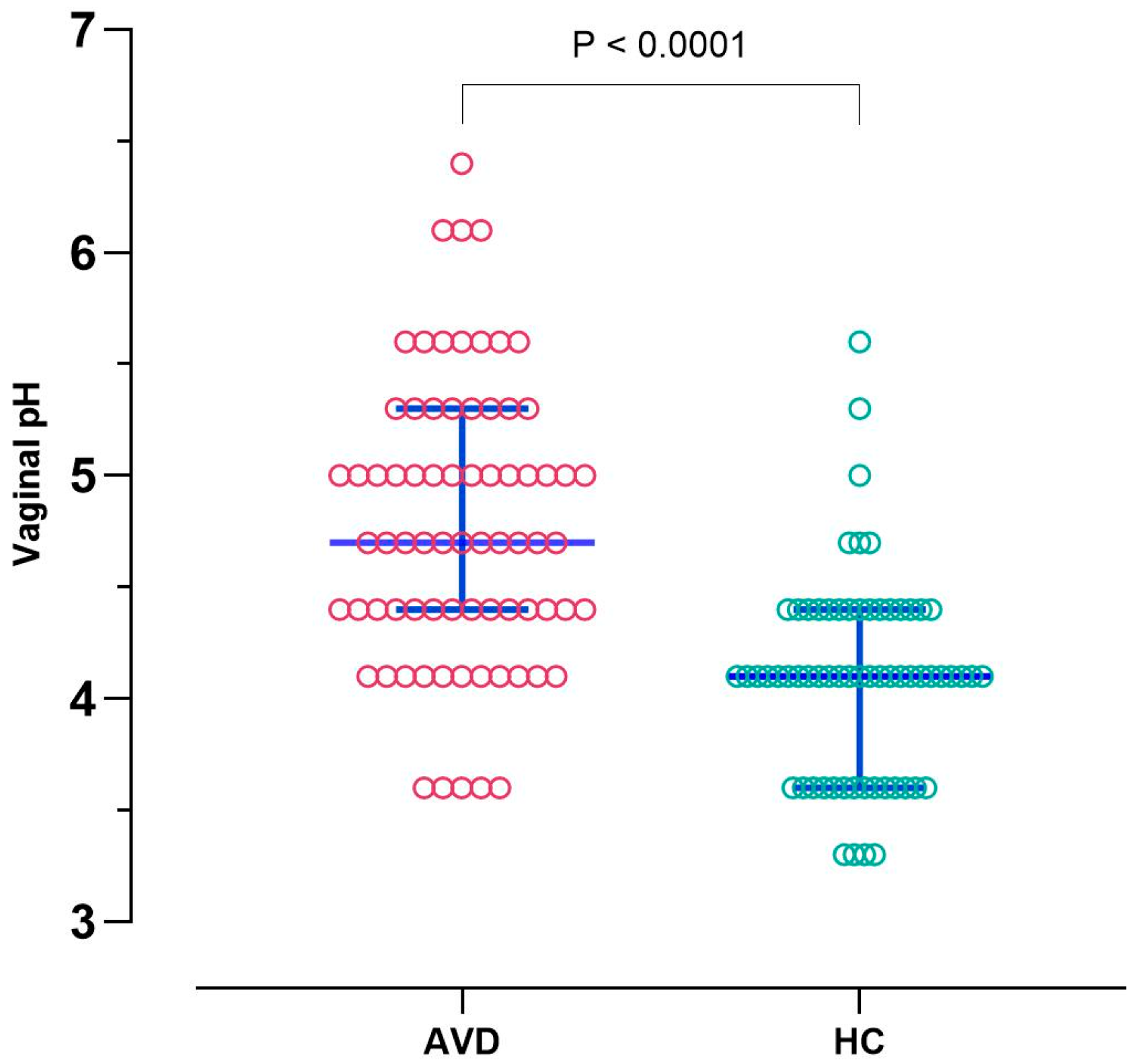
3.2. Reference Test Results and STI Panel Detections
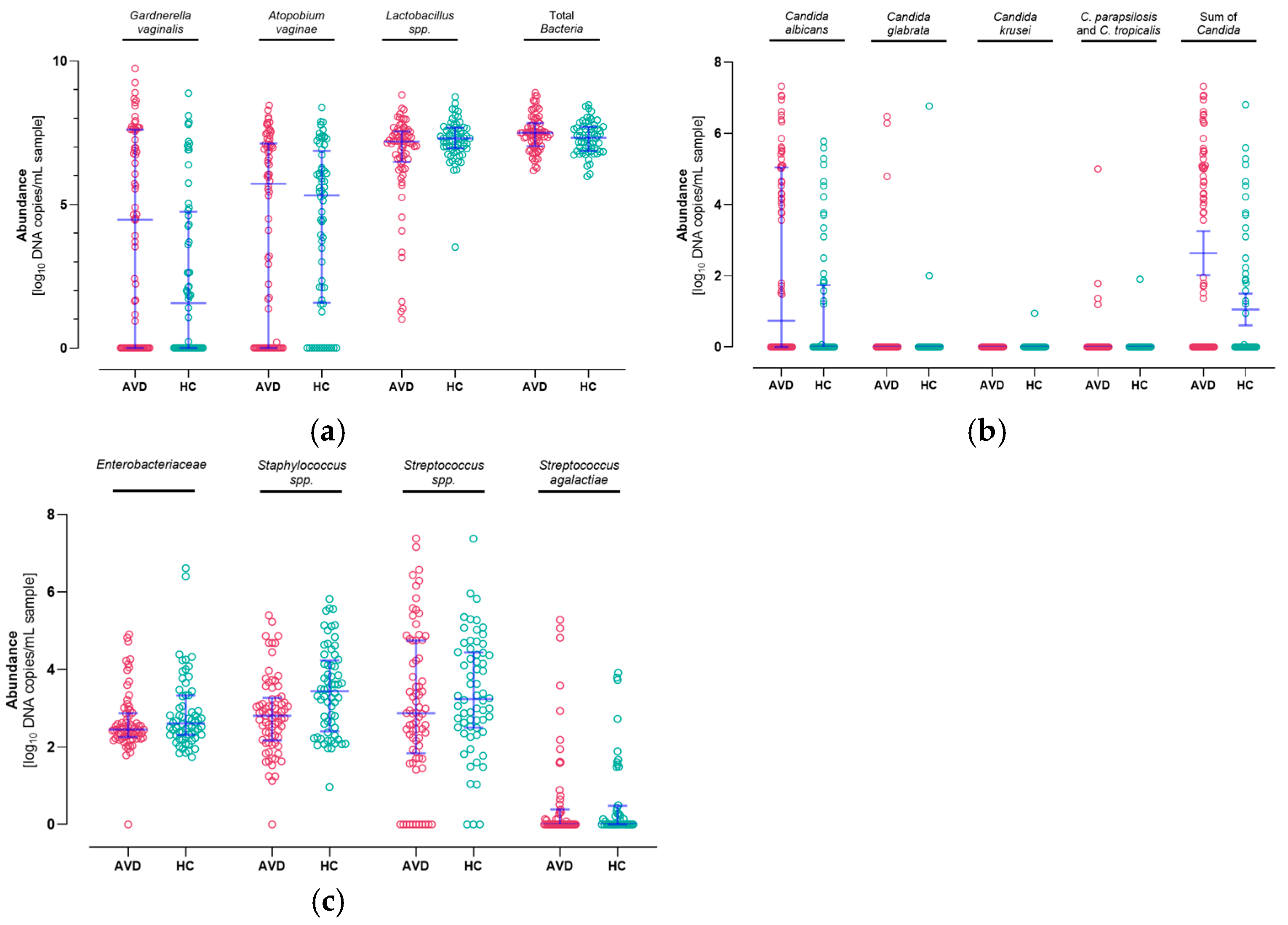
3.3. qPCR Abundances of Targeted Taxa
3.4. BV qPCR Dysbiosis Index Development
3.5. VVC qPCR Dysbiosis Index Development
3.6. AV qPCR Dysbiosis Index Development
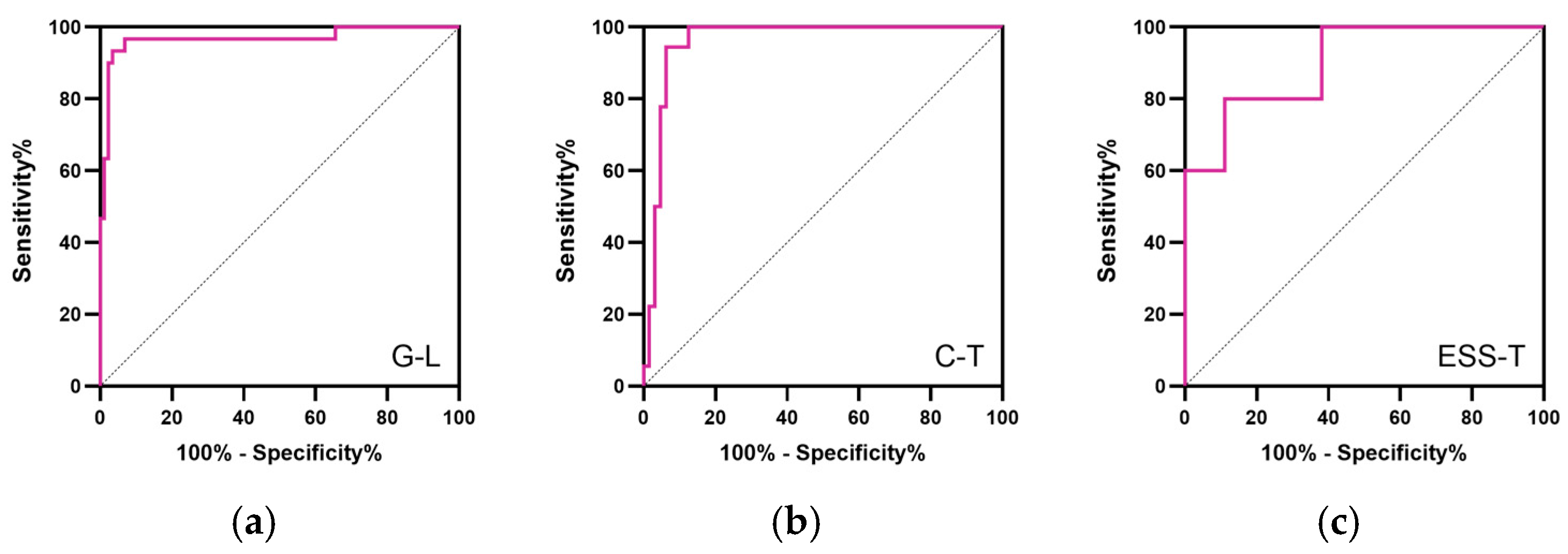
3.7. Validation of the qPCR Dysbiosis Indices
3.8. Combinations of Causes of Altered Vaginal Discharge
4. Discussion
5. Conclusions
Supplementary Materials
Author Contributions
Funding
Institutional Review Board Statement
Informed Consent Statement
Data Availability Statement
Conflicts of Interest
Abbreviations
| qPCR | Quantitative real-time polymerase chain reaction |
| AVD | Abnormal vaginal discharge |
| BV | Bacterial vaginosis |
| VVC | Vulvovaginal candidiasis |
| AV | Aerobic vaginitis |
| STI | Sexually transmitted infection |
| NS | Nugent scoring |
| HC | Healthy control |
| ROC | Receiver operating characteristic |
| AUC | Area under the ROC curve |
| CI | Confidence interval |
References
- Anderson, M.R.; Klink, K.; Cohrssen, A. Evaluation of Vaginal Complaints. JAMA 2004, 291, 1368–1379. [Google Scholar] [CrossRef] [Scilit] [PubMed]
- Sobel, J.D.; Akins, R.A. The Role of PCR in the Diagnosis of Candida Vulvovaginitis—A New Gold Standard? Curr. Infect. Dis. Rep. 2015, 17, 33. [Google Scholar] [CrossRef] [Scilit] [PubMed]
- Sherrard, J.; Wilson, J.; Donders, G.; Mendling, W.; Jensen, J.S. 2018 European (IUSTI/WHO) International Union against Sexually Transmitted Infections (IUSTI) World Health Organisation (WHO) Guideline on the Management of Vaginal Discharge. Int. J. STD AIDS 2018, 29, 1258–1272. [Google Scholar] [CrossRef] [Scilit] [PubMed]
- Hazra, A.; Collison, M.W.; Davis, A.M. CDC Sexually Transmitted Infections Treatment Guidelines, 2021. JAMA 2022, 327, 870–871. [Google Scholar] [CrossRef] [Scilit] [PubMed]
- Košnik, I.G.; Dermota, U.; Golle, A. Frequency of Detection of Gardnerella Vaginalis in Vaginal Smears in the Upper Carniola Region. Acta Dermatovenerol. Alp. Pannonica Adriat. 2016, 25, 31–33. [Google Scholar] [CrossRef] [Scilit]
- Vovko, P.; Fabjan Vodušek, V.; Sodec, B.; Retelj, M.; Bučar, M.; Kostanjšek, J.; Klarič Kamin, M.; Testen, V.; Tul Mandić, N. Prevalence and Causes of Vaginal Complaints in Women in Slovenia: Importance of Comprehensive Laboratory Testing. Slov. Med. J. 2024, 93, 149–159. (In Slovenian) [Google Scholar] [CrossRef] [Scilit]
- Schwebke, J.R.; Gaydos, C.A.; Nyirjesy, P.; Paradis, S.; Kodsi, S.; Cooper, C.K. Diagnostic Performance of a Molecular Test versus Clinician Assessment of Vaginitis. J. Clin. Microbiol. 2018, 56, e00252-18. [Google Scholar] [CrossRef] [Scilit] [PubMed]
- Gaydos, C.A.; Beqaj, S.; Schwebke, J.R.; Lebed, J.; Smith, B.; Davis, T.E.; Fife, K.H.; Nyirjesy, P.; Spurrell, T.; Furgerson, D.; et al. Clinical Validation of a Test for the Diagnosis of Vaginitis. Obstet. Gynecol. 2017, 130, 181–189. [Google Scholar] [CrossRef] [Scilit] [PubMed]
- van den Munckhof, E.H.A.; van Sitter, R.L.; Lamont, R.F.; le Cessie, S.; Kuijper, E.J.; Knetsch, C.W.; Molijn, A.; Quint, W.G.V.; Boers, K.E.; Leverstein-van Hall, M.A. Developing an Algorithm for the Diagnosis of Abnormal Vaginal Discharge in a Dutch Clinical Setting: A Pilot Study. Diagn. Microbiol. Infect. Dis. 2021, 101, 115431. [Google Scholar] [CrossRef] [Scilit] [PubMed]
- Kusters, J.G.; Reuland, E.A.; Bouter, S.; Koenig, P.; Dorigo-Zetsma, J.W. A Multiplex Real-Time PCR Assay for Routine Diagnosis of Bacterial Vaginosis. Eur. J. Clin. Microbiol. Infect. Dis. 2015, 34, 1779–1785. [Google Scholar] [CrossRef] [Scilit] [PubMed]
- Wei, S.; Bahl, M.I.; Baunwall, S.M.D.; Hvas, C.L.; Licht, T.R. Determining Gut Microbial Dysbiosis: A Review of Applied Indexes for Assessment of Intestinal Microbiota Imbalances. Appl. Environ. Microbiol. 2021, 87, e00395-21. [Google Scholar] [CrossRef] [Scilit] [PubMed]
- Shipitsyna, E.; Roos, A.; Datcu, R.; Hallén, A.; Fredlund, H.; Jensen, J.S.; Engstrand, L.; Unemo, M. Composition of the Vaginal Microbiota in Women of Reproductive Age—Sensitive and Specific Molecular Diagnosis of Bacterial Vaginosis Is Possible? PLoS ONE 2013, 8, e60670. [Google Scholar] [CrossRef] [Scilit] [PubMed]
- Rumyantseva, T.A.; Bellen, G.; Savochkina, Y.A.; Guschin, A.E.; Donders, G.G.G. Diagnosis of Aerobic Vaginitis by Quantitative Real-Time PCR. Arch. Gynecol. Obstet. 2016, 294, 109–114. [Google Scholar] [CrossRef] [Scilit]
- Rumyantseva, T.A.; Bellen, G.; Romanuk, T.N.; Shipulina, O.I.; Guschin, A.E.; Shipulin, G.A.; Donders, G.G.G. Utility of Microscopic Techniques and Quantitative Real-Time Polymerase Chain Reaction for the Diagnosis of Vaginal Microflora Alterations. J. Low. Genit. Tract. Dis. 2015, 19, 124–128. [Google Scholar] [CrossRef] [Scilit] [PubMed]
- Plummer, E.L.; Garland, S.M.; Bradshaw, C.S.; Law, M.G.; Vodstrcil, L.A.; Hocking, J.S.; Fairley, C.K.; Tabrizi, S.N. Molecular Diagnosis of Bacterial Vaginosis: Does Adjustment for Total Bacterial Load or Human Cellular Content Improve Diagnostic Performance? J. Microbiol. Methods 2017, 133, 66–68. [Google Scholar] [CrossRef] [Scilit] [PubMed]
- Deng, T.; Shang, A.; Zheng, Y.; Zhang, L.; Sun, H.; Wang, W. Log (Lactobacillus crispatus/Gardnerella vaginalis): A New Indicator of Diagnosing Bacterial Vaginosis. Bioengineered 2022, 13, 2981–2991. [Google Scholar] [CrossRef] [Scilit] [PubMed]
- Yamada, H.; Shimada, S.; Ota, H.; Kobayashi, Y.; Fukushi, Y.; Wada, S.; Kataoka, S. A New Real-Time PCR Test (Flora SelectTM) and Nugent Score for the Diagnosis of Bacterial Vaginosis During Pregnancy. Microorganisms 2024, 12, 2110. [Google Scholar] [PubMed]
- Oyenihi, A.B.; Haines, R.; Trama, J.; Faro, S.; Mordechai, E.; Adelson, M.E.; Osei Sekyere, J. Molecular Characterization of Vaginal Microbiota Using a New 22-Species QRT-PCR Test to Achieve a Relative-Abundance and Species-Based Diagnosis of Bacterial Vaginosis. Front. Cell. Infect. Microbiol. 2024, 14, 1409774. [Google Scholar] [PubMed]
- Ivanova, T.; Shalepo, K.; Nazarova, V.; Shipitsyna, E.; Guschin, A.; Savicheva, A. Evaluation of a Real-Time PCR-Based Test for Bacterial Vaginosis. Sex. Transm. Infect. 2013, 89, A88. [Google Scholar] [CrossRef] [Scilit]
- Savochkina Yu, A.; Rumiantseva, T.A.; Dolgova, T.I.; Guschin, A.E. The Development of Technique of Diagnostic of Vuvlvovaginal Candidiasis Based on Quantitative Multiplex Polymerase Chain Reaction. Klin. Lab. Diagn. 2015, 60, 56–62. [Google Scholar]
- Easmon, C.S.; Hay, P.E.; Ison, C.A. Bacterial Vaginosis: A Diagnostic Approach. Genitourin. Med. 1992, 68, 134. [Google Scholar] [CrossRef] [Scilit] [PubMed]
- Nugent, R.P.; Krohn, M.A.; Hillier, S.L. Reliability of Diagnosing Bacterial Vaginosis Is Improved by a Standardized Method of Gram Stain Interpretation. J. Clin. Microbiol. 1991, 29, 297–301. [Google Scholar] [CrossRef] [Scilit] [PubMed]
- Choe, H.-S.; Lee, D.S.; Lee, S.-J.; Hong, S.-H.; Park, D.C.; Lee, M.-K.; Kim, T.-H.; Cho, Y.-H. Performance of AnyplexTM II Multiplex Real-Time PCR for the Diagnosis of Seven Sexually Transmitted Infections: Comparison with Currently Available Methods. Int. J. Infect. Dis. 2013, 17, e1134–e1140. [Google Scholar] [CrossRef] [Scilit] [PubMed]
- Berçot, B.; Amarsy, R.; Goubard, A.; Aparicio, C.; Loeung, H.U.; Segouin, C.; Gueret, D.; Jacquier, H.; Meunier, F.; Mougari, F.; et al. Assessment of Coinfection of Sexually Transmitted Pathogen Microbes by Use of the Anyplex II STI-7 Molecular Kit. J. Clin. Microbiol. 2015, 3, 991–993. [Google Scholar] [CrossRef] [Scilit] [PubMed]
- Horner, P.; Donders, G.; Cusini, M.; Gomberg, M.; Jensen, J.S.; Unemo, M. Should We Be Testing for Urogenital Mycoplasma hominis, Ureaplasma parvum and Ureaplasma urealyticum in Men and Women?—A Position Statement from the European STI Guidelines Editorial Board. J. Eur. Acad. Dermatol. Venereol. 2018, 32, 1845–1851. [Google Scholar] [CrossRef] [Scilit] [PubMed]



| Altered Vaginal Discharge N = 74 | Healthy Controls N = 64 | p-Value for the Difference | ||
|---|---|---|---|---|
| Age, median (interquartile range) | 30.0 (23.8–35.0) | 32.5 (27.0–37.8) | 0.11 | |
| Medical history data, N (%) | ||||
| Underlying diseases | Yes | 6 (8.1) | 6 (9.4) | >0.99 |
| No | 68 (91.9) | 58 (90.6) | ||
| Allergies | Yes | 13 (17.3) | 8 (12.5) | 0.48 |
| No | 62 (82.7) | 56 (87.5) | ||
| Long-term medication use | Yes | 6 (8.1) | 6 (9.4) | 0.79 |
| No | 68 (91.9) | 58 (90.6) | ||
| Type of contraception | None | 46 (62.1) | 39 (60.9) | 0.61 |
| Condom | 5 (6.8) | 6 (9.4) | ||
| Intrauterine device | 5 (6.8) | 7 (12.5) | ||
| Oral hormonal contraception | 18 (24.3) | 11 (17.2) | ||
| Altered Vaginal Discharge N = 74 | Healthy Controls N = 64 | |
|---|---|---|
| Nugent score for BV, N (%) | ||
| 0–3 (normal) | 36 (48.6) | 51 (79.7) |
| 4–6 (intermediate microbiota) | 15 (20.3) | 6 (9.4) |
| 7–10 (BV) | 23 (31.1) | 7 (10.9) |
| Hay–Ison grade for AV, N (%) | ||
| 0 (use of antibiotics) | 0 (0.0) | 0 (0.0) |
| 1 (normal state) | 26 (35.1) | 37 (57.8) |
| 2 (intermediate state) | 0 (0.0) | 0 (0.0) |
| 3 (BV) | 16 (21.6) | 7 (10.9) |
| 4 (AV) | 3 (4.1) | 2 (3.1) |
| Not completed | 29 (39.2) | 18 (28.2) |
| Growth of Candida in culture, N (%) | ||
| Not detected | 41 (55.4) | 49 (76.5) |
| Light | 4 (5.4) | 4 (6.3) |
| Medium | 13 (17.6) | 5 (7.8) |
| Heavy | 16 (21.6) | 6 (9.4) |
| Medium or heavy | 29 (39.2) | 11 (17.2) |
| Multiplex STI panel detections, N (%) | ||
| Chlamydia trachomatis | 5 (6.8) | 1 (1.6) |
| Trichomonas vaginalis | 2 (2.7) | 0 (0.0) |
| Mycoplasma hominis | 8 (10.8) | 4 (6.3) |
| Mycoplasma genitalium | 0 (0.0) | 0 (0.0) |
| Neisseria gonorrhoeae | 0 (0.0) | 0 (0.0) |
| None of the above | 59 (79.7) | 59 (92.1) |
| Condition | Dysbiosis Index | Cut-Off Value | Sensitivity (%) | Specificity (%) | AUC (95% CI) |
|---|---|---|---|---|---|
| BV | g-l | >−1.339 | 96.7 | 93.1 | 0.9667 (0.9224–1.000) |
| VVC | c-t | >−3.065 | 94.4 | 93.8 | 0.9583 (0.9161–1.000) |
| AV | ess-t | >−0.855 | 60.0 | 98.4 | 0.9016 (0.7656–1.000) |
| Condition | Method | Sensitivity (95% CI) | Specificity (95% CI) | PPV (%) | NPV (%) |
|---|---|---|---|---|---|
| BV | Dysbiosis index g-l | 95.7 (79–99.8) | 91.7 (78.2–97.1) | 88.0 | 97.1 |
| Clinical diagnosis | 47.8 (29.2–67.0) | 100.0 (90.4–100.0) | 100.0 | 75.0 | |
| VVC | Dysbiosis index c-t | 94.4 (74.2–99.7) | 80.4 (68.2–88.7) | 60.7 | 97.8 |
| Clinical diagnosis | 100.0 (82.4–100.0) | 80.4 (68.2–88.7) | 62.1 | 100.0 | |
| AV | Dysbiosis index ess-t | 3/3; 100.0 (43.9–100.0) | 42/42; 100.0 (91.6–100.0) | 100.0 | 100 |
| Clinical diagnosis | 0.0 (0.0–56.2) | 92.9 (81–97.5) | 0.0 | 92.9 | |
| BV + VVC | Concurrent positivity of g-l and c-t | 80.0 (37.6–99) | 91.3 (82.3–96.0) | 40.0 | 98.4 |
| Clinical diagnosis | 0.0 (0.0–43.5) | 98.6 (92.2–99.9) | 0.0 | 93.2 |
| Reference Test Result | BV-Only N = 18 | BV + VVC N = 5 | VVC-Only N = 13 | AV N = 3 | Negative N = 35 | |
|---|---|---|---|---|---|---|
| Multiplex STI panel Detections * | Chlamydia trachomatis | 3 | 2 | |||
| Trichomonas vaginalis | 2 | |||||
| Mycoplasma hominis | 6 | 1 | 1 | |||
| Dysbiosis index results | BV only | 16 | 2 | |||
| BV + VVC | 2 | 4 | 3 | 1 | ||
| VVC-only | 1 | 9 | 7 | |||
| AV | 3 | 1 | ||||
| Negative | 1 | 24 | ||||
| Clinical diagnosis | BV-only | 10 | 1 | |||
| BV + VVC | 1 | |||||
| VVC-only | 1 | 5 | 13 | 9 | ||
| AV | 3 | 5 | ||||
| Inconclusive | 3 | 3 | 20 |
Disclaimer/Publisher’s Note: The statements, opinions and data contained in all publications are solely those of the individual author(s) and contributor(s) and not of MDPI and/or the editor(s). MDPI and/or the editor(s) disclaim responsibility for any injury to people or property resulting from any ideas, methods, instructions or products referred to in the content. |
© 2026 by the authors. Licensee MDPI, Basel, Switzerland. This article is an open access article distributed under the terms and conditions of the Creative Commons Attribution (CC BY) license.
Share and Cite
Vovko, P.; Fabjan Vodušek, V.; Retelj, M.; Sodec, B.; Bučar, M.; Kostanjšek, J.; Klarič Kamin, M.; Testen, V.; Tul Mandić, N. Comprehensive Diagnosis of Abnormal Vaginal Discharge Using qPCR-Based Microbial Dysbiosis Indices. Diagnostics 2026, 16, 2075. https://doi.org/10.3390/diagnostics16132075
Vovko P, Fabjan Vodušek V, Retelj M, Sodec B, Bučar M, Kostanjšek J, Klarič Kamin M, Testen V, Tul Mandić N. Comprehensive Diagnosis of Abnormal Vaginal Discharge Using qPCR-Based Microbial Dysbiosis Indices. Diagnostics. 2026; 16(13):2075. https://doi.org/10.3390/diagnostics16132075
Chicago/Turabian StyleVovko, Petra, Vesna Fabjan Vodušek, Matjaž Retelj, Barbara Sodec, Martina Bučar, Jasna Kostanjšek, Marijana Klarič Kamin, Veronika Testen, and Nataša Tul Mandić. 2026. "Comprehensive Diagnosis of Abnormal Vaginal Discharge Using qPCR-Based Microbial Dysbiosis Indices" Diagnostics 16, no. 13: 2075. https://doi.org/10.3390/diagnostics16132075
APA StyleVovko, P., Fabjan Vodušek, V., Retelj, M., Sodec, B., Bučar, M., Kostanjšek, J., Klarič Kamin, M., Testen, V., & Tul Mandić, N. (2026). Comprehensive Diagnosis of Abnormal Vaginal Discharge Using qPCR-Based Microbial Dysbiosis Indices. Diagnostics, 16(13), 2075. https://doi.org/10.3390/diagnostics16132075