


Abstract
A family of Schwartz functions are interpreted as eigensolutions of MADEs in the sense that where the eigenvalue is independent of the advancing parameter . The parameters are characteristics of the MADE. Some issues, which are related to corresponding q-advanced PDEs, are also explored. In the limit that we show convergence of MADE eigenfunctions to solutions of ODEs, which involve only simple exponentials and trigonometric functions. The limit eigenfunctions () are not Schwartz, thus convergence is only uniform in on compact sets. An asymptotic analysis is provided for MADEs which indicates how to extend solutions in a neighborhood of the origin . Finally, an expanded table of Fourier transforms is provided that includes Schwartz solutions to MADEs.
PACS:
34K06; 34A12; 42C40; 42A38; 33E99
1. Introduction
The introduction of a relaxing parameter in differential equations was found to provide stability properties for their corresponding solutions. This is a phenomenon well-known in numerical analysis where if the Ordinary Differential Equation (ODE)
is stiff then one can try to use the backward Euler method to obtain the sequence by first considering the algebraic equations
for small time-steps . If one can obtain explicitly in terms of then the iteration scheme often converges much faster, and for longer time intervals, than that provided by the forward Euler method [1], p. 349. That such a principle holds for ODEs as was established through the study of Multiplicatively Advanced Differential Equations (MADEs) as , and will be discussed further in this article. Part of our analysis of stability will require obtaining uniform apriori bounds. This will be achieved in a somewhat general setting, and the consequences will be presented in the form of examples of advanced differential equations.
1.1. Solutions of MADEs as Eigenfunctions
In [2] solutions to equations of the form
were studied for , , and . In the case that , with , solutions are referred to as eigenfunctions since as . Specific asymptotic properties of solutions were obtained in Theorem 10 of [3]. Here we only consider the case that and , however the derivatives may be of higher (integer) order than in Equation (1). In addition, we extend solutions of these equations to all so that the eigen equation, referred to as an eigen-MADE, has a solution the Schwartz space of infinitely differentiable functions, with derivatives that decay faster than reciprocal polynomials (as defined in [4] section V.3). An asymptotic theory near can be developed indicating that an extension to is quite natural. In this way the special functions that we study are eigenfunctions in , although not in the traditional, local () sense. The significance of these functions will be demonstrated by examples, and convergence to familiar functions is obtained on compact subsets of , as .
1.2. Brief Overview
The study of multiply advanced differential equations falls within the area of functional differential equations, as is studied for instance in Fox, et al. [2], Kato, et al. [3] and Dung [5]. There is also significant overlap with the area of q-difference differential equations, where the multiplicative advancement is referred to as a dilation and is denoted . There is a rich and active study within the area of q-difference differential equations with dilations involving . These are highlighted by works of: L. Di Vizio [6,7,8]; C. Hardouin [7]; T. Dreyfus [9,10]; A. Lastra [10,11,12,13,14,15,16,17,18,19]; S. Malek [10,11,12,13,14,15,16,17,18,19,20,21,22]; J. Sanz [17,18,19]; H. Tahara [23]; and C. Zhang [8,24]; along with further references by these researchers and others. Often these studies in q-difference differential equations overlap with the area of Gevrey asymptotics.
In the current work we continue by focusing on global solutions of a MADE on . In particular, we discuss several techniques for starting with a given global solution to an original MADE and then generating solutions of new related MADEs. This theme will be developed as follows: In Section 2, a known MADE solution first introduced in [25], namely , is used to produce a simple related solution which is an eigensolution of a MADE in the sense of the Abstract. In turn, is then used to obtain a new q-advanced Airy function satisfying a MADE analogue of the Airy differential equation. Then itself is used along with convolution to generate families of functions solving a q-advanced PDE.
In Section 3, a family of MADE solutions, under convolution and auto-correlation, are seen to produce related solutions of new MADEs. Furthermore, the least-element method in Poincare asymptotics is deployed to find natural extensions to related MADE solutions on the negative real line. A theory of asymptotic extensions to is developed to clarify the notion that solutions to MADEs behave smoothly in a neigborhood of the origin. We also give conditions that ensures a natural extension to all of , as is needed to even consider a Fourier transform. An investigation of the inhomogeneous MADEs that these solve is begun.
In Section 4 we focus on considering solutions of MADEs as perturbations of classical solutions, and, mirroring a more direct convergence proof in Section 2, we exhibit MADE solutions which converge to a classical solution of a damped-oscillation equation—the convergence being uniform on compact subsets of .
In Section 5, we return to the topics of convolution and auto-correlation to observe their impact when applied to MADE solutions. In this paper, we will discuss convolutions, correlations, and Fourier transforms for MADEs.
A table of Fourier transforms of global MADE solutions under study here is provided in Section 6. These will be solutions of new MADEs, for which we obtain new elements in a table of Fourier transforms. This new table mimics what is often done for Laplace transforms, in the study of linear constant coefficient ODEs.
In various theories of differential equations, convolutions provide a useful tool since general solutions can be determined from fundamental solutions, as demonstrated here in Equation (33). This is one motivation for obtaining solutions to homogenous equations, as appears in Proposition 2.
2. A Normalized Cosine Example and Extensions
From [25], consider the following Schwartz functions, for and all ,
where
Next define
There are several properties that we note. In particular, the function is normalized, in that the uniform bound holds, after some delicate work performed in [25], for each . It also solves the following eigen-MADE for all and each ,
From (6) we see that satisfies an eigen-MADE in the sense of the Abstract, with independently of the advancing parameter . Note that (as recorded in (10) below) does not have an eigenvalue independent of q, thus we rely on as the appropriate eigen-MADE solution.
Since is not only and bounded, but in fact Schwartz, we can obtain its Fourier transform, an operation defined for any , as
In [25] it was found that
where was defined in Equation (4) above, and the other normalizing constant is
To express the Fourier transform of linear, homogeneous MADEs, we found multiple uses of the Jacobi theta function
which allows the association that , and which ensures that for all , due to the product formula. It will be of significance to note that the reciprocal , for , is Schwartz when extended to be identically 0 for . Critical algebraic properties that we use are
A consequence is that the only zeros of are for for all . This is obvious from the product definition of in Equation (8).
2.1. Uniform Convergence
Using Taylor series methods as an approach paralleling that in [25] we show:
Proposition 1.
On any compact subset of , approaches uniformly as .
Proof.
A given compact set is contained in an interval for sufficiently large, so it suffices to prove the theorem on .
First, recall the following results shown in [25]
From these, by induction on the even order derivatives of , we obtain the higher order derivatives
and
We infer all derivatives of via
and
Evaluating the derivatives of at yields
for all .
Next computing , the degree Taylor polynomial for expanded about , gives
with remainder term
for appropriate between 0 and t. Using the sup norm , along with the fact that , to bound from above, we obtain
Let and denote the degree Taylor polynomial and remainder terms for respectively. Then, for each and each t with , one has
Now, given any choose such that . Then one has . Next choose with . Then for all one has
Next choose such that . Then for all one has
Remark 1.
Note that, alternatively, one can express Proposition 1 as
A similar convergence proof is given in Section 4, with details related to the novelty of the result.
2.2. Application to PDE Example
We are now in a position to obtain q-versions of various equations using as a building block for relaxing equations. For example, define the Airy function (see page 570 in [26])
Some properties of this function are that as , and . We now show:
Proposition 2.
The q-advanced Airy function is defined here to be
for . The functions and satisfy the homogeneous ODE and MADE
respectively, for . Basic properties of for , are that is Schwartz with . Furthermore, for each , , and sufficiently large, so that
In other words, uniformly for t in compact subsets of , as .
Remark 2.
Verifying convergence in Equation (27) may seem rather straight forward, due to the uniform convergence of to on compact sets. However, we need to use a careful argument, as demonstrated here.
Proof.
That is Schwartz follows from the same for , whereas the property requires a manipulation of theta functions, and is shown in Appendix A. We start with the second equation in (26) since the first equation is known to hold [26]. First define the function
Now compute, using , and , for ,
Next, to show convergence, consider any and, without loss of generality, fix . Let t be in the interval . Then, for any , using integration by parts and boundedness of the sine function, we can write
Thus, for all we can easily find sufficiently large so that
The bound in Equation (30) also holds if is replaced with since and for all . Now, fix sufficiently large so that the bounds in (30), and also (30) with cos replaced by , are less than . It is essential to note that this value of R is independent of .
Finally, for each , define the function
2.3. A q-Advanced PDE Example
The argument in the proof of Proposition 2 shows that knowledge of one MADE can help to generate and study other MADEs. In fact, this extends to Partial Differential Equations (PDEs). For example, consider the linear constant-coefficient Airy PDE [27]
for , , and constant . To obtain an advanced-type equation, consider the kernel function, defined for each ,
for appropriate , to be determined. For any integrable and any , define,
(compare with Equation (2.2) of [27]). Recall that the functional operation of convolution for integrable functions gives a new function defined by
where the last equality in Equation (35) is the Convolution Theorem (see [28] Theorem IX.4). To discover the PDE that solves, first compute the t-partial derivative of Equation (34), to obtain
By replacing in Equation (38), one can verify that the q-advanced PDE, for and ,
holds. To obtain consistency with the initial data , first define the constant, for ,
which is finite since is Schwartz (thus integrable) for . Then we require,
The q-Airy Hypothesis: Given , the expression in Equation (40) does not vanish, i.e., .
In Appendix B we show that the q-Airy Hypothesis holds for all . Then
where convergence in Equation (41) is pointwise, and is shown in Appendix C using a mollifier-type argument. If, in addition, we have and , then convergence in Equation (41) becomes uniform.
3. Solutions of MADEs and Natural Extensions
Define the family of Dirichlet-type functions for , and , as introduced in [29],
For each and , the corresponding function solves the eigen-MADE
Here is in reduced form with . The function has eigenvalue and can be normalized so that the function solves the q-advanced eigen equation
for . In this manner the q-dependence of the eigenvalue can be removed. Note that the sign of the eigenvalue can dramatically affect the behavior of the solution.
3.1. Flat Solutions of MADEs
In [29] we found special conditions under which extends to all , so that
gives a Schwartz solution to an associated MADE to all . The essential condition is that for all , which is a property called flatness, at . It was shown in [29] that
This condition for flatness can be expressed as
Then, for as in Equation (46), all solve first-order MADEs:
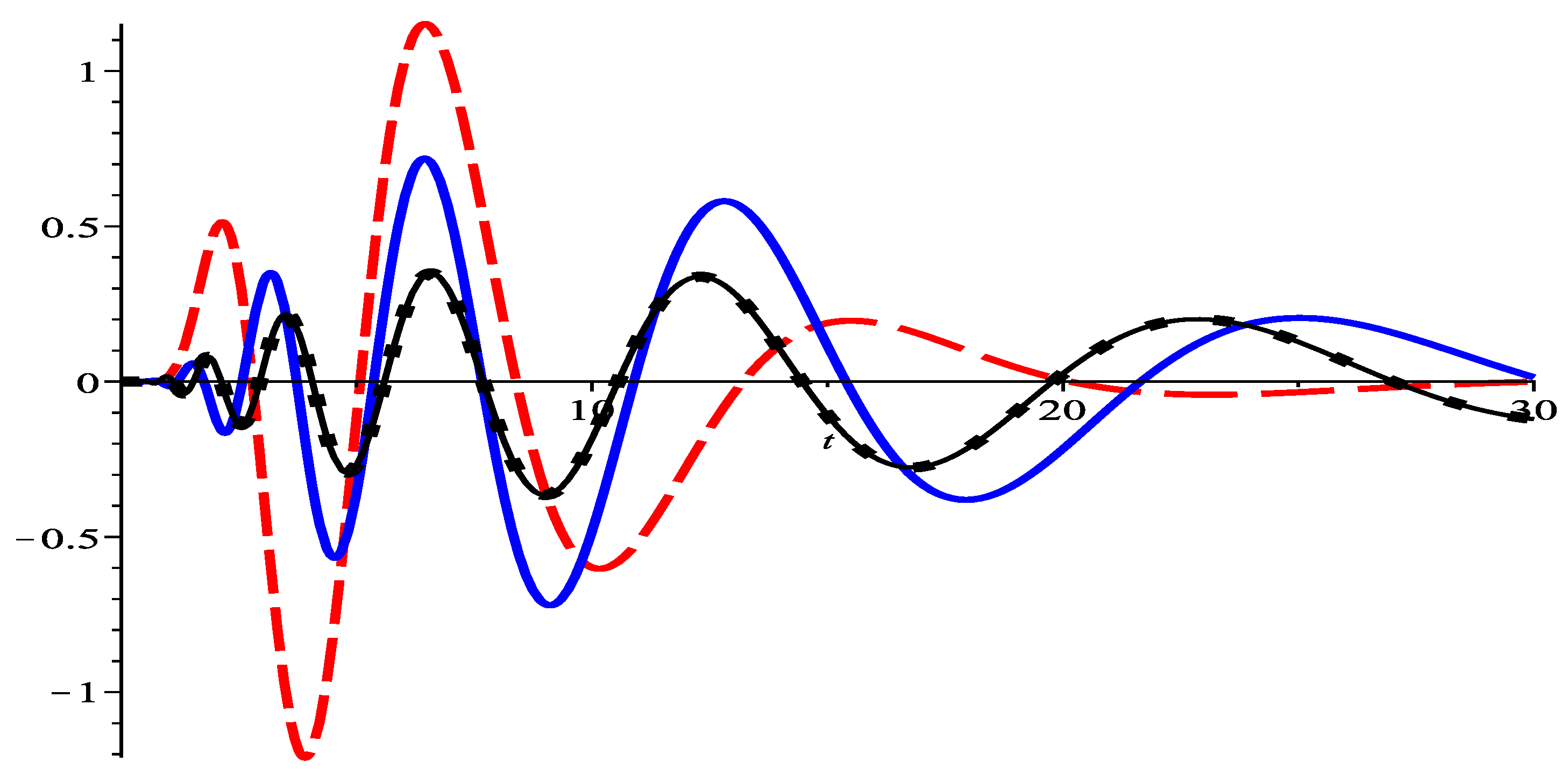
for and . See examples in Figure 1. Furthermore, the Fourier transform has a special form:
where for each , the points of valuation of the theta function require,
for , and are the N distinct solutions of .
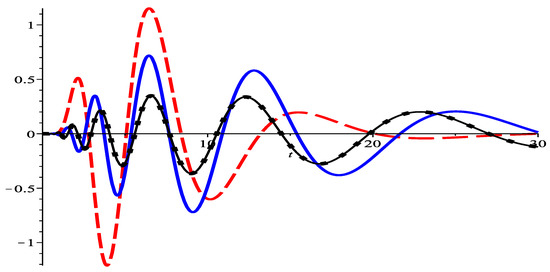
Figure 1.
Three Flat Functions: Normalized plots of first-order MADE solutions that are flat at , (1) (dashed red), (2) (solid blue), (3) (dotted black line) all for .
3.2. A Non-Trivial Extension of a MADE Solution
Now consider the situation where where . Then an extension of to the region is not so clear. However, by truncating the series in Equation (42) an asymptotic exponential-series is obtainable that provides, what appears to be, a smooth extension to the region. However, extending in this manner does not lead to a homogeneous, eigen-MADE in the region . This is demonstrated with a specific example.
We begin by recalling the Airy equation as given in Proposition 2
However, taking the derivative of this equation gives a generalization
where the right hand side is expected to be small for . Hence a solution to the constant coefficient equation
see Section 4, may be considered to be an approximate solution to the Airy equation near the origin. For example, the function
solves (49) with initial conditions
Now we consider a q-relaxed version of (50) in the form of a solution to the MADE
with parameter . Note that (52) is a multiplicatively advanced relaxed version of the approximate Airy ODE (49) for . From Equations (42) and (43), a particular solution of Equation (52) is for . To extend to all of in a fashion, we find that
is a Schwartz function, where is analytic for and bounded for . Although there is no unique solution to MADEs in general, the function constructed in Equation (53) will be called canonical, and it solves the MADE in Equation (52) for all .
3.3. Asymptotic Analysis of an Extension
There is an alternate continuous way to extend to the region , for defined below, in terms of . Define the constant so that
where the last equality follows from (8). Note that is non-zero for real by (9), whence is well-defined and finite. For the function is defined as
Now, for , solves (52) with initial conditions
However, for each the function diverges, due to the rapid growth of , in k, as compared to that of in the summands of (55), as k approaches infinity. Thus, for each the function is not defined.
To remedy this, while keeping the same summands as in (55), we truncate the upper limit of summation in (55). Thus, for all we define the asymptotic extension of by
where the integer upper limit of the sum, and the normalizing coefficient, are defined to be
Since it will follow from the definition below that as , continuity for is achieved at . However, as a solution to a MADE, we have that , where is the space of distributions, dual to , the set of compactly supported, infinitely differentiable functions. In fact, since
where , with , we have that is a weak solution (as defined in [4] p. 149) to the inhomogeneous extension of (52).
For , a best choice for is chosen to be the k value at which a local minimum for the function
exists, where the exponent function is defined to be
The choice of truncation presented here is made based on the least-term approximation from Poincaré asymptotics, as presented on p. 94 of Bender and Osrzag [26]:
“We look over the individual terms in the asymptotic series; …For every given value of …… we locate the smallest term. We then add all the preceding terms in the asymptotic series up to but not including the smallest term.”
Traditionally this rule gives a good estimate of the actual function, which is often the solution of a differential equation. In our case the rule above can only be applied for sufficiently close to the origin, which for this function turns out to be
This is a consequence of the following more general result.
Proposition 3.
For with , define the following function on
for any bounded sequence . Define the exponential growth portion of the summands as
Then, define two constants, for fixed ,
For , the function exists uniquely as the local minimum of .
Remark 3.
The coefficients in Equation (62) play no part in the following analysis. However, if they decay as , or if they change sign, then the asymptotic behavior may be different than what is derived here.
Proof.
Taking a second derivative of with respect to k gives the inflection point condition
Interpreting the middle critical point condition in (65) as the intersection of the concave up function with the fixed line reveals three possibilities:
- Case 1:
- There are two critical points with an intervening inflection point for and q sufficiently small. By the first derivative test, a local maximum occurs at while the desired local minimum then occurs at .
- Case 2:
- An edge case occurs, in which the two critical points coalesced to one point equaling the inflection point, . There is no local minimum for in this setting.
- Case 3:
- There are no critical points when either or q is too large, resulting in no local minimum for in this setting.
Thus, the edge case, Case 2, marks the transition at which a local minimum of the summand occurs, and hence Case 2 marks the transition at which an asymptotic phenomena for the index k occurs. To quantify this point of transition, we note that the edge case, Case 2, where the inflection point equals the critical point, implies that the solution of (65) also simultaneously solves (66) in this setting. Substituting the expression for in (65) into (66) gives
Then substituting the value of as obtained in (67) into the value of k in Equation (65) gives the value of that corresponds to this transition as
Thus, we saw that Case 2 holding implies that
Conversely, if , then (66) holds if and only if
Furthermore, observe that since is concave up with tangent line at then the inequality holds for all x and equality holds if and only if . Replacing x by in our inequality gives
Multiplying the inequality on the left through by gives
whence (65) also holds at the same value of . Thus, the critical points and the inflection point coalesced to the common value and Case 2 holds. We see that Case 2 holding is equivalent to holding. Furthermore, one sees that Case 1 holds when , and a local minimum is obtained. Thus, the asymptotic phenomena occurs for where for the upper index limit we take the larger of the two solutions to the transendental equation for in Equation (65):
Then, for sufficiently small, has a local minimum at , which can be found by taking a seed point greater than the value of the inflection point and utilizing Newton’s method. □
3.4. Special Case of the Derivative of an Airy Approxiamtion
We return to considering the special case that , and . However, rather than illustrating a graph of the above phenomena for , we instead illustrate the behavior for its derivative
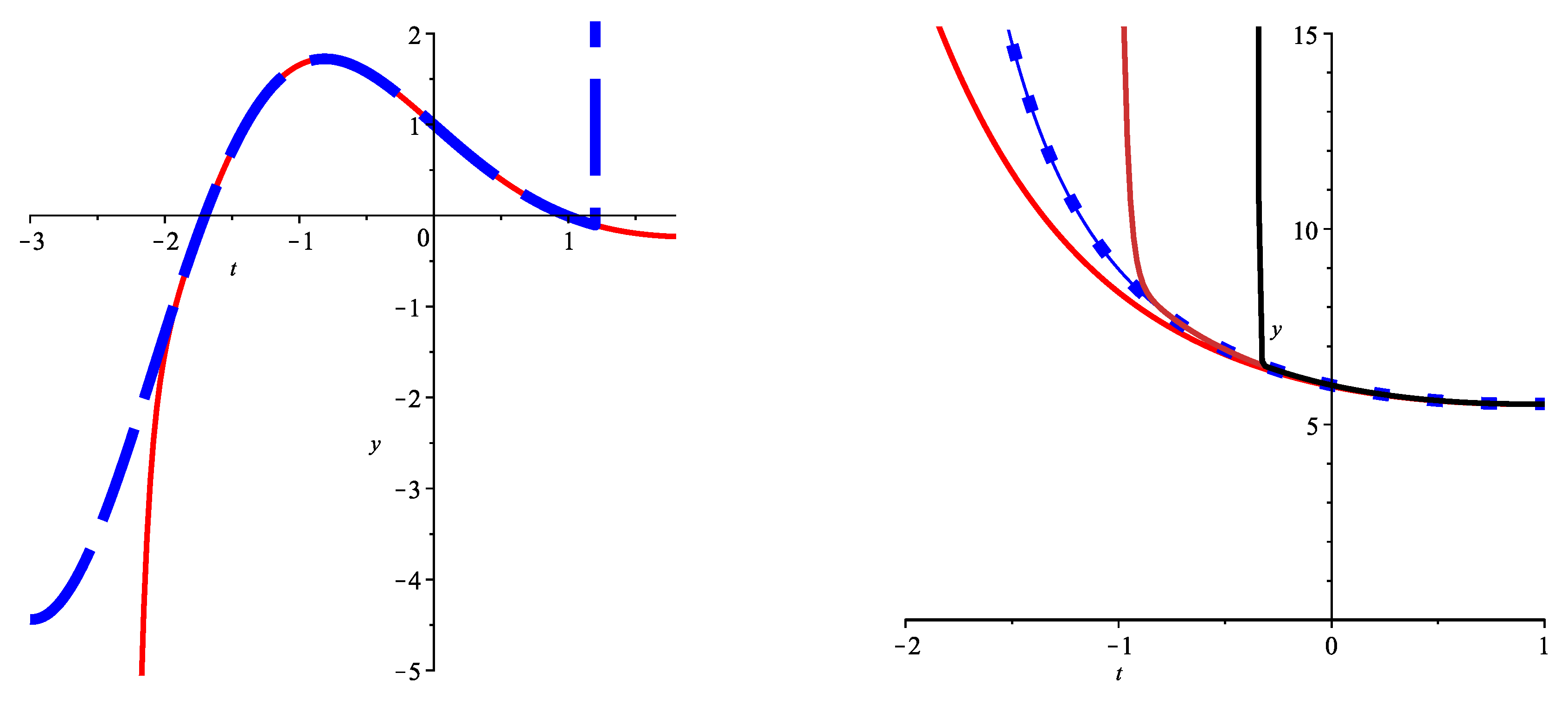
in Figure 2 below. In this setting, , , and the asymptotic extension of is
where for , we compute, using , , and ,
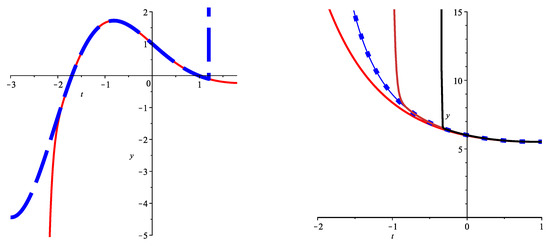
Figure 2.
(Left) Asymptotic extension from Equation (73) for (solid red) together with a similarly constructed asymptotic extension for (dashed blue) both for . (Right) Plots of where the functions are defined in Equation (76) for . Failure of the asymptotic extension is found to be around , as compared to the computed value of . The upper-sum limits, from left to right, are .
For the function is the k value giving the larger of the two solutions to the transendental equation:
which is the analogue of (65) and (72). The asymptotic extension is given by the solid red graph in Figure 2 (Left). Defining the function
the dotted blue graph in Figure 2 (Left) is the asymptotic extension of to . The asymptotic extension of the derivative (rather than the original function ) is used due to non-vanishing at as well as due to its comparatively flatter derivative.
From Figure 2 the asymptotic expansion is valid to around , using , rather than , using , contrary to what was expected from Equation (74). This is due to the alternation since cancelations require a more careful analysis. This is not done here, but the next example considers a comparatively simple case, which gives a better comparison.
3.5. An even Simpler Example of MADE Asymptotics
In this section, we motivate a simpler type of asymptotic extension, distinct from Section 3.4, using two examples.
To begin, we recall a MADE that was studied in [30], for and ,
where for set . Here we consider the extension to negative values of the parameter. Then, for , we will choose the constant . To use the asymptotic analysis, note that , and . Thus, we obtain an approximate MADE solution extension to the region . Start by defining
Differentiating h with respect to j gives the critical condition
The second derivative gives the inflection condition
Combining these expressions to eliminate gives
from Equation (67) which then results in
from Equation (68). For , we have . By inspection, Figure 2 (Right) indicates that we maintain a good asymptotic expansion by letting all . In particular, for our rule suggests , which is expected to be valid for . The Right of Figure 2 indicates a good match for , using .
Finally, we return to Equation (57), and consider the slightly different series, for all (where )
where now the integer upper-sum limit, and the normalizing coefficient, are defined to be, respectively
The function is differentiable for , and solves an inhomogeneous MADE
where is derived in Appendix D. Note that is distinct from for in Equation (59), and the corresponding weak solution is much easier to compute than , with little consequence to the asymptotics.
4. Convergence of MADEs to Classical Solutions
In this section, we present another example where we can study convergence of a MADE solution to its classical analogue. This requires an apriori uniform bound in a fixed neighborhood of for all sufficiently small. Obtaining a uniform-in-q bound for general is rather deep, and complicated by the presence of the alternation in Equation (42). Here we study a series without this alternating factor, which defines a function that behaves like a damped oscillation. The details are more challenging than what appears in the proof of Proposition 1, so a full analysis is provided.
Consider the following linear third-order MADE
for , on the interval , satisfying the initial conditions
For small , as , Equations (80) and (81) can be considered to be a perturbation of the classical analogue, which is the ODE
with initial conditions
obtained by setting in (80) and (81). One can check directly that (82) and (83) is solved uniquely by
Now, using techniques mirroring those of Theorem 3.2 of [29], a particular solution to (80) is
for . Note that the expression in Equation (85) does not have the alternation , unlike the expression in Equation (55) for , and this will allow a sharp bound on for all , independent of .
The first derivative of is seen to be
where the fact that:
was used explicitly to obtain the last equality in (86). Using this identity implicitly, we obtain:
and finally we verify:
A re-indexing was used to move from (88) to (89). Note that (89) gives that (80) holds. From (85)–(87), one sees that
where the last equalities of (91) and (92) are obtained from (8).
Normalizing by to obtain
one sees that now satisfies the MADE (80) along with the initial conditions (81). The last initial condition follows from the fact that
where the last equality in (94) follows from the next lemma.
Lemma 1.
For the Jacobi theta function (8) satisfies
Proof.
For the first equality in (95) one can write
where the second equality is obtained from Equation (9) with , and the last equality is the reciprocal identity in Equation (9) with . Dividing (96) by gives (95). For the second equality in (95), let and in Equation (9). Then as above . The lemma is shown. □
In addition to the last equality of (94) being proven by the first equality in (95) in Lemma 1, the second equality of (95) proves that the second derivative of at equals .
The following theta function bound will also be helpful.
Lemma 2.
For the Jacobi theta function (8) satisfies
Proof.
Observe that
while
Next we compute all derivatives of at and of at , in preparation for the computation of the Taylor series expansion at for both and . From (82) we immediately have that for and
The analogous results for are obtained in the following lemma.
Lemma 3.
For and , let with given by (85). Then for and one has
Furthermore, at one has
Proof.
We first establish (104) for the case that by induction on k. So for note that (104) holds as a tautology for , and for it holds by (89). Assume that for fixed k. Then
where: the inductive hypothesis gives the rightmost equality in (106), and that (89) along with the chain rule gives the first equality in (107). Thus, the case holds for all k. Now differentiate the expression either or times to obtain (104) in all remaining cases. Evaluating (104) at and relying on (90)–(94) gives (105). □
Next, the -degree Taylor polynomials of g and f, respectively, expanded about are given by
where (108) follows from (103), and (109) follows from (105). For , these have respective remainder terms
for some and . The goal of uniform convergence on compact subsets is now obtained in the following proposition.
Proposition 4.
Proof.
Without loss of generality, there is a such that , and it is sufficient to prove uniform convergence on . For , from the triangle inequality one has
Now for and relying on (111), one starts with (114) to see
where: moving to (115) is obtained via (93); (116) follows from (85) and (91); the equality in (118) is obtained by (8); and the inequality in (119) is given by (97) in Lemma 2. Similarly, from (110) and (84), one has
Also, from (108) and (109) if we let: , then
Now, given , choose sufficiently large such that one has . Then
Pick so that
and
Then for one has
and
whence for
and
So approaches uniformly on as , and the proposition is proven. □
5. Convolutions, Correlations and Bounds
Here we briefly demonstrate that solutions of MADEs beget new solutions of different MADEs.
5.1. Distinction between Convolutions and Correlations
Let and recall the standard definitions:
Proposition 5.
Consider , which solve the following MADEs
respectively, for , , and , . Then the correlation and convolution solve the following higher-order MADEs
and .
Proof.
The fact that convolution and correlation preserve the Schwartz property follows from Theorem 3.3 of [31]. The MADE equations easily follow from repeated applications of integration by parts, use of Equation (129), and a change of variables. □
5.2. Auto-Correlation
It was shown in Theorem 7 of [25] that the auto-correlation of , as defined in (45) for and , gives , as defined in (42) for and , in the sense that
where , as defined in (42) for and . Using this result, along with the Cauchy-Schwartz inequality it was shown in Proposition 4 of [25] that
This important bound allows one to obtain uniform convergence of the normalized function , as .
5.3. Cross-Correlation
Let us consider an example that involves different MADE solutions, to obtain a new MADE. Knowing the Fourier transform of these functions allows us to easily derive properties of the resulting function. Compute, using Plancherel’s Lemma,
Now, to simplify the integrand in (130), we use the Fourier transforms from [25,32] respectively, to write:
The equality in (131) follows from the fact that and uses the definition of the Jacobi theta function in Equation (8). The consequence is that there are simple poles when for , but double poles at . Computing the integral in (130) using residue theory, requires a careful consideration of the position of these poles off the real axis.
For the contour for must traverse the lower-half plane, encompassing the simple poles . Consequently, residue theory and Equation (9) gives
which solves the eigen-MADE
6. Expanded Table of Fourier Transforms
In this final section we establish a short table of Fourier transforms for solutions of MADEs and their relations to Jacobi theta functions. Included are well-established results, along with new functions. The positive constants and are generic, but estimates are not presented here.
The introduction of new functions are as follows: For see [32] for decay constants and in Table 1; The functions and are closely related to and , respectively, introducted in [25], where constants and are obtained; The q-Bessel functions, related to , were introduced in [33], along with decay constants and ; Flat wavelets have Fourier transforms that are averages of theta functions, first derived in [29], along with constants and . The functions and , have Fourier transforms that involve theta functions, which can be used to obtain decay parameters and .

Table 1.
Table of Fourier transforms with solutions of ODEs and MADEs.
Note that similar tables for Laplace transforms are quite extensive, since applications only require control of function growth on . Here we are concerned with globally defined functions on for which a Fourier transform can be defined.
Author Contributions
Conceptualization, D.W.P., N.R. and M.J.S.; investigation, D.W.P., N.R. and M.J.S.; writing–original draft preparation, D.W.P., N.R. and M.J.S.; writing–review and editing, D.W.P., N.R. and M.J.S. All authors have read and agreed to the published version of the manuscript.
Funding
This research received no external funding. This research was supported in part by the ECU Mathematics Department and by the ECU Thomas Harriot College of Arts and Sciences.
Acknowledgments
The authors would like to thank the reviewers for very helpful comments and suggestions that aided in the completion of this project.
Conflicts of Interest
The authors declare no conflict of interest.
Abbreviations
The following abbreviations are used in this manuscript:
| ODE | Ordinary Differential Equation |
| PDE | Partial Differential Equation |
| MADE | Multiplicatvely Advanced Differential Equation |
Appendix A. Normalization in Terms of Theta Functions
The normalization for in Equation (4) involves a theta function, so that
Appendix B. Establishing the q-Airy Hypothesis for q > 1
To compute explicitly, we will find the Fourier transform of and then find its value at the origin. This requires a careful change of variables. To begin, we combine definition Equation (25) and the inverse Fourier transform of formula in Equation (7) giving
To handle the double integral note that the odd power of both the k and the t variables allows the following rearrangement
We can now obtain the Fourier transform
Finally, computing at gives the final result
which is clearly a finite, positive, non-zero quantity, for each .
Appendix C. Mollifier Argument for Airy PDE Initial Profile
Let us first make clear the importance of normalization. Indeed, observe that if , then the change of variables for , gives
Thus, explicitly, for each fixed and , and as in Equation (34)
At this point we use the Schwartz property of , along with the integrability and continuity of , to argue that the expression above is arbitrarily close to 0. This will be done in two parts.
Given , choose so that
Note that this estimate is independent of , so with and fixed, the choice of will determine a bound that is needed on t, near 0.
Now, consider the region . Since , is continuous, so given and , so that
Thus, we require so that
which establishes pointwise convergence. However, if and , returning to Equation (A2) for , we obtain uniform convergence as follows:
Now, clearly, the condition in Equation (A3) can be achieved.
Appendix D. Derivation of Inhomogeneous MADE
Using the characteristic function , and delta function centered at the origin , express the function in Equation (57) as
for fixed. Note that is defined in Equation (54), and is defined in Equation (78), so that , and . Thus, the first derivative is continuous, and the second derivative is bounded. However, the third derivative results in the appearance of a distribution,
which is an inhomogeneous MADE for all , and which defines , by inspection of the quantity in the square brackets. The last three terms on the right hand side vanish as , where in a manner described after the proof of Proposition 3.
References
- Burden, R.L.; Fairs, D.J.; Burden, A.M. Numerical Analysis; 10E. Cengage Learning: Boston, MA, USA, 2016. [Google Scholar]
- Fox, L.; Mayers, D.F.; Ockendon, J.R.; Tayler, A.B. On a Functional Differential Equation. IMA J. Appl. Math. 1971, 8, 271–307. [Google Scholar] [CrossRef]
- Kato, T.; McLeod, J.B. The Functional-Differential Equation y′(x) = ay(λx) + by(x). Bull. Am. Math. Soc. 1971, 77, 891–937. [Google Scholar]
- Reed, M.; Simon, B. Functional Analysis I; Academic Press: New York, NY, USA, 1975. [Google Scholar]
- Dung, N.T. Asymptotic behavior of linear advanced differential equations. Acta Math. Sci. 2015, 35, 610–618. [Google Scholar] [CrossRef]
- Di Vizio, L. An ultrametric version of the Maillet-Malgrange theorem for nonlinear q-difference equations. Proc. Am. Math. Soc. 2008, 136, 2803–2814. [Google Scholar] [CrossRef]
- Di Vizio, L.; Hardouin, C. Descent for differential Galois theory of difference equations: Confluence and q-dependence. Pac. J. Math. 2012, 256, 79–104. [Google Scholar] [CrossRef]
- Di Vizio, L.; Zhang, C. On q-summation and confluence. Ann. Inst. Fourier (Grenoble) 2009, 59, 347–392. [Google Scholar] [CrossRef]
- Dreyfus, T. Building meromorphic solutions of q-difference equations using a Borel-Laplace summation. Int. Math. Res. Not. IMRN 2015, 15, 6562–6587. [Google Scholar] [CrossRef]
- Dreyfus, T.; Lastra, A.; Malek, S. On the multiple-scale analysis for some linear partial q-difference and differential equations with holomorphic coefficients. Adv. Differ. Equ. 2019, 2019, 326. [Google Scholar] [CrossRef]
- Lastra, A.; Malek, S. On q-Gevrey asymptotics for singularly perturbed q-difference-differential problems with an irreguular singularity. Abstr. Appl. Anal. 2012, 2012, 860716. [Google Scholar] [CrossRef]
- Lastra, A.; Malek, S. On parametric Gevrey asymptotics for singularly perturbed partial differential equations with delays. Abstr. Appl. Anal. 2013, 2013, 723040. [Google Scholar] [CrossRef]
- Lastra, A.; Malek, S. Parametric Gevrey asymptotics for some Cauchy problems in quasiperiodic function spaces. Abstr. Appl. Anal. 2014, 2014, 153169. [Google Scholar] [CrossRef][Green Version]
- Lastra, A.; Malek, S. On parametric multilevel q-Gevrey asymptotics for some linear q-difference-differential equations. Adv. Differ. Equ. 2015, 2015, 344. [Google Scholar] [CrossRef]
- Lastra, A.; Malek, S. On multiscale Gevrey and q-Gevrey asymptotics for some linear q-difference differential initial value Cauchy problems. J. Differ. Equ. Appl. 2017, 23, 1397–1457. [Google Scholar] [CrossRef]
- Lastra, A.; Malek, S. On a q-Analog of Singularly Perturbed Problem of Irregular Type with Two Complex Time Variables. Mathematics 2019, 2019, 924. [Google Scholar] [CrossRef]
- Lastra, A.; Malek, S.; Sanz, J. On q-asymptotics for linear q-difference-differential equations with Fuchsian and irreguular singularities. J. Differ. Equ. 2012, 252, 5185–5216. [Google Scholar] [CrossRef]
- Lastra, A.; Malek, S.; Sanz, J. On q-asymptotics for q-difference-differential equations with Fuchsian and irregular singularities, Formal and analytic solutions of differential and difference equations. Pol. Acad. Sci. Inst. Math. 2012, 97, 73–90. [Google Scholar]
- Lastra, A.; Malek, S.; Sanz, J. On Gevrey solutions of threefold singular nonlinear partial differential equations. J. Differ. Equ. 2013, 255, 3205–3232. [Google Scholar] [CrossRef]
- Malek, S. On complex singularity analysis for linear partial q-difference-differential equations using nonlinear differential equations. J. Dyn. Control Syst. 2013, 19, 69–93. [Google Scholar] [CrossRef]
- Stéphane, M. On parametric Gevrey asymptotics for a q-analog of some linear initial value problem. Funkcial. Ekvac. 2017, 60, 21–63. [Google Scholar]
- Malek, S. On a Partial q-Analog of a Singularly Perturbed Problem with Fuchsian and Irregular Time Singularity. Abstr. Appl. Anal. 2020, 2020, 7985298. [Google Scholar] [CrossRef]
- Tahara, H. q-analogues of Laplace and Borel transforms by means of q-exponentials. Ann. Inst. Fourier Grenoble 2017, 67, 1865–1903. [Google Scholar] [CrossRef]
- Zhang, C. Analytic continuation of solutions of the pantograph equation by means of θ-modular forms. arXiv 2012, arXiv:1202.0423. [Google Scholar]
- Pravica, D.W.; Randriampiry, N.; Spurr, M.J. Reproducing kernel bounds for an advanced wavelet frame via the theta function. Appl. Comput. Harmon. Anal. 2012, 33, 79–108. [Google Scholar] [CrossRef]
- Bender, C.M.; Orszag, S.A. Asymptotic Analysis; Advanced Mathematical Methods for Scientists and Engineers; Springer: New York, NY, USA, 1999. [Google Scholar]
- Craig, W.; Goodman, J. Linear Dispersive Equations of Airy Type. J. Differ. Equ. 1990, 87, 38–61. [Google Scholar] [CrossRef]
- Reed, M.; Simon, B. Fourier Analysis, Self-Adjointness II; Academic Press: New York, NY, USA, 1975. [Google Scholar]
- Pravica, D.W.; Randriampiry, N.; Spurr, M.J. Solutions of a class of multiplicatively advanced differential equations. C.R. Acad. Sci. Paris Ser. I 2018, 356, 776–817. [Google Scholar] [CrossRef]
- Pravica, D.; Spurr, M. Analytic Continuation into the Future. Discret. Contin. Dyn. Syst. 2003, 2003, 709–716. [Google Scholar]
- Stein, E.; Weiss, G. Introduction to Fouier Analysis on Euclidian Spaces; Princeton University Press: Princeton, NJ, USA, 1971. [Google Scholar]
- Pravica, D.; Randriampiry, N.; Spurr, M. Applications of an advanced differential equation in the study of wavelets. Appl. Comput. Harmon. Anal. 2009, 27, 2–11. [Google Scholar] [CrossRef]
- Pravica, D.; Randriampiry, N.; Spurr, M. On q-advanced spherical Bessel functions of the first kind and perturbations of the Haar wavelet. Appl. Comput. Harmon. Anal. 2018, 44, 350–413. [Google Scholar] [CrossRef]
© 2020 by the authors. Licensee MDPI, Basel, Switzerland. This article is an open access article distributed under the terms and conditions of the Creative Commons Attribution (CC BY) license (http://creativecommons.org/licenses/by/4.0/).