


Abstract
Vein-type pyrobitumen, widely developed along the western margin of the Jiangnan–Xuefeng Uplift, preserves important records of structural modification and post-accumulation alteration within tectonically reworked reservoirs. In this study, Rock-Eval pyrolysis, molecular geochemistry, Raman spectroscopy, X-ray diffraction (XRD), trace and rare earth element (REE) geochemistry, and fluid inclusion analyses were integrated to investigate the origin of geochemical heterogeneity and the evolution of residual hydrocarbons. The analyzed samples are uniformly overmature, with high Tmax values (527–594 °C), extremely low S1 and HI values, and poorly ordered turbostratic carbon structures composed of defect-rich aromatic domains. Despite the comparable thermal maturity, marked variations occur in n-alkane distributions, NSO fractions, asphaltene abundance, and aromatic hydrocarbon compositions. These differences are not systematically related to maturity parameters but instead appear to reflect selective retention and localized redistribution of pyrobituminous material during structural reworking. Late Indosinian–Early Yanshanian compression generated NE-trending shear fractures together with NW-oriented extensional faults, forming a fault–fracture network that served as the principal pathways for fluid circulation and localized emplacement of pyrobituminous material. Trace-element and REE signatures, together with fluid inclusion microthermometry, suggest localized fluid–rock interaction and possible hydrothermal overprinting during pyrobitumen emplacement. The combined results suggest that tectonically driven mobilization, selective compositional fractionation, and late-stage fluid–rock interaction collectively contributed to the observed compositional heterogeneity of the vein-type pyrobitumen. This study provides additional constraints on hydrocarbon redistribution and fluid evolution in structurally reworked, highly evolved petroleum reservoirs.
1. Introduction
Solid bitumen is widely preserved in pores, fractures, and mineralized veins within sedimentary rocks, particularly in highly evolved petroleum systems. As a secondary organic residue derived from liquid hydrocarbons, it commonly forms through thermal cracking, biodegradation, or gas-induced deasphalting, and thus, retains important evidence of post-charge alteration and reservoir evolution [1,2,3,4]. In tectonically active basins, paleo-oil reservoirs are rarely preserved intact. Severe tectonic deformation routinely triggers reservoir breaching, forcing the mechanical extrusion of degraded petroleum residues into adjacent fault-fracture networks [5]. A prominent case occurs along the Jiangnan–Xuefeng Uplift, which hosts widespread vein-type pyrobitumen occurrences. Although recent trace-element and isotopic signatures have substantiated their petroliferous origin [6], the post-accumulation alteration of these highly overmature deposits remains contentious. Conventional geochemical investigations of pyrobitumen typically focus on molecular or elemental variations driven by thermal maturation during the in situ cracking of deep paleo-reservoirs, or during localized, short-distance micro-migration [7,8,9]. The Jiangnan–Xuefeng system, however, represents a distinct scenario involving reservoir destruction and extensive, structurally driven expulsion into regional fault zones. Consequently, the relationship between macro-structural reworking and the resulting pyrobitumen geochemistry remains poorly constrained. It is particularly unclear how late-stage fluid–rock interactions, localized hydrothermal overprinting, and phase-selective fractionation decouple from pure thermal maturity to generate the pronounced compositional heterogeneity characteristic of these fracture-hosted residues.
At high to overmature stages, extensive cracking of trapped oils generates both gaseous hydrocarbons and solid bitumen. Although heavily altered, such pyrobitumen still preserves valuable information on paleo-oil charging and subsequent hydrocarbon evolution [10,11]. Previous studies have shown that vein-type pyrobitumen commonly displays considerable molecular variability, particularly in the distribution of n-alkanes, aromatic compounds, NSO fractions, and asphaltenes [3,10]. These differences are not controlled solely by thermal maturity but are also influenced by precursor oil composition and selective mobilization during migration, which collectively govern the molecular signatures preserved in solid bitumen [12]. This partly explains why molecular compositions in highly mature systems do not always correlate well with maturity indicators. Instead, post-accumulation modification—particularly phase-selective fractionation during tectonically mediated mobilization of residual hydrocarbons within fracture systems—appears to play a critical role.
An increasing number of studies indicate that hydrocarbon cracking, phase separation, and structurally induced fluid mobilization can strongly modify the spatial distribution of organic matter through differential compositional partitioning [13,14,15]. In structurally complex basins, fracture networks not only serve as effective migration conduits but also exert a major control on hydrocarbon accumulation and reservoir connectivity [16]. Vein-type pyrobitumen commonly occurs along high-angle faults and related secondary fractures, where transient fluid overpressure and structurally controlled injection of residual bituminous material produce variable vein geometries and pronounced internal heterogeneity [17,18]. In some cases, later fluid activity may further overprint the geochemical characteristics of solid bitumen. Hydrothermal fluids under reducing conditions, for example, can modify both elemental compositions and organic molecular signatures. Evidence from trace elements, rare earth elements (REEs), and fluid inclusions suggests episodic influxes of high-temperature fluids and localized fluid–rock interaction during the later stages of reservoir evolution. These findings are largely consistent with previous research in analogous basinal systems, suggesting a potential role for hydrothermal fluids in facilitating solid bitumen genesis and trace element redistribution [19,20].
Here, we investigate how structural deformation, selective compositional fractionation, and multi-stage fluid evolution collectively influenced the emplacement and geochemical heterogeneity of fracture-filling pyrobitumen. By integrating molecular geochemistry with structural observations, trace-element and REE geochemistry, and fluid inclusion analyses, this study constrains the processes responsible for compositional differentiation, structural remobilization, and post-emplacement alteration of pyrobituminous material. The results provide further insight into geochemical modification within structurally reworked, thermally overmature petroleum systems. Specifically, under uniformly overmature conditions, structurally mediated processes, including selective fractionation within fault–fracture networks and subsequent hydrothermal fluid overprinting, are likely to contribute to the geochemical heterogeneity of highly overmature pyrobitumen. These results provide a conceptual framework for interpreting hydrocarbon redistribution and fluid evolution in structurally reworked petroleum systems, as well as underscore the role of fracture architecture in modulating the geochemical signatures of solid bitumen.
2. Geological Setting
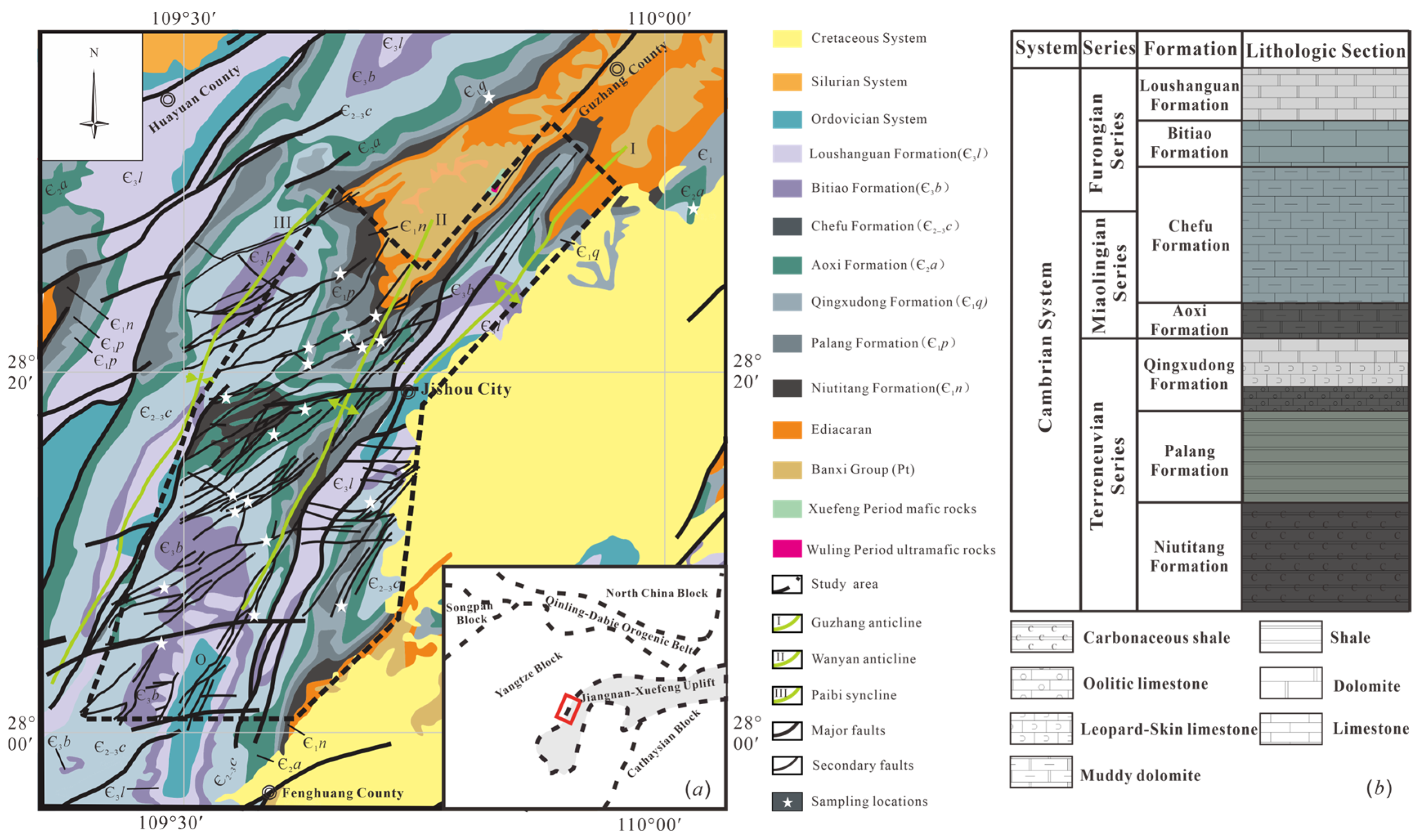
The study area lies along the western margin of the Jiangnan–Xuefeng uplift in the southern Yangtze Block, within a transitional zone between the Yangtze Craton and the Jiangnan Orogenic Belt [21,22] (Figure 1a). Regionally, three stratigraphically distinct but laterally extensive hydrocarbon source-rock systems are developed, namely, the Upper Ediacaran Doushantuo Formation, the Lower Cambrian Niutitang Formation organic-rich shale, and the Silurian Longmaxi Formation black shale. However, no convincing geochemical evidence supports any contribution from the Doushantuo Formation to Cambrian paleo-oil accumulations in the study area [23,24], whereas only limited geochemical signals potentially related to the Longmaxi Formation are observed in a few localized paleo-oil reservoirs [25].
Oil–source correlation based on molecular and isotopic parameters shows that bitumens from the Fenghuang, Wangcun, and adjacent Nanshanping reservoirs share very similar n-alkane distributions, biomarker patterns (steranes and terpanes), and δ13C signatures with the Niutitang Formation source rocks, consistent with previous biomarker and stable carbon isotope comparisons of Lower Cambrian-derived oils [25,26]. The match is quite consistent across most parameters, suggesting a close genetic link. Sterane distributions and hopane/sterane ratios, in particular, do not show any clear signal of mixing with hydrocarbons derived from the Silurian Longmaxi Formation, which is consistent with earlier interpretations of dominant Lower Cambrian sourcing in adjacent paleo-oil systems [27]. On this basis, the Cambrian petroleum system appears to be largely controlled by a single dominant source, namely, the Niutitang Formation, which is regionally extensive.
The Longmaxi Formation is unquestionably an effective marine shale source rock, but its main phase of hydrocarbon generation occurred during the Triassic to Jurassic. This timing is clearly younger than the main charging event recorded in the Cambrian reservoirs, as widely documented in burial-thermal evolution reconstructions of southern China Paleozoic petroleum systems [21]. By then, most Cambrian reservoirs had already been deeply buried, and earlier oil accumulations had undergone thermal cracking to varying degrees, with widespread bitumen development [28]. As a result, effective porosity was reduced and migration pathways became increasingly restricted.
In addition, a relatively thick package of Ordovician muddy limestone and calcareous shale separates the Longmaxi source interval from the Cambrian reservoirs. This succession acts as a regionally persistent seal, and it is difficult to envisage sustained vertical migration across it except along major fault zones, as also indicated in regional petroleum system analyses of South China cratonic margins [25,26]. Taken together—timing, stratigraphic separation, and geochemical mismatch—the contribution of Longmaxi-derived hydrocarbons is likely limited to minor, localized charge along fault- or fracture-controlled pathways, without any significant overprint on the overall biomarker or isotopic signatures of Cambrian bitumens.
In contrast, the Niutitang Formation was buried to a depth of over 1500 m during the Cambrian. By the end of the Silurian, rapid subsidence led to burial depths exceeding 4000 m and paleotemperatures above 130 °C [29], reaching peak oil generation. At that stage, generated hydrocarbons migrated efficiently into Cambrian carbonate reservoirs through fault systems and carrier beds, forming the main phase of oil accumulation in the region [25]. During the Early Permian, burial depths reached over 5000 m with formation temperatures exceeding 160 °C; consequently, the system continued to evolve thermally, gradually moving into the late oil window and then into wet gas generation [27]. By the Middle Triassic, burial depths surpassed 6500 m and formation temperatures exceeded 200 °C [29]. With continued burial and heating, earlier-formed oils were progressively cracked, leaving behind gaseous hydrocarbons and increasing amounts of bitumen. Extensive secondary oil cracking would have driven substantial volumetric expansion, ultimately generating abnormal fluid overpressures within the reservoir. Much later, during the Late Jurassic to Early Cretaceous Yanshanian tectonic event, regional uplift and brittle deformation overprinted the earlier petroleum system. Many pre-existing accumulations were effectively destroyed or redistributed [21]. Residual bitumen within reservoirs was locally remobilized and concentrated along fracture networks, where it now occurs as vein-type pyrobitumen infills.
Vein-type pyrobitumen is extensively developed within Cambrian strata and is mainly hosted by fault-related fractures associated with breached paleo-reservoir systems [25,26,27]. Steeply dipping major faults commonly intersect subsidiary fractures at high angles, forming hierarchical fault–fracture networks that acted as principal pathways for fluid circulation and hydrocarbon transport [30]. The distribution of pyrobitumen veins is therefore closely tied to fracture connectivity and structurally favorable fault-intersection zones. Within Cambrian limestones along the western limb of the Wanyan Anticline, structurally curved fault segments and fault-intersection zones typically contain denser fracture networks, conditions that favored hydrocarbon entrapment and localized accumulation of pyrobitumen (Figure 1). Variations in fracture geometry, density, and connectivity exerted a strong influence on fluid pathways and localized organic matter redistribution and ultimately controlled the spatial distribution of pyrobitumen mineralization.
Figure 1.
Geological setting of the study area. (a) The geological framework is compiled and modified from previous regional geological maps and published datasets [21]. The red square indicates the location of the study area within the western margin of the Jiangnan-Xuefeng Uplift; (b) The stratigraphic column is modified based on regional stratigraphic frameworks [31].
3. Samples and Methods
3.1. Sample Collection
A total of 44 organic-rich vein and vein-associated samples were collected during regional geological mapping and field investigation. All samples were obtained from underground mine exposures or surface outcrops; no drill cores were used in this study. Following collection, all samples underwent preliminary petrographic examination and geochemical screening to confirm their occurrence as vein-type pyrobitumen. The screening results showed that several samples contained substantial proportions of Lower Cambrian stone coal, carbonaceous shale, or mixed organic-rich host-rock material and therefore could not be regarded as representative pyrobitumen veins. These samples were excluded from subsequent analyses. Seventeen representative pyrobitumen samples were subsequently selected for detailed geochemical and structural characterization. Sample selection was based on three criteria: (1) confirmation of vein-type pyrobitumen occurrence with minimal host-rock contamination; (2) preservation of fresh and unweathered material suitable for geochemical analyses; and (3) coverage of the principal structural settings and geographic locations within the study area. The selected samples include fault-controlled vein pyrobitumen from the Jiélian and Wanrongjiang mines, surface-exposed vein systems from the Datangpo and Da’anping areas, and transitional samples collected from vein–host-rock interfaces. Collectively, these samples encompass the major spatial, structural, and compositional variations recognized within the pyrobitumen system.
3.2. Sample Preparation
Representative pyrobitumen samples selected in this study were prepared according to the requirements of different analytical techniques.
For bulk geochemical and mineralogical analyses, including Rock-Eval pyrolysis, X-ray diffraction (XRD), and trace element geochemistry, fresh rock fragments were mechanically cleaned to remove weathered surfaces and potential contamination, and then crushed and homogenized using an agate mill to obtain powders finer than 200 mesh. For extractable organic matter (EOM) analyses, aliquots of the powdered samples were decarbonated using dilute HCl until the reaction ceased, followed by repeated rinsing with deionized water and drying at low temperature. Petrographic and organic petrology analyses, including pyrobitumen reflectance and Raman spectroscopy, were conducted on polished blocks or thin sections prepared from representative vein-hosted samples, preserving their original textures and structural relationships. Fluid inclusion microthermometry was carried out on doubly polished sections prepared from quartz- and calcite-hosted veins.
3.3. Analytical Methods
3.3.1. Rock-Eval Pyrolysis Analysis
Rock-Eval pyrolysis was carried out using a Rock-Eval 6S instrument (Vinci Technologies, Rueil-Malmaison, France). Samples were initially heated to 300 °C and held for 3 min, followed by programmed heating at 25 °C/min to 650 °C in accordance with GB/T 18602-2001 [32]. Parameters including free hydrocarbons (S1), residual hydrocarbon-generating potential (S2), the residual carbon signal (S4), and the temperature of maximum pyrolysis yield (Tmax) were obtained during the analysis. Total organic carbon (TOC) values were directly provided by the Rock-Eval 6S software as instrument-derived carbon estimates. Derived indices, such as the hydrogen index (HI) and production index (PI), were further used to evaluate residual hydrocarbon characteristics and the overmature evolution stage of the pyrobitumen.
3.3.2. Pyrobitumen Reflectance Analysis
Pyrobitumen reflectance (Rb%) was measured on polished sections using a CRAIC 20/20 PV microspectrophotometer (CRAIC Technologies, Inc., San Dimas, CA, USA). Multiple points were analyzed for each sample, and mean values were reported. Vitrinite reflectance equivalent (Ro%) was calculated from Rb% using the empirical calibration equation [33]. Pyrobitumen filling generations were determined from petrographic observations of polished thin sections based on filling sequences and cross-cutting relationships.
3.3.3. Extractable Organic Matter and Molecular Characterization
Extractable organic matter (EOM) was recovered by chloroform extraction to obtain chloroform bitumen “A” fractions. The extracts were then separated into saturated hydrocarbons, aromatic hydrocarbons, and resin fractions using column chromatography, eluted with n-hexane, n-hexane/dichloromethane (7:3, v/v), and methanol, respectively.
Saturated fractions were analyzed by gas chromatography (GC) to determine the distributions of n-alkanes and isoprenoids, whereas aromatic fractions were characterized using gas chromatography–mass spectrometry (GC–MS) on a GCMS-QP2010PLUS instrument (Shimadzu Corporation, Kyoto, Japan). Molecular parameters, including Pr/Ph, Pr/nC17, Ph/nC18, and CPI, were calculated to evaluate compositional variability and possible migration-induced compositional differentiation.
3.3.4. Structural and Mineralogical Characterization
The structural ordering of pyrobitumen was investigated using Raman spectroscopy. Raman analyses were performed using a Horiba Jobin Yvon XploRA confocal micro-Raman spectrometer (Horiba Jobin Yvon, Kyoto, Japan). Samples were first examined under an Olympus BX51 microscope (Olympus, Tokyo, Japan), after which selected domains were analyzed using a 50× objective and a 514.5 nm excitation laser operated at 1 mW. The laser spot size was approximately 1 μm. Spectra were acquired over the range of 800–2000 cm−1 with an integration time of 10 s and five accumulations per analysis.
To ensure analytical consistency, all Raman spectra were processed using the same workflow. Fluorescence background was removed using asymmetric least-squares (ALS) baseline correction (λ = 105, p = 0.01). The D (~1350 cm−1) and G (~1580 cm−1) bands were then fitted using a dual-Gaussian model within the range of 1000–1800 cm−1. Parameters including band position, full width at half maximum (FWHM), intensity ratio (ID/IG), and area ratio (AD/AG) were extracted to estimate the in-plane aromatic crystallite size (La).
Mineralogical composition were further characterized by XRD using a Rigaku D/MAX-PC2000 diffractometer (Rigaku Corporation, Akishima, Tokyo, Japan) under the following conditions: Cu Kα radiation, 40 kV, 150 mA, step size 0.02°, scan rate 4°/min, and 2θ range of 2.5–75°. The carbon (002) reflection was fitted using Gaussian functions after ALS baseline correction. Interlayer spacing (d002) and stacking height (Lc) were calculated while accounting for overlapping quartz (~26.6°) and calcite (~29.4°) reflections. These analyses provided semi-quantitative constraints on mineral composition and crystallite-scale structural ordering.
3.3.5. Trace Element and Fluid Inclusion Analysis
Pulverized samples (~50 mg, 200 mesh) were digested in sealed high-pressure PTFE vessels using HF–HNO3. Digestion was conducted at 185 °C for 24 h, followed by evaporation to near dryness and re-dissolution in HNO3. The solutions were then heated at 130 °C for 3 h in sealed vessels. After digestion, solutions were cooled, quantitatively transferred, and diluted to 25 mL prior to analysis by ELEMENT XR ICP-MS (Thermo Fisher Scientific, Bremen, Germany). Chondrite-normalized REE patterns and diagnostic trace-element ratios were subsequently calculated. Analytical precision was generally better than 5%.
Fluid inclusion microthermometry was conducted as a supplementary approach to characterize thermal and physicochemical conditions associated with vein-type pyrobitumen emplacement. Hydrocarbon-bearing and aqueous inclusions hosted mainly in calcite and quartz were analyzed using a CRAIC 20/20 PV microspectrophotometer (CRAIC Technologies, Inc., San Dimas, CA, USA) equipped with a heating–freezing stage. Fluorescence excitation was set at 420 nm, and measurements were performed over a temperature range of −200 to 600 °C. Heating rates of 5–10° C/min were used during initial heating and reduced to 1–3 °C/min near homogenization temperatures following SY/T 6010-2011 [34]. Multiple inclusions from each sample were measured in order to obtain representative homogenization temperatures (Th) and salinity ranges.
4. Results
4.1. Organic Geochemical Characteristics and Thermal Maturity Constraints
The Rock-Eval pyrolysis data for vein-type pyrobitumen samples hosted in structural fractures are summarized in Table 1. Total organic carbon (TOC) contents range from 11.09% to 51.68%, with most samples yielding values above 30%. Relatively lower TOC contents (11–15%) occur in samples DAP-S01, DAP-S02, JL-T02, and JL-T03. Free hydrocarbon yields (S1) are consistently low, varying between 0.04 and 0.32 mg HC/g rock, and in most cases remaining below 0.20 mg HC/g rock. Residual hydrocarbon-generating potential (S2) ranges from 0.35 to 3.32 mg HC/g rock, with the majority of samples clustering between 1.5 and 2.8 mg HC/g rock. Among them, WRJ-V05 exhibits the highest S2 value, whereas DAP-S01 and DAP-S02 yield markedly lower values (<0.5 mg HC/g rock).
Table 1.
TOC and pyrolysis parameters of vein-type pyrobitumen.
Tmax values vary from 527 to 594 °C and are predominantly concentrated between 540 and 560 °C, although slightly lower values (<535 °C) are recorded in JL-V03 and WRJ-V04. Hydrogen index (HI) values are uniformly low, ranging from 3 to 10 mg HC/g TOC and typically falling between 4 and 7 mg HC/g TOC. Sample WRJ-V05 shows the highest HI value (10 mg HC/g TOC). Production index (PI) values range from 0.03 to 0.41. Most samples display relatively low PI values (0.03–0.10), whereas DAP-S01 and DAP-S02 are characterized by comparatively elevated PI values of 0.24–0.41.
Vitrinite reflectance equivalent (Ro%) was derived from solid bitumen reflectance (Rb%) measured on vein-type pyrobitumen samples. Rb% values range from 2.42% to 3.09%, yielding Ro values of 2.52–3.10% (Table 2). Ro values cluster within a relatively narrow interval of 2.70–3.05%. Petrographic and reflectance characterization was conducted on selected representative samples to constrain pyrobitumen filling generation. In the Jielian (JL) group, samples JL-V03, JL-V04, and JL-V05 are assigned to a single filling generation within the fracture-hosted system. The remaining JL samples (JL-V01, JL-V02) were not included in the filling-generation classification. In the Wanrongjiang (WRJ) group, samples WRJ-V05, WRJ-V06, and WRJ-V07 are similarly characterized as a single filling generation. Other WRJ samples were not included in the petrographic classification.
Table 2.
Reflectance characteristics of vein-type pyrobitumen.
Ro values show a continuous distribution (2.52–3.10%), indicating a relatively uniform thermal maturity across samples. Petrographic evidence suggests a single dominant filling generation in representative vein systems (JL and WRJ groups), while Ro is not used as a structural indicator. Ro values are in agreement with Rock–Eval Tmax measurements.
4.2. Molecular Composition and Heterogeneity
Extractable organic matter (EOM) yields of the vein-type pyrobitumen samples are uniformly low, ranging from 0.0105 to 0.2083 wt.% (Table 3). Most samples contain less than 0.08 wt.% EOM, although JL-V03 and WRJ-V06 display comparatively higher yields of 0.115 wt.% and 0.2083 wt.%, respectively. In most samples, the extracts are dominated by saturated hydrocarbons, whereas aromatic fractions generally account for less than 20% of the total extract. Sample JL-V03 differs noticeably from the others, showing depleted saturated and aromatic fractions together with relatively enriched NSO compounds and asphaltenes.
Table 3.
EOM composition and saturated hydrocarbon geochemical parameters.
The saturated hydrocarbon distributions are characterized mainly by low- to middle-carbon-number n-alkanes. For most samples, the main peak carbon number (MPCN) occurs at nC16, although several samples exhibit maxima at nC13 or nC18. Abundances of ΣnC10–20 consistently exceed those of ΣnC21–25 and ΣnC26+, and the ΣnC10–20/ΣnC21+ ratios range from 1.16 to 8.97. Isoprenoid-related parameters, including Pr/Ph, Pr/nC17, and Ph/nC18, together with CPI values, also show appreciable inter-sample variability. Among the analyzed samples, JL-V05 is distinguished by the lowest CPI value and relatively elevated Pr/nC17 and Ph/nC18 ratios.
Aromatic hydrocarbon compositions were further examined in five representative samples (Table 4), representing a relatively limited dataset for statistical interpretation. Phenanthrene is the dominant aromatic compound in all analyzed samples, whereas anthracene occurs only in minor proportions, as indicated by low Ant/(Ant + Phe) values (0.017–0.050). MPI-1 values range from 0.62 to 0.83. Ratios including Phe/ΣNaph, Pyrene/Phe, and DBT/Phe also vary among samples, with DAP-S01 consistently showing the highest values.
Table 4.
GC–MS-derived aromatic compound distributions and geochemical molecular parameters.
4.3. Structural Characteristics
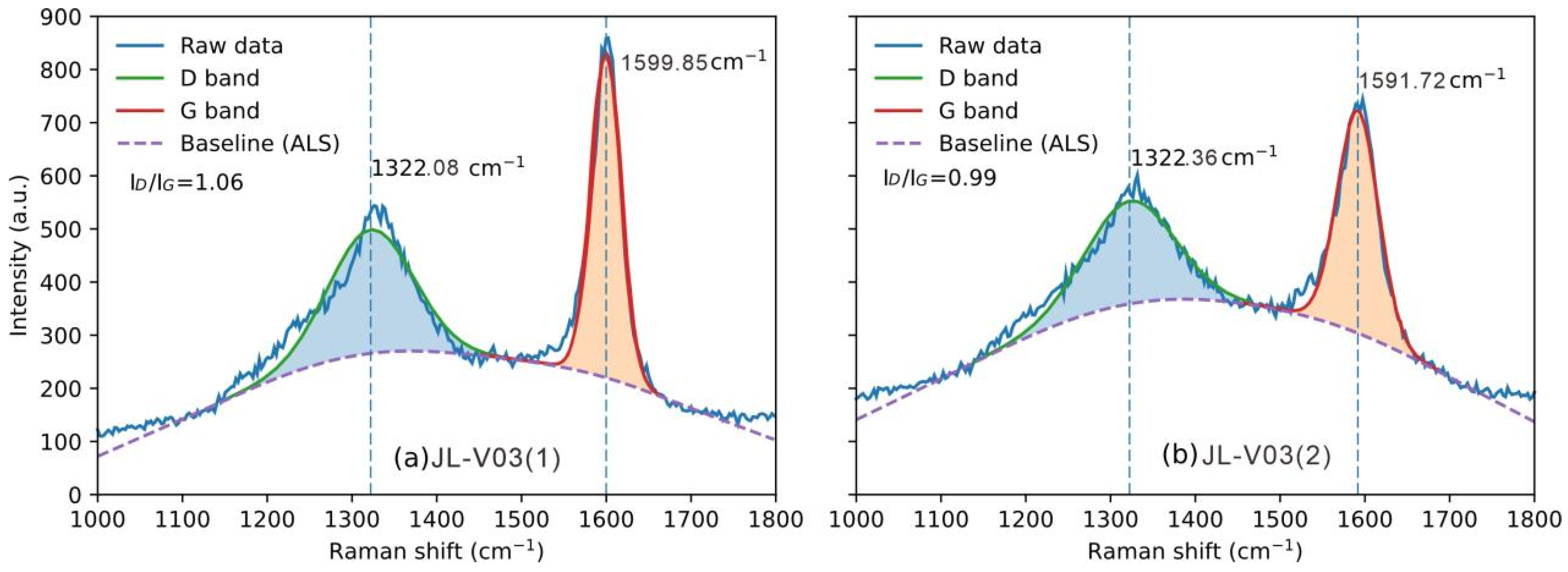
The Raman spectral parameters of the vein-type pyrobitumen samples are summarized in Table 5. The D-band positions vary from 1322.08 to 1352.77 cm−1, whereas the G band occurs between 1582.21 and 1599.85 cm−1, producing Δω (G−D) values of 230.93–277.77 cm−1. Compared with the G band, the D band exhibits a broader positional dispersion, spanning nearly 30 cm−1, while the G band varies over a narrower interval of approximately 18 cm−1. Correspondingly, Δω displays an overall variation of nearly 47 cm−1.
Table 5.
Summary of Raman spectral fitting results and derived structural parameters.
The full width at half maximum (FWHM) of the D band ranges from 116.96 to 182.66 cm−1, whereas the G-band FWHM varies between 41.90 and 108.55 cm−1, indicating a more pronounced spread in G-band broadening among the analyzed samples. Intensity and area ratios (ID/IG and AD/AG) remain relatively consistent, ranging from 0.984 to 1.231 and generally clustering around unity. The calculated in-plane aromatic crystallite size (La), based on the 514.5 nm excitation wavelength, ranges from 13.76 to 17.22 nm, with an overall dispersion of approximately 3.5 nm.
Several Raman parameters also show measurable variability within individual sample series. For example, D-band positions in JL-V03, JL-V04, JL-V05, WRJ-V01, WRJ-V06, and WRJ-V07 differ by several cm−1, whereas Δω values vary from less than 1 cm−1 to nearly 10 cm−1. Similar fluctuations are observed in FWHM and ID/IG values, and these differences are reflected in the corresponding La estimates. Representative Raman peak fitting for sample JL-V03 is presented in Figure 2, illustrating the deconvolution procedure and overall fitting quality.
Figure 2.
Gaussian Fit of the Raman spectrum of JL-V03 using the ALS method.
Taken together, the Raman characteristics suggest that the vein-type pyrobitumen is composed of finite sp2-bonded aromatic domains separated by structurally disordered and defect-rich boundaries. The coexistence of relatively ordered aromatic domains and defect-related carbon structures indicates a predominantly uniform overmature carbon framework composed of sp2-bonded aromatic clusters with limited nanoscale structural disorder.
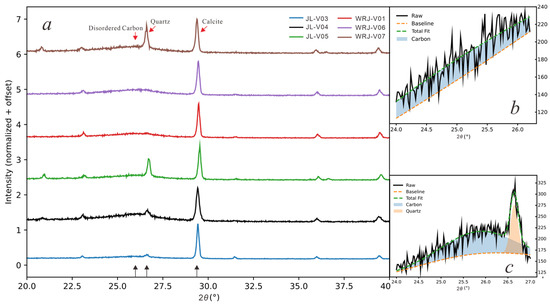
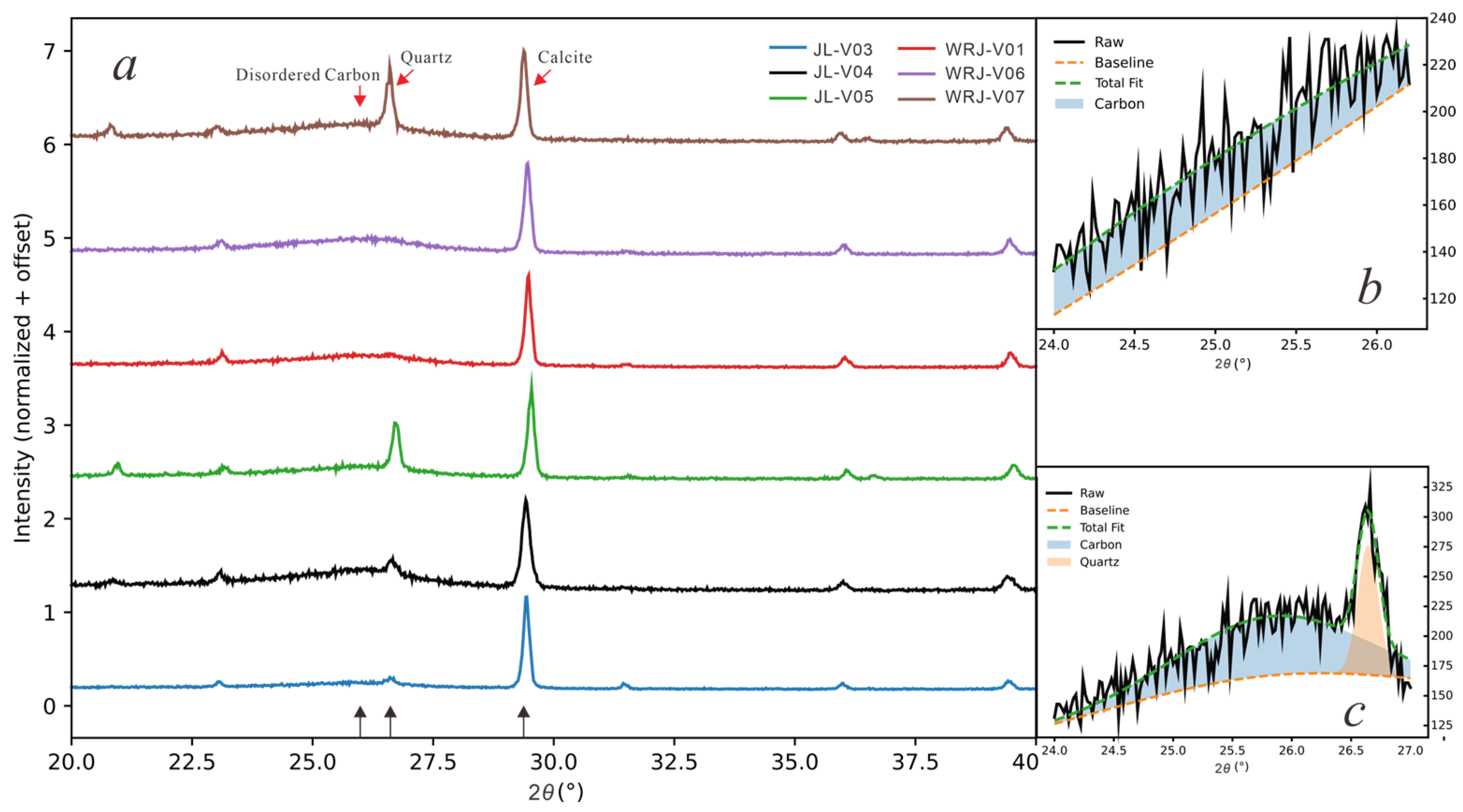
XRD patterns of the analyzed samples (Figure 3a) display a broad carbon (002) reflection, indicating variable degrees of structural ordering within the pyrobitumen (Table 6). The (002) peak position ranges from 25.853° in WRJ-V07 (d002 = 0.3443 nm, FWHM = 2.09°, Lc = 3.86 nm) to 26.364° in JL-V05 (d002 = 0.3378 nm, FWHM = 2.70°, Lc = 2.99 nm). Intermediate values are observed in JL-V03, JL-V04, WRJ-V01, and WRJ-V06, as summarized in Table 6. Variations in d002 spacing, peak width, and variations in stacking height suggest subtle differences in stacking order that remain within a generally uniform overmature carbon framework.
Figure 3.
XRD patterns and peak fitting analysis of representative samples. (a) XRD patterns of the studied samples, showing a broad carbon (002) reflection at ~25–26°, a sharp quartz peak at ~26.6°, and a distinct calcite (CaCO3) peak at ~29.4°; (b) Single-peak Gaussian fitting of the carbon (002) reflection for sample JL-V04; (c) Dual-peak fitting of the carbon (002) and quartz reflections for JL-V04, highlighting the overlap of the carbon peak with the higher-angle quartz peak.
Table 6.
Structural parameters of carbon (002) peak derived from Gaussian fitting.
In addition to the carbon reflection, a sharp diffraction peak near 26.6° is consistently present and is attributed to quartz, whereas the reflection near 29.4° corresponds to calcite, accompanied by several weaker carbonate-related peaks at higher angles. Differences in peak intensity and broadening further suggest variations in both mineral assemblages and carbon structural ordering. Representative fitting results for sample JL-V04 (Figure 3b,c) show that the broad carbon (002) reflection partially overlaps with the quartz peak at higher diffraction angles, illustrating the influence of mineral interference on the carbon peak profile.
4.4. Rare Earth Element Model and Supplementary Fluid Inclusion Data
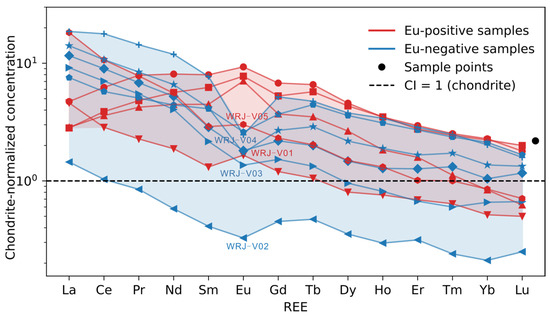
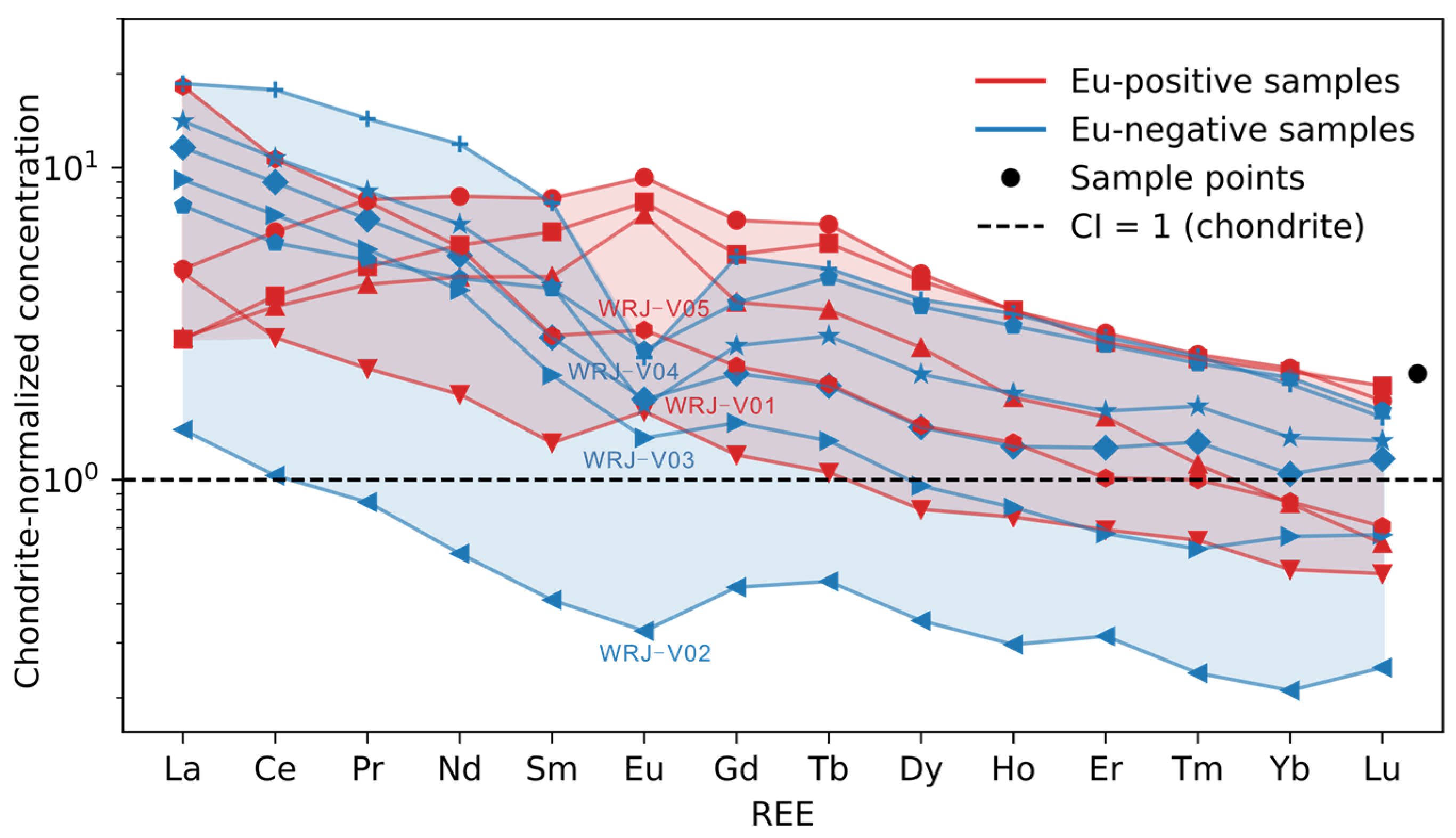
Chondrite-normalized rare earth element (REE) patterns of the vein-type pyrobitumen samples are presented in Figure 4. Despite variations in total REE abundance, all samples display broadly subparallel distribution patterns characterized by enrichment of light rare earth elements (LREEs) relative to heavy rare earth elements (HREEs).
Figure 4.
Chondrite-normalized REE patterns of pyrobitumen samples. Normalization values are from McDonough and Sun [35]; Shaded areas represent the range of each group; The horizontal dashed line indicates CI = 1; Samples are grouped based on Eu anomalies.
Total REE concentrations (ΣREE) range from 1.709 to 26.617 μg/g, although most samples fall between 8 and 16 μg/g (Table 7). LREE contents vary from 1.38 to 23.25 μg/g, whereas HREE concentrations remain comparatively lower (0.31–3.88 μg/g). Corresponding LREE/HREE ratios range from 2.04 to 11.02, reflecting variable degrees of LREE enrichment and fractionation among the samples. Europium anomalies (Eu/Eu*) vary considerably, from 0.39 to 1.74. On this basis, the analyzed samples can be separated into two groups: a positive Eu anomaly group (Eu/Eu* = 1.17–1.74; JL-V03, JL-V05, DTP-S01, and WRJ-V05) and a negative Eu anomaly group (Eu/Eu * = 0.39–0.76; WRJ-V01, WRJ-V02, WRJ-V03, WRJ-V04, DAP-S01, and DAP-S02) (Figure 4). Samples showing positive Eu anomalies generally exhibit relatively lower LREE/HREE ratios than those characterized by negative Eu anomalies.
Table 7.
Selected trace element ratios and REE parameters.
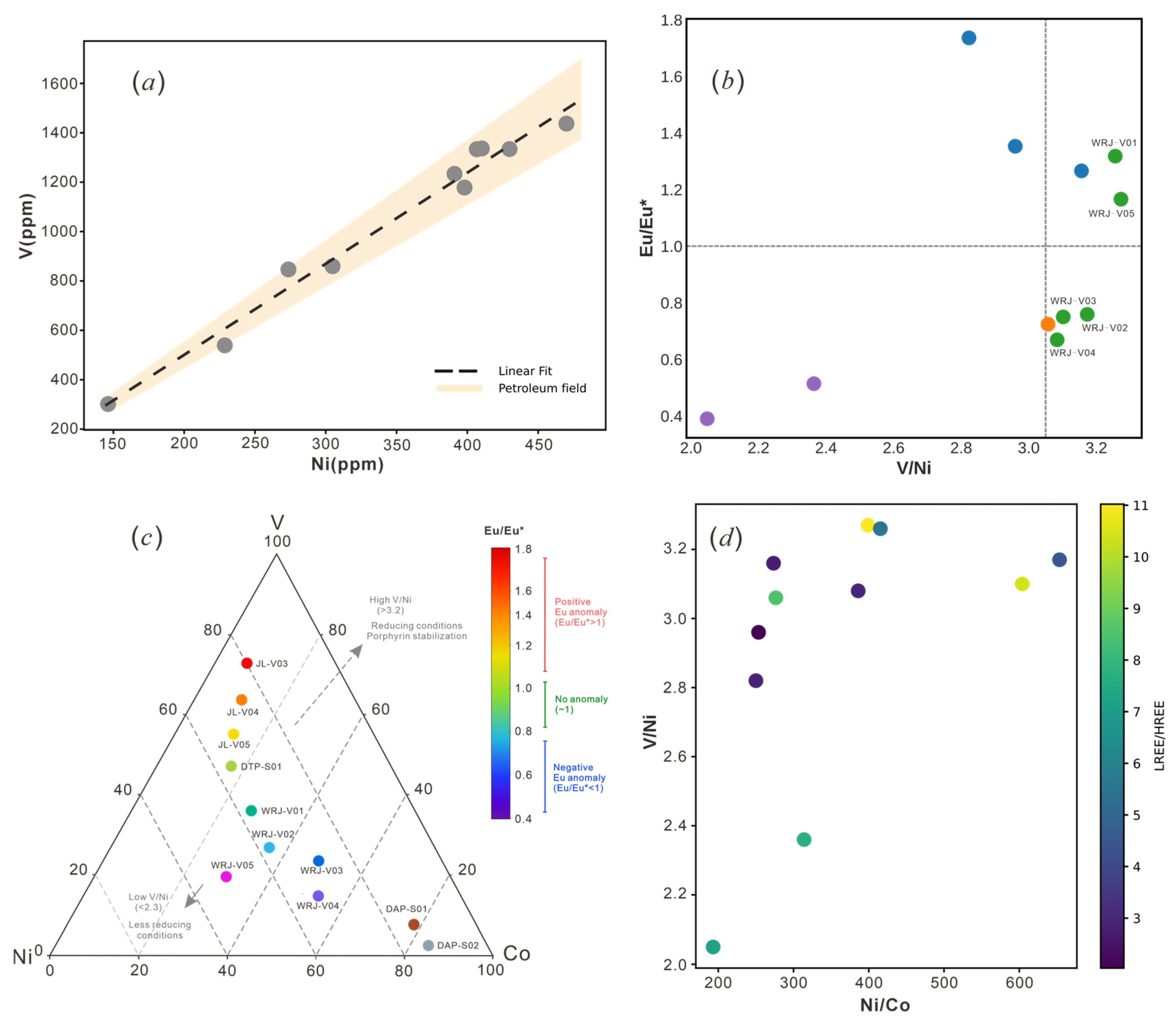
Trace-element compositions are dominated by vanadium (V; 299–1526 μg/g) and nickel (Ni; 146–481 μg/g). V/Ni ratios range from 2.05 to 3.27 and are mostly clustered around 3.0. Similarly, V/(V+Ni) ratios (0.67–0.77), together with consistently elevated Ni/Co ratios (193–654), suggest formation under persistently reducing conditions.
Fluid inclusion microthermometry was conducted on three representative samples. Homogenization temperatures (Th) range from 126 to 260 °C, with most measurements concentrated between 180 and 230 °C. All analyzed samples contain a population of relatively high-temperature inclusions with Th values of 240–260 °C. Salinities vary from 2.5 to 8.8 wt.% NaCl equivalent, indicating considerable variation in fluid properties and suggesting the involvement of mixed fluid systems during vein formation. The occurrence of hydrocarbon-bearing inclusions further supports the participation of organic-derived fluids during pyrobitumen emplacement.
5. Discussion
5.1. Thermal Maturity and Carbon Structural Ordering
Integrated Ro values, Rock-Eval, Raman, and XRD data collectively indicate that all analyzed vein-type pyrobitumen samples have reached an overmature stage corresponding to dry-gas thermal evolution. This interpretation is primarily constrained by uniformly high Ro values (2.52–3.10%) (Table 2), which provide the most reliable indicator of thermal maturity in the present dataset. These observations are further supported by consistently low S1 and HI values, together with elevated Tmax values (527–594 °C) (Table 1), features typically associated with pyrobitumen generated through extensive cracking of previously accumulated liquid hydrocarbons [4,10,36]. The consistently low S2 yields suggest pronounced hydrogen depletion and only limited residual hydrocarbon-generating potential. Given that Tmax values derived from weak S2 signals may be compromised by analytical artifacts in highly carbonized samples [4], Ro was adopted as the primary maturity parameter.
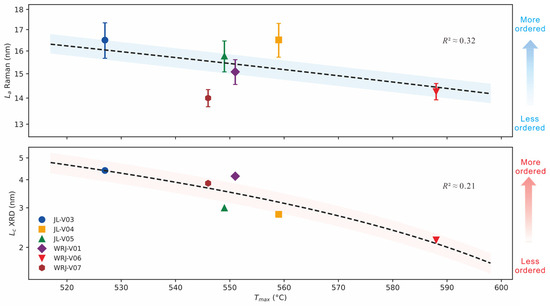
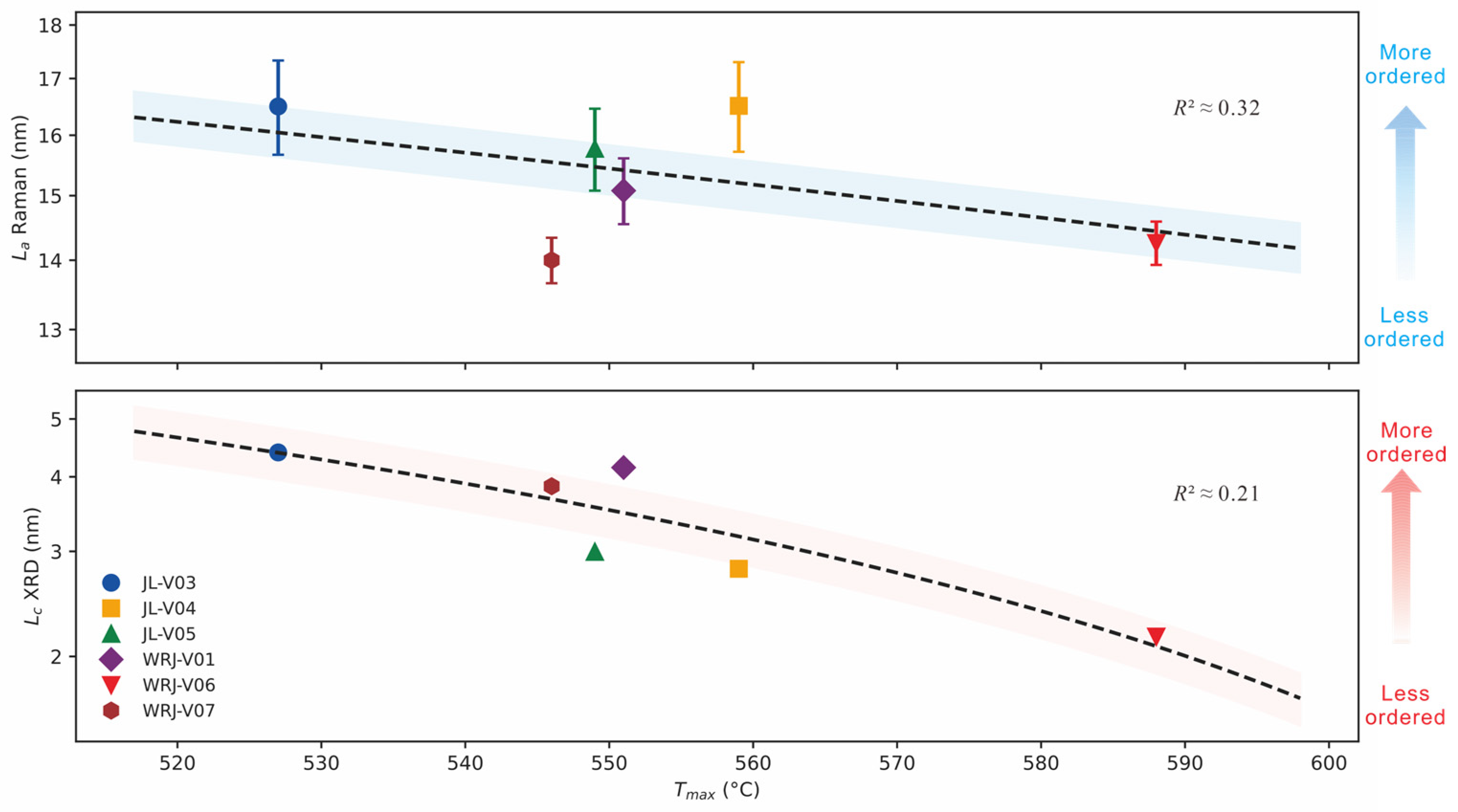
The discrepancy between TOC and extractable organic matter (EOM) indicates that the organic carbon in vein-type pyrobitumen is predominantly present as an insoluble carbon matrix. The graphitization potential is primarily constrained by the structure of this insoluble carbon framework rather than the residual extractable organic matter [37]. Raman spectra display relatively high ID/IG ratios (~1.0–1.2) and broad D and G bands. The limited variation in aromatic crystallite size (La ≈ 13.8–17.2 nm) (Table 5; Figure 5) further suggests the relatively consistent defect-rich aromatic carbon structures. Similarly, XRD patterns display broad carbon (002) reflections and comparatively small crystallite stacking heights (Lc ≈ 2.2–4.4 nm) (Table 6; Figure 5). These structural characteristics are consistent with a turbostratic carbon framework composed of moderately ordered aromatic layers lacking well-developed three-dimensional stacking. Such structures are typical of highly evolved natural pyrobitumen rather than fully graphitized carbon [3,38]. The insoluble carbon framework consists of heteroatom-containing, cross-linked aromatic networks with turbostratic stacking. These structural features restrict aromatic rearrangement and interlayer sliding. Consequently, long-range carbon ordering is kinetically inhibited, delaying graphitization during geological thermal evolution [39]. This structural state originates from a structural locking process during oil-to-bitumen transformation [4]. During this process, radical-mediated polymerization and extensive cross-linking reactions generate a three-dimensional aromatic network. These reactions progressively reduce molecular mobility and generates localized π-conjugated domains [40,41]. These domains become spatially immobilized within the developing carbon framework. As a result, the carbon architecture is preserved at an early disordered stage and further thermally driven reorganization is inhibited. This decoupling between thermal maturity and carbon structural ordering is observed in natural pyrobitumen systems and supported by experimental pyrolysis studies [42,43,44]. Fluid inclusions and REE systematics record hydrothermal overprinting in a fracture-controlled open system, indicating fluid activity. However, these geochemical records show no direct control on the evolution of the pre-existing insoluble carbonaceous framework, which primarily governs graphitization. Therefore, highly mature pyrobitumen may retain turbostratic carbon structures rather than developing fully graphitic ordering.
Figure 5.
Raman La and XRD Lc (both in nm) versus Tmax. Points show sample averages for La (±SD) and Lc. The data consistently characterize the vein-type pyrobitumen as a structurally disordered, uniformly overmature carbonaceous system.
5.2. Evaluation of Controlling Factors for Molecular Heterogeneity
Molecular heterogeneity in highly evolved petroleum systems may originate from several processes, including (1) multiple precursor oils, (2) multiple hydrocarbon charging events, (3) variable thermal cracking histories, and (4) migration-related compositional fractionation. Because these mechanisms may produce similar molecular signatures, each possibility should be evaluated using the available geological, petrographic, and geochemical evidence. The most plausible explanation can then be identified for the observed heterogeneity.
One possible explanation for the molecular variability is the mixing of multiple precursor oils, given the presence of several potential source-rock intervals in the study area. Biomarker and stable carbon isotope data are commonly applied to evaluate oil–oil and oil–source rock correlations [45,46]. However, the available geological and geochemical evidence does not support significant mixing of distinct petroleum systems. Bitumens from the Fenghuang, Wangcun, and adjacent reservoirs show consistent n-alkane, sterane, terpane, and δ13C characteristics. These features indicate a dominant affinity with the Lower Cambrian Niutitang source rock [25]. The Silurian Longmaxi source entered its main generation window later than the Cambrian charge, and stratigraphic separation limits vertical migration [27,28]. Minor input cannot be excluded, but large-scale mixing is unlikely. Source-related differences do not account for the observed molecular variability, suggesting that post-accumulation processes may play a key role.
In structurally reactivated petroleum systems, multiple charging is commonly indicated by discontinuous maturity clusters, distinct fluid inclusion assemblages, overprinting bitumen phases, or segregated biomarker distributions reflecting separate charge events [47,48]. Pyrobitumen emplacement analysis was conducted on representative samples from the Jielian and Wanrongjiang fracture systems. Petrographic observations combined with vitrinite reflectance data indicate a single emplacement generation within each structural domain. Maturity data exhibit a continuous distribution, with no evidence of discrete populations or overprinting textures. These features collectively indicate the absence of multiple compositionally distinct charge events. Accordingly, multiple charging is unlikely to be a controlling factor in the observed molecular heterogeneity.
Thermal maturity represents another potential control on molecular heterogeneity. However, vitrinite reflectance, Tmax, MPI, and related aromatic maturity parameters suggest relatively uniform maturity across the studied samples. No significant spatial variation was observed. Accordingly, thermal maturity alone is insufficient to account for the observed molecular variability.
With source mixing, multiple charging, and thermal maturity considered unlikely, the observed molecular heterogeneity is best interpreted as resulting from migration-related fractionation. During petroleum migration, phase-dependent partitioning and selective transport under multiphase flow conditions induce compositional fractionation among hydrocarbon fractions [45]. The underlying mechanism governing this fractionation appears to be a combination of geochromatographic effects and pressure-induced phase separation within the fault-fracture network. During episodes of structural reactivation, migrating hydrocarbon fluids permeated the carbonate host rocks and syn-kinematic calcite veins. As these fluids percolated, polar NSO heteroatomic compounds and heavier aromatics were preferentially adsorbed onto the active mineral surfaces. Conversely, the highly mobile, non-polar aliphatic fractions underwent more extensive secondary migration along the fault conduits. Furthermore, intermittent fault rupturing triggered abrupt depressurization. This process likely induced phase separation. Such transient pressure drops promoted the exsolution and subsequent loss of volatile hydrocarbons, ultimately leading to the accumulation of heavy, polar-enriched residual bitumen [49]. Several independent molecular geochemical indicators consistently support this interpretation. Extractable organic matter (EOM) yields are uniformly low across all samples, suggesting extensive depletion of mobile hydrocarbons during migration and expulsion processes (Table 3). In highly evolved petroleum systems, such limited extract yields commonly represent residual organic matter remaining after preferential loss of readily mobile fractions [10,50].
Marked variability in group composition, particularly in NSO compounds and asphaltenes, further indicates selective redistribution during thermal cracking and structural remobilization. As previously indicated, thermal maturity remains broadly comparable across the investigated samples (Table 1), suggesting that maturity-related overprinting is unlikely to account for the observed compositional variability. Instead, the dataset reflects selective preservation and localized redistribution associated with tectonic remobilization of hydrocarbons. During this process, low-polarity and relatively low-molecular-weight fractions are preferentially mobilized and transported within the fault-related fluid system. In contrast, polar constituents and aromatic hydrocarbons tend to be retained and progressively enriched in the residual bituminous phase [50,51,52].
Distributions of n-alkanes and related molecular parameters also record variable depletion of light hydrocarbons. The broad range of ΣnC10–20/ΣnC21+ ratios suggests different migration efficiencies and hydrocarbon residence times among the fracture systems. These variations are consistent with fractionation occurring during transport rather than during in situ hydrocarbon generation. Isoprenoid-related parameters display a comparable pattern. Pr/Ph ratios remain relatively stable across the samples, supporting a common organic source, whereas variations in Pr/nC17 and Ph/nC18 indicate preferential removal of n-alkanes relative to isoprenoids (Table 3). Such decoupling between isoprenoids and n-alkanes is commonly interpreted as evidence of selective hydrocarbon redistribution during secondary migration [50].
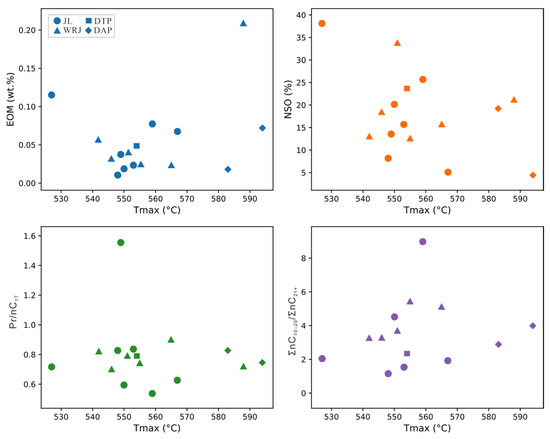
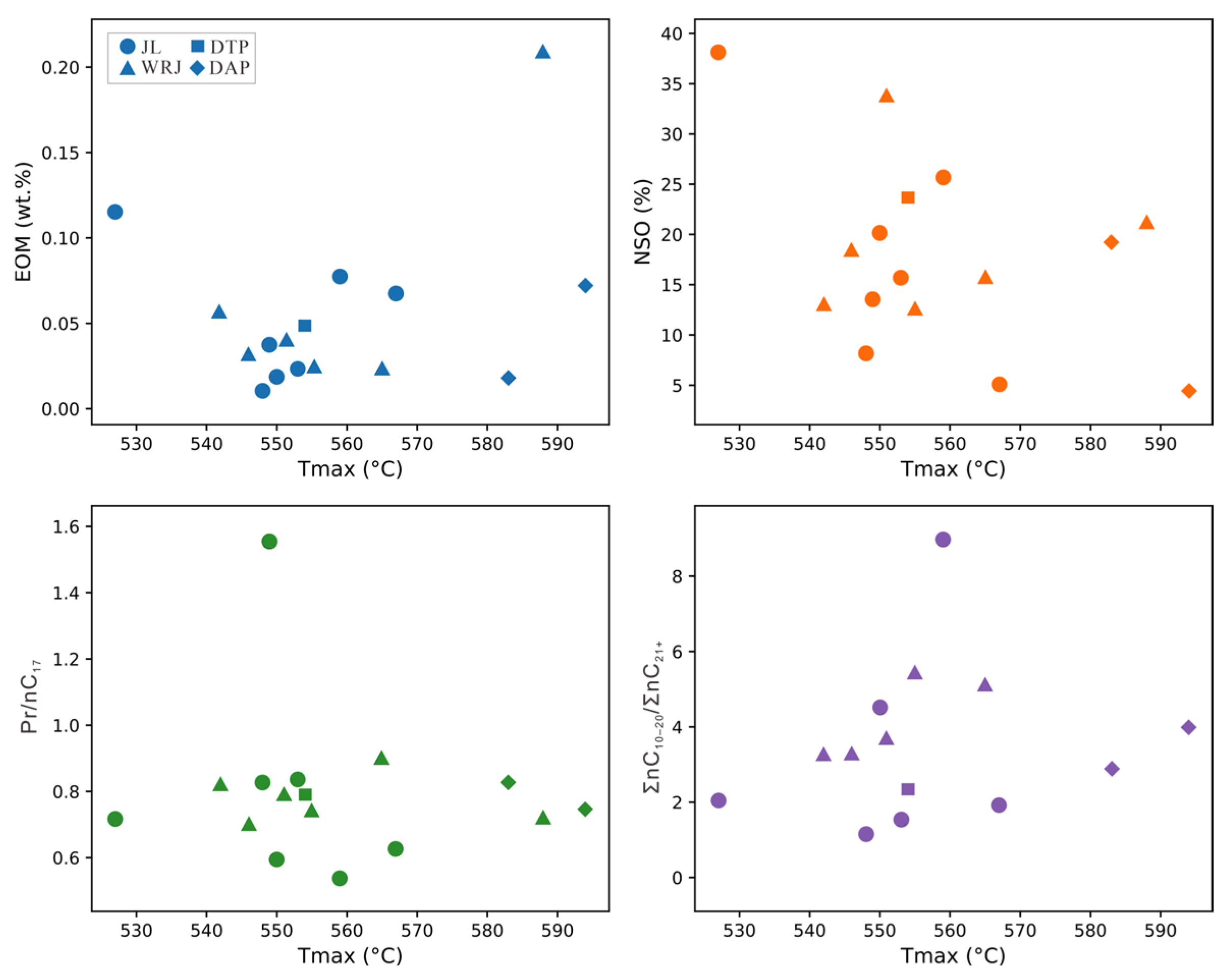
Figure 6 illustrates the relationships between Tmax and several compositional parameters, including EOM abundance, NSO content, Pr/nC17, and ΣnC10–20/ΣnC21+. The overall distributions suggest that migration-related fractionation exerted a stronger control on compositional variability than thermal maturity. Particularly notable are the low EOM yields, the pronounced fluctuations in NSO content, and the wide variations in Pr/nC17 and ΣnC10–20/ΣnC21+ ratios. These features collectively point to variable mobilization and selective retention of specific molecular fractions during structural redistribution of residual hydrocarbons. Such effects were likely amplified within structurally reworked fracture systems. Heterogeneous fluid pathways, episodic fluid circulation, and variable residence times may have promoted localized compositional fractionation.
Figure 6.
Relationships between Tmax and selected compositional parameters. Different colors represent different geochemical parameters shown in each subplot, whereas different symbols represent different samples.
Aromatic hydrocarbon parameters provide additional support for this interpretation. MPI-1 values remain within a relatively narrow interval, further indicating broadly uniform thermal maturity. In contrast, substantial variations in Phe/ΣNaph and DBT/Phe ratios imply differential mobility among aromatic compounds (Table 4). More stable polycyclic aromatic hydrocarbons appear to have been preferentially retained during structural redistribution and post-emplacement alteration processes [53,54].
Nevertheless, several uncertainties remain. Extremely low extract yields limit the robustness of quantitative compositional analysis, and the lack of continuous sampling along individual fracture systems restricts reconstruction of detailed compositional gradients. In addition, constraints from fluid inclusions on the physicochemical conditions of structural remobilization remain limited. Therefore, direct evaluation of the thermal–fluid processes involved in pyrobitumen emplacement and alteration remains challenging. Future work integrating higher-resolution spatial sampling and microscale analytical techniques may further constrain the evolution of fracture-controlled pyrobitumen systems.
5.3. Structural Framework and Spatial Geochemical Heterogeneity
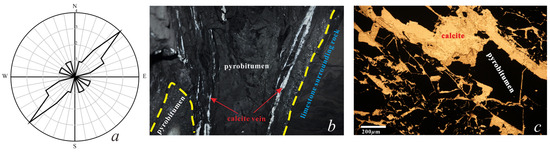
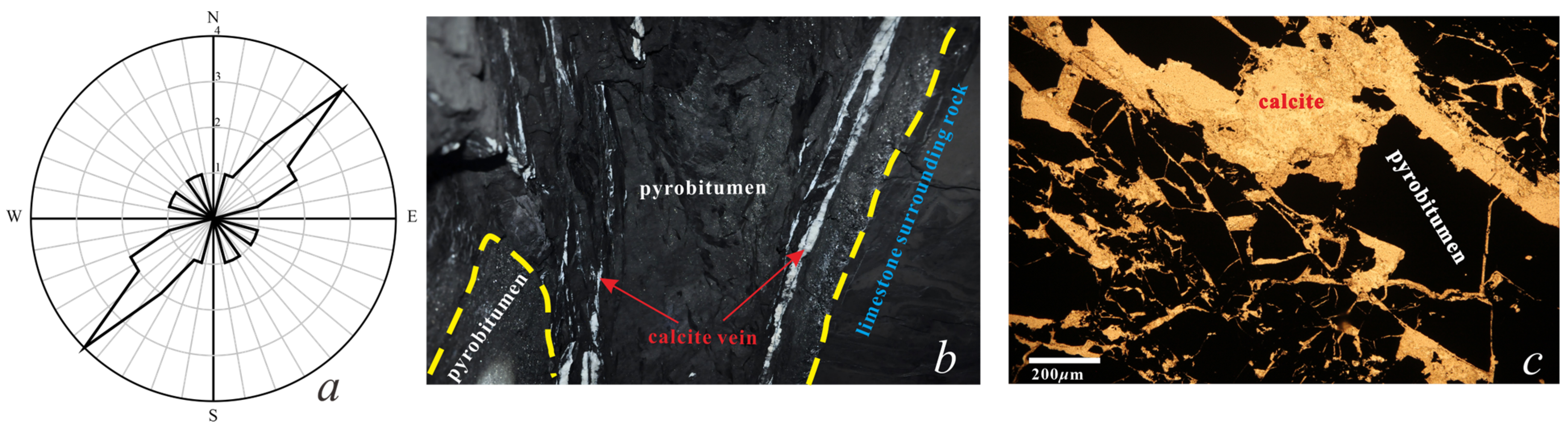
The fault–fracture system constitutes the principal structural framework controlling vein-type pyrobitumen emplacement. The structural framework comprises high-angle faults and associated fracture networks. These structures define the principal migration pathways within the host carbonate succession. Pyrobitumen occurs predominantly as fracture-filling veins along major fault-controlled structural corridors, whereas subordinate occurrences are restricted to secondary fractures and minor extensional cracks. The veins exhibit diverse geometries, including S-shaped, lenticular, and branching forms, with thicknesses ranging from 0.1 to 2.8 m. Rose-diagram analysis of pyrobitumen vein-hosting fractures reveals a distinct bimodal orientation pattern. Two dominant fracture sets can be identified: a NE-trending population with a principal peak at ~40° and a NW-trending population concentrated between ~320° and 340°. A subordinate fracture set occurs near 235° (Figure 7a), possibly reflecting localized structural perturbation or strain partitioning. Most fractures are steeply dipping (~75°) and locally approach vertical orientations.
Figure 7.
Statistics of fractures and macro- to microscopic characteristics of pyrobitumen veins. (a) Rose diagram showing the strike distribution of pyrobitumen vein-hosting fractures; (b) In situ occurrence of pyrobitumen veins in the underground workings of the Jielian mine, showing pyrobitumen filling limestone-hosted fractures and multiple generations of calcite veins; (c) Polarized-light photomicrograph of sample JL-V-03 (50×).
Regional structural and stratigraphic evidence suggests that the study area experienced four major stages of tectonic evolution. During the Caledonian stage, regional uplift and denudation prevailed. The Cambrian reservoir remained deeply buried and was only minimally affected by subsequent fracture development [21,22]. Late Indosinian–Early Yanshanian compression generated NE-trending shear fractures and NW-oriented extensional faults. These structures established the principal fault–fracture network, which later acted as the dominant conduit for fluid migration. The Late Yanshanian–Early Himalayan stage represents the principal episode of fault reactivation and hydrocarbon emplacement. A predominantly vertical stress regime promoted widespread fracture opening and fault reactivation. These processes facilitated hydrocarbon migration and ultimately resulted in vein-type pyrobitumen formation within pre-existing structural corridors. Subsequent Late Himalayan compression imposed a strike-slip structural overprint. In the Shuitian pyrobitumen mine, faults lacking pyrobitumen cross-cut earlier pyrobitumen-bearing structures. This relationship indicates that the deformation modified pre-existing mineralized fractures but did not contribute to primary hydrocarbon emplacement. The close spatial association of pyrobitumen with quartz- and calcite-bearing vein assemblages further suggests multiple pulses of fluid infiltration under evolving physicochemical conditions. Although the detailed paragenetic sequence remains incompletely constrained, the observed mineralogical and structural relationships are consistent with repeated fracture reactivation accompanied by fluid–rock interaction within a fault-controlled system (Figure 7b,c).
Systematic spatial variations in molecular and structural parameters further highlight the influence of fracture architecture on secondary hydrocarbon redistribution. Samples collected from vein margins, particularly JL-V01 and JL-V02, show lower HI values and greater depletion of light n-alkanes. These features suggest late-stage thermal overprinting and structural modification. In contrast, samples from the interior of the veins, such as JL-V04 and JL-V05, retain relatively higher ΣnC10–20 abundances and less altered molecular signatures, reflecting earlier bitumen emplacement and better preservation within the fracture system.
Previous studies have generally interpreted pyrobitumen as a product of advanced thermal evolution [4]. Fracture architecture may have influenced localized compositional variations during hydrocarbon redistribution. In this context, the fault–fracture system likely acted as a conduit for fluid migration and pyrobitumen emplacement. It may also have contributed to spatial variability in fluid–rock interaction conditions.
5.4. Trace Elements and REE Constraints on Fluid–Rock–Structure Interactions
The chondrite-normalized REE patterns and trace-element signatures of vein pyrobitumen are likely governed by a combination of primary compositional inheritance, host-rock buffering effects, and subsequent fluid-related overprinting.
Vanadium and nickel exhibit relatively stable ratios (V/Ni = 2.05–3.27; Figure 8a). These values are consistent with a relatively uniform marine Type II organic matter input and suggest limited influence from multiple source contributions or large-scale mixing processes. The V–Ni–Co relationships further support this interpretation by revealing a consistent organic-associated elemental signature (Figure 8c). Chondrite-normalized REE patterns are broadly subparallel across all samples, indicating a largely coherent inherited geochemical signature from the original petroleum system [55,56]. Only subtle deviations in Eu behavior are observed, as discussed below. Europium anomalies display notable variability (Eu/Eu * = 0.39–1.74) (Table 7), with both positive and negative values documented within the same structural domain (Figure 4). The lack of systematic covariation between V/Ni ratios and Eu anomalies (Figure 8b) suggests that Eu behavior was decoupled from the primary organic-affiliated metal signature. Nevertheless, the overall preservation of consistent REE pattern geometries suggests that such overprinting was limited and did not substantially modify the inherited REE framework of the pyrobitumen system.
Figure 8.
Geochemical characteristics of trace elements and Eu anomalies. (a) V versus Ni concentrations with linear regression. (b) V/Ni versus Eu/Eu*, showing both positive and negative Eu anomalies in samples from the Wanrongjiang mining area. (c) V–Ni–Co ternary diagram colored by Eu/Eu* values. (d) V/Ni versus Ni/Co plot colored by LREE/HREE ratios. The colors of the dots correspond to the values of the respective parameters indicated by the color bars.
Vein-type pyrobitumen is genetically distinct from magmatic or intrusion-related hydrothermal systems, which are typically dominated by high-temperature water–rock interaction processes. The carbonate host rocks in the study area exhibit relatively low-to-moderate total REE contents (ΣREE = 10–130 μg/g), suggesting a limited capacity to modify the REE budget of the migrating organic system [56,57]. The lack of systematic correlation between ΣREE and V/Ni ratios (Figure 8d) suggests that REE variability was not primarily controlled by variations in organic matter affinity. Within this framework, Eu anomaly variability is likely influenced by fluid-related physicochemical perturbations during migration and emplacement. Such variability is consistent with redox-sensitive Eu2+/Eu3+ partitioning and episodic interaction with carbonate precipitation fronts. However, alternative processes such as local redox fluctuations in pore fluids and organic complexation of REE may also contribute and cannot be excluded. The nature of the migrating fluids remains uncertain and may include diagenetic fluids rather than exclusively hydrothermal-derived solutions. The carbonate host rocks are therefore interpreted as a weakly reactive buffering medium. Their influence on pyrobitumen REE systematics is limited because REE partitioning into carbonate phases is low and organic-phase transport dominates. The effect of carbonate host rocks is mainly restricted to adsorption and surface complexation processes along fracture interfaces. Calcite vein systems may provide localized reactive surfaces that facilitate such interface-controlled geochemical modification rather than acting as primary reservoirs for REE.
Vein-type pyrobitumen is structurally governed by a fault–fracture network. Field and microscopic observations indicate that pyrobitumen occurs as angular breccias and fragmented aggregates within veins, reflecting brittle deformation during emplacement. These brecciated pyrobitumen fragments are frequently enclosed or cemented by multiple generations of calcite veins. Calcite commonly crosscuts earlier pyrobitumen and partially envelops pyrobitumen clasts. These relationships indicate episodes of dilatational fracturing, bitumen emplacement, fragmentation, and carbonate cementation. In thin sections, pyrobitumen aggregates display brittle deformation textures, reflecting reworking of originally coherent bituminous masses into angular particles within later carbonate cement (Figure 7). In addition, field observations reveal mesh-like calcite veining that cements fragmented pyrobitumen aggregates. Fluid inclusion microthermometry, although based on a limited dataset, suggests the involvement of multiple fluid pulses during vein formation and serves as a supplementary constraint. Overall, these structural and fluid observations indicate post-emplacement structural reactivation and fluid overprinting of the vein system. These processes collectively suggest that structural reactivation enhanced fluid pathways, facilitating localized geochemical redistribution rather than pervasive system-wide alteration.
6. Conclusions
- (1)
- Vein-type pyrobitumen from the western margin of the Jiangnan–Xuefeng Uplift is characterized by a uniform thermal state, as suggested primarily by vitrinite reflectance equivalent values (2.52–3.10% Ro), which is supported by consistently low S1 and HI values and elevated Tmax values (527–594 °C). Raman and XRD analyses reveal a poorly ordered turbostratic carbon structure with defect-rich aromatic domains, with La values of 13.8–17.2 nm and Lc values of 2.16–4.39 nm, confirming a non-graphitic and weakly ordered carbon framework despite advanced thermal evolution.
- (2)
- Pronounced molecular heterogeneity is observed among the analyzed samples, particularly in n-alkane distributions, NSO contents, asphaltene abundance, and aromatic hydrocarbon parameters. Variations in ΣnC10–20/ΣnC21+, Phe/ΣNaph, and DBT/Phe are not systematically correlated with thermal maturity, suggesting that phase-selective redistribution contributed to the observed molecular compositional heterogeneity. Variable mobilization and retention efficiency within fracture systems likely promoted selective redistribution of low-molecular-weight hydrocarbons, whereas relatively polar and aromatic fractions were preferentially retained within residual pyrobitumen.
- (3)
- The results suggest that structural reworking and associated fluid activity played a role in hydrocarbon redistribution and preservation. Variable Eu anomalies (Eu/Eu* = 0.39–1.74), elevated V/Ni and Ni/Co ratios, and homogenization temperatures up to 260 °C collectively suggest localized fluid–rock interaction and hydrothermal-related fluid overprinting during post-accumulation evolution. The fracture network therefore acted not only as a pathway for fluid circulation and pyrobituminous material emplacement but also as an important influence on fluid redistribution and geochemical modification.
- (4)
- Compositional heterogeneity can persist even within uniformly overmature petroleum systems. In the study area, structurally mediated remobilization and migration-influenced fractionation within fracture networks are interpreted as the important contributors to the redistribution and preservation of residual hydrocarbons, with additional contributions from phase-selective processes and late-stage fluid activity. While multiple source inputs and episodic charging events cannot be fully excluded, the integrated geochemical and petrographic evidence does not suggest that they played a major role in the observed molecular compositional variability.
Author Contributions
Conceptualization, C.W. and D.C.; methodology, C.W.; software, C.W. and G.H.; validation, C.W., D.C. and G.H.; formal analysis, C.W.; investigation, C.W.; resources, C.W., D.C. and G.H.; data curation, C.W. and G.H.; writing—original draft preparation, C.W.; writing—review and editing, D.C.; visualization, C.W.; supervision, C.W. and D.C.; project administration, C.W.; funding acquisition, C.W., D.C. and G.H. All authors have read and agreed to the published version of the manuscript.
Funding
This research was funded by Scientific and Technological Innovation Programs of Higher Education Institutions in Shanxi (Grant No. 2024L397), the Shanxi Institute of Technology Start-up Research Fund (Grant Nos. 2023QD-05 and 2023PT-11), the Liaoning Key Laboratory of Green Development of Mineral Resources Open Fund (Grant No. LNTU/GDMR-2306), the National Natural Science Foundation of China (Grant No. 42372187), the Shanxi Provincial Basic Research Program Joint Funding Project (Grant No. 202503011251011), and the Natural Science Foundation of Shanxi Province (Grant No. 202303021212310). The APC was funded by the Shanxi Institute of Technology Start-up Research Fund (Grant Nos. 2023QD-05 and 2023PT-11).
Data Availability Statement
The data presented in this study are available from the corresponding author upon reasonable request.
Acknowledgments
The authors would like to thank Yingchun Wei from China University of Mining and Technology (Beijing) and Jun Han from the Exploration and Development Research Institute of Sinopec Northwest Oilfield for their valuable support and inspiration throughout the writing process. The field investigation was greatly supported by Jianming Chen, Rongzhou Zhou, and colleagues from the former Second Exploration Team of the Hunan Coalfield Geological Bureau. The authors also acknowledge the National Geological Laboratory Testing Center, the Nuclear Industry Geological Analysis and Testing Research Center, and the Beijing Institute of Printing for their analytical support.
Conflicts of Interest
The authors declare no conflicts of interest.
References
- Curiale, J.A. Origin of solid bitumens, with emphasis on biological marker results. Org. Geochem. 1986, 10, 559–580. [Google Scholar] [CrossRef] [Scilit]
- Jacob, H. Classification, structure, genesis and practical importance of natural solid oil bitumen (“migrabitumen”). Int. J. Coal Geol. 1989, 11, 65–79. [Google Scholar] [CrossRef] [Scilit]
- Mastalerz, M.; Drobniak, A.; Stankiewicz, A.B. Origin, properties, and implications of solid bitumen in source-rock reservoirs: A review. Int. J. Coal Geol. 2018, 195, 14–36. [Google Scholar] [CrossRef] [Scilit]
- Sanei, H. Genesis of solid bitumen. Sci. Rep. 2020, 10, 15595. [Google Scholar] [CrossRef] [Scilit] [PubMed]
- Ren, Y.; Wang, A.; Du, Y.; Li, C.; Wang, B.; Li, Z.; Wang, J.; Wei, J. Identification of oil vertical migration through tectonic fractures: A new insight into the oil migration process in the central Ordos Basin, China. Energies 2025, 18, 283. [Google Scholar] [CrossRef] [Scilit]
- Cao, D.; Zhu, X.; Deng, J.; Li, Z.; Wu, Y. Analysis on features of anthraxolite from the Wanrongjiang Mine in northwestern Hunan and its geological significance. Coal Sci. Technol. 2013, 41, 110–112. [Google Scholar]
- Zhang, Y.; Li, Q.; Niu, Y.; Li, B.; Shi, Y.; Pang, Y. Key stage and model of hydrocarbon accumulation of Ordovician reservoir in the Gucheng area, Tarim Basin, China. Front. Earth Sci. 2023, 10, 1108734. [Google Scholar] [CrossRef] [Scilit]
- Liu, S.; Liu, S.; Gao, G.; Zhu, R. Organic matter source, fluid migration, and geological significance of stylolites in organic-lean carbonate rocks: A case from the Sichuan Basin. Processes 2023, 11, 2967. [Google Scholar] [CrossRef] [Scilit]
- Fang, X.; Wu, L.; Geng, A.; Li, Y.; Jiang, W.; Cheng, B.; Liu, S.; Wang, P. Characteristics of bound biomarkers released from pyrobitumens generated from the cracking of different types of crude oils. Org. Geochem. 2023, 186, 104701. [Google Scholar] [CrossRef] [Scilit]
- Hackley, P.C.; Cardott, B.J. Application of organic petrography in North American shale petroleum systems: A review. Int. J. Coal Geol. 2016, 163, 8–51. [Google Scholar] [CrossRef] [Scilit]
- Schoenherr, J.; Littke, R.; Urai, J.L.; Kukla, P.A.; Rawahi, Z. Polyphase thermal evolution in the Infra-Cambrian Ara Group (South Oman Salt Basin) as deduced by maturity of solid reservoir bitumen. Org. Geochem. 2007, 38, 1293–1318. [Google Scholar] [CrossRef] [Scilit]
- Wang, X.; Tian, H.; Zhou, Q.; He, C. Origin and formation of pyrobitumen in Sinian–Cambrian reservoirs of the Anyue gas field in the Sichuan Basin: Implications from pyrolysis experiments of different oil fractions. Energy Fuels 2021, 35, 1165–1177. [Google Scholar] [CrossRef] [Scilit]
- Lewan, M.D.; Maynard, J.B. Factors controlling enrichment of vanadium and nickel in the bitumen of organic sedimentary rocks. Geochim. Cosmochim. Acta 1982, 46, 2547–2560. [Google Scholar] [CrossRef] [Scilit]
- Arouri, K.R.; van Dijk, C. Mapping solid reservoir bitumen by deconvoluting formation mechanism: A case study from the South Oman Salt Basin. J. Pet. Sci. Eng. 2021, 205, 108893. [Google Scholar] [CrossRef] [Scilit]
- Bian, L.; Wu, N.; Cai, Z. Identification and tracing of near-source petroleum transport system based on reservoir bitumen index (RBI) method: A case study of the Lower Cambrian in the Tazhong–Bachu area, Tarim Basin, China. Pet. Res. 2025, 10, 45–56. [Google Scholar] [CrossRef] [Scilit]
- Chen, Y.; Liu, H.; Jiang, Z.; Sun, J.; Zhao, C.; Jiang, W.; Dong, X.; Li, H.; Luo, C.; Guan, J. Research on fault-controlled hydrocarbon accumulation in rifted lacustrine basins based on structural geological modeling: A case study of the Banqiao area in Bohai Bay Basin, China. Front. Earth Sci. 2024, 11, 1273223. [Google Scholar] [CrossRef] [Scilit]
- Parnell, J.; Carey, P.F. Emplacement of bitumen (asphaltite) veins in the Neuquén Basin, Argentina. AAPG Bull. 1995, 79, 1798–1816. [Google Scholar] [CrossRef] [Scilit]
- Zhang, D.; Wang, R.; Liu, H.; Huang, H.; Huang, X.; Zheng, L. Hydrocarbon-bearing hydrothermal fluid migration adjacent to the top of the overpressure zone in the Qiongdongnan Basin, South China Sea. Appl. Sci. 2025, 15, 10587. [Google Scholar] [CrossRef] [Scilit]
- Han, Y.; Han, Y.; Wang, L.; Volmer, D.A.; Qi, Y. Impact of hydrothermal fluids on hydrocarbon generation and solid bitumen formation in the Kongdian Formation, Huanghua Depression, China. J. Am. Soc. Mass. Spectrom. 2024, 35, 3274–3285. [Google Scholar] [CrossRef] [Scilit] [PubMed]
- Xu, S.; Hu, Y.; Cheng, Y.; Zhu, J.; Ping, Y.; Zhang, Q.; Pei, Z. Genetic relationship between the Maoping Pb-Zn deposit and paleo-oil reservoir in the northern Yunnan–Guizhou Depression: Evidence from bitumen trace elements and the in-situ sulfur isotope of pyrite associated with bitumen. Front. Earth Sci. 2022, 10, 1109112. [Google Scholar] [CrossRef] [Scilit]
- Deng, D.; Mei, L.; Shen, C.; Liu, Z.; Tang, J.; Fan, Y. Characteristics and distributions of marine paleo-reservoirs in the northern margin of the Jiangnan-Xuefeng Uplift, southern China. Oil Shale 2014, 31, 225–237. [Google Scholar] [CrossRef] [Scilit]
- Mei, L.; Deng, D.; Shen, C.; Liu, Z. Tectonic dynamics and marine hydrocarbon accumulation of Jiangnan–Xuefeng Uplift. Bull. Geol. Sci. Technol. 2012, 31, 85–93. [Google Scholar]
- Yang, P.; Xie, Y.; Wang, Z.; Du, Q.; Liu, J. Geochemical characteristics and oil source correlation of Dengying Formation paleo-reservoir in Jinsha. Geochimica 2012, 41, 452–465. [Google Scholar] [CrossRef]
- Yang, P.; Xie, Y.; Li, X.; Bai, D.; Liu, Z.; Chen, H. Hydrocarbon-generating potential of the source rocks of the Sinian Doushantuo Formation on the western side of the Xuefeng Mountain. China Geol. 2012, 39, 1299–1310. [Google Scholar] [CrossRef] [Scilit]
- Liu, Y.; Shen, Z.; Ding, D.; Leng, D.; Liu, G.; Rao, D. The characters of the old asphalt-oil pool in the Jiangnan–Xuefeng thrust nappe front and the correlation of oil sources. J. Chengdu Univ. Technol. (Sci. Technol. Ed.) 2008, 35, 34–40. [Google Scholar]
- Gao, B.; Zhou, Y.; Liu, Q.; Peng, Y.; Li, S.; Wang, X. Geochemical characteristics and origin of reservoir bitumen in Wangcun paleo-reservoir, western Hunan Province. Pet. Geol. Exp. 2011, 33, 61–65. [Google Scholar]
- Han, S.; Wang, S.; Hu, W. The discovery of a paleocol in Majiang and its geological significance. Oil Gas. Geol. 1982, 3, 316–326. [Google Scholar] [CrossRef] [Scilit]
- Fan, Y.; Feng, Y. Formation and analysis of destruction factors of the Nanshanping fossil oil pool. Miner. Resour. Geol. 2005, 19, 296–298. [Google Scholar]
- Zhou, W.; Jin, W.; Xie, R.; Chen, W.; Qiu, D. An analysis of geological characteristics and destruction types of hydrocarbon accumulation in the basin-mountain transitional zone on the western side of the Xuefeng Mountain. Geol. Bull. China 2012, 31, 1838–1851. [Google Scholar]
- Yuan, F.; Tian, J.; Hao, F.; Liu, Z.; Zhang, K.; Wang, X. Fault characterization and its significance on hydrocarbon migration and accumulation of western Tazhong Uplift, Tarim Basin: Insight from seismic, geochemistry, fluid inclusion and in situ U-Pb dating. Mar. Pet. Geol. 2024, 170, 107137. [Google Scholar] [CrossRef] [Scilit]
- Liang, W.; Mou, C.; Zhou, K.; Wang, R.; Ge, X.; Xu, P.; Zheng, B.; Tan, Z. Origin and sedimentary characteristics of mixed carbonate–siliciclastic sediments of the third series of Cambrian in Hunan Province, South China. Geol. Rev. 2016, 62, 881–896. [Google Scholar] [CrossRef]
- GB/T 18602-2001; Rock pyrolysis analysis. General Administration of Quality Supervision, Inspection and Quarantine of the People’s Republic of China: Beijing, China, 2001.
- Landis, C.R.; Castano, J.R. Maturation and bulk chemical properties of a suite of solid hydrocarbons. Org. Geochem. 1995, 22, 137–149. [Google Scholar] [CrossRef]
- SY/T 6010-2011; Microthermometric Method for Fluid Inclusions in Sedimentary Basins. National Energy Administration: Beijing, China, 2011.
- McDonough, W.F.; Sun, S.-S. The composition of the Earth. Chem. Geol. 1995, 120, 223–253. [Google Scholar] [CrossRef] [Scilit]
- Xiong, Y.; Jiang, W.; Wang, X.; Li, Y.; Chen, Y.; Zhang, L.; Lei, R.; Peng, P. Formation and evolution of solid bitumen during oil cracking. Mar. Pet. Geol. 2016, 78, 70–75. [Google Scholar] [CrossRef] [Scilit]
- Hwang, R.J.; Teerman, S.C.; Carlson, R.M. Geochemical comparison of reservoir solid bitumens with diverse origins. Org. Geochem. 1998, 29, 505–517. [Google Scholar] [CrossRef] [Scilit]
- Oberlin, A. Carbonization and graphitization. Carbon 1984, 22, 521–541. [Google Scholar] [CrossRef] [Scilit]
- Ōya, A.; Qian, Z.; Marsh, H. Structural study of cokes using optical microscopy and X-ray diffraction. Fuel 1983, 62, 274–278. [Google Scholar] [CrossRef] [Scilit]
- Takai, K.; Sato, H.; Enoki, T.; Yoshida, N.; Okino, F.; Touhara, H.; Endo, M. Effect of fluorination on nano-sized π-electron systems. J. Phys. Soc. Jpn. 2001, 70, 175–185. [Google Scholar] [CrossRef] [Scilit]
- Mao, B.; Cortezon-Tamarit, F.C.; Ge, H. Directed molecular stacking for engineered fluorescent three-dimensional reduced graphene oxide and coronene frameworks. ChemistryOpen 2019, 8, 1383–1398. [Google Scholar] [CrossRef] [Scilit] [PubMed]
- Mo, Y.; Wu, L.; Yang, P.; Liu, K. Rapid oil pyrolysis in Ediacaran carbonate reservoirs in the central Sichuan Basin revealed by analysis of the unique optical and Raman spectral features of pyrobitumen. Appl. Sci. 2025, 15, 12272. [Google Scholar] [CrossRef] [Scilit]
- Huang, J.; Li, X.; Tan, K.; Xiang, N.; Zhang, Y. Discovery of solid bitumen in Cambrian reservoirs and its geological implications in the Ordos Basin, China. Front. Earth Sci. 2023, 10, 1070924. [Google Scholar] [CrossRef] [Scilit]
- Song, J.; Hackley, P.C.; Sanders, M.M.; Jubb, A.M.; Luo, Q. Thermal evolution of graptolite and solid bitumen properties at high maturity under natural and artificial conditions. Int. J. Coal Geol. 2023, 273, 104269. [Google Scholar] [CrossRef] [Scilit]
- Ogbesejana, A.B.; Liu, B.; Ostadhassan, M. Stable isotope geochemistry of the organic elements within shales and crude oils: A comprehensive review. Molecules 2022, 27, 34. [Google Scholar] [CrossRef] [Scilit] [PubMed]
- Sofer, Z. Stable carbon isotope compositions of crude oils—Application to source depositional environments and petroleum alteration. AAPG Bull. 1984, 68, 31–49. [Google Scholar] [CrossRef] [Scilit]
- Jiang, Y.; Fang, L.; Liu, J.; Hu, H.; Xu, T. Hydrocarbon charge history of the Paleogene reservoir in the northern Dongpu Depression, Bohai Bay Basin, China. Pet. Sci. 2016, 13, 625–641. [Google Scholar] [CrossRef] [Scilit]
- Lerch, B.; Karlsen, D.A.; Matapour, Z.; Seland, R.; Backer-Owe, K. Organic geochemistry of Barents Sea petroleum: Thermal maturity and alteration and mixing processes in oils and condensates. J. Pet. Geol. 2016, 39, 125–147. [Google Scholar] [CrossRef] [Scilit]
- Yelwa, N.A.; Mustapha, K.A.; Opuwari, M.; Abd Aziz, A. Biomarkers, stable carbon isotope, and trace element distribution of source rocks in the Orange Basin, South Africa: Implications for paleoenvironmental reconstruction, provenance, and tectonic setting. J. Pet. Explor. Prod. Technol. 2022, 12, 307–339. [Google Scholar] [CrossRef] [Scilit]
- Han, Y.; Noah, M.; Lüders, V.; Körmös, S.; Schubert, F.; Pötz, S.; Horsfield, B.; Mangelsdorf, K. Fractionation of hydrocarbons and NSO-compounds during primary oil migration revealed by high resolution mass spectrometry: Insights from oil trapped in fluid inclusions. Int. J. Coal Geol. 2022, 254, 103974. [Google Scholar] [CrossRef] [Scilit]
- England, W.A.; Mackenzie, A.S.; Mann, D.M.; Quigley, T.M. The movement and entrapment of petroleum fluids in the subsurface. J. Geol. Soc. 1987, 144, 327–347. [Google Scholar] [CrossRef] [Scilit]
- Larter, S.R.; Bowler, B.F.J.; Li, M.; Chen, M.; Brincat, D.; Bennett, B.; Noke, K.; Donohoe, P.; Simmons, D.; Kohnen, M.; et al. Molecular indicators of secondary oil migration distances. Nature 1996, 383, 593–597. [Google Scholar] [CrossRef] [Scilit]
- Radke, M.; Willsch, H.; Welte, D.H. Preparative hydrocarbon group type determination by automated medium pressure liquid chromatography. Anal. Chem. 1980, 52, 406–411. [Google Scholar] [CrossRef] [Scilit]
- Li, M.; Liu, X.; Wang, T.; Jiang, W.; Fang, R.; Yang, L.; Tang, Y. Fractionation of dibenzofurans during subsurface petroleum migration: Based on molecular dynamics simulation and reservoir geochemistry. Org. Geochem. 2018, 115, 220–232. [Google Scholar] [CrossRef] [Scilit]
- Shi, C.; Cao, J.; Bao, J.; Zhu, C.; Jiang, X.; Wu, M. Source characterization of highly mature pyrobitumens using trace and rare earth element geochemistry: Sinian–Paleozoic paleo-oil reservoirs in South China. Org. Geochem. 2015, 83–84, 77–93. [Google Scholar] [CrossRef] [Scilit]
- Guo, R.; Zhao, Y.; Wang, W.; Hu, X.; Zhou, X.; Hao, L.; Ma, X.; Ma, D.; Li, S. Application of rare-earth elements and comparison to molecular markers in oil–source correlation of tight oil: A case study of Chang 7 of the Upper Triassic Yanchang Formation in Longdong area, Ordos Basin, China. ACS Omega 2020, 5, 22140–22156. [Google Scholar] [CrossRef] [Scilit] [PubMed]
- Tan, R.; Shao, Y.; Xiong, Y.; Di, H.; Fan, Z.; Xu, K. The sedimentary diagenetic characteristics of the Qingxudong Formation and the relationship between whole-rock REY characteristics and Pb-Zn mineralization in the Huayuan area, western Hunan. Miner. Petrol. 2025, 45, 65–80. [Google Scholar]

Disclaimer/Publisher’s Note: The statements, opinions and data contained in all publications are solely those of the individual author(s) and contributor(s) and not of MDPI and/or the editor(s). MDPI and/or the editor(s) disclaim responsibility for any injury to people or property resulting from any ideas, methods, instructions or products referred to in the content. |
© 2026 by the authors. Licensee MDPI, Basel, Switzerland. This article is an open access article distributed under the terms and conditions of the Creative Commons Attribution (CC BY) license.