


- In Abstract and Keywords, Text correction:
- Abstract: An antimagic labeling of a graph is a bijection from the set of edges of G to and such that any two vertices of G have distinct vertex sums where the vertex sum of a vertex v in is nothing but the sum of all the incident edge labeling of G. In this paper, we discussed the antimagicness for rooted product of regular graph and for certain condition the corona product of regular graphs is antimagic. We proved that if we let G be a connected t-regular graph and H be a connected k-regular graph, then the rooted product of graph G and H admits antimagic labeling for for some We also proved that, let G be a connected graph and be a sequence of regular graphs under certain conditions admits an antimagic labeling.
- Keywords: graph labeling; antimagic labeling; product graphs; rooted product; corona product; regular graph
- In Section 1. Introduction:
- Missing Citation: In the original publication [1], the reference [2] was not cited. The citation has now been inserted as reference [15] in the paragraph 5 of the Introduction. The reference [3,4,5] was not cited. This citation is now been inserted as references [30–32] respectively, in the second paragraph after Theorem 1.
- Text removed: In the original publication [1], the paragraph 4 is removed.
- In Section 2. Main Results:
- Text included: Under Observation 1, lemma 4.2 of the reference [24] from original paper [1] is included.
- Lemma 2.[24] Let G be any graph with vertices Let the graphs with vertices, have and each be antimagic. Further suppose that , and Then the compounding of given by merging vertex in with the corresponding in is antimagic.
- Text correction: In the proof of Theorem 2, Case 2.2 is modified as follows:
Case 2.2. When for . Consider,
We apply the maximum value for the negative terms and the minimum value for the positive terms in the above equations, i.e., and
By the definition of f, for any , and by Lemma 1, we have the following:
By (10),
If then .
If and if we let for some constant then Equation (11) is reduced into the following:
In particular, if we get,
By applying in Equation (13), we obtain, .
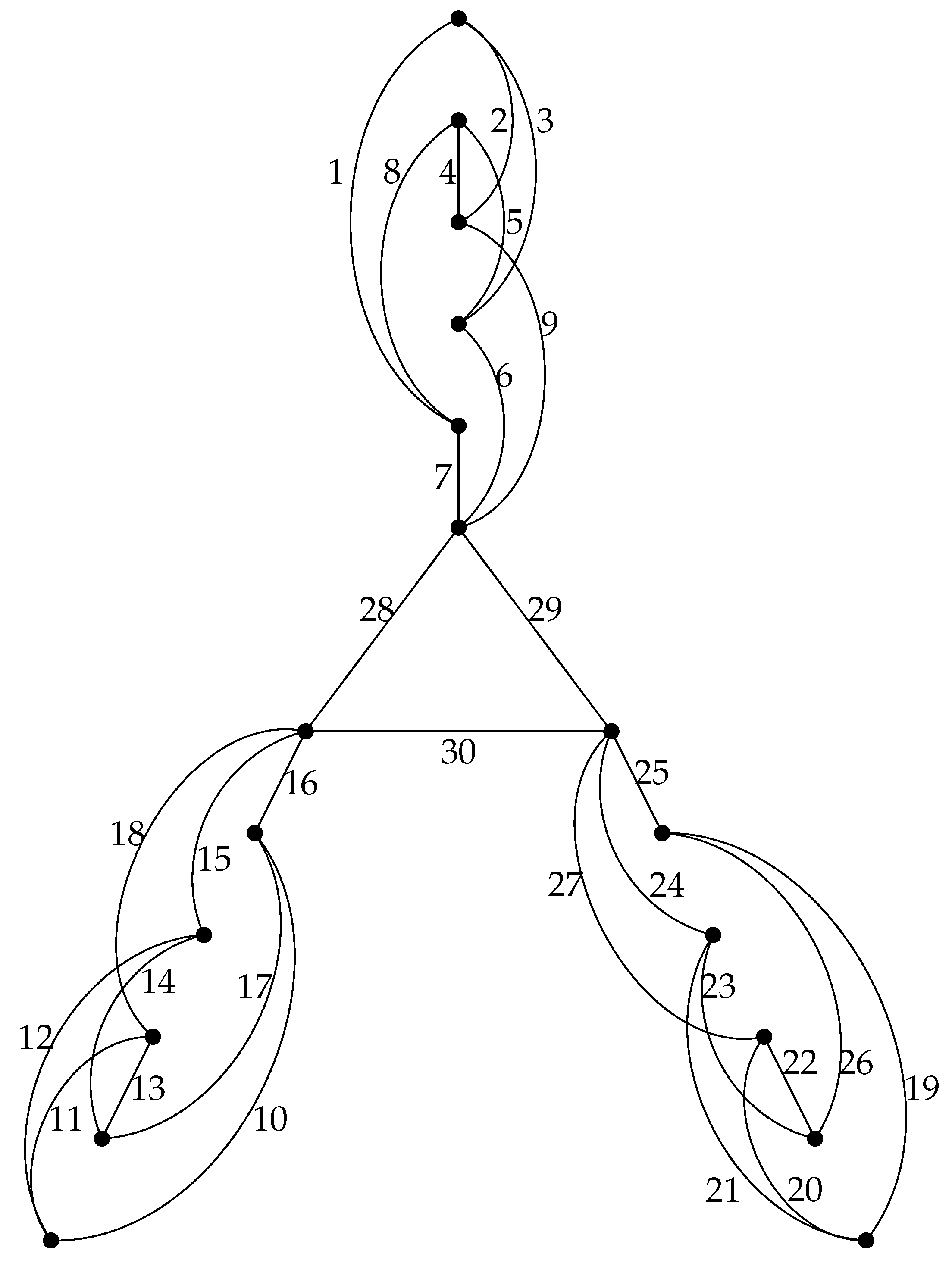
Figure 1, Figure 2, Figure 3 and Figure 4 illustrate the proof of Theorem 2. An antimagic labeling of a 2-regular graph G and the antimagic labeling of a 3-regular graph H are given in Figure 1 and Figure 2, respectively. In Figure 3, the three copies of the graph H are considered with their labeling function . The rooted product of the graph G and H with their antimagic labeling is given in Figure 4. Here, the root vertex of the graph H is chosen as .
Figure 1.
A graph G with .
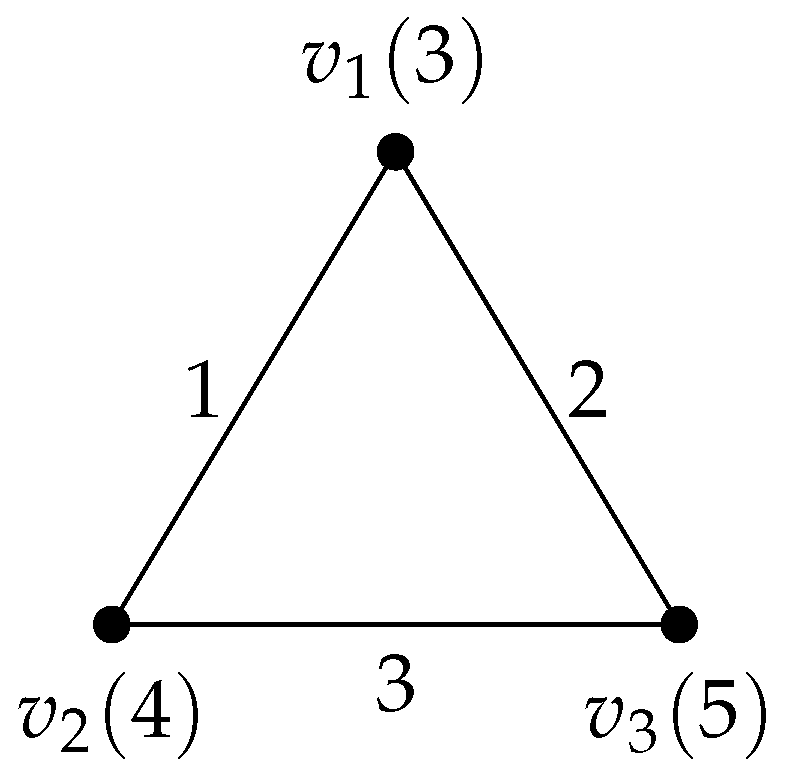
Figure 2.
A graph H with .
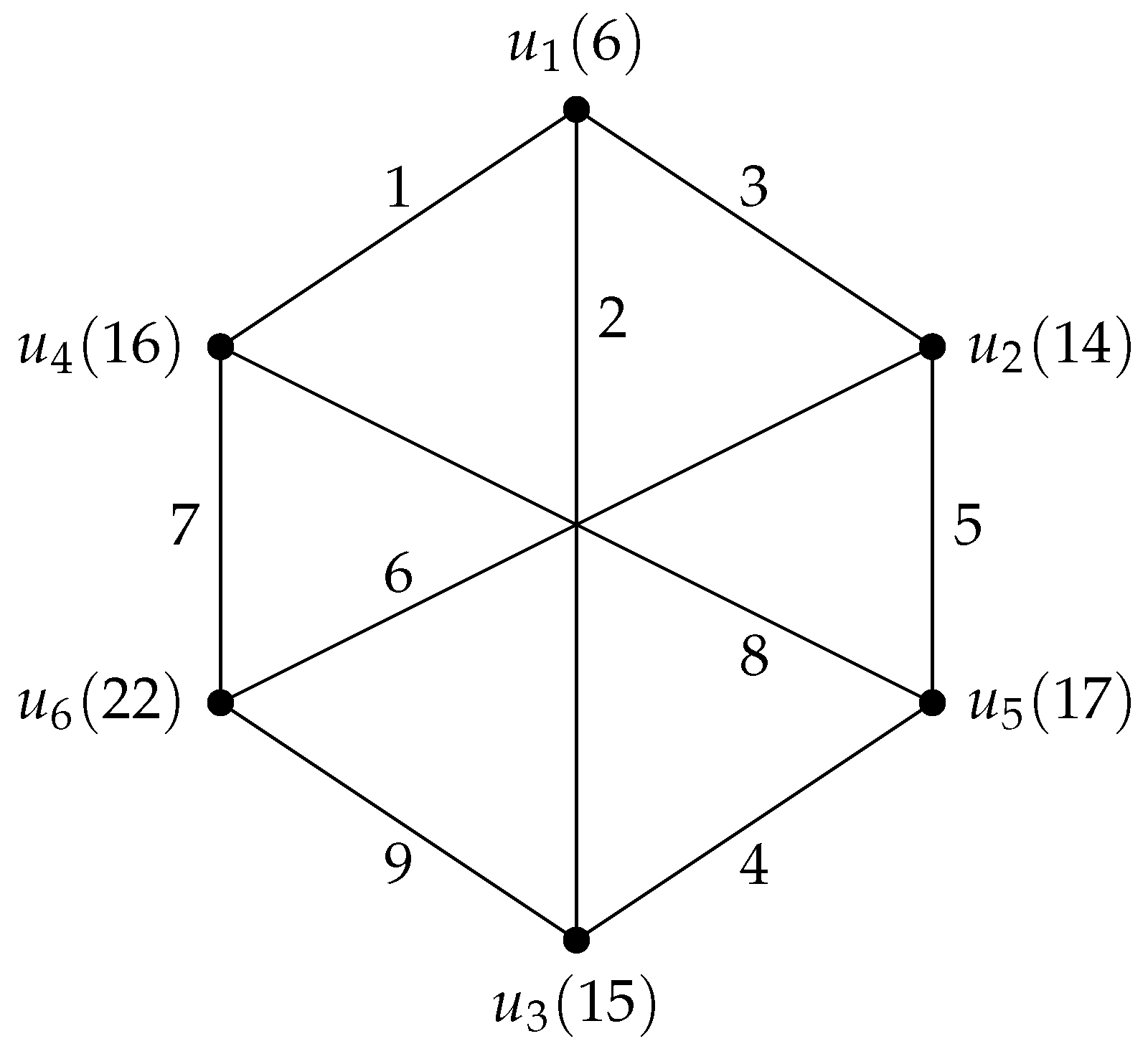
Figure 3.
3 copies of H.
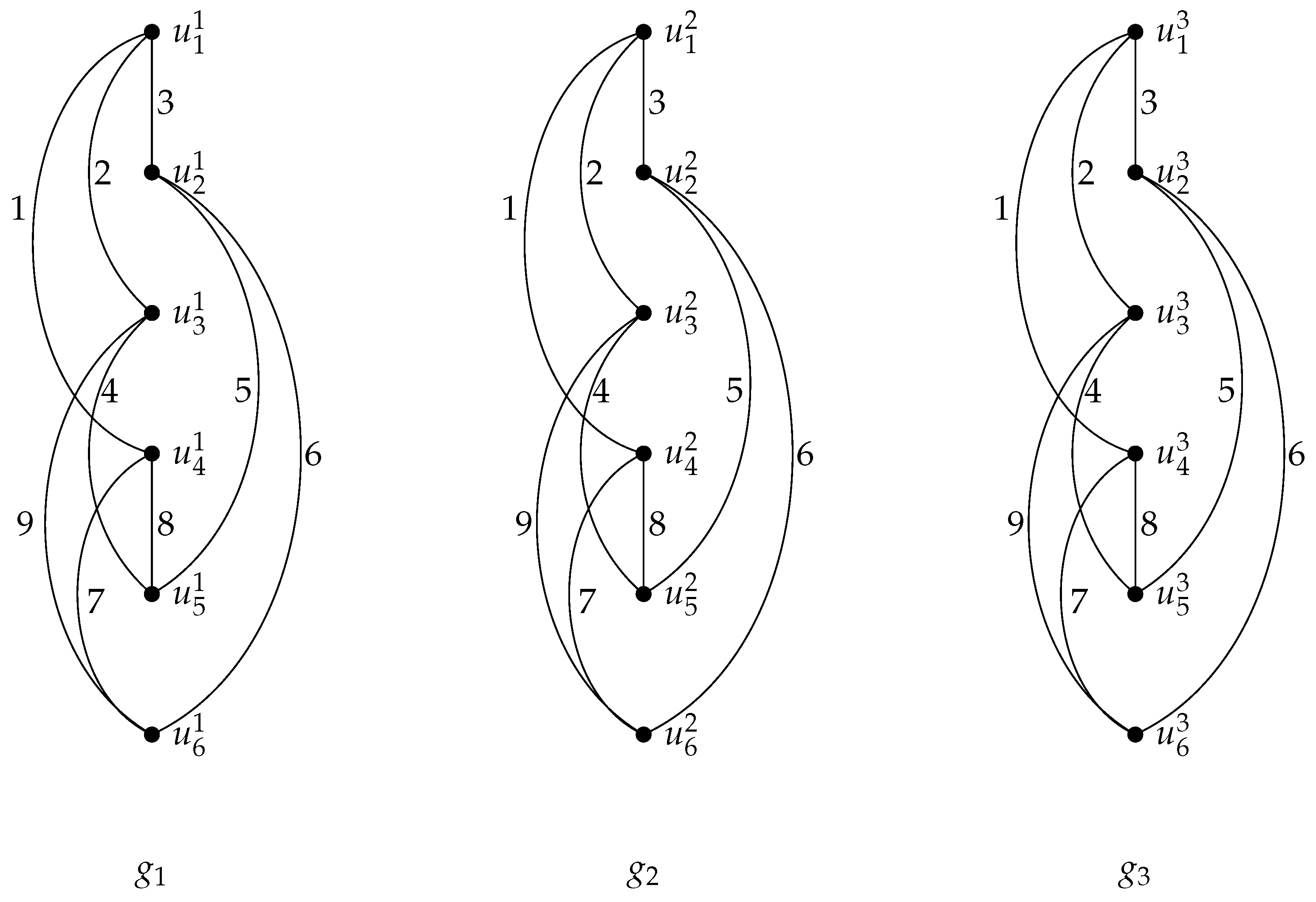
Figure 4.
Antimagic labeling of .
- Text included: A new paragraph is added after the illustration of Theorem 2 in which first paragraph gives the explanation and second paragraph gives the new construction.
Theorem [24] is a generalized result for the antimagicn-ess of the corona product of graphs. It is worth mentioning that Theorem 3, which is given in our original manuscript [1], will be immediate according to Theorem (cited [24] in [1]). Thus, the graph considered for in Theorem 3 [1] is not true. In this correction, we prove Theorem 3 [1] with a new construction of the corona product by altering the conditions of generalized corona product is cited [24] in [1].
Let G be a connected graph of order n and size m, and let with each are connected regular graph of order and size .
The minimum and maximum degree of the graph G is denoted as and . For ; then, consider , where are called the pair of . Then the following are true:
- (i)
- For each pair must be a complete graph of odd order and is a regular graph of order and
- (ii)
- For any consecutive pairs, and , we must have and .Furthermore, if , we have and .
- (iii)
- The sum of the edges of the graphs in each pair is divisible by 2. Moreover, the sum of the edges in the graphs are also divisible by 2.
- (iv)
Note that, means, x is divisible by
- Text correction: Theorem 3 and its proof is replaced with new theorem along with its proof according to the above construction.
Theorem 3.
Let G be a connected graph of order n and size m, and let be a sequence of regular graphs under the conditions as defined above; then, the corona product of is antimagic.
Proof.
Let G be a connected graph of order n and size Let , with each being a connected regular graph of order and size . Then, construct the corona graph by the above construction. We have . Now, we give the labels of the edges of using the following steps:
First, we label the edges of and then, we give labels to the edges that are incidents from the vertices of G to the vertices of . Finally, we label the edges of G.
- Case (i). If then Label the edges of each pair as follows:
The edges of are labeled randomly from the set,
Then, the edges of are labeled randomly from the set,
The edges of are labeled randomly from the set,
Next, we label the edges of G randomly, from the set .
Before labeling the remaining edges, we name the vertices of and G based on the partial sum of their vertices, using the labeling defined above. The partial vertex sum for any vertex v is denoted as and the vertex sum for any vertex v is denoted as .
We name the vertices of as if .
We name the vertices of G as if .
Now, we label the edges, incident to the vertex of and of G, as
, which is defined as follows:
For each pair , the edge of for is labelled as
The edge of for is labelled as
The edge of is labelled in the following way. If , then the label of is and for , then the label of is .
If , then the edge is labelled as , .
- Case (ii). If , then .
First, we label the edges of and G, and their incident edges, from to G, as done in case (i).
Now, we label the edges of randomly from the set . We name the vertices of using the partial sum as if ≤.
Then, label the edge of as for .
- Case (iii). If , then .
First, we label the edges of and G, and the incident edges, from to G, as done in case (ii).
We label the edges of randomly from the set . Then, we name the vertices of using the partial vertex sum as , if .
Then, we label the edge of as for .
From the above labeling scheme, we can easily observe the following:
For each pair we have,
Observation 2.
The vertex sum of , is odd, .
Observation 3.
The vertex sum of , is even, .
Claim: The above labeling of is antimagic.
From the above labeling, we can easily observe that the vertex sum of the vertices of G satisfies . Therefore, any two vertices in G are different.
For any we observe that the vertices in satisfy . From observation 2 and 3, we conclude that, for each pair , then , where and . Also, we have . .
For any consecutive pairs and , we have .
When , then we have .
Thus, any two vertices in are distinct.
Now, we will prove that any vertex in achieves a different vertex sum compared to any vertex sum in G. In order to prove this, we consider the minimum vertex sum in G and the maximum vertex sum in . From the labeling, the vertex gets the minimum sum in G, as follows:
and the vertex gets the maximum vertex sum in , as follows:
Therefore, from Equations (14) and (15),
By applying to Equation (16), we obtain . Therefore, any two vertices in receive distinct sums. □
- Errors in Figures: In the original publication [1], the illustrations (Figures 5–8) of Theorem 3 is now been modified with the new illustrations based on the above Theorem 3.
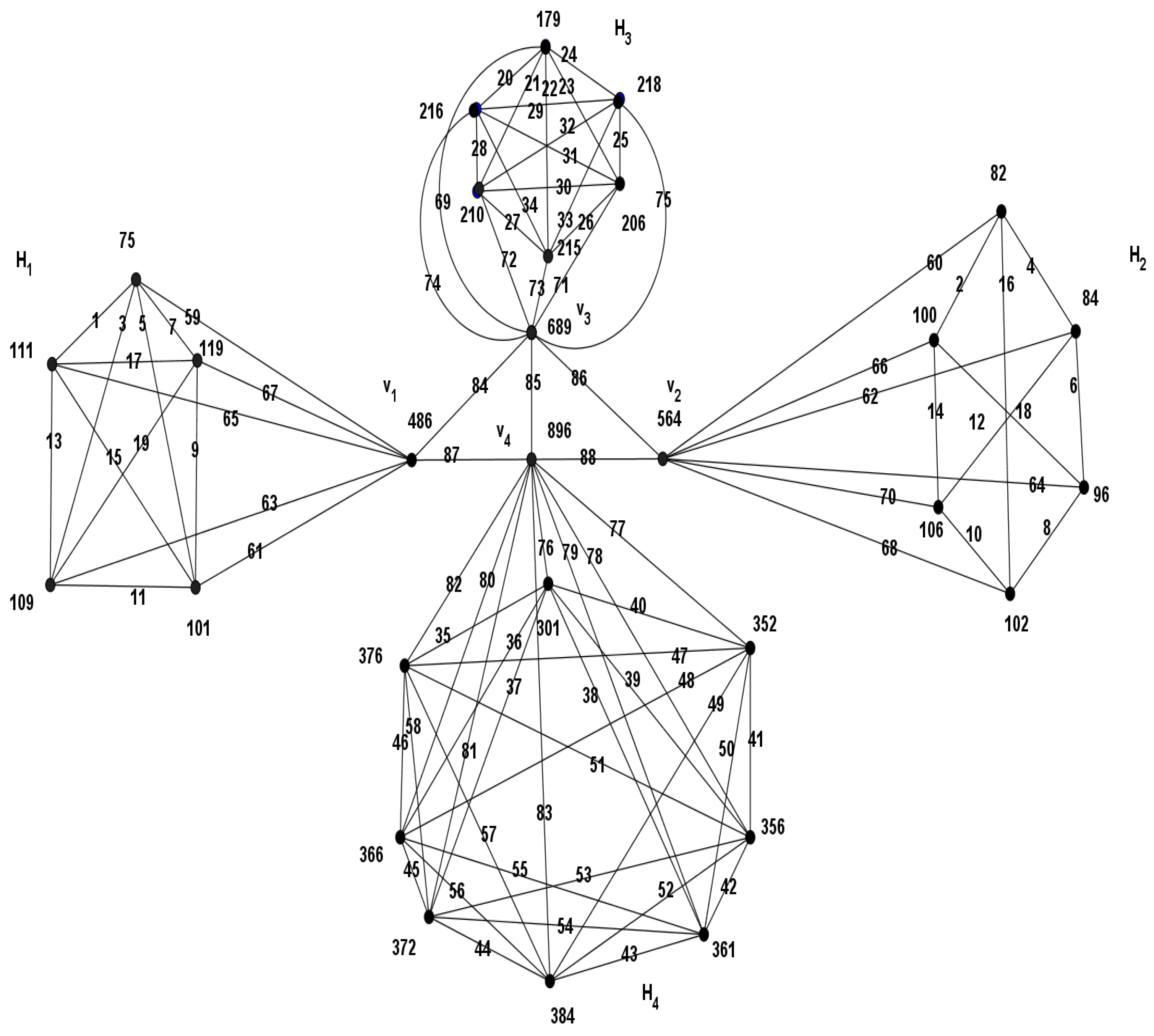
A graph G shown in Figure 5 with their respective labelings as defined in the Theorem 3 and the graph as shown in Figure 6, Figure 7, Figure 8 and Figure 9 with their respective labelings as defined in the Theorem 3. An antimagic labeling of graph is shown in Figure 10.
Figure 5.
The graph G.
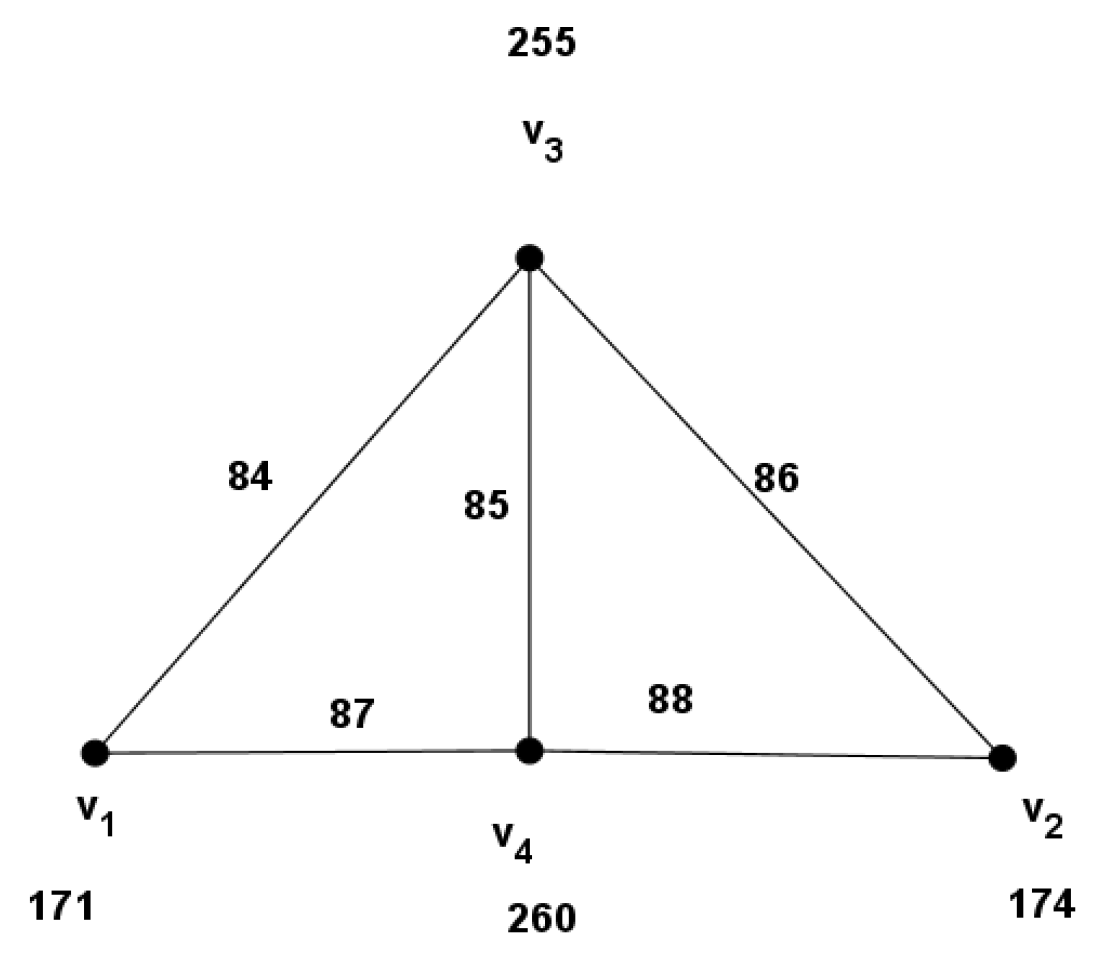
Figure 6.
The graph having regularity 4, .
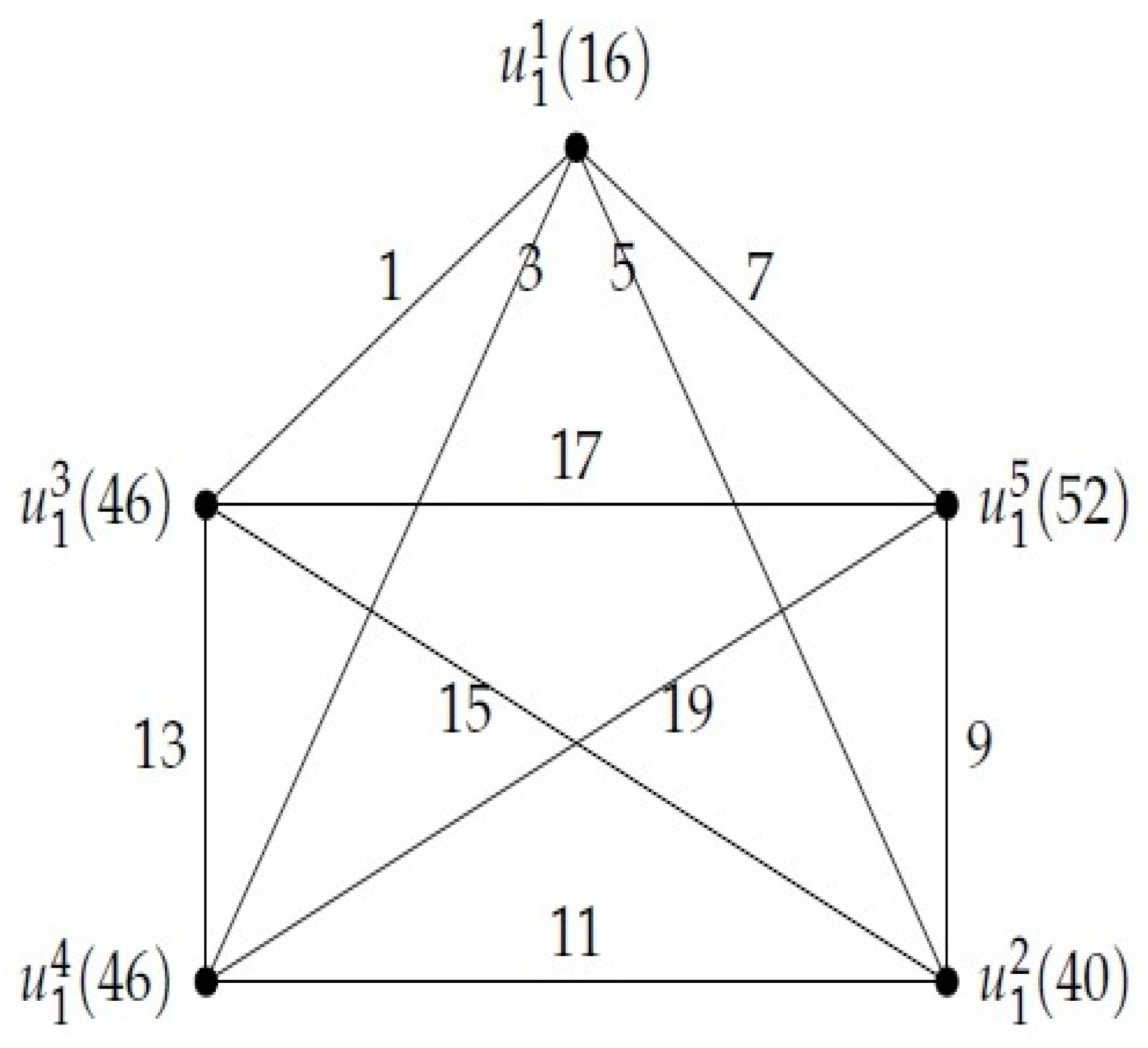
Figure 7.
The graph having regularity 3, .
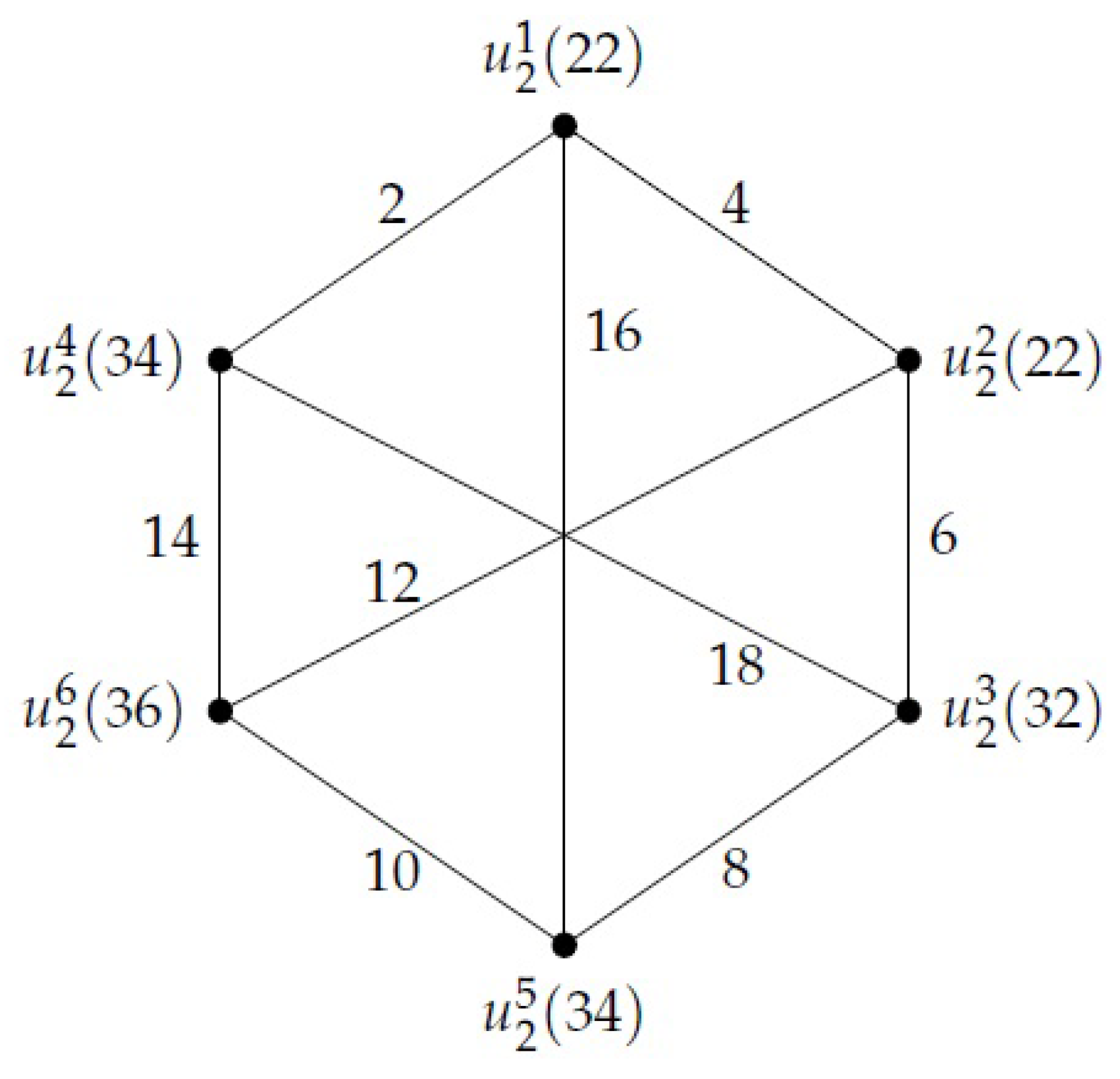
Figure 8.
The graph having regularity 5, .
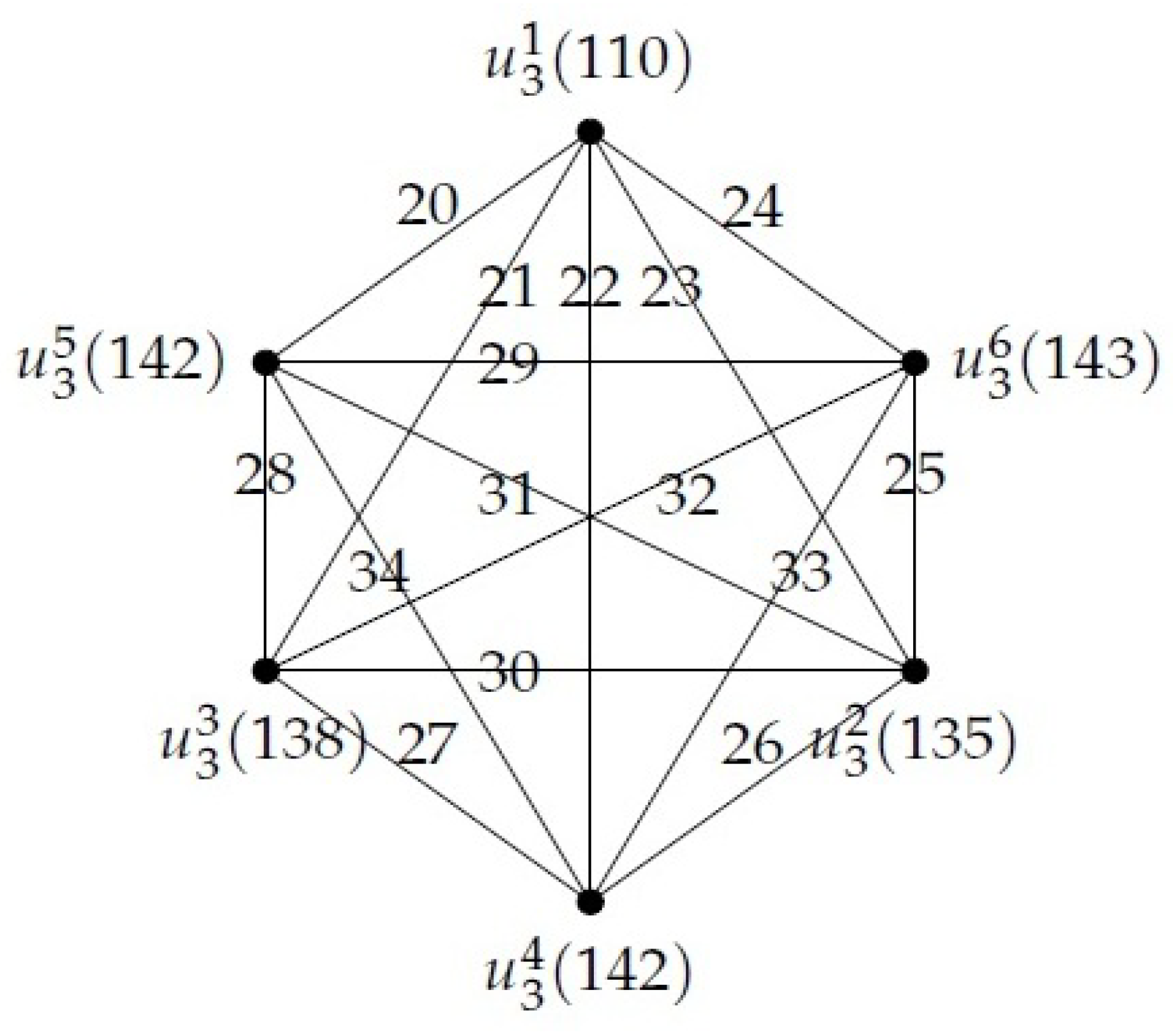
Figure 9.
The graph having regularity 6, .
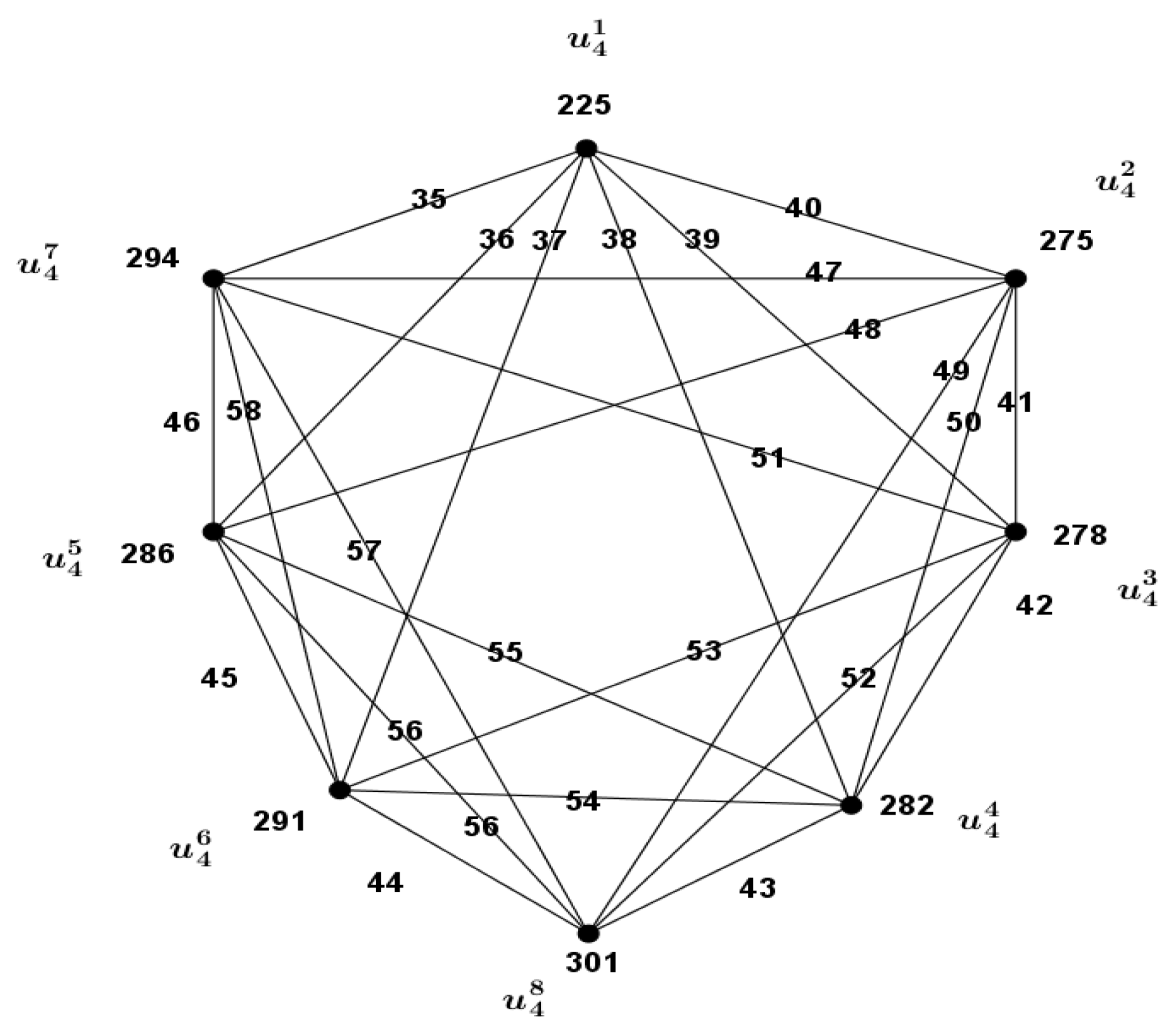
Figure 10.
The graph .
Text Correction: In Section 3, Conclusions is modified and given below:
We proved an antimagic labeling for the rooted product of graphs G and H where G is a t-regular connected graph and H is a k-regular connected graph for for some Moreover, we proved that there exists an antimagic labeling for the corona product of regular graphs G and H under certain conditions.
- In Author Contributions Section, Text correction:
- Author Contributions: Conceptualization, M.V.; methodology, M.V.; investigation, V.L. and M.V.; Validation, M.V.; writing—original draft preparation, V.L. and M.V.; writing—review and editing, V.L. and M.V.; supervision, M.V.; M.V was an in charge and overall direction and planning of this research. All authors have read and agreed to the published version of the manuscript.
- In Funding Section, Text correction:
- Funding: The APC charge for this research is funded by Vellore Institute of Technology, Vellore, India.
The authors apologize sincerely for any inconvenience caused to the readers. With this correction, the order of some references has been adjusted accordingly. The authors state that the scientific conclusions are unaffected. This correction was approved by the Academic Editor. The original publication has also been updated.
References
- Latchoumanane, V.; Varadhan, M. Antimagic Labeling for Product of Regular Graphs. Symmetry 2022, 14, 1235. [Google Scholar] [CrossRef] [Scilit]
- Gallian, J.A. A dynamic survey of graph labeling. Electron. J. Comb. 2021, 1, DS6. [Google Scholar] [CrossRef] [Scilit] [PubMed]
- Frucht, R.; Harary, F. On the corona of two graphs. Aequationes Math. 1970, 4, 322–325. [Google Scholar] [CrossRef] [Scilit]
- Godsil, C.D.; McKay, B.D. A new graph product and its spectrum. Bull. Aust. Math. Soc. 1978, 18, 21–28. [Google Scholar] [CrossRef] [Scilit]
- Hammack, R.; Imrich, W.; Klavžar, S. Handbook of Product Graphs; CRC Press: Boca Raton, FL, USA, 2011. [Google Scholar]
Disclaimer/Publisher’s Note: The statements, opinions and data contained in all publications are solely those of the individual author(s) and contributor(s) and not of MDPI and/or the editor(s). MDPI and/or the editor(s) disclaim responsibility for any injury to people or property resulting from any ideas, methods, instructions or products referred to in the content. |
© 2026 by the authors. Licensee MDPI, Basel, Switzerland. This article is an open access article distributed under the terms and conditions of the Creative Commons Attribution (CC BY) license.