


Abstract
Based on picture fuzzy sets (PFSs), we use a mathematical model to tackle such types of problems when a person has opinions like yes, no, abstain, and refusal. The spherical fuzzy model is more flexible and practical than the picture fuzzy model, as it enhances the space of uncertainty. It broadens the space of vague information evaluated by decision makers since graphs are the pictorial representation of information. Graphs are a tool to represent a network. To handle some real-world problems, spherical fuzzy graphs can be used more effectively as compared to picture fuzzy graphs (PFGs). In this article, we expand the notion of fuzzy Zagreb indices of the fuzzy graph to the spherical fuzzy Zagreb indices of the spherical fuzzy graph (SFG). The spherical fuzzy Zagreb matrix of SFG and Zagreb energy of SFG are defined with examples. Additionally, we develop several lower and upper bounds of the spherical Zagreb energy of SFG. In addition, we present an application of SFG by computing its Zagreb energy in the decision-making problem of choosing the best location for business purposes.
1. Introduction
In 1965, the notion of fuzzy set theory, which is the generalization of classical set theory, was established by Zadeh [1]. Enormous applications of fuzzy sets are found in telecommunication, control engineering, decision theory, expert systems, logic, management science, operation research, and others, which are all based on Zadeh’s exceptional idea. One of the limitations of fuzzy set (FS) is that it deals only with the membership degree (). To overcome this deficiency, Atanassov [2] in 1983 initiated the concept of the intuitionistic fuzzy set (IFS), which is the generalization of the fuzzy set (FS) theory. He expanded the notion of FSs by declaring the degree of truthiness () besides the degree of falseness () with the constraint . On emphasizing the notion of IFS, Yager presented the Pythagorean fuzzy set (PyFS), which enlarged the space with the new constraint, . The situation when a person has an opinion like yes, abstain, no, and refusal can be handled with the picture fuzzy set (PFS) that was initiated by Cuong [3,4] which is an abstraction of IFS. It gives grades to the three parameters, named the degree of truthiness , degree of abstinence , and the degree of falseness with the constraint , where is the degree of refusal. Garg [5] proposed some picture fuzzy aggregation operators. The notion of PFS was extended by Gundogdu and Kahraman [6] namely as the spherical fuzzy set (SFS). It gives more space to the degree of truthiness , degree of abstinence , and degree of falseness with the constraint , where is the degree of refusal. Ashraf et al. [7] explored the idea of SFSs with an application in multi-criteria decision-making (MCDM) problems using weighted averaging and weighted geometric aggregation operators. Further, Ashraf et al. [8] presented some spherical fuzzy Dombi aggregation operators and their applications in the MCDM problem. Mahmood et al. [9] presented the concept of the spherical fuzzy set and T-spherical fuzzy set as the generalization of the fuzzy set, intuitionistic fuzzy set, and Pythagorean fuzzy set. Some operations of SFSs and T-SFSs were introduced. They utilized these in MCDM of medical diagnostics problems. The q-rung orthopair fuzzy sets (q-ROFs) are the generalized form of IFS and PyFS and provide a more flexible way to handle uncertain information [10,11]. Then, Li et al. [12] introduced the idea of the q-Rung picture fuzzy set (q-RPFS), which is the generalization of SFSs. It provides huge space to the conditions of as well as with . By this, we can obtain more accurate outcomes as we increase the q-rungs.
In mathematics, graphs are a way to formally represent a network, which is basically just a collection of objects that are all interconnected. The notion of fuzzy graphs (FGs) based on fuzzy relation is presented by Kaufmann [13] and by some other experts who contributed to fuzzy graphs [14,15,16,17,18,19,20,21,22,23,24,25]. In [26], a MCDM problem is tackled with the help of a certain form of Pythagorean fuzzy graphs. Akram et al. [27] presented an idea of spherical fuzzy graph (SFG) as well as defining some operations on SFGs, namely symmetric difference and rejection. Akram [28] also presented MCDM models involving SFG. Then, Guleria and Bajaj [29] introduced a generalized version of SFGs using T-spherical fuzzy sets.
Topological indices are arithmetical quantities for structural molecular graphs. In 1972, Gutman [30] introduced the first Zagreb index. In 1978, Gutman [31] introduced the idea of the energy of a graph as the sum of the absolute values of the eigenvalues of the adjacency matrix of the graph. Gutman and Zhou [32] presented the term Laplacian energy of a graph as the sum of the absolute values of the differences of the average vertex degree of graph and the Laplacian eigenvalues of the graph.
The research study of topological fuzzy indices (TFIs) seems to be advantageous for multi-criteria decision-making (MCDM) problems and many connected fuzzy networks. Kalathian et al. [33] defined many TFIs for FGs, including the Gutman index, hyper Wiener index, Schultz index, Zagreb indices, Randic index, modified Wiener index, and harmonic index, and they established bounds for few of the indices as well. Islam and Pal [34] investigated the first Zagreb index for various FGs, like path, star, cycle, and fuzzy subgraphs, as well as proving several results. Moreover, a MCDM technique was elaborated that uses the first Zegrab index of a FG for evaluating the best employee in a company. The fuzzy Zagreb index is a degree-based index. Ahmad and Nasir [35] presented Randic and harmonic indices for FGs and derived some upper and lower bounds for different types of products, such as the cross product, Cartesian product and lexicographic product. These fuzzy indices were then utilized to handle a cybercrime problem as well. The Wiener index (based on geodesic distances between the vertices) for directed rough fuzzy graph was defined by Ahmad and Iqra [36], with its application to human trafficking. Some TIs in FGs, which are based on the degree and distance between the vertices, were explored in [37] and used in a multi-criteria decision-making problem.
Anjali and Mathew [38] elaborated the energy for a FG as the sum of the modulus values of the eigenvalues corresponding to the adjacency matrix of FG. The Laplacian energy of FG has defined in [39]. Kale and Minirani [40] presented the fuzzy Zagreb matrix and derived some bounds for fuzzy Zagreb energy. Praba et al. [41] extended the idea of energy of FG to the energy of an IFG and derived several lower and upper bounds. Akram and Naz [42] presented the energy of an IFG to Pythagorean fuzzy graphs (PyFGs) and explored the concepts of energy and Laplacian energy of PyFGs, as well as the energy and Laplacian energy of Pythagorean fuzzy digraphs. Akram et al. [43] introduced the notion of energy of double dominating bipolar fuzzy graphs. Shi et al. [44] extended the notion of the energy of the Pythagorean fuzzy graph to the energy of picture fuzzy graphs (PFGs) and presented the types of energy, including Laplacian energy as well as skew-Laplacian energy in both PFGs and picture fuzzy digraphs. They ranked the suitable locations for business purposes by making use of the picture fuzzy graph and its related energies. Yahya and Mohamed [45] explored the energy of SFG and extracted some bounds of the energy of SFG.
The following points influenced us to write this article:
- Due to the enormous applications of TIs, including Zagreb indices for FGs in distinct decision-making problems, it also seems advantageous to expand the notion of Zagreb indices in SFG.
- There are numerous applications of the spectrum of fuzzy graph theory in solving linear systems, computer science, chemistry, and others.
- The spectrum of the graph plays a crucial role in combinatorial optimization problems in mathematics.
- Moreover, the Zagreb energy of SFG has not yet been discussed and studied in the literature; therefore, we expanded the notion of the energy of SFG to the Zagreb energy of SFG.
The subscription of our proposed research work is given as follows:
- The aim of this research study is to establish the notion of the first and second Zagreb indices of spherical fuzzy graphs.
- We introduce the concept of spherical fuzzy Zagreb matrices of SFGs and corresponding spectra.
- We define the Zagreb energy of SFG and establish the lower and upper bounds for the Zagreb energy of SFGs and some of their results.
- Finally, we utilize the idea of Zagreb energy of SFG in a MCDM problem. In particular, we determine the best place to start a certain business.
This paper is organized as follows.
In Section 2, some definitions are recalled for better understanding. In Section 3, we define fuzzy Zagreb indices of SFG. In Section 4, we discuss the lower and upper bounds of Zagreb energy and some of the main results as well. In addition, in Section 5, we present an application of SFG by computing Zagreb energy in a multi-attribute decision-making problem. Finally, we conclude our proposed work.
Some of the symbols used in this article are mentioned in Table 1.
Table 1.
List of symbols.
2. Preliminaries
Definition 1
([27]). Let be a nonempty underlying set of vertices. A spherical fuzzy set R over is defined as
where , , and denote the degree of truthiness of v in R, degree of abstinence of v in R, and degree of falseness of v in R, respectively. Moreover, such that 0 ≤ + + ≤ 1. Further, for all is called the degree of refusal of membership of v in R.
Definition 2
([45]). Let V be an underlying set of vertices. A spherical fuzzy graph is a pair of mappings such that and , where R is a spherical fuzzy set with constraint for all v ∈ V and S is spherical fuzzy relation on , such that , , and , where , , and denote the degree of truthiness, degree of abstinence, and degree of falseness, respectively, satisfying the following condition:
for all .
Example 1.
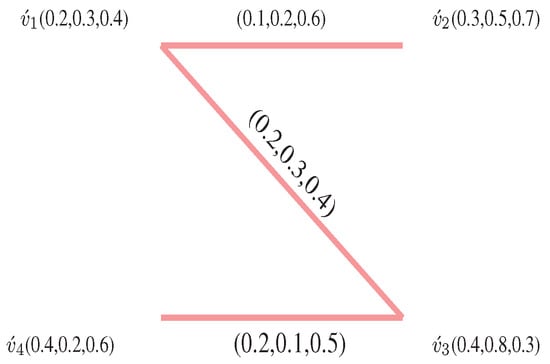
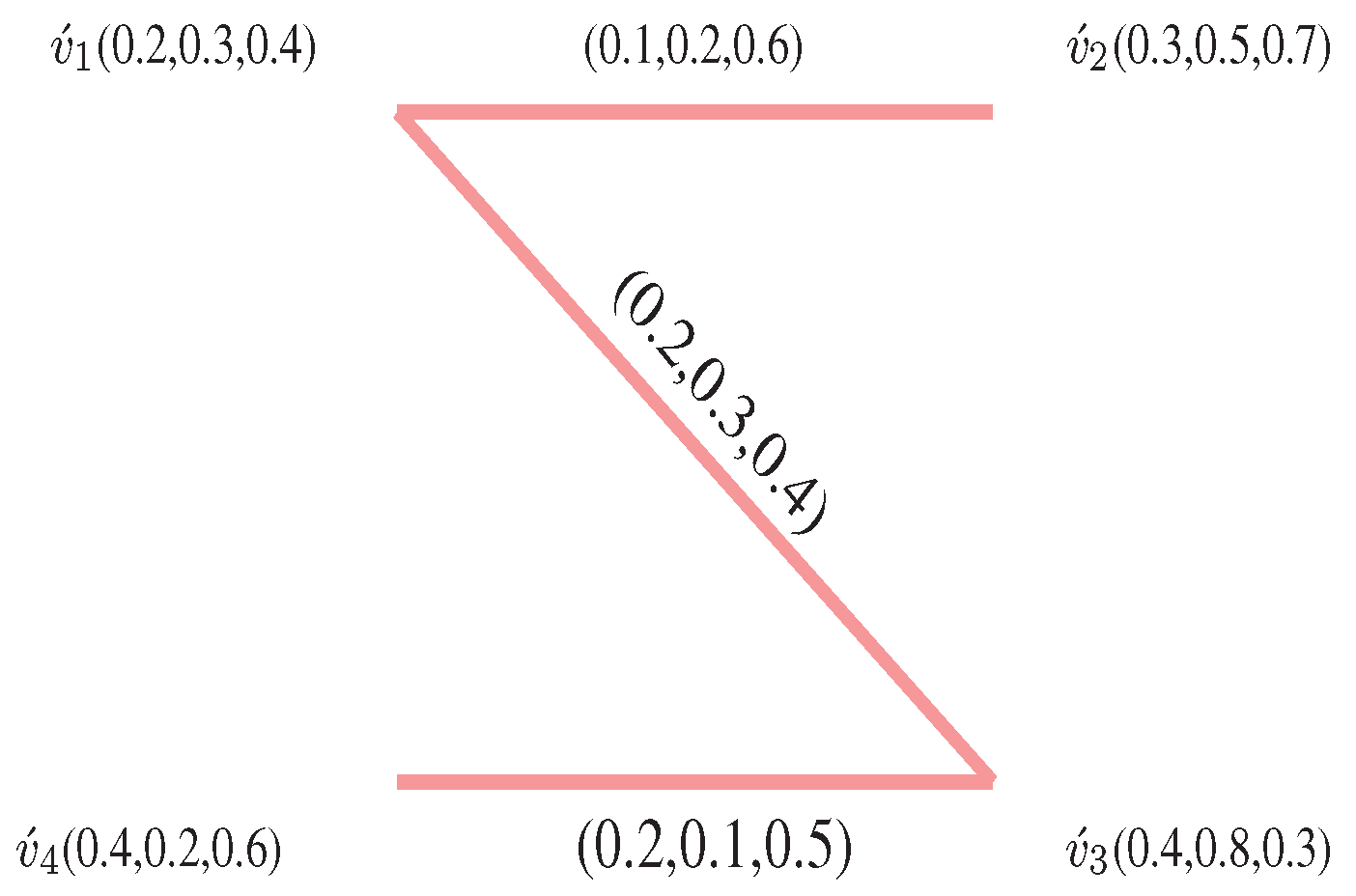
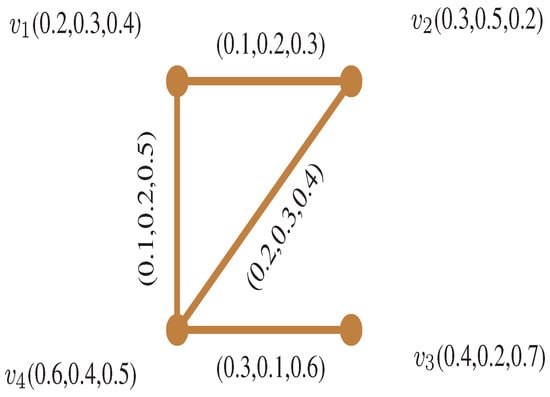
The graph is defined on an underlying set of vertices and . Consider the graph , where is a spherical fuzzy subset of V and is a spherical fuzzy subset of E defined as in Table 2 and Table 3, respectively. The graph is shown in Figure 1.
Table 2.
Table for .
Table 3.
Table for .
Figure 1.
A SFG .
Definition 3
([27]). Consider a SFG defined on . The degree of a vertex v of G () is expressed as
for all ∈ .
Definition 4.
Using OWA operator weights for preference aggregation, let wj be the relative importance weight attached to the jth ranking place and vij be the vote candidate i receives in the j-th ranking place. The total score of each candidate is defined as [36], which is a linear function of the relative importance weights. Although the weights are not required to be summed to one, we assume them to be normalized in this paper. That is, once the weights are determined, candidates can be ranked in terms of their total.
3. Spherical Fuzzy Zagreb Indices
Several topological indices are defined in a crisp graph, but in real life, many issues cannot be tackled by these indices. So, there is a need to define these indices for the fuzzy graph. One of the most famous and useful indices is the Zagreb index, which can be used in several fields of mathematics and chemistry. It is a degree-based topological index. The strength of vertices plays a vital role in fuzzy graph theory. Fuzzy Zagreb indices can be used to measure the connectivity of edges. These can be used to evaluate how much the fuzzy graph is strengthened. In spherical fuzzy Zagreb indices, we involve the membership values of vertices as well as the degree of vertices in terms of truthiness, abstinence, and falseness, which help to encounter the connectivity of neighborhoods of the vertices.
Definition 5.
Let be a spherical fuzzy graph. Then, the first Zagreb index denoted as of SFG is defined by
Here, , , , , , and are defined in Table 1.
Definition 6.
Let be a spherical fuzzy graph. Then the second Zagreb index denoted as of the spherical fuzzy graph is defined as
Here, , , , , , and are defined in Table 1.
Remark 1.
From Definitions 5 and 6, it is noted that , and .
Example 2.
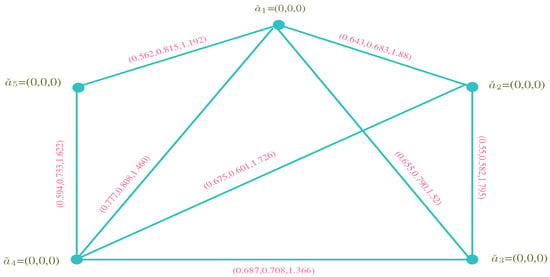
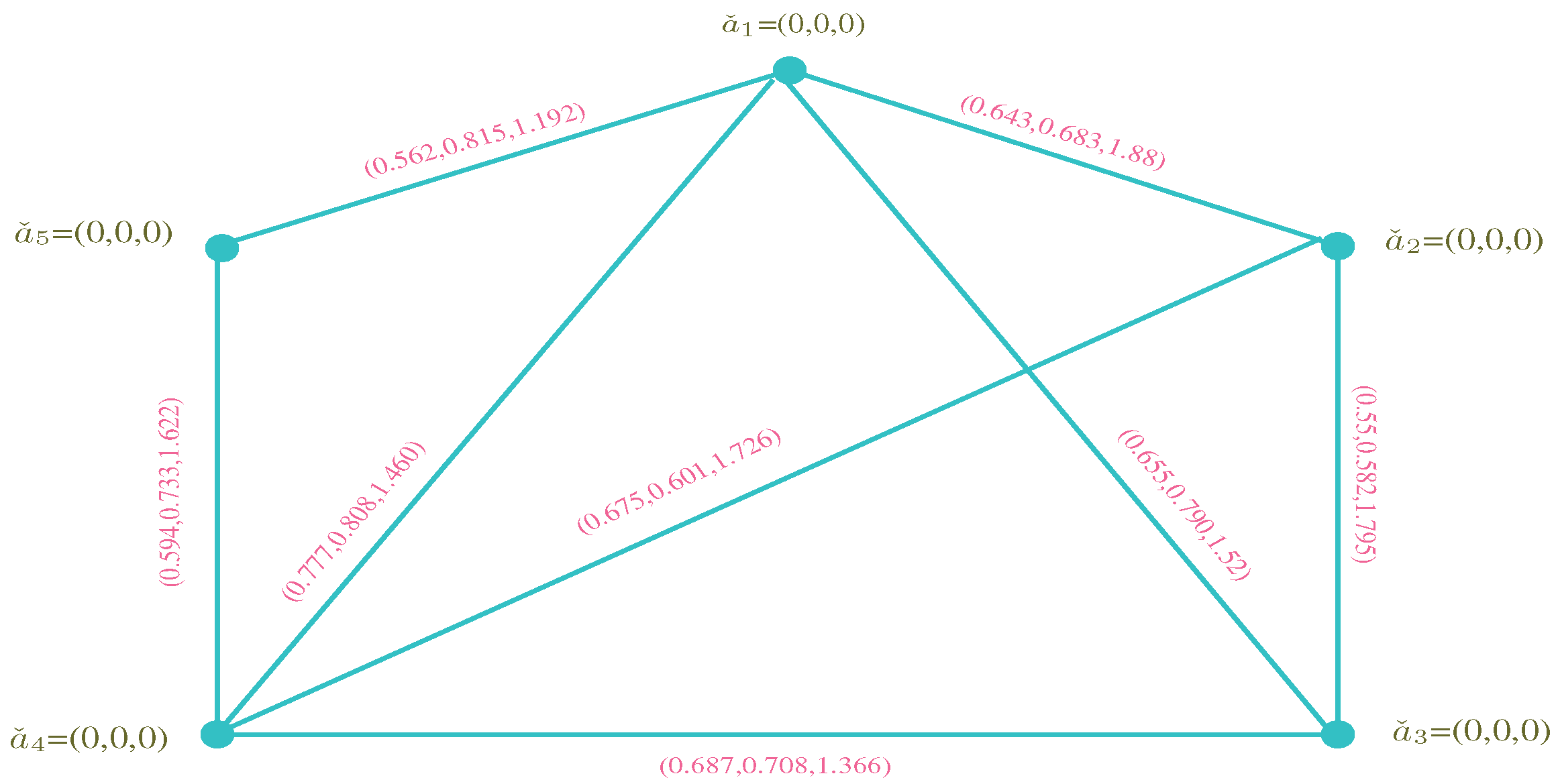
Consider the spherical fuzzy graph as shown in Figure 2.
Figure 2.
A SFG J.
Now, by using (2), the second Zagreb index of SFG J is computed as
to remove numbering (before each equation)
Definition 7.
Consider a SFG and . Then the spherical fuzzy Zagreb matrix () is defined as
where
and,
Definition 8.
The spectrum of of is expressed as , where , , and are the sets of eigenvalues of , , and , respectively.
Definition 9.
The spherical fuzzy Zagreb energy of is defined as
where , , and are the eigenvalues of , , and , respectively. Further, denotes the fuzzy Zagreb energy.
Example 3.
Consider the as shown in Figure 3.
Figure 3.
Spherical fuzzy graph .
The spherical fuzzy Zagreb matrix is obtained according to the definition mentioned as above:
The set of eigenvalues of , , and is given as
and,
respectively. Also, by using Definition 8, we compute that
Now, by using (3), the spherical fuzzy Zagreb energy of SFG is calculated as
By putting the values, we obtain
4. Main Results
In this section, we present some upper and lower bounds related to the maximum eigenvalue and spherical fuzzy energy of SFG. The obtained bounds are then illustrated with the help of examples to show the validity of the results.
Theorem 1.
Let with order n and size m be a spherical fuzzy undirected and connected graph defined on . Then,
where these symbols , , , , , , , , , and are described in Table 1. In particular, the equalities in (5) hold for SFG such that , and are constant functions, and each vertex has the same spherical fuzzy degree.
Proof.
It implies that
Similarly, we can prove other bounds. □
Theorem 2.
Let with order n and size m be a spherical fuzzy undirected, and connected graph defined on , and let be its spherical fuzzy Zagreb matrix. If , , and are the eigenvalues of , and , respectively. Then
and
where , , and . , , . Further, , , , , and denotes the number of edges in SFG. In particular, the equalities in (5) hold for SFG such that , and are constant functions, and each vertex has the same spherical fuzzy degree.
Proof.
By the trace properties of a matrix, we have
Hence, we have
Let and . Now consider,
Hence,
Similarly, we have
and
For the lower bound, let Now using the same arguments as those used to prove (5), we have
Hence,
Similarly,
□
Theorem 3.
Consider a SFG G = having n number of vertices and
as the corresponding SZM of G. Then,
and
Proof.
By considering two sequences (1, 1, 1,..., 1) and and applying the Cauchy–Schwarz inequality, we have
Now, by using (3), it follows that
Similarly, we have
Now, for the lower bound, consider
where represents the arithmetic mean of the terms . As we know that the arithmetic mean () of the terms is always greater than the geometric mean () of these terms i.e., AM ; therefore, it follows that
Now from Theorem 2, we have
Also,
Thus,
Similarly, we have
and
□
Example 4.
Consider the SFG as shown in Figure 3. The value of from Example 3 is given as , , and . Now from Theorem 3, the lower bound for and the upper bound for . Here, , , , , , , and . Thus, we obtain
Thus,
Similarly, we compute that
and
This shows that the values of spherical Zagreb fuzzy energies lie within the bounds given in Theorem 3.
Remark 2.
In particular, if we take a SFG such that the membership values of the vertices are constant, the spherical fuzzy degree of each vertex is also the same. Then, the bounds given in Theorem 3 seem to be sharp.
Remark 2 can be explained with the following example:
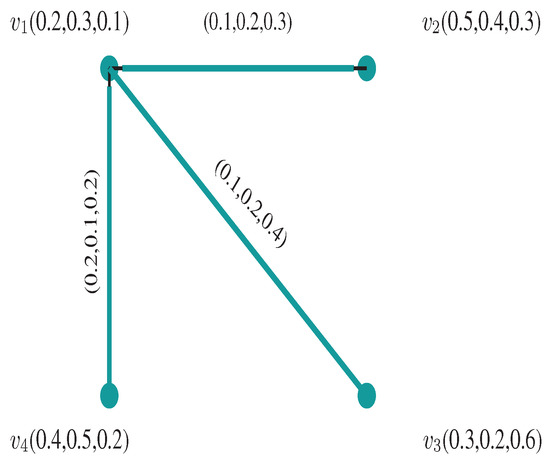
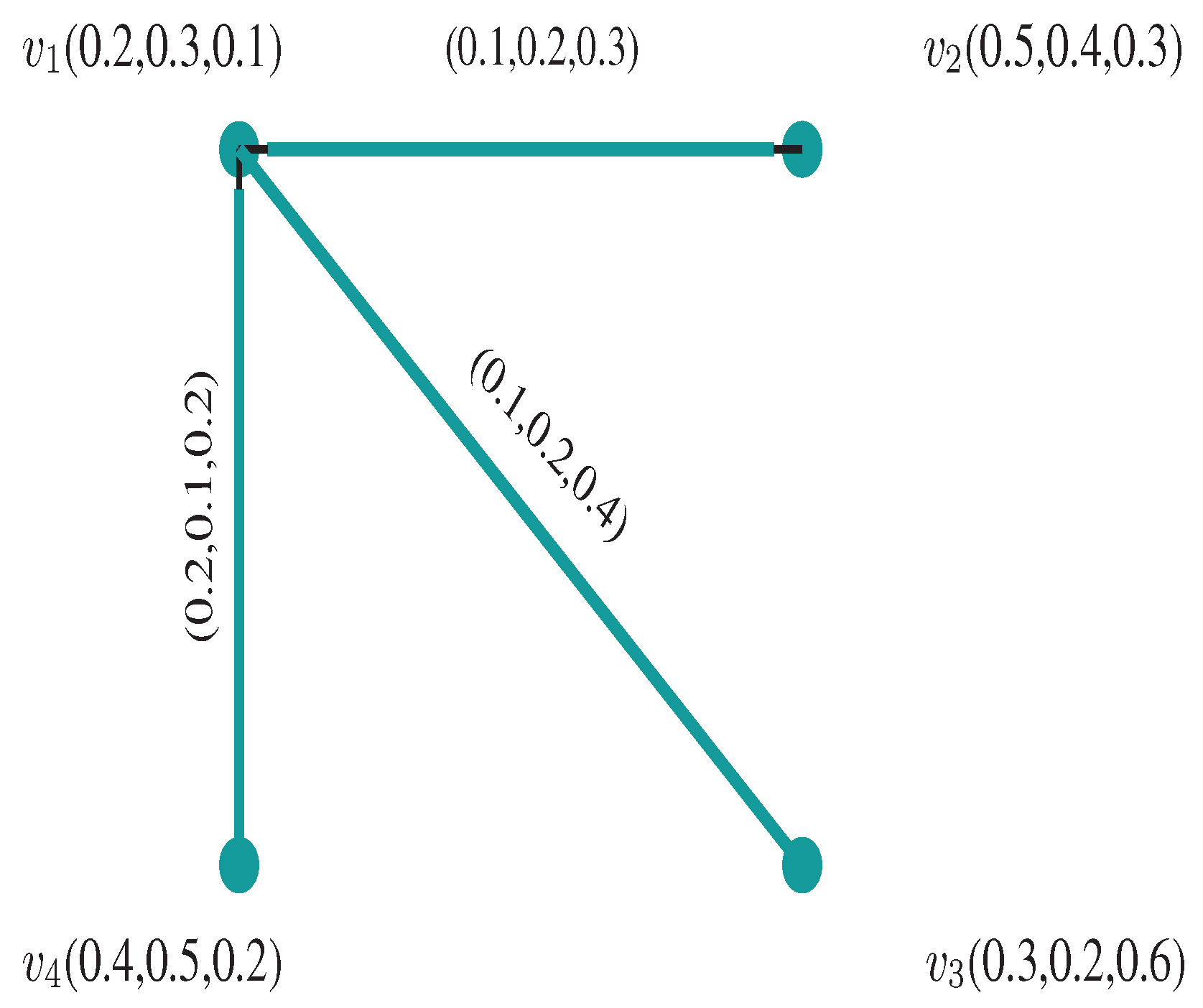
Example 5.
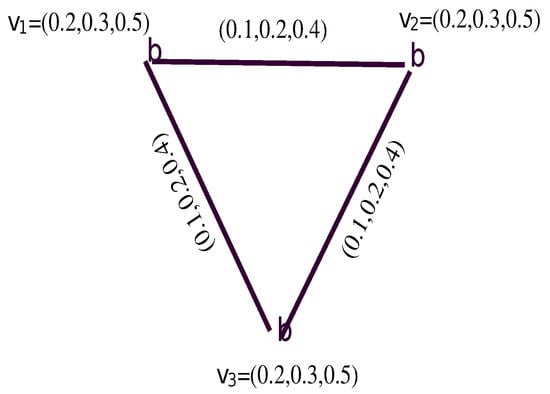
Let D be a SFG as depicted in Figure 4. Since, , , and . Now from Theorem 3, Lower bound for Upper bound for . Here, , , , , , , and . Thus, we obtain
Figure 4.
The SFG D.
Thus,
Similarly, we compute that
and
Lemma 1.
If is a SFG with is its corresponding such that is the maximum eigenvalue of , is the maximum eigenvalue of , and is the maximum eigenvalue of , then
where is a maximum crisp degree.
Proof.
Given that is the maximum eigenvalue, let T be the eigenvector that corresponds to . Then, vividly,
If the vector T has maximum entry corresponding to the vertex and has corresponding row , then we obtain
By using the same arguments, as we prove (2) in Theorem 2, we have
Hence,
Similarly, for and , we have
□
Theorem 4.
For a SFG with n vertices and
Similarly,
Proof.
Since , and are symmetric matrices with zero trace, so we have
where , and are the greatest eigenvalues of , , and , respectively. Let be the maximum eigenvalue of the matrix and by using Definition 7, we can write
By using Definition 5, we can write
Using Theorem 1,
Moreover, from Theorem 2, we have such that
By using (3), we can write
It implies that
By considering two sequences and and then applying the Cauchy–Schwarz inequality with entries, we have
Using Lemma 1, and from (12), Hence,
Similarly,
□
The above Theorem 4 can be explained by the following example:
Example 6.
Consider the SFG as shown in Figure 3. The value of from Example 3 is given as , , and . Now from Theorem 4, the upper bound for Here, , , , , , and . Thus upper bound for is . Similarly, we compute the upper bounds for as 5.53 and for as 14.37. Thus,
and
This shows that the values of the spherical Zagreb fuzzy energies lie within the bounds given in Theorem 4.
Remark 3.
It is observed from Examples 4 and 6 that the upper bound of obtained from Theorem 4 is closer to the exact value than the upper bound obtained from Theorem 1, whereas the upper bounds of and given in Theorem 1 are closer to the exact value as compared to the upper bounds obtained in Theorem 4. This indicates that together with both bounds obtained from Theorems 1 and 4, we can better estimate the exact value of the spherical Zagreb fuzzy energies of SFG.
5. Application
In this section, we present an application related to the selection of the best location to start a new business to describe the suitability of . Further, we illustrate a comparative analysis with the existing technique.
5.1. Selection of Best Location for Business Purpose
Business depends on profitability and loss; thus, it has a ratio of success or failure with the wide range of variations. Usually, the term business is figured out as a ‘company’, but it has broad meanings. Business is not just the ownership of a multinational company; the work of a street peddler is a business too. Some of the factors which enhance the profitability of business include high skills of management, mental peace, a broad mental vision, teamwork, patience, and good work performance. But one of the most important factors is location to upgrade the level of business. Since the growth of a business is not certain, a businessman should be mentally ready to accept the decline of a business at any stage of its life. But, if proper consultation is given by an expert, then a business can achieve success at a large scale.
Therefore, we consider five different locations , for a new business and taking a panel of four experts , from real estate, finance, law and business communities to decide the most preferable location for the required purpose.
The following are the some factors that affect the location.
- Proximity to target customers.
- Competitors’ locations.
- Taxes (utilities and other costs).
- Government laws and policies.
- Infrastructure and accessibility.
- Safety.
- Parking facility.
Each consultant makes distinct judgments based on their experiences between the two different locations. Their opinions depend on three factors, including neutral, appropriate and inappropriate.
An Algorithm 1 to describe our proposed technique is given below:
| Algorithm 1: Algorithm to find the best place for business purpose. |
INPUT:
A discrete set of locations , a set of decision-makers in order to attain the goal and fashioning of spherical fuzzy preference relations (SFPRs) , for each consultant. OUTPUT:
The nomination of best location for business.
|
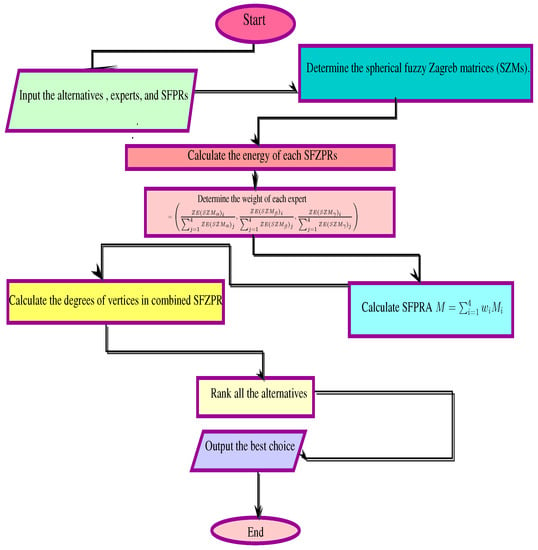
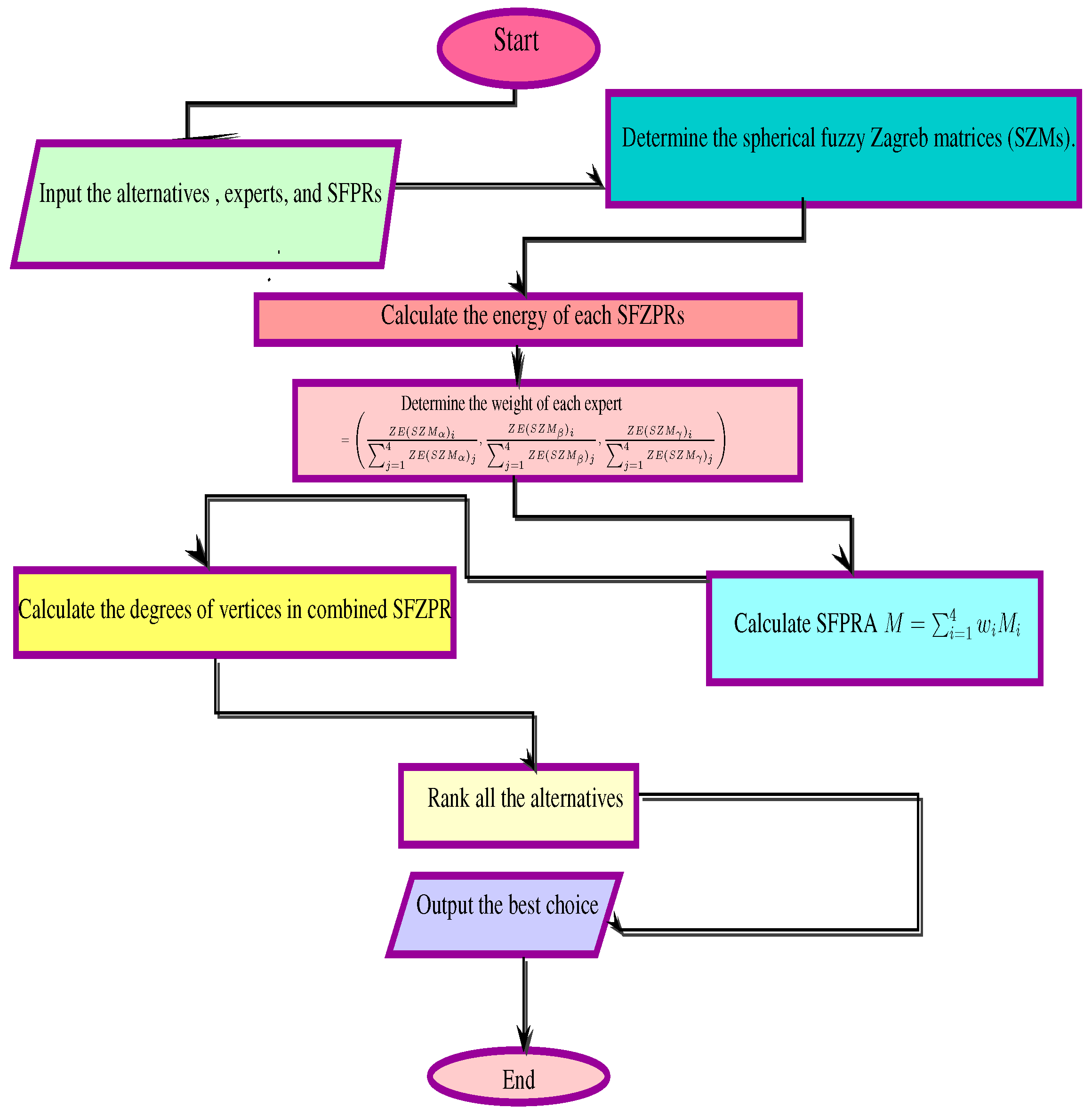
The flowchart corresponding to the proposed technique is exhibited in Figure 5:
Figure 5.
Flowchart for algorithm.
Table 4.
SFPRs of the first decision-making expert.
Table 5.
SFPRs of the second decision-making expert.
Table 6.
SFPRs of the third decision-making expert.
Table 7.
SFPRs of the fourth decision-making expert.
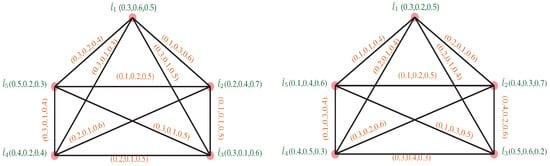
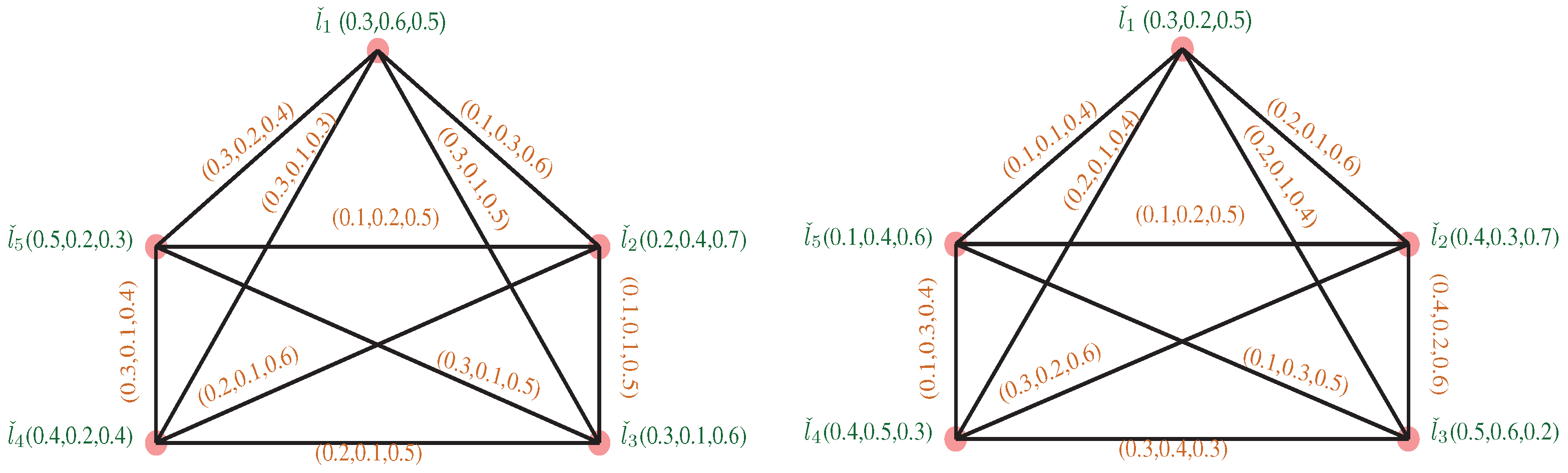
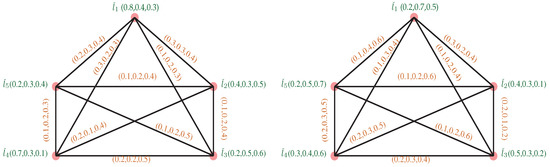
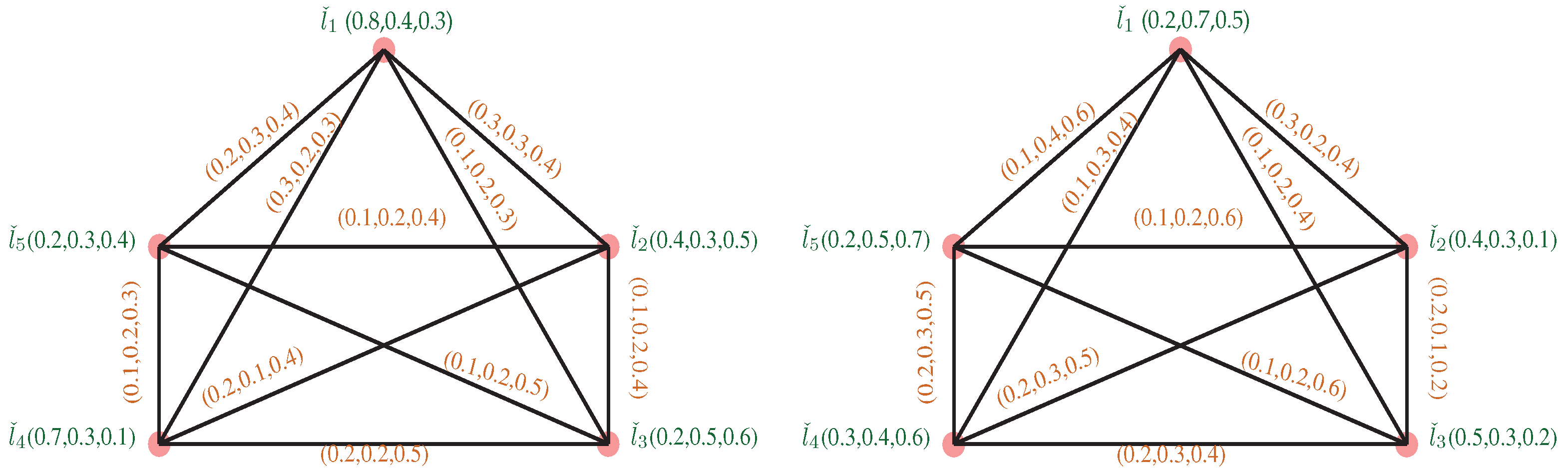
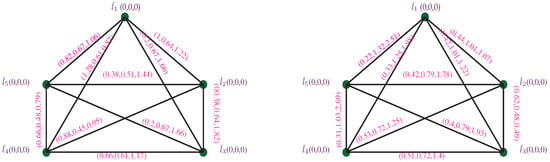
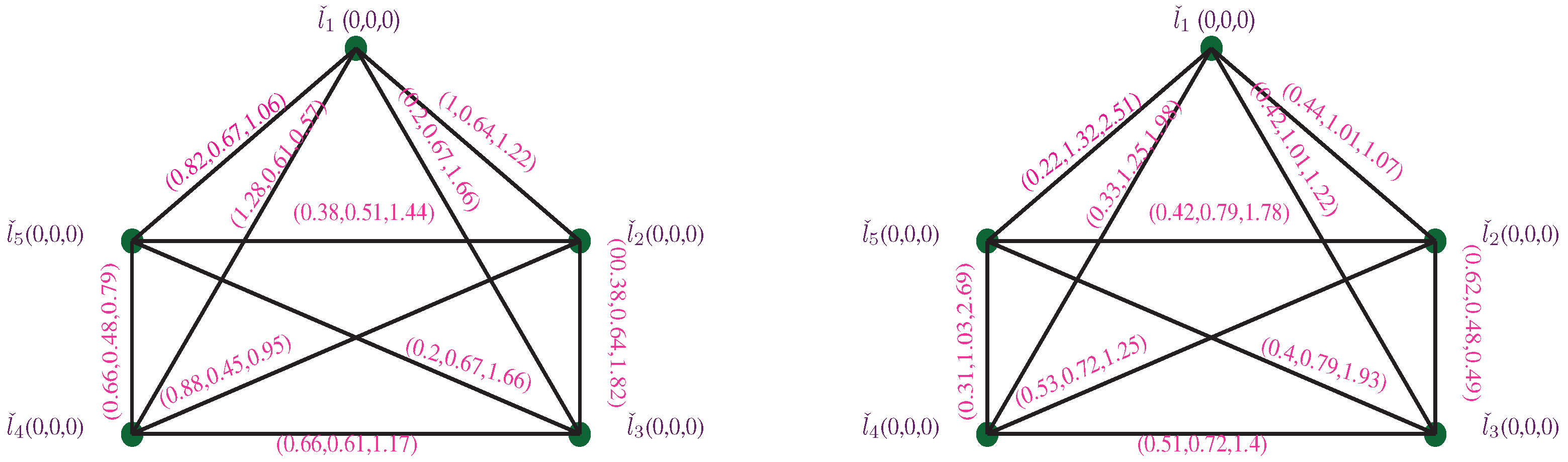
The spherical fuzzy graphs , based on spherical fuzzy preference relations () , are constructed by taking each expert’s preference between two distinct alternatives as the membership values of the edges, including degree of truthiness, degree of abstinence, and degree of falseness. These spherical fuzzy graphs , are depicted in Figure 6 and Figure 7.
Figure 6.
The graphical representations of and .
Figure 7.
The graphical representations of and .
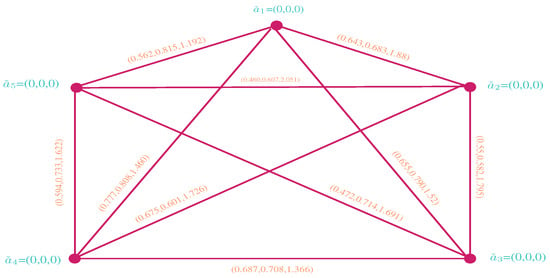
Now, we form the spherical fuzzy Zagreb matrices , of each . These matrices are based on the degree to which the vertices will give the effect of connectivity in the neighborhood. The , of each is given below:
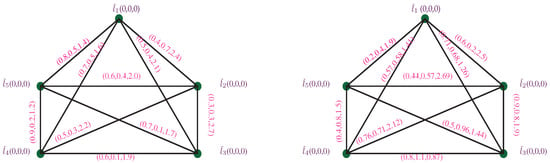
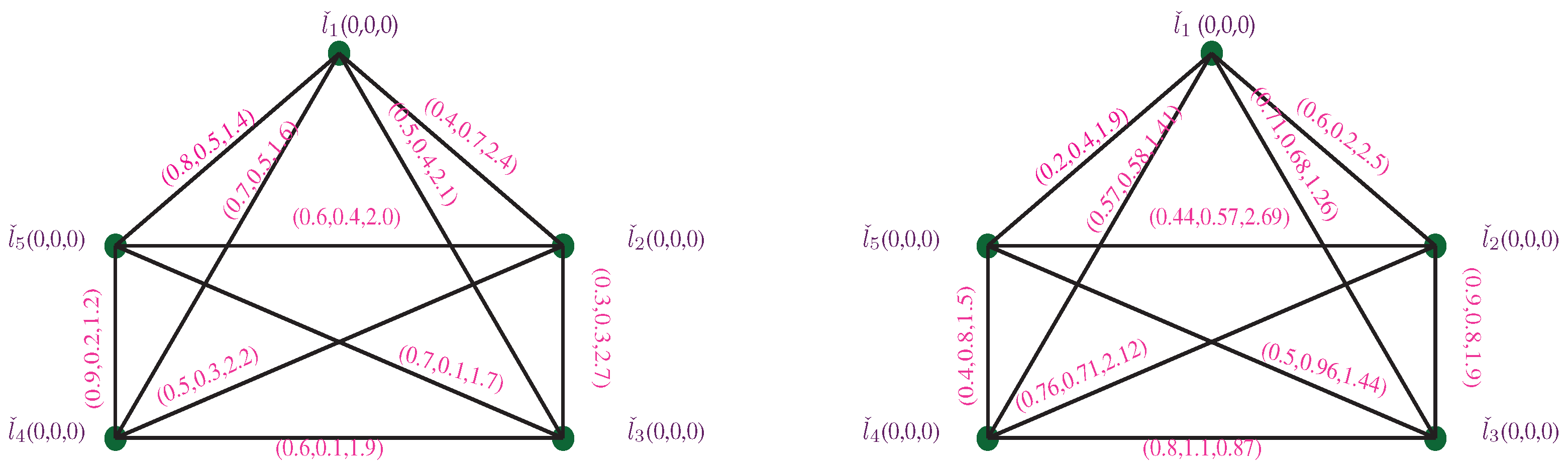
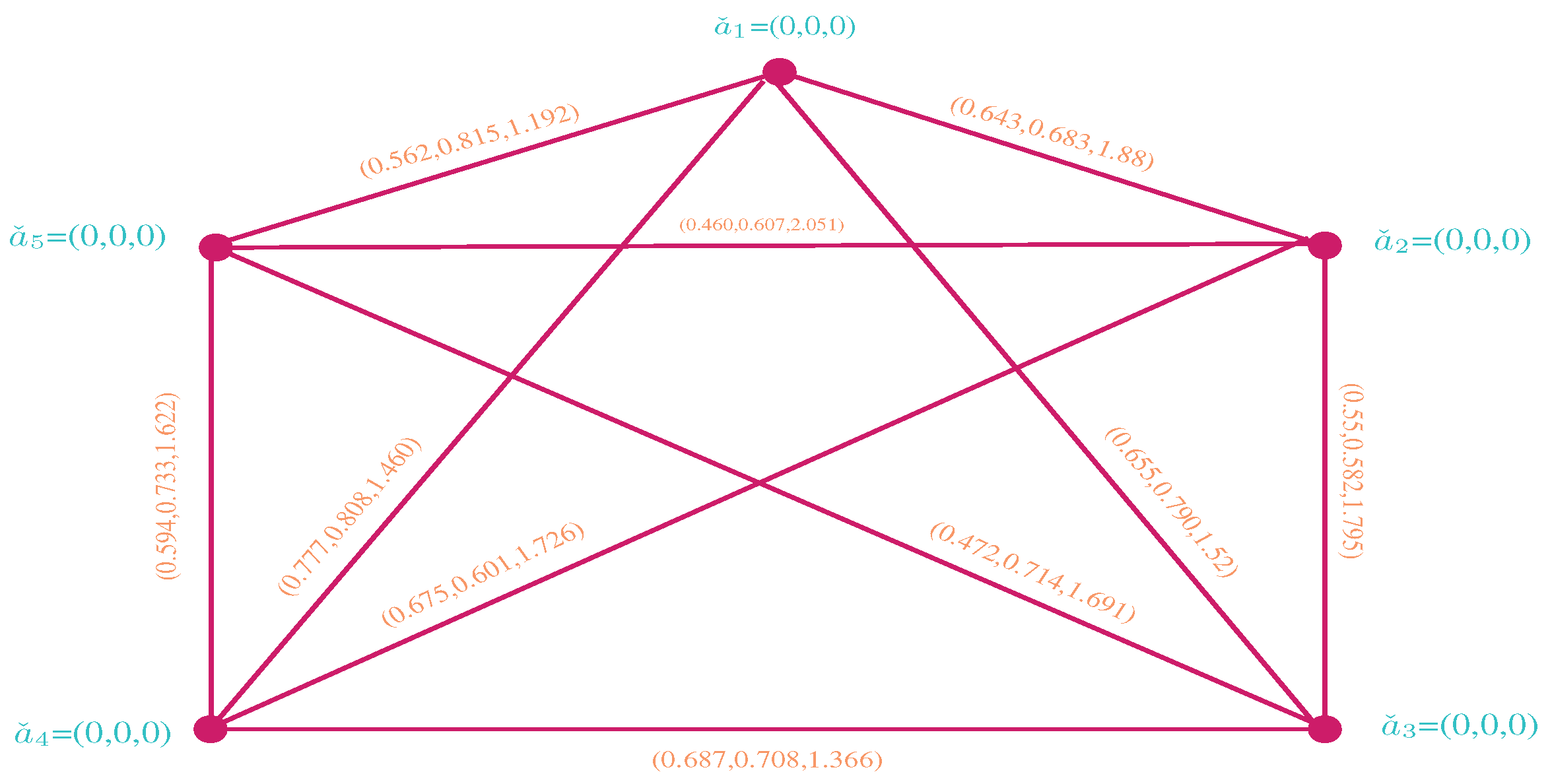
The spherical fuzzy Zagreb relations related to , where i = (1, 2, 3, 4) are shown graphically in Figure 8 and Figure 9. These figures elaborate on the concept of the connectedness of the edges. These graphs corresponding to spherical fuzzy Zagreb relations are more strengthened than the SFGs represented in Figure 6 and Figure 7.
Figure 8.
The graphical representation of spherical fuzzy Zagreb relations to , .
Figure 9.
The graphical representation of spherical fuzzy Zagreb relations to and .
The spherical fuzzy Zagreb energy of each is calculated as
The weight of each expert is computed as
From the aggregation of four SFZPRs, the collective spherical fuzzy Zagreb preference relation (SFZPR) is calculated as
The collective SFZPR is shown in Figure 10. In the representation of this collective SFZPR, as exhibited in Figure 10, we choose spherical fuzzy membership, whose truthiness degrees are . The obtained partial model is depicted in Figure 11.
Figure 10.
Model of the combined SFZPR.
Figure 11.
Partial model of the combined SFZPR.
We calculate the degrees in a partial directed model as follows: , , , , and .
Since has the largest degree, we have the positioning of the alternatives as
Thus, the best choice for selecting location is .
5.2. Comparative Analysis
The comparative inspection with previously existing procedures is needed to examine the feasibility and validity of the proposed technique. By comparative analysis, it can be seen that one adopts whatever techniques and methods are either more accurate to one another or whose results should be the same.Here, we compare our proposed model to the already existing one. In the existing technique, which was proposed in [44], the directed spherical fuzzy graphs with their corresponding adjacency matrices are considered. The spherical fuzzy energy of all adjacency matrices is calculated by adding the absolute value of their eigenvalues. The average operator is applied to aggregate the obtained results. In that technique, the ranking of alternatives is based on the out-degree, which is greater than 0.5 in the partial model of SFGs. In our proposed model, we consider Zagreb spherical fuzzy matrices as compared to the adjacency matrices of SFGs, which give us a more reliable and feasible solution since, in our proposed technique, the concept of the degree of vertices is involved, which encounters the connectivity of the neighborhoods of the vertices. The consequences related to the methodologies are summarized in Table 8 and Table 9.
Table 8.
Comparison of degrees of the alternatives with existing techniques.
Table 9.
Comparison of ranking.
Eventually, the result for the positioning of the options of the existing strategy is similar to the presented technique, which shows the accuracy and viability of the proposed procedure. Clearly, the technique introduced in this paper is more exact, adaptable, and generalized.
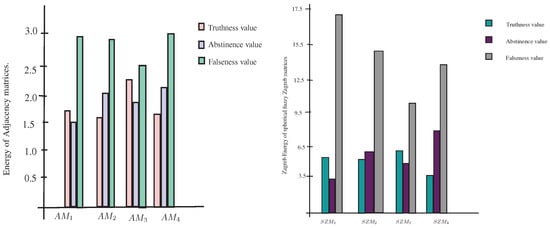
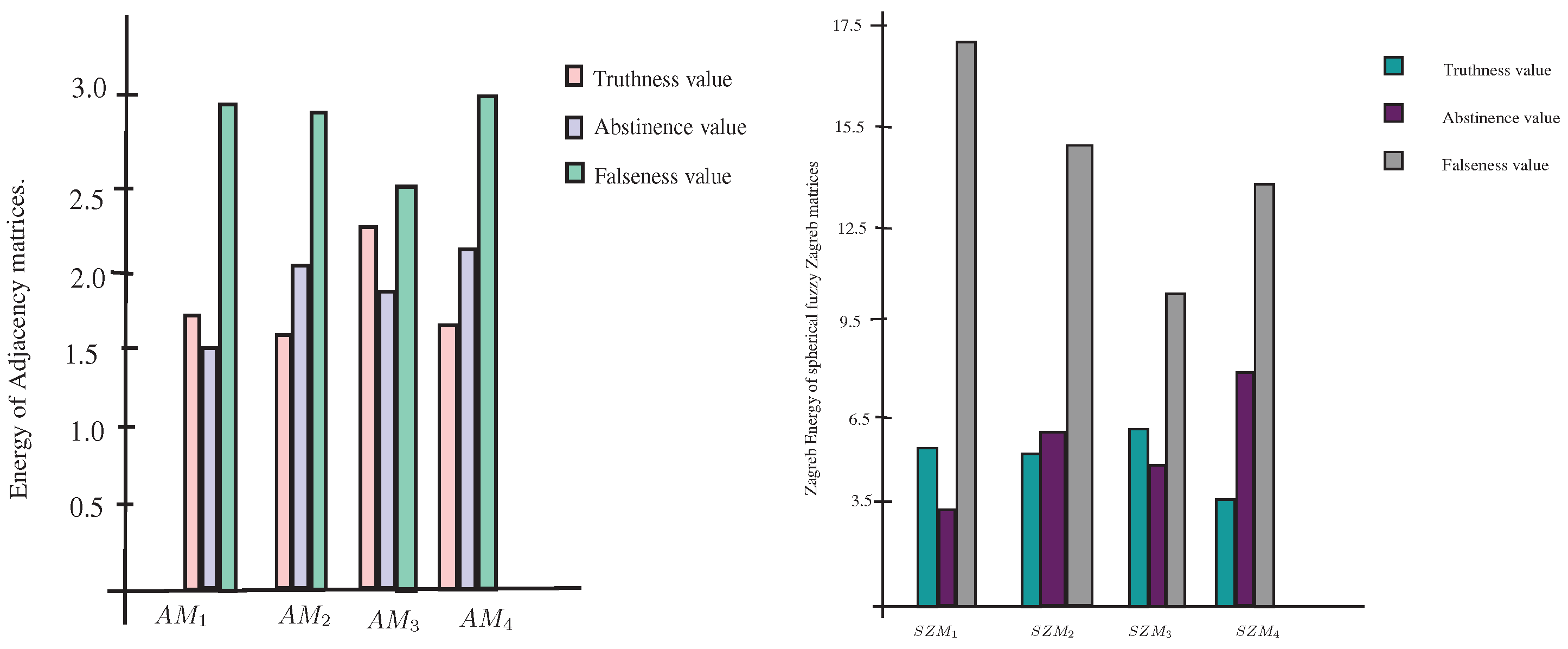
The comparison between the proposed and existing techniques, via finding the energy and Zagreb energy of adjacency matrices and SFGs, respectively, is graphically displayed in Figure 12.
Figure 12.
Comparison between energy of AMs and Zagreb energy of SZMs.
6. Conclusions
Spherical fuzzy sets are the generalization of picture fuzzy sets, as they enlarge the space of membership degrees of truthiness, abstinence, and falseness in the unit interval satisfying the condition . Spherical fuzzy models can handle uncertainty problems more efficiently when a person has different viewpoints like yes, abstain, no, and refusal as compared to the fuzzy set, intuitionistic fuzzy set, Pythagorean fuzzy set, and picture fuzzy set. Topological indices play a crucial role in fuzzy graph theory. One of the important indices are the fuzzy Zagreb index, which includes the fuzzy first, second, and hyper Zagreb index. The Zagreb index is the degree-based index, which encounters the strength of vertices as well as the strength of the fuzzy graph too.
In this research article, we discussed spherical fuzzy Zagreb indices and determined some bounds. Further, we studied how the spherical fuzzy Zagreb matrix of SFG is defined. The concept of the spectrum of SFG was introduced. In addition, we computed the spherical fuzzy Zagreb energy of the spherical fuzzy graph. Further, we extracted some bounds of spherical fuzzy Zagreb energy. Finally, we presented an application to ensure the applicability of our proposed model. In future, our goal is to extend the notion of this work to the following:
- Hesitant SFGs.
- SF hypergraphs.
- Interval-valued SFGs.
- Single-valued SFGs.
- Complex spherical fuzzy Hamacher aggregation operators.
Author Contributions
Conceptualization, G.F.; methodology, G.F., L.A. and S.I.; formal analysis, G.F., U.A., L.A. and S.I.; investigation, U.A. and S.I.; writing—review and editing, U.A. and S.I. All authors have read and agreed to the published version of the manuscript.
Funding
This work was supported by the National Natural Science Foundation of China under Grant 61972107.
Data Availability Statement
No data were used to support this study.
Conflicts of Interest
The authors declare no conflict of interest.
References
- Zadeh, L.A. Fuzzy sets. Inf. Control 1965, 3, 338–353. [Google Scholar] [CrossRef] [Scilit]
- Atanassov, K.T. Intuitionistic fuzzy sets. Fuzzy Sets Syst. 1986, 20, 87–96. [Google Scholar] [CrossRef] [Scilit]
- Cuong, B.C. Picture fuzzy sets-First results, Part 1. In Seminar Neuro-Fuzzy Systems with Applications; Institute of Mathematics, Vietnam Academy of Science and Technology: Hanoi, Vietnam, 2013. [Google Scholar]
- Cuong, B.C. Picture fuzzy sets-First results, Part 2. In Seminar Neuro-Fuzzy Systems with Applications; Institute of Mathematics, Vietnam Academy of Science and Technology: Hanoi, Vietnam, 2013. [Google Scholar]
- Garg, H. Some picture fuzzy aggregation operators and their applications to multicriteria decision-making. Arab. J. Sci. Eng. 2017, 42, 5275–5290. [Google Scholar] [CrossRef] [Scilit]
- Gundogdu, F.K.; Kahraman, C. Spherical fuzzy sets and spherical fuzzy TOPSIS method. J. Intell. Fuzzy Syst. 2018, 36, 1–16. [Google Scholar]
- Ashraf, S.; Abdulla, S.; Mahmood, T.; Mahmood, F. T-Spherical fuzzy sets and their applications in multi-attribute decision making problems. J. Intell. Fuzzy Syst. 2018, 36, 2829–2844. [Google Scholar] [CrossRef] [Scilit]
- Ashraf, S.; Abdullah, S.; Mahmood, T. Spherical fuzzy Dombi aggregation operators and their application in group decision making problem. J. Ambient Intell. Humaniz. Comput. 2019, 11, 2731–2749. [Google Scholar] [CrossRef] [Scilit]
- Mahmood, T.; Kifayat, U.; Khan, Q.; Jan, N. An approach toward decision-making and medical diagnosis problems using the concept of spherical fuzzy sets. Neural Comput. Appl. 2018, 31, 7041–7053. [Google Scholar] [CrossRef] [Scilit]
- Alcantud, J.C.R. Complemental Fuzzy Sets: A semantic justification of q-rung orthopair fuzzy sets. IEEE Trans. Fuzzy Syst. 2023, 1–9. [Google Scholar] [CrossRef] [Scilit]
- Yager, R.R. Generalized orthopair fuzzy sets. IEEE Trans. Fuzzy Syst. 2017, 25, 1222–1230. [Google Scholar] [CrossRef] [Scilit]
- Li, L.; Zhang, R.; Wang, J.; Shang, X.; Bai, K. A novel approach to multi-attribute group decision-making with q-rung picture linguistic information. Symmetry 2018, 10, 172. [Google Scholar] [CrossRef] [Scilit]
- Kaufmann, A. Introduction to the Theory of Fuzzy Sets, Fundamental Theoretical Elements; Academic Press: New York, NY, USA, 1980; Volume 1. [Google Scholar]
- Kosari, S.; Shao, Z.; Rao, Y.; Liu, X.; Cai, R.; Rashmanlou, H. Some Types of Domination in Vague Graphs with Application in Medicine. J. Mult.-Valued Logic Soft Comput. 2023, 40, 203–219. [Google Scholar]
- Kou, Z.; Kosari, S.; Akhoundi, M. A Novel Description on Vague Graph with Application in Transportation Systems. J. Math. 2021, 2021, 4800499. [Google Scholar] [CrossRef] [Scilit]
- Qiang, X.; Akhoundi, M.; Kou, Z.; Liu, X.; Kosari, S. Novel Concepts of Domination in Vague Graphs with Application in Medicine. Math. Probl. Eng. 2021, 10, 6121454. [Google Scholar] [CrossRef] [Scilit]
- Kosari, S.; Shao, Z.; Shi, X.; Sheikholeslami, S.M.; Chellali, M.; Khoeilar, R.; Karamib, H. Cubic graphs have paired-domination number at most four-seventh of their orders. Discret. Math. 2022, 345, 113086. [Google Scholar] [CrossRef] [Scilit]
- Rosenfeld, A. Fuzzy Sets and Their Applications to Cognitive and Decision Processes; Elsevier: Amsterdam, The Netherlands, 1975; pp. 77–95. [Google Scholar]
- Rao, Y.; Kosari, S.; Shao, Z.; Qiang, X.; Akhoundi, M.; Zhang, X. Equitable domination in vague graphs with application in medical sciences. Front. Phys. 2021, 9, 635–642. [Google Scholar] [CrossRef] [Scilit]
- Rao, Y.; Kosari, S.; Shao, Z.; Cai, R.; Xin, L. A Study on Domination in vague incidence graph and its application in medical sciences. Symmetry 2020, 12, 1885. [Google Scholar] [CrossRef] [Scilit]
- Shi, X.; Kosari, S. Certain Properties of Domination in Product VagueGraphs With an Application in Medicine. Front. Phys. 2021, 9, 680634. [Google Scholar] [CrossRef] [Scilit]
- Thomson, M.G. Convergence of powers of a fuzzy matrix. J. Math. Anal. Appl. 1977, 57, 476–480. [Google Scholar] [CrossRef] [Scilit]
- Zimmermann, H.-J. Fuzzy set theory and mathematical programming. In Fuzzy Sets Theory and Applications; Springer: Berlin/Heidelberg, Germany, 1986; pp. 99–114. [Google Scholar]
- Rashmanlou, H.; Jun, Y.B.; Borzooei, R.A. More results on highly irregular bipolar fuzzy graphs. Ann. Fuzzy Math. Inform. 2014, 8, 149–168. [Google Scholar]
- Zeng, S.S.; Shoaib, M.; Ali, S.; Smarandache, F.; Rashmanlou, H.; Mofidnakhae, F. Certain Properties of Single-Valued Neutrosophic Graph With Application in Food and Agriculture Organization. Int. J. Comput. Intell. Syst. 2021, 14, 1516–1540. [Google Scholar] [CrossRef] [Scilit]
- Akram, M.; Habib, A.; Ilyas, F.; Dar, J.M. Specific types of Pythagorean fuzzy graphs and application to decision-making. Math. Comput. Appl. 2018, 23, 42. [Google Scholar] [CrossRef] [Scilit]
- Akram, M.; Saleem, D.; Al-Hawary, T. Spherical Fuzzy Graphs with Application to Decision-Making. Math. Comput. Appl. 2020, 25, 8. [Google Scholar] [CrossRef] [Scilit]
- Akram, M. Decision Making Method Based on Spherical Fuzzy Graphs. In Studies in Fuzziness and Soft Computing; Kahraman, C., Otay, L., Eds.; Springer: Berlin/Heidelberg, Germany, 2020. [Google Scholar]
- Guleria, A.; Bajaj, R.K. T-Spherical Fuzzy Graphs: Operations and Applications in various Selection Processes. Arab. J. Sci. Eng. 2019, 45, 2177–2193. [Google Scholar] [CrossRef] [Scilit]
- Gutman, I.; Trinajstic, N. Graph theory and molecular orbitals, total ϕ-electron energy of alternant hydrocarbons. Chem. Phys. Lett. 1972, 17, 535–538. [Google Scholar] [CrossRef] [Scilit]
- Gutman, I. The energy of a graph. Ber. Math. Statist. Sekt. Forsch-Ungszentram Graz. 1978, 103, 122. [Google Scholar]
- Gutman, I.; Zhou, B. Laplacian energy of a graph, Linear Agebra and its Application. J. Linear Algebra Appl. 2006, 414, 29–37. [Google Scholar] [CrossRef] [Scilit]
- Kalathian, S.; Ramalingam, S.; Sundareswaran, R.; Srinivasan, N. Some topological indices in fuzzy graphs. J. Intell. Fuzzy Syst. 2020, 39, 6033–6046. [Google Scholar] [CrossRef] [Scilit]
- Islam, S.R.; Pal, M. First Zagreb index on a fuzzy graph and its application, Computer science. J. Intell. Fuzzy Syst. 2021, 40, 10575–10587. [Google Scholar] [CrossRef] [Scilit]
- Ahmad, U.; Khan, N.K.; Saeid, A.B. Fuzzy topological indices with application to cybercrime problem. Granul. Comput. 2023, 8, 967–980. [Google Scholar] [CrossRef] [Scilit]
- Ahmad, M.; Nawaz, I. Wiener Index of a Directed Rough Fuzzy Graph and Application to Human Trafficking. J. Intell. Fuzzy Syst. 2023, 44, 1479–1495. [Google Scholar] [CrossRef] [Scilit]
- Ahmad, U.; Sabir, M. Multicriteria Decision Making based on the Degree and Distance Based Indices of Fuzzy Graphs. Granul. Comput. 2022, 8, 793–807. [Google Scholar] [CrossRef] [Scilit]
- Anjali, N.; Mathew, S. Energy of a fuzzy graph. Ann. Fuzzy Math. Inf. 2013, 6, 455–465. [Google Scholar]
- Sharbaf, S.R.; Fayazi, F. Laplacian energy of a fuzzy graph, Iran. J. Math. Chem. 2014, 5, 1–10. [Google Scholar]
- Kale, M.; Minirani, S. Fuzzy Zagreb indices and some bounds for fuzzy Zagreb energy. Int. J. Anal. Appl. 2021, 19, 252–263. [Google Scholar]
- Praba, B.; Chandrasekaran, V.M.; Deepa, G. Energy of an intuitionistic fuzzy graph. Ital. J. Pure Appl.-Math.-N. 2014, 32, 431–444. [Google Scholar]
- Akram, M.; Naz, S. Energy of Pythagorean Fuzzy Graphs with Applications. Mathematics 2018, 6, 136. [Google Scholar] [CrossRef] [Scilit]
- Akram, M.; Saleem, D.; Davvaz, B. Energy of double dominating bipolar fuzzy graphs. J. Appl. Math. Comput. 2019, 61, 219–234. [Google Scholar] [CrossRef] [Scilit]
- Shi, X.; Kosari, S.; Asghar Talebi, A.; Hossein Sadati, S.; Rashmanlou, H. Investigation of the main energies of picture fuzzy graph and its applications. Int. J. Comput. Intell. Syst. 2022, 15, 31. [Google Scholar] [CrossRef] [Scilit]
- Yahya, M.S.; Mohamed, A.A. Energy of spherical fuzzy graphs. Adv. Math. Sci. J. 2020, 9, 321–332. [Google Scholar]
- Yager, R.R. Generalized OWA aggregation operators. Fuzzy Optim. Decis. Mak. 2004, 3, 93–107. [Google Scholar] [CrossRef] [Scilit]

Disclaimer/Publisher’s Note: The statements, opinions and data contained in all publications are solely those of the individual author(s) and contributor(s) and not of MDPI and/or the editor(s). MDPI and/or the editor(s) disclaim responsibility for any injury to people or property resulting from any ideas, methods, instructions or products referred to in the content. |
© 2023 by the authors. Licensee MDPI, Basel, Switzerland. This article is an open access article distributed under the terms and conditions of the Creative Commons Attribution (CC BY) license (https://creativecommons.org/licenses/by/4.0/).