


Abstract
This paper is devoted to the study of the double domination in vague graphs, and it is a contribution to the Special Issue “Advances in graph theory and Symmetry/Asymmetry” of Symmetry. Symmetry is one of the most important criteria that illustrate the structure and properties of fuzzy graphs. It has many applications in dominating sets and helps find a suitable place for construction. Vague graphs (VGs), which are a family of fuzzy graphs (FGs), are a well-organized and useful tool for capturing and resolving a range of real-world scenarios involving ambiguous data. In the graph theory, a dominating set (DS) for a graph is a subset of the vertices X so that every vertex which is not in is adjacent to at least one member of . The subject of energy in graph theory is one of the most attractive topics serving a very important role in biological and chemical sciences. Hence, in this work, we express the notion of energy on a dominating vague graph (DVG) and also use the concept of energy in modeling problems related to DVGs. Moreover, we introduce a new notion of a double dominating vague graph (DDVG) and provide some examples to explain various concepts introduced. Finally, we present an application of energy on DVGs.
1. Introduction
Zadeh [1] introduced the subject of a fuzzy set (FS) in 1995. Rosenfeld [2] proposed the subject of FGs. The definition of FGs was presented by Kaufmann [3]. Akram et al. [4,5,6] explained several concepts in FGs. Gau and Buehrer [7] introduced the notion of a vague set (VS) in 1993. The concept of VGs was defined by Ramakrishna [8]. VGs belong to the FG family, such that have several applications in real-life systems. The system varies with time and has different accuracy levels. Rashmanlou et al. [9,10,11] investigated different subjects of VGs. Moreover, Akram et al. [12,13,14] developed several results on VGs. Kosari et al. [15] defined vague graph structure and studied its properties. Borzooei [16] proposed the degree of vertices in VGs. Haynes et al. [17] expressed the fundamentals of domination in graphs.
Symmetry is a kind of invariant or a feature that a mathematical object remains the same under some operations or transformations. However, symmetry is a significant feature in FG theory, especially in fuzzy DSs. Symmetric graphs have been the subject of much research. For instance, there are known and famous connections between symmetric configurations and regular bipartite graphs. The concept of DSs in VGs, both theoretically and practically, is very valuable. DSs in VGs are used for solving problems of different branches in applied sciences such as location problems. In this way, the study of new concepts such as the DS is essential in VGs. The domination in VGs has applications in several fields. The domination emerges in the facility location problems, where the number of facilities is fixed, and one endeavors to minimize the distance that a person needs to travel to get to the closest facility. Nagoor Gani and Prasanna Devi [18] suggested the reduction in the domination number of an FG and the notion of 2-domination in FGs [19] as the extension of 2-domination in crisp graphs. In another study, Somasundram [20] proposed the domination notion in FGs. The domination in product FGs and intuitionistic FGs were studied by Mahioub [21,22]. Karunambigai et al. and Rao et al. [23,24,25] expressed certain domination properties in vague incidence graphs. Kosari et al. [26,27,28] studied the domination of product VGs. The DS concept in FGs, both theoretically and practically, is very valuable. A DS in FGs is used for solving problems of different branches in applied sciences such as location problems. In this way, the study of new concepts, such as DSs, seems essential in FGs. The domination in VGs has numerous applications in several fields. Qiang et al. [29] introduced new domination concepts in VGs.
The DDS and double domination number (DDN) were first defined and introduced by Harary and Haynes in [30] as cited in [31]. Rashmanlou [32] expressed a new concept of Ring sum in product intuitionistic FGs. Gutman [33] introduced the graph energy concept. New results on energy are proposed in [34,35,36]. Anjali and Sunil Mathew [37] extended the energy of the graph to the energy of FGs. Gutman et al. [38] introduced that the Laplacian energy of a graph is the sum of the absolute deviations (i.e., the distance from the mean) of the eigenvalues of its Laplacian Matrix. Although VGs are better at expressing uncertain variables than FGs, they do not perform well in many real-world situations, such as IT management. Therefore, when the data come from several factors, it is necessary to use VGs. Zeng et al. presented new results in [39,40].
In this paper, we introduced a new notion of DSs in VGs. Finally, an application was proposed.
2. Preliminaries
In this section, we present some preliminary results which will be used throughout the paper. In Table 1, we show the essential notations.
Table 1.
Some essential notations.
Definition 1.
A graph is a pair where X is called the vertex set and is called the edge set.
Definition 2.
A pair is an FG on a graph where ζ is an FS on X and η is an FS on E, such that
for all
Definition 3
([7]). A vague set (VS) is a pair on set X, where and are real-valued functions that can be defined on so that,
Definition 4
([8]). A pair is called a VG on graph , where is a VS on X and is a VS on E such that
for all . is called VS on . A VG is named strong if
for all
Definition 5.
A quadruple form is named DVG, where denotes a degree of membership and denotes a degree of non-membership, defined as
for
Note: The DS means a subset is named DS in if for each , there exists one vertex r in so that r dominates s, i.e.,
Definition 6.
Suppose is a DVG. Suppose , we say that r dominates s in if there exists strong edge from r to s. A subset is named DS in if for each , there exists r in such that r dominates s.
A DS of is called to be a minimal DS if no proper subset of is a DS of .
The minimum cardinality of a minimal DS in is named the domination number (DN) of and is denoted by and the corresponding minimal DS is named the minimum DS of .
Definition 7.
and
Suppose is a DVG. The adjacency matrix (AM) of a DVG is defined as , in which where and represent the strength of relationship between and , respectively.
This AM of a DVG can be written in two different matrices as , where
Definition 8.
The spectrum of AM of a DVG is defined as , where and are the sets of eigenvalues of and , respectively.
Definition 9.
The energy of a DVG is defined as
where and .
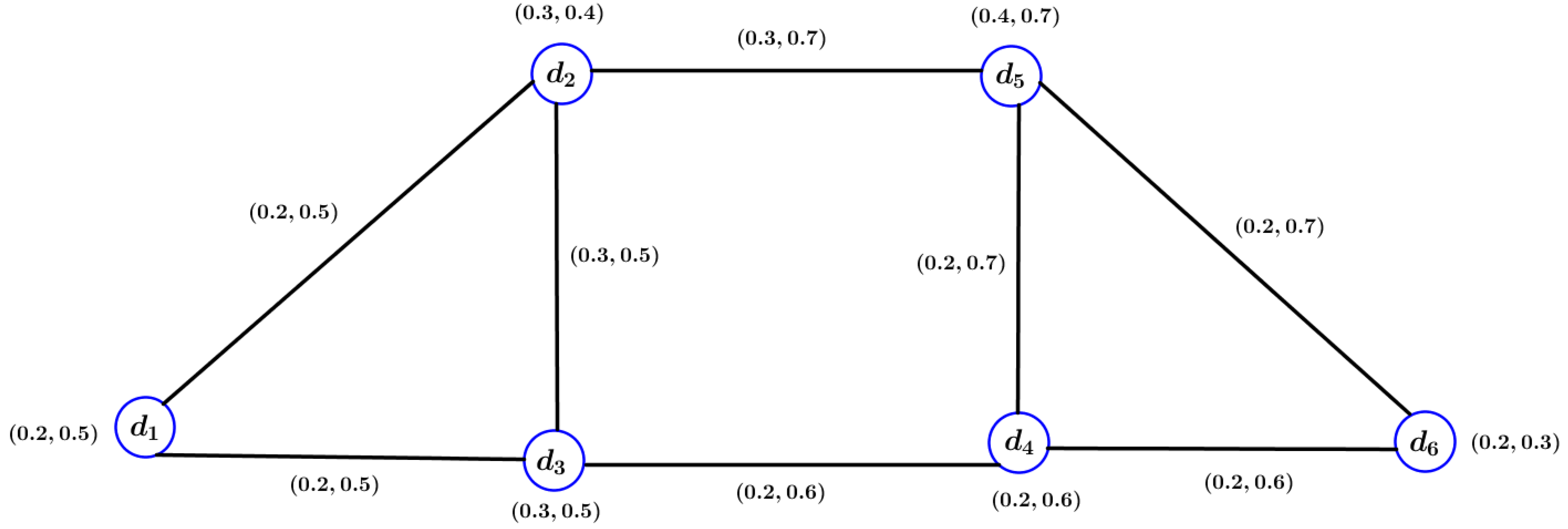
Example 1.
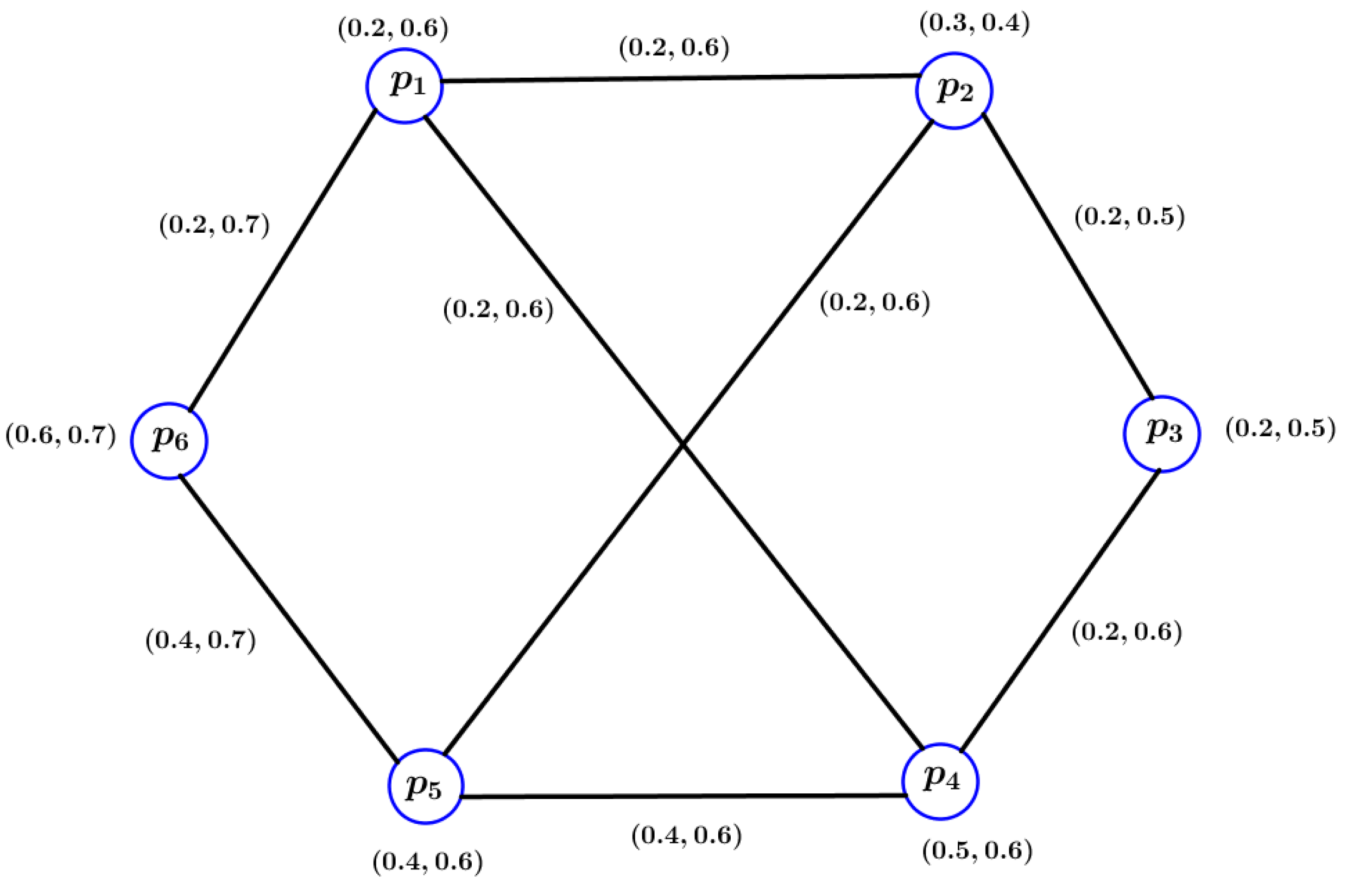
Consider a DVG on and are defined by and , as shown in Figure 1.
Similarly,
Moreover,
Similarly,
Here, dominates and dominates because
Therefore, is a DS because every vertex in is dominated by at least one vertex in The AM of DVG is given below
Figure 1.
Dominating VG.
=
We can write in two different matrices as
=
and
=
We obtain
Therefore,
.
The energy of DVG is
Theorem 1.
Suppose is a DVG with p vertices and m edges. Suppose is a DS. If are the eigenvalues of AM , then
and if are the eigenvalues of AM , then
where
Proof.
(i) By the trace property of matrices, we have
(ii) Equivalently, the sum of square of eigenvalues of
Similarity, we can show that
□
Theorem 2.
Suppose is a DVG with p vertices and m edges. If is the DS, then
where and
where and
Proof.
(i) By Cauchy Schwarz inequality, we have
Upper bound
If and then
Lower bound
However,
Therefore,
Combining upper bound and lower bound, we have
Similarity, we can show that
For example, the equality is satisfied for the family of graphs in the form of union . □
Theorem 3.
Suppose is a VG and is the AM of Suppose is the DVG of and is the DVG AM of . Then
Proof.
Now
Similarity, we can show that
□
3. Energy of Double Dominating Vague Graphs
In this section, we defined the notion of energy of double dominating vague graphs.
Definition 10.
A graph is named DDVG, where denotes a degree of membership and denotes a degree of non-membership, defined as and
Note: The double dominating set (DDS) means a subset is named DDS in if for each , there exists two vertices r in such that r dominates s, i.e.,
Definition 11.
Suppose is a DDVG. Suppose , we say that r dominates s in if there exists strong edge from r to s. A subset is named DDS in if for each , there exists r in such that r dominates s.
A DDS of X is said to be a minimal DDS if no proper subset of is a DDS of . The minimum cardinality of a minimal DDS in is called the DDN of and is denoted by and the corresponding minimal DDS is called the minimum DDS of .
Figure 2.
DVG.
Theorem 4.
For any VG, then .
Proof.
Suppose is a VG. Suppose is a DS and is a DDS of . If , then . If , then has at least one vertices more than and hence, . Therefore, . □
Theorem 5.
Suppose is a VG with DDS. Then .
Proof.
Suppose is a VG. Suppose is the DDS. Then, . Therefore, . □
Theorem 6.
Suppose is a VG, then .
Proof.
Suppose is a VG. Then, by Theorem 5, . Therefore, . □
Definition 12.
Suppose is a DDVG. The adjacency matrix (AM) of is defined as , where
This AM of can be written in two different matrices as , where
and
Definition 13.
The spectrum of AM of a DDVG is defined as , where and are the sets of eigenvalues of and , respectively.
Definition 14.
The energy of a DDVG is defined as
where and .
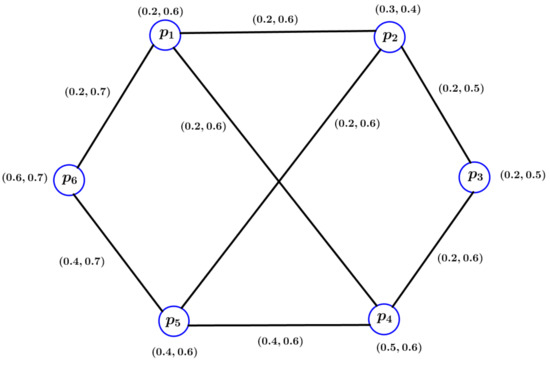
Example 3.
Consider a DVG on and are defined by and , as shown in Figure 3.
Similarly,
Moreover,
Similarly,
Here, dominates and dominates and dominates because,
Figure 3.
Double dominating VG.
Therefore, is a DDS because every vertex in , is dominated by atleast two vertices in The AM of DVG is given below
=
We can write in two different matrices as
=
and
=
We obtain
Therefore,
.
The energy of DVG is
Theorem 7.
Suppose is a DDVG with p vertices and m edges. Suppose is a DDS. If are the eigenvalues of AM , then
and if are the eigenvalues of AM , then
where
Proof.
By using similar information as used in Theorem 1. □
Theorem 8.
Suppose is a DDVG with p vertices and m edges. If is the DDS, then
where and
where and
Proof.
By using similar information as used in Theorem 2. □
Theorem 9.
Suppose is a VFG and is the AM of Suppose is the DDVG of and is the AM of . Then
Proof.
By using similar information as used in Theorem 3. □
4. Application to Select the Best Medical Laboratories
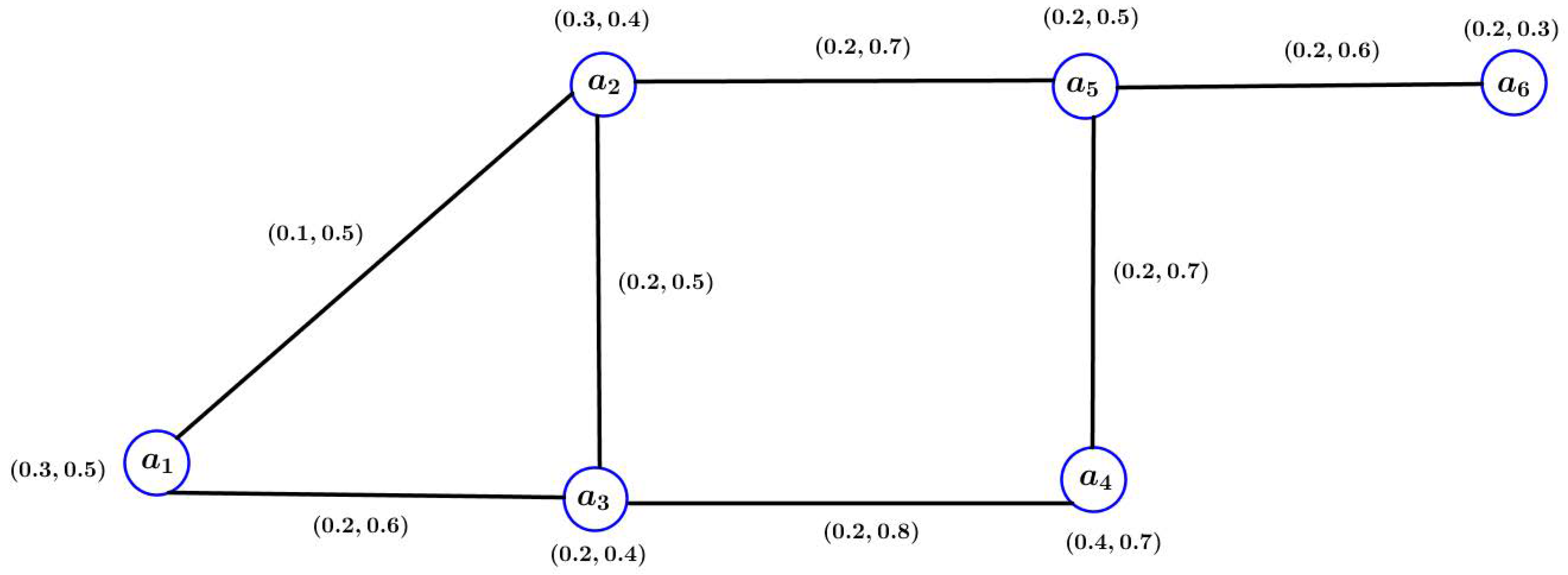
Assume that there are six different medical labs working in a city for conducting tests. The vertices show the laboratories and the edges show the contract conditions among the laboratories to share the facilities or test kits. To make a domination collection among these labs, a collection of labs that have higher quality and have good communication with other laboratories is assumed. It is necessary to find the minimal dominant set to obtain a dominance number. Furthermore, to construct a minimal dominant set with a lab that has higher features (fuzzy vertex value), the maximum neighborhood with the value of the effective edge should be preferred.
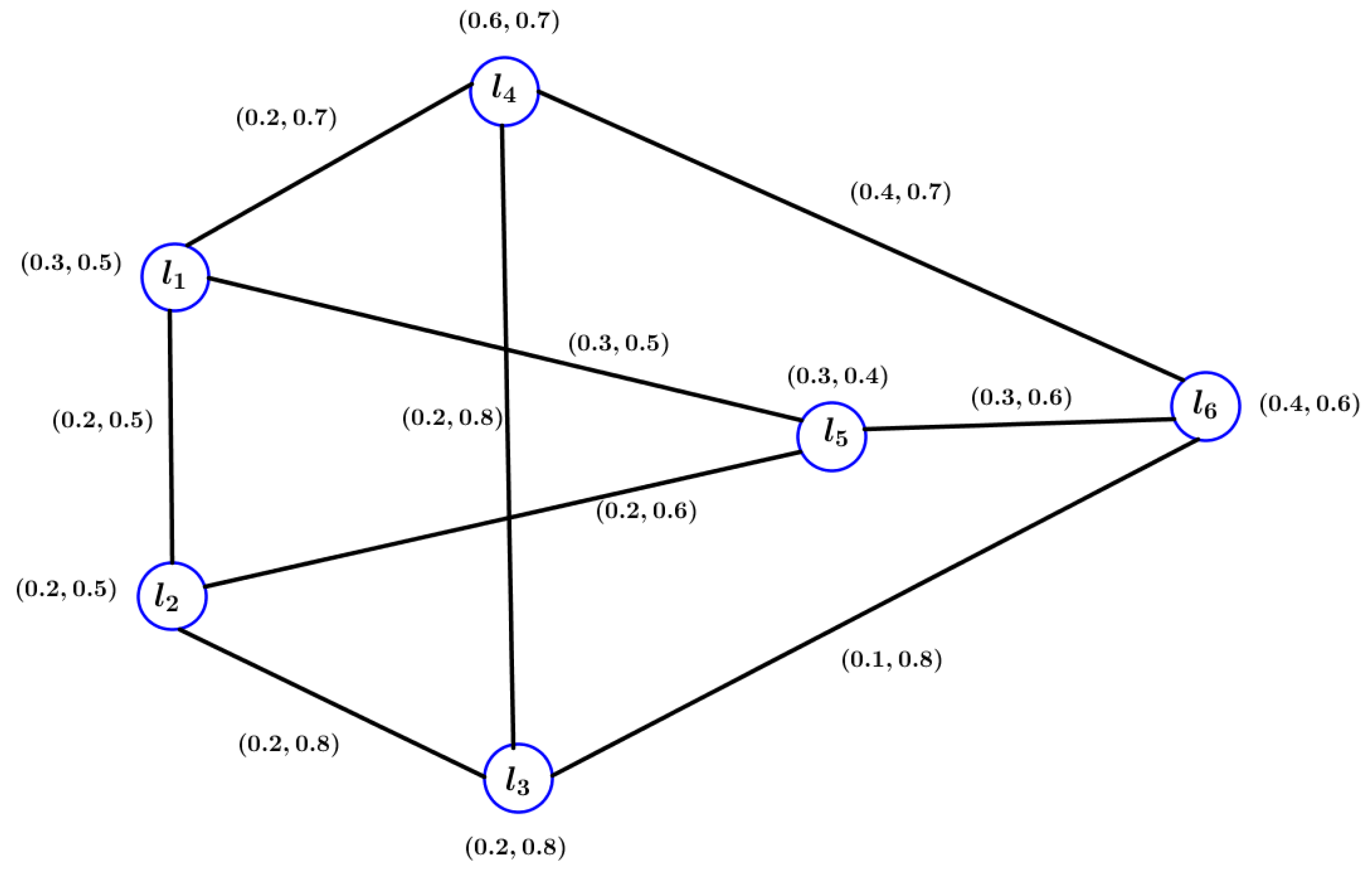
Consider a city with 6 labs framed as a VG with 6 vertices as shown in Figure 4. The labs are considered vertex sets of VG, as shown in Table 2. The relationship between the labs is considered an edge set of VG, as shown in Table 3. Here, we have to choose the labs that have the quality level and available facilities from the rest of the labs, which are the DSs.
Figure 4.
Dominating VG .
Table 2.
The membership and non-membership of vertices of DVFG .
Table 3.
The membership and non-membership of edges of DVFG .
Consider DVG on X and are, therefore, defined by and . The quality level of labs is shown in Table 4.
Table 4.
The quality level of labs.
Here, lab dominates labs and lab dominates labs and lab dominates labs , because
It means that labs have a quality level and available facilities from the rest of the labs, thus, is a DS because every lab is dominated by at least two labs. After selecting the minimum labs that have access to the rest of the labs and are at a high level in terms of facilities and diagnosis of diseases, we will examine the performance of the labs of this city, so by calculating a new concept of energy on the DVG, we presented the quality of the labs. First, we obtain the AM of DVG , which is given below
=
Then we can write the two different matrices as
=
and
=
We obtain
The energy of DVG is
In this part, we conclude that by choosing three laboratories and equipping them and raising their quality level, the level of diagnosis performance in the labs will increase.
5. Conclusions
A VG is suitable for modeling uncertainty-related problems that necessitate human knowledge and evaluation. Moreover, DSs have a wide range of applications in VGs for the analysis of vague information, and also, serve as one of the most widely used topics in VGs in various sciences. In this research, we described a new concept of the DS in VGs. We also defined DDVG. We have presented the notion of the energy of the DVG and we discussed some properties and bounds for the energy of DVG and DDVG. Finally, an application of DVG was presented. In future work, we will define a DVG structure and study the DS energy of VG structure.
Author Contributions
Y.R., R.C. and A.A.T.; methodology, R.C., M.M. and Y.R.; validation, R.C. and A.A.T.; formal analysis, Y.R. and M.M.; investigation, M.M., A.A.T. and R.C.; data curation, A.A.T., R.C. and Y.R.; writing—original draft preparation, Y.R. and A.A.T.; writing—review and editing, R.C., A.A.T. and M.M.; visualization, M.M., Y.R. and R.C.; supervision, R.C. and project administration, Y.R. and A.A.T.; funding acquisition, Y.R. All authors have read and agreed to the published version of the manuscript.
Funding
This work was supported by the National Natural Science Foundation of (No. 62172116, 61972109), and the Basic Research Program of Guizhou Province (No. QiankeHe ZK [2023] 279).
Data Availability Statement
Not applicable.
Conflicts of Interest
The authors declare no conflict of interest.
References
- Zadeh, L.A. Fuzzy set. Inf. Control 1965, 8, 338–353. [Google Scholar] [CrossRef]
- Rosenfeld, A. Fuzzy Graphs, in Fuzzy Sets and Their Applications to Cognitive and Decision Processes; Elsevier: Amsterdam, The Netherlands, 1975; pp. 77–95. [Google Scholar]
- Kaufmann, A. Introduction a la Theorie des Sour-Ensembles Flous; Masson et Cie: Paris, France, 1973; Volume 1. [Google Scholar]
- Akram, M.; Sitara, M.; Saeid, A.B. Residue product of fuzzy graph structures. J. Mult. Valued Log. Soft Comput. 2020, 34, 365–399. [Google Scholar]
- Akram, M.; Sitara, M. Certain fuzzy graph structures. J. Appl. Math. Comput. 2019, 61, 25–56. [Google Scholar] [CrossRef]
- Akram, M.; Sitara, M.; Yousaf, M. Fuzzy graph structures with application. Mathematics 2019, 7, 63. [Google Scholar]
- Gau, W.M.L.; Buehrer, D.J. Vague sets. IEEE Trans. Syst. Man Cybern. 1993, 23, 610–614. [Google Scholar] [CrossRef]
- Ramakrishna, N. Vague graphs. Int. J. Comput. Cogn. 2009, 7, 51–58. [Google Scholar]
- Rashmanlou, H.; Borzooei, R.A. Vague graphs with application. J. Intell. Fuzzy Syst. 2016, 39, 3291–3299. [Google Scholar] [CrossRef]
- Rashmanlou, H.; Samanta, S.; Pal, M.; Borzooei, R.A. A Study on Vague Graphs; Springer: Berlin/Heidelberg, Germany, 2016; Volume 5, pp. 12–34. [Google Scholar]
- Rashmanlou, H.; Borzooei, R.A. Domination in vague graphs and its applications. J. Intell. Fuzzy Syst. 2015, 29, 1933–1940. [Google Scholar]
- Akram, M.; Farooq, A.; Saeid, A.B.; Shum, K.P. Certain types of vague cycles and vague trees. J. Intell. Fuzzy Syst. 2015, 28, 621–631. [Google Scholar] [CrossRef]
- Akram, M.; Samanta, S.; Pal, M. Cayley Vague Graphs. J. Fuzzy Math. 2017, 25, 1–14. [Google Scholar]
- Akram, M.; Feng, F.; Sarwar, S.; Jun, Y.B. Certain types of vague graphs. UPB Sci. Bull. Ser. A Appl. Math. Phys. 2014, 76, 141–154. [Google Scholar]
- Kosari, S.; Rao, Y.; Jiang, H.; Liu, X.; Wu, P.; Shao, Z. Vague graph Structure with Application in medical diagnosis. Symmetry 2020, 12, 1582. [Google Scholar] [CrossRef]
- Borzooei, R.A.; Rashmanlou, H. Degree of vertices in vague graphs. J. Appl. Math. Inform. 2015, 33, 545–557. [Google Scholar] [CrossRef]
- Haynes, T.W.; Hedetniemi, S.T.; Slater, P.J. Fundamentals of Domination in Graphs; Marcel Dekker, Inc.: New York, NY, USA, 1998. [Google Scholar]
- Nagoor Gani, A.; Prasanna Devi, K. Reduction of domination parameter in fuzzy graphs. Glob. J. Pure Appl. Math. 2017, 7, 3307–3315. [Google Scholar]
- Nagoor Gani, A.; Prasanna Devi, K. 2-Domination in Fuzzy Graphs. Int. Fuzzy Math. Arch. 2015, 9, 119–124. [Google Scholar]
- Somasundaram, A.; Somasundaram, S. Domination in fuzzy graphs-I. Pattern Recognit. Lett. 1998, 19, 787–791. [Google Scholar] [CrossRef]
- Mahioub, M.M.Q. Domination in product fuzzy graphs. Adv. Comput. Math. Appl. 2012, 1, 119–125. [Google Scholar]
- Mahioub, M.M.Q. Domination in product intuitionistic fuzzy graphs. Adv. Comput. Math. Appl. 2012, 1, 174–182. [Google Scholar]
- Rao, Y.; Kosari, S.; Shao, Z. Certain properties of vague graphs with a novel application. Mathematics 2020, 8, 1647. [Google Scholar] [CrossRef]
- Rao, Y.; Kosari, S.; Shao, Z.; Qiang, X.; Akhoundi, M.; Zhang, X. Equitable domination in vague graphs with application in medical sciences. Front. Phys. 2021, 9, 635–642. [Google Scholar] [CrossRef]
- Rao, Y.; Kosari, S.; Shao, Z.; Cai, R.; Xinyue, L. A Study on Domination in vague incidence graph and its application in medical sciences. Symmetry 2020, 12, 1885. [Google Scholar] [CrossRef]
- Shi, X.; Kosari, S. Certain Properties of Domination in Product Vague Graphs With an Application in Medicine. Front. Phys. 2021, 9, 634–680. [Google Scholar] [CrossRef]
- Shi, X.; Kosari, S. New Concepts in the Vague Graph Structure with an Application in Transportation. J. Funct. Spaces 2022, 2022, 1504397. [Google Scholar] [CrossRef]
- Kou, Z.; Kosari, S.; Akhoundi, M. A novel description on vague graph with application in transportation systems. J. Math. 2021, 2021, 4800499. [Google Scholar] [CrossRef]
- Qiang, X.; Akhoundi, M.; Kou, Z.; Liu, X.; Kosari, S. Novel Concepts of Domination in Vague Graph with Application in Medicine. Math. Probl. Eng. 2021, 2021, 6121454. [Google Scholar] [CrossRef]
- Harary, F.; Haynes, T.W. Double domination in graphs. Arts Comb. 2000, 55, 201–213. [Google Scholar]
- Harary, F.; Haynes, T.W. Norhdhaus-Gaddum inequalities for domination in graphs. Discret. Math. 1996, 155, 99–105. [Google Scholar] [CrossRef]
- Borzooei, R.A.; Rashmanlou, H.R. Ring sum in product intuitionistic fuzzy graphs. J. Adv. Res. Pure Math. 2015, 7, 16–31. [Google Scholar] [CrossRef]
- Gutman, I. The energy of a graph. Ber. Math. Statist. Sekt. Forschungszentram Graz. Sci. Res. 1978, 103, 1–22. [Google Scholar]
- Brualdi, R.A. Energy of a Graph. Notes to AIM Workshop on Spectra of Families of Atrices Described by Graphs, Digraphs, and Sign Patterns. 2006. Available online: https://aimath.org/WWN/matrixspectrum/matrixspectrum.pdf (accessed on 3 September 2007).
- Liu, H.; Lu, M.; Tian, F. Some upper bounds for the energy of graphs. J. Math. Chem. 2007, 42, 377–386. [Google Scholar] [CrossRef]
- Gutman, I. The energy of a graph: Old and new results. In Algebraic Combinatorics and Applications; Betten, A., Kohner, A., Laue, R., Wassermann, A., Eds.; Springer: Berlin/Heidelberg, Germany, 2001; pp. 96–211. [Google Scholar]
- Anjali, N.; Sunil, M. Energy of a fuzzy graph. Ann. Fuzzy Math. Inf. 2013, 6, 455–465. [Google Scholar]
- Gutman, I.; Zhou, B. Laplacian energy of a graph. Linear Algebra Appl. 2006, 414, 29–37. [Google Scholar] [CrossRef]
- Zeng, S.; Shoaib, M.; Ali, S.; Smarandache, F.; Rashmanlou, H.; Mofidnakhaei, F. Certain Properties of Single-Valued Neutrosophic Graph With Application in Food and Agriculture Organization. Int. J. Comput. Intell. Syst. 2021, 14, 1516–1540. [Google Scholar] [CrossRef]
- Zeng, S.; Shoaib, M.; Ali, S.; Abbas, Q.; Shahzad Nadeem, M. Complex vague graphs and their application in decision-making problems. IEEE Access 2020, 8, 174094–174104. [Google Scholar] [CrossRef]

Disclaimer/Publisher’s Note: The statements, opinions and data contained in all publications are solely those of the individual author(s) and contributor(s) and not of MDPI and/or the editor(s). MDPI and/or the editor(s) disclaim responsibility for any injury to people or property resulting from any ideas, methods, instructions or products referred to in the content. |
© 2023 by the authors. Licensee MDPI, Basel, Switzerland. This article is an open access article distributed under the terms and conditions of the Creative Commons Attribution (CC BY) license (https://creativecommons.org/licenses/by/4.0/).