


Abstract
Restoration-oriented forest management is increasingly recognized as an important strategy for enhancing long-term carbon sequestration and rehabilitating degraded peri-urban forest landscapes. This study presents a scenario-based assessment of projected carbon sequestration trajectories under a National Reserve Forest Project implemented in peri-urban Wuhan, central China. Thirteen silvicultural models were grouped into three management pathways: intensive plantation cultivation, transformation of existing degraded stands, and tending of young and middle-aged forests. Carbon sequestration was evaluated over a 40-year assessment period (2024–2063) using a Biomass Expansion Factor-based accounting framework incorporating above- and belowground biomass, harvested wood products, and conservative baseline deductions consistent with national and provincial methodologies. The results indicate a sustained long-term increase in projected carbon sequestration despite periodic short-term declines associated with planned thinning and harvesting cycles. Transformation-oriented pathways contributed the largest cumulative project-scale sequestration and generally exhibited relatively strong area-normalized sequestration performance compared with intensive plantation and tending pathways. Intensive plantation systems displayed greater temporal fluctuation associated with shorter rotation cycles and repeated harvesting events. The analysis also highlights the importance of distinguishing between area-normalized sequestration efficiency and cumulative project-scale contribution, as models with moderate per-hectare performance generated substantial total carbon benefits because of their larger implementation area. The findings suggest that restoration-oriented management of existing degraded stands may provide a relatively stable long-term carbon-sequestration pathway in peri-urban forest systems where land availability for large-scale afforestation is constrained. The study also demonstrates the applicability of conservative scenario-based accounting frameworks for restoration-oriented forest carbon assessment and planning under data-limited conditions.
1. Introduction
Forest ecosystems play an important role in climate-change mitigation while simultaneously supporting timber production, biodiversity conservation, watershed protection, and broader ecosystem services [1,2,3]. Globally, restoration-oriented forest management has become increasingly important within climate governance frameworks aimed at enhancing long-term terrestrial carbon sinks and improving the resilience of degraded forest landscapes [4,5,6]. In China, large areas of plantation forests established during periods of rapid afforestation have experienced long-term structural degradation, excessive stand density, simplified species composition, and declining productivity, limiting their capacity for sustained carbon sequestration and ecological recovery [1,2]. Similar challenges have been reported in managed plantation systems internationally, where historical emphasis on rapid afforestation, timber yield, and area expansion has frequently resulted in structurally simplified stands with reduced long-term ecological performance and carbon stability [7,8].
In peri-urban regions, these constraints are often compounded by competing land-use pressures, fragmented landscape conditions, and the need to balance ecological restoration with long-term resource security and urban environmental quality [9,10,11]. On the metropolitan fringe of Wuhan, extensive areas of pure Pinus massoniana plantations and low-quality oak-dominated stands exhibit reduced canopy vigor, poor regeneration, and limited growth potential, highlighting the need for restoration-oriented management strategies that move beyond conventional plantation forestry [1]. Peri-urban forest systems are increasingly recognized as important components of regional climate adaptation and carbon governance because they simultaneously support ecological rehabilitation, recreational functions, watershed protection, and urban environmental regulation [12,13,14]. However, compared with large commercial forest systems or protected natural forests, peri-urban restoration-oriented forests remain comparatively understudied in long-term carbon-accounting research [15,16].
In response, Wuhan initiated a National Reserve Forest Project in 2023 that applies differentiated silvicultural pathways to rehabilitate degraded forests while maintaining timber functions. The project integrates intensive plantation cultivation, transformation of existing low-efficiency stands, and tending of young and middle-aged forests. It has increasingly emphasized the integration of timber security, ecological rehabilitation, and carbon sequestration objectives into long-term forest management planning frameworks [17]. While such approaches are increasingly promoted in forest policy and planning, comparative evidence remains limited regarding how different restoration-oriented silvicultural pathways influence projected long-term carbon sequestration trajectories under unified accounting conditions, particularly in peri-urban forest landscapes where ecological constraints and management objectives differ from those of large industrial forest regions.
Robust and transparent carbon accounting is essential for guiding forest-management decisions and supporting emerging forest-based carbon mechanisms. Regional initiatives such as the Hubei Forest Carbon Certificate require scientifically grounded estimates of carbon sequestration that reflect management intensity, stand structure, harvested wood products, and harvest regimes [18,19,20]. Conservative accounting frameworks incorporating baseline adjustment and harvested-wood-product dynamics are increasingly emphasized in both national and international forest-carbon methodologies because they improve the transparency and comparability of projected sequestration outcomes [15,16]. However, empirical evidence remains limited on how alternative restoration-oriented silvicultural pathways influence long-term carbon dynamics under a unified accounting framework.
Accordingly, this study aims to evaluate how different restoration-oriented silvicultural pathways influence projected long-term carbon sequestration under a unified scenario-based accounting framework, with particular attention to differences between area-normalized sequestration performance and cumulative project-scale contribution. Using Wuhan’s National Reserve Forest Project as a case study, the analysis compares multiple silvicultural pathways within a Biomass Expansion Factor-based accounting framework that incorporates harvested wood products and conservative baseline adjustments. By linking restoration-oriented management strategies with carbon estimation and indicative economic valuation, the study seeks to provide management-relevant insights for peri-urban forest restoration and a transferable reference for restoration-oriented forest carbon accounting in managed forest systems undergoing structural rehabilitation.
2. Materials and Methods
2.1. Study Area and Project Context
The study was conducted in Wuhan, a major metropolitan area in central China, covering approximately 8569 km2 and supporting a permanent population of approximately 13.7 million residents. Peri-urban forests play a dual role in ecological restoration and long-term timber supply. Wuhan is located in the middle reaches of the Yangtze River Basin and is characterized by a humid subtropical climate, diverse topography, and a long history of plantation-based forest management. Peri-urban forests in this region have been shaped by successive waves of afforestation, timber production, and land-use conversion, resulting in heterogeneous stand structures and varying degrees of ecological degradation. These characteristics make Wuhan an appropriate case for examining restoration-oriented forest management under complex socio-ecological constraints. The study area is dominated by low mountainous and hilly terrain. Forest soils are primarily yellow-brown subtropical soils with acidic to slightly acidic conditions (pH 5.6–6.3), soil depths generally exceeding 40 cm, and soil organic matter content ranging from 1.60% to 3.48%. Soil and forest-condition information was derived from the Wuhan forest resource inventory database and regional planning documents.
The National Reserve Forest Project targets degraded plantations and low-efficiency stands distributed around the urban built-up area and within key tributary watershed zones. According to the Wuhan National Reserve Forest Construction Plan (2023–2035), the project covers a total area of approximately 30,026 ha and is implemented through three distinct silvicultural pathways: intensive plantation cultivation, transformation of existing forests, and tending of young and middle-aged stands [17]. These pathways reflect differentiated management objectives within the same regional context, ranging from timber-oriented cultivation to ecological restoration and structural rehabilitation.
A total of 13 silvicultural models defined in the planning documents (Figure 1) were grouped into these three pathways [21]. Intensive plantation models emphasize fast-growing species and relatively high harvesting intensity to secure a long-term timber supply under suitable site conditions (Table 1). Transformation-oriented models focus on restructuring degraded stands through thinning, density regulation, and selective species replacement to enhance growth efficiency and ecological function. Tending models prioritize gradual improvement of stand health and structure under lower management intensity, emphasizing stability and long-term development. These pathways represent contrasting restoration strategies and management intensities applied under a unified project framework.
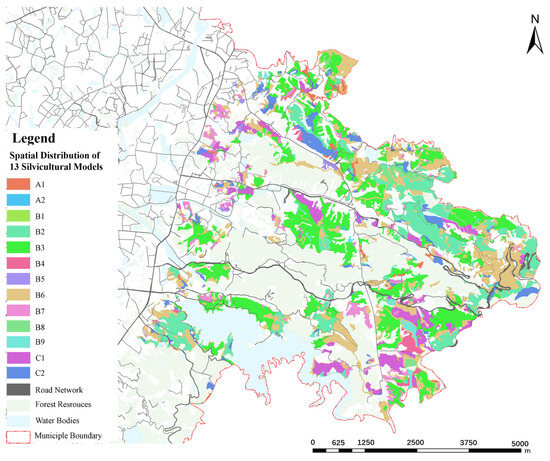
Figure 1.
Spatial distribution of silvicultural models within the Wuhan National Reserve Forest Project.

Table 1.
Planning Forest Management Model Table.
Stand-level species composition, diameter structure, canopy-closure classifications, and management schedules were derived from the 2023 forest resource inventory database and the Wuhan National Reserve Forest Construction Plan (2023–2035). These datasets provided the primary inputs for scenario construction, parameter assignment, and long-term carbon accounting.
To ensure comparability across silvicultural pathways, all scenarios were evaluated using a consistent project boundary and temporal horizon as defined in the planning documents. The same accounting period, spatial extent, and baseline assumptions were applied across models, allowing differences in carbon sequestration outcomes to be attributed primarily to management pathways rather than to scale effects or boundary inconsistencies. The assessment period covered 40 years (2024–2063), and all results presented in this study represent scenario-based projections rather than direct field observations. This scenario-based design supports project-level comparison while reflecting the diversity of management intensities implemented within a single restoration program.
2.2. Carbon Accounting Framework, Growth Assumptions, and Sensitivity Analysis
Carbon sequestration was estimated using a scenario-based accounting framework based on the Biomass Expansion Factor (BEF) method, which is widely applied in large-scale forest carbon assessments and supports the use of existing inventory data and long-term monitoring information [18,22]. The BEF approach is particularly suitable for policy-oriented evaluations where detailed process-based modeling inputs are unavailable or impractical, and where consistency with national carbon accounting standards is required.
The accounting approach followed national and provincial methodological standards, including CCER afforestation methodologies and guidelines for forest quality improvement and carbon incentives [19,20,23,24]. These methodologies provide standardized parameters and calculation procedures for estimating forest biomass carbon, harvested wood products, and baseline deductions, ensuring alignment with emerging forest carbon mechanisms and policy reporting requirements.
For each silvicultural model, per-hectare carbon stocks were calculated by converting standing timber volume into biomass using species-group-specific basic wood density and biomass expansion factors. Total biomass carbon was then estimated by applying carbon fraction coefficients and root–shoot ratios, incorporating both aboveground and belowground biomass components.
Tree biomass carbon was estimated using the BEF-based accounting framework:
where represents total tree biomass for species under silvicultural model in year (t d.m.); is standing timber volume (m3); is species-specific basic wood density (t d.m. ); is the biomass expansion factor; and is the root–shoot ratio. Carbon storage was subsequently estimated as:
where represents tree carbon storage (t C), and is the carbon fraction coefficient for each species group.
Species-group-specific parameters, including BEF values, wood density, root–shoot ratios, and carbon fraction coefficients, are summarized in Table 2. Parameter values were derived from the Hubei Provincial Forest Carbon Accounting Methodology and related CCER forestry guidelines [19,20,23,24]. To support comparability across management pathways, these coefficients were conservatively assumed to remain constant throughout the simulation period, avoiding additional uncertainty associated with dynamic parameter calibration.
Table 2.
Species-group-specific carbon accounting parameters used in the BEF-based framework.
Both aboveground and belowground biomass pools were included to provide a more comprehensive representation of carbon storage under restoration-oriented forest management. This is particularly relevant in structurally rehabilitated stands, where improvements in stand vigor and root development may contribute to long-term biomass accumulation.
To facilitate comparison across management pathways, species growth curves and stand-development assumptions were derived from regional silvicultural and forestry studies conducted under comparable ecological conditions in central China [25,26,27,28]. Differences among scenarios were attributed primarily to management intensity, stand-structure adjustments, harvest schedules, and implementation scale rather than to intrinsic growth functions. Key assumptions of the framework include standardized species growth trajectories, constant accounting coefficients within species groups, fixed harvest schedules defined by the planning scenarios, and the exclusion of future climate-driven disturbances or market fluctuations.
This standardization reflects the analytical focus of the study, which is not to predict absolute growth trajectories with high precision but to evaluate relative differences in carbon sequestration outcomes among alternative silvicultural pathways under a unified accounting framework and comparable ecological assumptions. All carbon sequestration results reported in this study, therefore, represent scenario-based projections over the 2024–2063 assessment period rather than direct field observations.
To evaluate the robustness of the accounting framework, a single-factor sensitivity analysis was conducted by varying three key parameters: BEF, stand growth rates, and baseline carbon storage assumptions. Each parameter was independently adjusted by ±20% relative to the baseline scenario, while all other variables were held constant. Sensitivity testing was performed on all silvicultural models to assess the extent to which parameter uncertainty affected projected carbon sequestration outcomes, pathway-level comparisons, and area-normalized sequestration estimates.
2.3. Harvested Wood Products and Baseline Adjustment
Carbon sequestration associated with harvested wood products was estimated following provincial methodological guidance. Timber output rates were assigned according to tree functional type, with conifers assigned higher output rates than broadleaves, while processing loss rates were applied by product category [19]. Accounting for harvested wood products enables a portion of harvested carbon to remain within the system boundary through continued storage in long-lived wood products.
Baseline carbon accumulation was accounted for using conservative deduction rates specified in national and provincial methodologies. Intensive plantation models applied no baseline deduction, whereas transformation and tending models applied standardized deduction rates to account for carbon sequestration that would have occurred in the absence of restoration-oriented interventions [19,24]. By applying standardized deduction rates and excluding optimistic assumptions regarding future growth acceleration, the accounting framework prioritizes methodological consistency and comparability across alternative management pathways under the same project framework.
2.4. Economic Valuation of Carbon Sequestration
To provide an indicative measure of economic significance, estimated carbon sequestration was converted into an indicative economic value using regional carbon market prices reported by the Hubei Carbon Emissions Trading Center [24]. This valuation was intended to support comparison among silvicultural pathways and to provide a project-scale economic reference for forest carbon sequestration under regional carbon-governance frameworks.
The valuation was designed to contextualize the magnitude of projected carbon sequestration rather than to estimate realized financial returns. Accordingly, price variability, transaction costs, and future policy adjustments were not explicitly modeled. This simplified valuation approach is appropriate for comparative analysis within a scenario-based accounting framework.
3. Results
At the project scale, projected carbon sequestration exhibits a clear long-term increasing trajectory over the 40-year assessment period, intermittently interrupted by short-term declines associated with planned thinning and harvesting events (Figure 2). These temporary reductions occur at relatively regular intervals corresponding to scheduled management cycles, after which carbon accumulation resumes and continues to increase over time. Despite periodic fluctuations, the overall trajectory remains positive throughout the assessment period, indicating sustained long-term sequestration under restoration-oriented forest management. The pronounced negative deviations observed in several years reflect planned silvicultural interventions rather than persistent carbon loss.
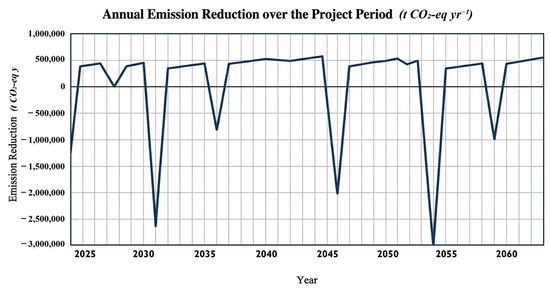
Figure 2.
Projected annual emission reduction trajectory over the 40-year assessment period (2024–2063).
Marked differences emerge among silvicultural pathways in both model-level performance and pathway-level cumulative sequestration. At the model scale, Table 3 shows that transformation-oriented models generally achieved higher annual carbon sequestration per hectare than intensive plantation models. Model B3 reached the highest annual sequestration per hectare in Year 40, at approximately 541 t CO2-eq ha−1, followed by B1 at approximately 528 t CO2-eq ha−1. Models B4, B6, and B8 also maintained relatively high per-hectare sequestration values, all exceeding 450 t CO2-eq ha−1 in Year 40. In contrast, intensive plantation models A1 and A2 remained below 50 t CO2-eq ha−1, indicating substantially lower area-normalized sequestration performance.
Table 3.
Carbon sequestration performance of silvicultural models under different management pathways over the 40-year assessment period. (Carbon Sink Quantity Unit: t CO2-eq).
At the project scale, however, cumulative sequestration was influenced by the implementation area. Model B6 provides the clearest example of this scale effect. Although its Year 40 per-hectare sequestration value was not the highest among all models, its large implementation area of approximately 11,231 ha resulted in the largest total model carbon sequestration, exceeding 4.39 million t CO2-eq, and the largest net emission reduction, approximately 4.49 million t CO2-eq. By contrast, models such as B1 and B9 had comparatively high per-hectare values but contributed less to total project-scale sequestration because of their much smaller implementation areas. These results indicate that model-level performance should be interpreted by distinguishing area-normalized efficiency from area-driven cumulative contribution.
The pathway-level summary further confirms this distinction (Table 4). Pathway B, transformation of existing forests, accounted for the largest implementation area, 22,754 ha, and contributed the greatest total carbon sequestration, approximately 7.74 million t CO2-eq, with a net emission reduction of approximately 8.65 million t CO2-eq. Pathway C, tending of young and middle-aged stands, contributed approximately 1.78 million t CO2-eq in total carbon sequestration and 1.91 million t CO2-eq in net emission reduction. Pathway A, intensive plantation, had the smallest implementation area and the lowest cumulative contribution. These pathway-level results show that the dominance of transformation-oriented management reflects both its broad implementation scale and the comparatively strong per-hectare performance of several transformation models.
Table 4.
Summary of carbon sequestration performance across silvicultural pathways over the 40-year assessment period. (Carbon Sink Quantity Unit: t CO2-eq).
The temporal dynamics of carbon accumulation further distinguish the three pathways. Intensive plantation systems tend to deliver rapid carbon gains during early growth stages, but these gains are accompanied by pronounced inter-annual variability driven by shorter rotation cycles and frequent harvesting. This results in sharper fluctuations in carbon stocks, with repeated short-term reductions followed by relatively rapid but discontinuous recovery phases. In contrast, tending-oriented management produces a more gradual and consistent accumulation pattern, characterized by limited short-term variability but slower overall increases in carbon stocks.
Transformation-oriented pathways display a distinct accumulation trajectory that combines relatively continuous carbon gains with reduced short-term volatility compared to intensive plantation systems. Although periodic declines associated with harvesting are still evident, their magnitude is generally smaller, and recovery phases are more sustained. As illustrated in Figure 1, deeper negative deviations are more closely associated with intensive plantation cycles, whereas transformation pathways exhibit shallower declines and smoother recovery trajectories. Consequently, carbon stocks under transformation management increase more steadily over successive cycles, leading to both higher cumulative sequestration and greater temporal stability throughout the assessment period.
Sensitivity analysis demonstrates that projected carbon sequestration outcomes respond predictably to variation in key accounting parameters (Table 5). Adjustments to BEF produced approximately proportional changes in total sequestration estimates, whereas variations in stand growth rates generated substantially amplified fluctuations in cumulative carbon sequestration outcomes. In contrast, baseline carbon adjustments exerted relatively limited influence on overall project-scale sequestration outcomes.
Table 5.
Single-factor sensitivity analysis of projected carbon sequestration under parameter-adjustment scenarios (unit: t CO2-eq).
Despite these variations in absolute sequestration quantities, the relative ranking and comparative performance of silvicultural pathways remained stable across all parameter-adjustment scenarios. No reversals in pathway-level contribution patterns or area-normalized sequestration trends were observed. These results suggest that the comparative conclusions of the study are relatively robust to moderate uncertainty in key accounting assumptions.
4. Discussion
The projected short-term declines in carbon stocks observed in this study primarily reflect scheduled silvicultural interventions rather than sustained reductions in long-term sequestration capacity. Thinning and harvesting temporarily reduce standing biomass, but these practices are widely recognized components of managed forest systems intended to alleviate overstocking, improve light availability, and redistribute site resources to residual trees [28,29,30]. Similar temporal fluctuations have been reported in managed forest carbon studies in both China and other temperate and subtropical plantation regions, where short-term reductions in biomass are often followed by renewed accumulation during subsequent recovery phases [1,2,31,32,33]. In the present study, cumulative carbon sequestration continued to increase across the 40-year assessment period despite intermittent declines associated with management cycles. These results suggest that short-term variability should be interpreted within the broader temporal context of silvicultural rotation and stand rehabilitation rather than as evidence of long-term sequestration failure [34,35,36].
The comparatively strong performance of transformation-oriented pathways is also consistent with previous studies emphasizing the importance of restoring structurally simplified or degraded plantation systems [37,38]. Many peri-urban forests in rapidly urbanizing regions retain relatively large standing biomass stocks but exhibit reduced productivity due to excessive density, limited species diversity, a simplified vertical structure, or historical management legacies [39,40,41]. In this study, transformation-oriented models generally displayed higher area-normalized sequestration values than intensive plantation pathways and contributed the largest cumulative project-scale sequestration because of both relatively high per-hectare performance and large implementation area. However, these comparisons should be interpreted cautiously. The present analysis is based on scenario-based carbon accounting projections rather than statistical comparison of observed field measurements, and the reported differences among pathways reflect modeled outcomes under standardized assumptions rather than experimentally validated causal relationships.
The results further highlight the importance of distinguishing between area-normalized sequestration efficiency and cumulative project-scale contribution. Models such as B1 and B3 exhibited relatively high per-hectare sequestration performance, whereas the dominance of B6 at the project scale was strongly influenced by its substantially larger implementation area. This distinction is particularly relevant for large-scale restoration planning, where management decisions are often shaped not only by stand-level efficiency but also by land availability, restoration feasibility, and long-term management objectives. Similar scale-related effects have been observed in regional forest restoration programs internationally, where moderate-efficiency management pathways may generate substantial cumulative carbon benefits when implemented across extensive degraded landscapes [42,43].
From a broader climate-governance perspective, the findings contribute to ongoing discussions regarding the role of peri-urban and restoration-oriented forests in long-term climate mitigation. Although global forest-carbon research has often focused on tropical deforestation or large intact forest systems, peri-urban forest landscapes are increasingly recognized as important components of regional carbon governance because they simultaneously support ecological rehabilitation, timber production, watershed protection, and urban environmental quality [12,13,14]. The present study suggests that restoration-oriented management of existing degraded stands may provide a relatively stable long-term sequestration pathway under conditions where land availability for large-scale afforestation is limited. At the same time, the inclusion of harvested wood products and baseline carbon adjustments highlights the importance of transparent and conservative accounting frameworks for evaluating restoration projects under emerging carbon-market and climate-policy mechanisms [15,16].
Several limitations should also be acknowledged. First, the study relies on a scenario-based BEF accounting framework rather than direct long-term field observations, and parameter values were standardized across species groups and management pathways to improve comparability. Second, the analysis focuses primarily on projected carbon sequestration outcomes and does not explicitly quantify biodiversity responses, habitat connectivity, hydrological processes, or broader ecosystem-service trade-offs associated with different restoration pathways. Third, although sensitivity analysis suggests that the relative ranking of pathways remains stable under moderate parameter variation, uncertainties associated with future climate variability, disturbance regimes, market conditions, and long-term stand development remain difficult to fully capture within a planning-oriented accounting framework. Future research integrating long-term ecological monitoring, spatially explicit landscape analysis, and multi-ecosystem-service assessment would further improve understanding of restoration-oriented peri-urban forest management under changing environmental conditions.
Overall, the results indicate that restoration-oriented management of degraded peri-urban forests can support sustained long-term carbon sequestration under a range of silvicultural pathways. Within the assumptions and scope of the present accounting framework, transformation-oriented management of existing forests generally demonstrated comparatively strong cumulative sequestration performance and relatively stable long-term accumulation trajectories. These findings provide planning-relevant insights for forest restoration programs seeking to balance climate mitigation, timber production, and ecological rehabilitation objectives in rapidly urbanizing regions.
5. Conclusions
This study presents a scenario-based assessment of long-term carbon sequestration trajectories under a restoration-oriented National Reserve Forest Project in the peri-urban area of Wuhan, China. By comparing alternative silvicultural pathways within a unified BEF-based accounting framework, the results indicate that restoration-oriented management of degraded peri-urban forests can support sustained carbon sequestration over multi-decadal management cycles despite periodic declines associated with thinning and harvesting interventions.
Among the evaluated pathways, transformation-oriented management generally exhibited comparatively strong cumulative sequestration performance and relatively high area-normalized sequestration values. In particular, several transformation models combined comparatively stable long-term accumulation trajectories with reduced short-term fluctuation relative to intensive plantation systems. At the same time, the results also demonstrate that cumulative project-scale sequestration is strongly influenced by implementation area, highlighting the importance of distinguishing between area-normalized sequestration efficiency and scale-driven total carbon contribution in restoration planning and carbon accounting. Methodologically, the study demonstrates the applicability of a conservative, scenario-based BEF accounting framework for evaluating restoration-oriented forest management under data-limited planning conditions. The inclusion of harvested wood products, baseline carbon adjustments, and sensitivity analysis improves the transparency and comparability of projected sequestration outcomes across management pathways. Although uncertainties associated with long-term growth dynamics, future climate variability, and market conditions remain difficult to fully constrain, the relative pathway-level comparisons remained stable under moderate parameter perturbation scenarios. Overall, the findings suggest that structurally oriented rehabilitation of existing degraded forest stands may represent an important component of long-term carbon management in peri-urban landscapes where land availability for large-scale afforestation is constrained. More broadly, the study highlights the importance of integrating silvicultural processes, temporal dynamics, and conservative accounting principles into restoration-oriented forest carbon assessment and planning.
Author Contributions
Conceptualization, L.Z. and B.S.; methodology, L.Z. and B.S.; formal analysis, L.Z. and B.S.; writing—original draft preparation, L.Z. and B.S.; writing—review and editing, J.K. and L.Z.; visualization, B.S.; supervision, L.Z. All authors have read and agreed to the published version of the manuscript.
Funding
This research received no external funding.
Data Availability Statement
Data gathered during this study is available upon request.
Acknowledgments
The authors gratefully acknowledge Zhu Ruiming, Li Mingqing, Ma Jiajing, and Peng Wei for their assistance with figure preparation, table organization, and literature management.
Conflicts of Interest
Author Benyun Song was employed by the company Wuhan Weimei Ecological Landscape Planning and Design Institute Co., Ltd. The remaining authors declare that the research was conducted in the absence of any commercial or financial relationships that could be construed as a potential conflict of interest.
References
- Yu, G.; Zhu, J.; Xu, L.; He, N. Technological approaches to enhance ecosystem carbon sink in China: Nature-based solutions. Bull. Chin. Acad. Sci. (Chin. Version) 2022, 37, 490–501. [Google Scholar] [CrossRef]
- Liu, S.; Cheng, L.; Gong, Y. The evaluation of forest carbon sequestration potential value of national parks and its promotion path. Natl. Park 2024, 2, 763–769. [Google Scholar] [CrossRef]
- Homolák, M.; Gömöryová, E.; Pichler, V. Can soil electrical resistivity measurements aid the identification of forest areas prone to windthrow disturbance? Forests 2020, 11, 234. [Google Scholar] [CrossRef]
- Wiegant, D.; van Oel, P.; Dewulf, A. Scale-Sensitive Governance in Forest and Landscape Restoration: A Systematic Review. Reg. Environ. Change 2022, 22, 25. [Google Scholar] [CrossRef]
- Abrams, J.; Greiner, M.; Schultz, C.; Evans, A.; Huber-Stearns, H. Can Forest Managers Plan for Resilient Landscapes? Lessons from the United States National Forest Plan Revision Process. Environ. Manag. 2021, 67, 574–588. [Google Scholar] [CrossRef]
- Doerfler, I.; Cadotte, M.W.; Weisser, W.W.; Müller, J.; Gossner, M.M.; Heibl, C.; Bässler, C.; Thorn, S.; Seibold, S. Restoration-Oriented Forest Management Affects Community Assembly Patterns of Deadwood-Dependent Organisms. J. Appl. Ecol. 2020, 57, 2429–2440. [Google Scholar] [CrossRef]
- Paquette, A.; Messier, C. Managing Tree Plantations as Complex Adaptive Systems. In Managing Forests as Complex Adaptive Systems; Routledge: Abingdon, UK, 2013. [Google Scholar]
- Baskent, E.Z.; Kašpar, J.; Baskent, H. Implications of Carbon Management with Forest Plantation on Understocked, Degraded and Bare Forests: Simulated Long-Term Dynamics between Timber Production and Carbon Sequestration. Renew. Energy 2025, 242, 122437. [Google Scholar] [CrossRef]
- La Rosa, D.; Geneletti, D.; Spyra, M.; Albert, C.; Fürst, C. Sustainable Planning for Peri-Urban Landscapes. In Ecosystem Services from Forest Landscapes: Broadscale Considerations; Perera, A.H., Peterson, U., Pastur, G.M., Iverson, L.R., Eds.; Springer International Publishing: Cham, Switzerland, 2018; pp. 89–126. [Google Scholar] [CrossRef]
- Gomes, E.; Banos, A.; Abrantes, P.; Rocha, J.; Schläpfer, M. Future Land Use Changes in a Peri-Urban Context: Local Stakeholder Views. Sci. Total Environ. 2020, 718, 137381. [Google Scholar] [CrossRef]
- Tavares, A.O.; Pato, R.L.; Magalhães, M.C. Spatial and Temporal Land Use Change and Occupation over the Last Half Century in a Peri-Urban Area. Appl. Geogr. 2012, 34, 432–444. [Google Scholar] [CrossRef]
- Livesley, S.J.; Escobedo, F.J.; Morgenroth, J. The Biodiversity of Urban and Peri-Urban Forests and the Diverse Ecosystem Services They Provide as Socio-Ecological Systems. Forests 2016, 7, 291. [Google Scholar] [CrossRef]
- Salbitano, F. Guidelines on Urban and Peri-Urban Forestry; ITA: Amsterdam, The Netherlands, 2016. [Google Scholar]
- Konijnendijk, C.C.; Sadio, S.; Randrup, T.B.; Schipperijn, J. Urban and Peri-Urban Forestry in a Development Context—Strategy and Implementation. Arboric. Urban For. (AUF) 2004, 30, 269–276. [Google Scholar] [CrossRef]
- Chen, G.; Shan, Y.; Hu, Y.; Tong, K.; Wiedmann, T.; Ramaswami, A.; Guan, D.; Shi, L.; Wang, Y. Review on City-Level Carbon Accounting. Environ. Sci. Technol. 2019, 53, 5545–5558. [Google Scholar] [CrossRef]
- Schaltegger, S.; Csutora, M. Carbon Accounting for Sustainability and Management. Status Quo and Challenges. J. Clean. Prod. 2012, 36, 1–16. [Google Scholar] [CrossRef]
- Wuhan Municipal Bureau of Landscaping and Forestry. Wuhan National Reserve Forest Construction Plan (2023–2035); Wuhan Municipal Bureau of Landscaping and Forestry: Wuhan, China, 2023. [Google Scholar]
- Fang, J.; Chen, A.; Peng, C.; Zhao, S.; Ci, L. Changes in forest biomass carbon storage in China between 1949 and 1998. Science 2001, 292, 2320–2322. [Google Scholar] [CrossRef]
- Hubei Academy of Forestry. Methodology for Forest Quality Improvement and Carbon Incentive Mechanisms in Hubei Province; Hubei Academy of Forestry: Wuhan, China, 2025. [Google Scholar]
- Hubei Provincial Forestry Bureau. Guidelines for the Development of “Hubei Forest Carbon Certificates” (Trial); Hubei Provincial Forestry Bureau: Wuhan, China, 2025. [Google Scholar]
- Tan, C.; Nie, W.; Liu, Y. Tree growth model and bark thickness model of three Quercus species based on trunk analysis. J. Zhejiang AF Univ. 2023, 40, 589–597. [Google Scholar] [CrossRef]
- Hubei Carbon Emissions Trading Center. Available online: https://www.hbets.cn/ (accessed on 30 November 2025).
- Hubei Provincial Department of Ecology and Environment. Implementation Plan for Synergistic Reduction of Pollution and Carbon Emissions in Hubei Province (EHF [2022] No. 33); Hubei Provincial Department of Ecology and Environment: Wuhan, China, 2022. [Google Scholar]
- China GHG Voluntary Emission Reduction Trading System. 2025. Available online: https://www.ccer.com.cn/wcm/ccer/html/index.html (accessed on 1 May 2026).
- Qin, F.; Guo, T.; Liu, Z.; Song, M. Literature review of researches on Pistacia chinensis Bunge. Non-Wood For. Res. 2007, 4, 90–96. [Google Scholar]
- Song, C.; Wang, Y.; Zhang, L.; Zheng, M.; Ren, Z.; He, Z.; Fan, S.; Lin, K. Determination of the initial thinning period of Chinese fir plantations based on large-diameter timber cultivation. J. Beijing For. Univ. 2022, 44, 45–54. [Google Scholar] [CrossRef]
- Zhang, L.; Chen, N.; Luo, S.; Gao, X.; Wu, P. Growth characteristics of slash pine (Pinus elliottii) plantations based on stem analysis. China For. Sci. Technol. 2022, S1, 32–34. [Google Scholar]
- Chen, X.; Tu, S.; Song, X.; Liu, Z.; Hu, Z.; Xiao, F. Variation and selection of seedling growth traits among Cyclobalanopsis glauca provenances and families. J. Southwest For. Univ. 2023, 43, 1–7. [Google Scholar] [CrossRef]
- D’Amato, A.W.; Bradford, J.B.; Fraver, S.; Palik, B.J. Forest Management for Mitigation and Adaptation to Climate Change: Insights from Long-Term Silviculture Experiments. For. Ecol. Manag. 2011, 262, 803–816. [Google Scholar] [CrossRef]
- Ganatsas, P.; Tsakaldimi, M.; Karydopoulos, T.; Papaemannuil, A.; Papadopoulos, S. Long-Term Effect of Different Forest Thinning Intensity on Carbon Sequestration Rates and Potential Uses in Climate Change Mitigation Actions. Mitig. Adapt. Strateg. Glob. Change 2024, 29, 3. [Google Scholar] [CrossRef]
- Kadioğullari, A.İ.; Sayin, M.A.; Çelįk, D.A.; Borucu, S.; Çįl, B.; Bulut, S. Analysing Land Cover Changes for Understanding of Forest Dynamics Using Temporal Forest Management Plans. Environ. Monit. Assess. 2014, 186, 2089–2110. [Google Scholar] [CrossRef]
- Senf, C.; Seidl, R. Natural Disturbances Are Spatially Diverse but Temporally Synchronized across Temperate Forest Landscapes in Europe. Glob. Change Biol. 2018, 24, 1201–1211. [Google Scholar] [CrossRef] [PubMed]
- Tonteri, T.; Salemaa, M.; Rautio, P.; Hallikainen, V.; Korpela, L.; Merilä, P. Forest Management Regulates Temporal Change in the Cover of Boreal Plant Species. For. Ecol. Manag. 2016, 381, 115–124. [Google Scholar] [CrossRef]
- Levasseur, A.; Lesage, P.; Margni, M.; Brandão, M.; Samson, R. Assessing Temporary Carbon Sequestration and Storage Projects through Land Use, Land-Use Change and Forestry: Comparison of Dynamic Life Cycle Assessment with Ton-Year Approaches. Clim. Chang. 2012, 115, 759–776. [Google Scholar] [CrossRef]
- Goetz, S.J.; Bond-Lamberty, B.; Law, B.E.; Hicke, J.A.; Huang, C.; Houghton, R.A.; McNulty, S.; O’Halloran, T.; Harmon, M.; Meddens, A.J.H.; et al. Observations and Assessment of Forest Carbon Dynamics Following Disturbance in North America. J. Geophys. Res. Biogeosci. 2012, 117, G02022. [Google Scholar] [CrossRef]
- Ameray, A.; Bergeron, Y.; Valeria, O.; Montoro Girona, M.; Cavard, X. Forest Carbon Management: A Review of Silvicultural Practices and Management Strategies across Boreal, Temperate and Tropical Forests. Curr. For. Rep. 2021, 7, 245–266. [Google Scholar] [CrossRef]
- Acuña-Coll, N.; Sánchez-Silva, M. Integrating Systems Thinking and Flexibility in Infrastructure Management. Innov. Infrastruct. Solut. 2023, 8, 144. [Google Scholar] [CrossRef]
- Werners, S.E.; Wise, R.M.; Butler, J.R.A.; Totin, E.; Vincent, K. Adaptation Pathways: A Review of Approaches and a Learning Framework. Environ. Sci. Policy 2021, 116, 266–275. [Google Scholar] [CrossRef]
- Tilahun, D.; Gashu, K.; Shiferaw, G.T. Effects of Agricultural Land and Urban Expansion on Peri-Urban Forest Degradation and Implications on Sustainable Environmental Management in Southern Ethiopia. Sustainability 2022, 14, 16527. [Google Scholar] [CrossRef]
- Seifollahi-Aghmiuni, S.; Kalantari, Z.; Egidi, G.; Gaburova, L.; Salvati, L. Urbanisation-Driven Land Degradation and Socioeconomic Challenges in Peri-Urban Areas: Insights from Southern Europe. Ambio 2022, 51, 1446–1458. [Google Scholar] [CrossRef] [PubMed]
- Imbrenda, V.; Quaranta, G.; Salvia, R.; Egidi, G.; Salvati, L.; Prokopovà, M.; Coluzzi, R.; Lanfredi, M. Land Degradation and Metropolitan Expansion in a Peri-Urban Environment. Geomat. Nat. Hazards Risk 2021, 12, 1797–1818. [Google Scholar] [CrossRef]
- Edmunds, D.S.; Wollenberg, E.K. Local Forest Management: The Impacts of Devolution Policies; Routledge: Abingdon, UK, 2013. [Google Scholar]
- Schultz, C.A.; Mclntyre, K.B.; Cyphers, L.; Kooistra, C.; Ellison, A.; Moseley, C. Policy Design to Support Forest Restoration: The Value of Focused Investment and Collaboration. Forests 2018, 9, 512. [Google Scholar] [CrossRef]
Disclaimer/Publisher’s Note: The statements, opinions and data contained in all publications are solely those of the individual author(s) and contributor(s) and not of MDPI and/or the editor(s). MDPI and/or the editor(s) disclaim responsibility for any injury to people or property resulting from any ideas, methods, instructions or products referred to in the content. |
© 2026 by the authors. Licensee MDPI, Basel, Switzerland. This article is an open access article distributed under the terms and conditions of the Creative Commons Attribution (CC BY) license.