


Abstract
Conservation tillage plays an important role in improving sustainable land use and maintaining food production. Using survey data from 261 agricultural producers in Heilongjiang Province, China, this study examines how conservation tillage policy mixes affect agricultural green total factor productivity (AGTFP). The slack-based measure (SBM) model incorporating undesirable outputs is employed to estimate AGTFP. A Tobit model with interaction terms is applied to analyze the independent and combined effects of three policy instruments: subsidies, regulations, and supporting services, and a mediating effect model is used to verify how these instruments work. The results indicate that: (1) the mean AGTFP value stands at 0.37, reflecting a generally low level of performance, with the largest improvement requirements observed in seed inputs (66.25%), machinery inputs (65.53%), and nitrogen emissions (61.55%); (2) subsidies, regulations, and supporting services all improve AGTFP, while the combinations of subsidies and services, regulations and services, and the full three-policy mix generate significant positive synergistic effects; (3) policy mixes facilitate AGTFP enhancement by increasing agricultural producers’ perceived value of conservation tillage technologies and reducing perceived risks. In particular, the interaction between regulations and supporting services significantly increased perceived value (β = 1.129, p < 0.01) and reduced perceived risk (β = −0.810, p < 0.01); (4) the effects of policy mixes are stronger for producers pursuing green production goals and for small-scale farmers. Based on these findings, the following recommendations are proposed: policy efforts should strengthen the coordination of subsidies, regulations, and services, linking training and inspection results to subsidy eligibility; address efficiency bottlenecks in seeds, machinery, labor, and nitrogen emissions; design differentiated policy packages for various farm types; and build a training system that includes at least two mandatory sessions per season and ties training outcomes to subsequent subsidies. This study contributes a policy mix perspective to the evaluation of AGTFP and provides empirical evidence for coordinated conservation tillage policy design.
1. Introduction
Cultivated land constitutes the most fundamental factor in agricultural production, and its quality status directly determines agricultural productivity and the stability of food supply [1,2]. According to estimates by the Food and Agriculture Organization (FAO), over 10% of the world’s land resources are already in a state of degradation as a result of unsustainable land management and utilization practices [3], and the compounding effects of soil organic matter loss and intensified erosion pose a serious threat to the long-term stability of food production systems [4]. Conservation tillage is widely regarded as an effective approach for balancing agricultural production and environmental protection. Conservation tillage includes practices such as no-tillage, reduced tillage, straw mulching, and crop rotation. These practices reduce soil disturbance and maintain ground cover, which helps control soil erosion, improve soil structure, and increase soil organic carbon [5,6,7]. Extensive field experiments and long-term observations demonstrate that conservation tillage can improve soil health, stabilize yields [8], and enhance the adaptive capacity of agroecosystems to climate change [9]. For these reasons, conservation tillage has been widely adopted in agricultural production practices across numerous countries worldwide.
As the world’s largest grain producer, China is also confronted with the challenge that land resource degradation poses to sustainable agricultural development. The black soil region of Northeast China, one of the world’s three major black soil zones, serves as a core area for national grain production, and the quality of its cultivated land directly determines the stability of grain supply [10,11]. Heilongjiang Province, situated in the heartland of the Northeast black soil region, has long shouldered the dual responsibility of safeguarding national food security and ecological security. But prolonged intensive exploitation and conventional tillage have caused problems in the region, such as the degradation of black soil ecological functions. Studies have shown that the soil organic matter content of cultivated land in the Northeast black soil region has decreased substantially compared with the initial period of reclamation [12,13]. In response to this challenge, the Chinese government has continuously advanced the construction of a conservation tillage policy system. In 2020, the Action Plan for Conservation Tillage on Black Soils in Northeast China (2020–2025) explicitly set forth the goal of “improving the policy system for conservation tillage development in accordance with local conditions and effectively harnessing policy synergy effects,” systematically charting the development pathway for conservation tillage. Under this policy framework, Heilongjiang Province has gradually established a multi-layered policy system encompassing three categories of instruments: fiscal subsidies to provide economic incentives, supervision and regulation to enforce technical standards and safeguard implementation quality, and supporting services such as skills training to enhance producers’ technical capacity.
Agricultural green total factor productivity (AGTFP) provides a rigorous framework for evaluating the effectiveness of these policy instruments. By incorporating undesirable outputs, including carbon emissions and non-point source pollution, into the efficiency accounting framework alongside conventional inputs and desirable outputs, AGTFP offers a comprehensive reflection of resource consumption and environmental costs in the agricultural production process [14]. The slack-based measure model originally proposed by Tone (2001) has been widely adopted as a frontier estimation method for measuring green productivity and environmental efficiency, as it directly captures inefficiency attributable to non-zero slacks relative to the best-practice production frontier [15]. A growing body of empirical research has employed AGTFP to evaluate agricultural policy performance. Lu et al. (2025), drawing on Chinese provincial panel data, found that agricultural technological progress and structural adjustment are the core drivers of AGTFP growth [16]. Zhang et al. (2024) demonstrated that environmental regulations and agricultural policies in neighboring regions exert significant spatial transmission effects on local AGTFP [17]. At the level of individual policy instruments, Zhong et al. (2025) showed that specific types of agricultural subsidies can independently improve AGTFP, and Shi et al. (2025) demonstrated that environmental regulations exhibit differentiated effects on green productivity [18,19]. These studies, while informative in establishing the independent effects of particular instruments or factors, share a notable limitation in that each treats its focal variable as operating in isolation from other policy instruments. In actual practice, agricultural producers in Heilongjiang Province encounter subsidies, regulatory inspections, and technical training concurrently, and their production decisions are shaped by the combined influence of these instruments rather than by any single one. Single-policy models, by construction, cannot detect these interdependencies.
Although the policy framework has been preliminarily established, the dissemination of conservation tillage still faces multiple constraints, including the high initial investment required for mechanized operations, the temporal mismatch between long-term benefits and short-term returns, and farmers’ path dependence on conventional tillage practices (Ogieriakhi, 2022) [20]. These constraints make the promotion of conservation tillage a systemic undertaking, where reliance solely on technological demonstration is unlikely to succeed, and policy interventions are needed to provide impetus [21,22]. The three policy instruments established in Heilongjiang Province do not operate in isolation in practice; rather, they are intertwined and jointly influence agricultural producers’ production decisions. Research indicates that a well-designed policy mix, through complementarity, reinforcement, and synergy among policies, can achieve an overall effect that exceeds the simple sum of individual policy effects [23,24], thereby more effectively guiding agricultural producers to adopt green production practices. But if policy design involves inherent conflicts or implementation links are poorly coordinated, effects may be mutually weakened. For instance, excessively rigid regulatory measures lacking supporting services may undermine the adoption willingness stimulated by subsidies. Jørgensen et al. (2017) further noted that interactions among policy instruments may generate either synergistic gains or offsetting effects due to goal conflicts or temporal mismatches, with the outcome depending on the internal coherence of the mix structure [25]. Despite these insights, empirical research on agricultural policy mixes has concentrated predominantly on farmers’ technology adoption behavior rather than on green total factor productivity that incorporates environmental costs. Claassen et al. (2008) examined the cost-effective design of agri-environmental payment programs in the United States, and Rodríguez-Barillas et al. (2024) analyzed the climate smart agriculture policy mix in Costa Rica; both focused on adoption outcomes [26,27]. Guyomard et al. (2023) reviewed how the green architecture of the European Union Common Agricultural Policy could be improved to support environmentally friendly farming, also centering on adoption and design rather than productivity measurement [28]. Zhen et al. (2026) investigated the impact of cross-policy mixes on agricultural total factor productivity by analyzing the effects of mechanization and large-scale operations as separate policy variables [29], and Wang et al. (2025) examined how the characteristics of environmental policy mixes influence green innovation efficiency [30]. In both studies, individual policies or their aggregated characteristics serve as explanatory variables, and the interaction effects among specific policy instruments are not estimated. The mechanisms through which the joint deployment of subsidies, regulations, and supporting services affects AGTFP, and the psychological pathways that transmit these effects, also remain unexamined.
While previous studies have improved our understanding of individual conservation tillage policies, limited evidence is available on whether different policy instruments operate independently or jointly in shaping green agricultural performance. In particular, the synergistic effects of policy mixes and the mechanisms through which they influence AGTFP remain insufficiently explored. Addressing these issues is important because conservation tillage has increasingly evolved from a single-policy intervention into a coordinated governance framework that combines economic incentives, regulatory measures, and technical support. A better understanding of how these policy instruments interact can provide a more accurate basis for policy evaluation and optimization.
Against this background, this study examines the effects of conservation tillage policy mixes on AGTFP and investigates the underlying mechanisms from the perspectives of perceived value and perceived risk. Specifically, three research questions are addressed: Do individual policy instruments improve AGTFP? Do policy mixes generate synergistic effects beyond the impacts of single policies? Through what mechanisms do policy mixes affect AGTFP? To answer these questions, this study employs the SBM model to measure AGTFP and uses Tobit and mediation models to evaluate both the effects and mechanisms of conservation tillage policy mixes. By integrating policy mix theory with AGTFP analysis, this study provides a new perspective for evaluating conservation tillage policies. The findings offer empirical evidence for coordinated policy design and contribute to the literature on agricultural green productivity and sustainable land governance.
2. Theoretical Analysis
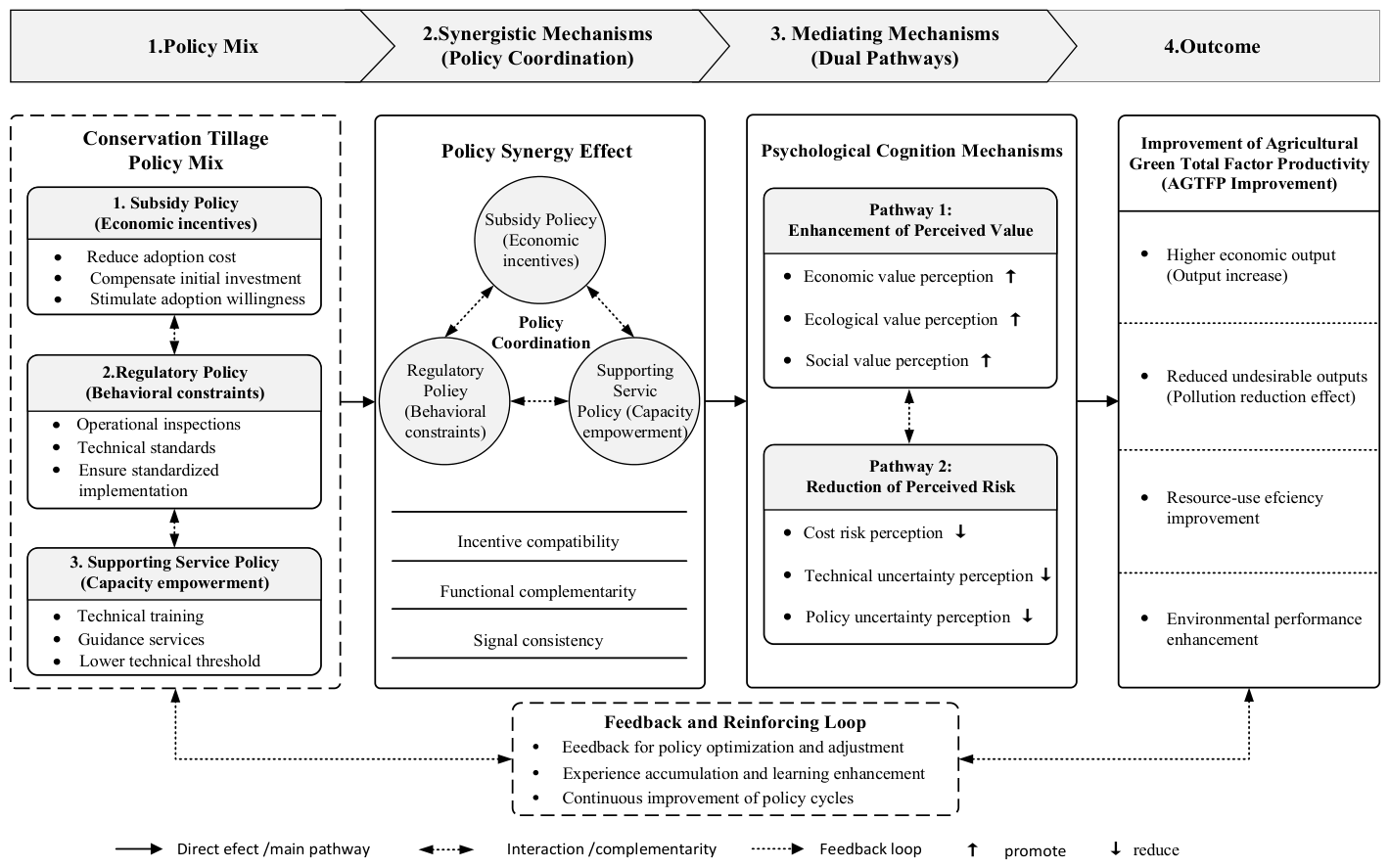
The improvement of agricultural green total factor productivity (AGTFP) represents a comprehensive efficiency enhancement process in which greater economic output is achieved alongside reduced undesirable outputs under given factor inputs. Such improvement does not occur spontaneously; rather, it depends on the systematic impetus provided by external policies. In practice, agricultural producers are mainly affected by subsidies, regulations, and supporting services, which promote the green transformation of agricultural production through economic incentives, behavioral guidance, and technical support. Specifically, subsidy policies, through direct economic support, can reduce the costs and risks associated with agricultural producers’ adoption of new technologies, thereby effectively stimulating their initial willingness to adopt. Regulatory policies, by establishing technical standards and implementing operational inspections, delineate clear implementation norms for conservation tillage, thereby safeguarding the ecological benefits of technology execution. Supporting service policies, by providing technical guidance and facility assistance, can lower the learning and application thresholds for agricultural producers, thereby enhancing their capacity and confidence in technology implementation. Although these three policy instruments differ in their mechanisms of action, each exerts an independent, fundamental positive effect on promoting the adoption and diffusion of conservation tillage technologies and, consequently, on enhancing AGTFP. On this basis, the following research hypothesis is proposed:
H1.
Individual conservation tillage policies exert significant positive effects on agricultural green total factor productivity.
In affirming the fundamental role of individual policies, this study further draws upon collaborative governance [31] and signaling theory [32] to explore potential synergy effects that policy mixes may generate. The direction of policy effects hinges on the specific manner in which policies interact. When policies are smoothly coordinated and functionally complementary, positive synergistic effects may arise; when policies conflict, create incentive distortions, or suffer from implementation disconnects, negative offsetting effects may emerge. With respect to the conservation tillage policy practice in Heilongjiang Province, the various policies are all designed around the shared goal of achieving conservation tillage that prioritizes ecology, integrates utilization with conservation, stabilizes and increases yields, and saves costs while enhancing efficiency. This common orientation endows the policies with strong internal consistency and complementarity, thereby providing an institutional foundation for the emergence of positive effects.
From the perspective of synergy governance, when the three policy instruments are implemented in combination, they can form an organic whole characterized by incentive compatibility and functional complementarity. Subsidies provide economic motivation, stimulating adoption willingness; regulations delineate quality redlines, safeguarding the standardization of implementation; and supporting services supply capacity support, lowering technical thresholds. These three instruments work in concert to guide agricultural producers from passive responses toward proactive, standardized, and sustainable technology application. From the signaling perspective, a coherent and coordinated policy mix can transmit stronger, more consistent, and more credible composite signals to agricultural producers, indicating that conservation tillage technologies possess long-term economic value, are taken seriously by the government, have clearly defined operational norms, and can receive systematic support. Such stable and consistent signals help reduce policy uncertainty, facilitate the formation of stable expectations, and motivate agricultural producers to undertake specific asset investments and deepen technology application. Moreover, the synergy among subsidies, regulations, and supporting services extends beyond the simple accumulation of policy functions. At the behavioral level, coordinated policies can simultaneously enhance adoption willingness, standardize technology implementation, and strengthen technical capacity, thereby improving the quality and continuity of conservation tillage practices. At the production level, more effective technology application contributes to better factor allocation, reduces resource waste and environmental losses, and improves the joint performance of economic output and ecological outcomes. Consequently, the coordinated implementation of multiple policy instruments is expected to generate efficiency gains beyond those achievable through individual policies alone, thereby promoting AGTFP improvement. Building on this logical reasoning, this study anticipates that the combined implementation of conservation tillage policies will generate positive synergistic effects, wherein the overall effect of implementing multiple policies simultaneously exceeds the sum of the effects of individual policies. On this basis, the second research hypothesis is proposed:
H2.
The combined implementation of conservation tillage policies generates positive synergistic effects on agricultural green total factor productivity, with the overall effect exceeding the sum of the independent effects of individual policies.
Although multiple factors may influence agricultural producers’ responses to conservation tillage policies, this study focuses specifically on perceived value and perceived risk because these two cognitive evaluations directly shape technology adoption decisions. Existing studies have shown that perceived value constitutes a key driver of agricultural technology adoption, whereas perceived risk often acts as an important constraint on behavioral change [33,34,35]. Agricultural producers typically evaluate conservation tillage technologies by comparing their expected economic and ecological benefits with the costs and uncertainties associated with implementation. Perceived value reflects the overall assessment of potential gains from technology adoption, including productivity improvement, cost reduction, and environmental enhancement, while perceived risk captures concerns regarding yield fluctuations, investment recovery, and operational uncertainty. Since conservation tillage adoption simultaneously involves benefit acquisition and risk management, perceived value and perceived risk jointly represent two core cognitive channels through which policy interventions influence producers’ decision-making processes. Therefore, this study examines the mechanism of conservation tillage policy mixes from the perspectives of perceived value and perceived risk.
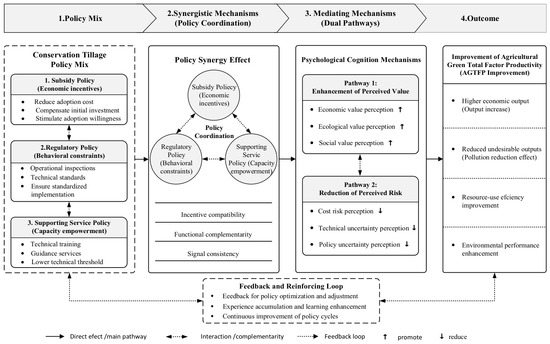
Based on the above theoretical analysis, Figure 1 illustrates the conceptual framework through which conservation tillage policy mixes influence AGTFP, including both the direct synergy effect and the behavioral mechanisms associated with agricultural producers’ responses.
Figure 1.
Mechanisms of conservation tillage policy mix impact on AGTFP.
3. Materials and Methods
3.1. Data Sources and Sample Profile
3.1.1. Overview of the Research Area
Heilongjiang Province, situated in the core zone of the Northeast China black soil belt, possesses an extensive black soil area and shoulders the important strategic mission of safeguarding national food security. To scientifically evaluate the implementation effects of conservation tillage policies, the selection of survey areas must take into account typicality, representativeness, and the advanced nature of policy implementation. Given that the objective of this study is to identify the effects of conservation tillage policy mixes under a relatively unified policy framework, the investigation was confined to Heilongjiang Province. Limiting the survey scope to one province helps avoid additional institutional variation arising from differences in policy implementation arrangements across regions and allows for a clearer assessment of policy mix effects. This study determined the survey scope based primarily on the following principles.
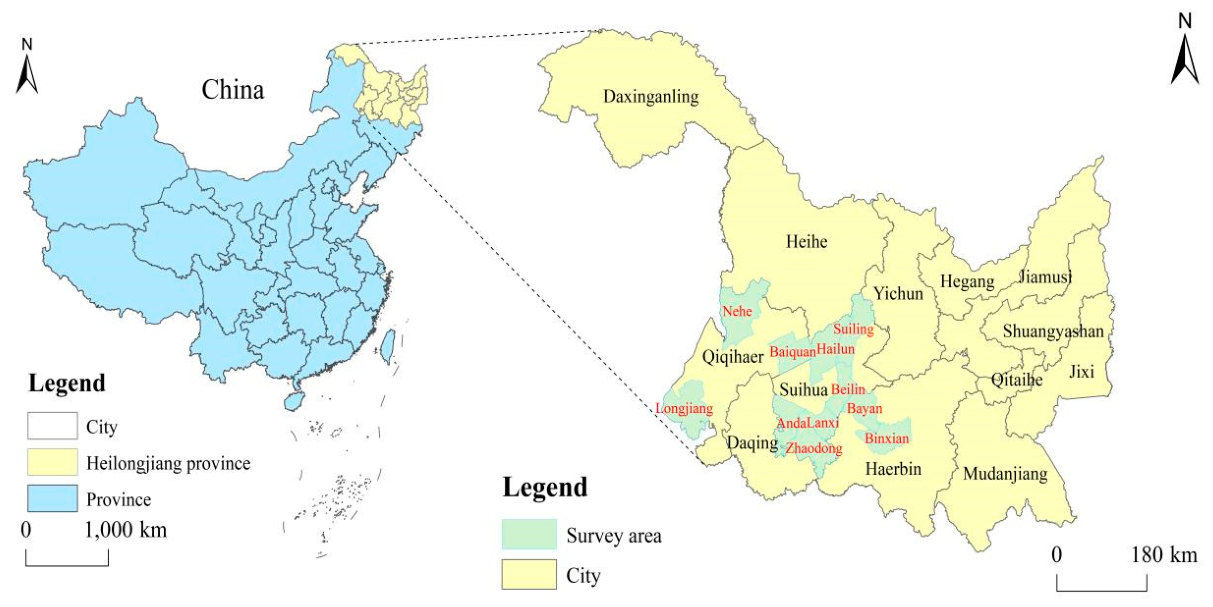
First, the study focused on the core black soil zone and major grain-producing areas. The Songnen Plain is the region in Heilongjiang Province with the most concentrated black soil resources, the highest cultivated land quality, and the most critical grain production. Accordingly, the survey emphasis was placed on Suihua City, Qiqihar City, and Harbin City, all located within this plain. These three prefectural-level cities are not only important commercial grain bases in the province, but their cultivated land is also predominantly composed of typical black soils and chernozems, rendering the promotion of conservation tillage highly significant and the problems encountered more representative. Second, the gradient differences and demonstration effects of policy implementation were taken into consideration. In advancing conservation tillage, Heilongjiang Province has adopted a strategy of piloting first and then promoting comprehensively. This study paid particular attention to areas designated as comprehensive promotion counties for conservation tillage. These counties and county-level cities typically possess pioneering and systematic characteristics in terms of policy support intensity, technological extension depth, and task implementation scale, and their experiences and challenges hold important reference value for the entire province and even the Northeast region. On this basis, seven comprehensive promotion counties were selected as key survey areas within Suihua City, Qiqihar City, and Harbin City, namely Nehe City, Longjiang County, Lanxi County, Zhaodong City, Anda City, Bayan County, and Acheng District. Meanwhile, to enable comparison and enhance sample diversity, other representative counties, including Hailun City, Suiling County, Beilin District, and Baiquan County, were also incorporated into the survey within the same three prefectural-level cities. The specific selection of survey areas and sample coverage is presented in Figure 2.
Figure 2.
Map of the survey area in Heilongjiang Province.
3.1.2. Data Sources
The data used in this study were obtained from field surveys conducted between April 2025 and January 2026 across 11 counties and districts within Suihua City, Qiqihar City, and Harbin City in Heilongjiang Province. The areas marked in red indicate the survey counties. The surveys primarily targeted new agricultural business entities engaged in maize cultivation, with questionnaires administered to collect information on each entity’s production input and output during the previous production season. A total of 283 questionnaires were distributed, and after screening and processing, 22 invalid questionnaires were eliminated, yielding 261 valid questionnaires with an effective response rate of 92%.
During the field surveys, on the one hand, discussions were held with staff from the agricultural and rural affairs bureaus, agricultural economic stations, agricultural machinery stations, and agricultural technology extension centers in each pilot county and district. These discussions served to collect current policy documents related to conservation tillage and to gain an understanding of the current implementation status, pilot achievements, and existing problems. On the other hand, questionnaire surveys were administered to new agricultural business entities to capture their production conditions and the extent to which they were affected by black soil conservation measures. The questionnaire consisted of two parts. The first part addressed the characteristics of the production and operation entities and their production input–output conditions. The second part addressed the impact of conservation tillage policies on production activities, including the implementation of conservation tillage compensation policies, regulatory policies, and supporting service policies.
3.1.3. Overview of Conservation Tillage Policy Implementation in the Sample
The policies currently implemented in the sample areas fall primarily into three categories: economic incentives, supervision and regulation, and supporting services. These three policy types differ in terms of implementation form, coverage, and agricultural producers’ satisfaction levels (Table 1). Economic incentive policies primarily take the form of conservation tillage operation subsidies, with subsidized producers accounting for 64.04% of the total sample. These subsidies play a positive guiding role in technology adoption; however, some producers report a gap between the subsidy standards and operational costs, which affects their willingness to continue participating, yielding a mean satisfaction score of 3.483 on a 5-point scale. Supervision and regulation policies are principally manifested as operational inspections, with inspected producers accounting for 59.59% of the sample. The rigorous inspection mechanism safeguards the standardized implementation of policies and the efficiency of fund utilization, enhancing producers’ recognition of policy fairness and yielding a mean satisfaction score of 4.067, the highest among the three policy types. Supporting service policies are mainly delivered through skills training, with trained producers accounting for 65.41% of the sample. Training helps farmers better understand conservation tillage practices, but some respondents reported that the training sessions were too infrequent and lacked practical guidance, resulting in a mean satisfaction score of 3.172. Overall, all three policy types have achieved a certain level of coverage in the sample areas, yet differences exist in implementation effects and satisfaction levels, thereby providing a realistic basis for further optimizing the policy mix and enhancing its synergy and implementation efficacy.
Table 1.
Implementation of conservation tillage policies among surveyed samples.
3.2. Model Specification
3.2.1. SBM Model Specification
The slack-based measure (SBM) model, initially proposed by Tone (2001) [15], has been widely adopted for measuring green productivity, energy efficiency, and environmental efficiency, representing a class of frontier estimation methods that explicitly account for technical inefficiency [32,33]. This study uses the SBM model for three main reasons. In terms of measurement principle, the SBM model directly captures the inefficiency attributable to non-zero slacks relative to the best-practice production frontier, while circumventing the biases introduced by radial and angular orientations. The SBM model can handle multiple inputs and outputs simultaneously. It also incorporates undesirable outputs into the production process, which allows the estimated efficiency scores to better reflect actual agricultural production conditions (Xu et al., 2023) [34]. The specification of the model proceeds as follows.
Each agricultural producer is treated as an individual DMU to construct the production frontier. Assume that the agricultural production system comprises n DMUs, each employing m types of factor inputs to generate q types of desirable outputs alongside h types of undesirable outputs. Let x, y, and b represent the input, desirable output, and undesirable output variables, respectively. Accordingly, each DMU is associated with three vectors: x ∈ Rm, y ∈ Rq, b ∈ Rh. The matrices X, Y, and B are defined as follows:
X = x1,…, xn ∈ Rm×n > 0
Y = y1,…, yn ∈ Rq×n > 0
B = b1,…, bn ∈ Rh×n > 0
Defining λ as the weight vector, the production possibility set for each DMU is expressed as:
P = x, y, bx ≥ Xλ, y ≤ Yλ, b ≥ Bλ, λ ≥ 0
Upon incorporating undesirable outputs, the SBM−DEA efficiency score for each DMU can be formulated as:
In Equation (3), denotes the efficiency score, bounded by 0 ≤ ρ* ≤ 1. The slack variables , and , all of which take non-negative values, correspond, respectively, to input redundancies, desirable output shortfalls, and undesirable output excesses. The objective function is strictly monotonically decreasing in , , and , such that the optimal solution is attained if and only if , at which point . A value of unity signals that the DMU is technically efficient, exhibiting neither excess in inputs or undesirable outputs nor deficiency in desirable outputs. By contrast, when 0 ≤ ρ* < 1, the DMU operates with efficiency loss, a condition indicative of green production inefficiency that necessitates adjustments in both inputs and outputs, with the scope for improvement governed by the proportion of each slack variable relative to its corresponding input or output quantity.
3.2.2. Tobit Model Specification
To examine the impact of conservation tillage policies on AGTFP, an appropriate econometric model must be constructed. The dependent variable, AGTFP, is derived from the SBM model estimation and is theoretically bounded within the interval [0, 1]. An examination of the sample distribution reveals that the efficiency scores are continuously distributed over the (0, 1) interval without left-end clustering, yet a certain proportion of observations accumulate at the right boundary, exhibiting a typical right-censoring pattern. Given that ordinary least squares (OLS) estimation may, under such circumstances, produce biased parameter estimates and compromise consistency, the Tobit model is adopted as the baseline estimation method in this study. By specifying a latent continuous variable to characterize the data-generating mechanism of the censored dependent variable, the Tobit model, estimated via maximum likelihood, possesses desirable statistical properties and is well suited for handling data of this truncated nature.
To identify the policy effects, a baseline Tobit model is constructed. Let the latent variable represent the potential agricultural green total factor productivity of agricultural producer i, with its relationship to the observed value defined as follows:
In Equation (5), denotes the latent variable, denotes the observed value, α is the constant term, is the coefficient to be estimated, Xi denotes the independent variable, and denotes the random disturbance term.
To further investigate whether synergistic effects that exceed the sum of the individual effects exist among the different policy instruments, it is necessary to introduce interaction terms of the policy variables into the model. Directly constructing product terms from the original dummy variables tends to induce multicollinearity and renders the main effect coefficients interpretable only when the other policy variables take a value of zero, a condition that considerably narrows the scope of interpretation. The three core policy variables are mean-centered before the construction of the interaction terms. The specific transformation is specified as follows:
S′ = Si − S, R′ = Ri − R, C′ = Ci − C
After the centering procedure, each variable has a mean of zero, and its value represents the extent to which an individual’s policy environment deviates from the sample average. Based on the centered variables, the Tobit model incorporating interaction terms is constructed as follows:
In Equation (7), the main effect coefficients β capture the independent effects of the subsidy, regulation, and supporting service policies. When the other two policies are held at their mean levels, a positive coefficient for a given policy indicates that the policy can independently promote an increase in AGTFP; a negative coefficient suggests that the policy’s standalone effect is relatively limited.
The interaction-term coefficients θ serve as the key parameters for testing policy mix effects. A positive θ indicates that the two policies are complementary and synergistic, such that their simultaneous implementation yields a positive policy synergy effect in which the combined impact exceeds the sum of the individual contributions. Conversely, a negative θ suggests that the two policies function as substitutes and produce offsetting effects, with their concurrent implementation weakening the overall policy effectiveness. Taking θSR as an example, this coefficient captures how the adoption of regulatory policies (R) moderates the effect of subsidy policies (S) on agricultural producers’ AGTFP. A positive θSR indicates complementarity between subsidies and regulations, implying that the incentive effect of subsidies becomes more pronounced when regulatory policies are in place simultaneously. By contrast, a negative θSR points to substitution and offsetting effects between the two instruments, meaning that the incentive effect of subsidies is weakened under the concurrent implementation of regulatory policies.
The coefficient of the three-way interaction term (θSRC) reflects the combined effect of subsidies, regulations, and supporting services when implemented together. A positive coefficient indicates that these policy instruments can reinforce one another, helping agricultural producers adopt conservation tillage practices more consistently and improve AGTFP.
3.3. Variable Selection and Descriptive Statistics
3.3.1. Variable Selection and Descriptive Statistics for the SBM Model
Drawing on the conceptual essence of agricultural green total factor productivity, the findings of existing scholarship [14,15] and the actual production conditions observed during the field survey, this study constructs an input–output indicator system that incorporates non-point source pollution emissions as the undesirable output. The definitions and descriptive statistics of the indicators are presented in Table 2. Building upon the framework of conventional production efficiency, AGTFP introduces undesirable outputs, represented by non-point source pollution emissions, while the input indicators encompass land, labor, and various types of physical capital. Among these, labor input is measured in working hours rather than labor costs, given that the labor costs of family-owned labor are difficult to account for accurately and market wage rates are subject to considerable fluctuation, problems that the use of working hours effectively circumvents. Pesticide input is characterized in terms of purchase costs, since the actual quantity of pesticide application—which must be formulated and applied according to crop type and growth stage—is difficult to capture precisely, particularly in the sample areas where third-party specialized pest control services are widely adopted. Purchase cost data, by contrast, can be directly collected through the survey questionnaire with a high degree of accuracy. Machinery input integrates fuel costs, maintenance costs, and rental fees for both self-owned and leased agricultural machinery, a treatment that circumvents the difficulty of accurately accounting for total machinery power and depreciation at the micro level. Fertilizer input adopts the total fertilizer application across all fertilization stages for each sample entity, serving as a key component of physical capital input that comprehensively reflects the overall level of fertilizer use.
Table 2.
AGTFP input–output indicator system and descriptive statistics.
Desirable output is measured by the total output value of the planting sector, an indicator that provides a comprehensive reflection of the economic output level of agricultural production. The data are sourced from the annual gross planting income reported by agricultural producers in the survey questionnaire. Undesirable output focuses on the non-point source pollution generated during the agricultural production process, specifically characterized by the nitrogen and phosphorus loss quantities resulting from fertilizer application. Given that the utilization rate of agricultural film is extremely low among the surveyed samples, it is not incorporated in this study.
The specific formulas for estimating nitrogen and phosphorus loss quantities from fertilizers are as follows:
In Equation (8), denotes the pollution emission quantity, represents the fertilizer nutrient conversion ratio, captures the fertilizer nutrient utilization efficiency, or soil retention rate, of the j-th agricultural producer, reflecting the proportion of nutrients absorbed and utilized by crops, and is the regional loss coefficient.
3.3.2. Variable Selection and Descriptive Statistics for the Tobit Model
To rigorously examine the impact of conservation tillage policy mixes on agricultural green total factor productivity (AGTFP), this study systematically selects the core variables, control variables, and mediating variables based on the actual implementation of conservation tillage policies in the surveyed areas, the production and operation characteristics of the sample entities, and the potential pathways through which these characteristics may affect AGTFP. The selected variables and their descriptive statistics are presented in Table 3.
Table 3.
Tobit model variable description and descriptive statistics.
4. Results
4.1. Analysis of AGTFP Measurement Results
Based on the SBM model, this study estimates the redundancy of input factors and undesirable outputs in maize production. The degree of redundancy is measured by the proportion of required improvement relative to the original input or output level. Table 4 reports the estimated improvement requirements for each input and undesirable output. Most input factors require improvements of more than 45%, and the average improvement rates for land, seed, machinery, and labor all exceed 60%. These results suggest that agricultural producers generally rely on excessive input use and remain far from the efficient production frontier. One possible explanation is that many agricultural producers still rely on high input use to maintain crop yields, while conservation tillage technologies have not been widely adopted in the surveyed areas. The maximum improvement values for pesticide, machinery, and fertilizer inputs are all close to 100%, indicating that some agricultural producers use these inputs far beyond efficient production levels. Seed input shows the highest improvement requirement, suggesting that inefficient seed use remains an important constraint on production efficiency. Machinery and labor inputs also show high redundancy, which may be related to farmland fragmentation and seasonal labor underutilization in the surveyed areas. Although the average improvement requirements for pesticide and fertilizer inputs are relatively lower, some agricultural producers still apply these inputs excessively. Among undesirable outputs, nitrogen emissions show a higher improvement requirement than phosphorus emissions, suggesting that nitrogen loss remains a major environmental problem in agricultural production.
Table 4.
Degree of improvement needed in input–output indicators for the total sample.
4.2. Analysis of the Regression Results of Conservation Tillage Policy Mixes on AGTFP
Based on the specified Tobit model, this study employs Stata 15.1 to estimate the effects of conservation tillage policy mixes on the AGTFP of the sampled agricultural producers, with the regression results presented in Table 5.
Table 5.
Regression results of the Tobit model.
The regression results reported in Table 6 reveal that all three core policy variables exert significant positive effects on AGTFP, thus confirming hypothesis H1. Subsidy policies are positively associated with AGTFP, suggesting that financial support helps agricultural producers adopt conservation tillage practices by reducing initial adoption costs. Regulatory policies also show a positive relationship with AGTFP, indicating that technical standards and inspection requirements help agricultural producers adopt conservation tillage practices more consistently. Supporting service policies show the strongest association with AGTFP among the three policy instruments, highlighting the importance of technical training and guidance in conservation tillage adoption.
Table 6.
Robustness test.
Model (4) further examines the interaction effects among subsidies, regulations, and supporting services. All two-way interaction terms are positive, suggesting that the effects of individual policy instruments are strengthened when combined with other policy measures. Interactions involving supporting services show comparatively stronger effects, suggesting that technical guidance and training can improve the effectiveness of both subsidy incentives and regulatory requirements. These findings suggest that different policy instruments work more effectively when implemented in combination rather than in isolation. Model (5) further incorporates the three-way interaction term, which is positive and statistically significant. This result suggests that the joint implementation of subsidies, regulations, and supporting services can more effectively help agricultural producers adopt conservation tillage practices. The positive three-way interaction further supports H2.
4.3. Robustness Checks
The robustness tests reported in Table 6 are conducted to examine whether the estimated effects of conservation tillage policy mixes on AGTFP remain stable under alternative estimation methods and sample treatments. To further verify the robustness of the baseline regression results, this study conducts robustness checks using two approaches: model substitution and winsorization. Models (1)–(5) present the results after replacing the estimation model. A Fractional Logit model is employed for re-estimation. The results show that the coefficients of the three policy instruments remain positive at the 1% level, while all two-way interaction terms and the three-way interaction term also remain statistically significant. These findings are fully consistent with the baseline regression conclusions. In Models (6)–(10), the dependent variable is winsorized at the 1st and 99th percentiles, and the Tobit model is then re-estimated on the processed sample. The results indicate that neither the signs nor the statistical significance of the coefficients for the individual policies, the two-way interaction terms, or the three-way interaction term exhibit any change. Taken together, both robustness checks support the core conclusions of the baseline regression, demonstrating that the findings of this study are robust.
4.4. Endogeneity Analysis
In the preceding analysis, we conducted robustness checks using alternative estimation methods and sample treatments, and the results remained consistent with the baseline findings. Nevertheless, the baseline Tobit model may still be affected by endogeneity arising from reverse causality or omitted variables. For example, agricultural producers with higher AGTFP may be more proactive in obtaining policy support, which could lead to biased estimates of policy effects.
To further address this concern, an instrumental variable approach is employed. Whether the respondent’s village serves as the township government seat is selected as the instrumental variable. Township governments play a central role in policy implementation, information dissemination, and agricultural extension services. Villages located at township government seats generally have greater access to policy information, technical training, and administrative services, which affects the likelihood of receiving subsidies, participating in training programs, and being subject to policy inspections. At the same time, the administrative location of a village is largely determined by historical governance arrangements and regional development patterns and is unlikely to directly affect AGTFP.
The estimation results are reported in Table 7. Columns (1), (3), and (5) present the first-stage results, while Columns (2), (4), and (6) report the second-stage estimates. All first-stage F statistics exceed the conventional threshold of 10, and the Cragg-Donald Wald F statistics are higher than the corresponding Stock-Yogo critical values, indicating that the instrumental variable satisfies the relevance requirement and that weak instrument concerns are limited. In the second-stage regressions, the coefficients of subsidy policies, regulatory policies, and supporting service policies remain positive and statistically significant at the 1% level. These findings are consistent with the baseline results and suggest that potential endogeneity does not alter the main conclusions of this study.
Table 7.
Endogeneity test.
4.5. Mechanism Analysis
The baseline regression results show that conservation tillage policies have positive effects on AGTFP. Building on the theoretical framework presented in Figure 1, this section further examines whether agricultural producers’ perceived value of conservation tillage technologies and perceived risks associated with green transitions serve as important channels through which policy mixes influence AGTFP. The corresponding estimation results are reported in Table 8.
Table 8.
Mechanism test.
Policy mixes, by strengthening producers’ recognition of the comprehensive value of conservation tillage, encourage agricultural producers to adjust production practices and improve green production efficiency. When agricultural producers recognize the economic and environmental benefits of conservation tillage, they are more willing to improve field management and increase investment in green production practices, which can help improve AGTFP. Table 8 reports the regression results with perceived value serving as the mediating variable. In Model (1), all two-way interactions between subsidies, regulations, and supporting services remain positive. This indicates that when the policy mix operates synergistically, it transmits composite information concerning the technical and economic feasibility, ecological necessity, and operational accessibility of the technology to farmers more effectively, thereby elevating their assessment of its comprehensive value. In Model (2), the interaction among the three policy instruments shows the strongest effect on agricultural producers’ perceived value. Stronger value recognition encourages agricultural producers to continue adopting conservation tillage practices and make more effective use of available resources, thereby improving both economic returns and environmental performance. These findings suggest that changes in agricultural producers’ perceptions of conservation tillage benefits help explain how conservation tillage policies improve AGTFP.
Policy mixes, by constructing a systemic risk mitigation mechanism, alleviate agricultural producers’ concerns about financial, technical, and policy risks in the process of green transition, thereby enhancing both their willingness and their capacity to adopt conservation tillage. When perceived risks decline, producers are more inclined to undertake long-term investments and commit to specific assets related to green production [36], and to implement sustainable agronomic practices with greater resolve, conditions that directly contribute to stabilizing and enhancing long-term production efficiency. In this study, higher scores for risk perception indicate stronger concerns about adopting conservation tillage technologies, so the estimated coefficients are expected to be negative. Table 8 reports the regression results with risk perception serving as the mediating variable. In Model (3), all two-way interactions remain negative. The interaction between subsidies and regulations suggests that economic support and regulatory guidance can jointly reduce concerns about compliance costs and policy uncertainty. The interaction between subsidies and supporting services indicates that financial support and technical assistance help agricultural producers reduce concerns about production risks and income instability. In addition, the interaction between regulations and supporting services suggests that technical guidance helps agricultural producers meet policy requirements more easily and strengthens confidence in the long-term stability of conservation tillage policies. In Model (4), the interaction among subsidies, regulations, and supporting services remains negative and stronger than the two-way interactions. This result suggests that when the three policy instruments are implemented together, agricultural producers perceive lower levels of financial, technical, and policy-related risks associated with conservation tillage adoption. As perceived risks decline, agricultural producers become more willing to continue adopting conservation tillage practices over the long term.
4.6. Heterogeneity Analysis
To examine whether the effects of conservation tillage policies differ across agricultural producers, this study conducts a heterogeneity analysis based on production goals and farm size. Production goals were identified based on whether agricultural producers had adopted yield-enhancing practices, including wide-narrow row planting, dense planting, and integrated water–fertilizer management. These practices reflect whether agricultural producers focus mainly on increasing yields or place greater emphasis on balancing production and environmental sustainability. Farm size also affects agricultural producers’ financial resources, their ability to adopt new technologies, and their willingness to take production risks. Grouped regressions were used to compare the effects of conservation tillage policies across agricultural producers with different production goals and farm sizes.
The sample was divided into a non-adoption group (141 households) and an adoption group (120 households) based on whether agricultural producers had adopted yield-enhancing practices, and the regression results are reported in Table 9. At the individual policy level, all three policy instruments show stronger effects among agricultural producers who have not adopted yield-enhancing practices. This result suggests that conservation tillage policies are more effective among agricultural producers who place greater emphasis on long-term land quality and environmental protection. These agricultural producers are generally more consistent with the environmental objectives of conservation tillage policies. In terms of policy interactions, the combined effects are also stronger in the non-adoption group. The interaction between subsidies and supporting services remains positive only in the non-adoption group. A similar pattern is observed for the interaction between regulations and supporting services, although the effect is stronger in the non-adoption group. The combined effect of the three policy instruments is observed only in the non-adoption group. These findings suggest that policy combinations are more effective when agricultural producers place greater importance on environmental protection and long-term land quality. By contrast, agricultural producers who have adopted yield-enhancing practices tend to focus more on short-term productivity improvements, making them less responsive to conservation-oriented policy support.
Table 9.
Heterogeneity analysis: Acceptance of yield enhancement policy.
The sample was divided into small-scale (126 households) and large-scale groups (135 households) based on the median farm size, and the regression results are reported in Table 10. All three policy instruments show stronger effects among small-scale agricultural producers than among large-scale producers. Small-scale agricultural producers often face tighter financial constraints and greater difficulties in adopting conservation tillage technologies, and under these conditions, policy support can reduce initial investment costs and lower learning barriers more directly. In terms of policy interactions, the combined effects are also stronger in the small-scale group. The interactions between subsidies and regulations, as well as between subsidies and supporting services, are more robust among small-scale agricultural producers. A similar pattern is observed for the interaction between regulations and supporting services, which remains positive in both groups. These findings suggest that small-scale agricultural producers face multiple constraints that are difficult to address through a single-policy instrument. When subsidies, regulations, and supporting services are implemented together, they can provide more comprehensive support for conservation tillage adoption and AGTFP improvement.
Table 10.
Heterogeneity analysis: Farm size.
5. Discussion
This study finds that the policy mix of subsidies, regulations, and supporting services generates a significant positive synergistic effect, with the overall impact exceeding the sum of individual policy contributions. This synergy is transmitted through the mediating roles of perceived value and risk perception, and the effects are more pronounced among green-oriented and small-scale farmers.
Regarding the effects of single-policy instruments, prior research has provided sufficient evidence: economic incentives can reduce farmers’ adoption costs, regulatory measures can constrain production behavior, and service support can enhance technology acquisition capacity [37,38]. These analyses, however, tend to treat different policies as mutually independent factors and rarely examine the interactions among instruments. Dong et al. (2024), in their study on territorial space layout optimization noted that resource efficiency in China has been rising continuously but displays marked regional disparities, and they proposed constructing multi-scenario development and conservation patterns through factor integration [39]. The present article, adopting a policy mix perspective, reveals the interaction effects between subsidies and regulations, subsidies and services, regulations and services, and the joint implementation of all three instruments, thereby providing micro-level evidence at the farm level for the integrated approach mentioned above. This finding suggests that the focus of policy design should shift from evaluating individual instruments toward optimizing the structure of the policy mix.
Further analysis indicates that the policy mix exerts its effects by transmitting coherent and credible signals. These signals strengthen farmers’ recognition of the comprehensive value of conservation tillage technologies while alleviating their concerns about yield losses, policy instability, and technical operational risks through cost sharing, rule stability, and capacity empowerment. The improvement of these two psychological processes constitutes a critical bridge through which policy signals are translated into productivity gains. Existing research on policy transmission mechanisms has largely remained at the level of theoretical deduction and lacks rigorous empirical testing. The current study, employing a mediating effect model, verifies the significant mediating roles of perceived value and risk perception. Pan et al. (2024), in their research on green economic efficiency in the Yangtze River Economic Belt, identified economic development level, labor input, and capital investment as the dominant driving factors of spatiotemporal efficiency evolution, with government intervention and information infrastructure consistently exerting high influence [40]. These findings outline the macro-level driving forces behind efficiency changes. Our analysis further suggests that these external conditions can only translate into tangible production behavior when they are internalized through farmers’ value recognition and risk assessment, thereby establishing a logical connection between macro-level drivers and micro-level transmission.
The heterogeneity analysis reveals that policy effects are more pronounced among farmers whose production goals are oriented toward green sustainability and among those operating smaller scale farms. This finding suggests that policy provision should take into account differences in farmers’ intrinsic motivations and resource endowments. Among green-oriented farmers, intrinsic motivation resonates with policy signals, amplifying the overall effect. For small-scale farmers, subsidies lower the financial threshold, training fills knowledge gaps, and inspections ensure technical compliance; the synergy of these three instruments effectively alleviates the resource and capacity constraints they face. Zhang et al. (2025), in their global study on steeply sloped land use, found that governance related SDG dimensions exert positive direct effects on the amount of ecological space, whereas basic needs dimensions show negative effects, and interactions among different goal dimensions produce indirect impacts [41]. A similar pattern of differentiation emerges in our results, where policy effects vary significantly depending on the characteristics of the target population. At the same time, the widespread redundancy of seeds, machinery, labor, and nitrogen emissions in the sampled areas constitutes the key bottleneck constraining green efficiency and provides clear targets for subsequent policy intervention.
Based on the above findings, this study proposes the following policy recommendations. First, the institutionalized coordination of subsidies, regulations, and supporting services should be advanced. At the provincial level, agricultural authorities should issue a coordinated implementation guideline and establish a cross-departmental information sharing platform, clarifying the procedural linkages in project design, application, and acceptance. At the county level, governments should link training participation records to subsidy eligibility and tie inspection results to the subsequent provision of technical services. At the township level, agricultural technology extension stations should take charge of organizing technical training and on-site demonstrations. At the village level, organizations should simplify application procedures for small-scale farmers, mobilize farmer participation in training, disseminate policy information, and collect implementation feedback. Second, targeted interventions should be implemented to address the four major efficiency bottlenecks concerning seeds, machinery, labor, and nitrogen emissions. In the seed dimension, the dissemination of high-quality varieties and precision sowing techniques should be accelerated; in the machinery dimension, appropriately scaled land management and agricultural machinery trusteeship services should be advanced; in the labor dimension, farmers should be guided toward diversified operations; and in the nutrient management dimension, soil testing and formula fertilization should be deepened and slow and controlled-release fertilizers should be popularized. Third, differentiated policy mixes should be designed for different types of farmers, strengthening ecological compensation and green certification for farmers oriented toward green production, providing yield insurance and technical trusteeship for those pursuing high yields, simplifying application procedures and offering village-level trusteeship services for small-scale farmers, and encouraging the provision of socialized services with performance-based rewards for large-scale farmers. Fourth, a training and monitoring system should be built. Training content needs to shift from general knowledge to plot-specific guidance, delivered through a combination of centralized sessions, field demonstrations, follow-up visits, and pre-inspection corrections. Outcomes of the training should be linked to subsequent subsidies, and at least two sessions per growing season must be mandatory. A monitoring platform operating at the county, township, and village levels can track indicators such as subsidy delivery, inspection coverage, training attendance, and farmer satisfaction, with independent third-party evaluation arranged at the provincial level to maintain transparency.
The contribution of this study lies in both the theoretical and practical dimensions. At the theoretical level, it introduces interaction terms from a policy mix perspective to identify complementary relationships among subsidies, regulations, and supporting services, moving beyond single-policy analysis. It constructs and tests an integrated transmission framework linking the policy mix, psychological cognition, and green productivity, connecting collaborative governance theory, signaling theory, and behavioral decision theory to reveal the psychological mechanism through which macro-level policy signals translate into micro-level efficiency gains. Grouped regressions confirm that farmers’ production goal orientation and resource endowment are important moderating factors, providing a basis for precision policy design. At the practical level, this study offers empirical evidence to inform policy optimization in Heilongjiang Province following the conclusion of the Conservation Tillage Action Plan for Black Soils, assisting local governments in allocating policy instruments more efficiently. The four efficiency bottlenecks identified provide targeted intervention points for technology extension and socialized services. The differentiated strategies for farms of varying scales and goal orientations can help shift policy implementation from a uniform approach toward precision governance. The psychological transmission mechanism also holds cross regional reference value for other major grain-producing areas and comparable developing countries designing comprehensive agricultural green support policies.
This study also has several limitations. First, the cross-sectional data used in this study cannot fully capture the long-term effects of conservation tillage policies because both economic and ecological outcomes often emerge gradually over time. Future research could therefore use panel data or longitudinal surveys to examine how policy effects change over time. Second, the mediating variables are based on self-reported responses from agricultural producers, which may introduce recall errors or socially desirable responses. Future studies could combine field experiments with more detailed psychological measurement tools to improve the reliability of these mechanisms. Finally, this study focuses mainly on nitrogen and phosphorus emissions when measuring environmental outcomes. Future research could incorporate additional indicators, such as greenhouse gas emissions and changes in soil organic carbon, to provide a more comprehensive evaluation of the ecological effects of conservation tillage policies. These limitations point to several directions for future research. First, panel data or multi-period tracking surveys should be adopted to examine the cumulative nature and temporal heterogeneity of policy effects, thereby revealing how the effectiveness of policy mixes differs across various stages of implementation. Second, field experiments or quasi-experimental designs, supplemented by more refined psychometric scales, could be employed to more accurately measure the causal effects of policy signals on agricultural producers’ perceived value and risk perception. Third, a more comprehensive measurement framework for green total factor productivity should be constructed, one that incorporates greenhouse gas emissions and soil organic carbon dynamics into the undesirable output system, thus enabling a more precise evaluation of the ecological performance of conservation tillage policies.
6. Conclusions
Taking the conservation tillage policy system of Heilongjiang Province as the research object, this study examines the impact and operational pathways of the policy mix comprising subsidies, regulations, and supporting services on the agricultural green total factor productivity (AGTFP) of agricultural producers. By constructing an integrated analytical framework that encompasses AGTFP measurement, policy mix effect evaluation, and mechanism testing, and by employing the SBM model, the Tobit model, and the mediating effect model for empirical examination, the study arrives at the following conclusions: First, the joint deployment of all three policy instruments creates a significant synergistic effect, with the three-way interaction among subsidies, regulations, and supporting services reaching a coefficient of 0.192 at the 5% significance level. Second, the mean agricultural green total factor productivity across the sample is 0.37, and 58.23% of producers belong to the low-efficiency group; seeds need the largest improvement at 66.25%, machinery follows at 65.53%, and nitrogen emissions require an improvement of 61.55%, well above the 45.16% for phosphorus emissions, making these four dimensions the key efficiency bottlenecks. Third, the policy mix operates by strengthening producers’ perceived value of conservation tillage and easing their perceived risk; among the policy interactions examined, the combination of regulations and supporting services showed the strongest link to these two psychological channels, with a coefficient of 1.129 for perceived value and −0.810 for perceived risk, both significant at the 1% level. Fourth, the effects of the policy mix are more pronounced among producers pursuing green production goals and among those operating on a small scale.
These findings carry implications for regions beyond China. In many developing regions, including Sub-Saharan Africa and South Asia, efforts to promote conservation agriculture face similar structural constraints, such as fragmented smallholdings, limited access to mechanization services, and persistent tension between short-term yield targets and long-term soil stewardship [42,43]. The coordinated mix of economic incentives, regulatory oversight, and technical support documented in this study may therefore offer a useful reference for policy design in those settings. The differentiated strategies identified here, particularly the combination of training linked to subsidy eligibility and inspection results tied to subsequent technical services, provide concrete measures that can be adapted to local conditions.
Author Contributions
Conceptualization, Y.D.; methodology, Y.D. and M.Z.; software, Y.D.; validation, Y.D.; formal analysis, Y.D.; investigation, M.Z. and Y.D.; resources, M.Z.; data curation, Y.D.; writing—original draft preparation, Y.D.; writing—review and editing, Y.D.; visualization, Y.D.; supervision, M.Z.; project administration, M.Z.; funding acquisition, M.Z. All authors have read and agreed to the published version of the manuscript.
Funding
This research was funded by the National Social Science Fund of China, grant number (23BJY187).
Institutional Review Board Statement
This study was reviewed and approved for ethical compliance by Northeast Agricultural University. All participants provided informed consent prior to the survey and were informed of their right to withdraw at any time. The data were collected via anonymous questionnaires and used solely for research purposes.
Data Availability Statement
The raw data supporting the conclusions of this article will be made available by the authors on request.
Acknowledgments
We sincerely thank the editors and anonymous reviewers for their constructive comments and suggestions, which have significantly improved the quality of this paper.
Conflicts of Interest
The authors declare no conflicts of interest.
References
- Foley, J.A.; Ramankutty, N.; Brauman, K.A.; Cassidy, E.S.; Gerber, J.S.; Johnston, M.; Mueller, N.D.; O’Connell, C.; Ray, D.K.; West, P.C.; et al. Solutions for a Cultivated Planet. Nature 2011, 478, 337–342. [Google Scholar] [CrossRef] [Scilit] [PubMed]
- Godfray, H.C.J.; Beddington, J.R.; Crute, I.R.; Haddad, L.; Lawrence, D.; Muir, J.F.; Pretty, J.; Robinson, S.; Thomas, S.M.; Toulmin, C. Food Security: The Challenge of Feeding 9 Billion People. Science 2010, 327, 812–818. [Google Scholar] [CrossRef] [Scilit] [PubMed]
- FAO. The State of the World’s Land and Water Resources for Food and Agriculture 2025—The Potential to Produce More and Better; Food and Agriculture Organization of the United Nations (FAO): Rome, Italy, 2025. [Google Scholar] [CrossRef] [Scilit]
- Amelung, W.; Bossio, D.; de Vries, W.; Kögel-Knabner, I.; Lehmann, J.; Amundson, R.; Bol, R.; Collins, C.; Lal, R.; Leifeld, J.; et al. Towards a global-scale soil climate mitigation strategy. Nat. Commun. 2020, 11, 5427. [Google Scholar] [CrossRef] [Scilit] [PubMed]
- Sachin, M.L.; Yogananda, S.B.; Pruthviraj; Pravalika, K.M.; Roopa, M.N. Advances in Soil Carbon Monitoring and Management: Tools and Strategies for Climate-Smart and Sustainable Agriculture. Environ. Monit. Assess. 2026, 198, 283. [Google Scholar] [CrossRef] [Scilit] [PubMed]
- Farooq, M.S.; Uzair, M.; Raza, A.; Habib, M.; Xu, Y.; Yousuf, M.; Yang, S.H.; Ramzan Khan, M. Uncovering the Research Gaps to Alleviate the Negative Impacts of Climate Change on Food Security: A Review. Front. Plant Sci. 2022, 13, 927535. [Google Scholar] [CrossRef] [Scilit] [PubMed]
- Ruiz-Espinosa, L.I.; Verhulst, N.; van Ogtrop, F.; Cross, R.; Govaerts, B.; van Rees, H.; Trethowan, R. Quantifying the Adoption of Conservation Agriculture: Development and Application of the Conservation Agriculture Appraisal Index. Agric. Syst. 2024, 220, 104095. [Google Scholar] [CrossRef] [Scilit]
- Teng, J.; Hou, R.; Dungait, J.A.J.; Zhou, G.; Kuzyakov, Y.; Zhang, J.; Tian, J.; Cui, Z.; Zhang, F.; Delgado-Baquerizo, M. Conservation Agriculture Improves Soil Health and Sustains Crop Yields after Long-Term Warming. Nat. Commun. 2024, 15, 8785. [Google Scholar] [CrossRef] [Scilit] [PubMed]
- Pittelkow, C.M.; Liang, X.; Linquist, B.A.; van Groenigen, K.J.; Lee, J.; Lundy, M.E.; van Gestel, N.; Six, J.; Venterea, R.T.; van Kessel, C. Productivity Limits and Potentials of the Principles of Conservation Agriculture. Nature 2015, 517, 365–368. [Google Scholar] [CrossRef] [Scilit] [PubMed]
- Liao, X.; Yao, Q.; Wan, X.; Wang, J.; Li, Z. Theoretical Basis and Technical Path for the Regional All-for-One Customization Model of Black Soil Granary. J. Geogr. Sci. 2022, 32, 2147–2169. [Google Scholar] [CrossRef] [Scilit]
- Wang, W.; Deng, X.; Yue, H. Black Soil Conservation Will Boost China’s Grain Supply and Reduce Agricultural Greenhouse Gas Emissions in the Future. Environ. Impact Assess. Rev. 2024, 106, 107482. [Google Scholar] [CrossRef] [Scilit]
- Xu, X.; Xu, Y.; Chen, S.; Xu, S.; Zhang, H. Soil loss and conservation in the black soil region of Northeast China: A retrospective study. Environ. Sci. Policy 2010, 13, 793–800. [Google Scholar] [CrossRef] [Scilit]
- Li, H.; Zhu, H.; Qiu, L.; Wei, X.; Liu, B.; Shao, M. Response of Soil OC, N and P to Land-Use Change and Erosion in the Black Soil Region of the Northeast China. Agric. Ecosyst. Environ. 2020, 302, 107081. [Google Scholar] [CrossRef] [Scilit]
- Zhang, M.; Zhang, H.; Deng, Y.; Yi, C. Effects of Conservation Tillage on Agricultural Green Total Factor Productivity in Black Soil Region: Evidence from Heilongjiang Province, China. Land 2024, 13, 1212. [Google Scholar] [CrossRef] [Scilit]
- Tone, K. A Slacks-Based Measure of Efficiency in Data Envelopment Analysis. Eur. J. Oper. Res. 2001, 130, 498–509. [Google Scholar] [CrossRef] [Scilit]
- Lu, D.; Zhang, X.; Yang, D.; Zhang, S. What Affects Agricultural Green Total Factor Productivity in China? A Configurational Perspective Based on Dynamic Fuzzy-Set Qualitative Comparative Analysis. Agriculture 2025, 15, 136. [Google Scholar] [CrossRef] [Scilit]
- Zhang, W.; Li, Z.; Wagan, S.A.; Tan, S. The Green Transformation of Agricultural Production: Evaluating the Spatial Role of Agricultural Industrial Structure Innovation in Guangdong, China. Front. Sustain. Food Syst. 2024, 8, 1384358. [Google Scholar] [CrossRef] [Scilit]
- Lu, Y.; Zhong, B.; Fang, Q. Research on Fiscal Support for Agriculture, Green Agricultural Productivity, and the Urban–Rural Income Gap: A PVAR Approach. Sustainability 2025, 17, 5443. [Google Scholar] [CrossRef] [Scilit]
- Shi, Y.; Lu, W.; Lin, L.; Li, Z.; Chen, H. Does Environmental Regulation Affect China’s Agricultural Green Total Factor Productivity? Considering the Role of Technological Innovation. Agriculture 2025, 15, 649. [Google Scholar] [CrossRef] [Scilit]
- Ogieriakhi, M.O.; Woodward, R.T. Understanding Why Farmers Adopt Soil Conservation Tillage: A Systematic Review. Soil Secur. 2022, 9, 100077. [Google Scholar] [CrossRef] [Scilit]
- Ngoma, H.; Angelsen, A.; Jayne, T.S.; Chapoto, A. Understanding Adoption and Impacts of Conservation Agriculture in Eastern and Southern Africa: A Review. Front. Agron. 2021, 3, 671690. [Google Scholar] [CrossRef] [Scilit]
- Ranjan, P.; Wardropper, C.B.; Eanes, F.R.; Reddy, S.M.W.; Harden, S.C.; Masuda, Y.J.; Prokopy, L.S. Understanding Barriers and Opportunities for Adoption of Conservation Practices on Rented Farmland in the US. Land Use Policy 2019, 80, 214–223. [Google Scholar] [CrossRef] [Scilit]
- Dombrowsky, I.; Iacobuţă, G.I.; Daioglou, V.; Keppler, D.; Soergel, B.; Weindl, I.; Kriegler, E. Policy Mixes for Sustainable Development Pathways: Representation in Integrated Assessment Models. Environ. Res. Lett. 2024, 20, 014030. [Google Scholar] [CrossRef] [Scilit]
- Liu, Z.; Wu, Z.; Zhu, M. Research on the Green Effect of Environmental Policies—From the Perspective of Policy Mix. Sustainability 2022, 14, 15959. [Google Scholar] [CrossRef] [Scilit]
- Jørgensen, M.S.; Jørgensen, U.; Jensen, J.S. Navigations and Governance in the Danish Energy Transition Reflecting Changing Arenas of Development, Controversies and Policy Mixes. Energy Res. Soc. Sci. 2017, 33, 173–185. [Google Scholar] [CrossRef] [Scilit]
- Claassen, R.; Cattaneo, A.; Johansson, R. Cost-Effective Design of Agri-Environmental Payment Programs: U.S. Experience in Theory and Practice. Ecol. Econ. 2008, 65, 737–752. [Google Scholar] [CrossRef] [Scilit]
- Rodríguez-Barillas, M.; Klerkx, L.; Poortvliet, P.M. Transformative Policy Mix or Policy Pandemonium? Insights from the Climate Smart Agriculture Policy Mix in Costa Rica. Environ. Innov. Soc. Transit. 2024, 50, 100791. [Google Scholar] [CrossRef] [Scilit]
- Guyomard, H.; Détang-Dessendre, C.; Dupraz, P.; Delaby, L.; Huyghe, C.; Peyraud, J.-L.; Reboud, X.; Sirami, C. How the Green Architecture of the 2023–2027 Common Agricultural Policy Could Have Been Greener. Ambio 2023, 52, 1327–1338. [Google Scholar] [CrossRef] [Scilit] [PubMed]
- Zhen, S.; Wang, W.; Peng, Y.; Liu, Y. Does Cross-Policy Mix Work on Agriculture Total Factor Productivity: Analyzing by the Impact of Agricultural Mechanization and Large-Scale Operations in China. Environ. Dev. Sustain. 2026, 28, 1847–1881. [Google Scholar] [CrossRef] [Scilit]
- Wang, X.; Zhang, Y.; Ma, Z. The Impact of Environmental Policy Mix Characteristics on Green Innovation Efficiency. Environ. Dev. Sustain. 2025, 27, 1–33. [Google Scholar] [CrossRef] [Scilit]
- Emerson, K.; Nabatchi, T.; Balogh, S. An Integrative Framework for Collaborative Governance. J. Public Adm. Res. Theory 2012, 22, 1–29. [Google Scholar] [CrossRef] [Scilit]
- Chen, X.; Ding, R.; Wei, S.; Wang, P. Understanding and Mitigating Risks in Social Commerce: An Empirical Study from the Perspective of Signalling Theory. Behav. Inf. Technol. 2024, 43, 2195–2215. [Google Scholar] [CrossRef] [Scilit]
- Shen, Y.; Shi, R.; Yao, L.; Zhao, M. Perceived Value, Government Regulations, and Farmers’ Agricultural Green Production Technology Adoption: Evidence from China’s Yellow River Basin. Environ. Manag. 2023, 73, 509–531. [Google Scholar] [CrossRef] [Scilit] [PubMed]
- Jayashankar, P.; Nilakanta, S.; Johnston, W.J.; Gill, P.; Burres, R. IoT Adoption in Agriculture: The Role of Trust, Perceived Value and Risk. J. Bus. Ind. Mark. 2018, 33, 804–821. [Google Scholar] [CrossRef] [Scilit]
- Liu, M.; Liu, H. Farmers’ Adoption of Agriculture Green Production Technologies: Perceived Value or Policy-Driven? Heliyon 2024, 10, e23925. [Google Scholar] [CrossRef] [Scilit] [PubMed]
- Salam, R.; Ghose, B.; Shill, B.K.; Islam, M.A.; Islam, A.R.M.T.; Sattar, M.A.; Alam, G.M.M.; Ahmed, B. Perceived and Actual Risks of Drought: Household and Expert Views from the Lower Teesta River Basin of Northern Bangladesh. Nat. Hazards 2021, 108, 2569–2587. [Google Scholar] [CrossRef] [Scilit]
- Guo, Z.; Chen, X.; Zhang, Y. Impact of Environmental Regulation Perception on Farmers? Agricultural Green Production Technology Adoption: A New Perspective of Social Capital. Technol. Soc. 2022, 71, 102085. [Google Scholar] [CrossRef] [Scilit]
- Mgendi, B.G.; Mao, S.; Qiao, F. Does Agricultural Training and Demonstration Matter in Technology Adoption? The Empirical Evidence from Small Rice Farmers in Tanzania. Technol. Soc. 2022, 70, 102024. [Google Scholar] [CrossRef] [Scilit]
- Dong, Y.; Jin, G.; Deng, X. Optimization of Territorial Space Layout in China. J. Geogr. Sci. 2024, 34, 1719–1738. [Google Scholar] [CrossRef] [Scilit]
- Pan, T.; Jin, G.; Zeng, S.; Wang, R. Spatial-Temporal Divergence Characteristics and Driving Factors of Green Economic Efficiency in the Yangtze River Economic Belt of China. Chin. Geogr. Sci. 2024, 34, 1158–1174. [Google Scholar] [CrossRef] [Scilit]
- Zhang, H.; Chai, J.; Li, Z.; Li, H.; Gibson, J.; Kumar, P.; Jin, G. Global Effects of Progress towards SDGs on Steeply Sloped Land Use and Land Cover. Fundam. Res. 2025, in press. [Google Scholar] [CrossRef] [Scilit]
- Karki, E.; Sharma, A.; Timsina, P.; Chaudhary, A.; Sharma, R.; Brown, B. Strategies to Overcome Stagnation in Agricultural Adoption despite Awareness and Interest: A Case Study of Conservation Agriculture in South Asia. Renew. Agric. Food Syst. 2024, 39, e14. [Google Scholar] [CrossRef] [Scilit]
- Araya, T.; Ochsner, T.E.; Mnkeni, P.N.S.; Hounkpatin, K.O.L.; Amelung, W. Challenges and Constraints of Conservation Agriculture Adoption in Smallholder Farms in Sub-Saharan Africa: A Review. Int. Soil Water Conserv. Res. 2024, 12, 828–843. [Google Scholar] [CrossRef] [Scilit]

Disclaimer/Publisher’s Note: The statements, opinions and data contained in all publications are solely those of the individual author(s) and contributor(s) and not of MDPI and/or the editor(s). MDPI and/or the editor(s) disclaim responsibility for any injury to people or property resulting from any ideas, methods, instructions or products referred to in the content. |
© 2026 by the authors. Licensee MDPI, Basel, Switzerland. This article is an open access article distributed under the terms and conditions of the Creative Commons Attribution (CC BY) license.