


Abstract
Traditional olive groves are widely recognised as providers of landscape, environmental and cultural public goods in Mediterranean rural areas, but their long-term economic viability remains uncertain. This study assesses the income gap between traditional, intensive and super-high-density (SHD) olive-growing systems in a representative hill olive-growing area in Tuscany (central Italy), characterised by physical and structural conditions typical of traditional Mediterranean systems. Using a discounted cash-flow framework, the analysis compares long-term financial performance through standard investment appraisal indicators and uses the Equivalent Annual Value (EAV) as a policy-relevant benchmark for calibrating support. The results reveal a clear structural divergence: while intensive and SHD systems achieve higher profitability and faster capital recovery, the traditional system exhibits a persistent income disadvantage under market conditions. The estimated EAV gap amounts to approximately 950 €/ha relative to the intensive system and 3104 €/ha relative to the SHD system—values that represent the additional annual support required to preserve traditional olive groves and prevent abandonment. These values can also be interpreted as the annual private opportunity cost of maintaining traditional olive landscapes rather than converting them to more financially competitive systems. Break-even analysis further shows that the traditional system requires an oil price of at least 9.6 €/kg to achieve economic viability without public support, compared to 6.97 €/kg and 4.13 €/kg for the intensive and SHD systems, respectively. The findings highlight a structural misalignment between private profitability and social value, suggesting that the conservation of traditional olive landscapes cannot rely on market mechanisms alone and requires targeted, evidence-based policy instruments.
1. Introduction
Olive cultivation is one of the most emblematic agricultural systems of the Mediterranean basin and a historical, economic and cultural pillar of rural areas in Southern Europe. The cultivation of the olive tree (Olea europaea L.) has developed over centuries as a production system deeply adapted to complex pedo-climatic conditions, often characterised by hilly terrain, poor soils and limited water availability. In such contexts, olive farming has served not only a productive function, but also a wider territorial role, shaping agrarian landscapes, supporting hydrogeological stability and fostering socio-economic cohesion within rural communities [1,2,3].
Olive cultivation is also embedded in wider food, environmental and cultural systems. Extra virgin olive oil is a central component of the Mediterranean diet, a dietary model recognised for its cultural significance and associated with well-documented health benefits, which also contribute to consumer interest and to the economic relevance of the sector [4,5,6,7,8,9]. Beyond its food value, olive cultivation is increasingly interpreted within the framework of multifunctional agriculture, as olive groves provide ecosystem services such as soil erosion control, water regulation, carbon sequestration, biodiversity conservation and the maintenance of historic rural landscapes [10,11,12]. These multifunctional roles are particularly important in marginal and hilly areas, where land abandonment may generate long-term environmental and social costs that are difficult to reverse [12,13].
Despite this multidimensional relevance, European olive cultivation is currently facing increasing pressure in terms of economic sustainability, particularly affecting traditional systems. In many Mediterranean contexts, and especially in Italy, the sector is characterised by fragmented landholdings, ageing orchards and low-density planting models with limited scope for mechanisation [13]. These structural features result in high production costs and limited operational efficiency, which weigh heavily on farm budgets [14,15]. As a consequence, revenues from olive oil sales often fail to offset management costs, rendering traditional olive cultivation economically fragile and strongly dependent on public support [13,16,17,18].
The economic fragility of traditional olive systems does not only threaten farm income, but also the persistence of Mediterranean rural landscapes. When profitability falls below acceptable thresholds, farmers are faced with a rational choice between abandonment, intensification or structural transformation of the orchard. Each of these pathways may lead to the erosion of landscape features, biodiversity and ecosystem services that are socially valuable but insufficiently remunerated by markets. This process has already contributed to a progressive abandonment of olive groves in several Mediterranean regions, with significant implications for landscape integrity, soil stability and the socio-economic vitality of rural areas [19].
In this context, the preservation of traditional olive groves can be interpreted as a policy-relevant issue of public good provision. Within the European Union, this role is partly recognised through the Common Agricultural Policy (CAP), which combines general income support with eco-schemes designed to reward farming practices that contribute to environmental, climate and landscape objectives [20]. In the Italian CAP Strategic Plan 2023–2027, Eco-scheme 2 supports permanent soil cover in tree crops [21], while Eco-scheme 3 specifically targets the preservation of olive groves of particular landscape value [22]. In addition, rural development measures under the Second Pillar may further support traditional olive groves located in areas with recognised environmental or landscape constraints, as in the case of the Tuscan SRA25-ACA15 intervention. These measures are especially relevant for traditional olive systems, as they explicitly link public support to the maintenance of environmental and landscape functions that are not fully remunerated by the market [23,24]. However, the key issue is not simply the existence of public support, but the lack of a clear quantitative benchmark linking such support to the economic disadvantage of traditional systems. In other words, while policy instruments acknowledge the provision of public goods, the magnitude of the income gap that these instruments should compensate remains largely unexplored.
In light of these considerations, the present study aims to fill this gap by providing a quantitative assessment of the income differential between traditional and more intensive olive-growing systems. Using a discounted cash-flow framework, the analysis estimates the magnitude of this gap over the full life cycle of the orchard and identifies the level of annual support required to ensure the economic viability of traditional systems. The empirical analysis focuses on Tuscan hill olive growing, a context that combines recognised landscape and quality value with structural conditions typical of traditional Mediterranean systems, including fragmented landholdings, physical constraints to mechanisation and strong dependence on public support. This analysis provides a policy-relevant benchmark that may inform comparable Mediterranean contexts. In doing so, the paper contributes to the literature by linking the economic sustainability of traditional olive groves to the quantification of the public goods they generate—a connection that existing studies have acknowledged but not explicitly measured.
The next section situates this contribution within the literature on the economic sustainability of olive-growing systems, focusing on the comparative performance of traditional, intensive and super-intensive models and on the investment evaluation frameworks used to assess their long-term performance.
2. Literature Review: Economic Sustainability and Investment Evaluation in Olive-Growing Systems
In response to the structural constraints affecting traditional olive cultivation, many producing areas have progressively shifted towards more intensive production models. Intensive and super-intensive olive-growing systems are characterised by higher planting densities, earlier entry into production and greater mechanisation of core operations, particularly harvesting. These systems aim to reduce unit production costs and increase productivity per hectare, thereby improving farm-level economic competitiveness [19,23]. In several contexts, particularly in Spain, the large-scale adoption of high-density and super-high-density systems has contributed to a structural transformation of the European olive oil sector [24,25].
However, the feasibility of more intensive systems remains highly dependent on site-specific conditions, including topography, water availability, farm structure and landscape constraints [24,25,26]. In heterogeneous Mediterranean areas characterised by hilly terrain and high cultural value, the applicability of highly mechanised systems may therefore be limited, and their economic advantages need to be assessed jointly with environmental and landscape implications.
The economic sustainability of olive-growing systems has been widely analysed within the broader framework of agricultural investment economics, particularly in relation to perennial crops. Olive orchards are characterised by high establishment costs, delayed returns and long productive cycles, which make static indicators of annual profitability inadequate for assessing economic performance. Instead, dynamic approaches based on long-term investment evaluation are required to capture the full economic profile of alternative production systems [27,28].
Within this framework, the literature has extensively employed discounted cash-flow (DCF) analysis and related financial indicators, such as Net Present Value (NPV), Internal Rate of Return (IRR) and discounted payback period (DPP), to compare olive-growing systems with different structural and technological characteristics. These indicators allow for a consistent evaluation of investment profitability over time and are particularly suitable for analysing systems that differ in capital intensity, labour requirements and production dynamics [14,15,16,17,19].
Empirical evidence consistently shows that traditional olive groves, especially in marginal and hilly areas, tend to exhibit lower economic performance compared to more intensive systems. Despite their capacity to generate significant environmental and social externalities, traditional systems are often characterised by high labour costs—particularly for pruning and harvesting—and relatively low productivity, which limits their profitability under market conditions [16,17]. As a result, their economic sustainability frequently depends on public support mechanisms and on the ability to obtain price premiums linked to quality differentiation.
By contrast, intensive and super-intensive systems generally display more favourable financial indicators, driven by higher yields, earlier production and substantial reductions in harvesting costs through mechanisation. However, these systems also entail higher initial investments and increased exposure to market and technical risks, including price volatility, yield instability and uncertainty regarding orchard lifespan. De Gennaro et al. [14], using an integrated Life Cycle Costing and Life Cycle Assessment approach, highlighted that high-density systems may offer a more balanced trade-off between economic performance and resource-use efficiency compared to super-intensive systems. More recent studies confirm that the long-term viability of super-intensive orchards depends critically on stable yields and effective control of management costs, particularly those associated with irrigation and mechanisation [17,26].
The debate on olive-growing systems is also closely connected to broader research on perennial cropping systems, including vineyards, fruit orchards and agroforestry systems. Comparative studies in these sectors reveal similar structural dynamics, whereby more intensive production models tend to achieve higher economic returns, albeit at the cost of increased capital requirements and greater exposure to market risks and technological obsolescence [29,30]. Within this perspective, economic sustainability emerges as a necessary condition for the adoption and maintenance of environmentally and socially sustainable farming practices, in line with European policy objectives.
Despite the extensive body of literature on the economic performance of olive-growing systems, an important gap remains. Existing studies primarily focus on comparing profitability across production models, while limited attention has been paid to the explicit quantification of the income differential between traditional and more intensive systems. In particular, the magnitude of this gap and its implications for policy design—especially in relation to the level of public support required to sustain the provision of public goods associated with traditional olive groves—remain largely unexplored.
Against this background, the originality of the present study lies in combining long-term investment appraisal with a policy-oriented interpretation of the income gap between olive-growing systems. Rather than only comparing profitability, the paper translates this differential into an annualised benchmark that can inform the calibration of support for traditional olive groves as providers of landscape and environmental public goods.
3. Materials and Methods
3.1. Study Area
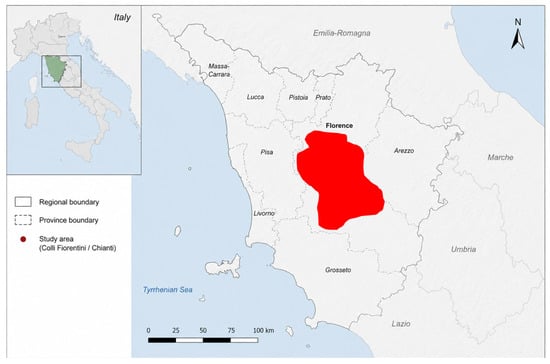
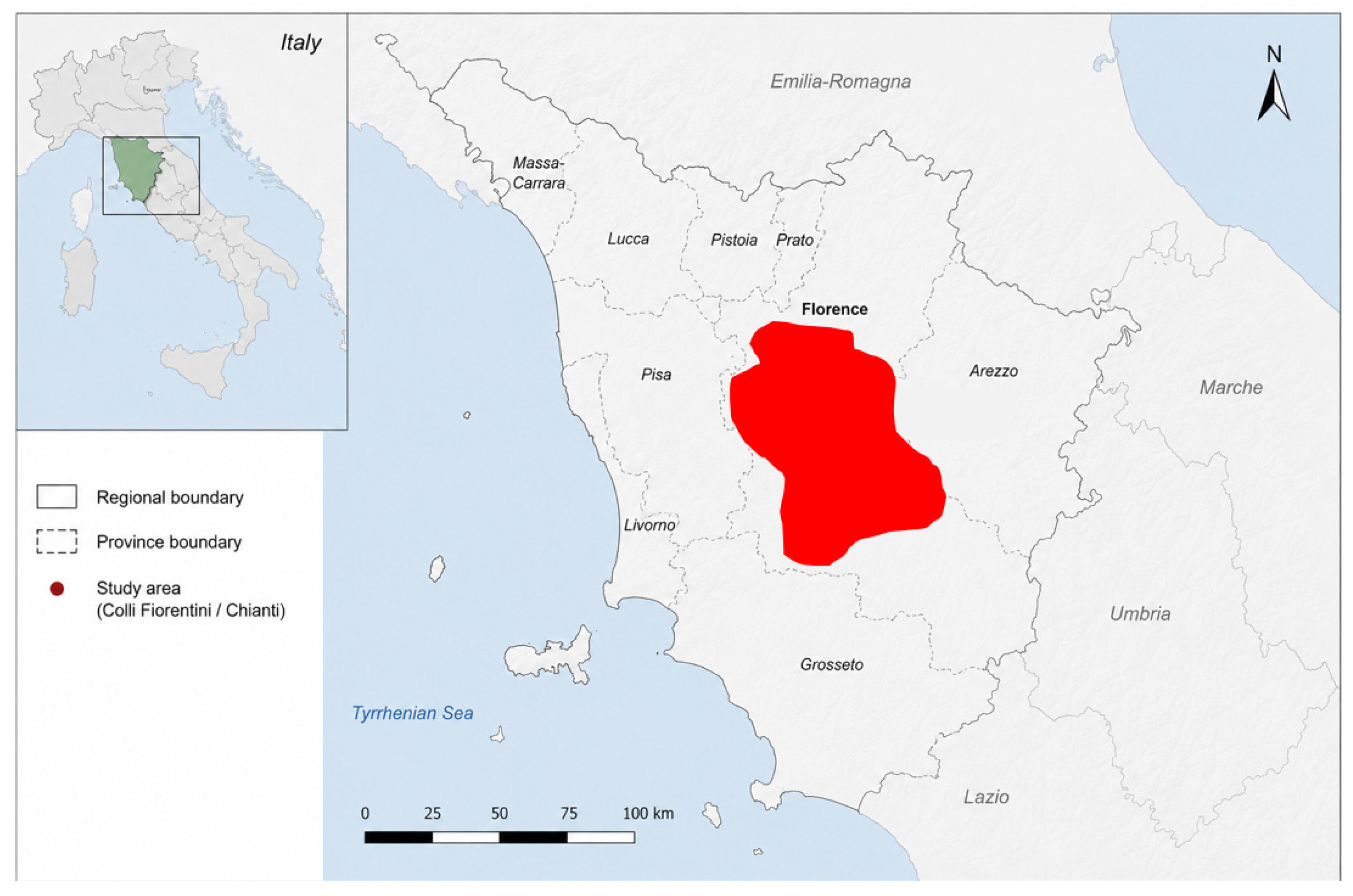
The case study is located in central Italy (Tuscany), within the olive-growing area of the Colli Fiorentini/Chianti (province of Florence), a region characterised by a strong historical vocation for olive cultivation and high-quality olive oil production (Figure 1). The choice of Tuscany is justified by: (i) its recognised territorial identity and quality orientation, including the PGI “Olio Toscano” [31]; (ii) its structural representativeness within Italian olive growing, characterised by small-to-medium farm sizes and fragmented land ownership [32]; (iii) the presence of physical constraints typical of hill olive groves, which strongly affect mechanisation and production costs [33].
Figure 1.
Location of the study: the red area indicates the analysed study area, corresponding to the Colli Fiorentini/Chianti olive-growing area within Tuscany (green area), central Italy.
Rather than representing a single observed farm, the empirical framework is based on a synthetic representative farm constructed through a structured data collection process combining three complementary sources. First, technical and economic parameters were derived from direct farm observations and key informant interviews conducted with twenty olive growers operating in the study area, selected through purposive sampling to cover the full range of planting densities, management intensities and farm structures present in Tuscan hill olive growing. Second, the collected data were integrated with technical coefficients and agronomic assumptions drawn from the peer-reviewed literature on Mediterranean olive systems. Third, input costs and output prices were obtained from regional economic sources, including market price series and regional agricultural statistics. To ensure methodological robustness, all parameters were further validated through consultation with three agronomists with direct operational experience in the study area and cross-checked against regional statistical sources [34,35,36]. The resulting dataset was assessed for internal consistency before being incorporated into the financial model. The typical farm constructed through this process should therefore be interpreted as representative of a typical Tuscan hill olive-growing context, consistent with the ‘typical farm’ methodology widely used in agricultural economics, rather than as a description of any individual farm. Although the analysis is grounded in a specific Tuscan context, the study area shares several features with other Mediterranean hill olive-growing regions. These include hilly terrain, small farm size, rainfed traditional systems coexisting with newly introduced intensive models, and dependence on public support [19,37]. The quantitative results should therefore be interpreted as context-specific benchmarks, while the methodological framework and the policy implications are transferable to comparable Mediterranean contexts.
The farm characteristics reported in Table 1 (e.g., altitude, slope, and surface area) are thus intended to define a coherent production environment for the simulations. These parameters are consistent with the physical conditions that characterise traditional olive growing across Mediterranean hill areas, where slope constraints limit mechanisation and water availability determines the feasibility of intensive systems.
Table 1.
Mean characteristics of the production system.
3.2. Study Design and Analytical Framework
The study adopts a comparative investment-analysis approach to evaluate the economic sustainability of three olive-growing systems—traditional, intensive and super-high-density (SHD)—through long-term financial analysis based on annual cash flows. This approach is consistent with the economic characteristics of permanent tree crops, where high establishment costs, delayed entry into full production and long life cycles render static indicators inadequate for profitability assessment [27].
Investment-oriented evaluations using Net Present Value (NPV/VAN), Internal Rate of Return (IRR/SIR) and discounted payback period (DPP) are widely applied in olive-growing systems and other Mediterranean perennial crops, particularly to compare systems differing in capital intensity and mechanisation [14,15,16,17,19]. However, the application of such indicators to systems with structurally different capital configurations—as in the comparison between an already-established traditional system and newly planted systems—requires methodological clarification.
Specifically, the traditional system is modelled as an already-established orchard—a going concern evaluated on the basis of its ongoing annual net returns—rather than as a greenfield investment. This choice reflects the economic reality that establishing a traditional olive grove ex novo is no longer a rational investment decision under current market conditions, given structural labour cost increases, limited mechanisability and competitive pressure on olive oil prices. The analytically relevant question is therefore not which system to establish, but whether an existing traditional orchard should be maintained or converted. Residual comparability concerns related to differential capital deployment are substantially mitigated by the realistic assumption that establishment costs for intensive and SHD systems are financed through agricultural credit instruments—as is standard practice in the sector—whereby the cost of capital is already incorporated in the discount rate applied to all cash flows. The inclusion of an annual plant replacement rate (2% per year) in the traditional system’s cost structure further contributes to restoring comparability by approximating the ongoing cost of maintaining biological capital over time.
From a policy perspective, the methodological framework is aligned with the EU Green Deal and the Farm to Fork Strategy, which promote environmental sustainability while implicitly requiring economically viable farm systems. In this context, the CAP 2023–2027 plays a central role in shaping farm-level decisions through direct payments and eco-schemes [38,39].
3.3. Definition of Olive-Growing Systems
The three olive-growing systems are defined as technical scenarios consistent with agronomic practice and the scientific literature.
The traditional system represents low-density hill olive groves (<300 trees ha−1), trained with volume canopies (vase or polyconic forms) and characterised by high labour requirements and limited mechanisation of pruning and harvesting. Numerous studies identify this configuration as economically fragile due to high unit labour costs and low productivity, especially when market prices do not compensate labour intensity [16,40].
The intensive system represents an intermediate modernisation pathway, with higher planting density (approximately 300–800 trees ha−1) and improved orchard architecture designed to enhance efficiency and partial mechanisation. Harvesting can be mechanised using trunk shakers with inverted umbrellas. No specific equipment model or manufacturer was used in the empirical analysis, as the system definitions are technical scenarios based on the literature. Irrigation is typically applied as supplementary irrigation depending on seasonal conditions [41].
The super-high-density (SHD) system is based on hedgerow orchards with very high planting densities (≈1600 trees ha−1), designed for fully mechanised harvesting with over-the-row harvesters. The literature consistently reports early bearing, high yields and drastic reductions in harvesting costs, but also emphasises dependence on irrigation, specific cultivars and site suitability, as well as potential environmental and landscape trade-offs [19,23,24].
Table 2 compares the three systems in terms of planting density, canopy architecture, mechanisation level, irrigation regime, entry into production, full production phase and assumed economic lifespan.
Table 2.
Main differences among the three olive-growing systems considered.
3.4. Economic Parameters, Costs and Revenues
Economic parameters were derived from published technical–economic studies, regional price data and documented operational costs from the case study. Costs were aggregated into macro-categories in order to enhance transparency and avoid excessive micro-accounting typical of technical reports. Establishment costs include land preparation, planting material, planting labour and, where applicable, irrigation systems and structural supports. Annual operating costs in full production include pruning, soil management, fertilisation, plant protection, irrigation and energy, harvesting and milling. Harvesting is treated explicitly as a central cost component, consistent with the literature identifying it as the most discriminating factor between systems [42]. Annual revenues are calculated as oil yield per hectare multiplied by the average selling price. The average selling price refers to the representative farm-gate price assumed for the baseline scenario. It was defined by combining price information from interviews with local olive growers and regional market quotations, and was cross-checked against available price data from the Chamber of Commerce and ISMEA [43]. The value therefore represents a conservative reference price for each marketing channel rather than a single-year market average. For the SHD system, a conservative price assumption is adopted, reflecting the higher probability of bulk marketing compared to direct on-farm sales typical of traditional quality-oriented production. This approach is consistent with economic analyses that distinguish between differentiated and commodity channels in olive oil markets [16].
The selection of the discount rate is a critical methodological step, as it directly affects the magnitude of financial indicators. Two conceptual criteria are commonly used in agricultural investment analysis: the opportunity cost of capital and the expected rate of return required by the investor [27]. The opportunity cost approach defines the discount rate as the average return obtainable from alternative investments of similar duration and risk. The expected return approach reflects the minimum return that the investor considers satisfactory, incorporating subjective risk perception. In agricultural contexts, particularly in structurally stable perennial systems, discount rates typically range between 1% and 4%, reflecting relatively moderate levels of financial risk [27]. In the present study, a uniform discount rate of 3% was adopted across all three systems. This value reflects the actual cost of agricultural credit in the Italian context and is consistent with the moderate expected return typical of a sector characterised by limited but stable profitability, in line with previous economic assessments of Mediterranean olive systems [17]. Although the three systems differ in some dimensions of technical and obsolescence risk, most notably the SHD system’s dependence on irrigation and its shorter productive lifespan, they share the same market environment, end product and price exposure. This common price exposure represents the main source of systematic risk and does not vary across systems. The adoption of a uniform rate is consistent with established practice in comparative DCF analyses of olive-growing systems [14,15,17], where risk heterogeneity is managed through sensitivity and break-even analysis rather than through discount rate differentiation [27,44].
To distinguish between market-based profitability and policy-supported sustainability, CAP payments were incorporated into the model. The analysis considers support instruments across both pillars of the CAP 2023–2027 framework. Under the First Pillar of the Italian CAP Strategic Plan, direct payments provide the general income-support component (Basic Income Support for Sustainability, BISS), while eco-schemes remunerate voluntary practices delivering environmental and climate-related benefits. Eco-scheme 2 (permanent ground cover in tree crops) was assumed to apply to all systems, with a support level of 120 €/ha [21]. Eco-scheme 3 (protection of olive groves of particular landscape value, 220 €/ha) was considered applicable to the traditional system only, consistent with its policy rationale and with the eligibility conditions for low-density and landscape-value olive groves, following the regional derogation issued by the Tuscany Regional Government extending the density threshold to 400 trees/ha [22]. Under the Second Pillar, the Tuscany Regional Complementary Plan (CSR 2023–2027) includes the intervention SRA25-ACA15 “Tutela delle colture arboree a valenza ambientale e paesaggistica” [45], providing up to 840 €/ha specifically for olive groves located in areas with recognised landscape constraints, slopes exceeding 20%, terraced systems or IGP/DOP designations—conditions directly applicable to the study area. This instrument is explicitly non-cumulative with Eco-scheme 3, meaning that farms must choose between the two support pathways depending on their structural and territorial eligibility.
The CAP payment figure adopted for the traditional system (952 €/ha) represents the weighted average of support effectively received by the farms surveyed in the study sample, as recorded through direct interviews and cross-validated against ARTEA regional data. The heterogeneity in uptake across farms—reflecting different combinations of First and Second Pillar instruments—produces an observed average consistent with the figure reported in Table 3. This value is, if anything, conservative relative to the upper bound of support available in the study area. Incorporating CAP payments in this way allows the analysis to assess the extent to which the economic sustainability of each olive-growing system depends on public support mechanisms.
Table 3.
Main economic parameters used in the financial analysis (€/ha in full production phase).
The time horizon corresponds to the expected period over which the investment generates economic effects. In perennial crops, this should reflect the technical–economic lifespan of the orchard rather than its biological longevity. While traditional olive groves may physically persist for several decades or even centuries, economic evaluation requires a more conservative horizon to account for technological obsolescence and market uncertainty [27].
Following Polidori and Omodei Zorini [16], a 50-year horizon was adopted for traditional and intensive systems, representing a prudent estimate of their economic lifespan. For SHD systems, the productive lifespan remains debated due to their relatively recent diffusion; however, recent agronomic studies indicate that 25–30 years of stable production can be reasonably assumed under proper management [26,41]. Consequently, a 25-year horizon was adopted for the SHD scenario1.
Given the inherent uncertainty affecting key economic variables in olive-growing systems, a sensitivity analysis was conducted to test the robustness of the results. In particular, the analysis focuses on olive oil price.
Oil price variability was explored by considering alternative scenarios around the baseline values, reflecting market volatility and differences between quality-differentiated and bulk market channels.
The sensitivity analysis allows the identification of the conditions under which the relative economic performance of the three olive-growing systems may change, as well as the robustness of the estimated income gap between traditional and more intensive systems.
3.5. Financial Indicators and Decision Criteria
Because olive orchards are long-lived investments with front-loaded establishment costs and delayed returns, the economic comparison was carried out using a discounted cash-flow (DCF) framework and a set of complementary financial indicators. In capital budgeting, Net Present Value (NPV) is widely regarded as the main decision criterion under certainty. Internal Rate of Return and payback-type measures are nevertheless commonly used to describe other dimensions of project performance, particularly when investors face uncertainty about discount rates or project duration. Recent theoretical work has formalised how NPV, IRR, payback period and discounted payback period can be interpreted as members of a coherent class of profitability metrics, each emphasising different sources of uncertainty and decision needs, thereby supporting their joint use in applied evaluations [44].
In the present study, the annual net cash flow (NCF) for each year was defined as the difference between total revenues and total costs:
where includes market revenues from olive oil sales and, in policy scenarios, CAP direct payments and relevant eco-schemes; includes establishment costs (in year 0 and early years) and annual operating costs during the productive phase. Consistent with economic sustainability assessments applied to Mediterranean perennial crops and olive systems, the evaluation focused on indicators derived from the full life-cycle stream of costs and benefits rather than on single-year margins [15,46]. For the traditional system, the analysis does not represent a new investment but the economic performance of an already established orchard. Consequently, no establishment costs are included, and the NPV reflects the discounted value of annual net returns rather than a conventional investment appraisal, thus representing an income-based evaluation. This modelling choice is justified on economic grounds: the traditional system is not a credible greenfield investment alternative under current market conditions and is therefore appropriately treated as a going concern. The comparability of NPV and EAV estimates across systems—which formally requires a common decision-making starting point—is partially restored through the inclusion of a 2% annual plant replacement rate, which approximates the cost of maintaining the biological capital of an ageing orchard and is further supported by the assumption of debt financing for establishment costs in the intensive and SHD systems. Under this assumption, the cost of capital is embedded in the discount rate and no residual equity capital requiring alternative deployment remains unaccounted for.
NPV was calculated as the discounted sum of net cash flows over the project time horizon , using a constant real discount rate :
A project is considered economically viable if NPV ≥ 0 at the chosen discount rate, and higher NPV indicates greater value creation in absolute terms. This criterion is standard in DCF-based appraisal and is widely adopted in the economic evaluation of olive systems and other perennial crops, including analyses integrated with Life Cycle Costing [15,44,46,47].
Internal Rate of Return (IRR) was computed as the discount rate that sets the NPV of the investment to zero:
IRR provides a relative measure of profitability (a rate of return) that is often informative when comparing investments with different scales of capital requirement. Although IRR is widely reported alongside NPV in agricultural and sustainability investment studies, recent contributions emphasise that IRR may be undefined or ambiguous for certain non-conventional cash-flow patterns, which reinforces the practice of reporting IRR as a complement rather than a substitute for NPV [15,44]. For the traditional system, IRR is not reported, as the analysis does not involve an initial investment. In the absence of a conventional investment structure, IRR cannot be meaningfully defined, and economic performance is instead interpreted through annual net returns.
To capture the time dimension of economic risk and liquidity exposure, the discounted payback period was calculated as the smallest integer such that the cumulative discounted cash flow becomes non-negative:
DPP is particularly relevant for perennial crops where early-year negative cash flows can be prolonged and where differences in time-to-break-even across systems may matter to farmers and lenders. The theoretical literature highlights that payback-based measures can be especially useful when project duration is uncertain (e.g., early termination, replacement decisions), which is a pertinent consideration for orchard systems with differing economic lifespans and potential technological obsolescence [44,48]. For the traditional system, payback-based indicators are not applicable, as the analysis does not include an initial investment. Consequently, these indicators are reported only for investment-based systems (intensive and SHD).
The Equivalent Annual Value (EAV) was calculated using the equivalent annual annuity transformation, which converts the project’s NPV into a constant annual net benefit over the time horizon T:
In this study, the primary role of the EAV is not only to standardise results across systems with different lifespans, but more importantly to provide a direct measure of the annual income gap between alternative olive-growing models. Differences in EAV can therefore be interpreted as the additional annual income required to make traditional olive groves economically comparable to more intensive systems.
This interpretation allows long-term financial performance to be translated into a policy-relevant benchmark, expressing the level of annual support needed to sustain traditional systems in the presence of more competitive alternatives [49,50].
Given the volatility of olive oil markets, robustness was further assessed by estimating the break-even oil price that yields under a “no-subsidy” condition (i.e., excluding CAP payments). Operationally, this was implemented by solving for the oil price that satisfies:
where denotes annual oil output (kg/ha) at year . This procedure isolates the intrinsic market viability of each system from policy support, a distinction frequently recommended in applied sustainability and farm-economics evaluations when public payments can materially alter profitability rankings [15,44].
Financial calculations were performed using Microsoft® Excel® for Microsoft 365 MSO, Version 2605, Build 16.0.20026.20168, 64-bit.
4. Results
4.1. Cost Structure and Revenue Configuration
The three olive-growing systems exhibit markedly different cost structures, reflecting their distinct technical configurations and degrees of mechanisation. Table 3 reports the key economic parameters used in the financial model, expressed per hectare in full production.
The traditional system is characterised by comparatively low establishment costs but high labour incidence in pruning and harvesting. In contrast, both the intensive and SHD systems require substantially higher initial investment due to planting density, structural components and, in the case of SHD, irrigation infrastructure and hedgerow configuration. Operating costs in full production are higher in the intensive and SHD systems than in the traditional system, although they do not follow a strictly linear gradient. This reflects differences in cost composition: harvesting costs remain dominant in the traditional system, whereas irrigation, fertilisation, plant protection and mechanisation-related expenses become more relevant in intensified systems.
Oil revenues follow a different pattern. Under the baseline price assumptions, full-production revenues from oil sales reach 3600 €/ha in the traditional system, 7200 €/ha in the intensive system and 10,500 €/ha in the SHD system. When CAP payments are included, total annual revenues increase to 4552 €/ha in the traditional system and 7720 €/ha and 10,750 €/ha in the intensive and SHD systems, respectively. The traditional system benefits more proportionally from CAP support due to eligibility for additional eco-scheme components, whereas the other two systems rely more heavily on market-derived income.
4.2. Long-Term Financial Performance
The discounted cash-flow analysis highlights substantial differences in long-term financial performance across systems. The main financial performance indicators are reported in Table 4. Net Present Value (NPV) amounts to 19,112 € for the traditional system, 43,540 € for the intensive system and 98,975 € for the SHD system. For the traditional system, NPV reflects the performance of a mature and stabilised orchard, without establishment costs, and therefore captures only the stream of annual net returns.
Table 4.
Financial performance indicators of the three olive-growing systems.
The Internal Rate of Return (IRR) follows a similar pattern, increasing from 9.1% in the intensive system to 14.9% in the SHD system. The discounted payback period (DPP) shortens correspondingly, reaching approximately 17 years in the intensive system and 9 years in the SHD configuration.
These indicators confirm a clear gradient of increasing capital efficiency and earlier recovery of investment as production systems intensify. However, capital requirements also increase substantially, indicating a significantly higher financial barrier to entry for intensified systems.
In policy terms, the difference in Equivalent Annual Value provides a first estimate of the annual income gap faced by traditional olive groves. In this case, the estimated gap amounts to approximately 950 €/ha relative to intensive systems and 3104 €/ha relative to SHD systems, in addition to current support schemes, to prevent the abandonment of traditional olive groves in favour of more economically competitive systems.
4.3. CAP Dependency and Structural Sustainability
When current CAP payments are excluded, the traditional system becomes structurally vulnerable. The break-even oil price required to obtain a non-negative NPV rises to approximately 9.60 €/kg. In contrast, the intensive and SHD systems remain economically viable at considerably lower break-even prices, estimated at 6.97 €/kg and 4.13 €/kg respectively. These break-even values should be interpreted against the background of current market quotations for extra virgin olive oil, which vary substantially according to origin, quality certification and marketing channel. Recent Italian producer price data reported by ISMEA show that ordinary extra virgin olive oil is generally quoted below the break-even price estimated for the traditional system, whereas territorially certified or quality-differentiated oils may reach higher price levels [43]. This comparison suggests that the economic viability of traditional olive groves without public support is unlikely to be achieved through ordinary bulk-market channels alone and depends instead on access to quality-differentiated markets or on complementary policy support. These results are summarised in Table 5. Together with the baseline results, they show that the traditional system is markedly more dependent on public support and high market prices to ensure long-term sustainability.
Table 5.
Break-even oil price (NPV = 0) under no-CAP scenario.
The break-even analysis can be interpreted as a price-based sensitivity analysis, highlighting the robustness of the relative performance across systems under varying market conditions. Results show that, even under a no-subsidy scenario, the ranking of systems remains unchanged, with SHD and intensive systems maintaining positive economic viability at substantially lower price levels compared to the traditional system.
This confirms that the income gap identified in the baseline scenario is not driven by specific price assumptions, but reflects structural differences in cost efficiency and productivity across systems.
4.4. Landscape-Preservation Implications of the Income Gap
The economic results can also be interpreted in relation to the landscape-preservation function of traditional olive groves. The traditional system considered in this study is not only a production model, but also a landscape configuration characterised by low planting density, rainfed management, limited mechanisation and continuity with historic hill olive-growing systems. These features support the provision of non-market public goods, including landscape identity, soil protection, biodiversity conservation and territorial resilience.
From this perspective, the lower EAV of the traditional system does not simply indicate weaker private profitability. It also represents the opportunity cost borne by farmers who maintain a landscape-preserving production system instead of shifting towards more financially competitive alternatives. The estimated EAV gap of 950 €/ha compared with the intensive system and 3104 €/ha compared with the SHD system therefore provides an economic measure of the annual private income foregone when traditional olive groves are preserved.
This interpretation links the financial results to the theoretical framework of multifunctional agriculture and public-good provision. Traditional olive groves generate benefits that extend beyond farm income, but these benefits are only partially reflected in market prices and current support schemes. The results therefore suggest that landscape preservation requires policy mechanisms capable of compensating the structural income disadvantage associated with traditional systems. At the same time, the analysis does not directly monetise ecosystem services; rather, it identifies the private economic gap that policy instruments would need to address if the preservation of traditional olive landscapes is considered a social objective.
5. Discussion
The findings provide a consistent ranking across systems and reveal a key trade-off in Mediterranean olive-growing areas: systems that are more competitive in market terms also require higher capital investment and more favourable site conditions. The break-even results also provide a price-based sensitivity perspective, confirming that the relative ranking of systems remains stable under alternative market conditions and that the observed income gap reflects structural differences rather than specific price assumptions.
The SHD configuration is the most financially attractive option in this case study, with the highest profitability and the fastest recovery of invested capital. With an NPV of €98,975, an IRR of 14.9%, and a discounted payback period of approximately nine years, the system allows a rapid transition from establishment costs to sustained positive cash flows. This result is consistent with the well-established economic advantages of mechanised harvesting and early bearing in hedgerow systems, particularly in contexts where labour scarcity and harvesting costs constrain traditional production models [19,26].
However, the capital required during the establishment and non-bearing phase (€28,561) represents a substantial barrier to entry, especially in fragmented agricultural contexts such as those typical of Italy. This confirms that intensification is not only a technological shift but also a capital-intensive strategy, whose feasibility depends on financial capacity, access to credit, and the ability to withstand early-stage cash deficits [26]. In addition, SHD systems require irrigation and field layouts compatible with over-the-row machinery, conditions that are not always met in hilly Mediterranean landscapes and may entail structural changes with potential landscape implications [24,51].
The intensive system represents an economically robust intermediate pathway, combining improved productivity and partial mechanisation with lower capital requirements compared to SHD systems. With an NPV of €43,540, an IRR of 9.1%, and a discounted payback period of approximately 17 years, it provides a more balanced trade-off between profitability and investment risk. This finding is consistent with previous studies suggesting that high-density systems can offer an efficient compromise between economic performance and structural adaptability, particularly in areas where full mechanisation is constrained [14,19]. From a practical perspective, the intensive system can be interpreted as a feasible transition strategy for farms operating in structurally heterogeneous or hilly areas, where full conversion to SHD systems may not be technically or socially viable.
The traditional system, by contrast, cannot be interpreted as a standard investment scenario, as it is modelled as a mature and stabilised orchard maintained through continuous tree renewal, without establishment costs. Therefore, its economic performance should be assessed in terms of annual net returns rather than conventional investment indicators. Under these assumptions, the Equivalent Annual Value (742 €/ha) is substantially lower than that of both intensive (1692 €/ha) and SHD systems (3846 €/ha), indicating a persistent income disadvantage under market conditions.
This result is consistent with broader evidence on Mediterranean olive farming, where labour-intensive traditional systems, particularly in hilly areas, struggle to remain economically viable without adequate price premiums or public support [13,52]. In this context, the risk of abandonment emerges not as a behavioural anomaly, but as a predictable outcome of structural economic constraints, increasingly documented through spatial analyses of land-use change in central Italy [13,19,33].
From a policy perspective, the key contribution of this study lies in the interpretation of the Equivalent Annual Value (EAV) as a benchmark for economic support. The difference in EAV between systems provides a direct measure of the annual income gap that would need to be compensated to ensure the economic viability of traditional olive groves. In this case, the estimated gap amounts to approximately 950 €/ha compared to intensive systems and 3104 €/ha compared to SHD systems, in addition to current support schemes. These values represent a quantitative benchmark for policy design aimed at preventing the abandonment of traditional olive groves in favour of more economically competitive systems.
These findings have broader implications beyond private profitability, as olive groves in Mediterranean hill systems generate a range of public goods that are not fully captured by market mechanisms. Traditional and low-input systems are consistently associated with higher levels of landscape integrity, biodiversity conservation and soil protection, whereas more intensive systems tend to maximise private returns [1]. This implies a structural divergence between private profitability and social value, unless appropriate policy instruments or market-based mechanisms are introduced to internalise these externalities [1,53]. If traditional olive groves were to disappear purely on the basis of market efficiency criteria, the loss of ecosystem services and cultural landscapes would entail long-term social and environmental costs that are difficult to reverse.
This divergence also involves resource-use trade-offs. In the present simulations, traditional olive groves are associated with lower levels of fertilisation, plant protection and irrigation costs, whereas intensive and especially SHD systems rely more heavily on external inputs and water availability. Therefore, the higher financial performance of intensified systems should not be interpreted as an unambiguous sustainability advantage. Rather, it highlights a potential conflict between private economic returns and some environmental policy objectives, particularly in areas affected by water scarcity, drought risk or constraints on irrigation infrastructure. This reinforces the need for policy instruments that distinguish between financial efficiency, environmental pressure and landscape preservation [51,53].
The results are directly relevant to the Common Agricultural Policy (CAP) 2023–2027, the Green Deal and the Farm to Fork Strategy. Within this framework, eco-schemes provide an important mechanism for linking farm support to environmental and climate objectives, but the estimated income gap suggests that current support levels may not be sufficient to fully compensate the economic disadvantage of traditional systems, particularly in structurally constrained areas [20,21,22].
At the same time, the results highlight a potential policy trade-off. If profitability gains are primarily associated with intensification, policies that focus exclusively on maintaining low-input systems without supporting structural adaptation may risk locking farms into low-income equilibria. Conversely, indiscriminate promotion of highly intensive systems may lead to the erosion of landscape and environmental functions where site conditions are not suitable. This calls for a differentiated policy approach, combining targeted support for traditional systems as providers of public goods with context-specific strategies for sustainable intensification.
In practical terms, the long-term survival of traditional olive groves in high-value regions such as Tuscany depends on making multifunctionality economically viable. This may require a combination of policy instruments, including adequately calibrated agri-environmental payments, strengthened market differentiation strategies, and organisational innovations aimed at reducing labour costs without compromising landscape values [52].
Finally, the study has some limitations that should be acknowledged. The analysis is based on a specific case study and is therefore not intended to provide universally generalisable results. Economic performance is sensitive to assumptions regarding yields, prices and orchard lifespan, while the feasibility of SHD systems depends on irrigation availability and site suitability. Moreover, the analysis does not explicitly monetise non-market ecosystem services, which implies that the social value of traditional systems may be underestimated in purely economic terms.
Overall, the results highlight a clear structural divergence between economically efficient and socially desirable production systems. While intensive and SHD systems offer higher profitability and greater resilience to market conditions, traditional systems remain essential for the provision of landscape, environmental and cultural public goods. Bridging this gap requires policy instruments capable of aligning private incentives with social value, ensuring that the preservation of traditional olive groves is not only environmentally desirable, but also economically sustainable.
6. Conclusions and Limitations
This study quantitatively assesses the economic sustainability of alternative olive-growing systems in a Mediterranean context, focusing on the income gap between traditional and more intensive production models. The results show a clear structural divergence: while intensive and super-high-density systems achieve higher profitability and faster capital recovery, traditional olive groves exhibit significantly lower economic performance under market conditions, despite their recognised environmental and cultural value. The key contribution of the analysis lies in the use of the Equivalent Annual Value (EAV) as a policy-relevant indicator. Differences in EAV provide a direct measure of the annual income gap between systems, which in this case amounts to approximately 950 €/ha compared to intensive systems and 3104 €/ha compared to SHD systems. These values represent a benchmark for the level of additional support required to ensure the economic viability of traditional olive groves, in addition to current policy instruments.
From a policy perspective, the findings suggest that the preservation of traditional olive landscapes cannot rely solely on market mechanisms, as these systems generate public goods that are not fully remunerated. Targeted support measures, combined with strategies for market valorisation and organisational innovation, are therefore necessary to align private incentives with social value and to prevent the progressive abandonment of traditional systems.
Finally, the results should be interpreted as relative economic benchmarks rather than strictly comparable investment outcomes, given the different structural assumptions underlying the analysed systems. Future research should integrate economic analysis with quantitative assessment of ecosystem services, in order to support more comprehensive and evidence-based policy design.
Several limitations should be acknowledged. The analysis is grounded in a specific Tuscan case study and, although it shares several structural features with other Mediterranean hill olive-growing areas, the quantitative results should not be transferred to other contexts without appropriate calibration. The model assumes constant oil prices and stable yields throughout the projection horizon, while in practice olive oil markets are subject to significant volatility and SHD yield trajectories may decline over time; the assumed 25-year economic lifespan for SHD systems, while consistent with recent evidence, also remains subject to uncertainty. The comparison of NPV and EAV across systems with different capital structures rests on the assumption of debt financing for establishment costs—consistent with standard sectoral practice—whereby the cost of capital is embedded in the discount rate; in contexts where equity financing prevails, the opportunity cost of undeployed capital would require explicit treatment.
Furthermore, a uniform discount rate of 3% was applied across all three systems, reflecting the actual cost of agricultural credit in the Italian context rather than a theoretically risk-adjusted rate. While the three systems share the same market environment, end product and price exposure—which represents the primary driver of systematic risk—they do differ in dimensions of technical and obsolescence risk, particularly the SHD system given its greater dependence on irrigation and its shorter and less certain productive lifespan. Future analyses could explore the sensitivity of results to system-specific discount rates, which would allow a more granular treatment of risk heterogeneity across production models.
The analysis also does not monetise the ecosystem services and public goods associated with traditional olive groves. The estimated EAV gap should therefore be interpreted as a lower bound of the compensation required rather than as a comprehensive measure of social value.
Author Contributions
Conceptualization, G.S. and T.F.; methodology, G.S. and T.F.; formal analysis, G.S.; data curation, G.S. and T.F.; writing—original draft preparation, T.F.; writing—review and editing, G.S. and T.F.; visualisation, T.F.; supervision, G.S. All authors have read and agreed to the published version of the manuscript.
Funding
This research received no external funding.
Data Availability Statement
The data supporting the findings of this study are available from the corresponding author upon reasonable request. The relevant dataset and supporting documentation have also been submitted to the Editorial Office for verification during the review process.
Acknowledgments
During the preparation of this manuscript, the authors used ChatGPT GPT-5.5, OpenAI, for language editing and proofreading. The authors reviewed and edited all AI-assisted outputs and take full responsibility for the content of the publication.
Conflicts of Interest
The authors declare no conflicts of interest.
Note
| 1 | To ensure comparability of Net Present Value (NPV) across systems with different economic lifespans, the SHD investment was assumed to be replicated after the first 25 years. This allows the analysis to be conducted over a common time horizon consistent with that adopted for traditional and intensive systems. |
References
- Brunori, E.; Salvati, L.; Antogiovanni, A.; Biasi, R. Worrying about ‘vertical landscapes’: Terraced olive groves and ecosystem services in marginal land in central Italy. Sustainability 2018, 10, 1164. [Google Scholar] [CrossRef] [Scilit]
- Agnoletti, M. Italian Historical Rural Landscapes: Dynamics, Data Analysis and Research Findings. In Italian Historical Rural Landscapes: Cultural Values for the Environment and Rural Development; Springer: Dordrecht, The Netherlands, 2012; pp. 3–87. [Google Scholar]
- Infante-Amate, J.; Villa, I.; Aguilera, E.; Torremocha, E.; Guzmán, G.; Cid, A.; González de Molina, M. The making of olive landscapes in the south of Spain. A history of continuous expansion and intensification. In Biocultural Diversity in Europe; Springer International Publishing: Cham, Switzerland, 2016; pp. 157–179. [Google Scholar]
- Saulle, R.; La Torre, G. The Mediterranean Diet, recognized by UNESCO as a cultural heritage of humanity. Ital. J. Public Health 2010, 7, 414–415. [Google Scholar] [CrossRef] [Scilit] [PubMed]
- Dernini, S.; Berry, E.M.; Serra-Majem, L.; La Vecchia, C.; Capone, R.; Medina, F.X.; Aranceta-Bartrina, J.; Belahsen, R.; Burlingame, B.; Calabrese, G.; et al. Med Diet 4.0: The Mediterranean diet with four sustainable benefits. Public Health Nutr. 2017, 20, 1322–1330. [Google Scholar] [PubMed]
- Nocella, C.; Cammisotto, V.; Fianchini, L.; D’Amico, A.; Novo, M.; Castellani, V.; Stefanini, L.; Violi, F.; Carnevale, R. Extra virgin olive oil and cardiovascular diseases: Benefits for human health. Endocr. Metab. Immune Disord.-Drug Targets (Former. Curr. Drug Targets-Immune Endocr. Metab. Disord.) 2018, 18, 4–13. [Google Scholar]
- Schwingshackl, L.; Morze, J.; Hoffmann, G. Mediterranean diet and health status: Active ingredients and pharmacological mechanisms. Br. J. Pharmacol. 2020, 177, 1241–1257. [Google Scholar] [PubMed]
- George, E.S.; Marshall, S.; Mayr, H.L.; Trakman, G.L.; Tatucu-Babet, O.A.; Lassemillante, A.C.M.; Bramley, A.; Reddy, A.J.; Forsyth, A.; Tierney, A.C.; et al. The effect of high-polyphenol extra virgin olive oil on cardiovascular risk factors: A systematic review and meta-analysis. Crit. Rev. Food Sci. Nutr. 2019, 59, 2772–2795. [Google Scholar] [PubMed]
- Contini, C.; Casini, L.; Stefan, V.; Romano, C.; Juhl, H.J.; Lähteenmäki, L.; Scozzafava, G.; Grunert, K.G. Some like it healthy: Can socio-demographic characteristics serve as predictors for a healthy food choice? Food Qual. Prefer. 2015, 46, 103–112. [Google Scholar] [CrossRef] [Scilit]
- Ncube, A.; Fiorentino, G.; Panfilo, C.; De Falco, M.; Ulgiati, S. Circular economy paths in the olive oil industry: A Life Cycle Assessment look into environmental performance and benefits. Int. J. Life Cycle Assess. 2024, 29, 1541–1561. [Google Scholar]
- Camposeo, S.; Vivaldi, G.A.; Russo, G.; Melucci, F.M. Intensification in olive growing reduces global warming potential under both integrated and organic farming. Sustainability 2022, 14, 6389. [Google Scholar] [CrossRef] [Scilit]
- Muñoz-Rojas, J.; García-Ruiz, R. Olive Groves (and Olive Oil) in the Mediterranean in 2023: A Heterogeneous and Dynamic Mosaic of Rural Landscapes and Ecosystems. In The Olive Landscapes of the Mediterranean: Key Challenges and Opportunities for Their Sustainability in the Early XXIst Century; Springer Nature: Cham, Switzerland, 2024; pp. 3–15. [Google Scholar]
- Fantechi, T.; Contini, C.; Casini, L. From productivity to abandonment: Sub-national evidence from the Italian farm sector in the context of EU agricultural policy. J. Rural Stud. 2026, 121, 103949. [Google Scholar] [CrossRef] [Scilit]
- De Gennaro, B.; Notarnicola, B.; Roselli, L.; Tassielli, G. Innovative olive-growing models: An environmental and economic assessment. J. Clean. Prod. 2012, 28, 70–80. [Google Scholar] [CrossRef] [Scilit]
- Spada, E.; Stillitano, T.; Falcone, G.; Iofrida, N.; Gulisano, G.; De Luca, A.I. Economic sustainability assessment of Mediterranean crops: A comparative Life Cycle Costing (LCC) analysis. Front. Sustain. Food Syst. 2022, 6, 1004065. [Google Scholar] [CrossRef] [Scilit]
- Omodei Zorini, L.; Polidori, R. Impatto economico di tecniche alternative nei processi produttivi olivicoli in Toscana. Aestimum 2010, 56, 59–90. [Google Scholar]
- Stillitano, T.; De Luca, A.I.; Falcone, G.; Spada, E.; Gulisano, G.; Strano, A. Economic profitability assessment of Mediterranean olive growing systems. Bulg. J. Agric. Sci. 2016, 22, 517–526. [Google Scholar]
- Garrido-Almonacid, A.; Parras-Rosa, M.; Sánchez-Martínez, J. Traditional (economically vulnerable) olive groves. An approach to their conceptualization and spatial delimitation based on the Spanish case. GeoJournal 2026, 91, 36. [Google Scholar] [CrossRef] [Scilit]
- Freixa, E.; Gil, J.M.; Tous, J.; Hermoso, J.F. Comparative study of the economic viability of high-and super-high-density olive orchards in Spain. Acta Hortic. 2010, 924, 247–254. [Google Scholar]
- European Commission. Eco-Schemes (CAP 2023–27). 2024. Available online: https://agriculture.ec.europa.eu/common-agricultural-policy/income-support/eco-schemes_en (accessed on 25 May 2026).
- Ministero Dell’agricoltura, della Sovranità Alimentare e Delle Foreste (MASAF). Eco-Schema 2—Inerbimento Delle Colture Arboree. 2023. Available online: https://www.masaf.gov.it/flex/cm/pages/ServeBLOB.php/L/IT/IDPagina/18875 (accessed on 4 May 2026).
- Ministero Dell’agricoltura, Della Sovranità Alimentare e Delle Foreste (MASAF). Eco-Schema 3—Salvaguardia Olivi di Particolare Valore Paesaggistico. 2023. Available online: https://www.masaf.gov.it/flex/cm/pages/ServeBLOB.php/L/IT/IDPagina/18877 (accessed on 25 May 2026).
- Trentacoste, E.R.; Connor, D.J.; Gómez-del-Campo, M. Response of oil production and quality to hedgerow design in super-high-density olive cv. Arbequina orchards. Agronomy 2021, 11, 1632. [Google Scholar] [CrossRef] [Scilit]
- Díez, C.M.; Moral, J.; Cabello, D.; Morello, P.; Rallo, L.; Barranco, D. Cultivar and tree density as key factors in the long-term performance of super high-density olive orchards. Front. Plant Sci. 2016, 7, 1226. [Google Scholar] [CrossRef] [Scilit] [PubMed]
- Pomarici, E.; Vecchio, R. The Italian olive oil industry in the global competitive scenario. Agric. Econ./Zemědělská Ekon. 2013, 59, 361–372. [Google Scholar] [CrossRef] [Scilit]
- Lo Bianco, R.; Proietti, P.; Regni, L.; Caruso, T. Planting systems for modern olive growing: Strengths and weaknesses. Agriculture 2021, 11, 494. [Google Scholar] [CrossRef] [Scilit]
- Gallerani, V.; Viaggi, D.; Zanni, G. Manuale di Estimo; McGraw-Hill: New York, NY, USA, 2011. [Google Scholar]
- Iofrida, N.; Stillitano, T.; Falcone, G.; Gulisano, G.; Nicolo, B.F.; De Luca, A.I. The socio-economic impacts of organic and conventional olive growing in Italy. New Medit. 2020, 19, 117–131. [Google Scholar] [CrossRef] [Scilit]
- Scordia, D.; Corinzia, S.A.; Coello, J.; Vilaplana Ventura, R.; Jimenez-De-Santiago, D.E.; Singla Just, B.; Castaño-Sánchez, O.; Arcarons, C.C.; Tchamitchian, M.; Garreau, L.; et al. Are agroforestry systems more productive than monocultures in Mediterranean countries? A meta-analysis. Agron. Sustain. Dev. 2023, 43, 73. [Google Scholar] [CrossRef] [Scilit]
- Pergola, M.; Palese, A.M.; Persiani, A.; De Francesco, P.; Cirillo, C.; Giacca, G.M.; Maffia, A.; Celano, G. Mediterranean cropping systems: The importance of their economic and environmental sustainability. Adv. Environ. Eng. Res. 2021, 2, 1–35. [Google Scholar] [CrossRef] [Scilit]
- Belletti, G.; Burgassi, T.; Marescotti, A.; Scaramuzzi, S. The effects of certification costs on the success of a PDO/PGI. In Quality Management in Food Chains; Wageningen Academic: Wageningen, The Netherlands, 2007; pp. 107–121. [Google Scholar]
- Cisilino, F.; Giampaolo, A.; Licciardo, F.; Orlando, M.; Tarangioli, S. The Tuscany integrated supply chain projects 2014–2022: A new path to support the Agri-food industry. Land 2023, 12, 1230. [Google Scholar] [CrossRef] [Scilit]
- Volpi, I.; Marchi, S.; Petacchi, R.; Hoxha, K.; Guidotti, D. Detecting olive grove abandonment with Sentinel-2 and machine learning: The development of a web-based tool for land management. Smart Agric. Technol. 2023, 3, 100068. [Google Scholar] [CrossRef] [Scilit]
- ARTEA. Agenzia Regionale Toscana per le Erogazioni in Agricoltura. 2026. Available online: https://www.artea.toscana.it/ (accessed on 25 May 2026).
- CREA. Rete di Informazione Contabile Agricola—RICA. 2026. Available online: https://rica.crea.gov.it/ (accessed on 25 May 2026).
- Camera di Commercio di Firenze. Prezzi e Listini. 2026. Available online: https://www.fi.camcom.gov.it/ (accessed on 25 May 2026).
- Duarte, F.; Jones, N.; Fleskens, L. Traditional olive orchards on sloping land: Sustainability or abandonment? J. Environ. Manag. 2008, 89, 86–98. [Google Scholar] [CrossRef] [Scilit] [PubMed]
- Sotte, F.; Rolandi, S. The CAP 2023–2027. In European Agricultural Policy: History and Analysis; Springer Nature: Cham, Switzerland, 2025; pp. 237–269. [Google Scholar]
- Cardone, G.; Bottalico, F.; Prebibaj, M. Assessment of the economic sustainability of an organic olive oil farm in Puglia region (Italy) under the voluntary regional quality scheme. New Medit. 2021, 20, 113–129. [Google Scholar] [CrossRef] [Scilit]
- Vossen, P. Olive oil: History, production, and characteristics of the world’s classic oils. HortScience 2007, 42, 1093–1100. [Google Scholar] [CrossRef] [Scilit]
- Massenti, R.; Ioppolo, A.; Veneziani, G.; Selvaggini, R.; Servili, M.; Lo Bianco, R.; Caruso, T. Low tree vigor, free palmette training form, and high planting density increase olive and oil yield efficiency in dry, sloping areas of Mediterranean regions. Horticulturae 2022, 8, 817. [Google Scholar] [CrossRef] [Scilit]
- Pellegrini, G.; Sala, P.L.; Camposeo, S.; Contò, F. Economic sustainability of the olive oil high and super-high density cropping systems in Italy. Glob. Bus. Econ. Rev. 2017, 19, 553–569. [Google Scholar] [CrossRef] [Scilit]
- ISMEA. Olio D’oliva—Prezzi e Quotazioni Alla Produzione. ISMEA Mercati. 2026. Available online: https://www.ismeamercati.it/flex/cm/pages/ServeBLOB.php/L/IT/IDPagina/648 (accessed on 25 May 2026).
- Sokolov, M.V. Npv, irr, pi, pp, and dpp: A unified view. J. Math. Econ. 2024, 114, 102992. [Google Scholar] [CrossRef] [Scilit]
- Regione Toscana. Bando “Tutela Delle Colture Arboree a Valenza Ambientale e Paesaggistica”, Codice SRA25–ACA25; Decreto Dirigenziale n. 24809 del 24 Novembre 2023, Allegato C; Complemento per lo Sviluppo Rurale FEASR 2023–2027 Della Regione Toscana. Available online: https://www301.regione.toscana.it/bancadati/atti/Contenuto.xml?id=5396804&nomeFile=Decreto_n.24809_del_24-11-2023-Allegato-C (accessed on 25 May 2026).
- Degieter, M.; Gellynck, X.; Goyal, S.; Ott, D.; De Steur, H. Life cycle cost analysis of agri-food products: A systematic review. Sci. Total Environ. 2022, 850, 158012. [Google Scholar] [CrossRef] [Scilit] [PubMed]
- Peña, A.; Rovira-Val, M.R. A longitudinal literature review of life cycle costing applied to urban agriculture. Int. J. Life Cycle Assess. 2020, 25, 1418–1435. [Google Scholar] [CrossRef] [Scilit]
- Bhandari, S.B. Discounted payback period-some extensions. J. Bus. Behav. Sci. 2009, 21, 28–38. [Google Scholar]
- Luciano, E.; Peccati, L. Cycles optimization: The equivalent annuity and the NPV approaches. Int. J. Prod. Econ. 2001, 69, 65–83. [Google Scholar] [CrossRef] [Scilit]
- Kuehne, C.; Granhus, A.; Astrup, R. Assessing the profitability of thinning Norway’s spruce and pine forests: An analysis accounting for machine trail effects. Scand. J. For. Res. 2025, 40, 41–51. [Google Scholar]
- Sobreiro, J.; Patanita, M.I.; Patanita, M.; Tomaz, A. Sustainability of high-density olive orchards: Hints for irrigation management and agroecological approaches. Water 2023, 15, 2486. [Google Scholar] [CrossRef] [Scilit]
- Pulighe, G. Trapped in the past: The decline of Italian Olive groves in the face of traditional visions and policies, emerging challenges and innovation. Agric. Rural Stud. 2023, 1, 7. [Google Scholar] [CrossRef] [Scilit]
- Raz, S.; Hila, S.; Assaf, S. Ecological, social and economic benefits of organic olive farming outweigh those of intensive and traditional practices. Sci. Total Environ. 2024, 921, 171035. [Google Scholar] [CrossRef] [Scilit] [PubMed]

Disclaimer/Publisher’s Note: The statements, opinions and data contained in all publications are solely those of the individual author(s) and contributor(s) and not of MDPI and/or the editor(s). MDPI and/or the editor(s) disclaim responsibility for any injury to people or property resulting from any ideas, methods, instructions or products referred to in the content. |
© 2026 by the authors. Licensee MDPI, Basel, Switzerland. This article is an open access article distributed under the terms and conditions of the Creative Commons Attribution (CC BY) license.