


Highlights
- Activated carbon from durian skin was used to study the adsorption of heavy metal ions.
- A monolayer model was applied to interpret the adsorption isotherms of Pb2+ and Cu2+.
- The adsorbent shows a competitive performance in adsorbing Pb2+ and Cu2+.
- The heavy metal ion adsorption on activated carbon was a multi-ionic process.
- Pb2+ and Cu2+ ions were adsorbed via an endothermic process.
- Activated carbon can be used to remove heavy metals from water.
- Activated carbon can be used to depollute water containing heavy metals.
- An advanced monolayer model was used to calculate physicochemical parameters.
- Physical forces are mainly responsible for heavy metal adsorption on activated carbon.
Abstract
This study reports a mechanistic analysis of Pb2+ and Cu2+ adsorption on activated carbon (AC) obtained from durian skin. Pb2+ and Cu2+ adsorption tests were carried out at 303–323 K and pH 5.5 to interpret the heavy metal—durian skin AC systems. A monolayer model was applied to simulate experimental isotherms and calculate steric and energy parameters. The results indicated that the removal of these target pollutants was a multi-ionic process. The saturation adsorption capacities of this AC improved with increasing aqueous solution temperature, ranging from 81 to 139 mg/g for Pb2+ and from 95 to 180 mg/g for Cu2+ under the tested operating conditions. The calculated interaction energies indicated a physisorption mechanism where oxygenated functional groups played a relevant role. Durian skin AC can be used as an alternative adsorbent for purifying wastewater and industrial streams polluted by heavy metals.
1. Introduction
The literature indicates that several industrial sectors (e.g., tanneries, paper, and metal plating) impact the environment because of improper disposal of residual effluents containing hazardous heavy metals [1,2,3,4,5,6]. These contaminants have been identified in water resources (e.g., groundwater, creeks, wetlands, lakes, and rivers) and, consequently, generate toxicological risks to living organisms and humans [1,2,3,4,5,6]. Copper (Cu2+), lead (Pb2+), chromium, mercury, and cadmium have been associated with water pollution, and their slow natural degradation intensifies the environmental damage they cause [7]. Therefore, the development and application of purification methods to treat wastewater and industrial streams containing heavy metals are important for protecting water resources. Note that Cu2+ and Pb2+ are priority contaminants and are frequently employed as representative target ions in adsorption studies. These cations interact with oxygen-containing functional groups on the surfaces of carbon-based materials, which are model pollutants for evaluating both adsorbent performance and physicochemical interpretation of metal–adsorbent interactions.
The literature review indicates that different technologies can be applied to depollute water containing heavy metal ions, including coagulation, ion exchange, membrane separation and flotation [8,9,10]. These technologies have techno-economic disadvantages, such as the generation of secondary pollution, low pollutant removal rates, and high operational costs [11,12,13,14]. Adsorption is an effective purification method for reducing the concentrations of heavy metals in the environment because this separation process offers simple operation, and the adsorbent can be regenerated and recycled, minimizing waste generation during the treatment process [15]. However, the minimization of water treatment costs to remove heavy metals requires the identification of competitive adsorbents. Activated carbon (AC) is one of the best materials for adsorbing pesticides [16,17,18], dyes [19,20,21], pharmaceuticals [22,23,24], and heavy metals, including Pb2+ and Cu2+ [25,26,27]. The removal properties of AC can be optimized using different feedstocks, activation routes, and technologies to obtain an adsorbent with improved adsorption capacity to purify contaminated water.
On the other hand, the analysis of the adsorption mechanism of water pollutants in AC systems provides important data for the process design and optimization of water cleaning systems. Classical adsorption models can be applied to interpret experimental isotherms generated during the removal of water pollutants under different operating conditions. For instance, Marcela et al. [27] used the Dubinin–Radushkevich, Freundlich, and Langmuir models to understand the adsorption mechanisms of Cu2+ and Pb2+ on AC fibers. However, these conventional models provide limited information for analyzing adsorption mechanisms due to their fundamental and theoretical limitations. In contrast, statistical physics models are a better alternative for studying adsorption data via the calculation of physical parameters for understanding the corresponding separation mechanisms of heavy metals using various adsorbents of different origins [28,29,30]. The statistical physics modeling of heavy metal adsorption reported in previous studies concluded that a monolayer process can occur via the contribution of one or more adsorbent functional groups [28,29,30]. These active sites usually correspond to the oxygenated functionalities common to AC surfaces. Therefore, the objective of this paper was to analyze the adsorption mechanisms of Cu2+ and Pb2+ ions on AC prepared from durian skin using a monolayer statistical physics model. The main physicochemical parameters associated with the adsorption mechanisms of these heavy metals were calculated and discussed. The novelty of this study lies in the application of advanced adsorption models to rationalize the steric and energy parameters associated with heavy metal adsorption on the AC surface. The results showed that a physisorption multi-ionic mechanism governed the removal of these heavy metal ions using durian skin AC.
2. Materials and Methods
2.1. Materials
Durian skin was the AC precursor and collected from several supermarkets in Surabaya, Indonesia. Potassium hydroxide (KOH, ACS reagent, >85%, Sigma-Aldrich, Singapore) was used for the chemical pretreatment of this precursor. Lead chloride (PbCl2, Sigma-Aldrich, Singapore) and copper chloride (CuCl2, Sigma-Aldrich, Singapore) were utilized to prepare the heavy metal aqueous solutions. Deionized water was also used to prepare Pb2+ and Cu2+ solutions and to wash the AC prior to the removal experiments. Nitrogen (N2) and carbon dioxide (CO2) gases (supplied by Aneka Gas, Surabaya, Indonesia) were utilized during carbonization and activation of the adsorbent.
2.2. AC Preparation from Durian Skin and Its Characterization
AC was prepared from durian skin through sequential chemical and physical activation. The collected durian skin was crushed to approximately 1 × 1 cm, dried, and pulverized using a hammer mill to obtain particles of approximately 425 µm (equivalent to 40 mesh). The durian skin powder was treated with 2 N KOH for 24 h and then dried at 105 °C for 12 h. The KOH-treated material was carbonized in a pyrolysis reactor at 500 °C for 2 h, with a heating rate of 10 °C/min and an N2 flow rate of 3 L/min. Physical activation of the char was carried out at 800 °C for 1 h under CO2 flow. After activation, the reactor was cooled to room temperature under a flow of N2 at 3 L/min to prevent further oxidation of the AC surface. The final adsorbent was washed with deionized water prior to its use in the adsorption experiments. AC was characterized by Fourier transform infrared (FTIR) spectroscopy, powder X-ray diffraction (XRD), scanning electron microscopy (SEM), and N2 physisorption analysis. These techniques were used to evaluate the surface functional groups, crystallographic features, morphology, and textural properties of the adsorbent and to associate the main adsorbent properties with heavy metal adsorption. Additional details of the characterization procedures are provided in the Supporting Information.
2.3. Studies of Pb2+ and Cu2+ Adsorption on Durian Skin AC
Adsorption isotherms were measured at 303, 313, and 323 K, with an initial solution pH of 5.5. The pH of the Pb2+ and Cu2+ solutions was adjusted before the adsorption experiments using dilute HCl and/or dilute NaOH, and the solutions were measured with a pH meter. The pH was checked again after adsorption, and only a slight variation was observed. Pb2+ and Cu2+ aqueous solutions with an initial concentration (Co) of 250 mg/L were prepared by dissolving PbCl2 and CuCl2 salts (Sigma Aldrich, Singapore) in deionized water. No acidification or other solubilization treatment was used during the solution preparation. Before generating the adsorption isotherms, preliminary screening experiments were conducted to identify the most suitable operating conditions for the equilibrium study. Preliminary contact-time tests were performed to determine that the time required to reach adsorption equilibrium was 24 h. Therefore, the adsorption equilibrium studies were carried out with 100 mL of heavy metal solutions varying AC amounts (0.01–0.1 g) under continuous agitation at 200 rpm for 24 h in a temperature-regulated water bath. The heavy metal equilibrium concentration (Ce, mg/L) was quantified at the end of the removal experiments after separating AC by centrifugation to calculate the corresponding adsorption capacity (Qe, mg/g) via the material balance. Atomic absorption spectroscopy was utilized to quantify the concentrations of both pollutants in the aqueous solutions.
2.4. Models for the Mechanistic Analysis of Heavy Metal Adsorption
Three models were adopted to explain the Cu2+ and Pb2+ adsorption mechanisms on durian skin AC: two advanced statistical physics models and the classical Langmuir model.
(a) Langmuir model: This model considers Pb2+ and Cu2+ adsorption as a monolayer process on the AC surface, and the classical hypothesis establishes that a single active site can accept only one heavy metal ion. The Langmuir model can be expressed as follows [31]:
where qm (mg/g) is the monolayer adsorption capacity and KL (L/mg) is the equilibrium constant for the heavy metal—AC system.
(b) Monolayer model with one active site: This model assumes that Pb2+ and Cu2+ ions can be removed from an aqueous solution via the contribution of one type of AC functional group, forming a single layer during the adsorption process. However, this model differs from the Langmuir hypothesis in that each AC active site can adsorb a non-fixed number (ni) of heavy metal cations, depending on the operating conditions. A single adsorption energy (ΔE, kJ/mol) can be estimated for Pb2+ and Cu2+ interactions involved in the monolayer formation on the adsorbent surface. This advanced monolayer model is given by [32]
where C1/2 (mg/L) is the half-saturation concentration and D (mg/g) is the functional group density of AC. The saturation adsorption capacity (Qm, mg/g) of durian skin AC to remove Pb2+ and Cu2+ can be obtained from: Qm = ni ⋅ D.
(c) Monolayer model with two active sites: In this model, it is assumed that two AC active sites, adsorbing n1 and n2 ions, are involved in heavy metal removal. This adsorption mechanism involves two interaction energies, ΔE1 (kJ/mol) and ΔE2 (kJ/mol), for each type of adsorption site. The two-energy adsorption model is given by [33]:
where D1 and D2 (mg/g) are the AC active site densities, and Ci (I = 1, 2) is the half-saturation concentration for the ith AC active site. These models were compared, and their parameters were calculated via nonlinear regression of experimental isotherms.
3. Results and Discussion
3.1. Durian Skin AC Characterization
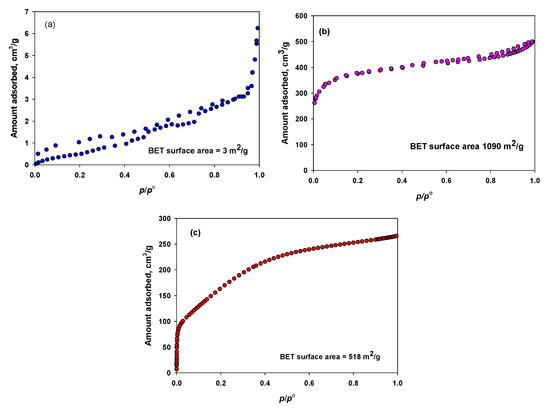
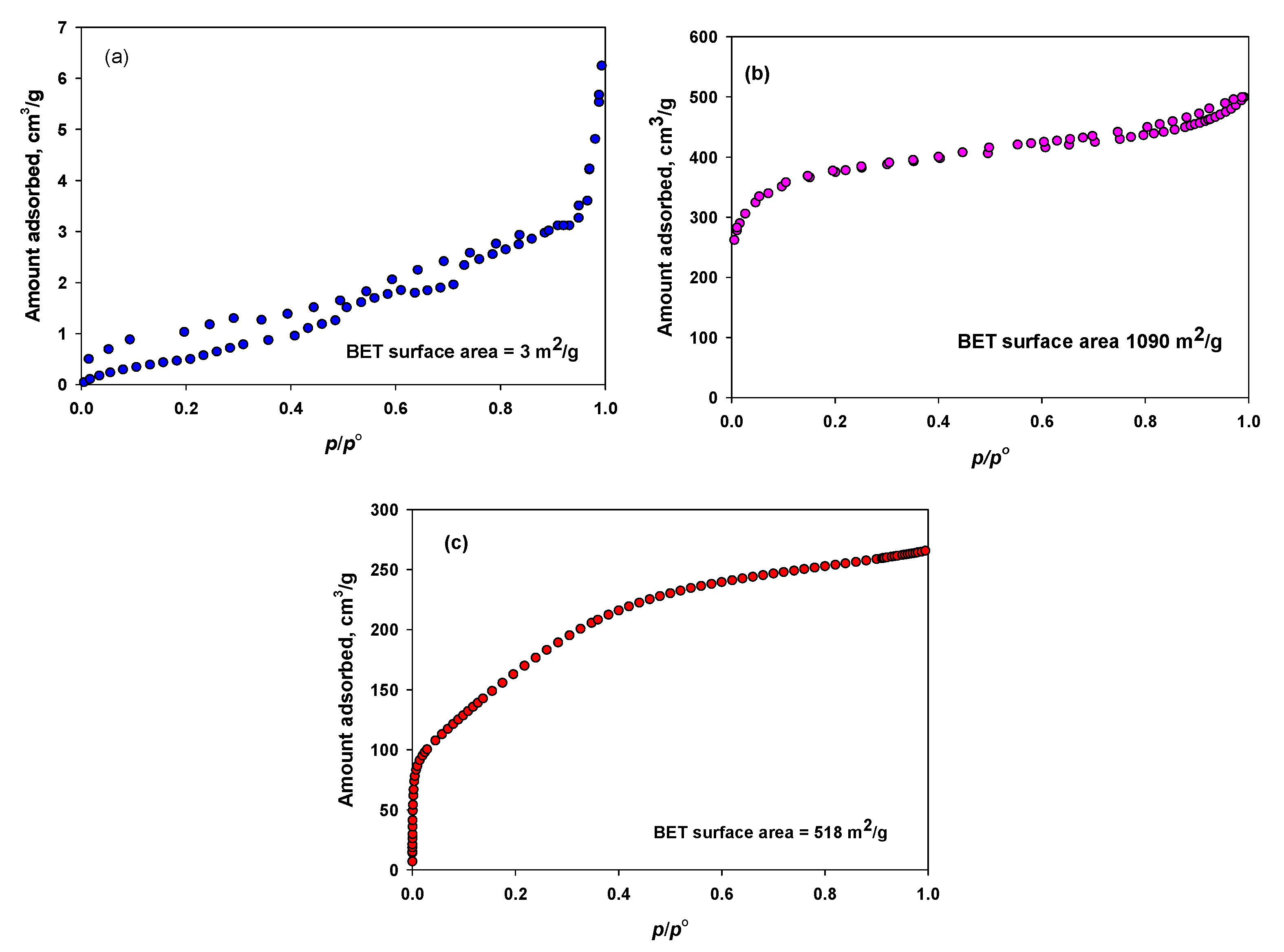
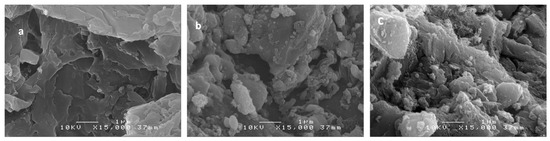
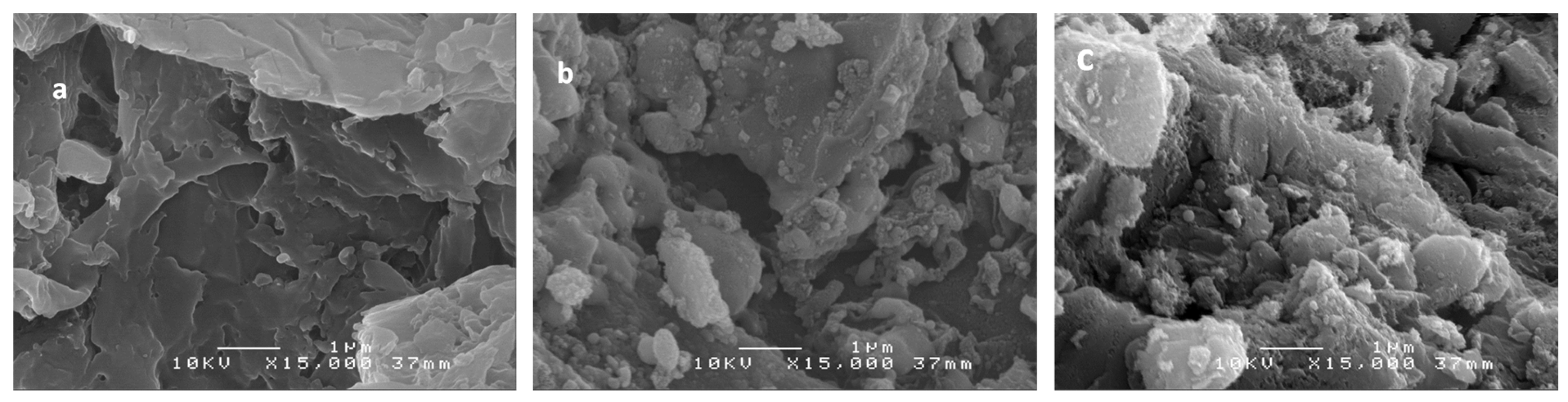
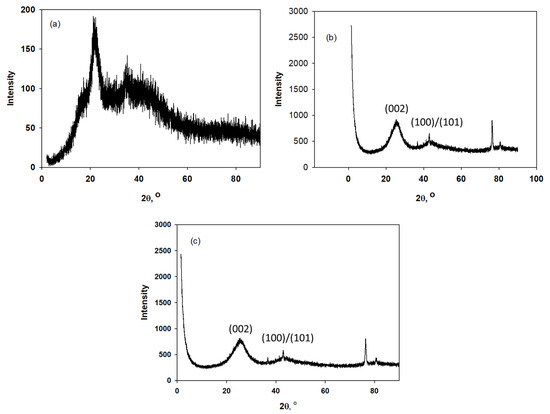
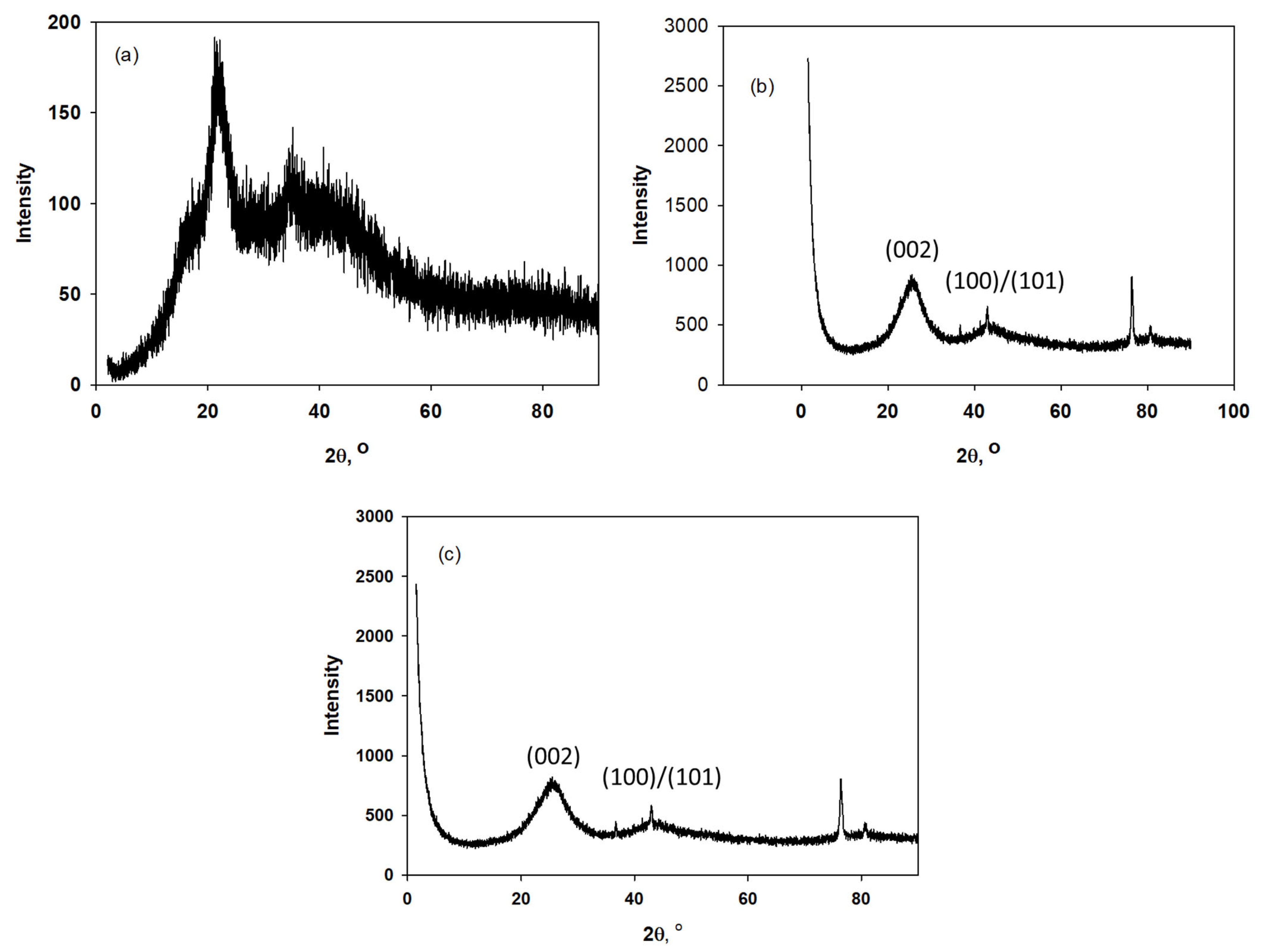
N2 adsorption–desorption isotherms of durian skin AC are shown in Figure 1. The isotherm of raw durian skin (Figure 1a) shows a Type II-like pattern, characteristic of nonporous or weakly porous solids, and is consistent with its low BET surface area of 3 m2/g. After chemical and physical activation, the isotherm of durian skin AC (Figure 1b) changed markedly, exhibiting a combined Type I/Type IV pattern. The sharp N2 uptake at low relative pressure indicates the presence of micropores, whereas the uptake at intermediate-to-high relative pressure reflects the contribution of mesopores formed during activation. This result confirms that the activation procedure developed the precursor’s porous texture, resulting in a BET surface area of 1090 m2/g. After heavy metal adsorption, the isotherm of metal-loaded AC (Figure 1c) retained the same general shape as that of raw AC, indicating that the overall porous framework was preserved. However, the total adsorbed N2 volume decreased significantly, as reflected by the reduction in BET surface area to 560 m2/g. The raw durian skin exhibited a total pore volume of 0.011 cm3/g and an average pore size of ~13.2 nm, which is consistent with its Type II-like isotherm. After chemical and physical activation, the total pore volume increased to 0.767 cm3/g, while the average pore size was 2.67 nm. These values are consistent with the mixed Type I/Type IV isotherm profile and indicate the development of a microporous AC with a mesoporous contribution. After heavy metal adsorption, the total pore volume decreased to 0.394 cm3/g, whereas the average pore size changed only slightly to 2.86 nm. These results suggest that Pb2+ and Cu2+ adsorption mainly reduced the accessible pore volume through partial pore filling and/or blockage of adsorption sites inside the carbon matrix. SEM images of durian skin precursor and AC are shown in Figure 2. Overall, the AC surface morphology was not altered after heavy metal adsorption. XRD patterns of the raw durian skin and AC are shown in Figure 3. The raw precursor has an amorphous structure, whereas the diffraction pattern of AC exhibited the characteristic broad diffraction peaks of disordered carbonaceous materials at approximately 2θ = 24° and 42°, which can be assigned to the (002) and (100)/(101) reflections, respectively [33]. After heavy metal adsorption, the same broad peaks were still observed in the XRD pattern of the metal-loaded AC, albeit with lower intensity. This result indicates that the overall carbon framework was preserved after adsorption, while partial attenuation of the diffraction signal may be associated with heavy metal loading on the adsorbent surface.
Figure 1.
N2 adsorption isotherms of (a) raw durian skin, (b) durian skin AC, and (c) durian skin AC loaded with heavy metals.
Figure 2.
SEM images of (a) durian skin, (b) durian skin AC, and (c) durian skin AC after adsorption of heavy metals.
Figure 3.
XRD patterns of (a) durian skin, (b) durian skin AC, and (c) durian skin AC after heavy metal adsorption.
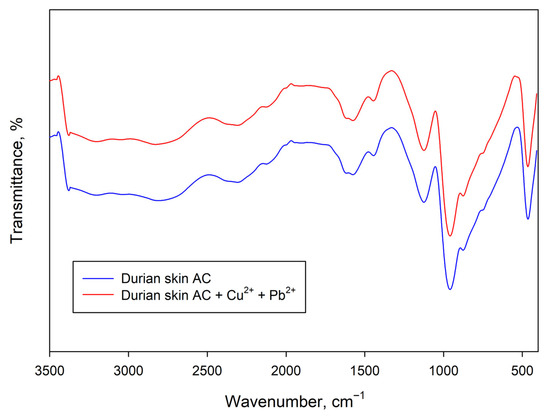
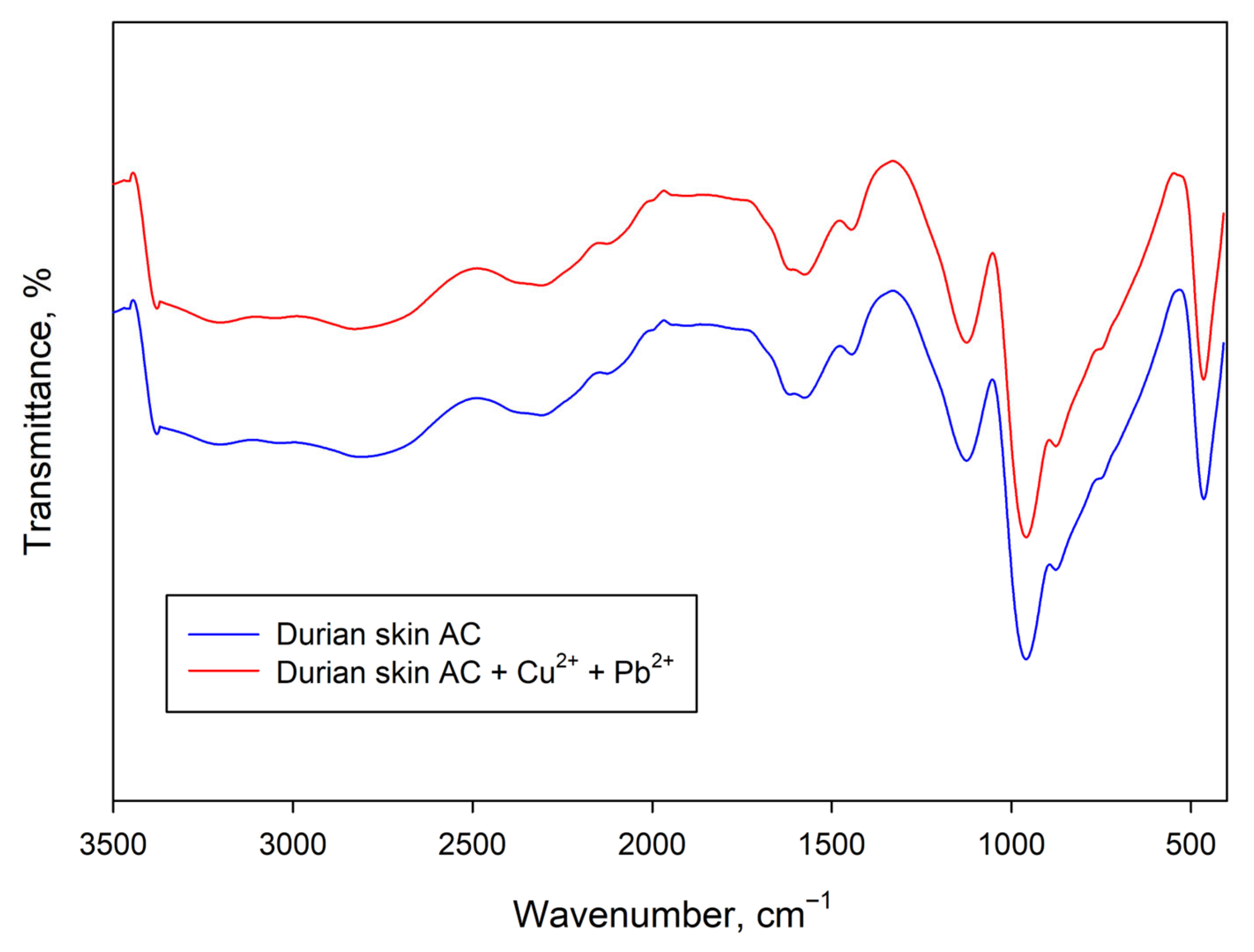
FTIR spectrum of durian skin AC confirmed the presence of oxygen-containing surface functionalities that are relevant to heavy metal adsorption; see Figure 4. After Pb2+ and Cu2+ removal, slight variations in the absorption band of O–H at 3200 cm−1 and in the oxygen-related bands near 1574, 1445, and 1124 cm−1 were identified. These spectral changes are consistent with the participation of hydroxyl, carbonyl/carboxylate, and C–O surface groups in metal binding. Furthermore, the absorption bands identified in the 530–470 cm−1 region also indicate metal–oxygen interactions. FTIR results are consistent with the proposed mechanism in which Pb2+ and Cu2+ adsorption occurs through interactions with oxygenated functional groups located on the AC surface.
Figure 4.
FTIR spectra of durian skin AC before and after heavy metal adsorption.
3.2. Pb2+ and Cu2+ Adsorption on Durian Skin AC
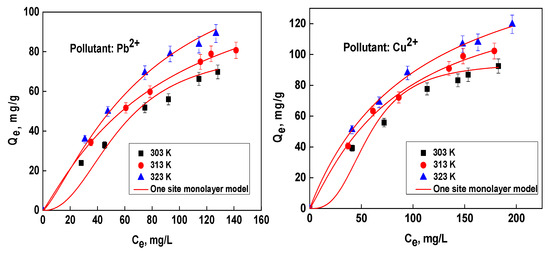
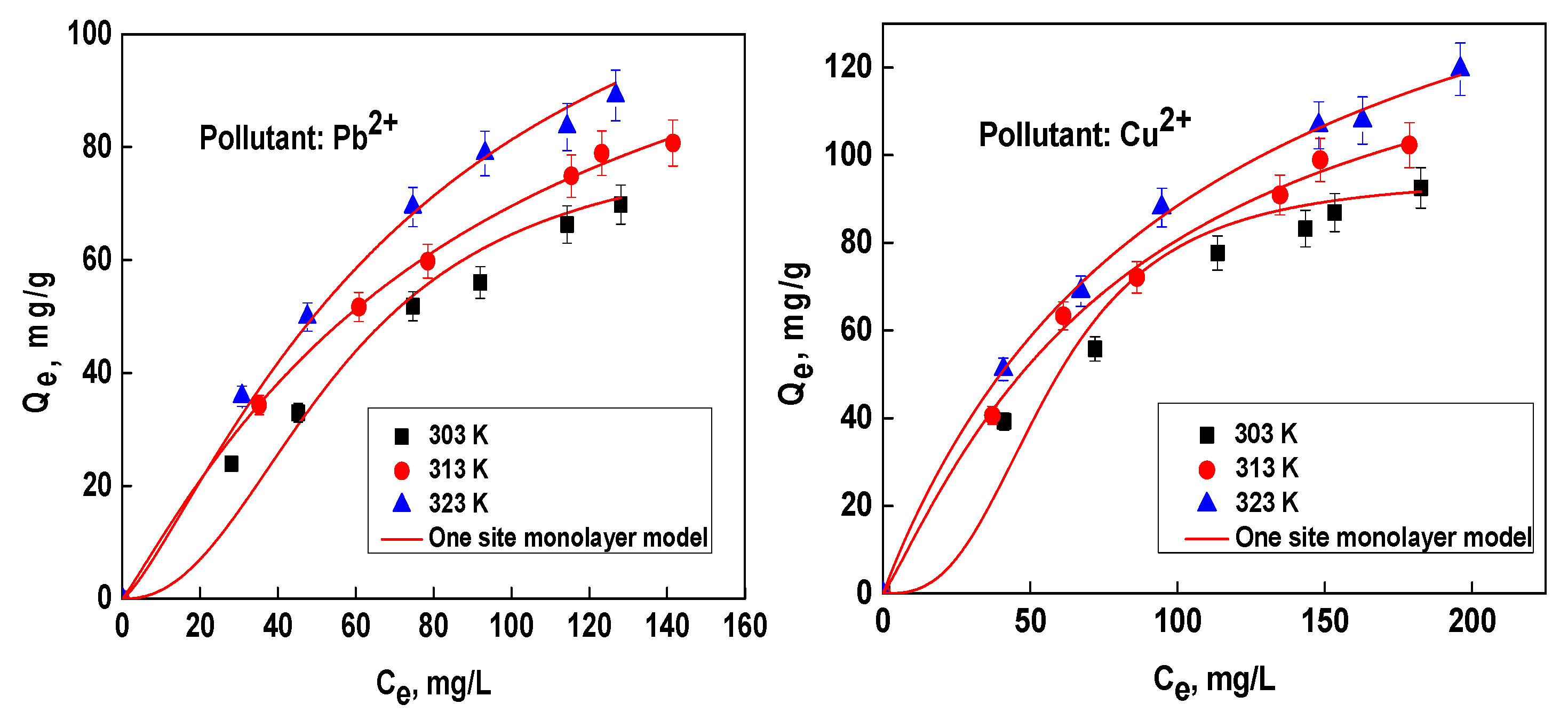
Figure 5 reports the experimental adsorption isotherms of Pb2+ and Cu2+ on durian skin AC at pH 5.5 and 30–50 °C. Overall, an increase in the adsorption temperature favored the removal of both cations using durian skin AC, indicating an endothermic process. The isotherms were fitted to the three models to perform the adsorption mechanism analysis. The calculated R2 values for the Langmuir model were lower than those obtained with the two statistical physics models. However, the trends in the calculated parameters of the monolayer model with one active site were reasonable and easier to analyze than those of the model with two active sites. For instance, some Ci values of the monolayer model with two sites were very high and inconsistent with the observed experimental equilibrium concentrations. For simplicity, a monolayer model with one active site was selected to study the adsorption mechanism of both heavy metal ions. All model parameters are summarized in Table 1, and Figure 5 provides the model fitting performance. R2 values of this model were 0.998 and 0.997 for Pb2+ and Cu2+ isotherms, respectively.
Figure 5.
Pb2+ and Cu2+ adsorption isotherms of durian skin AC at 30–50 °C and pH 5.5, and their correlation with a monolayer model with one active site.
Table 1.
Calculated parameters of the one-site monolayer model for Pb2+ and Cu2+ adsorption on durian skin AC.
3.3. Analysis of Steric Adsorption Parameters for the Removal of Pb2 and Cu2+ on Durian Skin AC
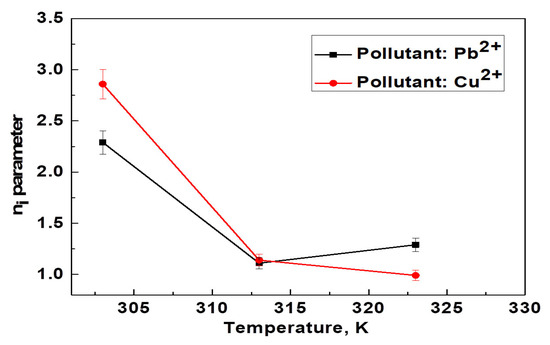
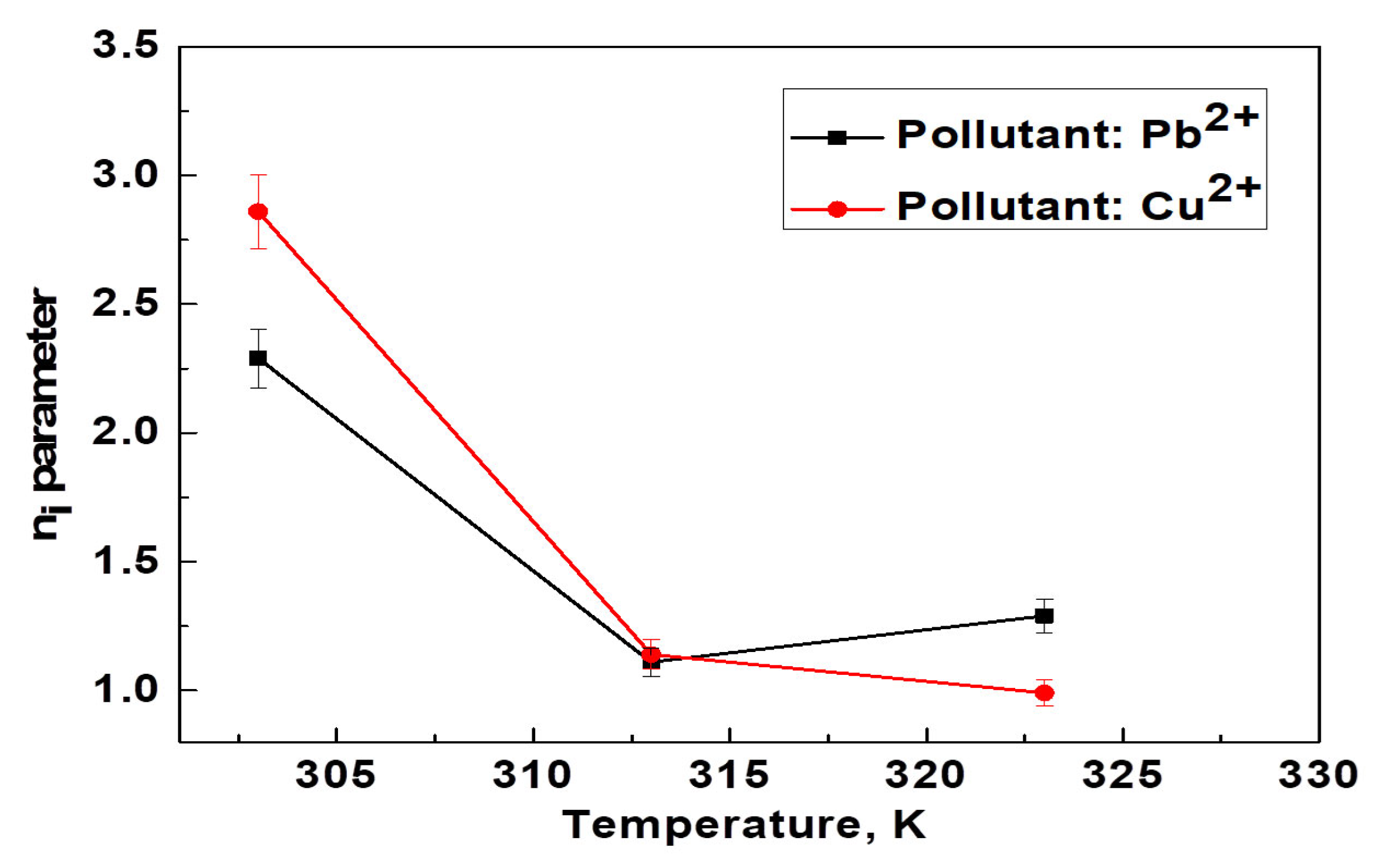
Calculated ni values were 2.29, 1.11 and 1.29 and 2.86, 1.14, and 0.99 for Pb2+-AC and Cu2+-AC systems at 303, 313 and 323 K, respectively. Note that three scenarios can be concluded from these values: (a) ni ≤ 0.5: heavy metal ions were adsorbed on durian skin AC surface via the participation of two or more active sites; (b) ni ≥ 1: one active site of durian skin AC surface can participate in the heavy metal removal, where the adsorption mechanism can be mono- or multi-ionic; and (c) 0.5 ≤ ni ≤ 1: the adsorption of heavy metal cations on durian skin AC surface occurred via the presence of a multi-interaction and multi-ionic process. Overall, all ni values were ≥1, suggesting that one to three ions were adsorbed by each active site of AC. Therefore, Cu2+ and Pb2+ were removed from the aqueous solution via a multi-cationic mechanism. The estimated ni values for both adsorption systems were similar, indicating that the AC active sites showed a similar affinity for removing both pollutants. The trend of calculated ni values versus removal temperature is shown in Figure 6. Thermal agitation reduced the capability of the AC functional groups to interact with several heavy metal ions during the adsorption process. Notably, there is a deviation in the number of ions per site at 313 K, which may be caused by a change in the adsorbent site.
Figure 6.
Adsorption temperature versus ni parameter for Pb2+ and Cu2+ removal from aqueous solutions using durian skin AC.
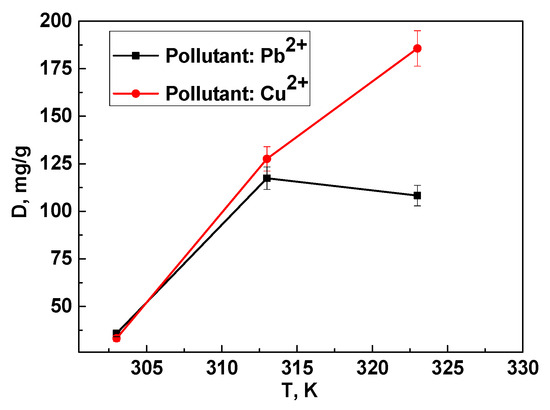
Figure 7 reports the trend of adsorption temperature versus the calculated D parameter. In general, the change in solution temperature increased the concentration of AC functional groups that participated in the adsorption of the tested heavy metal ions. This behavior indicated that active sites from the internal pore structure of AC participated more actively in removing the tested pollutants as the aqueous solution temperature increased. Note that the change in density of receptors at 313 K is related to changes in the adsorption sites.
Figure 7.
Adsorption temperature versus D parameter for Pb2+ and Cu2+ removal from aqueous solutions using durian skin AC (T = 303, 313, and 323 K, pH 5.5).
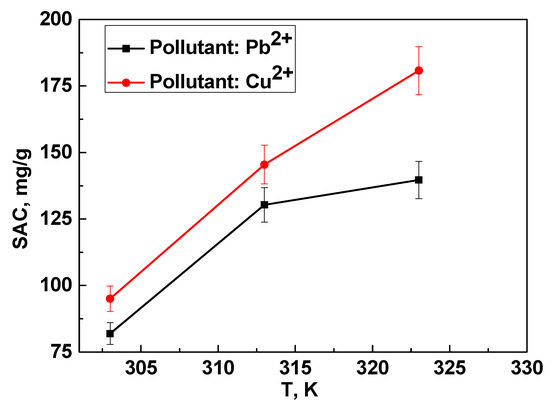
The Qm results for both systems are shown in Figure 8. Calculated Qm values increased with the aqueous solution temperature. This trend can be beneficial for industrial processes that generate wastewater at high temperatures, in which durian skin AC displays the best performance. This improvement in AC adsorption properties can be associated with better heavy metal mass transfer in the aqueous solution, favoring cation interactions with the AC active sites [34]. The same behavior was observed for the depollution of these heavy metals using other materials [34]. Qm values were 81, 130, and 139 mg/g for Pb2+ and 95, 145, and 180 mg/g for Cu2+ at 303, 313, and 323 K, respectively, using durian skin AC. This indicates that the performance of the AC for Cu2+ removal was higher than that for Pb2+ adsorption. Table 2 lists a comparison of the heavy metal removal performance of durian skin AC with that reported for other materials. This comparison confirms that durian skin AC offers advantages for the treatment of water polluted with Cu2+ and Pb2+. The deviation in adsorption capacity is probably a consequence of changes in both the number of molecules per site and the receptor site density.
Figure 8.
Adsorption temperature versus Qm parameter for Pb2+ and Cu2+ removal from aqueous solutions using durian skin AC (T = 303, 313, and 323 K, pH 5.5).
Table 2.
Survey of heavy metal adsorption capacities of different materials reported in the literature.
Finally, the interaction energies of Cu2+ and Pb2+ on the tested AC samples were calculated using the following expression:
where R (J/K⋅mol) is the ideal gas constant, and S is the heavy metal solubility (mg/L). The adsorption energies varied from 18.12 to 22.10 kJ/mol for both adsorption systems. These values suggest that both systems implied the presence of physisorption to remove heavy metals from water using the tested AC. As stated, the oxygenated functionalities of durian skin AC participate in the heavy metal adsorption mechanism.
ΔE = RT ⋅ ln (S/C1/2)
4. Conclusions
Activated carbon was prepared from durian skin biomass via chemical and physical activation, and the adsorbent was evaluated to remove Pb2+ and Cu2+ from aqueous solutions under selected laboratory conditions. The equilibrium data of heavy metal adsorption on durian skin activated carbon were better described by the monolayer statistical physics model with one active site, allowing the estimation of steric parameters and interaction energies associated with heavy metal adsorption. The results indicated that Pb2+ and Cu2+ adsorption on durian skin activated carbon proceeded through multi-cationic and endothermic interactions, in which oxygen-containing surface functionalities may play an important role. The adsorption capacities increased with temperature, reaching 139 mg/g for Pb2+ and 180 mg/g for Cu2+ under the tested conditions. These findings demonstrate the potential of durian skin-derived activated carbon as a promising adsorbent for heavy metal removal. However, regeneration and reusability, matrix effects, and removal performance in real wastewater should be evaluated to determine the limitations and capabilities of this activated carbon in water purification.
Supplementary Materials
The following supporting information can be downloaded at: https://www.mdpi.com/article/10.3390/w18080974/s1, Textural, Morphological, and Structural Characterization of Raw Durian Skin and Derived Activated Carbon.
Author Contributions
Conceptualization: K.N., L.S. and N.B.M.M.; methodology: L.S., R.G., H.G., N.S. and S.I.; formal analysis: A.B.-P. and F.E.S.; investigation: K.N., M.M. and R.G.; writing—original draft: L.S. and K.N.; writing—review and editing: N.B.M.M., S.I., A.B.-P. and F.E.S. All authors have read and agreed to the published version of the manuscript.
Funding
No external funding was received for this work.
Data Availability Statement
The original contributions presented in this study are included in the article and Supplementary Material. Further inquiries can be directed to the corresponding author.
Conflicts of Interest
The authors declare no conflicts of interest.
References
- Agarwal, A.; Upadhyay, U.; Sreedhar, I.; Singh, S.A.; Patel, C.M. A Review on Valorization of Biomass in Heavy Metal Removal from Wastewater. J. Water Process Eng. 2020, 38, 101602. [Google Scholar] [CrossRef] [Scilit]
- Dhaouadi, F.; Sellaoui, L.; Reynel-Ávila, H.E.; Landín-Sandoval, V.; Mendoza-Castillo, D.I.; Jaime-Leal, J.E.; Lima, E.C.; Bonilla-Petriciolet, A.; Lamine, A.B. Adsorption Mechanism of Zn2+, Ni2+, Cd2+, and Cu2+ Ions by Carbon-Based Adsorbents: Interpretation of the Adsorption Isotherms via Physical Modelling. Environ. Sci. Pollut. Res. 2021, 28, 30943–30954. [Google Scholar] [CrossRef] [Scilit] [PubMed]
- Lamsiah, S.; Benhadj, M.; Alouiz, I.; Bouhadda, M.; Amarouch, M.Y.; Mazouzi, D.; Sennoune, M. Prediction of heavy metal adsorption by activated carbon using machine learning. Artif. Intell. Chem. 2026, 4, 100117. [Google Scholar] [CrossRef] [Scilit]
- Indhumathi, P.; Sathiyaraj, S.; Koelmel, J.P.; Shoba, S.U.; Jayabalakrishnan, C.; Saravanabhavan, M. The Efficient Removal of Heavy Metal Ions from Industry Effluents Using Waste Biomass as Low-Cost Adsorbent: Thermodynamic and Kinetic Models. Z. Phys. Chem. 2018, 232, 527–543. [Google Scholar] [CrossRef]
- Meena, A.K.; Mishra, G.K.; Rai, P.K.; Rajagopal, C.; Nagar, P.N. Removal of Heavy Metal Ions from Aqueous Solutions Using Carbon Aerogel as an Adsorbent. J. Hazard. Mater. 2005, 122, 161–170. [Google Scholar] [CrossRef] [Scilit]
- Srivastava, N.K.; Majumder, C.B. Novel Biofiltration Methods for the Treatment of Heavy Metals from Industrial Wastewater. J. Hazard. Mater. 2008, 151, 1–8. [Google Scholar] [CrossRef] [Scilit]
- Cao, F.; Wu, J.; Dai, G.; Gao, J.; Zhou, Q.; Zhang, P.; Xiong, B.; Tang, K. Electrospun Porous Polyacrylonitrile Nanofibrous Membrane Grafted with Branched Polyethyleneimine for Efficient Adsorption of Cu2+ and Pb2+ from Polluted Water. J. Environ. Chem. Eng. 2024, 12, 114424. [Google Scholar] [CrossRef] [Scilit]
- Shrestha, R.; Ban, S.; Devkota, S.; Sharma, S.; Joshi, R.; Tiwari, A.P.; Kim, H.Y.; Joshi, M.K. Technological Trends in Heavy Metals Removal from Industrial Wastewater: A Review. J. Environ. Chem. Eng. 2021, 9, 105688. [Google Scholar] [CrossRef] [Scilit]
- Zhou, H.; Zhu, H.; Xue, F.; He, H.; Wang, S. Cellulose-Based Amphoteric Adsorbent for the Complete Removal of Low-Level Heavy Metal Ions via a Specialization and Cooperation Mechanism. Chem. Eng. J. 2020, 385, 123879. [Google Scholar] [CrossRef] [Scilit]
- Fan, X.; Wang, X.; Cai, Y.; Xie, H.; Han, S.; Hao, C. Functionalized Cotton Charcoal/Chitosan Biomass-Based Hydrogel for Capturing Pb2+, Cu2+ and MB. J. Hazard. Mater. 2022, 423, 127191. [Google Scholar]
- Zhao, M.; Huang, Z.; Wang, S.; Zhang, L.; Zhou, Y. Design of l-Cysteine Functionalized UiO-66 MOFs for Selective Adsorption of Hg(II) in Aqueous Medium. ACS Appl. Mater. Interfaces 2019, 11, 46973–46983. [Google Scholar] [CrossRef] [Scilit] [PubMed]
- Lu, M.; Deng, Y.; Luo, Y.; Lv, J.; Li, T.; Xu, J.; Chen, S.-W.; Wang, J. Graphene Aerogel–Metal–Organic Framework-Based Electrochemical Method for Simultaneous Detection of Multiple Heavy-Metal Ions. Anal. Chem. 2019, 91, 888–895. [Google Scholar] [CrossRef] [Scilit] [PubMed]
- Fang, X.; Li, J.; Li, X.; Pan, S.; Zhang, X.; Sun, X.; Shen, J.; Han, W.; Wang, L. Internal Pore Decoration with Polydopamine Nanoparticle on Polymeric Ultrafiltration Membrane for Enhanced Heavy Metal Removal. Chem. Eng. J. 2017, 314, 38–49. [Google Scholar] [CrossRef] [Scilit]
- Kalidhasan, S.; Kang, M.-S.; Choi, J.; Lee, H.-Y. Smart and Responsive Nano Copper Oxide–PDMS Composite for “Three-in-One” Synergistic Adsorptive–Oxidative/Reductive Degradation of the Persistence of Organic Pollutants, Elimination of Nanoparticles and Heavy Metal Ion. J. Clean. Prod. 2024, 469, 143150. [Google Scholar] [CrossRef] [Scilit]
- Sajjadi, S.-A.; Meknati, A.; Lima, E.C.; Dotto, G.L.; Mendoza-Castillo, D.I.; Anastopoulos, I.; Alakhras, F.; Unuabonah, E.I.; Singh, P.; Hosseini-Bandegharaei, A. A Novel Route for Preparation of Chemically Activated Carbon from Pistachio Wood for Highly Efficient Pb (II) Sorption. J. Environ. Manag. 2019, 236, 34–44. [Google Scholar] [CrossRef] [Scilit]
- Wang, Y.; Lin, C.; Liu, X.; Ren, W.; Huang, X.; He, M.; Ouyang, W. Efficient Removal of Acetochlor Pesticide from Water Using Magnetic Activated Carbon: Adsorption Performance, Mechanism, and Regeneration Exploration. Sci. Total Environ. 2021, 778, 146353. [Google Scholar] [CrossRef] [Scilit]
- Zieliński, B.; Miądlicki, P.; Przepiórski, J. Development of Activated Carbon for Removal of Pesticides from Water: Case Study. Sci. Rep. 2022, 12, 20869. [Google Scholar] [CrossRef] [Scilit]
- Harabi, S.; Guiza, S.; Álvarez-Montero, A.; Gómez-Avilés, A.; Bagané, M.; Belver, C.; Bedia, J. Adsorption of Pesticides on Activated Carbons from Peach Stones. Processes 2024, 12, 238. [Google Scholar] [CrossRef] [Scilit]
- Abdel-Aziz, M.H.; El-Ashtoukhy, E.Z.; Bassyouni, M.; Al-Hossainy, A.F.; Fawzy, E.M.; Abdel-Hamid, S.M.S.; Zoromba, M.S. DFT and Experimental Study on Adsorption of Dyes on Activated Carbon Prepared from Apple Leaves. Carbon Lett. 2021, 31, 863–878. [Google Scholar] [CrossRef] [Scilit]
- Samiyammal, P.; Kokila, A.; Pragasan, L.A.; Rajagopal, R.; Sathya, R.; Ragupathy, S.; Krishnakumar, M.; Reddy, V.R.M. Adsorption of Brilliant Green Dye onto Activated Carbon Prepared from Cashew Nut Shell by KOH Activation: Studies on Equilibrium Isotherm. Environ. Res. 2022, 212, 113497. [Google Scholar] [CrossRef] [Scilit]
- Karaca, S.; Gurses, A.; Bayrak, R. Effect of some pretreatments on the adsorption of methylene blue by Balkaya lignite. Energy Convers. Manag. 2004, 45, 1693–1704. [Google Scholar] [CrossRef] [Scilit]
- Zhu, X.; He, M.; Sun, Y.; Xu, Z.; Wan, Z.; Hou, D.; Alessi, D.S.; Tsang, D.C. Insights into the Adsorption of Pharmaceuticals and Personal Care Products (PPCPs) on Biochar and Activated Carbon with the Aid of Machine Learning. J. Hazard. Mater. 2022, 423, 127060. [Google Scholar] [CrossRef] [Scilit] [PubMed]
- Feizi, F.; Sarmah, A.K.; Rangsivek, R. Adsorption of Pharmaceuticals in a Fixed-Bed Column Using Tyre-Based Activated Carbon: Experimental Investigations and Numerical Modelling. J. Hazard. Mater. 2021, 417, 126010. [Google Scholar] [CrossRef] [Scilit] [PubMed]
- Pauletto, P.S.; Lütke, S.F.; Dotto, G.L.; Salau, N.P.G. Adsorption Mechanisms of Single and Simultaneous Removal of Pharmaceutical Compounds onto Activated Carbon: Isotherm and Thermodynamic Modeling. J. Mol. Liq. 2021, 336, 116203. [Google Scholar] [CrossRef] [Scilit]
- Mulyani, B.; Manullang, A.S.F.B.; Purwanti, A.D.; Anisa, R.F. Analysis of Adsorption of Adsorbent Sugarcane Bagasse Activated Charcoal in Concentration Variations of Pb2+ and Cu2+ Metal Mixture. In Proceedings of the 3rd International Conference on Science, Mathematics, Environment, and Education: Flexibility in Research and Innovation on Science, Mathematics, Environment, and Education for Sustainable Development; AIP Publishing: Melville, NY, USA, 2023; Volume 2540. [Google Scholar]
- Khater, D.; Alkhabbas, M.; Al-Ma’abreh, A.M. Adsorption of Pb, Cu, and Ni Ions on Activated Carbon Prepared from Oak Cupules: Kinetics and Thermodynamics Studies. Molecules 2024, 29, 2489. [Google Scholar] [CrossRef] [Scilit]
- Silva, M.C.; Crespo, L.H.; Cazetta, A.L.; Silva, T.L.; Spessato, L.; Almeida, V.C. Activated Carbon Fibers of High Surface Area from Corn Husk: Mono and Multicomponent Adsorption Studies of Pb2+ and Cu2+ Ions from Aqueous Solution. J. Mol. Liq. 2024, 405, 124919. [Google Scholar] [CrossRef] [Scilit]
- Dhaouadi, F.; Sellaoui, L.; Hernández-Hernández, L.E.; Bonilla-Petriciolet, A.; Mendoza-Castillo, D.I.; Reynel-Ávila, H.E.; González-Ponce, H.A.; Taamalli, S.; Louis, F.; Lamine, A.B. Preparation of an Avocado Seed Hydrochar and Its Application as Heavy Metal Adsorbent: Properties and Advanced Statistical Physics Modeling. Chem. Eng. J. 2021, 419, 129472. [Google Scholar] [CrossRef] [Scilit]
- Sellaoui, L.; Mendoza-Castillo, D.I.; Reynel-Ávila, H.E.; Ávila-Camacho, B.A.; Díaz-Muñoz, L.L.; Ghalla, H.; Bonilla-Petriciolet, A.; Lamine, A.B. Understanding the Adsorption of Pb2+, Hg2+ and Zn2+ from Aqueous Solution on a Lignocellulosic Biomass Char Using Advanced Statistical Physics Models and Density Functional Theory Simulations. Chem. Eng. J. 2019, 365, 305–316. [Google Scholar] [CrossRef] [Scilit]
- Sellaoui, L.; Dhaouadi, F.; Taamalli, S.; Louis, F.; Bakali, A.E.; Badawi, M.; Bonilla-Petriciolet, A.; Silva, L.; da Boit Martinello, K.; Dotto, G.L.; et al. Understanding the Cu2+ Adsorption Mechanism on Activated Carbon Using Advanced Statistical Physics Modelling. Environ. Sci. Pollut. Res. 2022, 29, 54882–54889. [Google Scholar] [CrossRef] [Scilit]
- Zhu, S.; Yang, N.; Zhang, D. Poly (N, N-Dimethylaminoethyl Methacrylate) Modification of Activated Carbon for Copper Ions Removal. Mater. Chem. Phys. 2009, 113, 784–789. [Google Scholar] [CrossRef] [Scilit]
- Altalhi, T.; Jethave, G.; Fegade, U.; Mersal, G.A.M.; Ibrahim, M.M.; Mahmoud, M.H.H.; Kumeria, T.; Isai, K.A.; Sonawane, M. Adsorption of Magenta Dye on PbO Doped MgZnO: Interpretation of Statistical Physics Parameters Using Double-Layer Models. Int. J. Environ. Res. Public Health 2022, 19, 12199. [Google Scholar] [CrossRef] [Scilit] [PubMed]
- Dhaouadi, F.; Sellaoui, L.; Badawi, M.; Reynel-Ávila, H.E.; Mendoza-Castillo, D.I.; Jaime-Leal, J.E.; Bonilla-Petriciolet, A.; Lamine, A.B. Statistical Physics Interpretation of the Adsorption Mechanism of Pb2+, Cd2+ and Ni2+ on Chicken Feathers. J. Mol. Liq. 2020, 319, 114168. [Google Scholar] [CrossRef] [Scilit]
- Feng, Z.; Li, J.; Chen, N.; Feng, C. Sulfonated Corn Stalk Enhanced Hydrogel Adsorption for Heavy Metal from Metal Mine Gallery Effluent. Sep. Purif. Technol. 2024, 357, 130160. [Google Scholar] [CrossRef] [Scilit]
- Zhang, H.; Ma, J.; Wang, F.; Chu, Y.; Yang, L.; Xia, M. Mechanism of Carboxymethyl Chitosan Hybrid Montmorillonite and Adsorption of Pb (II) and Congo Red by CMC-MMT Organic-Inorganic Hybrid Composite. Int. J. Biol. Macromol. 2020, 149, 1161–1169. [Google Scholar] [CrossRef] [Scilit]
- Liang, S.; Guo, X.; Feng, N.; Tian, Q. Application of Orange Peel Xanthate for the Adsorption of Pb2+ from Aqueous Solutions. J. Hazard. Mater. 2009, 170, 425–429. [Google Scholar] [CrossRef] [Scilit]
- Amarasinghe, B.M.W.P.K.; Williams, R.A. Tea Waste as a Low Cost Adsorbent for the Removal of Cu and Pb from Wastewater. Chem. Eng. J. 2007, 132, 299–309. [Google Scholar] [CrossRef] [Scilit]
- Uddin, M.K. A Review on the Adsorption of Heavy Metals by Clay Minerals, with Special Focus on the Past Decade. Chem. Eng. J. 2017, 308, 438–462. [Google Scholar] [CrossRef] [Scilit]
- Herath, A.; Layne, C.A.; Perez, F.; Hassan, E.B.; Pittman, C.U.; Mlsna, T.E. KOH-Activated High Surface Area Douglas Fir Biochar for Adsorbing Aqueous Cr(VI), Pb(II) and Cd(II). Chemosphere 2021, 269, 128409. [Google Scholar] [CrossRef] [Scilit]
- Li, H.; Xiao, D.; He, H.; Lin, R.; Zuo, P. Adsorption Behavior and Adsorption Mechanism of Cu(II) Ions on Amino-Functionalized Magnetic Nanoparticles. Trans. Nonferrous Met. Soc. China 2013, 23, 2657–2665. [Google Scholar] [CrossRef] [Scilit]
- Yantasee, W.; Lin, Y.; Fryxell, G.E.; Alford, K.L.; Busche, B.J.; Johnson, C.D. Selective Removal of Copper(II) from Aqueous Solutions Using Fine-Grained Activated Carbon Functionalized with Amine. Ind. Eng. Chem. Res. 2004, 43, 2759–2764. [Google Scholar] [CrossRef] [Scilit]
- Ho, Y.-S. Removal of Copper Ions from Aqueous Solution by Tree Fern. Water Res. 2003, 37, 2323–2330. [Google Scholar] [CrossRef] [Scilit]

Disclaimer/Publisher’s Note: The statements, opinions and data contained in all publications are solely those of the individual author(s) and contributor(s) and not of MDPI and/or the editor(s). MDPI and/or the editor(s) disclaim responsibility for any injury to people or property resulting from any ideas, methods, instructions or products referred to in the content. |
© 2026 by the authors. Licensee MDPI, Basel, Switzerland. This article is an open access article distributed under the terms and conditions of the Creative Commons Attribution (CC BY) license.