Abstract
Cytostatics are contaminants of emerging concern. Their increasing presence in waste- and surface water is becoming a risk to aquatic life. Among them, 5-fluorouracil (5-FU) is one of the most frequently prescribed cytostatic drugs. 5-FU inhibits the thymidylate synthase activity, causing the depletion of thymidine nucleotides and misincorporation of uracil, and thus blocks DNA synthesis and replication. This study focuses on the influence of 5-FU on brackish and marine diatoms from the Baltic Sea, including Bacillaria cf. paxillifera, Gedaniella sp., Navicula perminuta, Nitzschia cf. aurariae, Skeletonema marinoi and Stephanocyclus meneghinianus, as well as natural microphytobenthos assemblages. The toxic effects of 5-FU were investigated in acute growth inhibition tests, which were performed using four types of media, i.e., artificial seawater with a salinity of 6.7, natural Baltic water, artificial seawater with a salinity of 22, and artificial seawater with the addition of cyclophosphamide and ifosfamide. The toxicity of 5-FU was checked for (1) each strain grown individually in all media, (2) six-strain mixed cultures grown in artificial seawater, and (3) natural microphytobenthic communities maintained in natural Baltic water. The diatom responses to 5-FU were species-specific. Growth conditions significantly modified the toxicity of 5-FU; tested strains were the most resistant to 5-FU when grown under optimal conditions, i.e., in natural Baltic water and/or at the optimal salinity. In the six-strain mixed cultures, higher 5-FU concentrations (>0.1 mg L−1) shifted the dominance of diatom strains; the most resilient diatom S. meneghinianus replaced two other fast-growing strains, i.e., B. cf. paxillifera and Gedaniella sp. In the tested microphytobenthos assemblages, the highest biomass and species diversity were observed under the highest 5-FU concentrations (>5 mg L−1). This indicated that the responses of complex species mixtures were governed by the ecophysiological features of their members and interactions among them, shaping the adaptive capacity of the entire assemblage. The introduction of the ecophysiological approach to toxicity testing seems to be crucial, and it would enable more realistic environmental risk assessment.
1. Introduction
Pharmaceuticals are emerging as a potential threat to the aquatic environment [1,2]. Currently, they occur in relatively low concentrations; however, their levels are predicted to increase due to population growth, increased life expectancy, and the resulting rise in pharmaceutical consumption [3,4]. Among them, cytostatic drugs (also called anticancer or antineoplastic drugs) constitute a group of compounds that are extensively used in chemotherapy [5]. Despite the unquestionable benefits of cancer treatment, they have also been demonstrated to have carcinogenic, mutagenic, and teratogenic activity, adversely affecting animals and posing a serious threat to human health, including the potential to provoke secondary malignant tumors [6,7,8]. The primary sources of cytostatic drugs are hospital and household wastewaters [9], which are often directly discharged into the sewage system without prior treatment [7,10]. Conventional sewage treatment systems are characterized by low removal efficiency for cytostatic drugs. As a result, these compounds can gradually accumulate in water and sediments, posing serious environmental and health risks [10,11]. This is a substantial issue, given that cytostatics are designed to be highly active at low concentrations [12]. Studies on the presence of cytostatics in the aquatic environment have shown that five drugs—cyclophosphamide (CP), 5-fluorouracil (5-FU), gemcitabine (GEM), ifosfamide (IF), and methotrexate (MET)—are the most frequently detected [13,14,15]. Among them, 5-FU has been proven to be effective against solid tumors and has been used in the treatment of colorectal, breast, and other types of cancer since 1957 [16,17]. Currently, it is one of the most frequently prescribed anticancer drugs [4]. Therefore, it is not surprising that it is regularly detected at the highest concentrations in aquatic environments [10,18]. Risk quotients (RQ) have identified 5-FU as posing a high environmental risk [4,19].
5-FU is a heterocyclic aromatic organic compound, structurally similar to uracil, with a fluorine atom replacing a hydrogen atom in the C-5 position [20,21]. Being a nucleobase analogue of uracil, the anticancer mechanism of action of 5-FU includes (i) the formation of a stable complex with thymidylate synthase (TS), inhibiting the catalysis of deoxyuridine monophosphate (dUMP) methylation to deoxythymidine monophosphate (dTMP), thereby hindering its synthesis; and (ii) misincorporation of 5-FU into DNA and RNA, replacing uracil or thymine [21]. 5-FU may also disrupt the maturation of pre-rRNA, post-transcriptional modification of tRNAs, and splicing of mRNA [22,23]. Pharmacokinetic studies have shown that 5-FU is rapidly metabolized, with up to 80% being converted into α-fluoro-β-alanine within 2–24 h after administration, while ca. 10% of the drug remains unchanged and is subsequently excreted from the body into the sewage system, eventually reaching surface waters [24,25]. Currently, the amount of cytostatics in sewage and surface waters remains low (within the range of ng L−1 to µg L−1) [26]. Reported concentrations of 5-FU in wastewater have reached up to ca. 150 µg L−1 [27,28], while in heavily polluted surface waters, concentrations of up to ca. 0.6 µg L−1 have been observed [29]. International Agency for Research on Cancer’s Global Cancer Observatory predicts that by 2050, there will be 35 million new cases of cancer, representing a 77% increase compared to 2022, as a result of a growing and ageing population. Therefore, it is predicted that the usage of cytostatics will increase [29]. Considering the fact that cytostatics are highly active substances, which concentrations in the environment are continuously growing, their adverse effects on living biota may also escalate due to chronic exposure (even to low drug dosages), and potentially due to their synergistic effects with other pollutants and/or environmental stressors [30].
Ecotoxicity studies are usually performed using standardized methodologies developed by the International Organization for Standardization (ISO) [31,32] or the Organization for Economic Cooperation and Development (OECD) [33]. Algal and/or cyanobacterial growth inhibition tests are widely used. However, despite their clear advantages (e.g., short duration, adjustability), they also have some limitations. The application of an ecophysiological approach (considering environmental variables as stimulating or stressful conditions affecting microalgal metabolism and growth) would certainly allow for better understanding, interpretation, and further use of test results, especially in the environmental context [34]. The toxicity of cytostatics has generally been studied by growth inhibition of recommended strains, usually planktonic green algae such as Desmodesmus subspicatus, Raphidocelis subcapitata, and cyanobacteria, e.g., Anabaena flos-aquae, Synechococcus leopoliensis [35,36,37]. As a result, ecotoxicity data are available for a limited number of freshwater species. Such data are suitable for systematic descriptions and comparisons of chemical toxicity, but may be of limited use for drawing conclusions about environmental effects. For instance, many freshwater species may occur in estuaries; however, their responses to a contaminant may differ due to suboptimal growth conditions and interactions with various ecological variables, as evidenced by studies on other contaminants [38,39]. This may have consequences for environmental risk assessments, imposing restrictions on data usage. To the best of our knowledge, there are no ecotoxicological data on cytostatics describing the responses of brackish and marine microalgae. Therefore, there is a need for more ecotoxicity investigations on strains indigenous to specific habitats, under conditions matching those in the environment.
The Baltic Sea is an enclosed continental brackish sea with an average depth of 50 m and a limited connection to oceanic waters. As a result, it is characterized by a strong land influence and long water residence time, which makes it especially vulnerable to accumulating pollutants [40]. Furthermore, its salinity is lower compared to ocean waters, and varies across a wide range of 2–22, which strongly affects the diversity of the Baltic fauna and flora, including microalgal communities [41]. Under such specific conditions, which vary widely with seasons, it is conceivable that the occurrence of contaminants, such as cytostatics, may heavily affect the diversity and functioning of microalgae. This, consequently, may have profound effects on higher trophic levels and thus on the entire ecosystem. Therefore, the main objective of this study was to test the influence of 5-FU on diatom strains, isolated from the Baltic Sea, maintained under various growth conditions. This study presents (i) the variety of diatom species-specific responses to 5-FU; (ii) changes in the 5-FU toxicity induced by altered salinity; (iii) the effect of other cytostatics, i.e., cyclophosphamide and ifosfamide, on the toxicity of 5-FU; (iv) modified diatom species-specific response to 5-FU when grown in multi-strain cultures; and (v) effects of 5-FU towards natural microphytobenthos assemblages. To our knowledge, the data presented here provide the first insight into 5-FU toxicity towards brackish and marine diatoms.
2. Materials and Methods
2.1. Tested Chemicals
The main tested chemical was 5-fluorouracil (5-FU) (CAS: 51-21-8). Additionally, the toxicity of 5-FU was also investigated in the presence of cyclophosphamide (CP) (CAS: 6055-19-2) and ifosfamide (IF) (CAS: 3778-73-2). All cytostatics were purchased from Merck Life Science Sp. z o.o. (Warsaw, Poland). They were handled in compliance with international safety guidelines [42], and after completing the experimental work, all drug residues were disposed of as hazardous waste.
2.2. Test Organisms
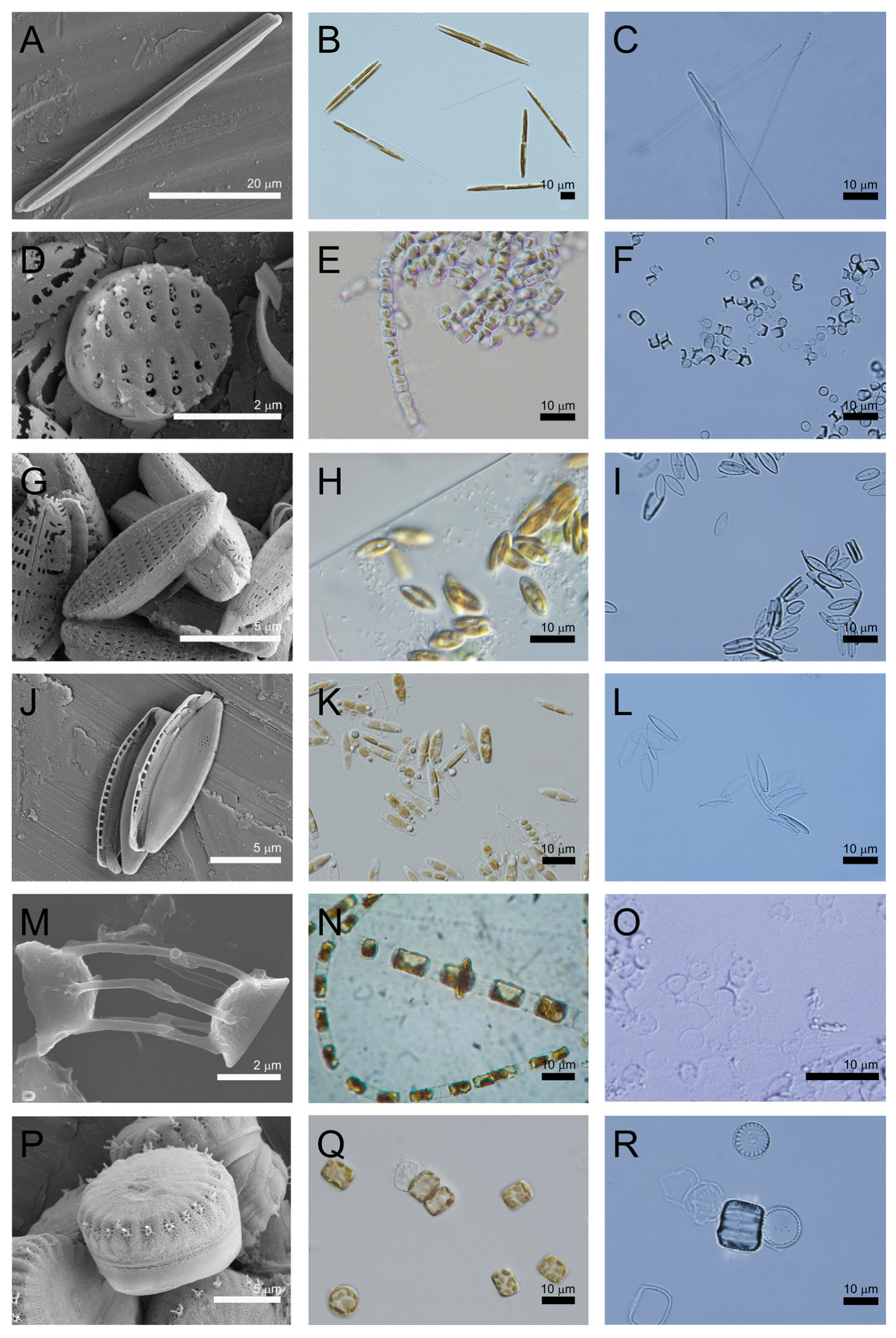
The diatom strains used in the study—Bacillaria cf. paxillifera BA14, Gedaniella sp. PL1.21, Navicula perminuta BA30, Nitzschia cf. aurariae BA158, Skeletonema marinoi BA98, and Stephanocyclus meneghinianus BA10—came from the Culture Collection of Baltic Algae (CCBA), University of Gdańsk. The strains are currently maintained as monocultures and kept under low light conditions of ca. 30 µmol photons m−2 s−1, at a temperature of 17 ± 1 °C, in liquid f/2 medium [43] prepared with natural Baltic water at a salinity of ca. 7. All strains were isolated from water or sediment samples collected in the Gulf of Gdańsk. Their morphological descriptions and salinity preferences are presented in Table 1. Microphotographs (Figure 1) were taken, and measurements were made with the light microscope Nikon 80i. Permanent slides were prepared as described in Section 2.6. For scanning electron microscopy, cleaned diatom frustules were coated with gold and analyzed with a field emission scanning electron microscope FESEM. Salinity tests are routinely performed to characterize CCBA isolates. Briefly, diatoms were exposed to 10 salinity variants (including freshwater) for seven days. For each variant, three biological replicates were performed. After seven days, cell densities were calculated by counting cells using a hemocytometer chamber with the Bürker grid.
Table 1.
Morphological characteristics and salinity preferences of the tested diatom strains.
Figure 1.
Microphotographs of the tested diatom strains: Bacillaria cf. paxillifera BA14 (A–C), Gedaniella sp. PL1.21 (D–F), Navicula perminuta BA30 (G–I), Nitzschia cf. aurariae BA158 (J–L), Skeletonema marinoi BA98 (M–O) and Stephanocyclus meneghinianus BA10 (P–R). White and black bars denote scale. The microphotograph of S. marinoi (M) comes from the resources of the Culture Collection of Baltic Algae and it was taken by prof. Adam Latała.
2.3. Preparation of Microphytobenthos Suspension
Sampling was performed in summer (August) near Władysławowo (the Baltic, 54°43′0″ N, 18°34′0″ E), a coastal station located in Puck Bay (western part of the Gulf of Gdańsk). To obtain microphytobenthos assemblages, three sediment cores (10 cm in diameter) were collected from a depth of 20 cm. Subsequently, a top centimeter of each core was taken, placed in a dark, cooled container and transported to the laboratory [44]. Next, sediment samples were resuspended in filtered Baltic water collected at the sampling site, thoroughly mixed, and sonicated for 5 min to detach microalgae from the sand. The resulting microalgal suspension was filtered through a plankton net to remove small invertebrates [45]. This procedure was performed on all three sediment samples. The resulting suspensions were then combined.
2.4. Growth Inhibition Experiments
Three sets of growth inhibition tests were conducted. In the first, the influence of 5-FU on strains grown individually under various media conditions, i.e., in (i) artificial seawater (ASW) with a salinity of 6.7, matching the salinity at the sampling site; (ii) natural Baltic seawater (BAL); (iii) ASW with a salinity of 22 (ASW22); and (iv) ASW supplemented with CP and IF at concentrations of 45 mg L−1 each (CP + IF), was analyzed. The second test evaluated the effect of the drug on six-strain mixed cultures grown in ASW. In the third experiment, microphytobenthos assemblages maintained in natural Baltic seawater, collected during sampling and supplemented with NO3−, NH4+ and PO43− to match pore water nutrient concentrations, were exposed to 5-FU. Table 2 presents the chemical and physical characteristics of pore and column water.
Table 2.
Physical and chemical characteristics of the collected water samples. Concentrations of NO3−, NH4+ and PO43− were measured using a Hach Lange DR6000 spectrophotometer (Hach Lange Sp. z o.o., Wrocław, Poland). All water samples were prepared according to the manufacturer’s instructions. Water temperature and salinity were measured using a multiparameter WTW meter (WTW GmbH, Weilheim, Germany).
Artificial seawater was prepared according to ISO 10253 [32] and then diluted to salinities of 6.7 or 22, depending on the experiment. The water (either ASW or BAL) was enriched with f/2 medium [43] (except for the microphytobenthos experiments), as it is routinely used for maintaining microalgae in the CCBA collection. When Baltic water was used to prepare media for the tests, the vitamin solution was omitted.
Diatoms were exposed to 11 gradually increasing drug concentrations. The maximum 5-FU concentration was 10 mg L−1. Stock solutions were prepared in the respective media (the solubility of 5-FU in water is 12.2 mg mL−1; [46]).
In single-strain experiments (i.e., ASW, BAL, CP + IF, and ASW22), test solutions were inoculated at cell densities of 2.5 × 10⁴ cells mL−1 for large diatoms (>1000 µm3, i.e., Bp and STm) and 5 × 10⁴ cells mL−1 for small diatoms (<1000 µm3, i.e., Ged, Na, Np, and SKm). In the six-strain mixed culture experiment, the initial total cell density was 6.3 × 10⁴ cells mL−1. Cell densities for each species were adjusted to achieve equal biovolume (0.0016 mm3), corresponding to the total biovolume of the smallest diatom, Gedaniella sp. PL1.21 with cell density of 2.5 × 10⁴ cells mL−1. In the test with microphytobenthos assemblages, inoculation was based on chlorophyll a (Chl a) concentration, and the starting microphytobenthos biomass was 0.01 mg Chl a L−1.
Diatoms were grown under a constant irradiance of 100 µmol photons m−2 s−1, with a photoperiod of 16 h light and 8 h darkness, at a temperature of 20 ± 1 °C for 96 h. All cultures were vigorously mixed twice a day. Tests were performed in four biological replicates.
2.5. Growth Inhibition Data Analysis
Growth inhibition was assessed by counting diatom cells in a hemocytometric chamber with a Bürker grid and expressed as cells mL−1. Subsequently, growth rates (d−1) and growth inhibition (%) were calculated [32]. The latter, plotted as a function of log 5-FU concentration, allowed for the construction of dose–response curves, which were then used to calculate ecotoxicological parameters, i.e., NOEC (no observed effect concentration), LOEC (lowest observed effect concentration), and ECx (effective concentrations, calculated for 20%, 50%, and 80% growth inhibition) (mg L−1), as well as the maximum inhibited growth rate (%). Effective concentrations (ECx) were calculated using a non-linear regression model, following Equations (1)–(3):
where Y is a growth inhibition (%) at a 5-FU concentration (X), ECF is a concentration of 5-FU which gives a response of F% (e.g., EC20, EC50, EC80) between D and A, which are plateaus expressed in the units of the responses (% growth inhibition) under low and high 5-FU concentrations, respectively (the A value was also considered as the maximum inhibited growth rate, when 100% growth inhibition was not observed), Hill slope describes the steepness of the curve. NOEC and LOEC were determined using one-way analysis of variance (ANOVA) and Dunnett’s post hoc test [12]. All calculations were performed using Statistica 13 software (StatSoft Inc., Tulsa, OK, USA).
logECF = logEC50 + (1/Hill slope) × log(F%/(100 − F%))
F% = (Y − D)/(A − D) × 100
Y = D + (A − D)/(1 + 10^logEC50 − X) × (Hill slope)
The EC50 data obtained in this study were used to construct a model using the species sensitivity distribution (SSD) method, which allowed for the calculation of a model-averaged hazardous concentration (HC5). The SSD curve was constructed using a log-normal statistical distribution with maximum likelihood (ML) as the fitting method, implemented in the SSD Toolbox version 1.0 developed by the US Environmental Protection Agency (https://www.epa.gov/chemical-research/species-sensitivity-distribution-ssd-toolbox, accessed on 15 September 2025) [47]. The periodic no-observed effect concentration (PNEC) was calculated by dividing HC5 by an assessment factor (AF). Two values of AF were used, i.e., AF = 10 as recommended in [48] and estimated according to [49]. The latter AF was calculated by multiplying three factors: the endpoint standardization factor (FES), the species variation factor (FSV), and the mode-of-action factor (FMOA). Following this method, the AF value of 200 was obtained. Data were presented as means with 95% confidence limits.
2.6. Microscopic Analysis
To analyze the benthic diatom composition, microphytobenthos suspensions were cleaned with a mixture of acids—96% H2SO4 and 75% HNO3—mixed in a 3:1 ratio [50]. The samples were then washed several times with distilled water until the pH was ca. 7, and permanent slides were prepared using Naphrax (Brunel Microscopes Ltd., Kington Langley, UK) [51]. Samples were analyzed using a Nikon 80i microscope (Precoptic, Warsaw, Poland) equipped with a 100× immersion objective. Relative species abundances were determined by counting at least 300 diatom frustules.
2.7. Photosynthetic Pigment Analysis
Pigments were analyzed as described in [52]. Briefly, 5 mL samples of experimental cultures were filtered under low vacuum through GF/C Whatman glass filters and subsequently frozen at −20 °C until analysis. Pigments were extracted by incubating samples for 2 h at −20 °C in 90% acetone [53]. Extracts were then centrifuged and filtered through PTFE filters. Pigments were analyzed using reversed-phase high-performance liquid chromatography (RP-HPLC) with a Waters HPLC system equipped with a DAD detector set at 440 nm. Separation was performed on a C18 Spherisorb column (150 × 4.6 mm; 3 µm) (Waters, Warsaw, Poland) with injection of 40 µL of extract. Elution was carried out using 80% methanol buffered with 200 mM ammonium acetate (final concentration) as mobile phase A, and methanol–acetone (v:v, 80:20) as mobile phase B. The analytical gradient protocol was as follows: 2.5 min isocratic flow at 45% B; linear gradient to 90% B over 22.5 min; linear gradient to 100% B at 27 min; isocratic flow at 100% B until 44 min; linear gradient to 45% B at 46 min; and isocratic flow at 45% B until 50 min. The flow rate was 0.7 mL min−1. The HPLC system was calibrated using phytoplankton pigment standards (DHI, Hørsholm, Denmark), and pigments were identified and quantified according to [54].
2.8. Statistics
To identify statistically significant differences between species, growth conditions, and applied 5-FU concentrations, the mean values of growth rate and ecotoxicological parameter (i.e., ECx values) were analyzed using one-way ANOVA followed by Tukey’s HSD post hoc tests. Data on photosynthetic pigments, i.e., Chl a concentration and the Fx/Chl a ratio, were treated in the same way. Due to the limited number of biological replicates, normality and homoscedasticity of data were checked using the analysis of residuals and by inspecting the mean vs. standard deviation figures, respectively [55]. In addition, the Kruskal–Wallis ANOVA and Median Test were also performed. Since the results of both tests were the same, only the ANOVA results were shown. All statistical analyses were performed using Statistica 13 software (StatSoft Inc.).
3. Results
3.1. Response of Diatom Strains to Various Growth Conditions
Diatom strains were grown in various media, i.e., artificial seawater (ASW), natural Baltic water (BAL), artificial seawater with a salinity of 22 (ASW22), and artificial seawater with added cyclophosphamide and ifosfamide (45 + 45 mg L−1) (CP + IF). The type of medium used significantly affected the growth of diatoms (Table 3), which was seen from the growth rate values obtained for the control cultures (ANOVA, p < 0.05). The strains responded differently to the applied medium (Table 3). In five strains, i.e., Bp, STm, SKm, Ged and Na, the highest growth rate values were observed in BAL and ASW22 media, which were considered to represent their optimal growth conditions (i.e., natural Baltic water, which provides more essential components required by microalgae for growth, such as microelements, organic matter, and optimal salinity). The only exception was Np, which grew best in the artificial seawater medium (ASW).
Table 3.
Growth rate values of the control cultures obtained for the tested diatom species, i.e., Bacillaria cf. paxilifera BA14, Stephanocyclus meneghinianus BA10, Skeletonema marinoi BA98, Gedaniella sp. PL1.21, Nitzschia cf. aurariae BA158, Navicula perminuta BA30, grown in various media: artificial sea water (ASW), natural Baltic water (BAL), artificial sea water with the salinity of 22 (ASW22), artificial sea water with added cyclophosphamide and ifosfamide (45 + 45 mg L−1) (CP + IF), and together in the six-strain mixed cultures; growth rates are expressed d−1; mean ± SE (n = 4).
3.2. Response of Single Strains to 5-Fluorouracil
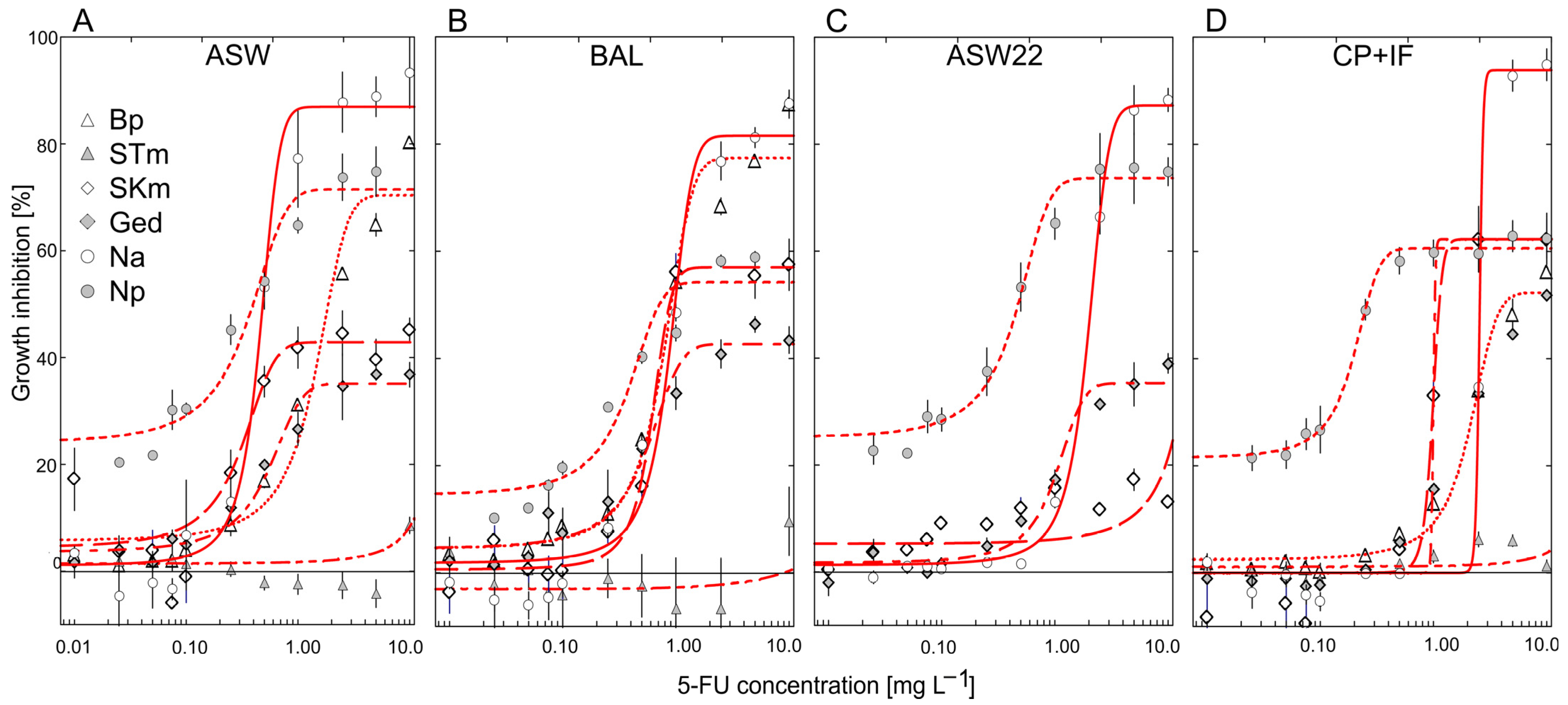
The response of the tested diatoms to 5-FU was species-specific (Figure 2, Table 4). When grown in ASW, the negative effects of 5-FU towards STm were limited; at the high est 5-FU concentration (i.e., 10 mg L−1), growth inhibition of 8.6% was observed (Figure 2A). Consequently, the highest NOEC and LOEC values among all tested strains were also recorded (Table S1). At the concentrations above 2.5 mg L−1, the maximum growth inhibition over 75% was observed for Bp, Np and Na, and ca. 40% for Ged and SKm (Figure 2A). Within the low 5-FU concentration range (up to 0.1 mg L−1), in four of the species (i.e., Bp, Ged, Na, SKm) the effect of the drug was negligible. The only exception was Np, for which growth inhibition was ca. 25% (Figure 2A). The EC50 values varied within the range of 0.31–0.5 mg L−1 in small diatoms, namely: Ged, Np and Na, and SKm. For Bp, EC50 was the highest and reached 1.38 mg L−1. Np was characterized by the lowest NOEC and LOEC values (below 0.1 mg L−1 as compared to other species), i.e., 0.01 and 0.025 mg L−1, respectively (Table S1).
Figure 2.
Toxicity of 5-fluorouracil towards Baltic strains of diatoms, i.e., Bacillaria cf. paxilifera BA14 (Bp), Stephanocyclus meneghinianus BA10 (STm), Skeletonema marinoi BA98 (SKm), Gedaniella sp. PL1.21 (Ged), Nitzschia cf. aurariae BA158 (Na) and Navicula perminuta BA30 (Np) grown in various media; (A) artificial sea water (ASW), (B) natural Baltic water (BAL), (C) artificial sea water with the salinity of 22 (ASW22); and (D) artificial sea water with added cyclophosphamide and ifosfamide (45 + 45 mg L−1) (CP + IF), shown as log dose–response growth inhibition curves obtained after 96 h of growth; mean ± SE (n = 4).
Table 4.
Ecotoxicological parameters of 5-fluorouracil for growth inhibition of Baltic strains of diatoms, i.e., Bacillaria cf. paxilifera BA14, Stephanocyclus meneghinianus BA10, Skeletonema marinoi BA98, Gedaniella sp. PL1.21, Nitzschia cf. aurariae BA158 and Navicula perminuta BA30 grown in various media; artificial sea water (ASW), natural Baltic water (BAL), artificial sea water with the salinity of 22 (ASW22), artificial sea water with added cyclophosphamide and ifosfamide (45 + 45 mg L−1) (CP + IF); obtained after 96 h exposure to the drug; parameter values are expressed as mg L−1; mean ± SE (n = 4).
Culturing diatoms in Baltic water altered their responses to 5-FU (Figure 2B). In STm, the influence of the drug was limited; however, the values of NOEC and LOEC decreased to 1 and 2.5 mg L−1, respectively. In four species, Bp, Ged, Na and SKm, the toxic effects of 5-FU were reduced. The EC50 values increased significantly, exceeding the value of 1 mg L−1 for Ged and SKm, and 2 mg L−1 for Bp and Na (Table 4). In the case of Na, the increase in EC50 was the highest—ca. 5.5-fold (2.54 mg L−1). There was also no change (SKm) or increase (Bp, Ged, Na) in NOEC and LOEC values. Np was the only species for which the toxicity of 5-FU increased in BAL; its EC50 was 0.19 mg L−1. Interestingly, for Ged, Na and SKm, the maximum growth inhibition also increased, and for Na this value was the highest, ca. 94% (Figure 2B).
Four of the six tested species grew best in salinities above 16, with the optimum ranging from 19.9 to 23 (Table 1). For the experiment, a salinity of 22 was selected, as it reflects salinity conditions in the western part of the Baltic Sea (Great Belt). The response of SKm at salinity 22 was similar to that of STm at salinity 6.7 (Figure 2C). The SKm growth inhibition at the highest 5-FU concentration (i.e., 10 mg L−1) was ca. 13%. Nonetheless, NOEC and LOEC decreased to 0.05 and 0.075 mg L−1 (Table 4), respectively. For Ged, Na and Np5-FU toxicity at salinity 22 was also reduced; as confirmed by the increased EC50 values, NOEC and LOEC, but only for Ged and Na (Table 4 and Table S1).
The presence of CP and IF in the medium affected the influence of 5-FU. The observed responses differed between species (Figure 2D). No change was observed in three species, i.e., STm (although NOEC increased to >10 mg L−1), Ged and Np (Table 4). In contrast, the toxicity of 5-FU towards Na and SKm decreased, with the EC50 values increasing two-fold. For Bp, the opposite effect was observed, and CP + IF exacerbated the growth of the species. The values of all ecotoxicological parameters (NOEC, LOEC and effective concentrations) decreased (Table 4 and Table S1).
3.3. Response of the Six-Strain Mixed Cultures to 5-Fluorouracil
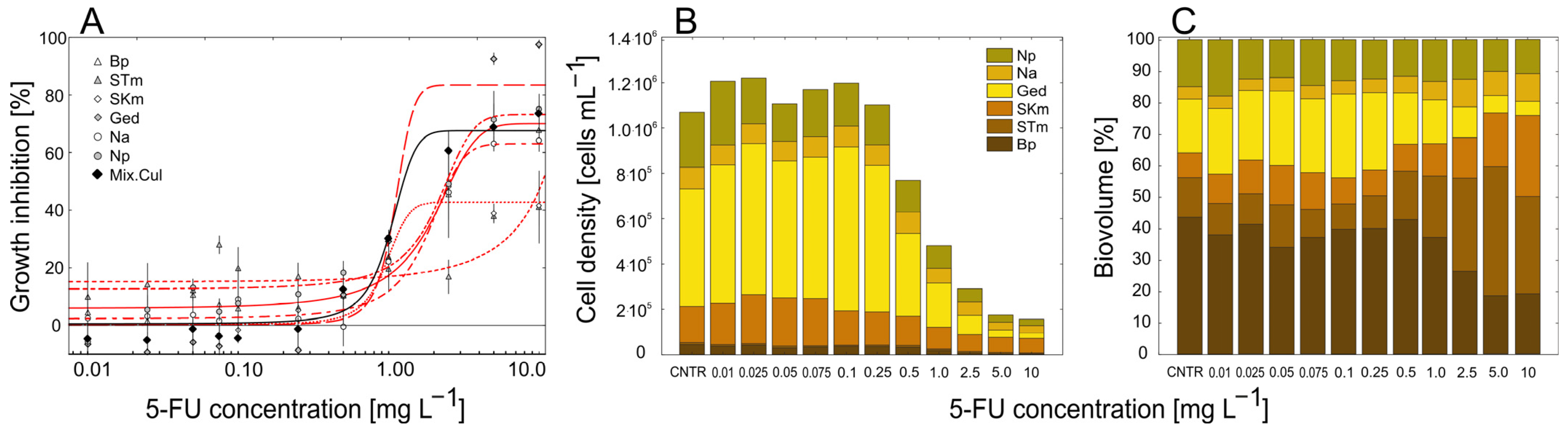
Up to 0.25 mg L−1, no observable toxic effect of 5-FU was detected in the diatom mixed culture. At the highest 5-FU concentrations (above 2.5 mg L−1), the average maximum growth inhibition for the culture as a whole reached ca. 70%. The EC50 value was 1.05 mg L−1, while NOEC and LOEC were 0.25 and 0.5 mg L−1, respectively (Figure 3A, Table 3 and Table S2). The EC50 values of individual species varied widely, ranging from 0.93 to 2.12 mg L−1; with the highest EC50 values, significantly differing from the control sample (ANOVA, p < 0.05, Dunnett test, p < 0.05), obtained for Ged and Bp. All EC50 values were either considerably higher or similar to those obtained for the tested species grown separately in ASW and BAL.
Figure 3.
A. Toxicity of 5-fluorouracil towards Baltic strains of diatoms, i.e., Bacillaria cf. paxilifera BA14 (Bp), Stephanocyclus meneghinianus BA10 (STm), Skeletonema marinoi BA98 (SKm), Gedaniella sp. PL1.21 (Ged), Nitzschia cf. aurariae BA158 (Na), Navicula perminuta BA30 (Np), and grown together in the six-strain mixed cultures (black diamonds); (A) log dose–response growth inhibition curves obtained after 96 h of growth; (B) culture cumulative cell density based on the cell count of each diatom strain; (C) diatom relative biomass based on the biovolume of each diatom strain; mean ± SE (n = 4).
The total cell number decreased by ca. 85% with increasing 5-FU concentration, as compared to the control culture (Figure 3B). Up to the 5-FU concentration of 0.25 mg L−1, the most dominant species was Ged, constituting ca. 50% of the total cell count. At higher concentrations (>0.25 mg L−1), its cell number sharply dropped and was replaced by SKm, which became the most abundant species (>24%) at concentrations above 2.5 mg L−1.
The analysis of the biovolume changes showed that in the control sample and at the lowest applied concentration (0.01 mg L−1), the most dominant species were two large diatoms (biovolume > 1000 μm3), i.e., Bp and STm, and one small diatom (<1000 μm3)—Ged. With the increasing 5-FU concentration, the biovolume of Bp decreased, constituting ca. 20% of the total culture biovolume. The contribution of STm increased. Among small diatoms, Ged was gradually substituted by SKm (Figure 3C).
3.4. 5-Fluorouracil Hazard Assessment
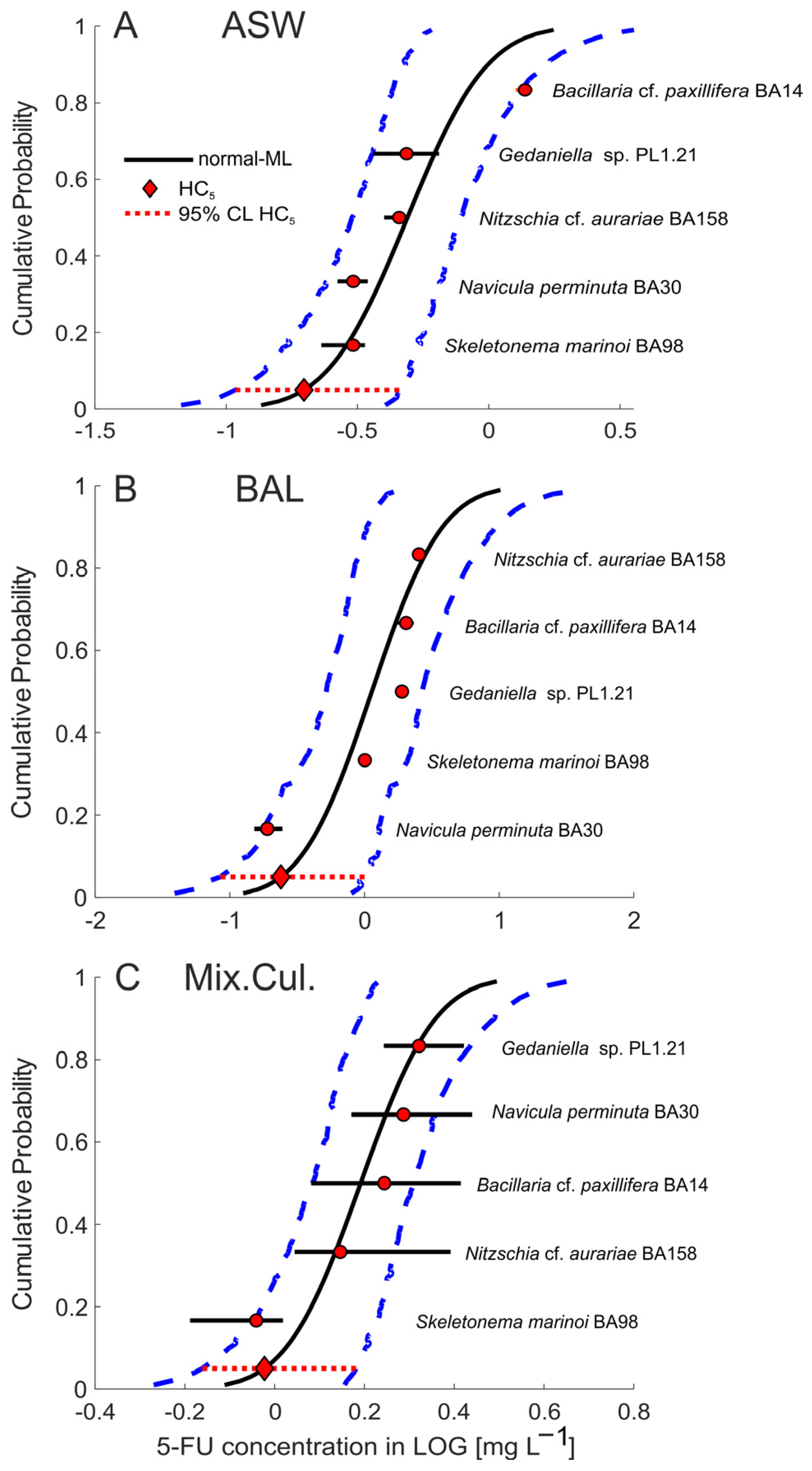
To construct a species sensitivity distribution (SSD), the EC50 values obtained for the species grown in ASW, BAL, and the six-strain cultures were used. The HC5 values derived from the model were consistent with the EC50 values obtained for Ged, Na, Np and SKm, grown in ASW (Figure 4A); for Np and SKm in BAL (Figure 4B), and Bp, Na, Np and SKm when grown in mixed cultures (Figure 4C). In natural Baltic water, the most sensitive species was Np, for which the average EC50 value was lower than HC5. A similar observation was made regarding SKm in six-strain mixed cultures. The lowest PNEC value (calculated using AF = 200) was found for ASW cultures. In BAL, PNEC increased by ca. 20%. The highest PNEC value, almost 5-fold higher than in ASW, reaching 0.00475 mg L−1 —was observed when the tested species were grown together. In addition, PNEC values using AF = 10 were also calculated (Table 5).
Figure 4.
Normal species sensitivity distribution (SSD) plot obtained using maximum likelihood (normalML; black line) with 95% confidence limits (CL; dashed blue lines) based on EC50 values obtained for the tested diatom species, i.e., Bacillaria cf. paxilifera BA14, Skeletonema marinoi BA98, Gedaniella sp. PL1.21, Nitzschia cf. aurariae BA158, Navicula perminuta BA30, exposed to 5-fluorouracil (5-FU) for 96 h, grown in various media: (A) artificial sea water (ASW); (B) natural Baltic water (BAL); and (C) together in the six-strain mixed cultures (Mix.Cul). Red diamond indicates the fifth percentile of the fitted distribution (HC5) value, a red dotted line shows 95% confidence limits (95% CL HC5); red circles are geometric EC50 means (n = 4), horizontal black lines indicate the range of the 5-FU toxicity based on EC50 values.
Table 5.
Model-averaged hazardous concentration (HC5) and periodic no-effect concentration (PNEC) with 95% confidence limits (95% CL) based on simulated species sensitive distribution (SSD) curves (Figure 4) for Baltic diatom strains grown in various media: artificial sea water (ASW) and natural Baltic water (BAL); and together in the six-strain mixed cultures (Mix.Cul); parameter values are expressed as mg L−1; n = 4.
3.5. Response of Microphytobenthos to 5-Fluorouracil
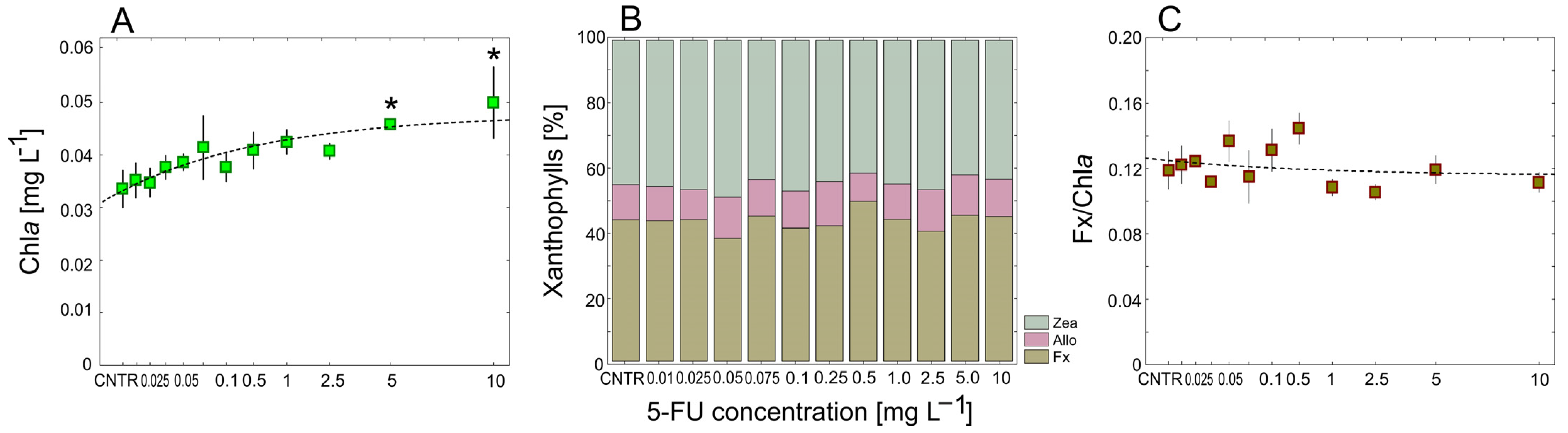
With increasing drug concentration, the biomass of the assemblages gradually grew, reaching the highest average Chl a concentrations, significantly different from the control (ANOVA, p < 0.05, Tukey HSD test, p < 0.05), at the two highest 5-FU concentrations (5 and 10 mg L−1) (Figure 5A). The analysis of photosynthetic pigments showed that there were three main xanthophylls, i.e., fucoxanthin (Fx), zeaxanthin (Zea) and alloxanthin (Allo). Their concentrations varied slightly without any specific pattern (ANOVA, p > 0.05) (Figure 5B). There were no significant variations in the Fx/Chl a ratio (ANOVA, p > 0.05) (Figure 5C).
Figure 5.
Toxicity of 5-fluorouracil towards Baltic microphytobenthos assemblages; (A) chlorophyll a (Chl a) concentration as a microphytobenthos biomass proxy; (B) marker pigments (Allo—alloxanthin, Fx—fucoxanthin, Zea—zeaxanthin); (C) fucoxanthin to chlorophyll a ratio (Fx/Chl a) as a proxy for the diatom biomass contribution; asterisks denote means that were significantly different from the control (CNTR); mean ± SE (n = 4).
Microscopic investigations revealed that 16 diatom species were identified in the studied assemblages. The samples were dominated by small-sized (<1000 μm3) diatoms, including Pseudostaurosira elliptica, Staurosira venter, Staurosirella pinnata, Gedaniella sp. (which may represent a complex of several species), Karayevia clevei. Each species accounted for over 5% of the cell count in the samples. The highest number of species (14) was found in cultures with the highest 5-FU concentration (5 and 10 mg L−1). In the control samples, eight species were identified.
4. Discussion
A previous study has suggested that 5-FU has low adsorption on solids suspended in the water; however, it is characterized by high mobility into sediments. It is also not likely to be easily degraded by sunlight [10]. Laboratory tests have also shown contradictory results, considering its biodegradability (up to 50% in the closed bottle tests) [56] (and references therein). This suggests that 5-FU may persist in the environment, constituting a positive alert for ecotoxicity. Furthermore, 5-FU has also been indicated as a cytostatic drug posing a high risk to aquatic organisms [57].
4.1. Response of Baltic Diatoms to 5-FU
There are only a handful of studies investigating the toxicity of 5-FU on microalgae. Most of them were performed on the green alga R. subcapitata (previously known as Pseudokirchneriella subcapitata), a strain recommended by the ISO 8692 standard [12,36,37]. Results of those studies showed that EC50 for this species varied within the range of 0.075–0.13 mg L−1. There are only three reports in which other species were used, i.e., the cyanobacterium S. leopoliensis, and two other green algal species: Chlorella vulgaris and D. subspicatus [12,57,58]. The EC50 value for the cyanobacterium was 1.20 mg L−1, while the half-maximal effective concentrations for the remaining two species were much higher—20.8 and 48 mg L−1, respectively. Such limited data, encompassing a small number of species, allow for a systematic comparison of 5-FU toxicity under strictly defined growth conditions; however, they are insufficient to conclude on possible 5-FU effects in the environment. Hence, in this study, another microalgal group—diatoms (represented by six strains, including planktonic and benthic ones) was investigated. 5-FU induced various species-specific responses in diatoms when grown in ASW medium, as seen from the diverse dose–response curve shapes and ecotoxicological parameters. The EC50 values obtained in this study (0.31–1.38 mg L−1) were similar to those previously reported for R. subcapitata. Regarding their resistance to 5-FU (based on EC50 values), the tested diatom strains could be ranked as follows: N. perminuta BA30, S. marinoi BA98 (ca. 0.3 mg L−1) < N. cf. aurariae BA158 (0.46 mg L−1), Gedaniella sp. PL1.21 (0.50 mg L−1) < B. cf. paxillifera BA14 (1.38 mg L−1) < S. meneghinianus BA10 (not determined). Venâncio and co-workers [29] commented that, regarding the influence of 5-FU on microalgae, there was no clear dose–effect response, which was also observed in this study.
To our knowledge, there are no reports providing detailed information on the molecular mechanisms governing microalgal responses to 5-FU. Neither the 5-FU toxicity mechanisms were elucidated, nor were protective ones. Previous research has shown that 5-FU most likely enters the cell via lipophilic interactions. By inhibiting thymidylate synthase, it causes depletion of thymidine nucleotides, which blocks DNA synthesis and replication [59,60]. Furthermore, a reduced amount of thymidine nucleotides leads to an imbalance in the uracil–thymidine (dUTP:dTTP) ratio, favoring uracil incorporation into DNA. Resulting uracil–adenine pairs are not mutagenic, but may be cytotoxic [61]. Studies on various organisms, including bacteria, archaea, fungi, plants and mammals, showed that to deal with uracil misincorporation, they actively remove it through the base excision repair (BER) pathway, which is initiated by uracil DNA glycosylase (UDG). This mechanism naturally occurs in living organisms as uracil may also appear in DNA due to the deamination of cytosine [62]. UDGs are members of a protein superfamily consisting of five UDG families characterized by various substrate recognition and amino acid sequences [63]. For instance, in Arabidopsis, the AtUNG enzyme—a member of the Family-1 UDGs was reported [62]. It was also identified as the major source of UDG activity in the plant extracts. The authors investigated the influence of 5-FU in wild-type and mutant atung−/− (lacking AtUNG) plants. They found that mutant atung−/− plants were more resistant to the drug at moderate concentrations (100–300 µM) than wild-type plants. This was explained by the increased uracil accumulation in the DNA of mutant atung−/− plants and the detrimental activity of AtUNG under an increased dUTP:dTTP ratio in wild-type plants due to the initiated ineffective BRE cycles, causing the incorporation of toxic DNA intermediate repair products under depleted dTTP. A similar observation, linking the BRE pathway with the 5-FU toxicity, was also observed in yeast [64]. Considering microalgae, BRE of uracil was detected in cell-free extracts of Chlamydomonas reinhardtii, which was attributed to the presence of a Family-1 UDGs protein—CrUNG. This protein was characterized by a high substrate specificity and was able to excise uracil and, unlike AtUNG, 5-FU [65]. In diatoms (Fragilariopsis cylindrus, Phaeodactylum tricornutum, Thalassiosira pseudonana and Seminavis robusta), on the other hand, a unique DNA glycosylase was found—the so-called Dual DNA glycosylase (DDG), possessing two glycosylase domains, i.e., an N-terminal NEIL domain and a C-terminal UNG domain, next to the UNG homolog (UNG1) also recognized in other eukaryotes [66]. No information on the microalgal UNGs activity under high 5-FU concentration is available. However, it can be speculated that with the observed diversity of UNG structures and substrate specificities among photosynthetic organisms, the activity of the BRE pathway may significantly differ among microalgae.
Microalgae have also developed other protective mechanisms—such as extracellular polymeric substances (EPS) production, enzymatic detoxification, and antioxidant activity—that help them shape their responses to various toxicants, e.g., [67,68]. Some studies have also shown that the toxicity of drugs may be regulated by algae–bacteria interactions [69]. It was previously shown that the bacterial microbiome of microalgae played an essential role in maintaining cell health and facilitating adaptation to changing environmental conditions [70]. In this study, the most resilient species turned out to be STm. It is noteworthy that STm secreted a large amount of EPS. On one hand, EPS constitutes a barrier restricting the absorption of toxicants into the cell [71]; on the other hand, it can also be utilized by bacteria as a source of organic matter (OM) [72]. Given that most microalgae are mixotrophic and grow better in the presence of OM, it is conceivable that 5-FU-metabolising bacteria could not only protect the cell from the drug’s negative effects but also provide additional OM for the diatom itself [73,74]. This hypothesis requires more systematic studies; however, this study found that at 5-FU concentrations up to 5.0 mg L−1, STm grew better than in the control cultures, showing a stimulatory effect of 5-FU. Similar effects were also observed in other studies, investigating the toxicity of various drugs towards microalgal, e.g., [75,76].
The least resistant species, based on NOEC and LOEC values, was Np. The strain quickly responded to the presence of 5-FU (the lowest NOEC and LOEC values). However, despite a considerable 5-FU effect, it appeared to have the potential to survive even under heavy 5-FU pollution (no 100% maximum growth inhibition observed). This was further supported by the fact that this diatom is classified as polysaprobous, an organism living in habitats polluted with organic matter [77].
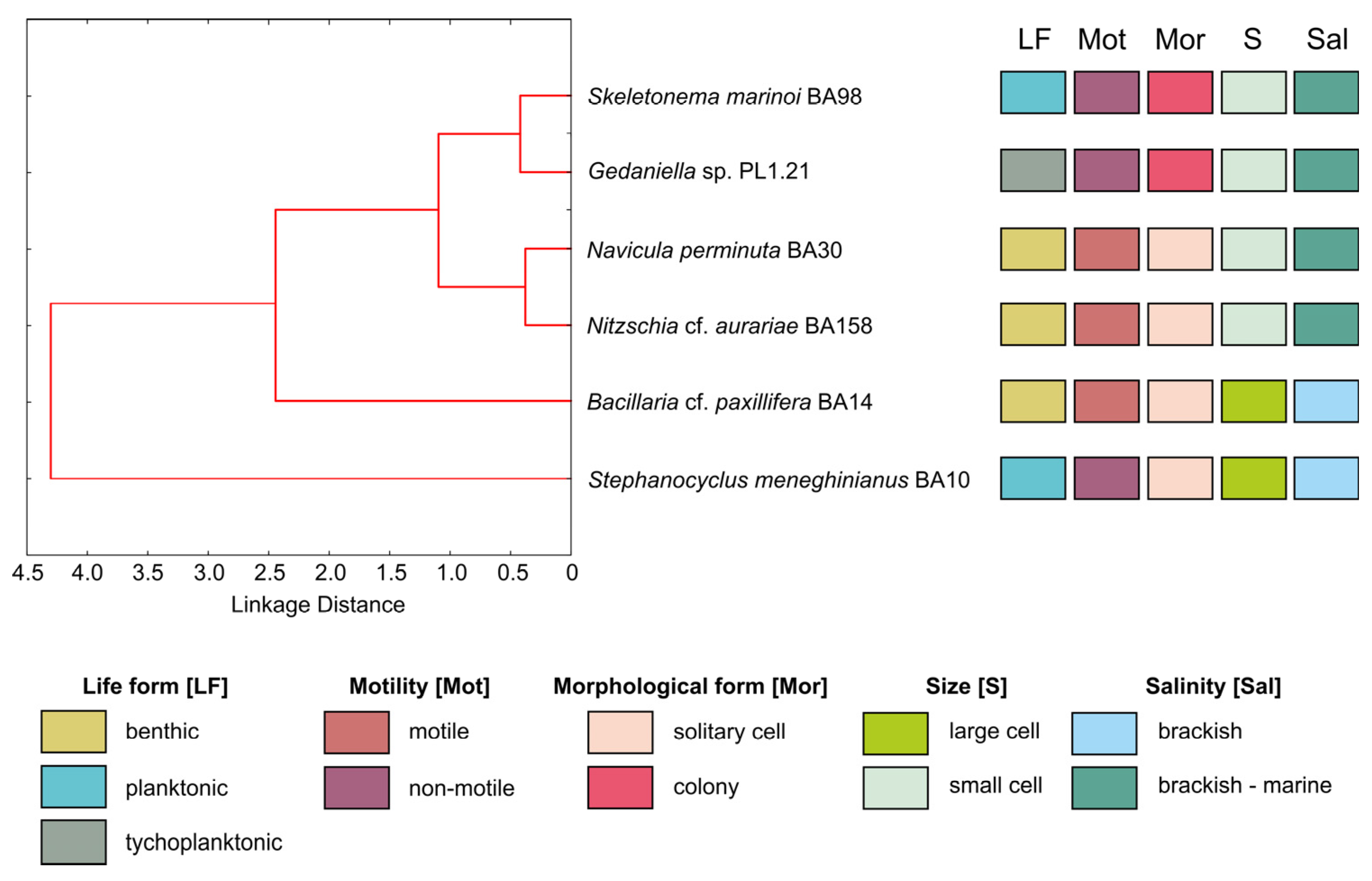
To elucidate the possible connection between responses to 5-FU and diatom traits (ecological, morphological, and life-form), the strains were clustered (using Euclidean distances inferred from normalized data, with complete linkage as the amalgamation rule) based on the values of the analyzed ecotoxicological endpoints, including NOEC, EC50 and the maximum growth inhibition. The clustering analysis recovered diatom groups corresponding to their morphological features and most favorable habitats in terms of salinity (Figure 6). The separation of STm and subsequently Bp coincided with their size (large diatoms, >1000 µm3) and salinity preferences (brackish species). Within the next group, two pairs of species were identified: small, benthic, motile diatoms (Na and Np), and non-motile, colonial SKm and Ged. The placement of the latter diatom emphasized its unique character; it is a pennate, araphid diatom that can be easily resuspended in the water column, due to the lack of strong adhesion mechanisms, forming floating ribbon-like colonies. Thus, its grouping with the planktonic species may indicate its tychoplanktonic nature rather than a strictly benthic one. All species within the second group were small-sized diatoms (<1000 µm3) with marine affinities (euryhaline, with optimum salinity higher than the average salinity in the Gulf of Gdańsk). Recovered strain groupings suggested that diatoms may employ various 5-FU response mechanisms, ensuring diatom survival in the environment. Identification of those mechanisms would allow for further understanding of diatom adaptations to the presence of 5-FU and possibly other cytostatic drugs.
Figure 6.
Clustering analysis based on ecotoxicological parameters (NOEC, LOEC, EC20, EC50, EC80, the maximum growth inhibition). Rectangles filled with color represent various ecological (life form, LF; motility, Mot), morphological (morphological form, Mor; size, S) and salinity (Sal) features of the tested strains.
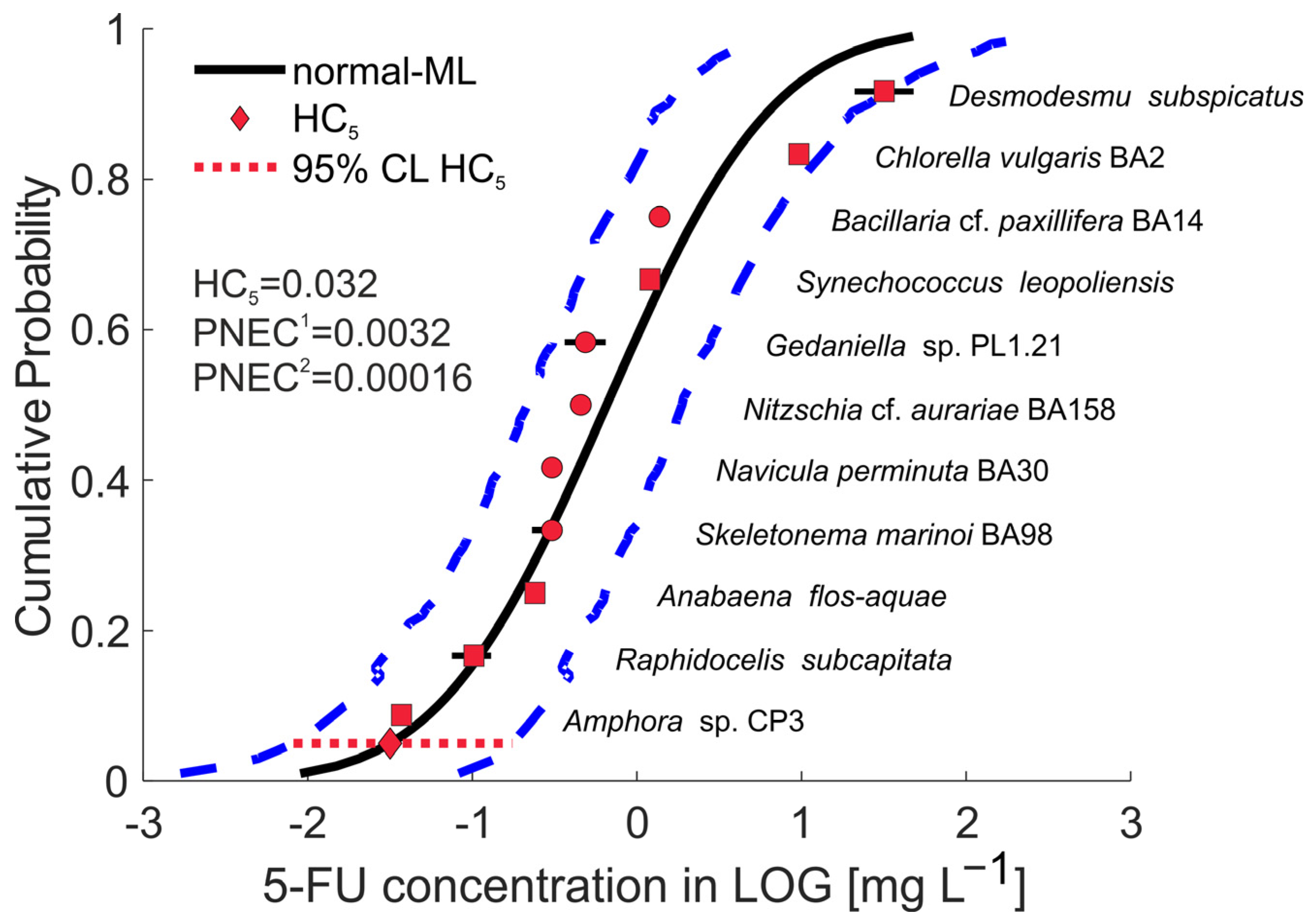
PNEC values can be used as water quality standards, indicating the concentration of a toxicant considered safe for most species in an ecosystem [78]. In this study, only five species were used, which may be considered too few [79]. However, to date, no other EC50 values for 5-FU have been reported in either brackish or marine microalgae. This is a recurring issue in ecotoxicological studies on marine species. Therefore, freshwater species are often included in SSD analyses, assuming that some physiological processes and ecological traits may be comparable [80]. To enhance PNEC calculations, six additional species were used (Figure 7). The inferred HC5 value—0.032 mg L−1 and the resulting PNEC—0.00016 mg L−1 were considerably lower than HC5 and PNEC obtained for ASW. The six-fold drop in those values was caused by the inclusion of Amphora sp. CP3, a diatom strain isolated from sediment samples collected in Władysławowo (the microphytobenthos sampling location for this study), which proved highly sensitive to 5-FU (EC50 = 0.037 ± 0.0015; mean ± SE, n = 4; to be published elsewhere). The obtained HC5 value was of the same magnitude as previously reported by Li et al. [81]—0.058 mg L−1. The authors also noted that among the studied species, the most sensitive to 5-FU was the microalga R. subcapitata. The calculated PNEC value (0.16 µg L−1) was lower than, and comparable to, the 5-FU concentrations measured in wastewater and the most polluted surface waters [27,28,29]. Since current wastewater treatment technologies are insufficient for removing cytostatics [82], the gradual accumulation of 5-FU due to continuous wastewater discharge contaminated with this drug may eventually induce significant changes in microalgal communities. Tested diatom species responded differently to 5-FU, which underscores the need to investigate a broad range of species across various taxonomic groups. Research based on a small number of selected species imposes substantial limitations on concluding about the potential environmental effects of pollutants—especially if sensitive species are omitted.
Figure 7.
Normal species sensitivity distribution (SSD) plot obtained using maximum likelihood (normalML; black line) with 95% confidence limits (CL; dashed blue lines) based on EC50 values obtained for the tested diatom species, i.e., Bacillaria cf. paxilifera BA14, Skeletonema marinoi BA98, Gedaniella sp. PL1.21, Nitzschia cf. aurariae BA158, Navicula perminuta BA30, exposed to 5-fluorouracil (5-FU) for 96 h, grown in artificial sea water (ASW) and literature data. Red diamond indicates the fifth percentile of the fitted distribution (HC5) value, a red dotted line shows 95% confidence limits (95% CL HC5); red circles are geometric EC50 means (n = 4) for species tested in the study when grown in ASW, red squares denote literature data, black horizontal lines indicate the range of 5-FU toxicity based on EC50 values. PNEC1 was calculated using an assessment factor (AF) of 10, for PNEC2 AF = 200.
Culturing diatoms in natural Baltic water altered their response to 5-FU compared with ASW. The sensitivity of the tested strains (based on EC50) allows ranking them in the following order: N. perminuta BA30 (0.19 mg L−1) < S. marinoi BA98 (1.01 mg L−1) < Gedaniella sp. PL1.21 (1.90 mg L−1) < B. cf. paxillifera BA14 (2.05 mg L−1) < N cf. aurariae BA158 (2.54 mg L−1) < S. meneghinianus (not determined). The differences can be attributed to the chemistry of the water used for medium preparation. ASW is relatively simple, consisting of only seven ingredients [32]. Long-term maintenance of microalgae in ASW causes significant changes in their morphology and weakens growth over time, indicating that some essential components are lacking—most likely microelements and organic matter (OM) (which were provided in the stock solutions of the f/2 medium). Dissolved organic matter (DOM) plays a crucial role in microalgal physiology [83]. It consists of organic substances that pass through 0.45 µm filters, such as humic acids, polysaccharides, proteins, and small molecular organic acids [84,85]. On the one hand, microalgae use organic substances (e.g., glucose, acetic acid, alcohols) as sources of organic carbon [73]; on the other, some DOM components (e.g., citric acid) may support microalgal growth indirectly by keeping iron in solution and ionic heavy metals at nontoxic concentrations [86]. The application of the natural Baltic water allowed microalgae to remain in good physiological condition, making them more resilient to potential pollutants. Furthermore, DOM is also an important environmental component, strongly affecting the toxicity of various chemical substances, including drugs and other pharmaceutical products [87,88]. The research on the interaction between bisphenol A and natural organic matter (NOM) found that bisphenol–organic matter complexes reversed the toxic effects of bisphenol A [89]. Tests on the influence of three herbicides—diuron, irgarol, and S-metolachlor—on the growth of Sphaerellopsis sp. confirmed that the alga grew better in the presence of DOM compared to cultures without it. It was also shown that in the presence of DOM, there was no toxic effect of herbicides at the peak growth phase of the alga [90].
As of now, data on the influence of DOM on the 5-FU toxicity is unavailable, while other cytostatics have been rarely investigated. The study by Liu et al. [91] revealed that low DOM concentration increased the toxicity of CP, while high concentration diminished its toxicity in zebrafish larvae. In another study, Liu et al. [92] investigated the effect of humic acid (HA, a main DOM component) on the neurobehavior of female zebrafish exposed to CP. They observed that HA enhanced CP neurotoxicity and suggested that HA may increase membrane permeability, thereby increasing the bioavailability of CP or its metabolites. The potential of DOM effect on the toxicity of 5-FU towards microalgae is challenging to predict. The physico-chemical properties of 5-FU indicate its high water-solubility and low partitioning onto organic matter (low octanol–water partition coefficient; log Kow = −0.81). This would suggest that the influence of DOM on the 5-FU toxicity may be limited. However, this hypothesis requires proper testing, as the toxicity of CP, similarly characterized by the low Kow value (0.97), was proven to be altered by HA [81,92].
Natural waters better support microalgal growth by providing all the essential, often not fully identified, inorganic and organic compounds [86,93]. The results of this study corroborate previous observations. The average PNEC value for tests performed in BAL was ca. 20% higher than that in ASW, indicating that growth conditions and, thus, the physiological state of microalgae (resulting from optimal growth conditions) strongly influenced their response to pollutants. This demonstrated that, in an environmental context, the use of natural waters—preferably from the habitat where test strains were isolated—would provide a more realistic assessment of microalgal responses to toxicants. However, it is important to stress that the source of natural water for tests must be carefully chosen, as it may pose obstacles due to seasonal changes in water chemistry, the presence of secondary metabolites of indigenous organisms and/or pollution [86]. Nonetheless, such tests could still yield valuable results useful in the environmental risk assessment.
Since salinity turned out to have a strong influence on the growth of microalgae, four strains were also exposed to the drug under higher salinity conditions. Considering that all the tested strains were isolated from the Baltic Sea, a salinity of 22 was chosen for the tests as it corresponds to the highest salinity observed in the western part of the Baltic Sea, in the Danish Straits. These results further emphasized that, depending on environmental conditions, species reacted differently. This is especially important in ecosystems such as the Baltic Sea, where environmental parameters (e.g., salinity) vary widely. Species with different salinity affinities may coexist, but with varying population sizes and physiological conditions depending on local salinity. Since these conditions are often suboptimal, the presence of an additional stressor, like in this case, 5-FU, could induce profound changes in community composition. This further confirms that the toxicity of 5-FU toward each strain resulted from an interplay among drug concentration, strain’s ecophysiological features, and the applied growth conditions.
In the environment, polluting chemical compounds occur as complex mixtures, which may affect microorganisms not only directly but also via their interactions. Various pollutants can affect organisms in different ways, having antagonistic or synergistic effects, as it was also observed here. Data on the influence of cytostatic drug mixtures on microalgae are even more scarce than for single drugs. Studies on S. leopoliensis and P. subcapitata, found that the combination of 5-FU and cisplatin (CDDP) was more toxic than 5-FU alone to both species. However, the mixture of 5-FU and imatinib mesylate (IM) affected them differently: for the cyanobacterium, the adverse effects were lower, while for the green alga, the mixture was more toxic [12]. Other authors also observed greater toxic effects of the 5-FU+IM mixture on the green alga C. vulgaris than with 5-FU alone [58]. Both studies demonstrated that the effects of various cytostatic drug mixtures were compound- and species-specific. These conclusions were also supported by this study, strengthening the notion that single-drug tests are insufficient for predicting the environmental effects of cytostatics.
4.2. Response of Microalgal Communities to 5-FU
Data obtained from single-strain tests allow for the observation of various responses to the toxicant as well as elucidation of the underlying processes. They also provide initial information on the possible reactions of microalgal communities. However, the direct transfer of single-strain responses to entire communities is impossible, since in the environment, microalgae are exposed to a set of rapidly changing conditions and interconnected through ecological processes (e.g., competition for resources, allelopathic interactions) [45,94,95,96]. Tests on multi-strain mixed cultures may provide—although still simplified—a general overview of microalgal community responses, such as changes in species composition and dominance patterns, and thus community sensitivity to a toxicant. In the six-strain mixed cultures studied, the EC50 values were consistently higher than in ASW tests. Such results may be due to the higher inoculum used in mixed cultures compared to single-strain tests; on average, the EC50 increased 3.5 times. With respect to their sensitivity to 5-FU (based on EC50), diatoms were arranged in the following order: S. marinoi BA98 (1.02 mg L−1) < N. cf. aurariae BA158 (1.16 mg L−1) < N. perminuta BA30 (1.73 mg L−1) < B. cf. paxillifera BA14 (1.84 mg L−1) < Gedaniella sp. PL1.21 (2.12 mg L−1) < S. meneghinianus BA10 (not determined). The differences in diatom responses between single-strain and six-strain cultures most likely resulted from an interplay among 5-FU concentration, diatoms’ autecological characteristics and ecological interactions. In terms of cell size, small-sized diatoms overshadowed the large ones; this is in line with observations that small microalgae have faster metabolism and may thus outcompete larger species [97]. However, from an ecological point of view, the biomass data are more relevant, as they better reflect energy transfer and productivity within the ecosystem [98]. A change in community structure is a typical response to environmental pollutants, and it suggests adjustment of the community to prevailing conditions [99,100]. Exposure to 5-FU led to an altered community, potentially better adapted to the toxic environment, with increased tolerance to 5-FU—a phenomenon known as Pollution-Induced Community Tolerance (PICT) [101,102]. PICT assumes the elimination of the most sensitive species and their replacement by more resilient ones, allowing the formation of a community capable of surviving and thriving in a toxic environment. Both large diatoms, i.e., Bp and STm, accounted for half of the biomass, which reflected their inherent resistance to 5-FU and optimal salinity growth conditions. The biomass proportion between both species varied with 5-FU concentration. At the highest 5-FU concentrations, Bp was replaced by STm, the most 5-FU-resistant species. At the highest 5-FU concentration, STm maintained its highest growth rate, confirming a relatively limited effect of the drug on STm, which was consistent with the results of the single-strain tests. However, although in single-strain tests, STm growth inhibition never exceeded 10%, in the six-strain cultures it reached ca. 40%. This could tentatively suggest that some degree of competition with other species could occur, possibly due to the growing SKm share in the culture biomass; despite having the lowest EC50 value, SKm also showed the lowest maximum growth inhibition (likewise in all single-strain tests). Overall, the two most 5-FU-resistant species (STm and Bp in ASW), together with SKm, accounted for ca. 77% of the biomass. Based on the biovolume results, it could be tentatively assumed that these three species could form the basis for a new, more tolerant community. Na most likely experienced the strongest pressure from other species, as a two-fold drop in its growth rate was observed when comparing the ASW and six-strain mixed control cultures. In addition, this species was also characterized by the highest maximum growth inhibition at the highest 5-FU concentrations, which likely effectively prevented it from achieving higher biomass at the highest 5-FU concentration. Ged exhibited an average negative growth rate (−0.05 d−1) at the highest 5-FU, indicating that its abundance began to decline, despite achieving the highest EC50 value in the mixed culture. Despite the much slower growth of Np, its cell numbers—and thus biomass—were still increasing at the highest 5-FU concentrations, as indicated by their positive growth rates (0.18 d−1). This demonstrated that the formation of a new resilient community is not a simple sum of individual responses to the toxicant, as other factors—such as physiological requirements, ecological preferences, and species interactions—also influence microalgal growth. Extending the duration of the experiment would likely lead to more profound changes in the mixed cultures and more efficient adaptation to the presence of 5-FU. The short-term experiment presented here demonstrated a rapid adjustment of the six-species community to toxic growth conditions. The PNEC value estimated for this community was 4.8 times higher than in ASW (4.75 µg L−1), confirming that the restructuring of the community led to the higher 5-FU tolerance. Nonetheless, this value still indicated that the community remained sensitive to 5-FU.
In contrast, the response of the microphytobenthos assemblage was markedly different (increasing microphytobenthos biomass with the increase in 5-FU concentration). These observations indicated that the influence of toxic chemical compounds on communities in their natural habitat can be quite complex. The growth conditions applied during the experiment simulated the microphytobenthos’ natural environment with respect to water chemistry, i.e., low nutrient concentrations (Table 2) and an N:P ratio of 14:1. In natural environments, benthic microalgae form a phycosphere, i.e., a microenvironment comprising microalgae and their associated microbiome [70,100]. Therefore, it can be hypothesized that interactions between diatoms and their associated bacteria could play a significant role. The influence of bacteria is not limited to maintaining a proper microalgal physiological state [70]. Under unfavorable conditions, the production of EPS increases, acting not only as a protective barrier against toxicants but also as a carbon pool that can be utilized by bacteria [72]. During this process, inorganic nitrogen and phosphorus can be regenerated [103], providing an additional nutrient source for diatoms and thus supporting their growth under elevated 5-FU concentrations by improving growth conditions. Therefore, the lack of biomass growth at low 5-FU concentrations could result from the strong effect of reduced levels of nitrates and phosphates rather than limited adverse 5-FU effects. In contrast, at higher concentrations, a slight increase in biomass and species number could result from the interplay between the stimulatory activity of bacteria and the drug’s inhibitory concentrations.
Pigment analysis indicated that the studied community consisted of diatoms, cyanobacteria and cryptophytes (based on the marker pigment hypothesis [104]). No significant change in the overall community composition (i.e., main taxonomic group constituting the investigated community) was observed. 5-FU triggered processes that not only increased community biomass, but also enhanced species diversity. The samples were dominated by small diatoms (<1000 µm3), taxonomically belonging to araphid, non-motile diatoms from the order Fragilariales (i.e., Gedaniella, Fragilaria, Pseudostaurosira, Staurosira, and Staurosirella genera), which together constituted 76% of the total cell count. These observations were consistent with the six-strain mixed culture experiment, in which Ged was the most abundant species in terms of cell number.
4.3. Ecological Considerations
The Baltic Sea appears to be an especially vulnerable ecosystem due to its unique characteristics, including limited water exchange with the ocean and lower salinity. The effect of 5-FU varied significantly among the tested diatom species and depended on the growth conditions. Baltic microalgal communities are unique, as low salinity allows for the co-existence of species with differing salinity affinities—i.e., freshwater, brackish, and marine species. The balance between these species is delicate, and any change in environmental conditions—such as an increase in salinity due to the inflow of Atlantic waters or increased discharge of freshwater and organic matter from rivers, especially during flooding [105,106,107]—may shift the response of microalgae to 5-FU, making them either more or less vulnerable. This study showed that diatoms grown under optimal conditions were more resilient to 5-FU. Overall, this highlighted that toxicity evaluations of various toxicants, including cytostatic drugs, must consider the ecophysiological properties of the tested species. The same species may respond differently across habitats, depending on environmental factors, tolerance ranges, and preferred optima. For example, S. marinoi is found throughout the Baltic Sea. Although its optimal salinity range is 20–30, in the Southern Baltic—where the average salinity is ca. 7—it still forms massive spring blooms, often constituting the majority of the diatom biomass [108]. However, its tolerance to 5-FU would likely vary across Baltic regions, affecting ecosystem functioning. Therefore, the introduction of an ecophysiological approach to toxicity testing would enable the collection of data that could serve as a basis for more comprehensive environmental risk assessments.
Since microalgae are more resistant to 5-FU when growing under optimal conditions, the overall good condition of an ecosystem—characterized by high biodiversity and a complex network of interactions—appears to be the best protective mechanism for mitigating adverse effects. However, aquatic ecosystems are far from being in good condition, as they face constant anthropogenic pressure, including rising average temperatures and heatwaves, eutrophication and chemical pollution, leading to the loss of habitats and species or major changes in communities [109,110]. Therefore, the presence of another stressor, such as cytostatics, may exacerbate the changes already occurring in ecosystems. From this perspective, although the effects of CP or IF were limited, in their presence, 5-FU altered diatom growth. Notably, one strain, Bp, was more negatively affected when exposed to 5-FU in combination with CP + IF than to 5-FU alone. Considering the influence of other pollutants seems necessary; otherwise, the results of ecotoxicological experiments are prone to misinterpretation when predicting the risks that cytostatics pose to natural environments.
In his extensive review, Straub [111] concluded that 5-FU posed no significant environmental risk, as most 5-FU concentrations in wastewater and surface waters were in the ng L−1 range. However, over the years, the situation has changed, and 5-FU concentrations have increased considerably. Straub [111] extrapolated PNEC values of 0.2 and 2 µg L−1, assuming an assessment factor (AF) of 10, based on NOECs from long-term tests and growth inhibition tests with A. flos-aquae [112], respectively. Applying the AF = 10 and 200 the data presented here (the extended SSD analysis) yielded the PNEC values of 3.2 and 0.16 µg L−1, respectively. These values fall within the range of 5-FU concentrations currently recorded in wastewater and the most polluted surface waters. As a result, 5-FU already poses a threat to microalgae, at least locally. However, considering the predicted rapid and significant increase in cytostatic drug usage, their presence—including 5-FU, one of the most widely prescribed drugs—may soon become a widespread environmental issue.
5. Conclusions and Future Perspectives
This report showed that the responses of the tested diatom strains—Bp, Ged, Na, Np, SKm, and STm—to 5-FU were species-specific and depended on growth conditions. These results enabled the qualification of 5-FU as very toxic (EC50 ≤ 1 mg L−1) or toxic (EC50 > 1 mg L−1, but ≤10 mg L−1) [113]. The highest resistance to 5-FU was observed when strains were cultured under salinity and water chemistry conditions optimal for their physiological performance. Significant interspecific differences were also observed depending on whether the strains were grown in monocultures or mixed cultures. These findings suggested that functional traits and ecological preferences were critical in shaping community-level responses to pharmaceutical contaminants. The observed stimulatory effects of 5-FU on microphytobenthic biomass and species composition may be attributed to a combination of specific nutrient conditions—particularly low nitrate and phosphorus concentrations—and potential microalgal–bacterial interactions, masking the toxic 5-FU effects.
The limited number of species studied (covering only three taxonomic groups), the predominant focus on freshwater species, the lack of data on marine species, and the absence of information on the effects of drugs under suboptimal growth conditions or in combination with environmental variables (e.g., light intensity, temperature, nutrient availability, organic matter), as well as other types of contamination, highlight the need for further research. These limitations underscore the urgent need for further investigations elucidating the ecological impacts of 5-FU, especially given its increasing environmental concentrations.
Considering the unique characteristics of the Baltic Sea ecosystem, future studies should include a broader range of species from diverse taxonomic groups. Experiments should be conducted under environmental conditions that closely reflect the natural habitats of these species to yield ecologically relevant data. Moreover, the combined effects of 5-FU and other environmental variables—such as salinity—should be investigated to provide a more comprehensive understanding of microalgal ecophysiological responses. Several researchers have advocated for a multifaceted approach to toxicity testing [114,115,116]. Such an approach should encompass (i) monoculture assays, which offer rapid, reproducible, and comparable toxicity data; (ii) multi-strain culture experiments, which provide insights into the complexity of microalgal responses based on strains’ ecophysiological traits and interactions between the community members (including both eukaryotic and prokaryotic organisms); (iii) testing the toxicity of the drug using natural microalgal communities, since numerous species, some of which may be instrumental to the ecosystem functioning, cannot be cultured in laboratory conditions. Thus, such tests seem to be the only way to obtain data on community restructuring, the trajectory of community adjustment, and the final species composition. Such an ecophysiological framework offers the most robust strategy for assessing the ecological consequences of pharmaceutical contamination in aquatic ecosystems [114].
Supplementary Materials
The following supporting information can be downloaded at https://www.mdpi.com/article/10.3390/w17243506/s1, Table S1: Ecotoxicological parameters of 5-fluorouracil for growth inhibition of Baltic strains of diatoms, i.e., Bacillaria cf. paxilifera BA14, Stephanocyclus meneghinianus BA10, Skeletonema marinoi BA98, Gedaniella sp. PL1.21, Nitzschia cf. aurariae BA158 and Navicula perminuta BA30 grown in various media; artificial sea water (ASW), natural Baltic water (BAL), artificial sea water with the salinity of 22 (ASW22), artificial sea water with added cyclophosphamide and ifosfamide (45 + 45 mg L−1) (CP+IF); obtained after 96 h exposure to the drug; parameter values are expressed as mg L−1; mean ± SE (n = 4); Table S2: Ecotoxicological parameters of 5-fluorouracil for growth inhibition of Baltic strains of diatoms, i.e., Bacillaria cf. paxilifera BA14, Stephanocyclus meneghinianus BA10, Skeletonema marinoi BA98, Gedaniella sp. PL1.21, Nitzschia cf. aurariae BA158 and Navicula perminuta BA30 grown together in six-strain mixed cultures, obtained after 96 h exposure to the drug; parameter values are expressed as mg L−1; mean ± SE (n = 4).
Author Contributions
Conceptualization, F.F.P.; Methodology, F.F.P., E.S. and B.T.; Validation, F.F.P.; Formal Analysis, F.F.P. and E.S.; Investigation, F.F.P. and E.S.; Resources, F.F.P.; Data Curation, F.F.P.; Writing—Original Draft Preparation, F.F.P.; Writing—Review and Editing, F.F.P., E.S. and B.T.; Visualization, F.F.P. and B.T.; Supervision, F.F.P.; Project Administration, F.F.P.; Funding Acquisition, F.F.P. All authors have read and agreed to the published version of the manuscript.
Funding
This was funded by the National Science Centre in Poland (Grant No. DEC-2021/05/X/NZ8/01105) and the APC was funded from the statutory funds of the Department of Marine Ecosystem Functioning, Faculty of Oceanography and Geography, University of Gdańsk.
Data Availability Statement
Data are included in the Supplementary Material. Further inquiries should be directed to the corresponding author.
Acknowledgments
The authors gratefully acknowledge Damian Orzeł for help with collecting samples and Iwona Bubak for diatom species identification in microphytobenthos samples.
Conflicts of Interest
Author Bartosz Tylkowski was employed by the company—Eurecat, Tecnologic de Catalunya, Chemical Technologies Unit, Marcel·lí Domingo 2, 43007 Tarragona, Spain. The remaining authors declare that the research was conducted in the absence of any commercial or financial relationships that could be construed as a potential conflict of interest.
References
- Aziz, K.H.H.; Mustafa, F.S.; Hama, S. Pharmaceutical Removal from Aquatic Environments Using Multifunctional Metal-Organic Frameworks (MOFs) Materials for Adsorption and Degradation Processes: A Review. Coord. Chem. Rev. 2025, 542, 216875. [Google Scholar] [CrossRef]
- Formagini, L.; Ramirez, J.Z.R.; Corá, V.R.; Souza, D.M. Psychotropic Pharmaceuticals in Aquatic Environments: Occurrence and Analytical Challenges. Sci. Total Environ. 2025, 998, 180269. [Google Scholar] [CrossRef]
- Kock, A.; Glanville, H.C.; Law, A.C.; Stanton, T.; Carter, L.J.; Taylor, J.C. Emerging Challenges of the Impacts of Pharmaceuticals on Aquatic Ecosystems: A Diatom Perspective. Sci. Total Environ. 2023, 878, 162939. [Google Scholar] [CrossRef] [PubMed]
- Gouveia, T.I.A.; Alves, A.; Santos, M.S.F. New Insights on Cytostatic Drug Risk Assessment in Aquatic Environments Based on Measured Concentrations in Surface Waters. Environ. Int. 2019, 133, 105236. [Google Scholar] [CrossRef] [PubMed]
- Hossein Karami, M.; Abdouss, M. Cutting-Edge Tumor Nanotherapy: Advancements in 5-Fluorouracil Drug-Loaded Chitosan Nanoparticles. Inorg. Chem. Commun. 2024, 164, 112430. [Google Scholar] [CrossRef]
- Hansel, S.; Castegnaro, M.; Sportouch, M.H.; De Méo, M.; Milhavet, J.C.; Laget, M.; Duménil, G. Chemical Degradation of Wastes of Antineoplastic Agents: Cyclophosphamide, Ifosfamide and Melphalan. Int. Arch. Occup. Environ. Health 1997, 69, 109–114. [Google Scholar] [CrossRef]
- Balcerzak, W.; Rezka, P. Occurrence of Anti-Cancer Drugs in the Aquatic Environment and Efficiency of Their Removal—Selected Issues. Czas. Tech. 2014, 20, 11–18. [Google Scholar] [CrossRef]
- Corpa, C.; Balea, A.; Nieto, G.; Chernysh, Y.; Stejskalová, L.; Blanco, A.; Monte, M.C. Bibliometric Analysis of Emerging Contaminants and Cytostatic Compounds: Understanding the Current Challenges. J. Hazard. Mater. Adv. 2025, 17, 100538. [Google Scholar] [CrossRef]
- Janssens, R.; Mandal, M.K.; Dubey, K.K.; Luis, P. Slurry Photocatalytic Membrane Reactor Technology for Removal of Pharmaceutical Compounds from Wastewater: Towards Cytostatic Drug Elimination. Sci. Total Environ. 2017, 599–600, 612–626. [Google Scholar] [CrossRef]
- Zhang, J.; Chang, V.W.C.; Giannis, A.; Wang, J.Y. Removal of Cytostatic Drugs from Aquatic Environment: A Review. Sci. Total Environ. 2013, 445–446, 281–298. [Google Scholar] [CrossRef]
- Ofiarska, A.; Pieczyńska, A.; Fiszka Borzyszkowska, A.; Stepnowski, P.; Siedlecka, E.M. Pt-TiO2-Assisted Photocatalytic Degradation of the Cytostatic Drugs Ifosfamide and Cyclophosphamide under Artificial Sunlight. Chem. Eng. J. 2016, 285, 417–427. [Google Scholar] [CrossRef]
- Brezovšek, P.; Eleršek, T.; Filipič, M. Toxicities of Four Anti-Neoplastic Drugs and Their Binary Mixtures Tested on the Green Alga Pseudokirchneriella Subcapitata and the Cyanobacterium Synechococcus Leopoliensis. Water Res. 2014, 52, 168–177. [Google Scholar] [CrossRef]
- Mišík, M.; Filipic, M.; Nersesyan, A.; Kundi, M.; Isidori, M.; Knasmueller, S. Environmental Risk Assessment of Widely Used Anticancer Drugs (5-Fluorouracil, Cisplatin, Etoposide, Imatinib Mesylate). Water Res. 2019, 164, 114953. [Google Scholar] [CrossRef]
- Santana-Viera, S.; Hernández-Arencibia, P.; Sosa-Ferrera, Z.; Santana-Rodríguez, J.J. Simultaneous and Systematic Analysis of Cytostatic Drugs in Wastewater Samples by Ultra-High Performance Liquid Chromatography Tandem Mass Spectrometry. J. Chromatogr. B 2019, 1110–1111, 124–132. [Google Scholar] [CrossRef]
- Nassour, C.; Barton, S.J.; Nabhani-Gebara, S.; Saab, Y.; Barker, J. Occurrence of Anticancer Drugs in the Aquatic Environment: A Systematic Review. Environ. Sci. Pollut. Res. 2020, 27, 1339–1347. [Google Scholar] [CrossRef] [PubMed]
- Weiss, A.J.; Jackson, L.G.; Carabasi, R. An Evaluation of 5-Fluorouracil in Malignant Disease. Ann. Intern. Med. 1961, 55, 731–741. [Google Scholar] [CrossRef] [PubMed]
- Grem, J.L. 5-Fluorouracil: Forty-Plus and Still Ticking. A Review of Its Preclinical and Clinical Development. Investig. New Drugs 2000, 18, 299–313. [Google Scholar] [CrossRef] [PubMed]
- Laenge, R.; Steger-Hartmann, T.; Schweinfurth, H. The Environmental Risk Assessment of Human Pharmaceuticals in the Overall EU Regulatory Affairs Process. Regul. Toxicol. Pharmacol. 2006, 45, 223–228. [Google Scholar] [CrossRef]
- Mirza, L.A.; Salih, R.O.; Abdullah, N.R. Calcite Nano-Structure as a Novel Drug Carrier for 5-Fluorouracil Chemotherapy Agent: A Computational Study Using DFT and AIMD. Comput. Theor. Chem. 2025, 1248, 115181. [Google Scholar] [CrossRef]
- Zhang, N.; Yin, Y.; Xu, S.J.; Chen, W.S. 5-Fluorouracil: Mechanisms of Resistance and Reversal Strategies. Molecules 2008, 13, 1551–1569. [Google Scholar] [CrossRef]
- Longley, D.B.; Harkin, D.P.; Johnston, P.G. 5-Fluorouracil: Mechanisms of Action and Clinical Strategies. Nat. Rev. Cancer 2003, 3, 330–338. [Google Scholar] [CrossRef] [PubMed]
- Samuelsson, T. Interactions of Transfer RNA Pseudouridine Synthases with RNAs Substituted with Fluorouracil. Nucleic Acids Res. 1991, 19, 6139–6144. [Google Scholar] [CrossRef]
- Bemadou, J.; Armand, J.P.; Lopez, A.; Malet-Martino, M.C.; Martinoo, R. Complete Urinary Excretion Profile of 5-Fluorouracil during a Six-Day Chemotherapeutic Schedule, as Resolved by 19F Nuclear Magnetic Resonance. Biomed. Pharmacother. 1985, 37, 357–359. [Google Scholar]
- Heggie, G.D.; Sommadossi, J.-P.; Cross, D.S.; Huster, W.J.; Diasio, R.B. Clinical Pharmacokinetics of 5-Fluorouracil and Its Metabolites in Plasma, Urine, and Bile. Cancer Res. 1987, 47, 2203–2206. [Google Scholar]
- Hull, W.E.; Port, R.E.; Herrmann, R.; Britsch, B.; Kunz, W. Metabolites of 5-Fluorouracil in Plasma and Urine, as Monitored by 19F Nuclear Magnetic Resonance Spectroscopy, for Patients Receiving Chemotherapy with or without Methotrexate Pretreatment. Cancer Res. 1988, 48, 1680–1688. [Google Scholar]
- Kosjek, T.; Perko, S.; Žigon, D.; Heath, E. Fluorouracil in the Environment: Analysis, Occurrence, Degradation and Transformation. J. Chromatogr. A 2013, 1290, 62–72. [Google Scholar] [CrossRef]
- Mahnik, S.N.; Rizovski, B.; Fuerhacker, M.; Mader, R.M. Determination of 5-Fluorouracil in Hospital Effluents. Anal. Bioanal. Chem. 2004, 380, 31–35. [Google Scholar] [CrossRef]
- Mahnik, S.N.; Lenz, K.; Weissenbacher, N.; Mader, R.M.; Fuerhacker, M. Fate of 5-Fluorouracil, Doxorubicin, Epirubicin, and Daunorubicin in Hospital Wastewater and Their Elimination by Activated Sludge and Treatment in a Membrane-Bio-Reactor System. Chemosphere 2007, 66, 30–37. [Google Scholar] [CrossRef] [PubMed]
- Venâncio, C.; Monteiro, B.; Lopes, I.; Sousa, A.C.A. Assessing the Risks of Capecitabine and Its Active Metabolite 5-Fluorouracil to Freshwater Biota. Environ. Sci. Pollut. Res. 2023, 30, 58841–58854. [Google Scholar] [CrossRef] [PubMed]
- Jureczko, M.; Kalka, J. Cytostatic Pharmaceuticals as Water Contaminants. Eur. J. Pharmacol. 2020, 866, 172816. [Google Scholar] [CrossRef] [PubMed]
- ISO 8692:2004; Water Quality—Fresh Water Algal Growth Inhibition Test with Unicellular Green Algae. ISO International Organization for Standardization: Geneva, Switzerland, 2004.
- ISO 10253:2016; Water Quality—Marine Algal Growth Inhibition Test with Skeletonema Sp. and Phaeodactylum Tricornutum. ISO International Organization for Standardization: Geneva, Switzerland, 2016.
- OECD. OECD Guidelines for the Testing of Chemicals. Freshwater Alga and Cyanobacteria, Growth Inhibition Test; Organisation for Economic Cooperation and Development: Paris, France, 2011. [Google Scholar]
- Janssen, C.R.; Heijerick, D.G. Algal Toxicity Tests for Environmental Risk Assessments of Metals. Rev. Environ. Contam. Toxicol. 2003, 178, 23–52. [Google Scholar] [CrossRef]
- Zounková, R.; Odráška, P.; Doležalová, L.; Hilscherová, K.; Maršálek, B.; Bláha, L. Ecotoxicity and Genotoxicity Assessment of Cytostatic Pharmaceuticals. Environ. Toxicol. Chem. 2007, 26, 2208–2214. [Google Scholar] [CrossRef]
- Białk-Bielińska, A.; Mulkiewicz, E.; Stokowski, M.; Stolte, S.; Stepnowski, P. Acute Aquatic Toxicity Assessment of Six Anti-Cancer Drugs and One Metabolite Using Biotest Battery—Biological Effects and Stability under Test Conditions. Chemosphere 2017, 189, 689–698. [Google Scholar] [CrossRef]
- Grabarczyk, Ł.; Mulkiewicz, E.; Stolte, S.; Puckowski, A.; Pazda, M.; Stepnowski, P.; Białk-Bielińska, A. Ecotoxicity Screening Evaluation of Selected Pharmaceuticals and Their Transformation Products towards Various Organisms. Environ. Sci. Pollut. Res. 2020, 27, 26103–26114. [Google Scholar] [CrossRef] [PubMed]
- Latała, A.; Nędzi, M.; Stepnowski, P. Toxicity of Imidazolium and Pyridinium Based Ionic Liquids towards Algae. Bacillaria Paxillifer and Geitlerinema Amphibium. Green Chem. 2009, 11, 1371–1376. [Google Scholar] [CrossRef]
- Latała, A.; Nędzi, M.; Stepnowski, P. Toxicity of Imidazolium Ionic Liquids towards Algae. Influence of Salinity Variations. Green Chem. 2010, 12, 60–64. [Google Scholar] [CrossRef]
- Pawlak, J.F.; Laamanen, M.; Andersen, J.H. HELCOM 2009 Eutrophication in the Baltic Sea: An Integrated Thematic Assessment of the Effects of Nutrient Enrichment in the Baltic Sea Region: Executive Summary. Balt. Sea Environ. Proc. 2009, 115A, 148. [Google Scholar]
- Riisgård, H.U.; Larsen, P.S.; Turja, R.; Lundgreen, K. Dwarfism of Blue Mussels in the Low Saline Baltic Sea—Growth to the Lower Salinity Limit. Mar. Ecol. Prog. Ser. 2014, 517, 181–192. [Google Scholar] [CrossRef]
- Easty, A.C.; Coakley, N.; Cheng, R.; Cividino, M.; Savage, P.; Tozer, R.; White, R.E. Safe Handling of Cytotoxics: Guideline Recommendations. Curr. Oncol. 2015, 22, e27. [Google Scholar] [CrossRef]
- Guillard, R.R.; Ryther, J.H. Studies of Marine Planktonic Diatoms. I. Cyclotella Nana Hustedt, and Detonula Confervacea (Cleve) Gran. Can. J. Microbiol. 1962, 8, 229–239. [Google Scholar] [CrossRef] [PubMed]
- Dahl, B.; Blanck, H. Use of Sand-Living Microalgal Communities (Epipsammon) in Ecotoxicological Testing. Mar. Ecol. Prog. Ser. 1996, 144, 163–173. [Google Scholar] [CrossRef]
- Pniewski, F.F.; Biskup, P.; Bubak, I.; Richard, P.; Latała, A.; Blanchard, G. Photo-Regulation in Microphytobenthos from Intertidal Mudflats and Non-Tidal Coastal Shallows. Estuar. Coast. Shelf Sci. 2015, 152, 153–161. [Google Scholar] [CrossRef]
- Yuan, M.; Xiao, Y.; Le, V.; Wei, C.; Fu, Y.; Liu, J.; Lang, M. Micelle Controlled Release of 5-Fluorouracil: Follow the Guideline for Good Polymer-Drug Compatibility. Colloids Surf. A Physicochem. Eng. Asp. 2014, 457, 116–124. [Google Scholar] [CrossRef]
- Etterson, M. Technical Manual: SSD Toolbox, Version 1.0; US Environmental Protection Agency: Washington, DC, USA, 2020. [Google Scholar]
- Lee, H.; Nguyen, D.V.; Wu, D.; De Saeger, J.; Park, M.; Lee, S.D.; Yu, Y.; Lee, J.; Lee, C.; Han, T.; et al. A rapid and multi-endpoint ecotoxicological test using Mychonastes afer for efficient screening of metals and herbicides. Ecotoxicol. Environ. Saf. 2024, 281, 116652. [Google Scholar] [CrossRef] [PubMed]
- Okonski, A.I.; MacDonald, D.B.; Potter, K.; Bonnell, M. Deriving Predicted No-Effect Concentrations (PNECs) Using a Novel Assessment Factor Method. Hum. Ecol. Risk Assess. 2021, 27, 1613–1635. [Google Scholar] [CrossRef]
- Savio, S.; Farrotti, S.; Di Giulio, A.; De Santis, S.; Ellwood, N.T.W.; Ceschin, S.; Congestri, R. Functionalization of Frustules of the Diatom Staurosirella Pinnata for Nickel (Ni) Adsorption From Contaminated Aqueous Solutions. Front. Mar. Sci. 2022, 9, 889832. [Google Scholar] [CrossRef]
- Fleming, W.D. Naphrax: A Synthetic Mounting Medium Of High Refractive Index New And Improved Methods Of Preparation. J. R. Microsc. Soc. 1954, 74, 42–44. [Google Scholar] [CrossRef] [PubMed]
- Pniewski, F. HPLC Separation of Cyanobacterial and Algal Photosynthetic Pigments. Biologia 2020, 75, 223–233. [Google Scholar] [CrossRef]
- Strickland, J.D.H.; Parsons, T.R. A Practical Handbook of Seawater Analysis, 2nd ed.; Fisheries Research Board of Canada Bulletin: Ottawa, ON, Canada, 1972. [Google Scholar]
- Mantoura, R.F.C.; Repeta, D.J. Calibration Methods for HPLC. In Phytoplankton Pigments in Oceanography; Jeffrey, S.W., Mantoura, R.F.C., Wright, S.W., Eds.; UNESCO Publishing: Paris, France, 1997; pp. 407–428. [Google Scholar]
- Stanisz, A. Przystępny kurs statystyki z zastosowaniem statistica pl na przykładach z medycyny. Tom 2. In Modele Liniowe i Nieliniowe; StatSoft Polska Sp. z o.o.: Kraków, Poland, 2007. [Google Scholar]
- Lutterbeck, C.A.; Wilde, M.L.; Baginska, E.; Leder, C.; MacHado, Ê.L.; Kümmerer, K. Degradation of Cyclophosphamide and 5-Fluorouracil by UV and Simulated Sunlight Treatments: Assessment of the Enhancement of the Biodegradability and Toxicity. Environ. Pollut. 2016, 208, 467–476. [Google Scholar] [CrossRef]
- Santos, M.S.F.; Franquet-Griell, H.; Lacorte, S.; Madeira, L.M.; Alves, A. Anticancer Drugs in Portuguese Surface Waters—Estimation of Concentrations and Identification of Potentially Priority Drugs. Chemosphere 2017, 184, 1250–1260. [Google Scholar] [CrossRef]
- Wilczewska, P.; Ona, A.E.N.; Bielicka-Giełdoń, A.; Malankowska, A.; Tabaka, K.; Ryl, J.; Pniewski, F.; Siedlecka, E.M. Application of BiOClnBrm Photocatalyst to Cytostatic Drugs Removal from Water; Mechanism and Toxicity Assessment. Sep. Purif. Technol. 2021, 254, 117601. [Google Scholar] [CrossRef]
- Zounkova, R.; Kovalova, L.; Blaha, L.; Dott, W. Ecotoxicity and Genotoxicity Assessment of Cytotoxic Antineoplastic Drugs and Their Metabolites. Chemosphere 2010, 81, 253–260. [Google Scholar] [CrossRef]
- Jia, J.; Zhu, F.; Ma, X.; Cao, Z.W.; Li, Y.X.; Chen, Y.Z. Mechanisms of Drug Combinations: Interaction and Network Perspectives. Nat. Rev. Drug Discov. 2009, 8, 111–128. [Google Scholar] [CrossRef]
- Guillet, M.; Boiteux, S. Origin of Endogenous DNA Abasic Sites in Saccharomyces Cerevisiae. Mol. Cell Biol. 2003, 23, 8386–8394. [Google Scholar] [CrossRef] [PubMed]
- Córdoba-Cañero, D.; Dubois, E.; Ariza, R.R.; Doutriaux, M.P.; Roldán-Arjona, T. Arabidopsis Uracil DNA Glycosylase (UNG) Is Required for Base Excision Repair of Uracil and Increases Plant Sensitivity to 5-Fluorouracil. J. Biol. Chem. 2010, 285, 7475–7483. [Google Scholar] [CrossRef] [PubMed]
- Chung, J.H.; Im, E.K.; Park, H.Y.; Kwon, J.H.; Lee, S.; Oh, J.; Hwang, K.C.; Lee, J.H.; Jang, Y. A Novel Uracil-DNA Glycosylase Family Related to the Helix-Hairpin-Helix DNA Glycosylase Superfamily. Nucleic Acids Res. 2003, 31, 2045–2055. [Google Scholar] [CrossRef] [PubMed]
- Seiple, L.; Jaruga, P.; Dizdaroglu, M.; Stivers, J.T. Linking Uracil Base Excision Repair and 5-Fluorouracil Toxicity in Yeast. Nucleic Acids Res. 2006, 34, 140–151. [Google Scholar] [CrossRef]
- Morales-Ruiz, T.; Romero-Valenzuela, Á.C.; Vázquez-Grande, V.M.; Roldán-Arjona, T.; Ariza, R.R.; Córdoba-Cañero, D. Monitoring Base Excision Repair in Chlamydomonas reinhardtii Cell Extracts. DNA Repair 2018, 65, 34–41. [Google Scholar] [CrossRef]
- Andersen, M.V. Purification and Characterization of an Unusual DNA Glycosylase in Diatoms. Master’s Thesis, NTNU-Trondheim, Norwegian University of Science and Technology, Trondheim, Norway, 2012. [Google Scholar]
- Nanda, M.; Kumar, V.; Fatima, N.; Pruthi, V.; Verma, M.; Chauhan, P.K.; Vlaskin, M.S.; Grigorenko, A.V. Detoxification Mechanism of Organophosphorus Pesticide via Carboxylestrase Pathway That Triggers de Novo TAG Biosynthesis in Oleaginous Microalgae. Aquat. Toxicol. 2019, 209, 49–55. [Google Scholar] [CrossRef]
- Li, C.; Zheng, C.; Fu, H.; Zhai, S.; Hu, F.; Naveed, S.; Zhang, C.; Ge, Y. Contrasting Detoxification Mechanisms of Chlamydomonas Reinhardtii under Cd and Pb Stress. Chemosphere 2021, 274, 129771. [Google Scholar] [CrossRef]
- Levy, J.L.; Stauber, J.L.; Wakelin, S.A.; Jolley, D.F. The Effect of Bacteria on the Sensitivity of Microalgae to Copper in Laboratory Bioassays. Chemosphere 2009, 74, 1266–1274. [Google Scholar] [CrossRef] [PubMed]
- Koedooder, C.; Stock, W.; Willems, A.; Mangelinckx, S.; De Troch, M.; Vyverman, W.; Sabbe, K. Diatom-Bacteria Interactions Modulate the Composition and Productivity of Benthic Diatom Biofilms. Front. Microbiol. 2019, 10, 1255. [Google Scholar] [CrossRef] [PubMed]
- Delgado, L.F.; Schetrite, S.; Gonzalez, C.; Albasi, C. Effect of Cytostatic Drugs on Microbial Behaviour in Membrane Bioreactor System. Bioresour. Technol. 2010, 101, 527–536. [Google Scholar] [CrossRef][Green Version]
- Kamalanathan, M.; Chiu, M.H.; Bacosa, H.; Schwehr, K.; Tsai, S.M.; Doyle, S.; Yard, A.; Mapes, S.; Vasequez, C.; Bretherton, L.; et al. Role of Polysaccharides in Diatom Thalassiosira Pseudonana and Its Associated Bacteria in Hydrocarbon Presence. Plant Physiol. 2019, 180, 1898–1911. [Google Scholar] [CrossRef]
- Liu, C.H.; Chang, C.Y.; Liao, Q.; Zhu, X.; Chang, J.S. Photoheterotrophic Growth of Chlorella Vulgaris ESP6 on Organic Acids from Dark Hydrogen Fermentation Effluents. Bioresour. Technol. 2013, 145, 331–336. [Google Scholar] [CrossRef]
- Di Costanzo, F.; Di Dato, V.; Romano, G. Diatom–Bacteria Interactions in the Marine Environment: Complexity, Heterogeneity, and Potential for Biotechnological Applications. Microorganisms 2023, 11, 2967. [Google Scholar] [CrossRef]
- Baran, W.; Sochacka, J.; Wardas, W. Toxicity and Biodegradability of Sulfonamides and Products of Their Photocatalytic Degradation in Aqueous Solutions. Chemosphere 2006, 65, 1295–1299. [Google Scholar] [CrossRef]
- Gong, H.; Chu, W.; Chen, M.; Wang, Q. A Systematic Study on Photocatalysis of Antipyrine: Catalyst Characterization, Parameter Optimization, Reaction Mechanism and Toxicity Evolution to Plankton. Water Res. 2017, 112, 167–175. [Google Scholar] [CrossRef]
- Van Dam, H.; Mertens, A.; Sinkeldam, J. A Coded Checklist and Ecological Indicator Values of Freshwater Diatoms from The Netherlands. Neth. J. Aquat. Ecol. 1994, 28, 117–133. [Google Scholar] [CrossRef]
- Park, S.Y.; Lee, J.; Kwon, I.; Song, H.; Kim, B.; Kim, T.; Lee, C.; Yoon, S.J.; Noh, J.; Hong, S.; et al. Ecotoxicological Effects of Suspended Sediments on Marine Microalgae Using Flow Cytometry and Pulse-Amplitude Modulation (PAM) Fluorometry. Mar. Pollut. Bull. 2024, 208, 116968. [Google Scholar] [CrossRef] [PubMed]
- Belanger, S.E.; Carr, G.J. Quantifying the Precision of Ecological Risk: Misunderstandings and Errors in the Methods for Assessment Factors versus Species Sensitivity Distributions. Ecotoxicol. Environ. Saf. 2020, 198, 110684. [Google Scholar] [CrossRef]
- Warne, M.S.J.; Batley, G.; van Dam, R.; Chapman, J.; Fox, D.; Hickey, C.; Stauber, J. Revised Method for Deriving Australian and New Zealand Water Quality Guideline Values for Toxicants; Update of 2015 Version; Australian and New Zealand Governments: Canberra, Australia, 2018. [Google Scholar]
- Li, D.; Chen, H.; Liu, H.; Schlenk, D.; Mu, J.; Lacorte, S.; Ying, G.G.; Xie, L. Anticancer Drugs in the Aquatic Ecosystem: Environmental Occurrence, Ecotoxicological Effect and Risk Assessment. Environ. Int. 2021, 153, 106543. [Google Scholar] [CrossRef] [PubMed]
- Garcia-Costa, A.L.; Gouveia, T.I.A.; Alves, A.; Santos, M.S.F. Adsorption Technologies for the Removal of Cytostatics in Water: A Review. Water 2023, 15, 4005. [Google Scholar] [CrossRef]
- Xiang, R.; Liu, T.; Chu, Z.; Wang, X.; Zheng, B.; Jia, H. Effects of Dissolved Organic Matter Derived from Two Herbs on the Growth, Physiology, and Physico-Chemical Characteristics of Four Bloom-Forming Algae Species. J. Environ. Manag. 2023, 336, 117559. [Google Scholar] [CrossRef] [PubMed]
- Suo, Y.; Li, T.; von Sperber, C.; Ge, L.; Cao, C.; Zhai, Z.; Bu, Z.; Wang, M. Low Molecular Weight Organic Acids Mobilize Soil Organic Phosphorus for Enzymatic Hydrolysis in a Temperate Montane Peatland. Biogeochemistry 2025, 168, 19. [Google Scholar] [CrossRef]
- Fu, X.; Pan, X.; Chen, J.; Zhang, M.; Ye, Z.; Yu, X. Characterization of the Differences in Dissolved Organic Matter (DOM) Adsorbed on Five Kinds of Microplastics Using Multiple Methods. Molecules 2025, 30, 1586. [Google Scholar] [CrossRef]
- Harrison, P.J.; Berges, J.A.; Harrison, P.J. Marine Culture Media; Academic Press: Amsterdam, The Netherlands, 2005. [Google Scholar]
- Bejarano, A.C.; Chandler, G.T.; Decho, A.W. Influence of Natural Dissolved Organic Matter (DOM) on Acute and Chronic Toxicity of the Pesticides Chlorothalonil, Chlorpyrifos and Fipronil on the Meiobenthic Estuarine Copepod Amphiascus Tenuiremis. J. Exp. Mar. Biol. Ecol. 2005, 321, 43–57. [Google Scholar] [CrossRef]
- Alsop, D.; Wilson, J.Y. Waterborne Pharmaceutical Uptake and Toxicity Is Modified by pH and Dissolved Organic Carbon in Zebrafish. Aquat. Toxicol. 2019, 210, 11–18. [Google Scholar] [CrossRef]
- Yao, S.; Boguta, P.; Giolito, M.V.; Pontoni, L.; Sirakov, M.; Plateroti, M.; Fabbricino, M. Nano-Sized Natural Organic Matter Interacts with Bisphenol A and Decreases Cytotoxicity to Human Cells. Environ. Chem. Lett. 2024, 22, 2183–2189. [Google Scholar] [CrossRef]
- Morin, S.; Coquillé, N.; Éon, M.; Budzinski, H.; Parlanti, É.; Stachowski-Haberkorn, S. Dissolved Organic Matter Modulates the Impact of Herbicides on a Freshwater Alga: A Laboratory Study of a Three-Way Interaction. Sci. Total Environ. 2021, 782, 146881. [Google Scholar] [CrossRef]
- Liu, T.; Shang, D.; Tian, W.; Li, Y.; Xie, R.; Zhao, J.; Dong, H. The concentration of dissolved organic matter impacts the neurobehavior in zebrafish larvae exposed to cyclophosphamide. Environ. Sci. Pollut. Res. 2024, 31, 61181–61190. [Google Scholar] [CrossRef] [PubMed]
- Liu, T.; Dong, H.; Zhao, J.; Shang, D.; Li, Y.; Xie, R. The Concentration of Dissolved Organic Matter Impacts the Neurobehavior in Female Zebrafish Exposed to Cyclophosphamide. Comp. Biochem. Physiol. C. Toxicol. Pharmacol. 2024, 278, 109866. [Google Scholar] [CrossRef] [PubMed]
- Klin, M.; Pniewski, F.; Latała, A. Multistage Optimization of Growth and Physiological Condition of Brackish Green Microalgae with the Use of Natural Waters. Aquaculture 2023, 562, 738820. [Google Scholar] [CrossRef]
- Zhou, Y.; Jia, Y.; Liu, P.; Peng, B.; Li, J.; Zhang, H.; Xu, L.; Huang, B.; Liu, F.; Lin, J.; et al. Alleviation of Competitive Constraints through Long-Term Adaptation to High CO2 in Mixed Cultures of Two Diatom Species. Environ. Exp. Bot. 2025, 235, 106163. [Google Scholar] [CrossRef]
- Śliwińska-Wilczewska, S.; Pniewski, F.; Latała, A. Allelopathic Activity of the Picocyanobacterium Synechococcus sp. under Varied Light, Temperature, and Salinity Conditions. Int. Rev. Hydrobiol. 2016, 101, 69–77. [Google Scholar] [CrossRef]
- Pniewski, F.; Sylwestrzak, Z. Influence of Short Periods of Increased Water Temperature on Species Composition and Photosynthetic Activity in the Baltic Periphyton Communities. Biologia 2018, 73, 1067–1072. [Google Scholar] [CrossRef]
- Klin, M.; Pniewski, F.; Latała, A. Characteristics of the Growth Rate and Lipid Production in Fourteen Strains of Baltic Green Microalgae. Oceanol. Hydrobiol. Stud. 2018, 47, 10–18. [Google Scholar] [CrossRef]
- Fant, L.; Ghedini, G. Biomass Competition Connects Individual and Community Scaling Patterns. Nat. Commun. 2024, 15, 54307. [Google Scholar] [CrossRef]
- Schmitt-Jansen, M.; Altenburger, R. Community-Level Microalgal Toxicity Assessment by Multiwavelength-Excitation PAM Fluorometry. Aquat. Toxicol. 2008, 86, 49–58. [Google Scholar] [CrossRef]
- Ashraf, N.; Ahmad, F.; Lu, Y. Synergy between Microalgae and Microbiome in Polluted Waters. Trends Microbiol. 2023, 31, 9–21. [Google Scholar] [CrossRef]
- Blanck, H. A Critical Review of Procedures and Approaches Used for Assessing Pollution-Induced Community Tolerance (PICT) in Biotic Communities. Hum. Ecol. Risk Assess. 2002, 8, 1003–1034. [Google Scholar] [CrossRef]
- Tlili, A.; Berard, A.; Blanck, H.; Bouchez, A.; Cássio, F.; Eriksson, K.M.; Morin, S.; Montuelle, B.; Navarro, E.; Pascoal, C.; et al. Pollution-Induced Community Tolerance (PICT): Towards an Ecologically Relevant Risk Assessment of Chemicals in Aquatic Systems. Freshw. Biol. 2016, 61, 2141–2151. [Google Scholar] [CrossRef]
- Bohórquez, J.; McGenity, T.J.; Papaspyrou, S.; García-Robledo, E.; Corzo, A.; Underwood, G.J.C. Different Types of Diatom-Derived Extracellular Polymeric Substances Drive Changes in Heterotrophic Bacterial Communities from Intertidal Sediments. Front. Microbiol. 2017, 8, 245. [Google Scholar] [CrossRef] [PubMed]
- Brotas, V.; Plante-Cuny, M.R. The Use of HPLC Pigment Analysis to Study Microphytobenthos Communities. Acta Oecol. 2003, 24, S109–S115. [Google Scholar] [CrossRef]
- Schultz, K.; Dreßler, M.; Karsten, U.; Mutinova, P.T.; Prelle, L.R. Benthic Diatom Community Response to the Sudden Rewetting of a Coastal Peatland. Sci. Total Environ. 2024, 955, 177053. [Google Scholar] [CrossRef]
- Szcześniak, M.; Kokociński, M.; Jagodziński, R.; Pleskot, K.; Zajączkowski, M.; Szczuciński, W. Late Holocene Vistula River Floods Recorded in Grain Size Distributions and Diatom Assemblages of Marine Sediments of the Gulf of Gdańsk (Baltic Sea). Palaeogeogr. Palaeoclimatol. Palaeoecol. 2023, 617, 111499. [Google Scholar] [CrossRef]
- Dutz, J.; Zettler, M.L.; Kremp, A.; Paul, C.; Sandra, K. Biological Assessment of the Baltic Sea 2023. Meereswiss. Ber. 2025, 129, 26. [Google Scholar] [CrossRef]
- von Scheibner, M.; Herlemann, D.P.R.; Lewandowska, A.M.; Jürgens, K. Phyto-and Bacterioplankton during Early Spring Conditions in the Baltic Sea and Response to Short-Term Experimental Warming. Front. Mar. Sci. 2018, 5, 231. [Google Scholar] [CrossRef]
- Moullec, F.; Asselot, R.; Auch, D.; Blöcker, A.M.; Börner, G.; Färber, L.; Ofelio, C.; Petzold, J.; Santelia, M.E.; Schwermer, H.; et al. Identifying and Addressing the Anthropogenic Drivers of Global Change in the North Sea: A Systematic Map Protocol. Environ. Evid. 2021, 10, 234. [Google Scholar] [CrossRef]
- Fernandez, S.; Acle, S.; Dopico, E.; Masiá, P.; Menéndez, D.; Rick, J.; Ardura, A.; Garcia-Vazquez, E. Anthropogenic Stressors That Favour Nuisance Species. A Study from Environmental DNA in Marine Plankton Samples. Sci. Total Environ. 2025, 973, 179194. [Google Scholar] [CrossRef]
- Straub, J.O. Combined Environmental Risk Assessment for 5-Fluorouracil and Capecitabine in Europe. Integr. Environ. Assess. Manag. 2010, 6, 540–566. [Google Scholar] [CrossRef] [PubMed]
- Junker, T.; Seck, C. 5-Fluorouracil: A Study on the Toxicity to Blue-Green Algae (Anabaena Flos-Aquae); ECT Report 08AZ1AB; ECT Oekotoxikologie: Flörsheim am Main, Germany; Battelle: Ongar, UK, 2009. [Google Scholar]
- GHS. Globally Harmonized System of Classification and Labelling of Chemicals (GHS), 4th ed.; United Nations: New York, NY, USA, 2011; ISBN 9789211170429. [Google Scholar]
- Nalewajko, C.; Olaveson, M.M. Ecophysiological Considerations in Microalgal Toxicity Tests. In Microscale Testing in Aquatic Toxicity: Advances, Technical and Practice; CRC Press: Boca Raton, FL, USA, 1998. [Google Scholar]
- Brandt, K.K.; Amézquita, A.; Backhaus, T.; Boxall, A.; Coors, A.; Heberer, T.; Lawrence, J.R.; Lazorchak, J.; Schönfeld, J.; Snape, J.R.; et al. Ecotoxicological Assessment of Antibiotics: A Call for Improved Consideration of Microorganisms. Environ. Int. 2015, 85, 189–205. [Google Scholar] [CrossRef] [PubMed]
- Daly, G.; Decorosi, F.; Viti, C.; Adessi, A. Shaping the Phycosphere: Analysis of the EPS in Diatom-Bacterial Co-Cultures. J. Phycol. 2023, 59, 791–797. [Google Scholar] [CrossRef] [PubMed]
Disclaimer/Publisher’s Note: The statements, opinions and data contained in all publications are solely those of the individual author(s) and contributor(s) and not of MDPI and/or the editor(s). MDPI and/or the editor(s) disclaim responsibility for any injury to people or property resulting from any ideas, methods, instructions or products referred to in the content. |
© 2025 by the authors. Licensee MDPI, Basel, Switzerland. This article is an open access article distributed under the terms and conditions of the Creative Commons Attribution (CC BY) license (https://creativecommons.org/licenses/by/4.0/).