Article

Developing the Ascorbic Acid Test: A Candidate Standard Tool for Characterizing the Intrinsic Reactivity of Metallic Iron for Water Remediation

1
Angewandte Geologie, Universität Göttingen, Goldschmidtstraße 3, D-37077 Göttingen, Germany
2
School of Earth Science and Engineering, Hohai University, Fo Cheng Xi Road 8, Nanjing 211100, China
3
Department of Sedimentology & Environmental Geology, University of Göttingen, Goldschmidtstraße 3, D-37077 Göttingen, Germany
4
Grassland Science and Renewable Plant Resources, Faculty of Organic Agricultural Science, University of Kassel, Steinstrasse 19, D-37213 Witzenhausen, Germany
5
Leibniz Institute for Agricultural Engineering and Bioeconomy (ATB), Max-Eyth-Allee 100, D-14469 Potsdam, Germany
6
Department of Water and Environmental Science and Engineering, Nelson Mandela African Institution of Science and Technology, Arusha P.O. Box 447, Tanzania
7
Faculty of Science and Technology, Campus of Banekane, Université des Montagnes, Bangangté P.O. Box 208, Cameroon
8
Centre for Modern Indian Studies (CeMIS), Universität Göttingen, Waldweg 26, D-37073 Göttingen, Germany
*
Author to whom correspondence should be addressed.
Water 2023, 15(10), 1930; https://doi.org/10.3390/w15101930
Submission received: 29 March 2023 / Revised: 28 April 2023 / Accepted: 17 May 2023 / Published: 19 May 2023
(This article belongs to the Section Wastewater Treatment and Reuse)

Abstract

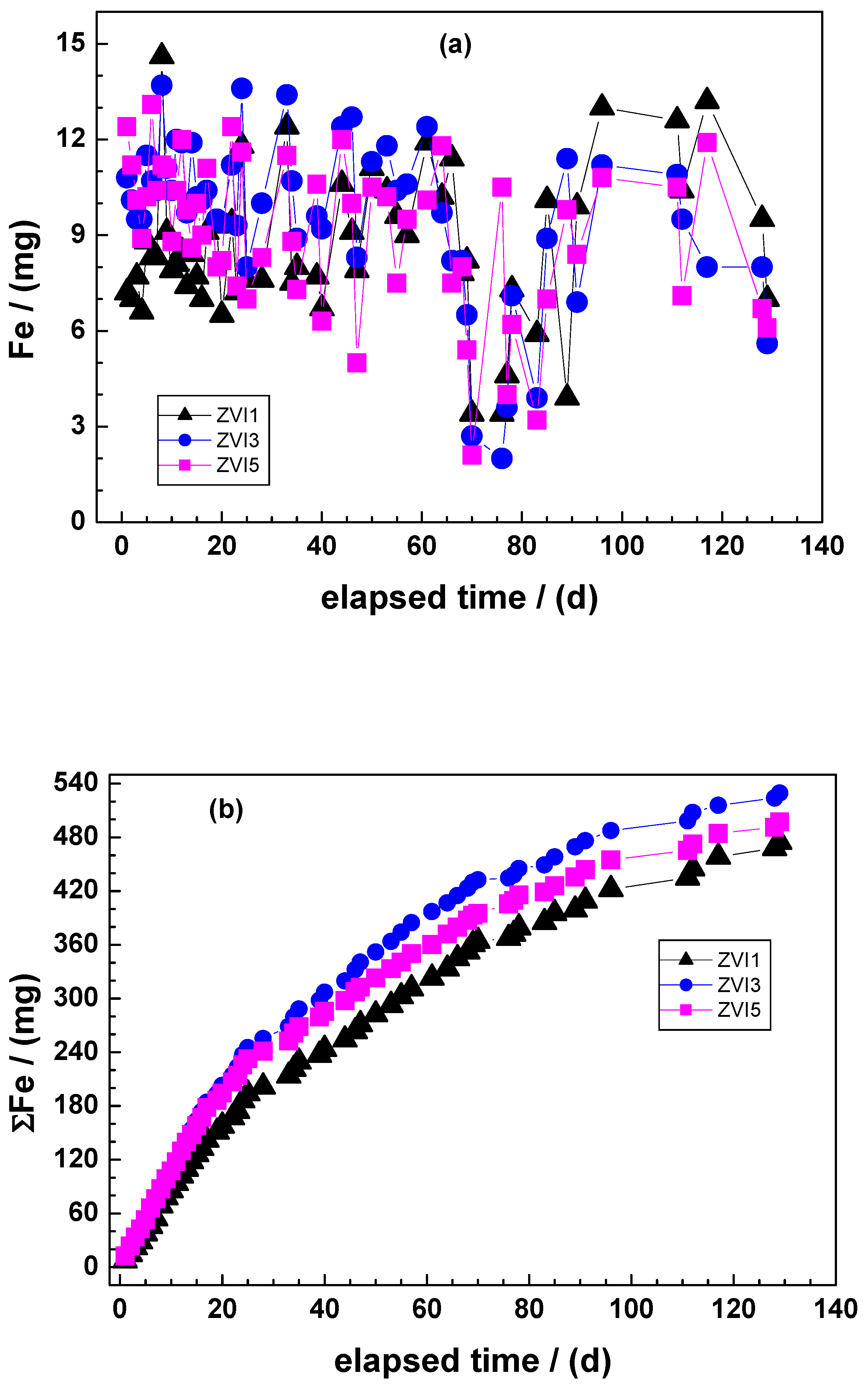
Granular metallic iron (gFe0) materials have been widely used for eliminating a wide range of pollutants from aqueous solutions over the past three decades. However, the intrinsic reactivity of gFe0 is rarely evaluated and existing methods for such evaluations have not been standardized. The aim of the present study was to develop a simple spectrophotometric method to characterize the intrinsic reactivity of gFe0 based on the extent of iron dissolution in an ascorbic acid (AA—0.002 M or 2 mM) solution. A modification of the ethylenediaminetetraacetic acid method (EDTA method) is suggested for this purpose. Being an excellent chelating agent for FeII and a reducing agent for FeIII, AA sustains the oxidative dissolution of Fe0 and the reductive dissolution of FeIII oxides from gFe0 specimens. In other words, Fe0 dissolution to FeII ions is promoted while the further oxidation to FeIII ions is blocked. Thus, unlike the EDTA method that promotes Fe0 oxidation to FeIII ions, the AA method promotes only the formation of FeII species, despite the presence of dissolved O2. The AA test is more accurate than the EDTA test and is considerably less expensive. Eight selected gFe0 specimens (ZVI1 through ZVI8) with established diversity in intrinsic reactivity were tested in parallel batch experiments (for 6 days) and three of these specimens (ZVI1, ZVI3, ZVI5) were further tested for iron leaching in column experiments (for 150 days). Results confirmed the better suitability (e.g., accuracy in assessing Fe0 dissolution) of the AA test relative to the EDTA test as a powerful screening tool to select materials for various field applications. Thus, the AA test should be routinely used to characterize and rationalize the selection of gFe0 in individual studies.
Keywords: groundwater remediation; intrinsic reactivity; iron dissolution; permeable reactive barrier; zero-valent iron groundwater remediation; intrinsic reactivity; iron dissolution; permeable reactive barrier; zero-valent iron