You are currently viewing a new version of our website. To view the old version click .

Genes, Volume 11, Issue 3

March 2020 - 109 articles

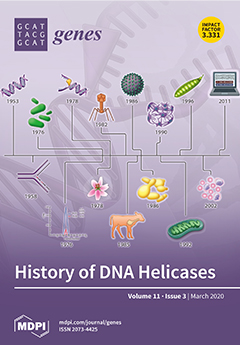
Cover Story: DNA helicases are motor enzymes that move directionally along the phosphodiester backbone to catalyze ATP-dependent unwinding of duplex DNA. The discovery of viral, prokaryotic, and eukaryotic DNA helicases since the 1970s indicates their ubiquitous presence. DNA helicases have fundamentally important roles in virtually all aspects of nucleic acid metabolism including DNA replication and repair, recombination, transcription, and maintenance of genomic stability. Research by many laboratories has elucidated their molecular and cellular functions. Genetic defects in DNA helicases underlie hereditary diseases and cancers. Continued work in this area is anticipated to yield important new insights to the seminal importance of DNA helicases in genome biology. View this paper.
  • Issues are regarded as officially published after their release is announced to the table of contents alert mailing list .
  • You may sign up for email alerts to receive table of contents of newly released issues.
  • PDF is the official format for papers published in both, html and pdf forms. To view the papers in pdf format, click on the "PDF Full-text" link, and use the free Adobe Reader to open them.

Articles (109)

  • Review
  • Open Access
14 Citations
7,027 Views
16 Pages

24 March 2020

During embryonic development in vertebrates, morphogens play an important role in cell fate determination and morphogenesis. Bone morphogenetic proteins (BMPs) belonging to the transforming growth factor-β (TGF-β) family control the dorsal&...

  • Review
  • Open Access
21 Citations
10,385 Views
14 Pages

CRISPR-Generated Animal Models of Duchenne Muscular Dystrophy

  • Kenji Rowel Q. Lim,
  • Quynh Nguyen,
  • Kasia Dzierlega,
  • Yiqing Huang and
  • Toshifumi Yokota

24 March 2020

Duchenne muscular dystrophy (DMD) is a fatal X-linked recessive neuromuscular disorder most commonly caused by mutations disrupting the reading frame of the dystrophin (DMD) gene. DMD codes for dystrophin, which is critical for maintaining the integr...

  • Article
  • Open Access
29 Citations
6,149 Views
24 Pages

Ectopic Expression of AhGLK1b (GOLDEN2-like Transcription Factor) in Arabidopsis Confers Dual Resistance to Fungal and Bacterial Pathogens

  • Niaz Ali,
  • Hua Chen,
  • Chong Zhang,
  • Shahid Ali Khan,
  • Mamadou Gandeka,
  • Dongyang Xie and
  • Weijian Zhuang

24 March 2020

GOLDEN2-LIKE (GLK) is a member of the myeloblastosis (MYB) family transcription factor and it plays an important role in the regulation of plastid development and stress tolerance. In this study, a gene named AhGLK1b was identified from a cultivated...

  • Article
  • Open Access
16 Citations
5,297 Views
16 Pages

A Novel WAC Loss of Function Mutation in an Individual Presenting with Encephalopathy Related to Status Epilepticus during Sleep (ESES)

  • Emanuela Leonardi,
  • Mariagrazia Bellini,
  • Maria C. Aspromonte,
  • Roberta Polli,
  • Anna Mercante,
  • Claudia Ciaccio,
  • Elisa Granocchio,
  • Elisa Bettella,
  • Ilaria Donati and
  • Elisa Cainelli
  • + 5 authors

24 March 2020

WAC (WW Domain Containing Adaptor With Coiled-Coil) mutations have been reported in only 20 individuals presenting a neurodevelopmental disorder characterized by intellectual disability, neonatal hypotonia, behavioral problems, and mildly dysmorphic...

  • Article
  • Open Access
13 Citations
4,428 Views
11 Pages

24 March 2020

Arabidopsis thaliana MUT9-LIKE KINASES (MLKs), a family of the plant-specific casein kinase 1 (CK1), have been implicated collectively in multiple biological processes including flowering. Three of the four MLKs (MLK1/2/4) have been characterized, ho...

  • Review
  • Open Access
17 Citations
7,113 Views
20 Pages

Experimental Evolution of Legume Symbionts: What Have We Learnt?

  • Ginaini Grazielli Doin de Moura,
  • Philippe Remigi,
  • Catherine Masson-Boivin and
  • Delphine Capela

23 March 2020

Rhizobia, the nitrogen-fixing symbionts of legumes, are polyphyletic bacteria distributed in many alpha- and beta-proteobacterial genera. They likely emerged and diversified through independent horizontal transfers of key symbiotic genes. To replay t...

  • Article
  • Open Access
22 Citations
5,289 Views
16 Pages

23 March 2020

Shigella flexneri is the principal cause of bacillary dysentery, contributing significantly to the global burden of diarrheal disease. The appearance and increase in the multi-drug resistance among Shigella strains, necessitates further genetic studi...

  • Article
  • Open Access
5 Citations
3,898 Views
10 Pages

Diversity of KIR/HLA Genotypes and Their Association with Psoriasis Vulgaris in the Western Mexican Population

  • Omar Graciano-Machuca,
  • Anabell Alvarado-Navarro,
  • María Guadalupe Ramírez-Dueñas,
  • Delfina Guadalupe Villanueva-Quintero,
  • Erandi Enif Velarde-de la Cruz,
  • Andrea Carolina Machado-Sulbarán,
  • Margarita Montoya-Buelna and
  • Pedro Ernesto Sánchez-Hernández

22 March 2020

NK and some T cell functions are regulated by the interaction between KIR and HLA molecules. Several studies have shown an association between activating KIR genes and the development of autoimmune diseases, including psoriasis vulgaris (PsV). Our ob...

  • Article
  • Open Access
6 Citations
4,098 Views
17 Pages

Quantitative Trait Loci (QTLs) Associated with Microspore Culture in Raphanus sativus L. (Radish)

  • Kyeongmin Kim,
  • Yuna Kang,
  • Sol-Ji Lee,
  • Se-Hyun Choi,
  • Dong-Hyun Jeon,
  • Min-Young Park,
  • Suhyoung Park,
  • Yong Pyo Lim and
  • Changsoo Kim

21 March 2020

The radish is a highly self-incompatible plant, and consequently it is difficult to produce homozygous lines. Bud pollination in cross-fertilization plants should be done by opening immature pollen and attaching pollen to mature flowers. It according...

  • Article
  • Open Access
17 Citations
3,578 Views
14 Pages

20 March 2020

Hypoxia is one of the most frequent and severe stresses to an organism’s homeostatic mechanisms, and hypoxia during gestation has profound adverse effects on the heart development increasing the occurrence of congenital heart defects (CHDs). Ca...

of 11

Get Alerted

Add your email address to receive forthcoming issues of this journal.

XFacebookLinkedIn
Genes - ISSN 2073-4425