Skip Content
You are currently on the new version of our website. Access the old version .

Cells, Volume 6, Issue 3

2017 September - 15 articles

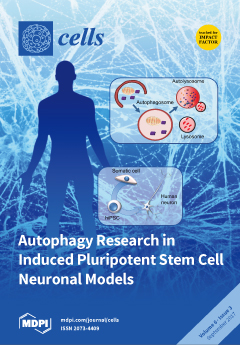
Cover Story: Autophagy cytoplasmic quality control protects neurons against operational stress and cell death. Human neurodegenerative diseases are often associated with declining autophagic activity, highlighting the need for better human neuronal disease models. Human neurons can be generated from somatic cells following pluripotency reprogramming (hiPSCs) and neural induction. Here, we discuss the potential of hiPSC-derived neurons for autophagy research in human neurodegenerative disease models in vitro. View this paper
  • Issues are regarded as officially published after their release is announced to the table of contents alert mailing list .
  • You may sign up for email alerts to receive table of contents of newly released issues.
  • PDF is the official format for papers published in both, html and pdf forms. To view the papers in pdf format, click on the "PDF Full-text" link, and use the free Adobe Reader to open them.

Articles (15)

  • Review
  • Open Access
9 Citations
12,937 Views
12 Pages

Assessing Autophagy in Sciatic Nerves of a Rat Model that Develops Inflammatory Autoimmune Peripheral Neuropathies

  • Susana Brun,
  • Nicolas Schall,
  • Hélène Jeltsch-David,
  • Jérôme de Sèze and
  • Sylviane Muller

18 September 2017

The rat sciatic nerve has attracted widespread attention as an excellent model system for studying autophagy alterations in peripheral neuropathies. In our laboratory, we have developed an original rat model, which we used currently in routine novel...

  • Article
  • Open Access
23 Citations
7,701 Views
15 Pages

Delayed Activation Kinetics of Th2- and Th17 Cells Compared to Th1 Cells

  • Andrea Duechting,
  • Anna Przybyla,
  • Stefanie Kuerten and
  • Paul V. Lehmann

12 September 2017

During immune responses, different classes of T cells arise: Th1, Th2, and Th17. Mobilizing the right class plays a critical role in successful host defense and therefore defining the ratios of Th1/Th2/Th17 cells within the antigen-specific T cell re...

  • Review
  • Open Access
50 Citations
19,643 Views
17 Pages

Lamin B Receptor: Interplay between Structure, Function and Localization

  • Eleni Nikolakaki,
  • Ilias Mylonis and
  • Thomas Giannakouros

31 August 2017

Lamin B receptor (LBR) is an integral protein of the inner nuclear membrane, containing a hydrophilic N-terminal end protruding into the nucleoplasm, eight hydrophobic segments that span the membrane and a short, nucleoplasmic C-terminal tail. Two se...

  • Review
  • Open Access
42 Citations
11,189 Views
19 Pages

Approaches for Studying Autophagy in Caenorhabditis elegans

  • Yanfang Chen,
  • Vincent Scarcelli and
  • Renaud Legouis

30 August 2017

Macroautophagy (hereafter referred to as autophagy) is an intracellular degradative process, well conserved among eukaryotes. By engulfing cytoplasmic constituents into the autophagosome for degradation, this process is involved in the maintenance of...

  • Review
  • Open Access
48 Citations
10,549 Views
16 Pages

Assessment of Autophagy in Neurons and Brain Tissue

  • Irene Benito-Cuesta,
  • Héctor Diez,
  • Lara Ordoñez and
  • Francisco Wandosell

23 August 2017

Autophagy is a complex process that controls the transport of cytoplasmic components into lysosomes for degradation. This highly conserved proteolytic system involves dynamic and complex processes, using similar molecular elements and machinery from...

  • Feature Paper
  • Review
  • Open Access
20 Citations
13,254 Views
27 Pages

11 August 2017

Human induced pluripotent stem cells (hiPSCs) are invaluable tools for research into the causes of diverse human diseases, and have enormous potential in the emerging field of regenerative medicine. Our ability to reprogramme patient cells to become...

  • Feature Paper
  • Review
  • Open Access
54 Citations
16,579 Views
24 Pages

Assays to Monitor Autophagy in Saccharomyces cerevisiae

  • Raffaela Torggler,
  • Daniel Papinski and
  • Claudine Kraft

13 July 2017

Autophagy is an intracellular process responsible for the degradation and recycling of cytoplasmic components. It selectively removes harmful cellular material and enables the cell to survive starvation by mobilizing nutrients via the bulk degradatio...

  • Feature Paper
  • Review
  • Open Access
62 Citations
13,851 Views
14 Pages

Exploring Autophagy in Drosophila

  • Péter Lőrincz,
  • Caroline Mauvezin and
  • Gábor Juhász

12 July 2017

Autophagy is a catabolic process in eukaryotic cells promoting bulk or selective degradation of cellular components within lysosomes. In recent decades, several model systems were utilized to dissect the molecular machinery of autophagy and to identi...

  • Feature Paper
  • Review
  • Open Access
57 Citations
14,082 Views
26 Pages

Studying Autophagy in Zebrafish

  • Benan John Mathai,
  • Annemarie H. Meijer and
  • Anne Simonsen

9 July 2017

Autophagy is an evolutionarily conserved catabolic process which allows lysosomal degradation of complex cytoplasmic components into basic biomolecules that are recycled for further cellular use. Autophagy is critical for cellular homeostasis and for...

of 2

Get Alerted

Add your email address to receive forthcoming issues of this journal.

XFacebookLinkedIn
Cells - ISSN 2073-4409