


Abstract
Under the combined influence of climate change and long-term mowing pressure, natural mowing grasslands in the Altai Mountain meadow region of Xinjiang have undergone degradation, primarily manifested as a decline in the proportion of high-quality forage species and an increase in forbs, which has severely constrained grassland-based livestock production and regional ecological security. For the restoration of degraded natural mowing grasslands, systematic assessments of the effects of legume–grass mixture overseeding on ecosystem multifunctionality (EMF) are still lacking; existing studies have mostly focused on single ecological functions, and the understanding of how different species mixtures drive synergistic vegetation–soil system recovery and the underlying mechanisms remains unclear. This study targeted degraded natural mowing grasslands in Altai and selected seven species: Onobrychis viciifolia cv. Qitai, Medicago sativa cv. Xinmu No. 4, Trifolium pratense cv. Minshan, Dactylis glomerata, Poa pratensis, Bromus inermis cv. Wusu No. 1, and Elymus dahuricus. Overseeding mixtures with different species compositions were established under a uniform legume–grass ratio of 2:8. Through a fixed-point field observation experiment conducted from 2024 to 2025, we integrated indicators of quantitative community characteristics, forage nutritional quality, soil physical properties, and soil chemical properties to construct aboveground EMF (AEMF), belowground EMF (BEMF), and overall EMF indices. The effects of different legume–grass mixtures on the restoration of degraded natural mowing grasslands were evaluated, candidate mixtures suitable for different restoration goals were screened, and the driving mechanisms were elucidated. The results showed that: (1) The restoration effects of different legume–grass mixtures on degraded natural mowing grasslands differed markedly. Community composition changed after overseeding, and some mixtures rapidly formed a grass-dominated community structure. (2) Superior mixtures significantly increased community cover and aboveground biomass, improved forage quality, and enhanced soil fertility to a certain extent. (3) Overseeding resulted in a greater improvement in aboveground EMF than in belowground EMF. In the first year, EMF exhibited synchronous enhancement across all functions, whereas in the second year, the system shifted to a phase of functional reorganization. (4) Based on the 2024–2025 field trial results, candidate legume–grass mixtures suitable for different restoration objectives were preliminarily identified: for comprehensive ecological restoration, a mixture of 5% Onobrychis viciifolia cv. Qitai + 15% Trifolium pratense cv. Minshan + 15% Dactylis glomerata + 15% Poa pratensis + 50% Bromus inermis cv. Wusu No. 1 is recommended; for rapid productivity recovery, a mixture of 10% Trifolium pratense cv. Minshan + 10% Medicago sativa cv. Xinmu No. 4 + 30% Poa pratensis + 50% Bromus inermis cv. Wusu No. 1 is recommended; and for producing high-quality forage, a mixture of 10% Medicago sativa cv. Xinmu No. 4 + 10% Trifolium pratense cv. Minshan + 30% Dactylis glomerata + 50% Bromus inermis cv. Wusu No. 1 is recommended. This study clarifies the goal-specific suitability of different legume–grass mixtures in terms of productivity enhancement, quality improvement, and soil function recovery, and provides a reference for the ecological restoration and subsequent regional verification of degraded natural mowing grasslands in the Altai Mountain meadow area.
1. Introduction
Natural mowing grasslands serve as a critical forage source for grassland-based livestock production in China, primarily distributed in areas such as northeastern Inner Mongolia, the agro-pastoral ecotone, the Songnen Plain, and northern Xinjiang [1,2]. In this study, the term “natural mowing grasslands” refers to grassland types that are based on naturally established plant communities and have long been used for hay production through mowing. Here, “natural” is used primarily to distinguish these grasslands from artificially sown pastures and does not imply that the system is free from human use or management. Through mowing, forage conditioning, and hay storage, natural mowing grasslands can alleviate seasonal imbalances between forage supply and livestock demand, ensure livestock survival through the winter and early spring, and play an important role in disaster prevention and mitigation as well as in the sustainable use of grasslands [3,4].
The Altai region of Xinjiang is an important distribution area of natural mowing grasslands in northern China. Its mountain meadows serve not only as a critical source of winter–spring forage reserves, but also as a fundamental basis for maintaining regional livestock stability and ecological security [5]. During long-term mowing utilization, aboveground biomass and nutrients are continuously removed. When an imbalance occurs among mowing intensity, nutrient return, and the natural recovery capacity of the plant community, mowing grasslands may undergo degradation [6]. Degraded natural mowing grasslands in Altai are characterized primarily by a decline in the proportion of palatable forage species, an increase in forbs, reductions in community cover and aboveground biomass, and a weakening of topsoil nutrient supply capacity [7]. These changes not only reduce hay yield and forage quality, but also impair the recovery capacity of the vegetation–soil system [8,9]. Therefore, how to enhance both the productive and ecological functions of degraded natural mowing grasslands through low-disturbance and broadly applicable vegetation restoration measures is an issue that needs to be addressed for the sustainable use of grasslands in this region.
Overseeding with forage species is a key measure for restoring natural grasslands [10]. Compared with single-species overseeding, overseeding with mixtures of species from different functional groups can improve resource use efficiency through niche complementarity and enhance community structure and forage quality [11,12]. Legume–grass mixtures have drawn particular attention because legumes have high protein content and can improve nitrogen supply through nitrogen fixation, whereas grasses generally possess strong tillering and root expansion capacities, which can increase community productivity and soil resource use efficiency [13,14,15]. However, the effectiveness of overseeding is not fixed but is jointly influenced by factors such as land-use type, degradation degree, climatic conditions, soil status, and species composition [16]. To date, studies on legume–grass mixture overseeding have mostly focused on grazed grasslands or sown pastures, whereas the screening of species mixtures and evaluation of restoration effectiveness for degraded natural mowing grasslands under long-term mowing use in Altai remain relatively limited.
Previous assessments of grassland restoration have often focused on the recovery of single ecological functions, such as aboveground biomass, cover, or soil nutrients, which cannot fully capture the synergistic changes among productive functions, forage quality, and soil functions [13,14,17]. Ecosystem multifunctionality (EMF) can serve as an integrated framework for evaluating changes in multiple ecosystem functions and their interrelationships [18,19,20]. In this study, the EMF framework integrated three categories of functions: (i) productive function, represented by aboveground biomass; (ii) quality function, represented by forage nutrient composition; and (iii) soil function, represented by soil moisture, bulk density, organic matter, and available nutrients. By incorporating these indicators into a unified evaluation framework, it is possible to determine whether different legume–grass mixtures can simultaneously promote productivity enhancement, forage quality improvement, and soil function recovery, rather than merely improving a single indicator [21,22,23].
To fill the gap in the systematic restoration theory and technology for degraded natural mowing grasslands, this study focused on typical degraded natural mowing grasslands in Altai, Xinjiang. With the goals of optimizing community structure and enhancing ecosystem multifunctionality, and following the principle of selecting native and adaptive species, seven superior legume and grass species were chosen for mixture experiments, taking into account multiple factors such as local climatic adaptability and palatability. A suite of indicators including plant community structure, plant nutrition, and soil physicochemical properties were measured, and an ecosystem multifunctionality (EMF) was integrated and calculated. The objectives of this study were: (1) to compare the effects of overseeding with different legume–grass mixtures on vegetation, forage quality, soil properties, and EMF in degraded natural mowing grasslands; (2) to determine the interannual differences and mixture-specific responses of aboveground EMF (AEMF) and belowground EMF (BEMF) to overseeding; and (3) to elucidate the main pathways through which different legume–grass mixtures drive the synergistic recovery of the vegetation–soil system, and to screen candidate species mixtures suitable for different restoration objectives.
2. Materials and Methods
2.1. Study Area
The experimental site is located on a mountain meadow within the administrative area of Qibashileke Village, Tierekti Township, Habahe County, Altay Prefecture, Xinjiang, away from village settlements. The center coordinates of the experimental plot are 48°26′37″ N, 86°33′11″ E, at an elevation of 1199.69 m. These coordinates represent the center point of the experimental plot, rather than the residential area or the village committee of Qibashileke Village. The site has been used long-term as a natural mowing grassland and is part of the local village grassland resources. The area lies within the Altai Mountain forest–steppe ecological functional zone, under a temperate continental climate, with a mean annual temperature of approximately 4.4 °C and a mean annual precipitation of approximately 195.5 mm, while precipitation in mountainous areas can reach 400–600 mm [24].
The experimental site is a degraded natural mowing grassland that has experienced long-term combined mowing and grazing use. Locally, mowing typically occurs from 20 to 25 July each year, followed by grazing until approximately 10 September, with no use during the remainder of the year. To ensure uniform initial conditions across treatments, the experiment was arranged on a meadow section with relatively consistent topography, slope, soil conditions, vegetation degradation level, and use history. The total experimental area was approximately 3096 m2 (86 m × 36 m), within which 33 plots were established. Each plot measured 50 m2, with 1 m isolation strips between adjacent plots.
Prior to overseeding, a background vegetation survey was conducted over the entire experimental area on 17 May 2023. The pre-experiment vegetation survey adopted a quadrat method: three 1 m × 1 m quadrats were randomly placed within each planned plot, all vascular plant species within the quadrats were recorded, and the cover, height, and aboveground biomass of each species were measured. The survey results showed that a total of 15 plant species, belonging to 15 genera and 13 families, were recorded in the original grassland community at the experimental site. Because the site is a moderately degraded grassland under long-term mowing and grazing use, and the survey was confined to the homogeneous area where the experimental plots were established, the recorded species number is lower than the total flora of the region. Only dominant and main companion species are listed in the main text. The dominant species were Carex tristachya, Achillea millefolium, Geum aleppicum, Alopecurus aequalis, and Agrostis alba, whereas the main companion species included Potentilla chinensis, Taraxacum mongolicum, Rumex acetosa, and Geranium pratense. In terms of forage quality, high-quality forage species were relatively scarce, accounting for only 11.34% of the community; the sward quality was poor, with forbs dominating, and degradation was highly evident. According to the national standard “Classification indicators of degradation, desertification, and salinization of natural grasslands” [25], the grassland was assessed as moderately degraded.
The soil physicochemical properties of the 0–10 cm layer before overseeding were as follows: alkali-hydrolyzable nitrogen content was 233 mg kg−1, available phosphorus content was 12.72 mg kg−1, available potassium content was 252.67 mg kg−1, and soil pH ranged from neutral to slightly alkaline.
2.2. Experimental Design
Based on the adaptability to the local cool, arid, and non-irrigated conditions, feeding value and establishment capacity, nitrogen-fixing potential of legumes, community stability and forage yield potential of grasses, and relevance to degraded grassland restoration objectives, seven legume and grass species were selected as mixture components (Table 1): Onobrychis viciifolia cv. Qitai, Medicago sativa cv. Xinmu No. 4, Trifolium pratense cv. Minshan, etc. The non-overseeded control (CK) was maintained as the original degraded natural grassland vegetation and received only the same basal fertilization and management as the other treatments. The remaining treatments were artificially overseeded mixture treatments. Based on preliminary trial results and the ecological functional differences among species, 10 legume–grass mixtures were established, including treatments with 3, 4, 5, and 6 species. The seeding ratio of legume to grass was fixed at 2:8 for all mixtures, determined according to the establishment performance, community stability, and competitive advantage of grasses observed in the preliminary trial (Table 2).

Table 1.
Grass species composition of experimental plots and some management and quality indicators.
Table 2.
Grass combination.
The experiment was arranged in a completely randomized block design with 11 treatments and three replications, resulting in 33 plots. Each plot measured 48 m2 (6 m × 8 m), with 1 m-wide isolation strips between adjacent plots. Overseeding was performed on 17 May 2023, using no-till drill seeding with a row spacing of 30 cm. Seeds were untreated, and the seeding rates of the mixtures were calculated on a pure live seed (seed value) basis (see Table 1 for actual seeding rates). Prior to seeding, basal fertilizer was uniformly broadcast across all plots, consisting of 2000 kg ha−1 of locally sourced composted sheep manure and 8 kg ha−1 of diammonium phosphate (N–P2O5–K2O: 18–46–0). No irrigation was applied. The composted sheep manure was a traditional farmyard manure produced by local farmers, without commercial labeling or nutrient content analysis, and was applied uniformly as a basal amendment to all treatments.
2.3. Measurements and Variables
From 7 to 14 August in both 2024 and 2025, vegetation and soil surveys were conducted using a quadrat-based sampling approach. In each experimental plot, three 1 m × 1 m quadrats were randomly selected to determine plant community characteristics, forage nutritional quality, and soil physicochemical properties.
2.3.1. Measurement and Calculation of Community and Functional Group Attributes
Within the selected quadrats, the height (natural growth height), cover, and aboveground and belowground biomass of the plant community and functional groups (grasses, legumes, perennial forbs, and annual/biennial forbs) were measured.
Cover. Cover was determined using the point-intercept method. A 10 cm × 10 cm grid with a total of 100 intersection points was placed over each 1 m × 1 m quadrat. A fine pin was vertically inserted at each intersection point, and the plant species in contact with the pin were recorded. Species cover was calculated as the proportion of the number of pin-point hits for a given species relative to the total number of pin points. If the pin contacted more than one species at a single point, each contacted species was recorded separately. Total community cover was calculated as the proportion of pin points at which at least one plant was contacted.
Aboveground biomass (AGB). All aboveground plant material in each quadrat was clipped at ground level and sorted by species. Samples were returned to the laboratory, weighed fresh, dried at 65 °C to constant weight, and then weighed to determine dry mass.
Belowground biomass (BGB). After aboveground biomass harvest, root samples were collected from the same quadrats using a root corer with an inner diameter of 7 cm from the 0–10 cm soil layer. Three replicate cores were collected from each plot and pooled into one composite sample per plot, which was placed in a mesh bag. Samples were thoroughly washed under running water to remove soil particles and impurities until roots were clean. The washed roots were dried at 65 °C to constant weight, and dry mass was recorded as belowground biomass.
2.3.2. Determination of Forage Nutritional Value
At each harvest, three 1 m × 1 m quadrats were selected along the diagonal of each plot, and approximately 200 g of fresh forage was collected as a composite sample. All samples were air-dried and ground prior to analysis. The following nutritional variables were determined: crude protein (CP) using the Kjeldahl method, and acid detergent fiber (ADF) and neutral detergent fiber (NDF) using the Van Soest method [26].
2.3.3. Determination of Soil Physicochemical Properties
After aboveground vegetation sampling, soil samples were collected from the same quadrat. A soil auger with an inner diameter of 3.8 cm was used to collect soil from the 0–10 cm layer following a five-point “Z”-shaped sampling pattern. The five subsamples from each quadrat were thoroughly mixed to form one composite sample.
The soil samples were divided into two portions. One portion was used for the determination of soil physical properties. Undisturbed soil samples were collected using a cutting ring or auger of known volume, weighed fresh, and then oven-dried at 105 °C to constant weight. Soil water content (SW) was calculated from the difference between fresh and dry soil mass, and soil bulk density (BD) was calculated as the ratio of dry soil mass to sampling volume.
The other portion was brought back to the laboratory, air-dried naturally in a cool and ventilated place, and freed of plant roots, litter, gravel and other debris. The samples were then ground, homogenized, and passed through a 2 mm sieve, after which they were sealed and stored for subsequent analysis. Soil organic matter (OM) was determined by the potassium dichromate oxidation—external heating method. Soil alkali-hydrolyzable nitrogen (AN) was measured by the alkali diffusion method, with hydrolysis performed using 1.0 mol L−1 NaOH. Soil available phosphorus (AP) was extracted with 0.5 mol L−1 NaHCO3 solution (pH 8.5) and determined spectrophotometrically by either the molybdenum-antimony anti-colorimetric method or the molybdenum blue colorimetric method. Soil available potassium (AK) was extracted with 1.0 mol L−1 NH4OAc solution (pH 7.0) and determined by flame photometry. All soil physicochemical analyses were performed following the methods of Klute [27] and Sparks [28].
2.4. Data Analysis
2.4.1. Importance Value Calculation
Species importance value was used to characterize the relative dominance of each species in the community and was calculated for all plant species recorded within the quadrats. The importance value was derived from relative height, relative cover, and relative aboveground biomass [29]:
Importance value (IV)
where: RHi, RCi, and RBi represent the relative height, relative cover, and relative aboveground biomass of the i-th species, respectively.
2.4.2. Forage Nutritional Quality Calculation [30]
Relative feed value (RFV)
Dry matter digestibility (DDM)
Dry matter intake (DMI)
2.4.3. Species Diversity Calculation [31]
Species richness was expressed as the number of plant species recorded within each quadrat (S). Three 1 m × 1 m quadrats were established in each plot, and all plant species occurring in each quadrat were recorded. Plot-level species richness was calculated as the mean number of species across the three quadrats.
Shannon–wiener diversity index (H)
where: is the proportion of the importance value of the i-th species relative to the total importance value of all species in the quadrat.
2.4.4. Ecosystem Function Index Calculation
Highly collinear indicators were excluded through Pearson correlation analysis, and 11 core indicators were selected from the 28 measured indicators based on their representativeness of ecological functions and literature conventions for calculating ecosystem multifunctionality. Ecosystem multifunctionality (EMF) was then calculated using the selected core indicators, with aboveground ecosystem functions represented by Height, aboveground biomass (AGB), belowground biomass (BGB), the Shannon–Wiener index (H), and relative feed value (RFV), and belowground ecosystem functions represented by bulk density (BD), soil water content (SW), organic matter (OM), alkali-hydrolyzable nitrogen (AN), available phosphorus (AP), and available potassium (AK) [31].
Ecosystem multifunctionality index (EMF)
2.5. Data Processing
All data were organized using Microsoft Office Excel 2013, and statistical analyses were performed using IBM SPSS Statistics 27.0.1. Differences in various indicators among overseeding treatments were tested by one-way analysis of variance (ANOVA), with overseeding treatment treated as a fixed factor and quadrat replicates as the error term. When ANOVA results were significant, post hoc multiple comparisons were conducted using Duncan’s multiple range test, with the significance level set at p < 0.05. Pearson correlation analysis was used to evaluate the relationships among individual ecosystem functions, the EMF index, the aboveground EMF (AEMF) index, and the belowground EMF (BEMF) index. All figures were plotted using OriginPro 2024.
3. Results
3.1. Changes in Community Composition and Structure
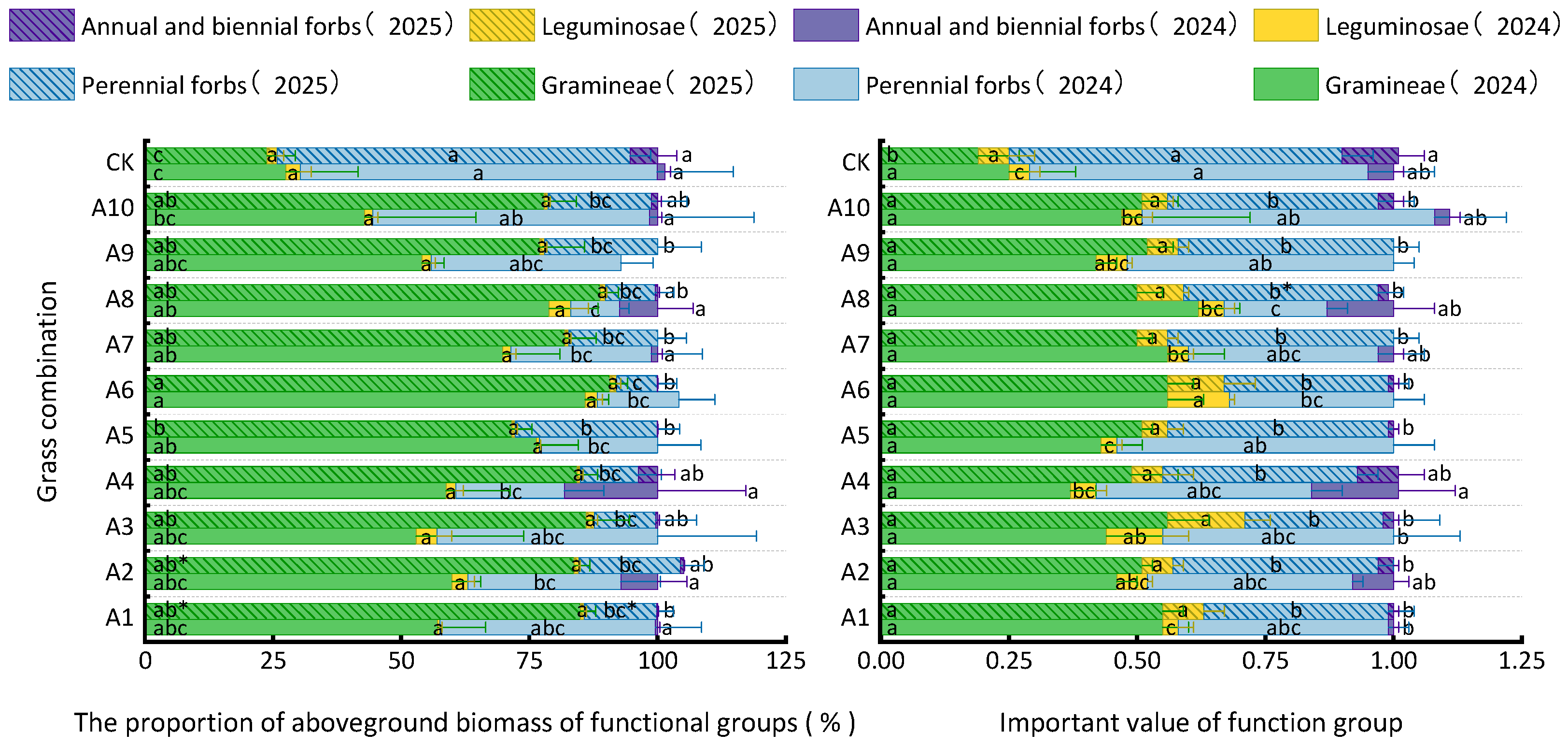
Two-year observations showed that overseeding with different species mixtures markedly altered the functional group composition of the plant community at the experimental site, primarily manifested as an increased proportion of grass biomass and a decreased proportion of forb biomass (Figure 1).
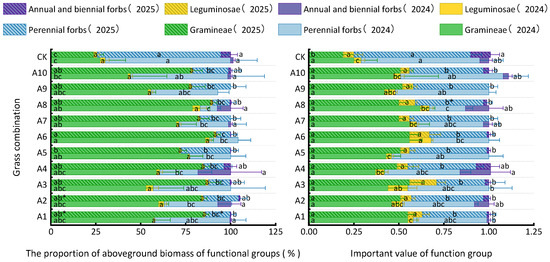
Figure 1.
Changes of community functional group structure. Different letters indicate significant differences between treatments (p < 0.05); * denote significant differences at p < 0.05.
In terms of biomass proportion, the proportion of grass biomass across all treatments ranged from 42.87% to 85.87% in 2024, and increased to 71.62–90.67% in 2025. In both years, the A6 mixture had the highest proportion. The proportion of legume biomass remained low throughout, ranging from 0.43% to 4.23% in 2024 and increasing slightly to 0.62–1.59% in 2025, with the A3 mixture being the highest; interannual variation was not pronounced. In contrast, the proportion of perennial forb biomass decreased, from 9.54–54.03% in 2024 to 7.95–27.70% in 2025, with the greatest decline observed in the A6 mixture. The upper limit of the proportion of annual/biennial forbs also decreased from 18.15% to 3.75%, and this proportion dropped to zero in several mixtures including A5 and A6.
In terms of importance value, in the second year after overseeding, the importance value of grasses under all overseeding treatments was above 0.49 and was higher than that of CK; whereas the importance value of perennial forbs was lower than that of CK (p < 0.05), with the greatest decrease observed for annual/biennial forbs.
3.2. Changes in Individual Ecosystem Functions
3.2.1. Changes in Plant Community Attributes
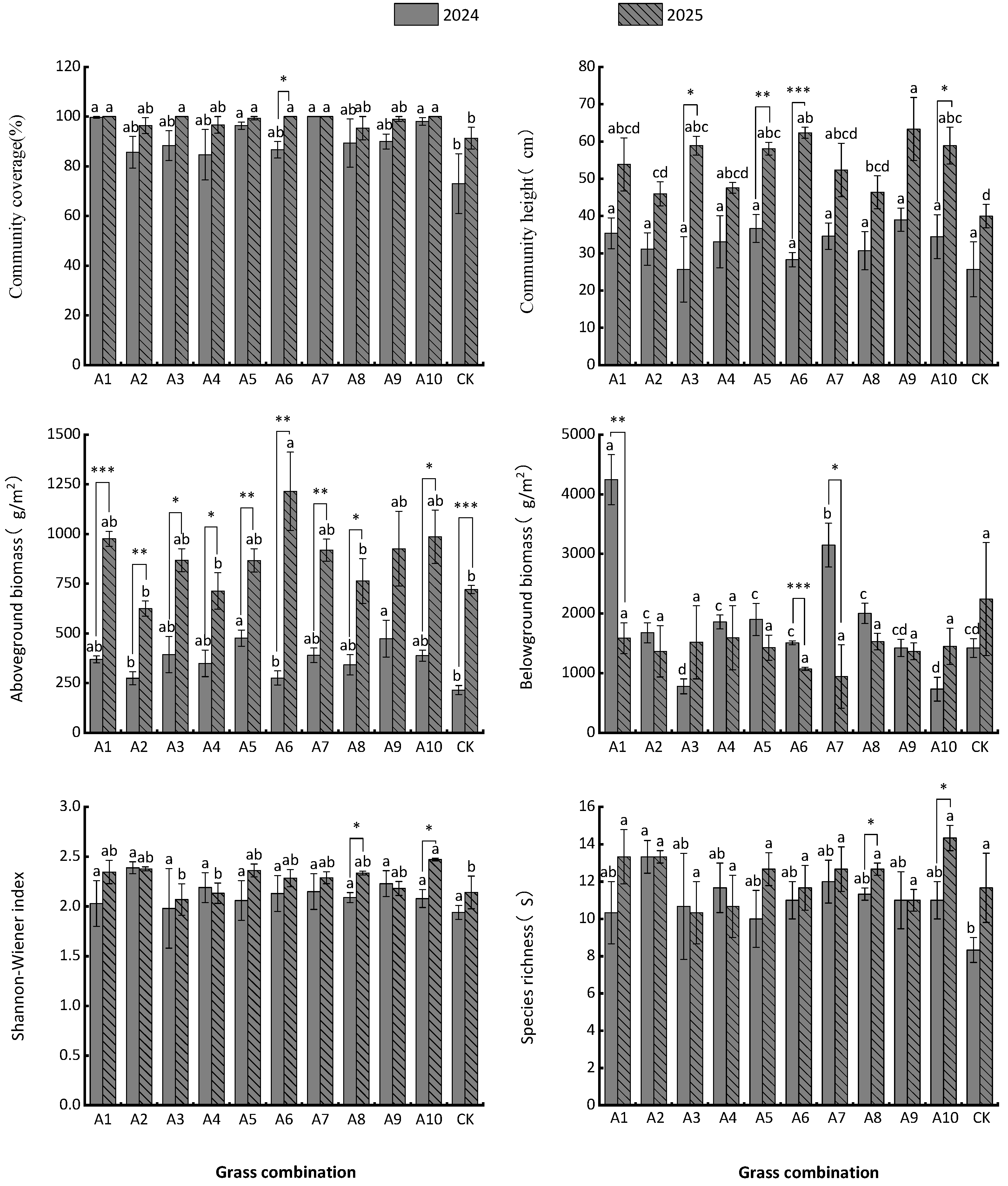
Overseeding with different species mixtures significantly affected community vertical structure and productivity, but the responses of individual indicators differed between years (Figure 2).
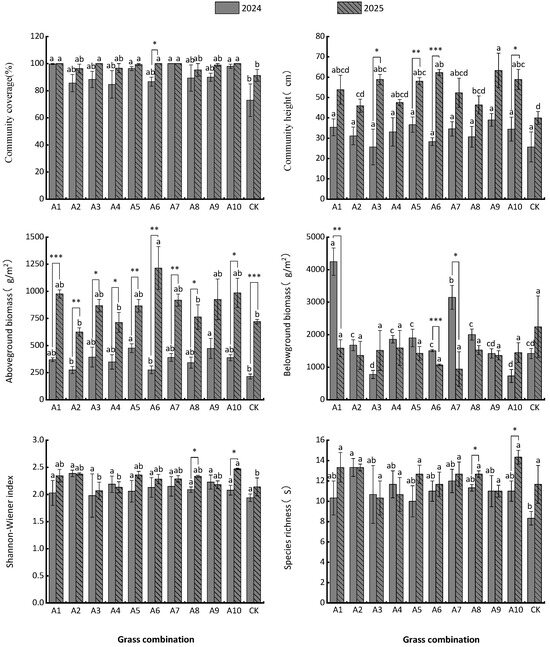
Figure 2.
Changes in plant community characteristics. Different letters indicate significant differences between treatments (p < 0.05); *, **, and *** denote significant differences at p < 0.05, 0.01, and 0.001, respectively.
Community cover and height. In 2024, cover was significantly greater in the A1, A5, A7, and A10 mixtures than in CK (p < 0.05), with A7 having the greatest cover. Height across mixtures ranged from 25.66 to 39.90 cm and did not differ from CK (p > 0.05). By 2025, cover reached 100% in the A1, A3, A6, A7, and A10 mixtures, while the remaining mixtures had cover values between 95.33% and 99.33%, none of which differed significantly from CK. Height was greatest in A9, at 63.26 cm, which was significantly taller than CK. From 2024 to 2025, all mixtures increased in both cover and height, with the largest increase observed in A6 (p < 0.05).
Aboveground and belowground biomass. In 2024, aboveground biomass was highest in A5 and A9, at 475.88 and 473.17 g m−2, respectively; both were significantly greater than in A2, A6, and CK (p < 0.05). By 2025, aboveground biomass had increased in all treatments. A6 reached the highest value of 1214.46 g m−2 and was significantly greater than CK, whereas the other mixtures did not differ from CK. Belowground biomass showed the opposite pattern: in 2024, A1 had the highest value, 4245.00 g m−2, which was significantly higher than all other treatments, but by 2025 no significant differences were found among treatments. From 2024 to 2025, aboveground biomass increased in all treatments, while belowground biomass declined in all treatments except A3 and A10, which increased slightly.
Species diversity. In 2024, the Shannon–Wiener index across mixtures ranged from 1.98 to 2.39 and did not differ significantly from CK (p > 0.05); species richness was significantly higher than CK only in the A2 mixture, reaching 13.33 (p < 0.05). In 2025, the Shannon–Wiener index of the A10 mixture was significantly higher than those of the A3 and A4 mixtures and CK (p < 0.05); species richness did not differ significantly among any of the mixtures and CK (p > 0.05). From 2024 to 2025, both indices increased significantly in the A8 and A10 mixtures (p < 0.05), with no significant changes in the other mixtures.
3.2.2. Changes in Forage Nutritional Quality
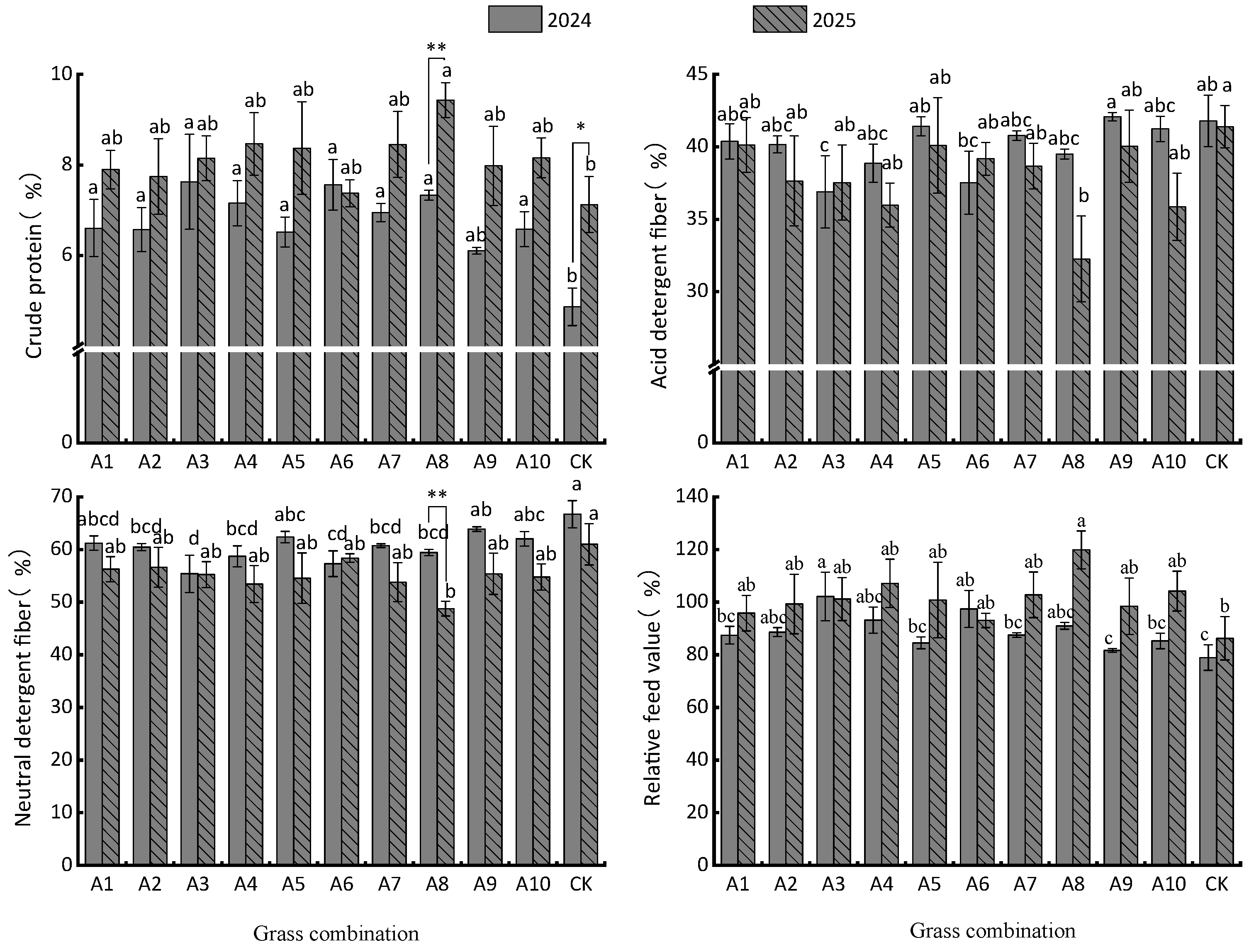
Overseeding different species mixtures significantly improved forage nutritional quality (p < 0.05), and these positive effects became stronger over time, with the best-performing mixtures showing particularly pronounced advantages in the second year (Figure 3).
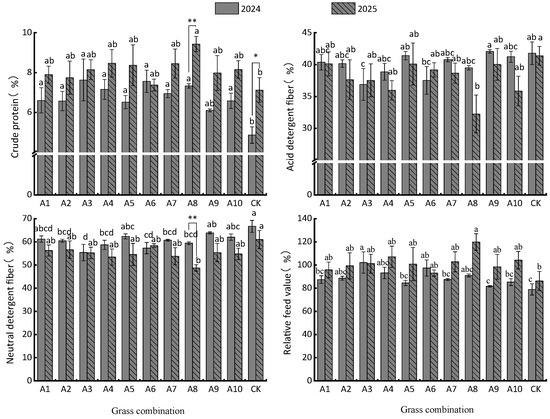
Figure 3.
Changes of plant nutritional quality. Different letters indicate significant differences between treatments (p < 0.05); * and ** denote significant differences at p < 0.05 and 0.01 respectively.
Crude protein content generally increased. In 2024, A3 had the highest crude protein content (7.63%), significantly exceeding that of CK (p < 0.05). By 2025, A8 showed a highly significant increase (p < 0.001), with crude protein rising to 9.43%, again significantly higher than CK (p < 0.05). Fiber contents declined significantly (p < 0.05). In 2025, A8 had the lowest acid detergent fiber (ADF) and neutral detergent fiber (NDF) values, at 32.26% and 48.78%, respectively, both significantly lower than those of CK (p < 0.05). Relative feed value (RFV) increased significantly (p < 0.05). In 2024, the highest value was observed in A3 (102.19%), significantly higher than CK (p < 0.05). In 2025, A8 showed the strongest advantage, with relative feed value reaching 119.87%, significantly higher than CK (p < 0.05), indicating that this mixture had the greatest potential for producing high-quality forage.
3.2.3. Changes in Soil Physicochemical Properties
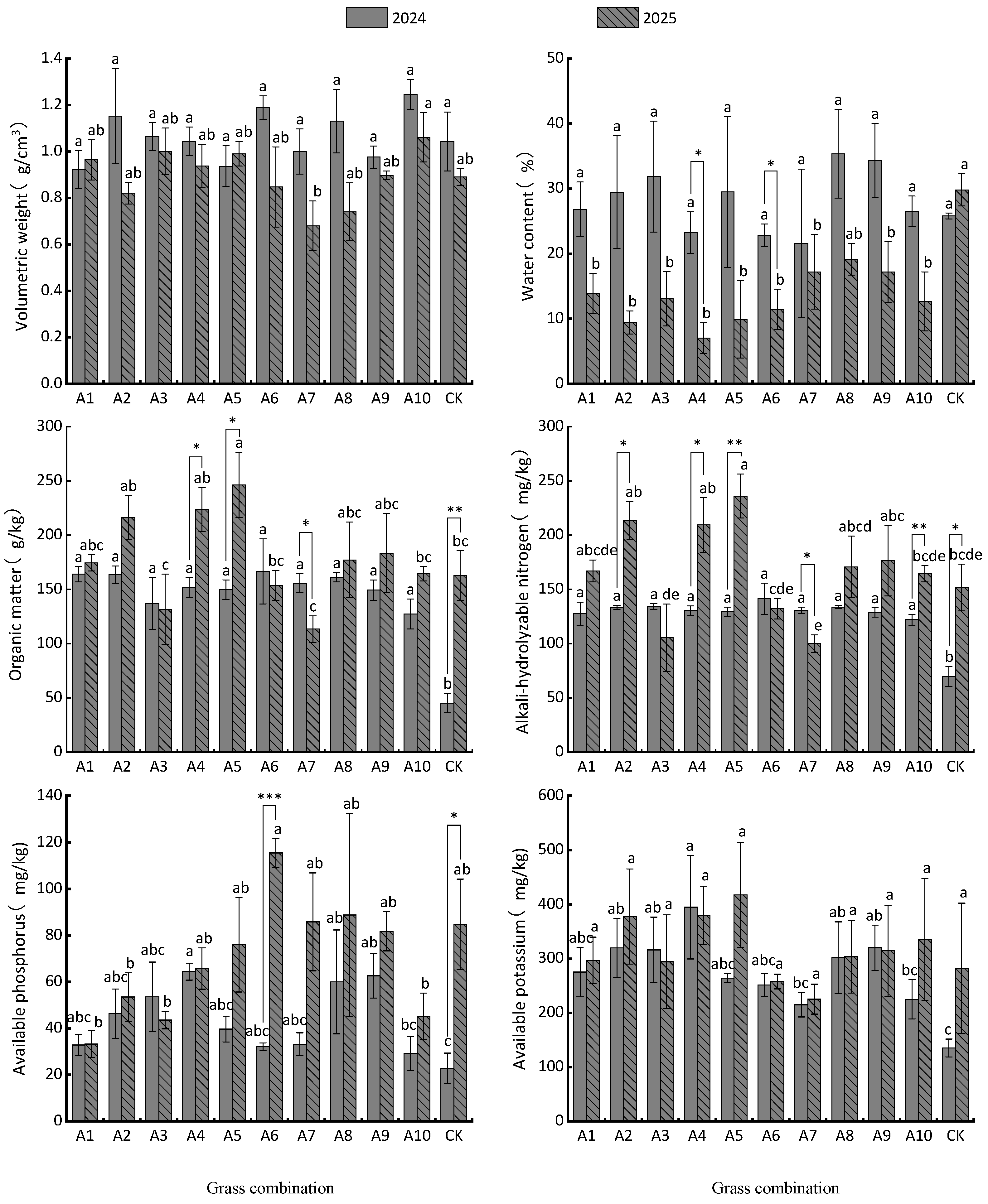
Overseeding with different species mixtures led to markedly greater improvements in aboveground vegetation than in soil properties, with significant differences among mixtures (p < 0.05). Interannual changes further showed that soil nutrients had accumulated significantly in several superior mixtures (p < 0.05), whereas inferior mixtures exhibited limited improvement or even a declining trend (Figure 4).
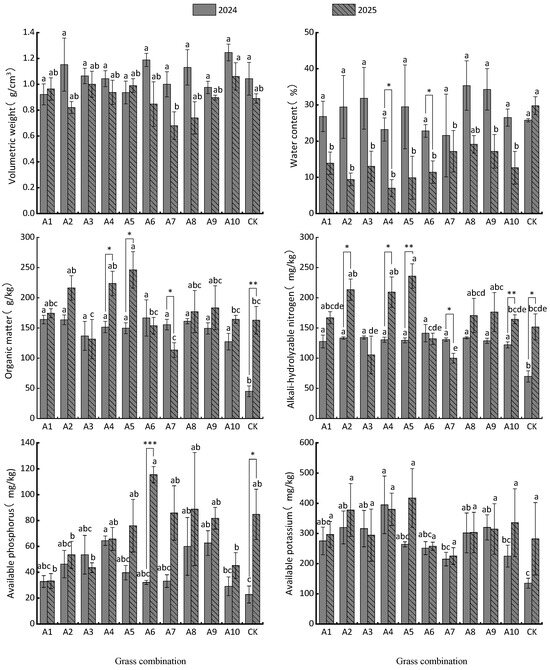
Figure 4.
Changes of soil physical and chemical properties. Different letters indicate significant differences between treatments (p < 0.05); *, **, and *** denote significant differences at p < 0.05, 0.01, and 0.001, respectively.
For soil physical properties, soil bulk density ranged from 0.92 to 1.25 g cm−3 across treatments in 2024, with no significant differences compared with CK (p > 0.05). By 2025, bulk density ranged from 0.68 to 1.06 g cm−3, with the lowest value in A7 and the highest in A10; the difference between these two treatments was significant (p < 0.05). Soil water content in 2025 ranged from 7.02% to 19.12%, with the highest value in A8 and the lowest in A4, and all treatments were significantly higher than CK (p < 0.05). However, compared with the 2024 range of 21.57–35.36%, soil water content declined markedly overall, indicating strong interannual variability.
For soil chemical properties, all oversown treatments showed significantly higher soil organic matter than CK in 2024 (p < 0.05), with values ranging from 127.27 to 166.59 g kg−1; A6 had the highest value. By 2025, soil organic matter peaked in A5 at 246.35 g kg−1, representing a 64.64% increase relative to 2024. By contrast, A3 and A7 had the lowest values, at 131.55 and 113.36 g kg−1, respectively, both significantly lower than A5 (p < 0.05). Although CK also increased significantly to 162.82 g kg−1 in 2025 (p < 0.05), it remained below A5. In 2024, soil available nitrogen (alkali-hydrolyzable nitrogen) was highest in A6 (141.41 mg kg−1), and all treatments were significantly higher than CK (p < 0.05). In 2025, available nitrogen ranged from 100.00 to 236.00 mg kg−1, with the highest value in A5, which was significantly higher than that in A7 (p < 0.05); most mixtures exhibited an increasing trend over time. Soil available phosphorus ranged from 29.14 to 64.42 mg kg−1 in 2024, with A4 showing the highest value and significantly exceeding CK (p < 0.05). In 2025, this range increased to 33.23–115.47 mg kg−1, and A6 was significantly higher than A1, A2, A3 and A10 (p < 0.05). Soil available potassium showed an overall increasing trend over the two years, with the highest value in A4 in 2024 (394.85 mg kg−1) and in A5 in 2025 (417.67 mg kg−1) (Figure 4).
3.3. Effects of Overseeding Different Species Mixtures on Ecosystem Multifunctionality
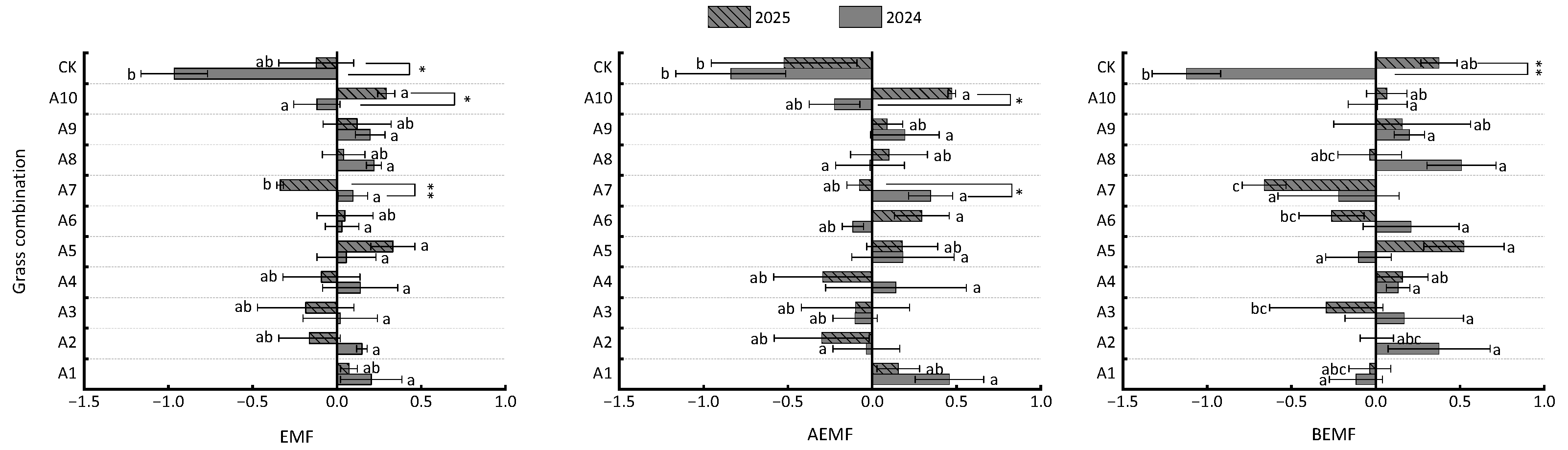
Overseeding with different species mixtures had a significant effect on ecosystem multifunctionality (p < 0.05). In 2024, the total EMF index of all overseeding mixtures was significantly higher than that of CK (p < 0.05). By 2025, most mixtures still maintained their advantage. The total EMF index was highest in A5 in 2025, whereas it declined significantly in A7 and CK (p < 0.05) (Figure 5).
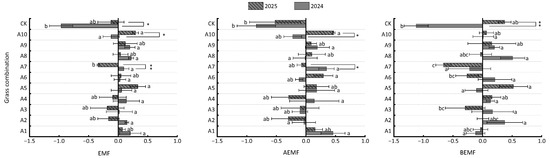
Figure 5.
Changes of ecosystem multifunctionality (EMF) index, aboveground EMF index and belowground EMF index. Different letters indicate significant differences between treatments (p < 0.05); * and ** denote significant differences at p < 0.05 and 0.01 respectively.
Overseeding rapidly and significantly enhanced aboveground functions. In 2024, the aboveground EMF was already significantly higher in A1, A2, A4, A5, A7, A8 and A9 than in CK (p < 0.05). By 2025, the aboveground EMF of all treatments exceeded that of CK, and differences among mixtures had narrowed, with A10 showing the highest index.
Compared with aboveground functions, soil functions responded more weakly and less stably to short term overseeding. In 2024, the belowground EMF index was significantly higher in all oversown treatments than in CK (p < 0.05), although A1, A5 and A7 showed negative belowground EMF values. In 2025, only A5 had a significantly higher belowground EMF index than A7 (p < 0.05), whereas differences among the other treatments were not significant (p > 0.05) (Figure 5).
3.4. Relationships Among Individual and Multiple Ecosystem Functions
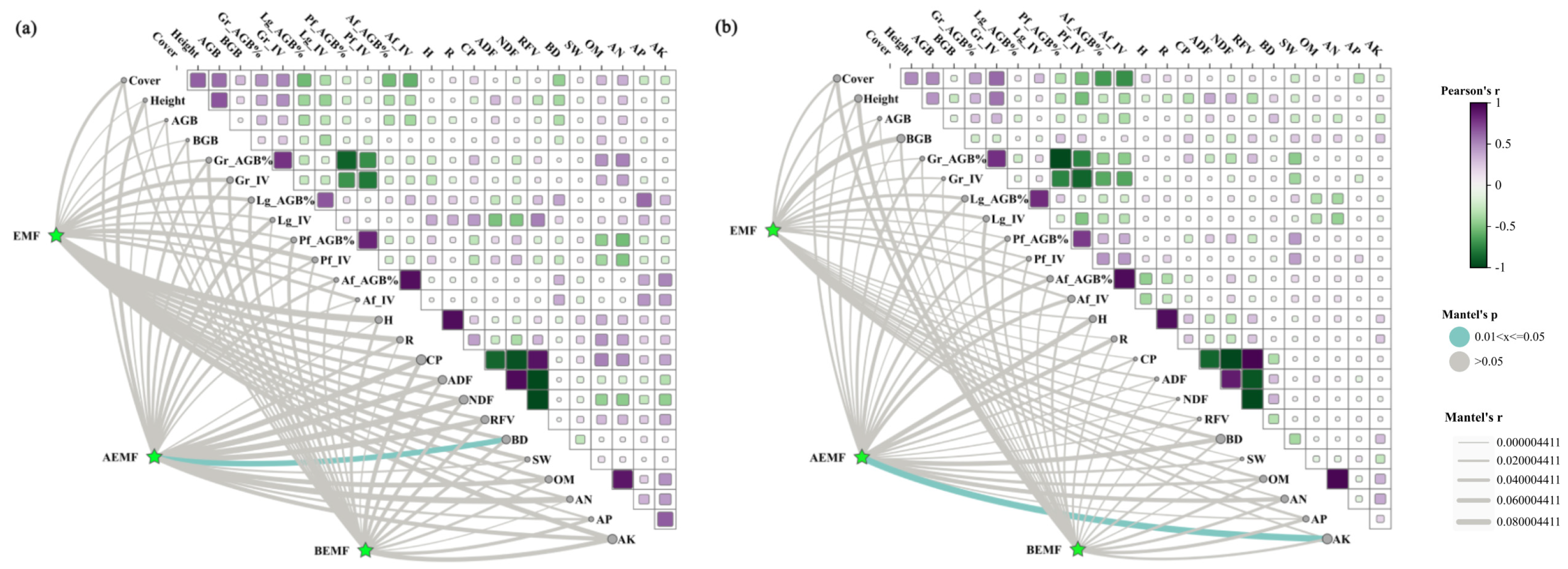
No significant correlations were found between the EMF index and any individual indicator (p > 0.05), nor between the belowground EMF index and any single indicator (p > 0.05) (Figure 6).
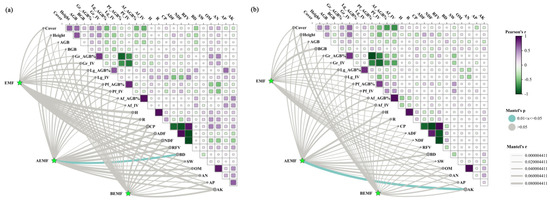
Figure 6.
Correlation coefficients among vegetation characteristics, soil properties and ecosystem multifunctionality (EMF) index. (a): Cover, community coverage; Height, community height; AGB, community above-ground biomass; BGB, community below-ground biomass; Gr–AGB%, grass above-ground biomass ratio; Gr–IV, grass importance value; Lg–AGB%, legume above-ground biomass ratio; Lg–IV, legume importance value; Pf–AGB%, perennial forb above-ground biomass ratio; Pf–IV, perennial forb importance value; Af–AGB%, annual and biennial forb above-ground biomass ratio; Af–IV, annual and biennial forb importance value; H, Shannon-Wiener index; R, Margalef index; CP, crude protein; ADF, acid detergent fiber; NDF, neutral detergent fiber; RFV, relative feed value; BD, bulk density; SW, soil water content; OM, organic matter; AN, alkaline hydrolysable nitrogen; AP, available phosphorus; AK, available potassium. (b): Cover, community coverage; Height, community height; AGB, community above-ground biomass; BGB, community below-ground biomass; Gr–AGB%, grass above-ground biomass ratio; Gr–IV, grass importance value; Lg–AGB%, legume above-ground biomass ratio; Lg–IV, legume importance value; Pf–AGB%, perennial forb above-ground biomass ratio; Pf–IV, perennial forb importance value; Af–AGB%, annual and biennial forb above-ground biomass ratio; Af–IV, annual and biennial forb importance value; H, Shannon-Wiener index; R, Margalef index; CP, crude protein; ADF, acid detergent fiber; NDF, neutral detergent fiber; RFV, relative feed value; BD, bulk density; SW, soil water content; OM, organic matter; AN, alkaline hydrolysable nitrogen; AP, available phosphorus; AK, available potassium.
In 2024, soil nutrients were positively correlated with species richness and plant diversity (p < 0.01). Soil organic matter (OM) and alkali-hydrolyzable nitrogen (AN) were also positively correlated with the biomass proportion and importance value of grasses (p < 0.01), whereas legume importance value was positively correlated with plant crude protein content and relative feed value (p < 0.01). The ecosystem multifunctionality indices (total EMF, aboveground EMF, and belowground EMF) showed strong positive correlations with most community-structure and soil-nutrient variables; notably, aboveground EMF was significantly correlated with soil bulk density (p < 0.01) (Figure 6a).
In 2025, the strong positive correlations between total EMF, aboveground EMF, and belowground EMF and individual indicators generally weakened to moderate or weak levels. Aboveground EMF exhibited the weakest correlations with individual indicators, whereas total EMF was more strongly correlated with plant indicators than with soil indicators (Figure 6b).
4. Discussion
4.1. Effects of Overseeding Different Species Mixtures on Plant Community Structure and Stability
The degradation of natural mowing grasslands has profound impacts, reducing both grazing capacity and ecosystem productivity while lowering the proportion of palatable forage [32]. Selecting suitable species and mixture combinations can fully realize the complementary advantages of forages in overseeded grasslands, facilitate the efficient utilization of environmental resources such as water, nutrients, light, and space, promote plant growth, and thereby increase community biomass and cover, ultimately enhancing the community stability of sown grasslands [10,33]. Our results showed that overseeding effectively improved the plant community structure of degraded natural mowing grasslands, but the stability of community structure varied with species composition [16]. Specifically, the most effective mixtures, particularly A5, A6, and A8, were dominated by highly competitive grasses such as Bromus inermis cv. Wusu No. 1, combined with nitrogen-fixing legumes such as Trifolimm pratense cv. Minshan. These mixtures rapidly established a community configuration characterized by grass dominance, legume complementarity, and suppression of forbs, thereby conferring greater resistance to disturbance and higher stability. By contrast, A4 was less effective in suppressing forbs and optimizing functional group composition, suggesting that restoration outcomes remain limited when species mixtures fail to achieve effective niche complementarity [34].
Mechanistically, early-stage niche preemption and the initial recovery of productivity were primarily governed by the mass ratio effect [35]. In resource-limited degraded habitats, successful restoration at the initial stage depends on pioneer species that can rapidly establish dominance [36]. In our study, the grass biomass proportion of A6 reached 85.87% in 2024 and further increased to 90.67% in 2025, indicating that grasses rapidly attained overwhelming dominance in community biomass. This supports the mass ratio hypothesis, which predicts that ecosystem functioning is determined largely by the functional traits of dominant species [37]. The high first-year biomass of A5 (475.88 g m−2) can likewise be attributed mainly to the strong competitive ability of grasses such as Bromus inermis cv. Wusu No. 1, whose rapid growth, vigorous tillering, and superior resource capture enabled efficient preemption of light, water, and space. This accelerated the recovery of community productivity, while rapid canopy closure created a suppressive environment for forbs. These findings are consistent with grassland experiments by Sonkoly et al. (2019) [36], which showed that productivity is often highest when communities are dominated by perennial grasses with high-performance traits, whereas increased evenness may reduce the productivity gains driven by dominant species. Together, these results highlight the pivotal role of dominant species in the early phase of grassland restoration.
However, dominance by competitive grasses alone cannot fully explain the superior performance of the best mixtures in forage quality and long-term sustainability. Both our results and the correlation analysis showed that legume importance value was positively correlated with crude protein content and relative feed value. This suggests that the contribution of legumes lies not in dominating community biomass, but in occupying a distinct functional niche linked to nitrogen fixation and nutritional improvement [17,37]. This pattern is consistent with a functional complementarity effect, whereby different functional groups differ in their resource-acquisition strategies and thereby enhance resource-use efficiency and multifunctionality at the community level [18,23]. In a controlled experiment on sown grasslands, Suter showed that complementary nitrogen-acquisition strategies between grasses and legumes can support both high productivity and multifunctionality under low to moderate nitrogen availability [38]. This finding further suggests that functionally informed mixture design can reduce dependence on external nitrogen inputs and promote a more self-sustaining restoration trajectory. Viewed in this context, the strong performance of A5, A6, and A8 indicates that these mixtures were underpinned by a dual mechanism of dominant-species structuring and functional complementarity [34,35]: grasses provided structural stability and a production base, whereas legumes enhanced nitrogen availability and forage quality. Together, these components strengthened community competitiveness, suppressed forbs, and promoted the formation of stable communities.
The advantageous community configuration characterized by grass dominance and legume complementarity not only achieved short-term restoration goals, but also created the structural basis for long-term stability. Short-term stability may derive from the stress tolerance of dominant grasses themselves and from the physical suppression of colonization by their dense canopy. Over longer timescales, however, mixtures containing species with contrasting ecological strategies are more likely to enhance interannual stability through species asynchrony and insurance effects [39,40]. A 17-year experiment by Wagg showed that the positive effect of species richness on productivity strengthened over time, and that by the second year the stabilizing effect of diversity operated mainly through increased species asynchrony [40]. Although our study spanned only two years and therefore cannot fully test these long-term mechanisms, the community configuration established by the best-performing mixtures has already laid an important ecological foundation for buffering against future climatic variability and sustaining ecosystem functioning over time.
4.2. Effects of Overseeding Different Species Mixtures on Ecosystem Service Functions
Numerous studies have shown that overseeding can markedly improve community structure, and increase community biomass, species diversity, and forage quality in degraded grasslands [41,42]. However, other studies have found that overseeding with different species mixtures has no significant effect on community species diversity in degraded grasslands [43]. Through multi-indicator measurements of community structure, forage quality, and soil physicochemical properties, this study evaluated the effects of overseeding with different species mixtures on aboveground and belowground ecosystem functions in degraded natural mowing grasslands. The results showed that aboveground productive functions responded rapidly to overseeding with different species mixtures, whereas the recovery of belowground functions exhibited a marked lag and depended strongly on the type of plant community established. The temporal lag and specificity of plant–soil feedbacks are central to understanding the long-term dynamics of the ecological benefits of overseeding [44,45].
In terms of aboveground EMF, the A8 mixture demonstrated a marked capacity to enhance forage yield and nutritional quality. This directly meets the core production requirement of natural mowing grasslands as a source of winter–spring forage reserves. This can be attributed to the functional complementarity between legumes and grasses: grasses boost biomass, whereas legumes improve protein content, and together they achieve an effective combination of productivity and quality at the community level [17,46]. Suter [38] found that legume–grass mixture overseeding can achieve synergistic gains in yield and quality under low nitrogen conditions, suggesting that a well-designed biodiversity configuration can reduce nitrogen fertilizer inputs and associated environmental risks. Research has shown that biodiversity influences ecosystem service supply through its effects on primary production and nutrient cycling, forming a coherent logical chain [47].
For belowground EMF, improvements in soil fertility were both delayed and mixture-specific. Notably, only A5 showed a substantial increase in soil organic matter from 2024 to 2025, with an increase of 64.64%, whereas A7 exhibited a decline in the second year. This highlights two defining features of belowground recovery: temporal lag and strong context dependence. The accumulation of soil organic matter is inherently slow and depends critically on both the quantity and quality of litter and root inputs from the reassembled plant community, as well as on the microbial processes through which these organic inputs are transformed in soil [45,48]. Only communities that are stable and productive, and that continuously supply abundant, high-quality litter that is readily decomposable and relatively low in C:N ratio, are likely to initiate and maintain positive plant–soil feedbacks [44,48]. In our study, the strong performance of A5 may reflect an effective balance between legumes and grasses: legumes likely increased nitrogen availability and reduced litter C:N ratio, thereby promoting decomposition, whereas grasses contributed substantial root-derived carbon inputs. This interpretation is consistent with the view of Hector and Bagchi (2007) that species richness enhances multifunctionality by positively affecting multiple, partly independent ecosystem processes, even though these processes may differ in how rapidly they respond to diversity and community structure [18]. Our findings further suggest that aboveground processes can be rapidly enhanced by dominant structuring species, whereas improvement in belowground processes is slower, more conditional, and dependent on sustained inputs from stable communities over longer periods.
In addition, by the second year after overseeding, aboveground biomass had generally increased in most treatments, while differences in soil functions among mixtures became more pronounced. This may indicate that the system had entered a phase of internal adjustment, in which competitive hierarchies became more stable and biomass and nutrients were redistributed among functions [40,49]. This dynamic underscores the need to evaluate restoration outcomes from a multidimensional and long term perspective. Judging restoration success on the basis of a single function measured at a single time point may lead to misleading conclusions and may obscure internal ecosystem changes that are critical for long term sustainability [22,23].
4.3. Response Patterns of Ecosystem Multifunctionality Under Overseeding with Different Species Mixtures
Elucidating the effects of overseeding with different species mixtures on ecosystem multifunctionality is critical for the restoration and management of degraded natural mowing grasslands. Appropriate species mixtures can effectively enhance ecosystem functioning through complementarity effects [50,51]. Using ecosystem multifunctionality (EMF) as an integrated assessment framework, this study not only identified locally optimized schemes applicable to degraded natural mowing grasslands in Altai, but also revealed the overall pattern and dynamic trajectory of multifunctionality during restoration. The results showed that changes in plant community structure and functional group composition were key factors driving differences in ecosystem multifunctionality. Moreover, EMF exhibited a multi-indicator integrated response rather than being dominated by any single indicator. In the first year after overseeding, strong coupling relationships were observed among all functional indicators, and total EMF showed very strong positive correlations with most community structure and soil nutrient indicators. By the second year, these correlations generally weakened, and the recovery trajectories of aboveground and belowground functions began to diverge, indicating a shift from a rapid reestablishment phase to a stage of functional reallocation and homeostatic adjustment. These findings are consistent with previous studies [52,53,54].
Mantel tests and correlation analyses in this study consistently demonstrated that plant community characteristics were the most important and stable factor influencing ecosystem multifunctionality in both the first and second years after overseeding. This is consistent with the view of Hector and Bagchi [18] that biodiversity is the core driver of ecosystem multifunctionality. The dynamic trajectory of the system observed under the EMF framework revealed typical stage-dependent characteristics of restoring ecosystem development. In the first year after overseeding, resources and space were rapidly reconfigured from a degraded, inefficient state, and the successfully established dominant plant communities simultaneously drove rapid improvements in multiple functions, which were highly synergistic during this period. In the second year, aboveground biomass continued to increase across all overseeding mixtures, and CK showed a similar trend, indicating that vegetation restoration in the study area remained in a phase of ongoing advancement and functional accumulation. The synchronous changes observed in CK suggest that, in addition to overseeding, natural recovery processes and interannual variation in environmental conditions jointly contributed to vegetation growth and functional improvement [55,56].
Previous studies have indicated that ecosystem functions are continuously reorganized as communities develop, and the positive effect of diversity on productivity gradually emerges over time [22,57]. Therefore, the changes observed in the second year suggest that the restored system, driven jointly by environmental conditions and human interventions, is still progressing toward a higher level of multifunctionality. Isbell [39] demonstrated in a large-scale grassland experiment that most species contribute positively to at least some functions under certain environmental contexts, and that their importance varies considerably with time, space, functional targets, and environmental conditions. This indicates that the optimal mixtures identified in a study often represent local optimums specific to the particular years, soil conditions, and selected functions. Facing longer time scales and greater climatic uncertainty, reliance on a single species mixture poses risks, whereas maintaining a pool of species with diverse functional traits and different environmental adaptation strategies can enhance system adaptability and effectively buffer against risks [58]. Long-term experiments have shown that the diversity–stability relationship strengthens over time, and that ecosystem stability is enhanced through mechanisms such as species asynchrony [40]. Therefore, while this study identified superior mixtures such as A5, A6, and A8, it further demonstrates that species mixture composition is a key factor influencing the restoration outcomes of degraded natural mowing grasslands. Appropriate legume–grass mixtures can not only improve the establishment success and productive performance of overseeded communities, but also drive synergistic recovery of the vegetation–soil system through functional complementarity, thereby providing essential support for maintaining ecosystem multifunctionality and achieving sustainable use of degraded mowing grasslands.
5. Conclusions
Overseeding with grass–legume mixtures effectively restored degraded natural mowing grasslands in Altai. Legumes and grasses, through niche complementarity, rapidly established stable and productive communities, leading to early increases in aboveground biomass and forage quality, which subsequently drove gradual improvements in soil nutrient cycling and structure. However, the enhancement of the belowground EMF index lagged markedly behind that of the aboveground index and varied among species mixtures.
For different land-management objectives, we recommend distinct mixture strategies. The mixture of O. viciifolia cv. QiTai (5%) + T. pratense cv. Minshan (15%) + D. glomerata (15%) + P. pratensis (15%) + B. inermis cv. Wusu No. 1 (50%) exhibited the most comprehensive and sustained performance in improving ecosystem multifunctionality and soil fertility; therefore, it is best suited to areas where integrated ecological restoration is the primary goal. The mixture of T. pratense cv. Minshan (10%) + M. sativa cv. Xinmu No. 4 (10%) + P. pratensis (30%) + B. inermis cv. Wusu No. 1 (50%) demonstrated clear advantages in rapidly suppressing forbs, maintaining the highest aboveground biomass, and increasing soil phosphorus content; thus, it is most suitable for natural mowing grassland where rapid productivity recovery and weed control are priorities. The mixture of M. sativa cv. Xinmu No. 4 (10%) + T. pratense cv. Minshan (10%) + D. glomerata (30%) + B. inermis cv. Wusu No. 1 (50%) was uniquely effective in improving forage nutritional quality and is therefore the preferred option for producing high-quality hay. By contrast, the mixture of O. viciifolia cv. QiTai (5%) + M. sativa cv. Xinmu No. 4 (15%) + D. glomerata (15%) + P. pratensis (15%) + B. inermis cv. Wusu No. 1 (50%) showed the weakest suppression of annual and biennial forbs, which may leave natural mowing grassland vulnerable to persistent weed invasion. Similarly, the mixture of M. sativa cv. Xinmu No. 4 (15%) + O. viciifolia cv. QiTai (5%) + P. pratensis (30%) + B. inermis cv. Wusu No. 1 (50%) performed poorly in driving key belowground functions such as soil organic matter accumulation, suggesting limited long-term restoration sustainability. Neither mixture is therefore recommended for practical restoration.
Taken together, the stage-dependent recovery dynamics identified here demonstrate that restoration outcomes must be evaluated from a multidimensional and long-term perspective that integrates vegetation, soil, and hydrological interactions. These findings provide empirical support for restoration planning and adaptive land management in vulnerable ecosystems under global change. More broadly, our results support a management pathway based on nature-mimicking, function-oriented vegetation reassembly to enhance land-based ecosystem services and climate resilience, and provide a practical technical option for advancing the goal of land degradation neutrality under SDG 15.
Author Contributions
Conceptualization, J.Y., X.Z. and Z.D.; methodology, J.Y., P.Z. and H.X.; software, J.Y. and C.S.; validation, J.Y., P.Z., H.X. and C.S.; formal analysis, J.Y. and P.Z.; investigation, J.Y., H.X. and C.S.; resources, X.Z. and Z.D.; data curation, J.Y. and P.Z.; writing—original draft preparation, J.Y.; writing—review and editing, X.Z., Z.D., P.Z., H.X. and C.S.; visualization, J.Y. and C.S.; supervision, X.Z. and Z.D.; project administration, X.Z. and Z.D.; funding acquisition, X.Z. and Z.D. All authors have read and agreed to the published version of the manuscript.
Funding
This research was funded by Xinjiang Forestry and Grassland Administration grant number XJLYKJ-2024-21. APC: The APC was funded by Xinjiang Forestry and Grassland Administration.
Data Availability Statement
The original contributions presented in the study are included in the article material. Further inquiries can be directed to the corresponding authors.
Acknowledgments
The authors thank the relevant departments of the Xinjiang Forestry and Grassland Administration for their coordination and assistance.
Conflicts of Interest
The authors declare no conflicts of interest.
References
- Qu, Y.; Zhao, Y.; Ding, G.; Chi, W.; Gao, G. Spatiotemporal patterns of the forage-livestock balance in the Xilin Gol steppe, China: Implications for sustainably utilizing grassland-ecosystem services. J. Arid Land 2021, 13, 135–151. [Google Scholar] [CrossRef]
- Lyu, F.; Pan, Y.; Yu, L.; Wang, X.; Yu, Z. The impact of anthropogenic activities and natural factors on the grassland over the agro-pastoral ecotone of Inner Mongolia. Land 2023, 12, 2009. [Google Scholar] [CrossRef]
- Zhao, Y.; Liu, Z.; Wu, J. Grassland ecosystem services: A systematic review of research advances and future directions. Landsc. Ecol. 2020, 35, 793–814. [Google Scholar] [CrossRef]
- Chen, L.; Baoyin, T.; Minggagud, H. Effects of mowing regimes on above-and belowground biota in semi-arid grassland of northern China. J. Environ. Manag. 2021, 277, 111441. [Google Scholar] [CrossRef]
- Liao, C.; Morreale, S.J.; Kassam, K.-A.S.; Sullivan, P.J.; Fei, D. Following the Green: Coupled pastoral migration and vegetation dynamics in the Altay and Tianshan Mountains of Xinjiang, China. Appl. Geogr. 2014, 46, 61–70. [Google Scholar] [CrossRef]
- Mayel, S.; Jarrah, M.; Kuka, K. How does grassland management affect physical and biochemical properties of temperate grassland soils? A review study. Grass Forage Sci. 2021, 76, 215–244. [Google Scholar] [CrossRef]
- Zhang, R.; Liang, T.; Guo, J.; Xie, H.; Feng, Q.; Aimaiti, Y. Grassland dynamics in response to climate change and human activities in Xinjiang from 2000 to 2014. Sci. Rep. 2018, 8, 2888. [Google Scholar] [CrossRef]
- Varga, K.; Csízi, I.; Halász, A.; Mezőszentgyörgyi, D.; Nagy, D. Monitoring the degradation of semi-natural grassland associations under different land-use patterns. Agronomy 2023, 14, 35. [Google Scholar] [CrossRef]
- Atkinson, C. The effect of clipping on net photosynthesis and dark respiration rates of plants from an upland grassland, with reference to carbon partitioning in Festuca ovina. Ann. Bot. 1986, 58, 61–72. [Google Scholar] [CrossRef]
- Mi, W.; Zheng, H.; Chi, Y.; Ren, W.; Zhang, W.; Zhang, H.; Liu, Y.; Yuan, F. Reseeding inhibits grassland vegetation degradation–global evidence. Agric. Ecosyst. Environ. 2024, 374, 109144. [Google Scholar] [CrossRef]
- Zhu, Q.; Chen, H.; Peng, C.; Liu, J.; Piao, S.; He, J.-S.; Wang, S.; Zhao, X.; Zhang, J.; Fang, X. An early warning signal for grassland degradation on the Qinghai-Tibetan Plateau. Nat. Commun. 2023, 14, 6406. [Google Scholar] [CrossRef]
- Liu, Y.; Dong, J.; Ren, S.; Liu, Y. Differential impacts of degradation on grassland ecosystems in the Tibetan Plateau and the Northern agro-pastoral ecotone: A meta-analysis. Plant Soil 2024, 496, 677–696. [Google Scholar] [CrossRef]
- Bedoussac, L.; Journet, E.-P.; Hauggaard-Nielsen, H.; Naudin, C.; Corre-Hellou, G.; Jensen, E.S.; Prieur, L.; Justes, E. Ecological principles underlying the increase of productivity achieved by cereal-grain legume intercrops in organic farming. A review. Agron. Sustain. Dev. 2015, 35, 911–935. [Google Scholar] [CrossRef]
- Brooker, R.W.; Karley, A.J.; Newton, A.C.; Pakeman, R.J.; Schöb, C. Facilitation and sustainable agriculture: A mechanistic approach to reconciling crop production and conservation. Funct. Ecol. 2016, 30, 98–107. [Google Scholar] [CrossRef]
- Li, Q.; Shen, X.; Huang, Q.; Sun, F.; Zhou, J.; Ma, X.; Ran, Z.; Chen, Y.; Li, Z.; Yan, Y. Resource islands of Salix cupularis facilitating seedling emergence of the companion herbs in the restoration process of desertified alpine meadow, the Tibetan Plateau. J. Environ. Manag. 2021, 289, 112434. [Google Scholar] [CrossRef] [PubMed]
- Freitag, M.; Klaus, V.H.; Bolliger, R.; Hamer, U.; Kleinebecker, T.; Prati, D.; Schäfer, D.; Hölzel, N. Restoration of plant diversity in permanent grassland by seeding: Assessing the limiting factors along land-use gradients. J. Appl. Ecol. 2021, 58, 1681–1692. [Google Scholar] [CrossRef]
- Nyfeler, D.; Huguenin-Elie, O.; Suter, M.; Frossard, E.; Lüscher, A. Grass–legume mixtures can yield more nitrogen than legume pure stands due to mutual stimulation of nitrogen uptake from symbiotic and non-symbiotic sources. Agric. Ecosyst. Environ. 2011, 140, 155–163. [Google Scholar] [CrossRef]
- Hector, A.; Bagchi, R. Biodiversity and ecosystem multifunctionality. Nature 2007, 448, 188–190. [Google Scholar] [CrossRef]
- Zavaleta, E.S.; Pasari, J.R.; Hulvey, K.B.; Tilman, G.D. Sustaining multiple ecosystem functions in grassland communities requires higher biodiversity. Proc. Natl. Acad. Sci. USA 2010, 107, 1443–1446. [Google Scholar] [CrossRef]
- Maestre, F.T.; Quero, J.L.; Gotelli, N.J.; Escudero, A.; Ochoa, V.; Delgado-Baquerizo, M.; García-Gómez, M.; Bowker, M.A.; Soliveres, S.; Escolar, C. Plant species richness and ecosystem multifunctionality in global drylands. Science 2012, 335, 214–218. [Google Scholar] [CrossRef]
- Sanderson, M.; Skinner, R.; Barker, D.; Edwards, G.; Tracy, B.; Wedin, D. Plant species diversity and management of temperate forage and grazing land ecosystems. Crop Sci. 2004, 44, 1132–1144. [Google Scholar] [CrossRef]
- Byrnes, J.E.; Gamfeldt, L.; Isbell, F.; Lefcheck, J.S.; Griffin, J.N.; Hector, A.; Cardinale, B.J.; Hooper, D.U.; Dee, L.E.; Emmett Duffy, J. Investigating the relationship between biodiversity and ecosystem multifunctionality: Challenges and solutions. Methods Ecol. Evol. 2014, 5, 111–124. [Google Scholar] [CrossRef]
- Manning, P.; Van Der Plas, F.; Soliveres, S.; Allan, E.; Maestre, F.T.; Mace, G.; Whittingham, M.J.; Fischer, M. Redefining ecosystem multifunctionality. Nat. Ecol. Evol. 2018, 2, 427–436. [Google Scholar] [CrossRef]
- Yeernaer, H.; Xu, X.-h.; Dilinuer, T.; Li, H.-d. Response of Vegetation Coverage to Climate Change in Altai Mountain Forest and Grassland Ecological Function Area in Xinjiang, China. J. Ecol. Rural Environ. 2019, 35, 307–315. [Google Scholar]
- GB 19377-2003; Parameters for Degradation, Sandification and Salification of Rangelands. General Administration of Quality Supervision, Inspection and Quarantine of the People’s Republic of China: Beijing, China, 2003; p. 8.
- Cunniff, P.; Washington, D. Official methods of analysis of AOAC International. J. AOAC Int. 1997, 80, 127A–128A. [Google Scholar]
- Klute, A. Methods of Soil Analysis. Part 1. Physical and Mineralogical Methods; SSSA: Washington, DC, USA, 1986. [Google Scholar]
- Sparks, D.L.; Page, A.L.; Helmke, P.A.; Loeppert, R.H. Methods of Soil Analysis, Part 3: Chemical Methods; John Wiley & Sons: Hoboken, NJ, USA, 2020. [Google Scholar]
- Ellenberg, D.; Mueller-Dombois, D. Aims and Methods of Vegetation Ecology; Wiley: New York, NY, USA, 1974; Volume 547. [Google Scholar]
- Ma, Y.; Khan, M.Z.; Liu, Y.; Xiao, J.; Chen, X.; Ji, S.; Cao, Z.; Li, S. Analysis of nutrient composition, rumen degradation characteristics, and feeding value of Chinese rye grass, barley grass, and naked oat straw. Animals 2021, 11, 2486. [Google Scholar] [CrossRef] [PubMed]
- Tian, L.; Yang, W.; Ji-Shi, A.; Ma, Y.; Zhao, W.; Chen, Y.; Zhou, Q.; Qu, G.; Zhao, J.; Wu, G.L. Artificial reseeding improves multiple ecosystem functions in an alpine sandy meadow of the eastern Tibetan Plateau. Land Degrad. Dev. 2023, 34, 2052–2060. [Google Scholar] [CrossRef]
- Koyama, A.; Koyanagi, T.F.; Akasaka, M.; Takada, M.; Okabe, K. Combined burning and mowing for restoration of abandoned semi-natural grasslands. Appl. Veg. Sci. 2017, 20, 40–49. [Google Scholar] [CrossRef]
- Ning, X.; Wang, S.; Huangqing, D.; Kang, Y.; Zhang, Y.; Shi, M.; Yang, L.; Yang, M. Effects of Fertilization and Reseeding on Above-and Belowground Biodiversity in Degraded Alpine Steppe. Diversity 2025, 17, 617. [Google Scholar] [CrossRef]
- Loreau, M.; Hector, A. Partitioning selection and complementarity in biodiversity experiments. Nature 2001, 412, 72–76. [Google Scholar] [CrossRef] [PubMed]
- Grime, J. Benefits of plant diversity to ecosystems: Immediate, filter and founder effects. J. Ecol. 1998, 86, 902–910. [Google Scholar] [CrossRef]
- Sonkoly, J.; Kelemen, A.; Valkó, O.; Deák, B.; Kiss, R.; Tóth, K.; Miglécz, T.; Tóthmérész, B.; Török, P. Both mass ratio effects and community diversity drive biomass production in a grassland experiment. Sci. Rep. 2019, 9, 1848. [Google Scholar] [CrossRef] [PubMed]
- Dı́az, S.; Cabido, M. Vive la différence: Plant functional diversity matters to ecosystem processes. Trends Ecol. Evol. 2001, 16, 646–655. [Google Scholar] [CrossRef]
- Suter, M.; Huguenin-Elie, O.; Lüscher, A. Multispecies for multifunctions: Combining four complementary species enhances multifunctionality of sown grassland. Sci. Rep. 2021, 11, 3835. [Google Scholar] [CrossRef] [PubMed]
- Isbell, F.; Calcagno, V.; Hector, A.; Connolly, J.; Harpole, W.S.; Reich, P.B.; Scherer-Lorenzen, M.; Schmid, B.; Tilman, D.; Van Ruijven, J. High plant diversity is needed to maintain ecosystem services. Nature 2011, 477, 199–202. [Google Scholar] [CrossRef]
- Wagg, C.; Roscher, C.; Weigelt, A.; Vogel, A.; Ebeling, A.; De Luca, E.; Roeder, A.; Kleinspehn, C.; Temperton, V.M.; Meyer, S.T. Biodiversity–stability relationships strengthen over time in a long-term grassland experiment. Nat. Commun. 2022, 13, 7752. [Google Scholar] [CrossRef]
- Zhao, W.; Yin, Y.; Song, J.; Li, S. Mixed sowing improves plant and soil bacterial community restoration in the degraded alpine meadow. Plant Soil 2024, 499, 379–392. [Google Scholar] [CrossRef]
- Wróbel, B.; Zielewicz, W.; Paszkiewicz-Jasińska, A. Improving forage quality from permanent grasslands to enhance ruminant productivity. Agriculture 2025, 15, 1438. [Google Scholar] [CrossRef]
- Ganjurjav, H.; Li, M.; Han, L.; Sha, Y.; Li, Z.; Han, X.; Ji, G.; Wu, R.; Ma, Y.; Hu, G. Reseeding increased plant biomass production and soil fertility, but not plant species diversity in degraded grasslands in China. J. Environ. Manag. 2024, 370, 122966. [Google Scholar] [CrossRef]
- Cortois, R.; Schröder-Georgi, T.; Weigelt, A.; van der Putten, W.H.; De Deyn, G.B. Plant–soil feedbacks: Role of plant functional group and plant traits. J. Ecol. 2016, 104, 1608–1617. [Google Scholar] [CrossRef]
- Kulmatiski, A.; Beard, K.H.; Heavilin, J. Plant–soil feedbacks provide an additional explanation for diversity–productivity relationships. Proc. R. Soc. B Biol. Sci. 2012, 279, 3020–3026. [Google Scholar] [CrossRef] [PubMed]
- Helgadóttir, Á.; Suter, M.; Gylfadóttir, T.Ó.; Kristjánsdóttir, T.A.; Lüscher, A. Grass–legume mixtures sustain strong yield advantage over monocultures under cool maritime growing conditions over a period of 5 years. Ann. Bot. 2018, 122, 337–348. [Google Scholar] [CrossRef]
- Cardinale, B.J.; Duffy, J.E.; Gonzalez, A.; Hooper, D.U.; Perrings, C.; Venail, P.; Narwani, A.; Mace, G.M.; Tilman, D.; Wardle, D.A. Biodiversity loss and its impact on humanity. Nature 2012, 486, 59–67. [Google Scholar] [CrossRef]
- Fornara, D.; Tilman, D. Plant functional composition influences rates of soil carbon and nitrogen accumulation. J. Ecol. 2008, 96, 314–322. [Google Scholar] [CrossRef]
- Allan, E.; Weisser, W.; Weigelt, A.; Roscher, C.; Fischer, M.; Hillebrand, H. More diverse plant communities have higher functioning over time due to turnover in complementary dominant species. Proc. Natl. Acad. Sci. USA 2011, 108, 17034–17039. [Google Scholar] [CrossRef] [PubMed]
- Jing, X.; Sanders, N.J.; Shi, Y.; Chu, H.; Classen, A.T.; Zhao, K.; Chen, L.; Shi, Y.; Jiang, Y.; He, J.-S. The links between ecosystem multifunctionality and above-and belowground biodiversity are mediated by climate. Nat. Commun. 2015, 6, 8159. [Google Scholar] [CrossRef]
- Ma, Y.; Tian, L.; Qu, G.; Li, R.; Wang, W.; Zhao, J. Precipitation alters the effects of temperature on the ecosystem multifunctionality in alpine meadows. Front. Plant Sci. 2022, 12, 824296. [Google Scholar] [CrossRef]
- Wang, Y.; Wu, Z.; Wang, Z.; Chang, S.; Qian, Y.; Chu, J.; Jia, Z.; Zhou, Q.; Hou, F. Ecosystem coupling and ecosystem multifunctionality may evaluate the plant succession induced by grazing in alpine meadow. Front. Plant Sci. 2022, 13, 839920. [Google Scholar] [CrossRef]
- Jiang, K.; Zhang, Q.; Wang, Y.; Li, H.; Yang, Y.; Reyimu, T. The combination of plant diversity and soil microbial diversity directly and actively drives the multifunctionality of grassland ecosystems in the middle part of the northern slopes of the Tian Shan under grazing disturbance. Sustainability 2023, 15, 5673. [Google Scholar] [CrossRef]
- Zhang, Y.; Gao, X.; Yuan, Y.; Hou, L.; Dang, Z.; Ma, L. Plant and soil microbial diversity co-regulate ecosystem multifunctionality during desertification in a temperate grassland. Plants 2023, 12, 3743. [Google Scholar] [CrossRef]
- Lyons, K.G.; Török, P.; Hermann, J.-M.; Kiehl, K.; Kirmer, A.; Kollmann, J.; Overbeck, G.E.; Tischew, S.; Allen, E.B.; Bakker, J.D. Challenges and opportunities for grassland restoration: A global perspective of best practices in the era of climate change. Glob. Ecol. Conserv. 2023, 46, e02612. [Google Scholar] [CrossRef]
- Ren, Y.; Lü, Y.; Fu, B. Quantifying the impacts of grassland restoration on biodiversity and ecosystem services in China: A meta-analysis. Ecol. Eng. 2016, 95, 542–550. [Google Scholar] [CrossRef]
- Van Der Plas, F. Biodiversity and ecosystem functioning in naturally assembled communities. Biol. Rev. 2019, 94, 1220–1245. [Google Scholar] [CrossRef]
- Zhang, Y.; Zhou, J.; Yang, G.; Jing, J.; Liu, N. Theory and application of no-tillage reseeding in degraded grasslands. Chin. Sci. Bull. 2020, 65, 1546–1555. [Google Scholar] [CrossRef]
Disclaimer/Publisher’s Note: The statements, opinions and data contained in all publications are solely those of the individual author(s) and contributor(s) and not of MDPI and/or the editor(s). MDPI and/or the editor(s) disclaim responsibility for any injury to people or property resulting from any ideas, methods, instructions or products referred to in the content. |
© 2026 by the authors. Licensee MDPI, Basel, Switzerland. This article is an open access article distributed under the terms and conditions of the Creative Commons Attribution (CC BY) license.